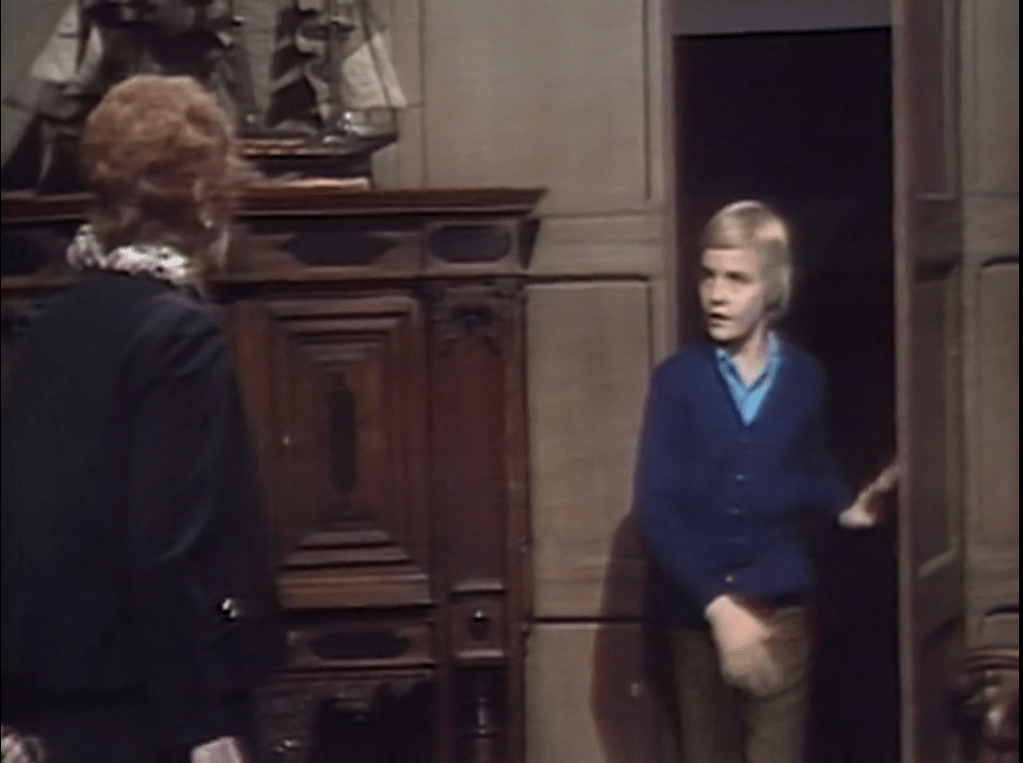
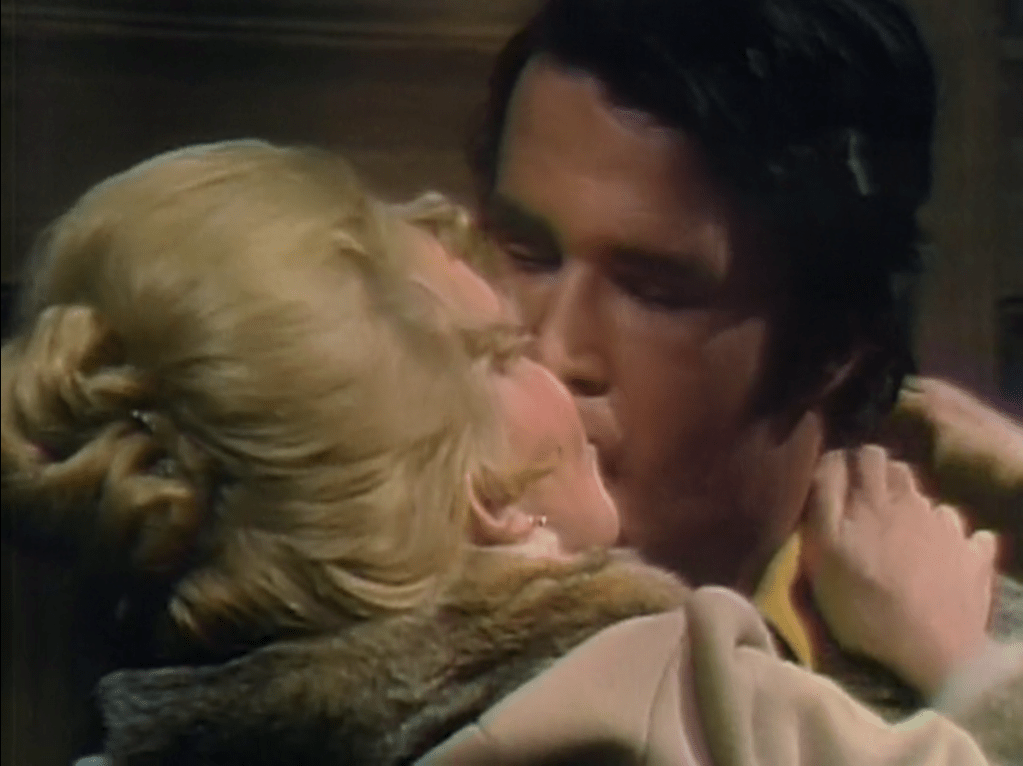
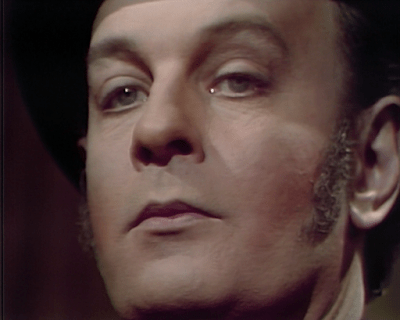
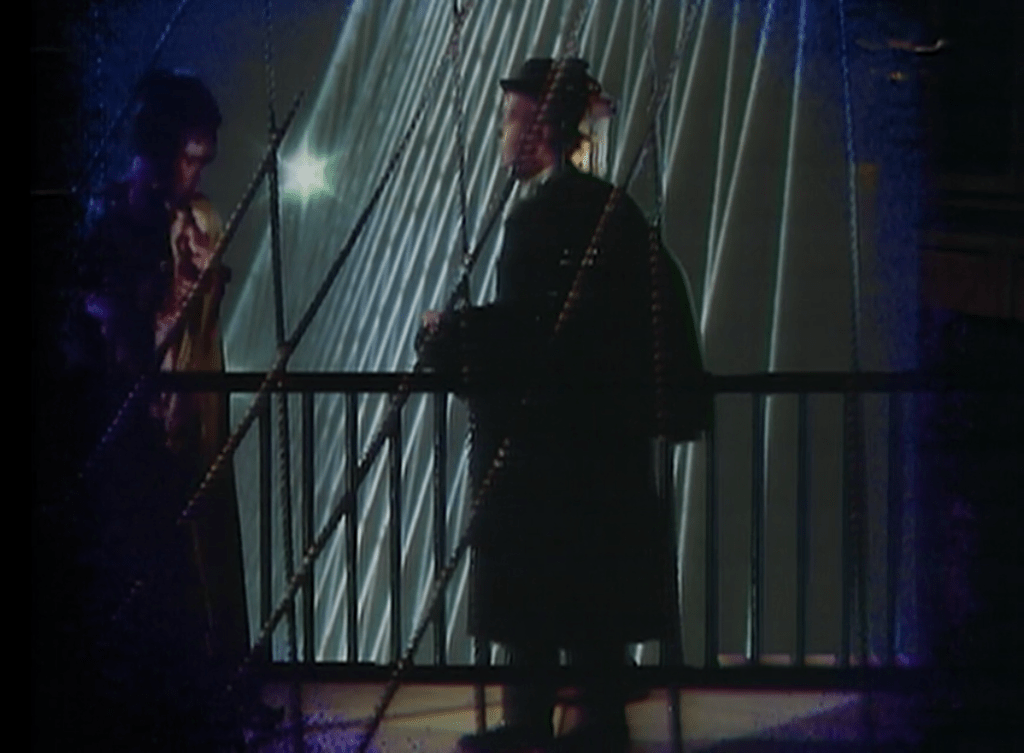
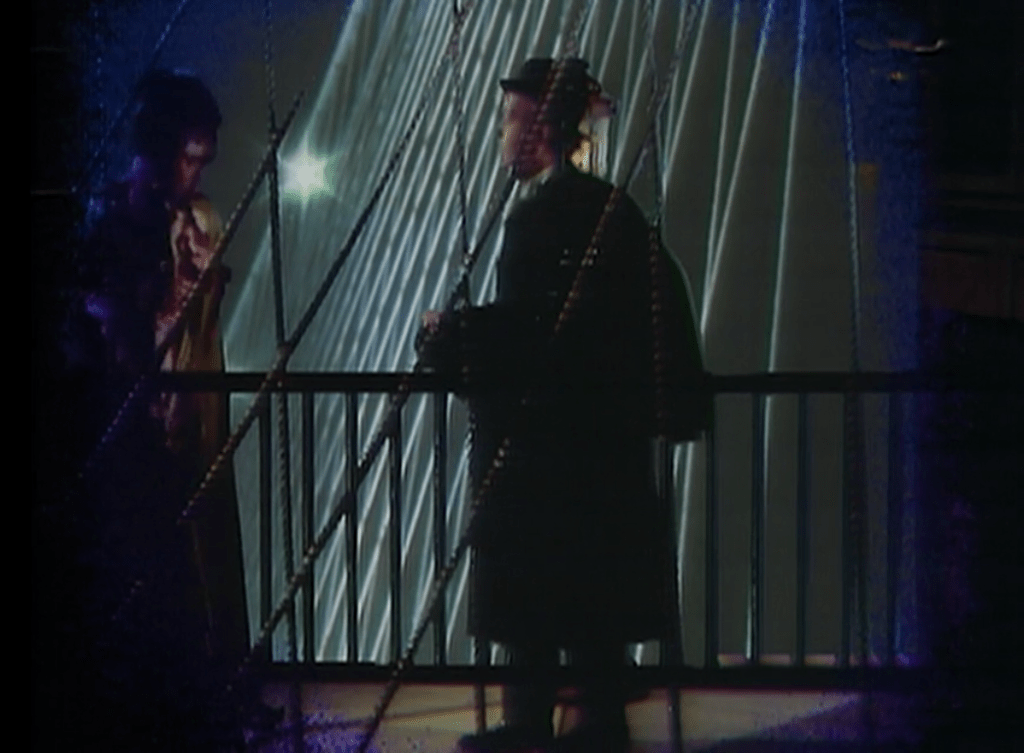
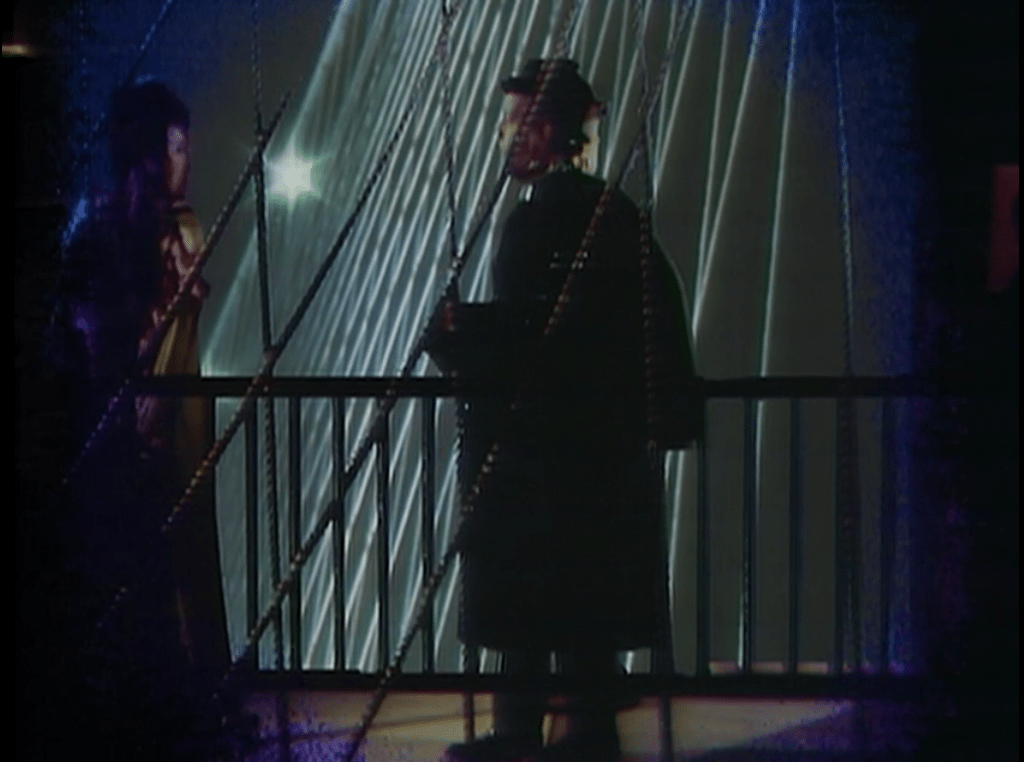
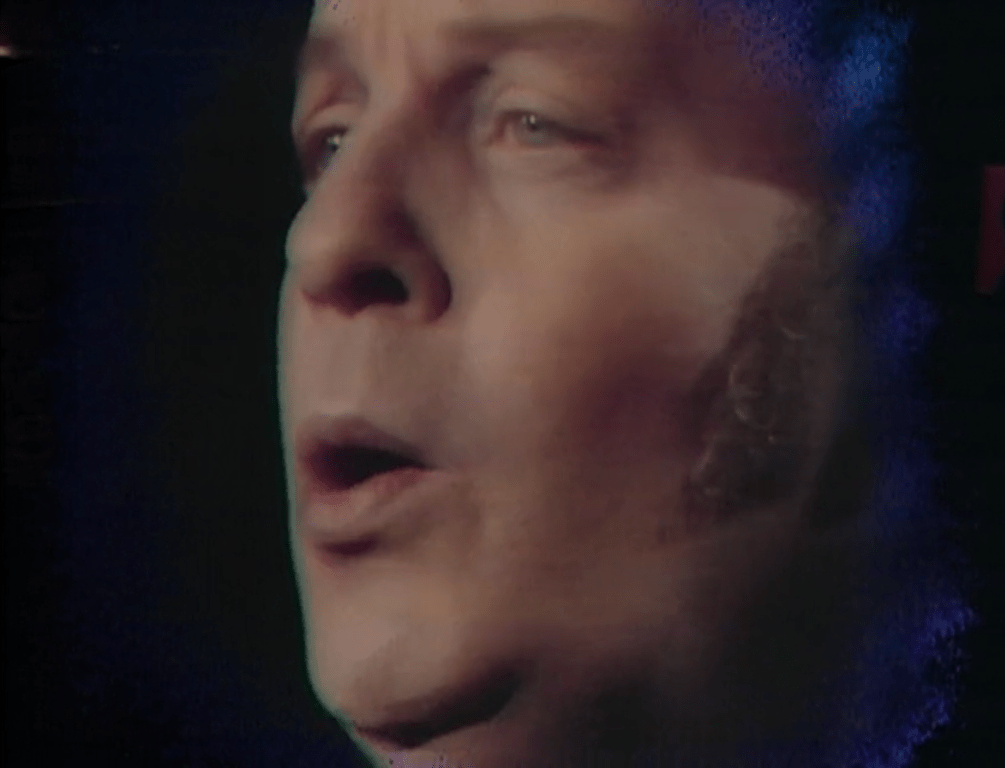
Episode 698: The kind of scene you should be avoiding

Barnabas Collins, old world gentleman extraordinaire, and Julia Hoffman, MD, are helping mysterious drifter Chris Jennings cover up the fact that he is a werewolf, responsible for a great many violent deaths. Lately Chris has started transforming into his lupine shape even on nights when the moon is not full, and this morning they find that he has not changed back even after dawn.

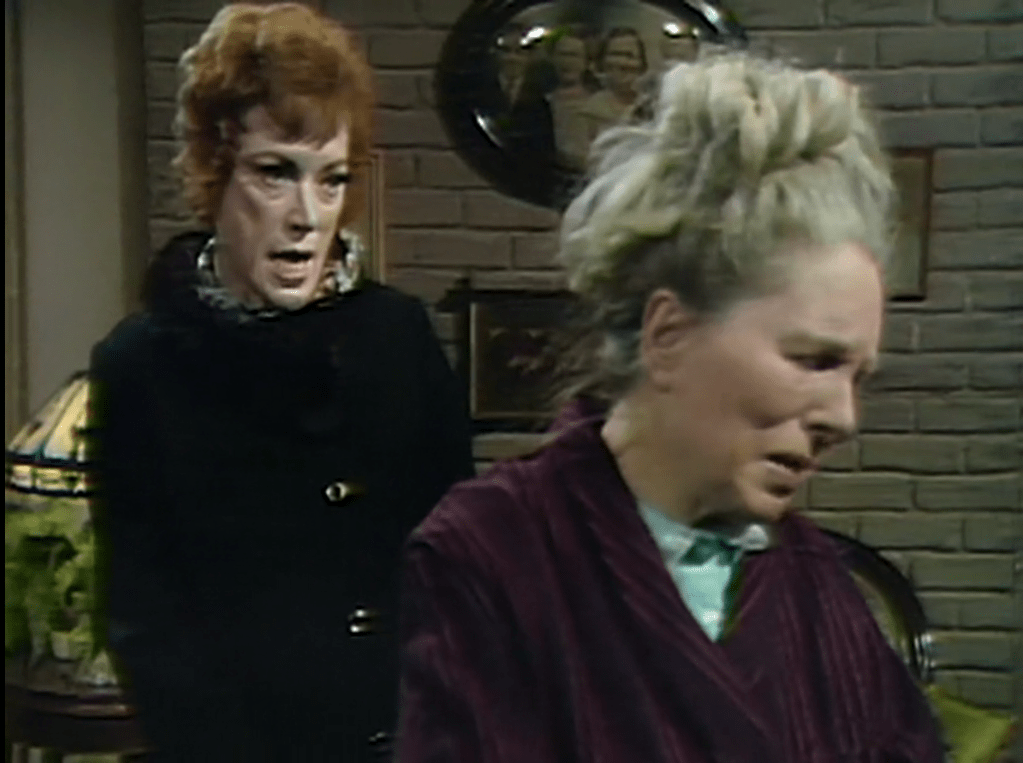
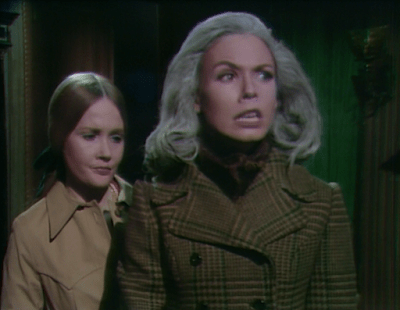
As if that did not present enough difficulty to Julia and Barnabas, one of Chris’ surviving victims is in town. She is his onetime fiancée, Sabrina Stuart. Two years ago, Sabrina saw Chris as the werewolf. She hasn’t told anyone about him, because she hasn’t been able to speak since. Her hair turned white, her skin turned pale, and she has been nearly catatonic.

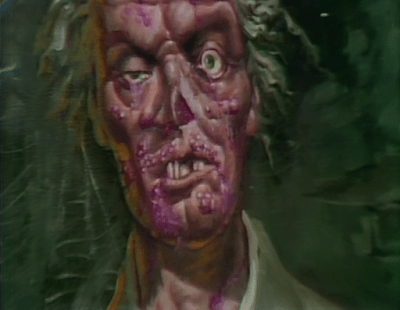
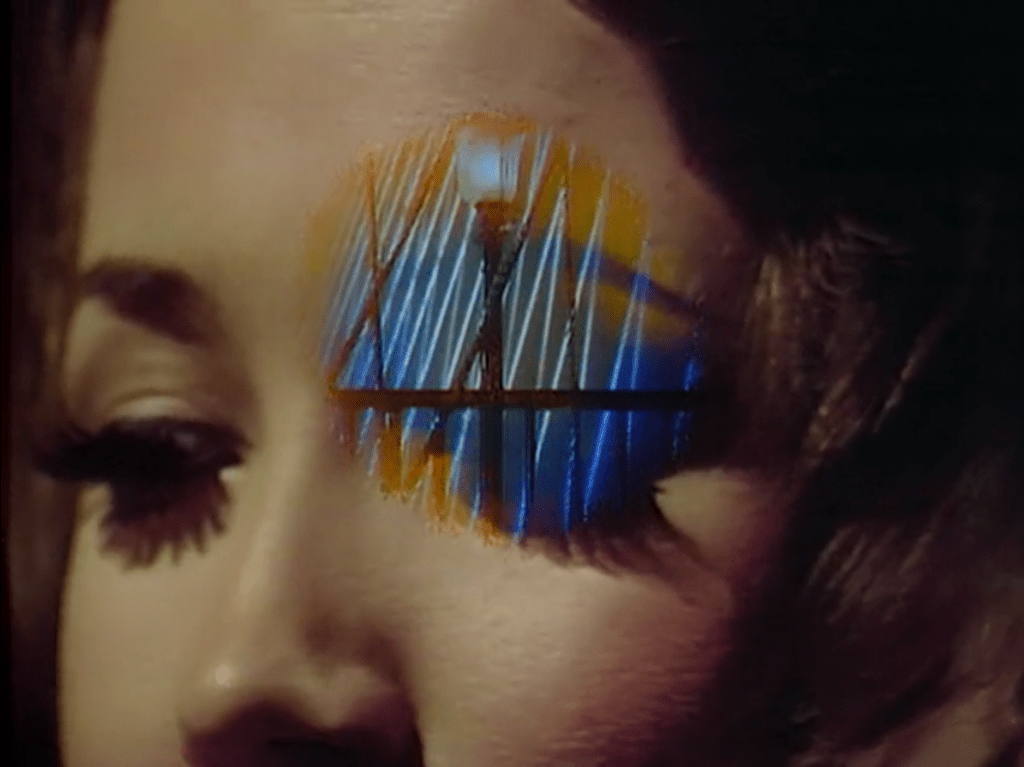
Others have encountered the werewolf, and none has had this reaction. It’s true that Chris’ cousin Joe had to be taken to a mental hospital after he saw the transformation, but Joe had just been through a very long train of supernaturally induced traumas that had shattered his sensibilities and taken away everything he cared about. Seeing Chris change was just the last step in that process. Sabrina, as we see in a flashback segment today, was fine until she encountered Chris as the werewolf, and she didn’t even see the transformation itself. Yet here she is two years later, unspeaking, immobilized, and wearing the same makeup that Eli Wallach wore as Mr Freeze in the 1960s Batman TV show.

In a comment on Danny Horn’s post about this episode at Dark Shadows Every Day, “Cole” speculates that the show might have meant to tell us that the real reason Sabrina’s condition is less to do with what happened that on night in Chris’ apartment than with her brother and sole caretaker, Ned, played by Roger Davis:

I am once more getting through the Ned/Sabrina scenes thanks to this blog and the comments here; and although I still have to frequently avert my eyes from the screen to hold back the nausea, I keep concentrating on the dialogue while speculating further on JRM’s theory.

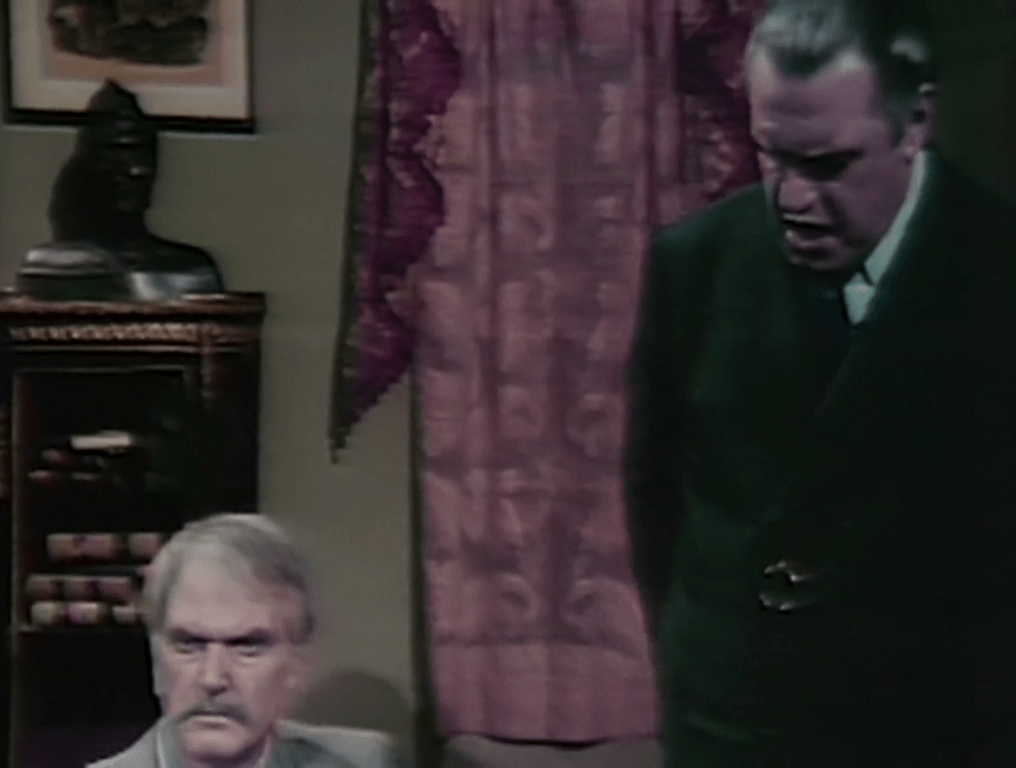
It does seem that we– and Julia– might be meant to feel especially concerned by Ned’s refusal to even consider allowing Sabrina to stay at Windcliff. He even says (or, rather, since it is Roger Davis, he SCREAMS), ​”I won’t be separated from her!”

I don’t think his character is meant to be overly suspicious of Julia and Barnabas so the vehemence behind his already rather alarming declaration becomes more baffling unless the viewer concludes he has … extremely unnatural feelings of possessiveness towards sad, PTSD-afflicted Sabrina.

It is almost half as frustrating as it is disturbing because, with any other actors, we would surely know for certain how to interpret these scenes.

We would perhaps recognize that when Sabrina stares pleadingly at Julia once Ned leaves the room, that her muteness is caused as much by her horror at being an ongoing victim of her brother’s unspeakable abuse as by having once witnessed Chris’s transformation into a werewolf. We wouldn’t wonder, instead if the actress, Lisa Richards, is actually pleading with Hall to help her endure Davis’s deliberate act of molesting and assaulting her through out these scenes.

If it wasn’t Roger Davis in this role, we would know who Ned is really meant to be since there is no way any of the other regular male cast members would willingly subject their costars to type of abuse Davis is inflicting on Richards.

If it were … say, Jerry Lacy who was currently playing “Ned Stuart” in a manner even remotely similar to Roger Davis’s ‘interpretation’ of the role, we would recognize at once that the character of Ned is obviously scripted to be an incestuous rapist (and I am sure Lacy would still keep his hands professionally and respectfully away from Lisa Richards’s/”Sabrina’s” breasts, instead using actual acting techniques to portray his character’s warped nature). But with Davis ..

It really could be, as Mary commented below, that he is trying to get the poor actress to break character. And how could we expect other than that he would use his usual disgusting and violent Drumph-like/”‘you can grab them by the pussy” sense of Curtis-granted entitlement to assault her as “Ned,” regardless of the intent of the writer and director.

Either way, what a horrifically mistaken choice in casting.

Lisa Richards: fifty years later, I am thinking of you and hoping you weren’t forced to endure PTSD after filming these scenes with Davis.

Comment left 29 August 2021 by “Cole” on “Episode 698: Sister Act,” Dark Shadows Every Day, Danny Horn, 8 August 2015

When I mentally recast the many parts Roger Davis played on Dark Shadows, I divide them between two men who were background players in the show’s first months. I imagine Fredric Forrest playing the two characters with aliases, Peter Bradford (a.k.a. Jeff Clark) and Charles Delaware Tate (a.k.a. Harrison Monroe.) Forrest excelled both as a quietly intense man under pressure and as a sweet, goofy, overgrown kid. In the hands of an actor who, unlike Mr Davis, could project those qualities, those two unloved characters might both have become fan favorites. His other two parts, Ned Stuart and Dirk Wilkins, would have been perfect for Harvey Keitel, who is unsurpassed as a man who is agitated by a deep anger that he himself barely understands and that he certainly cannot explain to anyone else. Not that it’s any secret why Ned is angry at Chris, but when he takes a break from pawing at Sabrina’s face and breasts he handles her so roughly that he is obviously angry with her, and that is something he isn’t going to be giving any thought.

Mr Davis’ behavior wasn’t much better in episodes directed by Lela Swift and others, but it is little surprise director Henry Kaplan didn’t rein him in. Kaplan directed with a conductor’s baton, and actresses complain that he would jab them with it. When the person in charge has that light a regard for women’s personal space, it’s no wonder a creep like Mr Davis felt free to rub himself all over Ms Richards.

Episode 692: The only existing link

There are two ongoing narrative threads in this part of Dark Shadows. One is the story of mysterious drifter Chris Jennings. Mad scientist Julia Hoffman knows Chris to be a werewolf and she is trying to help him. The other is the story of Quentin Collins, a ghost who is gradually gaining power and planning to drive everyone away from the great estate of Collinwood so that he can have the place to himself. Chris’ story had been the fast-paced A plot that kept expanding to involve more and more characters, while Quentin’s was the slow-paced B plot that consistently involved only Chris’ nine year old sister Amy, strange and troubled boy David Collins, and their governess Maggie Evans, with intermittent small parts for other established characters and the occasional chance for a day player to act a death scene. That changed yesterday, when Quentin decided that he had grown so strong he no longer needed to conceal himself from matriarch Elizabeth Collins Stoddard or the other adults in the great house. Quentin’s story is now the main topic, and Chris is the secondary feature.

We open today with Liz telling Julia what happened the night before. Julia tells Liz that she and old world gentleman Barnabas Collins had suspected that an evil ghost was at work in the house, and that they have seen another spirit that seems to be opposed to it. Liz says she has called occult expert Timothy Eliot Stokes. Stokes arrives and questions everyone.

Liz is alone at the desk in the drawing room when a secret panel leading to a passage to the long-deserted west wing opens. A cutout meant to suggest a disembodied hand appears on the screen. It picks up a letter opener from the desk and is about to stab her when Stokes enters.

Stokes shouts. The hand drops the letter opener and vanishes. He tells Liz what he saw. He notices the panel is open, and asks Liz about it. She says that it leads to the west wing, but that, as far as she knows, no one has used it in years. That answers a question that has been on the audience’s minds since October 1966. In that month, we saw Liz’ brother, high-born ne’er-do-well Roger, use the panel to play a dirty trick on well-meaning governess Victoria Winters. The panel was not seen or mentioned again until David and Amy started using it to do Quentin’s bidding several weeks ago. This line is our first confirmation that Liz knows that the panel and the passage behind it exist. Stokes asks Liz’ permission to perform an exorcism.

Meanwhile, Julia gets a telephone call from Chris. Liz’ daughter, heiress Carolyn Collins Stoddard, has taken a fancy to Chris and installed him in a cottage on the estate. Chris tells her that he is facing an emergency. Someone has come to the village of Collinsport who might know his secret.

In the cottage, Chris tells Julia that an unpleasant man named Ned Stuart has brought his sister Sabrina to the village and that he is demanding Chris meet with Sabrina. Chris had assumed Sabrina was dead, because she was in the room with him one night two years before when he underwent the transformation into his lupine form. Ned had told Julia and Barnabas that he was looking for Chris because he wanted to know what happened to his sister; he had always referred to Sabrina in the past tense, leading them to assume she was dead. Now Chris is in a panic, convinced that Sabrina will tell the police about him and that he will be punished for the many, many homicides he has committed as the werewolf.

Julia points out that if Sabrina were going to do that, she could have done so at any time. He would already have been arrested. Sabrina must not have told Ned or anyone else what she saw, and Ned must be telling the truth when he says he does not know what happened the last time Chris and Sabrina were together. She persuades Chris to go to visit the Stuarts in their suite at the Collinsport Inn.

Julia accompanies Chris on the visit. Ned is irritated that Chris did not come alone. His remarks are uncomfortable to hear, chiefly because of actor Roger Davis’ habit of clenching his anal sphincters when he raises his voice, making him sound like he is suffering from agonizing constipation.

After Ned makes this fingernails-on-a-blackboard noise for a couple of minutes, he lets Chris and Julia into Sabrina’s room. She is in a catatonic state. Her hair is white, and her face is tinged with light blue makeup. The makeup makes her look haggard in color, but most TV sets in the USA in the 1960s received only in black and white. In black and white, the makeup is not very effective.

Ned says that Sabrina was like that when he found her, the morning after she paid her last visit to Chris’ apartment. Several takes of a framed copy of actress Lisa Blake Richards’ professional headshot invite us to imagine the before-and-after. Ned calls Sabrina’s attention to Chris; she rises from her chair, starts towards him, and collapses.

Episode 688: Why have you come back?

Actor Roger Davis rejoined the cast yesterday, after an absence of not nearly long enough. He has an interminable scene with Grayson Hall and Jonathan Frid, during which he thrusts his arm onto the mantel immediately behind Hall, effectively putting his arm around her shoulders. She visibly flinches at this invasion of her personal space. When he exits she sighs “Oh, I thought we’d never get rid of him.” Frid says that he thought the same thing. They then get back into character and play out the scene in the script.

Roger Davis imposes himself on Grayson Hall and Jonathan Frid.

Later, Kathryn Leigh Scott is on a set representing the woods, and she sees Mr Davis. She reacts with a shout of “Don’t come near me! Stay where you are!” When she demands to know “Why have you come back?,” he reminds her that the camera is on and he is playing a character named “Ned Stuart.” She goes into character and says her lines, keeping as much distance from him as the 4:3 aspect ratio of 1960s US television would allow.

The parts of the episode that are not ruined by Mr Davis’ odious presence tell a story about ghosts and werewolves. Frid and Hall play Barnabas Collins and Julia Hoffman, friends of werewolf Chris Jennings. The other day Barnabas and Chris dug up an unmarked grave and found that it contained the remains of a baby wearing an apotropaic device meant to ward off werewolves. We saw the ghost of Quentin Collins watching as they did so, a sad look on his face. Later, we learned that Quentin paid for the apotropaic device, proving that there was a werewolf in the area when he was alive and that he had some connection with the baby.

Strange and troubled boy David Collins is under Quentin’s influence. After Quentin imposes himself on him, David writes a story about a werewolf who tried to keep from hurting anyone by locking himself in a room, but who was let out of that room and killed by a hunter. Barnabas has indeed locked Chris in the secret room of the old Collins family mausoleum.

Julia finds the story and shows it to Barnabas. They fear that David has somehow learned of Chris’ secret. As Barnabas and Julia are aware, David is one of the few people who know about the secret room. And indeed, at the end of the episode, we see him about to open the panel that leads to it.

But that may not be the story’s whole meaning. Regular viewers know something that Julia and Barnabas do not. David and his friend, Chris’ nine year old sister Amy, first came into contact with Quentin when they made their way into a room hidden behind a wall in the long-deserted west wing of Collinwood. They found a decayed skeleton seated in a chair there, wearing Quentin’s clothes. Evidently Quentin was locked in that hidden room, and Amy and David let him out. Perhaps the story David wrote is a suggestion that Quentin was a werewolf, and that by letting him out he and Amy exposed him to hunters.

Episode 686: Curious so many hearts should stop in this house

When Dark Shadows began in June 1966, we were introduced to Roger Collins as a high-born ne’er-do-well with no sense of responsibility to anyone or anything. Roger had squandered his entire inheritance; his sister, reclusive matriarch Elizabeth Collins Stoddard, nearly bankrupted herself trying to buy up his half of the family business to keep it from falling into outside hands. Roger and his son, strange and troubled boy David, lived in Liz’ house as her guests. Roger drew a salary from the business, but barely pretended to do any work for it. He made absolutely no pretense of concern for David; on the contrary, he expressed his hatred for his son openly, tried to persuade Liz to send him to a boarding school or an institution or any other place that was far away, and speculated out loud that David might be the natural son of his sworn enemy, dashing action hero Burke Devlin.

David’s mother, Roger’s estranged wife Laura Murdoch Collins, was on the show from December 1966 to March 1967. Roger schemed to get her to leave and take David with her. When he discovered that Laura was an undead fire witch whose plan was to burn David alive in order to secure her own peculiar immortality, he was shocked into a display of fatherly tenderness. He’s never been quite himself since.

By April 1968, the show had long since erased all signs of the financial crisis Roger’s crapulent youth had brought upon the family. Further, Roger had by that time shown so many signs of mature responsibility in his attitudes both towards his son and towards his work that we might have wondered if they were going to retcon away all of his vices. It was a genuine surprise when, in #474, Liz told Roger’s new wife Cassandra that Roger lived in her house as her guest, worked in her business as her employee, and owned nothing himself. Roger’s spendthrift past seemed to have no place in the story by that point.

Today, Roger is at his most conventionally respectable. He comes home from a long business trip, indicating his sober devotion to the work of Collins Enterprises. He finds David in his room, struggling with distant cousin Barnabas Collins and permanent houseguest Julia Hoffman. After a commercial break, Roger says that he has heard about the many complicated events that took place while he was away. Barnabas explains that David had told him that silversmith Ezra Braithwaite came to the house to see him, bearing a ledger with information he wanted. David found Mr Braithwaite in the drawing room, dead of a heart attack. The ledger was nowhere to be found. Barnabas and Julia have come to David to ask if he can shed any light on what may have happened to the ledger, and the boy became violently upset. Roger insists Julia and Barnabas leave the room. He talks soothingly to David and tells him he does not believe any accusations against him.

Later, Roger confronts Barnabas and Julia in the drawing room. He finds the ledger on the desk where Mr Braithwaite was sitting when he died; he does not accept Julia and Barnabas’ assurance that it was not there earlier. He dismissively asks if they are suggesting that “a ghost” put it there. He demands they apologize to David, making it a condition for their continued presence in the house that they do so.

Barnabas is shocked when Roger threatens to revoke his great house privileges. Screenshot by Dark Shadows Before I Die.

As it happens, Barnabas and Julia strongly suspect that a ghost did put the ledger back on the desk, and the audience knows they are right. Roger has seen quite a bit of evidence of supernatural forces at work in and around Collinwood, as has Liz. But both of them consistently refuse to acknowledge this evidence. Each of them has had moments when the wall of denial started to crumble; notably in #88, Roger said to Liz, “I’ve seen and felt things, things I couldn’t actually explain. You can’t tell me it hasn’t happened to you, because I know better.” But they always snap back to form sooner or later, no matter how obvious the truth is, and there would obviously be no point in laying the facts before Roger when he is in this mood.

Julia and Barnabas have asked Liz to show them the old family archives. It is the middle of the night, everyone is very tired as the result of the fuss and bother that occurs when a corpse has to be removed from the house by lawful means, they will not tell her what topic they are researching, and they insist on starting work immediately. She asks if they expect her to go along with them on this basis, prompting Barnabas to smile as genially as he can and say “Of course!” You can’t expect to persuade crazy people to behave reasonably, so she gives in.

The archives are a dusty room somewhere in the great house that Julia somehow failed to enter during the months when she was staying at the house under the pretense of being an historian looking into the early years of the Collins family. The first book Julia picks up is an old photo album, and one of the first pages she turns to is a photograph of a woman whose ghost she and Barnabas saw the other night. The photo is dated 1897. The woman looks just as she did in her ghostly form, suggesting that she died not much later than that. There is some business with doors slamming shut and windows blowing open to fill the last thirty seconds of the episode, and the closing credits roll.

My wife, Mrs Acilius, pointed out that Roger’s defensiveness concerning David serves the same purpose in the plot as does Barnabas and Julia’s ludicrously cack-handed approach to questioning him. The evil ghost is still quite weak, the ghost of the woman opposes him, and David and his friend Amy Jennings are desperate to escape from his influence. If any of the adults caught on to what was happening at this point, they could cut the Haunting of Collinwood story short. But it is just getting interesting, and there is only one other plot ongoing now. So we don’t want that. Roger and Liz have to be in full denial mode, Julia and Barnabas have to be terrible at talking with kids, and governess Maggie Evans has to be a squish who doesn’t know the first thing about discipline for the plot to work.

Fortunately, we have ample foundation for each of these character developments. Roger’s origin as a shockingly indifferent father makes it understandable that he would swing to the opposite extreme and treat David with excessive indulgence. As a former vampire and a mad scientist, Barnabas and Julia are metaphors for extreme selfishness, and when they were called upon to act as parents to Frankenstein’s monster Adam in April 1968 they did the worst possible job. Maggie is brand new to governessing; she has been on the show since #1, so we know that she was good at running the coffee shop in the Collinsport Inn, at containing the damage her father did by his alcoholism, at escaping from vampires and mad scientists, and at miscellaneous other tasks involving other adults. But she has never been responsible for children or trained as a teacher, and so it neither surprises us nor alienates us from her that she is bad at the job.

Episode 678: This time, I saved him

At the estate of Collinwood, two ghosts are at odds over the fate of a werewolf. Caught in the crossfire are a mad scientist, a recovering vampire, and a couple of kids.

The ghosts are the evil Quentin Collins and a weepy woman so far known only as Beth. The werewolf is Chris Jennings, who is staying in the caretaker’s cottage on the estate. The mad scientist is Julia Hoffman, MD, a permanent guest in the great house. The recovering vampire is Julia’s inseparable friend Barnabas Collins, master of the Old House. The kids are Chris’ nine year old sister Amy and strange and troubled boy David Collins, who live in the great house.

Yesterday, Quentin went to the cottage and put strychnine in Chris’ whiskey. Beth appeared to Julia and led her and Barnabas to the cottage in time to save Chris; today, they figure out that Beth is a ghost.

Quentin has been exercising power over David and Amy, at first with Beth’s cooperation. Beth appears to Amy in a dream visitation. While she guides Amy to images of Chris and David and to the realizations that Quentin means to kill Chris and that David has tried vainly to stop him, we hear Beth speak for the first time. She says everything twice, giving her dialogue a lyrical quality that could be quite lovely. Unfortunately, Terrayne Crawford’s limitations as an actress keep that loveliness from coming through.

Barnabas and Julia know that Chris is a werewolf and have persuaded him to accept their help. They question Chris and are satisfied that he did not poison himself. When he mentions that David visited him the previous morning, Barnabas decides to go interrogate David. Longtime viewers know that David has extensive experience with ghosts, a fact of which Barnabas has at times been most uncomfortably aware. Once Barnabas has learned that Beth is a ghost, it will strike us as reasonable that he will be interested in David’s connection with the matter.

Amy goes to the cottage and sees Julia tending to Chris. They tell her he just had an upset stomach and will be fine. She does not believe them, and says she had a dream that convinced her Chris was in mortal danger. This intrigues Julia, who presses for more details about the dream. Amy clams up, but now Julia and Barnabas, the show’s two chief protagonists, have figured out that David and Amy have something to do with ghosts, and that those ghosts in turn have to do with Chris. The Haunting of Collinwood story hasn’t made any real progress for several weeks, but that can now change.

Back in the great house, Barnabas questions David about his visit to Chris. He doesn’t get any more information out of him than Julia had got out of Amy. There is a bit of intentional humor when Barnabas tells David he thought it would be pleasant to share breakfast with him and Amy. David says it isn’t so pleasant at breakfast- housekeeper Mrs Johnson is in a bad mood in the mornings. Barnabas suggests they ignore her, and David replies that it is not easy to do that. David Henesy delivers this line with perfect comic timing.

Barnabas realizes David knows more than he is telling. Screenshot by Dark Shadows Before I Die.

Amy shows up and responds favorably to Barnabas’ self-invitation to their breakfast. After Barnabas leaves the room, Amy confronts David about Quentin’s attempt to kill Chris. David has despaired of opposing Quentin, and is terrified when Amy tells him she will go tell matriarch Elizabeth Collins Stoddard everything that has been going on. He is convinced Quentin will kill them if she does this. He is pleading with her to come back when the episode ends.

Episode 677: To contain your violence

Old world gentleman Barnabas Collins and mad scientist Julia Hoffman have figured out that mysterious drifter Chris Jennings is a werewolf. Last night, Barnabas took Chris to the room hidden behind the secret panel in the old Collins family mausoleum and locked him up there. That had the desired effect- Chris transformed, but couldn’t get out and didn’t kill anyone.

This morning, Barnabas walks with Chris as he returns home to the caretaker’s cottage on the grounds of the estate of Collinwood. They find Julia already there. Barnabas had neglected to tell Chris that Julia also knows his secret, so he is puzzled to find her in his house. When she explains that she knows he is the werewolf, she also says that she advised Barnabas against helping him. She seems to be in quite a snippy mood.

Chris says that Julia was right; Barnabas replies “Right or wrong, I have made my decision and I intend to follow it through!” That’s a perfectly characteristic remark for Barnabas, who often shows great tenacity but never shows any signs of a functional conscience. Julia warms up and tells Chris that she will come back the following morning and begin a series of tests meant to discover a medical intervention to deal with his condition. Later, Chris will call Barnabas “a good man.” When Barnabas says that some would dissent from this view, Chris says that those who do are “wrong, very wrong.” Chris hasn’t been watching Dark Shadows!

While werewolf Chris was cooped up in the mausoleum, strange and troubled boy David Collins was at home in the great house of Collinwood. David is friends with Chris’ nine year old sister Amy, and both children are coming under the sway of the evil spirit of the late Quentin Collins. Last night, Quentin showed David a bottle of strychnine and ordered him to poison Chris with it. David refused that order. A moment after Barnabas and Julia leave the cottage, David knocks on the door.

David asks who it was he saw “sneaking out” of the cottage. Chris tells him that he may have seen Julia and Barnabas, but that they probably weren’t “sneaking”- they had simply stopped by to visit him. When David is surprised that they came so early in the morning, Chris points out that he dropped in only a few minutes later. David declares that he always gets up early, and is surprised Chris doesn’t know that. Chris does not seem to believe that it is reasonable for David to expect him to know what time he gets up.

David tells Chris he likes what he has done with the interior of the cottage. Chris says he hasn’t changed a thing- it is just as he found it. This will interest longtime viewers. The last person to stay in the cottage was David’s mother, undead blonde fire witch Laura Murdoch Collins, who occupied it early in 1967. David often visited her there in those days. We remember those scenes when he takes a seat in front of the fireplace, where he and Laura used to sit.

David in a familiar spot.

Chris tells David he was up all night and has to get some sleep. He offers him a soda “to give you some energy for your hike through the woods.” Once they have collected their sodas, Chris tells David “Well, I tell ya, I like a carbonated grape soda myself. It reminds me of the vineyards in the south of France.” He delivers this line in the voice of W. C. Fields. This is the first unmistakable occurrence of Briscoe’s W. C. Fields imitation; it is a seed from which much will grow. In August, another character of Briscoe’s will make an appearance wearing Fields’ signature costume, top hat and all.

David’s comment about the figures he saw “sneaking” from the cottage shows that he is worried about Chris, and he keeps talking and asking questions until Chris all but pushes him out. His concern is quite understandable in the light of the command Quentin gave him the night before.

After David leaves the cottage, the camera stays in the front room by itself and focuses on the door for such a long time we begin to wonder whether anyone else is coming. Maybe they just want us to see what a nice door the set department has put together. Finally it does open, but we do not see anyone enter. The stopper rises from a decanter of brandy on the table, apparently by itself. The strychnine bottle Quentin showed David comes into view; it tips over, and its contents are emptied into the decanter.

When the day is done, we are at the great house. Julia and Barnabas have had a conversation about a book she is reading, The Lycanthrope of Angers. Coupled with Chris’ joking reference to the south of France, this mention of a city in northwestern France suggests that there is something French about being a werewolf. Barnabas used to be a vampire; that condition came upon him because of his involvement with some French people. Perhaps the makers of the show were planning to turn to the same country to explain the origin of Chris’ troubles. It might not be so far-fetched. The show is set in Maine, after all, home to a great many Franco-Americans.

Alone in the cottage, Chris decides to celebrate the end of the Moon’s “cycle of fullness” by taking a drink of whiskey before bed. He sickens. At first he thinks he is transforming into the werewolf. He collapses, but does not go into the convulsions typical of strychnine poisoning.

Julia is in bed in her room in the great house. She is awakened by the sound of sobbing. A tall, very thin blonde woman in a long white dress appears. She beckons Julia and leaves the room. Julia pauses to put on a robe.

Barnabas is downstairs; he sees the woman. He initially mistakes her for heiress Carolyn Collins Stoddard, the only blonde woman in the house, but by the time the woman in white has reached the bottom of the stairs and gone out the front door he knows it is not her.

Given their shared hair color, it is unsurprising Barnabas mistakes the woman in white for Carolyn. But there is a bit of an Easter egg here for sufficiently obsessive fans. As the Dark Shadows wiki notes, actress Terry Crawford appeared in a 1969 commercial for the “Barnabas Collins Dark Shadows Board Game” with her hair styled so that she would look like Nancy Barrett as Carolyn.

Julia arrives downstairs and asks if Barnabas saw the woman. The two of them go out the front door and spot her in the distance, on the path to Chris’ cottage. We cut to the cottage, and see the woman enter. Barnabas and Julia enter a moment later, at which point she is gone. They find Chris unconscious, and Julia says he is dying.

Returning viewers recognize the woman in the white dress as Quentin’s associate Beth. We do not know why Quentin wants Chris to be poisoned, or why Beth wants Julia and Barnabas to find him while he is still alive. Perhaps they are working at cross-purposes, and Beth is trying to keep Quentin from killing Chris. Or perhaps they are working together, and their shared plan was to injure Chris but to get Julia, who is after all a doctor, to him in time to prevent the worst.

Episode 675: The best alibi you can have in this town

In #128, wisecracking waitress Maggie Evans opened a conversation in the diner at the Collinsport Inn with that old familiar ice-breaker, “Whaddaya hear from the morgue?” The show took us all the way to Phoenix, Arizona for a trip to that city’s morgue in #174, but it is only today we see the inside of Collinsport’s own morgue for the first time. Sheriff George Patterson brings heiress Carolyn Collins Stoddard in to identify a body found on her property. Carolyn is shocked to find that it is her friend, Donna Friedlander.

Last night, Carolyn and Donna were in the drawing room of the great house of Collinwood with permanent houseguest Julia Hoffman and old world gentleman Barnabas Collins, who lives in the Old House on the same estate. Also in the room was Chris Jennings, a mysterious drifter who caught Carolyn’s fancy and who now lives in the caretaker’s cottage on the estate as her guest. Barnabas invited everyone to dinner at his house. The ladies delightedly accepted, but Chris begged off, saying he would have to leave immediately to keep an important business engagement in Bangor, Maine. Donna said that she was going home to Bangor and that she was ready to leave, and asked Chris for a ride. When he tried to squirm his way out of taking her, Barnabas looked on with smug self-satisfaction.

This morning in the morgue, Carolyn tells Sheriff Patterson that the last time she saw Donna, she was leaving with Chris. But she recoils from the implication. She cannot believe that Chris had anything to do with Donna’s death.

Carolyn does not know what Barnabas has figured out. Chris is a werewolf. When Barnabas told Julia that he had come to that conclusion, she was unconvinced. Barnabas’ dinner invitation was a ploy intended to elicit just the panicked reaction Chris did have. Barnabas’ look of triumph at Chris’ frantic attempts to ensure that he is alone on this night of the full Moon reflects his belief that he has been proved right.

Barnabas went to the cottage some time after the Moon rose, intending to use his silver-headed cane to take control of Chris in his werewolf form. But he delayed too long, and by the time he got there the cottage was vacant and Donna’s mangled corpse lay in the woods nearby.

We cut to the cottage, where we see a disheveled and bloodstained Chris come home. He has just had time to change his shirt and set some furniture right side up when Carolyn drops in. She has come to warn Chris that Sheriff Patterson is coming. The sheriff is right behind her. Carolyn leaves the two of them alone. Chris refuses to allow a search of the premises; when he spots Donna’s purse on his table, he throws a newspaper over it. The sheriff somehow fails to notice this, but takes Chris to his office for questioning.

In the drawing room, Barnabas and Julia are fretting over Donna’s death. Barnabas asks “Could we have stopped it?” He decides that they could not have, and that whatever sequence of events led to the killing must have been “Donna’s fault.” It is always fun to watch the scenes where Barnabas faces the horrific results his actions have on other people, strikes a noble pose while briefly considering the possibility that he may be partially responsible for them, and then agrees with Julia that it is pointless for him to blame himself. Julia and Barnabas’ self-exculpatory attitudes are so transparently absurd that you have to admire Grayson Hall and Jonathan Frid for keeping straight faces while delivering their dialogue.

Meanwhile, Carolyn has called the Collins family lawyer, Richard Garner. Garner agrees to help Chris. We saw Garner and his son Frank a number of times in the first months of 1967, but he hasn’t been on screen since #246. He has only been mentioned a handful of times since then, most recently in #577. This is the last time his name will come up.

Back in the drawing room, Barnabas tells Julia that he can see “So many possibilities” for dealing with Chris’ problem. Frid’s delivery of this line made my wife, Mrs Acilius, shudder. She could hear the evil in his voice as he shows us Barnabas playing God.

Chris is in an interrogation room, telling Sheriff Patterson a series of mutually contradictory lies about what he did last night. The sheriff says he’s going to leave him alone for a few minutes so that he can come up with a more plausible story. You might think this was a sarcastic remark, but in this context it seems it might actually be sincere. Sheriff Patterson’s failure to notice Donna’s purse on Chris’ table is of a piece with the complete nonfeasance he has shown all along, and Vince O’Brien delivers the line so warmly it doesn’t sound like a joke. Moreover, Sheriff Patterson’s predecessor as Collinsport’s chief representative of law enforcement, Constable/ Sheriff Jonas Carter, capitulated to the Collins family’s directions to cover up a crime in his final appearance on the show, back in #32. Longtime viewers may suspect that Sheriff Patterson is as averse to the tough parts of his job as was Constable/ Sheriff Carter.

While Chris is alone in the interrogation room, he decides to tell Sheriff Patterson the truth when he comes back. He does in fact open his mouth and get the first few words of a confession out when the sheriff cuts him short. He says that Barnabas Collins called the office to tell him Chris was with him last night, and that Barnabas is “about the best alibi you can have in this town.” He shakes Chris’ hand and sends him on his way. Law enforcement characters on Dark Shadows are symbols of helplessness, and after that moment Sheriff Patterson has reached the zenith of that quality, achieving a measure of futility that cannot be surpassed. We never see him again.

Sheriff Patterson completes his quest. Screenshot by Dark Shadows Before I Die.

Chris goes home and finds Barnabas waiting for him. Chris expresses his gratitude for the alibi Barnabas gave him, but keeps trying to get him to leave before the Moon rises. Barnabas tells him that when he leaves, Chris will leave with him. Barnabas closes the episode by telling him that he knows that he is not only Chris Jennings, but that “You are also the werewolf.”

This episode marks the final appearance not only of Sheriff Patterson, but also of Vince O’Brien. O’Brien joined the show in #148 as the second actor to play Lieutenant Dan Riley of the Maine State Police. O’Brien’s stolid manner suited the role of that ineffective investigator, but he was much less fun to watch than was the man who originated the part, the charming John Connell.

O’Brien took over as the second Sheriff Patterson in #328. He was again a step down from his predecessor; the first Sheriff Patterson was Dana Elcar, an extraordinary performer who always found a way to give the audience hope that his character was only playing dumb. Other actors filled in for O’Brien a couple of times, Angus Cairns in #341 and #342 and Alfred Sandor in #615, leading some fans to refer to “the Patterson brothers” (whose parents named all of their sons George) and others to speculate that for a time Collinsport allowed any man to be sheriff who was willing to change his name to “George Patterson.” Like O’Brien, Cairns and Sandor were accomplished professionals, but none could match Elcar’s gift for overcoming bad writing and keeping our attention focused on the sheriff.

Episode 674: When there is a moon

Heiress Carolyn Collins Stoddard is attracted to mysterious drifter Chris Jennings, so much so that she has set Chris up in the caretaker’s cottage on the estate of Collinwood. Today, Carolyn’s friend Donna Friedlander is visiting her. The day’s main action is a classic farce plot. Donna wants Chris to drive her home to Bangor, Maine, but in order to keep a secret from her he makes a series of increasingly frantic attempts to avoid doing so. In the end Donna doesn’t get her ride, and Chris doesn’t keep his secret.

The episode deviates from the typical farce in that Chris is not a man trying to keep his or his roommate’s girlfriends from finding out about each other. He is a werewolf, and the Moon is full. If Donna is with him after dark, he will kill her, as he has already killed an unknown number of people in the last several years.

Donna is a student of interior design, and Carolyn is showing her around the great house. We first see her when Carolyn brings her into the study. Chris is in the room with his sister, nine year old Amy, who has been staying at the great house. Chris is distracted, abrupt, and rude with Donna. His manner grows even less inviting when he sees an inverted red pentagram on Carolyn’s face, typically the sign that the person will be the werewolf’s next victim. His eyes bug out, he breaks into a sweat, and turns his back on the ladies, stalking off to stare out the window.

Donna and Carolyn leave the room. In the hallway outside the study, Donna exclaims “Wow!” and exhales as if she were very worked up. She tells Carolyn that Chris is her type. She summarizes that type as “moody”; a more fitting description of what Donna saw of Chris’ behavior would be “not interested,” but hey, I’m not the sex police. If Donna gets excited by foul-tempered guys who ignore her and want her to go away, that’s none of my business.

Donna expresses her interest in Chris.

The little space in which Donna tells Carolyn she is attracted to Chris is a new set. We’ve been seeing a lot more of these tiny nondescript corners representing hallways lately, and Donna’s identification with interior design makes us conscious of this one. In #664, they even had actors walk from one set to another through some undecorated studio space that they tried to persuade us was a corridor. It seems they are developing a strategy to make us feel that the great house is a bigger place than they have managed to create in our minds just by cutting from one room to another.

Complicating matters for Chris are old world gentleman Barnabas Collins and mad scientist Julia Hoffman. Barnabas has figured out that Chris is the werewolf, and today explains this to Julia.

Barnabas uses the word “werewolf” as he is bringing Julia up to date. This represents a departure from the show’s previous practice. Barnabas was himself a vampire when he first came on the show in #211, but they didn’t use the word “vampire” for 40 weeks, until #410. They aren’t afraid of vocabulary anymore.

Julia doubts Barnabas’ interpretation of the facts, and he decides to demonstrate his thesis by putting Chris in an awkward position. He invites Chris, Carolyn, and Donna to join him and Julia for dinner at his home, the Old House on the estate. Chris excuses himself by claiming to have a business meeting in Bangor for which he must leave at once. At this, Donna asks for a ride to that town. Barnabas watches Chris’ discomfort with a smug grin, confident that he is being proven right.

Outside the front door of the great house, Chris tries to wriggle out of giving Donna a ride by saying that now he is getting a migraine and will have to cancel his meeting. He offers to give Donna his keys, suggesting she hide them under the front seat when she parks his car at the bus station in Bangor. She initially accepts this, but later comes to the cottage to say she has decided against it. She is there when he transforms, and runs away.

Back in the great house, Barnabas is telling Julia that werewolves are vulnerable to silver weapons, so he will be able to use the head of his cane to control Chris. Julia wonders if Chris may already have left with Donna. Barnabas airily dismisses this, assuring her that he knows Chris well enough to be sure that Donna is perfectly safe. In fact, Barnabas barely knows Chris at all, but he is so pleased with himself for having figured out who the werewolf is that we can see there wouldn’t be much point in reminding him of this. At his leisure, Barnabas sets out for the cottage, which he finds to be unoccupied and in disarray. Donna’s mauled corpse lies in the woods nearby.

We might wonder why Chris saw the pentagram on Carolyn and not on Donna during the scene in the study. Is the show telling us the pentagram is out of order as a warning system? If so, is it just breaking down from overuse, or is some other supernatural presence interfering with it? Or maybe it isn’t automatic, but is a message from some spirit that has guessed wrong this time? They don’t explain, and the pentagram has been a big enough part of the werewolf story up to this point that it produces a lot more confusion than you might expect.

Yesterday’s episode ended with a bewildered Chris finding Amy in the cottage. Amy was listening to a mysterious voice Chris could not hear. Chris’ bewilderment deepened when Amy obeyed the voice’s command to hurry away. He finally discovered that Amy lit a fire in his hearth and burned a shirt of his in it. Chris took us to the final blackout holding the scorched remains of his shirt, giving a look in the direction Amy had fled, and exclaiming “My shirt!” in a pained voice that would make anyone laugh.

Today’s episode opens with a reprise of that interaction, but it is played very differently. Instead of a light scene that ends with a note of comedy, we have a heavier confrontation that builds to a melodramatic shock. Chris is alarmed, not bewildered, to find Amy in his cottage, and his alarm mounts when she responds to the mysterious voice. When he goes to the hearth, he is forceful, apparently angry. He still exclaims “My shirt!” even though the wardrobe department did not provide a shirt, but his voice is not the high-pitched, defeated squawk that had made the end of yesterday’s installment so funny. This is a full-throated baritone shout. The more serious tone of the scene sets us up for an outing that is technically a comedy and is at several turns quite funny, but that finally concerns itself with a matter of life and death.

Donna is played by Beverly Hayes, in her only appearance on Dark Shadows. Miss Hayes’ IMDb page tells us that for a few months in 1965 she was a regular on a soap called A Flame in the Wind, that in 1968 and 1969 she had a recurring part on The Secret Storm, and that after her one shot on Dark Shadows she was absent from the screen for 41 years, returning in a 2010 production called Marathon. Since then she has been in other little-known independent films, including something from 2015 called House of Shadows, which sounds suspiciously like an imitation of Dark Shadows. She also has some writing credits. Donna is perfect as a one-shot, but Miss Hayes does such a good job with her I wish they’d cast her in other roles later on.

Episode 673: Urgent business

This episode rests squarely on the shoulders of eleven year old Denise Nickerson, playing the role of nine year old Amy Jennings. A performer of any age could take pride in the results.

We first see Amy in the predawn hours of a night when a werewolf is prowling the grounds of the great estate of Collinwood. The werewolf has attacked heiress Carolyn Collins Stoddard; old world gentleman Barnabas Collins is out hunting him. In the opening sequence, Barnabas fired a shotgun at the werewolf without result, then hit him with his silver-headed cane and drove him off. Barnabas is still outside, still tracking the werewolf. Barnabas’ friend, mad scientist Julia Hoffman, is nervously pacing in the drawing room of the great house.

Amy comes downstairs. Julia sees her and demands to know why she is up and dressed at such an hour. Amy says she must go to the caretaker’s cottage on the estate, where her grownup brother Chris lives. Julia forbids her to go out. Julia saw the werewolf attack Carolyn, but says nothing about the incident. She tells Amy only that it is dangerous in the woods at night. Amy says that she had a dream from which she drew the conclusion that “Something is happening to [Chris,] and it’s happening now!” Neither Amy nor Julia knows that Chris is the werewolf, but they both know that Amy has a paranormal sensitivity to whatever is going on with Chris. Julia offers to go to the cottage if Amy will stay in the house. Amy gladly agrees, and Julia gets a gun and goes.

This quarrel could have been quite annoying. Julia is withholding vital information from Amy, who is in her turn insistent on doing something she could not possibly expect to be permitted. The actresses make it interesting. Amy stands very still, locks her eyes on Julia’s, and enunciates each word carefully, showing every sign of an earnest attempt to persuade her. When she cannot, she does not display anger or frustration or irritation. The only emotion she projects is a sense of urgency. Unlike children throwing tantrums, who make conflicting demands because they are in the grip of conflicting feelings, Nickerson leads us to believe that Amy is pursuing a single coherent objective. We expect her to be part of action that will advance the story.

Grayson Hall emphasizes Julia’s attentive response to Amy’s words and her reluctance to physically restrain her. It is still inexplicable that Julia fails to tell Amy about the attack on Carolyn and about the fact that Barnabas is walking around with a gun ready to shoot at figures moving in the darkness, but those failures don’t bother us as much as we might expect them to do. We see her taking seriously information which we know to be accurate, and this gives us grounds to hope that she will do something intelligent.

Julia gets to Chris’ cottage and back without being eaten by the werewolf or shot by Barnabas. At the cottage, she finds that the furniture has all been overturned and Chris is not in. Back home, she smiles and tells Amy that she saw Chris and he was fine. Julia’s lies convince Amy. She brightens immediately and happily goes back to bed. This really is an amazing moment of acting on Nickerson’s part; Amy’s mood switches in a second from dread and gloom to a big glowing smile. Executing that lift on command is the equivalent of faking a loud laugh and having the result sound natural.

The next morning, Amy mentions to Julia that she and Carolyn have plans to go into town. That leaves Julia no choice but to level with Amy about the werewolf attack. Amy is shocked that Carolyn was hurt, and even more shocked that she might have been killed. Julia assures her that the wounds Carolyn did suffer were minor and that she will be all right after some rest, but Amy is deeply affected. She looks directly into the camera and tells the audience that she did not want Carolyn to be harmed.

Amy tells us she is sorry that Carolyn was hurt. Screenshot by Dark Shadows Before I Die.

In the first months of Dark Shadows, strange and troubled boy David Collins was the only character who looked directly into the camera. He did it several times in those days, and actor David Henesy’s talent for the role of Creepy Little Kid always made it pay dividends. He stopped looking into the camera in the autumn of 1966 when David Collins stopped being a menace, and various other actors have been called on to break the fourth wall from time to time since. Since Amy joined the show, eye contact with the audience has become her province, and Nickerson manages to deliver a jolt every time they have her do it.

First-time viewers won’t know why Amy is so eager for us to know that she did not wish Carolyn ill, but the way she addresses herself to us leaves no doubt that Julia is missing the point when she makes conventional remarks about how no one wanted anything bad to happen to Carolyn, no one could have prevented it, etc etc. The camera stays on Amy as Julia burbles through these lines, and the particular sadness on her face confirms what she indicated by looking at us, that she knows more about the incident that Julia imagines.

Returning viewers know that Amy and David are falling under the power of the evil spirit of the late Quentin Collins, and that Quentin ordered them to send Carolyn out the night before so that she would no longer obstruct his plans. We also know that Quentin, who had for many weeks been confined to the little room in the long-deserted west wing of Collinwood where David and Amy first saw him several weeks ago, was the other day able to manifest himself in Chris’ cottage. He is gaining strength, and Amy and Chris’ presence on the estate is part of the reason.

Amy talks Julia into letting her go outside. Again, this could be an annoying scene. As Julia points out, the animal that attacked Carolyn has not been captured, and Barnabas has not returned. Further, regular viewers know that Amy’s promise to stay within sight of the front door is worthless, since she and David have often broken similar promises. But Julia knows that Amy has an extraordinary awareness of the situation, and she knows also that in #639 the werewolf ran away when he saw Amy. So all Grayson Hall has to do is look at Amy with a searching gaze and talk to her in a hushed voice, and we get the idea that she has come to the conclusion that the child will be able to take care of herself.

Amy wanders deep into the woods, and comes to a spot where we earlier saw the werewolf transform back into Chris. When that happened, the camera caught the hem of a white dress and panned up to show the face of the woman wearing it. At first it was a puzzle who that might be. Wicked witch Angelique often wore white dresses, but she is not connected to the ongoing stories, and the last time we saw her she was killed in a way that suggests she won’t come back to life at least until this thirteen week cycle is over. The ghost of the gracious Josette was known in the first year of the show as “the woman in white,” but we saw her quite recently, and she doesn’t have anything to do with Chris and Amy.

The figure turned out to be the ghost of someone named Beth. We have seen her only once before, in #646. She was with Quentin, and like him could exist only in a little room in the long-deserted west wing of the great house. But now she, too, is able to roam about the estate. When Amy comes to the spot where Chris transformed, Beth appears to her. She begins crying. Amy sounds like any other sweet little girl when she urges Beth not to cry, and then suddenly becomes quite a different person. Her face goes blank, and she declares in a flat voice that she knows what she must do. This isn’t such a tricky transition as the one Nickerson achieved when Amy cheered up in response to Julia’s lie, but it certainly is effective.

Amy goes to Chris’ cottage. He is out. She finds his bloodstained shirt, puts it in the fireplace, and sets it alight. Chris comes in and sees her. She embraces him, and tells him she must be going. He asks why, and she seems genuinely surprised by the question. “Can’t you hear her?” Chris says he can’t, Amy says she can, and she hurries away.

Chris looks at the fireplace. One sleeve of his shirt is hanging out, a fire hazard; he puts it into the center of the hearth. He examines it, and with dismay exclaims “My shirt!” Don Briscoe delivers that line with the timing and inflection of Jack Benny, and it is hilarious. Mrs Acilius and I laughed long and loud at it; we are convinced that the humor must have been intentional, at least on the part of actor Don Briscoe, probably on that of director Lela Swift, and possibly on that of writer Ron Sproat as well. The episode belongs to Nickerson, but that final line leaves us with a strong memory and a deep fondness for Briscoe as well.

Episode 672: And it was my mother’s voice

Today, everyone has the memory of a goldfish. Heiress Carolyn receives a telepathic message from her mother, the apparently-dead Liz, urging her to go home to the great house of Collinwood and stay inside in order to escape a terrible danger. A few minutes later, she has apparently forgotten the content of this message, as she goes back outside to check on Liz in her coffin.

During her brief stay in Collinwood, Carolyn talked with permanent houseguest Julia. Julia keeps telling her that Liz is dead and that the dead cannot communicate with the living, suggesting that she too has become a goldfish. Julia is a doctor, and Liz is entombed because she mistakenly declared her dead. She had made the same mistake about her several weeks before, and learned nothing from that experience. But she has also attended several séances, built two Frankenstein’s monsters, seen a number of ghosts, and spent a year and a half carrying on a one-sided romance with recovering vampire Barnabas. She also knows that in #592 and #593, Carolyn herself died and came back to life. So it is bizarre that she goes on about the finality of death and the impossibility of communication between the living and the dead.

Carolyn goes back to her mother’s crypt and is attacked by a werewolf. Liz knew she would be buried alive, and so insisted her coffin be equipped with a button that would ring bells everyone at Collinwood could hear. While Carolyn is confronting the werewolf, Liz overcomes her paralysis sufficiently to push this button. That brings Barnabas and Julia.

The werewolf paused in his attack on Carolyn when he saw her silver bracelet; that gave Julia and Barnabas time to arrive while Carolyn was still alive. Barnabas strikes him with the silver head of his cane, causing him to run off. When Carolyn tells of the werewolf’s fascination with the bracelet, Barnabas mentions that the head of the cane is also silver; he grows very thoughtful, apparently realizing that silver has a power over the werewolf. Yet later, when he goes to hunt for the werewolf, he takes a gun but nearly leaves the cane behind. He finally takes it, but his long hesitation shows that he, too, is suffering from goldfishism.

While still in the crypt, Julia had looked at Liz’ body and insisted she was dead. She wrote off the ringing of the bells as a coincidence, perhaps caused by some jostling during Carolyn’s encounter with the werewolf. Later, Liz gets out of the coffin and goes home to Collinwood. There, Julia, Barnabas, and Carolyn are astonished to see her. Julia examines her. After she finds that Liz has what is in Collinsport English called a “pulsebeat,” she seems willing to concede that she might be alive. She then starts giving orders which everyone willingly follows, because she is such a good doctor.

Liz remembers. Screenshot by Dark Shadows Before I Die.

Liz is the one character whose brain seems to be in working order today. She can remember that her trouble started when her brother Roger’s wife Cassandra cast a spell on her. Barnabas and Julia know that Cassandra was in fact a wicked witch named Angelique, and that Barnabas has just returned from a trip back in time during which he destroyed Angelique. They assure her that Cassandra will never return. They can’t tell her why they are sure of this, because they, like the producers of Dark Shadows, have decided that Liz must never know what is really happening around her, lest she become an active participant in the plot. So all they can say is that they just know, and she is of course unconvinced.

It is a relief to wrap up the “Liz will be buried alive” storyline; that was dull from the beginning, and just got duller as it went. It didn’t help that we have seen Liz immobilized by depression twice before. This isn’t even the first time she has been rendered catatonic as the result of a curse placed by an undead blonde fire witch.

It’s also encouraging that Julia and Barnabas have met the werewolf and are engaged with him. They are the show’s chief protagonists, and nothing can really move without their involvement. Now that they are involved with the werewolf, we can stop spinning our wheels.