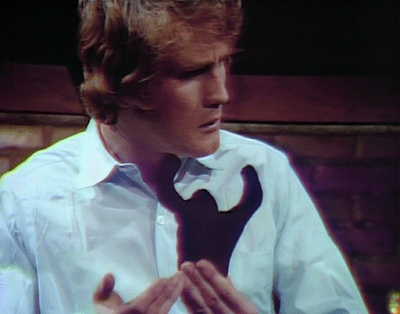
Episode 915: Emergency Leviathan Broadcast

In #701, old world gentleman Barnabas Collins traveled in time from 1969 to 1897. For the next eight months, ending in #884, Dark Shadows was a costume drama set in that year. On his way back to a contemporary setting, Barnabas took a detour to the 1790s, when he was a vampire. Before he left the 1790s, he was abducted by and absorbed into a cult that serves supernatural beings known as the Leviathans. At their behest, he took a small wooden box with him to November, 1969, and functioned as one of the leaders of the Leviathan cult in that period.

The first six weeks of the Leviathan story has had its strengths. Ever since Barnabas was first cured of vampirism in March 1969, he has been under the impression that he was a good guy and has been doing battle with various supernatural menaces. He was hopelessly inept at this, and created as much work for the other characters by his attempts at virtue as he formerly did in his unyielding evil. That has made him a tremendously productive member of the cast, but it does leave him with a tendency to seem harmless, even when he is trying to murder his way out of a problem. But Barnabas the Leviathan chief has been ice-cold and formidably efficient. Even though not much has yet been done to hurt anyone, seeing him in this mode adds a note of terror to the proceedings.

Moreover, the Leviathans have voided Barnabas’ friendship with mad scientist Julia Hoffman. Since the relationship between the two of them has been the heart of the show for over two years now, from the hostility of their early days to the close bond they formed in the summer of 1968, this reinvigorates the action. It is as interesting to see them fight with each other as it is to see them collaborate against a common foe, and their hate scenes gain an extra depth because we keep wondering about their eventual reconciliation. If they play their cards right, they should be able to keep this up for months.

Today, it all falls apart. Barnabas has drawn a huge following of very young fans who run home from elementary school to watch the show. The 1897 segment was a triumph in large part because it had a core of stories that could hold the attention of adults while also appealing to the preteen demographic. But the Leviathan arc has so far had little to offer anyone but grownups. Apparently the kids were writing angry letters, because this episode, rushed into production at the last minute and bearing signs of haste in every shot, turns Barnabas back into the would-be hero who was such a klutz that he couldn’t even stay in the right century.

The creature who emerged from the box Barnabas brought from the past now appears to be a 13 year old boy and answers to the name Michael. In the opening scene, Michael orders Barnabas to kill Julia. Barnabas declares that he will not, and goes home. There, he tells his troubles to the box, then falls asleep in his chair.

A hooded figure appears to him. This hooded figure says that he is a Leviathan, and tells Barnabas he must comply with Michael’s commands. The Leviathan is not named in the dialogue and there are no actors’ credits at the end, but reference works based on the original paperwork call him Adlar.

Adlar sets out to explain Barnabas’ position, much as Marley’s ghost did to Scrooge in Dickens’ A Christmas Carol. The shortened production schedule shows in inconsistencies that litter Adlar’s speeches. At one point he says that the Leviathans needed Barnabas to transport the box from the eighteenth century to the twentieth; at another, he claims that they are holding his lost love Josette prisoner in the eighteenth century and will inflict a new, far more horrible death on her than the one she died the last time Barnabas was in the 1790s, a threat they will be able to carry out only if they have their own means of traveling back and forth through the years. Barnabas doesn’t pick up on this or any of Adlar’s other inconsistencies; perhaps he is too distracted by the many jump cuts that make this episode look like the videotape was edited with a rusty butter knife.

Adlar threatens to make Barnabas a vampire again, then disappears. He does not tell him that he will be visited by three spirits, one representing his past, another his present, and the third the future he is risking by his present course of action, but this is in fact what happens. Barnabas goes outside, and sees a bat. It was a bat whom he first saw on this very spot who initially made him a vampire. Barnabas rushes inside, looks in the mirror, and does not see a reflection. He thinks of his mouth, and feels fangs growing there.

Next comes Megan Todd, a Leviathan cultist who with her husband Philip is fostering Michael in their home. Barnabas cannot take his eyes off Megan’s long white neck. Megan keeps telling Barnabas that he is the only one she can confide in about her concerns with the progress of the Leviathan plan; he keeps demanding ever more stridently that she leave at once. His bloodlust may explain why he doesn’t notice the continuity problem in the scene. They’ve made the point time and again that it is only while Barnabas is giving orders to her and Philip that Megan remembers that he is their leader. At other times, she thinks he is an outsider. But Megan is the only one who can tell Barnabas a story of family life in any way paralleling that which the Ghost of Christmas Present brings to Scrooge’s attention at the Cratchit house. Continuity has to go if the episode is going to fit into the form of A Christmas Carol.

Suddenly, Barnabas finds himself in an alley by the waterfront. A sign behind him says that he is next to the Greenfield Inn; we saw this sign in #439, set in the year 1796. Evidently the Greenfield Inn is a long-established, though not very reputable, place of lodging.

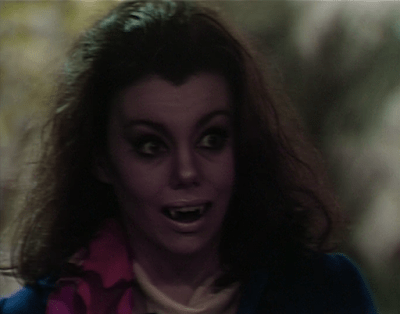
A woman approaches him. She is very aggressive about insisting he take her with him wherever he is going. He is reluctant at first, urging her to seek friends at the Blue Whale tavern, but she won’t take no for an answer. All of a sudden, he brightens and looks at her with desire. She says she is afraid of him. He asks if she wants to go, and she screws up her courage to declare that she will stay with him. He bares his fangs and attacks. The rough videotape editing adds to the violence of the scene. There is no sensuous bite, only a flash as he lunges at her and then is standing up again, protesting that he didn’t want to do it. When the camera zooms in on the bleeding marks on her neck, it is surprising to see that he didn’t rip her throat out altogether.

We cut back to Barnabas’ house. He is dozing in his chair, and the woman, displaying vampire fangs of her own, walks in through the front door. She approaches Barnabas. He awakens, and is horrified. Adlar tells Barnabas that “she is not up to your usual standards.” She’s standing right there, that’s pretty tactless. Also, she is future four-time Academy Award nominee Marsha Mason. The only other Oscar nominee Barnabas bit was Grayson Hall as Josette’s aunt, the Countess DuPrés, in #886. Hall was only nominated once, so if anything this woman is a step up for him.

Four time Academy Award Nominee Marsha Mason. Screenshot by Dark Shadows Before I Die.

Adlar makes the woman disappear, and shows Barnabas that he is not really a vampire again. With that, we see that she is a shade of a future that may come to be, not one that is already ordained. Adlar also tells Barnabas that it is not now necessary to kill Julia. But he does say that Barnabas will have to do something to ensure Julia’s silence, or else Josette will suffer. Barnabas hangs his head and says to the mirror that he has no choice to obey.

Episode 911: I might forget I’m dead

The Story So Far

In December 1968, children David Collins and Amy Jennings explored the long-deserted west wing of their home, the great house on the estate of Collinwood. They stirred up the ghost of Quentin Collins, who turned out to be David’s great-great uncle and Amy’s great-grandfather. For the next several weeks, Quentin steadily gained power and wrought ever graver havoc, until by the end of February the great house had become uninhabitable and David was hovering between life and death. At that point, David and Amy’s distant cousin Barnabas Collins did some mumbo-jumbo to try to contact Quentin’s ghost, only to come unstuck in time and find himself in the year 1897, when Quentin was a living being.

For the next eight months, Dark Shadows was primarily a costume drama set in 1897. Occasional glimpses of 1969 showed us that the haunting was continuing. In #839, we saw David lying dead before his father Roger, finally having succumbed to the effects of the haunting. But while Roger was lamenting him, David came back to life. The events in the part of the episode set in 1897 had changed the future, so that the ghost of Quentin found peace and Collinwood returned to its usual condition. But that took effect as of the anniversary of the change. Everyone’s memories of the ten months of Quentin’s haunting and of the eight months of Barnabas’ absence in the past are intact.

Not only is Quentin no longer a ghost, he isn’t even dead. In the altered version of 1897 that we saw, an artist named Charles Delaware Tate painted a portrait of Quentin that had the same magical effects on him that Dorian Gray’s portrait had in Oscar Wilde’s novel. Quentin looks, moves, and sounds exactly like he did when he was 28 years old. He has recently returned to Collinsport, and has amnesia. He was found carrying identity papers in the name of Grant Douglas. He’s open to the possibility that that may not be his right name, but when he finds Dr Julia Hoffman, MD trying to convince him he is the 99 year old Quentin, he is incredulous.

At Collinwood

We open today in Quentin’s old room in the west wing. Julia has persuaded Quentin to sit there and listen to his record player. In the unaltered timeline, he was obsessed with a sickly little waltz, listening to it over and over in 1897 and inflicting it on Collinwood when he was a ghost. Julia plays the record, and it doesn’t mean a thing to him. She becomes frustrated and accuses him of lying when he says that he doesn’t remember that he is Quentin.

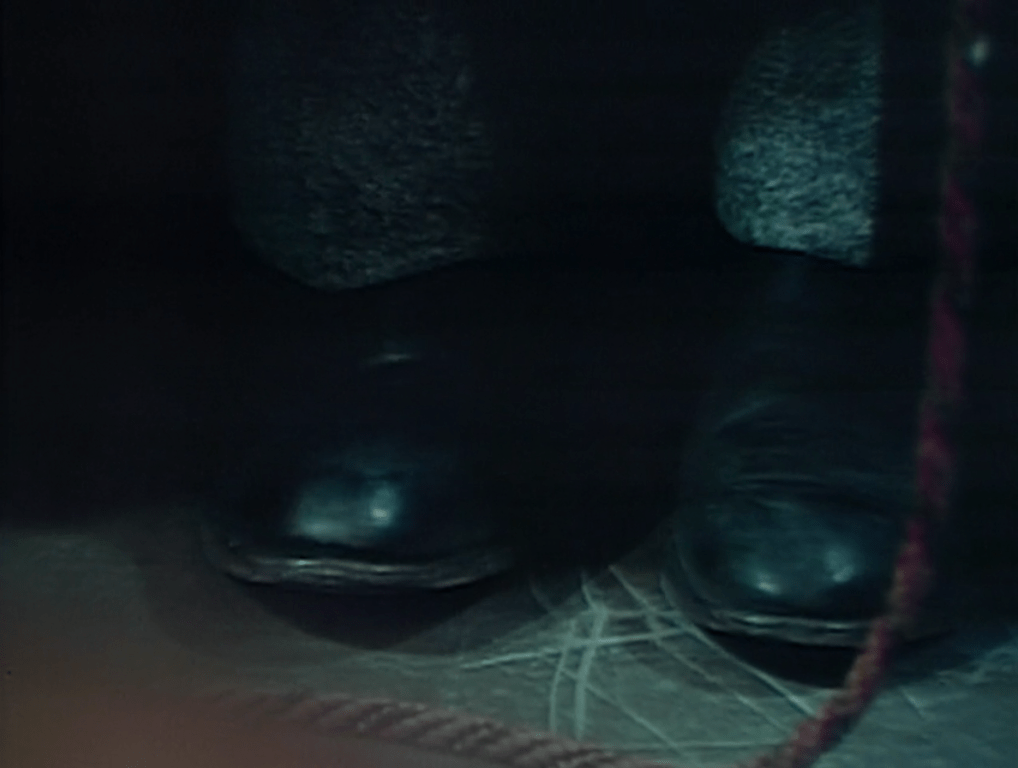
The music does ring a bell for someone else in the house. The sound of it reaches David and wakes him. Alarmed, he makes his way to Quentin’s room. By the time he gets there, Quentin is hiding behind a curtain. Julia tells David she went in to look for a painting, and that she thoughtlessly started the record player. He accuses her of hiding Quentin. While she is denying it, he sees Quentin’s shoes sticking out from under the curtain.

Quentin’s shoes, as seen by David.

In 1963, philosopher Edmund Gettier published a little paper about the traditional definition of knowledge as “justified true belief.” He gave several examples of justified true beliefs that most people would not regard as knowledge. His examples were kind of far-fetched, but it is easy to come up with more plausible instances. For example, I first read Gettier’s paper when I was in college, and at the same time I was reading Anthony Trollope’s novel The Eustace Diamonds. The main point of that novel is that everyone believes that Lizzie Greystock has stolen some diamonds from her late husband’s estate. She has in fact done so, and they have good reason for believing that she did so, but those reasons are so mixed up with misunderstandings of Lizzie’s motives and other circumstances that we wouldn’t say any of them really knows anything about her. My epistemology professor was excited when I told her about the novel, since the example she gave to our class to show that Gettier’s contrivances were not the only cases illustrating his point was something overly elaborate about believing that you have recognized someone whom you have partially seen while he is hiding most of himself behind a curtain.

David’s claim that Julia is hiding Quentin is another Gettier case. He believes it, the sight of Quentin’s shoes in Quentin’s room provides compelling justification for believing it, and it is true. Yet the Quentin whom Julia is hiding does not have any of the characteristics that give David’s belief the significance that he draws from it. His presence is not a sign that the haunting has resumed and that David is back in mortal danger. He is not a ghost at all and is not a threat to David or anyone else in the house. So while David has a justified true belief that Julia is hiding Quentin, that belief is so deeply entangled with a severe misunderstanding of the situation that we wouldn’t count it as knowledge.

Once David is gone, Quentin emerges and demands answers from Julia. She tells him something about Quentin’s ghost; he already finds her insistence that he is 99 years old to be so preposterous that the additional detail that he used to be dead prompts a merry laugh. By the time he is at the front door ready to leave, he is stern and telling Julia that he expects a “full explanation” tomorrow. Lotsa luck on that- ghosts, time travel, magical portraits, and a universe where the present is a stew made up of the consequences of several mutually incompatible pasts? And those are just the elements you can’t avoid in the executive summary of the situation. A “full explanation” involves werewolves, vampires, a humanoid Phoenix bent on incinerating her children, demons conjured from the depths of Hell, a sorcerer who still misses his pet unicorn, and about a thousand other fantastical topics.

David eavesdrops on Quentin and Julia’s parting conversation. When he was a ghost, we never heard Quentin speak- he communicated telepathically with David and Amy, and they could apparently hear his voice on a particular telephone, but he never stood around and talked with anyone like this. So the mere fact of the conversation undermines David’s belief that the man he is looking at is Quentin’s ghost. When David hears Julia call Quentin “Mr Douglas,” he can see that whoever this person may be, he is not exactly Quentin, not as he knew him. He does recognize the name “Mr Douglas” as that of a man his cousin Carolyn Stoddard met at the antique shop in the village where she works and whom she visited in the hospital when he first had amnesia, so his attitude towards him changes.

In the Antique Store

Unknown to Julia or Carolyn, David has been assimilated to a cult that serves unseen supernatural beings known as the Leviathans. Carolyn’s mother, Elizabeth Collins Stoddard, has also been absorbed into the cult, as has Barnabas. Megan and Philip Todd, the owners of the antique store, are members too, and they are fostering a mysterious creature who currently appears to be an eight year old boy and answers to the name Alexander. Liz takes David and Amy to the antique store, where they interrupt an uncomfortable conversation between Alexander and Julia.

Liz suggests to Julia that they should leave Amy and David in the store to play with Alexander. Julia doesn’t think this is such a hot idea, but Liz insists.

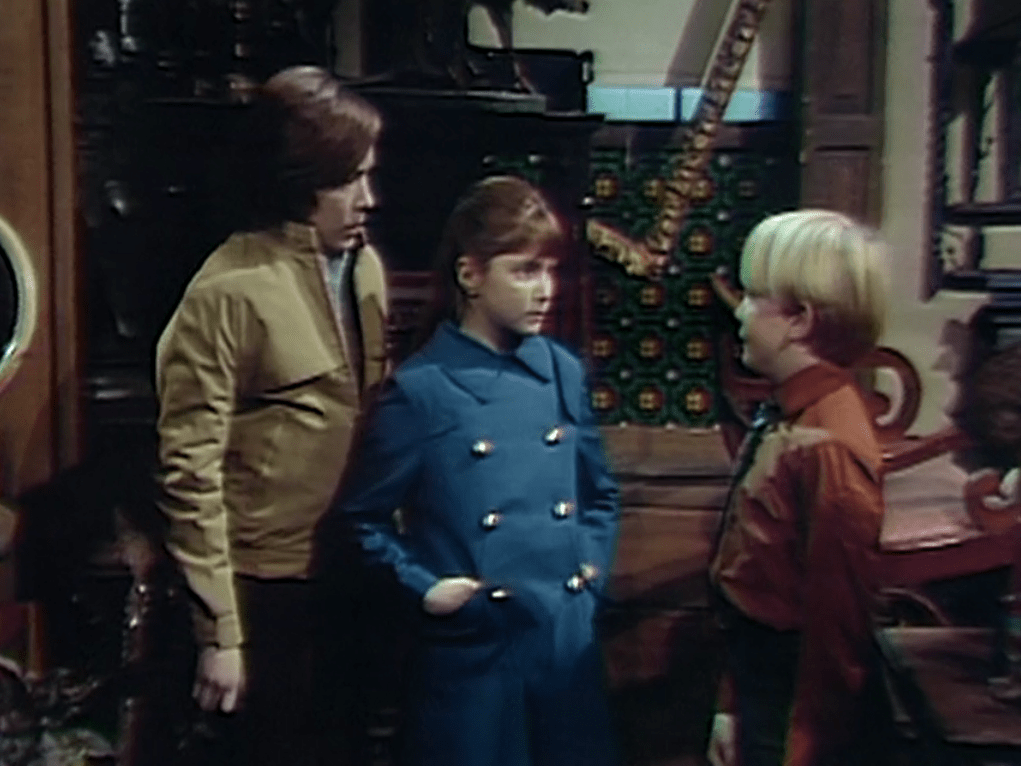
We then have the first scene on Dark Shadows populated by three child actors. It was a breakthrough when the ten year old David played with the ghost of nine year old Sarah Collins in the spring and summer of 1967; their scenes, the first interaction between children on Dark Shadows, advanced it towards becoming a kids’ show. David had up to that point been the only child on the show. He was first a homicidal monster who threatened the adults, then a figure threatened by his mother Laura and in need of rescue. When we saw him with Sarah, the two of them built a relationship that was of importance in itself and that had consequences which grew to dominate the story, leading directly to the show’s first time travel segment in November 1967. In David and Sarah, the fans running home from elementary school to watch the show could see characters their own age driving the action.

The current phase has been very heavy in adult interest. This first three-scene among children might be expected to take us back to territory Sarah and David did so much to open, but it does nothing of the kind. The three children do not really interact with each other at all. David is under the control of the Leviathans, Alexander is a manifestation of their power, and Amy is at a loss to figure out what’s going on. The forces motivating the action are not on screen, any more than they would be if the boys’ parts were played by marionettes.

David, Amy, and Alexander

Amy finds that Alexander has a photograph of Carolyn as she was when she was eight. She realizes that he stole it from a photo album at Collinwood. She declares that she will take it back to the house. Alexander forbids her to do so, and David takes his side. Amy is puzzled by David’s attitude. David threatens to sic Quentin on her. That shakes her up, but she says that Quentin is gone. David says he isn’t, and he and Alexander force her to play hide and seek. Once she is out of the room, David tells Alexander to keep her away for a couple of minutes. He telephones “Grant Douglas” and asks him to come to the shop to pick up a book he left there.

Amy comes back just in time to see and recognize Quentin. She runs upstairs and goes into the room which belongs to Alexander. She hears a heavy breathing there and sees something that terrifies her. Returning viewers know that what she saw was some inhuman thing that is of the Leviathans.

For his part, David is quite calm with “Grant.” Though we saw at the beginning that his connection to the Leviathans has not removed his fear of Quentin, he has reached the conclusion that he doesn’t need to be afraid of “Grant Douglas.” Maybe he thinks that someone using the names of two such prominent Canadians can’t be all bad. He gives Quentin the book and assures him Amy will be all right.

Quentin accepts David’s assurance, but we cannot. Amy is absent from the cast for long periods, and is usually unmentioned during those intervals. The same was true of Nora Collins, the character Denise Nickerson played in the 1897 segment. The show seems to be deliberately telling us not to get used to having this fine young actress in the cast. And the Leviathans haven’t done anything truly horrible yet- they are due to murder a character we really like. So it is quite possible we will tune in tomorrow and find that Amy is dead. Again, the contrast with the David and Sarah story is telling. David Henesy was a core member of the cast from the first week of the show, and the ghost of Sarah was a key part of the show for months. Dark Shadows was as much their show as it was that of any of the adults on screen. Keeping both Amy and Denise Nickerson at the margins, they make it clear that the kids are going to be taking a back seat.

David Henesy and Denise Nickerson were both highly capable performers, but eight year old David Jay just stands on his mark and shouts his lines. That need not have been a problem. Alexander has only been in human form for a week or two, so we don’t expect subtlety from him, and to the extent that he sounds like a real child he is supposed to be a vicious little bully trying to figure out what he can get away with. Such children often do put on acts and sound awkward, so Mr Jay’s professional ineptitude dovetails with the requirements of his part. That’s similar to the way Sharon Smyth’s limitations fit with the part of Sarah. We were supposed to be unsure whether Sarah knew that she was a ghost, whether she knew what year it was, and what if anything she remembered from one appearance to the next. Since Miss Smyth* was, as she says now, “clueless” about the craft of acting, she did a great job keeping us guessing. Later we saw Sarah as a living being, and Miss Smyth’s performance was less satisfactory. We know that Alexander is likely to transform into a shape that is not compatible with David Jay soon, so his shortcomings aren’t a particular concern. But again, the fact that Alexander comes with an expiration date keeps us from regarding him as one of the main characters.

The Store Room

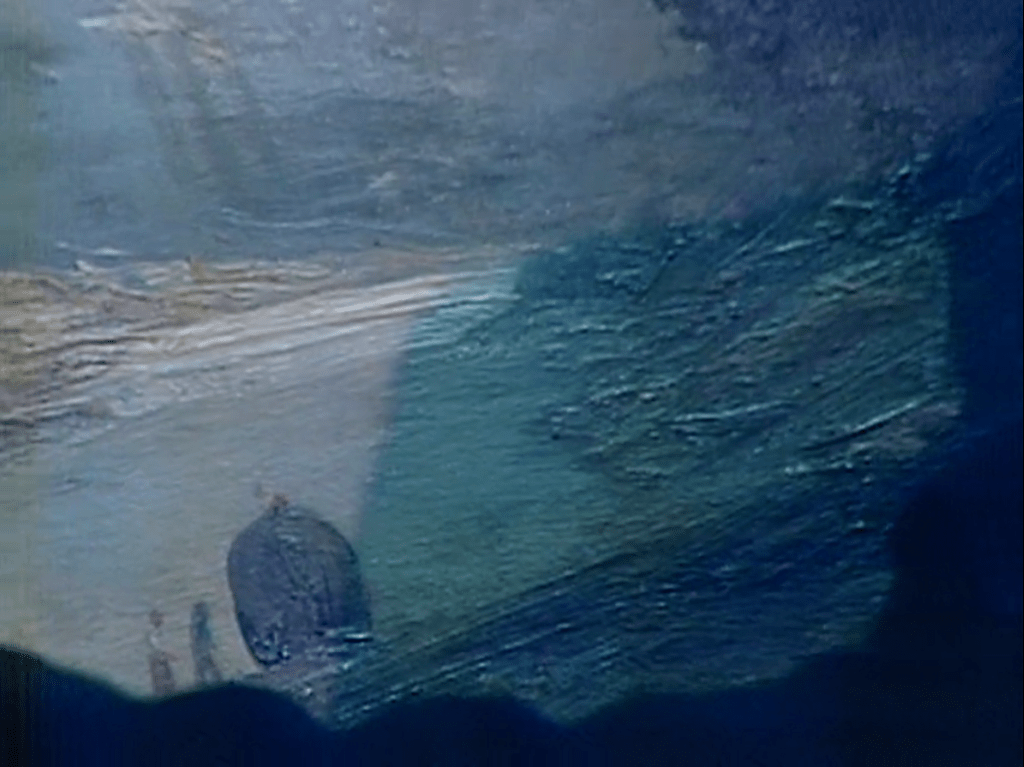
While the kids were alone in the antique shop, Liz took Julia to a store room in the west wing of Collinwood to show her some photographs she had been asking about. While there, they come upon a painting. Liz says that she bought it about a year before at a charity auction, and that when her brother Roger saw how lousy it was he said he hoped that it was a worthy cause. She took it directly to the store room. It is signed “Harrison Monroe” and dated 1968. We will learn tomorrow that it depicts a place called Indian Hill. Julia recognizes the painting as extremely similar to an equally undistinguished landscape she bought a few weeks ago.

Detail from “A View of Indian Hill,” Harrison Monroe, 1968.

That painting was the work of Charles Delaware Tate, executed about 20 years previously. That Tate had been alive and working as recently as that gave Julia the hope that he might still be around and able to help a friend of hers who has problems. Yesterday, an expert called on to remove the landscape and reveal the portrait underneath it said that Tate died in 1959. But this painting is apparently the product of the same hand. Julia hopes that “Harrison Monroe” is a pseudonym of Tate’s.

It has been clear to the audience ever since Julia found the first painting that Tate would be back. That can’t be welcome news to many people. Like all characters played by Roger Davis, Tate is a loathsome man who shouts his lines and assaults his scene partners. So this pseudonym, as strongly redolent of old Virginia as “Grant Douglas” is of twentieth century Canada, will bring a sinking feeling to much of the audience. Our reprieve that began when we left Tate in the nineteenth century five weeks ago cannot last much longer.

*Her name is Mrs Lentz nowadays, but that’s an odd title to give a nine year old. So I refer to her as Miss Smyth.

Episode 908: Mollycoddle that monster

The current phase of Dark Shadows is focused on the threat to the human race posed by the Leviathans, unseen supernatural beings who have taken control of several characters on the show. Among their devoted servants are matriarch Elizabeth Collins Stoddard and her nephew, strange and troubled boy David Collins. Today, Liz and David welcome a boy known as Alexander to the great house of Collinwood. Alexander appears to be an eight year old boy, but is in fact an extreme case of Soap Opera Rapid Aging Syndrome. Last week he was an infant, and a few days before a whistling sound coming from a wooden box. Whatever Alexander may really be, he holds a key position in the Leviathans’ plan.

At times, Dark Shadows becomes so much a kids’ show that it loses much of its adult audience. The Leviathan story so far has gone to the opposite extreme. A scene in which Alexander orders the thirteen year old David to give up the transistor radio he had long wanted and that his father just gave him will probably get similar reactions from viewers of all ages, but when Alexander scolds Liz for asking questions and she apologizes, only those who remember Joan Bennett as the great star she was in the late 1930s and early 1940s will get the full force of the moment. In general, adults will probably feel the distress Alexander’s tyranny is supposed to induce, while the fans who are running home from elementary school to watch the show will likely be either annoyed with the kid or amused to see the grownups getting theirs.

Liz’ ex-husband Paul is being persecuted by the Leviathans and their human agents. Paul is staying at Collinwood, and he is outraged to find Alexander in the house. Paul carries on like a crazy man, prompting Liz to tell him that if he doesn’t compose himself he will end up in a mental hospital. He tells Maggie Evans, David’s governess, about his suspicions; she listens sympathetically until he catches Alexander eavesdropping and roughs the boy up. Maggie then freezes in horror, and Paul goes on shaking Alexander and yelling at him until Liz enters and puts a stop to it. While Liz and Maggie stand in the corridor and talk about Paul’s lunatic behavior, he paces in the drawing room, telling himself that he mustn’t “fly off the handle” again.

David enters and hands Paul a small photo album. He says that it has pictures of Paul and Liz’ daughter Carolyn when she was a child. Since Paul wasn’t around when Carolyn was growing up, David says it occurred to him that Paul might want to look through it. Paul thanks David for his thoughtfulness.

As Paul leafs through the album, we get a look at a picture depicting Carolyn as she was when she was about ten. We haven’t seen the model before. Dark Shadows had such a tight budget that regular viewers will be fairly sure they wouldn’t have brought a girl in only to pose for a single photograph, so we might start wondering when we will meet the ten year old Carolyn.

Child Carolyn. Screenshot by Dark Shadows Before I Die.

We may also be wondering when we will see another girl of about the same age. Denise Nickerson, twelve years old in December 1969, has been in the cast for a year at this point, and has made major contributions every time we’ve seen her. We saw in #893 and #896 that her character Amy Jennings is still living at Collinwood and is still David’s chief playmate. But as is usual in episodes where she does not appear, Amy is unmentioned today. Liz tells Paul that David spends entirely too much time surrounded by adults, as if Amy does not exist. They followed the same pattern during the eight months of 1969 when Dark Shadows was set in 1897 and Nickerson played nine year old Nora Collins. When Nora was in the episode, she was often its brightest spot, but when she wasn’t her name never came up. It’s unnerving that the show does so little to reassure us that it will continue to make use of such a talented and appealing young actress.

Alexander sits on the bench that has been in the foyer at Collinwood throughout the whole series. The Dark Shadows wiki says this is only the second time the bench has been used. I want to say it is the third- I remember David sitting there in #176, when Maggie’s predecessor Vicki told him he could have two desserts, cake and ice cream, but I seem to recall either him or someone else sitting there at some point around that time. I’m not going to go back through those episodes to check, but if you’ve been watching them I’d appreciate it if you’d leave a note in the comments.

Episode 899: How well I remember that charm of yours

When Dark Shadows debuted in June 1966, matriarch Elizabeth Collins Stoddard (Joan Bennett) had not left the estate of Collinwood in eighteen years. We soon gathered that Liz was afraid that if she strayed far from the house someone might open the locked room in the basement and discover that her husband Paul was buried there, dead of a blow she dealt him when he was trying to run off with a chunk of her patrimony.

Liz’ reclusiveness was a major theme of Dark Shadows‘ first 55 weeks. After the show committed itself to becoming a supernatural thriller with the story of Laura the humanoid Phoenix, which ran from December 1966 to March 1967, they brought in Paul’s old friend and partner in crime Jason McGuire (Dennis Patrick) as an in-betweener to sweep away the few miscellaneous this-worldly narrative threads not already subsumed in the Laura story and to help introduce the next uncanny Big Bad, vampire Barnabas Collins.

It turned out Jason was the one who agreed to bury Paul for Liz, in return for the money Paul had been trying to steal from her. Upon his return to Collinwood, Jason blackmailed Liz with this information. Time and again she caved in to his demands. Liz let him stay in the great house, gave him money, hired him for a lucrative non-job in the family business, let his rapey sidekick Willie Loomis stay in a room just down the hall from those occupied by her daughter Carolyn Stoddard and her all-but-acknowledged daughter, well-meaning governess Victoria Winters, and was in the middle of a wedding ceremony meant to unite her with Jason when she finally burst out with the truth. When she did that, Carolyn dropped the loaded pistol with which she had planned to prevent Jason becoming her stepfather. For his part, Jason said that Paul wasn’t dead, and that he hadn’t buried him. Perhaps the whole thing started when Jason said “cranberry sauce,” and Liz misheard it as “I buried Paul.” With that, the wedding was off, and a few days later Barnabas killed Jason. Since Jason was on his way out of town and had no friends left, no one missed him. He has barely been mentioned since.

Now, Paul himself has come back. Like Jason, he is played by Dennis Patrick. He has charmed Carolyn into thinking he had nothing to do with faking his own death, and she is falling over herself in her eagerness to establish a relationship with the father who left the family when she was an infant. Carolyn and Liz are on their way out the front door of the great house, heading to a committee in charge of raising funds for the hospital, when the phone rings. It is Paul, asking Carolyn to come to his hotel room at once. She agrees. She gives her mother a vague excuse, irking her, and the women leave the house separately.

In the hotel room, Paul tells Carolyn that he is in some kind of trouble that he can’t explain. Someone is trying to do something terrible to him, but he does not know who or what. Carolyn takes a firm tone when she urges him to tell her what he does know, and when she tells him that whatever is happening she will help him.

Father and daughter embrace, and Liz enters. She is furious to see Paul. She demands Carolyn leave the room. Only when Paul says that he and Liz need a moment together does Carolyn comply. The ex-spouses have a confrontation in which Liz gets to voice her righteous indignation with Paul. She tells him that she expects him to be on the next train out of town. She lists some of the people she will call if he isn’t. Among these is the proprietor of the hotel, who will presumably throw him out in the street at her behest.

In its first months, Dark Shadows tended to attract an aging audience, largely composed of people who still thought of Joan Bennett as the star she was in the late 1930s and early 1940s. Now, with its cast of vampires and werewolves and witches and ghosts and zombies and mad scientists and heaven knows what, it is more of a kid’s show. By the end of the costume drama segment set in the year 1897 that ran from March to November of 1969, viewers over the age of twelve would find themselves reacting to more and more episodes with little more than an indulgent chuckle.

Now that they have returned to contemporary dress, they have swung sharply back towards an adult audience. Carolyn was supposed to be a teenager when the show started; Nancy Barrett was significantly older than the character, and they let Carolyn catch up to her age after a while. But having her spend her evenings serving alongside her mother on the hospital’s fundraising board suggests that they’ve aged her up quite a bit further than that, foreclosing any youth-oriented stories. The conventionally soapy situation the Stoddards find themselves in today is of course something that will be of little interest to the elementary school students who are running home to see the show at this period. And while the main overall story is supernatural, about a cult controlled by unseen beings called the Leviathans that assimilates to itself one character after another, it is understated in tone, allegorical in development, and densely allusive in its relation to its literary antecedents. However many older viewers the show may have lost in the second half of the 1897 segment, they are in danger of shaking off an even larger number of their very young fans if they continue down this road.

In Art Wallace’s original story bible for Dark Shadows, titled “Shadows on the Wall,” the blackmail story was to be followed immediately by Paul’s return. Wallace called for Paul to be a man pursued by dark forces from his past. They made major changes to “Shadows on the Wall” long before they taped the first episode, and it has been almost entirely forgotten for years now. Indeed writer Ron Sproat, who was with the show from October 1966 to January 1969, said that executive producer Dan Curtis told him when he joined the staff that they were going to be leaving “Shadows on the Wall” behind and never let him see it. But they did dip into it in the case of Paul’s return- he is indeed being pursued by dark forces from his past. The Leviathan cult is after him.

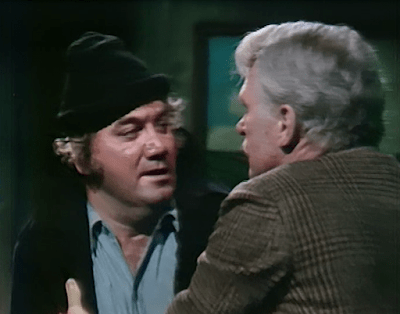
After his confrontation with Liz, we see Paul sitting at the bar in the Blue Whale tavern. The jukebox plays a tune familiar from the early days of the show, when the Blue Whale was a frequent set and there were usually extras dancing in the background. Today the only people we see there are Paul and a middle aged sailor sitting next to him.

The sailor keeps looking at Paul. We hear Paul’s thoughts as he wonders if the sailor is “one of them.” Paul irritably asks him why he is looking at him. The sailor says that he wants to buy Paul a drink. Paul angrily snaps back that “I buy my own drinks!” After some sharp words, the two men warm to each other. They wind up getting handsy with each other and disappear for some private time together.

Paul and his new fella. Screenshot by Dark Shadows Before I Die.

This scene turns out to be motivated by the two men’s mutual awareness of the Leviathan cult. Over the years, I’ve seen lots of guys in bars interact with each other in exactly this way. I don’t know what that’s all about, maybe the Leviathans are real.

Since I mentioned “Shadows on the Wall” above, I should say that the tavern figures in there as well. Only it isn’t called “The Blue Whale,” but “The Rainbow Bar.” I don’t know, somehow I think Paul and the sailor might not have got off to such a rocky start if the show had gone with that name. Sounds friendlier, somehow, at least to lonesome sailors and the mature men for whom they want to buy drinks.

Paul’s new buddy, unnamed in the dialogue, is identified in the closing credits as “Jack Long.” He is played by Kenneth McMillan, in his first screen credit. In the 1970s and 1980s, McMillan was one of the busiest television actors in the USA. I always mixed him up with Dolph Sweet, who was a similar physical type. Sweet appeared on Dark Shadows once, in #99. He played Ezra Hearne, the most loyal employee at Liz’ cannery. Sweet was a tremendous actor, McMillan a very good one, and they occasionally worked together. So long as they are doing normal soap opera stuff, it would have been nice if they could have had a little story about Ezra’s reunion with his long-lost cousin Jack. Maybe Jack could have introduced Paul to Ezra, we could have seen how he’d fit in with the family.

In place of episode 801: Periodization again

No episode of Dark Shadows premiered 56 years ago this afternoon; the show was preempted by ABC-TV’s coverage of the Apollo 11 mission. That mission included the first steps taken by humans on the surface of the Moon, at a site 25 kilometers south of a crater then known as Sabine D. The following year, Sabine D was renamed Collins. That was not an attempt to console Dark Shadows fans for the trauma of a Monday spent away from Barnabas and his relatives, but was an honor given to United States Air Force officer Michael Collins, Command Module pilot on Apollo 11. Moreover, the nearby crater named Moltke was not named for Alexandra Moltke Isles, who played well-meaning governess Vicki in 333 episodes of Dark Shadows, but for her distant cousin Count Helmuth von Moltke the Elder, who died in 1891 and never appeared on the show (as far as we can tell.)

Photo courtesy of Sky and Telescope.

These changes to the map of the Moon remind me that, on this 56th anniversary watch-through, I’ve been revising my mental map of the show’s development. I used to divide it into chunks with labels like “Meet Vicki,” “Meet Matthew,” “Meet Laura,” “Meet Barnabas,” “Meet Julia,” “Meet Angelique,” and so on. In that scheme, this 161st week is an early part of the chunk I would have called “Meet Petofi.” I still see that the show defaults to having a main character, but now I think in terms of larger units. I also tend to focus more on the writing staff than on the central characters. So the first 38 weeks drew their vitality from the story of Vicki’s attempt to befriend strange and troubled boy David, a story which reached its conclusion at the end of the Phoenix tale, when David chose Vicki and life over his mother and death. That was Dark Shadows version 1.0, and I subdivide it less into the parts driven by Vicki, Matthew, and Laura than into the parts written by Art Wallace alone, by Wallace in alternation with Francis Swann, and by Ron Sproat and Malcolm Marmorstein with uncredited contributions by Joe Caldwell.

Dark Shadows 2.0 ran from March to November 1967, and its most interesting theme was vampire Barnabas Collins’ attempt to pass himself off as a living man native to the twentieth century. The first part of this, written by Sproat and Marmorstein, was even more slow-paced than were the first 38 weeks. Caldwell was credited with a number of scripts from May through October, Gordon Russell joined the staff in July, Marmorstein was fired in August, and Sam Hall replaced Caldwell in November. With each of those changes, the pace picked up and the overall quality of the scripts improved noticeably. There was also a shift in story in the middle of this period, as mad scientist Julia Hoffman teamed up with Barnabas in an attempt to physically transform him into a human, shifting his masquerade from an acting job to a medical problem.

Dark Shadows 3.0 ran from November 1967 to March 1968. This was a costume drama set in the 1790s, an era to which Vicki had traveled when she came unstuck in time while participating in a séance. It seemed at first that it would invert the 1967 story, with Vicki trying to pass herself off as a native in the time to which Barnabas actually belonged, but for some reason they chose to write Vicki as a screaming ninny during this segment. Mrs Isles made a valiant effort to overcome the painfully dumb lines she was given, but by the end of it, the character was no longer sustainable.

Barnabas was a human through the first half of Dark Shadows 3.0, and a vampire for the second half. That alternation answered three questions, each of which opened a door for further development.

First, the audience wanted to see how Barnabas became a bloodsucking ghoul. When they showed this happening in the course of his relationship with wicked witch Angelique, they laid the groundwork for more stories involving her.

Second, the audience wanted to see what Barnabas was like in his lifetime. When they showed this, they proved that he didn’t have to be a vampire to be interesting, and made it possible for Julia’s experiment or some other effort to free him of the effects of the curse to succeed.

Third, the audience wanted to see what Barnabas would be like if he were as deadly as one might expect a vampire to be. In the whole of 1967, Barnabas killed only two characters, each of them a middle aged man who had run out of story and seemed likely to disappear anyway. But he kills seven people in 1795-1796, not counting people who died of fright or confusion or despair as a result of seeing him.

When it was set in contemporary times, Dark Shadows was careful to keep its characters alive. They need to fill 22 minutes a day with conversations, and if they end up with Barnabas alone on the estate of Collinwood those will get to be rather one-sided. But since they were not committed to staying in the 1790s, they could let him slaughter people with abandon. That created a fast pace that the show tried to maintain for the rest of its time on the air. In consequence of that pace, by the end of the 1790s segment the show had left behind its origins as a Gothic romance appealing to an older demographic who were impressed that Joan Bennett was in the cast and had become a kids’ show.

Vicki returned to 1968 in #461, but Dark Shadows 3.0 did not end at that moment. Vicki came back to exactly the same collection of narrative dead-ends the show had gone to the eighteenth century to escape. It wasn’t until #466 that Barnabas found that he had been cured of vampirism- not by Julia, but by another mad scientist. That set the tone for Dark Shadows 4.0. Version 2.0 may have been content with one mad scientist, but 4.0 needed at least two, in addition to multiple witches, Frankensteins, vampires, ghosts, an invisible man, and, if not the Devil himself, at least one of the assistant managers of his upper New England operations. The fast pace of the 1790s segment turned into a frantic dash through this Monster Mash era.

In the course of Dark Shadows 4.0, there were four personnel changes that had especially profound effects. Two were in the cast. At the end of the segment, Mrs Isles left the role of Vicki, never to return to the show. Though Vicki had been pushed to the margins long before, she was so strongly associated with the first phase of Dark Shadows that every time she appeared on screen she made a connection with those early days. With her departure, that link is broken.

Thayer David, who had played crazed handyman Matthew Morgan in 1966 and much-put-upon indentured servant Ben Stokes in the 1790s segment, returned in 1968 as Ben’s descendant, occult expert Timothy Eliot Stokes. Ben was a commentary on Matthew, an example of what he might have been had he not grown up in a community under the somber mark of the Collinses and the many curses they bear. As such, David was like the rest of the cast for the 1790s, playing a character who shed light on the part he took in contemporary dress. But as Stokes, he is playing a man who has no direct connection to Matthew, and little connection to Ben. With that doubling, we see that any performer might return to the cast in a new role at any point in the story.

The other personnel changes during Dark Shadows 4.0 took place behind the camera. Ron Sproat ended his duties as a regular member of the writing staff late in that period, and left the show altogether shortly after. Sproat was the most devoted to conventional soapcraft of all the writers, and was the only one who consistently took care to keep the show comprehensible to first-time viewers. But he didn’t have an especially fertile imagination for story points or for clever dialogue. As Hall and Russell hit their stride and really started cooking, Sproat’s relative weakness became impossible to ignore. The show entered its most exciting phase when Sproat left, but his absence would later be felt at times when the staff tried to keep the story moving at a breakneck pace even when they were too fatigued to make sure it all made some kind of sense.

The least remarked of all the personnel changes was the departure of director John Sedwick. Sedwick was an outstanding visual artist, the equal of his colleague Lela Swift. Swift stayed with the show to the end, eventually combining the role of producer with responsibility for directing half the episodes. But after several men helmed a few episodes each, they settled on the lamentable Henry Kaplan as her alternate in the director’s chair. Kaplan was a famously poor director of actors, and the visual compositions he knew how to orchestrate ran the gamut from closeup to extreme closeup to even more extreme closeup. Dark Shadows was never all that easy for first-time viewers to take seriously, and when you tune in to one of Kaplan’s efforts you’re likely to dismiss it before you hear a word of dialogue.

As Dark Shadows 3.0 didn’t end until the show had already been back in 1968 for a week, so version 4.0 ended well before it began its next time travel story. In #627, we meet werewolf Chris Jennings and hear about Chris’ little sister, who will eventually be named Amy. Amy befriends David, and together they become the central figures in the Haunting of Collinwood by the ghost of Quentin Collins. This leads Barnabas to travel back in time to 1897 in #701. Barnabas and the show will stay in that year until #884. This whole arc, from #627 airing in November 1968 to #884 airing in November 1969, makes up Dark Shadows 5.0.

The major subdivisions of version 5.0 are the “Meet Amy” section that runs from #627 to #700, the “Meet Quentin” section from #701 to #778, and the “Meet Petofi” section from #778 to #884. The transitions among these segments showed that the shift from one time frame to another is not essential for making a chapter break in the show. The reset from the focus on Quentin to the focus on Petofi rolls across a few weeks, and does not have the single spectacular moment when we first find ourselves in 1897, but it is just as definite a break. It even involves doubling Thayer David, who played broad ethnic stereotype Sandor Rákóczi in 5.0.1 (the “Meet Quentin” section,) and who plays sorcerer Count Petofi in 5.0.2 (the “Meet Petofi” section.) As Ben was an alternative version of Matthew, so Petofi is an answer to the question “What would Stokes be like if he were evil?” As such, he brings version 5.0.2 in line with version 3.0, in which characters in one time frame mirror those in another.

That we can make a major transition without returning to the 1960s raises the question of whether we need to go back there at all. Barnabas is on a mission to save David and Amy and Chris, but he could always find a fresh threat to them in the 1890s. And the characters we have met in that period are at least as compelling as are those we left behind in the contemporary time frame. Despite the deficiencies of Henry Kaplan, the writing staff of Hall, Russell, and the brilliantly witty Violet Welles combine with an almost unanimously strong cast to make the dialogue glitter. It is the strongest period of the show by far, and it is difficult to imagine wanting it to end.

We will go back to a contemporary setting, eventually. The H. P. Lovecraft-inspired monster cult known as the “Leviathans” will be the center of version 6.0; in that segment, the show will start on the most adult tone it ever adopts, and end pitched squarely at a very young demographic. The change may well have come because the three-person writing staff burned out, and became a grave matter when Welles left the show.

Version 7.0 is another time travel story, but a story of traveling sideways in time, to an alternative universe where the characters wear clothing appropriate to 1970 but have different personalities and different relationships than do the people with the same names and faces whom we have met previously.

Version 8.0 is the most ambitious of all the segments, starting with a trip in time to the far-off future year 1995, returning to 1970 for a reprise of the Haunting of Collinwood, this time by a ghost who resembles Quentin in hairstyle and wardrobe but not in height, and proceeding to a long stay in the year 1840. That version had enough characters and enough story to last indefinitely, but Hall and Russell were the only full-time writers, and they simply could not keep it up. It finally collapsed, and the last nine weeks were set in another alternate universe, with no characters in common with the stories we had seen up to that point.

Version 9.0 had a drab feeling; some say it isn’t Dark Shadows at all, but another series shot on the same sets with some of the same actors. The name Dim Reflections has been proposed for it. There is one week in the middle of Dim Reflections when Violet Welles comes back to make some uncredited contributions to the scripts; you can tell it’s her, because all of a sudden the characters have senses of humor. But after that Gordon Russell is all alone at his typewriter until Sam Hall returns for the very last day, and by that time everyone knows it is time to go.

Episode 785: Time is my hobby

Early in 1969, the great estate of Collinwood became uninhabitable. The ghost of Quentin Collins took possession of the place and was about to kill strange and troubled boy David Collins. Quentin and David’s distant cousin Barnabas Collins traveled back in time to the year 1897, when Quentin was a living being, and hoped to somehow prevent Quentin from becoming an evil spirit.

So far, Barnabas has managed to make everything much, much worse. As soon as he arrived in 1897, he found that he had become a vampire. So far, he has been responsible for at least six homicides that did not take place the first time through this period of history. He has also enslaved three people by biting them. He has not prevented a curse that has made Quentin a werewolf, which is evidently the origin of the disaster at Collinwood in 1969.

Moreover, Barnabas’ blunderings have caused Judith Collins, who owns Collinwood and the Collins family businesses, to become close to the hypocritical Rev’d Gregory Trask. Trask has responded to Judith’s interest in him by enlisting lawyer/ Satanist Evan Hanley to carry out a particularly cruel plan to murder Trask’s wife Minerva. Now Trask and Judith are married. Today she tells her brothers, Quentin and the stuffy Edward, that she is changing her will. Edward’s twelve year old son Jamison will still be her heir, but Gregory will administer the estate if Judith dies before Jamison is 21. Regular viewers know, not only that Gregory killed Minerva on the off-chance that he would thereby get a shot at taking Judith’s money, but that he is a sadist who takes special pleasure in making Jamison miserable. So this provision is a death sentence for Jamison. Since the residents of the great house at Collinwood in the 1960s are Jamison’s daughter Liz, son Roger, and grandchildren Carolyn and David, Trask will negate Dark Shadows‘ contemporary timeline if he murders Jamison.

It is not impossible that this might happen. The show is now chiefly about time travel, and the 1960s are not an indispensable destination. Barnabas did leave a few interesting characters behind when he traveled to the nineteenth century- sooner or later he is going to have to be reunited with mad scientist Julia Hoffman, MD, and occult expert Professor Timothy Eliot Stokes also has a lot to offer. But if Barnabas could find a way to come unstuck in time, Julia and Stokes can too. Wicked witch Angelique has already made her way to 1897. And anyone else we might miss can be replaced by the same actor playing a similar part. It does seem unlikely Collinwood will become Traskwood. But in April 1967 it seemed even less likely that the ABC network would devote thirty minutes of airtime five days a week to showing a vampire feeling sorry for himself, yet here we are.

Quentin is amused by Judith’s marriage to Trask, Edward appalled. Edward tells Judith that their grandmother’s will specified that he and Quentin would have the right to stay in the house as long as they wished, a point Judith concedes. This is a retcon. When the will was read in #714, it was made very clear that only Quentin was given a place in the house. Jamison was named as contingent heir. Edward was not mentioned at all. Neither was Carl Collins, another brother of Judith’s, whom Barnabas murdered a couple of days ago and who has already been forgotten.

Judith runs Edward and Quentin out of the drawing room. When she comes back in, she finds that the new will has been torn to shreds, a dagger has been stuck into a Bible under a verse lamenting the sufferings of the righteous, and there is a childish drawing tacked to the wall labeled “Mrs Trask.” Although “Mrs Trask” is now her own name, a fact which she proudly declared to Edward a few minutes before, she immediately assumes the drawing depicts Minerva.

Not the usual sort of portrait one finds on the walls of the great house. Screenshot by Dark Shadows Before I Die.

This resonates with two stories that longtime viewers will remember. From November 1967 to March 1968, Dark Shadows was set in the 1790s. The ancestor of the future Collinses in that period was Daniel Collins, who like Jamison and David is played by David Henesy. Daniel’s big sister Millicent married roguish naval officer Nathan Forbes, who set about trying to murder Daniel in order to get all of Millicent’s wealth for himself.

Yesterday Judith saw Minerva’s ghost in the same part of the drawing room where these odd occurrences have taken place, and the Biblical verse is very much the sort of thing Minerva would have been likely to quote. So we are to assume that she is indulging in a little poltergeist activity. But the “Mrs Trask” drawing is so unlike anything the somber Minerva would have made herself that we can only assume she took it from some other spirit out in the unseen realm. Since “Mrs Trask” is Judith’s name now, the question of who that spirit might be brings up a second old story.

From March to July 1967, Liz was being blackmailed by seagoing con man Jason McGuire. Jason’s ultimate demand was that Liz should marry him, giving him control of the Collins family fortune. Liz’ daughter Carolyn was outraged when it looked like she was going to marry Jason, and in #252 she taunted her mother by shouting the name “Mrs McGuire!” over and again. Perhaps Minerva’s dead spirit has crossed paths with Carolyn’s unborn one, and Carolyn has drawn the picture as a way of rehearsing for that scene. Though Carolyn is an adult, Jamison had a dream in #767 in which he caught a glimpse of the Collinwood of 1969 and saw that Carolyn has a fondness for childish imagery.

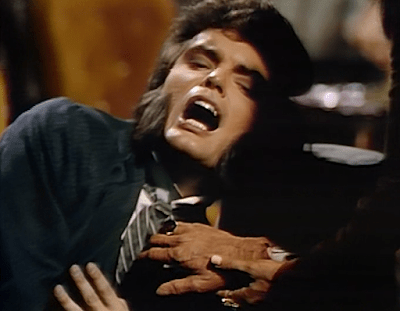
There is also some business in this episode about broad ethnic stereotype Magda Rákóczi’s effort to lift the werewolf curse she placed on Quentin. Magda has stolen a severed hand that has magic powers and plans to put it on Quentin’s heart when he begins transforming tonight. Yesterday, Evan forced Magda to let him see the hand; when he looked at it, the hand grabbed him. It left him unconscious and severely disfigured. Now Magda is keeping Evan in her home, the Old House at Collinwood, and treating him with surprising tenderness. Quentin sees Evan there. He does not recognize him, even though he and Evan were close friends, Evan is wearing the same gray suit he always wore, and his very distinctive hair and beard are unchanged. Eventually Evan regains the ability to say his name, and Quentin freaks out. He does not want to go through with Magda’s plan, but when the transformation begins he drops his opposition.

Magda placed the hand on Quentin. Screenshot by Dark Shadows Before I Die.

The hand looks very much like a Halloween decoration, so much so that I wonder if Dan Curtis hoped to make some money by getting copies of it into department stores by October 1969. It’s pretty disgusting to look at, but that’s the point.

One of the problems Dark Shadows had throughout its run was that it tended to veer between appealing exclusively to adults and exclusively to children. In the early months, its glacial pace, heavy atmosphere, psychological depth, and reliance on the star power of Joan Bennett drew a rather mature audience. As the supernatural and fantastic themes came to predominate, the average age of the viewers dropped towards the single digits. By the end of the big Monster Mash that ran through 1968, the show’s strongest demographic was probably elementary school pupils. Dividing an episode between the relatively adult melodrama of Edward’s reaction to the Judith/ Trask marriage and the undisguised kids’ stuff of The Hand of Count Petofi would seem to be a way of offering something to both the oldest and youngest viewers.

This episode originally aired on 27 June 1969. That was the third anniversary of the show’s premiere. That first installment, like 332 of those that followed it, revolved around the character of well-meaning governess Victoria Winters, played by Alexandra Moltke Isles. Mrs Isles left the show in November 1968; her son Adam Isles, who would in the 2000s become a top official of the USA’s Department of Homeland Security, was born this day. Mrs Isles has said in interviews that while she was recovering from the birth she tuned in to Dark Shadows, but that the show had changed so much in her time away from it that she couldn’t figure out what was going on.

I imagine Mrs Isles had changed a great deal as well. Like so many members of the cast and production staff, she was a fashionable, sophisticated New York society figure. While she was working on the show, she was immersed in its imaginary world, but after several months away she would have refocused her attention on the sorts of things she was raised to care about when she was growing up as the daughter of Countess Mab Moltke. One doubts that magical severed hands, werewolves, devil worshipers, and actors in brownface makeup would have ranked especially high on that list.