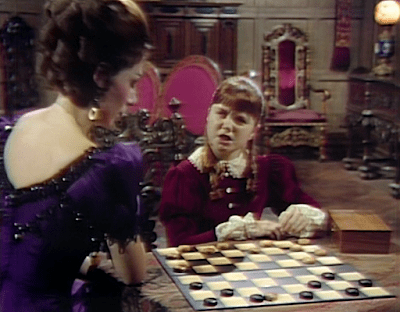
Nine year old Nora Collins enters the drawing room of the great house of Collinwood. She walks in on her father, the stuffy but lovable Edward, embracing Kitty Soames, the dowager countess of Hampshire. She gives them a dirty look and says she supposes Edward is too busy to join her in a game of checkers. He says he does have to run an errand, but suggests that Nora play with Kitty.
Kitty is eager to ingratiate herself with Nora, who clearly wants nothing to do with her. Nora asks, in an icy voice, if the reason Kitty wants to be her friend is that she is planning to marry her father. Returning viewers suspect she is right. Kitty and Edward have more in common than they know. Both are penniless, each is sure the other is very rich, and each imagines marriage to the other will solve all their problems. Kitty can’t very well level with Nora about this, so she claims that the women in the Collins family, being outnumbered by the men, have to stick together. Nora does not hide her distaste at Kitty’s inclusion of herself among the women of the family. Kitty asks Nora if she wants her father to be happy. Nora drills her eyes into Kitty’s face and says in a firm, flat voice “I want that.”
Nora asks Kitty if she is just letting her win at checkers. While she is asking this, Nora moves twice in one turn and takes three of Kitty’s pieces. Kitty watches this without protest and denies that she is letting her win. She then says she wants to concede the game and listen to whatever information Nora is willing to share about the family.
Edward comes back from his errand to find Nora packing up the checkers and the board. He asks if she enjoyed her game with Kitty. Not looking up, Nora says they never finished it. Kitty hastens back in and asks if she wants to finish it now. Edward points out that it is getting close to Nora’s bedtime. He kisses her, and bids her say goodnight to Lady Hampshire. Kitty asks Nora to call her by her first name. Nora pointedly says “Good night, Lady Hampshire.”
It doesn’t show in her scenes with Nora, but Kitty seems to be suffering from a severe mental health crisis. Returning viewers know that the ghost of Josette Collins is taking possession of her, and suspect that she will turn out to be a reincarnation of Josette. Edward knows enough about the supernatural doings on the estate of Collinwood that he might give Kitty the benefit of the doubt when, for example, she comes running in today and is shrieking about a haunted house, a vanishing woman, and a curse that follows her everywhere. But she is so often so highly distraught that Nora must have noticed that she is not right in the head, and she can hardly look forward to having such a person as a stepmother.
Shortly before Nora enters, Edward calls Kitty “Katie.” This is a small enough slip of the tongue, but Kathryn Leigh Scott’s friends call her Katie, so it is a case of an actor’s name in place of the character’s. I think I can see Louis Edmonds blush a little when he realizes what he has done.
This episode marks the final appearance of Nora, and very nearly the last time we will hear Nora’s name. I think she was badly underused, disappointingly so after the outstanding work Denise Nickerson did as Amy Jennings in the months leading up to the segment set in 1897. She will be back later, in other parts.
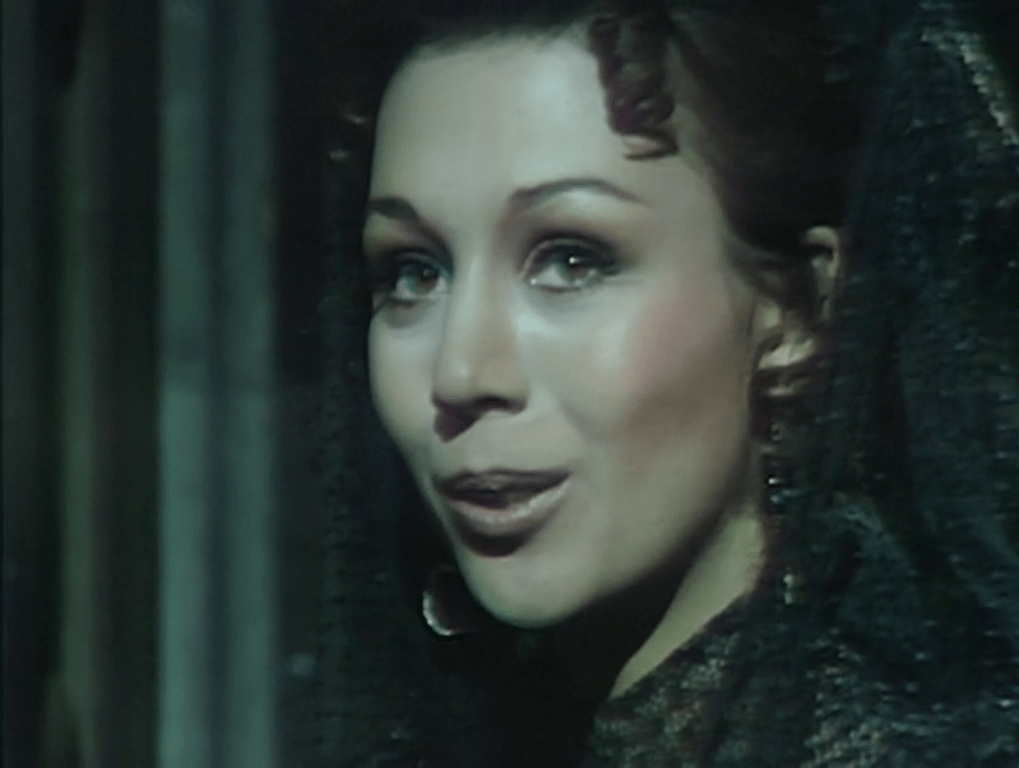
Director Henry Kaplan was not much of a visual artist, and his deficiencies are particularly glaring today. Especially during Kitty and Nora’s first scene, the camera keeps drifting up to the actors until we see a randomly selected two-thirds of their faces in extreme closeup. Once the shot excludes the eyes or the mouth, it abruptly pulls back. Even the successfully framed closeups are rarely in focus, and you can forget about finding coherent visual storytelling in any kind of shot other than a closeup. The actors themselves do a good job, in spite of Kaplan’s notoriously unpleasant behavior towards them, but aside from a few evocative facial expressions, most of them by Nickerson, it may as well have been a radio play.
Ever since she came to the estate of Collinwood in #844, Kitty Soames, the dowager Countess of Hampshire, has been having psychotic breaks. Regular viewers know that these are supernatural in origin. The late Josette DuPrés Collins is taking possession of Kitty.
As Kitty continues turning into Josette, so rakish libertine Quentin Collins has begun turning into sorcerer Count Petofi. Josette has been dead for 101 years, but Petofi is alive and squatting in an abandoned mill on the old North Road in the village of Collinsport. Petofi’s magical powers are immense, but he is vulnerable to the Rroma people, who have reason to hate him and have been hunting him for a century. He has cast a spell that will cause him and Quentin to switch bodies. We see the first effects of this spell today.
Petofi knew Kitty’s late husband quite well. We learned in #844 that he persecuted the Earl and drove him to suicide; we learned also that Kitty was left penniless. During a conversation with Kitty today in the drawing room at Collinwood, Quentin switches into Petofi mode and confronts her with these facts. She slaps him, and he reverts to himself. He is bewildered by the fact that she slapped him, and cannot remember saying anything. This is just how Kitty is after one of her Josette moments- she doesn’t even know that they happened. Kitty tells Quentin that “If you don’t remember, neither do I.”
Kitty realizes she isn’t the only one who isn’t always herself.
I clapped and cheered when she said this. The writers of Dark Shadows rarely trust their characters with such simple lines. Most of them would get flustered and say something compromising, and even the very smartest of them, such as Julia Hoffman, MD, would likely make up a cover story that would be at risk of disproof. That Kitty can make the perfect response leaves me sad that she is so clearly meant to be a short-timer. Perhaps we can hope that she will stick around for a while after she has fully become Josette, and that she will show us a new side of that character.
There’s also a laugh-out-loud funny moment in this one when Petofi is talking to his henchman Aristide. Once he is in the form of Quentin, he plans to travel forward in time from 1897 to 1969. Julia came from that year a while ago, and was dressed in the costume of the period. Petofi disapproves of her look, and says that he can’t believe that men’s fashions will be as degraded. If he’d known how American men would actually dress in the years following 1969, he might have surrendered to the Rroma!
Kitty Soames, a young American woman who is the dowager Countess of Hampshire, is gradually turning into Josette DuPrés, who has been dead for 101 years. Kitty is staying at the great house on the estate of Collinwood. Also among the houseguests is Angelique, the immortal, time-traveling wicked witch who was responsible for Josette’s death.
Kitty has been getting information about Angelique, apparently from Josette’s ghost. She interrogates Angelique’s fiancé, rakish libertine Quentin Collins. Quentin does not give her any useful information about Angelique. When Kitty asks if Angelique has ever lived in England, Angelique herself enters and says that she has not. Kitty asks Angelique if she was ever a servant. Angelique made it quite clear yesterday that she knows perfectly well what is happening to Kitty, but she regards the transformation as a nuisance and does not want to help it along. She chooses to pretend that Kitty is being a snob, and says that Quentin is not marrying beneath his station. With that, Kitty has nowhere to go but back to her room.
Angelique has made an alliance with Julia Hoffman, MD, a fellow time-traveler from the late 1960s. Julia followed her friend and the object of Angelique’s lunatic obsessions, vampire Barnabas Collins, to 1897. Barnabas is now believed to have been destroyed, but we’ve already seen that Julia is continuing work replicating the experimental procedure that put his vampirism into abeyance for a little while in the spring of 1968. Today, Angelique brings some medical supplies to Julia in her hiding place, and Julia asks if she can come a little earlier the next day.
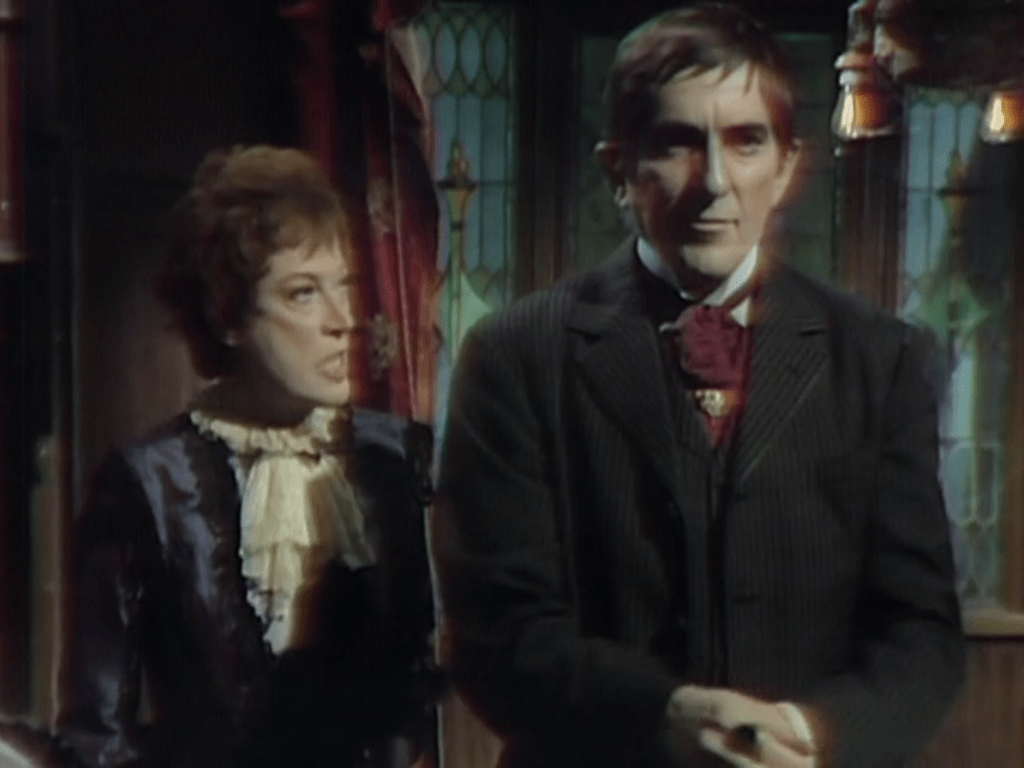
The two women sit down and have a friendly chat. Longtime viewers will find this breathtaking. Angelique was at Collinwood in 1968, wearing a black wig, calling herself Cassandra, and functioning as Julia and Barnabas’ bitterest enemy. Now that Angelique has turned to Quentin and has let go of her drive to dominate Barnabas, she and Julia have made an alliance against sorcerer Count Petofi. Their animosity set aside, they can commiserate about the difficulty of a life yoked to Barnabas.
“Ugh, vampires, all the good ones are either obsessed with recreating their dead ex or gay.” Screenshot by Dark Shadows Before I Die.
Angelique wants to liberate Quentin, whom Petofi has enslaved. Julia is horrified today when Kitty, in Josette mode, bursts into her hiding place and demands to see Barnabas. Quentin follows her in and hears her ask why she is keeping Barnabas in the next room. Neither Kitty nor Quentin believe Julia when she keeps insisting that Barnabas is no more. If Quentin knows that Barnabas is still around, Petofi will soon know it as well, and that can only be bad news.
Petofi is not content keeping Quentin as a slave. He wants to abuse him even more totally. We saw the other day that Petofi wants to swap bodies with Quentin as his means of escaping from his deadly enemies, the Rroma people. Petofi visits Quentin in the drawing room at Collinwood this evening and gives him a scalp massage. Quentin notices Petofi’s ring, and agrees that he would like a new life. He falls asleep, then wakes up to find Petofi’s ring on his finger. To his alarm, he cannot take it off. My wife, Mrs Acilius, called out to the screen to suggest he spray some Windex on his finger, but that wasn’t invented until 1933 and the dramatic date is 1897. Presumably the transfer of the ring is the first step towards Quentin’s eviction from his own body and his replacement in it by Petofi.
Closing Miscellany
Danny Horn’s post about the episode at his great Dark Shadows Every Dayis a study of Kathryn Leigh Scott’s facial expressions. His thesis is that Miss Scott is imitating Grayson Hall, who plays Julia. Later in the series there will be a moment when Miss Scott imitates Hall in a scene they play together; Hall’s reaction then will be hilarious.
Kitty sees the portrait of Barnabas Collins hanging in the foyer on the spot by the front door. She Josettifies and becomes fascinated by it. Stuffy but lovable Edward Collins had the portrait removed when Barnabas was exposed as a vampire some time ago, and is shocked to find that it has returned. Presumably whatever supernatural agency is Josettifying Kitty put it there. Longtime viewers, who remember how active Josette’s own ghost was at Collinwood before Barnabas first appeared on the show, will think she is the likeliest suspect.
When Kitty/ Josette is kneeling beside the grave of Josette’s husband Jeremiah Collins (spelled “Jerimiah” on the marker,) Edward shows up and tells her that she was married, not to Jeremiah, but to the late Gerald Soames Earl of Hampshire. That was the first time it dawned on me that both Josette and Kitty married guys named Jerry.
Angelique’s intrusion into the scene between Quentin and Kitty might have been more effective if the camera hadn’t swung wide and shown her standing outside the door waiting to make her entrance. We don’t see Angelique eavesdropping, but Lara Parker standing well upstage waiting to make her entrance.
From November 1967 to March 1968, Dark Shadows was set in the 1790s. The cast included Kathryn Leigh Scott as the gracious Josette, Louis Edmonds as haughty overlord Joshua Collins, and Lara Parker as wicked witch Angelique. Now, the dramatic date is 1897. Miss Scott plays Kitty Soames, an American who went to England to be a governess, married the Earl of Hampshire, and is now widowed, penniless, and scheming to land another rich husband. Edmonds takes the role of stuffy but lovable Edward Collins, who is the focus of Kitty’s ambition. Parker is still Angelique, who is both immortal and a time-traveler.
Ever since arriving at the great house of Collinwood in #844, Kitty has been having psychological breaks during which she acts like Josette. She therefore appears to be suffering from a severe mental illness, an impression which would tend to get in the way when trying to win a new spouse. Today these breaks take a new turn.
Kitty is walking in the woods on the grounds of Collinwood when she is overwhelmed by the sense that she is being watched, and furthermore that the person watching her knows her well and wishes her ill. She runs into the house and flings herself at Edward, describing this paranoid episode to him. Edward has only begun to talk her down when his brother, rakish libertine Quentin, enters with his own fiancée. The fiancée is Angelique.
Edward is about to introduce the two ladies, who have never met. Before he can do so, Kitty becomes Josette. In Josette’s voice, she denounces Angelique. She then grabs her by the throat and vows to kill her for what she has done.
Angelique was responsible for the deaths of Josette and many others at Collinwood in the 1790s, and has been obsessively hostile to her throughout the centuries. When she was first conjured up from Hell to be part of the 1897 segment in #711, she went to the Old House on the estate, looked at the portrait of Josette that hangs over the mantel in the front parlor there, and declared “I am Angelique and I hate you!” During her lifetime, Josette was oblivious to Angelique’s enmity. She knew Angelique as a lady’s maid in service to her aunt, and regarded her as a close friend. But on Dark Shadows, death is a learning opportunity, and we see today that when she is animated by Josette’s spirit Kitty knows everything Angelique hid from Josette when she was alive.
Edward and Quentin separate Kitty and Angelique. In a private conversation with Quentin, Angelique makes it clear to the audience that she knows exactly what is happening with Kitty, and that she regards it as a minor nuisance. Quentin has troubles of his own, and doesn’t ask for an explanation.
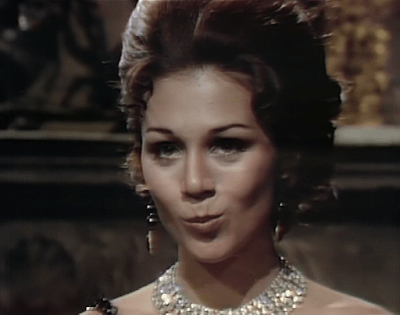
Meanwhile, Kitty and Edward have a private conversation of their own. Edward tells Kitty that she is just upset because of her late husband’s death, and assures her that he will help her recover. She flashes a cunning smile at the camera. Well she might- not many people are so good at attaching themselves to rich guys that they can turn a psychotic episode to their advantage.
Kitty has a dream in which Angelique is her servant and is addressing her as “Mademoiselle.” In the dream, Angelique delivers an arrangement of flowers and a book of poetry that Josette’s fiancé wants her to have before their impending wedding. When she wakes up, Kitty finds the arrangement and the book by her bedside, and she realizes that what is happening to her is not simply a mental aberration.
The dream will puzzle new viewers, even those who know that Angelique was a servant in Josette’s household. When Angelique is busy being Evil, she often laughs a maniacal laugh that breaks in the middle with a sharp intake of breath. She keeps doing this throughout the dream, which doesn’t fit at all with the action of bringing a present from a lover. She also tells Josette that her happy life is of the sort that makes the gods jealous, and speaks the lines with an undisguised and exaggerated hostility that leads into another gale of maniacal laughter. People who have joined the show in the last year will wonder why Angelique is being so crudely obvious.
Lara Parker used to say that she didn’t really learn to act until Humbert Allen Astredo joined the cast of Dark Shadows in June 1968. She’d taken acting classes and appeared in plays and so on, but it wasn’t until Astredo explained acting techniques to her while they were rehearsing that it all clicked in her head. You really can see a sudden improvement in her performances at that time. The dream Josette transmits to Kitty’s mind takes her to a time, not only when Angelique was a servant, but when Lara Parker was not a particularly good actress. The contrast between the reliably capable professional we see in most of the episode and the often bombastic student who appears in the dream makes us appreciate just how far she came in a short time.
Once upon a time, an American girl named Kitty moved to England, where she joined the household of the Earl of Hampshire as a governess. The Earl married her, and she became his Countess. Now it is 1897. The Earl is dead, driven to suicide by sorcerer Count Petofi. Kitty has returned to America, without the stepchildren who were once her charges and with so little money that she writes a letter apologizing to her mother that she cannot pay the train fare from Maine to her home in Pennsylvania. She is staying in the great house on the estate of Collinwood, home to her late husband’s friend Edward Collins. Her hope is that Edward will marry her and allow her to go on living in the style to which she has grown accustomed.
Her hopes would seem to be well-founded. Edward was so devoted to the late Earl that for a time he was under the delusion that he was his valet, and he is smitten with Kitty. But there are several flies in the ointment. For one thing, regular viewers know that Edward is in fact penniless. His sister Judith inherited the whole of their grandmother’s estate. He lives in Judith’s house as a guest and works in her business as her employee, and while she is in the mental hospital he must take orders from her husband, the odious Gregory Trask.
Second, Petofi is in the area. It was he who cast the spell that prompted Edward to reveal his true self-image as the Earl’s manservant, and he has evil plans for many of the people with whom Kitty must deal. She met Petofi at Collinwood the day she arrived there, but has kept her acquaintance with him secret from Edward and everyone else.
Third, vampire Barnabas Collins saw Kitty and believed she was his lost love Josette come back to life. Shortly after, she had a psychological break suggesting he was right. A music box that Barnabas has given to several women whom he wanted to turn into Josette appeared in Kitty’s room the other day, after a woman who used to be Trask’s daughter Charity but has now been transformed into Cockney showgirl/ mentalist Pansy Faye had warned her it was a sign of great danger.
It seems unlikely Barnabas put the music box on Kitty’s table. For one thing, Charity/ Pansy had staked him shortly before, so that he is apparently hors de combat. Further, it was placed there during the daylight hours, when he is always out of operation. Also, it appeared while Kitty was sitting a few feet away, and she did not see anyone else in the room. Petofi stripped Barnabas of his power to materialize and dematerialize at will some time ago, so he would not have been able to manage that trick. The explanation that will occur to longtime viewers is that Josette’s ghost did it. She was very active at Collinwood before Barnabas made his first entrance in April 1967, when the show took place in a contemporary setting. Perhaps she is active in 1897, as well.
Kitty doesn’t know about any of that, so she assumes that Petofi is responsible. She marches over to Petofi’s residence, an abandoned mill. Originally this was a hideout, but by now most of the principal cast have visited him there at least once, so she could have stopped just about anyone on the street and asked for directions. She accuses him of having Charity/ Pansy give her a chilling warning about a particular music box, and of then causing that music box to appear in her room. He has no idea what she is talking about. She produces the music box and they play it. She then has another mental flash onto images of Barnabas. Petofi finds all of this most interesting, and walks Kitty back to Collinwood.
There, Kitty finds the devastatingly handsome reprobate Quentin Collins moping over a glass of liquor. She asks him if she has him to thank for the music box. He is shocked to see it. He says that it looks just like one that belonged to a distant relative of his, but that he doesn’t believe it can be the same one. She asks if the relative is Barnabas Collins, and he is shocked again. He asks how she knows that name. In response, Kitty introduces Quentin to the concept of “learning”: “I collect information, Mr. Collins, and I remember what I hear… I listen when people speak.” Quentin reacts as if it is the first time anyone has described these activities to him, which, considering the world he lives in, is not so unlikely.
Back in his squat, Petofi sees his servant Aristide for the first time in several days. Aristide went absent without leave when Barnabas threatened to kill him, and has come back now that he has heard Barnabas has been safely disposed of. Petofi is irked, not only at Aristide’s unauthorized departure, but even more at his failure to carry out the task he had entrusted to him. They had captured Julia Hoffman, MD, Barnabas’ friend, who followed him after he traveled back in time from 1969 to 1897. Petofi wanted to know how they managed this journey, and was convinced Julia was withholding the information he needed. Aristide rigged up a death trap that Barnabas triggered when he came to Julia’s rescue. Aristide did not stay to make sure it actually killed her.
Aristide shows Petofi that the gun he pointed at Julia’s heart did fire a bullet through the back of the chair to which he tied her. One would think that even a sorcerer, seeing that bullet hole, would conclude that Julia got out of the ropes while Aristide wasn’t looking. But instead he looks with a wild surmise and goes to Julia’s hiding place, in the old rectory on Pine Road.
Before Petofi enters, we see Julia holding a hypodermic and preparing an injection. She hides the needle when she hears the knock on the door. Julia had been giving Barnabas a series of shots meant to put his vampirism into remission. That she is still preparing the shots suggests to regular viewers that Barnabas’ staking was a trick of some kind, and that he is still in operation somewhere.
There are rules of etiquette in the universe of Dark Shadows that people follow no matter how absurd it is to do so. Julia lets Petofi into the room, even though he has tried to kill her. One cannot refuse admittance to anyone who knocks! She accepts a snifter of brandy from him and drinks it. One cannot refuse to share liquor with anyone who offers it!
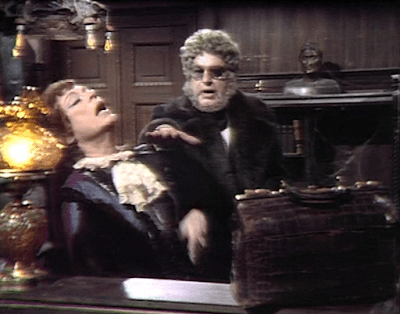
As it happens, Petofi has put cyanide in the brandy. Enough cyanide, he says, to kill ten women. When he tells Julia this, she briefly tries to pretend that she is ill, then gives up. He declares that she cannot die. She admits that this is true. He figures out that only her “astral body” is in 1897, while her physical person remained in 1969. She confirms this.
Julia tries to make Petofi think he has succeeded by faking the symptoms of cyanide poisoning. Screenshot by Dark Shadows Before I Die.
Later, Petofi concludes that if he is to go to 1969, he will need to have a physical body there. Barnabas the vampire originally died in the 1790s and was in 1897 a body sealed in a coffin, so when he traveled back in time he could animate that body and be subject to all the thousand natural shocks that flesh is heir to. Petofi decides that the body he wants is the best-looking available male one, which is Quentin’s. We have seen that Petofi can vacate his own body and take possession of another’s, as when in #801 he took up residence in twelve year old Jamison Collins. He has also, for reasons of his own, granted Quentin eternal youth. So it now seems logical to him that he should compel Quentin to make the exchange.
Of late, the editors of the Dark Shadows Wiki have taken to having discussions with each other in comments placed in parentheses and italicized. I couldn’t resist adding a comment myself to a discussion attached to the entry for this episode. My contribution is the fourth of the four below:
In 807, Aristede tells Charles Delaware Tate that if Petofi got his hand back, he would be able to live forever. As Petofi got his hand back, he must have a body in the future, so why would he need Quentin’s?
(Who would you rather look like?)
(Isn’t the point of the body-switch to evade the gypsies?)
(Yes, that is the point of the body-switch — but surely he only needs to switch bodies? If he can switch bodies now, and become unrecognisable, why does he need to go to the future as well?)
(Petofi says that he has many ambitious plans. If he carries them out, they may attract widespread attention. The Rroma have been keeping track of him for a long time, and may become suspicious if a known associate of Petofi’s starts doing all sorts of spectacular things.)
I expect this whole discussion to be deleted soon- it isn’t really in keeping with the purpose of the site, which is just to serve as ready reference for basic facts about each episode. But it does address a theme that often comes up in online discussions of this storyline, so I wanted to preserve it here.
Tim Shaw was a poor put-upon fellow when first we met him in #731, an episode set in April 1897. He had spent his childhood among the pupils imprisoned at Worthington Hall, a dungeon masquerading as a school, and when he was of age the headmaster, the evil Gregory Trask, coerced him into staying on as a teacher. In company with another man, Trask contrived to use Tim as an unwitting instrument in his plot to murder his wife Minerva. Trask’s plan to frame Tim for the murder fell apart, and Tim managed to keep his freedom. Not only that- he stole the legendary Hand of Count Petofi and took it to New York City, where within weeks he used its magical powers to make himself very rich. In August, he returned to Collinsport determined to take revenge on Trask.
Shortly after coming back to his hometown, Tim lost the Hand. (Which, to be clear, was an actual human hand severed from a sorcerer named Count Petofi a century before.) The 150 year old Petofi himself reclaimed it, and reattached it to his wrist. The ill-fortune Tim suffered in his youth left him a weak and cowardly man, who betrayed his only friend when Trask was looking for her. But his good fortune when he was in possession of the Hand has corrupted him much more severely. He used to be kind to children and even risked his life to rescue nine year old Nora Collins when Worthington Hall burned down in #736, but in #816 he violently shook Nora when he found that she had let the box containing the Hand out of her sight. In his pursuit of another gimmick that will enable him to continue getting rich, he has developed a number of schemes, the worst of which do not stop at murder.
This morning, Tim is sitting at a table in the Blue Whale, Collinsport’s tavern. The place isn’t open yet, and Tim does not appear to have any connection with it, so it is simply a mystery how he got in and why he wants to be there. The only other person in the room is sitting at the bar. She is a woman who used to be Trask’s daughter Charity, but who has since been transformed into Cockney showgirl and sometime mentalist Pansy Faye, who died in June.
Pansy’s presence makes some kind of sense, as she works at the tavern doing her act. But returning viewers know that she isn’t still there from the night before. After closing, she went back to the great house of Collinwood, where Trask and she live, and talked with the rakish and profoundly drunk Quentin Collins. After dawn, Pansy followed Quentin from the house to a cave. In the cave, she found a mallet and stake Quentin left behind, and next to them the coffin occupied by vampire Barnabas Collins. She drove the stake into Barnabas’ heart. Now she wants a good stiff drink, and she doesn’t care if she has to pour it herself.
Tim stops Pansy’s attempt to pilfer her employer’s stock, and she tells him that she has destroyed Barnabas. Dollar signs flash in his eyes as he calculates what it is worth to the Collins family to know that their single most embarrassing relative is no longer going to be exsanguinating the locals. Pansy does not want to go back to the great house or even to tell the Collinses what happened, and she steadfastly declares she does not want any of their money. But Tim insists.
At the house, stuffy Edward Collins makes it clear he wants nothing to do with Tim and that he regards Pansy as a lunatic. When Tim makes him listen to the story, Edward dismisses it out of hand. But Edward finally agrees to go to the cave with Tim while Pansy stays in the drawing room.
Edward sees that Pansy was telling the truth, and returns to Collinwood in time to see the aftermath of a strange conversation. Pansy meets Edward’s guest, a young American woman named Kitty Soames who is the widow of the Earl of Hampshire. Pansy’s reaction when the dowager countess introduces herself as “Lady Hampshire” is a very characteristic “Well, la-dee-dah!”
Pansy’s delighted smile and relaxed manner suggest that in Kitty she has recognized a kindred spirit. Returning viewers know she’s onto something- we’ve heard Kitty’s interior monologue as she’s screwed up her courage to try to connect with the rich Collinses. We also know that she and her husband were mixed up with Petofi, who is not an individual who often attracts the innocent. And while she is so quick to deny to Edward that her husband’s suicide had anything to do with business reverses that he assumes she is still imposingly rich, later today we will hear the text of a letter in which she tells her mother that if she doesn’t get something going with Edward, she won’t be able to raise enough money to pay the train fare from Maine to Pennsylvania. So Kitty’s presentation of herself is misleading, and she is not so different from the living Pansy, who was what in the parlance of the 1890s might have been called an adventuress.
In her letter to her mother, Kitty mentions that she first came to the earl’s home as the governess. This circumstance reminds us of two other characters played by the same actress. In the parts of Dark Shadows set in 1969, Kathryn Leigh Scott’s Maggie Evans was the governess at Collinwood. And in the first part of the 1897 segment, she took the role of neurotic intellectual Rachel Drummond, who held the same job in that year.
Rachel was the friend whom Tim betrayed to Trask, and the contrast between her and Kitty reflects the change in Tim. Rachel and Tim were both well-meaning but helpless before Trask. They stood out in the 1897 segment as almost the only characters who weren’t playing an angle of their own. Rachel died in Tim’s arms, in the same room where he would later find the Hand. As his discovery of the Hand opened the way for Tim to become a schemer, so the death of Rachel allowed Miss Scott to return as a someone who could keep up with the quick-witted and merrily vicious characters who make 1897 such a delight. Moreover, we are in suspense as to what sort of person Kitty will turn out to be. She could end up being as innocent as Miss Scott’s previous roles, she could be as detestable as Tim has become, or she could land anywhere in between.
Pansy has a vision of a music box. She vocalizes its tune, and tells Kitty that if she ever receives one like it she must destroy it at once. If she does not, she will die. Kitty is upset by the whole conversation. Pansy tells Kitty that she ought to listen to her, because she has “powers.” “I guess… I didn’t use to have, but now I do.” Pansy often mentions this point, which harks back to her first appearance. In #771, the living Pansy came to Collinwood as the fiancée of the childlike Carl Collins. She was astounded to find that in the spirit-charged atmosphere of the estate her phony “mentalist” act really did conjure up a voice from the supernal realms. In turn, that echoed #400, when Charity’s ancestor, the fanatical Rev’d Mr Trask, was delighted that an exorcism he was performing seemed actually to work.
When Edward comes back, he assures Kitty that Pansy is mad and that he will “deal with her.” Kitty goes upstairs to her room, where she will later find that the music box Pansy described has materialized. This music box has a long history, and in 1967, when the show was set in contemporary times, Barnabas used it to try to convince girls that they were his lost love Josette. Even if Barnabas hadn’t been staked, we wouldn’t suspect him of planting the music box in Kitty’s room- it appears there during the daytime. Viewers who have been with the show from the beginning will remember that Josette’s ghost used to be quite active around Collinwood, and might wonder if she did it.
In the drawing room, Edward talks with Tim and Pansy. He refuses to call Pansy anything other than “Charity Trask”; she is indignant at being live-named, but he won’t relent. He asks her to stay in the house, and offers to provide her with the best possible mental health care. She angrily declares “I! Ain’t! Sick!”
Tim says that he will see to it that Pansy doesn’t tell anyone about Barnabas; Edward doesn’t bother to conceal his contempt for Tim, and makes it clear that he will not pay him for this or any other service he might offer to perform. Pansy tells Tim that it is time for them to leave. She invites Edward to catch her act at the Blue Whale; he says he doesn’t expect to find the time, but that he is sure Tim will come back to Collinwood when he wants something.
When Tim first came back to town, he had a girlfriend named Amanda whom he planned to use in the game he was going to run on Trask. Eventually we learned that this plan was to involve the murders of the former Judith Collins, who is now Trask’s wife, and of Trask himself. Amanda would marry Trask after she had incited him to kill Judith, they would then kill Trask, and Tim would marry Amanda, thereby becoming the master of Collinwood. Amanda was never fully sold on the homicides, and she and Tim now seem to have gone their separate ways. So Tim is left without friends and without a plan. Nor does he seem to understand how dangerous the people he is dealing with truly are. He thinks that he can bluff his way into partnership with the enormously powerful and thoroughly evil Petofi, and is only dimly aware of the other monsters lurking in the area. One might surmise that Tim’s happiest days are firmly behind him.
Julia Hoffman is miserable. She has followed her friend, vampire Barnabas Collins, and traveled back in time to the year 1897 on a mission to prevent terrible things that were happening in 1969. She has managed to come up with a treatment that is similar to one that briefly cured Barnabas of vampirism in March and April 1968, and is giving him regular injections in the course of that treatment. She is in hiding with him in an abandoned building, and has survived kidnapping and attempted murder. And what is her reward for all that? He is back on the same bullshit he was involved in when she first learned of his existence in 1967. He has met a girl and made up his mind to throw away all of their plans in an effort to convince her that she is the reincarnation of his lost love Josette. It’s no wonder Julia is so furious with him that she looks like she is the one with fangs.
Barnabas in danger.
Making matters worse, this time it seems Barnabas might be on to something. He pays a visit to his distant cousin, Quentin Collins, and asks who the girl is. Quentin says that she is Kitty Soames, widow of the late Earl of Hampshire, returned to her native USA after her husband’s death. When Barnabas starts in with his lunacy about Josette, Quentin becomes excited. He tells him that Kitty looked at the spot where his portrait hung until he was exposed as a vampire and asked what had become of it. When Quentin asked how she knew about that, since she had never been to the house before, she laughed and said that of course she knew the portrait, of course she was familiar with Barnabas. After a few seconds, she said she knew nothing of any portrait or of anyone named Barnabas.
Barnabas takes this as proof positive that Kitty is Josette returned to life, and that her memories of the 1790s are coming back to her. He asks Quentin to meet him at his hiding place so that they can arrange for him to meet her. He tells him where the hiding place is. Quentin agrees. Barnabas gives Quentin an enigmatic look before he exits.
Quentin is miserable. He is under the power of sorcerer Count Petofi, who has ordered him to kill Barnabas. Now that he knows where Barnabas keeps his coffin, there is nothing to stop him obeying. He will have to go there at dawn and stake his friend.
Barnabas has confronted Quentin about his subjection to Petofi, whom he knows to be his deadly foe. He has several times shown his distrust of Quentin. So people who started watching the show in the last year or so will be puzzled when he tells Quentin where to find him when he is helpless. Those who have been in the audience longer know that Barnabas not only has a habit of telling his enemies exactly what they need to know, but that he also loses all semblance of rationality where Josette is concerned. It is all too believable that he may have done this. Still, there is that look back at Quentin, suggesting that Barnabas knows that he is giving information to his enemies.
Quentin is in the drawing room of the great house, waiting for the dawn to bring with it his obligation to kill his friend. A woman who used to be Miss Charity Trask enters. Petofi erased Charity’s personality some time ago. Her body is now home to Pansy Faye, Cockney showgirl, mentalist, and onetime fiancée of Quentin’s late brother, inveterate prankster Carl Collins.
Pansy is miserable. Pansy is cross that Quentin did not go to see her perform at the Blue Whale, a local tavern where she is doing her old act. But what really has her down is that it is exactly three months since Barnabas murdered Carl, and she is the only one who seems to remember him. When Kitty and Quentin spoke of Carl yesterday, they were the first characters other than Pansy to mention his name since the immediate aftermath of his death. She is irritated with Quentin for getting drunk, angry that Barnabas is still at large, and sorrowful that while the dawn means a new day for most, for people like her and Quentin it just means reliving the same day time and again. Quentin perks up when Pansy lists the many good reasons why someone ought to kill Barnabas, and for a moment it seems like he is going to tell her where he is and invite her to do it. She recognizes this, and keeps asking questions after he stops himself. The whole scene is beautiful from beginning to end, one of the highlights of the series. If they had had Daytime Emmys in 1969, it is the tape they should have sent to the voters to get the acting awards for Nancy Barrett and David Selby.
Dawn comes, and Quentin does go to the cave where Barnabas’ coffin is. He has a stake and mallet with him. He opens the coffin, sees Barnabas, places the stake over his heart, and raises the mallet. That’s as far as he can go. He throws the weapons aside and leaves the cave, vowing that if Barnabas can face whatever he has faced, he too can face his own destiny.
Shortly after, we hear footsteps. Pansy enters. She sees the coffin and opens it. She finds the mallet and stake. She drives the stake into Barnabas’ chest. Blood spurts out around the wound and out of his mouth. It would seem that Barnabas Collins is no more.
Quentin is a villain, but he is charming, and at this point David Selby is a breakout star to rival Jonathan Frid as Barnabas. Earlier, it had seemed Pansy might kill Quentin, and many fans hated her for that. No one seriously expected her to kill Barnabas, since he was a pop culture phenomenon familiar even to people who never saw the show. To this day, Dark Shadows is known (to those who know it at all) as “the vampire soap opera from the 1960s.” So having her kill Barnabas is certainly a twist worthy of ending a week.
Adventurer Tim Shaw is in his hotel room with an apparently mute man, trying to get him to speak. The man is struggling to make a sound when artist Charles Delaware Tate enters and produces a revolver. Tate proclaims that the man will never speak. He fires, and the man falls dead to the floor.
The man’s body glows, then vanishes. Tim knows that Tate created the man earlier in the evening. Tate has a magical power that enables him to cause objects and people to pop into existence just by drawing them. Tim says that he ought to call the police, since Tate just murdered a man in cold blood in front of him. But there is no body, and the only other person who has seen the man is Tim’s traveling companion and occasional accomplice Amanda Harris, who turns out to be another of Tate’s creations. So instead Tim pours a drink, and Tate tells him all about how he gained his powers as the result of a bargain he struck with sorcerer Count Petofi.
Petofi is aware of several magical abilities he gave Tate, but does not know that he can bring his creations to life. Tim calls Petofi to his room and brings him up to date. He believes that this report will somehow establish a partnership between himself and Petofi. Since Tate made it clear that his powers are the result of Petofi’s own interventions, it is unclear why Tim would expect even a finder’s fee for this information. It certainly does not provide the basis for an ongoing relationship of any kind.
Meanwhile, a visitor is arriving at the great house of Collinwood. Her face is familiar to longtime viewers- she is played by Kathryn Leigh Scott, who has been in the cast from #1 as Maggie Evans, wisecracking waitress turned The Nicest Girl in Town. When from November 1967 to March 1968 the show was a costume drama set in the 1790s, Miss Scott played the gracious Josette; she had already played Josette’s ghost in some of the episodes in contemporary dress, and in the spring and summer of 1967 vampire Barnabas Collins had tried to brainwash Maggie into becoming Josette. We last saw Miss Scott from March to June in the first part of the still-ongoing segment set in 1897, when she was neurotic intellectual Rachel Drummond.
Before we know the name of this new character, we see that she is wearing widow’s weeds. There is also a first- we hear her thoughts in an interior monologue before she interacts with another character. Whoever she is, the widow is telling herself that she has come to her big moment and she shouldn’t chicken out now. “No one will know,” she assures herself.
Neither Maggie, Josette, or Rachel ever used that facial expression.
The unknown widow knocks, and rakish libertine Quentin Collins lets her in. He appreciates her beauty and asks who in the house is fortunate enough to know her. She says that she and her late husband were friends of the stuffy Edward Collins. Quentin says that Edward is away, and identifies himself as his brother. “Quentin or Carl?” asks the widow. Quentin says, with a sad note, that Carl is dead. This is the first time anyone other than his onetime fiancée Pansy Faye has mentioned Carl’s name in the three months since his death.
The widow finally identifies herself as Kitty Soames, Countess to the late Earl of Hampshire. She says that she is an American, and that after her husband’s death she felt that she was a stranger in England and ought to return home. Quentin invites her to stay in the house.
Kitty is alone in the foyer when Petofi enters. She is horrified to see him. It becomes clear that her husband’s death was a suicide, and that Petofi’s threats prompted it. She goes out to take a walk in the woods.
Along the way, she meets Barnabas, who has traveled back in time from 1969. They have a brief talk. When she exits, he says that she is Josette, returned to him at last.
Back in the great house, Quentin finds Kitty looking at the spot on the wall next to the front door where Barnabas’ portrait has long hung. Some weeks ago, Edward learned that Barnabas was a vampire and ordered the portrait removed. There is a mirror there now, the same mirror that hung in that spot in #195, when the ABC art department was painting Barnabas’ portrait and another portrait was reflected in it. Kitty asks Quentin why Barnabas’ portrait was removed. Since she has never been in the house before, this question perplexes him. He asks how she knows about the portrait and how she knows of Barnabas. At first she is amused by the idea that she would not know of him, but a second later she returns to herself. She insists she has never met anyone named Barnabas and has no idea what Quentin is talking about. Perhaps this time, Barnabas is right- maybe Kitty really is a revenant of Josette.
Miss Scott was one of the biggest stars on the show. She tells a story nowadays about a trip she and her then-husband took to Africa in the late 1960s, when they were on a photo safari deep in the bush. Some people happened by, took one look at her, and all started saying excitedly “Maggie Evans!” So it is inexplicable that today’s closing credits misspell her name as “Kathryn Lee Scott.”




 Dark Shadows Commentary