Episode 933: Easy street

In the middle of The Odyssey, Odysseus and his companions enter a certain cave and follow a path that leads to the realm of the dead. There, Odysseus talks with several people whom he knew when they were alive, then comes back to the upper world. This passage, known in Greek as the νέκυια (nekyia,) led many subsequent epic poets to include journeys to and from the Underworld in their works. In the Aeneid, his Latin language response to the Iliad and the Odyssey, Vergil put Aeneas’ voyage to the Underworld in the same halfway spot where the nekyia stands in the Odyssey. The words of warning the Cumaean Sibyl speaks when she gives Aeneas directions to reach the Underworld by way of a path leading through the crater in Mount Avernus are quite famous:

Facilis descensus Averno:
Noctes atque dies patet atri ianua Ditis;
Sed revocare gradum superasque evadere ad auras,
Hoc opus, hic labor est.

The road down through Avernus is easy.

The doors of dark Dis lie open by day and by night.

But to reverse your stride and escape to the air above,

This is the achievement, this is the feat.

(Vergil, Aeneid 6:126-129, my translation.)

It wasn’t only warrior princes like Odysseus and Aeneas who had to go to the realm of the dead and back in the mythology of the ancient Mediterranean. The legendary poet Orpheus was so disconsolate when his wife Eurydice died that he journeyed to the Underworld to plead with the gods of the dead to let him take her back with him. As Ovid tells the story in Book 10 of his Metamorphoses, Orpheus made his case in a song that was so beautiful that the whole pantheon of deities who dwell among the ghosts of humans wept. Their chief, known by a long list of names including Pluto, Dis, and Hades, was no exception. Through his tears, he agreed to release Eurydice. But the god knew his business too well not to make conditions. First, Orpheus and Eurydice would have to take the hard and treacherous road that separates the shades of the dead from the world of the living. Second, they would have to complete the whole journey without once looking at each other.

They made it through all the ruggedness and the many snares. At the moment Orpheus felt the warmth of the sun on his cheeks once more, he became so excited that he forgot everything. He turned his head to face Eurydice and exclaim that they had succeeded. But she was still in the shadows. He saw only her silhouetted figure, and that only for an instant. She shrank from him at impossible speed, disappearing forever into the darkness of death.

Dark Shadows steals from every writer, sooner or later, and they’ve stolen a woman named Amanda Harris from a story that comes later in Book 10 of Ovid’s Metamorphoses. A sculptor named Pygmalion was a sour misogynist, who sought a substitute for the companionship of the real live women he so disliked by making a statue of a woman he thought he could get along with. Much to his surprise, the statue came to life and they fell in love, more or less.

In 1969, we learned that an artist named Charles Delaware Tate, who was every bit as unpleasant a person as Ovid’s Pygmalion, had painted a portrait of an imaginary woman and that, because of some magic powers Tate was unaware he had, that woman had popped into existence and started calling herself Amanda Harris. It was a couple of years after her inception that Amanda met Tate. Unlike Pygmalion’s statue, Amanda was as repulsed by her creator as one would expect her to be. Instead, she fell in love with the boundlessly charming, albeit none too admirable, Quentin Collins.

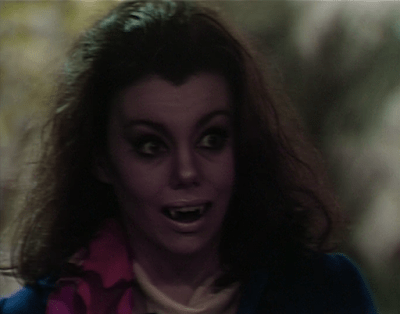
Now Amanda has died, and Quentin is willing to do anything to be reunited with her. A god of death named Mr Best has offered him a sporting proposition. If he and Amanda can walk the whole of the hard and treacherous road that separates the shades of the dead from the world of the living without once touching each other, they can share an eternal life. But if they do touch, or if either of them falls victim to one of the many traps along the way, they will be separated forever.

Their journey almost ends before it begins. Amanda sees Quentin looking out the door that opens on the road home, and reaches out to touch him. At the last second he tells her not to, explaining the conditions Mr Best had laid down. They set out. Along the way, Amanda is caught in a giant web where she is menaced by a giant spider, twists her ankle when she trips over some rocks, has to walk over a rickety rope bridge, and experiences a series of phobic reactions. She is just about to make it when, not looking down lest her fear of heights get the better of her, she puts her foot through a gap in the rope bridge and falls into oblivion.

It’s unclear what this will mean for Quentin. He has no direct connection to any other unresolved story, and while there are characters who care about him he isn’t particularly interested in having anything to do with them. He has been one of the show’s great breakout stars, second only to Jonathan Frid as occasional vampire Barnabas Collins, so it is hard to believe they won’t come up with something new for him to do, but it is not at all clear what that might be.

Book 10 of Ovid’s Metamorphoses does not seem like it will be very helpful. When Orpheus loses Eurydice, he can no longer stand the sight of any other woman, so to pass the time he invents male homosexuality. He has great success popularizing his invention throughout his homeland of Thrace. When the Thracian women find that many of their menfolk have lost interest in them, they signal their displeasure by killing Orpheus. I very much doubt that the American Broadcasting Company’s office of Standards and Practices would have been too happy at the idea of dramatizing that story five days a week at 4 PM in 1970. Besides, Dark Shadows has been so antiseptically sexless that the women of Collinsport wouldn’t be any worse off if the men devoted all their eroticism to each other, so you couldn’t use that ending.

The Orpheus and Eurydice story only takes up half of today’s episode. The rest recounts the final hours of the life of Mr Paul Stoddard. Paul has found out that a group of people in and around the village of Collinsport are in the service of invisible supernatural beings known as the Leviathans. Earlier this week he encountered a nonhuman creature that is central to the Leviathan cult. Contact with the creature caused his clothes to rot and stink and left him dazed and unable to speak.

Paul is currently sitting and staring into space in the apartment of Professor Timothy Eliot Stokes, expert on the occult. When we cut to Stokes’ apartment from Quentin and Amanda on the way back to the world of the living, we see a bust of the poet Dante, reminding us that Christian poets followed ancient pagans in writing epics about visits to the realms of the dead. It also suggests that Quentin’s experience in Mr Best’s domain may give him some knowledge or power that will allow him to join Stokes and mad scientist Julia Hoffman in their battle against the Leviathans.
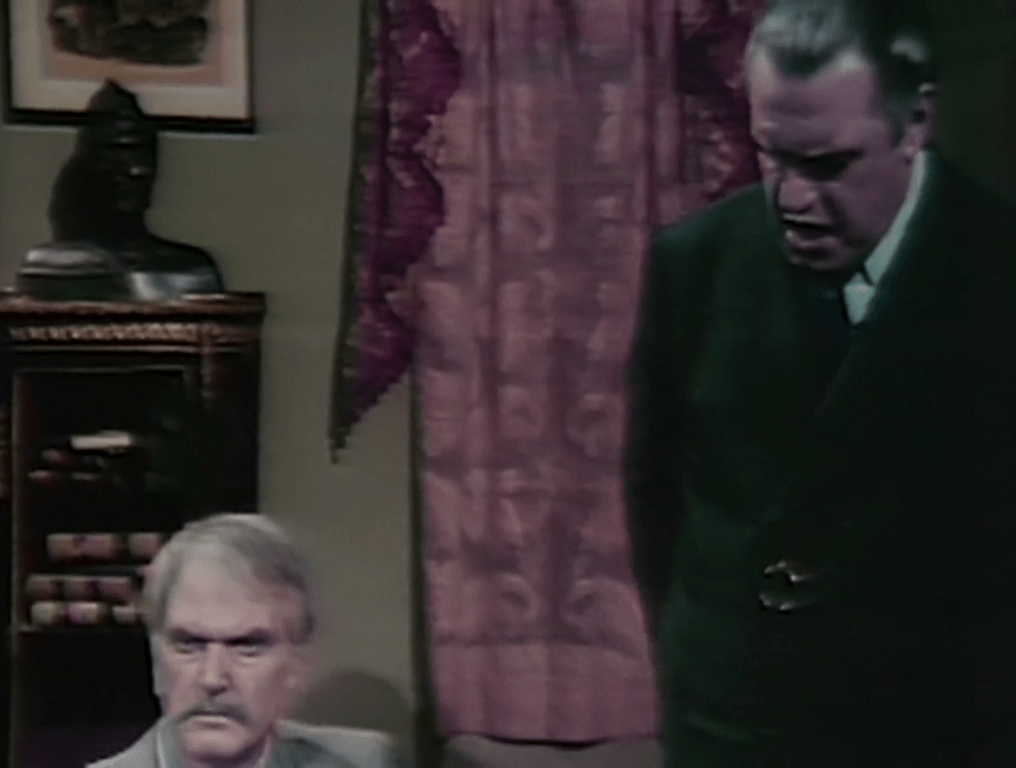
Dante watches over Paul and Stokes.

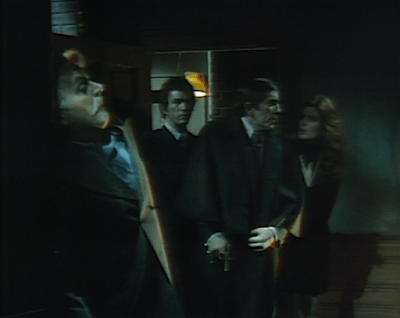
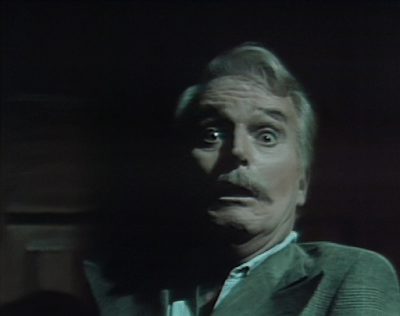
Stokes tries to get Paul to tell him what happened when he encountered the creature, but he will neither speak nor move. Stokes leaves the room for a moment, and Paul gets up to call the police. Stokes stops him doing that, for some reason. Paul runs to Stokes’ bedroom and locks himself in. Julia enters, and they try to persuade him to come out. Julia pretends to call the sheriff. A loud noise comes from the room, and Paul comes reeling out. He falls down and dies. Stokes reports that the room is entirely destroyed. Its ruins are covered with a slime that emits an unbearable stench. In a mild tone, he adds that perhaps it might now be a good idea to call the police after all.

This episode marks the final appearance of Dennis Patrick on Dark Shadows. We will see an extraordinary still photograph of Paul in #953, but the actor is gone. Patrick left to produce and appear in the movie Joe, which was quite an event in its day. Patrick got out of his contract by offering to punch Dan Curtis in the face; evidently Curtis didn’t take offer that too seriously, because he gave Patrick a small part in the feature film House of Dark Shadows later in 1970.
Episode 931: Into strange rooms

Some invisible Elder Gods known as the Leviathans have taken control of a group of individuals in and around the area of Collinsport, Maine and formed them into a cult serving their plan to reclaim the Earth. Confusingly enough, the cultists are also known as Leviathans.

In 1949, deadbeat dad Paul Stoddard was leaving his family. On his way out of town, he stopped in a bar, where he ran into a Leviathan (whether one of the mortal or supernatural variety is never explained.) This being tricked Paul into selling his infant daughter Carolyn to the Leviathans. Late in 1969, Paul came back to town, where the leader of the new cult, old world gentleman Barnabas Collins, explained to him what he had done that night twenty years before. Since the deal was already made, it is unclear why Paul had to come back to Collinsport, why he had to be told what he had done, and why Barnabas had to be a big jerk to him about it.

Paul has been trying to warn people that something terrible is happening, and Barnabas has become disaffected from the cult. The Leviathans are based on concepts H. P. Lovecraft developed in his tales of cosmic horror, and the specific Lovecraft story from which they have been drawing most heavily is The Dunwich Horror. In that one, what appeared to be a rapidly-growing, unaccountably precocious boy named Wilbur Whateley turned out to be one half of an unearthly creature of vast destructive power. Their Wilbur analogue has been a series of children who live in the antique shop that cultists Megan and Philip Todd own. There is a room above the shop where the creature takes its true, invisible form. Yesterday Barnabas helped Paul escape from captivity, and Paul went directly to the shop where he let himself into the upstairs room. Barnabas and the Todds got Paul out of the room and locked him in the prison cell in the antique shop’s basement.* The episode ended with the creature approaching the door of the cell and Paul holding a chair to use as a weapon against it.

Today we open with the creature entering the cell. The metal door jumps off its hinges and disappears; the chair flies from Paul’s hands; and Megan looks down from the top of the stairs, a gleeful look on her face as she anticipates Paul’s grisly end.

Megan is thrilled to see what her baby boy can do. Screenshot by Dark Shadows Before I Die.

Danny Horn devotes his post about the episode at his great blog Dark Shadows Every Day to a series of complaints about the invisibility of the creature, claiming that it is unsuitable to have something important on a television show that does not come with striking visuals, but I can’t believe that any monster effect would be as impressive as this sequence. Director Lela Swift really delivers with it.

Barnabas shows up in the nick of time and orders the creature to leave Paul alone. He wrangles it back to its room, then scolds Megan for letting it out. While this is going on, Paul staggers out of the shop.

In the street, Paul meets mad scientist Julia Hoffman. Julia knows that Barnabas is involved in an evil scheme. It is very unlike him to leave her out of those, so she is alarmed. She takes Paul to the apartment of her non-evil friend, occult expert Timothy Eliot Stokes.

Stokes and Julia comment on Paul’s appearance. His clothes are rotting away, as if they had been dipped in acid, and something is on him that emits a strong odor. This is a nod to The Dunwich Horror, in which the Elder Gods cannot be seen, but boy oh boy can they be smelled. “As a foulness you shall know them,” goes the refrain. Paul is in terrible shape and can’t talk. Julia vetoes Stokes’ suggestion that they call the police, and even after she notices Paul’s blood pressure dropping she does not suggest taking him to the hospital.

Stokes then shifts Julia’s attention to the B-story. He tells her that a friend of his is just about finished removing an overpainting from the portrait of Quentin Collins. Julia knows that this portrait, painted in 1897, freed Quentin of the effects both of the werewolf curse and of aging. Like the picture of Dorian Gray, it changes while Quentin himself remains the same. Quentin is back in town now, but he has amnesia. Julia believes that showing the portrait to him will jolt his memory back into place.

Julia lives as a permanent houseguest on the estate of Collinwood. We cut there, and see a woman named Amanda Harris pacing nervously in the foyer of the great house. Amanda was Quentin’s girlfriend in 1897, and was in that year granted more than 70 years of youth by a supernatural being named Mr Best. Mr Best said she could go on living even beyond that time if she could reunite with Quentin and get him to tell her her loved her. She has reconnected with Quentin, but since he doesn’t remember their past he doesn’t know he is in love with her. For some reason they don’t reveal to the audience she can’t tell him the truth. She has told Julia everything, and they have joined forces. We can assume Amanda is at Collinwood waiting for Julia to come back.

The telephone rings and Amanda answers it. It is Megan asking to speak with Elizabeth Collins Stoddard, owner of Collinwood and a member of the Leviathan cult. Amanda tells her no one is home. Megan asks who she is, and Amanda gives her current alias, Olivia Corey. As Olivia, she is a big star on Broadway, a fact which will be mentioned later today. There is quite a bit of overlap between antique dealers and Broadway fans, especially in the northeastern USA, and Amanda/ Olivia has been in Collinsport long enough that everyone must know she is in town. I try to imagine an antique shop owner in Bar Harbor or Kennebunkport asking a person on the telephone who they were, hearing “I’m Donna McKechnie,” and not getting excited. I suppose Megan’s continued focus on her own problem shows just how profoundly she is committed to the Leviathan cause.

Julia enters, and Amanda tells her that Mr Best will be coming for her in two hours. Julia replies that they must get Quentin to the portrait within that time.

They manage it. Quentin is noisily skeptical about the whole thing. He is frustrated that Julia keeps telling him he’s a hundred years old when he doesn’t look like he’s quite 29 yet, and even more frustrated that Amanda (who introduced herself to him as Olivia, and only today admits that isn’t her original name) won’t tell him when they met before and why she is so interested in him. Several times he threatens to leave the room before Julia can unveil the portrait. When she finally does, Amanda screams and runs out. Quentin reacts with fascinated horror.

Quentin can’t take his eyes off the painting. Screenshot by Dark Shadows Before I Die.

Regular viewers, remembering the Dorian Gray bit, would have expected these reactions. If the moon is full enough, it will be the portrait of a wolf wearing an adorable little suit. Otherwise, it will show all the effects of 73 years of dissolute living. In neither case will it look much like the Quentin we know.

*That’s how people tell you they aren’t from Collinsport without saying they aren’t from Collinsport, they get all surprised when basements have prison cells.

Episode 930: Indoctrinated by his thinking

The current A-story is about a group of people under the control of the Leviathans, unseen supernatural beings. The Leviathans’ plan involves a mysterious force that has incarnated itself in a series of children, most recently an apparently thirteen year old boy named Michael, and will culminate in the obliteration of the human race. Since all of the actors who are under contract to appear on Dark Shadows are human beings, the success of this plot would leave Dan Curtis on the hook for a lot of buyouts, so we can be fairly sure the Leviathans will eventually fail. Besides, the non-human day players, such as the parakeet we saw in Wednesday’s episode, just haven’t caught on with the public.

Recovering vampire Barnabas Collins was originally the leader of the cultists who serve the Leviathans. Since his introduction in April 1967, Barnabas has been far and away the show’s biggest draw, so it is unlikely he will go down with the ship whenever the Leviathan story ends. Making him the chief villain means that we once more get to see him as he was when he was first on the show, an ice-cold, merciless villain, and also that we are in suspense the whole time as to how and when he will return to the side, not of good exactly, but of sustainable narrative development.

Three weeks ago, they decided to throw all of that away. Episode #915, aired on Monday 29 December 1969, was an homage to Charles Dickens’ A Christmas Carol. As A Christmas Carol begins with Scrooge in his place of business denying a request from his subordinate Bob Cratchit, so #915 began with Barnabas in an antique shop in the village of Collinsport refusing to comply with a demand from Michael, who is currently under his charge. As Marley’s ghost appeared to Scrooge and warned him that he would come to a bad end if he did not become more obliging to Bob Cratchit, so an embodied Leviathan appeared to Barnabas and warned him that he would have to be more deferential to Michael. As Scrooge was visited by spirits representing his past, present, and possible future, so Barnabas is visited by a bat representing his former existence as a vampire, antique shop owner and fanatical Leviathan cultist Megan Todd representing his present, and a woman played by future four-time Academy Award nominee Marsha Mason representing the grim future that awaits him if he does not obey. As Scrooge ends by knuckling under to Marley’s insistence that he become joyous and loving, so Barnabas gives in to the Leviathan’s command that he go on acting on behalf of the plan.

Barnabas’ main activity yesterday was helping Paul Stoddard, who has been trying to warn people about the Leviathan cult, to escape from captivity in the great house of Collinwood, and his main activity today is trying to help Paul after he has sneaked into to the antique shop and come face to face with the mysterious force in its true form. Since his efforts are so completely counterproductive, they might have led viewers who missed #915 to wonder if Barnabas, still loyal to the Leviathans, has deliberately led Paul into a trap, or if he is sincere when he says he wants to help him and is just bungling as he usually does.

They might have, that is, had the show not gone out of its way to ensure it would not create any such suspense. Yesterday’s opening voiceover told us in so many words that the Leviathans were extorting Barnabas’ participation in their plot and that he was “desperate to find a way of stopping the menace.” Today, it tells us that Barnabas “has been forced to do things against his own will” but is trying “to secretly fight back.” As if that weren’t enough, today’s episode also interrupts a conversation between Barnabas and his sometime best friend, mad scientist Julia Hoffman, to give us an interior monologue in which Barnabas tells us exactly what’s on his mind.

Not only do they tell us too much today, they show us too much. Yesterday ended with Paul going into the room where the mysterious force is kept; we closed with a shot zooming in on the terrified expression on his face as he saw this force. We open with a reprise of that scene, which is harmless enough. But after the opening title, we return to the room and see Paul still standing around, still looking terrified. Eventually, Megan, her husband Philip, and Barnabas all come into the room as well and try to figure out how to get Paul out. The four-scene drags on and on, turning a quick moment of horror into a protracted scene of low comedy.

Dr Howard, Dr Fine, and Dr Howard come to Paul’s rescue. Screenshot by Dark Shadows Before I Die.

We also see too much of the antique shop itself. Yesterday Philip mentioned to Megan that he was going to add “a bolt” to the door of the room to keep the mysterious force from escaping. That left us free to picture a metal insert as massive as we please. But today we get a clear look at Philip’s handiwork, and it’s one of those little things that you accidentally tear out of the wall if you open the door when you forget it is latched. The mysterious force can’t be all that much of a threat if that bolt is enough to keep it in.

When Barnabas and the Todds finally extract Paul from the room, they take him to the prison cell in the basement of the antique shop. It has been well established by now that all houses in and around the village of Collinsport have prison cells in their basements, and since the Todds live above the shop they wouldn’t be up to code if they didn’t have one. The basement prison cells we’ve seen previously have been sparsely decorated, but this one features a stuffed deer’s head, a kerosene lamp, and several other objects. In that way it fits with the rule for disused spaces on Dark Shadows, which is to cram them with peculiar-looking junk. But since the only way into the cell is through a solid metal door, it would be easy for a prisoner to find a blunt instrument to bean any jailer who might come calling.

Again, this is a matter of showing too much. A person in a cell is already an intriguing visual- we are inclined to examine every detail of their expression, appearance, and attire to see how they got there, how they feel about it, what might happen to them while they are confined, and whether they might get out any time soon. You can add to that interest by juxtaposing them with other people or showing them looking at objects they can’t reach, but heaping up miscellaneous props is at best a distraction.

Episode 929: The convergence

For the first 55 weeks of Dark Shadows, matriarch Elizabeth Collins Stoddard was under the impression that she had killed her husband Paul and that Paul’s associate Jason McGuire had buried his corpse in the basement of the great house on the estate of Collinwood. She spent nineteen years at home, terrified that if she left the estate someone might find Paul’s grave and hold her to account for his killing. Finally it turned out that she had only stunned Paul. He and Jason had faked his death to trick Liz into giving them a lot of money. Soon, Liz was no longer a recluse and that whole story was forgotten.

Now, Paul has returned. He denies knowing anything about his fake death, claiming that Jason acted alone. Longtime viewers will be skeptical of this claim, and Liz certainly is. But she doesn’t care about it as much as you might expect. She is now part of a secret cult that serves mysterious supernatural forces known as the Leviathan People, who plan to take over the earth, supplanting the human race. Paul has learned that he inadvertently sold Carolyn Collins Stoddard, his daughter with Liz, to the Leviathans, and he has been trying to sound the alarm about them. As a serenely happy devotee of the Leviathan cult, Liz has agreed to keep Paul at Collinwood where she can drug him into immobility.

The power of the Leviathans has taken bodily form in a succession of children who live in an antique shop in the village of Collinsport. The shop’s owners, Megan and Philip Todd, were the first people inducted into the cult by Liz’ distant cousin, old world gentleman Barnabas Collins. The latest manifestation of this being, an apparently thirteen year old boy known as Michael, had been attracting attention that threatened to blow the cult’s cover, so Philip and Megan faked his death. They held a funeral this morning.

Michael is supposed to retire into his room above the antique shop and stay there until he has graduated to his next form. He comes out and tells Megan and Philip that he has decided not to go through with this plan. Philip picks him up and carries him there, putting a new lock on the outside of the door to keep him in until he has gone through another transformation.

Carolyn calls the Todds and extends her mother’s invitation to an evening at Collinwood. They accept.

Unknown to Liz or the Todds, Barnabas has become disaffected from the cult. He visits Paul in his room. He gives Paul clothes and a lot of money and urges him to go far away. Paul doesn’t trust Barnabas, and holds him at gunpoint throughout their entire conversation.

When the Leviathan cult first emerged, its members were siloed off from each other. Barnabas gave Philip and Megan their instructions in dream visitations. When they were awake, they would not recognize him as their leader. They and Liz were not aware of each other’s connection to the cult, though Liz did know that Barnabas was her leader and her nephew David Collins was a fellow cultist. It reminded us of secret operations in the real world, where only people who work with each other directly are allowed to know of their shared allegiance.

Now, all that security is out the window. Liz and the Todds stand around the drawing room at Collinwood having drinks and talking about what Barnabas has and has not told them about the Leviathans and their goals. They do still keep some secrets, however. Liz says that she can’t help but wonder what Carolyn’s role will be in the time to come. Barnabas and the Todds know that she is fated to be the bride of the force currently incarnated as Michael, but they are not allowed to tell Liz this. They look at each other with alarm, and Barnabas gives her some vague and hasty assurances.

There is an unintentionally hilarious moment during the cocktail party scene. Megan is seized by enthusiasm for the Leviathan project, and starts babbling all sorts of portentous phrases about the new world that is taking shape through their efforts. Marie Wallace was one of the most committed exponents of the Dark Shadows house style of acting, which consists largely of delivering your lines so vehemently that you are in constant danger of spraining your back. For her part, while Joan Bennett sometimes played to the balcony as Liz and her other characters, she never really let go of the urbane and relatively understated approach that made her one of the biggest movie stars of the late 1930s. When Liz responds to Megan with the amiable smile and subtly musical voice of a sophisticated society hostess, it all of a sudden strikes regular viewers who have got used to the show’s peculiarities just how incredibly bombastic Miss Wallace was.

Meanwhile, Paul goes through a lot of business with Barnabas and Carolyn in which he is told to wait an hour, no half an hour, no ten minutes, before leaving the house. He steals the keys from Megan’s purse and sneaks off to the antique shop. He has decided he must figure out what exactly is going on there. He lets himself into the room where the Leviathan force is kept when it is not embodied as a child. He hears a heavy breathing. The camera zooms in on his shocked face. With that, the episode closes. Paul’s future would appear to be extremely brief. On the day of Michael’s phony funeral, he seems likely to bring the show’s first fake death firmly into the realm of the actual.

Paul gets more than he bargained for. Screenshot by Dark Shadows Before I Die.

Today marks Michael Maitland’s last appearance as Michael. He did a lot of acting as a child, including major roles on Broadway both before and after his run on Dark Shadows. Playing Michael didn’t give him much chance to show what he could do. His resume suggests that is a shame- he must have had a lot to offer to get all those big parts. And by all accounts, he was a very nice guy.

Michael Maitland died of cancer in 2014, at the age of 57. That means that three of the five child actors who appeared on Dark Shadows during the Leviathan segment have died. Denise Nickerson, who played Amy Jennings, was 62 when she died in 2019; Alyssa Mary Ross Eppich, who under the name Lisa Ross played the Leviathan child in the guise of an eight year old version of Carolyn in #909, was 60 when she died in 2020. David Henesy, who played David Collins, and David Jay, who played the Leviathan child as an eight year boy called Alexander, are still going strong. So too is Sharon Smyth Lentz, who played the ghost of nine year old Sarah Collins in 31 episodes in 1967 and the living Sarah in six episodes in 1967 and early 1968.

Episode 918: Ways of remaining young

Mrs Acilius and I did our first watch-through of Dark Shadows on streaming starting in the spring of 2020, when there was no live theater to attend. When we got to the episodes introducing Barnabas Collins the vampire, I found Danny Horn’s Dark Shadows Every Day, which picks up with those and follows the series to its conclusion. I enjoyed Danny’s blog very much, and soon became one of his regular commenters. When we started this watch-through to coincide with the 56th anniversary, I looked for someplace to leave my comments on the episodes Danny didn’t cover, and found that all I could do was to start this blog of my own.

In his post about #412, Danny wrote: “This actor, Roger Davis, plays five roles on Dark Shadows, and they just get more and more angry. By the time we get to Harrison Monroe in late 1969, his character is literally an automaton sitting behind a desk, who yells at people nonstop until his head falls off. That is actually true.” I remember reading that in 2020 and doubting that it was actually true, but by the time we got to this episode and saw it happen, we had learned not to underestimate Dark Shadows. It is far and away the best Roger Davis moment on Dark Shadows. In fairness to Mr Davis, he is a highly trained actor who can do good work, but he chose to do so only a handful of times on the show. When we see that the writers are as sick of his obnoxiousness as we are, it’s an occasion to stand up and cheer.

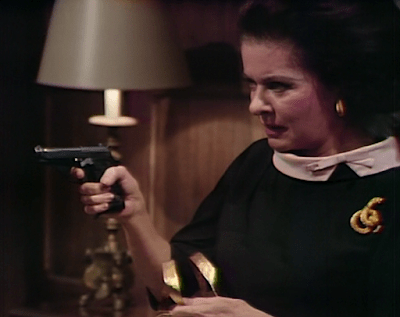
Much of the episode is taken up with some business about whether matriarch Elizabeth Collins Stoddard and her thirteen year old nephew David Collins are going to murder permanent houseguest Julia Hoffman. Liz and David have been absorbed into a secret cult devoted to unseen supernatural beings called the Leviathans, and Julia, who cannot be absorbed into the cult, is on track to uncover its existence. Liz takes a pistol and aims it at Julia’s back. Julia is absorbed in another crisis, and by the time she notices that someone else is in the room, Liz has put the pistol down.

Liz can’t bring herself to shoot Julia. Screenshot by Dark Shadows Before I Die.

Liz tells David she can’t bring herself to kill Julia, who has been very helpful to the family in the past. David sternly tells her that they must put aside all such considerations and think only of their duty to the Leviathans. They consult a sacred book the Leviathans have entrusted to them, and read that they must not kill anyone, since the ghosts of their victims are more formidable to them than are living people. Since most of the principal characters on the show, including Julia, Liz, and David, have committed or at least attempted homicide, this prohibition would seem to imply that the Leviathans are the good guys.

There is also a story about Quentin Collins and his great-grandson Chris Jennings. Quentin was a werewolf in the nineteenth century and Chris has inherited that curse. In 1897, a repellent little man named Charles Delaware Tate painted Quentin’s portrait. The portrait had magical powers, relieving Quentin of the effects both of lycanthropy and of aging. Quentin recently came back to town, suffering from amnesia and refusing to listen to Julia or Chris when they try to tell him he is 99 years old. Julia and Chris hope that Tate will be able to do for Chris what he did for Quentin, and they have figured out that he is still alive and using the name Harrison Monroe.

The moon was full enough last night to trigger the werewolf transformation, and will be again tonight. Chris turns up. She had taken him to a mental hospital she controls, to be locked up securely while he is in his lupine form; he checked himself out, and says he can’t stand being caged. Since the alternative is killing at least one person at random, it is rather difficult to sympathize with Chris’ insistence on letting himself out.

For her part, Julia was already afraid that a werewolf was on the loose before she knew Chris had left the hospital. She suspects Quentin may have reverted to lycanthropy. She goes to the apartment of the woman who has been keeping Quentin and finds him there, his face soiled and his clothing tattered as it might be the morning after a fit of werewolfery. It turns out that he did not transform- he simply got into a bar fight. When she tells Chris about this, he goes to his great-granddad and demands he accompany him to Tate/ Monroe’s house. Quentin isn’t interested in Chris or his problem or Tate/ Monroe, but he is too drunk to hold his ground for long.

Tate/ Monroe doesn’t want to let anyone in, but when Quentin announces himself he opens the door. Chris and Quentin see a young man sitting at a desk in a darkened room. The young man sees Quentin’s apparent youth and yells “Liar!,” shouting that he is too young to be Quentin. Quentin points out that Tate/ Monroe looks just as young as he does, and Tate/ Monroe responds by shouting something about being a genius. Within seconds, he is shouting that of course he recognizes him as Quentin. Confusing as this transition is, I don’t think it is a flaw in the writing, but in the acting. I suspect Mr Davis was supposed to put some sort of inflection on the lines in between to show that Tate has figured something out, but doing that would not be compatible with his technique of delivering all of his lines in an unvarying petulant shout.

Quentin can’t take Tate’s personality any more than the audience can. He throws a vase at him and runs out of the room. It’s when the vase hits the automaton that the head falls off.

The Leviathan story is based on some of H. P. Lovecraft’s stories. Chris and Quentin do not appear to have a direct connection to the Leviathans, but Harrison Monroe, and today’s closing revelation that he is a pile of junk arranged to look like a person, are taken from Lovecraft’s novella The Whisperer in Darkness. So perhaps werewolves and Leviathans have something to do with each other after all.

Episode 916: Julia Hoffman has had her dream

Certain People

Six weeks ago, old world gentleman Barnabas Collins was absorbed into a group serving supernatural beings known as the Leviathans. Also in the group is matriarch Elizabeth Collins Stoddard. Barnabas and Liz are worried that mad scientist Julia Hoffman, Barnabas’ sometime best friend and Liz’ permanent houseguest, is catching on to the truth about their group. They decide Julia must be absorbed into it.

Barnabas finds Julia on a couch in the drawing room, reading a book about lycanthropy. He strikes up a conversation about Chris Jennings, a young man who suffers from that condition. Julia replies bitterly that she still cares about Chris, unlike Barnabas. He tells her that he does care, and they quarrel a bit. He then strokes Julia’s cheek. He did the same thing with Chris’ little sister Amy in #912, at which point Amy fell asleep. Shortly after Amy woke up, she had become part of the Leviathan group. Julia gets a headache and goes to her room, where she does fall asleep.

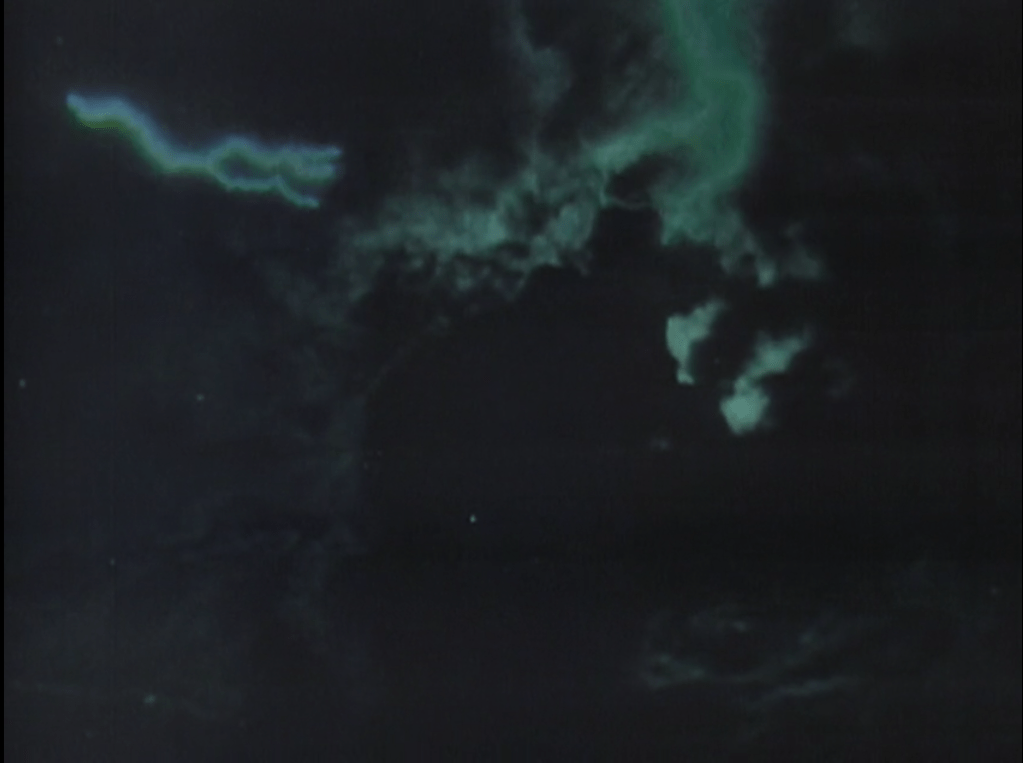
We didn’t see a dream sequence when Amy fell asleep, but do see one for Julia today. The visuals alternate between two stock clips of lightning flashes as we hear Jonathan Frid give a dramatic reading of some portentous nonsense, then give way to Julia finding Barnabas in the drawing room inviting her to open a wooden box. We saw a dream of Liz’ in #904; she woke from it already transformed into a faithful devotee of the Leviathans. But when Julia wakes up, she just has a worse headache.

They’ve shown us this clip more times than I can count…
… but I don’t think we’ve seen this one before. It’s fascinating to me, like an image David Lynch would have used in Eraserhead or the third season of Twin Peaks.

Julia goes downstairs and find Liz holding the box from her dream. She is urging her to open it. Julia is confused by the situation. A knock comes at the door, and she rushes to answer it. It is Chris, saying that it is time for Julia to drive him to the institution where he is locked up on nights of the full moon. Julia calls back to Liz that she will be back later in the evening.

Barnabas enters and says that Julia will never be absorbed into the cult. If she were suited for absorption, the knock at the door would not have distracted her. He explains that “There are certain people, Elizabeth, whom we are not able to absorb. It has to do with their genetic structure. And Julia Hoffman is one of them.” As a former vampire who is now leading a cult that is trying to bring a race of Elder Gods back into the world where they will destroy and replace humankind, Barnabas is supposed to be strange and unnerving, but hearing him talk about “certain people” and their “genetic structure” is off-putting in a whole other way. Why not just say that she’s Jewish, we know you mean that she’s Jewish.

Barnabas then tells Liz that it is now up to her to handle Julia. So far as we know, Liz does not have any special powers like those Barnabas uses when he fondles people’s faces. Liz doesn’t even know what the cult is all about- today, she asks Barnabas what the goal is they are working for, and he tells her he isn’t at liberty to say. So when Barnabas tells her to deal with Julia, we can only remember the last time we saw Joan Bennett playing a character under the control of an uncanny force, when Judith Collins shot and killed neurotic intellectual Rachel Drummond on the orders of vampire Dirk Wilkins in #776.

In #915, one Leviathan ordered Barnabas to kill Julia. When he refused, another caused him to have nightmares, then told him it was OK to leave Julia alive if he could find another way to keep her under control. That episode was written hurriedly and rushed into production at the last minute, three full weeks after this one was in the can, in response to complaints from fans dissatisfied with the Leviathan story in general and Barnabas’ coldness to Julia in particular. It’s anybody’s guess what they were originally planning to do with #915, but today’s episode makes it clear that it did not include the reset of Barnabas’ character that we saw yesterday. He is still leading the Leviathans, and when he delegates the problem to Liz murdering Julia is pretty obviously the likeliest solution.

Not a Portrait of Quentin Collins

Julia’s plan for Chris is to persuade an artist named Charles Delaware Tate to paint a portrait of him. Tate painted a portrait of Chris’ great-grandfather, Quentin Collins, in 1897. That portrait had magical powers. Once it was painted, Quentin’s own werewolf curse went into abeyance. It was the portrait that transformed on nights of the full moon, while Quentin himself remained human. Indeed, the portrait also caused Quentin to remain young and healthy. He returned to Collinsport a couple of weeks ago, and though he is 99 years old he still looks just like he did when he was 28. In #913/ 914, Julia found that Tate, also, is alive, and still looks like he did in 1897.

Quentin and Tate are not the only emigrés from 1897 currently sheltering in Collinsport. Another of Tate’s magical portraits, a concept piece depicting his ideal woman, caused its subject to pop into existence. In 1897, she went by the name Amanda Harris, met Quentin, and fell in love with him. She, too, is unchanged in 1969, though she now calls herself Olivia Corey.

Amanda/ Olivia and Julia are both hunting for paintings by Tate, and met each other through that pursuit. They have also met Quentin, and vied with each other to decide which would be the one to keep him. He has amnesia and knows only that he was carrying papers identifying him as Grant Douglas. He is open to the idea that this is not his real name, but he finds Julia’s attempt to convince him that he is a 99 year old man ludicrous and is frustrated with Amanda/ Olivia’s unwillingness to tell him when and where they first met.

Amanda/ Olivia comes back to her suite at the Collinsport Inn and finds Quentin there, swilling her booze and enormously drunk. He tells her that he finds his room depressing, because it doesn’t have a bar. He says he can’t stand not knowing who he is. She points out that he has taken this in his stride up to now, and asks why today is different. He says he doesn’t know why it is different, but it very much is. When the show was a costume drama set in 1897 and we saw Amanda, she did not know about Quentin’s lycanthropy, and now that she calls herself Olivia she still does not think of the full moon when she sees him in anguish.

Later, Julia shows up at Amanda/ Olivia’s door. She has brought one of Tate’s portraits of Amanda Harris. Amanda/ Olivia staggers back at the sight of it. She composes herself and says that it is of no interest to her, since she already has several of Tate’s paintings of her “grandmother.” Julia tells Amanda/ Olivia that the real reason she is not interested in it is that it is not a portrait of Quentin Collins. She replies that Julia is the one who is fascinated by Quentin, not she. Julia says that she wants to show the portrait to Quentin. Amanda/ Olivia does not bother pretending that his name is “Grant Douglas” or that it might be something other than “Quentin Collins”; she simply tells Julia that he is in his room sleeping off an alcoholic binge. Julia adopts her most unmistakably Mad Scientist manner when she responds “Then this is definitely the right time to see him!” She marches out, and Amanda/ Olivia follows her.

Julia had told Chris that if Quentin’s portrait has been destroyed, his lycanthropy will be back in force. If that is so, she wants to be with him when he transforms. This was a doubly confusing thing to say. First, if the portrait had been destroyed, Quentin would not only be a werewolf, he would also look his age. She therefore knows it is not so. Second, she does not have anything with her to protect her against werewolves. If she is with Quentin when he transforms, he will kill her immediately.

When Julia and Amanda/ Olivia let themselves into Quentin’s room, they find that it is a shambles and he is gone. As a closing cliffhanger, this is supposed to leave us with the fear that a werewolf is stalking Collinsport. But since we know what the portrait does for Quentin, it only leaves us wondering if Amanda/ Olivia will have to pay an extra housekeeping charge because he trashed the room she was renting for him.

When Julia met Tate in #913/914, she could not get him to engage her in any kind of conversation, much less agree to paint a portrait of Chris. She did not mention Amanda/ Olivia. Since Tate was maniacally obsessed with Amanda in 1897, Julia should have known that her acquaintance with her was the strongest card she had to play. So when she goes to Amanda/ Olivia’s suite today, returning viewers were hoping that she was going to propose they team up to persuade Tate to paint Chris. Perhaps that will still happen. If it does, it might be a lot more interesting than is the revelation that Quentin doesn’t keep his hotel room clean.

Episode 915: Emergency Leviathan Broadcast

In #701, old world gentleman Barnabas Collins traveled in time from 1969 to 1897. For the next eight months, ending in #884, Dark Shadows was a costume drama set in that year. On his way back to a contemporary setting, Barnabas took a detour to the 1790s, when he was a vampire. Before he left the 1790s, he was abducted by and absorbed into a cult that serves supernatural beings known as the Leviathans. At their behest, he took a small wooden box with him to November, 1969, and functioned as one of the leaders of the Leviathan cult in that period.

The first six weeks of the Leviathan story has had its strengths. Ever since Barnabas was first cured of vampirism in March 1969, he has been under the impression that he was a good guy and has been doing battle with various supernatural menaces. He was hopelessly inept at this, and created as much work for the other characters by his attempts at virtue as he formerly did in his unyielding evil. That has made him a tremendously productive member of the cast, but it does leave him with a tendency to seem harmless, even when he is trying to murder his way out of a problem. But Barnabas the Leviathan chief has been ice-cold and formidably efficient. Even though not much has yet been done to hurt anyone, seeing him in this mode adds a note of terror to the proceedings.

Moreover, the Leviathans have voided Barnabas’ friendship with mad scientist Julia Hoffman. Since the relationship between the two of them has been the heart of the show for over two years now, from the hostility of their early days to the close bond they formed in the summer of 1968, this reinvigorates the action. It is as interesting to see them fight with each other as it is to see them collaborate against a common foe, and their hate scenes gain an extra depth because we keep wondering about their eventual reconciliation. If they play their cards right, they should be able to keep this up for months.

Today, it all falls apart. Barnabas has drawn a huge following of very young fans who run home from elementary school to watch the show. The 1897 segment was a triumph in large part because it had a core of stories that could hold the attention of adults while also appealing to the preteen demographic. But the Leviathan arc has so far had little to offer anyone but grownups. Apparently the kids were writing angry letters, because this episode, rushed into production at the last minute and bearing signs of haste in every shot, turns Barnabas back into the would-be hero who was such a klutz that he couldn’t even stay in the right century.

The creature who emerged from the box Barnabas brought from the past now appears to be a 13 year old boy and answers to the name Michael. In the opening scene, Michael orders Barnabas to kill Julia. Barnabas declares that he will not, and goes home. There, he tells his troubles to the box, then falls asleep in his chair.

A hooded figure appears to him. This hooded figure says that he is a Leviathan, and tells Barnabas he must comply with Michael’s commands. The Leviathan is not named in the dialogue and there are no actors’ credits at the end, but reference works based on the original paperwork call him Adlar.

Adlar sets out to explain Barnabas’ position, much as Marley’s ghost did to Scrooge in Dickens’ A Christmas Carol. The shortened production schedule shows in inconsistencies that litter Adlar’s speeches. At one point he says that the Leviathans needed Barnabas to transport the box from the eighteenth century to the twentieth; at another, he claims that they are holding his lost love Josette prisoner in the eighteenth century and will inflict a new, far more horrible death on her than the one she died the last time Barnabas was in the 1790s, a threat they will be able to carry out only if they have their own means of traveling back and forth through the years. Barnabas doesn’t pick up on this or any of Adlar’s other inconsistencies; perhaps he is too distracted by the many jump cuts that make this episode look like the videotape was edited with a rusty butter knife.

Adlar threatens to make Barnabas a vampire again, then disappears. He does not tell him that he will be visited by three spirits, one representing his past, another his present, and the third the future he is risking by his present course of action, but this is in fact what happens. Barnabas goes outside, and sees a bat. It was a bat whom he first saw on this very spot who initially made him a vampire. Barnabas rushes inside, looks in the mirror, and does not see a reflection. He thinks of his mouth, and feels fangs growing there.

Next comes Megan Todd, a Leviathan cultist who with her husband Philip is fostering Michael in their home. Barnabas cannot take his eyes off Megan’s long white neck. Megan keeps telling Barnabas that he is the only one she can confide in about her concerns with the progress of the Leviathan plan; he keeps demanding ever more stridently that she leave at once. His bloodlust may explain why he doesn’t notice the continuity problem in the scene. They’ve made the point time and again that it is only while Barnabas is giving orders to her and Philip that Megan remembers that he is their leader. At other times, she thinks he is an outsider. But Megan is the only one who can tell Barnabas a story of family life in any way paralleling that which the Ghost of Christmas Present brings to Scrooge’s attention at the Cratchit house. Continuity has to go if the episode is going to fit into the form of A Christmas Carol.

Suddenly, Barnabas finds himself in an alley by the waterfront. A sign behind him says that he is next to the Greenfield Inn; we saw this sign in #439, set in the year 1796. Evidently the Greenfield Inn is a long-established, though not very reputable, place of lodging.

A woman approaches him. She is very aggressive about insisting he take her with him wherever he is going. He is reluctant at first, urging her to seek friends at the Blue Whale tavern, but she won’t take no for an answer. All of a sudden, he brightens and looks at her with desire. She says she is afraid of him. He asks if she wants to go, and she screws up her courage to declare that she will stay with him. He bares his fangs and attacks. The rough videotape editing adds to the violence of the scene. There is no sensuous bite, only a flash as he lunges at her and then is standing up again, protesting that he didn’t want to do it. When the camera zooms in on the bleeding marks on her neck, it is surprising to see that he didn’t rip her throat out altogether.

We cut back to Barnabas’ house. He is dozing in his chair, and the woman, displaying vampire fangs of her own, walks in through the front door. She approaches Barnabas. He awakens, and is horrified. Adlar tells Barnabas that “she is not up to your usual standards.” She’s standing right there, that’s pretty tactless. Also, she is future four-time Academy Award nominee Marsha Mason. The only other Oscar nominee Barnabas bit was Grayson Hall as Josette’s aunt, the Countess DuPrés, in #886. Hall was only nominated once, so if anything this woman is a step up for him.

Four time Academy Award Nominee Marsha Mason. Screenshot by Dark Shadows Before I Die.

Adlar makes the woman disappear, and shows Barnabas that he is not really a vampire again. With that, we see that she is a shade of a future that may come to be, not one that is already ordained. Adlar also tells Barnabas that it is not now necessary to kill Julia. But he does say that Barnabas will have to do something to ensure Julia’s silence, or else Josette will suffer. Barnabas hangs his head and says to the mirror that he has no choice to obey.

Episode 908: Mollycoddle that monster

The current phase of Dark Shadows is focused on the threat to the human race posed by the Leviathans, unseen supernatural beings who have taken control of several characters on the show. Among their devoted servants are matriarch Elizabeth Collins Stoddard and her nephew, strange and troubled boy David Collins. Today, Liz and David welcome a boy known as Alexander to the great house of Collinwood. Alexander appears to be an eight year old boy, but is in fact an extreme case of Soap Opera Rapid Aging Syndrome. Last week he was an infant, and a few days before a whistling sound coming from a wooden box. Whatever Alexander may really be, he holds a key position in the Leviathans’ plan.

At times, Dark Shadows becomes so much a kids’ show that it loses much of its adult audience. The Leviathan story so far has gone to the opposite extreme. A scene in which Alexander orders the thirteen year old David to give up the transistor radio he had long wanted and that his father just gave him will probably get similar reactions from viewers of all ages, but when Alexander scolds Liz for asking questions and she apologizes, only those who remember Joan Bennett as the great star she was in the late 1930s and early 1940s will get the full force of the moment. In general, adults will probably feel the distress Alexander’s tyranny is supposed to induce, while the fans who are running home from elementary school to watch the show will likely be either annoyed with the kid or amused to see the grownups getting theirs.

Liz’ ex-husband Paul is being persecuted by the Leviathans and their human agents. Paul is staying at Collinwood, and he is outraged to find Alexander in the house. Paul carries on like a crazy man, prompting Liz to tell him that if he doesn’t compose himself he will end up in a mental hospital. He tells Maggie Evans, David’s governess, about his suspicions; she listens sympathetically until he catches Alexander eavesdropping and roughs the boy up. Maggie then freezes in horror, and Paul goes on shaking Alexander and yelling at him until Liz enters and puts a stop to it. While Liz and Maggie stand in the corridor and talk about Paul’s lunatic behavior, he paces in the drawing room, telling himself that he mustn’t “fly off the handle” again.

David enters and hands Paul a small photo album. He says that it has pictures of Paul and Liz’ daughter Carolyn when she was a child. Since Paul wasn’t around when Carolyn was growing up, David says it occurred to him that Paul might want to look through it. Paul thanks David for his thoughtfulness.

As Paul leafs through the album, we get a look at a picture depicting Carolyn as she was when she was about ten. We haven’t seen the model before. Dark Shadows had such a tight budget that regular viewers will be fairly sure they wouldn’t have brought a girl in only to pose for a single photograph, so we might start wondering when we will meet the ten year old Carolyn.

Child Carolyn. Screenshot by Dark Shadows Before I Die.

We may also be wondering when we will see another girl of about the same age. Denise Nickerson, twelve years old in December 1969, has been in the cast for a year at this point, and has made major contributions every time we’ve seen her. We saw in #893 and #896 that her character Amy Jennings is still living at Collinwood and is still David’s chief playmate. But as is usual in episodes where she does not appear, Amy is unmentioned today. Liz tells Paul that David spends entirely too much time surrounded by adults, as if Amy does not exist. They followed the same pattern during the eight months of 1969 when Dark Shadows was set in 1897 and Nickerson played nine year old Nora Collins. When Nora was in the episode, she was often its brightest spot, but when she wasn’t her name never came up. It’s unnerving that the show does so little to reassure us that it will continue to make use of such a talented and appealing young actress.

Alexander sits on the bench that has been in the foyer at Collinwood throughout the whole series. The Dark Shadows wiki says this is only the second time the bench has been used. I want to say it is the third- I remember David sitting there in #176, when Maggie’s predecessor Vicki told him he could have two desserts, cake and ice cream, but I seem to recall either him or someone else sitting there at some point around that time. I’m not going to go back through those episodes to check, but if you’ve been watching them I’d appreciate it if you’d leave a note in the comments.

Episode 907: Knowing the criminals but not the crime

The current storyline on Dark Shadows revolves around the evil machinations of a cult that serves mysterious supernatural beings known as the Leviathan people. We haven’t seen the Leviathans themselves, and the humans who make up the cult have not yet done anything spectacularly destructive.

The vagueness of the Leviathans’ threat is lampshaded a couple of times today. We open with old world gentleman Barnabas Collins, a leader of the cult, standing over the hospital bed of his distant cousin Quentin Collins. He tried to kill Quentin, but managed only to give him a head wound resulting in massive amnesia. In our world that would represent an extremely severe injury, but in Soap Opera Land everyone gets amnesia from time to time. It’s like the common cold, only with a more definite prospect of complete recovery. Now he is thinking of finishing the job. He decides that since Quentin once saved his life, he will take a pass on killing him for now. We hear his thoughts as he counts that a payment in full of his debt to Quentin. Evidently he now considers himself free to kill Quentin at his next chance. That anticlimax sums up the whole story so far- lots of ominous suggestion, no resolutions.

The Leviathan cult has been menacing Paul Stoddard, a shady fellow who, in the late 1940s, married heiress Elizabeth Collins, sired her daughter Carolyn, and deserted the family after he realized he wouldn’t be getting his hands on Liz’ money. The night he ran off, he unwittingly made a Faustian bargain with a representative of the cult, handing Carolyn over to them. It is unclear why they have been so unpleasant to him lately, since he made his agreement twenty years before.

Now, Liz has been absorbed into the Leviathan cult. She has taken Paul back into her home, the great house on the estate of Collinwood. She told him yesterday that she wanted him close to her so that they could work together to fight his unseen enemies, but it dawns on him today that this is not her intention. She tells him that she and Carolyn have concluded that he is mentally ill and they want to get him help. He goes to telephone the police. Liz asks what crime he will report to them, and he realizes that he knows of none that has been committed.

Paul catches permanent houseguest Julia Hoffman, MD, eavesdropping on his conversation with Liz. He angrily accuses her of being “one of them.” Since Liz is talking about treating Paul as a mental patient and Julia is a psychiatrist in residence at Liz’ house, this is a natural assumption on his part. Before long, he realizes that Julia is in fact his likeliest ally. Between the summer of 1968 and the autumn of 1969, Julia and Barnabas were inseparably close friends. His absorption into the Leviathan cult put a stop to that, and now he can barely tolerate her presence. She does not know what is going on, but is avidly interested in whatever suspicions Paul can share concerning the change in Barnabas. Before they can get very far, Barnabas enters and Paul runs off. Julia faces Barnabas down, then goes after Paul.

Julia confronts Barnabas about his effect on Paul. Screenshot by Dark Shadows Before I Die.

Episode 905: My darling now

Heiress Carolyn Collins Stoddard has been hung up on mysterious drifter Chris Jennings for a while. Unknown to Carolyn, Chris is her third cousin, the great-grandson of her great-great uncle Quentin Collins. That is a distant enough relation that it needn’t be an obstacle to romance. But Chris is keeping another secret that presents a more definite obstacle. He inherited from Quentin a curse that makes him a werewolf.

From March to November 1969, Dark Shadows was a costume drama set in 1897. Old world gentleman Barnabas Collins and mad scientist Julia Hoffman traveled back in time from 1969 to that year, and befriended the living Quentin. They learned that Quentin had been freed of the effects of the werewolf curse when a magical portrait was painted of him. As long as the portrait remains intact, Quentin will not only retain his human form on the nights of the full moon, but will also be immune to injury, aging, and death. Julia and Barnabas know of Chris’ condition, and early in 1969 they were working together to cure him of it. Julia now hopes that another portrait can be painted to do for Chris what his great-grandfather’s portrait did for him.

Barnabas came back from the past wanting nothing to do with Chris. He has secretly been absorbed into a cult devoted to mysterious supernatural beings called the Leviathan people. When Barnabas first saw Chris after his return to 1969, he told him there was no hope for him. Since then, he has been cold and distant both to Chris and to Julia. He has urged Carolyn to forget Chris, and keeps telling her that she has a great future in store for her. We have had other indications that this future will involve a special role in the Leviathans’ plan to take over the world.

Now, Carolyn has met the living Quentin and become smitten with him. She does not know his true identity, but did tell Barnabas about him and that he was coming to meet her. Barnabas’ response was to run Quentin over with his car, claiming afterward that it was an accident.

Now, Quentin is in the hospital with a bandage on his head. He does not speak in today’s episode, but anyone who has seen a soap opera knows that a bandage wrapped around the head is a sure sign of amnesia. Indeed, when Julia addresses him as “Quentin,” he looks at her blankly.

Quentin wearing the amnesia badge. Screenshot by Dark Shadows Before I Die.

In his post about the episode on his great blog Dark Shadows Every Day, Danny Horn reminds us of another amnesia plot that followed a time travel story. That one dragged on for eight months, was never at all interesting, and ended with the two characters most directly involved being hustled off the show. Remembering it, longtime viewers will shudder at the sight of Quentin’s bandage. But amnesia stories are a staple of soaps, and Danny explains how they can work well by imagining a different version of that dismal flop:

Jeff Clark… might or might not have been a reincarnation of Peter Bradford, Vicki’s boyfriend from 1795. Somehow, they managed to spin that mystery out for a full eight months, until they finally decided that nobody cared, and then they wrote Jeff, Peter and Vicki off the show forever.

The real problem with the Jeff/Peter mystery — and this is important, for the Quentin/Grant Douglas conundrum — is that Jeff Clark was just an empty suit of clothes. Jeff had no memories, and he arrived on the scene with no family, and very little in the way of a storyline.

Worst of all, Jeff’s primary characteristic — being in love with Vicki — was also Peter’s primary characteristic, so it was a distinction without a difference. It didn’t really matter whether he was called Jeff or Peter, so they could just let it drift for month after month, with no appreciable impact on story progress.

Here’s how you do the amnesia story: Think of it as two people inhabiting the same body, and create a conflict between those people. If Peter’s in love with Vicki, then “Jeff” should be cold and distant. “Jeff” didn’t experience any of the events that brought Vicki and Peter together, so her clumsy attempts to revive his memory should upset and frustrate him.

At that point, you can take as long as you’d like to bring his memory back, because the longer this goes on, the more damage “Jeff” can do to Peter’s life. The ideal way to end that story is to have “Jeff” fall in love with Vicki’s worst enemy, and news of their engagement makes Vicki turn to someone new for support and understanding.

Then it should be obvious to everyone that his memory comes back on the day of his wedding, during or immediately after the vows. Suddenly, “Jeff” is Peter again, horrified to discover that he’s married to someone that he doesn’t like, and the love of his life is involved with somebody else.

That’s how you do the amnesia story.

Danny Horn, “Episode 905: Waiting for Quentin,” posted 27 July 2016 on Dark Shadows Every Day.

The sheer fact that Quentin is in a coma as a result of a collision with a car is a puzzle for attentive fans. In #844, sorcerer Count Petofi scraped Quentin’s cheek with a jagged piece of glass. That did not leave a mark on Quentin himself, but a scar appeared on the portrait in the place corresponding to the spot Petofi scratched. Since violence against Quentin leaves him as he was but marks the portrait, why is he hurt now? One of Danny’s commenters tackled this problem:


Yeah, why is he even hurt at all? The painting should have absorbed all the trauma of Barnabas’ reckless attempt at mayhem; the portrait should have amnesia. (Oh, but then it wouldn’t be protecting Quentin any more, since it wouldn’t remember who it’s a picture OF – which is why Quentin has the amnesia and injuries! How’s that for a fanwank?)…

Is it explained later just WHY Quentin thinks he’s Grant Douglas? Did he already have amnesia? And now he has double amnesia? (If I remember sitcom amnesia correctly, the second trauma should have reversed the first – but soap opera amnesia may be different.)

Comment left 29 December 2018 by “John E. Comelately” on Danny Horn, “Episode 905: Waiting for Quentin,” posted 27 July 2016 on Dark Shadows Every Day.

Later, Carolyn is at the antique shop where she has been working. The shop’s owner, Carolyn’s friend Megan Todd, makes a bunch of cryptic remarks about having discovered something greater than happiness. Carolyn wonders about the baby that Megan and her husband Philip have been looking after. She hears a ball bouncing in the upstairs room where the baby has been sleeping, and Megan orders her to ignore it. Eventually the ball comes rolling downstairs, and an eight year old boy follows it. Megan declares the boy to be her darling.

Returning viewers know that the baby was in fact some kind of creature associated with the Leviathans, and Megan has a scene in which Barnabas tells her that the creature is going to be undergoing a change. So we know that this boy and the baby are in fact one and the same.

That two consecutive men who attracted Carolyn turned out to be werewolves is interesting in light of the frequent references to the big plans the Leviathans have for her. The Leviathans have clearly not been giving their devotees a lot of background information about the tasks they make them perform, so that even if Barnabas did not know who Quentin was when he tried to kill him, the unseen forces manipulating him may have been well aware of that. Perhaps the show is suggesting that there is some kind of enmity between the Leviathans and werewolves.

Quentin’s ghost haunted the great house of Collinwood from December 1968 to September 1969 and wrought great havoc there. The haunting broke on the anniversary of an event in 1897 that went differently than it had originally because Barnabas and Julia had traveled back in time. But it was made clear when we returned to contemporary dress that the 1960s characters all remember the events of those ten months, and that Quentin’s ghost still frightens them. Carolyn was one of the few major characters who did not see the ghost, so I suppose it makes sense she isn’t afraid when she sees the living Quentin. But one does wonder what the reaction will be when the other residents of the great house meet him.

The Leviathan boy is played by David Jay, and is named in the credits as “Alexander.” Born in 1961, Mr Jay is the youngest person ever to have appeared on Dark Shadows. He acted off and on until the early 1980s. Evidently he is alive and well, but he never appeared at any of the Dark Shadows conventions and does not do the podcasts on which other cast members occasionally guest. Not one for the fandom, he.