Episode 37: Fatigue lines

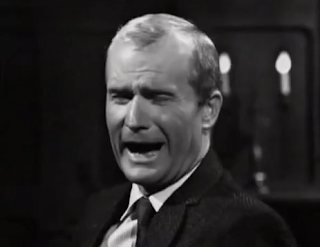
Roger’s mounting anxiety about what Burke may learn from Sam leads him to alternate in each scene between yelling and begging. Depicting this, Louis Edmonds’ chews the scenery so hard that he momentarily loses track of Roger’s mid-Atlantic accent and slips into his native Louisiana drawl, yelling at Vicki “Jes supposin’ you a-tell me how long you wah standin’ in that doah-way?” Perhaps this is Marc Masse’s “David Ford Effect”– Ford came to the show from a long engagement as Big Daddy in Cat on a Hot Tin Roof, maybe they’ve decided to transport Collinsport from Maine to the Mississippi Delta.

At the Evans cottage, Sam gives Maggie a sealed envelope to be opened in event of his death. Maggie is bewildered and upset. Surmising that her father’s trouble is to do with Collinwood, she wishes that the mansion would burn to the ground. Sam waxes philosophical, opining that “Ghosts of the past don’t live inside a home. They live inside each man. They fight for his soul.. twist it into something unrecognizable.”

Moments later we find out that Sam is wrong, ghosts totally live inside a home. In the middle of the night, Vicki is awakened by the same strange sobbing she had heard in episode 4. She follows it to the basement. Last time she was in the basement, in episode 6, Matthew found her there and spoke sharply to her. Now Roger finds her there and yells at her. As she had stood up to Roger in the drawing room earlier, so she stands up to him now. After their showdown, he even admits that he has heard the sobbing woman many times, and says that she may be “one of our ghosts.”

I divide the series into several periods, the first of which I call “Meet Vicki.” The major story-lines of the Meet Vicki period are all in a down-cycle during this episode. Roger’s panic and Sam’s melancholy are part of the Revenge of Burke Devlin story, but Roger’s activities today do nothing to advance that story, and Sam’s letter will become one of the most tedious MacGuffins in a series that is notorious for forcing the audience to sit through overlong contemplation of its MacGuffins. Roger’s angry reaction to finding Vicki in the basement touches on the Mystery of the Locked Room, which is connected with the question of why Liz became a recluse. Those stories haven’t advanced for weeks. The sobbing woman revives the question of whether the house is haunted. While Roger’s admission that he has heard the sobbing marks the first time one character knows what another is talking about concerning the ghostly happenings, it does not prompt any further action. The question of Vicki’s origins is at a stalemate, the romance between Carolyn and Joe is dead in the water, and David is so alienated right now that they can’t do much with Vicki’s attempts to befriend him.

So the Meet Vicki period has reached a dead end. Tomorrow we’re going to meet someone else, and a new period is going to begin.

Episode 36: Politeness is a passing phase

The actors all go big in this one. Marc Masse calls it “The David Ford Effect” and concentrates on Louis Edmonds’ thunderous performance in Roger’s confrontation with Liz, but since the entire cast has turned up the volume, I think it is more likely a response to direction coming from the people who hired David Ford (and, to be seen in a couple of days, Thayer David) than to David Ford himself.

Masse isn’t the only commentator who tends to ignore the directors and producers as influences on the acting. Perhaps that tendency goes back to an interview John Karlen gave in which he says that he doesn’t recall ever getting any direction at all on Dark Shadows. His first day, Lela Swift said “Go!” and that was it, he just did whatever he wanted for the next four years. On the other hand, Joel Crothers said that he left the show because the directors were so busy with special effects they no longer had any time to work with actors, implying that they had worked with them at one point. Since Crothers was there from the beginning and Karlen joined the cast ten months in, I can only assume that it was during these first months that the directors told the actors what they wanted.

Why would Lela Swift and the other masterminds behind the scenes start hiring actors like David Ford and Thayer David and tell the existing cast members to start hamming it up at this point? Well, the saga of the bleeder valve has wrapped up, and there is no other story going on that wasn’t there in episode 1. Some of those stories are starting to look pretty pointless. There’s “The Revenge of Burke Devlin”- they haven’t told us what exactly he wants revenge for, but if he ever takes it we will see either the death of Roger, which would have the disastrous effect of requiring Louis Edmonds to leave the show, or Burke taking control of the Collins family assets, which will bring the equally disastrous requirements of a showing a bunch of episodes about various forms of debt and building a new set for Joan Bennett to play her scenes on. So we’re starting to suspect that Burke will just keep going in circles. Roger’s angry scene with Sam in this episode is fun to watch because Edmonds and Ford play well off each other, but as part of The Revenge of Burke Devlin story it doesn’t take us to any new ground.

There’s “Vicki Seeks Her Origin.” We might expect that one to lead somewhere, eventually, but if that happens it won’t be for a good while. In this one, Vicki tells Liz that she’s decided she can’t help David and replies to Liz’ plea with her to stay with “Why am I so important?” She doesn’t renew her inquiries into how Liz knew about her and why she hired her. Of course not- that was getting tedious. So Alexandra Moltke Isles and Joan Bennett just emote furiously while exchanging lines that don’t add up to much.

We don’t see Carolyn or Joe in this one, but their romance is another dead end. Joe is a nice guy who wants to get married, Carolyn is a rich girl who doesn’t. There aren’t that many ways to make a story out of that.

The one story that works in the first 42 weeks is the growing friendship between Vicki and David. Right now there isn’t much to do with that one, either. David has just been caught trying to murder his father- he isn’t going to be particularly reachable. Today, he openly threatens Vicki at the beginning of the episode, then comes out of hiding after Liz persuades her to stay and declares that he doesn’t want her to stay. We have to see them at rock bottom today for the gradual rise in the months ahead to grip us the way they will, but not a lot happens while you’re at rock bottom.

So, maybe the producers and directors decided to dial the acting up to 11 because they knew they didn’t have much of a story to tell. This is Art Wallace’s final week as the sole credited writer on the show; I don’t know how much help he had in those first eight weeks, how much involvement he really had in episodes attributed to him in the nine weeks after, and whether anyone is already around whose name will be printed on the screen in that period. But they don’t have a story to tell right now. So it falls to the cast to distract us while they wait for the next phase.

Episode 32: Where all criminals belong

In today’s compare-and-contrast, we see the sheriff and Bill Malloy demonstrating how mentally healthy people might react to the idea that a nine year old boy has devised and executed a plan to murder his father. Then we go to Collinwood, where we see how Liz and Roger react to the idea.

The sheriff can’t bring himself to say out loud what the evidence is leading him to suspect David has done. Bill can say it only in part, and then only to express shock and bewilderment.

The scenes between Liz and Roger in this episode are among the strongest in the entire series. Roger is quite drunk, almost giddy, almost laughing at the fact that his son tried to kill him. Liz cycles through a half dozen intense emotions before finally accepting the fact that David is the culprit. She orders Roger to lie to the sheriff and say that what happened to his car was a simple accident, that no one was at fault.

In response to her explanation that this is the sort of thing the Collinses have always done, Roger brings up his suspicion that David may not be a Collins at all. David was born less than nine months after Roger and Laura* were married; she’d been Burke’s girl… Liz won’t hear such things, and insists that David is a Collins, that he belongs to all of the ancestors. She blames Roger for raising David in a home where he knew nothing but hate from the moment he was born, hate he couldn’t understand or cope with.

Roger insists that David be sent away to a mental hospital; Liz says no, that he will stay in the house, that “Miss Winters and I” will give him the home life he needs. Her mention of “Miss Winters” in this connection makes it clear that Vicki is central to Liz’ plans for the future, whatever those might be.

The sheriff shows up. He’s taking his time to get to the point. Roger cuts him off: “Is it about David?” At that, even the background music falls silent. The sheriff starts talking. Liz jumps in and says that the sheriff should drop the investigation, that it was all just an accident. The sheriff looks uneasily from Liz to Roger and back again, and finally agrees to do so.

In the coda, Roger tells Liz that she will regret covering up for David. He gives her a look of contempt that is among the most powerful things I’ve ever seen on a screen. Liz is totally alone now; Roger will obey her, but he’ll never respect her again. Joan Bennett was pushed to the margins of the show in later years, but she really did fill her “Starring” credit in these first months. It isn’t every show that would present us the leading lady devastated like this.

*Aside from the prologue delivered by Alexandra Moltke Isles, there are no surviving cast members in this episode. As of 9 August 2022, it is the earliest episode of which that can be said.

**Laura’s name is first mentioned here.

Episode 20: A mockery to the future

In episode 18, Roger (Louis Edmonds) had demanded Vicki (Alexandra Moltke Isles) come with him to Burke’s hotel room, where they will tell Burke (Mitch Ryan) about all the evidence they have connecting him to Roger’s car wreck. Vicki repeatedly protests in that episode that it would be better to take this information to the police. In this one, they arrive at the hotel, and again Vicki objects that they really should be going to the police. Roger, however, is a man obsessed. He asks Vicki to wait in the restaurant while he goes to Burke’s room, telling her that it may not be necessary for her to join him.

Sam (Mark Allen) comes to the restaurant looking for his daughter Maggie. Finding that Maggie isn’t at work, he invites himself to Vicki’s table. Their previous encounter had been a strange and frightening one on the top of Widow’s Hill; Vicki is no more comfortable with Sam now than she had been then. He bellows at her, she reacts with quietly frosty disdain. These attitudes may have less to do with the script or the direction than with Mark Allen’s limitations as an actor; he bellows all of his lines in this episode, and quiet frostiness is as effective a technique as any other for holding onto the audience while sharing a scene with an incompetent loudmouth.

There’s no incompetence in the scenes in Burke’s room. Louis Edmonds and Mitch Ryan were first-rate stage actors, and their confrontation is a terrific fireworks display. When Roger brings Vicki up to tell Burke what she saw him do in the garage, she again plays the scene quietly, an effective counterpoint to the artillery blasts the men have been letting loose.

In the Evans cottage, Sam finds that Maggie (Kathryn Leigh Scott) has been home all this time. When Allen bellows at her, Scott bellows back at him, a far less effective tactic than the quiet intensity Mrs Isles had used earlier. The scene has some potential- the situation is that an alcoholic finds that his adult daughter has been checking up on him, he resents it, and they have a fight about all of the ways in which she has been forced to take on the parental role in their relationship. But as a shouting match, it might as well be about anything, or about nothing.

Returning home after their confrontation with Devlin, Roger and Vicki say goodnight in the foyer. Time and again in these early episodes, people have urged Vicki to leave Collinsport while she still can. Even in this episode, Burke had told her that. But as they part ways for the night, Vicki to her bedroom and Roger to the brandy bottle, Roger tells her that as a witness, “you can’t leave now.”

That line is effective enough, but if the scene between Sam and Maggie had worked it would have been very powerful. The Evanses, father and daughter, are a case of two people who are trapped, trapped in Collinsport, trapped with each other, trapped with his alcoholism and her sense of obligation to keep him alive. As written, the scene could have brought all that out, and induced a claustrophobic sense in the audience that would have made Roger’s line feel like a death sentence. As ruined by Mark Allen, it just leaves us with the sense that we’re watching a show that needs some recasting.

Episode 18: Strange sounds and lonely echoes

Only three characters in this one- Roger, Vicki, and David. In the previous episode, Roger learned that his crash was no accident, that someone tampered with his brakes. Now he wants Vicki to tell him what she can that will help him prove that Burke Devlin was the one responsible. Which is a great deal- she saw him in the garage, with a wrench, next to Roger’s car. She had gone into the garage after hearing what she thought was a car door slam. She admits that the slam could have been the hood over the engine compartment, and since the car door next to Devlin was open, this seems likely. Since the reason Roger was on the road was that Devlin had invited him to town to discuss “business,” and the two of them do not seem to have any business together at all, the case against Devlin seems quite strong.

David will place rather a substantial difficulty in the way of Roger’s hope of sending Devlin back to prison. As the audience knows, it was he, not Devlin, who removed the valve from the braking system on his father’s car. We even see him handling the valve in this episode. In episode 17, he nearly confessed to his Aunt Elizabeth, and this time he makes an incriminating statement to Vicki. Both women had assumed he was merely expressing guilt for his hostility to his father, and tried to reassure him that his feelings and thoughts didn’t mean that he was to blame for what happened on the road. David even tries to talk to his father in this one, and Roger icily dismisses him. But we’ve seen enough mystery stories, including inverted mysteries where the audience knows who done it before the detective does, to be sure that Roger will learn the truth when he least expects it.

Roger not only has reason to suspect that Burke is responsible for his crash; he also has deep, complex, ungovernable feelings where Burke is concerned. Some of those feelings have to do with the testimony he gave at the trial ten years before which sent Burke to prison. Some go back before that, and have to do with the friendship that existed between them before that trial. All of them are deeply secret.

This show was being made in 1966, when Freudianism reigned supreme in much of American intellectual life, and the most respected of respectable novels was Proust’s À la recherche du temps perdu. All of the cast and much of the production staff comes from Broadway, where at that time Tennessee Williams was the undisputed king of serious playwrights. And the part of Roger was played by Louis Edmonds, who came out of the closet as a gay man as soon as it was possible to do so, and who was never in the closet as far as his friends and colleagues were concerned. So it seems likely that the secrets Roger is so desperate to conceal include some kind of homoerotic connection with Burke. This episode lampshades some standard soap opera craziness in order to call our attention to the irrational nature of Roger’s attitude towards Burke, and I think a mid-1960s audience would be likely to suspect that a repressed sexuality is driving that irrationality.

Here’s how I put it in a comment on John and Christine Scoleri’s Dark Shadows Before I Die:

When Vicki tells Roger what she saw Devlin doing in the garage, Roger asks her to come with him to confront Devlin at the hotel. That’s a typical soap opera character idea. What isn’t so typical is Vicki’s response, that it would be better to go to the police. She sticks with that rational idea until Roger tells her of his urgent need to see Devlin’s face. That picks up on Roger’s frantic behavior in Week One and sets him up for the whole saga of Where Burke Devlin’s Pen Is, in which we see that Roger’s attitude towards Burke is rooted in some deep and complicated emotions.

Episode 4: Frightening a new friend

Here’s the comment I left on the Scoleris’ Dark Shadows Before I Die blog entry about this episode:

Interesting how the early episodes tiptoe towards the supernatural. Burke, Roger, and Carolyn all use the word “ghost” metaphorically, to refer to unresolved conflicts from the past that are still causing problems in the present. Liz and Vicki, each in her turn, responds by saying there are no such things as literal ghosts, only to hear the first person assert that there absolutely are. Giving this same little conversation to both Liz and Vicki is one of the ways the show tries to establish Liz and Vicki as mirrors of each other, of presenting Liz’s current life as a possible future for Vicki and of Vicki as a revenant of Liz’s past.

The sobbing sounds Vicki hears in this one are the first occurrences that would have to be explained as the act either of a ghost or of someone trying to make Vicki believe there are ghosts. The next such moment will come in episode 14, and there will be several more in the weeks and months ahead. This tiptoeing is what the Dark Shadows wiki on fandom tracks as “Ghostwatch.”

In view of the near-sexlessness of the later years of the show, it’s striking how frank this one is. Roger’s aggressiveness towards Victoria is plainly sexual. Liz catches him trying to sneak into Victoria’s bedroom, he derides her attempt to regulate his “morals.” He offers Victoria a drink, they talk about pleasure and pain in words that so clearly about sex that they barely qualify as sens double. Indeed, that is the only moment in the whole series when Victoria seems like what she’s supposed to be, a street kid from NYC. And the flirtation between Uncle Roger and his niece Carolyn is so blatant that it’s a wonder how Louis Edmonds and Nancy Barrett keep the scene from making the audience either laugh or feel ill.

My usual themes: Gay subtext

In 281 of the posts that follow, I link to comments I made on Danny Horn’s blog, “Dark Shadows Every Day.”

Not all of these comments were absolutely unique. Several times, I picked up on one of Danny’s favorite topics, gay subtext in Dark Shadows. Usually I claimed that there was even more of this in the show than he identified.

Danny writes intricate, deeply considered analyses of episodes 210 through 1245 of Dark Shadows. He does not cover episodes 1-209, and frequently claims that there are many episodes among them he has never seen. He does refer several times to a plot point that stretched across many episodes in those 42 weeks, the story of Roger Collins and his obsessive interest in where Burke Devlin’s pen is. Burke has sworn to expose the nature of his former relationship with Roger, exposure which Roger fears will lead to his disgrace and imprisonment.

Driven by that fear, Roger alternately takes and loses Burke’s pen. He keeps returning to where the pen is, and his obsessive attention to the pen, moving it from one hiding place to another, holding it in his hands, staring at it, shifting it between his coat pocket and his pants pocket, dropping it out of his clothes to a place where people can see it, putting it in darkened corners of his house, burying it in the soil of the grounds of his home, digging it up again to put it in yet another place, leads directly to his arrest. Danny does not appear to find any gay subtext in this, even in the post in which he gives synopses of 21 episodes where Burke’s pen is the main theme. Instead, Burke’s pen is, for him, a symbol of the dangerous boring-ness of the first 42 weeks of the show. For an audience in 1966, watching what was at that point a rather ambitiously literate show and living in a country where Freudianism was enormously influential, I suspect a man obsessed with where another man’s pen is would have seemed likely to be dealing with psychological issues concerning male genitalia, even if he weren’t played by Louis Edmonds.

Though there may not be any posts about the first 209 episodes, the comment threads range over the whole series and over topics far beyond it. So, the Burke/ Roger relationship came up in a thread responding to Danny’s post on episode 1008. In response to that discussion, I wrote the following:

There is a dispute among the characters as to whether Burke or Roger was driving when the car hit Hanson. This hardly matters. It was Burke’s car, and even if he gave the keys to Roger, he would have done so knowing that Roger was as drunk and as unfit to drive as he was. A fact like that wouldn’t necessarily have kept Burke out of jail even if it were known at the time, and ten years later, after witnesses’ memories had faded, physical evidence had been lost, and statutes of limitations had expired, the whole basis of the “Revenge of Burke Devlin” storyline is sheer nonsense.

But let’s look at another question about the identities of the people in that car. The public story is that the three people in it were a pair of lovers and their friend, and that after the collision the lovers broke up and one of them ended up married to the friend. Maybe that’s true- but maybe the lovers were Roger and Burke, and Laura was the friend who was along for the ride. That’s the secret Roger is so desperate to cover up when Burke comes back to town.

It also explains why Burke “investigates” the matter personally, rather than handing it over to the high-priced private investigating firms the show goes out of its way to tell us he is in the habit of retaining. He isn’t trying to uncover established facts about the past- he’s trying to fabricate a new past, in which will stand a different sort of relationship than the one he and Roger actually shared. Perhaps, as a deeply closeted 1960s guy, Devlin has it in mind to remake the past so that he and Roger did not have a sexual relationship at all; by rewriting his history with Roger, he may hope to free himself of his same-sex desires and the threat they pose to his macho identity. Perhaps, at another level of his mind, he wants to free himself, not of his desires, but of that macho identity, and of the social norms and personal inhibitions that keep him from living openly as a gay man. In that way, Burke is the first of Dark Shadows’ would-be time travelers, embarking on a quest to erase a past he cannot tolerate and to replace it with one that will enable him to have a sustainable set of intimate relationships.

This would also explain Burke’s attitude towards other major characters. Carolyn and Laura are nothing to him but weapons to use against Roger and instruments to use in inscribing a new past. His relationship with Vicki doesn’t really get started until there’s no reason for either of them to be on the show anymore; it’s boring for that reason, but if we think of Burke using Vicki as a beard we can find an interest in its very lifelessness.

Moreover, we can connect Burke’s closeted homosexuality to his weirdly feckless efforts against Barnabas. He never figures out what Barnabas is, but he immediately sees what Barnabas is not- that is, he is not trying to be a perfect example of Heterosexual Male, 1960s edition. He responds to Barnabas with undisguised loathing, but not with any real jealousy about his attentions to Vicki. It’s Barnabas’ freedom from convention that he envies. Once we postulate a B/R sexual relationship before the crash that killed Hanson, we can draw a direct line from Burke’s return to town in episode 1 to the night he spent hiding behind a tree near the Old House waiting to see Barnabas come and go in episode 304.

I suppose there might be a reason they chose the name “Burke Devlin” for the character- not only was the actor who played “Burke Devlin” in the film “The Tarnished Angels” Rock Hudson, but that Burke Devlin is involved in a love triangle in which his strongest feelings seem to be for the husband of the woman with whom he is ostensibly involved. That Devlin is at first fascinated by the husband, has a falling-out with him, then turns his attentions to the wife.

Strong as the gay subtext in the whole development of Burke Devlin’s character is, there are other times when it is even closer to the surface. I wrote this about the beginning of the “Leviathans” storyline:

So far, this has been the gayest storyline the show has taken on yet.

In 899, the sailor offers to buy Paul a drink, and Paul shouts “I buy my own drinks!” This isn’t subtext- any man getting that reaction in a bar will know that the other fellow has interpreted his offer as including more than the drink. Paul apologizes and becomes friendly, indicating that he is willing to abandon that interpretation and set aside the hostility that accompanied it.

In this episode, we’re back in the same bar. Barnabas beckons Paul to his table with his index finger. I invite any man who doesn’t think we are intended to read this as a reference to a sexual come-on to try that move on a homophobic tough guy in a bar.

Paul’s face shows his inner struggle as he tries to resist Barnabas’ advances, but he can’t. Barnabas coaxes him into reminiscing about yet another night in the same bar, when a casual encounter with yet another guy led to something that seemed at the time like a little harmless tomfoolery, but that has now grown into a threat to his relationship with his family, his standing in the community, his physical well-being, and everything else.

Indeed, there are moments in the Leviathans story when the gay men in the cast seem to be having a bit of fun with the barely-coded gay themes:

Every time Barnabas addresses Philip as “Philip,” I see a little twinkle in Jonathan Frid’s eyes. By 1969, female impersonators had been imitating Bette Davis’ commands to Leslie Howard in OF HUMAN BONDAGE, where his character’s name is “Philip,” for thirty years. I knew gay men who were still making each other laugh as late as the 1980s by quoting lines beginning “Philip!” If Bernau hadn’t stayed so perfectly in character, I doubt Frid would have been able to keep from a giggling fit that would have brought the house down.

Christopher Bernau’s decision to play an antique dealer using a voice and mannerisms derived from a Jack Benny imitation led many of Danny’s commenters to bring up Bernau’s own sexuality and wonder whether he was simply incapable of staying in the closet. As it sometimes does in discussions of obviously gay actors playing men partnered with women on American TV in this period, The Paul Lynde Show (1972-1973) came up. I had altogether too much to say about this:

The reference to Paul Lynde in the original post reminds me of THE PAUL LYNDE SHOW, a sitcom which aired on ABC in the 1972-1973 season. It’s a fascinating artifact. Lynde’s character has a wife and two daughters. The opening sequence sets the tone- it flashes through several readily identifiable scenario (falling off a bicycle, etc) which end with Lynde falling into one or another kind of trap. Lynde plays each of those little vignettes with the same series of expressions on his face, the first a grim look of deep-seated misery, the last an explosion of panic. Each episode focuses on Lynde’s character stumbling into some kind of excruciatingly awkward situation, suffering through a rapidly escalating series of embarrassments, and finally escaping from it with his dignity annihilated but his wife and daughters feeling sorry for him.

It’s routine for people to cite that show as an example of how clueless the entertainment industry and the public who consumed its products were about gay people in the old days, but it is so plausible a version of what it might have been like for Paul Lynde to have married a woman that can’t imagine it wasn’t intentional on some level. You can read it as an exploration of a gay man and a woman who’ve ended up married to each other for whatever reason, and who have resolved to do what they can to make a marriage work. After all, they like each other, they want their daughters to know where home is, and they have a position to maintain within the community. They show the result as something that’s pretty nearly tolerable for all concerned, but at no point does it look like something great. Lynde’s daily frustrations, confusions, and humiliations are the basis of the comedy, but they could just as easily have been explored in a drama that makes their source explicit. It certainly gives academics interested in Queer Theory a lot to write about.

If the public wasn’t in fact as oblivious to gayness as is sometimes suggested, it would have been even more daring- or more clueless- to cast Christopher Bernau as a married man than you suggest. Especially so considering that he’s supposed to be an antique dealer, an occupation often stereotyped as a province of gay men. His performance in this episode is not as obviously gay as was his performance in episode 890- even if you were in an all-male porn video, it would be a challenge to be as obviously gay as Bernau is in episode 890- but it’s pretty darned flamboyant.

Maybe they had seen so many other gay actors play heterosexual characters convincingly enough that it didn’t occur to them that he would have a problem. Joel Crothers has been mentioned several times, but I would also bring up Louis Edmonds. As Edward Collins, he is perfectly credible in his scenes with Kathryn Leigh Scott’s Kitty Soames. And as Roger in 1966, he was credible both as a slimy guy coming on to Vicki and as the estranged husband of Laura.

The reference at the beginning of the last paragraph above to the late Mr Bernau having “a problem” is rather silly, and I regret it. It hadn’t struck me yet that he was doing a Jack Benny imitation, or that he would have expected a Jack Benny imitation to read in something like the way Jack Benny’s own performances did in his heyday. That the Jack Benny type shifted from an image of a rich, ineffectual man to an image of a gay man, and that Bernau was not thinking in terms of that shift at the end of the 1960s, is itself an interesting topic, far more so than my crude underestimate of Bernau’s acting ability (ability with which I was quite familiar!)

The Leviathans storyline was followed by the 1970 Parallel Time storyline, to which I usually refer as “Meet Another Angelique.” The A-story throughout that segment is an adaptation of Daphne Du Maurier’s Rebecca. I engaged in a bit of imaginary recasting concerning that story:

Daphne du Maurier was bisexual, and a lot of people have written a lot of criticism of REBECCA based on the idea that what drove de Winter to kill his wife was that she was sleeping with women as well as with other men.

I’m skeptical about that interpretation. Maybe du Maurier had planned to put that in the book, but once the story turned out to be about the second Mrs de Winter’s struggle with feelings of inadequacy, the events that actually took place between Rebecca and Maxim during their marriage are relegated to a secondary importance. As for Mrs Danvers, the most important thing about her in the novel is her ambiguity. The second Mrs de Winter is terrified of her, but she would be terrified of anyone. Since she is the narrator, we have no way of knowing what Mrs Danvers is actually thinking or doing.

Of course, Hitchcock and Judith Anderson made Mrs Danvers’ erotic attachment to Rebecca the central theme of the movie. The second Mrs de Winter finds that Maxim has become unavailable to her as soon as they arrived at Manderley. The only powerful emotion she encounters anywhere in her new environment is Mrs Danvers’ passionate attachment to Rebecca. That passion is just one more thing she can’t understand.

Grayson Hall is good as Hoffman, but I wish Clarice Blackburn had played the housekeeper. First, because she joined the cast thinking that Mrs Johnson would be based on Mrs Danvers, so that she had spent a few years preparing for the role. Second, she was in real life partnered with a woman, so it would have been good to see an actual lesbian play a homoerotic-inflected role.

Episode 603: Television Without Pity

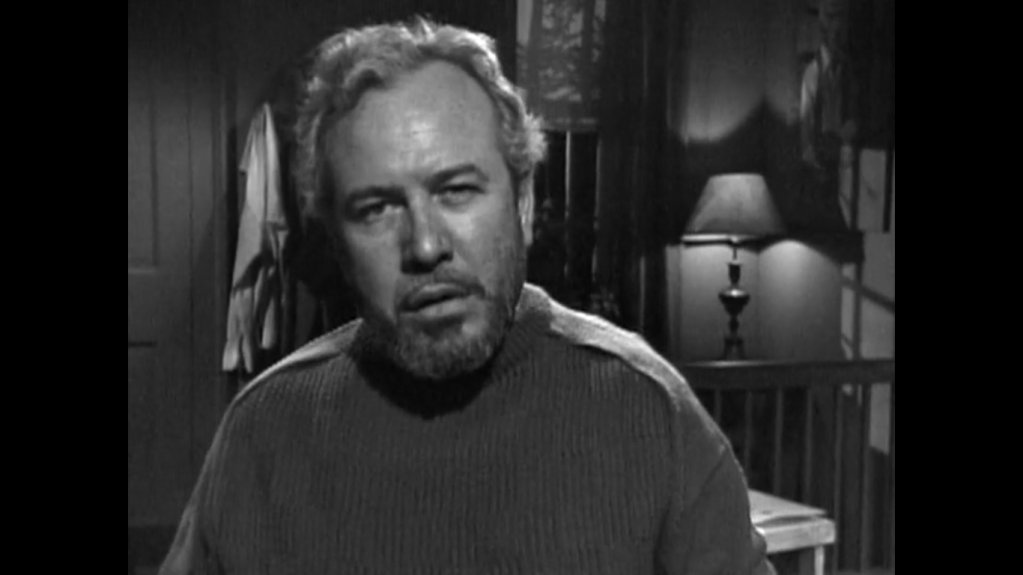
In which I praise three accomplished solo performances- Joan Bennett playing opposite her own voiceover, Louis Edmonds playing opposite an empty room, and Alexandra Moltke Isles playing opposite Roger Davis. 

Episode 603: Television Without Pity

Episode 694: The Surrender

In which I claim that the theme of child abuse running through this part of the show is especially powerful if you watch starting with episode 1. 

Episode 694: The Surrender