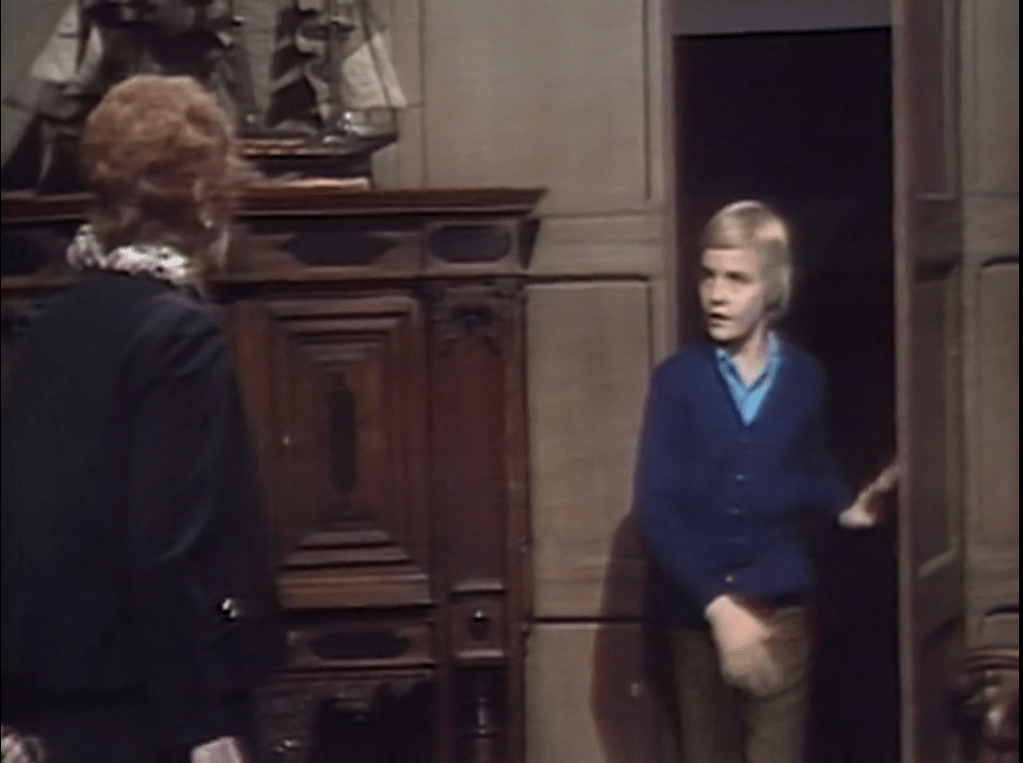
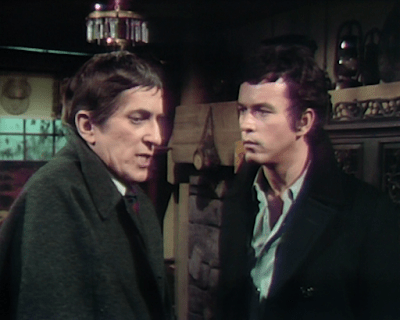
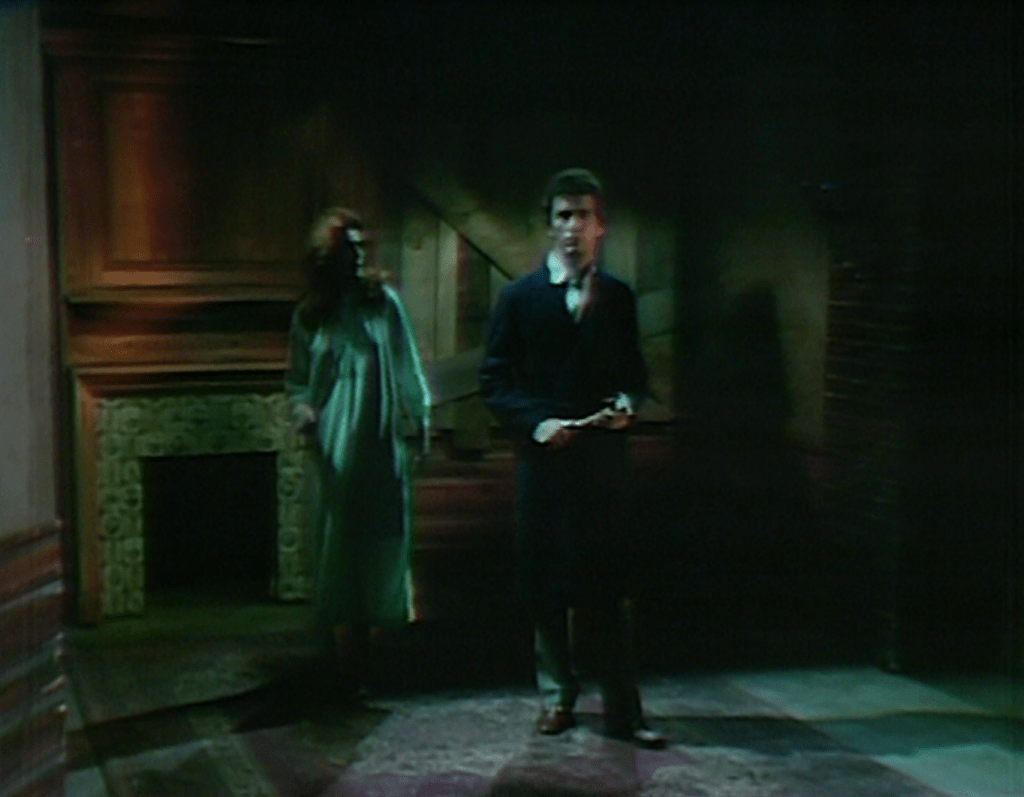
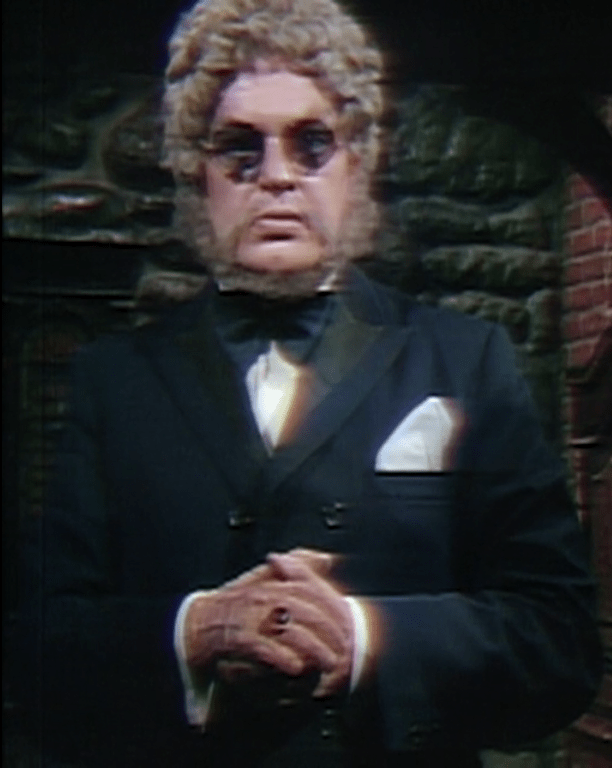
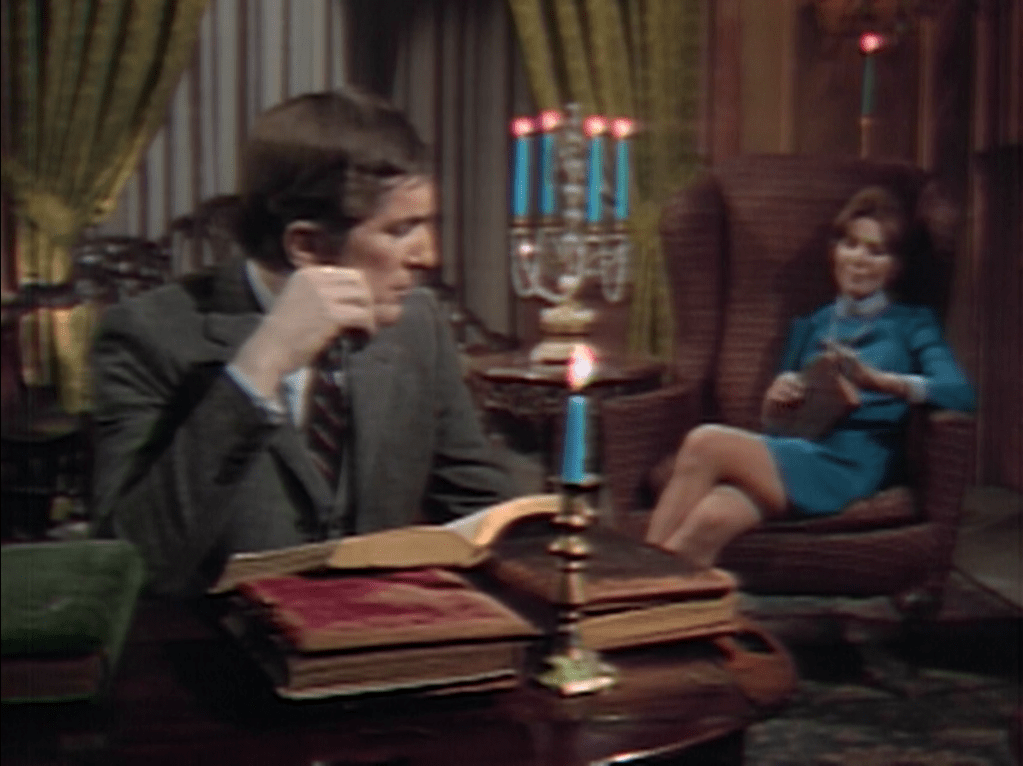
Episode 891: The only one there is

About Time

Dark Shadows committed itself to supernatural stories in late 1966 and early 1967, when the chief villain was undead blonde fire witch Laura Murdoch Collins. Since the usual laws of nature weren’t going to restrain Laura, they needed another set of rules that could predict her behavior sufficiently to create suspense. One of the things they settled on was that the barrier between past and present grows thin on the anniversaries of deadly events. So when well-meaning governess Vicki and the team she had assembled to fight Laura discovered that, in a previous iteration, she had taken a young son of hers to his fiery death “exactly one hundred years ago,” they knew that the crisis was at hand.

Anniversaries continued to have this effect in subsequent periods. So when in January 1969 recovering vampire Barnabas Collins wanted to take a day trip to the 1790s, he stood in a graveyard and shouted at a man who had died exactly 172 years previously to ask for a ride. It worked.

Barnabas was using a different form of mumbo-jumbo at the end of February, trying to contact the ghost that had made the great house of Collinwood uninhabitable, when he came unstuck in time and found himself in the year 1897.

In the middle of Barnabas’ long stay in 1897, the show decided to take its conceit that two events occurring on the same date in different years were mystically connected and show us both sides of the link. In #835, Barnabas was locked up in a cell with a secretary cabinet that he knew would be in the front parlor of his home, the Old House at Collinwood, in 1969. He wrote a letter to his friend, mad scientist Julia Hoffman, and hid it in a secret compartment of the secretary. We cut to the front parlor in 1969, exactly 172 years later, where a series of events leads Julia to discover the letter, travel back in time, and precipitate Barnabas’ rescue.

By #839, the events of 1897 had played out differently enough from whatever happened the first time through that year that the ghosts found peace. As we cut back and forth between that year and 1969, we saw that the 1960s characters remembered the haunting and the disasters that accompanied it and were relieved that they were over.

That gives us the present as the result, not of any one series of events in the past, but of a composite of many separate and mutually incompatible pasts. This idea is the logical culmination of substituting anniversaries for natural laws. In the first part of Barnabas’ trip to 1897, he had not yet done enough to lay the ghosts to rest. So the haunting continued, because it was happening on the anniversaries of events that were much the same as those that took place originally. By the time the living people of 1897 who would become the ghosts of 1969 had changed enough that they were no longer doomed to haunt the house, the date was one that would fall almost ten months into the haunting. In #836, Julia had a conversation in which one of the ghosts tells her about events in 1897 that could not have happened in the original timeline without Barnabas’ intervention, and which do not happen in #838 after Julia herself travels to that year. So each anniversary creates another past that becomes another ingredient in the stew that makes up the present.

This conception of the relationship between past and present shows the difference between a set of fantastic tales like Dark Shadows and a science fiction story exploring more-or-less plausible consequences of open questions in science. The “Copenhagen Interpretation” of quantum mechanics posits that the cosmos is made up of countless parallel universes, and that everything that could ever have happened did happen in at least one of those universes. Since that is a defensible position within science, an author can incorporate as much fact and reality as s/he likes in a story based on it. But since the idea that one period of history is the result of a confluence of many conflicting pasts is not only not a live option in science, but does not really make any practical sense except as a metaphor, the logic that really matters is dream logic. As dreams seem perfectly convincing to us when the only connections that lead from one moment to another are random similarities in names or shapes, so all that matters in a fantastic tale is that there is a pattern the audience can follow, whether or not that pattern corresponds to anything in the world where we spend our waking hours.

Now Barnabas has returned to 1969, brought back by a mysterious cult that has brainwashed him and adopted him as its leader. The characters he knew before he left are delighted to see him again. Today, matriarch Elizabeth Collins Stoddard comes to the Old House and is overjoyed that the haunting is over and that she and her family have been able to return to the great house. She is grateful to Barnabas for undertaking his harrowing journey back in time.

Liz and Barnabas talk about Chris Jennings, a young man in whom Liz’ daughter Carolyn is interested. Barnabas gives it as his firm opinion that Carolyn should avoid Chris, and he urges Liz to encourage her to do this. Barnabas knows that Chris is a werewolf, and we saw last week that the cult that has co-opted him has plans for Carolyn which do not include her death as one of Chris’ victims, so this will not surprise returning viewers.

Chris himself is another example of the weird metaphysics the show has stumbled upon. When Barnabas left 1969 for 1897, Chris was in his wolfish form all the time, apparently never to become human again. We learned during the 1897 segment that his lycanthropy is a curse inherited from his forebear, Quentin Collins. The version of 1897 we saw was changed sufficiently from the original that Quentin avoided his own death and was for a time relieved of the effects of the werewolf curse, though at the end of the segment it looked like they might be on their way back. That he is now human part of the time but still subject to transformation suggests that the difference in Quentin’s experiences in the later part of the 1897 stories had some effect on him. It’s unclear whether Chris’ condition fluctuated every time the date marked the 72nd anniversary of something happening to Quentin that hadn’t happened when he was living in a Barnabas-free zone, but it wouldn’t contradict anything we’ve seen if it did.

The Time to Come

Barnabas brought one object back with him from the past, a wooden box. The box must be opened only at a certain time, by certain people, for the cult’s plan to take effect. Today, Barnabas receives a visit from the people. They are Megan and Philip Todd, owners of the new antique shop in the village of Collinsport. Carolyn sent them, thinking that Barnabas would likely have some things they could add to their inventory. He sees that Megan is wearing a necklace with a symbol representing intertwined snakes, which Barnabas calls a “Naga.” When Megan is unable to explain just how she came into possession of the necklace, he shows them the box, which is topped with an oval in which the same symbol is carved. They are both thrilled at the prospect of buying the old furniture he has in the upstairs rooms of his house, but Megan is particularly fascinated by the box.

Later, Philip and Megan are back in their shop. They are confident they can buy a great deal of furniture from Barnabas, but are also sure that they wouldn’t be able to afford the box, even if he were willing to part from it. This is a bit odd- we get a good look at the box, and it is absolutely nothing special. The actors manage to sell the scene, but it would be better if they had either invested in a showier prop or been more sparing about putting it on camera.

Megan and Philip with the box. Screenshot by Dark Shadows Before I Die.

Barnabas comes to the shop and gives Megan and Philip the box as a present. After he goes, Megan is overwhelmed by an urge to open the box, which is locked. She is so consumed by this urge that she actually says “Let’s force it!” Since they had just minutes before been talking about it as if it were more expensive than anything they have for sale in their shop, this is a startling line. But when Philip opens the envelope Barnabas left to look at the list of furniture he is willing to sell them, he finds a key.

Philip is reluctant to open the box, having a strange feeling that if they do, nothing will ever be the same for them again. The other day it was Megan who had a strange feeling of impending doom. She wanted to sell the shop and flee Collinsport forever, lest they suffer an irretrievable disaster. That time it was Philip’s turn to urge her to set her misgivings aside. We’ve seen this kind of back and forth before. At the end of 1968, the great house of Collinwood was coming under the control of ghosts. Children Amy Jennings and David Collins kept trading the roles of possessed agent of the ghosts and unwilling sidekick. That alternation showed that the ghosts were not yet powerful enough to possess both children at once, and it faded as the haunting became more intense. It built suspense by suggesting that possible avenues of escape were gradually but inexorably closing.

As Philip and Megan begin to open the box, there is a whistling sound. They are unsettled, but decide they have to finish opening it anyway. They do, and we see their reaction to whatever is inside. Longtime viewers have seen similar reactions as cliffhangers many times; always before, they have indicated amazement that the container is empty.

New People

One of the less appealing villains of the 1897 segment was magically gifted artist/ surly criminal lowlife Charles Delaware Tate. Tate lived in a house that in the parts of Dark Shadows set in the 1960s was known as “the Evans Cottage,” home to drunken artist Sam Evans and his daughter Maggie, The Nicest Girl in Town. The cottage burned down in #883, leading us to wonder if it would still be there when the show returned to 1969.

Sam died last year, and Maggie now lives at Collinwood, where she is David and Amy’s governess. Today she goes to the cottage to prepare it for some tenants to whom she will be renting it. Evidently it must have been rebuilt before the Evanses moved in.

The only movable property in the cottage is a portrait of Maggie’s mother which her father painted. That portrait also appeared in the cottage a few times when Tate was living there; that was just carelessness on the part of the production staff, but it is kind of reassuring to see it again.

A man who has been in a couple of episodes knocks on the door. He identified himself as a friend of Sam’s and is saddened to hear of his death. He enters and asks Maggie to do him a favor. He keeps refusing to give her his name. We haven’t heard his name at all; evidently his identity is supposed to be a mystery to us. Word of that apparently did not reach the department responsible for making up the credits; they’ve been billing actor Dennis Patrick as Paul Stoddard, whom regular viewers know as the long-missing husband of matriarch Liz and father of Carolyn. They do that again today.

This is the last time we will see the Evans Cottage. In 1966 and 1967, the set was a symbol of the village of Collinsport, and scenes there showed the consequences that the doings of the rich people in the big house on the hill had for the working class who live in its shadow. By the time Maggie moved into Collinwood, they had long since given up on those kinds of stories. Dark Shadows is sometimes called “Star Trek for agoraphobes”; as we go, less and less of the action takes place anywhere other than Collinwood, and eventually they won’t even let us outside.

Liz agreed to let Barnabas live in the Old House in #218; by #223, she was talking about it, not only as his home, but as if he owned it and its contents. For while they went back and forth on the question of Barnabas’ legal status regarding the property, but when, at the suggestion of Liz’ daughter Carolyn, he gives the Todds a list of its furnishings that he is prepared to sell to them, I think we can take it for granted that Liz no longer has any claim on it.

Episode 873: Charming and exquisitely dangerous

In October 1897, sorcerer Count Petofi has used his magical powers to swap bodies with Quentin Collins. I refer to the villainous Petofi who looks like Quentin as Q-Petofi, and to the forlorn Quentin who looks like Petofi as P-Quentin.

We open with Q-Petofi meditating on a lineup of I Ching wands. He goes into a trance which unlocks a cosmic force that transports him to the great house of Collinwood in 1969. He wanders into the drawing room, finds a newspaper dated 28 October of that year, and starts exulting. Maggie Evans, governess in the great house in the late 60s, hears him and comes downstairs.

As the segment of Dark Shadows set in 1897 winds down, we’ve been thinking of ways they might have moved forward. Some of the possibilities involve splitting the week between episodes set in 1897 and others set in 1969. Maggie has been on the show from episode #1, and has been central to several of the storylines that take place in contemporary dress. The last of these stories before the move to 1897 centered on Quentin’s malevolent ghost haunting Collinwood and making it impossible for anyone to live there. In the course of that, he appeared to Maggie several times. In #682, Maggie had a dream in which Quentin’s ghost strangled her to death. Though the events we have seen in 1897 have changed the future, we saw in #839 that the 1960s characters remember Quentin’s haunting. So when Maggie is on her way to meet someone who is to all outward appearances Quentin, we have a hint that a story might be brewing in which Q-Petofi finds himself carrying the can for all of the horrors Quentin’s ghost wrought between December 1968 and September 1969.

Alas, it is not to be. By the time Maggie reaches the drawing room, Q-Petofi has vanished. A few moments after he left 1897, maidservant Beth scattered the wands and brought him back. He is furious when he comes to, and she explains that she had to do it. The magical portrait that keeps Quentin, and presumably also Q-Petofi, from becoming a werewolf is not in the suitcase Q-Petofi gave her earlier in the evening to bury. Q-Petofi has been in possession of Quentin’s body and of his portrait for weeks, and he has vast powers of sorcery, so you’d think he would have hidden the portrait long before. His magic powers would seem to give him the ability to do anything at all to hide it. My favorite idea is that he would impose onto Quentin’s portrait an exact copy of the portrait that hangs above the mantel in the drawing room of the great house and hang it in its place, so that it would be hidden in plain sight for years to come.

Besides, if Q-Petofi was going to bury the portrait surely he would at least have put it in something airtight and made of metal, not a wooden suitcase that doesn’t close all the way and that will likely rot to dust in a year or two. Apparently he isn’t as big on long-term plans as he led us to believe when he claimed he was working on a design to become the ruler of the cosmos.

Q-Petofi orders Beth to bring Pansy Faye, a deceased Cockney showgirl/ mentalist who has for some time been inhabiting the body once occupied by the stunningly dreary Charity Trask, to Quentin’s room at Collinwood. He demands information which she refuses to give. She storms out.

Pansy has a dream in which she and Quentin dance in the drawing room of Collinwood while a specially recorded version of her song, I Wanna Dance for You, featuring the voices of Nancy Barrett and David Selby, plays in the background. Colors flare on the screen while we hear them sing. Miss Barrett was an excellent singer, Mr Selby an adequate one. He does speak a few of his lines, which damages the rhythm of the song, and the flaring colors often obscure the actors completely. Mr Selby and Miss Barrett are so lovable that we very much want to overlook these flaws in the number’s conception.

The dream ends with Quentin turning into Petofi and laughing evilly at Pansy. She awakes in horror. She has known for some days that Q-Petofi isn’t Quentin, and she knows enough about Petofi that it is strange she hasn’t already figured out that he is the one hiding inside his body. But when she sits up with a gasp, we know that she has finally put it all together.

Time-traveler Barnabas Collins, a recovering vampire, meets Q-Petofi in the drawing room at Collinwood. Q-Petofi is convinced that Barnabas stole the portrait of Quentin, and is very aggressive about pressing his suspicions. Barnabas has been playing dumb ever since his vampirism went into remission, but after a couple of minutes of Q-Petofi’s hectoring he addresses him as “Count Petofi.” When Barnabas cannot tell him what he wants to hear, Q-Petofi declares that he will restore the vampire curse to its full potency. He touches Barnabas’ forehead with the right hand in which his powers are concentrated. Barnabas squeezes his eyes shut for a moment, then opens them with a look of triumph. He asks Q-Petofi what has become of his powers.

The rest of the episode revolves around yet another possessed person. Kitty Soames, a young American woman who is the dowager countess of Hampshire, is also Josette DuPrés, who plunged to her death from the cliff at Widow’s Hill 101 years before. Barnabas was supposed to marry Josette at one point, and he has been obsessed with recreating her ever since.

In May and June of 1967, when the show was set in the present, Barnabas abducted Maggie and tried to brainwash her into becoming Josette. In those days, the show was ambiguous about why Barnabas picked Maggie. Strange and troubled boy David Collins was an intimate friend of Josette’s ghost, and when he saw Maggie in Josette’s dress in #240 and #241, he thought she was Josette, looking just as she always did. Indeed, Miss Scott had played the ghost a few times, always behind a veil. When Barnabas was about to give up on Maggie in #260 he very earnestly told her “But you are Josette!” Yet after Maggie escaped, he picked another girl and planned to repeat the experiment with her, explaining to his sorely-bedraggled blood thrall Willie in #274 that all you have to do is “Take the right individual, place her under the proper conditions and circumstances, apply the required pressure, and a new personality is created.”

But when the show made its first trip back in time, visiting the 1790s from November 1967 to March 1968, Kathryn Leigh Scott played Josette. That was a bold move. Longtime viewers were left with the uncomfortable feeling that Barnabas may have had a point when he devised the horrifying program of torture that made the show so terribly bleak for several weeks. When we see Miss Scott playing Kitty, who really is Josette and really does have to accept that fact, longtime viewers can only squirm as they remember Barnabas shoving Maggie into his old coffin and later walking down the long gray corridors of his basement on his way to the prison cell where he was going to murder her. We’ve since come to know Barnabas as an endearingly ineffectual comic villain, but it is a stretch to remind us of him as he was in those grim days and ask us to concede that he was in any sense right.

Kitty confronts Barnabas at Collinwood and accuses him of orchestrating her Josettifying psychosis. He denies that he is responsible, and claims to know that Josette’s spirit lives in her and that she ought to yield to it. When she asks how he knows, he makes up a story about being a boy in England, falling in love with a portrait of Josette, and reading her diaries. She is unconvinced.

Later, Josette goes to P-Quentin in Petofi’s old squat, the abandoned mill on the North Road. She believes he is Petofi, and asks him to use his power to resolve her identity crisis. He tries to explain that he only looks like Petofi, and has none of his power, but she refuses to believe him. Having nothing to lose, he decides to play along. He tells the right hand to tell Kitty the truth about herself, and touches her forehead. She suddenly realizes that she is both Josette and Kitty. P-Quentin just as suddenly realizes that Petofi’s power has returned to the body in which he is now an unwilling tenant.

Kitty/ Josette keeps telling P-Quentin that she remembers what he was able to do with his right hand when he was staying with her and her late husband in England a few years before. This is a pretty bad continuity error. For eight weeks from #778, the most dynamic story on the show centered on the fact that Petofi’s hand was cut off in 1797 and kept in a box by a Romani tribe for the hundred years since, until broad ethnic stereotype Magda Rákóczi stole it in an attempt to lift the werewolf curse from Quentin. It was only in #815, in August, that Petofi reattached his hand and with it regained the bulk of his power. Granted, #815 is eleven and a half weeks ago, but the show now takes so little time to onboard new viewers by recapping that the writers are clearly counting on the audience to have a great deal of information about the story so far in their heads. As such, it is very surprising that they would break from established continuity on such a major point of the recent months.

Episode 699: If only I could put these images into some kind of a sequence

In the Old House on the estate of Collinwood, nine year old Amy Jennings pops into her governess’ bedroom in the morning. The governess, Maggie Evans, hasn’t been to bed yet. Maggie’s other charge, twelve year old David Collins, disappeared into the haunted corridors of the great house on the estate some time ago, and cannot be found. The evil spirit of the late Quentin Collins has been possessing David and Amy off and on for many weeks, and has now grown so powerful that no one dares go into the great house alone. Maggie is too worried to go to bed.

Maggie questions Amy about David and Quentin. Amy tries to deny knowing anything about Quentin, but Maggie keeps up the pressure until Amy admits she is afraid that if she talks, Quentin will do something to her big brother Chris Jennings. Permanent houseguest Julia Hoffman overhears this admission, and demands to know what Quentin has to do with Chris.

Julia knows something neither Maggie nor Amy does. Chris is a werewolf. As Quentin’s power over the children and the great house has grown, so has Chris’ lycanthropy spread over more of the month. For the past several years, Chris took his wolf form only for the two or three nights the moon was fullest, never for more than four nights, and never during any other lunar phase. Now he has started changing even when the moon is new. What is more, Julia and her friend, old world gentleman Barnabas Collins, just came from the chamber where they coop Chris up when he is the werewolf. They found that he has not changed back even though the sun has been up for two hours. They have no way of knowing when or if Chris will ever be human again.

Amy won’t tell Julia or Maggie anything more about Quentin or about Quentin’s fellow ghost, Beth. Amy has communicated with Beth, knows her name, and she and David first saw Beth with Quentin. She knows also that Beth weeps when she thinks of Chris suffering. For their part, Julia and Barnabas saw Beth when she led them to save Chris when Quentin had tried to kill him. Chris told them that Beth had appeared to him, and when he took Barnabas to the spot where that happened he and Barnabas found a shovel and excavated the unmarked grave of an infant wearing a pendant meant to ward off werewolves. Julia saw a photograph of Beth in an old Collins family album, dated 1897, the same year Quentin disappeared. If they could combine Amy’s knowledge about Beth with what they have learned from these three experiences, Barnabas and Julia might get somewhere.

Julia and Amy leave, and Maggie goes to bed. As she lies under the covers, we see visual effects that might have been impressive on daytime television in 1969, but that we all got pretty sick of seeing people use on video calls in 2020. The picture wiggles in the middle and a transparent sticker of Quentin’s face sweeps around the screen.

Quentin sticker. Screenshot by Dark Shadows Before I Die.

Maggie has a dream. Dream sequences on Dark Shadows are usually messages sent to the dreamer by some supernatural force; the sticker of Quentin’s face suggests at first that he is the sender of this message. Maggie goes to a room in the long-deserted west wing of the great house. She was in the room in #680, and saw Quentin there. When she took matriarch Elizabeth Collins Stoddard and David to the room in #681, there was a tailor’s dummy wearing Quentin’s frock coat, with a face and mutton chops painted on it. Liz was glad to believe that the dummy was what Maggie saw, and David nattered on about how he and Amy called the dummy “Mr Juggins.” In her dream, Maggie recognizes Mr Juggins, then sees an opening in the wall.

Mr Juggins startles Maggie. Screenshot by Dark Shadows Before I Die.

She goes through it, and finds a hidden chamber. Quentin is there. Quentin tried to strangle Maggie in #691, and earlier this week he dressed her up in a lovely outfit and did her hair in an elaborate up-do, so there’s really no telling what is going to happen when the two of them are alone together. This time, he kisses her passionately, and from the way she relaxes in his arms it is clear he is doing a great job.

Awake, Maggie tells Julia about her dream. This will bring back memories for longtime viewers. When we first saw Julia in #265, she was Maggie’s psychiatrist, and was asking her about, among other things, her dreams. The same viewers will have been marveling at the fact that Maggie is staying in the room of the Old House once occupied by the gracious Josette and now dominated by Josette’s portrait. In May and June of 1967, Barnabas was a vampire. He held Maggie prisoner in Josette’s room as part of his scheme to erase her personality and replace it with Josette’s. Julia hypnotized Maggie into forgetting that whole ordeal, and the show has recently been assuring us that they will not revisit the question of whether her memory will return. Putting her back in the room is their most heavy-handed way yet of telling us to stop wondering about that.

Maggie’s discussion with Julia also raises the question of who sent the dream. Had she responded to it by slipping out to the west wing without telling anyone where she was going, we could believe that Quentin was luring her to him by showing her what a good kisser he is. But this conference makes it clear that Maggie is not only consciously determined to do battle against Quentin, but that she is enlisting the support of the allies likeliest to make headway against him. Beth has done a great deal to warn people against Quentin, so she might have sent the dream. Since Maggie is in Josette’s room and the closing credits will run over a shot centered on Josette’s portrait, it is also possible that Josette’s ghost has returned to the business of sending dream warnings.

The image under the closing credits. Screenshot by Dark Shadows Before I Die.

Once Maggie figures out where Quentin’s chamber is, she decides that David must be there. She resolves to go to the chamber and find David. Julia tells her it is too dangerous for the two of them to go to Quentin’s stronghold alone, and insists they wait until Barnabas can join them. Julia goes to fetch Barnabas. When she brings him back to the Old House, Maggie says that now she can’t find Amy. Julia decides to look for Amy while Maggie and Barnabas go to the great house.

It might seem odd that Julia thinks it is OK for Maggie to go to the great house accompanied only by Barnabas when it would have been too dangerous had she herself been Maggie’s only companion. But Julia knows that Barnabas is not an ordinary man. He has been free of the effects of the vampire curse for almost a year, but his history made it possible for him to travel back in time in #661. It seems that he retains enough connection with the supernatural to make him a more formidable adversary for Quentin than is even so adroit a mad scientist as Julia.

Amy overhears Maggie’s conversations, and she goes to the west wing. She uses a crowbar to open the panel that leads to Quentin’s chamber. She goes in and calls for David. David is not there, but Quentin is. Amy tries to tell Quentin that she had come to warn him that Maggie and Barnabas were on their way; as her attempt to lie to Maggie had crumbled when Maggie kept questioning her, so her attempt to deceive Quentin collapses as he keeps staring at her. Amy’s face goes blank, and we realize that Quentin is transmitting commands into her mind.

Barnabas and Maggie do go to the room and they do find the opening in the panel. Barnabas looks through it, and sees a door on the other side. The opening is a small one, close to the floor. The children have been crawling through it, and evidently Maggie did the same in her dream. But Barnabas does not intend to get his suit dirty. He picks up the crowbar, and says he will rip out all the panels and walk through the door.

Barnabas is not going to crawl through that thing. Screenshot by Dark Shadows Before I Die.

Episode 696: Not anywhere at all

The ghost of Quentin Collins drove all of his living relatives out of the great house on the estate of Collinwood the other day, and now he has fetched two of them back. They are twelve year old David Collins and nine year old Amy Jennings. Today, governess Maggie Evans, old world gentleman Barnabas Collins, and Barnabas’ bedraggled servant Willie Loomis search the great house looking for the children.

When they find Amy, she is possessed by the evil spirits and insists that the house is where she belongs. She willingly leaves with Willie. When they get back to Barnabas’ house, she calmly tells Willie that he will never again have reason to worry about Maggie. “Maggie is not anywhere anymore… anywhere at all. You’ll see.” In the great house, Barnabas finds that Maggie has been dressed in clothing appropriate to the period when Quentin lived, the 1890s. She does not recognize him or respond to her own name. When he asks who she is, she struggles, then faints.

Barnabas finds Maggie. Screenshot by Dark Shadows Before I Die.

Dark Shadows first became a hit in May and June of 1967, when Barnabas was a vampire trying to erase Maggie’s personality and overwrite it with that of his lost love Josette. Since then, Maggie’s memory has been wiped, Barnabas has been cured, and the show has made it clear they will not be revisiting the question of whether he will have to pay for his crimes against her. They are great friends now. It is ironic that Barnabas is the one trying to get Maggie to return to herself, but it does further confirm that Maggie’s memory of her days in his dungeon is gone for good.

In a comment about John and Christine Scoleri’s post about this episode on their Dark Shadows Before I Die, someone known as “D. Wor” points out that the dress Maggie is wearing when Barnabas finds her harks back to his attempted Josettification of her:

I remember this episode well. At first I thought the Victorian dress Maggie suddenly was wearing didn’t add up to anything Josette-essential until I took a good look at the colours. I thought the dark green sash was horribly out of place, and then? I realized all three of those colours are representative of Josette’s bedroom at The Old House. The green sash represented her drapes. Wild, eh?

Comment left 25 February 2019 by “D. Wor” on “Dark Shadows Episode 696: 2/24/69” (25 February 2019) at Dark Shadows Before I Die, John and Christine Scoleri.

In Friday’s episode, Barnabas meditated on the idea that he and Quentin never knew about each other. Longtime viewers, seeing Maggie out of touch with her own identity and her proper time, might wonder if Quentin now knows what Barnabas did to her in 1967 and if he is taunting him with a reminder of it.

Episode 695: Collinwood belongs to the ghosts now

The ghost of the evil Quentin has driven the living members of the Collins family from the great house on the estate of Collinwood. They have taken refuge in the Old House on the estate, home to their distant cousin, old world gentleman Barnabas. Quentin wants to take possession of children Amy and David. Knowing of his plans for them, David and Amy sneak into the great house to recover and destroy the antique telephone Quentin first used to communicate with them. The children do not find the telephone there, and governess Maggie comes to the house and takes them away. Later, Maggie goes to their rooms in Barnabas’ house. She discovers that the children are missing, and Quentin’s telephone has appeared in David’s room.

Dark Shadows first became a hit in the late spring and early summer of 1967, when Barnabas was a vampire and Maggie was his victim. That story was chiefly modeled on the 1932 film The Mummy. As Boris Karloff’s Imhotep saw Zita Johanns’ Helen as the reincarnation of his lost love Ankh-Esen-Amun, so Jonathan Frid’s Barnabas saw Kathryn Leigh Scott’s Maggie as the reincarnation of his lost love Josette. As Imhotep took Helen prisoner and tried to replace her personality with Ankh-Esen-Amun’s, so Barnabas took Maggie prisoner and tried to replace her personality with Josette’s. As the movie showed us flashbacks to Imhotep’s time as a living being with Zita Johanns playing Ankh-Esen-Amun, so from November 1967 to March 1968 Dark Shadows became a costume drama set in the 1790s and featuring Miss Scott as Josette. Even Frid’s acting style and mannerisms were strongly reminiscent of Boris Karloff’s.

Since those days, Maggie’s memory has been repeatedly erased and Barnabas has been cured of vampirism. More than once, there were stories suggesting Maggie’s memory might come back and blow the whole show up, but those always ended with yet another mind-wipe. Several times lately, the show has gone out of its way to emphasize that they will not be revisiting that theme. There are two such moments today. David complains that the Old House is “like a prison”; Maggie, who was for long weeks kept in the barred cell in the basement, doesn’t miss a beat before replying “For a very good reason!”

In 1967, Barnabas’ only interest was recreating the history of the Collins family. His attempted Josettification of Maggie was part of that antiquarian project. Today, we catch a glimpse of what he might have been hoping for in that period. He and Maggie are sitting in the parlor reading family histories, and she glances at him with a fond smile. Granted, if his original project had been successful Maggie would have forgotten her own name, they would both have been vampires, and no living human would be safe from their creeping terror, but between feedings the two of them would probably have sat around like this.

A cozy evening at home.

Episode 691: Too late to be afraid

Throughout its first 73 weeks, Dark Shadows was usually very slow-paced, even by the standards of a 1960s daytime soap. Major characters like matriarch Liz and her brother, high-born ne’er-do-well Roger, often seemed to exist solely for the purpose of refusing to accept the facts in front of their faces and thereby slowing down the progression of the plot. Even characters who did face facts would often as not have the memory of goldfish, so that weeks of character development would evaporate with a sudden display of inexplicable ignorance.

That changed when well-meaning governess Vicki came unstuck in time in #365. For the next few months, Dark Shadows was a costume drama set in the 1790s, and events came thick and fast. When Vicki returned to the present and Dark Shadows returned to contemporary dress in March 1968, the show was a genuine hit. They tried to sustain the breakneck pace of the 1790s segment throughout 1968, with mixed success. That period was a Monster Mash, featuring multiple witches, vampires, mad scientists, Frankensteins, ghosts, and the Devil himself, or perhaps one of his middle managers. That attracted a new audience of preteen viewers, but all too often left the characters spinning their wheels as they tried to make room for each other within one small fishing village near Bangor, Maine.

A few months ago, they dumped all of those larger than life but ultimately unproductive figures and started concentrating on two storylines. The A story so far has been that of werewolf Chris and the efforts old world gentleman Barnabas and mad scientist Julia have made to keep him from killing quite so many people. That one has been moving along at a steady clip.

The B story has not progressed nearly as fast. At times, it has matched the leisurely pace of the show’s early days. Today is dedicated to that story, and in today’s pre-title teaser it appears that it has brought narrative progression to a total halt.

Maggie is the new governess in the great house of Collinwood, charged with the education of Chris’ nine year old sister Amy and of strange and troubled boy David. As usual, we open with a reprise of the previous episode. This time, the reprise is 5 minutes and 45 seconds of Maggie wandering around the house looking for the children and hearing voices, while doors open themselves. That was OK at the end of Friday’s installment, but on its own it is stupefying.

The story is that the evil spirit of the late Quentin is taking possession of David and Amy in order to destroy the Collins family and have the house to itself. It made sense that that story would start slow. Quentin was at first very weak. He existed only in a sealed chamber the children stumbled upon while exploring the long deserted west wing, and could influence events outside that chamber only by persuading them to do his bidding. He gradually gained the power to control one child at a time, and to manifest himself outside his little room. A while ago he was able to put strychnine into Chris’ drink; by the end of Friday’s episode he had Amy and David under his power simultaneously.

Once the action finally gets underway in today’s episode, Quentin is about to strangle Maggie and the children are screaming at him to stop. Housekeeper Mrs Johnson and Liz enter the room. Mrs Johnson sees Quentin, Liz does not. Maggie is unconscious and the children are in a state. By the end of the episode, Liz, Maggie, and Mrs Johnson know Quentin’s name, his plan, and his power. He has managed to create some kind of bubble around the house so that the people inside it cannot hear the rain. The children pass out. David comes to, and announces that it is too late to be afraid. He laughs maniacally, and in the background we also hear Quentin’s laughter.

Quentin no longer needs to hide from Liz and Mrs Johnson. Screenshot by Dark Shadows Before I Die.

With this slam-bang ending, the Haunting of Collinwood takes over as the A story and Liz forever sheds her role as a blocking figure. This phase of the show is approaching its climax, and there is a chance that what comes next will be exciting.

Episode 690: A different mood

We open with governess Maggie Evans entering the bedroom of strange and troubled boy David Collins. She had heard David’s screams and a man’s laughter coming from the room; the man is gone, and David is unconscious on the floor. He has a nasty burn on his arm, and as he is coming to he pleads with “Quentin” not to hurt him.

Once David is fully awake, Maggie asks who Quentin is. David frantically denies that there is any such person, and claims that the laughter she heard was his own voice as he was playing a make-believe game. She says that she knows he couldn’t have made those sounds. He points out that they are the only people in the room. Maggie does not even try to explain how anyone could have left the room unseen; she seems already to have concluded that Quentin is a supernatural being. Maggie identifies Quentin with a strange and frightening man she and housekeeper Mrs Johnson have both seen. David keeps trying to deny everything, and Maggie keeps telling him she wants to help. David sobs, and Maggie holds him.

Maggie holds David.

Quentin is indeed a ghost who is taking possession both of David and of Maggie’s other charge, nine year old Amy Jennings. With their help, Quentin has so far killed two people, tried to kill two others, and set about trying to drive everyone off the estate of Collinwood. Up to this point, Maggie has failed completely to represent any sort of obstacle to Quentin. She is a poor disciplinarian who lets the children run rings around her even when they are themselves, and is altogether at sea when they are doing Quentin’s bidding. This scene promises a breakthrough. Maggie is the first of the adult characters to learn Quentin’s name, she does not flinch from the evidence of his uncanny nature, she vows to fight him, and David finds comfort in her arms.

The breakthrough does not come today, however. After a moment, David declares that no one can help him, and he rushes out of the room. He goes downstairs to the foyer and hears a knocking at the door. He opens it and sees notoriously abusive actor Roger Davis standing there. He reacts to that sight as anyone might, running away without a backward glance.

Maggie follows David downstairs. There is again some question as to how much of the body language in the next scene is the blocking the director gave as an interpretation of Maggie’s response to the character Ned Stuart and how much is Kathryn Leigh Scott’s reaction to Mr Davis. Maggie tells Ned she can’t talk because she must go out in search of David; as she prepares to exit, she circles around with as much space as possible between her and him, never quite making eye contact but glancing back every time he moves towards her. This is not a pattern of movement we have seen before on the show, even when a character was dealing with a vampire or some other murderous foe. Miss Scott looks very much like a woman alone with a man whom she does not trust not to assault her. If he had, it wouldn’t be the first time he has physically abused a castmate on camera.

She keeps her eyes on his hands

A child’s voice is heard, singing the song “Inchworm.” It is Amy, and she is working a jigsaw puzzle in the drawing room. The drawing room brings out Amy’s musical side. She played “London Bridge” on the piano there in #656 and tapped a few random keys on the same instrument in #676. She is quite a good singer, perhaps not surprising since actress Denise Nickerson had been in the cast of the short-lived James Lipton/ Laurence Rosenthal Broadway musical Sherry! in 1967.

Ned enters and introduces himself to Amy. His lines are all perfectly polite and friendly. Amy is supposed to gradually sense that Ned is hostile to her big brother Chris and to become uncomfortable around him, but that is supposed to come at the end of their time together. As it plays out, she already seems uncomfortable when he first enters. A minute or so into the scene, Amy smiles at Ned. Nickerson was remarkably good at flashing quick smiles, but it doesn’t work this time. She looks like she is displaying her teeth to the dentist. When Amy is supposed to start edging away from him, Nickerson turns around and proceeds to her next mark at full speed. The camera pans back, but does not capture her movement- she has gone clean out of the shot, leaving Mr Davis alone in the frame.

She goes as far as she can as fast as she can.

Ned approaches Amy; he grabs her by the shoulders and pulls her back into the shot. Chris enters. Amy starts to warn him against Ned, and he tells her not to be afraid for his sake. Indeed, Chris is safe. It is only women and children who have to be afraid of Roger Davis.

Ned confronts Chris. Evidently something bad happened to Ned’s sister Sabrina. She can’t tell Ned what it was, but he thinks Chris is responsible and wants him to go with him to the Collinsport Inn to see her. Returning viewers know that Chris is a werewolf and that Sabrina saw him transform. He assumed that he had killed her while in his beastly form, and he is surprised to learn from Ned that she is still alive. Chris is a character we are supposed to sympathize with, so it is a bit disturbing that he does not seem particularly relieved to find that he did not kill Sabrina.

In the woods, Amy finds David. She learned some days ago that Quentin wants to hurt Chris, and she has been resisting Quentin’s influence ever since. She and David talk about ways they can work together to fight him. David says that he has decided to tell Maggie what has been happening; Amy objects that this is too dangerous. They seem to be getting somewhere when Quentin appears to them. They are terrified, and then resign themselves to their fate.

Later, the children are in the drawing room with Maggie. Amy is still working her jigsaw puzzle, and David is staring into the fireplace. Longtime viewers will remember that this is something his mother used to do. She was the show’s first supernatural menace and tried to lure David to his doom. Maggie’s predecessor, well-meaning governess Vicki, led the other characters in the campaign that saved David then. We wonder if Maggie will be able to match her success.

Maggie admires the puzzle and calls David over to look at it. David makes a show of being bored, leading Amy to remark airily that boys don’t like jigsaw puzzles. David complains that there is nothing to do. Maggie suggests the three of them sit down together for a heart-to-heart talk, an idea the children reject. They suggest a variety of games they might play. Maggie notices that their manner is quite different than it was earlier in the day. David is more assertive, Amy supercilious. She finally agrees to let them play dress-up.

In the first year of the show, the opening voiceovers often involved a weather report. “A cold wind blows from the sea to the great house of Collinwood, but the fog still hangs heavy on its vast lawns” that sort of thing. They stopped doing that some time ago, but today they slip in an almost comically detailed bit about atmospheric conditions- “Soon dark, threatening clouds will gather over Collinwood, and long, ever-lengthening shadows will creep menacingly toward the great house. By late afternoon, rain will come, a rain that will begin slowly but steadily increase into a raging storm.” You expect them to go on with “Expect cooler temperatures and clear skies after 8 PM, with a chance of frost in the morning.” But the rain, at least, plays a part in the story. It explains why David and Amy have to stay indoors, and a roar of thunder gives Amy a chance to sneeringly ask Maggie if she is frightened. It also occasions the use of this still of the exterior of the house, one which I do not believe we have seen before:

We don’t usually see that much of the lawn.

Later, Maggie goes to look for the children. She enters the study. This set has been familiar since early 1967, but today is the first time we see the outside of its door. Lately we have been seeing more of the little spaces that are supposed to join one room to another, part of a strategy to make the house seem like a bigger place.

The sequence before this suggests Maggie is heading into the long-deserted west wing, but once she goes through the door it is clearly the study.

Once in the study, Maggie hears Amy and David calling to her from no particular direction while Quentin laughs. She is bewildered, then the children join Quentin in laughing. His laughter is hearty, theirs is maniacal. Maggie goes out into the corridor, sees something frightening, and retreats into the study. She is only there for a moment when the doorknob starts turning. We end with Maggie staring directly into the camera, its lens representing the point of view of whatever it is that is terrifying her.

Maggie terrified.

This is the first of only two episodes credited to writer Ralph Ellis. Dark Shadows never had more than three writers on staff at any time. I often wish they had had many more. Ellis is one of those whom I would have liked to see as a senior writer on the show right the way through. The episode is well-paced, the characters are clearly defined, and the dialogue is smooth with just a touch of wit. If he had been in charge of, let’s say, every Monday’s script, the whole series would have been a cut above what it actually was. Since he only contributed two scripts, it is especially sad that Roger Davis had to crap on one of them, but even when Mr Davis is on camera you can still tell that Ellis did his job well.

Episode 689: A victim of the werewolf

Old world gentleman Barnabas Collins finds his distant cousin, strange and troubled boy David Collins, trying to pull the metal ring that opens the secret chamber hidden inside the old mausoleum.

Barnabas wants answers. Screenshot by Dark Shadows Before I Die.

Barnabas asks what David was doing. He says he was upset with his governess, Maggie Evans, and was hiding from her. Barnabas gestures around the publicly known part of the mausoleum and says “There’s no place to hide here.” David vigorously agrees, and says he didn’t expect Maggie to come there at all. Barnabas asks if David was trying to get into the hidden chamber.

Panicked, David claims not to know what Barnabas is talking about. Barnabas reminds him that he caught him at the mausoleum in #315. Longtime viewers will recall that he subsequently found part of David’s pocket knife in the hidden chamber and confronted him with it, and David seems to remember that as well. He drops his attempt to deny knowing about the chamber, and tells Barnabas he heard an animal inside it.

This goes to the heart of the issue that has brought Barnabas to the mausoleum. Barnabas has befriended mysterious drifter Chris Jennings and has learned that Chris is a werewolf. When Chris is in his beastly form, Barnabas locks him in the hidden chamber to keep him from hurting anyone. The werewolf is in there now. He was growling and snarling when David arrived, but fell silent when Barnabas entered.

Barnabas asks how an animal could have got into the hidden chamber; David admits he can’t think of a way. He then asks David if he can hear the noise now; he says he can’t. He asks if he might have imagined the whole thing; he doesn’t disagree.

Barnabas takes David back home to the great house of Collinwood. His governess Maggie is waiting up for him. She stays in David’s room until he seems to be asleep, then kisses him on the forehead and goes.

Yesterday, David told Maggie that she is a pretty girl. He’s twelve now, old enough to get excited about that very conspicuous fact, so when he opens his eyes immediately after she leaves the room returning viewers might think the reason he faked being asleep was that he was angling for the kiss.

David went to the mausoleum to release the werewolf because the evil spirit of the late Quentin Collins made him do it. Quentin has been dominating David lately. After Maggie goes, Quentin appears in the room and David confronts him. He says he does not want to be part of Quentin’s cruel schemes any longer. In response, Quentin causes David to suffer extreme pain. Passing by in the hallway, Maggie hears David’s scream and Quentin’s laugh, and she opens the door to find David curled up on the floor.

The laugh is noteworthy. Maggie hears it, and it is not a sound David could have made. She has already seen Quentin, but now she has further evidence that he exists. Moreover, it is the first time Quentin has broken his silence. We first met Quentin when he was in company with another ghost, a woman named Beth Chavez. Beth has spoken since then; we wonder when Quentin will have lines to deliver.

Episode 682: He killed me

Governess Maggie Evans saw the evil spirit of the late Quentin Collins yesterday, and she tells housekeeper Mrs Johnson about it today. Mrs Johnson saw Quentin a few days ago; she and Maggie are the only adults in the great house of Collinwood who know that Quentin exists, and not even they know his name. Quentin is gradually taking control of Maggie’s charges, nine year old Amy Jennings and twelve year old David Collins. Yesterday, David led Maggie and his aunt, matriarch Elizabeth Collins Stoddard, to the room in the long deserted west wing where Maggie saw Quentin. There is a mannequin there wearing a coat like Quentin’s; David says that he and Amy call it “Mr Juggins,” and Liz chooses to believe that Mr Juggins is what Maggie saw.

We see Maggie in bed. She gets up, goes back to the room, and sees Mr Juggins. We dissolve to a shot of Quentin in Mr Juggins’ place. Horrified, Maggie watches Quentin approach with a length of fabric. He chokes her with it. She falls to the floor. She is lying there when we cut to commercial. Maggie was introduced in #1 and has for long stretches been a central character, one of the most recognizable on Dark Shadows. Kathryn Leigh Scott tells a story of going to a wilderness area in Africa when the show was a hit and being greeted with cries of “Maggie Evans!” For the moment, it looks like they have decided to kill her off in the middle of a Tuesday episode.

Of course they haven’t. We come back from the break to hear Maggie telling old world gentleman Barnabas Collins about the dream in which she was strangled. She is surprised that Barnabas believes her story about seeing the man when she was awake, shares her suspicions that David and Amy are connected with the man, and is open to the idea that the dream is “a warning.” Barnabas tells Maggie that he and his inseparable friend, permanent houseguest Julia Hoffman, MD, saw a woman dressed in clothes of the same period as Quentin’s clothes, that the woman’s presence could not be explained, and that she led them to Amy’s brother’s Chris at a moment when Chris needed medical help to save his life. Barnabas has concluded that the man and the woman are ghosts and that they represent something very dangerous.

Barnabas enlists the aid of occult expert Timothy Eliot Stokes. Stokes agrees to conduct a séance in the drawing room in the hopes of contacting Madame Janet Findley, a psychic researcher whom he brought to the house in #647 to investigate the early signs of Quentin’s haunting. Amy and David tricked Madame Findley into going to Quentin’s stronghold in the west wing in #648, and she did battle with him there in #649. After that confrontation, Madame Findley appeared at the head of the stairs in the foyer and tumbled down them, dead.

This is the tenth séance we have seen on Dark Shadows. They usually come with four roles to be filled. In all séances, someone acted as organizer and leader. In eight of the first nine séances, someone else objected to the idea of a séance, but reluctantly took a place around the table. In seven of the nine, someone went into a trance, becoming a medium. Every time the trance began, someone grew alarmed at its first signs and tried to end the séance before the dead could speak; that drew a stern rebuke from the leader. The medium then spoke, more often than not passing out after struggling to utter a few mysterious words.

The roles of reluctant participant and objector are often combined. Today, Mrs Johnson is the first to combine the role of reluctant participant and medium. This is also the first time the trance does not draw an objection from someone wanting to stop the séance. Mrs Johnson does pull her hands back early on, breaking the circle of contact, and Stokes delivers the requisite stern rebuke. But no one speaks up when she starts to moan. As Madame Findley, she at first produces the usual jumble of words (“The children! Panel! Room!”) She manages to cry out “He killed me! He killed me!” before collapsing face first onto the table in the orthodox manner.

In their post about this episode on Dark Shadows Before I Die, John and Christine Scoleri compare Mr Juggins with Otto the Automatic Pilot from the 1980 film Airplane! Perhaps inspired by the dissolve from Mr Juggins to Quentin today, they go on to Juggins-ize Otto:

The Scoleris also list all the séances on the show up to this point. They name the leaders and mediums, but not the reluctant participants or the objectors. I have added those:

Dark Shadows Before I Die Séance Tracker


Episode 170/171: Dr. Peter Guthrie conducts; Carolyn, Vicki, Roger and Laura Collins participate; Josette speaks through Vicki in French; held in the drawing room at Collinwood [Roger and Laura join reluctantly; Carolyn objects]

Episode 186: Vicki conducts; Sam and David participate; David Radcliffe speaks through David; held in the drawing room at the Old House [Sam is both reluctant joiner and objector]

Episode 280/281: Roger conducts; Liz, Vicki, Burke, Barnabas, Carolyn participate; Josette speaks through Vicki; held in the drawing room at the Old House [Liz, Burke, and Barnabas are reluctant; Barnabas objects]

Episode 365: Roger conducts; Liz, Julia, Vicki, Carolyn and Barnabas participate; Sarah Collins speaks through Vicki after Carolyn pretends Sarah is speaking through her; Vicki is transferred to 1795; held in the drawing room at Collinwood [Liz and Barnabas are reluctant; Liz objects]

Episode 449: Countess duPrés conducts; Joshua Collins participates; Bathia Mapes shows up, claiming she was called; held in the drawing room at Collinwood [Joshua is reluctant; no trance]

Episode 510/511: Professor Stokes conducts; Julia and Tony Peterson participate; Reverend Trask speaks through Tony Peterson; the basement wall breaks open to reveal his skeleton; held in the basement at the Old House [Tony is reluctant, Julia objects]

Episode 600: Professor Stokes conducts; Barnabas and Julia participate; Phillipe Cordier speaks through Barnabas; held in the drawing room at the Old House [No conspicuously reluctant participant. Julia objects]

Episode 640: David conducts; Amy participates; unsuccessful attempt to contact Quentin Collins; held in Amy’s bedroom at Collinwood [Amy is reluctant; no trance]

Episode 642: Professor Stokes conducts; Liz, Vicki, Carolyn, Chris participate; Magda speaks through Carolyn; held in the drawing room at Collinwood [Chris is reluctant and is objector]

Today’s episode: Professor Stokes conducts; Barnabas, Maggie and Mrs. Johnson participate; Janet Findley speaks through Mrs. Johnson; held in the drawing room at Collinwood [Mrs Johnson is reluctant; no objector]

This is Maggie’s first séance, and they’ve been spending a lot of time lately showing us that she is unsure of herself. So it would have been expected for her to become frightened and try to stop the séance when Mrs Johnson goes into the trance. Maybe that’s why they left it out- it was too obvious a move. But the pattern is so familiar now that it feels like they’ve forgotten something when they leave the objection out.

Episode 681: Mr Juggins

The evil spirit of the late Quentin Collins has been taking control of strange and troubled boy David Collins. David tricks his governess, Maggie Evans, into going into a room in the long-deserted west wing of the great house of Collinwood. Quentin appears to Maggie there, frightening her.

Maggie goes to matriarch Elizabeth Collins Stoddard and tells her she saw an unfamiliar man lurking in the west wing. When she says that she suspects David is in cahoots with the man, Liz becomes deeply skeptical. Her disbelief reminds longtime viewers of #27, when Maggie’s predecessor, the well-meaning Vicki Winters, discovered evidence indicating that David was behind an attempt to murder his father, Liz’ brother Roger. Desperate to escape the implication, Liz briefly went so far as to suggest that Vicki herself might be the culprit. That idea was absurd on its face, and Liz treated Vicki as a member of the family, so she dropped it almost as soon as she had put it into words. But Maggie doesn’t have anything definite to back up her suspicions of David, and Liz is no more attached to her than she might be to any other member of the household staff. She remains leery of Maggie throughout the episode.

Quentin appears to David in his room. David talks to Quentin; he praises him for a fine plan, and Quentin smiles and nods in reply. He asks him how he came up with the name “Mr Juggins” and Quentin does not react. When Liz’ daughter Carolyn and local man Chris Jennings enter, Quentin vanishes.

After Carolyn and Chris exit, David sings a song about “Mr Juggins.” Quentin reappears, quite happy. I don’t blame Quentin, the song makes me happy too. It’s sung to the tune of “Yankee Doodle”:

Mr Juggins met Miss Evans on a darkened ni-i-ight,

The poor girl fainted dead away, he gave her such a fri-i-ight.

Mr Juggins keep it up,

Mr Juggins keep it up,

Mr Juggins keep it up,

Until Aunt Liz beleeeeves me!

This is the first time we’ve heard David sing, and it is delightful. David Henesy was in the national touring company of Oliver! in 1964 and 1965, and he does a first-class job with this little ditty. The song also marks the first time David utters the name “Liz”- he has always called her “Aunt Elizabeth.”

Furthermore, the Dark Shadows Almanac, as cited on the Dark Shadows Wiki, reports that the technician responsible for holding up the boom microphones was named Max Jughans. Considering that the shadows of the boom mics appeared on screen in most episodes, the mics themselves in many, and the entire boom mic assembly on occasion, the director’s voice must have come from the control room during many a dress rehearsal calling “Mr Jughans, keep it up!” Certainly David Henesy comes very close to laughing when he first gets to the line “Mr Juggins, keep it up!”

Maggie and Liz talk to David in his room. David offers to take them to the room where Maggie saw Quentin so that he can prove a story he has been telling; Liz replies “You don’t need to prove anything.” This line shows how completely she has disregarded what Maggie has told her. David insists, and they go.

In the room, Maggie gasps. She thinks she is seeing Quentin again. In fact, it is a dummy wearing a coat like his and with a face painted to look more or less like his. David says that he calls the dummy “Mr Juggins.” Liz turns to Maggie and triumphantly asks “Could this be the man you saw?” It’s lucky for Maggie she didn’t get the job when Vicki did, or she would still be in jail for the attempt on Roger’s life.

I’m not saying Mr Juggins is the best guest star Dark Shadows ever had, only that he was one of the best. Screenshot by Dark Shadows Before I Die.