Ethnic stereotype Magda Rákóczi is at home in the Old House on the great estate of Collinwood when Rachel Drummond, governess to the children in the great house on the same estate, comes to the door. Rachel says that the late Quentin Collins has risen from the dead and attacked her. Quentin was about to bury Rachel in his own disused grave when Magda’s husband Sandor showed up. Sandor fought Quentin, enabling Rachel to escape. Rachel cannot satisfactorily answer Magda’s questions about whether Sandor survived the fight, and Magda will not honestly answer Rachel’s questions about how Sandor knew to come to her aid.
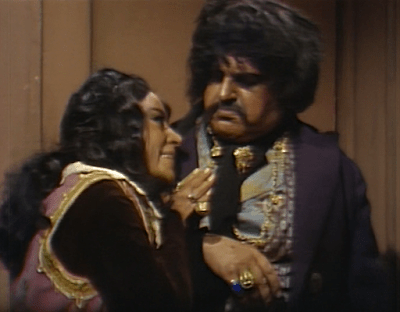
Sandor makes his way back. Magda is overjoyed to see him and throws herself at him with undisguised affection. He responds with his usual grumpiness. At the end, she remembers that they are not alone, and she reverts to their usual form of pretend-quarreling. Their dialogue is great fun, and Grayson Hall and Thayer David make the most of every laugh line:
Sandor: Oh, shut up. I cannot hit you. My arm is too sore.
Magda: Oh, what a brave man you are.
Sandor: Yes.
Magda: What a brave man to fight a zombie, a brave, foolish man.
Rachel: He is a brave man. Thank you, Sandor.
Sandor: I don’t like to see a beautiful lady getting buried before her time.
Magda: But you could have been killed.
Sandor: Yes, that at least would have made you cry. Get me some hot water. My wrist is beginning to swell.
Magda: Oh, so now, I have to nurse you. It is better he should have finished you!
Sandor and Magda are the first happily married couple we have seen on Dark Shadows, and this scene shows them at their very happiest. It is not only a good bit of comedy, it is quite lovely.
Rachel is bookish and intellectually ambitious, very much the sort of young lady you might expect to find in charge of the education of the children in a wealthy family in the late Victorian age. She tells Sandor that she cannot accept that Quentin has risen from the dead and is roaming about as a zombie, even though she has encountered as much evidence of the fact as anyone could want. When Sandor urges Rachel to believe what she has seen, she asks what she will have to believe in next- “Ghosts? Witches? Werewolves?” Sandor affirms that he believes in all of those things, and Rachel replies that she cannot.
Well might Sandor believe in such beings. He is under the power of the new master of the Old House, Barnabas Collins, a vampire. Barnabas rises from his coffin in the basement at dusk, when Rachel is upstairs sleeping. Barnabas knows that Angelique, the same witch who made him into a vampire in the 1790s, is controlling Quentin and persecuting Rachel. When Quentin turns up in the basement, Barnabas remembers a ceremony he saw on Angelique’s home island of Martinique that reunited a zombie’s soul with his body and made him once more a living man. He sends Sandor to the attic to retrieve a packet of letters he wrote to his uncle Jeremiah in those days, describing the ceremony.
Jeremiah’s name will jolt longtime viewers. Angelique raised Jeremiah from his grave as a zombie in #393. Over the next five episodes he initially did Angelique’s bidding, then turned on her. They never did tell us that Jeremiah had returned to his grave, in spite of Angelique’s phenomenally vehement exhortations to him to do so. It’s too bad Barnabas didn’t remember these letters then, he might have been able to un-kill Jeremiah.
Or perhaps not. The ceremony is a total failure today, so maybe Barnabas just doesn’t have what it takes to reunite a soul with a body.
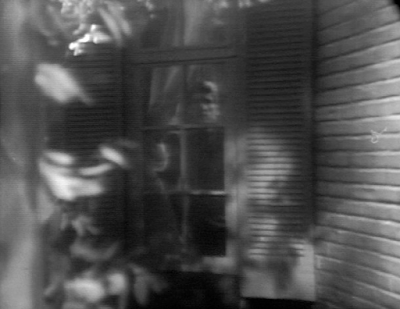
When Sandor and Quentin are fighting in the graveyard, we see a tombstone labeled “Laura Murdoch Radcliffe, born 1840.” The Oxford English Dictionary doesn’t have any examples of the phrase “Easter Egg” meaning hidden content of special interest to devotees until 1986, and for that matter this episode aired a few days before Easter began in 1969. So it is doubly premature to call this an Easter Egg. We learned in #181 that a woman named Laura Murdoch Radcliffe died (by fire!) in 1867, with her young son David in her arms; other Laura Murdochs have died that way in other years, and in #187 the residents of the great house decide that Laura Murdoch Collins is likely to take her own young son David to the same fate. The show has been dropping reminders of the Laura story lately, and any longtime viewers who can read this tombstone will appreciate the reference.
I suspect that the original audience for this particular Easter Egg was pretty nearly limited to the set decorators. The inscription is on screen for less than a second, and it is as clear as it is in the capture above for only a small fraction of that time. It’s hard to see even on a modern television; on a 1960s-vintage TV set tuned to an ABC affiliate, many of which had the worst reception in their markets, it must have been totally illegible to something like 99% of the audience. Moreover, it comes at the end of the fight scene, when most eyes were focused on Sandor’s falling figure. Not very many of the few thousand people who might have had a good enough picture to read the inscription would have been looking at it. And most of the audience who were tuning in at this point had joined the show after Barnabas was introduced, the month after Laura went up in smoke, her name unmentioned since. But in the age of streaming and DVDs, we can all appreciate the reference.
Quentin Collins is dead, his sister Judith would have you know. Their brother Carl is not so sure, but Carl is quite daft. So when high-strung governess Rachel Drummond reports that Quentin has taken a seat in the rocking chair in her bedroom, Judith is exasperated. She orders Carl to stop quivering and go into Rachel’s room himself to look at the rocking chair. Carl obeys Judith, and sees that the chair is vacant. Judith then orders Rachel to accompany her to the drawing room to see Quentin resting in his coffin. To Judith’s consternation, they see that the coffin is empty.
Judith and Rachel wonder who is playing morbid games with Quentin’s corpse. Of all the residents of the great house on the estate of Collinwood, Carl would seem to be the most obvious suspect. He is not only mentally unbalanced, but is also an inveterate prankster whose practical jokes are often disturbingly unpleasant. However, Carl is quick to break into maniacal laughter when he sees that the targets of his japes are uncomfortable, and he is not laughing now. He seems to be quite sincerely terrified. So Judith sends Carl upstairs to see if the body has been returned to Rachel’s room.
While the ladies are alone in the drawing room, Judith and Carl’s distant cousin Barnabas arrives. Judith tells Barnabas what has happened. When Judith expresses puzzlement as to how a dead body could be moved in and out of Rachel’s bedroom without using the door to the corridor, Barnabas mentions that there is a secret panel in the room. Judith is startled. She asks Barnabas how he, who only arrived from England a few weeks before, could possibly know about that panel. He claims that he read a “rare volume” by “the architect of Collinwood.” Judith does not seem entirely convinced, but she lets this explanation pass unchallenged.
Carl does not find the body in Rachel’s room, but he does notice something behind the drapes in the corridor. He pulls them apart to see Quentin. Carl screams. Quentin lumbers towards Carl and begins strangling him. Carl collapses, and Quentin leaves him on the floor.
Carl comes to in the drawing room. He tells Barnabas, Judith, and Rachel what happened. Judith cannot believe that Quentin has risen from the grave, and Barnabas takes it upon himself to tell her about zombies. He claims to have seen a zombie and to have witnessed ceremonies used to put them to rest while he was a young man on the island of Martinique.
Judith agrees to let Barnabas try his mumbo-jumbo. While the ladies are upstairs, Barnabas and Carl are in the drawing room, burning some potpourri next to Quentin’s coffin. Quentin comes lumbering in, and they withdraw to the shadows. The fun Jonathan Frid and John Karlen had working together is one of the most enjoyable things to see on Dark Shadows, but they get a little bit carried away in the moment when Barnabas and Carl hide. As they scurry off, they are so obviously a couple of kids playing that we are distracted from their otherwise outstanding performances.
Quentin comes back and resumes his place in the coffin. At Judith’s insistence, Carl and Barnabas bury the coffin on the grounds and pour cement over it. Judith assures Rachel that this means Quentin will not come back. Rachel is disappointed when Judith says she believes that Barnabas has gone back to the Old House on the estate, where he is staying. Since they have had such an exhausting night and it is almost dawn, Judith assumes that Barnabas will want to go to bed. Judith herself does retire.
Barnabas comes back and tells Rachel that he had to make sure she was all right. She thanks him, and says that during the day she will be leaving Collinwood, never to return. He asks her to reconsider. He says that he wants to see her again, but that he has to leave immediately and he cannot possibly return until the following night. He will not tell her why. Regular viewers know that Barnabas is a vampire and that he will turn to dust if he doesn’t get back into his coffin in a few minutes and stay there until sundown. Barnabas doesn’t seem to think that his relationship with Rachel has come to a point at which he can share secrets like that with her, so he evades her questions and rushes off. Rachel heads upstairs.
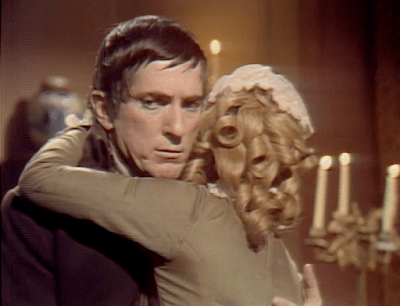
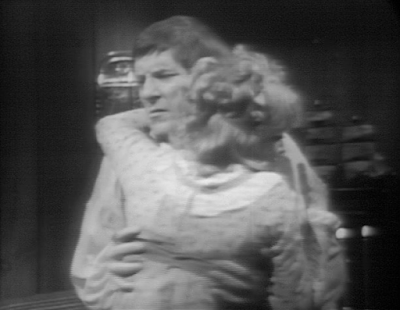
We see the doors open by themselves and hear the wind. Thinking Barnabas has returned, Rachel hurries down. Baffled that no one is there, she goes outside. She turns and sees Quentin. He plods towards her, and she faints into his arms. This impressively well choreographed movement brings us to a dramatic conclusion.
Wicked witch Angelique cast a spell bringing a painful and apparently terminal illness to little Sarah Collins, beloved baby sister of young gentleman Barnabas. Angelique was enraged that Barnabas would not love her and wanted him to watch Sarah in agony, so that the love he felt for his sister would torture him. Barnabas happened by Angelique’s room in the servants’ quarters of the manor house of Collinwood while Sarah was languishing, and it occurred to Angelique that she had some leverage to use against him. She told him she might know of a cure for Sarah, and extorted his promise to marry her if she effected it. He agreed, Sarah recovered, and today Angelique comes to collect.
At first, Barnabas is bewildered by Angelique’s belief that they are going to marry. She brings up his promise. He is flabbergasted to find that she took it seriously. He does not know that she is a witch, and only now seems to suspect that she is a crazy person. She asks if he won’t have her because she is a servant. He gallantly denies that class makes any difference. He says that the real problem is in his feelings for Josette, his former fiancée, who eloped with his uncle Jeremiah. He says that he knows there can never again be anything between him and Josette, but neither will he ever cease to love her. Barnabas asks if Angelique would be willing to marry him, knowing that Josette will always have the first place in his heart; she asks what that matters, as long as she gets to be his wife. She repeatedly releases him from the promise he made while Sarah was ill, but he agrees to marry her anyway.
Yesterday’s episode and today’s include writer Ron Sproat’s first significant scenes featuring Angelique and Barnabas. In the scenes Sam Hall and Gordon Russell gave them, it seems that, while Barnabas has definitely made up his mind that Josette is the one for him, he also has the hots for Angelique. So he squirms and looks unhappy when Angelique throws herself at him, but he does kiss her and he does not hesitate to accept her invitation to visit her alone in her room in the servants’ quarters. So we can imagine that when Barnabas first met Angelique on the island of Martinique, believing as he did at that time that Josette could never love him, he was just doing what came naturally to him when he availed himself of her favors.
But in Sproat’s scenes, Barnabas isn’t attracted to Angelique at all. Yesterday he saw her while he was frantically worried about Sarah’s illness, so any sign of attraction would have had to be subtle. But today, they have a long, deeply emotional conversation in the course of which they decide to get married, and throughout he looks and sounds like he’s talking to his grandmother. That invites us to imagine their affair on Martinique in quite a different light. Perhaps he settled for Angelique then in the same way he is settling for her now- he despaired of ever getting the relationship he really wanted, and decided to give the path of least resistance a try.
It may not be irrelevant that Sproat was gay. For that matter, so was actor Jonathan Frid, a fact that wasn’t publicly acknowledged by his representatives until he’d been dead for ten years, but that can’t have been all that hard for sophisticated viewers to figure out in 1967.
Before Dark Shadows took us back in time to 1795, we knew Barnabas as a vampire trying to convince people he was a living man. In his efforts to pass, we often saw him alienated from his own feelings, isolated from others, and unable to express himself through any conventional form of masculinity. It wasn’t hard to find gay subtext in him then. But I think that in this scene we see the most specific and recognizable closet situation he has been in so far. When he expresses disbelief that Angelique will “accept me as I am,” even knowing “the way I feel,” the character collapses into the actor for a moment, and Josette merges into some guy to whom Frid would never feel comfortable introducing us. When he takes Angelique at her word and agrees to a sham marriage, he sees her as someone who has a place for the man he is. From what we have seen of her single-minded pursuit of Barnabas’ devotion, we know that she expects to turn him into someone else, and that they will both be terribly disappointed.
In 1966 and 1967, supernatural menaces Laura Murdoch Collins and Barnabas Collins would often be seen staring out the windows of their houses on the great estate of Collinwood, sending psychic energy towards the targets of their sinister plans. In 1795, Barnabas is neither supernatural nor menacing, but we already see him peering out one of those windows. He is not projecting bad vibes into the world, but is worried about his beloved fiancée, Josette DuPrés. She is supposed to arrive soon, in fact was supposed to arrive some time ago. Now there is a storm, and he hopes she is not at sea.
The audience’s main point-of-view character in 1966 and for most of 1967 was well-meaning governess Vicki. Now Vicki has come unstuck in time, and found herself in this extended flashback to the eighteenth century. Since she will know Barnabas and regard him as a close friend in the 1960s, she is at her ease talking to him now. Although she is a member of the staff in his family’s house in a period when it was customary for masters to summon their servants with bells and communicate with them only in direct commands, Barnabas is a remarkably genial and democratic sort who welcomes her casual manner.
Vicki has already annoyed the audience several times by blurting out information that makes it obvious to the other characters that she does not belong in their world. She does that again in this scene. Barnabas is worried something may have happened to Josette, and Vicki tells him that she will arrive safely. He is surprised by the assurance with which she delivers this prediction, and asks if she is clairvoyant. She realizes that she has been indiscreet, and denies that she is. He is unconvinced.
Barnabas’ father, haughty overlord Joshua Collins, enters. He is appalled to find his son socializing with a servant. He dispatches Vicki to the nursery to look after her charge, his young daughter Sarah. He demands to know why Barnabas is not tending to his own duties at the family’s shipyard. They begin to quarrel, when a knock comes at the door.
Barnabas opens the door to find a woman named Angelique, whom he identifies as maid to Josette’s aunt, the Countess DuPrés. Angelique says that the countess was on her way to Collinwood, but that her carriage is stuck in the mud. Joshua orders Barnabas to send a footman to rescue her. Angelique is the first character we have met in 1795 who is not played by a performer we have seen in the first 73 weeks of the show.
Joshua goes to his wife, Naomi. Naomi is an alcoholic, a fact of which we are made aware because almost her every scene begins with a shot of her drinking alone. That’s what she is doing before Joshua finds her. He scolds her for her drinking; she complains that he doesn’t allow her to do anything else. She can’t even pass the time with a book- we saw Monday that Naomi is completely illiterate.
Naomi’s alcoholism is both a nod to the concern of first-wave feminism with the atrophy of the elite housewife, and a suggestive side-light on Barnabas as we knew him in the 1967 segment. Then, Barnabas abducted Maggie Evans, The Nicest Girl in Town, and tried by more or less magical means to replace her personality with that of Josette. For the first 40 weeks of Dark Shadows, Maggie’s father’s alcoholism had been a substantial story element, and she would always retain a number of classic Adult Child of an Alcoholic (ACoA, in the lingo of the recovery movement) characteristics, such as beginning utterances with a little laugh to prove that she is happy. Now that we know that Barnabas is also an ACoA, we can wonder if that shared experience was part of the reason he was drawn to Maggie.
The countess arrives. Since she is played by Grayson Hall, who also plays mad scientist Julia Hoffman in the parts of the show set in the 1960s, Vicki blurts out “Julia!” when she sees her. Hall had also been nominated for an Academy Award for her performance as Judith Fellowes in the 1964 film Night of the Iguana; if Vicki is going to keep the audience up to date on the cast’s resumes, it would have been more interesting if she’d exclaimed “Judith!” Vicki explains that the countess looks like someone she once knew who was named Julia, a remark which irritates the countess, who would like to think her appearance is distinctive. Vicki has certainly not made a favorable impression on this grand lady.
Joshua tells the countess he is surprised that “You still affect a title” when “France has followed our example and become a republic.” His pride in this development, after the Terror and in the bloodiest year of the wars in the Vendée, marks Joshua as a member of the Jeffersonian party in US politics. The Federalists and others had long since turned against the French Revolution by that year.
The countess tells Joshua that it is precisely because France has become a republic that she chooses to live on the island of Martinique. That answers a question that some fans ask about Angelique- why is she white? If the DuPrés family lives on Martinique and are major sugar planters there, they must hold a great many African people in slavery. When we hear that they are bringing a servant with them, we expect that servant to be Black. When we learn that the the countess is an emigré, we realize that she brought Angelique with her from France.
The countess may solve one puzzle for us in her exchange with Joshua, but she presents us with another. Josette’s father André is the countess’ brother, yet he is never referred to as a count. Indeed, when he appears, we will see him answer to “Mr DuPrés.” Perhaps he renounced his title, as many French aristocrats did during the Revolution.
Whatever the explanation, “DuPrés” would seem to represent a missed opportunity. When Josette was first mentioned, in the early months of Dark Shadows, her maiden name was given as “LaFrenière.” It would have been a nice touch to have kept that name for Josette and her father, and to have reserved “DuPrés” as the name of the countess’ late husband.
“LaFrenière” had been a perfect choice because of its class ambiguity for a show about an aristocratic family in the state of Maine- it was originally the family name of the barons of Fresnes, and could therefore be a sign of a senior order of nobility, but is also a very widespread name in Quebec. So “Josette LaFrenière” might either have been a French noblewoman who deigned to marry into the mercantile Collins family at the apex of their prestige, or a working class girl from the north who eloped with the boss’ son.
The choice of Martinique as Josette’s place of origin might add a new twist to this class ambiguity. The Empress Josephine grew up there as a member of the untitled but ancient Tascher family, who, like the fictional DuPrés family, owned an enormous sugar plantation on the island. The Taschers of Martinique went back and forth between Martinique and metropolitan France, and Josephine herself was living there in 1779 when she married her first husband, the Vicomte de Beauharnais. Josephine herself was in prison when the vicomte was guillotined in 1794, one of the last to die in the Reign of Terror, and she was freed just a few days later. The next year, she recovered her husband’s property, and a year after that married the young general Napoleon Bonaparte. It seems likely that the similarity between the names “Josephine” and “Josette” was writer Sam Hall’s inspiration for placing Josette’s origins on Martinique. Association with a figure who was at once a grand lady and an example of very steep upward social mobility could synthesize the two possible Josettes LaFrenière into a single figure.
Had they developed the story of the family’s relationship with the town of Collinsport more richly in Dark Shadows 1.0 and 2.0, they could have used this ambiguity to build up suspense that would be resolved today, in the third episode of Dark Shadows 3.0. Since they did so little with that theme in those days, when the story was moving very slowly and it would have been relatively easy to fit just about anything in, I suppose we shouldn’t be surprised that they drop it so completely at this period of the show, when the story is flowing at a breakneck speed.
The countess’ lofty aristocratic manner stings Joshua. Alone with Naomi, he loudly proclaims his belief that all men are equal. We already know enough about Joshua’s tyranny over his household that this absurd little speech must be an intentional spoof of the rich landowners who supported the Jeffersonian party in the early decades of the Republic. Again, this would be funnier and more poignant if the show had done more with social class in its first 73 weeks.
Barnabas sees the countess dealing out tarot cards. He tells her she is too sophisticated for them, and is reluctant to sit with her while she uses them to read his fortune. The moment she says that the cards suggest a connection between him and the concept of infinity, his skepticism evaporates instantly and he excitedly asks if that means he will live forever. The countess cautions that his jubilation at this idea may be misplaced. She notices the “Wicked Woman” card, and takes a significant look at Vicki. Evidently the audience is not alone in objecting to Vicki’s brainless nattering about what the show used to be like.*
Angelique comes to Barnabas’ room. It turns out the two of them had a brief affair when he was first on Martinique, and she expects to resume it. He is not at all pleased at her attentions.
Not how every man would react to a passionate embrace from Lara Parker… Screenshot by Dark Shadows Before I Die.
Barnabas explains that he was already falling in love with Josette when he and Angelique had their fling, but that he didn’t really know her. He couldn’t believe that she would reciprocate his feelings, and consoled himself by dallying with Angelique. This explanation goes over with her about as well as you’d expect, and she storms out of the room, vowing that she will get her way in the end.
We know that the tarot cards are giving accurate information, because the show leans heavily on the uncanny and they wouldn’t have spent so much time on a gimmick that wasn’t meant to advance the plot. We also know that Vicki is not the Wicked Woman the countess is looking for. That leaves Angelique, and we can assume that her wickedness will express itself in some supernatural action taken to avenge herself on Barnabas. Since we know that Barnabas will become a vampire, we wonder if it is Angelique who makes him one.
Closing Miscellany
I usually refer to surviving cast members with courtesy titles and to deceased ones by surname alone. So Alexandra Moltke Isles is “Mrs Isles,” which has been her professional name for 56 years, David Henesy is “Mr Henesy,” Nancy Barrett is “Miss Barrett,” etc, while Jonathan Frid, Joan Bennett, Louis Edmonds, and Grayson Hall are just “Frid,” “Bennett,” “Edmonds,” and “Hall.” Until last month, I’d been looking forward to saying lots of things about “Miss Parker” and her portrayal of Angelique, but Lara Parker died on 12 October 2023. So she’s just going to be “Parker,” and I’m going to be sad about it.
Artist Teri S. Wood has created a number of short animations about Angelique and Barnabas. This one is based on their two-scene at the end of today’s episode:
Patrick McCray has a post about this episode that mystifies me. He writes that “After seven months of hearing about Angelique, today, she enters. So, no pressure Lara. You only have to live up to a half year of build-up.” Uh, what? There has been absolutely no reference to Angelique on the show before today. I can think of an interpretation of the story that might retroject Angelique into episodes #211-365, and I will talk about it next week. But I don’t think it is an interpretation Patrick would favor.
He also talks about David Ball’s method of reading plays from the ending back to the beginning and then from the beginning forward, so that the ending comes to seem implicit in everything else. He allows that Dark Shadows has more than one ending, but I would say he doesn’t go far enough. I’d say the series has ten endings. The first came in #191, when Laura went up in smoke while her son David found refuge in Vicki’s arms. That ending defined Dark Shadows 1.0 as the story of David’s escape from his evil, undead mother Laura, and his adoption of Vicki as his new, life-affirming mother. The second came in #364, when Barnabas met the ghost of his little sister Sarah, she commanded him to be nice to the living, and he went right on with his murderous plans. That ending defined Dark Shadows 2.0 as the story of Barnabas’ irredeemable evil.
Two of the other endings will feature Angelique dying in Barnabas’ arms, and Patrick suggests that those make the whole show the story of their relationship. I don’t buy it at all. Each of the ten parts is about what it is about, and even those two episodes with Angelique dying derive more dramatic charge from other moments.
*Making connections with the first 73 weeks is my job!





 Dark Shadows Commentary