Episode 852: All kinds of spells on people

From November 1967 to March 1968, Dark Shadows was set in the 1790s. The cast included Kathryn Leigh Scott as the gracious Josette, Louis Edmonds as haughty overlord Joshua Collins, and Lara Parker as wicked witch Angelique. Now, the dramatic date is 1897. Miss Scott plays Kitty Soames, an American who went to England to be a governess, married the Earl of Hampshire, and is now widowed, penniless, and scheming to land another rich husband. Edmonds takes the role of stuffy but lovable Edward Collins, who is the focus of Kitty’s ambition. Parker is still Angelique, who is both immortal and a time-traveler.

Ever since arriving at the great house of Collinwood in #844, Kitty has been having psychological breaks during which she acts like Josette. She therefore appears to be suffering from a severe mental illness, an impression which would tend to get in the way when trying to win a new spouse. Today these breaks take a new turn.

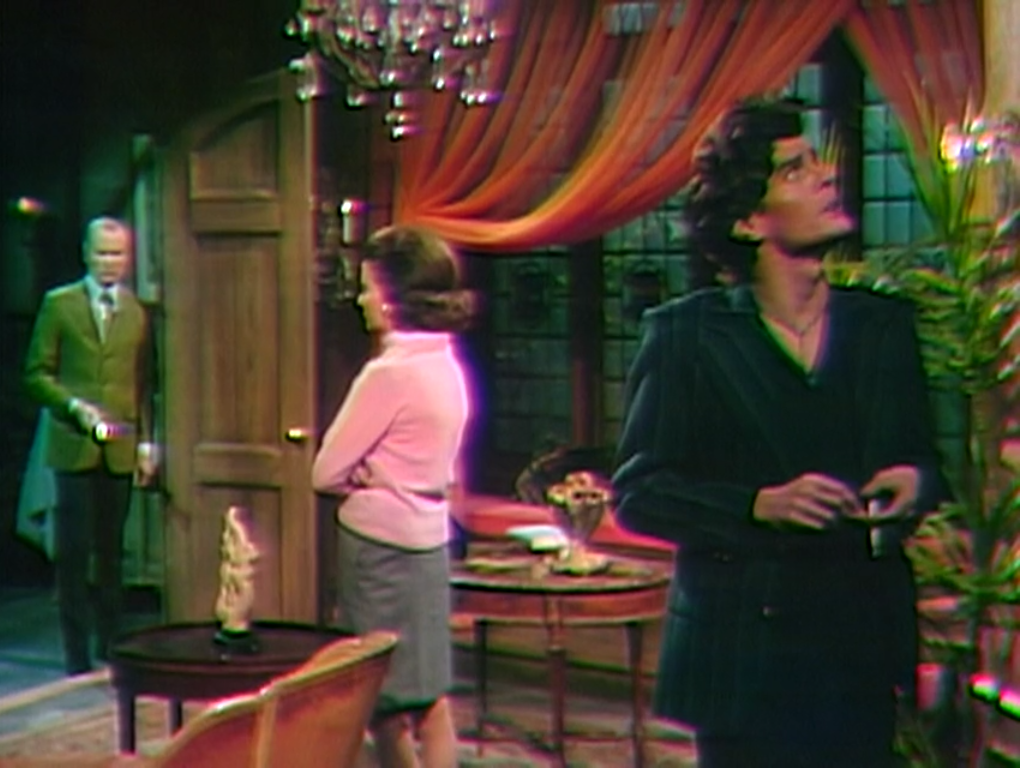
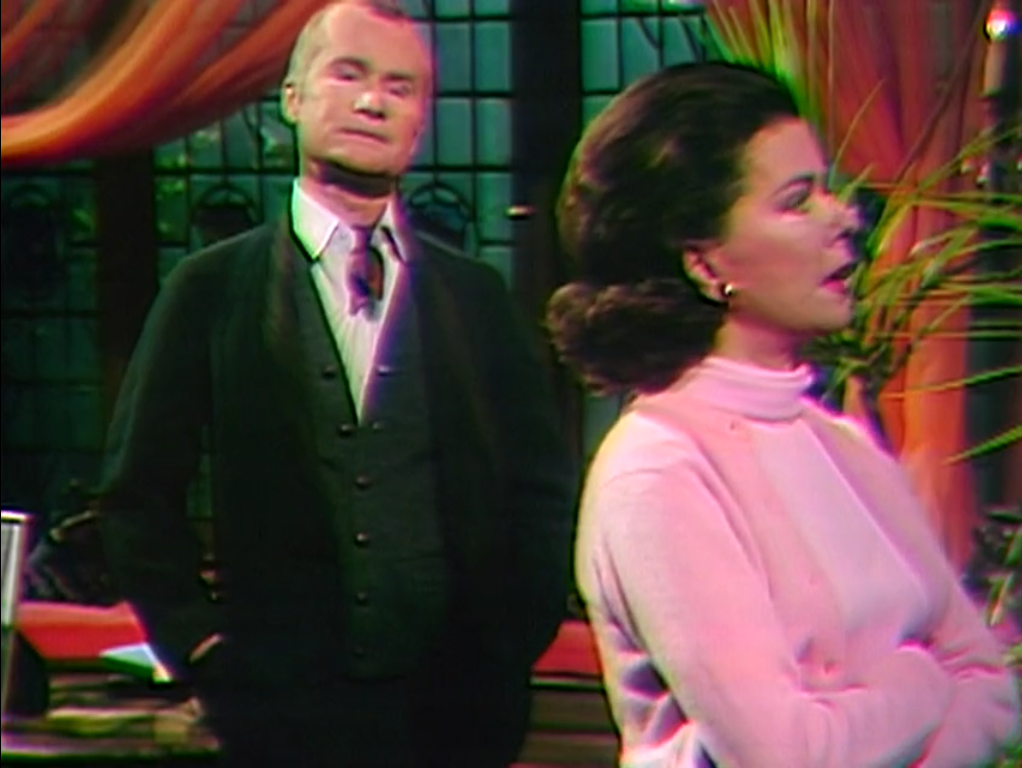
Kitty is walking in the woods on the grounds of Collinwood when she is overwhelmed by the sense that she is being watched, and furthermore that the person watching her knows her well and wishes her ill. She runs into the house and flings herself at Edward, describing this paranoid episode to him. Edward has only begun to talk her down when his brother, rakish libertine Quentin, enters with his own fiancée. The fiancée is Angelique.

Edward is about to introduce the two ladies, who have never met. Before he can do so, Kitty becomes Josette. In Josette’s voice, she denounces Angelique. She then grabs her by the throat and vows to kill her for what she has done.

Angelique was responsible for the deaths of Josette and many others at Collinwood in the 1790s, and has been obsessively hostile to her throughout the centuries. When she was first conjured up from Hell to be part of the 1897 segment in #711, she went to the Old House on the estate, looked at the portrait of Josette that hangs over the mantel in the front parlor there, and declared “I am Angelique and I hate you!” During her lifetime, Josette was oblivious to Angelique’s enmity. She knew Angelique as a lady’s maid in service to her aunt, and regarded her as a close friend. But on Dark Shadows, death is a learning opportunity, and we see today that when she is animated by Josette’s spirit Kitty knows everything Angelique hid from Josette when she was alive.

Edward and Quentin separate Kitty and Angelique. In a private conversation with Quentin, Angelique makes it clear to the audience that she knows exactly what is happening with Kitty, and that she regards it as a minor nuisance. Quentin has troubles of his own, and doesn’t ask for an explanation.

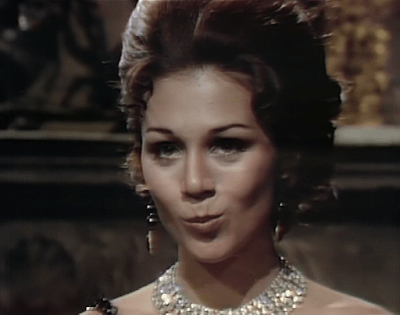
Meanwhile, Kitty and Edward have a private conversation of their own. Edward tells Kitty that she is just upset because of her late husband’s death, and assures her that he will help her recover. She flashes a cunning smile at the camera. Well she might- not many people are so good at attaching themselves to rich guys that they can turn a psychotic episode to their advantage.

Kitty takes satisfaction in a job well done. Screenshot by Dark Shadows Before I Die.

Kitty has a dream in which Angelique is her servant and is addressing her as “Mademoiselle.” In the dream, Angelique delivers an arrangement of flowers and a book of poetry that Josette’s fiancé wants her to have before their impending wedding. When she wakes up, Kitty finds the arrangement and the book by her bedside, and she realizes that what is happening to her is not simply a mental aberration.

The dream will puzzle new viewers, even those who know that Angelique was a servant in Josette’s household. When Angelique is busy being Evil, she often laughs a maniacal laugh that breaks in the middle with a sharp intake of breath. She keeps doing this throughout the dream, which doesn’t fit at all with the action of bringing a present from a lover. She also tells Josette that her happy life is of the sort that makes the gods jealous, and speaks the lines with an undisguised and exaggerated hostility that leads into another gale of maniacal laughter. People who have joined the show in the last year will wonder why Angelique is being so crudely obvious.

Lara Parker used to say that she didn’t really learn to act until Humbert Allen Astredo joined the cast of Dark Shadows in June 1968. She’d taken acting classes and appeared in plays and so on, but it wasn’t until Astredo explained acting techniques to her while they were rehearsing that it all clicked in her head. You really can see a sudden improvement in her performances at that time. The dream Josette transmits to Kitty’s mind takes her to a time, not only when Angelique was a servant, but when Lara Parker was not a particularly good actress. The contrast between the reliably capable professional we see in most of the episode and the often bombastic student who appears in the dream makes us appreciate just how far she came in a short time.

Episode 838: Your part in this drama is finished

In #836, the ghost of maidservant Beth Chavez appeared to Julia Hoffman in the year 1969. Beth told Julia what happened on the night in 1897 when she shot the rakish Quentin Collins to death.

Regular viewers would have recognized the events Beth described as different from what would have happened when Quentin originally died in 1897. For the last 28 weeks, the show has been set in that year because Julia’s friend, recovering vampire Barnabas Collins, accidentally traveled back in time while trying to figure out why Quentin had become a ghost bringing death and misery to everyone on the estate of Collinwood. In 1897, Barnabas met the living Quentin and befriended him, but also changed the history of the period substantially. So a wicked witch named Angelique, who was not at Collinwood the first time through 1897, is there on this iteration of events. Beth’s night took the turn that would lead her to shoot Quentin when Angelique told her that her engagement to Quentin was off and that Angelique would be marrying Quentin instead.

After Beth told her what happened in the latest version of 1897, Julia herself traveled back in time, determined to rescue both Quentin and Barnabas. Once she got to her destination, she was too dazed to speak. But Quentin found a letter in her pocket that Barnabas had written, and it led him to Barnabas. Barnabas was able to tell Quentin that he was fated to be killed tonight, after his nephew Jamison rejected him. He had no more to tell him, nor could he restore Julia’s ability to speak.

We open today with Quentin holed up in his room, waiting for midnight to come and go. Sorcerer Count Petofi knocks on his door; Quentin jumps to the conclusion that it is Petofi who will kill him. In fact, Petofi has learned of Quentin’s current fate, and offers to help save him. Quentin has ample reason to distrust Petofi, and refuses the offer.

Jamison then knocks. Quentin lets him in; the two have a happy talk about how much they enjoy each other’s company, and Quentin decides he won’t stay in his room after all. This leads directly to the reenactment of the scenes Beth had described, including Beth’s conversation with Angelique, Jamison’s discovery of Beth in the act of attempting suicide, Jamison’s consequent rejection of Quentin, and Beth’s pointing a loaded pistol at Quentin while she declares that she has decided to kill him.

Quentin’s time in his room shows that his behavior afterward is the direct result, not only of Barnabas’ intervention, but of Julia’s as well. So what we are seeing today is not what happened the first time through 1897 or the second, but is yet a third version of events. It does end quite differently- Petofi turns up in the nick of time and prevents Beth from shooting Quentin. The whole basis of the fantasy of going back in time to change events is the experience of rewriting stories, of what fandoms call “retroactive continuity” (“retcons” for short.) In the contrast between the two versions of the night of 10 September 1897 that Dark Shadows shows us, and in the contrast between each of those and the original events that we never saw, the story merges into the process of writing the scripts, and the characters explicitly create their own retcons.

Petofi tells Beth that she ought to leave Collinwood at once and go as far away as possible, because “Your part in this drama is ended.” The incorporation of retcons as an overt story element shows that metatheatricality can be fun, but I have to say it was pretty cold of Dan Curtis to delegate the job of firing actress Terrayne Crawford to the character Petofi.

Count Petofi tells Terrayne Crawford she won’t be getting another contract.

Petofi then goes to Quentin’s room and tells him the price for his services- Quentin must betray Barnabas. Quentin resists this demand until Petofi shows what else he has already done for him. Petofi commissioned a portrait of Quentin. Quentin saw the portrait the other night when there was a full Moon, and he was horrified by what he saw. The portrait bore, not his usual features, but those of a wolf. Since Quentin is a werewolf, he thought the portrait was a cruel reminder of his curse. But when Petofi bids him look at the portrait again tonight, Quentin sees his accustomed face. Petofi explains that the reason Quentin remained human that previous night was that the portrait changed, and that as long as the portrait remains intact Quentin will be free of the effects of the curse. Quentin’s blissful reaction to that news suggests that Petofi was right to tell him that he belonged to him now and would be able to refuse him nothing.

Sadly, this episode marks the last appearance of the character Jamison Collins. David Henesy plays the same scenes with the same dialogue he had on Monday, but he did a great job then and does an equally great one today. He’ll be back tomorrow for a brief appearance as his 1960s character, David Collins, then will be absent from the cast for almost 11 weeks. We’ll miss him while he is away.

Episode 778: The strongest magic is always the simplest

A lot happens in this one. Inveterate prankster Carl Collins realizes that his fiancée, Cockney showgirl Pansy Faye, is dead. He has a dream in which he meets Pansy backstage as she is preparing for her final performance, then sees her standing on stage before him, his sister Judith, and their distant cousin Barnabas; when he awakes from the dream, Carl is sure he has figured out what happened to Pansy, and he sets out for the very place where Barnabas is planning to rest during the day. This seems to imply that Carl will discover that Barnabas is a vampire.

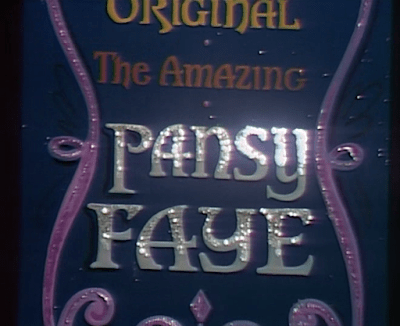
The dream sequence is like nothing we’ve seen before on Dark Shadows, though it is strongly reminiscent of the kind of thing you would have seen on near-contemporary shows like ABC’s prime-time horror anthology Night Gallery hosted by Rod Serling and the Paulist Fathers’ syndicated morality plays Insight hosted by the Rev’d Fr Ellwood Kieser. It starts with a closeup of a sign on which Pansy’s name is emblazoned in glittery letters, and plays over a soundtrack of an audience applauding thunderously. Pansy calls Judith, Barnabas, and Carl to join her on stage, each in their turn; their behavior in this drama-within-a-drama mirrors their behavior in the framing narrative.

Pansy’s sign. Screenshot by Dark Shadows Before I Die.

Meanwhile, Barnabas’ unwilling sidekick, broad ethnic stereotype Magda Rákóczi, has returned from Boston. There, she met with a leading member of the Romani people, whose name she alternately pronounces as “King Johnny Romana” and “King Johnny Romano.” She shows Barnabas a box she took from King Johnny. It contains a severed hand wearing a ring, which Magda declares will solve their troubles. Magda has placed a curse on Judith and Carl’s brother Quentin, turning Quentin into a werewolf. After placing that curse, Magda learned that her sister Jenny had borne two children to Quentin, and since the curse is hereditary she is desperate to find a way to lift it. Barnabas traveled back in time to 1897 in the course of his own attempt to resist the effects Magda’s curse will have in 1969, so they are allied in this effort.

Barnabas is utterly unimpressed with the hand and with Magda’s plan to place it on Quentin as he is about to transform. He seems convinced that Magda is just trying to conceal the fact that she failed to find anyone in King Johnny’s camp who could actually help them. He doesn’t care about the original owner of the hand, a legendary nobleman named Count Petofi who was himself cured of lycanthropy, or about an incantation Magda says over the hand that is supposed to prepare it to draw the curse from Quentin. He isn’t even interested when she admits that she stole the hand from King Johnny and that if they don’t get it back to him before he realizes it is missing he will send someone to kill her. He reacts as if the whole thing is a show she is putting on to build up her cover story.

In a metafictional set of way, Barnabas is onto something. The original storylines the writers had prepared for the 1897 segment are coming to a head. Several of its major characters have already died, and others, such as Carl, would not be very attractive customers for a life insurance salesman. Apparently the original flimsies, written six months ago, gave only a few more weeks until Barnabas was to return to 1969 and take the show back to contemporary dress. But 1897 is a hit. The ratings are soaring, and there are some dynamics among the characters that they want to explore in a lot more depth. So they want to stay, but to keep the momentum going they need more story and a number of new characters, including a major villain whom Barnabas and Quentin can team up to fight together. So the writers find themselves in the same position with regard to us that Magda is in with regard to Barnabas, trying to sell us on their latest preposterous brainstorm.

Pansy’s farewell performance in Carl’s dream is, alas, Kay Frye’s final appearance on Dark Shadows. Some fans seem unable to look past Pansy’s own hilariously inept performance when we first see her doing her act, and to see that Miss Frye herself does a terrific job playing a cold, cynical working girl. She is good today, when Pansy is on stage and in her character as the “world-famous mentalist and singer,” but is also trying to tell Carl the truth about Barnabas. I only wish they could have brought Miss Frye back as someone else, either in the extended 1897 segment or in another time period.

Episode 539: Child’s play

The wicked witch known variously as Angelique and Cassandra is standing in the drawing room of the great house of Collinwood, thinking evil thoughts. The camera zooms out and we see that her stepson, strange and troubled boy David Collins, is standing next to her. She starts to speak her thoughts out loud, saying “You will pay!” David asks “Who will pay?” Angelique/ Cassandra is startled to discover that David is there, and is flustered when she tries to change the subject. She so often delivers incriminating soliloquys while standing out in the open that the comic effect of this scene must be intentional.

Angelique/ Cassandra oblivious to David’s presence.

David asks Angelique/ Cassandra to help him figure out the correct operation of a tape recorder he received some time ago as a present from permanent houseguest Julia Hoffman. After Angelique/ Cassandra refuses to help, he goes upstairs and finds his cousin, heiress Carolyn Collins Stoddard, emerging from the long-deserted west wing of the house. He asks Carolyn what she was doing in the west wing. She asks him why he thinks she was in the west wing. When he says he saw her coming out of it, she drops her attempt to evade his question and tells him she was looking for some old family photos to show well-meaning governess Vicki. She has enough trouble remembering this story that it must be obvious to David that it is a lie, but he isn’t interested enough to follow it up. He just wants someone to help him figure out which buttons to push on the tape recorder.

On their Dark Shadows Before I Die, John and Christine Scoleri speak for longtime viewers of the show when they say that it is surprising David needs help with the tape recorder. When the show started, David was two years younger and had the mechanical skill to sabotage his father’s car in a very creditable attempt at patricide. All Carolyn has to do to get the tape going is read the label that identifies the play button. This apparent loss of cognitive function is of a piece with David’s massive loss of narrative function. For the first 39 weeks of Dark Shadows, David was the fulcrum on which every story turned, and actor David Henesy had abundant opportunities to show a level of professional skill that would be remarkable in a performer of any age. But he has been receding into the background for a long time now, and his extraordinary dim-wittedness today marks a low point for him.

Once the tape starts playing, Carolyn makes a hasty exit. David listens to a minute or so of Eine Kleine Nachtmusik, hoping it will end and he will hear “something spooky.” His wish is granted when the music abruptly stops, giving way to a voice addressing itself to Julia. The voice rambles about David’s distant cousin Barnabas Collins, saying that if both he and “my creation” live, Barnabas will be all right, but that if “Adam” dies, “Barnabas will be as he was before.” The name “Adam” should mean something to David. He shared a confused and frightening moment with a mysterious man of that name in #495. That man subsequently abducted Carolyn, and is still the object of a police search.

What only Julia, Barnabas, and Barnabas’ servant Willie know is that Adam is a Frankenstein’s monster created in an experiment that freed Barnabas of the effects of the vampire curse that Angelique/ Cassandra placed on him in the 1790s. The voice on the tape is that of Eric Lang, the mad scientist who began the experiment. Minutes before he died of the effects of one of Angelique/ Cassandra’s spells, Lang recorded this message for Julia. The audience has heard this message approximately a gazillion bajillion times, but until now, the only character to have heard it was Adam, and he could make no sense of it.

Angelique/ Cassandra recently made an unsuccessful attempt to renew Barnabas’ curse, and is desperately searching for the obstacle that prevented it from working. Carolyn’s actual task in the west wing was showing Adam to a hiding place there. So Angelique/ Cassandra is now under the same roof with both the information she needs to identify her obstacle and the person she can remove that obstacle by killing. Things are looking bad for Barnabas and for Adam.

While David is upstairs with the tape recorder, Vicki is sobbing in the drawing room. Suave warlock Nicholas, who is staying in the house in the guise of Angelique/ Cassandra’s brother, enters and asks her what’s wrong. She says that she has just learned that Barnabas is dead. His back to her, Nicholas smiles brightly when he first hears this news, then puts on a sad face and turns to her with sympathetic words. In response, Vicki reveals that she knows all about Angelique/ Cassandra and that she has little patience for Nicholas’ pretensions. Carolyn enters and doubts Vicki’s news. Angelique/ Cassandra is the last to enter. She says that she saw Barnabas alive and well after the time when he is supposed to have been dead. Vicki and Carolyn look at each other, and do not see Nicholas’ look of disappointment. They go upstairs, and Nicholas and Angelique/ Cassandra go into the drawing room.

Nicholas scolds Angelique/ Cassandra for her failure. He addresses her as “dear sister.” He suggests she may not hate Barnabas sufficiently to impose a curse on him. When she denies this, he leans to her ear and teasingly asks if she loves him. He threatens to send her back where she came from if she doesn’t re-vamp Barnabas by midnight, and to focus her mind replaces her arm with a fleshless bone.

Director John Weaver was not much of a visual artist, and in his post about the episode on Dark Shadows Every Day Danny Horn analyzes the dismally inept blocking of the scene between Vicki and Nicholas. Danny also has some unkind words for writer Ron Sproat, but I think those are unfair. It’s true the opening scene between Adam and Carolyn goes on too long, David’s helplessness with the tape recorder is dismal, and Vicki and Carolyn’s reaction to Angelique/ Cassandra’s report that Barnabas is still alive doesn’t make sense. That’s a long enough list of flaws that we might fairly classify Weaver and Sproat as the B-team, not on a par with director Lela Swift and writers Sam Hall and Gordon Russell.

But it is genuinely funny when we first see David standing next to Angelique/ Cassandra, David’s questioning of Carolyn is intelligently written, Lang’s message is for once an actual source of suspense, Vicki’s lines to Nicholas as Alexandra Moltke Isles delivers them show the character’s strength, Nicholas’ teasing Angelique/ Cassandra with her alleged love of Barnabas raises a laugh as it makes them sound like a couple of kids, and the final gag with the arm bone is at once goofy enough to keep up the humor in the episode and startling enough to be effective as a touch of horror. All in all, it’s an enjoyable episode, if not one that fans would be tempted to use to turn their friends on to the show.

Episode 522: Brother devil

A stranger comes to the great house on the estate of Collinwood and introduces himself as Nicholas Blair, brother of Cassandra Blair Collins. Cassandra’s husband Roger Collins is shocked; Cassandra had never mentioned that she had a brother. Moreover, she has been missing for the last 24 hours, and Roger is convinced something terrible has happened to her. Roger’s distant cousin Barnabas Collins and Dr Julia Hoffman are also shocked, but for a different reason. They know that Cassandra is actually Angelique, a wicked witch who, in the 1790s, turned Barnabas into a vampire. She recently returned to the world of the living when Barnabas’ vampirism went into remission, and she tried to implement a plan to bring it back in full force. When Angelique/ Cassandra went missing, they hoped it meant that she had been defeated. Nicholas’ arrival replaces their hopes with the fear of new battles.

Nicholas at first assumed that Barnabas was Angelique/ Cassandra’s husband, and told him “I should have recognized you anywhere!” This is a sure sign of trouble- Barnabas, who was in fact briefly married to Angelique in 1796, has not been out of the state of Maine since 1795, and has never been photographed. Nicholas says that he has recently been on Martinique, where Barnabas first met Angelique in the eighteenth century, and that he is a “citizen of the world” with no fixed address. He assures Roger that it is Cassandra’s way to disappear abruptly, and that she is sure to return.

Roger, Julia, Barnabas, and Nicholas in the drawing room.

Roger takes Nicholas to the bedroom he and Angelique/ Cassandra share. He shows Nicholas a portrait of Angelique which returning viewers know to have a mysterious connection with Angelique/ Cassandra’s physical being. Roger leaves the room, and Nicholas talks to the portrait. He asks Angelique if she can hear him, and a musical cue associated with her plays on the soundtrack. The cue cuts out, and Nicholas follows up with another question. Dark Shadows stood out from the daytime soaps of the period in having an orchestral score instead of an organ accompanying the action. The meta-theatrical touch of a character who can hear that score is a major departure. It is something people at the time would have seen in animated shorts from Warner Brothers, but likely not anywhere else. Since the biggest and fastest-growing share of Dark Shadows’ audience at this point was children under the age of 13, there was a risk that adult viewers might take that association with cartoons as a sign that it was time for them to find something else to do with their mid-afternoons.

Back in his own house on the same estate, Barnabas finds his servant Willie Loomis holding a rifle. Willie says that he is afraid that man named Adam will come to the house. Barnabas dismisses that fear and orders Willie to put the rifle away. Willie objects. Barnabas repeats the command and leaves. Willie grumbles, but does as he was told. We see a face peering in at the window.

The face belongs to hardworking young fisherman Joe Haskell. Returning viewers know that Barnabas held Joe’s fiancée Maggie prisoner from May to June of 1967 and was extremely cruel to her. When the case was being investigated, Barnabas framed Willie for those crimes. Willie was sent to a mental hospital, and Barnabas had Willie released and brought him back to work for him some weeks ago. Joe thinks that Willie is the perpetrator, and has no patience with him. He knocks on the door and demands Willie let him in.

Joe insists that Willie tell him what he knows about Adam. Willie tries to evade his questions. When Willie says that Adam dislikes him, Joe responds”that means he knows you.” Joe twists Willie’s arm while repeating his questions. Once Joe releases him, Willie runs off and comes back with the rifle. He points it at Joe and orders him out of the house. Joe complies, but says that he will be back, and that he will be having words with Barnabas.

Later, Willie is in the basement. Some bricks are missing from a wall, exposing a skeleton hanging from the ceiling. Viewers who have been with Dark Shadows all along will recognize the basement of Barnabas’ house as a redress of the set that represented the basement of the main house in the first year of the show. The spot with the missing bricks was where a door stood that was always locked in those days. For the first 54 weeks of Dark Shadows, matriarch Liz thought that her husband’s corpse was buried behind that door. That belief turned out to be mistaken, but now we see that there are indeed human remains in the most similar possible spot. We might wonder what else Liz might have been less wrong about than at first sight appeared.

We watch Willie preparing to fill in the missing bricks, leaving the skeleton in place. After all, judging by Liz’ old way of thinking, that’s what ought to be in a space like that. We hear Willie’s interior monologue. He is making himself laugh with a pun on his own name when a stagehand wanders into the shot.

Uh, hello?

That moment of unintentional humor gives way to a scene rich in intentional comedy. Willie goes upstairs and finds that Nicholas has let himself into the house. Nicholas entrances him and extracts information from him. Willie tells him about a meeting with a ghost- “the one downstairs,” he specifies. Nicholas directs Willie to sit down, to remain in a blissed-out state until he leaves, and then to forget all about their encounter.

Nicholas goes to the basement, looks at the skeleton, and calls it “Reverend Trask!” Willie hadn’t given him this name; evidently he recognizes Trask the same way he recognized Barnabas.

The gang’s all here.

Episode 491: What we do with him now is up to us

Vampires and mad scientists are both metaphors for extreme selfishness. The vampire exists only to feed on humans, gaining a night’s nourishment for himself at infinite cost to them; the mad scientist takes skills and equipment that could bring great boons to humanity and uses them only to further some perverse private whim. The Frankenstein’s monster emerges as the logical synthesis of these metaphors. As a botched resurrection and a parody of the Christian story, the Frankenstein’s monster evokes the vampire; as the helpless product of the mad scientist’s hubris, he is a child neglected and abused by a narcissistic parent, bringing home the real-world stakes of the issues raised in stories of uncanny horrors.

Mad scientist Julia Hoffman and vampire Barnabas Collins have finally got round to creating a Frankenstein’s monster of their own. His name is Adam. Julia and Barnabas had expected Barnabas to die and his “life force,” what the opening voiceover today refers to as his “spirit,” to animate Adam. They are surprised that the experiment has ended with Barnabas and Adam both alive. They are entirely bewildered about what to do with this 6′ 6″ newborn. Julia goes to her usual default, and injects him with a sedative.

Matriarch Liz comes from the great house of Collinwood to the house where Julia and Barnabas are working. She brings some information about the B plot. Barnabas makes it clear that he and Julia are deeply involved in an experiment begun by the house’s previous owner, the late Dr Lang. Liz is mystified by Barnabas’ new interest in science. She and Julia go to Collinwood, while Barnabas stays downstairs in Lang’s old consulting room. He is waiting for the dawn, wondering if the process of creating Adam cured him of the symptoms of vampirism or if he will crumble into dust when the sun rises.

In the lab upstairs, Adam regains consciousness. He plays with some of the shiny objects around him. It’s rather an odd playpen for a baby, with its electrical equipment spraying sparks, vials of boiling acid, loaded gun, and medical sharps. But he seems delighted with everything until he grabs a scalpel by the wrong end. Then he starts smashing things.

What newborn wouldn’t love that? Screenshot by Dark Shadows Before I Die

By that point, Julia is back, the sun is up, and Barnabas has learned he is human again. Julia and Barnabas hear the crashing sounds from upstairs. They try to stop Adam. He flings them aside. The episode ends with him sticking his arm out the door while they press it shut. Grayson Hall and Jonathan Frid do such a good job of playing Julia and Barnabas as farcically clueless that the sequence left me and Mrs Acilius roaring with laughter.

There is a bit of self-reference in this one. The first person Adam sees when he opens his eyes is Barnabas. When he can see Barnabas, he is calm. When he cannot, he becomes agitated and dangerous. Most of the people watching Dark Shadows at this point first tuned in because they were curious about Barnabas, and have stayed with the show because they are fascinated with him. The viewer mail whenever Barnabas was not getting enough of the spotlight to please his fans must have been unpleasant for the writing staff to read, and might have made them apprehensive of the crowds that gathered every weekday outside the studio at 442 West 54th Street. Perhaps Adam’s rampage was their nightmare dramatized.

Episode 420: A man’s position in society

One of the most story-productive relationships in the first 40 weeks of Dark Shadows was that between reclusive matriarch Elizabeth Collins Stoddard and her brother, high-born ne’er-do-well Roger Collins. Having squandered his entire inheritance, Roger lived as a guest in Liz’ house and drew a salary from her business. She tried to order him to rein in his bad behavior, but time and again wound up shielding him from accountability. When she does that, she reduces herself from authoritative to bossy.

In the summer of 1967, the relationship between mad scientist Julia Hoffman and vampire Barnabas Collins began to follow the same dynamic of Bossy Big Sister/ Bratty Little Brother. Appealing to her professional standing as a medical doctor doubly qualified in hematology and psychiatry and to her situational awareness as a native of the twentieth century, she makes efforts to convince him that not every problem has to be solved by murder. When he disregards her advice and kills people anyway, she covers up for him. Realizing that she is stuck with Barnabas for the rest of her life, Julia tries to drum up a romantic relationship with him, but he is not interested. Eventually, she will come to be “like a sister” to him in more senses of that phrase than she would like. In the years to come, we will even see storylines in which the two of them explicitly masquerade as siblings.

Dark Shadows took a break from its contemporary setting and began an extended stay in the late 18th century beginning in November 1967. We’ve already caught a glimpse of the Bossy Big Sister/ Bratty Little Brother dynamic in this period, when haughty overlord Joshua Collins found himself taking orders from his sister, repressed spinster Abigail. Today, we take a bit of a self-referential turn as a character decides to deliberately mimic this trope.

Caddish naval officer Nathan Forbes has talked fluttery heiress Millicent Collins into marrying him. Millicent is very rich and beautiful, Nathan is charming and handsome, and there are many reasons to think they might make a happy couple. There is one small problem. A very small problem, really; not more than five feet tall and well under 100 pounds. It is Nathan’s current wife, Suki. Suki has found out what Nathan is up to, and wants a cut of his take. To his surprise and discomfort, she shows up today at the great house of Collinwood and introduces herself to Millicent as Nathan’s sister.

The Millicent/ Nathan story has been a lot of fun so far, and Suki is just fantastic. Actress Jane Draper gives a performance as big as her body is small, and Suki instantly sees through Nathan’s every lie, which is to say his every utterance. She dominates every scene she is in.

Suki has Nathan where she wants him. Screenshot by Dark Shadows Before I Die.

Yesterday, Suki walked in on Nathan at The Eagle tavern and took charge of the place. Today, she is in command of the drawing room at Collinwood. Nathan and Millicent serve up one straight line after another, every one of which Suki answers by saying something unexpected and exciting.

Suki looks out the window and sees Barnabas looking in. She doesn’t know who he is, much less that he is a vampire, but she can recognize a miserable creep when she sees one. He throws her off her form, and we dissolve to an upstairs bedroom.

The rest of the episode is a scene where Barnabas lets himself into the bedroom occupied by his ex-fiancée, the gracious Josette. He tells Josette they can never be together again, but won’t explain why. She says she wants to be with him no matter what. He bites her. They’ve been telegraphing this scene all week. It’s a complete anticlimax, and it does nothing to make up for Barnabas interrupting our time with Suki.

For a show that plundered story ideas from virtually everywhere, Dark Shadows was remarkably wary of lifting anything from the Bible. Suki’s claim to be Nathan’s sister is something of an exception. It reminds us of Abraham, who twice in Genesis passes off his wife Sarai/ Sarah as his sister and then recommends that his son do the same with his wife Rebecca. The 1795 flashback is supposed to explain the origin of the accursed Collins family for us, to answer the question “Who are Barnabas’ kin?” as Genesis answers the question “Who are Joseph’s kin?” So Suki is in tune with the rationale of the segment when she draws on that book. While Genesis explains and justifies a patriarchal order of society, so that Sarah and Rebecca just go along with Abraham’s loony schemes, daytime serials are aimed at a mostly female audience and need self-starting female characters. So it is only to be expected that the gimmick will be at Suki’s initiative this time.

Episode 177: The glare of our scientific era

Maggie Evans, The Nicest Girl in Town, is at her job running the restaurant in the Collinsport Inn. Not that she’s working, exactly. There are no customers; the only other person there is her boyfriend, hardworking young fisherman Joe.

They’re hugging and kissing, and Joe is bringing up the idea of marriage. Maggie doesn’t think they can get married, since she has to look after her father, drunken artist Sam. Joe doesn’t think that is much of a problem. In previous episodes, we’ve seen that Joe likes Sam and doesn’t mind helping Maggie with him. He does say that he would rather Sam not come along on their honeymoon, and suggests that Sam might be ready to cut back on his drinking. Maggie isn’t getting her hopes up.

Flighty heiress Carolyn comes into the restaurant and asks to speak with Joe privately. Carolyn is Joe’s ex and Maggie is worried the two of them will get back together, but since she only wants to go to a table where they will be in Maggie’s line of sight she goes along with the idea. We do see Maggie looking vigilantly at them while they talk.

Maggie watching Joe and Carolyn

As it happens, Carolyn isn’t trying to win Joe back. She wants him to help Dr Peter Guthrie, visiting parapsychologist, in his efforts to determine whether her aunt, Laura Murdoch Collins, is the reincarnation of two women who died by fire in 1767 and 1867. Guthrie hasn’t told Carolyn what exactly he is planning to do, but he has said he needs the help of a strong young man and that what he is going to do is “not strictly legal.”

Carolyn leads off by telling Joe that she is going to ask him to do something to help her mother, reclusive matriarch Liz, who is in the hospital with a mysterious ailment. Joe immediately agrees to do anything that will help Liz. When she starts explaining that she wants him to work with Guthrie, and that Guthrie is a parapsychologist, Joe is incredulous. At length, he reluctantly agrees to go, and to keep what he will do secret from everyone, even Maggie.

When he tells Maggie that they have to cancel their date so that he can go to Carolyn’s house, she is dismayed. He assures her that he is not getting back together with Carolyn, but that Carolyn made him promise to keep it a secret just what he will be doing. Maggie vows to fight if Carolyn does try to take him back.

This scene is the current phase of Dark Shadows in a nutshell. It appears to be a more-or-less typical daytime soap opera of the sort you would see on American television in February of 1967, where good-looking young people in wholesome, everyday settings struggle about who will have a conspicuously chaste romance with whom. That’s what Maggie thinks she is watching when she keeps her eyes on Joe and Carolyn.

But in fact the series is heading towards becoming a full-time supernatural thriller, and stories like those are going to be tossed out and left by the roadside before long. That development doesn’t bode well for Joe and Maggie. Joe tells her today that their relationship is “the simplest thing in the world”- he loves her, she loves him, that’s all you need. Of course, a couple is only allowed to be on screen in a soap opera if they are participants in a conflict of some kind, and are only the main figures in a storyline if they are in conflict with each other. But the show Maggie thinks she’s on might supply them with conflicts that would make sense to the sensible, practical-minded people she and Joe are written to be.

When they start dealing with ghosts and fire witches and who knows what else, Maggie and Joe will have a limited amount of time to show us how level-headed real-world people might react to supernatural crises. Once they’ve exhausted that theme, they will have either to adapt to their new surroundings and become different sorts of people or to leave the show. The prospect of reconceiving the characters might be good news to the actors Kathryn Leigh Scott and Joel Crothers. But Maggie and Joe would be appalled to hear that they will have to discard their personalities and invent new ones, and Joe’s alarmed reaction when Carolyn starts talking about parapsychology is a foretaste of what the characters will be going through as this comes upon them.

As the show’s representatives of Collinsport’s working class, Joe and Maggie are the designated representatives of daylight sanity. From the first week of Dark Shadows, we’ve known that Carolyn and the other residents of the great house of Collinwood are in too close proximity to the supernatural back-world of ghosts and ghoulies for that kind of attitude to be possible.

That contrast is dramatized in three moments in today’s show. In the opening portion, Carolyn and Dr Guthrie spend approximately 500 hours* in the drawing room of the great house recapping all the uncanny elements of the current storyline. When Guthrie asks Carolyn if she has considered the idea of reincarnation, she says that she has considered it and dismissed it. When he starts in with an explanation of how the idea of reincarnation connects to their conflict with Laura, Carolyn is all in.

When Carolyn is in the restaurant telling Joe about Guthrie the parapsychologist, Joe says he is surprised she is taking this sort of thing seriously. “I always thought you were a level-headed girl.” Regular viewers may be startled by this comment. In the last few weeks, Carolyn has had to take over her mother’s duties as head of the household and of the family business, and has shown some maturity in discharging them. But the whole time Joe and Carolyn were a couple, she was fickle and irresponsible to the point of madness. In this context, where Joe is conscious of Maggie’s eyes on him and is trying to project a particular image of himself, he rewrites the history of his relationship with Carolyn. He isn’t the sort of fellow who would spend years chasing after a flighty heiress- he is a sensible man who would only ever be involved with an equally sensible woman. That self-image is going to take a beating as he participates in the kinds of stories we’re going to see from now on.

In the last scene, Joe is in the drawing room and Guthrie puts the same question to him that he had earlier put to Carolyn- has he thought about the idea of reincarnation? Joe says he’s never thought about it, and flatly refuses to entertain the notion. Finally he absorbs Guthrie’s request that he help open the graves of the previous Laura Murdochs, but he never says he believes in reincarnation, and he never shows the enthusiasm that Carolyn has for Guthrie’s theories. Carolyn can afford to be enthusiastic- she’s lived in the great house all her life, and so has never been more than one step away from the unearthly. But Joe is giving up a substantial part of his identity by even being in the same shot as Guthrie, and once he shows up with a shovel in a graveyard at night, the Joe we’ve known will be on his way out.

*The counter on my computer says the scene between Carolyn and Guthrie in the drawing room lasts only 6 minutes and 44 seconds, but I’m sticking with my estimate of 500 hours.

Episode 99: Sobbing women and females

This is the fourth episode credited to writer Ron Sproat. Sproat is making an inventory of the narrative elements available to him, and labeling each one with his plans for it.

In his first episode, #94, Sproat put two of Dark Shadows’ original storylines into a box marked “To Be Discarded.” Those were the quest well-meaning governess Vicki is on to discover her birth family and the relationship between flighty heiress Carolyn and hardworking young fisherman Joe. He put Vicki’s relationship with bland young lawyer Frank and Joe’s with Maggie, The Nicest Girl in Town, into the box marked “For Future Development.”

In #95, he put the whodunit surrounding the death of beloved local man Bill Malloy in the “For Future Development” box. He also noted the idea of a relationship between Vicki and high-born ne’er-do-well Roger Collins as a long-term possibility, depending on the outcome of the Bill Malloy story.

Yesterday, in #98, he reimagined Roger’s son, strange and troubled boy David Collins, not as the frantic and needy victim of his father’s abuse he has been hithertofore, but as an ice-cold sociopath who manipulates the adults around him. If he keeps that personality, David will be able to drive the story for longer periods than he has been able to do so far. We were also reintroduced to a ghost we haven’t heard from in months, suggesting that the supernatural themes will be getting a more detailed treatment.

Today, Sproat continues making his catalog. Dashing action hero Burke Devlin, sworn enemy of the Collins family, is key to the stories Sproat processes this time out. We see most of the events through the eyes of Burke’s secret agent in the great house of Collinwood, housekeeper Mrs Johnson. Using the housekeeper as the point of view character, Sproat suggests that his task in these episodes is primarily one of housekeeping.

In the middle of the episode, we have a couple of scenes about Burke’s attempt to hire staff away from the Collins cannery and fishing fleet. In #89, that attempt set up a visually interesting scene, where a larger than usual group of featured background players gathered in Burke’s hotel room to hear his plans. But the story about them never seemed likely to go anywhere. Today, actor Dolph Sweet appears as the spokesman for the loyal employees who refuse to leave the Collinses. Sweet brings a raw, immediate style to the part that makes a powerful impression. His job today is to drop the story point into the “To Be Discarded” box, and he does it memorably.

Ezra refuses Burke’s offer. Screenshot by Dark Shadows Before I Die.

Carolyn has long been obsessed with Burke and jealous of Burke’s interest in Vicki. The episode opens with Carolyn making snide remarks to Vicki about a ride Burke gave her to the town of Bangor, Maine. Vicki, under the impression that a pen she has found is evidence pointing to Burke’s involvement in Bill’s death, tells Carolyn that Burke is the very last man in the world a woman should want to be involved with. Vicki has promised Roger not to mention the pen to anyone, so she can’t explain her feelings to Carolyn.

Vicki and Carolyn discuss Burke while Mrs Johnson listens in the background. Screenshot by Dark Shadows Before I Die.

At the end of the episode, Burke has called Carolyn and made a date with her. Elated, Carolyn apologizes to Vicki and is her best friend again. Vicki tries to talk her out of seeing Burke without mentioning the pen. That effort gives way to a conversation in which Carolyn mentions that Burke gave her a pen, that she gave the pen to Roger, and that Roger lost the pen the night Bill Malloy died. Hearing this and remembering Roger’s behavior when they were alone together in episode 96, Vicki concludes that Roger, not Burke, killed Bill.

These scenes mark Carolyn’s fixation on Burke and her fluctuations between unrestrained hostility and unreserved solicitude towards Vicki as themes that will continue. The ending of course advances the Bill Malloy story, and sets up a conflict between Vicki and Roger.

Episode 94: The Sproatening

This is the first episode credited to writer Ron Sproat. Before long, Francis Swann will leave Dark Shadows, and for several months the only credited writers will be Sproat and Malcolm Marmorstein. Marmorstein will write 82 episodes and leave in August of 1967. Sproat will write hundreds and will stay with the show until 1969.

Today’s setup might remind us of the show’s first writer, Art Wallace. It’s shaped like one of Wallace’s diptych episodes, intercutting between two contrasting groups of characters. This time, we cut back and forth between, on the one hand, a dull but pleasant dinner date between well-meaning governess Vicki and instantly forgettable lawyer Frank at a restaurant in Bangor and, on the other hand, an extremely uncomfortable dinner date between hardworking fisherman Joe and flighty heiress Carolyn at the Blue Whale in Collinsport.

In Bangor, Vicki and Frank smile at each other while Vicki tells the sorts of stories she’s been telling all along. Vicki hopes Frank will be able to aid her in her effort to learn the identity of her birth parents, a quest she has been on since episode 1. Frank’s father Richard briefly joins him and Vicki at their table. Amid good wishes for the two of them, Richard delivers a cautionary message about Vicki’s research. Later, he talks privately with Frank. He strongly approves of Vicki as someone to date, but is chary of many aspects of the research Frank has volunteered to do for her.

Frank’s father stops by the table. Screenshot by Dark Shadows Before I Die

In Collinsport, Joe and Carolyn are bickering about Carolyn’s obsession with dashing action hero Burke Devlin when Maggie Evans, The Nicest Girl in Town, enters the tavern with her father, drunken artist Sam Evans. Carolyn invites the Evanses to join them at their table. Carolyn eventually starts talking about Burke again, prompting Joe to ask her to dance. Away from the Evanses, Joe tells Carolyn he is tired of her falling bacxk on him when Burke isn’t available. Carolyn storms out. Joe takes her home, then returns to the tavern, and he and Maggie start a conversation they both seem to be enjoying hugely.

Carolyn, Joe, and the Evanses at the Blue Whale. Screenshot by Dark Shadows Before I Die

By intercutting scenes, Wallace’s diptychs usually achieve a contrast that brings into focus details of the psychology of the characters and their relationships to each other that we might not have thought about had we watched the scenes straight through. In Sproat’s hands, today’s episode doesn’t do that so much as it comments his own position as a new writer joining an established show.

Vicki has learned nothing about her origins since episode 1, and there is no prospect she ever will. In Frank, she has found a potential boyfriend. In the ears of the audience, Richard’s advice to Frank to pursue Vicki energetically but to pursue her inquiries only circumspectly is a recommendation that the show drop an old, unproductive old storyline and to develop a new one.

Carolyn and Joe’s relationship is another story element that has been in place from the beginning and that has not advanced in any way. We have never seen any reason for them to be a couple, and are simply impatient with scenes where they sit around and make each other miserable. Joe recently had a date with Maggie, and it was sweet to watch those two having fun together. So today’s scenes in the Blue Whale make it emphatically clear that the time has come to drop the Carolyn and Joe story and move on to a new phase where Maggie and Joe are together.

Sproat not only makes himself visible in this episode, he also provides mirrors for critics and commentators. When Richard shows up and interrupts the ten thousandth* sad story the audience has heard about the Hammond Foundling Home, Frank and Vicki seem to be having a pleasant enough time with each other. It is possible that viewers who weren’t watching on many of the days when Vicki told those previous stories are having a pleasant enough time with the episode. But on any given day, only so much of your audience will consist of new viewers and people with short-term memory loss. A time will come when you have to move on to something new, and Richard is the in-universe representative of those who would say that time is already upon us.

In the Blue Whale, the Evanses represent the critics. Joe and Carolyn leave the table twice to dance. The first time, they look happy, and Sam tells Maggie that there is no chance of Joe and Carolyn splitting up. Sam is a chronic pessimist. If he makes a prediction, we take it that it would be bad news for that prediction to come true. In this context, to say that Joe will never break it off with Carolyn is to say that the show will never become more interesting. The second time Joe and Carolyn dance, they are obviously giving up on each other. Maggie, almost as much the optimist as her father is a pessimist, gives a little smile. Joe and Carolyn’s quarrel is embarrassing for her to watch, but it’s good news for her that she’s getting a boyfriend, and maybe a storyline. It’s also good news for us that the show is open to exploring fresh topics.

I don’t think that Richard and the Evanses are so much Sproat’s attempt to impose particular readings on the audience as they are the results of his analysis of the reactions thoughtful viewers are likely to have. If so, I have one data point in support of his theory. In their discussion about this episode on their blog Dark Shadows Before I Die, John and Christine Scoleri actually find themselves playing the roles of optimistic and pessimistic critic as Sproat scripted them for the Evanses. Here are John as Maggie and Christine as Sam:

John: Have we finally seen the end of the Joe/Carolyn relationship? Now that it’s clear to Joe that Carolyn only comes running to him when she’s jealous, I think he’s had enough of her. The only offenses on Maggie’s record are the bad blonde wig she started with, and calling Vicki a jerk when they first met. But other than that, she’s far less maintenance than Carolyn, so hopefully the change will do Joe some good, provided his job working for the Collins fishery isn’t in jeopardy…

Christine: It’s a soap opera, so I expect the relationship to go through its death throes before the last gasp. Joe’s a glutton for punishment, so I don’t think it’s over yet.

http://dsb4idie.blogspot.com/2016/11/episode-94-11366.html

The Scoleris always do a good job of pretending not to know what’s coming next even when they demonstrably do know. So there is a bit of role-playing to start with. But they are such patient and insightful critics that I don’t think they would just start imitating the characters, certainly not unintentionally. It’s more likely that this exchange represents evidence that Sproat was right about the ways people were likely to read the episode.

*A rough approximation. Could be the twelve thousandth, I haven’t counted.