The evil Gregory Trask coerced lawyer/ Satanist Evan Hanley into helping him murder his wife, Minerva, so that he could marry wealthy spinster Judith Collins. Now Trask and Evan have conjured up a magical simulacrum of Minerva and caused it to hang around Judith. They claim they can’t see it, which, coupled with some other troubles Judith has had, leads her to believe that she has lost her mind. Trask and Evan strong-arm Judith into signing a paper, Trask locks her up in the tower room, and Evan makes the simulacrum disappear.
Meanwhile, Judith’s brother Quentin is at large. Quentin is a werewolf, and when he returned to human form this morning his face was disfigured. This worked to his advantage. He was in jail at the time, and he was being watched. The sheriff’s deputy had not recognized Quentin’s brother Edward when he came to jail that night, so it isn’t so surprising he doesn’t recognize Quentin, even though he is six foot four, has a distinctive hairdo and prominent mutton chop sideburns, and is wearing the same blue suit with a frock coat that he always wears. It is surprising that Edward doesn’t recognize him either, but this may be the result of a congenital problem the Collinses have. Not only was Quentin himself stumped when the equally identifiable Evan had a similar glob of makeup on his face recently, but Judith fails to recognize Quentin today when he comes to the drawing room. When Judith found him, Quentin was listening to his favorite record and reciting its lyrics in his unaltered voice, and he identified himself to her by name. Still, she couldn’t see it.
Quentin bursts into Evan’s room shortly after he finishes dissolving the simulacrum of Minerva. He sees that Evan’s face is no longer disfigured, and assumes that he used the magical Hand of Count Petofi to restore his appearance. Evan tells him he did not- he can’t explain why his face reverted, it just did so on its own. This does not satisfy Quentin, and it will not satisfy returning viewers. We saw Evan struggle to fix his problem for some time, and when he found himself in a crisis situation he suddenly turned up looking like his old self. So we’ve been in suspense for several days wondering what the explanation would be for his cure, and we are no more inclined to settle for a non-explanation than is Quentin.
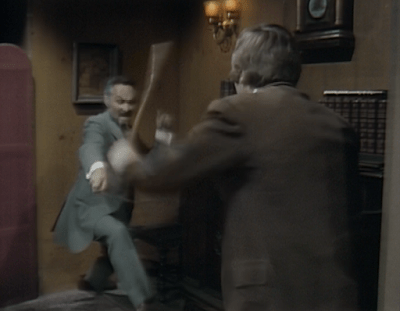
Quentin knocks Evan out with a candlestick; the background music is a cue we have previously heard during on-camera murders, leading us to wonder if Evan will survive the blow. Quentin rummages around for a moment and finds the hand. He is looking at it, wondering how to use it to restore his appearance, when a man in a wool cap enters and orders him to surrender the hand at once.
This episode features one of Dark Shadows‘ all-time great goofs. When Evan is casting the spell to dissolve the simulacrum, a black-clad figure dashes past in front of him. A voice can be clearly heard exclaiming “Jesus, Lacy!” Evidently actor Jerry Lacy was in such a hurry to get from one set to another that he didn’t realize he was crossing a live camera.
The evil Gregory Trask orchestrated a plot to murder his first wife, Minerva, and has married wealthy spinster Judith Collins. Now he and his accomplice, lawyer/ Satanist Evan Hanley, have conjured up a simulacrum of Minerva to hang around Judith and drive her insane. Once Judith is safely confined to the nearest high-class asylum, Trask will enjoy Judith’s riches, minus only whatever percentage Evan squeezes out of him.
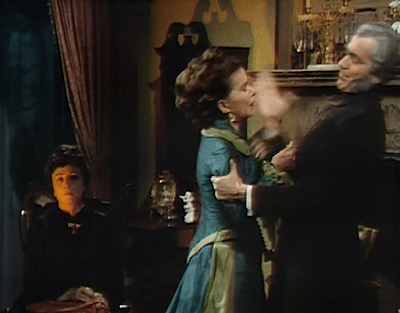
Today, Judith stands in her bedroom in the great house on the estate of Collinwood. She isn’t ready to go to bed, and the simulacrum of Minerva is sitting in the rocking chair, sewing. Trask pretends he cannot see the simulacrum, and forbids Judith to leave the room. When Judith becomes upset, he slaps her. This slap occurs on the soundtrack and in our imaginations. What we see on screen some time before the slapping sound effect plays is Jerry Lacy waving his hand a considerable distance short of Joan Bennett’s face. The two of them do such a good job of acting that this failure of blocking does nothing to undercut the oppressive atmosphere. For her part, Clarice Blackburn plays the pseudo-Minerva with just enough animation that we cannot predict what she will do. These performances take a sequence which may not have seemed like much on the page and make it into one of the most frightening scenes on Dark Shadows. When Judith lies to Trask and says that she does not see Minerva, it’s enough to produce a shudder.
Downstairs, Trask answers a knock at the door and broad ethnic stereotype Magda Rákóczi enters. Regular viewers know that Judith despises Magda and Magda hates her, and so it is surprising when we hear that Judith has sent for Magda. Trask blocks her way upstairs. Magda is defiant towards Trask; she knows what he did to Minerva, and is using that knowledge to force him to let her and her husband stay in the Old House on the grounds of Collinwood. But Trask has a new threat to make.
Trask knows that Magda is the sister of the late Jenny, who married Judith’s brother Quentin. He also knows something that not even Quentin knows, that Jenny bore twin children to Quentin after he left her. He threatens to send Jenny’s children away from the village of Collinsport. Evidently Magda wants the children to stay where they are, in the care of a woman named Mrs Fillmore. It is unclear why this would matter to her; we have had no indication that she has met Mrs Fillmore, much less visited the children at her house. But it is important enough to her that they not be moved that Magda responds to Trask’s threat with “What do you want me to do to her?”
We cut to Judith’s room. Magda enters. Judith tells her that the ghost of Mrs Trask vanished a few minutes ago, after sitting in the rocking chair for hours. Judith asks if she thinks she sounds mad, to which Magda replies there is nothing so strange about a simple ghost. The simulacrum reappears, and Judith asks Magda if she sees it. Magda says she does not.
Back downstairs, Magda tells Trask that he is a swine. She spits on the floor next to him and stalks off. Much as Magda hates Judith and many as are the crimes in which she is implicated, she is a warm-hearted sort, and Trask’s bloodless cruelty is not to her liking. Indeed, it is strange she did not tell Judith of Trask’s attempt to extort her complicity and make an alliance with her against him.
Meanwhile, Quentin is being held in the jail. When Magda realized that he murdered Jenny, she turned Quentin into a werewolf. She did not then know about the twins, and so she made the curse hereditary. Once she found out that her own kin were in line to become monsters, she started looking for a way to undo the curse.
The police captured Quentin the night before, while he was in his lupine form. As a result of Magda’s latest futile attempt to cure him, Quentin emerged from his bout of lycanthropy with his face disfigured and his memory a blank. Though his clothing and his hairstyle are so highly distinctive that virtually everyone who has seen the show before can tell that the man in the cell is Quentin, the Collinses suffer from a peculiar form of blindness that keeps them from recognizing people with globs of makeup on their faces, so his brother Edward is at a loss as to who he could be.
Magda is working with time-traveling vampire Barnabas Collins, distant cousin of Quentin, Edward, and Judith, who has set out on a mission to set the events of the year 1897 right so that Quentin will not become a malign ghost ruining things for everyone at Collinwood in 1969. Unfortunately, vampires are not problem-solvers; their function in a story is to create problems. Since coming to 1897, Barnabas has been responsible for at least six homicides. He has wrought a great deal of havoc even beyond those killings. For example, it was as a direct result of his actions that Judith and Trask got together in the first place. Today, Magda goes to Quentin’s cell and tries to tell him that Barnabas will come to him after nightfall and take him to the Old House.
We do not see Barnabas. We are watching Quentin in his cell when we hear a bat squeaking outside the jail. Barnabas can materialize wherever he chooses; he does not choose to materialize in the cell, where Quentin is alone and unattended, but goes into the outer office in his bat form. We hear a deputy in that office talking to the bat affectionately, asking him where he came from. We haven’t seen the deputy before this episode, but one suspects that a fellow who sees a bat in his office and strikes up a friendly conversation with it must have an extremely sweet personality. We then hear the deputy make a horrified exclamation, and the doors to Quentin’s cell and to the world outside open by themselves. As Quentin walks out, we see the deputy slumped at his desk, two bleeding wounds on his neck.
We cut to the darkened interior of the great house at Collinwood. Quentin comes ambling in. Biting the deputy was certainly not part of any plan Barnabas made with Magda, but it isn’t completely surprising- he hadn’t had a square meal for quite a while. But even for Barnabas, it shows an unusually low degree of operational competence to let Quentin wander off by himself when the whole idea is to get him to the Old House.
In the drawing room, we hear Quentin’s thoughts as he dwells on his amnesia. He does not know who he is, where he is, or why he has come. He sees his gramophone, and starts playing his only record. That brings him back to himself.
Judith enters. Quentin is not only wearing his usual suit and his distinctive hairstyle, he is listening to the music he has been playing obsessively for months and reciting the lyrics to it. As if that weren’t enough, his voice is quite outstanding- he must be the only senior member of an aristocratic Maine family with a West Virginia accent. Yet Judith not only fails to recognize her brother, she refuses to believe him when he identifies himself to her by name.
The simulacrum of Minerva enters, holding a letter opener above her head. Earlier this week, Minerva’s actual spirit had possessed Judith, and under her power Judith had held that same letter opener in that same position as she confronted Evan and accused him of her murder. Judith does not remember that, and she screams at the sight.
In #762, the Rev’d Mr Gregory Trask walked in on lawyer Evan Hanley and handsome rake Quentin Collins as they were performing a Satanic rite. Trask’s response was to blackmail Evan. Trask wanted his wife Minerva out of the way so that he could marry rich spinster Judith Collins, Quentin’s sister. Threatened with exposure, Evan cast a spell on an unfortunate young man named Tim Shaw. He brainwashed Tim into reenacting the plot of The Manchurian Candidate, with Trask in the Angela Lansbury role and Evan as the People’s Republic of China. As Evan and Trask planned, Tim killed Minerva. Shortly after, Trask married Judith.
On their wedding day, Judith saw Minerva’s ghost in the corner of the drawing room in the great house of Collinwood. In yesterday’s episode, Minerva’s ghost took possession of Judith, and the closing cliffhanger showed the possessed Judith about to stab Evan with a letter opener to avenge Minerva’s death. As we open today, Judith’s brother Edward enters and prevents the stabbing, and Judith is released from possession. She can remember nothing that happened while she was under Minerva’s power, and Edward is convinced that she has gone mad.
Edward takes Judith to her room, and Trask enters. Evan tells him that Minerva’s ghost has been in touch with Judith. The ghost knows what they did, and if the contact continues Judith will know as well. Trask demands that Evan do something to prevent that, and Evan says that he can cast a spell that may turn the haunting to their advantage and neutralize Judith permanently.
The plan turns out to be the creation of a “black ghost.” The only Black actor to have had a speaking part on Dark Shadows was Beverley Hope Atkinson, who played an unnamed nurse in one scene in #563, almost a year ago. Humbert Allen Astredo, who plays Evan, was also in that scene, playing suave warlock Nicholas Blair. Atkinson was terrific, and it would be great to see her again, but it turns out that the “black ghost” is not actually black. Nor is it a ghost. This misnamed entity is a simulacrum of Minerva, a kind of supernatural hologram that Evan will fabricate and that will appear when Judith is around. This will lead Judith to believe that she is insane, thereby causing her actually to become insane and to cease to be an obstacle to Trask’s enjoyment of her wealth.
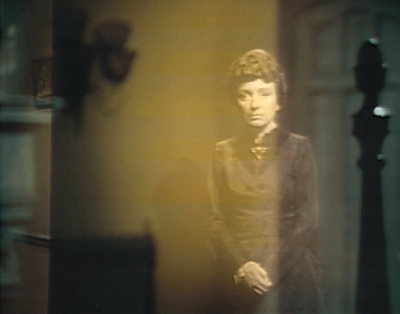
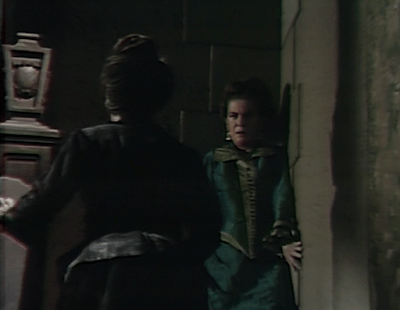
The simulacrum first shows up in a transparent form in Judith’s bedroom. Judith screams. In the drawing room, Trask and Edward hear her scream and break off a conversation in which Edward has been urging Trask to agree to annul his marriage to the obviously disturbed Judith. Judith comes downstairs. She is reluctant to explain why she screamed, and tells Edward and Trask that nothing is wrong. She and Trask go to the drawing room and talk privately. He has to prod her a bit before she will admit she saw Minerva. He tells her it was just her imagination. She considers this; after all, she was in bed when she saw the image, so it may have been a dream. But then the simulacrum appears in the drawing room, near the spot where she saw Minerva’s ghost on her wedding day. Judith sees Minerva sitting quietly and sewing. Trask pretends he does not see anything; after a bit, Judith pretends she can’t see the image either. Trask leaves Judith alone with the simulacrum. Judith goes upstairs, and the simulacrum follows her. When they reach the top of the staircase, Judith cries out in fear and tells the simulacrum to stay away from her.
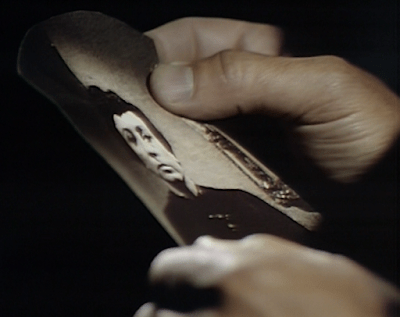
Though it is disappointing to be reminded that Beverley Hope Atkinson isn’t coming back, it is always good to see Clarice Blackburn. In her interviews with the authors of the book Barnabas and Company, Nancy Barrett said that Blackburn was the best performer in the entire cast of Dark Shadows. She doesn’t have a lot to do today- she delivers the opening voiceover, we see a snapshot of her, and as the simulacrum she stands motionless in a corner, sews placidly, then is seen from behind as she follows Judith up the stairs. But if there ever was a case to prove the old cliche that no part is small when a big enough actor plays it, Blackburn makes each of these little turns into a moment viewers will remember.
Screenshots by Dark Shadows Before I Die.
As Judith, Joan Bennett also deserves a great deal of credit for getting the gaslighting plot off to a good start. For example, there is an embarrassingly ill-written scene when Judith is in her room, pacing back and forth while some vibes play on the soundtrack. A knock comes at the door, and the music stops. Judith opens the door, and no one is there. The music resumes, and she starts pacing again. There is another knock. Again the music stops, again Judith opens the door, and again no one is there. The music resumes, and she’s back to pacing. The knock comes a third time. A third time the music stops, and a third time Judith turns to the door. This time she asks who’s there. It’s Trask. She lets him in, and he denies having knocked before. Knocking on doors and running away is a pretty crude tactic even on a show with an audience consisting largely of kids aged twelve and under, and the apparent complicity of the music in Trask’s plot is the kind of thing they ridiculed in Looney Tunes cartoons. But Bennett’s soulful performance holds our attention throughout.
This is the second time Dark Shadows has shown us an adventurer trying to gaslight his new wife so that she will go away and give him unfettered access to her fortune. The first time was in March 1968, when the show was set in 1796. Naval officer/ sleazy operator Nathan Forbes had married fluttery heiress Millicent Collins. Nathan discovered that Millicent had transferred all her assets to her little brother Daniel. Nathan then set about driving Millicent out of her mind so that he could take her place as Daniel’s legal guardian. That plot also featured some weak writing, but Joel Crothers and Nancy Barrett were so irresistible as Nathan and Millicent that it hardly mattered. Perhaps the writers wanted to revisit the gaslighting theme to show that this time they could consistently write scripts worthy of their outstanding cast.
A day of transformations. At dawn, the werewolf in the cell at the Collinsport jail turned into Quentin Collins. Edward Collins, Quentin’s stuffy brother, witnessed the transformation, and when we first see him he is staring at Quentin in bewilderment. Quentin is wearing the same blue suit he always wears, with the same distinctive hairstyle. But he has a glob of makeup on his face, and that’s enough to stymie Edward’s ability to recognize him.
This may reflect a hereditary disability of some kind. In #784, Quentin’s old friend and fellow Satanist, Evan Hanley, tried to steal the magical Hand of Count Petofi. The hand raised itself to Evan’s face and disfigured him, leaving his gray suit and highly identifiable hair and beard unchanged. But when Quentin saw Evan in #785, he was completely stumped as to who he might be.
Broad ethnic stereotype Magda Rákóczi enters. Edward accuses her of knowing who the man in the cell before them is. Magda does not share the Collinses’ peculiar inability to recognize people wearing facial appliances, so of course she does know. But she denies it. Edward does not believe her denials, and leaves in a huff.
Magda talks to Quentin, and he begins to speak. But he is not replying to her. Instead, he delivers lines that Count Petofi himself might have spoken when he was dwelling on the loss of his hand. He murmurs about “the forest of Ojden” and “the nine Gypsies” and suchlike. Magda realizes that Quentin has no idea who he is or what is going on.
Magda had placed the hand on Quentin’s heart the night before, as the moon was rising, hoping it would prevent the transformation. It didn’t do that, but by inflicting the same kind of facial disfigurement on Quentin that it had previously brought to Evan it does keep the werewolf story going beyond what might seem like a natural conclusion. When Magda leaves Quentin, she says that come nightfall she will consult with Quentin’s distant cousin, time-traveling vampire Barnabas Collins. “He will know what to do!” she declares. Barnabas has been the central character of the show for more than two years, and he has yet to have a non-disastrous idea. Ya gotta have hope, I guess.
At home in the great house of Collinwood, Edward tries to interest his sister Judith in the fact that he just saw a wolf turn into a human. She impatiently declares that she is not going to spend all day thinking about such a thing. Edward starts to remind Judith that she saw the wolf herself. He might have mentioned that she has seen it more than once, including in the very room where they are standing, but she says that it is “morbid” to go on paying attention to the topic once the creature has been caught and they can believe that they are safe.
Judith tells Edward that she had a bad dream. She won’t talk with him about that either. He needles her about her recent marriage to the Rev’d Mr Gregory Trask, which he calls “ridiculous.” She says that she does not regret her marriage, and that even if she did it would not be any more ridiculous than his own marriage. Since Edward’s wife was an undead fire witch who tried to incinerate their children to prolong her existence, all he can say to that is “Touché.”
Edward exits, and Judith dwells on her dream. It concerned Trask’s late wife Minerva. Minerva died in #773; Judith married Trask in #784. Judith knows that a young man named Tim Shaw poisoned Minerva, and that Trask gave Tim an alibi. She believes that Trask has forsworn justice for Minerva’s death for her sake. Tim knew that Judith, while under a magic spell, had shot his girlfriend Rachel Drummond to death, and he threatened to expose her if Trask handed him over to the police. What Judith did not know, and what is not mentioned today, is that Tim himself had acted under a spell. Trask and Evan connived to brainwash Tim so that when the Queen of Spades turned up in a card game he would poison Minerva. In her dream, Minerva told Judith that there was danger, then repeated the phrase “Queen of Spades” several times.
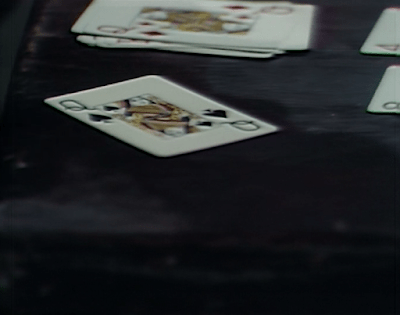
Judith turns around and looks at a table. It had been bare when last she saw it, and there was no one else in the room. But now a solitaire game is laid out there. She screams, and Edward comes. Judith turns up the Queen of Spades, and walks out the front door. Edward follows her to Minerva’s grave.
Judith tells Edward her dream, and he transforms into a psychoanalyst. “Your dream is nothing more than a manifestation of your own guilt.” Judith asks Edward what he imagines her to feel guilty about, and he says that she married Trask so shortly after Minerva’s death. She dismisses this, and soon goes into a trance. She wavers back and forth from the waist for a moment, then straightens up with a jolt. When Edward calls to her by her first name, she replies “I will thank you to call me Mrs Trask!” Edward doesn’t know what to make of this demand, but the audience knows that Minerva has taken possession of Judith.
Back at Collinwood, Edward meets Magda. She tells him that she is there to see maidservant Beth. Edward says that he hasn’t seen her all day. That puts him up on the audience; we haven’t seen her since #771. When they were setting up for the trip to this period, Beth was presented as a major character, and her ghost haunted the Collinwood of 1969 along with Quentin’s. When Barnabas and we first arrived in the year 1897 in #701, Beth figured very largely in the story for several weeks. But Terrayne Crawford’s limitations as an actress required Beth to be written as someone who says just what she means, no more and no less. Since the rest of the cast is able to rise to the task of portraying complex motivations and multilayered communication, and since Dark Shadows finally has a writing staff that can provide those things consistently, Miss Crawford has faded further and further into the background.
Edward goes to the drawing room and telephones Evan. Magda eavesdrops. She knows of Evan’s disfigurement, Edward does not. Edward tells Evan he must come over at once, that there is an emergency he must address in his capacity as Collins family attorney. Evan does not want anyone to see his face, and so he tries to beg off. Edward threatens to fire him if he does not show up. Evan has been making vain efforts to restore his appearance for days; he looks at himself in the mirror, and returning viewers might draw the conclusion that his goose is cooked.
That Evan’s face is still disfigured after we have seen Quentin’s disfigurement raises the possibility that the show is heading towards an all-disfigured cast. Evan is played by the conspicuously handsome Humbert Allen Astredo, and as Quentin David Selby’s good looks have become one of the show’s very biggest draws. If they are both going to be uglified for the duration, then there is nothing to stop anyone from having some plastic glued onto their face.
Judith enters. She does not recognize Magda and announces that she is Minerva. She closes herself in the drawing room.
Evan arrives, looking like his old self. Magda is astonished. When they have a moment alone together, he responds to her questions by saying that he will never tell her what happened to undo the hand’s work. That will hook returning viewers more effectively than any cliffhanger is likely to do- Evan’s case had seemed absolutely hopeless.
When Edward tells Evan what Judith has been doing, Evan starts playing psychiatrist, picking up where Edward had left off. “Well now, tell me exactly how she has been behaving. In what way is this delusion manifesting itself?” Edward sends Evan in to see for himself. Minerva/ Judith reacts to the sight of him with horror. She says that he was the one who made Tim Shaw poison her. Minerva did not know this in life, but it has long since been established on Dark Shadows that the dead pick up a lot of information in the afterlife. The murders have been coming thick and fast in 1897, and if all the victims talk to each other they would have a pretty easy time piecing together what has been happening behind closed doors. We end with Minerva/ Judith holding a letter opener over her head, walking towards Evan with evident intent of stabbing him.
A little over two weeks ago, Dark Shadows started an homage to The Manchurian Candidate, with some touches added from Pushkin’s The Queen of Spades. The overwhelmingly evil Rev’d Gregory Trask, keeper of a sadistic cult disguised as a boarding school, coerced Satanist Evan Hanley into casting a spell on Tim Shaw, one of the teachers at the school. When Tim sees the Queen of Spades, he will be prompted to poison Trask’s wife Minerva.
The whole point of employing an assassin is to give yourself an unbreakable alibi. Since Tim will not remember Evan or the spell once he has killed Minerva, the logical thing would seem to be to arrange it so that Tim poisons Minerva in front of several witnesses and that he still has the vial of poison on him when he is caught. But instead, Evan himself turns up as Minerva is in her death throes, and he is the only witness. After Evan erases Tim’s memory, Tim defeats Evan in a sword fight, then runs away, taking the poison with him. Tim flees to his only friend, fellow teacher Rachel Drummond, and tells her that if it is a matter of Evan’s word against his, he will have no chance in court. Later, Evan confronts Rachel and roughs her up, trying to intimidate her out of helping Tim in any way.
Absent witnesses to accuse Tim on his behalf or an alibi for himself, Evan may as well have skipped the whole brainwashing bit. Had he simply strangled Minerva and claimed he saw Tim do it, he would be in exactly the position he is in now.
The problem for Evan’s plan is that it is taking place at this point in the series. The segment of Dark Shadows set in the year 1897 is stuffed to bursting with vivid characters, each of them involved in at least one dynamic storyline. That makes it, from most points of view, the best part of the show, but it also makes it very difficult to get a bunch of people together. Any two characters you put in the same scene are likely to join plot threads together in new and consequential ways. That makes for a lot of excitement, but it makes it very difficult to do just one thing at a time.
For example, say Tim had insisted on bringing Minerva the poisoned tea while in the drawing room at the great house of Collinwood with rich spinster Judith Collins, Judith’s brother Edward, and Minerva’s daughter Charity, while maidservant Beth waits on the company. Trask is apparently scheming to marry Judith and get her money once Minerva is out of the way. Put her in Minerva’s death scene, and you accelerate that part of the story, perhaps beyond the pace you are prepared to follow up. Edward is starting to suspect that his distant cousin, recently arrived Barnabas Collins, might be a vampire. Those suspicions are the result of two qualities in which Edward is no more than average, his ability to notice the obvious and his concern for his son. But if you make him a participant in another story about a crime, any remarks he might make that would display any brainpower whatever would transform him into the show’s resident sleuth. Beth and Charity are both blood thralls of Barnabas’; if either of them were in the room while the poisoning took place, we would therefore expect them to go directly to him and start wondering how he would react to the news. That would shift our focus to him, subordinating the Tim and Minerva story to the Barnabas story. Virtually every other character is disqualified from serving as a witness for similar reasons, leaving Evan to do the honors himself.
Two of the things that make THE MANCHURIAN CANDIDATE work so well are that we don’t see any of Raymond Shaw’s training, and that when he sees the Queen of Diamonds he goes into a trance that strips him of all personality.
The training scenes here show why the first of those was so important. Not only are the scenes tedious, they force us to realize that the very idea we most have to take seriously is in fact preposterous. Whatever power you might imagine hypnosis or drugs or other conditioning techniques to have, they obviously couldn’t turn a human brain into a digital computer.
And Tim’s talkativeness while in his trance shows why the second element is essential. Raymond might do absolutely anything when he’s in his hyper-suggestible state. A bartender mentions the phrase “Go jump in a lake” and Raymond jumps in the nearest lake. That’s terrifying, because it is terrifying to think of what people might do who had no mind or will controlling their actions from moment to moment. But Tim’s endless chit-chat doesn’t suggest a soulless automaton. There seems to be a mind in there, it just isn’t a very nice or very interesting mind.
Don Briscoe’s performance doesn’t add much to this unpromising material. I can’t think of anything he might have done to make it work, and neither could he. Anyway, I’m glad it’s over.
Comment left 8 November 2020 by Acilius on “Episode 773: The Persecution and Assassination of Minerva Trask as Performed by Tim Shaw under the Direction of the Marquis de Sade,” Danny Horn, Dark Shadows Every Day, 21 November 2015
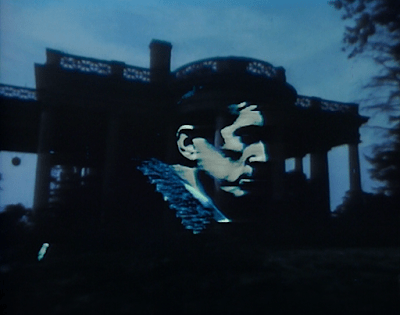
The opening voiceover plays over this image, a type of visual effect we have not seen before at the beginning of an episode:
A transparent sticker of Barnabas superimposed on the exterior of the Old House. Screenshot by Dark Shadows Before I Die.
Barnabas Collins has bitten dimwitted servant Dirk Wilkins, turning Dirk into a vampire like himself. Barnabas has been out all night, searching for Dirk’s hiding place. He hopes to expose Dirk and frame him for his own crimes.
Barnabas comes home to the Old House on the estate of Collinwood to find that Dirk seems to be trying to do the same thing to him. There is a blood-drained corpse in an armchair in his front parlor. It is that of Miss Pansy Faye, Cockney showgirl and Dirk’s first victim.
Barnabas’ distant cousins live in the great house on the estate. One of them, prankster Carl Collins, brought Pansy home with the intention of making her his bride. No sooner does Barnabas discover Pansy’s remains than Carl starts banging on the front door, shouting that he wants to speak with her.
Barnabas hides what’s left of Pansy in a secret chamber behind a bookcase, then lets Carl in. Grisly as the circumstances are, one person lying to another about the presence of a third nearby is a stock situation from farce, and John Karlen and Jonathan Frid play the scene with the particular brand of desperate seriousness that only works in farce. Barnabas persuades Carl to go away and search the grounds of the estate.
That takes a few minutes, starting from what the opening voiceover told us in so many words was “an hour before dawn.” In what remains of that hour, Barnabas takes Pansy’s body to a cemetery and buries her in a shallow grave between tombstones, telling her to “rest in peace.”
Barnabas comes home, and finds Carl, who has in the interval not only gone to the great house, the groundskeeper’s cottage, and a house on the estate which is currently occupied by a school, but has also gone into the village of Collinsport and made inquiries about Pansy. A speedy bunch, the Collinses.
Before Barnabas returned to the house, Carl had heard Pansy’s disembodied voice singing the song she had so memorably performed for Barnabas in yesterday’s episode. He had spoken to Pansy’s voice telling her that his grandmother’s will gave him a house to live in and that she could live there with him. This is puzzling for returning viewers. In #714, it was made perfectly clear that the will did not mention Carl at all. Edith Collins left her entire estate to Carl’s sister Judith, and the only one of the brothers who was mentioned was Quentin, who received no money or negotiable assets of any kind but who was guaranteed the right to stay at Collinwood as long as he pleased. Perhaps they are retconning that away, perhaps Carl is lying to Pansy, or perhaps Carl is losing his grip on reality.
Whether or not we are supposed to doubt Carl’s sanity, Barnabas talks Carl into suspecting that he might have hallucinated Pansy’s voice. Carl leaves, and Barnabas has time to return to his coffin before dawn.
The rest of the episode is taken up with doings at the school Carl had visited. We saw Carl questioning Charity Trask, daughter of the school’s master, the overwhelmingly evil Gregory Trask. The prim Charity was exasperated that Carl kept asking about Pansy after she had already denied having seen her. The scene is an interesting one- Charity and Pansy are such total opposites that it is a shame they never met. It would be amusing to see them juxtaposed.
Charity is engaged to marry Tim Shaw, a teacher at the school. Neither of them is happy about this situation. Tim was in love with Rachel Drummond, another of the teachers, and Charity is Barnabas’ blood thrall. But Gregory blackmailed Tim and bullied Charity into accepting the arrangement.
Charity’s mother, prudish Minerva Trask, does not like Tim or want him as a son-in-law. She urges Charity to set her sights on Carl. Charity says that she would rather marry Barnabas; Minerva says that her instincts are sound, but that she ought not to settle for a cousin of the rich Collinses when one of the brothers is available. Even if they have retconned Carl into owning a house, he is clearly not a rich man, so this reveals that Minerva knows as little about his financial position as she does about the curse under which Barnabas labors.
Charity tries to engage Tim in conversation, and is baffled that he is not willing to talk to her. Indeed, he does not seem like himself at all. Not only is he dismissive with Charity, but when Minerva confronts him he is bold and insolent, a far cry from the broken man we have seen interacting with the Trasks previously. When Charity tells him their engagement is off, he does not express the relief that she and we expect, but puts on a stagey voice we have not heard him use before and marches off to apologize to her mother.
There is a reason for Tim’s behavior. Gregory enlisted warlock Evan Hanley to brainwash Tim so that he would kill Minerva. There is some business with the Queen of Spades, first when Tim mutters the phrase “Queen of Spades,” then when Evan sends him a note on which is scrawled “Queen of Spades,” and lastly when he walks in on Minerva playing solitaire and sees her turn up the Queen of Spades. Many viewers in 1969 would have remembered Richard Condon’s 1959 novel The Manchurian Candidate and its 1962 film version. In Condon’s novel, Raymond Shaw became a robot capable of murder when he saw the Queen of Hearts; in the film, the card was the Queen of Diamonds. Many first time viewers, seeing Tim Shaw’s reaction to the Queen of Spades, would have made the connection and understood why he ends the episode by poisoning Minerva’s tea.
Tim Shaw differs from Raymond Shaw in that he is under a spell for a long while, including the whole time we see him today, and he can talk and act independently while it operates on him. Raymond simply became catatonic when he saw the card and remained that way until he heard a command. He then executed the command and came back to himself once he was finished. Tim’s behavior may suggest a nod to another literary work, Pushkin’s story “The Queen of Spades.” That tale, which Tchaikovsky turned into an opera and which in 1949 was made into a feature film, is about a timid man who inadvertently kills a powerful woman and loses control of himself as a consequence. Like Tim, Captain Herman is coerced into marrying a woman he does not love. Presented with an opportunity to get out of the marriage, he finds himself making extraordinary efforts to go through with it, efforts which bring about his ultimate downfall.
In December 1967, Dark Shadows was a costume drama set in the 1790s. In that month it introduced the Rev’d Mr Trask, a witch-hunter from Salem, Massachusetts, came to central Maine* to drive witchcraft out of the village of Collinsport and off the estate of Collinwood. Trask was bad at this job; wicked witch Angelique easily deceived him into blaming well-meaning governess Victoria Winters for her own crimes, leading to Vicki’s hanging and exacerbating the consequences of Angelique’s evil spells.
Now the show has relocated to the year 1897, and a descendant of Trask is among the villains. He is the Rev’d Mr Gregory Trask, and he runs a boarding school along lines dictated by his own sadistic delight in punishing innocent children.
Fans often say that while the original Trask** was a sincere believer who did harm because of his fanaticism, Gregory is a hypocrite who uses a pretense of religion to enable his perversions and his greed. I think the truth is more complicated, and more interesting, than this. In #441, the original Trask found the strangled body of a professionally agreeable lady named Maude Browning in his bed; it had been placed there to frame him for Maude’s murder. Trask’s principles, were he to follow them, would seem to imply that he should go directly to the authorities. If the worst happened and they hanged him, to the extent that he was targeted because of his Christian witness his death would win for him an everlasting crown of martyrdom. But fear got the better of Trask. He enlisted a man named Nathan Forbes to help him hide Maude’s remains, and went on from there to expand his conspiracy to suborn Nathan’s perjured testimony against Vicki. Considering the emphasis the Reformed movement put on the Ten Commandments, Trask could not have been unaware of the sinfulness of bearing false witness against a neighbor.
I think Trask’s fanaticism led him to overestimate the importance of the success of his mission in this world. It is not enough that he will be vindicated in the courts of God; God must be vindicated through Trask’s success in the courts of Massachusetts. Thus it is his very sincerity that turns Trask into a hypocrite. Eric Hoffer’s book The True Believer was one of the most influential publications of the 1960s; Trask, the fanatic-turned-hypocrite, could easily have found a home in its pages.
Gregory Trask is certainly a hypocrite. Today we hear Gregory’s wife Minerva talk about women he has dallied with over the years. Gregory comes upon Satanists Quentin Collins and Evan Hanley in the act of summoning the Devil; Gregory’s response is to blackmail Evan into using his command of the black arts to cast a spell to brainwash hapless schoolteacher Tim Shaw into murdering Minerva. We have seen in previous episodes that Gregory has plans for spinster Judith Collins and her enormous fortune; Minerva’s death, if it can be arranged just so, will leave him well-positioned to marry Judith and become the Master of Collinwood.
As his ancestor’s very sincerity turned him into a hypocrite, so Gregory’s hypocrisy occasionally turns him into a sincere believer in his own powers, if not exactly in God. We saw in #735 that Gregory does not take the same pleasure in reading the Bible that he does in leafing through his “Punishment Book,” a ledger which evidently details his abuse of the children attending his school. But he does read it and quote it, and when in #726 he encountered a case of possession, he immediately and with untroubled self-assurance set to work performing an exorcism. The possession was real, and so far as Gregory could tell his exorcism was successful. He reacted to that apparent success with a serenity that betrayed no suggestion that he had ever doubted that he was the right person to cast out the spiritual forces of darkness.
As the original Trask was a stranger to the routine play-acting that makes ordinary social life bearable and therefore gave himself permission to become a party to the most horrendous deceptions, so Gregory wears his mask so tightly that his face grows to fit it. Dark Shadows was often very self-conscious about showing characters who were acting; its greatest success, vampire Barnabas Collins, won over the audience when they saw him trying desperately hard to play the role of a living man native to the twentieth century. In the Trasks, we see men who do not know that they are acting and therefore cannot manage the effect that the parts they play in everyday life have on their personalities.
Gregory does have a tight mental focus on his projects. When he goes to Evan with his blackmail demands, Evan has learned of his eye for the ladies, and is hoping to use that information to lower his price. So his opening gambit is to describe himself as a man who drifts from one idea to another as other men drift from one woman to another. Three times he says the word “woman,” in each case as the last word of a sentence, in each case about twice as loudly as the words before it. Gregory is unimpressed, and Evan realizes he doesn’t have anything definite to use against Gregory. He crumbles and agrees to Gregory’s extreme demand.
Gregory’s academic standards seem considerably less exacting than are his expectations of his co-conspirators. He mentions to Tim today that when he was a young teacher, the first class he ever taught was in elementary Latin. He challenges Tim to translate the words amo, amas, amat; Tim wearily replies “I love, you love, he loves.” “Very good!” exclaims Gregory. Traditionally the first words students learned on the first day of Latin class were amo, amas, amat, amamus, amatis, amant– I love, you love, s/he loves, we love, you (plural) love, they love. “Very good!” would seem to be an outrageously inflated appraisal to apply to someone who has merely recognized the first three of those six words.
Gregory sends Tim to Evan’s house to read a Latin document that has some bearing on a legal matter that has come up in Evan’s work as an attorney. As it happens, I went to graduate school in ancient Greek and Latin at the University of Texas at Austin, and local attorneys would sometimes call our department asking for someone to help them translate Latin they had found in old Spanish legal documents. They would usually refer those calls to the ablest Latinists among us, since the legal Latin used in the Spanish Empire in the days it ruled Texas was rather a specialized form of the language. Tim can virtually speed-read Evan’s document, suggesting that “amo, amas, amat” was not a particularly stringent test of his abilities.
*Maine was part of Massachusetts until 1821.
**Who is never given a first name. One of the Big Finish audio dramas refers to him as “Vilorus Trask” and actor Jerry Lacy once said he thought his name should have been “Orville.” Neither of those sounds like a very plausible name for a junior-grade Puritan divine of the late eighteenth century. So we are left calling him “the original Trask.” My wife, Mrs Acilius, points out that this seems to suggest that Gregory should be “the extra-crispy Trask.” Maybe he will die by fire, as others have done.
A lot of business about a magical urn that belongs to undead blonde fire witch Laura Collins. This is Laura’s second tour on Dark Shadows; she didn’t have an urn the first time around, but the plot is much busier these days and she needs a MacGuffin for her enemies to chase after if she’s going to stay afloat.
There are also a couple of moments when characters deride spinster Judith Collins as “plain Judith,” envious of the “pretty wives your brothers brought home.” This is ridiculous. Judith isn’t even Hollywood ugly; she’s played by Joan Bennett, one of the great beauties of the screen in her youth and still, in her late 50s, a remarkably attractive woman.
But all in all, the episode is quite good. The highlight is a confrontation between governess Rachel Drummond and a villain who makes her first appearance today, Minerva Trask. Minerva is the wife of the loathsome Rev’d Gregory Trask, and with him she runs a boarding school called Worthington Hall. Rachel grew up at Worthington Hall, and like all other children there she was subjected to continual abuse at the hands of the Trasks. We haven’t seen Gregory for several days; as played by Jerry Lacy, he is so overwhelmingly evil a presence that the makers of the show wisely decided to use him sparingly. It looks like Rachel will soon be forced to go back to Worthington Hall as a teacher.
Minerva is played by Clarice Blackburn, whom many consider to be the single best actor in the whole series. For example, Nancy Barrett gave her that title in her interviews with the authors of the book Barnabas and Company. Blackburn is absolutely believable as the sanctimonious Minerva, so much so that I found her scenes as difficult to watch as are those featuring Mr Lacy as Gregory. Kathryn Leigh Scott plays the terror and misery Minerva inspires in Rachel quite effectively, but to be honest I felt those emotions very intensely myself just watching the episode on TV. I suspect that when you have a scene partner like Blackburn, all you need is to learn your lines and remember your training and you’ll connect with the audience.
Rachel tells her troubles to broad ethnic stereotype Magda Rákóczi, who volunteers to help her escape the Trasks. Magda’s plan requires Rachel to do three extraordinary things. She must give her garnet-encrusted broach, the only keepsake her late mother gave her, to Magda to sell to raise money for a coach ride to Boston. She must spend the night in a secret room hidden in an old mausoleum. And once in Boston, she will have to find employment without having recourse to any credentials or references that would make it possible for her to find a situation agreeable to a neurotic intellectual such as herself. We could never believe Rachel would do any of these things if she were facing a less gruesome threat than return to Worthington Hall.
Longtime viewers may wonder just how far Rachel’s fears will drive her. In #9, broadcast and set in the year 1966, flighty heiress Carolyn Collins Stoddard told well-meaning governess Victoria Winters that over the years, two governesses had leapt to their deaths from the precipice atop Widow’s Hill, and that legend had it that a third governess would someday follow their lead. In other episodes, before and after, that story was rephrased as “two women” rather than “two governesses.”
So far, we have only seen one woman take the plunge, and she wasn’t a governess. She was the gracious Josette, also played by Miss Scott. Josette jumped in 1796 because she saw that she was about to be made into a vampire. Now, the dramatic date is 1897. The prospect of turning into a member of the teaching faculty of Worthington Hall is scarcely less horrifying than is the prospect of becoming a vampire, so perhaps it will turn out that Rachel was one of those whom Carolyn had in mind after all.






 Dark Shadows Commentary