Yesterday, the ghost of Jeremiah Collins started to bury wicked witch Angelique alive. Today, we see that he barely got her dress dirty. She’s lying on a mound next to the empty grave when we find her.
This is the one where Angelique marries Barnabas. It ought to be packed with incident. There is a lot of activity, but like the live burial, it doesn’t amount to much. It’s a real disappointment.
One particular weak spot in the episode is the officiant at the wedding, the aptly named Reverend Bland. Actor Paul Kirk Giles does what he can, but as soon as the Rev’d Mr B realizes that something unwholesome is going on he declares that he is getting out of the place. Apparently his conception of the duties of a pastor consists of avoiding people who might need help confronting the spiritual forces of darkness. It doesn’t matter- Bland’s squeamishness disappears after Barnabas orders him to stay and perform the wedding.
After the wedding, Angelique returns to her bedroom. There is a gift that hadn’t been there before. Opening it, she finds a music box. The music box was a big deal in 1967, when Barnabas was a vampire and he thought that a woman who listened to it would turn into his lost love, the gracious Josette. This is the first time we have seen the music box during the segment of Dark Shadows set in 1795. In 1967, Barnabas told various stories about the origin of the music box, but the one thing that remained consistent was that it was meant for Josette.
Barnabas and Josette were engaged when the 1795 segment began, but that ended when Josette and Jeremiah conceived a mad passion for each other and eloped. Unknown to Barnabas, that was the result of a spell Angelique cast in hopes of getting Barnabas for herself. Barnabas responded to the elopement by killing Jeremiah in a duel. He has told Angelique that he still loves Josette and always will, but that he knows there can never again be anything between them. Moments after he had told her that, Angelique agreed to marry him. Evidently it was to be a sham marriage.
Jeremiah’s ghost has been railing at Angelique for raising him from his grave, and apparently he wants to be avenged by making the sham marriage even shammier. When Barnabas comes into the room, he sees the music box, explodes in rage, and storms out.
In life, Jeremiah never knew that Angelique was behind his and Josette’s passion. He has evidently learned that and other of her secrets, and is using them against her. Perhaps Angelique put more of herself into him than she intended.
On The Collinsport Historical Society, Patrick McCray says that this is an important episode because Barnabas and Angelique’s wedding is the basis for some developments much later in the series. That’s true, but by the time he’s talking about the show isn’t very good any more. So I consign it to the ranks of the “Stinkers.”
In 1966 and 1967, supernatural menaces Laura Murdoch Collins and Barnabas Collins would often be seen staring out the windows of their houses on the great estate of Collinwood, sending psychic energy towards the targets of their sinister plans. In 1795, Barnabas is neither supernatural nor menacing, but we already see him peering out one of those windows. He is not projecting bad vibes into the world, but is worried about his beloved fiancée, Josette DuPrés. She is supposed to arrive soon, in fact was supposed to arrive some time ago. Now there is a storm, and he hopes she is not at sea.
The audience’s main point-of-view character in 1966 and for most of 1967 was well-meaning governess Vicki. Now Vicki has come unstuck in time, and found herself in this extended flashback to the eighteenth century. Since she will know Barnabas and regard him as a close friend in the 1960s, she is at her ease talking to him now. Although she is a member of the staff in his family’s house in a period when it was customary for masters to summon their servants with bells and communicate with them only in direct commands, Barnabas is a remarkably genial and democratic sort who welcomes her casual manner.
Vicki has already annoyed the audience several times by blurting out information that makes it obvious to the other characters that she does not belong in their world. She does that again in this scene. Barnabas is worried something may have happened to Josette, and Vicki tells him that she will arrive safely. He is surprised by the assurance with which she delivers this prediction, and asks if she is clairvoyant. She realizes that she has been indiscreet, and denies that she is. He is unconvinced.
Barnabas’ father, haughty overlord Joshua Collins, enters. He is appalled to find his son socializing with a servant. He dispatches Vicki to the nursery to look after her charge, his young daughter Sarah. He demands to know why Barnabas is not tending to his own duties at the family’s shipyard. They begin to quarrel, when a knock comes at the door.
Barnabas opens the door to find a woman named Angelique, whom he identifies as maid to Josette’s aunt, the Countess DuPrés. Angelique says that the countess was on her way to Collinwood, but that her carriage is stuck in the mud. Joshua orders Barnabas to send a footman to rescue her. Angelique is the first character we have met in 1795 who is not played by a performer we have seen in the first 73 weeks of the show.
Joshua goes to his wife, Naomi. Naomi is an alcoholic, a fact of which we are made aware because almost her every scene begins with a shot of her drinking alone. That’s what she is doing before Joshua finds her. He scolds her for her drinking; she complains that he doesn’t allow her to do anything else. She can’t even pass the time with a book- we saw Monday that Naomi is completely illiterate.
Naomi’s alcoholism is both a nod to the concern of first-wave feminism with the atrophy of the elite housewife, and a suggestive side-light on Barnabas as we knew him in the 1967 segment. Then, Barnabas abducted Maggie Evans, The Nicest Girl in Town, and tried by more or less magical means to replace her personality with that of Josette. For the first 40 weeks of Dark Shadows, Maggie’s father’s alcoholism had been a substantial story element, and she would always retain a number of classic Adult Child of an Alcoholic (ACoA, in the lingo of the recovery movement) characteristics, such as beginning utterances with a little laugh to prove that she is happy. Now that we know that Barnabas is also an ACoA, we can wonder if that shared experience was part of the reason he was drawn to Maggie.
The countess arrives. Since she is played by Grayson Hall, who also plays mad scientist Julia Hoffman in the parts of the show set in the 1960s, Vicki blurts out “Julia!” when she sees her. Hall had also been nominated for an Academy Award for her performance as Judith Fellowes in the 1964 film Night of the Iguana; if Vicki is going to keep the audience up to date on the cast’s resumes, it would have been more interesting if she’d exclaimed “Judith!” Vicki explains that the countess looks like someone she once knew who was named Julia, a remark which irritates the countess, who would like to think her appearance is distinctive. Vicki has certainly not made a favorable impression on this grand lady.
Joshua tells the countess he is surprised that “You still affect a title” when “France has followed our example and become a republic.” His pride in this development, after the Terror and in the bloodiest year of the wars in the Vendée, marks Joshua as a member of the Jeffersonian party in US politics. The Federalists and others had long since turned against the French Revolution by that year.
The countess tells Joshua that it is precisely because France has become a republic that she chooses to live on the island of Martinique. That answers a question that some fans ask about Angelique- why is she white? If the DuPrés family lives on Martinique and are major sugar planters there, they must hold a great many African people in slavery. When we hear that they are bringing a servant with them, we expect that servant to be Black. When we learn that the the countess is an emigré, we realize that she brought Angelique with her from France.
The countess may solve one puzzle for us in her exchange with Joshua, but she presents us with another. Josette’s father André is the countess’ brother, yet he is never referred to as a count. Indeed, when he appears, we will see him answer to “Mr DuPrés.” Perhaps he renounced his title, as many French aristocrats did during the Revolution.
Whatever the explanation, “DuPrés” would seem to represent a missed opportunity. When Josette was first mentioned, in the early months of Dark Shadows, her maiden name was given as “LaFrenière.” It would have been a nice touch to have kept that name for Josette and her father, and to have reserved “DuPrés” as the name of the countess’ late husband.
“LaFrenière” had been a perfect choice because of its class ambiguity for a show about an aristocratic family in the state of Maine- it was originally the family name of the barons of Fresnes, and could therefore be a sign of a senior order of nobility, but is also a very widespread name in Quebec. So “Josette LaFrenière” might either have been a French noblewoman who deigned to marry into the mercantile Collins family at the apex of their prestige, or a working class girl from the north who eloped with the boss’ son.
The choice of Martinique as Josette’s place of origin might add a new twist to this class ambiguity. The Empress Josephine grew up there as a member of the untitled but ancient Tascher family, who, like the fictional DuPrés family, owned an enormous sugar plantation on the island. The Taschers of Martinique went back and forth between Martinique and metropolitan France, and Josephine herself was living there in 1779 when she married her first husband, the Vicomte de Beauharnais. Josephine herself was in prison when the vicomte was guillotined in 1794, one of the last to die in the Reign of Terror, and she was freed just a few days later. The next year, she recovered her husband’s property, and a year after that married the young general Napoleon Bonaparte. It seems likely that the similarity between the names “Josephine” and “Josette” was writer Sam Hall’s inspiration for placing Josette’s origins on Martinique. Association with a figure who was at once a grand lady and an example of very steep upward social mobility could synthesize the two possible Josettes LaFrenière into a single figure.
Had they developed the story of the family’s relationship with the town of Collinsport more richly in Dark Shadows 1.0 and 2.0, they could have used this ambiguity to build up suspense that would be resolved today, in the third episode of Dark Shadows 3.0. Since they did so little with that theme in those days, when the story was moving very slowly and it would have been relatively easy to fit just about anything in, I suppose we shouldn’t be surprised that they drop it so completely at this period of the show, when the story is flowing at a breakneck speed.
The countess’ lofty aristocratic manner stings Joshua. Alone with Naomi, he loudly proclaims his belief that all men are equal. We already know enough about Joshua’s tyranny over his household that this absurd little speech must be an intentional spoof of the rich landowners who supported the Jeffersonian party in the early decades of the Republic. Again, this would be funnier and more poignant if the show had done more with social class in its first 73 weeks.
Barnabas sees the countess dealing out tarot cards. He tells her she is too sophisticated for them, and is reluctant to sit with her while she uses them to read his fortune. The moment she says that the cards suggest a connection between him and the concept of infinity, his skepticism evaporates instantly and he excitedly asks if that means he will live forever. The countess cautions that his jubilation at this idea may be misplaced. She notices the “Wicked Woman” card, and takes a significant look at Vicki. Evidently the audience is not alone in objecting to Vicki’s brainless nattering about what the show used to be like.*
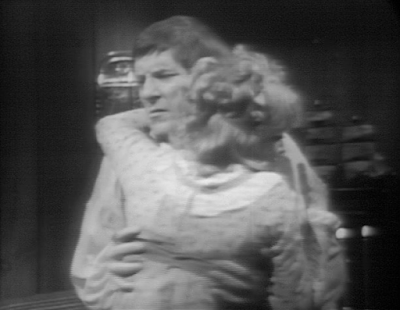
Angelique comes to Barnabas’ room. It turns out the two of them had a brief affair when he was first on Martinique, and she expects to resume it. He is not at all pleased at her attentions.
Not how every man would react to a passionate embrace from Lara Parker… Screenshot by Dark Shadows Before I Die.
Barnabas explains that he was already falling in love with Josette when he and Angelique had their fling, but that he didn’t really know her. He couldn’t believe that she would reciprocate his feelings, and consoled himself by dallying with Angelique. This explanation goes over with her about as well as you’d expect, and she storms out of the room, vowing that she will get her way in the end.
We know that the tarot cards are giving accurate information, because the show leans heavily on the uncanny and they wouldn’t have spent so much time on a gimmick that wasn’t meant to advance the plot. We also know that Vicki is not the Wicked Woman the countess is looking for. That leaves Angelique, and we can assume that her wickedness will express itself in some supernatural action taken to avenge herself on Barnabas. Since we know that Barnabas will become a vampire, we wonder if it is Angelique who makes him one.
Closing Miscellany
I usually refer to surviving cast members with courtesy titles and to deceased ones by surname alone. So Alexandra Moltke Isles is “Mrs Isles,” which has been her professional name for 56 years, David Henesy is “Mr Henesy,” Nancy Barrett is “Miss Barrett,” etc, while Jonathan Frid, Joan Bennett, Louis Edmonds, and Grayson Hall are just “Frid,” “Bennett,” “Edmonds,” and “Hall.” Until last month, I’d been looking forward to saying lots of things about “Miss Parker” and her portrayal of Angelique, but Lara Parker died on 12 October 2023. So she’s just going to be “Parker,” and I’m going to be sad about it.
Artist Teri S. Wood has created a number of short animations about Angelique and Barnabas. This one is based on their two-scene at the end of today’s episode:
Patrick McCray has a post about this episode that mystifies me. He writes that “After seven months of hearing about Angelique, today, she enters. So, no pressure Lara. You only have to live up to a half year of build-up.” Uh, what? There has been absolutely no reference to Angelique on the show before today. I can think of an interpretation of the story that might retroject Angelique into episodes #211-365, and I will talk about it next week. But I don’t think it is an interpretation Patrick would favor.
He also talks about David Ball’s method of reading plays from the ending back to the beginning and then from the beginning forward, so that the ending comes to seem implicit in everything else. He allows that Dark Shadows has more than one ending, but I would say he doesn’t go far enough. I’d say the series has ten endings. The first came in #191, when Laura went up in smoke while her son David found refuge in Vicki’s arms. That ending defined Dark Shadows 1.0 as the story of David’s escape from his evil, undead mother Laura, and his adoption of Vicki as his new, life-affirming mother. The second came in #364, when Barnabas met the ghost of his little sister Sarah, she commanded him to be nice to the living, and he went right on with his murderous plans. That ending defined Dark Shadows 2.0 as the story of Barnabas’ irredeemable evil.
Two of the other endings will feature Angelique dying in Barnabas’ arms, and Patrick suggests that those make the whole show the story of their relationship. I don’t buy it at all. Each of the ten parts is about what it is about, and even those two episodes with Angelique dying derive more dramatic charge from other moments.
*Making connections with the first 73 weeks is my job!
Nancy Barrett’s acting style is to throw herself unreservedly into whatever the script calls for her character to be doing on any given day, without regard for what the character may have done in past storylines. This turns out to be the perfect approach to playing Carolyn Collins Stoddard. In the first months of the show, flighty heiress Carolyn was fickle, capricious, and self-centered, traits that were all the more disturbing in someone who never showed any particular awareness of what she had said or done as recently as the day before.
That all changed when Carolyn shouldered responsibility for the Collins family business while her mother, matriarch Liz, was away for several weeks in February and March of 1967. After that period, her chief motivation was an earnest concern for the family’s well-being, and her chief difficulty was incomplete information. In her frustration, she tried to save her loved ones by doing just the wrong thing. So when Liz was going to marry seagoing con man Jason McGuire, Carolyn figured out that Jason was blackmailing Liz into the marriage. She also deduced that Liz’ fear was that her secret, if exposed, would ruin Carolyn’s chance at happiness. But Carolyn did not know what the secret was. So, she first tried to ruin her own happiness by dating motorcycle enthusiast Buzz, then when the prospect of Buzz as a son-in-law did not suffice to prompt Liz to stand up to Jason, Carolyn brought a gun to the wedding and planned to shoot Jason dead while he was saying his vows.
By Friday, Carolyn’s concern centered on her young cousin, strange and troubled boy David Collins. David was in touch with the supernatural, and had said that distant relative Barnabas Collins was an undead creature who posed a terrible threat to everyone. Carolyn thought Barnabas a fine and pleasant fellow, but she knew that much of what David had said was true. Though the boy kept pleading with her to forget everything he has said lest she die as the previous adult to believe him, Dr Dave Woodard, died, Carolyn could not do so. She decided to slip into Barnabas’ house to investigate David’s claims. There, she found Barnabas’ coffin. When he bit her and sucked her blood, she learned that he was a vampire.
Miss Barrett’s style usually produces a hot performance, in which she flings the character’s emotions directly before the audience. Today, though, she is playing a vampire’s newly acquired blood thrall. That is a part for a cold actor, one who keeps the audience guessing at the character’s feelings and intentions. On Friday, Barnabas told his co-conspirator, mad scientist Julia Hoffman, that if he bit her she would no longer have a will of her own; having heard that line, returning viewers are supposed to be unsure whether Carolyn even has an inner life now.
Miss Barrett rises to the challenge admirably. In her scenes with Julia at Barnabas’ house and with her mother and her uncle Roger at the great house of Collinwood, she manages to sound faraway and disconnected without seeming bored or confused; in her scenes with Barnabas, she sounds a note of unquestioning devotion without seeming robotic. All of the actors have been doing exceptional work the last few days, and with this eerie turn Miss Barrett is on a par with the very best.
Barnabas gives Carolyn two instructions. First, he tells her to convince everyone that David is mentally ill and that everything he has said should be disregarded. Carolyn smiles readily and says that this will not be difficult to accomplish. Since we have over recent months come to know Carolyn as the determined if maladroit protector of her family, and since she has been so focused on helping David, this easy acquiescence in Barnabas’ wicked plans for David comes as a heartbreak to regular viewers.
Barnabas’ second command is for Carolyn to encourage well-meaning governess Vicki to discard her personality, replace it with that of his long-lost love Josette, and come to him willingly as his bride. Carolyn is a bit puzzled by the Josettification project, but just a couple of days ago Vicki was telling her that she is “more than fond” of Barnabas. Besides, Vicki really is fascinated with Josette, and her current personality hasn’t given her much to do on the show lately. So Carolyn smiles again and says that she will see to it that Vicki comes to Barnabas.
The original videotape of this episode is lost, and the kinescope is particularly gray and scratchy. That is a happy accident. The very cheapness of its look adds to the Late Late Show quality of a story about a beautiful young blonde under the power of a vampire. The abstractness of black and white imagery also takes us out of the literal, workaday world of color pictures, into a realm of dreams and fables where we might expect to encounter vampires.
Most important, the kinescope makes a sharp contrast with images we saw last week. In #348, we got a look at Carolyn’s bedroom. It was the most brightly decorated set we have seen so far on Dark Shadows, so much so that I had to squint for a second when Carolyn switched a lamp on. In color, Barnabas’ house is drab enough, but in black and white it is so severely bleak that the idea of the resident of that glowing bedroom ending up there should give us a shudder. While Barnabas is on his way upstairs to see Carolyn, the camera lingers a bit on this shot of melted candles; for me, that was the moment that particular shudder comes hardest.
Smoldering in the ruins
Of course, a vampire’s bite is a metaphor for rape; of course, Barnabas’ investment in presenting himself as a member of the Collins family makes his attack on Carolyn a metaphorical incest. Every other Dark Shadows blogger who has posted about this episode has explored that theme- Danny Horn (and several of his commenters) here; Patrick McCray and Wallace McBride here and here; and John and Christine Scoleri here. All I have to add to that chorus of voices is that Carolyn’s role as doughty if misguided protector of her kindred makes her a particularly poignant victim of an incestuous assault.
We open on a set we haven’t seen since #180, the archives of the old cemetery north of town. There, a scene plays out between two actors who aren’t really on the show. Daniel F. Keyes created the role of the Caretaker of the cemetery; Robert Gerringer took over the role of Dr Dave Woodard some months ago and did as much with it as anyone could. But neither of those men was willing to cross a picket line and break the National Association of Broadcast Engineers and Technicians strike, and so they were replaced with a couple of stooges.
The stooges are both terrible. Patrick McCray, Danny Horn, and John and Christine Scoleri all go into detail documenting non-Woodard’s incompetence, but the non-Caretaker is just as bad. Patrick McCray memorably described the Caretaker, in Keyes’ realization, as a “refugee from the EC comics universe.” This fellow has none of Keyes’ zest or whimsy; he simply recites his lines.
At one point, the non-Caretaker tells non-Woodard that it will take some time for him to locate the document he is asking about. Non-Woodard replies “Take your time!” We then have about ninety seconds of the non-Caretaker sorting through papers. The show is moving away from the real-time staging that had often marked its earlier phases, so this comes as a surprise.
The episodes in which the archive set was introduced included a lot of talk about the geography of the cemeteries around the town of Collinsport. They told us that the old cemetery north of town was the resting place of the Stockbridges, Radcliffes, and some other old families, but that most of the Collinses were buried in their own private cemetery elsewhere. They also mentioned a public cemetery closer to town where the remains of less aristocratic Collinsporters might be found. In today’s opening scene, non-Woodard tells the non-Caretaker that they had met previously in Eagle Hill Cemetery. Eagle Hill is the name now associated with the old cemetery north of town. So perhaps this building, which also houses a tomb in which several of the Stockbridges were laid to rest, is not in Eagle Hill Cemetery, but one of the others.
Reading roomStacksThe Tomb of the Stockbridges.
In his last few episodes, Robert Gerringer had a couple of scenes in which he and David Henesy established a close relationship between Woodard and strange and troubled boy David Collins. Today, non-Woodard sits on the couch in the drawing room at Collinwood and tells David he has come to believe everything he has been saying, including the stories that have led the other adults to call in a psychiatrist. As my wife, Mrs Acilius, pointed out, that would have been a great payoff from Gerringer’s earlier scenes if he had been in it. It might have been effective enough if any competent actor had played the part of Woodard. Certainly Mr Henesy’s performance gives non-Woodard plenty to respond to. But he barks out his lines as if they were written in all-caps with randomly distributed exclamation points. It is a miserable disappointment.
There is also a scene where David’s father, high-born ne’er-do-well Roger, tries to convince his sister, matriarch Liz, that they ought to send David to military school. This both harks back to the first 39 weeks of Dark Shadows, when Roger openly hated his son and jumped at every chance to send him away, and illustrates the changes that have taken place since then, as Liz acknowledges that Roger is motivated by a sincere concern for David’s well-being. The scene is intelligently written and exquisitely acted. The high caliber of their work makes it all the more distressing to see Joan Bennett and Louis Edmonds on a scab job. David Henesy was ten years old, and had a stereotypical stage mother, so you can excuse his presence and marvel at his accomplished performance. But these two old pros don’t have any business on the wrong side of a strike.
Nor does Jonathan Frid. When non-Woodard goes to confront Barnabas, there are moments when Frid seems to be showing his own irritation with his scene-mate more than his character’s with his adversary. As well he might- neither man knows his lines particularly well, but even when Frid stops and looks down he expresses emotions Barnabas might well be feeling, and he is fascinating to watch. When non-Woodard doesn’t know what words he’s supposed to bark, he drifts away into nothing. But it serves Frid right to have to play off this loser- by this point, he knows full well that without him the show wouldn’t be on the air. He had no excuse at all for crossing that picket line.
The cemetery’s combination archive/ tomb was a prominent part of the storyline of undead fire witch Laura Murdoch Collins. That storyline approached its climax in #183 when Peter Guthrie, PhD, confronted Laura in her home about being “The Undead,” prompting her to kill him. An episode beginning on that set and ending with someone holding a doctoral degree confronting an undead menace would seem to be an obvious callback to that story. Guthrie’s confrontation had a point- he wanted to offer to help Laura find a place in the world of the living if she would desist from her evil plans, an idea which Woodard’s old medical school classmate Dr Julia Hoffman picked up in her quest to cure Barnabas of vampirism. By contrast with Guthrie and Julia, Woodard is just being a fool.
In the Old House on the great estate of Collinwood, vampire Barnabas Collins frets that his sorely bedraggled blood thrall, Willie Loomis, is failing to die. A couple of weeks ago, the police shot Willie and jumped to the conclusion that he was responsible for the abduction of Maggie Evans, The Nicest Girl in Town, among many other crimes that Barnabas actually committed. He’s been in a coma ever since, and if he dies, Barnabas will be off the hook.
Barnabas tells his co-conspirator, mad scientist Julia Hoffman, that he will go to the hospital and murder Willie. Her assurances that Willie will soon die of natural causes don’t stop Barnabas, but her news that the sheriff is on his way to the house does. Barnabas then orders her to go to the hospital and carry out the murder, but she refuses.
Meanwhile, Sheriff George Patterson, addled quack Dr Dave Woodard, and Maggie’s father Sam are hanging around Willie’s hospital room recapping the story so far. The sheriff wonders where Willie could have kept Maggie during the weeks she was held prisoner. Willie lives in Barnabas’ house and does not appear to have access to any other building. You might think this would be grounds for suspecting Barnabas of involvement, but no such thought crosses the minds of any of the three luminaries keeping Willie company. They just take it for granted that no crime could have taken place in Barnabas’ house.
George, Dave, and Sam, or their intellectual equivalents.
Back in the Old House, Barnabas has had an inspiration. He took a ring from Maggie in #253, and today he hides it in a candlestick in Willie’s bedroom. When the sheriff and Sam come to search that room (but no other part of the house,) Barnabas watches until they’ve given up, then knocks the candlestick over and exclaims in a ridiculously fake voice “Look! A ring!” Sam recognizes it as Maggie’s, and he and the sheriff are convinced it is conclusive evidence of Willie’s guilt.
For her part, Julia has made her way to Willie’s hospital room. She is there with Woodard when Willie shows signs of regaining consciousness. Woodard rushes out to tell the deputy to get the sheriff, and leaves Julia alone with Willie. She looks at Willie’s IV and remembers Barnabas urging her to kill him.
The sheriff and Sam are leaving Barnabas’ house with the ring when the deputy comes to the front door. He announces that Willie is coming to and is likely to start talking at any moment. We end with a closeup of a horrified Barnabas.
During the opening titles, announcer Bob Lloyd tells us that the part of Sheriff Patterson will be played by Vince O’Brien. This week’s episodes were shot out of broadcast sequence, so we will see Dana Elcar as Patterson one more time. O’Brien was on the show four times in January and February of 1967 as the second actor to play Lieutenant Dan Riley of the Maine State Police, an officer attached to an investigation concerning undead fire witch Laura Murdoch Collins. Patterson isn’t much of a character, and even an actor as distinguished as Elcar had trouble making him interesting. If we remember O’Brien from his time as Dan Riley Number Two, we know that he was a competent professional, but we won’t have much hope that he will outdo Dana Elcar.
O’Brien does show beyond all doubt that he belongs on Dark Shadows, though. While the closing credits are rolling, he strolls onto the set behind technical director J. J. Lupatkin’s name.
Well-meaning governess Vicki and vampire Barnabas are on the terrace of the great house of Collinwood. Vicki’s charge, strange and troubled boy David, is missing, and she is upset. Vicki is weeping on Barnabas’ shoulder.
Heiress Carolyn and hardworking young fisherman Joe show up in the nick of time to prevent Barnabas biting Vicki and giving her a role in the main storyline. They report on their fruitless search for David. When they mention that David had been looking for mysterious girl Sarah, Barnabas becomes alarmed.
In recent episodes, many characters have been trying to find Sarah, in hopes that she will be able to tell them who abducted Maggie Evans, The Nicest Girl in Town. In two conversations about Sarah, Vicki has kept quiet about the fact that she saw a girl matching her description in Barnabas’ house. She is sure her friend Barnabas is innocent of any wrongdoing, and does not want anyone to suspect him in connection with what happened to Maggie. But her concern for David drives that thought out of her mind, and she tells Joe and Carolyn what she saw.
Meanwhile, Barnabas goes home and tells his sorely bedraggled blood thrall Willie that they must find David. Barnabas knows that Sarah is the ghost of his little sister, and he is afraid she may have told David that he is a vampire. When Willie asks what Barnabas will do if he finds David, Barnabas makes it clear that he plans to kill him.
David is about ten years old, and he is the last bearer of the Collins name. Dark Shadows fans sometimes ask what would happen if any of Barnabas’ plans had ever succeeded. I think his fell design for David answers that question- he would annihilate the Collins family and turn their estate into a hellscape cut off from the world of the living. In July of 1970, the show will give us an extended vision of what would happen were another supernatural menace to achieve that result. We will also get a glimpse of an alternate version of Barnabas driving towards the same objective when House of Dark Shadows hits theaters in October of 1970.
That was a possible outcome for a feature film, but a continuing series could hardly go down that road. And lately, Barnabas has seemed too harmless to bring it about. Even first-time viewers have already seen him fail to bite someone who was actively pressing her neck towards his fangs. So it doesn’t really seem that David is in all that much danger. Indeed, Barnabas is well on his way to becoming a comic villain. We see the action through his eyes as he scrambles to keep his lies in place, and see him devise one cockamamie scheme after another, all of which fall apart. He is something like Wile E. Coyote operating in extreme slow motion.
Before Barnabas and Willie can leave in search of David, there comes a knock at the front door. It is Joe and the sheriff asking to go through the place looking for David and Sarah. The episode becomes pure comedy from that point on. On his Dark Shadows Daybook, Patrick McCray analyzes it as situation comedy; on Dark Shadows Every Day, Danny Horn analyzes it as farce.
While Joe searches upstairs and the sheriff searches the main floor, Willie keeps jabbering about how awful it would be if they went into the basement, where they might discover Barnabas’ coffin. Barnabas keeps shushing him. Both Barnabas and Willie panic a little more visibly each time the rooster crows, reminding them that Barnabas is running out of time to get back into his coffin.
When Joe and the sheriff do ask Barnabas to unlock the basement door so they can search there, Barnabas is cornered into claiming that he lost the key. They are openly incredulous, and he squirms as he elaborates on his assertion. He gives even lamer excuses when Joe offers to break the door down and then repair it. Finally, Carolyn lets Barnabas off the hook when she comes running with word that a boy meeting David’s description has been seen on the beach. Joe and the sheriff rush out, just in time for Barnabas to find shelter from the sunrise.
Both Danny Horn and Patrick McCray wrote fine blog posts about this episode. I have a few things to add to what they’ve said.
When vampire Barnabas Collins and his sorely bedraggled blood thrall Willie approach the Tomb of the Collinses, strange and troubled boy David hears them talking about mysterious little girl Sarah. Since Sarah had made him promise to keep her connection to the place secret, he opens the panel to the concealed chamber she had shown him and hides there. To his horror, he hears Barnabas order Willie to open the panel. Still trying to keep Sarah’s secret, he hides in the coffin in the center of the chamber while Willie and Barnabas walk around it. He hears them talk about Barnabas’ relationship with Sarah and Willie’s discomfort with the chamber.
They don’t mention that Barnabas is a vampire, or that he was the one who imprisoned Maggie Evans, The Nicest Girl In Town. But they say enough that David should be able to figure out all of Barnabas’ secrets. Once he has heard Barnabas say that he was left to comfort Sarah after their dog was put down, it isn’t much of a leap to conclude that Sarah is his little sister. And once he’s heard Barnabas ask Willie if he is frightened by the “contents” of the chamber, he should know that there is something in there more than can be seen at a first glance.
In episodes #301 and #306, we were reminded of Jason McGuire, whom Barnabas killed and forced Willie to bury in the floor of this chamber. We also saw the chamber itself in #306, so that regular viewers would be sure to think of Jason’s grave. If David should repeat Barnabas’ comment about the chamber’s “contents” at the right time, Jason might yet be exhumed. So Barnabas has created an extreme danger to himself with his big mouth. Since it does not seem that Dark Shadows could continue if either Barnabas or David were to destroy the other, we are in suspense as to how they will get out of this situation.
After Barnabas and Willie leave, David gets out of the coffin and finds he cannot open the panel from the inside. Willie had used a gadget hidden in the stairs to open it, the first time we have seen this device. As David starts to panic, he hears the strains of Sarah’s signature tune, “London Bridge.” He turns away from the panel, looks at the blank walls of the chamber, and starts calling on Sarah.
In his post, Danny Horn asks “Has David just figured out that Sarah’s a ghost?” I think it’s more complicated than that. In #288, David happily considered the possibility that Sarah might be a ghost, and throughout the series he has been on easy terms with several ghosts. So I think he has assumed she was a ghost all along, and was just too tactful to bring it up when he was talking with her.
Back in the great house of Collinwood, well-meaning governess Vicki is on the terrace, worried about David’s disappearance. Barnabas peeks at her through the gate, as he would do if he were not allowed to look at her. Then he just walks up and starts a conversation with her, leaving us to wonder what the whole peeping-Tom act was about.
Vicki is so concerned for David that she starts crying. Barnabas tells her to put her head on his shoulder, which she does. He seems to be trying to restrain himself, but she has such a long, pretty neck, and it’s right there, and he’s so very thirsty…
As Barnabas lunges in to bite her, my concern and sympathy is challenged as I ponder her almost athletic lack of awareness. Of course, I’ll inevitably side with the person getting her throat ripped out… but it won’t stop me from wondering why she’s practically painting a landing strip on her neck. Vicki? You have a generation of young people idolizing you.
Today, the discussion isn’t even a metaphor. No, she’s not asking for it. No one is. So, what is the message that we’re supposed to take away from a dangerous conversation like this? For a person constantly asking questions about everything — and never understanding what she hears — Vicki is the picture of unawareness. Evil is evil. An attack is an attack. And awareness is power. Ironic that her would-be attacker, Barnabas, is frequently even more unaware than is she. However, if anyone on a soap paid attention at all, the stories would last ten minutes. But that’s the point. The more the characters lack focus, the more we learn its value. David is the most aware character on the show, and in this episode, he learns the most he ever will in one night. Pity it’s from inside a coffin.
That part of the discussion is too much metaphor to ignore.
Patrick McCray, “The Dark Shadows Daybook: August 22,” The Collinsport Historical Society, 22 August 2018.
Again, I think it’s a more complicated. I think we have to analyze Vicki’s behavior at three levels of intentionality. First, there’s the in-universe level, the sort of analysis of her motives another character in the same story might give if they had the same information we do. If that character saw Vicki’s depressing fiancé Burke angrily telling her she was crazy for saying that she had seen and heard things that we have also seen and heard, refusing to give her even the most basic information about himself and airily dismissing her questions as a morbid preoccupation with “the past,” and telling other people that her imagination will “run wild” unless he monitors and controls her, they might very well think that Vicki is tired of Burke’s abusive ways. To that character, there would be nothing “athletic” about Vicki’s failure to suspect Barnabas- it is perfectly natural for her to want to think the best of a man who has always been pleasant and respectful to her, unlike the blatant villain she is supposed to marry.
The second level of intentionality is of Vicki’s usual function in the narrative. Up to this point, every storyline has come to its climax when Vicki found out what was going on. She is still the audience’s main point of view character, and as such she naturally tends towards the center of the action. All of the action lately has been in the vampire story, so we expect her to involve herself deeply in it. In the first weeks, when it was possible that Barnabas, as the second in a parade of supernatural nemeses, would be destroyed and make way for a third as undead fire witch Laura Murdoch Collins had made way for him, we expected Vicki to be the one who drive the stake into his heart. Now that it is clear he is on the show for the long haul, we are expecting Vicki to become his victim, and presumably to become a vampire herself. As the protagonist, she is actively working to get more deeply involved with Barnabas. She hasn’t yet resorted to “painting a landing strip on her neck,” but she did invite herself to spend the night at Barnabas’ house in #285 and #286, and it wasn’t her fault she left in the morning still having all her blood.
Vicki the unappreciated fiancée wants only a friend who will respect her; Vicki the protagonist wants to be part of the main story. The tension between the incompatible goals of these two aspects of Vicki is expressed in the third level of intentionality, which Alexandra Moltke Isles expresses in the choices that make up her performance. Mrs Isles takes every opportunity to show that Vicki is more strongly drawn to Barnabas than to anyone else, most definitely including Burke. That attraction brings the character back to life. After a few days when she was trying to submit to Burke’s abuse and ignore “the past,” Barnabas asks her to intercede with Burke on his behalf and she comes roaring back, an assertive character who will not give an inch even when Burke makes some good points.
It is the sight of this strong Vicki that introduces a conflict into the audience’s feelings. On the one hand, we don’t want to lose her, and if she does not become a vampire, it’s hard to see a future for her on the show. On the other, it would be a terrible betrayal for Barnabas to repay her trust in him by doing such a thing to her. All the more so because we’ve spent so much time seeing Vicki become close to David, and if she follows the pattern set in Bram Stoker’s Dracula, vampire Vicki will be a threat to all children.
Our sadness at that betrayal would be a deep emotion of exactly the kind soap operas are supposed to create. That so shocking a crime would lead to a more meaningful and more suspenseful story and a richer part for our favorite character would guarantee that we would surprise ourselves by forgiving Barnabas for it and cheering when he and Vicki become a couple. So, I think a savvy audience watching Dark Shadows up to this point would have to expect to see just that story play out.
The only story going on Dark Shadows is about the doings of vampire Barnabas Collins. So the only characters we will see in action are those connected to Barnabas. That puts the audience in the odd position of hoping that characters we like will become his victims or his accomplices.
Maggie Evans, The Nicest Girl in Town, has been an audience favorite since she was introduced in episode 1. Months ago, Barnabas bit Maggie and held her prisoner for a long time. After the ghost of Barnabas’ nine year old sister Sarah helped her escape him, Maggie had amnesia and became a patient at a mental hospital run by mad scientist Julia Hoffman, who is now in league with Barnabas. Sarah helped Maggie escape from the hospital and return to the town of Collinsport. Her amnesia lifted, but Julia erased Maggie’s memory before she could expose Barnabas.
The audience is tempted to accept Julia’s crime against Maggie as a convenient resolution of its own conflicting desires. On the one hand, we like Maggie and don’t want Julia to lock her up or Barnabas to kill her. On the other, Barnabas’ destruction would leave Dark Shadows without any stories to tell. That would lead to the show’s cancellation, taking Maggie and all the others with it. With Maggie’s memory mutilated, the show can stay on the air and Maggie can stay on it.
Our conflicting desires and divided loyalties create suspense. In his post about this episode on his blog Dark Shadows Every Day, Danny Horn analyzes a scene in which Sarah visits Maggie in her room today, and shows how it keeps us from simply accepting what Julia has done:
Maggie keeps making closing statements like, “Well, the important thing is that wherever I was, I’m back, and everything is going to be just like it was.” There’s an opportunity here to just wrap everything up in a bow and go do something else, the way they did with the blackmail storyline a month ago.
But then there’s Sarah, the weird little ghost girl who helped Maggie escape from the vampire’s dungeon, and then brought her home from the sanitarium…
It’s not clear whether Sarah actually has a plan to expose Barnabas as the vampire… But for today, at least, she seems to be dropping in purely for a social call.
She stands at the open French windows and watches Maggie read. Maggie looks up, and notices that she has a visitor.
Maggie: So, I see. Well, would you like to come in?
Sarah: Thank you.
And she strolls in, with a big smile…
Maggie is acting like a good-humored, friendly adult who’s meeting a strange child for the first time…
The penny drops. Maggie bends down, and looks Sarah in the eyes.
Maggie: Little girl… Sarah… Do you know anything about what happened to me?
Sarah: Will you tell me the truth?
Maggie: What truth?
Sarah: Do you remember me?
Maggie: The honest truth? No, I don’t.
Sarah pulls away.
She says, “You’ve forgotten me. Just like everybody else. You’ve forgotten me.”
Now, she’s not a great actress, and I’m not saying that she is. She’s nine years old and she has a strong Philadelphia accent,* and sometimes it sounds like she’s learned her lines phonetically. But right now, she’s a nine year old kid whose best friend suddenly doesn’t recognize her.
And it’s legitimately heartbreaking. Sarah is really important. She visited Maggie, and showed her how to escape, and told her father where to find her. Then she listened and concentrated for weeks, until she figured out where the sanitarium was, and then she helped Maggie escape from there, too. Sarah’s been faithful, and clever, and she truly believes that Maggie is her very best friend.
So Maggie’s memory loss isn’t just a magic reset button that wraps up this story thread. Sarah feels hurt, and with good reason. It really feels like a betrayal.
Sarah says she wants her doll back, and then she walks out, muttering, “Only my doll remembers me. Only my doll.”
…The important thing that happens in this episode is that Sarah is a lonely little girl who’s made one friend in the last hundred and fifty years, and Barnabas and Julia took her friend away.
That was a very bad mistake. Sarah is pissed. There will be consequences.
The reference to “the blackmail storyline a month ago” shows what is at stake for Maggie. When that story ended, Barnabas killed the character who drove it, seagoing con man Jason McGuire. Jason will be mentioned a couple of times in the next weeks, and then forgotten forever. If the show decides to “wrap everything up in a bow and go do something else,” there won’t be any way to fit Maggie into the only story they have. In the opening scene, Maggie’s father Sam and fiancé Joe are talking about leaving town. And rightly so- if Maggie no longer has unsettled business with Barnabas, either she and Joe will get married and move away, or they will simply fade into the background. Either way, they will be forgotten.
When Sarah goes away and takes her doll, we wonder if she will no longer protect Maggie. If so, we might see Maggie’s death very soon. Yesterday’s episode ended with Barnabas saying in a soliloquy that he didn’t believe Julia’s mumbo-jumbo would work, and that he would kill Maggie the following night. That night is tonight, and Barnabas is knocking on the door of the Evans cottage.
Sam and Maggie are happy to see Barnabas. Sam asks Barnabas to sit with Maggie while he goes to deliver a painting he has completed. Barnabas and Maggie chat about the gap in her memory. Barnabas says that he wishes people wouldn’t be so persistent with questions about it, a very credible statement. When Maggie says she thinks there is a chance her memory will come back bit by bit, he reacts with a look that tells us he has decided to come back later and go through with his plans.
Barnabas comes into Maggie’s room while she is sleeping. He picks up a pillow, intending to smother her. Why he doesn’t just drink her blood, I don’t know, maybe he’s on a diet or something. Suddenly Sarah’s voice rings out singing her signature song, “London Bridge.” Barnabas calls to Sarah and asks what she wants. She just keeps singing. He backs away from Maggie, then leaves. Sarah may be disappointed in Maggie and unwilling to let her keep the doll, but she is still watching over her.
In an entry in the “Dark Shadows Daybook,” Patrick McCray goes into depth about Sarah’s part today. I won’t quote any of it, because it is full of spoilers stretching right up to the final episode, but it is well worth reading if you have already seen the whole series.
*I don’t see any reason to object to Sharon Smyth’s accent. I’m sure a dialect expert could tell you all about the difference between the accents of eighteenth century Mainers and those of Baby Boomers from Philadelphia, but no one else could. Besides, the show gave up on having its actors sound like they were from Maine during its first month on the air.
Maggie Evans, The Nicest Girl in Town, has come back to Collinsport. This is bad news for vampire Barnabas Collins, who kept Maggie prisoner and fears she will expose him. Barnabas’ new accomplice, mad scientist Julia Hoffman, has erased Maggie’s memory and assures him she is no longer a threat to him.
Barnabas is unconvinced that Maggie’s amnesia will last. As he grows more agitated, Julia grows calmer. This contrast reaches its climax when Julia blithely lights a cigarette from Barnabas’ candelabra and he reacts with stunned bewilderment.
Julia tells Barnabas he has no choice but to trust her and leave Maggie be. He says that it would seem so. It doesn’t seem so to the audience- we know all Barnabas has to do is bite Julia to bring her under his power.
Julia shows herself out, a spring in her step. Once Barnabas is alone, he hears a rooster announce the dawn. He mutters that Maggie is safe for the moment, but that he will kill her tonight.
By now, there are three groups of characters on Dark Shadows: those who know Barnabas is a vampire; those who do not know this, but do know that supernatural doings are afoot; and those who think the show is still the Gothic romance/ noir thriller it was in its first weeks. Those in category one can move the story along very quickly, those in category two can nudge it forward a bit, and those in category three are blocking figures who slow things down.
When she was Barnabas’ victim, Maggie was in category one. Now she’s fallen back into category three. She has even resumed her vocal habits of showing herself to be happy by starting every statement with a laugh in her voice and of exaggerating the stress on whatever words have a rising intonation. She had those classic Adult Child of an Alcoholic mannerisms in the early days of Dark Shadows, when her father’s drinking problem was a story element. Months ago they revised him as a social drinker, so it’s like she’s been spliced in from tapes of old episodes. The question of Maggie’s memory therefore generates suspense, not only because we don’t want Barnabas to kill her, but also because we don’t want her to end up in a narrative dead end and fade from the foreground of the show.
Vampire Barnabas Collins is giving a costume party in his home at the Old House on the great estate of Collinwood. His distant relatives, the living members of the Collins family, are dressed as their ancestors from Barnabas’ own time as a living being. The whole thing was impossibly dull until the mischievous and witty Roger Collins suggested they have a séance. Now well-meaning governess Vicki is in a trance, channeling the spirit of Josette Collins.
The last time Josette took possession of Vicki at a séance was in #170 and #171. At that time, Josette delivered her message in French. Since Vicki could not speak French (but Alexandra Moltke speaks it fluently,) that was evidence enough to convince even the most skeptical that something was going on. Today Josette speaks English. The characters are all sure that she is the one speaking, but it doesn’t have the same effect on the audience as did that earlier irruption of a language we had not expected to hear.
I do wonder if the decision not to use French came at the last moment. Even though Vicki/ Josette’s voice is loud and clear, the others make a show of struggling to understand what she is saying and seize on a word here and there (“Something about ‘run!'”,) as people do when they are listening to someone speak a language they don’t quite understand. Perhaps writer Joe Caldwell wasn’t quite up to writing in French, and the Writer’s Guild wouldn’t let Alexandra Moltke Isles or any other Francophones on set make a translation. Or maybe they thought that the switch to French wouldn’t be as effective the second time as it was the first.
Josette is telling the story of her death. A man was chasing her, and fleeing him she threw herself off the peak of Widow’s Hill to the rocks below. Barnabas interrupts and breaks Vicki’s trance.
When the others scold him for stopping Josette before she could reveal the name of the man who ran her off the cliff, Barnabas says that the name could not have been of any importance, since whoever it was who drove Josette to kill herself must have been dead for “almost 200 years.” The others do not suspect that he was that man. They do not know that he is a reanimated corpse; they think he’s just English.
When Dark Shadows started, the stories of the tragic death of Josette and of the building of the great house of Collinwood were set in the 1830s. In the weeks before Barnabas’ introduction in April of 1967, they implied that Josette’s dates were much earlier, sometime in the 18th century. Last week, they plumped for the 1830s again. But Barnabas’ line about “almost 200 years ago” puts us back to the 1700s.
After the séance ends, we have evidence that this bit of background continuity might start to matter. Vicki looks at the landing on top of the staircase and sees the ghost of Barnabas’ 9 year old sister Sarah watching the party.
It seems that when Barnabas was freed to prey upon the living, he unknowingly brought Sarah with him. Sarah has been popping in and out quite a bit the last few weeks, and she has already made some important plot points happen. We’re starting to wonder just how many more beings will emerge from the supernatural back-world into the main action of the show. The opening voiceover today tells us that “the mists that have protected the present from the past are lifting,” so perhaps they will have to nail these dates down sooner rather than later.
The whole party had accepted instantly that Vicki was channeling the spirit of Josette and none of them ever comes to doubt it. But when she says that she saw a little girl at the head of the stairs, they get all incredulous. By the end of the episode, Vicki will have encountered so much disbelief on this point that she herself will decide that she must have been hallucinating.
Back in the great house, Roger is still overjoyed that the séance turned out to be so exciting. His sister Liz and Liz’ daughter Carolyn consider this to be in terrible taste. But Roger won’t give an inch. He has some great lines, exiting with “I think that all of the unhappiness of all of my ancestors is my rightful heritage, and you shouldn’t try to keep it from me. Good night, ladies.” Both Patrick McCray, in his Dark Shadows Daybook post about this episode, and Danny Horn, in his Dark Shadows Every Day post, make insightful remarks as they analyze the fun Louis Edmonds has playing Roger.
Carolyn approaches Vicki to speak privately. She tells her that she isn’t bothered that fake Shemp Burke Devlin is dating Vicki. Vicki’s response to this is “What?” Carolyn reminds Vicki that she used to be interested in Burke and was initially jealous of Burke’s interest in her. But she assures her she doesn’t feel that way any longer. Vicki smiles, nods, and looks away. Carolyn then says “He’s really very nice!” Vicki answers “Who?” “Burke!” says Carolyn. Again, Vicki smiles, nods, and looks away.
This is probably supposed to tell us that Vicki is coming under some kind of spell associated with Barnabas, but in fact it is likely to suggest something quite different to the audience. Burke was originally a dashing action hero played by Mitch Ryan. Dark Shadows never really came up with very much for a dashing action hero to do, but Ryan’s skills as an actor and his charismatic personality always made it seem that he was about to do something interesting. Several weeks ago, Ryan was fired off the show after he came to the set too drunk to work.
Since then, the part of Burke has been played by Anthony George. George was a well-trained actor with an impressive resume, and by all accounts was a nice guy. But he cannot dig anything interesting out of the character of Burke as he stands at this point in the series. The only scene in which George has shown any energy so far was in #267, when Burke had lost a dime in a pay phone. The rest of the time, he has blended so completely into the scenery that it is no wonder Vicki can’t remember him from one line to the next.
Back in the Old House, Barnabas talks to Josette’s portrait. In the months from #70 to #192, it was established that Josette can hear you if you do this. Several times she manifested herself either as a light glowing from the surface of the portrait or as a figure emerging from it. In #102, we saw strange and troubled boy David Collins having a conversation with the portrait- we could hear only his side of it, but it was clear that Josette was answering him.
The first time we saw Barnabas in the Old House, in #212, he spoke to the portrait. At that point, Josette was not yet his lost love. It seemed that she was his grandmother, and that she had sided against him in some terrible fight with his father Joshua. He ordered Josette and Joshua to leave the house to him. The next time David tried to talk to the portrait, in #240, it seemed that they had complied- David could no longer sense Josette’s presence in it.
Barnabas had spoken briefly to the portrait the other day, but today he makes his first substantial address to it since banishing Josette and Joshua in #212. Again he entreats her to go, but for a very different reason. Now he says that she is lost to him forever, and must allow him to live in the present. Since he has been scheming to capture a woman, erase her personality, replace it with Josette’s, and then kill her so that she will rise from the grave as a vampiric Josette, this sounds like he has decided to make a big change in his relations to the other characters.
It turns out that he hasn’t, but the writers have decided to change their relationship to their source material. Barnabas’ original plan was identical to that which Imhotep, the title character in the 1932 film The Mummy, had pursued in his attempt to replicate his relationship with his long-dead love Princess Ankh-esen-amun. Imhotep met Helen Grosvenor, whom he regarded as the reincarnation of Ankh-esen-amun because they were both played by Zita Johanns, and subjected her to the same treatment Barnabas first inflicted on Maggie Evans, The Nicest Girl in Town, and now plans to try on Vicki.
Maggie is played by Kathryn Leigh Scott. The audience in 1967 would not have known that Miss Scott also played the ghost of Josette in some of her most important appearances. However, they would have noticed when David saw Maggie dressed as Josette in #240 he assumed it was the ghost, because her face was “exactly the same” as it had been when she manifested herself to him previously. So we have the same reason to believe that Maggie is the reincarnation of Josette that Imhotep had to believe that Helen was the reincarnation of the princess, and we therefore assume that Barnabas, like Imhotep, was trying to take possession of both the ghost and the living woman.
But after Barnabas tells Josette to go away, he declares that if he is to have her, she must be someone from the present. This sequence of words is nonsensical in itself, but harks back to a theory he had laid out to his sorely bedraggled blood thrall Willie in #274: “Take the right individual, place her under the proper conditions and circumstances, apply the required pressure, and a new personality is created.” Jonathan Frid would always sound and move like Boris Karloff, but now his project of Josettery is inspired less by Imhotep than by the various “mad doctors” Karloff played in the 1940s. Of course, in the 1960s real-life mad scientists such as Stanley Milgram and John Money were performing experiments on human subjects for which Barnabas’ statement might have served as a motto. So Barnabas is coming to be less a merger of Dracula and Imhotep than of Dracula and Dr Frankenstein.
One of the devices by which Barnabas tries to place women “under the proper conditions and circumstances” for Josettification is a music box which he bought for the original Josette and may or may not have given her.* He gives this to Vicki. To his satisfaction, she is reduced to a complete stupor when she hears it play. She is in that state when the episode ends.
* In #236, he says he never had the chance to give it to her. In subsequent episodes, he implies the opposite.








 Dark Shadows Commentary
