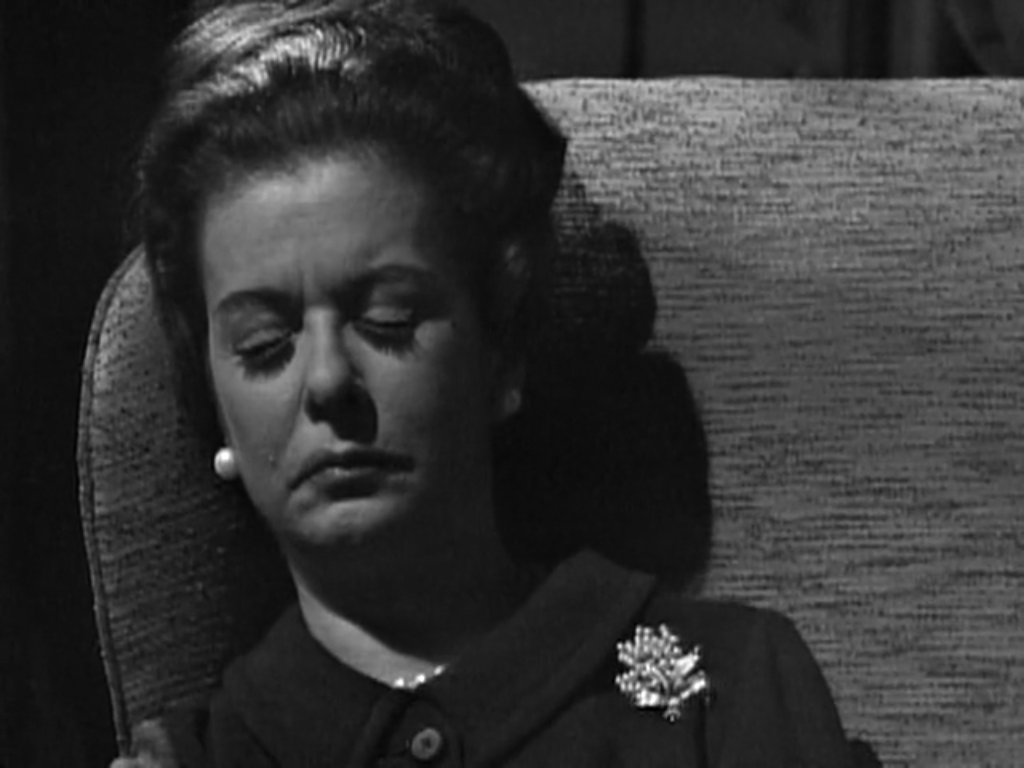
Episode 252: I know we swing, and that’s all I have to know

Frustrated that her mother, reclusive matriarch Liz, has decided to marry seagoing con man Jason McGuire, flighty heiress Carolyn spends the day and night with motorcycle enthusiast Buzz Hackett.

Buzz is modeled on the biker dude villains of Beach Blanket Bingo. Some of his mannerisms, such as speaking in a Beatnik slang that was a decade and a half out of date by 1967 and wearing sunglasses when he rides his motorcycle at night, would have been a little too broadly comic even for that movie, and are ludicrously out of place on the rather solemn Dark Shadows. The very sight of Buzz therefore raises a laugh.
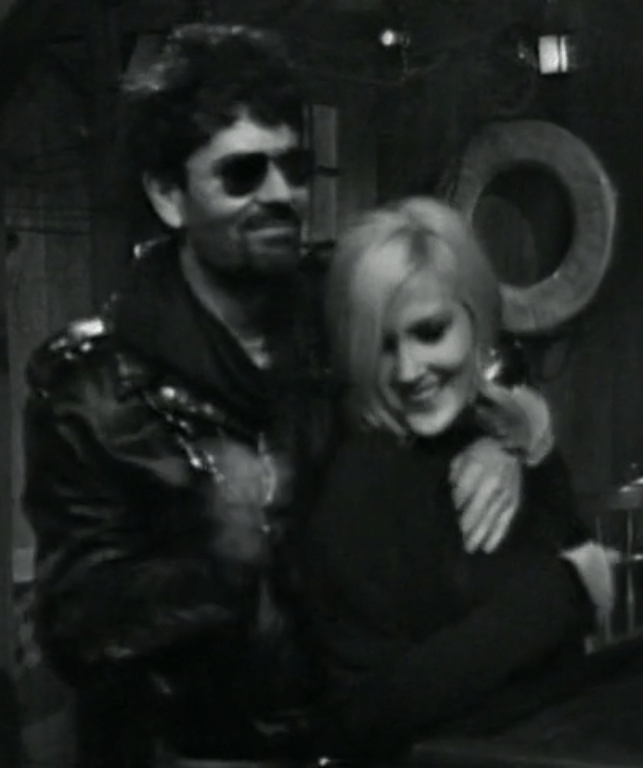
I mean really

Nancy Barrett’s acting style was to throw herself unreservedly into whatever the script had her character doing that day, and seeing her present Carolyn as a newly minted biker mama is hilarious from beginning to end. When Carolyn and Buzz show up at the Blue Whale tavern, she’s already sloppily drunk. They see well-meaning governess Vicki and hardworking young fisherman Joe at a table, and Carolyn insists they go over and greet them. Vicki and Joe give Buzz and Carolyn frosty stares, which are of course the main ingredients of drawing room comedy.

If Vicki put on a police uniform, Carolyn wore a big feathered headdress, and Joe were a construction worker, they could make beautiful music together

As Danny Horn points out in his post about the episode on Dark Shadows Every Day, Buzz is actually pretty nice. That’s a good comic move- the obvious outsider is the one who knows enough to be uncomfortable, while the one who has been a central member of the cast from the first week is oblivious to the social awkwardness surrounding her. If it were the other way around, we might feel sorry for Buzz or be angry with him, but since we know that Carolyn’s place is essentially secure we can laugh at her uninhibited behavior, no matter how much it may make others squirm.

Buzz takes Carolyn home to the great house of Collinwood, parking his motorcycle a few feet from the front door. That isn’t a sign of inconsideration- there only are a few feet in front of the door, they’d be off the set if he parked any further away. It’s still pretty funny to see.

Buzz and Carolyn

Inside the house, Buzz jokes about riding his bike up the main staircase. Carolyn laughs, then urges him actually to do it. He refuses, clearly appalled that she would want such a thing.

Carolyn shocks Buzz

They go into the drawing room. Carolyn picks up a transistor radio and finds some dance music. Buzz is ready to dance, but takes a seat when Carolyn goes into the violent, rhythm-less jerks people in Collinsport do when music is playing. Buzz watches her, apparently ready to provide first aid.

As Carolyn’s performance of the Collinsport Convulsion ends with her falling face first, Liz comes downstairs. She protests against Carolyn and Buzz making so much noise at 3 AM. For the first time, Buzz is rude. He does not stand up when Liz comes into the room, and when Carolyn introduces her as “Mommy,” he greets her with “Hiya, Mommy!” Liz orders him to go.

Before Buzz has a chance to comply, Carolyn starts taunting her mother, yelling at her that her name will soon be “Mrs McGuire!” Liz retreats up the stairs as Carolyn taunts her with repetitions of this name. When Liz is on the landing, Carolyn and Buzz clench and kiss passionately. While they kiss, we see Liz above and behind them, trying to exit the scene. As it happens, the door she is supposed to go out is stuck, so she has to struggle with the knob until she’s out of the frame. Thus, the longest period of intentional comedy on the show ends, not with a break into angry melodrama, but with a huge unintended laugh. It is one of the few truly perfect things ever seen on television.

Door’s stuck

As Buzz, Michael Hadge really isn’t much of an actor- he shouts his lines and goes slack whenever he isn’t speaking. That doesn’t matter so much today. Nancy Barrett’s high-energy performance, the other cast members’ skill at comedy of manners, and the mere sight of Buzz combine to keep the audience in stitches throughout.

Still, I can’t help but wonder what might have been. Yesterday, vampire Barnabas Collins threatened to murder his blood thrall, the sorely bedraggled Willie Loomis. Viewers watching on first run might have wondered if Buzz was going to be his replacement. They might have, that is, if Buzz were played by an actor in the same league as John Karlen. With Mr Hadge in the role, that suspense never gets off the ground.

One of the little games I play in my head when the show gets boring is to ask who else might have taken a part and to imagine how it would have changed with that other actor in the cast. So, if Harvey Keitel was available to dance in the background at the Blue Whale in #33, then surely Mr Keitel’s friend Robert De Niro would have taken a speaking part in #252. Actors inspire screenwriters, and if Mr De Niro had played Buzz I would have wanted to write this line for him to speak to Liz: “Mrs Stoddard, you got me all wrong. You think I want to hurt you, or take something from you, but that’s not the way it is. Me and Carolyn, we’re just trying to have a good time.” Mr Hadge’s shouting wouldn’t have made much of a line like that, but delivered by Mr De Niro to Joan Bennett it could have started a scene between Buzz and Liz that would have expanded his role beyond comic relief and earned him a permanent place in the cast.

It may be for the best that it didn’t work out that way. A De Niro-Buzz might have been such a hit that Dark Shadows never would have got round to becoming the excursion into sheer lunacy that we know and love. And Martin Scorsese might never have been able to get soap opera star/ teen idol Robert De Niro to answer his phone calls.

Closing Miscellany

There are some other notable moments today. We might wonder why Vicki and Joe are sitting together in the Blue Whale, when Vicki has been dating dashing action hero Burke. In fact, the script originally called for Vicki to be out with Burke, but actor Mitch Ryan showed up too drunk to work the day they taped this one and was fired off the show. Burke gave up on his big storyline over ten weeks ago and there hasn’t been a reason for him to be on the show since. Besides, the same cast of characters cannot indefinitely include one whose type is “dashing action hero” and another whose type is “vampire.” The vampire is already pulling in bigger audiences than anything else they’ve done, so Burke has to go. Still, Ryan was such a charismatic screen presence that he was a high point in every episode he appeared in, so it’s sad we’ve seen him for the last time.

The bartender brings drinks to Vicki and Joe’s table and Joe calls him “Bob.” They have settled on this name by now. The same performer, Bob O’Connell, has been playing the bartender since the first week, but in the opening months of the show he had a long list of names. My favorite was “Punchy.”

There is some new music in the jukebox at the tavern and more new music while Carolyn and Buzz are outside the front doors of Collinwood. In the tavern we hear something with brass, and at the doors we hear a low-key saxophone solo.

The closing credits give Buzz’ last name as “Hackett.” We heard about a businessman named Hackett in #223, but Buzz doesn’t seem to be related to him. In the Blue Whale, Carolyn says that her mother has more money than Buzz will ever see, to which Buzz laughingly replies “That isn’t much!”

Patrick McCray’s post about this episode on his Dark Shadows Daybook is fun. I especially enjoyed his description of Michael Hadge’s performance as a merger of “Russ Tamblyn with Truman Capote.”

Episode 245: Microscopic views of hideous malignancies

Two of the best blogs about Dark Shadows share the same web address. One is Dark Shadows Every Day, a series of more than a thousand well-crafted, insightful, often hilarious essays by Danny Horn about episodes #210 through #1245 and related topics. The other is the group blog that Danny’s readers maintain in the comment threads under each of his posts. The commenters outdid themselves in their remarks on Danny’s post about this episode.

At the beginning of the episode, addled quack Dr Woodard has figured out that the two victims of vampire Barnabas Collins, sorely bedraggled blood thrall Willie Loomis and missing local girl Maggie Evans, have something in common. He hopes that if he can compare a sample of Willie’s blood with Maggie’s he will figure out what that is. Willie is terrified that this will lead to the exposure of Barnabas. Puzzlingly, Barnabas is unworried and orders Willie to cooperate. Only after Willie has given the blood and the doctor has left do we learn that Barnabas switched Willie’s sample with a normal one. “DS Willie” comments:

Barnabas is seriously messing with Willie’s mind in this one. So much of what Barnabas says has double meanings, even triple. Of course he’s playing with Woodard too, but Woodard never realizes it.

For one thing, just after Willie’s blood is taken, Barnabas makes creepy blood comments, ending with “…surrendering your utmost self” and his next line “Now, you had no choice.” I suspect this is all meant more for Willie than for the doctor. Willie had no choice but to surrender his utmost self.

Barnabas delights in repeatedly demonstrating his control over Willie, all to the doctor’s approval. When Willie flares up momentarily at Dr. Woodard’s remark about understanding being frightened, Barnabas immediately brings Willie to heel with a harsh word and harsher look.

Later Barnabas jerks Willie’s chain some more, just because he can, and to tighten his control even more. It’s classic Stockholm syndrome type stuff. The victim is abused and in absolute fear for his life, and yet any lessening of the captor’s threats or violence can be perceived as mercy, bonding the victim to his captor.

His shirt in Barnabas’ menacing grasp, Willie swears he would never, never betray Barnabas. He is only thrown to the ground instead of being choked or beaten. Barnabas proceeds to make Willie feel stupid and disloyal and dishonorable and undeserving of future protection. Add enthrallment on top of that. Oh, and the police having Willie as their top suspect, and Jason having beaten and threatened to kill Willie, even though Willie was trying to protect him.

It is actually pretty amazing that Willie has held up under the strain. He is in full-on survival mode, and yet still has the decency to try to shield Maggie and others insofar as he can, given his powerlessness.

Hey, what was up with Barnabas saying Willie’s blood is a “delicate little flower painted on glass”? He says it twice (once to Woodard and once to Willie) while looking directly at the slide. That doesn’t come across as a remark about blood in general.

“DS Willie,” on Dark Shadows Every Day, 13 October 2018 at 12:38 AM Pacific time

He adds another comment:

Oh. Barnabas was using yet another method to get Willie under his thumb: verbally emasculating him with the “delicate little flower” reference to Willie’s blood on the slide. But I think Willie was so relieved that he missed the diss.

“DS Willie,” on Dark Shadows Every Day, 26 December 2018 at 5:57 PM Pacific time

I made a contribution of my own to the thread. In response to Danny’s unfavorable comparison of Dr Woodard with Bram Stoker’s Professor Van Helsing, I commented:

Screenshot by Dark Shadows Before I Die

I don’t think Woodard is Van Helsing at all. He’s Dr John Seward, treating Lucy and Renfield and baffled by the whole thing until he calls in his brilliant old professor. The mysterious Hoffman, one of the best men in the field, that’s the expert who is going to shake things up.

Seward is young, dynamic, and ready for adventure, while Woodard is middle aged, pudgy, and ready for an afternoon tee-time at the local country club. But that change is necessary. Readers of the novel have plenty of time to think about the sort of group that might go on the expedition Van Helsing organizes, and will expect a bunch of high-spirited youths. On a soap, a character like Seward would be the heroine’s new love interest, and Dark Shadows is flailing about trying to figure out what to do with the love interests Vicki and Maggie have now. The last thing they want right now is another bold, handsome young man who is apparently under a vow of celibacy.

“Acilius,” on Dark Shadows Every Day, 19 May 2023 at 7:26 PM Pacific time

In response to Danny’s remark that Jonathan Frid’s bobbles make it hard to guess what lines the script originally gave vampire Barnabas Collins, commenter “TD” replies:

#1. “Now, in a way, isn’t that understandable?

#2. “After all, blood is the life force.

#3. “It reaches into the deepest recesses of both the heart, and the brain.

#4. “It is the familiar of our complete being.

#5. “To surrender even one drop of it is to suggest a partial surrender of one’s utmost self.”

I’m not so sure this is actual Fridspeak. Yes, it’s kind of gibberishy, but it does make grammatical sense and some sort of syntactical sense. Frid delivers it smoothly and with confidence, unlike his halting fumblings when he can’t remember his lines. When he says this, it’s in a close-up shot, and he’s looking down. My guess is that he is reading it directly from a script. Also, this is Joe Caldwell’s first script (or first credited script–he did some writing on earlier Ron Sproat scripts, if another website is accurate). Maybe this is Caldwell exhibiting the enthusiasm of a first solo outing. Dr. Woodard has a couple of hi-falutin’ and rhetorically “poetic” (and gibberishy) speeches of his own in this episode.

Also, might this episode be marked as the first one to demonstrate the “reluctant” or “sympathetic” vampire in Barnabas’s character? In this episode (in another speechy series of lines), when Dr. Woodard and Barnabas are discussing the “madman” who broke into Woodard’s office and stole the blood sample, we get this exchange:

Dr. Woodard: You know, it’s the peculiar magnificence of the human spirit that’s required to provide the potential for such corruption. [See? This is like the Barnabas “blood is the life force” speech–who talks like this???]
Barnabas: Yes, I know what you mean. Whoever he is, he must certainly be, at one and the same time, more than a man…and less than a man.
Dr. Woodard: You seem almost sorry for him.
Barnabas: Sorry? No, I’m not sorry. The truth is, I loathe him. I loathe him very, very deeply.

“TD” on Dark Shadows Every Day, 2 June 2017 at 11:06 AM Pacific time

I agree with “TD” that today’s dialogue is marred by purple passages; I would go so far as to say that none of the lines would have survived a rewrite. Not among the lines delivered by the human actors, anyway- our beagle was fascinated when the hound howled on the soundtrack.

I should mention that at least one perceptive critic of Dark Shadows disagrees with me and “TD” about the script. Patrick McCray’s Dark Shadows Daybook is in its own way the equal of the two blogs at Dark Shadows Every Day. Patrick wrote two posts about this episode. In one from 2016, he wrote that “The language is poetic and evocative. Barnabas has moments of self-loathing and ambiguity that are gorgeously, hauntingly phrased, and the same can be said for Woodard’s exploration of science and mystery.” In 2019, he went so far as to call it “the best written episode of the series.”

John and Christine Scoleri also include some interesting material in the post about this episode on their recap-heavy blog Dark Shadows Before I Die. I particularly liked the series of screenshots at the end of the post captioned with some of the purple prose from today’s dialogue.

Episode 236: The future, for the first time

Maggie Evans, The Nicest Girl in Town, has vanished from her hospital bed. We start with a long succession of characters talking about this fact with Maggie’s father Sam. Had David Ford played Sam as effectively as he did in his first weeks on the show, one such exchange might have made for a good scene. But Ford is overacting today, and the first part of the episode drags on and on.

We cut to the Old House on the great estate of Collinwood, where Maggie’s boyfriend Joe and dashing action hero Burke Devlin have gone. Vampire Barnabas Collins resides in the Old House along with his sorely bedraggled blood thrall, Willie Loomis. Joe and Burke have no clue there is anything odd about Barnabas, but they don’t like Willie and suspect he may know what happened to Maggie.

Barnabas lets Joe and Burke in the house and explains that he sent Willie to run some errands for him out of town. When they tell him about the evidence that has led them to think Willie might be connected with Maggie’s disappearance, he persuades them that there is nothing to their suspicions. Once they are gone, he calls out “It’s all right, they’ve gone. You’re safe here- safe here with me.” Maggie walks into the room.

Barnabas talking to Burke

This scene is very good. Barnabas is made up to look much more like The Vampire than he has been in previous encounters with characters he was trying to fool into thinking he was a harmless eccentric recently arrived from overseas. He is polite enough to Joe and Burke that they can chalk his appearance up to the lateness of the hour, but as the audience watches him extract information from them point by point, until he knows exactly what they do and don’t know, we can see him calculating when and how he will have to kill them. It is as good a scene as Jonathan Frid has had since he debuted as Barnabas.

Frid’s performance in this scene benefits from his flawless line delivery. Not so, unfortunately, the scene that follows. His bobbles are not especially bad by Dark Shadows standards, but his task is far more fragile than any he has taken on before. We’ve seen him pretending to be the Collins family’s mild-mannered cousin from England; in those moments, Barnabas himself is taking on a challenging acting job, and Frid’s difficulties sometimes dovetail with troubles we might expect Barnabas to have in his performance. We’ve seen him abusing Willie; in those moments, we might expect him to sputter a bit, and Frid can hide some of his memory lapses in that mannerism. But now, he is telling Maggie what his plans are for her. As he does so, we realize he is a crazy man spilling out his deepest and sickest obsession. That context leaves nowhere to conceal even the slightest flub. As a sign of triumphant psychosis, the lines have to flow without interruption. Every time Frid stumbles for a fraction of a second, he breaks character.

Nor can Kathryn Leigh Scott bail him out. As Maggie, her part is to wander around in a stupor and occasionally repeat the last word or two of whatever is said to her. She makes that a lot more interesting to watch than you might expect, but there’s only so far it can take you.

Barnabas’ plan takes us outside the themes we are familiar with from vampire fiction. He wants to brainwash Maggie into thinking that she is Josette Collins, who has now been retconned into the woman Barnabas loved in his human days. His goal is that Maggie Evans will cease to exist, and that in her body Josette will live again.

Dracula never wanted to do anything like that, though after Dark Shadows has a hit with this storyline it will become part of vampire lore. Prince Mamuwalde, the menace in the 1972 film Blacula, kidnapped the heroine and tried to turn her into his long-dead love. Another undead fictional man from Africa had tried the same thing in 1932, when Imhotep, played by Boris Karloff, had spent the bulk of The Mummy trying to turn the heroine into a revived form of his adored Princess Ankh-esen-amun. Frid’s face and coloring were somewhat similar to those of Bela Lugosi, a fact often remarked in connection with his casting as a vampire. But his voice and movements are strongly reminiscent of Boris Karloff, and as a mashup of Dracula and Imhotep he is a synthesis of these two actors.

Barnabas gives Maggie a music box that he had intended to give Josette. He says that he bought it for Josette in his travels in “the Orient,” intending to give it to her “on a very special day,” and “this is that day.” This leaves us wondering why the day never came when he could give it to Josette. Did he become a vampire before he returned from his travels? Did he come back from his travels to find that she was no longer available to him? Or was it supposed to be a present at their wedding, a wedding that never occurred?

Barnabas also produces Josette’s wedding dress and tells Maggie that she, as the new Josette, will wear it. When Imhotep produces Ankh-esen-amun’s clothing and jewelry, we remember that royal personages in ancient Egypt were buried with their possessions and assume that he has retrieved them from her tomb. The show did lead us to wonder if the Collinses once had a similar practice. Willie released Barnabas because he had heard a story that some of the Collinses were buried with expensive jewelry and so was trying to rob a grave. The story of the buried jewels was framed as an echo of the Gothic romances that inspired the first weeks of Dark Shadows, but has now become an anticipation of the show’s journey into Universal Pictures’ back catalogue of horror movies.

If Barnabas does manage to somehow erase Maggie and bring Josette back to life in her body, it won’t be the first time Miss Scott has played Josette. In #70, Miss Scott was the ghost who emerged from Josette’s portrait and danced outside the Old House. Miss Scott put Josette’s veil on again in #126 when she led the ghosts who scared maniacal handyman Matthew Morgan to death before he could murder well-meaning governess Vicki. In that one, she delivered a few lines as Josette. Miss Scott’s name did not appear in the credits as Josette in either of those episodes, and the only time we caught a glimpse of Josette’s face was in #149, when she was played by stand-in Rosemary McNamara. But if by any odd chance a viewer does know that Miss Scott has played Josette before, the final dissolve from a closeup of Miss Scott to one of Josette’s portrait suggests a definite possibility that Barnabas’ plan, nonsensical though it seems, will somehow succeed.

Danny Horn’s post about this episode on his Dark Shadows Every Day is particularly good. He compares its visual strategy to that of the one surviving contemporary segment of General Hospital, and praises the ambitious approach director Lela Swift took to composing images. I should also mention Patrick McCray’s Dark Shadows Daybook post, in which he analyzes the way the story alienates us from our rooting interest in Maggie’s safety by promising a more exciting story if Barnabas has his way with her for an extended period.

Episode 215: Play the mystery man

In episode 1 of Dark Shadows, dashing action hero Burke Devlin returned to his home town, the isolated fishing village of Collinsport, Maine. He’d left Collinsport in poverty and disgrace, and returned as a millionaire many times over, the master of a financial empire. He had vowed to use his great wealth to exact vengeance on the ancient and esteemed Collins family. In #201, he gave up his quest for revenge, which had never been very interesting to watch anyway, and now is unconnected to any storyline. He’s still in town though, spending his evenings in The Blue Whale, a waterfront tavern where he has appointed himself to act as bouncer.

In #207, dangerously unstable ruffian Willie Loomis was rude to some other patrons at the Blue Whale. Burke defeated Willie in a fight and ordered him to leave town. Today, Burke comes back to the tavern. No one has seen Willie for a week or so, but neither is it clear that he has left Collinsport for good. Burke is looking for Willie, planning to beat him up again if he finds him.

When Burke enters, he sees Maggie Evans, The Nicest Girl in Town, sitting alone at a table. While she waits for her boyfriend, hardworking young fisherman Joe, Maggie talks with Burke about not knowing where Willie is.

Willie’s associate, seagoing con man Jason McGuire, comes into the tavern. Burke goes up to him. They also talk about not knowing where Willie is.

Joe shows up. He’s been helping his uncle search, not for Willie, but for a missing calf. They found remains of the little guy, far from the farm and completely drained of blood by some mysterious process. They are baffled by this development.

Willie drifts in. He sits down at the bar and starts drinking. Burke goes up to confront him, but is confounded by Willie’s broken demeanor. After a few moments, his hostility gives way to compassion, and he speaks gently to Willie.

Burke puzzled by Willie’s meekness. Screenshot by Dark Shadows Before I Die

Jason returns, and Burke tells him he’s worried that Willie seems to be very ill. Jason then confronts Willie, and is astounded when Willie tells him he doesn’t want the $500 in cash Jason is holding for him. Jason also notices that Willie has some bloodstains on his sleeve.

Everything I have to say about the acting in this episode I said in a long comment I left on Danny Horn’s Dark Shadows Every Day in December 2021. Here it is:

I like this one. Sure, the writing has its flaws, and there are a couple of shots where it’s hard to tell what the visual composition was supposed to be. And Mitch Ryan is obviously drunk. But they rise beyond all that.

Kathryn Leigh Scott plays Maggie throughout as an understated version of her original wised-up conception, very apt for the barroom setting and a fine offset to the intensity all the male characters have to show this time. She doesn’t have many lines, but she has everything she needs to keep the show on track.

Dennis Patrick’s face and voice show at least two emotions in every shot, and he and Mitch Ryan do a terrific job as two men who don’t like each other but can’t help getting absorbed in a puzzle that fascinates them both. The music that builds throughout that scene and reaches its crescendo as Jason leaves the bar matches the complex emotional palette with which the actors are working; it doesn’t sound anything like the usual Dark Shadows music, and I don’t think we ever hear it again.

Joel Crothers’ turn as the messenger announcing the tragedy of the calves is as tense as the dialogue between Patrick and Ryan, but his studiousness and deliberation change the pace sufficiently to keep the scenes from blurring together. Ryan and Scott deliver their responses to him with a calm intelligence that emphasizes those qualities and makes Willie’s stumbling entrance a real surprise.

Ryan’s scene with John Karlen is a turning point in the series. Burke’s shift from a menacing demand that Willie leave town to an alarmed concern for his well-being marks the end of Scary Violent Willie and the arrival of Wretched Broken Willie, and his conference with Jason confirms that change. Everything Karlen does on the show from this point on, right up to his performance as Kendrick, begins with this scene.

If that looks familiar, it may be because I linked to it on tumblr.

I should also link to a characteristically insightful post in which Patrick McCray explains how this episode, in which Barnabas Collins is neither seen nor mentioned, contributes substantially to the sense of danger surrounding him. The story Joe tells about his uncle’s calf is the show’s first reference to blood-sucking, and it comes after we’ve started to wonder whether Barnabas really is a vampire, or is some less familiar type of hobgoblin.

Episode 211: He pretended to be someone he wasn’t

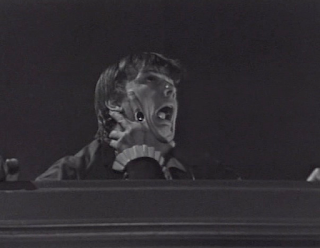
The opening voiceover complains about “a frightening and violent man.” We then see a fellow with a crazed look on his face trying to break into a coffin. Assuming that he is the frightening and violent man, a first time viewer might not be especially upset when a hand darts from the coffin and chokes him, even though something like that can’t be altogether a good sign.

At a mansion identified as the great house of Collinwood, an aristocratic lady is demanding that a man in a captain’s hat account for the whereabouts of someone called Willie. The man answers to the name of Jason and calls the lady Liz. Liz has had all she can take of Willie, whoever he might be, and is not at all happy that Willie’s things are still in her house. Jason does a lot of fast talking, but cannot satisfy Liz either that Willie is really leaving or that he himself does not know where Willie is.

Jason talks with the housekeeper, a woman named Mrs Johnson. He asks her a series of questions about what she knows about Willie and she asks why he wants to know. Even though Mrs Johnson was in the room when Liz was insisting that Jason find Willie and get rid of him, for some unaccountable reason he will not tell her that he is looking for Willie.

Despite Jason’s inexplicable reticence, Mrs Johnson does tell him that Willie was preoccupied with the portrait of an eighteenth century figure named Barnabas Collins, that he was also interested in a legend that another eighteenth century personage, someone named Naomi Collins, was buried with a fortune in jewels, that Naomi Collins is buried in a tomb in a cemetery five miles north of town, and that the night before she saw Willie hanging around the toolshed. Returning viewers will recall that in yesterday’s episode, well-meaning governess Vicki had also told Jason that she had seen Willie in the vicinity of the toolshed, carrying a bag. There doesn’t seem to be a television set in the house, so everyone spends the evenings looking out the windows at the toolshed.

We see a cemetery. It soon becomes clear that it is the same cemetery we saw in the opening teaser. The gate of the tomb in which the frightening and violent man did his sinister work is swinging in the breeze. An old man in a three piece suit and celluloid collar comes upon it. He shows alarm and mutters that he can feel evil in the air.

Jason arrives at the cemetery and meets the old man. Jason says that he is looking for a friend of his, a young man. The old man identifies himself as the caretaker of the cemetery and laments the fact that a young man meeting the description Jason gives was there last night and broke the lock on the gate to the tomb. A first-time viewer’s suspicion that Willie and the frightening and violent man from the teaser are one and the same finds confirmation.

The caretaker can’t believe that Jason is unable to sense the palpable evil that emanates from the tomb. Jason overcomes the caretaker’s attempts to keep him out and makes his way into the tomb. The caretaker keeps warning Jason of the perceptible evil and Jason keeps failing to perceive it. Jason does find a cigarette on the edge of a casket in the tomb, and in closeup gives a look that can only be his recognition of a trace of Willie’s presence.

Jason finds Willie’s cigarette

Jason returns to the great house. Liz is exasperated that he still can’t tell her where Willie is, and Mrs Johnson is irritated he doesn’t put his hat and coat where they belong. After Jason and Liz have left her alone in the foyer, Mrs Johnson takes Jason’s things to the coat closet.

We see Mrs Johnson fussing with the hat and coat from inside the coat closet, an unusual perspective that has in the past been used during shots when characters have stumbled onto important evidence about whatever mystery they were puzzling over at the moment. The shot goes on long enough to lead us to wonder if Mrs Johnson is about to find something important. My wife, Mrs Acilius, mentions that each time she has seen this shot she expected Mrs Johnson to find Willie’s cigarette in Jason’s pocket and to recognize it.

Mrs Johnson fussing with Jason’s coat

That expectation is thwarted when there comes a knock at the door. Mrs Johnson answers and greets the visitor.

The next shot is from the perspective of the visitor. We see a look of astonishment on Mrs Johnson’s face as a man in a fedora and an overcoat asks to be announced to “the mistress of this house, Mrs Elizabeth Collins Stoddard.” He identifies himself as Mrs Stoddard’s cousin from England. Mrs Johnson invites the man in. He hastens across the threshold.

We cut back to the interior, and see the man and Mrs Johnson facing each other. As she bustles up the stairs, the camera tracks around to show him standing next to the portrait of Barnabas Collins, a portrait he resembles strongly. He says, “Oh, madam! If you would, you may tell her that it is Barnabas Collins.”

For regular viewers, it is refreshing to see Jason on the defensive. Ten times in the first eight episodes where they appeared together, he and Liz had a conversation in which he made a demand of her, she resisted, he threatened to expose her terrible secret, and she capitulated. Today is the second episode in which they have interacted without reenacting this drab ritual. Liz is driving the action, Jason is thinking fast, and they are each in their element. For a first time viewer wondering about the hand that came out of the coffin, it’s a lot of filler, but for those of us who have been suffering through the tedium of the blackmail plot it is a fun change of pace.

Regular viewers will also be glad to see the return of the caretaker. He appeared four times* in the storyline of Laura Murdoch Collins, the humanoid Phoenix, and managed to be simultaneously eerie and funny. His catchphrases “Died by fire!” and “The dead must rest!” are all it takes to make Mrs Acilius laugh out loud. His return in #209 moved Patrick McCray to label him a refugee from the EC comics universe, and in my post about that episode I pointed to a shot that looks so much like a panel from an EC comic book that I wonder if the similarity might have been intentional.

While first time viewers may be confused or impatient with the caretaker’s oft-repeated attempts to alert Jason to the nimbus of evil that hangs in the air around him, regular viewers know that the caretaker is the one who understands the show he is on. Jason thinks that he’s on a noir crime drama, and indeed there had been a period when Dark Shadows just about met that description.

But for months now, all the action has been pointing towards the supernatural back-world behind the visible setting. Jason’s own storyline was introduced the very day Laura’s ended, and it is a means for wrapping up all the non-supernatural narrative elements still lying around. Jason’s insensibility to the evil in the tomb is not only a sign that he is himself too corrupt to tell the difference between a wholesome space and a cursed one, but also that he doesn’t fit into the genre where Dark Shadows will be from now on. The audience in 1967 wouldn’t have known that actor Dennis Patrick always insisted on fixing a date for his departure when he joined the cast of a daytime soap, but this scene should give them a strong indication that Jason McGuire is not to be with us indefinitely.

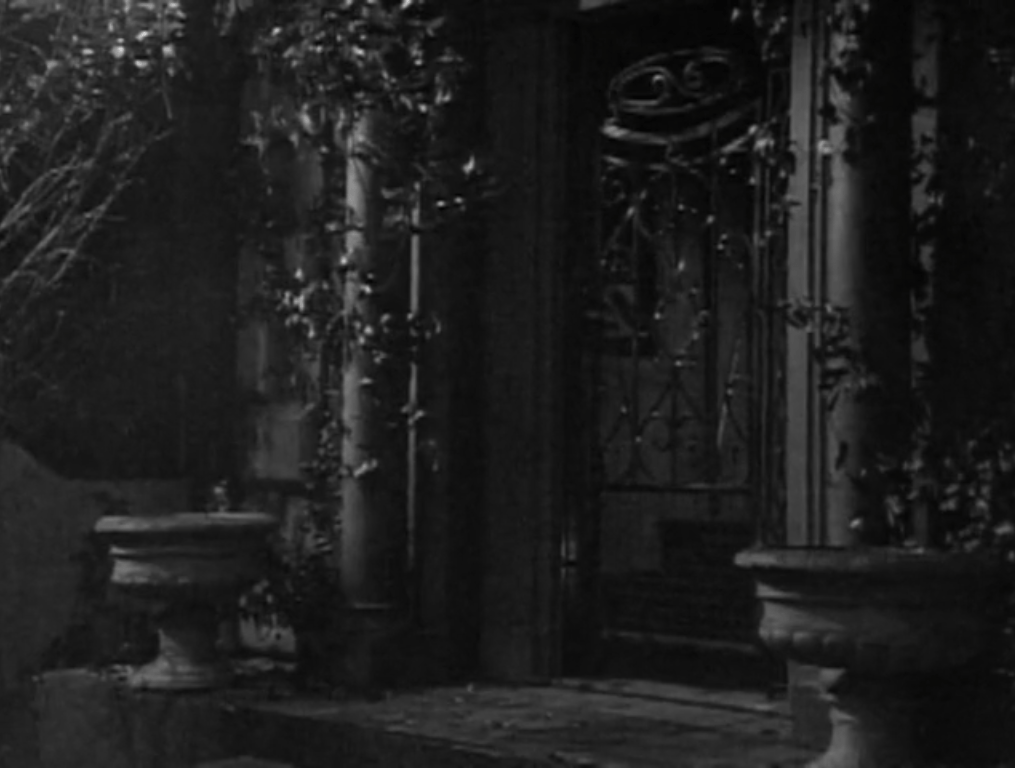
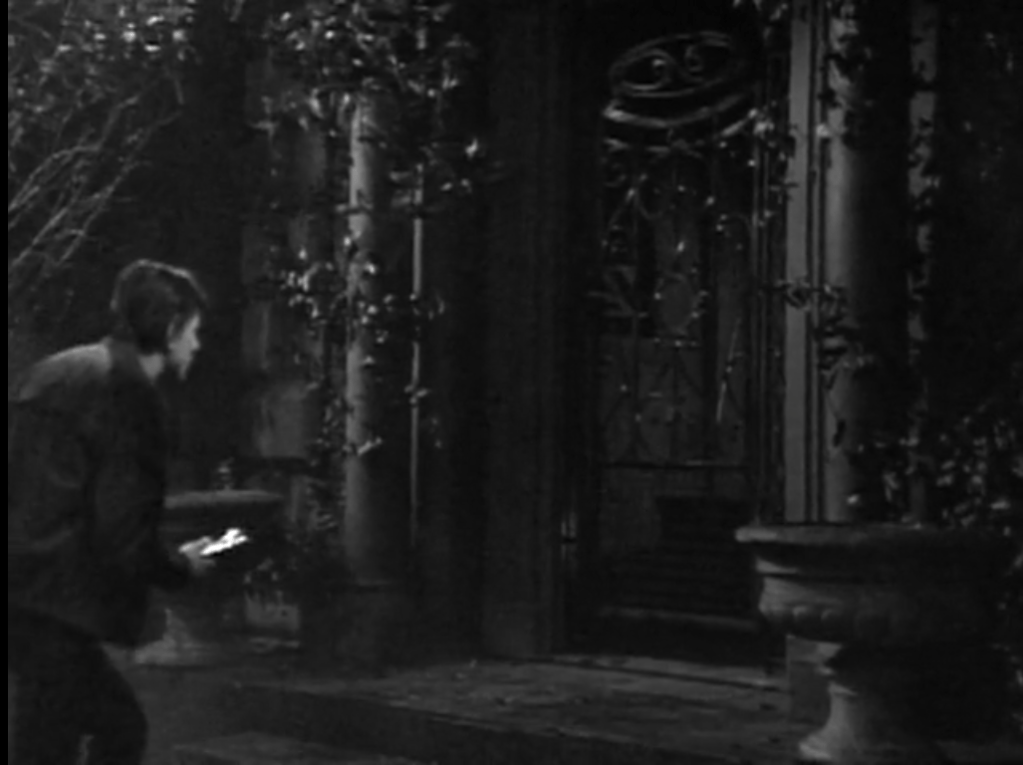
Patrick McCray’s commentary on this episode includes an analysis of director John Sedwick’s visual strategy in the last two shots, those in which Jonathan Frid first appears as Barnabas Collins. McCray confines himself to the first thing photography students are usually taught, the “Rule of Thirds.” But that’s all it takes to get us to look closely at the imagery and to see how Sedwick tells his story with pictures:

Two clear and subtly clever images with a bridge. His introduction comes from his own perspective, rather than Mrs. Johnson’s. It’s an exterior shot of the entrance, looking in.

The grid helps us divide the image. People in the west read from left to right, and tend to circle in our gaze back to the left. Sedwick uses this model of composition in all three shots.  In image 1, we see someone — him? — through the eyes of Mrs. Johnson as the camera hangs over his shoulder, minimizing her (1.1). Why is she so transfixed? We follow her gaze up to the towering figure (1.2). Following the slope of his collar, we come back to Mrs. Johnson… specifically, her throat (1.3). After that, we circle back up to her gaze, even more worried. For what reason?

Then he enters with purpose, and we next see him again from the back, divesting himself of his cane and hat, getting a glimpse of his strangely antique cloak. His voice is rich with a uniquely tentative sense of authority. We still don’t see his face, just bits of his profile. These moments tease us, and yet they put us in the position of a confidant of the vampire’s. The composition mirrors what we saw outside. Within, Mrs. Johnson (2.1) is minimized, and the turn in the figure shows him looming, ready to pounce. Again, we begin with her, following her gaze from left to right. The mystery of what bedevils her, bedevils us, as well. The man towers (2.2) in the right, blocking the exit. Instead of following a sloping collar, we follow its larger, expanding offspring in the cape, which takes us circling to the left again where we stop on the poor, miniscule shield of his hat and then, like a wolf pulling her away, his feral looking cane (2.3).

Situated so close to the predator, with his gaze elsewhere, we have a strange safety. We don’t see him from the eyes of his prey. Instead, we are a quietly unacknowledged friend. Finally, as Mrs. Johnson goes to summon Elizabeth, the figure turns to face the portrait, rotating upstage to let us see him from profile to profile. As she exits, and we are alone with him, the chiseled face comes into focus from the side. It is alien. It is familiar. We think we know why, but then we see why. They are only face to face for a moment before the camera takes us away from him and uncomfortably close to the painting from 1795, cold and haughty and haggard and sad. He then steps even uncomfortably closer to it and spins to give his inevitable name. We see the two men in mutual relief.

The painting of Barnabas is a prisoner in a four-sided frame on the wall, disapproving and distant as the first thing our eyes rest on (3.1). Is the painting gazing at the man? No. The more we look, the more the painting is gazing at us, as if we’ve been caught looking. It’s natural to avert our eyes from this, and by comparison, section 3.2 is practically benevolent. His impossible doppelganger is standing before it in three dimensions on our 2D screen. Liberated, he smiles, and there is something optimistic about it. He’s gazing upward to the landing, yes, but it’s also to the future. Gazing left, he’s anticipating the next image rather than look for one that has passed. Subtly, our eyes wander down to 3.3, his medal, a subtle reminder that, despite his strange warmth, he’s a soldier as well, and a force to be reckoned with. 

Patrick McCray, “The Dark Shadows Daybook: April 14,” from The Collinsport Historical Society, 14 April 2017

*In episodes 154, 157, 179, and 180

Episode 210: He’d want to say goodbye

Dangerously unstable ruffian Willie Loomis is under the impression that Dark Shadows is still the show ABC originally bought, a Gothic romance. So when he hears a tale of a grand lady in a manor house who fell in love with a pirate and is buried with a fortune in jewels that he gave her, he takes the story at face value and sets out to find and rob her grave.

Willie’s associate, seagoing con man Jason McGuire, believes that Dark Shadows is now the crime drama it more or less became for a couple of months after the Gothic romance approach petered out. He is blackmailing reclusive matriarch Liz, and refers to his incessant threats against her in their first conversation today.

Yesterday, the Caretaker of Eagle Hill cemetery tried to warn Willie that Dark Shadows has changed direction, and has been developing as a supernatural thriller/ horror show since December. Willie wouldn’t listen to him, but regular viewers know that all the old storylines are finished, and even people tuning in for the first time today will notice that the emphasis is on the uncanny.

At the end of today’s episode, Willie finds a hidden coffin and forces it open. It doesn’t have the jewels he was seeking, but something is in there that will bring great wealth to ABC and Dan Curtis Productions.

Screenshot by Dark Shadows Before I Die

This is the first episode of Dark Shadows most people see. Posting commentary on episodes 1-209 is a bit like driving down a quiet, picturesque country road. By contrast, googling “Dark Shadows episode 210” is like merging onto a busy highway. I want to respond to two of the many, many commentators on this one, Patrick McCray and Danny Horn.

On his great Dark Shadows Every Day, Danny writes:

Elizabeth calls Jason into the drawing room and throws an envelope of money at him — she’s paying Willie to leave town. She tells Jason to count it, but he turns on the charm, assuring her, “It’s all there. I can tell by the feel of it.” She barks at him that his friend should leave the house immediately. He apologizes: “I wanted this to be kept quiet. You know, the same way you wanted something kept quiet?” She walks out, and as soon as her back is turned, he opens the envelope and counts the money. Jason is funny. We like Jason.

Danny Horn, Dark Shadows Every Day, “Episode 210: Opening the Box,” 2 September 2013

Danny makes a point of ignoring the first 42 weeks of the show, often claiming never to have seen most of it. As his blog goes on, it becomes clear that he has seen a lot more than he wants to let on, but he is consistent enough about writing from the point of view of someone who started from this episode that I could always find a place in his comment section to add remarks about the connections to the early months.

And indeed, it is easy to see how someone tuning in for the first time today could say “We like Jason.” He is trying to keep control of the situation when he doesn’t understand what’s going on and he can’t afford to tell anyone the truth, so he has to keep coming up with fresh lies that will keep the ladies of the house from calling his bluff and new ways of pretending to be scary that will keep Willie from laughing at him. That’s a winning formula for a character, as witness the history of theater all the way back to the Greek New Comedy. Actor Dennis Patrick has the craft and the charisma to sell it beautifully.

Returning viewers may well have a far less enthusiastic response to Jason. His conversations with Liz today are the first time the two of them talk without falling into a pattern where Jason makes a demand, Liz resists, he threatens to expose her terrible secret, and she capitulates. They’ve enacted that depressing ritual ten times in the weeks Jason has been on the show, sometimes twice in a single episode. In Jason’s scenes with Willie and some of the other characters, we’ve had hints of the breezy charm Dennis Patrick exudes today. But the Jason/ Liz exchanges are so deadly that we get a sinking feeling every time either of them appears. Since blackmail has been the only active storyline going for the last two weeks and the two of them are the only full participants in it, that’s a lot of sinking feelings.

Patrick McCray’s Dark Shadows Daybook entry focuses on Jason’s opening scene with Willie:

Jason is harassing Willie. The big one is abusing the little one, demanding that he account for his whereabouts and doing so violently. David and Goliath. Shrill and meek. Had we started earlier, it would be tougher to be on Willie’s side. Starting here? Jason is the villain. He accuses the bruised kid of having a scheme, and the kid obviously lies to the Irish galoot, gazing at the portrait conspiratorially. It’s as if he and the man in the painting already have a relationship. Cut to opening credits.

A lovable weasel. A bully. A silent and stern third party, hanging on the wall like a watchful ally, holding his action. Only a few lines, but resonantly human to anyone who’s been victimized by a know-it-all lout. Somehow, we know this power dynamic is bound to change, and that, for once, the know-it-all knows zip.

Patrick McCray, The Collinsport Historical Society, “Dark Shadows Daybook: April 13,” 13 April 2018

Willie has been a frantically violent character, showing every intention of raping every woman he meets and picking fights with every man. Some of Willie’s attempted rape scenes, especially in his first five appearances when he was played by Mississippian method actor James Hall, were so intense that they were very difficult to watch. Nor has Willie become less menacing since John Karlen took the part over. Just yesterday, Jason had to pounce on Willie as he was creeping up on well-meaning governess Vicki. It is indeed tough for anyone who has seen the previous episodes to be “on Willie’s side” in the sense of hoping that he will be the victor, even if we find him interesting enough that we want him to stay on the show.

But I think Patrick McCray overstates the degree of sympathy Willie is likely to gain from an audience watching Jason’s attempt to bully him today. At no point does Willie seem the least bit intimidated by Jason. He chuckles at him throughout the whole scene, and keeps his head up and his eyes open. The bruise Willie still has around his eye from a bar fight he lost the other day is faint enough that it does not give him any particular look of vulnerability. It’s true Willie is smaller than Jason, but he’s also younger and in good shape, so there is no reason to suppose he would be at a significant disadvantage were they to come to blows.

Returning viewers will also notice that the carpenters have been busy. Today we get a look inside the Tomb of the Collinses, a new set introduced yesterday. We also see a much more modest structural addition for the first time, a second panel of wall space downstage from the doors to the great house of Collinwood.

During the first weeks of the show, the foyer set ended right by the doors. When they added a panel to represent a bit more wall space, they decorated it at first with a metal contrivance that looked like a miniature suit of armor, then with a mirror, then alternated between these decorations for a while. When Jason first entered the house in #195, the mirror reflected a portrait, creating the illusion that a portrait was hanging by the door.

Episode 195

By #204, a portrait was in fact there, one we hadn’t seen before, but that they must have been painting when Jason first came on the show.

Episode 204

In #205, the portrait is identified as that of Barnabas Collins, and it is accompanied by special audio and video effects. Sharp-eyed viewers remembering #195 may then suspect that the point of Jason and Willie is to clear out the last remnants of the old storylines and to introduce Barnabas Collins.

Today, a second panel is added to the wall next to the portrait, and the mirror is mounted on it. Liz and Vicki are reflected in the mirror. The split screen effect not only puts the painting in the same shot as their reactions to it, but also establishes a visual contrast between the present-day inhabitants of the house and another generation of Collinses.

Screenshot by Dark Shadows Before I Die

Episode 209: The darkest and strangest secret of them all

Dangerously unstable ruffian Willie Loomis stares at the portrait of Barnabas Collins hanging in the foyer of the great house of Collinwood. The portrait’s eyes glow and the sound of a heartbeat fills the space. Willie’s fellow unwelcome house-guest, seagoing con man Jason McGuire, comes into the room. Willie is surprised Jason can’t hear the heartbeat.

After consulting the Collins family histories, Willie goes to an old cemetery where legend has it a woman was interred with many fine jewels. The Caretaker of the cemetery stops Willie before he can break into her tomb. Willie hears the heartbeat coming from the tomb, but, again to his amazement, the Caretaker cannot hear it.

Yesterday, strange and troubled boy David Collins had told Willie that in some previous century, a pirate fell in love with Abigail Collins, gave her jewels, and that Abigail took those jewels to her grave. Today, Willie repeats this story to wildly indiscreet housekeeper Mrs Johnson, only he identifies the woman as Naomi Collins. Fandom likes to seize on this kind of thing, presenting it either as an error or as a sign of retcons in progress, but I suspect that it is just a clumsy way of suggesting that the characters are hazy on the details of the legend.

The legend itself is very much the sort of thing that inspired Dark Shadows in its first months. ABC executive Leonard Goldberg explained that he greenlighted production of the show when he saw that Gothic romance novels were prominently featured everywhere books were sold. The idea of a grand lady in a manor house somehow meeting and having a secret romance with a pirate is a perfect Gothic romance plot, as for example in Daphne du Maurier’s Frenchman’s Creek. Willie’s fascination with the tale might reflect an accurate assessment of the situation if Dark Shadows were still a Gothic romance, but the show left that genre behind as the Laura Collins storyline developed from #126 to #193. If Willie had been watching the show, he would know that the story David told him is not the one that is going to shape his future as a character on it.

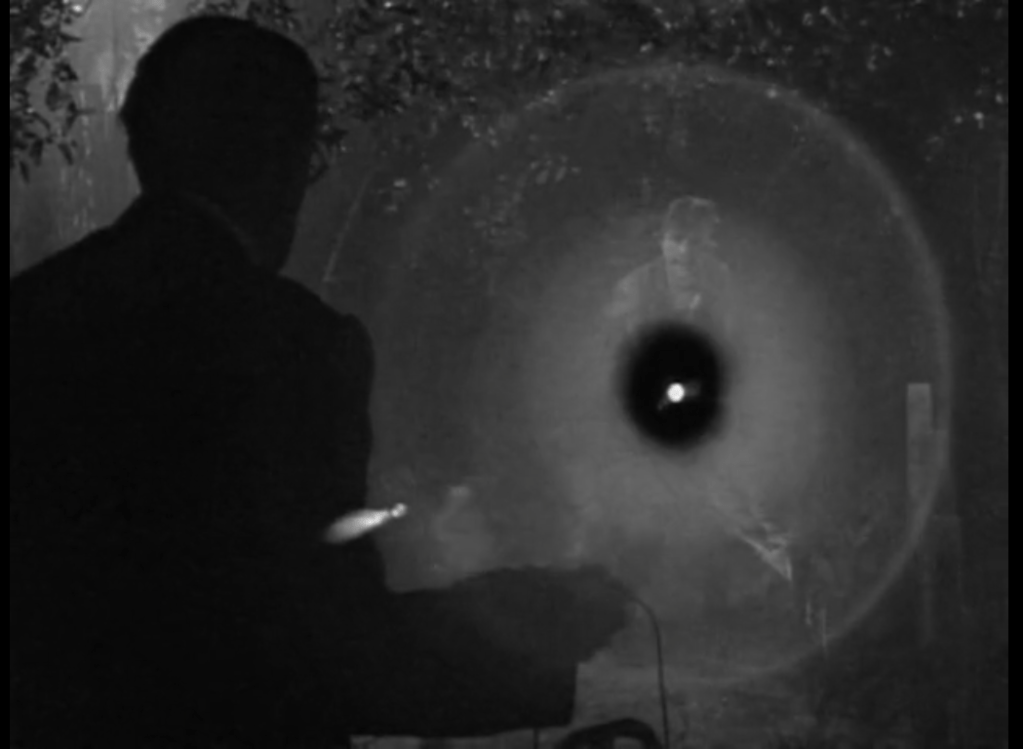
When Willie is wandering around the old cemetery, he twice shines a flashlight directly into the camera and creates a halo effect. The first time might have been an accident on the actor’s part, but the second time the halo frames the Caretaker in a way that is obviously intentional. Patrick McCray’s entry on this episode in his Dark Shadows Daybook describes the Caretaker as “a refugee from the EC universe.” Indeed, Willie’s crouching posture and angry facial expression, the halo filling so much of the screen, the tombstones in the background, and the Caretaker’s silhouetted figure carrying a lantern add up to a composition so much like a panel from an EC comic book that it may well be a conscious homage:

Beware the Vault of Horror!

This is our first look at the Tomb of the Collinses.

Introducing the Tomb of the Collinses
Willie sneaks up to the Tomb

It’s also the first time we are told the name of the cemetery five miles north of Collinsport in which the Tomb is situated. Mrs Johnson calls it “Eagle’s Hill Cemetery,” though later it will be called “Eagle Hill.” Mrs Johnson also mentions the Collinsport cemetery two miles south of town, and the Collins’ family’s private cemetery located in some other place. They won’t stick with any of this geography for long, though it all fits very neatly with everything we heard about burial grounds in the Collinsport area during the Laura story.

Episode 204: It pays to be friendly

Dangerously unstable ruffian Willie Loomis is staying at the great house of Collinwood, much to everyone’s dismay. Yesterday’s episode ended with a scene in which he appeared to be trying to rape well-meaning governess Vicki in the study. She resisted him pretty vigorously, especially after he trapped her in front of some furniture. When reclusive matriarch Liz interrupted the confrontation and demanded Willie leave the house, Vicki ultimately let Willie off the hook, saying that he didn’t really do anything.

Today, Vicki sees flighty heiress Carolyn in the kitchen and warns her about Willie’s violent ways. After Willie has insulted everyone in the house, Vicki and dashing action hero Burke Devlin run into him while on a date at Collinsport’s night spot, The Blue Whale. Willie enrages Burke, and the two men are about to fight. Vicki urges Burke not to fight, leading him to pause. She shouts at Willie, demanding that he go away. He does. This leads me to wonder if the reason Vicki didn’t back Liz up is that she wants to fight her own battles.

Willie returns to Collinwood. He finds Carolyn alone in the drawing room. He blocks her exit from the room. He grabs at her hair, and tells her that she is, unknown to herself, attracted to him. When she says she wants to leave the room, he orders her to stay until he dismisses her. He closes the doors and approaches her, responding to her protests by saying that he can’t hear her. If they had cut away at this moment, it would have been a fully realized rape scene. There is nothing left to show by putting the actual assault on screen.

But they don’t end it there. Carolyn reaches into the desk drawer and pulls a loaded gun on Willie. Willie does stand there and keeps talking for a moment, but eventually he takes “If you don’t leave me alone I’ll blow your head off” for an answer. He backs out of the room and goes upstairs. Evidently Carolyn doesn’t need rescuing either.

The closing credits run over an image including the spot on the wall to the left of the main doors to Collinwood. That spot has alternately been decorated with a mirror and a metallic device resembling a miniature suit of armor. Lately it has been the mirror; when Jason first entered the house, that mirror reflected a portrait. Now, the spot is decorated with a portrait. It is one we haven’t seen before.

Screenshot by The Collinsport Historical Society

We also see something that hasn’t happened since episode #1. The production slate tells us that this episode went to a Take 3. Considering what they left in for broadcast, it always boggles the mind what might have led them to stop tape.

Take 3? What’s that? Screenshot by Dark Shadows Before I Die

Episode 201: People like you

The first shot of the first episode of Dark Shadows featured well-meaning governess Vicki sitting on a train next to a window in which we saw the reflection of dashing action hero Burke Devlin. Vicki was on her way to the great estate of Collinwood, where she hoped to learn who her birth parents were. Burke was on his way to the village of Collinsport, where he hoped to exact revenge on high-born ne’er-do-well Roger Collins and other residents of Collinwood.

Vicki’s quest to learn her origins never took off, and hasn’t been mentioned for months. Burke’s pursuit of revenge drove a lot of action in the first twenty-one weeks of the show, but has been fading ever further into the background in the nineteen weeks since. Today, it fizzles out altogether.

In his original story bible for Dark Shadows, titled Shadows on the Wall, Art Wallace had proposed that Burke’s pressure on Roger would culminate in Roger’s death. Roger was to inadvertently reveal to Vicki that he was guilty of the crime that sent Burke to prison long ago. Roger would then try to push Vicki off the cliff at Widow’s Hill, but would miss her and go over the edge himself. The show discarded this resolution when Roger’s relationships with several other characters proved to be consistently interesting, particularly the Bossy Big Sister/ Bratty Little Brother dynamic between him and reclusive matriarch Liz. Besides, Louis Edmonds had such a gift for comic dialogue that he could get a laugh out of even the lines in which Malcolm Marmorstein attempted to be funny. So they couldn’t afford to kill Roger off.

Further, they have gone over Roger’s crime so frequently and made all the details so clear to everyone concerned that a trial wouldn’t give the audience any new information about what happened or show us any characters reacting to shocking news. It would be like a real trial, where all the evidence has gone through a discovery process and there are no surprise witnesses. No one is going to put that on commercial television in 1967.

So when Burke shows up at the great house of Collinwood with drunken artist Sam Evans, who has finally admitted that he saw what happened and took Roger’s bribe to keep quiet about it, the only real question is how Burke can leave the status quo in place.

Burke demands that Roger and Liz meet with him and Sam in the drawing room. Burke demonstrates his mastery by closing the drawing room doors, something that Liz, the mistress of Collinwood, usually does, and that Vicki did several times during the weeks when Liz was away and she was effectively in charge of the place.*

Roger of course tries out a series of lies in his attempts to deny Burke and Sam’s charges, but Liz is convinced. When she picks up the telephone and calls the sheriff, Burke reaches in and disconnects her. He says that she doesn’t have to turn Roger in- it is enough for him to know that she really would do it. She declares that she won’t let Burke keep coming back and using Roger’s guilt to blackmail the family, apparently intending to place another call. Burke says that he will never bring it up again, provided Roger confesses here and now in front of the three of them. He does. Burke tells Roger that he used to want to see him rot in jail but that now he realizes that “People like you rot wherever they are.” Burke and Sam leave, and that’s that as far as they are concerned.

During a few scenes scattered throughout the first forty weeks of Dark Shadows, Burke had considered relenting from his quest for vengeance. Those scenes hadn’t been developed in any great depth, and hadn’t been connected to each other. Only in the climactic week of the “Phoenix” storyline, when Burke and Roger briefly joined forces to save Roger’s young son David from death at the hands of his mother, blonde fire witch Laura Murdoch Collins, did we have a sustained glimpse of something other than all-consuming enmity between the two men. That was such an extreme situation, and was followed so quickly by a renewal of their hostilities, that Burke’s decision to peace out cannot be said to have any foundation in what we have seen the characters do so far. It is simply a convenient way of discarding a story element that has outlived its usefulness.

Most episodes of Dark Shadows have a cast of five actors. The rest are almost evenly divided between casts of six and casts of four. Today is a rarity with eight on screen. Six of these eight have been deeply involved in the Revenge of Burke Devlin storyline, and are at loose ends now that it has reached its abrupt conclusion. Burke, Roger, and Sam suddenly find themselves with nothing in particular to do. Also, flighty heiress Carolyn had a mad crush on Burke that alarmed her mother Liz and terrified her uncle Roger; that ended months ago, and she’s been a utility player ever since. Vicki is starting to date Burke; if Burke is no longer a threat to the family, there’s no obvious drama in that relationship, and she doesn’t have much else going on. David was as fascinated by Burke as Carolyn was; now that Laura is gone and he is happy with Vicki as his substitute mother, he’s pretty well settled in too.

We don’t see wildly indiscreet housekeeper Mrs Johnson today. She had come to Collinwood as Burke’s secret agent. Now that Burke is satisfied, presumably that’s over. Nor does Sam’s daughter Maggie, The Nicest Girl in Town, appear. She’s been dating hardworking young fisherman Joe, rebuffing his suggestions that they think about marriage because she is worried about what is going on with her Pop. Now that Sam’s conflict with Roger has come to its conclusion, there isn’t any reason the two of them shouldn’t get married, or stay unmarried, or whatever. So today’s episode leaves nine of the eleven major characters with no specific connection to any unresolved storyline.

Indeed, there is only one ongoing narrative arc. Long before he wrote Shadows on the Wall, Art Wallace wrote “The House,” a 1954 episode of The Web, an anthology series produced for CBS by Mark Goodson and Bill Todman.** Wallace recycled the story of “The House” for a 1957 installment of an hourlong anthology, Goodyear Playhouse, on NBC. Alternating with Alcoa Theatre in a window known collectively as A Turn of Fate, Goodyear Playhouse featured many pilots. The only one that seems to have been picked up was My World and Welcome to It, which went to series after an interval of more than a decade. I haven’t seen Wallace’s Goodyear Playhouse episode, but the 1954 version is too thin to fill a half hour, so I can’t see that an hourlong reworking would have been likely to catch the eyes of networks that passed on so many other pilots presented in that series, including teleplays by Rod Serling and Paddy Chayefsky. Wallace incorporated the story of “The House” in Shadows on the Wall, and a couple of weeks ago Dark Shadows dredged it up.

Seagoing con man Jason McGuire presented himself at Collinwood, to Liz’ great dismay. So far, they have had five conversations, two of them in Friday’s episode. All have followed the same pattern. Jason and Liz meet in the drawing room; he makes a demand of her; she resists; he threatens to expose her terrible secret; she capitulates. It’s true that on Friday they varied this a bit. Roger was with them during the first session, so that they had to veil their meanings, and in the second session Jason finds that Liz is unable to meet his initial demand, so that he shifts to a second one. In the first scene, they have a lot to show us as Liz and Jason manage to communicate their usual messages without letting Roger in on anything, and in the second they show us that Jason puts a higher priority on keeping Liz under his control than on any particular item he might want her to give him, so they managed to be interesting that day.

Today, Jason and Liz have their sixth conversation. It isn’t in the drawing room this time, but in the basement. While looking for David, Vicki had caught Jason listening at the doors of the drawing room at the moment when Liz was talking about going to the police, and he had rushed up to his room and telephoned*** his associate Willie, telling him they should be ready to get out of town fast. This conversation lets the audience know that Jason’s threat to Liz is a bluff. David had then caught Jason trying to get into the locked room in the basement. David told Liz what he saw Jason doing. Liz then goes down to the basement herself and shines a flashlight directly into the camera. We can see her in the halo, but Jason cannot. He seems helpless while she shines the light at him.

Jason blinded by the light

Jason scrambles a bit to regain control of the situation. Liz tells him he must leave the house immediately. He finally puts into words what the audience has long since figured out is on Liz’ mind, that she killed her husband Paul Stoddard eighteen years ago, that Jason buried him in the room, and that Jason will take this information to the police if she does not comply with his demands. She yields.

Liz’ reaction is interesting in the light of her scenes with Roger. When Burke was in the room, she explained her determination to call the police by saying that blackmail is no life for anyone to live. After Burke and Sam have gone, Roger starts begging Liz to let him and David keep living in her house. She doesn’t seem to know what he is talking about. She says that “Everyone does terrible things,” a remark she had also made to Burke and that is certainly true of characters who last on soap operas. He wants to go on pleading with her, but she just walks off, deep in thought about something else.

Remembering those scenes, we see Liz not simply giving in to Jason, but making a decision to keep going along with him. That makes today’s iteration of Jason Threatens Liz a bit more worthwhile than were the first three, if not quite as lively as the two we saw Friday. We can see something going on in her mind that raises the possibility she might do something different next time.

Two actors have bad trouble with lines today. When Burke is supposed to be saying something very dramatic and powerful about “hypocrites,” Mitch Ryan is actually blabbering about “hippie-crippie… er… hippie-crizz.” And when David Collins meets his Aunt Liz on the stairs and tells her he saw Jason in the basement, David Henesy stumbles over so many lines he falls out of character. Eventually he gets enough of the words out that you can tell what he’s trying to say, but he never really recaptures David Collins’ rhythm and intonations.

This latter slip-up leads to a reminder that there are always people in the audience checking in to a series for the first time with any given episode, so that actors are subject to judgments that don’t take into account what they have done before. At the bottom of their post on this episode, John and Christine Scoleri transcribe a conversation with a friend of theirs who hadn’t seen any of the episodes before this one. He says “Those who think the kid playing David went to any kind of acting school, raise your hand. Now leave the auditorium, please.”

In fact, David Henesy had been working steadily as a professional actor for four years before joining the cast of Dark Shadows at the age of nine. During that time, he had studied under many teachers, among them Uta Hagen. Usually, that background shows through, even when a particular script gives him problems. For example, he had a lot of difficulty with his lines in #191, and I rated that one as one of his weaker efforts. But here’s what Patrick McCray said about it on his Dark Shadows Daybook:

The success of this installment rests on the narrow shoulders of David Henesy. At the end of a big Henesy episode or scene, it’s common to announce that the kid nailed it, and this episode is no exception. His scene partners have it easy. They have straightforward, high stakes objectives to pursue. Either David goes into the fire or he doesn’t. There are only so many ways that people can implore the kid to come to them. On the other hand, Henesy has to stretch out indecision and keep it fresh for twenty minutes… with the help of an “ancient legend” that he recites. Not only does he succeed like a champ, but he concludes one of his better Hagen Days with a tearful catharsis that reads as properly-uncomfortably authentic.

Patrick McCray, Dark Shadows Daybook, 7 March 2018

I disagree with McCray overall about #191- I think Henesy’s line troubles in that one are bad enough that he doesn’t “succeed like a champ,” but I do agree that there are also some good things in his performance, particularly the way he uses his eyes and his posture. And there is no doubt that the last two minutes are very good.

Not even McCray comes to Henesy’s defense regarding #201, though the scene in the basement is all right. David Collins has a pleasant little conversation with Jason, and David Henesy gives sufficient support to Dennis Patrick that we can see just how badly wasted that talented actor is in all of those scenes where Jason repeats his threat to Liz.

*When we were watching the episode, my wife, Mrs Acilius, noticed the significance of Burke’s closing the drawing room doors. She had a lot to say about it, I wish she could remember her WordPress password and write her observations here.

**Later to become game show specialists, Goodson and Todman would be the producers of Match Game, which in the 1960s was on CBS 4:00-4:30 PM Monday through Friday opposite Dark Shadows, and of Password, a version of which would replace Dark Shadows on ABC in that timeslot when the show was canceled in April 1971.

***Just a few weeks ago, Laura nearly succeeded in killing David because there were no telephones upstairs. Apparently that has led Liz to have some new lines installed.

Episode 157: Exactly 100 years

In episode 10, reclusive matriarch Liz had napped in a chair in the drawing room of the great house of Collinwood. Her sleep was troubled by unpleasant dreams; we saw her shifting in the chair and heard her muttering about ghosts. Strange and troubled boy David awakened her when he came in, having just sabotaged his father’s car in an attempt to murder him.

Liz’ troubled sleep in episode 10

Today, we open with well-meaning governess Vicki sleeping in the same chair, showing the same signs of discomfort, and muttering in her sleep words she had heard Liz say in a mad scene at the end of yesterday’s episode: “fire… stone… bird…”

Vicki’s troubled sleep in episode 157

Vicki awakens, not to find David returning from a homicidal errand, but to be overwhelmed by the presence of the ghost of Josette Collins. She smells Josette’s jasmine perfume, and the picture is out of focus. She walks around the room talking to Josette, whom we can neither see nor hear. She agrees to some instruction from Josette only she can hear.

Vicki’s boyfriend, instantly forgettable young lawyer Frank, shows up. He is complaining that Vicki called him at 5 AM, asked him to come over at once, and still won’t explain why.

Liz’ brother, high-born ne’er-do-well Roger Collins, appears at the top of the stairs and demands to know what Frank is doing in the house. Vicki claims that she wants Frank to take her for a drive in the country to help her clear her head. This makes sense to Roger. Liz is in a very bad way, for no reason the doctors can determine, and it has been a rough night in the house. Roger tells Vicki that he thinks it would be a good idea if she and Frank did take a drive. He is going to need a lot of help today, and the more relaxed Vicki is, the better able she will be to provide it.

The audience knows what Vicki has come to suspect, that Roger’s estranged wife Laura is a blonde fire witch who is responsible for Liz’ condition. Laura is staying in the cottage on the estate and she and Roger have begun the process of divorce. Laura and Liz clashed about guardianship of David, and Laura responded by casting a spell on Liz. With something like this in mind, Vicki wants Frank to take her back to a cemetery where they found some clues about Laura last week.

It is interesting to see Vicki with Frank in this episode. She is usually very demure, rarely looking anyone directly in the eye and consistently using a soft, delicate voice. She is that way today when Roger is around. But she looks straight at Frank and tells him in a crisp, candid tone just what they are going to do and why they are going to do it. That’s one of the reasons I keep wishing someone other than Conard Fowkes had played Frank. Fowkes is so dull that he simply could not survive on a show like Dark Shadows, but Frank is a character who gives us a chance to see a seldom-glimpsed side of Vicki.

Frank and Vicki visit the Caretaker of the cemetery outside town. In the archives of his building, Vicki smells jasmine and feels Josette’s presence. The Caretaker catches a distant whiff of jasmine too, but only Vicki’s nose can lead her to where Josette wants her to go. Josette pushes a book off a shelf and opens it to a page about a Laura Murdoch Radcliffe, who died by fire in Collinsport in 1867. Since they already know of another Laura Murdoch who died by fire there in 1767 and of someone who is medically indistinguishable from Laura Murdoch Collins who died by fire in Arizona earlier this year (1967,) Vicki finds great significance in the interval of 100 years. She tells Frank that the Laura Murdochs who died in Collinsport in 1767 and 1867 and the woman who died in Arizona this year are parts of the same corporate entity that is represented by the woman staying in the cottage.

Patrick McCray and Wallace McBride of “The Collinsport Historical Society” gave up writing daily episode commentaries around the time Ron Sproat joined the writing staff of Dark Shadows, but McCray does have a post about this episode. As usual, his remarks are thought-provoking:

We are about fifty episodes away from the introduction of Barnabas Collins, and you can feel the show straining with the need for it. We are at least watching a supernatural show, now. Going back to something less exotic will take the charm of a Dennis Patrick to pull off. He and Laura have something new that they are bringing/will bring to the show. One of the problems with the first six months of the show is how sad it is. The villains are wracked with guilt, somewhat grating in their personalities, and driven by necessity. Laura changes that. Her contribution to the show is less supernatural than philosophical. She likes who she is. She likes what she’s doing. She is demented enough to see that burning David alive is just dandy. Contrast this with Roger. He just wanted to be left alone, like a quietly queeny, ineffectual Hulk. 

The Dark Shadows Daybook, 24 January 2018

I’m not at all sure Laura “likes what she’s doing.” Most of the time, what she’s doing is sitting motionless by the fire. She is stirred from that position only when someone calls for her, and then only with difficulty.

The only times happiness registers on Diana Millay’s face are when Laura is talking to David and telling him about the blissful life that awaits in the fantastic realm she comes from, not about the path she must take to approach that realm. At other times, her dominant mood is weariness and her manner is so distant as to be inscrutable. With characters other than David, she is energetic and immediate only when she flies into a rage.

We don’t even know how many of her there are. Vicki tells Frank at the end of today’s episode that Laura seems to be made up of four components, but the audience also knows of ghostly apparitions that seem to travel with those corporeal Lauras and to be at least partly independent of them. Maybe somewhere in that complex there is a spirit that delights in the idea of taking David into a pyre, but we don’t see that delight.

McCray goes on:

Burke? He just wanted to even the odds. I get that. But his victory would mean shutting down Collinwood, and that gives any viewer mixed feelings. As much as I like Burke, his storyline misfired because you’re left with nobody to root for. If Burke wins, the show has to end, and that’s not going to happen. For Burke to lose, justice must elude him once more, and a character we like goes away. I suppose that the show originally was so Vicki-centric that we weren’t supposed to care for either Team Burke or Team Collins compared with Team Winters. With the arrival of Laura, all of this changes. (I say this because Matthew was a loon and couldn’t take pride in his wrongdoing.) Like Burke and Roger or not, everyone is pitted against/used by the first in a series of Gloucesters employed by the series to delight viewers. 

Ibid

McCray is exactly right that Burke’s original storyline could never be resolved. The character had an even bigger problem that prevented the writers from coming up with a new storyline for him. That problem is his type. As a dashing action hero, sooner or later he’s going to have to rescue someone. Yet he never gets to save anyone from anything.

The first three rescues on the show are all rescues of Vicki. David locks her up and leaves her to die in the abandoned part of the great house of Collinwood. Burke doesn’t have access to that part of the house, so she ends up being rescued by Roger, of all people. That adds some complexity to Vicki’s attitude to Roger, keeps her from catching on to some plot points she isn’t supposed to understand yet, and most importantly enlarges the obstacles keeping her from befriending David, thereby enriching the one narrative arc that works every time we see it.

Next, gruff groundskeeper Matthew tries to break Vicki’s neck in the cottage. Liz saves her that time. It would have to be her, since she is the only person Matthew listens to. That’s the in-universe reason. Also, Joan Bennett is the biggest star on the show, the origin of the relationship between Liz and Vicki is supposed to be the biggest secret in the show, and the mostly-female audience of a daytime soap might be interested in a scene where a female character saves the day. So it is more satisfying all around to have Liz rescue Vicki from Matthew than it would have been to have Burke barge in.

When Matthew is holding Vicki prisoner in the Old House on the estate and is about to swing an ax at her head, Burke is in the area looking for her. But it is the ghosts of Josette and the Widows, accompanied by the ghost of beloved local man Bill Malloy, who rescue Vicki then. Burke and Roger show up after the fact and walk her home. The show has spent so much time building up the ghosts and the supernatural back-world behind the continuity in which the characters operate that it would be a cheat if they did not come forward at this point and bring a story to its climax. Again, Burke is left on the outside looking in.

Now David needs rescuing, but since the show’s most reliably interesting storyline has been the budding friendship between David and Vicki, she is the only one who can be his rescuer. Burke is got out of the way by having Laura entrance him with the memory of their old love. Since the threat to David is supernatural, this is also an opportunity to bring the ghosts back into play.

When the vampire story begins, Burke will become entirely superfluous. A dashing action hero can’t allow a bloodsucking fiend to run amok. But stop the vampire, and you stop the first ratings generator the show has ever had. So that will finish Burke once and for all.

Further:

I may be so-so on the Phoenix as a big bad on the show, partly because she was such an out-there villain, grounded in an unclear mythology. Nonetheless, she ushered in a sentient, supernatural threat and a new school of evil that finally gave viewers a moral compass to lead them through Collinsport.

Ibid.

It may be pedantic to point this out, but it is the nature of supernatural mythologies to be unclear. Once you pass the point where the laws of nature that we can examine out in the open apply, it’s up to the audience to guess at what the alternative structure of cause and effect might be. The storytellers can guide our guesses. Vicki’s discovery that the three Laura Murdochs died by fire in 1767, 1867, and 1967 leads her to tell us that the hundredth anniversary of the previous fire has the power to cause the next one. The power of anniversaries will indeed become a major part of Dark Shadows’ cosmology, coming up in several future storylines, and is the inspiration for my posting these blog entries at 4:00 pm Eastern time on the 56th anniversary of each episode’s original broadcast.

When you get to vampires and witches and Frankensteins and werewolves and other relatively familiar monsters, you can draw on horror movies produced by Universal Studios in the 1930s and endlessly shown on television since the 1950s, and beyond those on the plays, novels, and folklore from which those movies derived some of their imagery. That reduces the amount of explaining the protagonist has to do. We all know what blood and bats and wooden stakes and crosses and mirrors and daylight signify in connection with vampires, for example. That creates an impression that there are clear and logical rules, but when you hang out with the vampire for a thousand episodes you start to realize just how little sense any of those rules really make.

Laura is interesting precisely because she starts without any of that unearned sense of clarity. The show has to build her up to the point where she makes enough sense that we are in suspense, but not to go beyond that point and explain so much that we can’t avoid realizing how disconnected she is from the world we live in. I’d say they strike that balance quite well.

Moreover, because we have so little information about Laura, she is the perfect adversary for the supernatural beings we have met so far on the show. The ghosts of Josette and the Widows are definitely around, but they are deep in the background, seldom seen, even more seldom heard, and when they do intervene in the visible world their actions are brief and the consequences of them ambiguous. These vague, distant presences are credible as a counterforce to a figure as undefined as Laura, but have to evaporate when a menace appears that calls for a dynamic response sustained over a long period. Since the show has spent so much time hinting around about Josette and the Widows, it would be a shame if they hadn’t come up with a supernatural adversary for them to engage.

Back to McCray:

This episode is rich in atmosphere and menace, but anything involving the mysterious Caretaker will do that. It serves up Collins history as a net that strangles generation after generation… and the place where the answers to today’s mysteries will be found. The show has always been about the past… Paul Stoddard, the car accident, Vicki’s parentage… but (Widows notwithstanding) never beyond the lifetimes of the protagonists. By having our heroes deal with ancient dangers that still long to cause harm, DARK SHADOWS truly begins.

Ibid.

I demur from lines like “Dark Shadows truly begins” at some point other than episode 1. The whole wild ride of improvisation and reinvention is what I find irresistible. Each period of the show has some connections to the one immediately before it, but as time goes on there is absolutely no telling where they will go. Watching this part, the so-called “Phoenix” story, you can just about see how it follows from the moody, atmospheric showcase that Art Wallace and Francis Swann’s scripts provided for fine acting, ambitious visual compositions, and evocations of Gothic romance in the first 20 weeks of the series. And you can just about see how the period of the show that comes after it is resolved follows from the Phoenix. But when you look at the stories they will be doing in 1968 and later, all you can do is ask how they could possibly have found their way from here to there. Going along for that chaotic, meandering journey is the fun of it, and you deny yourself a little bit of that fun every time you ignore or downgrade an episode.

I also have reservations about the remark that “This episode… serves up Collins history as a net that strangles generation after generation.” The 1767 incarnation of Laura Murdoch married into the Stockbridge family, and the Caretaker told us they were great and powerful. The 1867 version of her married into the Radcliffes, and the Caretaker is shocked to find that her parents are not listed in his records- the Radcliffes were so high and mighty that none of them would ever have married someone whose parents were not known. So the history that strangles generation after generation is not the history of a single family, but something about the part of central Maine where Collinsport is. “Laura Murdoch” is a curse that falls on each prominent family in the region in its turn.