In the parts of Dark Shadows set in the 1960s, Grayson Hall plays mad scientist Julia Hoffman, sometime confidant of ancient vampire Barnabas Collins. Now it is 1796, Barnabas has only recently become a vampire, and Hall is the Countess DuPrés. Like Julia, the countess is deeply versed in the supernatural, and like her she is a long-term guest at the great house on the estate of Collinwood.
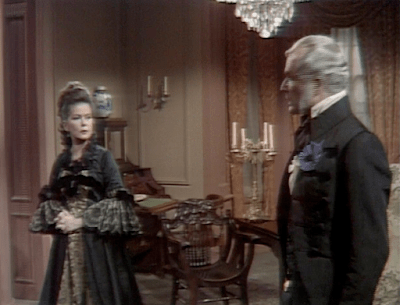
Barnabas’ father Joshua has learned of his son’s curse, and is desperate to find a way to free him of it. Today, we open in the Old House on the estate. Joshua has summoned the countess to meet him there. Joshua brings the countess up to date about Barnabas’ condition. He also informs her that the one who played the curse was not the luckless Victoria Winters, who is currently in gaol awaiting execution on charges of witchcraft, but was in fact the countess’ one-time maid Angelique. At this, the portrait above the mantel vanishes and is replaced with one of Angelique.
This is the first we have seen the portrait of Angelique. As Danny Horn points out in his post about this episode on Dark Shadows Every Day, it is a message to the audience. Barnabas killed Angelique weeks ago, and her ghost, which was pretty busy on the show for a little while after that, has not been prominent lately. They are running out of unresolved storylines, and will be returning to the 1960s soon. When they show us that they have commissioned and paid for a portrait of Angelique, the makers of Dark Shadows are telling us that she will be back when they return to a contemporary setting.
Joshua asks the countess if she can help lift the curse. At first the countess shows incredulity that Joshua thinks she can “provide a witch” who will counteract Angelique’s spell, but she immediately follows this display by announcing exactly how they will go about summoning such a person.
Back in the great house, naval officer/ sleazy operator Nathan Forbes is continuing with his efforts to drive his new wife Millicent insane so that he can get his hands on her share of the Collins family fortune. Millicent has seen a light in the room on top of the mansion’s tower. Nathan denies having seen the light, and Millicent takes his denial, not as a sign that his vision is failing, but as a reason to fear that she is hallucinating. Nathan insists that she go to the tower room and prove to herself that no one is there.
Returning viewers will be startled by this insistence of Nathan’s. Nathan has deduced that Barnabas is in the tower room. He does not know that Barnabas is a vampire, but does know that he is responsible for the many killings that have taken place in the area recently. When he presses Millicent to go to the room, he is not only trying to unhinge her mind, but is sending her to surprise a crazed murderer in his lair.
Perhaps Nathan hopes only that Millicent will be shocked to see her cousin. But he has been using his knowledge of Barnabas’ presence on the estate to blackmail Joshua. Millicent is a compulsive talker. If she learns that Barnabas is at home, it will only be a matter of time before she tells everyone about it, making Nathan’s information worthless as leverage over Joshua. Unless Nathan does in fact calculate that Barnabas will kill Millicent, it is hard to see what he thinks will happen when Millicent goes to the room.
Joshua and the countess return to the great house. Joshua hustles everyone out, commanding them to go into town to attend a speech by the governor of Massachusetts.* Nathan resists; alone with Joshua, he asks if Barnabas will still be in the tower when everyone gets back. Joshua refuses to discuss the matter.
Joshua and the countess begin their summoning ceremony in the drawing room. Nathan eavesdrops at the door. Joshua finds him there and drives him from the house; the ceremony begins again.
Millicent goes to the tower room. She lets herself in. Barnabas confronts her. He tells her that he will let her go if she will promise never to tell anyone she saw him there; she cannot do that. Patrick McCray puts it well in his post on The Dark Shadows Daybook: “Millicent’s tragedy is that her nature compels her to tell the truth. She knows it will kill her and she knows that she is consigned to it. She is addicted to chatter and chatter will kill her. When she screams at Barnabas’ attack, I think she’s not so much screaming at the terror of the vampire as she is screaming at herself.”
In the drawing room, the countess and Joshua continue the ceremony. We hear the wind. One draft blows out the candle; another blows open the door. An old woman appears in the doorway. She enters the foyer, and says that it is too late- the man they have summoned her to help has already gone.
*In our time-band, Samuel Adams held that office in 1796. We might imagine that Adams had a counterpart in the universe of Dark Shadows. If so, it would have struck people odd that Joshua was not already committed to attending the speech, and indeed that he had not invited Governor Adams to spend the night at Collinwood. When Joshua first met the countess, he proudly claimed that the French Revolution was an imitation of the USA’s War of Independence; by that point in history, such a claim marked its maker as a supporter of the faction in American politics that the governor represented, the more militant wing of Thomas Jefferson’s party. In fact, much later in the series we will see a portrait of Jefferson prominently displayed at Collinwood. Joshua must surely have been the richest and most eminent Jeffersonian in the region, so much so that even though his family was in mourning they would still have been expected to host the governor in their mansion.
The name “Barnabas Collins” was first spoken on Dark Shadows by strange and troubled boy David Collins in #205. By the time of his first appearance in #211, it was already clear to the audience that Barnabas was a vampire. Yet the word “vampire” was never spoken on the show in those days. Barnabas was referred to as one of “the Undead,” a title that had previously been given to David’s mother, blonde fire witch Laura Murdoch Collins, and also as “the living dead.” At times avoidance of the word led to a bit of fun. So in #315, mad scientist Julia Hoffman is trying to talk Barnabas out of killing David, and says that the boy must not die “at the hands of a-.” When her voice breaks off, Barnabas smiles, leans in, turns his face towards her, and asks “at the hands of a what, doctor?” He is positively gleeful that she has come so close to blurting out a taboo word. It’s as if he had caught her about to make a fool of herself by uttering a slur, and he all but dares her to say it out loud.
As of today, Barnabas has been a part of Dark Shadows for 41 weeks, the same length of time the show had been running before David spoke his name.* The embargo on the word “vampire” finally ends today. We are in the year 1795, and wicked witch Angelique has cursed Barnabas. The first part of the curse has killed him. His father, haughty overlord Joshua, believes Barnabas died of the plague and has hidden his corpse in the secret room of the Collins family mausoleum lest this news cause a panic at the shipyards. Joshua refuses to tell anyone where Barnabas’ remains are, even Angelique, who was Barnabas’ wife.
Angelique regrets the curse, and tried to lift it while Barnabas was still alive. Now that he has died, she wants to prevent the second part of it from coming true. If she does not drive a stake through Barnabas’ heart before dusk, he will rise as a vampire.
Angelique summons much put-upon servant Ben. Ben had been Barnabas’ loyal friend, and to his great misery Angelique has used her powers to enslave him and force him to help in her evil schemes. Now she orders him to find Barnabas’ body, make a sharp stake out of holly wood, and report back to her.
Joshua violently disapproved of Angelique’s marriage to Barnabas and wants to be rid of her. He offers her $20,000 in gold if she will go away and leave behind a signed paper promising never to return. He leaves the paper and the passbook to the bank account containing the gold, and we see her sign.
It isn’t always very meaningful to compare prices across centuries. You couldn’t get a smartphone or a Lexus or a roll of toilet paper for any amount of money in the eighteenth century. But we can compare the price of gold from year to year. In 1795, the official price of gold in the USA was $19.39 per ounce. So, when Joshua offers Angelique $20,000 in gold, he is offering her 1031.46** ounces of it. As I’m writing this (17 January 2024,) the price of an ounce of gold is $2010.60. So, there is a sense in which Joshua pays Angelique $2,073,852.50 to leave Collinwood.
Ben returns with the stake; he and Angelique go to the mausoleum. There, Ben opens the secret room, remarking that Joshua showed it to him on his first day as a servant at Collinwood. Joshua had explained that he hid guns there for the Continentals during the War for Independence, and he wants Ben to keep it clean so that it will be ready in case it is ever needed again. Ben says that it is hard to believe that Joshua was a patriot during the Revolution, but he supposes he was. That Joshua still thinks it might be necessary to take up arms at short notice during the second term of the Washington administration suggests his politics might have been rather fervent.
In the secret room, Angelique and Ben see Barnabas’ coffin. She introduces Ben to the word “vampire,” then tells him to open the coffin. He refuses, and runs out of the room. He shuts the door, sealing her in the chamber with Barnabas. It is surprising that he can do this- perhaps her power over him is waning. She opens the coffin herself and picks up the stake and mallet. The music plays on the soundtrack, and she moves in time with it. She raises the mallet, we catch a glimpse of Barnabas*** in his coffin, and the episode ends.
*Though he has been in the air for a bit longer than that. We first saw his portrait on the wall next to the front door of the great house of Collinwood in #204, and while the portrait was being painted an elaborate shot was tricked up in #195 to make it look like a portrait was on that spot.
**To be exact, 1031.45951521 ounces.
***A stand-in wearing heavy makeup, not Jonathan Frid.
In episode 368/369 of Dark Shadows, haughty overlord Joshua Collins of Collinsport, Maine told his house-guest, the Countess DuPrés, that he was surprised she still chose to “affect a title,” since in this year of 1795 “France has followed our example and become a republic.” After the countess handed Joshua his head, he fumed to his wife Naomi that her snobbish Old World ways offended him, since he is such a devout believer in human equality.
It was immediately clear to any viewer that Joshua was being hypocritical. He tyrannizes his family and treats his servants as domestic animals that have unaccountably, and rather inconveniently, gained the power of speech. When he says that all men are equal, he means that he, personally, is the equal of anyone in a sufficiently lofty position, and the superior of everyone else.
Audience members who know something about the history of the late eighteenth century in the USA and France will find more to savor in Joshua’s preposterous position. By 1795, the French Revolution had gone through its most radical phases, and was anathema to everyone in the USA other than some of the nascent political tendency led by Thomas Jefferson, a tendency known in the southeast and New England as the Republican Party and in the middle states and the west as the Democratic Party. When Joshua says with great satisfaction that “France has followed our example and become a republic,” he is identifying himself with the most militant factions of the Jeffersonian party, and when he tells Naomi that “all men are equal” he is echoing the most famous passage of Jefferson’s most celebrated writing.
Ridiculous as it is to hear Joshua invoke the egalitarian rhetoric for which Jefferson was so well known, as a major landowner in a rural area far removed from the major cities he was perfectly typical of the most important backers of the Democratic/ Republicans. Jefferson himself was a member of this category, and he displayed both a remarkably sophisticated understanding of the leftwardmost theorists of the French Revolution, as demonstrated for example in the edition of the works of Destutt de Tracy that he prepared for publication in 1817, and a dismally cruel approach to his livelihood as a slave-holding planter.
When Dark Shadows was on the air in 1966-1971, the party that traced its origins to Jefferson was undergoing a revolution of its own. The coalition he forged between working-class groups in the north and rich slave-owners in the south had been an inspiration to the Democratic Party from the days before the Civil War right through the presidencies of Woodrow Wilson and Franklin Roosevelt. After World War Two, the African American freedom movement finally scrambled this unlikely coalition, winning Black southerners the vote and challenging the dominance the heirs of the slave-owners had long held in the Democratic Solid South. Thoughtful Americans, seeing this change, might well think back to the origins of the Democratic Party and to the ridiculous incongruity of Jefferson’s soaringly egalitarian words coming out of his and other oligarchic mouths.
At the top of today’s episode, Joshua is very thorough about betraying all of Jefferson’s ideals. He tells Naomi that the common folk of the town must not know that their son Barnabas killed his uncle Jeremiah in a duel. Naomi replies that everyone already knows; Joshua insists that they do not, and declares that they will believe what he tells them to believe.
One of the major themes of Jefferson’s correspondence, as indeed of Destutt de Tracy and other Enlightenment philosophes, was what Karl Marx, a close reader of Destutt de Tracy, would call “false consciousness,” the tendency of the oppressed classes to see the world in categories generated by the ruling class, and that if false consciousness were erased the oppressed would rise up and sweep away all manner of social evils. Joshua’s determination to keep the working people of Collinsport in the dark about what is happening on the estate of Collinwood puts him at the opposite extreme from the beliefs his leader Jefferson professed. In his own life, Jefferson himself set about enforcing regimes of lies on more than one occasion, as for example when he used his office as president of the United States to cover up the crimes of General James Wilkinson. Even viewers who hadn’t read Jefferson’s letters and who were unaware of Jefferson’s less inspiring actions may well have known, in 1967, that the confidence which the Declaration of Independence expresses in what will happen if “the facts be submitted to a candid world” sat uneasily with the lies on which slavery in particular and white supremacy in general rests.
Joshua begins dictating to Naomi a fictitious story that sounds oddly familiar to regular viewers. Before well-meaning governess Vicki was plunged into her uncertain and frightening journey into the past, we had heard several versions of the Collins family history, none of which resembles the events that we have actually seen play out so far. As Joshua tells Naomi what he has decided people should believe, for the first time the outlines of the Collins family history published in the 1950s come into view. That history is not only sustained by false consciousness, but has its origins in a brazen lie.
Joshua is busy fabricating when Naomi interrupts him with more bad news. Barnabas has decided to marry Angelique, maid to the Countess DuPrés and to the countess’ niece, Barnabas’ former fiancée Josette. The great egalitarian Joshua is thunderstruck that his son would fall into the clutches of an “adventuress.”
Joshua sends Naomi to fetch Barnabas. He thunders his disapproval of the marriage, and Barnabas stands his ground.
Later, we see Josette in the cemetery, at Jeremiah’s grave. Barnabas spots her, and wonders whether he should tell her about his engagement to Angelique. He doesn’t want her to hear of it from someone else, as she surely will very soon. But the place could not be less appropriate. He approaches her; they have an awkward little talk, in the course of which he urges her to hate him for killing her husband. She says she cannot. She tells him not to say any more. He is helpless.
Angelique arrives and tells Josette that her carriage is waiting. Josette invites Barnabas to ride back to the manor house with them; he declines. Josette leaves the two of them alone for a moment; with a note of jealousy that belies her agreement to a sham marriage to a man who will always love Josette, she asks Barnabas if she interrupted something. He says that she did not. That’s true- he had already given up the idea of telling her about their engagement when Angelique joined them.
Back in the manor house, Joshua summons Angelique to the front parlor, where he offers her $10,000 to relinquish her claim on Barnabas and go back to the island of Martinique. It is difficult to compare prices between 1795 and 2023; to get a sense of proportion, we might remember that when Joshua offered Vicki a job as governess to little Sarah Collins in #367, he offered her a salary of $4 a week, and that this was rather a generous rate of pay for the position. So it would take even an upper servant 2500 weeks, that is to say almost fifty years, to earn the amount of money Joshua is offering Angelique.
Angelique refuses Joshua’s bribe. He says he is prepared to offer more, but when he sees that she is firm in her refusal he switches to threats. Naomi intervenes and says that she does not want to break ties. With Naomi’s promise of friendship, Angelique agrees to wait until the mourning period for Jeremiah is complete before marrying Barnabas.
What returning viewers know that Joshua, Naomi, Barnabas, the countess, and Josette do not is that Angelique is not only a maid, but is also a witch. It was under her spell that Josette, though in love with Barnabas, conceived a mad passion for Jeremiah, that Jeremiah, though a loyal friend to Barnabas, reciprocated that passion, and that the two of them, though they struggled with their consciences, eloped. That elopement prompted the jilted Barnabas to challenge his uncle to a duel, and his bewilderment at his own actions prompted Jeremiah to delope and let Barnabas kill him. Angelique and Barnabas had had a brief romantic fling before he became engaged to Josette, and she believed that once Josette was out of the way Barnabas would return to her.
It hadn’t quite worked out that way. In her frustration at Barnabas’ continued preference for Josette, Angelique cast a spell on Sarah, sickening her and threatening her life. When she saw how upset Barnabas was by his little sister’s illness, Angelique said that she could cure it, and extorted his promise to marry her if she did so. She released Barnabas from that promise in #390/391. When he told her that Josette would always come first for him, even though he knew there could never again be anything between them, she said she would marry him anyway. Apparently thinking he wouldn’t be likely to find another woman willing to enter a sham marriage on that basis, Barnabas proposed, and Angelique accepted.
In their conversation in the parlor, Joshua tells Angelique that he knows about the promise she extorted from Barnabas with her ability to cure Sarah. Evidently Barnabas told Naomi about that. There are those in the house who believe that witchcraft is afoot; indeed, Vicki is in hiding, having been accused as the witch. This story would seem to be proof positive that Angelique, not Vicki, is the guilty party, and she does widen her eyes when Joshua brings it up. But he and Naomi don’t make the connection.
Back in the graveyard, Angelique is holding a miniature coffin and casting a spell.
Where did she get that miniature? Screenshot by Dark Shadows Before I Die.
In her bedroom, Josette hears Angelique’s disembodied voice, saying that Jeremiah is not dead. She runs to the front door, where Naomi sees her. Unable to dissuade her from going out in the night, Naomi follows Josette to Jeremiah’s grave. Josette keeps hearing the voice; Naomi does not hear it. But when Jeremiah’s hand bursts out of the soil, both women see it.
Jeremiah waves to the ladies. Screenshot by Dark Shadows Before I Die.
In the parts of Dark Shadows set in the twentieth century, Joan Bennett played matriarch Elizabeth Collins Stoddard. Of all the major characters, Liz was the most reluctant to acknowledge the existence of supernatural forces, and she was the one who was least likely to see the evidence of such forces that abounded in the world around her. So when we see her as Naomi watching Jeremiah’s hand reaching out of his grave, it is the first time we have seen her react to an incontrovertible sign of the paranormal. It makes us wonder how far back in the Collinses’ past the roots of Liz’ denial extend.
In 1966 and the early weeks of 1967, the Collinsport Inn was an important place on Dark Shadows. The restaurant there, presided over by Maggie Evans (Kathryn Leigh Scott,) The Nicest Girl in Town, was a place where people could meet each other unexpectedly and characters new to town could be introduced. Dashing action hero Burke Devlin (Mitch Ryan) lived in a suite at the inn, and the place often represented his territory, the base from which he conducted his war against the ancient and esteemed Collins family.
We haven’t seen Burke’s room since #206, at which point he had given up his vendetta against the Collinses and proceeded far down the road to irrelevance. We haven’t seen the restaurant since vampire Barnabas Collins (Jonathan Frid) met Maggie there in #221. By the time Anthony George took over the part of Burke in #262, Burke seemed to live in the Blue Whale tavern. He made business calls from the pay phone there, and in one episode apparently stayed behind when the bartender locked the place up for the night.
The inn makes a return appearance at the top of today’s episode. It is 1795, and Jeremiah Collins (Anthony George) is sharing a suite with Josette DuPrés (Kathryn Leigh Scott.) They are on their honeymoon.
Jeremiah and Josette eloped from the estate of Collinwood on the night when Josette was supposed to marry Jeremiah’s nephew, kindly gentleman Barnabas Collins (Jonathan Frid.) Josette truly loved Barnabas and Jeremiah was his dearest friend, but they were under a spell cast by wicked witch Angelique, who wanted Josette out of the way so she could have Barnabas for herself. The power of the spell waxes and wanes. When Josette and Jeremiah are in the grip of it, a trident shaped mark appears on their hands; when they return to their senses, the mark disappears.
When the episode begins, the tridents are showing, and the newlyweds are inflamed with passion. Shortly after, Josette’s mark is gone, Jeremiah’s still showing. She is filled with regret, he is still ardent.
Back in the manor house of Collinwood, Barnabas has a conversation with Josette’s father André and his own father Joshua. He resists André’s suggestion that Josette and Jeremiah must have left together, and resists even more strenuously Joshua’s declaration that they did so because they are the victims of witchcraft. Joshua says that his sister Abigail and André’s sister, the Countess DuPrés, found a blasphemous trinket in the quarters of governess Victoria Winters, and that a witch-hunting divine, the Reverend Trask, is coming to investigate the matter. Barnabas is appalled at the notion of an inquiry into witchcraft, and vows to defend Victoria if Trask comes. Joshua forbids him to do so.
Barnabas’ reaction to the idea of a witchcraft trial, coupled with what we have seen of him so far in the 1795 segment, looks like a retcon. In #358, only a week and a half before we began this uncertain and frightening journey to the past, vampire Barnabas told a story about studying witchcraft under a warlock on Barbados who taught him “the secret magic number of the universe.” Events are moving so fast that it doesn’t look like Barnabas will have time to sail to the Caribbean before he becomes a vampire, and he won’t be crossing any waters after that. But now he is a man of the Enlightenment, who scoffs at the idea of witchcraft today as he scoffed at the tarot when the countess introduced him to it in #368/369.
Jeremiah returns to the house. There is an exquisite little scene with a servant, Riggs, who is uncomfortable at the sight of the disgraced Mr Jeremiah. Riggs stands in for the establishment of Collinwood and the whole working class of the town of Collinsport, and in his reaction we see the disquiet that bad news from the big house on the hill would spread among the people whose livelihoods are at stake when trouble comes to the family there. Riggs makes haste when Jeremiah tells him to go out and fetch Joshua.
When Riggs is gone, Josette enters. The audience sees that the mark is gone from Jeremiah’s hand, and Josette can tell that his passion for her is gone. She tells him that he no more loves her than she loves him. He begins with a protest against this remark, but ends by saying that they must be kind to each other.
Joshua and André enter. André embraces his daughter and tells her everything will be all right; Joshua looks at his brother with distaste and demands an explanation.
Jeremiah says that he and Josette are married. He further says he realizes they are not welcome, and that they will return to the inn. This raises the prospect of a recreation of the early days, with the inn as a territory separate from and opposed to Collinwood. Joshua rejects the idea at once. He will not have the scandal of Jeremiah and his new wife living in town because they have been estranged from the rest of the Collinses. He decrees that they will live at Collinwood and put on a happy face for the townsfolk.
Barnabas enters. Joshua tells him that Jeremiah and Josette are married. He refuses to believe it until Josette confirms it herself. He takes the glove from Jeremiah’s hand and slaps him in the face. He gives him a choice of weapons.
Dueling may have been as alien to the ideals of the Enlightenment as were Barbadian warlocks, but so too is Joshua’s plan of forcing the whole family to commit itself to a massive lie in order to preserve its hereditary privileges. Joshua, the proud apostle of Jeffersonian republicanism, is simply being a hypocrite, but Barnabas is a more complicated figure. Seeing his every hope turned to dust before him, his ideals have become useless. He has only a moment to choose among the evils the Enlightenment had promised to stamp out, and he chooses the most macho one available.
Joshua forbids the duel, but Barnabas disregards his father’s authority and insists on it. In 1795 and for some time after, dueling was widely practiced in much of the United States, and particularly in the South and West a gentleman lost face if he refused a challenge. No such stigma attached in New England, where dueling was condemned by law and religion. Had Joshua or Jeremiah gone to the police, Barnabas would have been arrested. In 1719, Massachusetts, of which Maine was a part until 1821, passed a law making it an offense punishable by a fine of £100 (equivalent to about $7000 today) to challenge someone to a duel. Massachusetts law already considered it murder to kill someone in a duel, and prescribed death by hanging as punishment. Of course, Joshua’s declaration that Jeremiah and Josette will live in the house and the family will present a “united front” to deter scandal makes it clear he will never turn his son over to the police, and the pattern of cover-up with the support of law enforcement we saw among the Collinses in 1966 and 1967 leads us to doubt that anything a member of the family does will ever be a matter for the courts to judge.
There is a missed opportunity in the show’s lack of interest in Massachusetts’ actual laws about dueling. The 1719 law was amended to be even stricter in 1730. Among the provisions added to the law at that time was a requirement that anyone who had either been killed in a duel or been put to death for winning a duel would “be given an unchristian burial at a gallows or crossroads, with a stake driven through their body.” Since the audience knows that Barnabas is fated to become a vampire, there is a chilling irony in seeing him volunteer for a staked burial.
In #370, wicked witch Angelique cast a spell on her onetime lover, young gentleman Barnabas Collins. To her surprise, the spell seemed likely to kill him. It took her the bulk of #371 to figure out a way to undo it.
That was the first we learned that Angelique was a witch, and her ill-success left us wondering if it was her first time casting a spell. By now we have seen her cast several more, some quite powerful. It no longer seems likely that she is a novice conjuror.
Early in today’s episode, we learn that Angelique is aware of the limitations of her ability. Thinking about what she has planned for Barnabas, she tells herself that once she has cast her next spell, she won’t be able to stop its consequences even if she wants to. As the idea that she might be new to sorcery led us to wonder if she would at some point turn from her ways and try to make up for her misdeeds, so this line leads us to expect that she will eventually find herself regretting something she has done.
For most of its first 73 weeks, Dark Shadows kept falling into long stretches where only one storyline was going at a time. They are in danger of that now; we are in the middle of the third week of the trip back in time to 1795, and only Angelique has made anything happen. Today, they take a step to correct the situation.
Caddish naval officer Nathan Forbes brings some papers to kindly Jeremiah Collins, and asks if governess Victoria Winters is available for his attentions. Jeremiah says that she isn’t, and asks if he would “accept Millicent Collins as a substitute.” Millicent is Jeremiah’s second cousin, and she is a feather-headed germophobe. Nathan recoils at the suggestion, until Jeremiah mentions that Millicent is very, very rich. He then goes directly to her and starts wooing her with gusto.
Joel Crothers and Nancy Barrett play Nathan and Millicent. In 1966, the same two actors played hardworking young fisherman Joe and flighty heiress Carolyn. In those days, Joe and Carolyn were dating but would rather not be. They were stuck playing one pointless scene after another about how bored they were with each other. When shameless Nathan plies his mercenary charms upon muddled Millicent, we see how much fun Crothers and Miss Barrett could have when the script gave them something to work with. They are a joy to watch.
Meanwhile, Angelique is working to prevent Barnabas from marrying his fiancée Josette. To that end, she has cast a spell causing Josette and Jeremiah to conceive a mad passion for each other. Last night, Barnabas’ mother Naomi had a dream in which Jeremiah was kissing a woman who had a trident marked on her hand. Today, she tells Jeremiah about the dream. He affects unconcern.
Josette, Millicent, and Naomi are about to have a little tea party. Naomi says that her husband disapproves of tea on political grounds. “Joshua remembers the Revolution, and regards tea as a symbol of British authority.” This reminds us of #368/369, when Joshua told Josette’s aunt, the Countess DuPrés, that he was surprised she still chose to “affect a title,” since, as he proudly reminds her, “France has followed our example and become a republic.” After the countess has put him rather firmly in his place, Joshua seethes to Naomi about her snobbery, and loudly declares his belief that all men are equal. These statements mark Joshua as a supporter of Thomas Jefferson, and as an extraordinary hypocrite- we have seen that Joshua is a tyrant in his household and that he regards his servants as a rather noisy form of domesticated animal.
As Josette offers her a cup of tea, Naomi sees the trident mark on her hand. She exclaims “It’s you!” and dashes out.
Josette had never seen the mark before. She goes to her room and tries to wash it off her hand. Angelique enters; she is the countess’ maid, but she also seems to be the only servant the DuPrés family has brought to Collinwood, and she is the one who has been attending Josette. Josette has no idea she has anything to fear from Angelique; had Barnabas admitted to Josette that he had a brief affair with Angelique before he knew Josette was interested in him and that Angelique is angry he does not want to resume it, Josette might not place herself so completely in her hands. Angelique rubs away the mark, but no doubt also applies some further mumbo-jumbo to her in the process.
Josette is alone in her room when a knock comes at the door. It is Jeremiah. He has been struggling to keep himself from coming to her, but he cannot resist. She is more deeply under the spell than he is, and welcomes him. He tries to shake her out of her amorous state. Some think he overdoes it:
He tries to go, then turns and nearly kisses her.* Finally he manages to leave the room. He has resolved to stay away until Josette and Barnabas are safely married.
*There is some kissing earlier in the scene. I discussed Anthony George’s stupefyingly bad kissing in detail when he played Burke Devlin, fiancé of well-meaning governess Vicki. In his post about this episode on Dark Shadows Every Day, Danny Horn goes into depth about how George “sticks his face to” Kathryn Leigh Scott and makes “weird kissing motions” with “his big monkey lips.” He provides five screenshots to accompany his analysis of this “watershed moment in awkward affection.” I don’t see any need to add further comment on this matter.
In 1966 and 1967, supernatural menaces Laura Murdoch Collins and Barnabas Collins would often be seen staring out the windows of their houses on the great estate of Collinwood, sending psychic energy towards the targets of their sinister plans. In 1795, Barnabas is neither supernatural nor menacing, but we already see him peering out one of those windows. He is not projecting bad vibes into the world, but is worried about his beloved fiancée, Josette DuPrés. She is supposed to arrive soon, in fact was supposed to arrive some time ago. Now there is a storm, and he hopes she is not at sea.
The audience’s main point-of-view character in 1966 and for most of 1967 was well-meaning governess Vicki. Now Vicki has come unstuck in time, and found herself in this extended flashback to the eighteenth century. Since she will know Barnabas and regard him as a close friend in the 1960s, she is at her ease talking to him now. Although she is a member of the staff in his family’s house in a period when it was customary for masters to summon their servants with bells and communicate with them only in direct commands, Barnabas is a remarkably genial and democratic sort who welcomes her casual manner.
Vicki has already annoyed the audience several times by blurting out information that makes it obvious to the other characters that she does not belong in their world. She does that again in this scene. Barnabas is worried something may have happened to Josette, and Vicki tells him that she will arrive safely. He is surprised by the assurance with which she delivers this prediction, and asks if she is clairvoyant. She realizes that she has been indiscreet, and denies that she is. He is unconvinced.
Barnabas’ father, haughty overlord Joshua Collins, enters. He is appalled to find his son socializing with a servant. He dispatches Vicki to the nursery to look after her charge, his young daughter Sarah. He demands to know why Barnabas is not tending to his own duties at the family’s shipyard. They begin to quarrel, when a knock comes at the door.
Barnabas opens the door to find a woman named Angelique, whom he identifies as maid to Josette’s aunt, the Countess DuPrés. Angelique says that the countess was on her way to Collinwood, but that her carriage is stuck in the mud. Joshua orders Barnabas to send a footman to rescue her. Angelique is the first character we have met in 1795 who is not played by a performer we have seen in the first 73 weeks of the show.
Joshua goes to his wife, Naomi. Naomi is an alcoholic, a fact of which we are made aware because almost her every scene begins with a shot of her drinking alone. That’s what she is doing before Joshua finds her. He scolds her for her drinking; she complains that he doesn’t allow her to do anything else. She can’t even pass the time with a book- we saw Monday that Naomi is completely illiterate.
Naomi’s alcoholism is both a nod to the concern of first-wave feminism with the atrophy of the elite housewife, and a suggestive side-light on Barnabas as we knew him in the 1967 segment. Then, Barnabas abducted Maggie Evans, The Nicest Girl in Town, and tried by more or less magical means to replace her personality with that of Josette. For the first 40 weeks of Dark Shadows, Maggie’s father’s alcoholism had been a substantial story element, and she would always retain a number of classic Adult Child of an Alcoholic (ACoA, in the lingo of the recovery movement) characteristics, such as beginning utterances with a little laugh to prove that she is happy. Now that we know that Barnabas is also an ACoA, we can wonder if that shared experience was part of the reason he was drawn to Maggie.
The countess arrives. Since she is played by Grayson Hall, who also plays mad scientist Julia Hoffman in the parts of the show set in the 1960s, Vicki blurts out “Julia!” when she sees her. Hall had also been nominated for an Academy Award for her performance as Judith Fellowes in the 1964 film Night of the Iguana; if Vicki is going to keep the audience up to date on the cast’s resumes, it would have been more interesting if she’d exclaimed “Judith!” Vicki explains that the countess looks like someone she once knew who was named Julia, a remark which irritates the countess, who would like to think her appearance is distinctive. Vicki has certainly not made a favorable impression on this grand lady.
Joshua tells the countess he is surprised that “You still affect a title” when “France has followed our example and become a republic.” His pride in this development, after the Terror and in the bloodiest year of the wars in the Vendée, marks Joshua as a member of the Jeffersonian party in US politics. The Federalists and others had long since turned against the French Revolution by that year.
The countess tells Joshua that it is precisely because France has become a republic that she chooses to live on the island of Martinique. That answers a question that some fans ask about Angelique- why is she white? If the DuPrés family lives on Martinique and are major sugar planters there, they must hold a great many African people in slavery. When we hear that they are bringing a servant with them, we expect that servant to be Black. When we learn that the the countess is an emigré, we realize that she brought Angelique with her from France.
The countess may solve one puzzle for us in her exchange with Joshua, but she presents us with another. Josette’s father André is the countess’ brother, yet he is never referred to as a count. Indeed, when he appears, we will see him answer to “Mr DuPrés.” Perhaps he renounced his title, as many French aristocrats did during the Revolution.
Whatever the explanation, “DuPrés” would seem to represent a missed opportunity. When Josette was first mentioned, in the early months of Dark Shadows, her maiden name was given as “LaFrenière.” It would have been a nice touch to have kept that name for Josette and her father, and to have reserved “DuPrés” as the name of the countess’ late husband.
“LaFrenière” had been a perfect choice because of its class ambiguity for a show about an aristocratic family in the state of Maine- it was originally the family name of the barons of Fresnes, and could therefore be a sign of a senior order of nobility, but is also a very widespread name in Quebec. So “Josette LaFrenière” might either have been a French noblewoman who deigned to marry into the mercantile Collins family at the apex of their prestige, or a working class girl from the north who eloped with the boss’ son.
The choice of Martinique as Josette’s place of origin might add a new twist to this class ambiguity. The Empress Josephine grew up there as a member of the untitled but ancient Tascher family, who, like the fictional DuPrés family, owned an enormous sugar plantation on the island. The Taschers of Martinique went back and forth between Martinique and metropolitan France, and Josephine herself was living there in 1779 when she married her first husband, the Vicomte de Beauharnais. Josephine herself was in prison when the vicomte was guillotined in 1794, one of the last to die in the Reign of Terror, and she was freed just a few days later. The next year, she recovered her husband’s property, and a year after that married the young general Napoleon Bonaparte. It seems likely that the similarity between the names “Josephine” and “Josette” was writer Sam Hall’s inspiration for placing Josette’s origins on Martinique. Association with a figure who was at once a grand lady and an example of very steep upward social mobility could synthesize the two possible Josettes LaFrenière into a single figure.
Had they developed the story of the family’s relationship with the town of Collinsport more richly in Dark Shadows 1.0 and 2.0, they could have used this ambiguity to build up suspense that would be resolved today, in the third episode of Dark Shadows 3.0. Since they did so little with that theme in those days, when the story was moving very slowly and it would have been relatively easy to fit just about anything in, I suppose we shouldn’t be surprised that they drop it so completely at this period of the show, when the story is flowing at a breakneck speed.
The countess’ lofty aristocratic manner stings Joshua. Alone with Naomi, he loudly proclaims his belief that all men are equal. We already know enough about Joshua’s tyranny over his household that this absurd little speech must be an intentional spoof of the rich landowners who supported the Jeffersonian party in the early decades of the Republic. Again, this would be funnier and more poignant if the show had done more with social class in its first 73 weeks.
Barnabas sees the countess dealing out tarot cards. He tells her she is too sophisticated for them, and is reluctant to sit with her while she uses them to read his fortune. The moment she says that the cards suggest a connection between him and the concept of infinity, his skepticism evaporates instantly and he excitedly asks if that means he will live forever. The countess cautions that his jubilation at this idea may be misplaced. She notices the “Wicked Woman” card, and takes a significant look at Vicki. Evidently the audience is not alone in objecting to Vicki’s brainless nattering about what the show used to be like.*
Angelique comes to Barnabas’ room. It turns out the two of them had a brief affair when he was first on Martinique, and she expects to resume it. He is not at all pleased at her attentions.
Not how every man would react to a passionate embrace from Lara Parker… Screenshot by Dark Shadows Before I Die.
Barnabas explains that he was already falling in love with Josette when he and Angelique had their fling, but that he didn’t really know her. He couldn’t believe that she would reciprocate his feelings, and consoled himself by dallying with Angelique. This explanation goes over with her about as well as you’d expect, and she storms out of the room, vowing that she will get her way in the end.
We know that the tarot cards are giving accurate information, because the show leans heavily on the uncanny and they wouldn’t have spent so much time on a gimmick that wasn’t meant to advance the plot. We also know that Vicki is not the Wicked Woman the countess is looking for. That leaves Angelique, and we can assume that her wickedness will express itself in some supernatural action taken to avenge herself on Barnabas. Since we know that Barnabas will become a vampire, we wonder if it is Angelique who makes him one.
Closing Miscellany
I usually refer to surviving cast members with courtesy titles and to deceased ones by surname alone. So Alexandra Moltke Isles is “Mrs Isles,” which has been her professional name for 56 years, David Henesy is “Mr Henesy,” Nancy Barrett is “Miss Barrett,” etc, while Jonathan Frid, Joan Bennett, Louis Edmonds, and Grayson Hall are just “Frid,” “Bennett,” “Edmonds,” and “Hall.” Until last month, I’d been looking forward to saying lots of things about “Miss Parker” and her portrayal of Angelique, but Lara Parker died on 12 October 2023. So she’s just going to be “Parker,” and I’m going to be sad about it.
Artist Teri S. Wood has created a number of short animations about Angelique and Barnabas. This one is based on their two-scene at the end of today’s episode:
Patrick McCray has a post about this episode that mystifies me. He writes that “After seven months of hearing about Angelique, today, she enters. So, no pressure Lara. You only have to live up to a half year of build-up.” Uh, what? There has been absolutely no reference to Angelique on the show before today. I can think of an interpretation of the story that might retroject Angelique into episodes #211-365, and I will talk about it next week. But I don’t think it is an interpretation Patrick would favor.
He also talks about David Ball’s method of reading plays from the ending back to the beginning and then from the beginning forward, so that the ending comes to seem implicit in everything else. He allows that Dark Shadows has more than one ending, but I would say he doesn’t go far enough. I’d say the series has ten endings. The first came in #191, when Laura went up in smoke while her son David found refuge in Vicki’s arms. That ending defined Dark Shadows 1.0 as the story of David’s escape from his evil, undead mother Laura, and his adoption of Vicki as his new, life-affirming mother. The second came in #364, when Barnabas met the ghost of his little sister Sarah, she commanded him to be nice to the living, and he went right on with his murderous plans. That ending defined Dark Shadows 2.0 as the story of Barnabas’ irredeemable evil.
Two of the other endings will feature Angelique dying in Barnabas’ arms, and Patrick suggests that those make the whole show the story of their relationship. I don’t buy it at all. Each of the ten parts is about what it is about, and even those two episodes with Angelique dying derive more dramatic charge from other moments.
*Making connections with the first 73 weeks is my job!
Episode #359 included a recreation of a shot from #69, harking back to a long-forgotten storyline in which housekeeper Mrs Johnson was a secret agent spying on the ancient and esteemed Collins family for their arch-nemesis, Burke Devlin. In #69, Mrs Johnson followed Burke’s orders and eavesdropped on a conversation between him and blonde heiress Carolyn Collins Stoddard. In #359, Carolyn herself is a secret agent, spying on the household for vampire Barnabas Collins. She follows Barnabas’ orders to eavesdrop on a conversation between him and mad scientist Julia Hoffman. The reference showed just how drastically both Carolyn and the show itself had changed from week fourteen to week seventy-two.
The puzzle is why writer Sam Hall watched #69. He wasn’t connected to Dark Shadows in those days, and it would be very far down the list of episodes you would watch in an attempt to get up to speed on what was happening when he came aboard. That puzzle is solved today.
As Mrs Johnson, Clarice Blackburn had a big turn in #69. Angrily denouncing the Collinses, she twisted up her face in a lunatic expression and loudly declared “I believe in signs and omens!” She appeared as the sworn enemy of the people we have been following all along, and as someone who is superstitious even by the standards of the haunted house where most of the action takes place.
Today, we and well-meaning governess Victoria Winters have been transported back in time to 1795. Blackburn reappears in the role she will be playing in the segment of the show set in that year- Abigail Collins, unmarried sister of haughty overlord Joshua. Abigail is a Puritan busybody out of Nathaniel Hawthorne by way of The Crucible. She renews the promise of all the mischief we had hoped Mrs Johnson would make when we first met her, long ago.
Vicki wakes up in the manor house and sees Abigail. She thinks Abigail is Mrs Johnson and is relieved that she has awakened from a nightmare. Abigail quickly makes it clear that the year is still 1795, that she is not “the friendly housekeeper,” and that she finds everything about Vicki to be appalling. She loses no time in declaring that Vicki is possessed by the Devil. Vicki denies this, but does not convince Abigail.
When Abigail leaves Vicki’s room, she locks the door from the outside. The rooms in the servants’ quarters are surprisingly large and well-appointed for the 1790s, but when we see that they can double as jail cells it offsets the apparent luxury. Vicki escapes through the window.
The great house of Collinwood, where Vicki lives in 1967, is under construction, and she goes there. Danny Horn, on his Dark Shadows Every Day, often said that the real subject of the series was the house. This scene corroborates his interpretation. When the ghost of little Sarah Collins said she would tell “the story from the beginning,” she sent Vicki back to the time when the great house was being built.
Vicki finds a man in the foyer played by Anthony George. George had been the second actor to play the part of Burke. You might think her experience with Abigail would break Vicki of her habit of telling her cast-mates what characters they played in the 1960s part of the show, but no such luck. She reacts to George’s new character as if he were Burke. After a moment, she tells him that she can see he isn’t the same man. This is a riddle- if the characters played by the same actor look so much alike that it makes sense for Vicki to keep mistaking them for each other, what does she see in this Anthony George character that sets him apart from the other?
As it happens, George is playing Jeremiah Collins, builder of the great house and brother of Joshua. In #280, Barnabas had given a costume party and George’s Burke had attended it dressed as Jeremiah. Barnabas, a native of the late eighteenth century, had been thunderstruck by the sight of Burke in that costume, unable to do anything but say “Jeremiah!” and glare at him. So there is a strong resemblance, perhaps suggestive of some spiritual linkage between the two men. Vicki’s constant confusion of the actors with their roles indicates that such linkages are to be found throughout the cast. Having her babble about the resemblances out loud so frequently is the most annoying possible way to make this point. If Barnabas had kept mistaking the 1960s characters for their 1790s counterparts, it’s hard to imagine that they would have accepted him and certain that the audience would not have.
Vicki tells Jeremiah that Abigail thinks she is a witch. Jeremiah makes it clear that he finds Abigail’s hostility to be a strong recommendation, and the fact that Sarah is a fan of Vicki’s clinches the deal. He takes her back to the main house.
Once Vicki is back in her room, Jeremiah brings her 1967 clothes. He asks her why she wants them so much, telling her that they will bring nothing but trouble if they are found. She tells him that she will need them when she gets home. Combined with her habit of blurting out remarks that could only strike people in the 1790s as bizarre, Vicki’s attachment to her belongings from her own time suggests that she will very soon find herself in huge trouble. That’s unwelcome- this voyage to the past is shaping up to be interesting, and it would be nice to stay here long enough to get to know all of the characters. If Vicki keeps acting like this, she’ll get herself kicked out of 1795 and drag us back to the 1960s before Dark Shadows has had a chance to show us what they can do with a period piece.
Vicki tells Jeremiah that she has amnesia about her life until her arrival at Collinwood the day before. He tells her that she will have to make up a better story than that. She is shocked that he is telling her to lie, and he says that she will never find a place in the world if she doesn’t.
When Barnabas left 1795 and showed up in 1967, we didn’t see anyone patiently explaining to him that he would have to conceal his true identity and maintain a convincing cover story. He had figured that out by the time we met him. Most of the time he was on screen in those first months, he was trying to play the role of a modern man, a distant cousin from England whom the Collinses had forgotten about. It was fascinating to watch him essay that part. Occasionally he would stumble and blurt out information only someone from an earlier century would know; Vicki caught him doing that more than once, most notably in #233, when it seems for a moment that he might be thinking of killing her to cover his indiscretion. Other times he would face questions he couldn’t answer, and we would wonder what he would set in motion with his attempts to evade them. Quite frequently actor Jonathan Frid would have trouble with Barnabas’ lines, and it would seem that Barnabas, not he, was the one groping for words. When we first realized yesterday that Vicki was taking Barnabas’ journey in reverse, we might have hoped that it would be as interesting to watch her trying to pass as a native of the eighteenth century as it was watching Barnabas trying to pass as a native of the twentieth. That hope took a beating before the day was done, and her conversation with Jeremiah reduces it to a still lower order of probability.
Downstairs, Abigail is telling Joshua and his wife Naomi that they ought to turn Vicki over to “the authorities.” Jeremiah opposes this plan. Naomi makes a great show of screwing up her courage and “for the first time” speaks out against Abigail’s ideas.
This is quite a reversal from what we saw in the part of the show set in the 1960s. Joan Bennett plays Naomi here and matriarch Elizabeth Collins Stoddard there; Louis Edmonds plays Joshua here and Liz’ brother Roger there. But where Joshua is an iron-willed, self-assured tyrant and Naomi his cowed and isolated dependent, Liz is the mistress of Collinwood and Roger a shameless, sybaritic wastrel who lives as a guest in her house and collects a salary from her business. We saw yesterday that Naomi is entirely illiterate; we see today that this inability, though it is an anachronism in a wealthy New England lady of the 1790s, is of a piece with her cramped position in the world. Not only is she supposed to obey her husband; she is supposed to defer to his sister, and is sidelined even in the management of her own household.
The show has been hinting heavily from the first episode that Vicki, played by Joan Bennett lookalike Alexandra Moltke Isles, is Liz’ unacknowledged daughter. It’s certainly no surprise when Liz goes out of her way to stick up for Vicki. Regular viewers, connecting Bennett’s two characters, may not be surprised that Naomi also takes Vicki’s side, but she doesn’t really have much reason within the story to do so. It might have been better if they had given the two of them more time together before this scene, and shown us why Naomi would be especially well-disposed towards Vicki.
Naomi carries her point, and Joshua offers Vicki a position as Sarah’s governess. Vicki is surprised when he asks if she can read; he says that “Many people can’t, these days,” a reference to yesterday’s demonstration of Naomi’s illiteracy. She is startled by his offer of four dollars a week; he angrily asserts he could get someone else for less, and she remembers herself sufficiently to agree that the pay is ample. Joshua is very much the haughty overlord, but he does have some closeups in which we see him looking vulnerable as he tries to figure out who Vicki is and why his wife and brother have taken her side against Abigail. It is a strong scene, and it raises our hopes that Joshua will make exciting things happen.
I think I said everything I wanted to say about this one in the comment I left on John and Christine Scoleri’s Dark Shadows Before I Die. So here it is:
“Idiot Plot” is a term for a story that can go on only if the characters in it are dumber than the average member of the audience. When Vicki left the valve where David could steal it in episode 26, Dark Shadows had its first Idiot Plot.
Now, just two days later, we have our second. The restaurant is open for business, and Maggie says in so many words that Roger is a frequent customer there. So he should walk right in and lay hold of David. But unaccountably, he waits for Maggie to let him in. She turns her back on David, calls Roger by name, and declares that she’s been tricking David into staying, all while David is a few feet away. Even worse, we have a number of scenes suggesting that Maggie had searched the hotel extensively for David and failed to find him, when he was simply hiding in the very telephone booth she herself had used a few minutes before.
Art Wallace is the only credited writer for the first eight weeks of the show. I’m sure he had some help, but not enough, apparently- these two episodes not only disappoint viewers who expect a well-constructed drama, but also do serious harm to the characters of Vicki and Maggie. Vicki has to be so sweet and innocent that unless she’s also as smart as she’s seemed in the first five weeks, she’ll get pretty cloying pretty fast. And Maggie, whether it’s the original wised-up dame who’s everybody’s pal but nobody’s friend or her successor, the nicest girl in town, has to produce witty dialogue and see through people’s attempts to deceive her if she’s to contribute to the story. Casting either of them as Designated Idiot is a sure way to put her on an ice floe to oblivion.
Two other things:
Interesting to see the first scene between Maggie and David. Especially so knowing that these characters will become important to each other later on, but already so as confirmation that the hostility Maggie had expressed towards the Collinses in general in Episode 1 isn’t going to define her character.
The picture of Lyndon Johnson in the sheriff’s office is apparently there to promote ABC’s coverage of the Luci Johnson’s wedding that weekend, but it’s a very odd choice of image. You’d expect the president’s photograph in a government office to show him from the chest up, showing his full face, with his eyes looking at the viewer and a calm or cheerful expression. But this picture is an extreme closeup of his face in profile, and he appears to be wincing. On a wall otherwise decorated with wanted posters, it communicates something less than unqualified admiration for President Johnson. If, as Roger implied in episode 26, the sheriff owes his office to the support of the Collins family, the picture would suggest that the Collinses were not LBJ fans.
I’ll also mention that Marc Masse’s entry for this episode on his Dark Shadows from the Beginning features one of his most outlandish accounts of a control room conversation between director Lela Swift and executive producer Dan Curtis. If you miss the sensibility of the 1970s National Lampoon, you’ll enjoy reading it.








 Dark Shadows Commentary