For most of 1969, Dark Shadows was a costume drama set in the year 1897. Among the characters we got to know were Quentin Collins, Charles Delaware Tate, Count Petofi, and Amanda Harris. Quentin was a rakish libertine and occasional murderer who was cursed to be a werewolf. Tate was an artist. Petofi was a sorcerer who had, for reasons of his own, given Tate the power to paint portraits with magical effects. Tate painted a portrait of Quentin that cured him of the effects both of lycanthropy and of aging. He painted a portrait of an imaginary woman, and she popped into being and became Amanda.
The story of Quentin’s portrait is borrowed from Oscar Wilde’s 1895 novel The Picture of Dorian Gray. The story of Amanda is borrowed from the story of Pygmalion and Galatea that Ovid told in Book 10 of his Metamorphoses. While Pygmalion’s statue of the ideal woman loved him when it came to life, Amanda can’t stand Tate. That’s understandable; like all characters played by Roger Davis, Tate had an intolerable personality. Amanda fell in love with Quentin, who is cruel and evil, but very charming.
Now it is 1970. Quentin has come back to the village of Collinsport, still young and handsome, but suffering from amnesia and unwilling to believe that he is a hundred years old. Amanda is back too. She is also young, not because of the painting, but because a god of death named Mr Best gave her several decades to reconnect with Quentin, get him to say he loves her, and then live with him ever after, perhaps happily.
Mad scientist Julia Hoffman has been working with Amanda to restore Quentin’s memory. Julia, Amanda, and Quentin go to see Quentin’s portrait, which Julia has just had restored. It is suitably gruesome, and Amanda runs out screaming when she sees it. But Quentin examines it, and his memory comes back to him. Julia tells him about Amanda’s deal, and says that Mr Best is on his way. He could catch up with Amanda at any time. Quentin runs out to tell Amanda that he loves her, but gets to the scene a moment too late.
Quentin’s portrait, a face only a fan of EC Comics could love. Screenshot by Dark Shadows Before I Die.
Mr Best takes Amanda to a hotel lobby. She described this lobby to Julia in #922 when she explained her arrangement with Mr Best, but he has to explain it to her today. In #922 he called it “The Stopping-Off Place”; today he calls it “A Passing-Through Place.” He excuses himself, since he has other souls to harvest.
Amanda is alone for a moment with a bellhop in a white costume with an accent that is supposed to be sort of Cockney, or perhaps Australian. The bellhop makes it clear that he used to be alive, and that his current job makes him nostalgic for his days as a human. When he mentions things he can’t do anymore, he looks Amanda up and down for a half second. The wistfulness of his tone, the frankness of his look, and the sadness with which he turns away from her leaves no doubt what he misses. It’s a surprisingly lovely moment, and a much more adult one than we expect from the show at this point.
Back in the land of the living, Quentin and Julia have a scene in Amanda’s suite at the Collinsport Inn. Julia leaves, and Quentin tries to kill himself. Mr Best stops him. He tells him that he knows he is alive “by courtesy of Count Petofi”; this is the first time we have heard Petofi’s name since the show came back from 1897, and the first vague hint that Petofi might have survived the fire that appeared to have killed him in #884. He says that it is not Quentin’s time to die.
Quentin says he doesn’t want to live without Amanda, and Mr Best gets a bright idea. He says he likes experiments, and he has one he will run with the two of them. He takes Quentin to The Stopping Off/ A Passing-Through Place. He explains his idea. As befits Amanda, it is derived from the tale of Orpheus and Eurydice which Ovid tells earlier in Book 10 of the Metamorphoses. As Orpheus was allowed to bring his wife Eurydice back from the realm of the dead so long as they could make the long, arduous journey without looking at each other, so Quentin will be allowed to bring Amanda back so long as they do not touch each other until they return to the sunlight. The episode ends with Quentin deep in thought about this proposition while Amanda walks up behind him, stretching her hand towards him.
Mr Best tells Quentin that if he and Amanda can make their way through the countless traps and perils of the journey back to the upper world, they will be together “for eternity- whatever that means.” It’s intriguing he doesn’t know- he explicitly identifies himself as an immortal being today, and he has such a wide range of discretion that he can only be called a god. Apparently writer Sam Hall is imagining a cosmos where even the gods are left guessing about the answers to the big questions.
The story of Orpheus and Eurydice has long been a popular favorite. In the 1960s, Jean Cocteau’s 1950 Orphée and the 1959 Brazilian hit Black Orpheus were both staples of art cinema and would have been familiar to NYC theater people like the makers of Dark Shadows, so it is hardly surprising that when they start looking to classical antiquity as a source of material that was one of the first stories to come to mind.
This is Emory Bass’ final appearance as Mr Best, and Brian Sturdivant’s only appearance as the bellboy from Hell. Each will return in another small part later this year.
The closing credits roll over an image of Quentin’s portrait. Most of them do, anyway. Sturdivant’s was cut into the middle of the roll over a black background. Apparently they forgot about him until the last minute.
Some invisible Elder Gods known as the Leviathans have taken control of a group of individuals in and around the area of Collinsport, Maine and formed them into a cult serving their plan to reclaim the Earth. Confusingly enough, the cultists are also known as Leviathans.
In 1949, deadbeat dad Paul Stoddard was leaving his family. On his way out of town, he stopped in a bar, where he ran into a Leviathan (whether one of the mortal or supernatural variety is never explained.) This being tricked Paul into selling his infant daughter Carolyn to the Leviathans. Late in 1969, Paul came back to town, where the leader of the new cult, old world gentleman Barnabas Collins, explained to him what he had done that night twenty years before. Since the deal was already made, it is unclear why Paul had to come back to Collinsport, why he had to be told what he had done, and why Barnabas had to be a big jerk to him about it.
Paul has been trying to warn people that something terrible is happening, and Barnabas has become disaffected from the cult. The Leviathans are based on concepts H. P. Lovecraft developed in his tales of cosmic horror, and the specific Lovecraft story from which they have been drawing most heavily is The Dunwich Horror. In that one, what appeared to be a rapidly-growing, unaccountably precocious boy named Wilbur Whateley turned out to be one half of an unearthly creature of vast destructive power. Their Wilbur analogue has been a series of children who live in the antique shop that cultists Megan and Philip Todd own. There is a room above the shop where the creature takes its true, invisible form. Yesterday Barnabas helped Paul escape from captivity, and Paul went directly to the shop where he let himself into the upstairs room. Barnabas and the Todds got Paul out of the room and locked him in the prison cell in the antique shop’s basement.* The episode ended with the creature approaching the door of the cell and Paul holding a chair to use as a weapon against it.
Today we open with the creature entering the cell. The metal door jumps off its hinges and disappears; the chair flies from Paul’s hands; and Megan looks down from the top of the stairs, a gleeful look on her face as she anticipates Paul’s grisly end.
Danny Horn devotes his post about the episode at his great blog Dark Shadows Every Day to a series of complaints about the invisibility of the creature, claiming that it is unsuitable to have something important on a television show that does not come with striking visuals, but I can’t believe that any monster effect would be as impressive as this sequence. Director Lela Swift really delivers with it.
Barnabas shows up in the nick of time and orders the creature to leave Paul alone. He wrangles it back to its room, then scolds Megan for letting it out. While this is going on, Paul staggers out of the shop.
In the street, Paul meets mad scientist Julia Hoffman. Julia knows that Barnabas is involved in an evil scheme. It is very unlike him to leave her out of those, so she is alarmed. She takes Paul to the apartment of her non-evil friend, occult expert Timothy Eliot Stokes.
Stokes and Julia comment on Paul’s appearance. His clothes are rotting away, as if they had been dipped in acid, and something is on him that emits a strong odor. This is a nod to The Dunwich Horror, in which the Elder Gods cannot be seen, but boy oh boy can they be smelled. “As a foulness you shall know them,” goes the refrain. Paul is in terrible shape and can’t talk. Julia vetoes Stokes’ suggestion that they call the police, and even after she notices Paul’s blood pressure dropping she does not suggest taking him to the hospital.
Stokes then shifts Julia’s attention to the B-story. He tells her that a friend of his is just about finished removing an overpainting from the portrait of Quentin Collins. Julia knows that this portrait, painted in 1897, freed Quentin of the effects both of the werewolf curse and of aging. Like the picture of Dorian Gray, it changes while Quentin himself remains the same. Quentin is back in town now, but he has amnesia. Julia believes that showing the portrait to him will jolt his memory back into place.
Julia lives as a permanent houseguest on the estate of Collinwood. We cut there, and see a woman named Amanda Harris pacing nervously in the foyer of the great house. Amanda was Quentin’s girlfriend in 1897, and was in that year granted more than 70 years of youth by a supernatural being named Mr Best. Mr Best said she could go on living even beyond that time if she could reunite with Quentin and get him to tell her her loved her. She has reconnected with Quentin, but since he doesn’t remember their past he doesn’t know he is in love with her. For some reason they don’t reveal to the audience she can’t tell him the truth. She has told Julia everything, and they have joined forces. We can assume Amanda is at Collinwood waiting for Julia to come back.
The telephone rings and Amanda answers it. It is Megan asking to speak with Elizabeth Collins Stoddard, owner of Collinwood and a member of the Leviathan cult. Amanda tells her no one is home. Megan asks who she is, and Amanda gives her current alias, Olivia Corey. As Olivia, she is a big star on Broadway, a fact which will be mentioned later today. There is quite a bit of overlap between antique dealers and Broadway fans, especially in the northeastern USA, and Amanda/ Olivia has been in Collinsport long enough that everyone must know she is in town. I try to imagine an antique shop owner in Bar Harbor or Kennebunkport asking a person on the telephone who they were, hearing “I’m Donna McKechnie,” and not getting excited. I suppose Megan’s continued focus on her own problem shows just how profoundly she is committed to the Leviathan cause.
Julia enters, and Amanda tells her that Mr Best will be coming for her in two hours. Julia replies that they must get Quentin to the portrait within that time.
They manage it. Quentin is noisily skeptical about the whole thing. He is frustrated that Julia keeps telling him he’s a hundred years old when he doesn’t look like he’s quite 29 yet, and even more frustrated that Amanda (who introduced herself to him as Olivia, and only today admits that isn’t her original name) won’t tell him when they met before and why she is so interested in him. Several times he threatens to leave the room before Julia can unveil the portrait. When she finally does, Amanda screams and runs out. Quentin reacts with fascinated horror.
Regular viewers, remembering the Dorian Gray bit, would have expected these reactions. If the moon is full enough, it will be the portrait of a wolf wearing an adorable little suit. Otherwise, it will show all the effects of 73 years of dissolute living. In neither case will it look much like the Quentin we know.
*That’s how people tell you they aren’t from Collinsport without saying they aren’t from Collinsport, they get all surprised when basements have prison cells.
Mad scientist Julia Hoffman finds that wicked witch Angelique has married a businessman who has a house on an island off the coast of central Maine. Angelique tells Julia that her husband’s love has freed her to live as a human being, and that for the sake of that love she has renounced her powers. In #882, set in the year 1897, Angelique said that she would soon have to return to the underworld unless she could find a man who would love her. The show has since returned to a contemporary setting, and she met her husband less than a year before, sometime in 1969. Evidently her time wasn’t running as short as she led us to believe it was.
In the 1897 segment, the show was quite clear that Angelique was aligned with Satan and that the underworld she was talking about was a Hell that Dante or Milton or other Christians would have recognized. The deal she described with her master therefore made little sense then. But Dark Shadows has drawn freely on the mythologies of many cultures and has made up stories about supernatural worlds of its own. The borrowings from the Christian tradition are a relatively minor part of the universe they have been patching together, and they have recently given us reason to suspect it is something they are backing away from. So I don’t think we are under any obligation to reconcile Angelique’s account of the lord of the damned with the teachings of any church.
Angelique is afraid that Julia has come to reenlist her in the cosmic battles surrounding the estate of Collinwood. In fact, Julia had no idea she would find Angelique. She went to the island because she had figured out that a painting she was looking for was there. It is a magical portrait of rakish Quentin Collins, obscured by a landscape painted over it. Quentin has amnesia, and Julia apparently thinks that if she shows him the portrait she will be able to jar some memories loose.
Angelique agrees to let Julia take the painting and expose Quentin’s portrait, on condition that the overpainting be exactly reproduced on another canvas and brought back to the house on the island before her husband knows it was gone. Julia suggests they tell him a lie that will give them more flexibility, but Angelique says he is “a very thorough man” and would ask too many follow-up questions if they gave him any information at all.
Before and after her scene with Julia, we see Angelique with her husband. The first scene begins with some very awkward kissing. The awkwardness is partly due to Geoffrey Scott’s total incompetence as an actor; he stands stiffly while Lara Parker simultaneously kisses him and nudges him to his mark, making it look like she is moving a couch. But part of the blame must rest with director Lela Swift, who set up the shot from an angle that puts the emphasis on the straining muscles in Parker’s neck and back. Perhaps Swift overestimated Scott’s abilities.
“Move three inches back and to the right, dummy, you’re supposed to be in the center of the frame!”
This scene is accompanied by some music for a small string ensemble; I don’t believe we have heard the track since the very early days of the show. It feels jarringly old-fashioned. All of Dark Shadows’ orchestral score strikes 21st century viewers as a relic of an earlier era, but it set it apart from other daytime soaps of the 1960s and early 70s, most of which had an organ playing on the soundtrack. Compared to the organ accompaniment, which today’s audiences would find simply intolerable, I suppose even these creaky old violins are relatively modern.
The second scene ends with a more successful kiss. It is accompanied by a woodwind piece that used to be associated strongly with well-meaning governess Vicki and her doomed love for dashing action hero Burke Devlin. Burke was written out of the show in 1967, Vicki in 1968, and this music cropped up occasionally in 1969 during sentimental moments. It is still noticeably more old-fashioned than the rest of the score, albeit more dynamic than the string serenade that went along with the first kiss.
Meanwhile, in the great house at Collinwood, strange and troubled boy David Collins is coming down with a cold. David’s governess, Vicki’s successor Maggie Evans, is trying to get him to take his schoolwork seriously. A boy known as Michael appears in the house and announces that he and David will be playing now. Maggie explains that it is not a good time, and Michael bullies both her and David into giving him his way.
Michael is not really human, but is a manifestation of a supernatural force that has subjugated David and many other people. Seeing Michael push Maggie around, we might remember May and June of 1967, when Maggie was the prisoner of vampire Barnabas Collins. Those episodes were bleak and at moments painful to watch, but they also drew a new audience and made Dark Shadows, for the first time, a hit.
Barnabas attracted a crowd, not simply because he was cruel to Maggie, but because we wondered how others would react to his evil deeds, because his motives were unbelievably zany, and because actor Jonathan Frid took a visible joy in playing him. He became a breakout star, familiar to millions who never saw a single episode of Dark Shadows or knew anything else about it, because he generated stories that allowed the whole cast to shine, followed his crazy ideas to the point where many of them became the realities of the show’s narrative universe, and had quirks that dovetailed perfectly with Frid’s strengths.
Michael has none of these things going for him. When he is nasty to Maggie, he does not produce any suspense as to what others will do. Not only do most characters assume that as a teacher she will be able to handle an obstreperous child by herself, but most of the people to whom she would likely turn for support are among Michael’s subordinates. There are no crazy ideas bursting out of him- he is just a little tyrant, who at no point seems to have any hidden motives or nuances of feeling. And Michael Maitland seems depressed the whole time he is on screen. As a result, Michael is as straightforward and tedious as Barnabas was luridly intriguing.
When Barnabas was holding Maggie prisoner, his blood-thrall Willie felt sorry for her. He occasionally made efforts to help her, none of which did anything but make her situation even worse. John Karlen’s portrayal of the feckless Willie brought him almost as much fan mail as Jonathan Frid received during that period. Today it is David’s turn to play Willie to Michael’s Barnabas, and he does not disappoint. Thirteen year old David Henesy plays David Collins’ conflicted feelings more subtly than Karlen had played Willie’s, and as a result we watch him very closely. Disappointed as we may be in Michael, Mr Henesy’s triumph in these scenes brings the episode to a strong close.
Yesterday, Amanda Harris told the story of a suicide attempt she made in 1897. A supernatural being whom she calls “Mr Best” thwarted this attempt, and told her that he would arrange for her not only to avoid death, but to remain young, for the years that it had been ordained she would live. If in that time she could reconnect with her lost love, rakish Quentin Collins, she and he would never die. Now it is 1970, and Amanda’s time is up. Mr Best is at her door. Amanda has found Quentin, but he has amnesia and is not ready to resume their relationship as Mr Best’s terms require.
Mr Best has changed startlingly since we met him in the flashback that showed us Amanda’s story. Then he was warm and solicitous; today he is truculent and cold. Even his makeup is different. A pale coloring suggests sunken cheeks, making him look corpse-like.
Amanda has reversed her own attitude as well. In 1897, Mr Best lamented her wish for death and pleaded with her to stay alive; now it is Amanda’s turn to beg Mr Best for more time while he shows impatience with her. When she tells him about Quentin’s amnesia, he asks brusquely “Are you making this up?” It merits a laugh that the story of Dark Shadows has become so far-fetched that even Death Incarnate finds it hard to believe. But Mr Best does soften, and gives Amanda seven more days to get Quentin to tell her he loves her.
Quentin’s own perpetual youth is the result of a magical portrait that immunized him from the effects both of aging and of the werewolf curse that was placed on him in 1897. Quentin’s great-grandson Chris Jennings has inherited that curse. Mad scientist Julia Hoffman had learned that artist Charles Delaware Tate was still alive, and hoped he would paint a portrait of Chris that would free him from lycanthropy. Tate told Chris he no longer had the gift, but Chris forced him to paint his picture anyway. The moon rose, Chris transformed, and as the wolf he murdered Tate.
One of Chris’ surviving victims is his ex-fiancée, Sabrina Stuart. Sabrina saw him transform, and as a result was struck dumb for years and went prematurely gray. She can talk now, but she’s still gray. She shows up today at the great house of Collinwood where she calls on heiress Carolyn Collins Stoddard. Carolyn tells Sabrina that she doesn’t love Chris and never will, but that she realizes Sabrina loves him. This adds to a growing list of reasons the show has given us to doubt that Chris will be on much longer. His premeditated murder of Tate establishes him as a pure villain. A villain’s function is to create problems for other characters to solve, and Chris has been too passive and too dependent on Julia to be an interesting villain. His relationship with Carolyn gave him a connection to the core cast, but Carolyn’s conversation with Sabrina makes it clear that that is gone now.
Sabrina insists Carolyn go on a road trip with her. She takes her to Tate’s house and leads her into the room where Chris murdered the artist. She tells her that a man was just killed there. Carolyn asks Sabrina if Chris did it. Sabrina looks pained, and says “Not Chris!” This further undermines Chris’ position. As long as Sabrina was mute, we could wonder whether she would blow the whistle on Chris once she regained the power of speech and if so what the consequences of that would be. But now we see that she is still in denial about him, and can set aside any hope that she might generate a story for him.
Carolyn asks Sabrina how she knows about the murder. No answer is forthcoming, and there doesn’t seem to be any way she could know. Evidently Sabrina has now developed some kind of clairvoyance about Chris’ murders. Since she is apparently determined to use that power to limit Chris’ relevance to the story, it is yet another reason to suspect he will be written out soon.
Julia enters the crime scene. She and Carolyn are surprised to see each other. Sabrina announces that Julia knows all about Chris, and gets upset about it. Julia, a psychiatrist by profession, slaps her in the face, the accepted treatment for angry women in 1960s television shows. Sabrina quiets down, and Julia sends her away with Carolyn. Once they are gone, she settles in at Tate’s desk and starts rummaging through his papers.
Julia wants to cure Quentin of his amnesia. She looked through an old Collins family photo album, and found that two pictures of him had gone missing. She is puzzled as to who took them; this is a continuity error, since in #686 and #687 there was a whole thing about ghosts removing photos relevant to Quentin from albums after Julia had looked through them. Be that as it may, Julia discovers in Tate’s papers that he had painted over Quentin’s portrait and that it is now in a big house on an island nearby.
We see a man holding a telephone and reciting lines of dialogue. He puts the phone down, looks at Julia, and recites more lines in the same unmodulated voice. Grayson Hall stays in character with her responses, and plays Julia asking to see the painting, but the man does not do anything that could be called acting. Dark Shadows has featured its share of lousy performances, but I cannot recall a member of the cast simply enunciating words as if he were in a neurologist’s office demonstrating that he had memorized the unrelated syllables given him to reproduce. It is genuinely bizarre.
The man’s name is Geoffrey Scott, and if anyone had told him he was supposed to act he would be playing a character called Sky Rumson. I suppose “Rumson” is a good name for a character who is identified with a house on the beach, since beach houses are what Rumson, New Jersey is known for, though the beach might not be front of mind in early January in central Maine. Sky is a go-go businessman, and his lines to Julia are about what a great hurry he is in.
Sky shows Julia the painting that covers the portrait of Quentin. He tells her that it isn’t very good. Indeed it is not particularly distinguished, but it is far superior to any of Tate’s other works, some of which they want us to regard as museum pieces. Sky says that he bought the painting for his wife, who has an unaccountable fondness for it. He shows Julia a painting of Mrs Rumson. Julia has seen the painting before, and knows the model very well. It is a portrait of her old frenemy, wicked witch Angelique.
For regular viewers, this ending will be as satisfying and as logical as Geoffrey Scott’s phonetic rendering of his dialogue is disconcerting and inexplicable. Eight weeks ago, the show returned to contemporary dress after a long stay in 1897, beginning a new clutch of stories. Angelique is often absent from the show for extended periods, but she always turns up sooner or later. None of the three major storylines- Chris’ werewolf curse, Amanda’s attempt to rekindle her romance with Quentin, and the menace of the secret cult devoted to supernatural beings known as the Leviathans- is very closely connected to either of the other two, and none of them has any particular sense of urgency. Angelique’s vast powers and maniacal narcissism make it easy for the writers to inject her into every plot and accelerate them all towards a common resolution. In the 1897 segment, they moderated both her might and her mania, so that they can now keep her on indefinitely without overwhelming the show. Angelique is not what Julia expected to find, but she may be just what the doctor ordered.
Six weeks ago, old world gentleman Barnabas Collins was absorbed into a group serving supernatural beings known as the Leviathans. Also in the group is matriarch Elizabeth Collins Stoddard. Barnabas and Liz are worried that mad scientist Julia Hoffman, Barnabas’ sometime best friend and Liz’ permanent houseguest, is catching on to the truth about their group. They decide Julia must be absorbed into it.
Barnabas finds Julia on a couch in the drawing room, reading a book about lycanthropy. He strikes up a conversation about Chris Jennings, a young man who suffers from that condition. Julia replies bitterly that she still cares about Chris, unlike Barnabas. He tells her that he does care, and they quarrel a bit. He then strokes Julia’s cheek. He did the same thing with Chris’ little sister Amy in #912, at which point Amy fell asleep. Shortly after Amy woke up, she had become part of the Leviathan group. Julia gets a headache and goes to her room, where she does fall asleep.
We didn’t see a dream sequence when Amy fell asleep, but do see one for Julia today. The visuals alternate between two stock clips of lightning flashes as we hear Jonathan Frid give a dramatic reading of some portentous nonsense, then give way to Julia finding Barnabas in the drawing room inviting her to open a wooden box. We saw a dream of Liz’ in #904; she woke from it already transformed into a faithful devotee of the Leviathans. But when Julia wakes up, she just has a worse headache.
They’ve shown us this clip more times than I can count…… but I don’t think we’ve seen this one before. It’s fascinating to me, like an image David Lynch would have used in Eraserhead or the third season of Twin Peaks.
Julia goes downstairs and find Liz holding the box from her dream. She is urging her to open it. Julia is confused by the situation. A knock comes at the door, and she rushes to answer it. It is Chris, saying that it is time for Julia to drive him to the institution where he is locked up on nights of the full moon. Julia calls back to Liz that she will be back later in the evening.
Barnabas enters and says that Julia will never be absorbed into the cult. If she were suited for absorption, the knock at the door would not have distracted her. He explains that “There are certain people, Elizabeth, whom we are not able to absorb. It has to do with their genetic structure. And Julia Hoffman is one of them.” As a former vampire who is now leading a cult that is trying to bring a race of Elder Gods back into the world where they will destroy and replace humankind, Barnabas is supposed to be strange and unnerving, but hearing him talk about “certain people” and their “genetic structure” is off-putting in a whole other way. Why not just say that she’s Jewish, we know you mean that she’s Jewish.
Barnabas then tells Liz that it is now up to her to handle Julia. So far as we know, Liz does not have any special powers like those Barnabas uses when he fondles people’s faces. Liz doesn’t even know what the cult is all about- today, she asks Barnabas what the goal is they are working for, and he tells her he isn’t at liberty to say. So when Barnabas tells her to deal with Julia, we can only remember the last time we saw Joan Bennett playing a character under the control of an uncanny force, when Judith Collins shot and killed neurotic intellectual Rachel Drummond on the orders of vampire Dirk Wilkins in #776.
In #915, one Leviathan ordered Barnabas to kill Julia. When he refused, another caused him to have nightmares, then told him it was OK to leave Julia alive if he could find another way to keep her under control. That episode was written hurriedly and rushed into production at the last minute, three full weeks after this one was in the can, in response to complaints from fans dissatisfied with the Leviathan story in general and Barnabas’ coldness to Julia in particular. It’s anybody’s guess what they were originally planning to do with #915, but today’s episode makes it clear that it did not include the reset of Barnabas’ character that we saw yesterday. He is still leading the Leviathans, and when he delegates the problem to Liz murdering Julia is pretty obviously the likeliest solution.
Not a Portrait of Quentin Collins
Julia’s plan for Chris is to persuade an artist named Charles Delaware Tate to paint a portrait of him. Tate painted a portrait of Chris’ great-grandfather, Quentin Collins, in 1897. That portrait had magical powers. Once it was painted, Quentin’s own werewolf curse went into abeyance. It was the portrait that transformed on nights of the full moon, while Quentin himself remained human. Indeed, the portrait also caused Quentin to remain young and healthy. He returned to Collinsport a couple of weeks ago, and though he is 99 years old he still looks just like he did when he was 28. In #913/ 914, Julia found that Tate, also, is alive, and still looks like he did in 1897.
Quentin and Tate are not the only emigrés from 1897 currently sheltering in Collinsport. Another of Tate’s magical portraits, a concept piece depicting his ideal woman, caused its subject to pop into existence. In 1897, she went by the name Amanda Harris, met Quentin, and fell in love with him. She, too, is unchanged in 1969, though she now calls herself Olivia Corey.
Amanda/ Olivia and Julia are both hunting for paintings by Tate, and met each other through that pursuit. They have also met Quentin, and vied with each other to decide which would be the one to keep him. He has amnesia and knows only that he was carrying papers identifying him as Grant Douglas. He is open to the idea that this is not his real name, but he finds Julia’s attempt to convince him that he is a 99 year old man ludicrous and is frustrated with Amanda/ Olivia’s unwillingness to tell him when and where they first met.
Amanda/ Olivia comes back to her suite at the Collinsport Inn and finds Quentin there, swilling her booze and enormously drunk. He tells her that he finds his room depressing, because it doesn’t have a bar. He says he can’t stand not knowing who he is. She points out that he has taken this in his stride up to now, and asks why today is different. He says he doesn’t know why it is different, but it very much is. When the show was a costume drama set in 1897 and we saw Amanda, she did not know about Quentin’s lycanthropy, and now that she calls herself Olivia she still does not think of the full moon when she sees him in anguish.
Later, Julia shows up at Amanda/ Olivia’s door. She has brought one of Tate’s portraits of Amanda Harris. Amanda/ Olivia staggers back at the sight of it. She composes herself and says that it is of no interest to her, since she already has several of Tate’s paintings of her “grandmother.” Julia tells Amanda/ Olivia that the real reason she is not interested in it is that it is not a portrait of Quentin Collins. She replies that Julia is the one who is fascinated by Quentin, not she. Julia says that she wants to show the portrait to Quentin. Amanda/ Olivia does not bother pretending that his name is “Grant Douglas” or that it might be something other than “Quentin Collins”; she simply tells Julia that he is in his room sleeping off an alcoholic binge. Julia adopts her most unmistakably Mad Scientist manner when she responds “Then this is definitely the right time to see him!” She marches out, and Amanda/ Olivia follows her.
Julia had told Chris that if Quentin’s portrait has been destroyed, his lycanthropy will be back in force. If that is so, she wants to be with him when he transforms. This was a doubly confusing thing to say. First, if the portrait had been destroyed, Quentin would not only be a werewolf, he would also look his age. She therefore knows it is not so. Second, she does not have anything with her to protect her against werewolves. If she is with Quentin when he transforms, he will kill her immediately.
When Julia and Amanda/ Olivia let themselves into Quentin’s room, they find that it is a shambles and he is gone. As a closing cliffhanger, this is supposed to leave us with the fear that a werewolf is stalking Collinsport. But since we know what the portrait does for Quentin, it only leaves us wondering if Amanda/ Olivia will have to pay an extra housekeeping charge because he trashed the room she was renting for him.
When Julia met Tate in #913/914, she could not get him to engage her in any kind of conversation, much less agree to paint a portrait of Chris. She did not mention Amanda/ Olivia. Since Tate was maniacally obsessed with Amanda in 1897, Julia should have known that her acquaintance with her was the strongest card she had to play. So when she goes to Amanda/ Olivia’s suite today, returning viewers were hoping that she was going to propose they team up to persuade Tate to paint Chris. Perhaps that will still happen. If it does, it might be a lot more interesting than is the revelation that Quentin doesn’t keep his hotel room clean.
For eight months in 1969, Dark Shadows was a costume drama set in the year 1897. Old world gentleman Barnabas Collins and mad scientist Julia Hoffman traveled back in time from the 1960s to keep us company in that year. It was nice to have them around, but we didn’t really need them. Rakish Quentin Collins was the star then, and now that the show has returned to 1969 we are unsurprised that he has turned up, alive, well, and 28 years old.
Quentin has amnesia, which Julia is determined to cure. He spends all day today listing the things he doesn’t know about himself, such as his name, which of his hands is dominant, and why Julia and Broadway star Olivia Corey are fighting each other to see which one will keep him in the style to which he might like to become accustomed. He’s such a good-looking guy that this latter really can’t be all that mysterious to him, but maybe he’s just being tactful when he claims not to understand that part.
Quentin and Olivia go to her hotel room, which she has decorated with framed copies of her professional headshot and a bit of folded stage dressing that could be used to suggest windows. Apparently that’s just how actresses make themselves feel at home.
Quentin asks Olivia why she is interested in him. She tells him that they met a long time ago, but that she can’t tell him any more than that. This angers him; he knows nothing at all about his past, so it strikes him she is being cruel by withholding the information she has.
Regular viewers know that Olivia and Quentin were lovers in 1897, when she was known as Amanda Harris. Both of them owe their youth to magical paintings done by an artist named Charles Delaware Tate. Julia knows all about this, and has come into possession of a landscape Tate painted in the 1940s. Amanda/ Olivia came to Collinsport in hopes of getting the painting from her. The other day Amanda/ Olivia managed to have it x-rayed, and found that there was a portrait on the canvas underneath it. The x-ray could not show whose portrait it was. Later today, Julia will have the same examination made. When she gets the results, Julia arranges to have the landscape removed. It turns out that the underpainting is a portrait of Amanda Harris herself.
The expert who exposes the underpainting also brings bad news. He tells Julia’s sidekick Chris Jennings that Tate died about ten years before. Julia knows that Quentin’s portrait not only keeps him alive and youthful, but also prevents him turning into a werewolf. Since Chris is Quentin’s great-grandson and has inherited the werewolf curse, he and Julia were hoping that Tate was still alive and still empowered to paint magical portraits.
Closing Miscellany
Nowadays, Donna McKechnie says that, while she had been on Broadway as a singer and dancer before appearing on Dark Shadows, she was only a beginner in acting. It’s true that she is noticeably uncomfortable delivering her lines, but her scene partners- David Selby, Grayson Hall, and Don Briscoe- all give her such good support that she gets through it quite smoothly. Besides, she is so charming that the audience is willing to forgive her anything.
Danny Horn’s post about this episode on his great Dark Shadows Every Day is one of his occasional tours de force, a spoof of the postmodernist literary terminology that he learned in graduate school. I learned the same terminology when I was in graduate school, and I think his spoof of it is hilarious. But in the course of it, he has some really good insights. For example:
Chris: Olivia Corey… I don’t get it! Why is she so interested in him?
Julia: She must either know — or suspect! — that he is really Quentin Collins.
It’s telling that she puts the dramatic stress on the phrase “or suspect!” rather than the knowledge itself. To Dr. Hoffman, it’s the existence of suspicion! that is itself suspicious. Anybody can know something. It’s the act of suspecting! that reveals a new range of discursive positions.
Danny Horn, “Episode 910: Epistemology of the Portrait,” posted 8 August 2016 on Dark Shadows Every Day
Which is a great point! When the characters know facts about each other, those facts don’t move the story an inch unless they are clues that they can use to build on the suspicions they have about them or tools they can use to manipulate them into doing what they want. So Julia knows that Quentin lived in a particular room in the long-deserted west wing of Collinwood and that he obsessively listened to a particular sickly little waltz on his record player. Those facts are nothing in themselves, but when she takes him to the room and plays the waltz on the record player at the end of today’s episode, we have hope that Quentin might become himself again soon.
Towards the end of the 1897 segment, Judith Collins Trask and Tim Shaw bricked the evil Gregory Trask up in Quentin’s room. In #884, we heard her telephone Tim and instruct him to remove the bricks. When Julia takes Quentin into the room today, there is no trace of bricks. Evidently Tim did a good job clearing them out.
By the time Julia became best friends with Barnabas in 1968, she was in the habit of addressing him as “Barnabas, Barnabas.” In the 1897 segment, she addressed Quentin as “Quentin, Quentin.” Now she and Barnabas are on the outs, and Quentin isn’t answering to his name no matter how often you repeat it. So she addresses her henchman Chris as “Chris, Chris.” Don Briscoe was a likable actor and Chris has his points, but the character has some weaknesses that tightly circumscribe his future on the show. I suppose the point is that Julia has a higher opinion of Chris’ potential than the other characters do, but she so frequently represents the audience’s state of knowledge that it is a bit odd she thinks he belongs in a category with those breakout stars.
I believe this episode also marks the first time Julia addresses matriarch Elizabeth Collins Stoddard as “Liz.” She has been living in Liz’ house since the summer of 1967, so I guess it’s time she stop calling her “Mrs Stoddard.”
Heiress Carolyn Collins Stoddard has been hung up on mysterious drifter Chris Jennings for a while. Unknown to Carolyn, Chris is her third cousin, the great-grandson of her great-great uncle Quentin Collins. That is a distant enough relation that it needn’t be an obstacle to romance. But Chris is keeping another secret that presents a more definite obstacle. He inherited from Quentin a curse that makes him a werewolf.
From March to November 1969, Dark Shadows was a costume drama set in 1897. Old world gentleman Barnabas Collins and mad scientist Julia Hoffman traveled back in time from 1969 to that year, and befriended the living Quentin. They learned that Quentin had been freed of the effects of the werewolf curse when a magical portrait was painted of him. As long as the portrait remains intact, Quentin will not only retain his human form on the nights of the full moon, but will also be immune to injury, aging, and death. Julia and Barnabas know of Chris’ condition, and early in 1969 they were working together to cure him of it. Julia now hopes that another portrait can be painted to do for Chris what his great-grandfather’s portrait did for him.
Barnabas came back from the past wanting nothing to do with Chris. He has secretly been absorbed into a cult devoted to mysterious supernatural beings called the Leviathan people. When Barnabas first saw Chris after his return to 1969, he told him there was no hope for him. Since then, he has been cold and distant both to Chris and to Julia. He has urged Carolyn to forget Chris, and keeps telling her that she has a great future in store for her. We have had other indications that this future will involve a special role in the Leviathans’ plan to take over the world.
Now, Carolyn has met the living Quentin and become smitten with him. She does not know his true identity, but did tell Barnabas about him and that he was coming to meet her. Barnabas’ response was to run Quentin over with his car, claiming afterward that it was an accident.
Now, Quentin is in the hospital with a bandage on his head. He does not speak in today’s episode, but anyone who has seen a soap opera knows that a bandage wrapped around the head is a sure sign of amnesia. Indeed, when Julia addresses him as “Quentin,” he looks at her blankly.
In his post about the episode on his great blog Dark Shadows Every Day, Danny Horn reminds us of another amnesia plot that followed a time travel story. That one dragged on for eight months, was never at all interesting, and ended with the two characters most directly involved being hustled off the show. Remembering it, longtime viewers will shudder at the sight of Quentin’s bandage. But amnesia stories are a staple of soaps, and Danny explains how they can work well by imagining a different version of that dismal flop:
Jeff Clark… might or might not have been a reincarnation of Peter Bradford, Vicki’s boyfriend from 1795. Somehow, they managed to spin that mystery out for a full eight months, until they finally decided that nobody cared, and then they wrote Jeff, Peter and Vicki off the show forever.
The real problem with the Jeff/Peter mystery — and this is important, for the Quentin/Grant Douglas conundrum — is that Jeff Clark was just an empty suit of clothes. Jeff had no memories, and he arrived on the scene with no family, and very little in the way of a storyline.
Worst of all, Jeff’s primary characteristic — being in love with Vicki — was also Peter’s primary characteristic, so it was a distinction without a difference. It didn’t really matter whether he was called Jeff or Peter, so they could just let it drift for month after month, with no appreciable impact on story progress.
Here’s how you do the amnesia story: Think of it as two people inhabiting the same body, and create a conflict between those people. If Peter’s in love with Vicki, then “Jeff” should be cold and distant. “Jeff” didn’t experience any of the events that brought Vicki and Peter together, so her clumsy attempts to revive his memory should upset and frustrate him.
At that point, you can take as long as you’d like to bring his memory back, because the longer this goes on, the more damage “Jeff” can do to Peter’s life. The ideal way to end that story is to have “Jeff” fall in love with Vicki’s worst enemy, and news of their engagement makes Vicki turn to someone new for support and understanding.
Then it should be obvious to everyone that his memory comes back on the day of his wedding, during or immediately after the vows. Suddenly, “Jeff” is Peter again, horrified to discover that he’s married to someone that he doesn’t like, and the love of his life is involved with somebody else.
That’s how you do the amnesia story.
Danny Horn, “Episode 905: Waiting for Quentin,” posted 27 July 2016 on Dark Shadows Every Day.
The sheer fact that Quentin is in a coma as a result of a collision with a car is a puzzle for attentive fans. In #844, sorcerer Count Petofi scraped Quentin’s cheek with a jagged piece of glass. That did not leave a mark on Quentin himself, but a scar appeared on the portrait in the place corresponding to the spot Petofi scratched. Since violence against Quentin leaves him as he was but marks the portrait, why is he hurt now? One of Danny’s commenters tackled this problem:
Yeah, why is he even hurt at all? The painting should have absorbed all the trauma of Barnabas’ reckless attempt at mayhem; the portrait should have amnesia. (Oh, but then it wouldn’t be protecting Quentin any more, since it wouldn’t remember who it’s a picture OF – which is why Quentin has the amnesia and injuries! How’s that for a fanwank?)…
Is it explained later just WHY Quentin thinks he’s Grant Douglas? Did he already have amnesia? And now he has double amnesia? (If I remember sitcom amnesia correctly, the second trauma should have reversed the first – but soap opera amnesia may be different.)
Comment left 29 December 2018 by “John E. Comelately” on Danny Horn, “Episode 905: Waiting for Quentin,” posted 27 July 2016 on Dark Shadows Every Day.
Later, Carolyn is at the antique shop where she has been working. The shop’s owner, Carolyn’s friend Megan Todd, makes a bunch of cryptic remarks about having discovered something greater than happiness. Carolyn wonders about the baby that Megan and her husband Philip have been looking after. She hears a ball bouncing in the upstairs room where the baby has been sleeping, and Megan orders her to ignore it. Eventually the ball comes rolling downstairs, and an eight year old boy follows it. Megan declares the boy to be her darling.
Returning viewers know that the baby was in fact some kind of creature associated with the Leviathans, and Megan has a scene in which Barnabas tells her that the creature is going to be undergoing a change. So we know that this boy and the baby are in fact one and the same.
That two consecutive men who attracted Carolyn turned out to be werewolves is interesting in light of the frequent references to the big plans the Leviathans have for her. The Leviathans have clearly not been giving their devotees a lot of background information about the tasks they make them perform, so that even if Barnabas did not know who Quentin was when he tried to kill him, the unseen forces manipulating him may have been well aware of that. Perhaps the show is suggesting that there is some kind of enmity between the Leviathans and werewolves.
Quentin’s ghost haunted the great house of Collinwood from December 1968 to September 1969 and wrought great havoc there. The haunting broke on the anniversary of an event in 1897 that went differently than it had originally because Barnabas and Julia had traveled back in time. But it was made clear when we returned to contemporary dress that the 1960s characters all remember the events of those ten months, and that Quentin’s ghost still frightens them. Carolyn was one of the few major characters who did not see the ghost, so I suppose it makes sense she isn’t afraid when she sees the living Quentin. But one does wonder what the reaction will be when the other residents of the great house meet him.
The Leviathan boy is played by David Jay, and is named in the credits as “Alexander.” Born in 1961, Mr Jay is the youngest person ever to have appeared on Dark Shadows. He acted off and on until the early 1980s. Evidently he is alive and well, but he never appeared at any of the Dark Shadows conventions and does not do the podcasts on which other cast members occasionally guest. Not one for the fandom, he.
For eight months, from March through November of 1969, Dark Shadows was a costume drama set in the year 1897. Among the characters we got to know during that period were Amanda Harris (Donna McKechnie,) who came to life when an artist named Charles Delaware Tate used magical powers he didn’t know he had and painted a portrait of an imaginary woman. As long as the portrait exists, Amanda will live, remaining young and beautiful. Tate also painted a portrait of the rakish Quentin Collins. As Amanda’s story is a retelling of the ancient Greek tale of Pygmalion and Galatea, so Quentin’s portrait is a version of Oscar Wilde’s Picture of Dorian Gray. Quentin had been a werewolf when Tate painted him, but as long as the portrait is intact it will change on moonlit nights, while Quentin remains human. Like Amanda, Quentin is immune from aging while his portrait lasts.
These two conditionally immortal beings found each other towards the end of the 1897 storyline and fell in love. They were going to run off together, but Tate had stolen Quentin’s portrait and Quentin couldn’t leave without it. Shortly before the show came back to contemporary dress, it seemed that the portrait had been destroyed when Tate’s cottage burned down, though we did not see this happen.
In September, mad scientist Julia Hoffman managed to travel back in time and spend a few weeks in 1897. She befriended Quentin and saw Amanda’s portrait. After returning to 1969, Julia found a mediocre landscape Tate painted in 1949 at an antique shop in the village of Collinsport and shelled out a ridiculous sum for it, hoping that it would help her find out whether Quentin is alive, where his portrait is, and whether Tate himself might be alive and able to help Quentin’s great-grandson Chris Jennings, who has inherited the werewolf curse.
Another woman is interested in the portrait. She is Olivia Corey (Donna McKechnie,) a famous Broadway actress. Olivia has come to Collinsport to try to persuade Julia to sell her the painting. Julia sees Olivia’s resemblance to Tate’s paintings of Amanda and suspects that the women are one and the same, but since she did not meet Amanda when she was in 1897 she cannot disprove Olivia’s story that she is Amanda’s granddaughter.
We fade in on Julia today, sitting with Olivia on a couch in Olivia’s suite in the Collinsport Inn. We can tell Olivia is staying there, because she has decorated it with a copy of her professional headshot, among other things.
What, don’t you set your headshot on a table when you stay in a hotel room? Screenshot by Dark Shadows Before I Die.
The two are having a conversation in which they declare themselves to be devoted admirers of Tate’s works. We saw many of Tate’s works in the 1897 segment, and few of them were any better than the crummy landscape that has brought them together. When Julia found the painting, heiress Carolyn Collins Stoddard expressed amazement she would pay a hefty sum for such an undistinguished piece, and later today Olivia will say in so many words that it is of little interest to anyone but a Tate completist, so the show is not pretending that Tate’s pictures had great aesthetic value. We can therefore be sure that Olivia, like Julia, has an ulterior motive.
Olivia claims to be working with a figure in the fine art business in New York City who wants to stage an exhibition of Tate’s works. She refers to this figure as “he,” disappointing our hopes that she might be in league with the show’s most interesting character, NYC art dealer Portia Fitzsimmons, whom we met in #193. Then again, Olivia represented herself as “Mr Corey” in the telegrams she sent to the antique shop inquiring after the painting in an attempt to conceal her identity, so maybe she is doing the same thing on behalf of Mrs Fitzsimmons.
Olivia asks to be allowed to photograph the painting, and under the circumstances Julia can hardly refuse that request. Olivia asks when she can call at the great house on the estate of Collinwood, where Julia has been in residence since 1967. Julia says that she will have the chauffeur bring the painting to the hotel later that evening.
This is only the second time we have heard anything about a chauffeur at Collinwood. The first time was in #543, when Carolyn hired unsightly ex-convict Harry Johnson to help her manage Frankenstein’s monster Adam and covered up his true responsibilities by putting him on the payroll as chauffeur. We haven’t seen or heard of Harry since #669, which was also the only episode in which he was played by Edward Marshall. In previous episodes Harry had been played by Craig Slocum, usually pretty badly, but Mr Marshall did such a good job with the character we would be glad to see him again.
We have little hope this will happen, however. Not only is Harry generally forgotten after his long absence, he and Julia never had much to do with each other when he was on the show. Since her activities concerning the painting are a big secret, she would choose only an assistant whom she could trust. That means Chris.
Carolyn hired Chris as groundskeeper at Collinwood in #677, by which time he was already living in the cottage on the estate that goes with the job. By the time the show went to 1897, his lycanthropy had surpassed all bounds and he was a wolf at all times, even during the day. In #889, set in 1969, we saw that he had regained his human form and spent the eight months of the 1897 flashback confined to a mental hospital Julia controls. We also saw that Carolyn had no idea where he had been or what his problem was. That made it rather a surprise in #897, when we saw that he still lived in the cottage. Presumably he still has the job, as well. You’d think an unexplained absence of eight months, followed by a confrontation in which he told Carolyn that he was a monster who would kill her if she didn’t watch out, would lead to a firing, but evidently the Collinses have a relaxed attitude towards their staff.
When we cut to Julia after her scene with Olivia, we see her in the drawing room of the great house with Chris. She shows him a handwritten note from Amanda to Quentin, written in 1897, that she dug up someplace. He tells Chris that he is to take the painting to Olivia’s room and get a sample of her handwriting to compare to that standard. He is to present himself as the chauffeur at Collinwood. Since he is in fact the groundskeeper at Collinwood and he will give Olivia his right name, it’s hard to see what the point is of claiming to have a different position in the household. Chris is skeptical that Olivia and Amanda can be the same person, but Julia tells him that he of all people should be willing to accept the apparently impossible.
Chris is nervous in Olivia’s room, especially when she introduces him to a Mr Nakamura. She gives the painting to Mr Nakamura, who takes it to another room. She explains that Mr Nakamura is a professional photographer and will be taking the picture. She says she will call Chris when Mr Nakamura is finished. Chris says that Julia explicitly told him to wait for the painting. This is odd- if the goal is to get a sample of Olivia’s handwriting, why not insist on leaving it with her? Then she would have to write out a receipt.
Mr Nakamura takes a long time. Olivia takes out her silver tea service and keeps offering Chris more tea. It’s for just such situations that I take my silver tea service with me every time I check into a hotel, it really is a pity more people don’t think ahead like that. Eventually Chris gets restless and barges into the room where Mr Nakamura took the painting. He finds a fancy camera there, but no person and no painting. We don’t see much of the room, but from what we can see of the layout of the suite, there doesn’t appear to be any way Mr Nakamura could have exited except the way he went in. Chris is upset, but eventually Mr Nakamura comes back with the painting. He says that he had to go to a local shop to have it done, and shows Olivia a large photograph of the painting. She says that it is acceptable, and tells him that Chris is ready to call the police if they don’t return the painting to him at once.
Chris takes on a sheepish manner and apologizes for his nervousness. He tells Olivia he is an admirer of hers and asks for an autograph. She writes a little note for him. He takes it and the painting and goes.
Back at the great house, Chris delivers the painting and the autograph to Julia. She can see that Olivia’s handwriting is similar enough to Amanda’s to warrant an expert analysis. She thinks of her friend, Professor Timothy Eliot Stokes. Stokes is an expert on the occult, an expertise which typically arises in fields like history or classics that involve the study of manuscripts, so it makes sense that he would be trained in recognizing hands. Chris marvels at Olivia’s attractiveness.
Alone with Olivia, Mr Nakamura says that he found the best radiographer in Collinsport. He paid him to x-ray the painting and to keep quiet about it. Since Collinsport is supposed to be a very small town, one wonders how many radiographers Mr Nakamura had to choose from. At any rate, the x-ray confirms that there is another painting underneath the landscape. Olivia looks at the x-ray exposure, and says that it looks like a portrait.
Chris’ attraction to Olivia recalls the 1897 segment. Amanda came to Collinsport in the company of miserable schoolteacher-turned-unscrupulous adventurer Tim Shaw, who like Chris was played by Don Briscoe. Amanda and Tim stayed in the Collinsport Inn together, perhaps in this suite. We don’t know if Tim and Chris are supposed to resemble each other, and Olivia doesn’t show any signs of recognition. But regular viewers will enjoy seeing Briscoe and Donna McKechnie together in a situation so different from those they explored before.
Olivia’s conversation with Julia, like her headshot on the table, emphasizes that she is A Big Broadway Star. A few years after this episode, Miss McKechnie originated the role of Cassie in A Chorus Line, and actually became A Big Broadway Star. Watching this episode, I wonder if she found herself imitating Olivia when that happened to her.
Mr Nakamura is played by Sho Onodera. Onodera was born in Seattle in 1915 and died in New York in 1974. According to his obituary in The New York Times, Onodera served in US military intelligence during the Second World War, and was the court’s chief interpreter at the Tokyo war crimes trials after the war ended. In later years he.worked as a reporter for both American and Japanese news services. The Times does not mention that Onodera, like 120,000 other Americans of Japanese extraction, spent part of the period of US involvement in the war as an internee, in his case at the Manzanar camp. That fact is recorded in his IMDb biography. As an actor, he appeared in several television shows and a couple of movies, most notably the 1974 film The Taking of Pelham One Two Three, in which he took the role of Mr Matsumoto.
This episode marks Onodera’s only appearance on Dark Shadows. He was one of only three visibly non-white actors to appear in the series. The others were Beverly Hope Atkinson, who had a speaking role as an unnamed nurse in #563, and Henry Judd Baker (also known as Judd Henry Baker,) who was visually prominent but silent as Rroma tough guy Istvan in #821, #825, #826, and #827. From now on, the cast will be all-white. Granted, fishing villages in central Maine in the late 1960s and early 1970s didn’t tend to have a lot of racial diversity, but enough visitors come to town that you might think they could have found more opportunities than that to use the talents of the nonwhite actors who were working in New York in 1966-1971.
It is November 1897, and time traveler/ recovering vampire Barnabas Collins is searching through the burned remains of a cottage recently occupied by famed artist/ criminal lowlife Charles Delaware Tate. Barnabas finds a pair of glasses just outside the front door and a length of chain just inside. The glasses belonged to Tate’s master, evil sorcerer Count Petofi, the chain to a creature named Garth Blackwood whom Petofi and Tate summoned from the depths of Hell. When Barnabas was last in the house, Blackwood had taken Petofi prisoner there and announced his intention to kill him. Petofi couldn’t get far without his glasses, and the chain was Blackwood’s very favorite murder weapon. So Barnabas has reason to believe both of them died in the fire.
Tate shows up. Barnabas demands he paint another portrait of Quentin Collins to replace the one destroyed in the fire. Quentin is Barnabas’ friend and distant cousin, and, because of some magical powers Petofi long ago gave Tate, the portrait kept Quentin from turning into a werewolf. Tate is a jerk about Barnabas’ demands, as he is a jerk about everything, but finally says he will comply. He tells Barnabas to come back to the ruins of the cottage at 10 PM to pick up the portrait. Barnabas is surprised to hear that Tate can work so quickly, and Tate does not explain why he needs so little time. But after all, the important thing is simply that the magic spell is renewed- the portrait doesn’t have to have any particular aesthetic quality. Perhaps a simple sketch will serve that purpose as effectively as did the full oil painting Tate did previously.
Meanwhile, back at the great house of Collinwood, Quentin’s sister Judith is busy with a project of her own. She is torturing her husband to death. He is the odious Gregory Trask, so she has the audience’s sympathy, at least up to a point. She has had Trask bricked up in Quentin’s old room. There is a telephone there which can receive incoming calls, but not make outgoing calls. Judith has been using it to torment Trask. Today, she directs Trask’s attention to two objects which he has somehow overlooked in his time in the room. One is a portrait of Amanda Harris, a woman he tried to seduce while he had Judith imprisoned in a sanitarium. The other is a loaded gun. When she calls him for the last time, she does not receive an answer, evidently because he has shot himself to death.
Judith is the third role Joan Bennett played on Dark Shadows. In the parts of the show set in the 1960s, she plays matriarch Elizabeth Collins Stoddard. Liz is a depressive personality who keeps trying to kill herself. When from November 1967 to March 1968 the show was set in the 1790s, she played Naomi Collins, Barnabas’ mother, who actually did kill herself when she found out that her son was a vampire. Now she plays someone who, though she was introduced as a psychologically fragile individual, does not kill herself, but drives one of the major villains to commit suicide. Judith’s method of disposing of Trask is not morally defensible, but it is interesting to see Bennett playing a more assertive character.
Trask’s discovery of the portrait of Amanda leads to an interlude in New York City, a place the show hasn’t taken us since #8. Quentin is in a hotel lobby there, waiting for Amanda. She is surprised to see him. They had been lovers, and had planned to leave Collinsport together. He did not meet her at the train station. She had told him that if he did not, she would understand that he had given up on their relationship, so she had gone ahead without him. She says she is so overjoyed at the sight of him that she won’t ask for explanations, but he gives one anyway. He tells her about the portrait. Since she herself came to life as the result of another of Tate’s magical paintings, she can’t very well dismiss the story out of hand. He says that because he does not know where the portrait is, he cannot be sure he won’t become a mindless ravening beast at the next full moon, so he will have to leave her.
Oddly, Judith takes time out from her torture of Trask to perform the same function of motherly talk-to that Liz and Naomi often served. Kitty Soames, the dowager countess of Hampshire, has been staying at Collinwood for the last eight weeks, and is engaged to marry Judith’s stuffy but lovable brother Edward. Contrary to what her title would suggest, Kitty is an American woman in her twenties. Judith sees Kitty coming downstairs with two leather overnight bags. Kitty explains that she will be leaving at once and never returning. She has realized that she cannot marry Edward. She says that she has not told Edward this. Judith says that she is disappointed that they will not be sisters, but that she admires her for facing the truth and doing something about it.
Later, Barnabas comes to the great house. He finds Judith worried that Kitty’s bags are still in the foyer, though she has been gone for hours. He says that he knows where she is. She is waiting for him. They will be married later tonight. Judith is bewildered by this. Barnabas says that they will come back after their wedding and tell Edward what they have done, and that they will then leave Collinwood forever. She is sad to think that they will be going.
In fact, Kitty is two people at once. The young dowager shares her body with the soul of the late Josette DuPrés, whom Barnabas loved when he was a living being in the 1790s and whom he tried to recreate when he was a vampire in the 1960s. Ever since Kitty arrived at Collinwood in #844, Josette has been forcing her way into her conscious mind, triggering psychotic episodes and from time to time pushing Kitty aside and living through her body. Now Kitty is in the bedroom once meant for Josette in the Old House on the grounds of the estate. Josette’s voice keeps speaking to Kitty through the portrait of her that hangs there, urging her to let go and accept her place as part of a combined entity that will love Barnabas and live with him in the bonds of matrimony. Kitty struggles against the voice. For a time she hopes Barnabas will help her thwart Josette’s attempt to come back to life and take the leading part in their symbiotic existence, but when he enters he urges her to give up the fight and become Josette.
Kitty is alone in the room when she suddenly finds herself wearing Josette’s white dress. She floats off the floor and into the portrait. Barnabas enters just in time to see Kitty merge with the portrait. He reaches up to the Kitty/ Josette entity in the frame above the mantel, and he and Kitty both disappear from the screen at the same time.
Josette was first mentioned in #5 as the lady who went over the cliff at Widows’ Hill, and her ghost emerged as the tutelary spirit of Collinwood in the months that followed. In #70, our first view of the Old House involved the first truly ambitious special effect, when Josette’s ghost, who was Kathryn Leigh Scott in a veil and a white dress, emanated from the portrait and took three steps from it down to the floor. When Miss Scott’s Kitty rises up into the same portrait today, longtime viewers will see that momentous little journey in reverse.
Barnabas was not dreamed of until long after Josette’s ghost emerged. When we first saw him in the Old House in #212, he delivered a speech to her portrait telling her that her power on the estate was ended, and for several weeks afterward strange and troubled boy David Collins, who had been the ghost’s close friend, lamented that he could no longer feel her presence. In those days it sounded like Josette was Barnabas’ grandmother, and she had sided with his father in the fateful conflict that led to his becoming a vampire.
Later, Josette was retconned as Barnabas’ lost love. In a plot borrowed from the 1932 film The Mummy, Barnabas decided that Maggie Evans, The Nicest Girl in Town, was Josette’s reincarnation, and he tried to torture her into accepting this fact. Maggie resisted Barnabas. She ultimately escaped, only to have her memory of his abuse wiped clean by her psychiatrist, Barnabas’ accomplice and future best friend Julia Hoffman, MD.
Maggie was another Kathryn Leigh Scott character. When Miss Scott played Josette in the 1790s segment, the show was sticking to its source material, in which Zita Johanns played Imhotep’s victim Helen Grosvenor in the contemporary sequences and his lost love, Princess Ankh-Esen-Amun, in the flashback to ancient Egypt. It also left us with the uncomfortable feeling that perhaps Barnabas was onto something when he devised his horrifying program of cruelty towards Maggie. Sure, his methods were wrong, but if she “really” was Josette, he wasn’t just crazy.
With Kitty, they take us a step further. Barnabas’ attempt to Josettify Maggie made the show so bleak for so many weeks that longtime viewers will flinch at the thought that Kitty would be right to yield to Josette’s importunings, and even more at the idea that this will lead to a happy marriage between the Kitty/ Josette symbiont and Barnabas. Yet within the context of what we have seen in the 1897 segment, these would seem to be plausible conclusions. The body they share is as much Josette’s as it is Kitty’s, and Kitty has nothing to lose by merging fully into the being who lurks in the substrata of her mind.
For his part, Barnabas’ relationship to Kitty represents almost as drastic a departure from the personality he showed in his relationships to Miss Scott’s previous characters as the reinvention of Josette as his lost love rather than his estranged grandmother did in his early days on the show. He does not abduct her, torture her, or even give her Josette’s hypnotic music box. It is Josette’s ghost, always before shown as a benevolent force, that keeps pressing the transformation on Kitty. Barnabas is a gentle and considerate lover to the Josette part of the Kitty/ Josette complex, and is solicitous to the Kitty part. When Barnabas disappears with Kitty, we reverse not only the walk Josette’s ghost took in #70, but also the speech he gave in #212. So far from wanting to expel Josette from the world of the living as he did then, or turn her into his vampire bride as he tried both with Maggie in 1967 and with the living Josette in 1796, he wants to revive her as herself.
Barnabas’ function on the show, both when he is an outright villain and when he is trying to be the good guy, is to create problems that other characters will have to solve. So this moment of benevolence and rationality cannot last. It is the ultimate indication that the 1897 segment has indeed ended. But it is a beautiful little thing, for the few minutes it lasts.
This episode marks the final appearance of Trask and of Judith. We will see Kitty again tomorrow, but only in a reuse of today’s closing scene. After that she will only be implied as a feature of Josette’s unconscious mind.
In the parts of Dark Shadows set in 1966 and 1967, the home of artist Sam Evans and his daughter Maggie, The Nicest Girl in Town, was a frequent set. Sam and Maggie were important characters in several storylines, and in their cottage they represented the working class of the village of Collinsport, as against the rich people in the big house on the hill.
Now, the show is a costume drama set in 1897. In that year, the Evans Cottage is already an artist’s studio. It is occupied by Charles Delaware Tate, who became a nationally renowned painter by making a deal with evil sorcerer Count Petofi. Today, Petofi is staying in the cottage, and Tate is functioning as his goon.
Petofi is deep in a trance, trying to cast a spell that will cause him and handsome young rake Quentin Collins to switch bodies. Once he has accomplished this switch, he will cast another spell to take himself, in Quentin’s body, to the year 1969, leaving Quentin behind in 1897 to face the vengeance of Petofi’s mortal enemies.
Cockney showgirl/ mentalist Pansy Faye has caught on to what Petofi is attempting to do, and has sneaked into the cottage to stop him. He snaps out of his trance and declares he will punish her. She grabs his glasses and runs to the door; Tate enters and grabs her. At Petofi’s behest, Tate ties Pansy up. Petofi then sends Tate to the great house of Collinwood to fetch Quentin. He is to say that Petofi will kill Pansy unless Quentin comes within the hour.
At the great house, Tate finds that Quentin has fled and cannot be reached. Quentin’s friend and distant cousin, time traveler/ recovering vampire Barnabas Collins, insists on going back to the cottage with him. When he arrives, it occurs to Petofi that Barnabas’ body is just as well suited to his purposes as is Quentin’s. He lists some of the characters who are waiting for Barnabas in 1969, and predicts they will receive him “with open arms” when he arrives in Barnabas’ form. Regular viewers are perhaps chilled, and certainly intrigued, by the idea that the show might go forward with Petofi impersonating Barnabas in a contemporary setting while a Barnabas who looks like Petofi tries to make his way back from the past, though there are so few surviving characters and unresolved story points left in 1897 that it is hard to imagine many more episodes even partially set in this period. Petofi uses his magic powers to knock Barnabas unconscious, and goes into a trance to effect the body swap.
The door swings open, and someone called Garth Blackwood enters. The other day, Petofi had Tate draw a picture of Blackwood, a picture endued with magical powers. It brought Blackwood back to life. Some years ago, Blackwood was a jailer murdered by an escaping convict named Aristide. Petofi found Aristide and took him on as a servant. Aristide has recently proven to be unreliable, and Petofi has decided he wants to be rid of him once and for all. He was amused by the idea of resurrecting Blackwood to perform the task. Blackwood has killed Aristide, but Petofi found on Monday that there is more to him than his own magical powers created. He cannot lay Blackwood to rest. Now, Blackwood has resolved to kill Petofi and Tate.
Tate flees at the sight of Blackwood. Pansy, free, asks if he is the police. He identifies himself as the master of Dartmoor Prison. Pansy, being English, is impressed. She points to Petofi and tells Blackwood that he must act against him. Blackwood puts handcuffs on Petofi, then slaps him until he comes out of his trance.
Petofi pleads with Blackwood to drop all charges against him, since he was the one who gave him the chance to kill Aristide. Barnabas comes to and asks what is going on. When Blackwood asks if he testifies for Petofi or against him, Barnabas gladly pronounces “Guilty!” He starts to say that Petofi must be killed immediately, and Blackwood cautions him against giving opinions. The witnesses are to offer only facts. So he asserts that Petofi and Aristide traveled the world together for years and committed every possible crime. At that, Blackwood bids him and Pansy leave. Once he is alone with Petofi, Blackwood picks up a metal can, douses the place with fluid, and lights a fire.
Back at the great house of Collinwood, Barnabas and Pansy talk about what just happened. Barnabas says he is confident Blackwood will kill Petofi, but he thinks he and Pansy may have to fight Blackwood later. Pansy has a vision of Blackwood and Petofi struggling with each other amid the flames in the Evans Cottage. She also sees the portrait of Quentin burning there. Since this portrait has a magical charge that keeps Quentin from turning into a werewolf, that’s bad news.
Petofi has been so powerful that it has long seemed likely that his destruction could come only as the result of his own action. When his right hand, the locus of most of his powers, was reattached to his wrist in #815, the show was giving hints it might wrap 1897 up soon. We kept hearing that the Hand had developed a mind of its own in the century it had been separated from Petofi; we could easily imagine it deciding to strangle him, and indeed in #841 it nearly did. But 1897 was such a big hit that they kept restarting it, and for some time now the Hand has done more or less what Petofi wanted it to do.
It would have been fitting had Pansy killed Petofi, since she is, in her present form, one of his creatures. The original Pansy Faye was killed in #771. In #819, Petofi erased the personality of minister’s daughter Charity Trask and gave Charity’s body to Pansy. Pansy’s light-heartedness and apparent harmlessness would have added to her suitability as the instrument of Petofi’s demise. The whole idea of the supernatural is that what appears to be weak is in fact irresistibly strong, so it would be fitting to have a tiny woman who is a character from very broad comedy conquer the great wizard.
Blackwood has only been on Dark Shadows since #878, was never previously mentioned, and is the shallowest character possible. But those weaknesses, too, give him a logical place as Petofi’s executioner. Petofi was never more smug in his self-assurance than he was when he used Tate to bring Blackwood into being in order to murder Aristide. Petofi has so easily defeated efforts by characters who had long records of dominating the action of the show, such as Barnabas and wicked witch Angelique, that we can understand why it would not occur to him that a day player could present him with any serious difficulty. That self-assurance leads him to carelessness, as he creates in Blackwood a being whose strength comes not only from him, but from the fires of Hell from which he came. Indeed, Petofi’s only thought when he brought Blackwood back from the dead was of the suffering he would inflict on Aristide, and his only feeling was delight in contemplating that suffering. Coming as the price of his overconfidence and his gleeful cruelty, it puts a moral at the end of the story when Petofi falls at Blackwood’s hands.
This episode marks the final appearance of the characters Petofi and Blackwood. It is also the final on-screen appearance of Pansy, though her voice will be heard once more, in an episode next week.

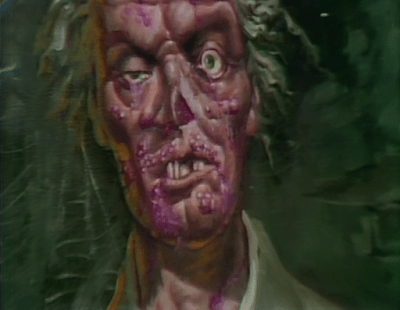
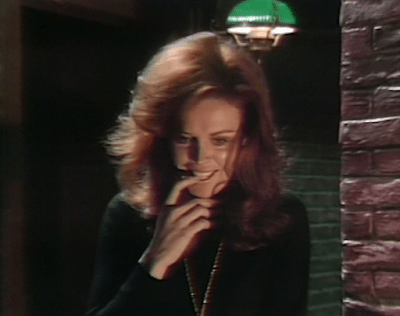
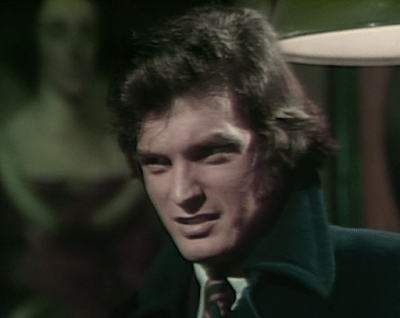
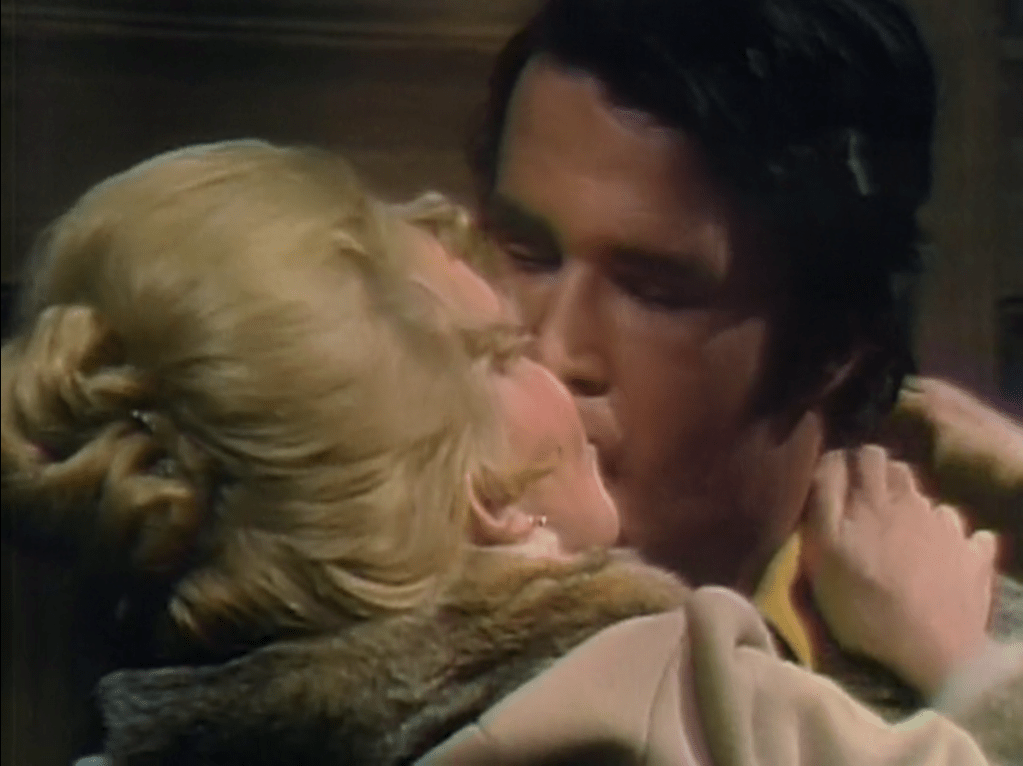
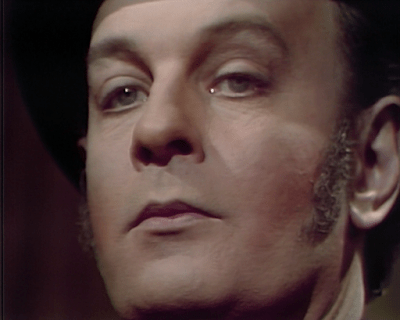
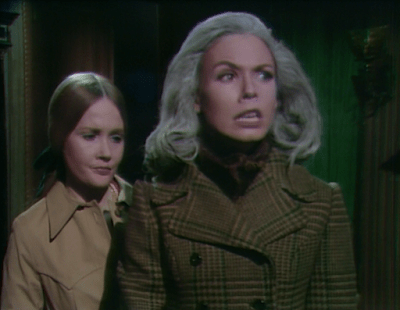

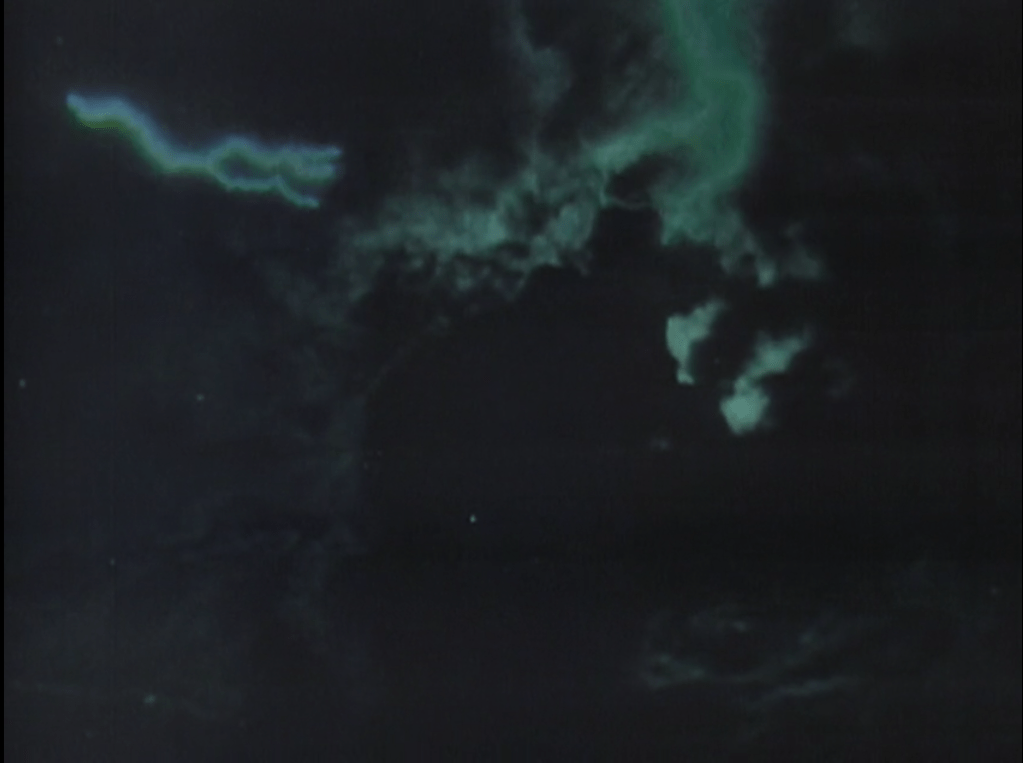

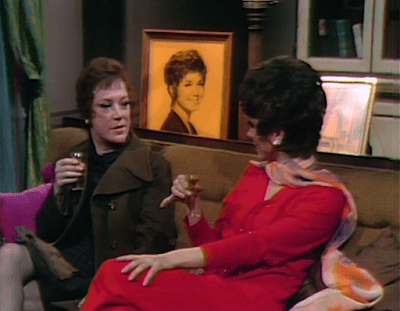


 Dark Shadows Commentary