Nine year old Nora Collins walks in on her teacher, Charity Trask, being bitten by vampire Barnabas Collins. Barnabas tells Nora to “Look into my eyes!” He hypnotizes Nora and mind-wipes away her memory of him. Barnabas has been on Dark Shadows for more than two years now, and this is only the second time he has pulled the “Look into my eyes!” move with someone whose blood he has not been drinking. The previous occasion was also with Nora, in #756. In the parts of Dark Shadows set in the 1960s, Barnabas is usually paired with mad scientist Julia Hoffman, who is the master of a magical form of hypnosis that allows her to rewrite people’s memories at will. So if Barnabas exercised this traditional vampire power in those segments of the show, he’d be stepping on Julia’s territory. But this episode is part of a time-travel story set in 1897, and Julia is not here.
Barnabas has been exposed and is being hunted by a number of people. His current hiding place is inside a cave. He confers there with his reluctant sidekick, broad ethnic stereotype Magda Rákóczi. Today the show is being taped on new cameras, and the image is crisper and more nuanced than we have seen since it went to color in August of 1967. The cave would barely have shown up through yesterday’s cameras, but it looks nifty today.
Magda is Barnabas’ sidekick, she is quick with lies, and she is played by Grayson Hall, but she does not do hypnosis. Screenshot by Dark Shadows Before I Die.
Magda has stolen a severed hand that a crime boss was keeping in a box, and believes that she can use it to undo a curse she placed on the rakish Quentin Collins. Barnabas is worried that they will not use the hand correctly when the time comes to release Quentin. Since there is no way to test the procedure they plan to use on Quentin, he asks if it will be able to help someone else. Magda says that it should. He has the bright idea to summon Charity. He evidently overate, and she is in danger of dying from loss of blood.
Vampires are metaphors for extreme selfishness, and with this suggestion Barnabas is a case in point. If the hand can lift curses from the people it touches, why does Barnabas not have Magda place it on him? If it freed him of vampirism, that would heal Charity and his other victims, and would allow him to stroll up to the vampire hunters on some sunny day and watch their suspicions of him collapse. But that is out of the question, because he does not know how to control the hand. He is simply using Charity as a laboratory animal.
Barnabas telepathically summons Charity. As it happens, lawyer/ Satanist Evan Hanley is at her bedside. Evan is among the vampire hunters, and knows Charity is under Barnabas’ power. He physically restrains her from leaving her room. Barnabas and Magda despair of bringing Charity and the hand together. The hand then disappears from its box. Magda thinks the hand is simply lost and is terrified that she will not be able to return it to its owner, but Barnabas is serenely convinced that it has gone to Charity under its own power.
This turns out to be true. The hand materializes in Charity’s room. Evan sees it, and, expert that he is in occult lore, exclaims “The hand of Ojden!” It settles on Charity’s face, and when it vanishes the bite marks are gone from her neck and she is once again her brisk, authoritative, and intensely priggish self, no longer a thrall of Barnabas. The hand reappears in the cave next to the box, and Barnabas smugly announces to Magda that it completed its mission.
For some reason, Barnabas’ self-satisfied certitude crumbles and he feels compelled to check on Charity to see that she has indeed been healed. He materializes in her room, but she is not there and the cock is already crowing. When he returns to the cave, Evan meets him, holding up a cross and keeping him from getting back into his coffin.
We open in the old cemetery north of town, where well-meaning governess Vicki and matriarch Liz are looking for the grave of Vicki’s old boyfriend Peter. Vicki last saw Peter this past Friday, which was over 170 years ago. That discrepancy was the result of some time travel she did in between. Vicki met Peter while spending nineteen weeks in the late eighteenth century. She came back home on Monday. By the end of her visit to the past, Vicki and Peter were both scheduled to be hanged for their many crimes. Vicki was whisked back to 1968 at the last possible instant, escaping by such a narrow margin that she had rope burns on her neck.
Vicki and Liz find Peter’s grave marker. Liz remarks that his date of death is the same as today’s date- 3 April. This sets Vicki off. She says that the hangings took place at dusk, that it’s dusk now, and that Peter is therefore being hanged even as they speak. Liz declares that this is gibberish. The date on the stone is 3 April 1795, and today’s date is 3 April 1968. Vicki tries to explain that everything that ever happened is happening over and again someplace. Yesterday, Liz heard similarly opaque verbiage from her distant cousin Barnabas. She didn’t buy this line when Barnabas was pitching it, and she isn’t any more impressed when she hears it from Vicki.
Longtime viewers of Dark Shadows are likely to make a connection. From December 1966 to March 1967, Vicki led the battle against the show’s first supernatural menace, undead fire witch Laura Murdoch Collins. When she saw the dates on which Laura’s previous incarnations immolated themselves along with their young sons, Vicki realized that she acted at intervals of exactly one hundred years. Laura was an embodiment of the cyclical nature of time; fighting her, Vicki is trying to break the cycle of death and rebirth, like a comely young Buddha.
I don’t think the show is making a serious metaphysical point by developing this theme. When you’re telling a story about a place where the usual laws of nature don’t apply, you need to substitute some other set of rules the audience can understand in order to create suspense. The power of anniversaries will do as well as anything else.
Back in the great house of Collinwood, we see Liz’ daughter Carolyn come in the front door wearing riding clothes and carrying a crop. This is the first indication that the Collinses have horses. In the early months of Dark Shadows, the family was running out of money, the estate was decrepit and mortgaged to the hilt, and they were barely holding onto control of their business. The stories those circumstances generated never went anywhere, and they’ve gradually been retconning the Collinses to be richer and richer. If they’re up to horse ownership now, by next year they might have a luxury yacht and a private jet.
The drawing room doors open, and lawyer Tony Peterson emerges. He quarrels with Carolyn about their last encounter. That was two weeks ago in story time, but we saw it before Vicki left for the past in November. It’s an even deeper dive for us than that makes it sound, because our view of Tony has changed profoundly in the interim. He was first introduced as an example of Jerry Lacy’s famous Humphrey Bogart imitation, and he still is that. But in the 1790s segment, Mr Lacy played the Rev’d Mr Trask, the fanatical witchfinder who hounded Vicki to her death and occasioned many other disasters. By now, we have come to see most of the 1960s characters as the (not necessarily dark) shadows cast by their eighteenth century counterparts. When Tony shows up today we find ourselves trying to figure out what it is about Collinsport in the twentieth century that could turn a holy terror like Trask into a basically nice guy like Tony.
Carolyn browbeats Tony into coming back at 8 pm to take her to dinner. He leaves, and Carolyn’s distant cousin, Barnabas the vampire, enters. Barnabas asks Carolyn if she’s noticed a change in Vicki. She has no idea what he’s talking about. He asks if she’s “more like you.” Thus first-time viewers learn that Carolyn is under Barnabas’ power. Returning viewers learn something, too. Yesterday’s episode ended with Barnabas about to bite Vicki, but cut to the closing credits before he sank his teeth into her. We’ve seen that before. Now we know that he has finally gone through with it.
In the opening scenes, Vicki showed absolutely no sign that anything had happened to her; Carolyn hasn’t noticed any change in her either. Soon, Vicki and Liz come home, and Vicki doesn’t react to Barnabas any differently than she had before he bit her. The people Barnabas has bitten have shown a wide variety of effects afterward. Perhaps Vicki will be the first victim who just can’t be bothered.
Vicki has a painting with her that she bought in town after she and Liz visited Peter’s grave. It turns out to be a portrait of Angelique, the wicked witch whose curse made Barnabas a vampire in the 1790s. That portrait first appeared in #449, a sign to the characters that Angelique’s evil spirit was still at work and to the audience that actress Lara Parker would be back on the show after the costume drama insert ended. Barnabas is upset to see this token of his old nemesis, and leaves the house. Vicki does not consciously remember the events she saw during her visit to the past, but when she sees Barnabas go she tells Liz that it makes sense that he would not like the picture.
Tony returns and spends a few moments twitting Carolyn for her glamorous attire, describing the homely pastimes in which a working class boy like himself whiles away his idle moments. This prompts her to tease him back. Viewers who remember Tony and Carolyn’s previous interactions will recognize this as their style of flirtatious banter. They agree to go to dinner.
Before Tony and Carolyn can leave, we cut to Barnabas, standing in the window of his own house and staring at the great house. He calls to Carolyn, summoning her to come to him immediately. We cut back to the great house, and see Carolyn’s face go blank while Tony is still talking. She excuses herself, telling him she will meet him later. He is outraged, and vows he will not wait for her.
In Barnabas’ house, Carolyn tells Barnabas she objects to his summons. Irritated by this, he starts talking about Vicki. He says that he couldn’t understand why biting her did not bring her under his power, but that seeing the portrait explained it to him. The witch is interfering with his efforts. Carolyn laughs at the idea of a witch. This is a bit odd. Carolyn has lived her whole life up to this point in a haunted house and is having a conversation with a vampire. It wouldn’t seem to be a stretch for her to believe in witches.
Barnabas has a bad habit of leaving his front window uncovered. Many times, we have seen people peer into that window and discover Barnabas’ secrets. Now, Tony sees Barnabas bite Carolyn’s neck.
Carolyn goes home to the great house and finds Tony in the foyer. She is delighted at the idea that he is waiting to go on their date, but such is not the case. He is there to berate her for her perverse relationship with her cousin Barnabas and to storm out.
In this, we see the first point of similarity between Tony and Trask. Trask was right that there was a witch at Collinwood and right that the witch was the source of all the troubles afflicting the Collinses. But he was wrong about her identity, and wrong about the means to combat her. Likewise, Tony is right that Carolyn and Barnabas are manipulating him, and is right that their relationship is unwholesome. But he has no understanding of their goals, and his belief that their relationship is sexual is quite mistaken.
Carolyn’s protest that Barnabas is merely her cousin, like Tony’s indignant implication that their family relationship makes what they are doing incest, is rather strained. In the cemetery, Liz mentioned that Daniel Collins was her great-great grandfather, which would make Daniel’s sister Millicent Carolyn’s great-great-great-great aunt. When Millicent and Daniel were introduced during the 1790s segment, Barnabas’ father Joshua identified them as his second cousins. That was a distant enough relative that Joshua considered Millicent a potential marriage partner for either Joshua’s brother Jeremiah or for Barnabas himself. Since Barnabas and Carolyn are second cousins five times removed, nothing going on between them could very well be called incestuous.
Later, Barnabas goes to the drawing room in the great house and looks at the portrait of Angelique. To his surprise, Carolyn is waiting for him. She tells him that she doesn’t want to be his blood thrall anymore. She declares that he loves Vicki and that she has her own life to live. He is too busy to discuss the matter with her, and she leaves.
Barnabas cuts the portrait out of the frame, and throws it into the fireplace. He gives a little speech about how this is the only way Angelique can be destroyed. He turns from the fire, and sees that the portrait has regenerated. Angelique’s laughter sounds in the air, and Barnabas realizes that she is present.
This is not the first time a portrait of an undead blonde witch has been thrown into the fire in the drawing room, prompting a woman’s disembodied voice to make itself heard. In #149, Laura’s estranged husband, Roger Collins, threw into it a painting featuring her with their son, strange and troubled boy David. When that painting burned, we heard a scream coming from no one we could see. Whether the screamer was Laura or benevolent ghost Josette was never explained. What was clear was that burning the painting accomplished none of the goals Roger may have had in mind, as Barnabas’ incineration of this painting serves none of his purposes.
Vampire Barnabas Collins arises from the dead, goes to the front parlor of his house, and finds a friend of his passed out drunk in an armchair. The friend, much put-upon servant Ben Stokes, had left the house the night before after saying that he would no longer help Barnabas in his murderous schemes. Barnabas brings this up, but apparently Ben has decided he has nowhere else to go, so he’s back.
Barnabas tells Ben that he has two projects going at the moment. He dropped his cane with its instantly recognizable silver handle in the shape of a wolf’s head at the scene of an attempted murder last night; the victim, a streetwalker named Maude Browning, screamed and someone came running. Barnabas orders Ben to find the cane and bring it back before it leads to his exposure.
The other project is Barnabas’ attempt to take revenge on the Rev’d Mr Trask, a visiting witchfinder who has wrought considerable havoc in town. Barnabas recently discovered he had some magical powers, and he has been using those powers to drive Trask insane. He says that he will stay in the house and cast more spells on Trask while Ben goes to Maude’s room over the feed store to look for the cane.
In his room at a local inn, Trask can’t keep a candle lit. He hears Barnabas’ laughter, and declares that it is the voice of the Devil. Or as Trask calls him, THE DE-VILLL!!!! A knock comes at the door. Trask is fearful, but answers when the knocker identifies himself as naval officer Nathan Forbes.
Trask believes hapless time traveler Vicki Winters to be the witch. A court has agreed with him, convicting Vicki of witchcraft and sentencing her to hang. Trask tells Nathan that the witch has started tormenting him. Since Nathan testified against Vicki, Trask warns that she might do the same to him next. When Nathan takes Trask’s warning lightly, he responds with some overheated rhetoric. To this, Nathan remarks that it’s never man-to-man with Trask. When he listens to him, he gets the feeling that sitting in a pew and that the rest of the congregation is absent.
Trask then tries to tell Nathan about the terrible visions he has been suffering. While he does so, he hears Barnabas’ voice and sees his hand. Nathan, of course, can neither see nor hear these manifestations.
Lately Nathan has established himself as a rather cold villain, but he used to be a good-hearted sort, though with some glaring personality defects. We catch another glimpse of the friendly Nathan when he tells Trask the trial must have taken a toll on him. He offers to take Trask out of his room and give him a place to rest. Trask responds indignantly to this offer, and demands Nathan leave him alone.
We cut to Ben searching Maude’s room. When Ben leaves, Nathan catches sight of him. Nathan follows Ben back to Barnabas’ house. Nathan stands at the window and eavesdrops as they talk about Ben’s search of the docks and of Maude’s room, of his failure to find the cane, and of the drunken ramblings with which Maude has been confusing the barroom patrons who want her to tell them about the attack she suffered.
When the show was set in 1967, we saw several characters stand at this window and listen as Barnabas held incriminating conversations with his henchmen. Most notably in #274, seagoing con man Jason McGuire eavesdropped as Barnabas handled a box of jewelry and told his sorely bedraggled blood thrall Willie Loomis of his evil plans for Vicki. As Nathan has become more and more a villain, he has become more and more reminiscent of Jason. The night after Jason listened to Barnabas and Willie, Barnabas killed him. Seeing Nathan in this position, regular viewers will wonder if it implies that his death is as near today as Jason’s was then.
Barnabas and Ben leave the house. Ben suggests they leave Collinsport and go someplace where Barnabas will not be recognized. Barnabas will not hear of it. He moans that the house is the place where he and his lost love Josette were supposed to live and be happy. Ben pleads with him to let go of the memory of Josette. Having seen Barnabas in 1967, we know that this plea will fall on deaf ears. Barnabas calls himself “stupid” for leaving the cane at the scene of the crime; the ever-forthright Ben tells him he’s being more stupid now. None of Barnabas’ twentieth century confederates would have dared say a thing like that to him, making Ben’s boldness a refreshing change for regular viewers.
We cut back to Maude’s room. Nathan is bringing Maude home. She is much the worse for drink. He urges her to stay in her room with the door and window locked, then goes.
A bat squeaks at the window, Maude panics, and Barnabas materializes in the room. He asks her about the cane. She tells him she doesn’t have it, and he strangles her. It’s one of the most brutal on-screen murders we have seen so far.
From Maude’s room, we cut to the door to Trask’s. He stands in front of it and we hear him deliver a monologue in a recorded voiceover. This is the first time we have heard an interior monologue from Trask. He shouts so much that it often seems that if you could read his mind you’d see nothing but all-caps disquisitions about THE ALMIGHTY! and THE DE-VILLL! But in fact, he’s telling himself that Nathan must have been right and that all the visions he saw and voices he heard must have been the result of nervous strain brought on by his hard work during Vicki’s trial. He goes into his room, telling himself to calm down. He looks at his bed, and finds Maude’s strangled corpse sprawled there.
Carolyn Collins Stoddard has been a spoiled heiress all her life, and now is settling into a new role as blood thrall to her distant cousin, vampire Barnabas Collins. Carolyn is trying her level best to comply with Barnabas’ command to seduce lawyer Tony Peterson so that she can steal the notebook mad scientist Julia Hoffman entrusted to him. She is on a date with Tony, and they are starting to do some serious kissing.
No matter how well Carolyn serves him, Barnabas can’t keep himself out of her way. When Barnabas is upset, nearby hound-dogs start baying; Danny Horn calls the dogs Barnabas’ “backup singers.” When Carolyn hears them, her face goes blank and she forgets about Tony. Tony becomes irritated and ends their date abruptly.
Later, Julia goes to Barnabas’ house. Carolyn is there; Barnabas sends her into the next room to eavesdrop on their conversation. The shot of Carolyn in that room recalls a similar shot of housekeeper Mrs Johnson eavesdropping on Carolyn and local man Burke Devlin, on Burke’s instructions, in #69. That shot marked the beginning of the career of the previously guileless Mrs Johnson as a secret agent Burke employed to spy on the Collinses.
As Mrs Johnson once listened to Burke pretending to a romantic interest in Carolyn, so Carolyn today listens as Barnabas pretends to a romantic interest in Julia. Julia realizes that she is unlikely ever to get Barnabas out of her life, and for a time she tried to make the best of the situation by falling in love with him. In his show of contrition and gallantry, she sees a glimmer of hope that he will reciprocate this love. Julia has seen too much to be as taken with Barnabas as Carolyn was with Burke, but she does give serious consideration to the idea that Barnabas might have given up on killing her and might be thinking of becoming her boyfriend instead.
After Julia leaves, Carolyn comes back into the room. She objects that Barnabas was being cruel by raising Julia’s hopes that way. Again, this echoes #69. Mrs Johnson came back into Burke’s room after Carolyn left, and asked him if he thought “the girl [was] involved” in the wrongdoing they thought had taken place at the great house of Collinwood. When Burke replied that anyone in the house was “fair game,” Mrs Johnson asked “Even the girl?” To which Burke replied “Anyone!” That marked the end of the episode, so we didn’t hear how Mrs Johnson reacted to that pronouncement. But she did go on working for Burke, so apparently it didn’t bother her too much.
Barnabas calls Carolyn to him, looks into her eyes, and tells her she is tired. She smiles, and agrees that she is tired. Evidently he used his supernatural influence over Carolyn to erase her misgivings about his treatment of Julia. He hadn’t done anything supernatural to quiet Carolyn’s predecessor, the luckless Willie, on any of the countless occasions when he acted as Barnabas’ external conscience; he usually just hit him in the face with his cane. Barnabas has been picking up lots of new powers lately, gaining the ability to transform into a bat, to materialize inside closed rooms, and to cast magic spells, so it shouldn’t be much of a surprise that he now has greater control over his blood thrall than he had before.
Barnabas Collins is a vampire, but he rarely bites anyone. He spends most of his time pursuing an acting career. His role is that of Living Man Born in the Twentieth Century, and his audience is almost everyone he meets.
Jonathan Frid often has trouble with Barnabas’ lines, but usually he manages to make it seem that it is Barnabas, not he, who is scrambling to keep his performance on track. His posture and facial expression project whatever emotion Barnabas is supposed to be feeling, and the words rarely get in the way.
As my wife, Mrs Acilius, pointed out, there is a moment today when he simply falls out of character. Barnabas is telling his distant cousin and blood thrall, Carolyn, that he is going to cast a spell that will bring madness upon his co-conspirator turned bête-noire, mad scientist Julia Hoffman. Barnabas has been acquiring new powers lately, and this is the first time we hear that he knows how to cast spells. Apparently this case of power creep was too much for Frid. While telling Carolyn about the “secret magic number of the universe,” he drifts from Barnabas’ voice into his own, looks down, then breaks off and stares mutely, not at Carolyn, but at Nancy Barrett struggling valiantly to keep a straight face. He then has to stand up and do a little dance while wearing a green dressing gown. The ridiculousness of it, for once, overwhelms him.
Dave Woodard, MD, has learned that Barnabas Collins is a vampire and mad scientist Julia Hoffman is his co-conspirator. We see Barnabas at home, pressuring Julia into helping him murder Woodard before he can go to the authorities. After a great show of reluctance, Julia prepares a hypodermic of some potion or other that will induce cardiac arrest. When Barnabas insists she administer the lethal injection herself, Julia resumes her attempt to find a way out. Barnabas finally allows her to go to Woodard and tell him that his only options are to cooperate with them and make a great contribution to medical science, or to go out into the night and suffer an unimaginably horrible death when Barnabas catches him.
Julia does go to Woodard’s office, and does deliver this message. Woodard replies that he doesn’t have to go anywhere to tell the sheriff about Barnabas and Julia. He picks up his telephone and starts dialing. High-pitched sounds play, and Woodard sees the shadow of a bat at his window. Yesterday we heard that Julia considered Woodard the most brilliant student in their medical school class, and we can see why- even though this was decades before Covid-19 or Nipah or other bat-borne viruses were in the news, he is transfixed by the outline of the squeaky little guy.
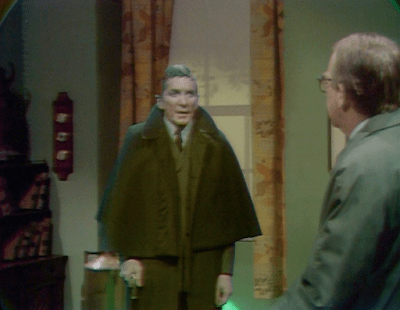
Perhaps Woodard is less prescient about bats as vectors for disease than he is mindful of the experiences of his young friend, strange and troubled boy David Collins. In #330, Barnabas sent a large bat to frighten David in his bedroom. Today, Barnabas materializes inside Woodard’s office after the bat has done its thing outside. This is the first indication we have had that Barnabas has the power to transport himself through walls.
Unfortunately, the National Association of Broadcast Engineers and Technicians were on strike during principal photography for this episode. No doubt the process shot of Barnabas’ materialization was added after they came back to work, but they could do only so much with the footage that the network executives and other amateurs had left them. The Barnabas who appears in Woodard’s office today is about three feet tall and is missing a chunk of his head.
Mini-Bar may be the funniest consequence of this attempt at strikebreaking, but there is another that isn’t amusing at all. Woodard is played by some stooge who took over the part when Robert Gerringer, who has been struggling valiantly since May to find something interesting to highlight in a character who usually doesn’t know anything and isn’t allowed to advance the plot, honored the NABET picket line. The scab annoys the audience every time he opens his mouth today, breathing directly onto his microphone, getting tangled up in trivial lines, and veering between a barking tone and a whine as high-pitched as the sounds the bat makes.
The result of his incompetence is that a conflict the audience is supposed to be experiencing as suspense does not come off. We’re supposed to be torn as Julia is torn, wanting Woodard’s threat to the continuation of the story to be removed, but feeling horror at the thought that he will be killed. Gerringer could have made us feel those incompatible desires, but this alleged actor makes us want nothing but that he be removed from our television screens as soon as possible and by any means necessary. So we find ourselves cheerfully rooting for the vampire and the mad scientist to get on with murder.
Dangerously unstable ruffian Willie Loomis spent a week staring at the eighteenth century portrait of Barnabas Collins in the foyer of the great house of Collinwood back in April, then tried to rob Barnabas’ grave. That turned out to be an awkward situation when Willie found that Barnabas wasn’t entirely dead. Barnabas was a vampire who bit Willie, turned him into his sorely bedraggled blood thrall, and had lots of conversations with him. Yesterday, Willie was written out of the show.
Today we open with strange and troubled boy David Collins staring at the same portrait. As Willie was obsessed with the idea that there were jewels hidden in the Collins mausoleum in the old cemetery north of town, where in fact Barnabas’ coffin was hidden, so David is preoccupied with the idea that Barnabas has something terrible stashed in the basement of the Old House on the estate, where in fact his new coffin is hidden. As Willie sneaked off to the cemetery on his ill-starred expedition, David will sneak off to the Old House today and try to search Barnabas’ basement.
Unlike Willie, David is not driven by greed. He is afraid of Barnabas, and his friend, the ten year old ghost of Barnabas’ sister Sarah, has told him that he must not go to the Old House. But his aunt Liz and his father Roger dismiss his attempts to warn them about Barnabas, and he thinks it is his duty to provide them with evidence. So he screws up his courage and makes his way across the property.
David lets himself into the Old House by opening the parlor window. Not only have we seen David do this before, but Willie’s sometime friend, seagoing con man Jason McGuire, got into the house the same way in #274. Barnabas would kill Jason when he reached the basement in #275, so you might think he’d have put a lock on that window by now.
Jason’s fate is certainly on the minds of returning viewers when David tries to open the basement door. It comes as a relief when he finds the door locked. Barnabas’ co-conspirator, mad scientist Julia Hoffman, catches him there.
Julia demands to know what David is doing in the house, and he tries to brazen it out. He claims that he has a right to be there, since it belongs to his Aunt Liz. This is a bit of a murky point- we never see Liz transfer title to Barnabas, but she and others act as if he owns the place and its contents. Julia doesn’t clarify it when she responds that Liz gave the house to Barnabas- she doesn’t deny that it still belongs to Liz, only says that it also belongs to Barnabas.
Back in the great house, Roger is banging away at the piano. We saw Liz play the piano in #47 and #91, a reference to the conception of her character writer Art Wallace developed in his original story bible, titled Shadows on the Wall, in which she, like similar characters in a couple of TV plays he wrote in the 1950s under the title “The House,” gave piano lessons. Since then, Liz’ daughter Carolyn tried her hand at “Chopsticks” in #119 and used the piano as a prop in a teen rebel scene in #258, and Jason poked at a few keys in #198. Roger isn’t exactly Vladimir Horowitz, but he’s the first one we’ve seen who actually achieves a melody.
Liz comes in and tells Roger that David isn’t in his room. They fret over David’s attitude towards Barnabas. Julia brings David home and tells Liz and Roger where she found him. After an angry scene between father and son, David goes upstairs, and Liz scolds Roger for his inept parenting. In these as in all of Liz and Roger’s scenes together, we see a bossy big sister who tries to govern her bratty little brother, but who ultimately abets all of his worst behavior.
In the Old House, Barnabas notices that Julia is troubled. He keeps asking what’s on her mind, and she has difficulty deflecting his questions. This is odd- Julia has been established as a master of deception, and Barnabas is the most selfish creature in the universe. All she has to do is start talking about something that does not affect him directly, and he will lose interest at once. Rather than talk about her personal finances, or the job from which she is apparently on an indefinite leave of absence, or some ache or pain she might have, or how sad she is to miss her Aunt Zelda’s birthday, she brings up Willie. That does get Barnabas’ mind off her tension, but it also reminds him of David. He thinks David knows too much about him, and is thinking of murdering him. Julia assures him that the boy doesn’t know so very much, that whatever he does know he hasn’t told anyone, and that if he does say something his reputation as an overly imaginative child will lead the adults to ignore him.
From the beginning of the series, we’ve heard people say that David is “imaginative.” The audience finds an irony in this, since we have never seen David show any imagination whatsoever. All his stories of ghosts are strictly literal accounts of apparitions he has seen. We’ve seen some drawings he has done and heard quotes from some essays he has written. Some of these are technically accomplished for a person his age, but they are just as literal as his ghost stories. And when he tells lies to cover his various misdeeds, he tells simple little tales that fall apart at once.
In #327, well-meaning governess Vicki became the first character to dissent from the “David is a highly imaginative child” orthodoxy. Liz and local man Burke Devlin were dismissing David’s laboriously accurate account of his latest encounter with Sarah as a sign of his “imagination,” and Vicki interrupted with “I don’t think it has anything to do with his imagination.” Now, Barnabas goes a step further. After pronouncing the word “imaginative” in a truly marvelous way that makes it sound like something I’ve never heard before, he tells Julia that she has given him an idea. Frightened, she asks what he means. All he will say is “You’ll see.”
Roger goes to David’s room and has a friendly talk with his son. Throughout the conversation and afterward, David is thinking intensely, trying hard to figure out what his next step should be.
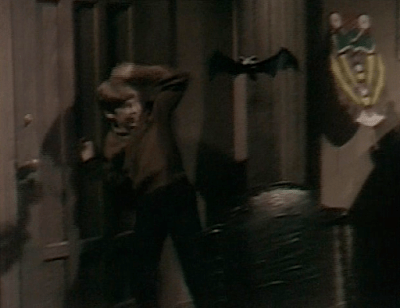
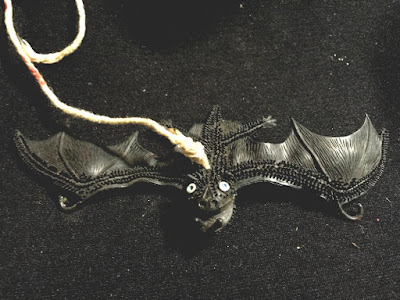
Once he is alone in the room, the window blows open and a bat enters. More precisely, a bat-shaped marionette is brought in on clearly visible strings by a pole that casts a shadow we can see the entire time, but no one who has been watching the show up to this point will doubt for a second that David’s fear, as depicted by David Henesy, is fully justified. David tries to flee from the bat, but he cannot open the door to escape from his room. His back against the door, David slides onto the floor and screams as the bat comes near him.
When Barnabas is about to attack someone, dogs start howling. Sometimes this works to his advantage, but it so often puts his intended victims on their guard that it doesn’t really seem to be something he is doing on purpose. So this bat represents something new. Perhaps Barnabas is using magic to control a bat- if so, it marks the first time we have seen Barnabas use magic to project influence over something other than a human mind. Or perhaps he himself has assumed the form of a bat. If so, that is the first indication we’ve had that he has shape shifting powers. In either case, Barnabas’ powers have just gone up a level.
Closing Miscellany
The bat was created by famed puppeteer Bil Baird. Most famous today for the puppets he created for “The Lonely Goatherd” sequence in The Sound of Music, Baird was a frequent guest on television programs like The Ed Sullivan Show, and Jim Henson cited Baird’s own TV series, the short lived Life with Snarky Parker, as a major influence on the Muppets. In December 1966, Baird opened a marionette theater in New York City, at 59 Barrow Street in Greenwich Village; it operated until 1978, and many leading puppeteers, including dozens who would go on to work with Henson, were members of its company in those years.
This is the last episode to end with ABC staff announcer Bob Lloyd saying “Dark Shadows is a Dan Curtis production.” We do hear the announcement again in February of 1969, but that won’t be because Lloyd has returned- they used an old recording for the music under the closing credits that day, and they picked one with him on it.
Fans of Dark Shadows will often talk about “the early episodes” which ended with Lloyd making that announcement. So I suppose #330 is the last of “the early episodes.”
Danny Horn’s post about this one on Dark Shadows Every Dayincludes a morphology of episode endings. He divides them into five categories, Haiku,* Restatement of Threat, ** New Information,*** Crisis Point,**** and Spectacle.***** It’s an intriguing scheme, and he makes a good case for it.
*Danny explains that “Haiku” “aren’t necessarily recognizable as endings in the traditional sense, because nothing is resolved and no progress is made. It’s just a little moment when a character pauses, and possibly has a feeling about something… In some extreme cases, the audience may not realize that the episode is over until halfway through The Dating Game.”
**Restatement of Threat, at this period of Dark Shadows, usually means Barnabas looking at us through his window and saying that someone or other “must die!” Which of course means that you can safely sell a million dollar life insurance policy to that character.
***”A New Information ending provides an actual plot point, which either advances the story another step, or tells us something that we didn’t know.”
****”The Crisis Point cliffhanger is the big game-changer, and for best effect, it should come at the end of a sequence that’s been building up for a while. This is a big turn in the story, and it should feel satisfying and thrilling… The defining feature of a Crisis Point ending is that the resolution marks a change in the status quo, ending one chapter and setting up the next.”
***** “Obviously, plot advancement is always welcome, but every once in a while the show needs to set its sights a little higher. These are the moments when the show goes above and beyond, in order to surprise and dazzle you… The point of a Spectacle is: You can’t take your eyes off the screen. Housewives in the audience have put down the iron, and switched off the vacuum. Teenagers have stopped swatting at their siblings… A Crisis Point cliffhanger will bring you back for the next episode, because you want to see what happens next. But a Spectacle cliffhanger is bigger than that — you’ll be coming back for the next episode, but it’s because you can’t believe what you’re seeing, and maybe tomorrow they’ll do it again.”





 Dark Shadows Commentary