Episode 826: King Johnny’s court

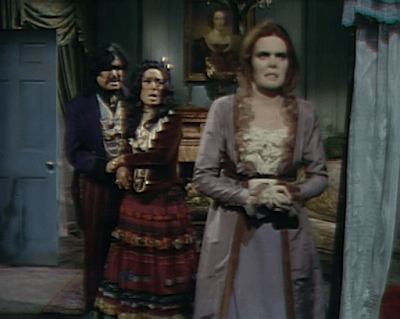
Rroma chieftain/ New England crime boss King Johnny Romana puts broad ethnic stereotype Magda Rákóczi on trial in the secret room of the old Collins family mausoleum. Evidently King Johnny has considerable magic powers; he conjures up the ghosts of several notorious murderers to serve as the jury. He also brings in the ghost of Magda’s husband to serve as the one witness for the defense.

The scenario is a remake of The Devil and Daniel Webster, a play that debuted at the Martin Beck Theatre in 1939. But the makers of Dark Shadows were likely thinking of a more recent Broadway production as well. From November 1964 to June 1965, a musical with a book by Ernest Kinoy and music by Walter Marks ran first at the Shubert Theatre, then at the Lunt-Fontanne, for a total of 232 Broadway performances. Its title is one of King Johnny’s favorite words- Bajour.

King Johnny keeps complaining that Magda tried to “pull the bajour on me!,” by which he means that she gave him one thing disguised as another. In the show, based on Joseph Mitchell’s stories of life among Rroma in the New York metropolitan area, bajour refers simply to a confidence trick with a big payoff for its perpetrators. The cast, saddled with a bunch of instantly forgettable songs, sings as joyously as it can about how the Rroma, to whom they of course refer as “gypsies,”* love nothing more than cheating lonely old women out of their life savings. This uninhibited celebration of racism reported losses of nearly a million dollars, more than twice the total amount of money invested in it. Perhaps the fictional Rroma weren’t the only ones who enjoyed running a good scam. Perhaps, too, Mel Brooks’ 1967 film The Producers wasn’t entirely a work of fiction.

The cast of Bajour does not appear to have overlapped with that of any episode of Dark Shadows. The closest link I can find to the cast at this period of the show is Michael Bennett, who danced in Bajour and later married Donna McKechnie. Many very distinguished performers appeared in Bajour, but I’m not tempted to do any imaginary recasting. I’m sure Chita Rivera and Herschel Bernardi were wonderful as leads Anyanka and Cockeye Johnny Dembo, but they couldn’t have outdone Grayson Hall and Thayer David as Magda and Sandor. Herbert Edelman was good in everything, and I’m sure his turn as “The King of Newark” was no exception, but no one could have done more than Paul Michael does to make the cartoonish role of King Johnny watchable. Paul Sorvino had a great career, and even has a screen credit in common with Henry Judd Baker- they both appeared in the disastrous 1980 film Cruising. I’m sure Sorvino would have been interesting as a replacement for Baker as Istvan, the mute Black Rroma, but that part is all about physical presence, and as was the case with Baker’s part in Cruising he is effective in a way that Sorvino could not have matched. Nancy Dussault is another performer who never lets an audience down, but Diana Davila’s approach to the character of Rroma maiden Julianka was so cleverly conceived that I couldn’t bear to think of anyone else taking the part.

While I’m on the topic of the Rroma, I want to bring up an oddity about my favorite Dark Shadows blog, Danny Horn’s great Dark Shadows Every Day. When he was writing about these episodes, Danny often stopped to ridicule the idea of a Rroma tribe living in New England in 1897. Danny works for the Wikimedia Foundation; you’d think he’d be in the habit of checking Wikipedia, where the article “Romani People in the United States” would tell him that, while Rroma have been migrating to North America continually since 1498, the majority of the ancestors of the million or so Americans who now identify as Rroma came in the late nineteenth century. The new arrivals tended to take some time to assimilate to the ways of the USA; the article is, as of this writing, illustrated with a photo of a Rroma caravan near Portland, Oregon, in 1905:

Rroma caravan near Portland, Oregon, in 1905. Photograph by the Portland Oregonian, found on Wikipedia.

Most Romani-Americans are totally assimilated nowadays, so much so that many people in the USA don’t realize that there actually is such an ethnic group. But there are still Romani heritage festivals in many cities, and the last traditional caravans were still traveling the Great Plains as late as the 1940s. And in Maine in 1897, Romani caravans were a frequent sight, one that indeed aroused exactly the sort of zyganophobic** reactions Magda and Sandor encountered from virtually everyone in their first days on the show.

Even Istvan isn’t as hard to explain as Danny seems to think. In the early days of European settlement, Rroma were often brought across the Atlantic as slaves; that was the case for the people on Christopher Columbus’ third voyage in 1498. Some intermarried with enslaved people of African extraction. There are still Afro-Romani communities in Louisiana and Cuba.

I started writing about Dark Shadows in the comment sections on Danny’s blog. He made a great display of ignoring the first 42 weeks of the show, and consistently made the harshest possible judgments of the acting of Alexandra Moltke Isles, who played well-meaning governess Vicki. That created a space for me to point out when the show was harking back to its early days, and to defend Mrs Isles. I would be remiss in a post like this if I did not mention that Mrs Isles made a documentary feature in 2003 called Porraimos: Europe’s Gypsies in the Holocaust. I’ve never been able to get hold of a copy of the film, but the New York Times liked it when it was shown on PBS.

*Rroma sometimes call themselves Gypsies, but you can’t assume they’ll like it if an outsider uses that word.

**Zyganophobia- racism against Rroma.

Episode 821: The beautiful people of 1969

Rroma chieftain/ New England crime boss King Johnny Romana has cornered broad ethnic stereotype Magda Rákóczi in her living room in the Old House on the estate of Collinwood. He turns his back on Magda, closes his eyes, and starts reciting a lot of nonsense. Magda sees an opportunity to escape, and creeps over to the front door. When she opens it, a large man enters, blocking her exit.

The man is King Johnny’s minion Istvan. He is played by Henry Judd Baker, who was the only Black man ever to appear on Dark Shadows. He does not have any dialogue; Istvan, King Johnny will tell us later today, lost his tongue as the penalty for a misdeed. We do hear him laugh and grunt. He also wears trousers from the Lilli Von Shtupp “It’s Twoo! It’s Twoo!`” collection.

Three Rroma people, according to the show. Screenshot by Dark Shadows Before I Die.

After Dark Shadows, Baker would reunite with Jonathan Frid, manhandling him in the movie Seizure. He also had a memorable turn in the lamentable 1980 film Cruising as a scantily clad man who slaps the main character. He died in 2016; the funeral home’s website calls him “Judd Henry Baker.” Maybe that’s a mistake on their part, or maybe he flipped the two parts of his given name for his acting work.

Meanwhile, evil sorcerer Count Petofi is holding time-traveling vampire Barnabas Collins prisoner. Petofi threatens to burn the great house of Collinwood to the ground and kill its residents if Barnabas does not take him to the year 1969. Barnabas realizes that this is an empty threat, and refuses to comply. This is notable as one of the few times Barnabas actually outwits someone. Also, Petofi’s sidekick Aristide spends the scene showing off two big flaming torches, continuing the show’s longstanding mockery of the fire marshals of New York City.

Just try to keep us safe, FDNY! Screenshot by Dark Shadows Before I Die.

King Johnny found a severed hand at Magda’s house, which he thinks is the one that was cut from Petofi’s right wrist long before. Little does he know that Petofi has taken that one and reattached it. When he and Istvan take Magda with them as their prisoner, what they actually have is a hand Petofi cut off a corpse he ordered Aristide to dig up. They haven’t got very far when the ghost of that man appears and reclaims the hand. King Johnny responds to this unusual sight with fury, realizing that Magda pulled a fast one on him. She manages to get away from him and Istvan.

Episode 745: What I am is what I will be

Broad ethnic stereotypes Sandor and Magda Rákóczi are in the parlor of their home, the Old House on the great estate of Collinwood, quarreling about a locket. Shortly before, Magda found maidservant Beth Chavez and libertine Quentin Collins in the parlor, and she noticed Beth snatch a locket from a table and try to hide it. Beth claimed that the locket was hers, but Magda declared that it was not, and that she knew who it really belonged to. Now Beth and Quentin have left, Magda has the locket, and Sandor is pleading with Magda to stop trying to figure out what it means that the locket is in the house. “She is far away!” he protests.

Returning viewers know that the locket belongs to madwoman Jenny, Quentin’s estranged wife. Unlike Magda, we also know that Quentin’s brother and sister, with the assistance of Beth and another servant, have been keeping Jenny prisoner in a series of cells deep in the great house ever since Quentin left her the previous year. Yesterday Jenny had a strong reaction to Magda’s name, in the course of which she started muttering about Sandor as well, hinting that the Rákóczis are of some importance to Jenny.

Sandor and Magda hear a voice from an upstairs bedroom. They go there, and are astonished to find Jenny. They ask her where she went when Quentin left her; she denies that Quentin ever did leave her, and talks about being locked up in a room. It dawns on Magda and Sandor that the Collinses locked Jenny up in the house and have been keeping her there. Jenny angrily says that yesterday she was horrified when Sandor and Magda’s caravan pulled up at the home she and her husband share, and that she told them never to speak to her again; they tell her that happened years ago. She is shocked and disbelieving.

Sandor and Magda are distressed by Jenny’s madness. Screenshot by Dark Shadows Before I Die.

Jenny sneeringly calls Magda and Sandor “Gypsies.” Magda replies “You are a Gypsy, too.” Jenny replies that “What I was is not what I am.” After a few more moments, Magda and Jenny embrace and Magda calls her sister.

The revelation that Jenny is Magda’s sister is one of the most effective twists in the whole series. When Mrs Acilius and I first watched the show through, we were thunderstruck by it. The most amazing thing is that it makes so much sense we couldn’t believe we hadn’t figured it out. The Collinses have disdain for Jenny, not only because their black sheep brother brought her into the family, but also because she is of obscure birth. So when she became mentally ill, why didn’t they just ship her off to an institution and have done with it? The answer is racism. They are not simply embarrassed that Quentin chose an unsuitable wife; they are frozen with horror that a Romani person now bears their family name. They cannot take the chance that anyone, even the staff of a discreet, high-end sanitarium, will learn of this shame, and so they hide her away in their own house.

In #701, the first episode of the part of Dark Shadows set in the year 1897, it was established that Beth came to Collinwood as Jenny’s maid and that it is surprising she stayed after Jenny ceased to be a visible member of the family. In the same episode, Magda mentioned some Romani folklore to Beth, said, “But you wouldn’t know anything about that!,” and laughed tauntingly while Beth looked alarmed. The implication that Beth has been trying to conceal her own Romani heritage, combined with her association with Jenny, was something else we were surprised we didn’t pick up on the first time through the show. Perhaps that is because of the visuals. As Sandor and Magda, Thayer David and Grayson Hall wear heavy brownface makeup and dark curly wigs. As Beth, the tall, wasp-waisted Terrayne Crawford has her own light blonde hair, pale skin, and blue eyes. So it was easy to take Magda’s line as a reflection of something that was in the flimsies months before they cast the part of Beth Chavez with an obviously Anglo actress, and to assume that we would never hear of it again.

There are some flaws on screen today. Early on, Quentin walks in front of a green-screen with a picture of the Old House, and it is ludicrously fake even by the standards of special effects on Dark Shadows.

The real house in this photo burned down about this time, perhaps because it couldn’t stand the disgrace of having appeared in this shot. Screenshot by Dark Shadows Before I Die.

Later, there are three goofs in thirty seconds. Sandor leaves Magda alone in the room with Jenny. Jenny is supposed to slam a book down on Magda’s head to stun her, but we can clearly see that the book sweeps through a space several inches to Magda’s left. When Magda falls and Jenny runs out, Sandor isn’t supposed to see Jenny, but the two of them are on screen together and their shoulders actually brush against each other. Once downstairs, Jenny is supposed to try the front door, find it locked, and look for a hiding place. But when she touches the door, it opens, and she has to pull it shut before she can play her scene about being unable to get out.

Episode 710: The raven and the viper and all the dark creatures

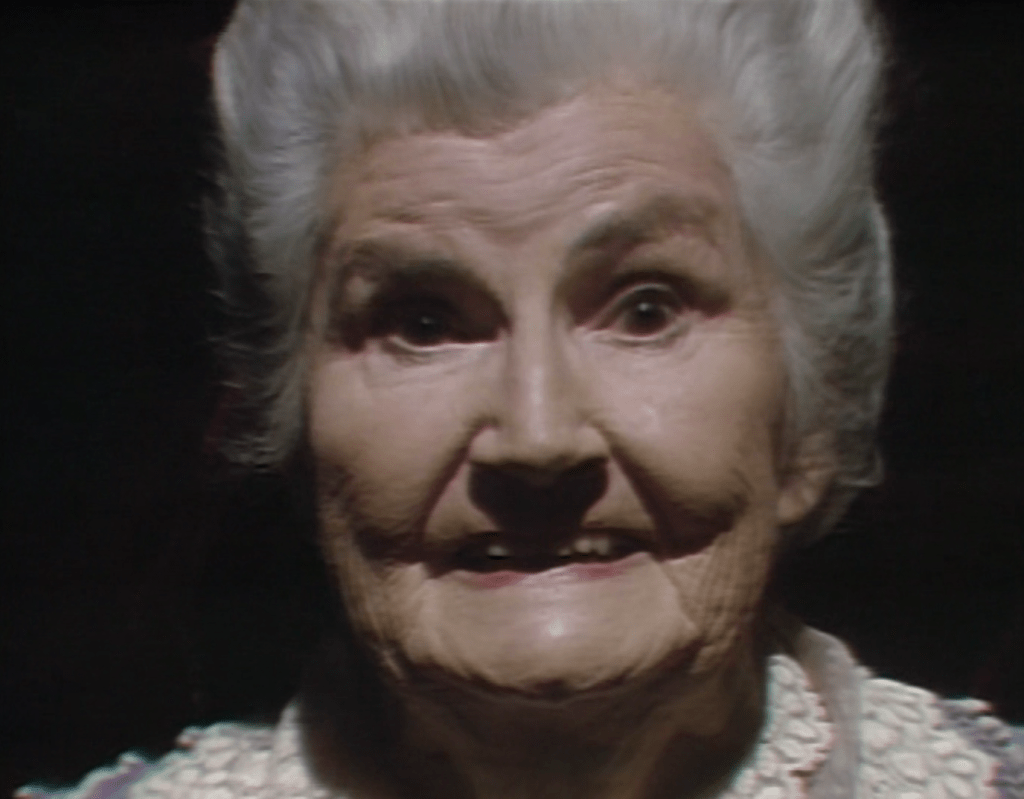
Libertine Quentin Collins has stolen his late grandmother Edith’s will, intending to forge a substitute that will give him control of her vast estate. His distant cousin, the recently arrived and thoroughly mysterious Barnabas, has warned Quentin that Edith’s ghost will haunt him if he persists in this plan. Quentin hears a loud pounding emanating from the walls of the great house of Collinwood. He goes to the study, where Edith lies in her coffin. He sees her there, grinning at him. Quentin returns to his room; the still-grinning Edith sashays in and taunts him. He tells her she is dead; this does not seem to bother her. She just keeps on grinning.

Edith may be dead, but she is clearly having a blast. Screenshot by Dark Shadows Every Day.

Quentin strangles Edith. She falls into an armchair in his room, unmoving but still grinning. He buries her somewhere on the grounds of the estate; her hand sticks up from the earth. He wakes up.

Quentin’s friend, unethical lawyer Evan Hanley, comes calling. Evan asks Quentin to give him the will so he can take it to a forger of his acquaintance. Quentin tells Evan about the dream, and how shaken he is. He also tells him about Barnabas, and his concern that Barnabas is a formidable enemy who may have uncanny powers. When Evan tries to dismiss Quentin’s worries, Quentin responds that he is the last person who should make light of the supernatural. When Quentin speaks of Evan’s “devil-callings,” we learn that the clandestine “meetings” they spoke of the other day are Satanist ceremonies. Evan agrees to meet Quentin at 8:00 that night in the groundskeeper’s cottage on the estate to summon one of the spiritual forces of darkness to fight Barnabas.

Returning viewers know that Quentin is right to fear Barnabas’ connections to the supernatural. Barnabas is a vampire, and his powers include the ability to send hallucinations to torment people with guilty consciences. He is also a time-traveler, who has come to 1897 from 1969 on a mission to prevent Quentin from becoming a ghost who will drive the Collins family of that year out of the great house and plague strange and troubled boy David Collins to the point of death.

First time viewers will not learn that today; aside from the opening voiceover, this episode tells us nothing about Barnabas. It does tell us something about Quentin and Evan. They are super-racist against Romani and Sinti people.

Evan has decided to hire Sandor Rákóczi to forge the will. Sandor and his wife Magda have been staying at the Old House on the estate for some time as Edith’s guests. Quentin’s brother Edward and sister Judith are offended by the presence of these “gypsies” in their midst. Unknown to Evan and Quentin, and unmentioned in today’s episode, Barnabas has bitten Sandor, enslaving him. Presumably Sandor has no secrets from Barnabas, making him a bad choice to be Quentin and Evan’s henchman.

Three times today, Evan addresses Sandor as “Gypsy.” When he is putting it to him that he wants him to forge the will, he barks at him with “Now, one moment, Gypsy.” He insists Sandor fix his price in advance. When Sandor tells Evan he is sad that he does not trust him, he replies “Well, then, be sad, Gypsy, but give me your price, now!” Later, Sandor will express curiosity about Quentin and Evan’s plans, to which Evan will reply “Well, don’t be curious, Gypsy, just do as you’re told.”

Evan told Quentin that the “devil-calling” at the cottage should involve twelve year old Jamison Collins as a “sacrificial lamb.” Quentin sincerely cares about his nephew Jamison, and he protests that he won’t do anything to hurt him. Evan assures him that Jamison will simply be a symbol of the innocence that their dark lord exists to despoil and that the boy himself will not be harmed. When Quentin is talking Jamison into joining him and Evan for a secret meeting that night, he tells him they will look into the future. Jamison asks”How, with a crystal ball?” Quentin replies “No, of course not. That kind of thing is for gypsies. It’s not for men, like you and me.” Scripted television in the US in the 1960s rarely gave such flagrantly racist remarks to recurring characters, not only because the audience included members of minority groups, but also because they are so unattractive that they limit the utility of the characters who make them. In this case, Quentin and Evan are already in league with the Devil, and Quentin is on track to die soon and become a ghost. So we know that they are due for a comeuppance. Moreover, their prejudices may lead them to underestimate Sandor, both on his own account and as a tool of Barnabas, so it is useful to the plot that they are in the grip of such ugly attitudes.

Sandor is in the cottage, preparing to forge a new will for Edith, when Jamison drops in. Jamison does not see what he is doing. He and Sandor spend a couple of minutes sparring verbally. Sandor ends the match when he points out to Jamison that it is getting dark. The boy looks alarmed and runs home while Sandor laughs.

In #701, Sandor and Magda mentioned that the Collinses were afraid of the night. Shortly after, they found out about Barnabas, and learned that they had good reason to be. But Sandor can still laugh when he sees that a boy as old as Jamison runs away at the news that the sun is setting.

Sandor is still in the cottage when Quentin brings Jamison by. Evidently Evan plans to let Sandor participate in the ceremony. Regular viewers will remember that in 1969 the first place Quentin manifested himself outside the little room in the great house where David and his friend Amy discovered him was in the cottage, and that he showed considerable power there. That he and Evan have their Satanic “meetings” in the cottage suggests that the evil he did in 1969 has its roots in what he did during them.

Evan directs Jamison to stare into the fire burning in the hearth. This will ring another bell for longtime viewers. Jamison is played by David Henesy, as is David Collins. From December 1966 through March 1967, David Collins’ mother Laura Murdoch Collins lived in the cottage. She was an undead blonde fire witch, and her plan was to lure David to join her in a fiery death. She would rise from the dead as a humanoid Phoenix, as she had done at least twice before. On each of those previous occasions, she went into the flames with a son named David; the Davids did not rise again, as becomes clear when one of them is available to speak in a séance in #186. Laura often urged David to join her in her favorite pastime, staring into fire. So when Evan urges Jamison to do the same, we wonder if Jamison, too, is in danger of being consumed by its fascination.

As the ceremony goes on, Jamison becomes alarmed. He runs out, and Evan orders Sandor to follow him. Quentin, too, runs to the door and protests that they have gone too far. He points to the flames, in which the likeness of a skull wearing a wig takes shape. We may wonder if more will be added to the skull, perhaps so much as to make up a whole woman, and if this woman will be someone we have met before.

Edith’s role in Quentin’s dream unfortunately marks Isabella Hoopes’ final appearance on Dark Shadows. She was just terrific. I wish they had done a parallel time story set around the period of the Civil War in which Hoopes played an aged Sarah Collins. Her nose, chin, and cheekbones resembled those of Sharon Smyth sufficiently that you can imagine an elderly Sarah looking like her, and she had a playfulness that would make longtime viewers remember the nine year old ghost we met in June 1967.

Episode 702: There are many times. You only have to find them.

We open in the secret chamber in the old Collins family mausoleum, where the woe-begotten Sandor Rákóczi has inadvertently freed vampire Barnabas Collins from his coffin. When dangerously unstable ruffian Willie Loomis freed Barnabas from the same coffin in 1967, Barnabas bit him on the wrist, because ABC-TV’s office of Standards and Practices wouldn’t allow one man to bite another on the neck. But now the ratings are high enough that the network will let Dark Shadows get away with a whole lot more than they would when the show was losing its time slot. So Sandor winds up with two big gashes near his right carotid artery.

Barnabas asks Sandor what year it is. He is shocked to find that it is 1897. The last Barnabas remembered, it was 1969 and he was going into a trance mediated by the casting of I Ching wands. Evidently he had hoped that he would encounter the ghost of Quentin Collins on an astral plane outside time and space and do battle with him for the souls of various characters who live at the great house of Collinwood in the 1960s. But instead he has been transported back to the period when Quentin was alive. In fact, Sandor tells him that this very night Quentin returned to Collinwood after a year away.

A few days before he left on this uncertain and frightening journey into the past, Barnabas reflected that when Quentin was alive, he lay in his coffin. They knew nothing of each other. By that time, Barnabas had been free of the effects of the vampire curse for almost a year. He did travel back in time once before, when he spent episodes #661-665 in the 1790s, and the curse reasserted itself then. So regular viewers should have taken that reflection as a hint that Barnabas might return to Quentin’s time and once more be the vampire he was in his first months on the show.

Barnabas is shocked to find that Sandor and his wife Magda live in the Old House at Collinwood. That was Barnabas’ home when he was alive in the eighteenth century, and he became its master again when he returned in the 1960s. He orders Sandor to get him some clothes; Sandor replies “I won’t get you nothing.” Barnabas tells him that he will do whatever he says. In a very hard voice, he says “You are a Gypsy.” As Sandor, Thayer David indeed wears a stereotypical Romani costume, complete with earrings, a flowing wig, and brownface makeup. It sometimes strikes me as odd that Barnabas’ first meal in 1897 was blackened whitefish. Barnabas follows this ethnic identification with “You know what will happen to you if you do not.” Bram Stoker’s Dracula, published in 1897, made it clear that Sinti and Romani people are experts on vampirism, so I guess Barnabas had some grounds for that statement. At any rate, Sandor does comply.

Magda is on her way to the great house. The mistress of the estate, Sandor and Magda’s patroness Edith Collins, has summoned Magda to visit her as she lies on her deathbed. She wants Magda to read the cards and tell her that her grandson Edward will come home before she dies. As she enters the house, Magda is waylaid by Quentin.

Quentin grabs Magda by the neck. When she protests, he threatens to do it harder. He tells her that when Edith dies, she and Sandor will be thrown off the estate. Magda says she expects that, but Quentin says it needs not be so. If she can persuade Edith to leave all her money to him, he will cut her and Sandor in for 10%. Magda does not agree. Quentin says that he is their only hope, because “I have no prejudices against your kind.” If this is how people with no prejudices against them treat Romani, you can just imagine how the bigots behave.

In fact, you don’t have to imagine for long. After an interlude with Barnabas looking over the interior of the Old House and showing dismay at its poor condition, we return to the great house. Quentin’s older sister Judith comes downstairs and sees Magda. She reacts with unconcealed disgust. Magda excuses herself, and Judith takes Quentin into the drawing room.

Judith closes the drawing room doors, complaining that the servants keep listening in. That is one of many indications that there are no background characters in 1897- everyone is playing an angle. Judith offers Quentin $1500 to go away. Quentin says that he is surprised how highly she thinks of him. He could easily spend that much before dawn, even in the village of Collinsport, and come back the next day claiming to know nothing about it. She mentions something about his word of honor, but neither of them can take that seriously enough to merit a complete sentence.

Quentin insists on seeing their nephew, 12 year old Jamison Collins. Judith complains that it is late and Jamison is asleep, but Quentin says he promised to wake Jamison as soon as he arrived, regardless of the time, and “I keep my promises to Jamison.” When Jamison does come in, Quentin is hiding. Jamison protests that he is too old for such games. Quentin jumps out and startles Jamison. Quentin takes this reaction as proof that Jamison isn’t too old at all, and the two of them share a happy laugh. Quentin gives Jamison a model ship with a plate reading “The Jamison Collins.” Jamison is delighted with this truly thoughtful gift. Judith appears, and Jamison clutches Quentin, shouting “I won’t say it! I don’t want Quentin to leave!”

In 1969, Quentin’s ghost has taken possession of strange and troubled boy David Collins, who like Jamison is played by David Henesy. He wants David to turn into Jamison, in which process he will die. It was to save David’s life that Barnabas meditated upon the I Ching and entered the trance. In this scene we learn that Quentin’s deadly attachment to the image of Jamison had its origin in a healthy love for the living Jamison.

This may suggest a parallel to regular viewers. In his first months on the show, Barnabas was hung up on his lost love, the gracious Josette, and embarked on monstrously evil schemes to turn various living women into vampiric replicas of her. We then had a long flashback to the late eighteenth century, in which we saw that Barnabas and Josette once loved each other and were happy, until a cruel fate ruined everything for them. With Quentin and Jamison, we see that it is not only sexual love, but also the filial love of uncle and nephew that can be twisted into something dark and murderous.

It is not just the audience- Barnabas, too, is thinking of Josette. In the Old House, he meets Magda and demands to know where the portrait of Josette that once hung over the fireplace has gone. “Did you pawn it?” he demands, in a contemptuous tone that admits of no response. He asks who sleeps in Josette’s old bedroom upstairs. When Magda says she does, he declares that he “will not have it!” Magda asks who he is to be so imperious about what he will “have,” and Sandor begs her to be respectful towards him. In view of Quentin’s casual violence towards Magda, Judith’s flagrant loathing of her, and Edith’s hobby of keeping her and Sandor around to amuse her by performing the broadest possible stereotypes of the Sinti and Romani, there can be little doubt that Barnabas’ rage is not just at the idea of a stranger occupying the holy place of his idealized beloved, but at the sight of a member of an ethnic group he has been raised to consider inferior occupying it.

Barnabas lays down the law. Screenshot by Dark Shadows Before I Die.

Quentin comes calling. Barnabas hides behind the barred window of the cellar door. Quentin badgers Magda for information about her meeting with Edith, and Sandor says that she is ill and will talk to him tomorrow. Quentin can tell something very strange is going on, but ultimately has to leave without further information.

Once Quentin is gone, it is Magda’s turn to press Sandor for answers. She tells Sandor that Barnabas has “the mark of death” on him, and demands to know who he is. She grabs the hand with which Sandor has been holding a kerchief at his neck and sees the bite marks. She gasps, turns to the cellar door, and exclaims “Vampire!”

Barnabas’ portrait was first seen in #204, he was first named in #205, he first appeared in #210, and he first spoke in #211. But it was not until #410 that anyone spoke the word “vampire” on screen. Up to that point, they had used a number of circumlocutions and ambiguous terms, such as “the undead.” For a while, it looked like Barnabas might not turn out to be a vampire exactly, but some other kind of monster who only occasionally sucks blood, as a treat. It’s a relief that people were more direct in 1897.