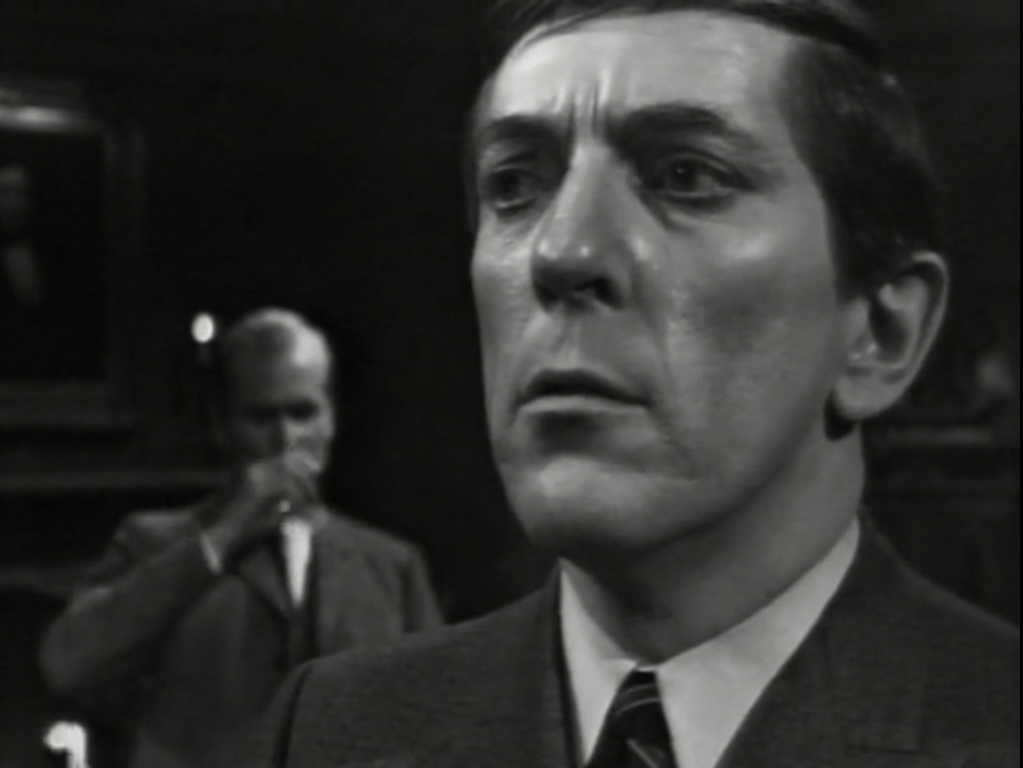
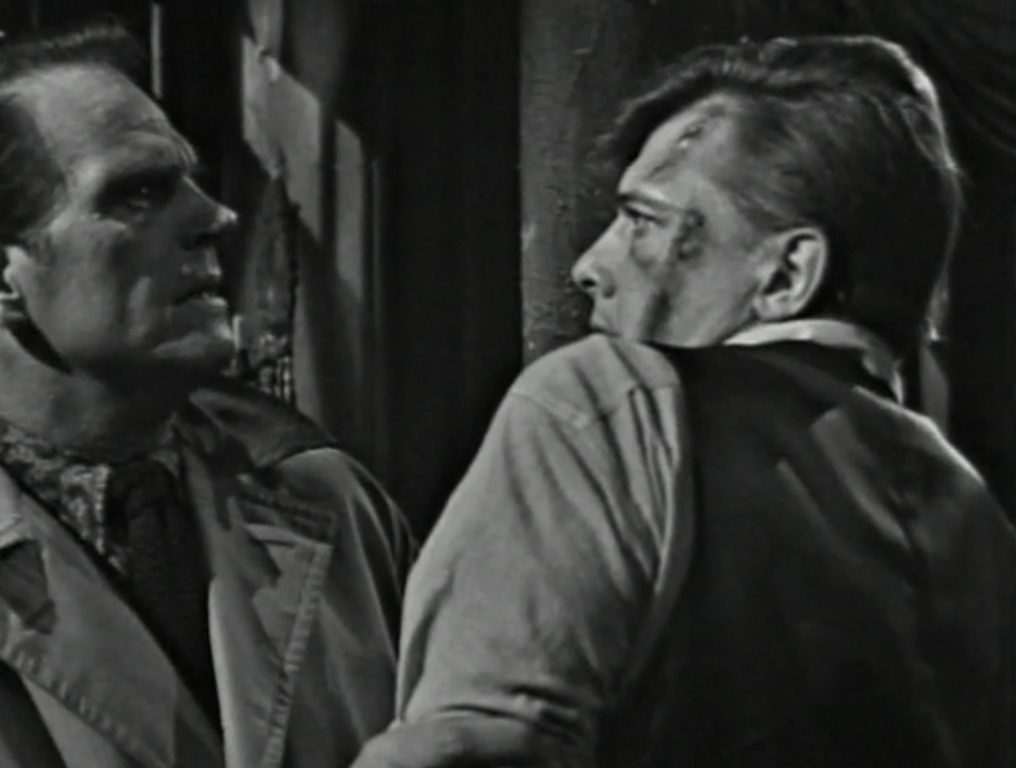
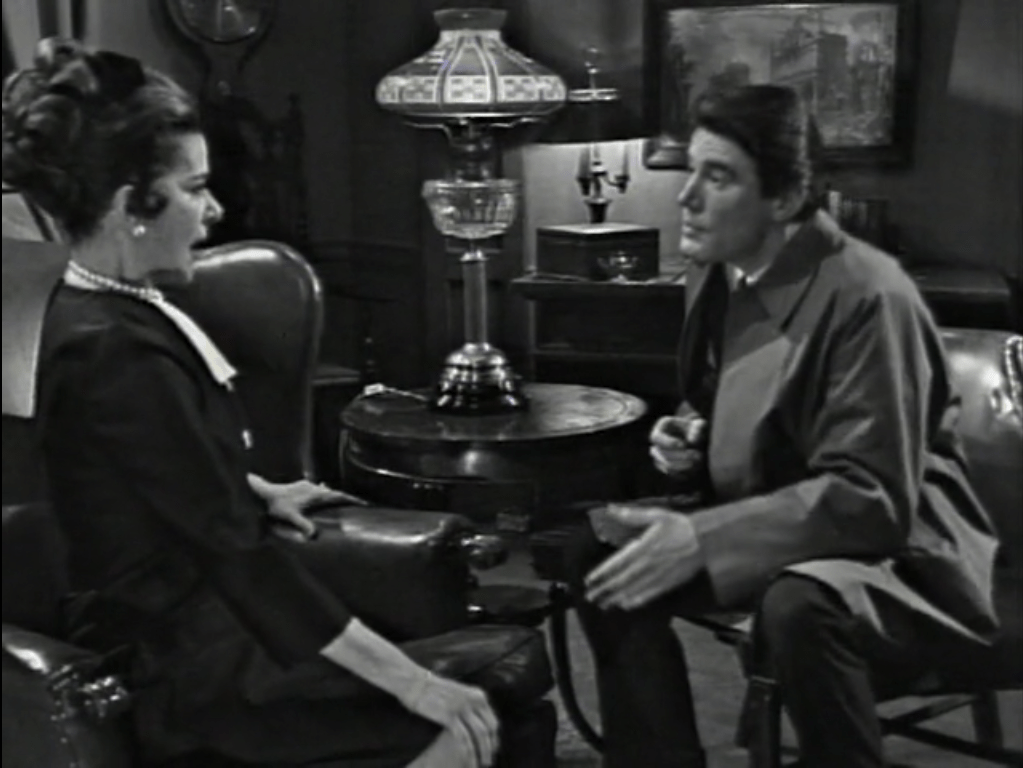
Episode 304: Strange vibrations

Yesterday, fake Shemp Burke Devlin tested his hypothesis that old world gentleman Barnabas Collins abducted Maggie Evens, The Nicest Girl in Town, and held her prisoner during the period covered by her current amnesia. On the one hand, he found that Maggie was perfectly relaxed when Barnabas visited her recently, and that she regards him only as a mildly pleasant acquaintance. There would seem to be no way she could have this reaction to someone who had subjected her to such an ordeal. On the other hand, he found that a melody she seems to remember hearing during her captivity might have come from a music box that was in Barnabas’ possession at the time. Since he has also found that the only person Barnabas will admit to having known before his arrival in the town of Collinsport lived over 130 years ago, he seems to be willing to consider that the resolution to this paradox might require a supernatural element.

Since we know that Barnabas is a vampire and have been frustrated with Burke’s recent angry denials of the existence of supernatural phenomena he previously knew all about, that episode felt like a breakthrough. Lately Barnabas has been harmless and all the non-villain characters have been clueless, leaving the show adrift. Maybe Burke will restart the vampire story. Maybe he will again become the dashing action hero he was when the charismatic Mitch Ryan played him in the first year of Dark Shadows, and maybe his investigation will precipitate a crisis that will bring the Barnabas arc to an exciting climax.

That hope shrivels to nothing in the first minutes of today’s outing. We begin with Burke knocking on the door of Barnabas’ house. When sorely bedraggled blood thrall Willie Loomis tells Burke that Barnabas isn’t in, Burke says that he knows he is. Willie asks why he thinks he knows this, and Burke says that he’s been hiding behind a tree for hours staring at the front door. Burke is supposed to be a rich guy- it would be one thing if he’d hired private detectives to hide behind trees, but that he chose to spend his time doing that himself makes him look ridiculous. He pushes past Willie and declares that he won’t let Willie keep him out of the house. So before the opening titles roll, we’ve seen Burke as an unstable man who alternately cowers in the dark and perpetrates home invasions.

After Burke shouts Barnabas’ name a couple of times, he tells Willie he knows Barnabas is there because he never saw him come out of the front door. Willie says he might have gone out the back door. Burke’s response to that is “Maybe.” With that, Burke blows his last shred of credibility as an action hero. He presses Willie with some questions about Barnabas’ business interests; usually when characters ask about that, I think a suitable send-off for Burke would be a story where Barnabas bites him, enslaves him, and uses his money and connections to put some substance behind his pretense to be an independently wealthy cousin from the Collins family’s long-lost English branch. But when we see Burke being such a total schmuck as he is in this sequence, it’s hard to imagine he could be of any use to anyone, or to care very much how they go about writing him off the show.

That “Maybe” is such a preposterous anticlimax that I wonder if it is a sign of some politics behind the scenes. Long after the show was made, writer Malcolm Marmorstein remembered executive producer Dan Curtis wanting to end the vampire storyline around this time and to give the show over to an arc about Burke and well-meaning governess Vicki getting married and moving into a long-vacant “house by the sea.” There have been a few vague stabs at getting such a story off the ground- Burke and Vicki are engaged now, and he is in the process of buying such a house. But the vampire story was so much the biggest ratings draw the show has had that it is hard to imagine Curtis really wanted to scrap it- more likely he wanted to have more than one story going at a time, as soap operas usually do. In any case, the “house by the sea” bits have been so dull that it feels like the writers are simply refusing to develop the theme, and Ron Sproat’s script today could hardly fail to do lasting damage to Burke. So perhaps there is a sneaky kind of revolt in progress.

Meanwhile, visiting mad scientist Julia Hoffman and strange and troubled boy David Collins have left the great house of Collinwood to take a walk in the woods. They are looking for David’s friend, the ghost of nine year old Sarah Collins. Sarah leaves belongings of hers as tokens of her presence; these objects linger in physical existence until she reclaims them, after which they vanish when she vanishes. Some Dark Shadows fans put a lot of energy into saying that this aspect of Sarah “doesn’t make any sense!” To which I reply, she’s a ghost. All you can expect is that the story will tell you what the rules are and will follow them consistently. Not only does Sarah follow this rule consistently, but the ghosts of Bill Malloy and of Josette Collins had both previously left things lying around the house for people to find. Most recently, Sarah left her bonnet in the house, and now David and Julia are on a quest to return it to her.

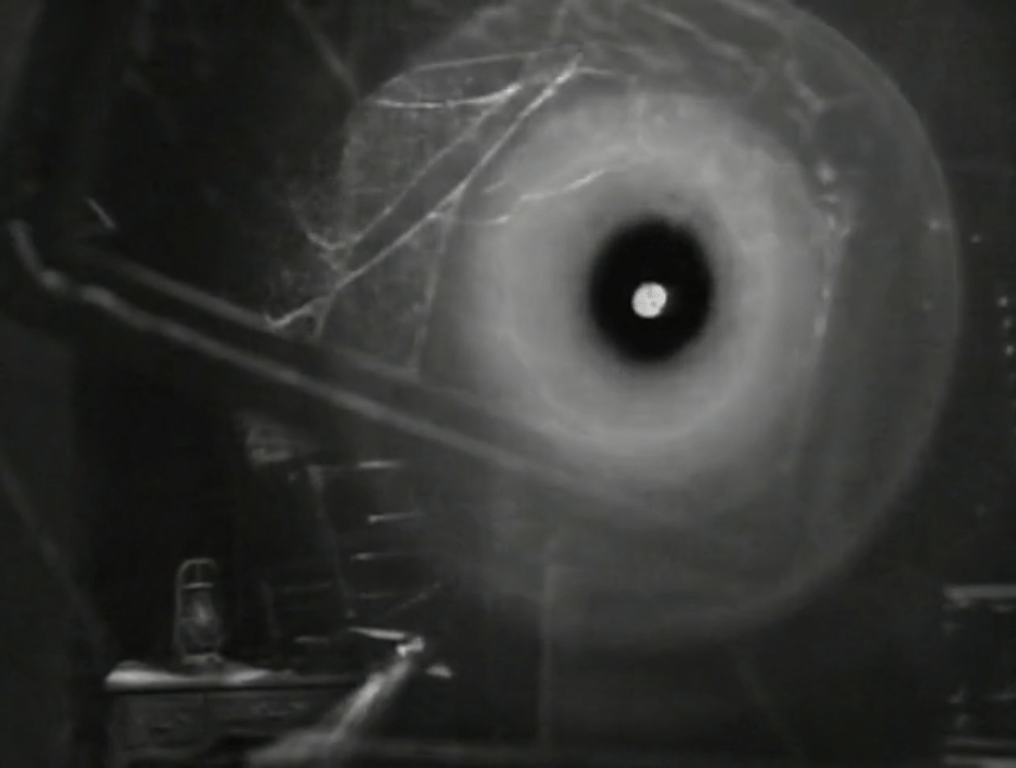
David takes Julia to a clearing in the woods where he has encountered Sarah before. We hear “London Bridge” on the soundtrack, the musical cue telling us that Sarah is present, but she does not appear. David and Julia look around and don’t see her. David thinks he hears someone nearby to their left. They look that way, but don’t see anyone. They turn back, and find that the bonnet is gone.

This little scene captures some of the feeling of live theater that gave the early episodes of Dark Shadows such a special quality. I particularly like the low camera angle on David and Julia, as if we are looking up at a stage.

Later, Julia goes to Barnabas’ house. She and Willie talk about Burke’s visit. Julia muses about the need to provide Barnabas a more complete cover story to keep Burke at bay. This is the first staff meeting we see between Julia and Willie. Until this scene, the only conversations we’ve seen between two people who knew that Barnabas was a vampire were between Willie and Maggie during her captivity, and only a sharply limited number of things could happen during those conversations. Willie would tell Maggie to submit to Barnabas, either sorrowfully or angrily. Maggie would either express defiance openly, pretend to be cooperative, or give nonresponsive answers that suggested she was losing her mind. Combine those attitudes, and you have six possible interactions. Sometimes the characters would change attitudes in mid-scene, multiplying the number of possible interactions, but no matter how you mix and match you still end with Maggie in the same fix she was in at the beginning. But when both characters have some measure of personal autonomy and both are invested in helping Barnabas keep his secret, the number of possible interactions is very large and the number of possible outcomes is infinite. So this is an exciting scene.

We end in The Blue Whale tavern, where Burke asks Vicki to stay away from Barnabas for reasons he refuses to explain. The only interesting thing about this scene is that Bob O’Connell does not appear in the background as Bob the Bartender. Some other uncredited extra is pouring today. 
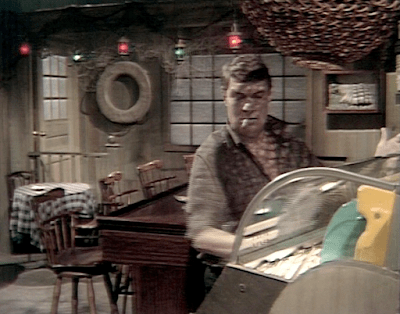
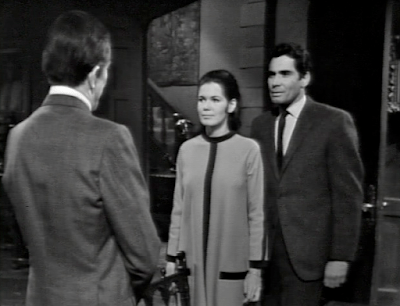
Mystery man. Screenshot by Dark Shadows Before I Die.

Episode 298: You will remember nothing

The only story on Dark Shadows at this point is the one about vampire Barnabas Collins. They’re trying to get a second one off the ground, about an old vacant house that has caught the fancy of well-meaning governess Vicki. Vicki’s depressing boyfriend Burke has interpreted her interest in the place as a marriage proposal. He wants to buy the house and live in it with her.

Today, we find out that the house is the property of the ancient and esteemed Collins family. That isn’t a big surprise, since Barnabas clearly knew something about it from his time as a human. It does suggest a partial answer to a question Vicki had when she, Burke, and Barnabas visited the house on Thursday. Barnabas found a handkerchief there bearing the initials “F. McA. C.” and gave it to Vicki. She expressed a determination to find out what those initials stood for. Now she should be able to look at the family’s records and search for a Mrs Collins whose maiden name had the initials “F. McA.”

Burke asks matriarch Liz if she is willing to sell the house to him, and she is perfectly agreeable. Liz’ daughter Carolyn joins them for a tour of the house. There is some startlingly sloppy writing in this scene. Carolyn remarks that the house has a special warmth and speculates that it is the result of so much light reflected into its windows from the sea nearby. A couple of minutes later, Liz complains that the house is terribly cold, and Carolyn says that’s because it is so close to the sea.

Both Liz’ glad willingness to sell the house to Burke and her trip to it signal that storylines from the first year of the show are now behind us once and for all. Burke was introduced in episode 1 as a dashing action hero returning to his home town to wreak vengeance on his old persecutors, the Collins family. The “Revenge of Burke Devlin” arc consisted so largely of talk about people, places, and events we never saw that it didn’t amount to much, and by the time Burke formally renounced his revenge in #201 it had long since fizzled. That left some chance it would flare back up, so in #223 Liz vowed she would never sell Burke any property at any price, but now the door is firmly closed on that old theme.

When Dark Shadows started, Liz was a recluse who hadn’t left home in eighteen years. Since they never showed us anyplace Liz might want to go, that story was an even more total dud than was The Revenge of Burke Devlin. Even after the reason for Liz’ seclusion was exposed as fraudulent in #273, she still made a show of reluctance when her brother Roger suggested she go to town in #277. Now she doesn’t hesitate to hop in a car and go to the house by the sea. In fact, she is the one who urges Carolyn to get out of the house. So that sends another non-starter to the narrative junk yard.

In this episode, the characters refer to “the house by the sea” as “Seaview.” That was an inside joke. The Newport, Rhode Island mansion used in the exterior establishing shots of the great house of Collinwood was known as Seaview Terrace. In 1974, Martin and Millicent Carey bought the house, and it came to be known as the Carey Mansion.

Meanwhile, Vicki is visiting Maggie Evans, The Nicest Girl in Town. Maggie has amnesia, a condition induced by her doctor, mad scientist Julia Hoffman. Julia is in league with Barnabas, and has damaged Maggie’s memory to keep her from recalling that Barnabas abducted her and tried to replace her personality with that of his lost love Josette. Vicki is trying to help Maggie regain her memory.

There is another instance of distressingly sloppy writing in this scene. Vicki tells Maggie that she thought she saw her in Eagle Hill cemetery during the period she cannot recall. She tells Maggie that Burke tried to convince her that she can’t have seen her. In response, Maggie asks if Burke saw her, and Vicki again says Burke tried to convince her she hadn’t seen her.

Vicki tells Maggie that she and Burke had gone to the cemetery to lay flowers at Josette’s grave. Maggie reacts strongly to Josette’s name, and Vicki starts telling her about Josette. When she mentions that Barnabas has restored Josette’s room, a light comes on in Maggie’s eyes and she grows very animated. She is about to say something when a knock comes at the door. It is Julia.

There is a strange blooper in the conversation between Vicki and Julia at the door. Julia asks “Would it be all right if I came in and waited?” Vicki responds “Not at all.” My wife, Mrs Acilius, is usually very forgiving of bloopers, but she laughed out loud at this one.

It could be that Julia’s line was “Would you mind if I came in and waited?” Alexandra Moltke Isles was famously accurate with her line delivery, even when her scene partners bobbled, and it could be that she just went ahead and said what Vicki was supposed to say even though it didn’t make sense. In view of Carolyn’s self-contradictory lines about the temperature of the house and Vicki’s repetitious lines about Burke’s attempt to gaslight her, both of which were obviously scripted, it could also be that the actors are working from Ron Sproat’s unrevised first draft.

While Julia looks at some of Maggie’s father’s paintings, Vicki sits back on the couch with Maggie. Julia hears Maggie exclaim “Barnabas!” and get very agitated. It seems she is about to tell Vicki all about what happened when she was missing.

Maggie, remembering

Julia swoops in, asking if they like antiques. Vicki looks bewildered at the interruption, but answers with a polite yes.

Julia interrupts

Julia presses her jeweled medallion on her. Vicki passes it to Maggie, and Julia asks for a cup of tea. Maggie volunteers to make the tea, but Vicki insists on doing it. In #143, the living room and kitchen in the Evans cottage were two parts of an undivided space, but now we hear Vicki close a door when she goes to make tea. Not only is that confusing to viewers who remember the earlier episodes, but since Vicki goes in the direction of the front door it seems for a moment that she is leaving the cottage altogether.

While Vicki is out of the room, Julia hypnotizes Maggie. She commands her to forget everything that happened while she was missing. When Vicki returns, Maggie has indeed forgotten everything.

Maggie under hypnosis

Episode 293: A better story next time

Well-meaning governess Vicki was the main character of Dark Shadows in its first 39 weeks, and themost interesting storyline was her relationship to her charge, strange and troubled boy David Collins. That story came to its climax when David chose life with Vicki over death with his mother, blonde fire witch Laura Murdoch Collins, in #191, and Vicki hasn’t had much to do since.

Yesterday, Vicki told her depressing boyfriend, fake Shemp Burke Devlin, about an old vacant house that excites her. Since Vicki’s work with David is compensated mainly with room and board, the only way her interest in an empty house could lead to anything happening on the show would be if she quit her job, married Burke, and moved there with him. Since Burke has even less connection to the ongoing narrative arc than Vicki does, and has been spending his time lately demanding that she stop trying to attach herself to the story and settle in with him in his dead end far away from the plot, that is a dismal prospect.

All the action on the show is centered on vampire Barnabas Collins. In the opening scene, Barnabas talked with his sorely bedraggled blood thrall Willie Loomis about two women. One was Vicki. Willie was agitated that Barnabas is planning to bite Vicki. This is an odd thing to worry about- Vicki has gone out of her way to make herself available to Barnabas for biting, even contriving to spend the night in his house. But she still has all her blood, and no foothold in the vampire story. When Barnabas tells Willie that he does not intend to harm Vicki in any way, those of us who hope she will stay relevant to Dark Shadows have a sinking feeling that he might be telling the truth.

The other woman Barnabas and Willie discuss is mad scientist Julia Hoffman. In contrast to his assurances that he means no harm to Vicki, Barnabas muses openly that he might have to kill Julia at any moment. Observing Willie’s reactions, Barnabas comments that it is interesting that Willie is so concerned about Vicki, but utterly indifferent to Julia. If we remember Willie as he was before Barnabas enslaved him, this may not be so odd.

Before he became sorely bedraggled blood thrall Willie Loomis, he was dangerously unstable ruffian Willie Loomis, menace to womankind. Willie tried to rape Vicki, among others, and his guilt over the use he made of his freedom when he had it is reflected in his solicitousness towards those whom he once used so ill. By the time he met Julia, he had been under Barnabas’ power for months, so he has made no choices concerning her that he can regret.

Barnabas shows up as Vicki and Burke are getting ready to visit “the house by the sea.” Barnabas slips a couple of times as he talks with them about it, revealing to the audience that he is familiar with the house. This raises our hopes- perhaps Vicki’s fascination with the house will lead her to Barnabas and relevance, not to Burke and oblivion. Vicki invites Barnabas to come along with her and Burke as they tour the house, and he agrees.

While Vicki is upstairs changing her clothes, Barnabas and Burke talk in the drawing room. Barnabas points out that little is known of how Burke became so rich so quickly in the years before he came back to Collinsport. Burke responds that far less is known of Barnabas than of him, that his entire life before this year is perfectly obscure to everyone. As Barnabas, Jonathan Frid plays this scene with more variety and subtlety of expression than any previous one, and as Burke, Anthony George gives a tight, forceful performance. It is the first time Dark Shadows viewers have glimpsed the reason George had such a long and busy career as an actor.

George was a cold actor who excelled at characters whose intelligence and determination were obvious, but whose feelings and intentions the audience could only guess at. That would have made him a fine choice for the part of Burke in the early months of the show, but these days he spends most of his time giving big reactions to bewildering news and the rest in passionate love scenes with Vicki. George was just awful at both of those. But in today’s duel with Barnabas, Burke is choosing his every word and gesture with care, putting him right in the center of George’s wheelhouse. Opposite the much warmer Jonathan Frid, the effect is electric.

It leaves me wondering what might have been. Mitch Ryan was compelling as Burke #1, but his hot style of acting pushed Burke’s emotions to the surface and took away some of the mystery that would have been needed to make the “Revenge of Burke Devlin” storyline a success. With George in the part, that story would probably still have fizzled, but it might have taken a bit longer to do so. And of course the part George has been struggling with, until this scene in vain, was written for Ryan. If the two had just traded places and the scripts had stayed the same, Burke #1 and Burke #2 might both have been strong characters.

Of course, they wouldn’t have stayed entirely the same. The writers watch the show and are influenced by what they see the actors doing. But they may not have changed as much as you might expect. Neither Ron Sproat nor Malcolm Marmorstein seemed to have much sense of what actors could do. It’s no wonder that George’s first good scene comes in the second episode credited to Gordon Russell. Perhaps if Russell had been with the show earlier, Burke #2 might have been more of a success.

The scene also brings up one of my favorite fanfic ideas. People are going to wonder about Barnabas’ background, and Burke needs to be written off the show. Why not solve both of those problems by having Barnabas enslave Burke, make Burke set up businesses in Barnabas’ name and use his shadier contacts to get Barnabas false identification papers, then kill Burke off once he has exhausted his resources? You could do that in such a way that the other characters would think Barnabas was a nice guy who was using his wealth to prop Burke up, consolidating his position in their eyes. You could also use it to connect Barnabas to the wider world beyond the estate, suggesting that he poses a menace not only to one family but to a whole community.

At length, Vicki comes back downstairs. Burke greets her first, but she barely acknowledges him. She has eyes only for Barnabas. Barnabas may not be in any hurry to bite Vicki, but she is bursting with readiness to get into the vampire story and back into the main action of the show.

Eyes on the prize. Screenshot by Dark Shadows Before I Die.

Episode 249: The most pitiful exhibition I’ve ever seen

Seagoing con man Jason McGuire stands outside the drawing room of the great house of Collinwood, eavesdropping. The conversation is among heiress Carolyn, Carolyn’s uncle Roger, and well-meaning governess Vicki. Carolyn tells Roger and Vicki that she wants to stop Jason from blackmailing her mother, reclusive matriarch Liz, into marriage. She doesn’t know what hold Jason has over Liz, but is sure it has to do with something secreted in a locked room in the basement. Roger agrees to help Carolyn break into the room.

Jason reports this conversation to Liz and suggests they give Carolyn the key to the room. What Liz is desperate to hide is that Jason buried the body of her husband, Paul Stoddard, under the floor there eighteen years ago. Jason tells her that he sealed the floor up well enough that there is nothing to see unless you start digging. Liz is unsure, and Jason offers to go to the room and look.

First-time viewers may not make much of this, but those who have been watching from the beginning will be exasperated. Liz has gone into the room herself many times over the years; Vicki has even caught her coming out of it. When they take us to the room and show us that there is nothing interesting to see there, they are telling us that there was no point to any of the scenes where Liz gets frantic at the prospect of someone going into the room. It’s a slap in the face of the audience.

The cast assembles in the room and pokes around a little. They don’t open all the trunks and cases; there is a big barrel that could hold the remains of several missing husbands, and they never so much as look at that. After this has gone on for some time, Jason declares that it is “The most pitiful exhibition I’ve ever seen.” That’s good, it’s always fun when the villain has a chance to put the audience’s feelings into words. After they go back upstairs, Roger says that he’s never been more embarrassed in his life. Louis Edmonds delivers that line with tremendous feeling, it doesn’t sound like he had to act at all.

The whole miserable mess leads to Liz and Jason announcing their engagement, something Carolyn had been talking about when she lamented for “Poor mother- abandoned in her first marriage, blackmailed into a second.” But Carolyn, Roger, and Vicki all look shocked, a dramatic sting plays on the soundtrack, and the closing credits start to roll, as if this were some kind of news.

Closing Miscellany

On his great Dark Shadows Every Day, Danny Horn analyzes the action of the episode as a series of devices to prevent anything interesting happening. He also goes through much of the unbelievably repetitious dialogue that clutters it up. He’s hilarious, the post is highly recommended.

When Jason goes to the basement to make sure that there is nothing there worth looking at, he shines his flashlight directly into the camera several times. It’s a flashlight we haven’t seen before, with a bulb mounted on top of a box. I’ve never been a particular flashlight aficionado, but that prop is the most dynamic part of today’s show.

Flashlight mounted on a box
Jason enters the basement
Looking at an old shirt

Episode 245: Microscopic views of hideous malignancies

Two of the best blogs about Dark Shadows share the same web address. One is Dark Shadows Every Day, a series of more than a thousand well-crafted, insightful, often hilarious essays by Danny Horn about episodes #210 through #1245 and related topics. The other is the group blog that Danny’s readers maintain in the comment threads under each of his posts. The commenters outdid themselves in their remarks on Danny’s post about this episode.

At the beginning of the episode, addled quack Dr Woodard has figured out that the two victims of vampire Barnabas Collins, sorely bedraggled blood thrall Willie Loomis and missing local girl Maggie Evans, have something in common. He hopes that if he can compare a sample of Willie’s blood with Maggie’s he will figure out what that is. Willie is terrified that this will lead to the exposure of Barnabas. Puzzlingly, Barnabas is unworried and orders Willie to cooperate. Only after Willie has given the blood and the doctor has left do we learn that Barnabas switched Willie’s sample with a normal one. “DS Willie” comments:

Barnabas is seriously messing with Willie’s mind in this one. So much of what Barnabas says has double meanings, even triple. Of course he’s playing with Woodard too, but Woodard never realizes it.

For one thing, just after Willie’s blood is taken, Barnabas makes creepy blood comments, ending with “…surrendering your utmost self” and his next line “Now, you had no choice.” I suspect this is all meant more for Willie than for the doctor. Willie had no choice but to surrender his utmost self.

Barnabas delights in repeatedly demonstrating his control over Willie, all to the doctor’s approval. When Willie flares up momentarily at Dr. Woodard’s remark about understanding being frightened, Barnabas immediately brings Willie to heel with a harsh word and harsher look.

Later Barnabas jerks Willie’s chain some more, just because he can, and to tighten his control even more. It’s classic Stockholm syndrome type stuff. The victim is abused and in absolute fear for his life, and yet any lessening of the captor’s threats or violence can be perceived as mercy, bonding the victim to his captor.

His shirt in Barnabas’ menacing grasp, Willie swears he would never, never betray Barnabas. He is only thrown to the ground instead of being choked or beaten. Barnabas proceeds to make Willie feel stupid and disloyal and dishonorable and undeserving of future protection. Add enthrallment on top of that. Oh, and the police having Willie as their top suspect, and Jason having beaten and threatened to kill Willie, even though Willie was trying to protect him.

It is actually pretty amazing that Willie has held up under the strain. He is in full-on survival mode, and yet still has the decency to try to shield Maggie and others insofar as he can, given his powerlessness.

Hey, what was up with Barnabas saying Willie’s blood is a “delicate little flower painted on glass”? He says it twice (once to Woodard and once to Willie) while looking directly at the slide. That doesn’t come across as a remark about blood in general.

“DS Willie,” on Dark Shadows Every Day, 13 October 2018 at 12:38 AM Pacific time

He adds another comment:

Oh. Barnabas was using yet another method to get Willie under his thumb: verbally emasculating him with the “delicate little flower” reference to Willie’s blood on the slide. But I think Willie was so relieved that he missed the diss.

“DS Willie,” on Dark Shadows Every Day, 26 December 2018 at 5:57 PM Pacific time

I made a contribution of my own to the thread. In response to Danny’s unfavorable comparison of Dr Woodard with Bram Stoker’s Professor Van Helsing, I commented:

Screenshot by Dark Shadows Before I Die

I don’t think Woodard is Van Helsing at all. He’s Dr John Seward, treating Lucy and Renfield and baffled by the whole thing until he calls in his brilliant old professor. The mysterious Hoffman, one of the best men in the field, that’s the expert who is going to shake things up.

Seward is young, dynamic, and ready for adventure, while Woodard is middle aged, pudgy, and ready for an afternoon tee-time at the local country club. But that change is necessary. Readers of the novel have plenty of time to think about the sort of group that might go on the expedition Van Helsing organizes, and will expect a bunch of high-spirited youths. On a soap, a character like Seward would be the heroine’s new love interest, and Dark Shadows is flailing about trying to figure out what to do with the love interests Vicki and Maggie have now. The last thing they want right now is another bold, handsome young man who is apparently under a vow of celibacy.

“Acilius,” on Dark Shadows Every Day, 19 May 2023 at 7:26 PM Pacific time

In response to Danny’s remark that Jonathan Frid’s bobbles make it hard to guess what lines the script originally gave vampire Barnabas Collins, commenter “TD” replies:

#1. “Now, in a way, isn’t that understandable?

#2. “After all, blood is the life force.

#3. “It reaches into the deepest recesses of both the heart, and the brain.

#4. “It is the familiar of our complete being.

#5. “To surrender even one drop of it is to suggest a partial surrender of one’s utmost self.”

I’m not so sure this is actual Fridspeak. Yes, it’s kind of gibberishy, but it does make grammatical sense and some sort of syntactical sense. Frid delivers it smoothly and with confidence, unlike his halting fumblings when he can’t remember his lines. When he says this, it’s in a close-up shot, and he’s looking down. My guess is that he is reading it directly from a script. Also, this is Joe Caldwell’s first script (or first credited script–he did some writing on earlier Ron Sproat scripts, if another website is accurate). Maybe this is Caldwell exhibiting the enthusiasm of a first solo outing. Dr. Woodard has a couple of hi-falutin’ and rhetorically “poetic” (and gibberishy) speeches of his own in this episode.

Also, might this episode be marked as the first one to demonstrate the “reluctant” or “sympathetic” vampire in Barnabas’s character? In this episode (in another speechy series of lines), when Dr. Woodard and Barnabas are discussing the “madman” who broke into Woodard’s office and stole the blood sample, we get this exchange:

Dr. Woodard: You know, it’s the peculiar magnificence of the human spirit that’s required to provide the potential for such corruption. [See? This is like the Barnabas “blood is the life force” speech–who talks like this???]
Barnabas: Yes, I know what you mean. Whoever he is, he must certainly be, at one and the same time, more than a man…and less than a man.
Dr. Woodard: You seem almost sorry for him.
Barnabas: Sorry? No, I’m not sorry. The truth is, I loathe him. I loathe him very, very deeply.

“TD” on Dark Shadows Every Day, 2 June 2017 at 11:06 AM Pacific time

I agree with “TD” that today’s dialogue is marred by purple passages; I would go so far as to say that none of the lines would have survived a rewrite. Not among the lines delivered by the human actors, anyway- our beagle was fascinated when the hound howled on the soundtrack.

I should mention that at least one perceptive critic of Dark Shadows disagrees with me and “TD” about the script. Patrick McCray’s Dark Shadows Daybook is in its own way the equal of the two blogs at Dark Shadows Every Day. Patrick wrote two posts about this episode. In one from 2016, he wrote that “The language is poetic and evocative. Barnabas has moments of self-loathing and ambiguity that are gorgeously, hauntingly phrased, and the same can be said for Woodard’s exploration of science and mystery.” In 2019, he went so far as to call it “the best written episode of the series.”

John and Christine Scoleri also include some interesting material in the post about this episode on their recap-heavy blog Dark Shadows Before I Die. I particularly liked the series of screenshots at the end of the post captioned with some of the purple prose from today’s dialogue.

Episode 242: One of the best men in the field

Maggie Evans, The Nicest Girl in Town, suffered from an ailment her doctor, Dave Woodard M. D., could not identify. She then vanished from her hospital room in a manner law enforcement, led by Sheriff George Patterson, could not explain. The opening voiceover says that Maggie’s troubles “mystify the finest minds.” This is the first and last time either Woodard or Patterson is classed with “the finest minds” even among the low-functioning characters who abound in the period when Dark Shadows is being written by Ron Sproat and Malcolm Marmorstein. Well-meaning governess Vicki is still the single smartest character on the show, and she turns into an absolute moron every two or three days.

In the opening teaser, dashing action hero Burke Devlin asks Dr Woodard if his studies of Maggie’s blood samples will help find her. He says that they won’t, but that if he can diagnose her he might be able to help her after she is found. Burke asks if he is about to make a diagnosis. He says that he might be making progress towards that goal. At that point, there is a dramatic musical sting, and we cut to the credits. That’s the hook, a statement that further study is needed.

Dr Woodard tells Burke that he has contacted “Hoffman, one of the best men in the field,” and that he hopes Hoffman will be able to get things moving. Under Burke’s questioning, he admits that he is pessimistic that Hoffman will see anything he has missed. This is the first mention of the name “Hoffman” on Dark Shadows. I believe it is only the second mention* of any surname that is not derived from Irish (as are such names as Collins, Devlin, Malloy, and McGuire,) English (as are names such as Woodard, Patterson, Loomis, Johnson, Stockbridge, and Garner,) Welsh (as are names such as Evans and Morgan,) Scottish (as are the names Adair and Murdoch,) or French (as are the names La Freniere, Bilodeau, and du Près.)** It is certainly the first name we have heard that suggests there might be Jewish people in the universe of Dark Shadows.

We then cut to the study in great house of Collinwood, where high-born ne’er-do-well Roger Collins has to confront his sister, reclusive matriarch Liz. The auditors have told Roger that the books are out of balance at the family business. Roger knows that the reason for this is that Liz is giving money to buy the silence of seagoing con man Jason McGuire. He reminds Liz that he himself was afraid of blackmail for the first 40 weeks of the show, so he knows from personal experience that it is no way to live. Liz refuses Roger’s plea that she tell him her secret. As he probes and she resists, they move around the room at times like fencers, at times like dancers performing a paso doble. Their movements are easily the most interesting element of the episode, a credit to director John Sedwick.

Roger’s first approach to the shielded Liz
Liz parries Roger’s thrust
Roger’s second approach

Roger admits that he hasn’t been much help to Liz over the years, but begs her to let him help her now. Liz won’t tell him anything, but she is touched to see her bratty brother sincerely trying to step up.

Liz goes to the drawing room. The camera is behind her as she approaches the room. Jason is standing at the fireplace under the large portrait, the spot furthest from the camera. Not only does he look as small as possible, but at the moment we first see him he is turned away from us, his head tilted far back as he takes a drink. Jason’s smallness and obscurity, coming so soon after Roger’s speech about the dreariness of blackmail, feels like an acknowledgment that Jason doesn’t have much to offer the audience.***

Coming upon Jason

Liz tells Jason she can’t give him any more money without blowing the secret they share. He amazes her by accepting this information calmly, but she is sure he is not done tormenting her.

Liz returns to the study, where Roger is still sitting. She tells him that she has talked to the auditor and straightened out the books. That sounds like something that would take quite a while, even if you are sitting across from each other, and Liz and the auditor had to do it over the telephone. So how long has Roger been sitting there?

Then we rejoin Burke and Woodard in the doctor’s office, which someone has ransacked. The perpetrator wrenched the metal bars out of the window and stole Maggie’s blood samples. Dr Woodard says that the only way the bars could have been twisted was by someone with the “supernatural strength of madness.” I’m not an expert in mental health, but that does not sound like a conventional psychiatric opinion to me.

*After Lieutenant Costa of the Arizona State Police, whom we saw when Dark Shadows took us to Phoenix in #174.

**It is pretty weird that a show set in Maine has so few French-surnamed characters. We’ve only heard of one working-class Mainer with a French name, Amos Bilodeau. La Freniere was given in #45 as the maiden name of Josette, a grand lady who came from France to marry into the Collins family in a previous century; eventually, Josette’s birth name will be retconned to du Près.

***My wife, Mrs Acilius, was the one who really noticed the visual strategy both in Liz and Roger’s first scene in the study and in Liz’ entry into the drawing room.

Episode 240: Don’t look for her there

Vampire Barnabas Collins has taken up residence in the long-abandoned Old House on the grounds of the great estate of Collinwood and restored two rooms, leaving the rest of the mansion a shambling ruin. That image captures the current state of Dark Shadows. This episode, like many others we’ve seen recently, contains some scenes that are all right by themselves, but that do not contribute to any structure. The result is continual frustration and disappointment.

From its introduction in #70 until Barnabas claimed it in #212, the Old House was the stronghold of the ghost of Josette Collins and the playground of Josette’s darling, strange and troubled boy David Collins. We’ve seen Josette appear several times, and characters including David, well-meaning governess Vicki, and artist Sam Evans have interacted with her. Now, Barnabas not only seems to have silenced Josette’s ghost, but is holding Sam’s daughter Maggie and trying to turn her into a resurrected Josette by following the procedures Boris Karloff’s character Imhotep demonstrated in the 1932 film The Mummy. Regular viewers are growing impatient to see Josette emerge from her portrait and lead the battle against Barnabas, as she led the successful battles against crazed handyman Matthew Morgan in #122-#126 and against blonde fire witch Laura Murdoch Collins in #126-#191.

Today, David reflects our impatience. We see him at the Old House, knocking on the door, then peeping through the window. He sees a veiled figure in Josette’s white dress walking down the stairs. He returns to the door, which opens for him. No one is in sight.

We have assumed that the woman in white was Maggie wearing the dress Barnabas gave her, but the fact that she was out of sight by the time the door opened suggests that it might have been Josette’s ghost after all. David calls to Josette. When she does not answer, he goes upstairs to look for her.

David finds Josette’s restored bedroom, where her portrait now hangs. He talks to the portrait, not in the easy conversational tone he had used with it in #102, but in awkward shouts. He pleads and protests that he can’t sense her presence. When he came to the house in #223 and saw that the portrait was not in its old place above the mantle in the front parlor, he had wandered around whining that the portrait is lost and Josette is lost with it. Now that he has found the portrait, his perplexity deepens- she is still nowhere near.

Barnabas enters, and demands to know what David is doing deep in his house. After a moment, he sits and talks with the boy. He tries to present the idea of ghosts as absurd on its face, but David has seen too much to find that convincing. When Barnabas tells him that the door probably opened because of the warping of the wood, we know that it must have been the work of a paranormal being- a villain cannot say something so plausible unless it is false. Even if the figure David saw was Maggie, there is definitely some spectral presence in the house that Barnabas does not know about and cannot control.

Barnabas and David have a man-to-man talk, or should I say ghoul-to-boy.

Barnabas finally tells David to take a long, deep look at the portrait, and asks him if he still feels that Josette is there. David says that he does not have that feeling. Barnabas triumphantly declares that Josette is really gone.

Now, at last, we expect everything will start to come together. David will talk to Vicki, they will compare notes about their encounters with Josette, and will try to figure out how and why she has changed. There will be images building on the ambiguity about who David really saw through the window and who really opened the door for him. David’s father, high-born ne’er-do-well Roger, will try to revert to his usual denials that anything peculiar is going on, but will grudgingly admit that the events of the last several months have proven that Josette’s ghost is real, and will not be able to resist wondering what is going on with it now. That in turn will lead to a new understanding between Roger and Vicki, allowing Roger’s relationships with both her and David to become more dynamic. Barnabas will realize that, even if he can keep Josette from manifesting herself again, she has already revealed enough to the characters about the supernatural back-world behind the settings in which they operate that she has created a dangerous situation for him, and he will have to scramble to keep them from discovering that he is a vampire.

The script brings us right up to the brink of every one of those events, only to whisk us away and instead show us something dull and pointless. David does tell Vicki that he saw Josette’s ghost, that Josette is in some way he cannot explain different than she was when he saw her before, and that he could not feel Josette’s presence in her portrait. But Vicki does not draw on her many experiences with Josette and join David in trying to unriddle these mysteries. Instead, she behaves as she did in the first twelve weeks of the show, and treats David as if he is having a neurotic episode.

David tells Vicki that Josette’s face, as he saw it through Barnabas’ window, was “exactly the same” as it was when he saw her ghost before. We don’t see the face at all today, and when we’ve seen Josette before, the only look we had at her face were brief glimpses in #149, #165, and #184. In each of those episodes, she was played by stand-in Rosemary McNamara. Today, the performer wearing the dress is Dorrie Kavanaugh. Casting Miss McNamara and letting a bit of her face peep out for a fraction of a second would seem to be way of building on the ambiguity, especially since she resembles Kathryn Leigh Scott strongly enough that she could easily be taken for Maggie.

Though Miss Scott played Josette’s ghost in #70 and #126, this is the first we’ve heard that Maggie resembles Josette. Perhaps Barnabas chose Maggie, not only because she is an attractive young woman who works late and often has to walk home alone after dark, but because she really does look like Josette. If so, the parallel with The Mummy is stronger- Helen Grosvenor looked just like the Princess Ankh-esen-amun, and the movie hints that Imhotep may have been right to believe that she was her reincarnation.

Vicki doesn’t react at all to David’s observation. She simply grows more exasperated with him for his persistence in believing in ghosts and intruding on Barnabas’ privacy, and warns him that “your father and I” will have to become stricter with him if his behavior does not improve.

Meanwhile, Barnabas and Roger are talking in the drawing room. Roger speculates that David has gone back to his preoccupation with ghosts because everyone is so worried about the missing Maggie, then remarks that it is strange that the boy’s behavior should have created a connection between Maggie and the portrait of Josette. This line doesn’t make any sense in the script as written, but if we could believe that Roger remembers what he recently knew to be true about Josette’s ghost, its powers, and its connection to Maggie’s father, it would be a sign that he is on his way to making a crucial discovery. In that situation, Barnabas’ mounting dread as he listens to Roger would carry considerable dramatic force, as opposed to the meaningless throwaway it in fact is.

Barnabas absorbing what Roger has said

Vicki’s amnesia is especially depressing, because the only story that consistently worked in the first 39 weeks of the show was the relationship between Vicki and David. At first David hated Vicki and wanted to kill her. After he found out she’d seen a ghost, David proclaimed his love for Vicki, but that was a love that might quickly transform itself into a violent hostility. Gradually, a true friendship grew between them. The Laura arc was the climax of that story, ending with David turning away from the biological mother who wanted to kill him and embracing Vicki as a more acceptable mother figure.

Once David had adopted Vicki as his new mother, their story was complete. Alexandra Moltke Isles and David Henesy made so much of Vicki and David’s scenes together, often in spite of very bad writing, that we are eager to see a sequel to that story that will give us more victories over the stuff that dribbled out of the typewriters of Ron Sproat and Malcolm Marmorstein. One possible sequel would have been an arc in which Vicki and David have to work together to defeat the vampire. If Vicki has forgotten everything that’s happened on the show since October of 1966, when she saw the ghost of Bill Malloy in #85, she won’t be able to do that, or much of anything else for that matter. The show has been primarily a supernatural thriller for months now, and if Vicki is excluded from the supernatural stories her future on it is very limited indeed.

A possible non-supernatural storyline might have been a romance between Vicki and Roger. After all, if Vicki is acting as David’s mother and she lives in the same house as his father, it only makes sense that the two of them should become a couple. And indeed, there are moments today when that seems to have happened. She hesitates for a fraction of a second while delivering the line about “your father and I,” which does sound so much like something an impatient mother would say. She then goes on to have a quarrel with Roger about how to discipline David and what emotions it is proper to display in front of him, sounding like they’ve been married for years. After a lot of raised voices, they apologize to each other and leave together.

We’ve seen Vicki and Roger in date-like situations a few times, for example in #78 and #96, and each time it has immediately become clear that the two of them are wrong for each other. Besides, Roger has been turning into the actor who plays him, the obviously gay Louis Edmonds. So a relationship between Vicki and Roger would be doomed from the start.

Still, it would reactivate some dead storylines. The series started with Vicki on a quest to learn who her parents were, a theme that went nowhere. They’ve been hinting very heavily that Roger’s sister, reclusive matriarch Liz, is Vicki’s mother, so that an engagement between Vicki and Roger would put Liz in a position where she could hardly keep that secret any longer. Moreover, Vicki has gone on some dates with dashing action hero Burke Devlin, who is not directly connected to any ongoing storylines. Burke hates Roger and is attracted to Vicki, so a love triangle involving the three of them might bring him back into the show. But that fizzles out just as the other potentially interesting situations do, leaving us without much to look forward to.

Episode 232: One quick day

Maggie Evans, The Nicest Girl in Town, has been sick in bed. As long as the sun is up, she is very weak, has no memory of what’s been going on, and can sleep. When darkness comes on, she has wild mood swings and has to be physically restrained from running out into the night.

Moreover, the people who have spent the most time trying to help Maggie have no idea what is wrong with her and don’t seem to be making any progress towards finding out. Her doctor is as ignorant of medicine as are the writers, which is to say completely. The parts assigned to her father Sam and her boyfriend Joe consist of variations on the theme of helplessness.

As this episode begins, Maggie is still in bed, Joe is still sitting with her, and they are still at a loss to understand the situation or develop any plans. After yesterday’s episode, in which the actors labored mightily to inject three minutes of nonverbal storytelling into the half hour window Dark Shadows filled, things are looking pretty grim for the audience.

But then we get a sign of hope. Joe calls well-meaning governess Vicki and asks her to sit with Maggie. At the end of #229, Vicki realized that Maggie’s condition is the same as that which befell the luckless Willie Loomis a few weeks back. Moreover, Vicki is our point-of-view character, and she has consistently been the first to catch on to information after it has been shown to the audience. In the storyline centering on blonde fire witch Laura Murdoch Collins, Vicki led the team that opposed Laura’s attempt to burn her son David to death, and ultimately rescued David as Laura vanished in the flames. So if a battle is going to be waged for Maggie’s sake, we expect Vicki to be a central figure in it.

When Vicki takes Joe’s call, she is in the foyer of the great house of Collinwood. Seagoing con man Jason McGuire is in the same space, and asks her about Maggie. Vicki hates Jason, who is flagrantly blackmailing reclusive matriarch Liz. Vicki keeps trying to excuse herself without answering his questions, and won’t make eye contact with him. But Jason insists, and she tells him enough that he, too, recognizes that Maggie is suffering from the same thing that happened to Willie.

If we remember the ending of #229, this is a poignant moment. If Vicki and Jason could work together, they could solve the puzzle and discover that the mysterious Barnabas Collins is in fact a vampire who has enslaved Willie and is preying on Maggie. But Vicki’s eminently justified loathing of Jason, combined with Jason’s own shortcomings, makes this impossible. As a result, Barnabas is free to go on wreaking havoc.

While Vicki makes her way to Maggie’s house,* Jason goes to the Old House on the grounds of Collinwood to call on Willie. He finds that his onetime henchman’s face is badly bruised and scraped. Regular viewers know that Barnabas used his heavy cane to give Willie a beating the other day, and these disfigurements confirm that Barnabas is quite uninhibited in his use of violence.

Jason discovers Willie’s wounds

Jason reminds Willie that he has found him a couple of times in Eagle Hill cemetery.** After one of those visits, Willie turned up very sick, with two little punctures in his skin and a great loss of blood. Though he was desperately weak during the day, at night he gained strength and ran out. Now, Maggie Evans has been found wandering in the same cemetery, and she exhibits the same symptoms.

Jason tells Willie that he won’t tolerate anything that might bring the police to Collinwood, and demands to know what is behind the troubles he and Maggie have had. Willie tells him it isn’t wise to probe into that matter. When Jason says that sounds like a threat, Willie replies that it is simply a warning. “Threat or warning, I don’t need either from you!” Willie has a strange faraway look as he replies “OK… but, at the moment, it’s all I have to give.” Willie then says “You’ll have to excuse me, but Mr Collins doesn’t like my entertaining guests.”

The reluctant host

The dialogue between Jason and Willie in this scene is spare and elegant, without a wasted word. The actors match it, giving delicate performances of a sort the scripts rarely support.*** As Willie, John Karlen begins it trying to conceal his wounds from Jason and scampering about the set looking for a place to hide. As Jason, Dennis Patrick begins in a stern but solicitous manner. When Jason cannot get Willie to tell him how his face was hurt, Jason finally declares “I’m not going to concern myself with what happened to you.” He then becomes more directly menacing, but with a faint undercurrent of panic as his fear that whatever is happening with Willie will upset his own plans grows. He loses his advantage, and Willie stops trying to hide. By the time the scene ends, Willie is in control. Jason promises to find out what Willie is up to, and Willie replies “Fortunately, you’re not a man who keeps his promises. Fortunately for you, that is.”

The scene is not only an improvement over the repetitious jabbering we heard in the episode Malcolm Marmorstein wrote yesterday, but such a departure from the usual standards of the show in this period that it’s hard to believe it was actually written by Ron Sproat, as the credits say it was. Joe Caldwell has been making uncredited contributions to the scripts for months now, and I believe this scene must have been one of his.

Vicki doesn’t know about Willie’s connection to Eagle Hill. She also doesn’t know that it was Willie who called to tell her where to find Maggie, something Jason figures out in his scene with Willie. Again, if it were possible for Vicki and Jason to pool their knowledge, things would start moving very quickly.

Back in the Evans cottage, Joe tells Vicki that Maggie is not herself. “I was in that room with her most of the day. I never missed her so much in my life.” I think that line was also one of Caldwell’s. Sproat was capable of writing the occasional lapidary epigram, as indeed was Marmorstein, but neither of them had much feeling for what the actors could do. So few people could deliver that line in as natural a tone as Joel Crothers achieves that it must have come from a writer who had Crothers’ voice in his head.

When Maggie was alone with Joe, she yelled at him to go away and never come back. Then, she sounded like a sick person who didn’t know what she was saying. With Vicki, she says very calmly that she and Joe must never see each other again as long as she lives. It leaves no doubt that she is protecting him, wanting him to stay away from her as she is absorbed into Barnabas’ world of the undead. That was clear enough to the audience yesterday, when she found herself receiving a transfusion of Joe’s blood and screamed that she didn’t want anyone’s blood, especially not his. If Vicki were able to add Jason’s information about Willie to what she already knows, she might begin to suspect something like it.

The thunder roars, the french windows swing open, and an ominous silhouette appears in the lightning. It is the figure of a man in a cape, holding a cane in his left hand.**** Vicki stifles a scream. The lightning illuminates the night again, and the figure is gone. Vicki rushes to close the windows, ignoring Maggie’s plea to leave them open.

Now you see him
Now you don’t

After closing the windows, Vicki turns to Maggie, bends over, and creaks out in a frightened voice “Ma-a-aggie!” Maggie responds “It’s all right… it’s all right now… it’s all right.” We cut to the closing credits, wondering just how wrong Maggie’s version of “all right” has become.

*How, I’d like to know? It’s unlikely she walked- Collinwood is miles from town, it’s a dark and stormy night, and several local women have been attacked by an assailant who is still unidentified and at large. But she doesn’t ask anyone to lend her a car, as she always has when she has wanted to go anywhere in previous episodes. Joe doesn’t say anything about coming to get her. And there hasn’t been any indication that she herself has acquired a car, or a bicycle, or a pogo stick.

**The show is still equivocating on the name of the cemetery. When it was first mentioned in #209, it was called “Eagle’s Hill.” Vicki and Sam still call it that, but the other characters who have mentioned it call it “Eagle Hill.” Eventually that latter form will become usual.

***John Karlen uses a vaguely Southern accent at some moments today. The first Willie Loomis, James Hall, is from Mississippi, and Karlen sometimes tries to make his version of the character sound like he also came from that part of the world. Eventually he will give up on that, and Willie, like Karlen, will be a native of Brooklyn.

****As a private joke,amusing only to me, I think of this as “Barnabas Collins #4.” Before the part was cast, producer Robert Costello was the model in the first stages of the painting of the portrait of Barnabas. Then stand-in Timothy Gordon played the hand that darts out of Barnabas’ coffin and grabs Willie’s throat in #210. Jonathan Frid first appeared in #211, making him Barnabas Collins #3. Today, stand-in Alfred Dillay becomes Barnabas Collins #4.

Episode 225/226: Enough to give any woman nightmares

Dark Shadows is recycling a story element from December 1966 and January 1967. Back then, blonde fire witch Laura Murdoch Collins kept staring out the window into the night and establishing a psychic connection with her son, strange and troubled boy David Collins. Each time she did so, David would have a terrible nightmare in which she was beckoning him to his death in flames. Since burning him to death was in fact her plan, we were left wondering if the nightmares were Laura’s attempt to get him used to the idea; if they were signs of his own willpower as he resisted her influence; if they were messages from the benevolent ghost of Josette Collins trying to warn her descendant of the danger his mother presented to him; or were the result of some other force that travels with Laura, but that is not under her control or necessarily known to her.

The other day, vampire Barnabas Collins stared out his window into the night and established a psychic connection with Maggie Evans, The Nicest Girl in Town. Maggie reacted to that contact with confusion and dismay. In yesterday’s episode, she had a nightmare in which she saw a coffin open from the inside and herself laid out in it. It isn’t much of a stretch to assume that Barnabas’ plans for Maggie will require her to spend her days in a coffin. That leaves us with just the same options we had in accounting for David’s nightmares.

Maggie and Barnabas cross paths today in Collinsport’s night spot, The Blue Whale tavern. When Maggie leaves, Barnabas wishes her “Sweet Dreams.” She is shocked at this conventional night-time farewell. We see her at home getting ready for bed; Barnabas is still in The Blue Whale, chatting amiably with dashing action hero Burke Devlin. Barnabas gets a peculiar look on his face, excuses himself, and hurries out. Then we cut to the Evans cottage, where we see him entering her room to bite her. These are things we might have expected to see if the nightmare was something Barnabas sent to get Maggie used to the idea of becoming a vampire.

Barnabas sits at a table in the tavern with Maggie’s father Sam. They talk about how strong and independent she is. We have known her since the first episode, and know that she is indeed someone who can stand up for herself. Reminding us of that, this conversation leaves open the idea that the source of the nightmare is Maggie’s own struggle against Barnabas.

Sam himself figured prominently in the Laura story as a medium for Josette’s influence. He is an artist, and when David’s nightmares did not suffice to make Laura’s plans clear to the characters, Josette took possession of Sam and used him to literally paint a picture for them. That possession occurred in Sam and Maggie’s cottage. Moreover, Maggie had been delighted with Barnabas before the nightmare, but seeing him now she is extremely uncomfortable. That reaction, Sam’s presence in the episode, and the scene in the Evans cottage would all seem to support the idea that the nightmare was a warning from Josette.

When Barnabas and Burke are alone at the table, Burke is admiring the silver wolf’s head sculpted on the handle of Barnabas’ cane. He says that it looks ferocious and asks if the cane was made to be a weapon. Barnabas replies that he sees the wolf’s head as a peaceful symbol, an animal originally wild and hostile that has been tamed to be a companion, “almost a servant,” to humans. Canines are not so tame when Barnabas is busy, however. We hear a variety of dog noises, ranging from the howl of a sad hound to the violent snarling of a pack of large hunting dogs. This does not appear to serve his interests. Since it happens around people like Maggie who are mystically connected to him when he is far away, it is difficult to see it as a natural phenomenon. And since Josette’s previous interventions have not involved dogs, she is not an obvious suspect. So perhaps when Barnabas rose from his grave, he brought with him a ghostly companion who is not his servant, but is working at cross-purposes with him.

Barnabas realizes that he wants to have a bite before sunrise

Joe and Maggie are interesting today. Maggie wakes up from her nightmare and calls Joe. We see Joe, getting our first look at his apartment. We don’t see much of the place, just a single panel behind him decorated in true Collinsport fashion with a painting on one side and the shadow of some studio equipment on the other.

Joe at home

It isn’t just the decor that tells us Joe is a true Collinsporter. Maggie waits anxiously for him to answer when the phone rings several times. When we see him, we know what took him so long- he had to put his robe on over his pajamas. Sure, he lives alone, but he isn’t a savage.

When Joe and Maggie enter the tavern, she remarks that they could have saved money- she has liquor at home. Joe tells her she needed to get out of the house. Again, he is following the norms of Collinsport. A young woman alone at home telephones her boyfriend in the middle of the night and asks him to come over right away. A fellow from another town might not have realized that the best thing to do was to take her to a public place where they would be likely to meet her father.

Maggie and Joe have been talking about getting married for a while now. She kept saying she couldn’t marry, because she was worried about her father. During the “Revenge of Burke Devlin” arc, which ran from the first episode until Burke decided to peace out in #201, Sam was an alcoholic given to binge drinking. When they gave up on that storyline, they dropped the theme of Sam’s alcoholism as well. Today he goes to a bar with someone who is determined to buy him all the liquor he will accept. He stops after a couple of drinks and goes home, where he is crisp and sober. Apparently he just isn’t an alcoholic any more. I’m no expert, but I have a feeling it doesn’t really work that way. Be that as it may, it leaves Joe and Maggie with no reason not to get married.

Joe and Maggie not only run into Sam at The Blue Whale, but also Barnabas. If Art Wallace and Francis Swann were still writing the show, or if Violet Welles had come on board, I might wonder if this were a subtle hint that sexual repression creates monsters. Joe Caldwell has been making uncredited contributions to the writing for months, and he was perfectly capable of slipping in a point like that. But this one is credited to Ron Sproat, and Sproat is shameless about putting characters where they need to be to make the next plot point happen on whatever flimsy pretext he can find, regardless of any other consideration. So while it is always possible that the cast or the director or someone else associated with the production was trying to make a clever point, I don’t think Sproat was in on it.

Closing Miscellany:

The makers of Dark Shadows wanted episodes aired on Fridays to have numbers that ended in 5 or 0. A strike several weeks ago caused them to miss a day of broadcasting, and the numbers have been off ever since. They gave this one two numbers, 525 and 526, to get back on track.

Barnabas addresses Burke as “Devlin” and hardworking young fisherman Joe Haskell as “Haskell.” We’ve heard him call Sam “Mr Evans,” so evidently he’s following some rule of his own about who gets a courtesy title and who doesn’t. His exquisite manners are such a big part of what comes up when the other characters talk about him that the writers might well have thought they were making some kind of point with this, but heaven knows what it was. Making it even harder to decipher, he calls Maggie “Miss Evans” at the beginning of the episode, but “Maggie” at the end.

I can’t resist quoting one of the many lines that made me laugh when I read Danny Horn’s commentary about Barnabas in his post about this episode:

What a weird character. Even for a vampire, he’s a weird character.

Danny Horn, “Episode 225/226: Fangs for Nothing,” Dark Shadows Every Day, 23 September 2013

Episode 223: She isn’t watching over us anymore

Strange and troubled boy David Collins is in the Old House on the estate of Collinwood with his aunt, reclusive matriarch Liz. David laments to Liz that he can no longer feel the tutelary presence of the ghost of their ancestor Josette Collins. For more than 24 weeks, from #70 when the Old House was introduced to #191 with the conclusion of the storyline centered on David’s mother, blonde fire witch Laura Murdoch Collins, the Old House had been Josette’s sanctuary. Now it is “a new house, a new place,” and she’s gone. David is particularly sad that the house’s new occupant, the newly arrived Barnabas Collins, has removed Josette’s portrait from its place above the mantle in the front parlor and plans to hang a portrait of himself there.

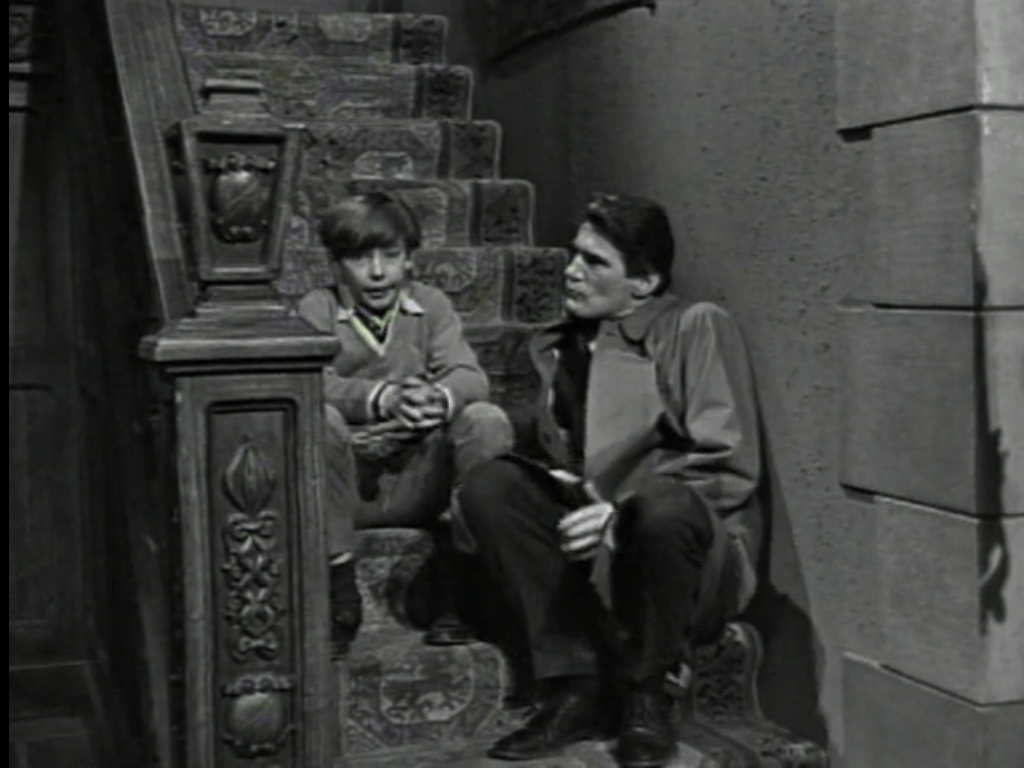
Back in the great house on the estate, David sees dashing action hero Burke Devlin. He sits on the stairs with Burke and talks about his feelings concerning Barnabas, Josette, the portrait, and the Old House. Burke suggests he ask Barnabas to give him the portrait. David is thrilled by this suggestion, and declares that he will go to the Old House at once to ask him. Burke points out that Barnabas probably isn’t home. That doesn’t make an impression on David, but he does stop before going out the door. Burke asks if he is afraid to go there alone, apparently preparing to volunteer to go with him. David says he isn’t afraid, but doesn’t explain what feeling he does have that is holding him back.

David and Burke talk it out

David goes to the Old House and calls to Barnabas. No one answers. The howling of dogs fills the air from every side, frightening David. He calls to Josette. He does not feel her presence. The doors slam shut on their own; when he runs to them, he cannot open them. We conclude with a closeup of his terrified face.

Those three scenes might have appeared in a good episode, but this is not that episode. In fact, it is a real stinker, very possibly the single worst we have seen so far. There is one funny line, when Liz remarks that Willie Loomis’ “illness appears to have caused him no end of convenience.” And the actors and director do what they can. But the script defeats them all.

As David Collins, David Henesy appears to be delivering the lines Ron Sproat actually wrote when he says things like “If I blame [Barnabas] for anything, it’s for changing things around [at the Old House]… I just hope he hasn’t changed [the Old House.]” Some of the words that come out of his mouth may be flubs, but most of it is of a piece with what the adult actors are saying in response to him, and nothing anyone says is close to intelligible. This is one of the rare episodes when Henesy winds up roaming about the sets declaiming like some kid actor in a 60s TV show.

As well-meaning governess Vicki, Alexandra Moltke Isles is trying so hard to remember her own pointless lines that she stands stiff as a board every time she is on camera. Vicki and David’s scenes were the heart of the first 39 weeks of the show, often in spite of writing nearly as bad as what the cast is stuck with today, but their conversation on the stairs today is terribly dull to watch.

Joan Bennett and Mitch Ryan each had star quality in abundance, and so they manage to hold their scenes together. The opening scene between Liz and Vicki has some snap to it, David’s conversation with Burke is appealing, and when Liz and Burke have a scene in the study arguing about a business deal she made with a man called Hackett* things start to crackle. But even in that scene Bennett and Ryan stumble over Sproat’s awful dialogue and wind up in the ditch more than once. Her frequent glances at the teleprompter and a couple of alarmingly long pauses from him turn the crackle to a fizzle well before it is over.

Burke and Liz argue about the Hackett deal

The scene between David and Liz in the Old House is another defeat for Joan Bennett. David Collins’ nonsensical lines and David Henesy’s flailing attempts to find some kind of through line in them leave her standing in mid-air, and the scene goes on so long they repeat every point they have to make at least twice. By the third time through the sparse material they have to work with, not even she could make it interesting.

Moreover, regular viewers will be puzzled when Liz tells David over and over that the Old House and its contents belong to Barnabas. On Monday, in #220, Barnabas and Vicki had a conversation in the foyer of the great house about the fact that he was not going to own the Old House. There hasn’t been any indication of a change in that plan, but Liz goes out of her way to say three times, not that Barnabas is staying in the house, but that it is his. We are left wondering what she is talking about.

Burke and Vicki spend some time together. They stand in front of the portrait of Barnabas Collins in the foyer of the great house talking about Barnabas’ decision to hire Willie as his servant. Burke remarks that “Cousin Barnabas doesn’t seem too bright.” That’s a fun moment, but then Vicki sticks up for Barnabas and they have nowhere to go with it. The scene doesn’t end until they’ve spent a few more moments standing there jabbering.

Burke and Vicki sit on the sofa together in the drawing room. The nonverbal communication between them raises the question the show has been teasing for some time, whether Burke and Vicki are dating. As with Burke’s paternal moment with David, it shows that the actors and directors can create little stories to keep us interested when they can keep the dialogue out of the way.

Burke says he’s going to talk with Liz about a business matter that he can’t tell Vicki about. He then tells Vicki why he is concerned about the matter. These mutually contradictory lines are no better than David being upset that Barnabas has changed the Old House, and just hoping that he hasn’t changed the Old House. For a moment, friend Burke doesn’t seem too bright.

*A name we have never heard before on Dark Shadows.