For the first 54 weeks of Dark Shadows, reclusive matriarch Liz was paralyzed by the fear that someone would enter the locked room in the basement of the great house of Collinwood and find the murdered body of her husband Paul Stoddard buried there. For the last 16 of those weeks, seagoing con man Jason McGuire exploited that fear to blackmail Liz.
It turned out that Liz didn’t actually kill Stoddard and there never was a corpse hidden in the basement of the great house. There is, however, a corpse hidden in the basement of another house on the same estate. During the daytime, Liz’ distant cousin Barnabas Collins is a dead body resting in a coffin in the basement of the Old House. He gets up at night to feed on the blood of the living, lure the unwary to their damnation, and deliver rambling monologues about how sorry he feels for himself. Unlike Stoddard’s supposed grave in the great house, Barnabas’ coffin is not kept in a locked room, so the parallel has been incomplete.
Today, Barnabas decides to complete it. Trying to find and steal Barnabas’ jewels, Jason had broken into the Old House. He made his way to the basement, where he stumbled upon the coffin. He opened it, and Barnabas strangled him. Now, Barnabas orders his sorely bedraggled blood thrall Willie to help him carry Jason’s body to the secret room in the mausoleum where Barnabas himself was imprisoned and undiscovered for “nearly 200 years.”
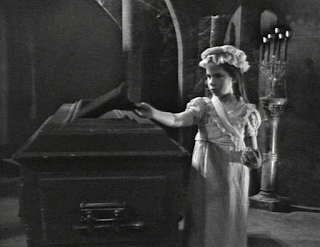
Before they leave the basement, Barnabas tells Willie about his sister Sarah, who died when she was very young and innocent. After they leave, Sarah’s ghost appears and puts Jason’s sea cap on Barnabas’ coffin.
Episodes #1-#274 had all opened with voiceover narrations delivered by Alexandra Moltke Isles in character as well-meaning governess Vicki. Starting Friday, they gave the opening monologues to one of the actresses who happened to be in the episode to deliver as an unnamed external narrator. Today, this spoils a surprise. We haven’t seen Maggie Evans, The Nicest Girl in Town, for a while, and aren’t sure when we will see her again. When Kathryn Leigh Scott delivers today’s opening voiceover, we know we will see Maggie today.
Barnabas had held Maggie prisoner for several weeks. He had borrowed a plan from the 1932 Universal film The Mummy. He would erase Maggie’s personality and replace it with that of his long lost love Josette. Once he had done that, he would kill her and she would rise from the dead as a vampiric version of Josette. Maggie did not go along with the plan, and Sarah’s ghost helped her to escape. Barnabas managed to scramble Maggie’s memory before her father found her, and she is now in treatment at a sanitarium called Windcliff.
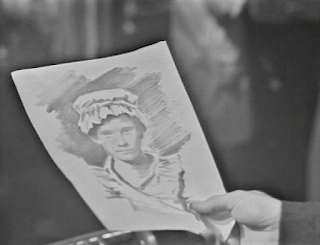
Maggie’s hometown doctor, addled quack Dave Woodard, is visiting the director of Windcliff, Dr Julia Hoffman. Woodard wants to show Maggie a sketch Maggie’s father, artist Sam Evans, made when the ghost of Sarah visited him to tell him where to look for Maggie. Julia resists, Woodard insists. While Julia delays, she feeds the fish in the aquarium in her office. We see enough of the aquarium to suggest that Julia is the keeper of a world within a world, a little enclosure with its own rules.
Woodard shows Maggie the sketch. After a moment, she says “Sarah.” She tells them that Sarah visited her in the room where she was confined, that she told her a riddle that showed her how to escape. She becomes too upset to talk. She starts miming her search for a loose brick in the wall of the cell, then sings a verse of Sarah’s signature tune, “London Bridge.” She is shouting words from “London Bridge” when the nurse drags her down the hall, back to her room. Julia declares that the whole thing was a waste of time, a judgment in which Woodard does not concur.
Sam’s sketch of Sarah. Apparently the drawing was done before Sharon Smyth was cast as Sarah, when they planned to give the part to Harvey Keitel in drag. Screenshot by Dark Shadows Before I Die
Meanwhile, Barnabas and Willie take the body of Jason to the tomb of the Collinses and bury it in the secret room. They talk about the people buried in the part of the structure known to the public- Barnabas’ parents and his sister Sarah. Barnabas confirms that Sarah is the one he was telling Willie about in the basement, the friend he knew long before he met Josette. He reminisces about repairing a doll of hers the night before she died. We see the plaque giving her dates as 1786-1796, implying that Barnabas met Josette after 1796. They leave, and Sarah appears.
Liz had last seen Jason the night she thought she killed Stoddard; his reappearance would lead to the opening of the locked room and the exposure of its secret. Barnabas last saw Sarah in 1796; her reappearance, today’s events suggest, might lead to the opening of all the rooms Barnabas wants to keep closed and to the exposure of all his secrets.
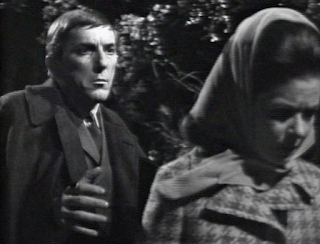
Reclusive matriarch Liz is standing on the edge of a cliff, staring out to sea. Her distant cousin, Barnabas the vampire, comes up stealthily behind her. He grabs her, and she screams.
For months, Liz has been stuck in a go-nowhere storyline about blackmail. So it is exciting to see the beginning of a new story where she is under Barnabas’ power. Or it would be, if that were what was happening. Instead, we come back from the opening credits to find that Barnabas approached Liz that way only because he was afraid she might go over the cliff if he made a noise and startled her.*
As a result of the blackmail arc, Liz is suicidal. Barnabas fears that she may be trying to jump, and tries to cheer her up by spending several minutes delivering a semi-coherent oration about how wonderful it is to be dead.
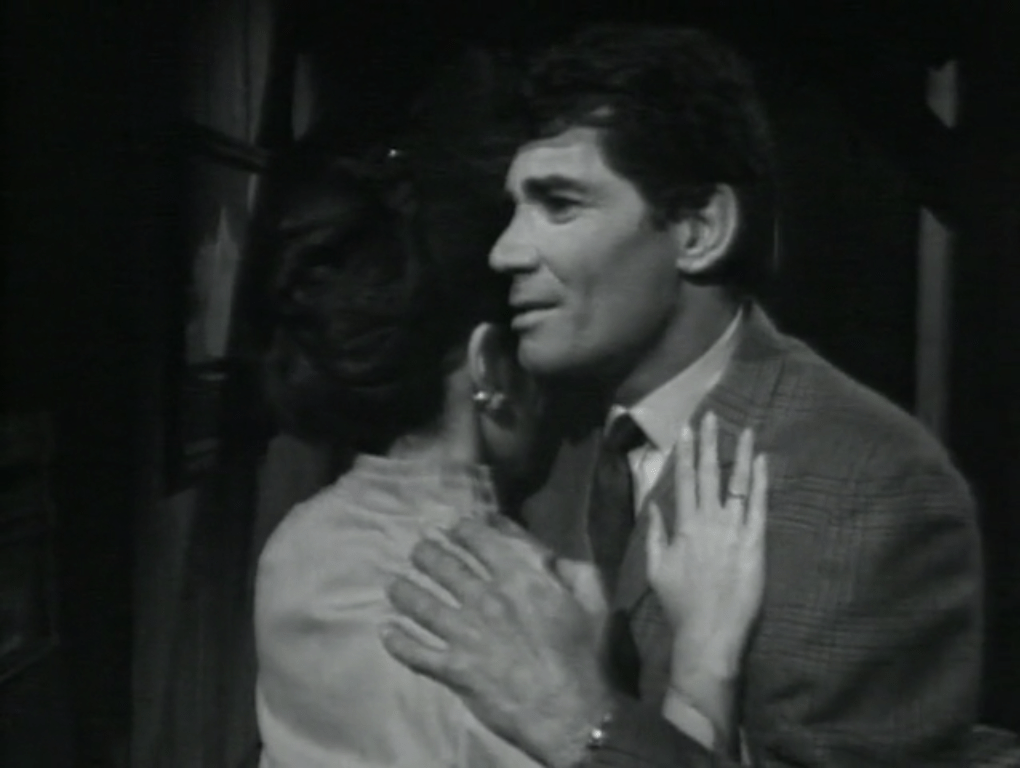
The scene started with a disappointment, and the dialogue doesn’t make much sense, but it is always fun to see Jonathan Frid and Joan Bennett work together. Frid’s acting style was a bit of a throwback to the nineteenth century, which made him an ideal scene partner for a daughter of Richard Bennett.
In #264, Barnabas had made some remarks to Liz’ brother Roger about the importance of family. Barnabas had then gone on to bluster uselessly at Liz’ blackmailer, seagoing con man Jason. He later told his sorely bedraggled blood-thrall Willie that he might kill Jason soon. As a vampire, Barnabas is a metaphor for extreme selfishness, and his hostility to Jason fits into that- Jason does represent a possible inconvenience for him. But today, we see a hint that Barnabas might actually have some measure of concern for Liz and the rest of the Collinses. After he walks Liz home, he confides in the perpetually well-meaning Vicki that he was afraid Liz would jump off the cliff. He tells Vicki that she seems to be the person most able to help Liz.
Yesterday, housekeeper Mrs Johnson had grabbed Liz as she was about to plunge off the same cliff, and had told Vicki of the incident. But Mrs Johnson just thought Liz was fainting. Vicki had noticed yesterday that Liz was deeply depressed, but she is shocked and disbelieving when Barnabas breaks the news that she seems to be suicidal.
On his way into the house with Liz, Barnabas had seen strange and troubled boy David Collins. David had seen Liz, but Liz neither saw nor heard him- she walked silently away from him, even though he twice called out “Aunt Elizabeth!”
In #256, David had met a little girl wearing eighteenth century dress hanging around outside Barnabas’ house. Unknown to anyone but the audience, the little girl is the ghost of Barnabas’ sister Sarah. David told Willie about Sarah, and Willie himself saw her in #264 and told Barnabas about her. Today, Barnabas tells David that if he sees Sarah again he should tell her to stay away from his property.
Barnabas’ message to Sarah and David
David denies that Sarah is his girlfriend, and says that her habit of singing “London Bridge” gets on his nerves. Barnabas is startled by the mention of “London Bridge.” David says that he isn’t likely to see Sarah near the Old House again, because “I’m not allowed to play at the Old House.” He delivers this line with a pungency that led us to laugh out loud. The whole scene is a lot of fun.
Barnabas had turned his creepy, anachronistic charm on at full force when talking to Vicki, and was obviously disappointed when she told him she had a date with fake Shemp Burke Devlin. He politely responded to this news by describing Burke as “a very interesting man.”
We then go to the Blue Whale tavern, where we see that “very interesting man” drinking and smoking by himself for a minute and a half. He wanders from his table to the bar to get another drink, passing some people whom first-time viewers will believe to be suffering from spastic disorders, but whom regular viewers will recognize as Collinsport residents who think they are dancing.
Notice her right hand- she has her guard up in case the convulsions spread to his arms
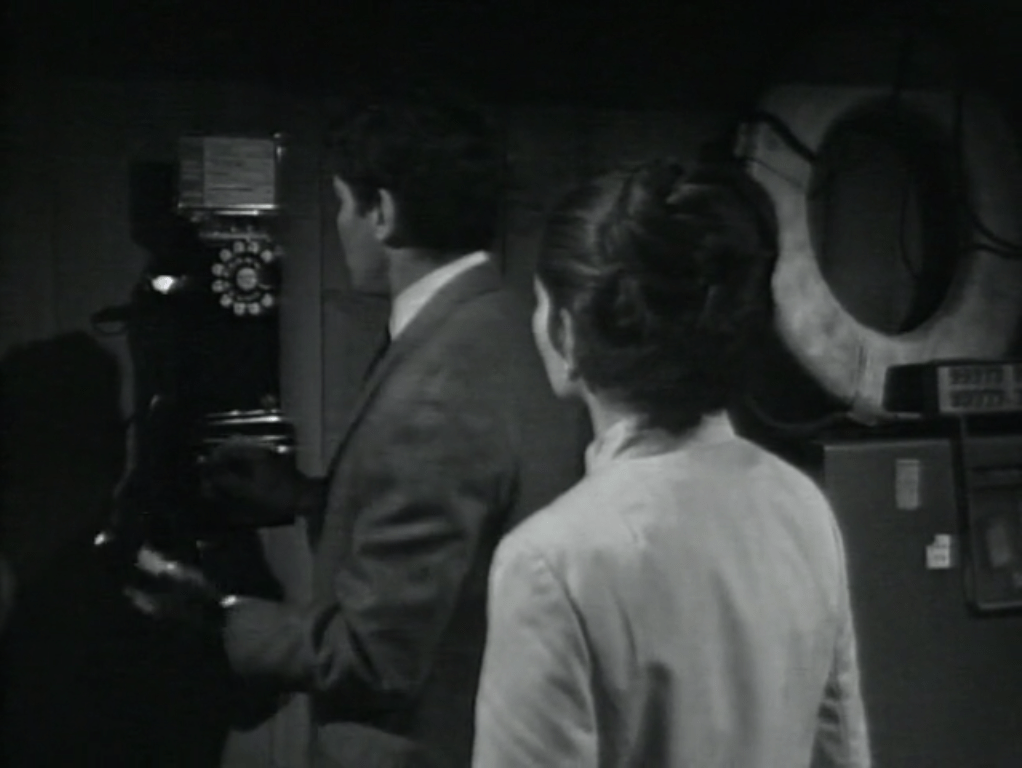
Burke goes to the pay phone to call Vicki. She enters, and he tries to get his dime back. He takes the receiver off the hook, replaces it, probes around in the coin return, bangs the side of the phone, explores the coin return again, and sadly tells Vicki that he has lost his dime. She tells him that if the purpose of calling was to get her to show up, he got his money’s worth. He agrees, but keeps looking back at the phone with longing.
Burke and Vicki dance. She tries to take his mind off the lost dime by recapping the last couple of episodes, but too little of interest has happened to refocus his attention. Vicki gives up and says she’s going home. We don’t see Burke resume his battle with the coin return slot, I guess they decided they had already given us our thrill for the day.
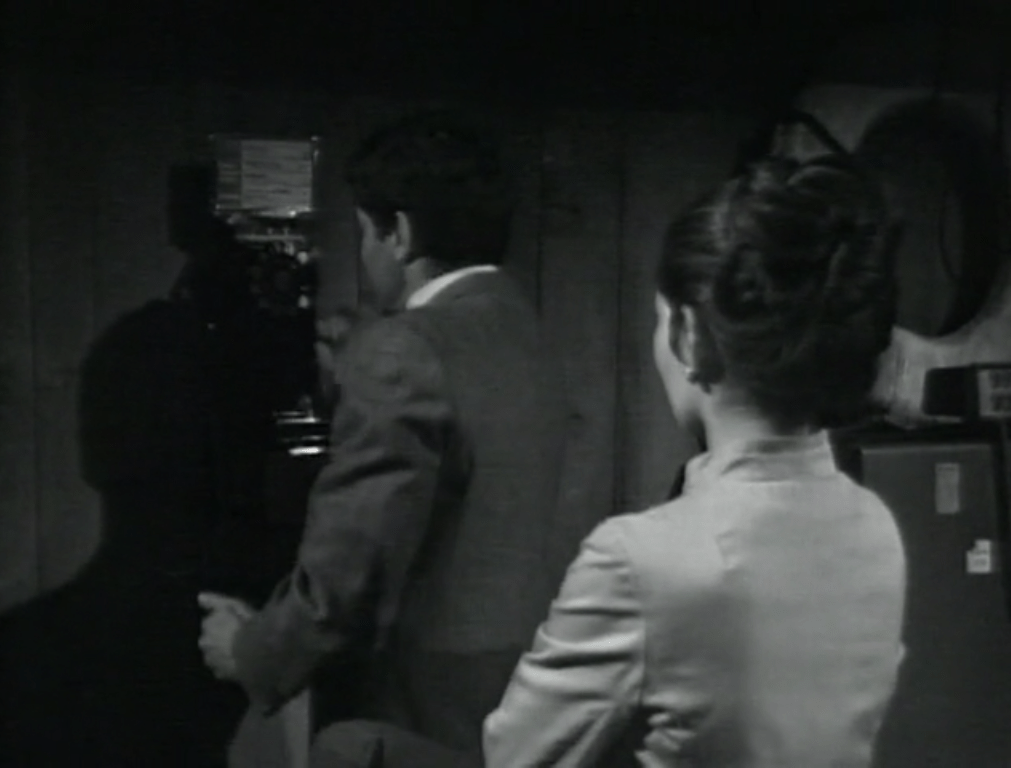
Back in the house, Liz is sitting in front of a table on which there is an open book. She is staring blankly into space. David enters the room. He greets her. She smiles vaguely, mumbles “Oh, David,” then gets up to leave. When Vicki comes in and says hello, Liz mutters “Hi, Vicki,” but doesn’t turn her head to look at her.
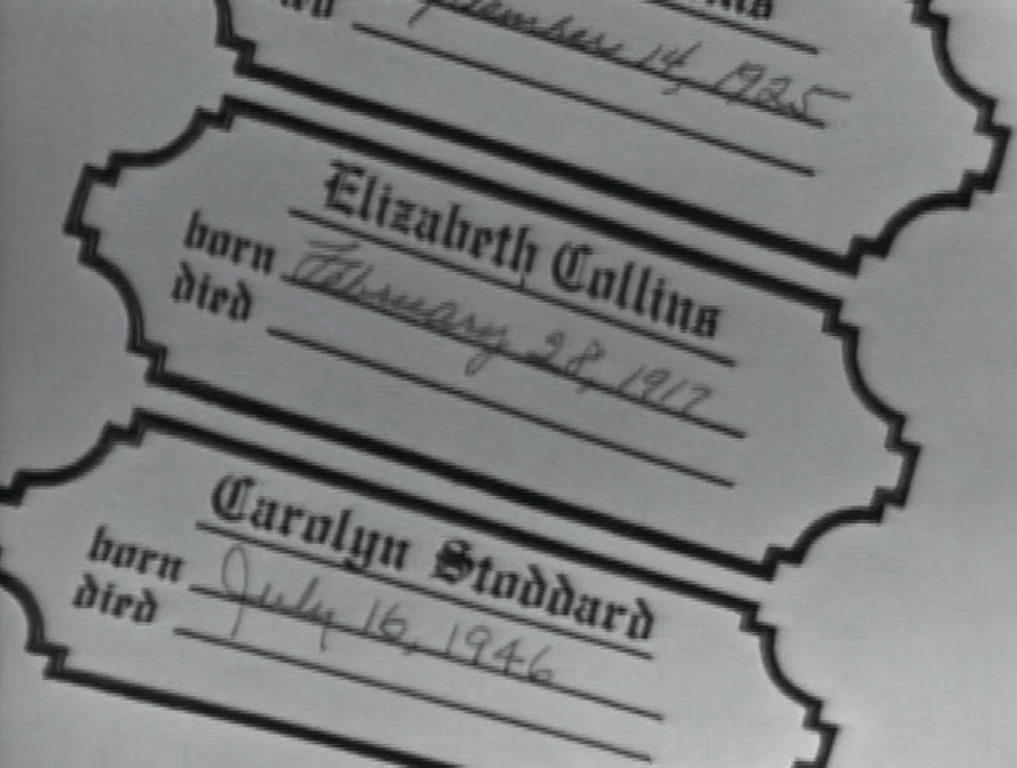
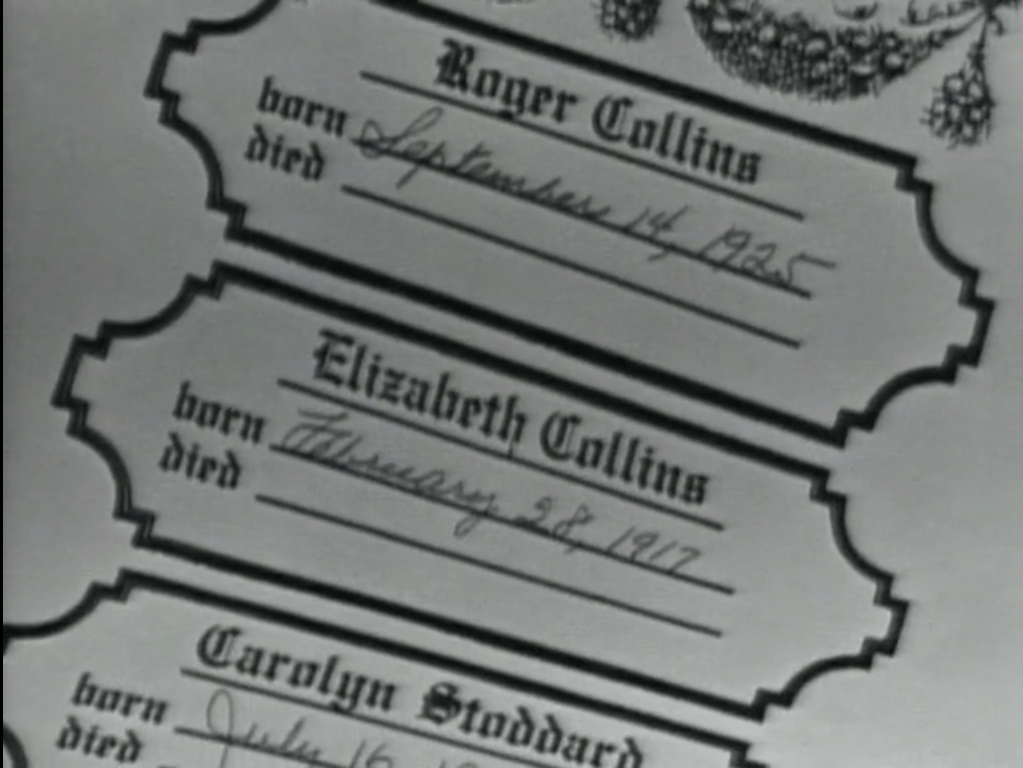
David calls Vicki’s attention to the book. It is the Collins family Bible, and was open to some plates that have been inserted bearing birth-dates for Liz and other members of the family. That’s the end of the episode. I must say, it’s quite an anti-climax after Burke’s attempt to retrieve his lost dime.
Closing Miscellany
Bob O’Connell is not on hand to play Bob the Bartender at the Blue Whale today. Instead, the bartender is Tom Gorman, who played the same role in #104 and will reprise it again in #607.
The birth-dates in the Collins family Bible are:
Roger Collins, 14 September 1925
Elizabeth Collins, 28 February 1917
Carolyn Stoddard, 16 July 1946
By comparison, the actual birth-dates of the actors were:
Louis Edmonds, 24 September 1923
Joan Bennett, 27 February 1910
Nancy Barrett, 5 October 1943
So it looks like they adjusted Edmonds’ and Bennett’s birth-dates by a few days plus a few years in setting their characters’ births, but ignored Miss Barrett’s actual birth-date in setting Carolyn’s. Maybe she refused to tell them what it was!
The show has been hinting heavily that Vicki is Liz’ biological daughter. A birth-date of 16 July 1946 for Carolyn would tend to pull against that- Vicki had apparently just turned 20 when the show started late in June 1966. Unless they were twins, one or the other of those characters is going to have to have her birth-date adjusted if they are going to resolve the question of Vicki’s origin that way.
*That’s a concern we’ve heard several times on this set- in #2, Roger introduced himself to Vicki by startling her as she stood at the edge of the cliff, and in #75 Vicki did the same thing to Roger. In #139, David was at the edge of the cliff when his mother, blonde fire witch Laura Murdoch Collins, surprised him; the episode ended with a literal cliffhanger after Laura made a move David wasn’t expecting. We’ve heard many times that the legendary Josette Collins was “the lady who went over the cliff,” as artist Sam Evans calls her in #185. It’s unclear why she did- maybe someone startled her.
In its first months, Dark Shadows spent a fair bit of time on the business interests of the ancient and esteemed Collins family. In those days, the Collinses were running out of money and their old nemesis, Burke Devlin, had come back to town with a plan to strip them of their remaining assets and drive them into poverty. The “Revenge of Burke Devlin” storyline never really took off, and was eventually subsumed into the tale of blonde fire witch Laura Murdoch Collins. Shortly after Laura disappeared, Burke formally gave up on his revenge. With that, the business stories ended, and there was no particular reason for Burke to stick around.
On Tuesday, Burke was recast. However little his character may have had to do on the show or however much he may have had to drink before he arrived at the studio, Mitch Ryan was always interesting to watch. Anthony George couldn’t match Ryan’s charisma, but by 1967 he had been a familiar face in feature films and primetime television for years. The original audience, even if they couldn’t remember George’s name, would have recognized him as a famous actor and assumed that his casting meant that something big was in store for Burke.
Today, we have two hints that business stories might be making a comeback as well. Seagoing con man Jason McGuire is blackmailing reclusive matriarch Liz into marrying him. Vampire Barnabas worries that the cozy little home he has made for himself in the Old House on the estate of Collinwood might be threatened if Jason takes control of the family’s holdings. He asks Liz’ brother, high-born ne’er-do-well Roger, to look at the original deeds for the Old House and the great house to see if there is some provision he might be able to use to defend his interests against Jason. That Barnabas asks about the deeds would suggest that he has acquired some form of ownership in the Old House. We’ve never seen him buy the house from Liz or receive it as a gift from her, but if both deeds are still in Liz’ name, he could hardly use their wording to claim a right to stay there. So when Roger goes off to look for the deeds, there is a chance he will come back with a story about real estate.
The second hint comes in Barnabas’ confrontation with Jason. Barnabas takes a very aggressive tone with Jason, who responds by asking Barnabas where he goes in the daytime and where his money comes from. “You have no accounts in the bank in town, and I know you don’t operate a business…” If Barnabas is going to be on the show for the long haul, as the ratings clearly indicate we should expect him to be, Jason will not be the last person to ask these questions. We might wonder how exactly he will forestall them.
If we have been watching from the beginning, the likeliest answer would involve Burke. When was a major character, Burke was presented as an inexhaustibly rich man who knew his way around some of the shadiest places in the world. If Burke happens upon Barnabas’ secret, we could expect Barnabas to bite him and thereby bring him under his power. With his money, Burke could set up plenty of bank accounts and businesses in Barnabas’ name. With his contacts in the demimonde, he could secure whatever papers Barnabas needs to establish his identity. Even a photo ID- Burke could easily hire a Barnabas lookalike to pose for a British passport.*
During the “Revenge of Burke Devlin” arc, Burke bought up a lot of Liz’ debts. In particular, he held enough notes payable on demand that she feared he might be able to put her out of business at any time. That hasn’t been mentioned for a long while, but if Barnabas takes control of Burke he could take those notes and exchange some of them for outright ownership of the Old House.
Barnabas could also compel Burke to fabricate some fraudulent papers that would make it look as if he were deeply in debt to Barnabas. When Barnabas got around to killing Burke, those papers would come to light. Liz and Roger would be grateful to Barnabas for taming their old adversary and clearing out some debts that posed a danger to their financial position, while well-meaning governess Vicki would be grateful to him for helping her boyfriend save his face after his business went south. As a result, his position at Collinwood would be unassailable.
Closing Miscellany
There is a location insert of Roger walking to the Old House, a flashlight in hand. I don’t think we have seen this footage before.
Until today, Barnabas has tried to be very suave with everyone who doesn’t know that he is a vampire. Since he has nothing to say to Jason that will intimidate him, he might as well continue that approach in his scene with him, or at least play dumb. But instead, he is openly, and self-defeatingly, hostile. This will become a pattern in future episodes. Time and again, Barnabas will greet a potential adversary with an immediate declaration of war, often before the adversary even knows who he is, thereby forfeiting whatever element of surprise he might have on his side.
Barnabas catches a glimpse of the ghost of his sister Sarah. He only sees her as a figure moving in the distance as he is looking out the window, and has no idea who she is. But it does confirm that he is able to see her, something we had not known he could do.
Maggie Evans, The Nicest Girl in Town, has been a prisoner of vampire Barnabas Collins for a long time now. Barnabas is planning to kill her tonight. We spend the opening scene with Barnabas’ sorely bedraggled blood thrall, Willie Loomis. We hear Willie’s thoughts as he does the housekeeping. Willie wishes he could save Maggie, but Barnabas has too much power over him. The most he can do is bring her a poisoned glass of milk and invite her to drink it if she wants to die an easy death.
Willie is not Maggie’s only friend. The ghost of Barnabas’ nine year old sister, Sarah, materializes in Maggie’s cell. Sarah asks Maggie why she is crying. Maggie tells her that if she doesn’t get out of the cell very soon, she will die. Sarah is distressed to hear this- “You mustn’t die- I don’t want you to die.”
Maggie hasn’t figured out that Sarah is a ghost, and keeps asking her how she manages to get in and out of the cell. Sarah usually evades this question, but now she says that there is a way. She came upon it accidentally, long ago, and her father ordered her not to tell anyone, not even her brother. She will be punished if she tells. If her father put her in the prison cell in their basement intentionally, Sarah’s fear of punishment is quite understandable.
Sarah overcomes her fear sufficiently to share a riddle with Maggie which she says will give her the answer:
One, two, away they flew.
Three, four, by the door.
Five, six, count the bricks.
Seven, eight, the clue is “grate.”
Nine, ten, home again.
Maggie asks Sarah to repeat the riddle, and she says she can only say it once. Maggie tells her where to find her own father, Sam Evans, and asks her to tell Sam that she has seen her. Sarah disappears.
Sarah’s fear of punishment will ring a bell for regular viewers. Strange and troubled boy David Collins is so intensely afraid that his father, high-born ne’er-do-well Roger, will punish him by sending him away to a boarding school or a jail that he tried to murder Roger. Later, David left his favorite person, well-meaning governess Vicki, to be decapitated by crazed handyman Matthew Morgan because he was afraid that if he helped Vicki his father would find out he had earlier defied him and would punish him. Now, Maggie is in mortal danger because another Collins child, one who lived in a previous century, has a similar fear of punishment. The cell in the basement of the Old House was there before slavery was abolished in the area in 1783; perhaps Sarah’s fear and David’s are a bequest from the slaves and indentured servants whom their forebears locked up in it.
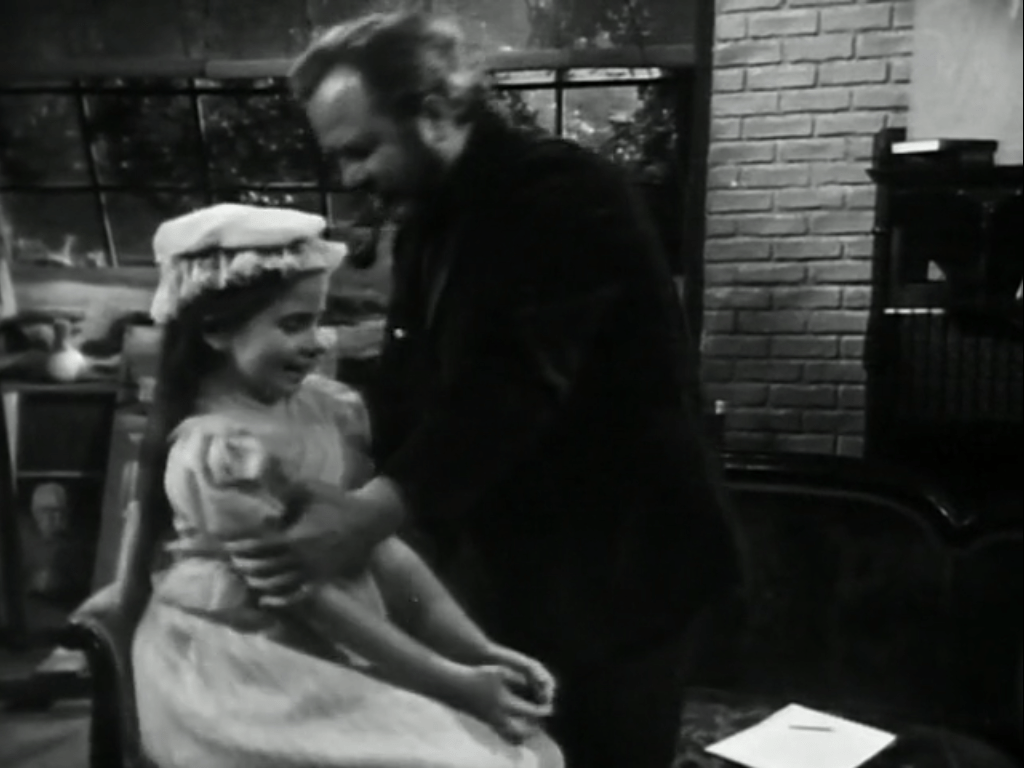
We cut to the Evans cottage. Sam is an artist, and is working. Sarah materializes in the living room. Sam had locked the door and Sarah won’t explain how she got in, but he seems to be delighted with her anyway. She is impressed with his paintings and asks him to paint a picture of her. He offers a drawing instead. When she agrees, he picks her up and sets her on a stool. She flashes a grin at being picked up. She asks if she can keep the drawing when he is done with it.
The most fun Sarah has had the whole time she’s been dead
Sam tells Sarah that her dress is very pretty. He then mentions that you don’t see many dresses in its style. She asks if that means he doesn’t like it. When Sam says that all he means is that it isn’t the sort of thing other little girls wear, she says she doesn’t play with other little girls so she doesn’t care what they wear. She seems to be getting worked up about this, so Sam calms her down with, “All right, all right, I see.” This little exchange gave my wife, Mrs Acilius, a laugh. Sarah may have been born in the same year as Jacob Grimm, but she is very much a nine year old girl.
While Sam draws Sarah, she steers the conversation to Maggie. She asks Sam if he looked for Maggie on the beach under Widow’s Hill. He says he’s looked everywhere he could. She repeats her suggestion that he look for her on the beach. He says he is sure he won’t find her there. She responds “You might, if you go there tonight.” Disturbed by this, Sam looks up, and finds that Sarah has vanished.
This surprises us almost as much as it surprises Sam. Sarah had made it clear that she very much wanted to keep the drawing, yet she disappears before Sam is finished. Evidently, it wasn’t within her power to stay.
Back in the cell, we see Maggie and hear her thoughts as she tries to remember Sarah’s riddle. Like Willie’s voiceover internal monologue in the opening scenes, Maggie’s goes on too long. We can see that Maggie is in an upsetting situation and understand why Sarah’s presence confuses and distracts her. That makes it clear she would have difficulty remembering the exact wording of the riddle, but we really don’t need to hear her go over every part of it.
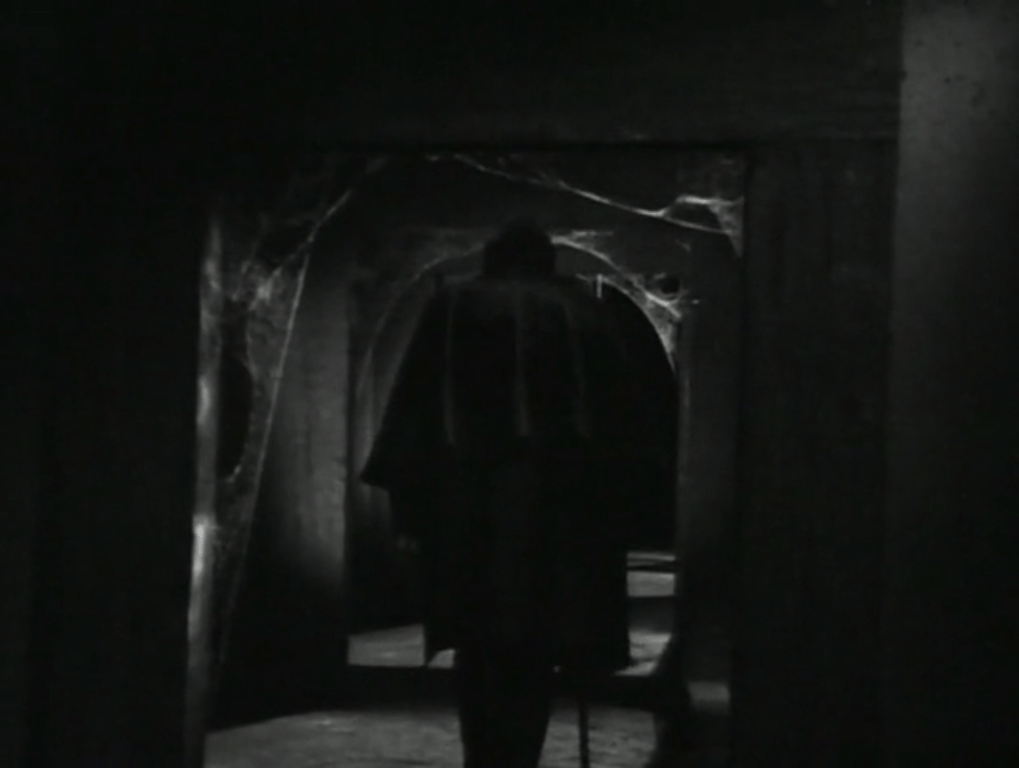
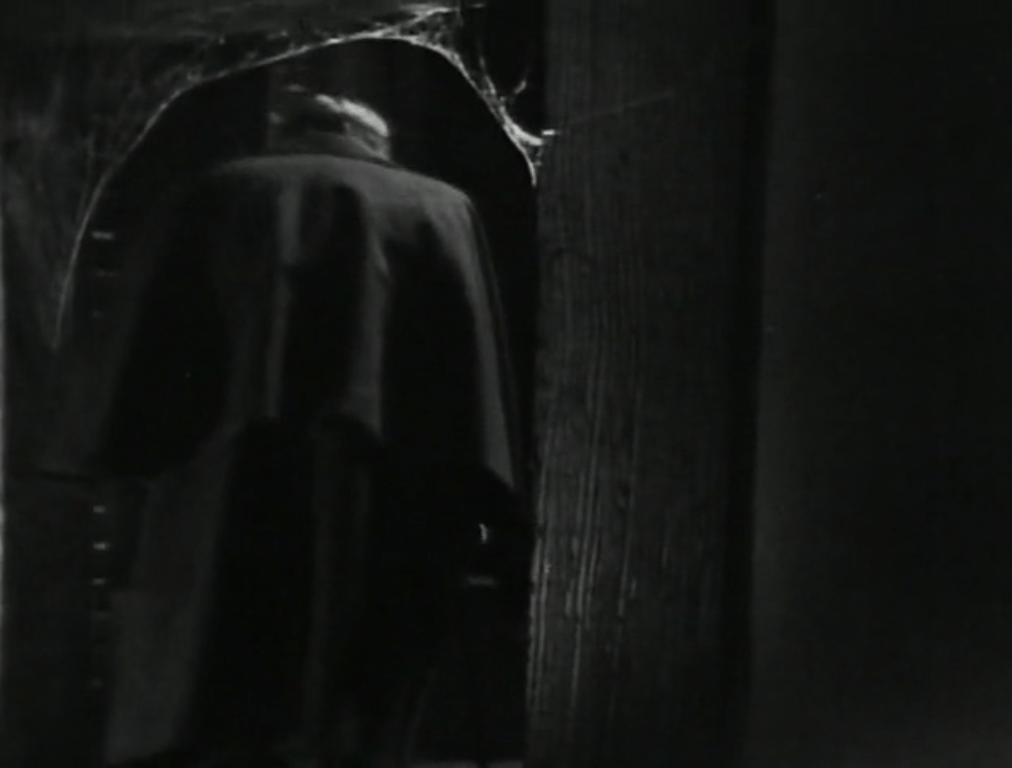
By the time Maggie finds the loose brick that triggers the opening of the secret panel, Barnabas is already rising from his coffin. We cut between Barnabas walking through the basement and Maggie struggling to open the panel. It may sound like we’re describing filler when we say that we see Barnabas traversing three distinct corridors between his coffin and Maggie’s cell, but it doesn’t feel that way. Not only do these shots build suspense as we wonder if Maggie will get out before he reaches her, but in Barnabas shown as a hunched, solitary figure in narrow spaces sketched in shades of gray we see the representative of a world bleak beyond endurance. We can see why the first serious feature film about a vampire, F. W. Murnau’s Nosferatu (1922), devoted so much screen time to showing Count Orlok skulking about the corridors of his castle.
First corridorSecond corridorThird corridor
Maggie crawls into the secret passage. She doesn’t close the panel behind her. Not only doesn’t Maggie know that Sarah is a ghost, she doesn’t know that Barnabas is Sarah’s brother. When Sarah says that not even her brother knows about the secret panel, she is telling us, but not Maggie, that Barnabas is unfamiliar with this way. We know that if Maggie had closed the panel, Barnabas wouldn’t have known where to look for her, and so we might yell at the screen urging her to do that. But since it is his house, she has to assume that he does know about the panel, and she knows that he might be at the door any second. So it is rational for her to forget the panel and use all of her time moving forward.
The gap between Maggie’s knowledge and ours again adds to the suspense as we watch her flee from Barnabas through the twisting passages beyond the panel. We only see one path, but the looks on the actors’ faces as they look from side to side tell us that there are several. Maggie is moving cautiously, choosing her way with care, the sensible thing to do if Barnabas is familiar with the passages. Since we know that it is new to him as it is to her, we want her simply to pick a path and run.
Maggie beholding the paths before her
Maggie finds two heavy doors, both of them apparently stuck. Barnabas looks around, seems bewildered, and takes a breath. He shouts a speech at Maggie, claiming that she has no chance of escape because he can hear her. He can’t hear much while he’s shouting, so we want her to take advantage of that and bash away at one of the doors during his speech.
Barnabas wondering at part of his house he never knew existedMaggie with two closed doors in front of her and an angry vampire behind her
This episode ends the 52nd week of Dark Shadows. When ABC* picked the series up in 1966, it gave executive producer Dan Curtis a 26 week commitment, carrying production to #130. After that, the network renewed it for the then-standard 13 week period. The first renewal carried them to #195, the second to this episode. Until just a couple of months ago, the ratings were so low that no one thought it was likely that it would get a third renewal. When the vampire was introduced in April, viewership started to pick up, preventing cancellation and requiring them to come up with a story that they could keep telling.
I do think we can see traces here and there of the original plan. The first part of the plan seems to have been to copy Bram Stoker’s Dracula far more thoroughly than they wound up doing.
The two female characters on the show who had or were about to have boyfriends when Barnabas was introduced were Maggie and Vicki, who are both seeing men who are cut out to be stout-hearted action heroes. The two female characters in Bram Stoker’s Dracula who had boyfriends were Lucy Westenra and Mina Murray, who were both seeing men who emerge as stout-hearted action heroes. Dracula feeds on Lucy, prompting several other people to band together to try to save her. Dr John Seward, MD, contacts his old Professor, the brilliant Abraham Van Helsing, to advise the group. Despite their best efforts, Lucy dies and rises as a vampire, the “Bloofer Lady” who feeds on the children of east London. Lucy’s boyfriend has to destroy her body to free her soul of the vampire curse.
If the show was about to be canceled, it would have been a favor to Kathryn Leigh Scott to have Maggie suffer Lucy’s fate. Going out with a splash like that would certainly have given her something to lead with as she looked for her next job. But once it was decided that the show would continue beyond #260, it was out of the question to lose a character as popular and versatile as Maggie. When the network ordered 65 more episodes, Maggie had to be saved.
The Van Helsing analogue was actually named on screen. In #242, the show’s equivalent of Dr John Seward, addled quack Dr Woodard, said that he was going to call in a specialist to consult on Maggie’s case, a Dr Hoffman, who is “one of the best men in the field.” We haven’t heard about this man since Dan Curtis found out the show was going to be renewed, suggesting that they’ve abandoned the idea to hew quite so closely to Dracula.
In Stoker’s novel, once Van Helsing has corrected the group’s knowledge deficits concerning vampires, Mina emerges as its leader. Attempting to be gallant, the men cut Mina out of their operations, with the result that Dracula escapes them and bites her. Mina is able to resist his influence so far that she can play a pivotal role in the Count’s final destruction.
The first time Dark Shadows modeled a storyline on Dracula, the menace was not a vampire, but undead fire witch Laura Murdoch Collins. In that arc, the men formed a group of stout-hearted heroes advised by Dr Peter Guthrie and led by well-meaning governess Vicki. Guthrie and Vicki were plainly Van Helsing and Mina. Laura killed Guthrie, so he can’t come back to help in the fight against Barnabas, but Vicki is still around, still the chief protagonist, and still the one likeliest to lead the opposition to a villain.
Indeed, Barnabas has expressed interest in Vicki as a replacement for Maggie, and in #233 he blurted out an obvious threat when he realized she was getting uncomfortably close to figuring out the truth about him. So, had Dark Shadows ended with this episode, it is likely that it would have ended with Vicki overcoming Barnabas’ power and driving a stake through his heart.
Of course, the vampire is the source of the ratings, and Vicki and Maggie are needed for future story development. So the makers of the show can’t use any of those plot elements. What in the world they can do is a question that does not, as yet, have a clear answer. So they have been stalling and stalling. Sooner or later, the stalling will have to end.
*The American Broadcasting Company, that is, not the Australian Broadcasting Corporation.
Maggie Evans, The Nicest Girl in Town, is giving up hope. Vampire Barnabas Collins locked her up in the jail cell in the basement of his house some time ago, and everyone she knows is coming to believe that she is dead.
The other day, a little girl in eighteenth century clothing appeared outside Maggie’s cell. The girl did not respond when Maggie tried to get her attention, nor did Barnabas’ sorely bedraggled blood thrall, Willie, see her when she walked past him. Only on her second or third visit to Maggie did the girl interact with her, and then only to warn her not to tell her big brother that she had seen her. Maggie suspects that the girl was a hallucination of hers.
We know that the girl is real, because we saw her interacting with someone else. Outside Barnabas’ house, the girl talked with strange and troubled boy David Collins and played catch with him. If we’ve been watching the show from the beginning, we also know that there are many ghosts in and around Barnabas’ house, and that they have a special rapport with David. Further, this girl gives her name as Sarah and says that everyone she knows went away a long time ago. We’ve been told that Barnabas had a sister named Sarah who died in childhood, so we know that Sarah is the ghost of that sister.
Today, the girl appears to Maggie again. This time she shows up in the cell itself. At first, she tosses her ball in the air, sings “London Bridge,” and ignores Maggie’s repeated questions. Eighteenth century kids didn’t have mobile phones, apparently they had to resort to a ball and “London Bridge” when they wanted to tune out the grownups. Sarah finally comes around when Maggie puts her hand on her shoulder.
Sarah explains that she came because Maggie was crying. She asks what Maggie is sad about, which Maggie doesn’t try to explain.
Sarah won’t answer many of Maggie’s questions. Sarah says that she has been looking for her parents, and she is puzzled as to where they and everyone else have gone. She says she does have one friend. If that is a reference to David, it would show that Sarah can learn information during one apparition and retain it during subsequent apparitions. It is unclear whether she knows that she is a ghost, and her understanding of Maggie’s situation is remarkably slight.
Maggie and Sarah play catch and sing “London Bridge” together. Sarah vanishes a moment before Barnabas arrives. Maggie reacts to him with terror, but when it becomes clear that he isn’t planning to kill her right away her excitement at Sarah’s visit comes bursting out. She tells him that she has a secret friend who visits her in her cell and plays with her. When he asks what she’s talking about, she tells him it’s a secret. She babbles in a gleeful, childlike way.
Barnabas reacts to this with discomfort. He keeps his eyes on Maggie and edges away from her, speaking to her in a pitying tone. Bleak as Maggie’s situation is, this is a laugh-out-loud moment- she’s become too weird for Barnabas.
Maggie weirds Barnabas out
Upstairs, Barnabas tells Willie that Maggie isn’t working out. In a moment of wild hope, Willie asks if that means he’ll let her go. Barnabas sourly replies that of course it does not mean that- they will have to kill her. His plan is to kill her in such a way that no trace of her will ever be found, “because there will be no trace.”
Willie takes a meal to Maggie and demands she stop pretending to be crazy. It isn’t helping her, he says. She denies that she is doing any such thing, and babbles cheerfully that “I do whatever anyone tells me to do.” Willie leans in, putting his face close to hers, and screams and shouts that she has to be her usual self if she is to have any chance of survival.
After Willie leaves, Maggie starts crying again and telling herself that there is no little girl. But then she looks at the floor and finds a doll Sarah left behind. Maggie smiles, knowing that her secret friend does exist.
Maggie’s mad scenes are fascinating. Even though she believes that Sarah is real and we know she is right, seeing Sarah has the same effect on Maggie a psychotic break might have. It takes her out of the reality that she shares with Barnabas and Willie, and gives her an affect that is neither continuous with her usual personality nor intelligible to them.
The three adult actors are all on the top of their form today, just superb. Nowadays, when Sharon Smyth Lentz describes her performance as Sarah, she says that “The first word that comes to mind is ‘clueless.’” But that works out surprisingly well. We know so little about what, if anything, is going on in Sarah’s mind that the keynotes of the performance would have to be “lost,” “confused,” and “vague,” and she had those three things down pat. Things sometimes get rocky when Sarah has a long stretch of dialogue or when multiple actors are moving at the same time, but neither of those is a problem today.
Joe Caldwell started making uncredited contributions to the writing of Dark Shadows early in 1967, and I am tempted to attribute every good thing in a script by Malcolm Marmorstein to him. But Caldwell’s name is showing up in the credits now, and this episode is excellent. So maybe Marmorstein could rise to an occasion every now and then.
My wife, Mrs Acilius, points out that this is the first episode set entirely in the Old House.
A mysterious little girl in eighteenth century garb shows up outside the dungeon cell where vampire Barnabas Collins is keeping his victim, Maggie Evans. The girl stands with her back to Maggie’s cell and sings a couple of verses of “London Bridge” over and over while tossing a ball. Maggie pleads with her to stop singing, to get away before Barnabas and his sorely bedraggled blood thrall Willie Loomis catch her, and to tell someone that she has seen her. The girl does not acknowledge Maggie in any way.
Seconds after the girl has strolled slowly away, Willie comes by the same path she had taken. Maggie is bewildered that Willie didn’t see her. She urges Willie to escape from Barnabas. Willie gives a big speech about how he thinks about escaping all the time, and that when he is in his car he has sometimes tried to keep driving. But Barnabas’ power keeps pulling him back. Regular viewers will be interested in this confirmation that Willie has a car.*
At the great house of Collinwood, strange and troubled boy David Collins is impatient with the geography lesson his governess Vicki is trying to give him. In the first 39 weeks of the show, the only set which consistently saw interesting scenes was David’s room, where he and Vicki became friends during his lessons. They don’t have the studio space to build that set today, so this lesson is conducted in the drawing room. When flighty heiress Carolyn comes into the room, Vicki sends David to play outside. Since the interrupted lesson was about Australia, he hops away kangaroo-style.
Vicki and Carolyn talk about Carolyn’s boyfriend, motorcycle enthusiast Buzz. Buzz is a refugee from Beach Blanket Bingo, so broadly comic a figure that he might have been too silly even for the biker gang in that movie and its sequels. Unfortunately, Buzz doesn’t show up today, and Vicki and Carolyn’s conversation is a pure specimen of old-time soap opera earnestness. There is an odd moment when Vicki asks Carolyn “How far do you intend to go with Buzz?” and Carolyn answers “All the way!” At the end of the scene, Carolyn uses the phrase “all the way” again. She’s talking about her plan to marry Buzz, but “all the way” was such a familiar euphemism for sexual intercourse in the 1960s that it is hard to imagine it wasn’t intentional on some level. When Carolyn tells Vicki that she and Buzz will go “all the way” while Vicki watches, we wonder what weddings are like in Collinsport.**
David has gone to the yard around Barnabas’ house. We see a location insert of him on the swing set there. This footage is reused from #130, when we discovered that he was being watched by his mother, blonde fire witch Laura Murdoch Collins. Laura had died sometime previously, but it didn’t take.
Now, he is being watched again. The mysterious little girl from the dungeon has made her way up to the porch and calls to him as “Boy!” When he tells her his name is David, she says “I know.” She gives her name as Sarah, and asks him to play with her. They toss her ball back and forth, and he finds fault with her fondness for “London Bridge.” She says she used to go to school, a long time ago. She lives around there, but everyone she lives with went away and left her all alone. She excuses herself to go look for them. Willie then comes out of the house. David tells him about Sarah, and Willie shoos him away.
Playing catch as best you can when you’re on a tiny set, photographed in 4X3. Screenshot byDark Shadows Before I Die
That Sarah can come and go from the dungeon without being seen shows that she is one of the ghosts who haunt the house. David has seen several of these, but does not recognize her. Her behavior in the opening scenes leaves us wondering if she is aware of Maggie’s presence; if not, she may simply be an apparition, unable to interact with the living characters.
When Sarah meets David, not only is she able to converse with him, but her ability to play catch with him using the ball she brought with her shows that she has a physical body and that she can manipulate material objects. That makes it all the more puzzling that she did not answer Maggie. Was she ignoring her, or was she somehow less capable in the dungeon than she is on the porch?
When Sarah uses the words “a long time ago,” we suspect that she knows she is a ghost and she has been displaced to a future century. But then she becomes confused as to where her people are, and is filled with a terrible urgency to go look for them. Again it is ambiguous just what sort of being Sarah is and what she can do.
There is always a vagueness about the supernatural- if you could explain a phenomenon fully in words and measurements, it wouldn’t be in that category at all. The key to holding an audience’s attention with a story about ghosts and such is to intrigue them with questions that seem like they might have answers and to use them to lead to another, equally imponderable set of questions before the first set gets old. So it is a promising sign that Sarah is introduced while we are still asking what Barnabas can do, what he wants to accomplish, what he needs for survival, and how he got to be the way he is.
That we see David in a lesson with Vicki and then hear him talking with Sarah about how neither of them goes to school anymore is also interesting to regular viewers. Dark Shadows is just about a year old. It started with Vicki’s arrival at Collinwood, where reclusive matriarch Liz had summoned her to teach David. David and his father, Liz’ impecunious brother Roger Collins, had been living at Collinwood for about a month. Before then, they had lived in Augusta, Maine, where David went to school.
When Vicki showed up, Roger objected that he knew nothing about her, and Liz refused to tell him or Vicki how she knew that she existed or why she chose her to be David’s governess. The show has been hinting very heavily that Vicki is Liz’ biological daughter and that Liz is desperate to keep that relationship secret. It is also clear that Liz wants above all for David to grow into her idea of a male Collins, an idea to which her bratty little brother Roger does not in any way conform.
Barnabas’ plan for Maggie is a ghoulish parody of Liz’ for David. He wants to erase her personality and replace it with that of his long-lost love, Josette Collins. Over the generations since her death, Josette has become the patroness of the Collins family and the emblem of its perfect female member. And of course Barnabas is as anxious to hide the secrets in his basement as Liz is to hide those in hers. That Sarah appears to both Maggie and David emphasizes that Barnabas is a funhouse mirror reflection of Liz.
Back in the great house, David hears Buzz’ motorcycle and tells Carolyn that he is there for her. She can’t quite bring herself to tell David that she and Buzz are planning to get married, but does encourage his interest in going for a bike ride with Buzz. As she leaves, he brilliantly mimes motorcycle riding.
David gives Vicki a detailed account of his encounter with Sarah. She is disappointed he didn’t bring her home. Though it is her job to be David’s only friend, Vicki is no more enthusiastic about his isolation from playmates his own age than Willie is about Barnabas’ treatment of Maggie.
Back in the dungeon, Willie finds that Maggie has not eaten. They share a sad moment. He leaves, and Sarah reappears. Maggie talks to her. At first, she doesn’t respond. But then she turns to her and says “If you see my big brother, don’t tell him you saw me. He doesn’t like anybody to come down here.” Then she leaves, a spring in her step.
The last time a ghost spoke to an imprisoned woman was in the same house, in #126. That time, Vicki was bound and gagged and hidden in a secret room on the main floor by crazed handyman Matthew Morgan. When Matthew had gone to get an ax with which to decapitate Vicki, the ghost of Josette had appeared to her and said, in a perfectly cheerful voice,*** “Do not be afraid.” Josette didn’t untie Vicki or anything, she just told her that and vanished. Later in the episode, she and some other ghosts scare Matthew to death before he can kill Vicki. When Sarah goes away from the stunned Maggie and skips along the floor, regular viewers might remember that event and see a promise that Sarah has something up her sleeve.
Closing Miscellany
Sarah is identified in the closing credits as “Sarah Collins,” the name given in #211 for Barnabas’ sister who died in childhood. That rather blunts the surprise of her closing reference to her “big brother.”
Sarah’s identity raises a couple of other questions. Barnabas’ house was the original Collins family home, and he and Sarah would have lived there. The cell in which he keeps Maggie is covered with cobwebs, evidently a feature of the house from its beginning. When she tells Maggie that her big brother “doesn’t like anybody to come down here,” she is speaking from experience- the adults don’t like it when you go near the jail cell in the basement.
Slavery was a legal institution in Massachusetts**** until 1783, and indentured servitude under conditions not so far removed from those to which slaves were subject continued long after. The Old House has been described as a “huge mansion,” so presumably its owners would have held people under at least one of these statuses. As a Collins of the eighteenth century, Sarah’s blithe attitude towards someone held in the cell would seem to be chillingly appropriate.
Sarah’s address to David as “Boy!” when she knows his name is also interesting coming from her. To be sure, if she had called him by name before they met, he would have known right away that there was something very strange about her. Since he has seen many ghosts and knows that ghosts congregate in and around the Old House, he may have identified her as one right away.
On the other hand, during the “Revenge of Burke Devlin” storyline that ran from #1-#201, there was considerable doubt as to whether David was Roger’s natural son or Burke’s. That doubt came to a head when Laura was on the show. Laura only left 13 weeks ago, and Burke is still hanging around. As far as we know, the question may come back up, and David Collins may turn out to be David Devlin. In that case, Sarah may have chosen to call him “boy” because she is a Collins and therefore better than everyone who is not.
I posted a couple of long comments about this episode on Danny Horn’s Dark Shadows Every Day. I won’t copy them here, because they contain spoilers for people who haven’t seen the whole series. But I’ll link to them- under the post about this episode, I argued that Sarah’s introduction was the most important plot development in the entire series; and under a post about a much later episode, I wish one of the words in her closing line had been different.
*Regular viewers are interested in some weird stuff, what can I say.
**My wife, Mrs Acilius, is very much taken with the actresses’ recollections of how Louis Edmonds, who played Roger, would make them laugh so hard during rehearsals that it was sometimes difficult for them to stay in character during filming. She says it is just as well that Roger wasn’t in this episode, because there is no way they could have got through this scene if he had been.
***Provided by Kathryn Leigh Scott, who also plays Maggie.
Imperious eccentric Barnabas Collins wants to reinvent working girl Maggie Evans as a member of his class- genteel in manner, florid in speech, thirsty for the blood of the living. Willie Loomis does not believe Barnabas’ plan will work, but because of the nature of their relationship he of course helps him with it. Living in their house, Maggie sometimes seems to be well on her way to developing the traits Barnabas is trying to inculcate in her, but at other times protests that she will never change.
Maggie’s father Sam is a drinking man. He comes to the house today to get some cash from Barnabas. Sam doesn’t know about Barnabas’ project; his visit has nothing to do with Maggie. He is an artist, and is delivering a portrait Barnabas commissioned him to paint.
The episode ends with a musical number. Maggie is in the basement prison cell where Barnabas keeps her between elocution lessons. Through the bars of her door, she sees and hears a little girl in eighteenth century garb singing “London Bridge is Falling Down.” The girl sings an obscure variant of the song with a verse that runs “Take the key and lock her up, lock her up, lock her up. Take the key and lock her up, my fair lady.”
Up to this point, the Barnabas story has been a mashup of Dracula with the 1932 film The Mummy. There isn’t any particular reference to vampirism today. Maggie’s neck is uncovered throughout the episode, and we don’t even see the bite marks. It’s all about The Mummy and its possible sources.
Imhotep’s attempt in The Mummy to turn Helen Grosvenor into Princess Ankh-esen-amun may have been inspired in part by George Bernard Shaw’s Pygmalion. Imhotep only has Helen in his custody for a few minutes of screen time and those minutes are so heavy with images of Egyptian antiquities, suggestions of magic, and the threat of extreme violence that they never find time for an explicit comparison.
Dark Shadows, on the other hand, keeps Maggie in Barnabas’ house for weeks and weeks, so it’s inevitable that sooner or later they would explore the connection. Thanks to Lerner and Loewe, the story of Pygmalion was very familiar to American audiences in 1967. It’s only surprising that Sam isn’t getting married in the morning, Maggie’s boyfriend Joe doesn’t tell us that he’s often walked down Barnabas’ street before, and Maggie never shouts at a race horse to move its bloomin’ arse. Considering the alarmingly awkward movements people in Collinsport make when music is playing, there was never any prospect she could have danced all night.
Just You Wait
Maggie uses the word “undead” to describe Barnabas. The first time we heard that word on Dark Shadows was in #183, when parapsychologist Dr Guthrie told blonde fire witch Laura Murdoch Collins that he believed her to be “the undead.” Though Laura’s story owed many structural elements to Bram Stoker’s Dracula, not least Guthrie’s own depiction as a Van Helsing-like figure, she was not a vampire. So “undead” is not simply a euphemism for “vampire” on this show, though it is true they will avoid saying “vampire” until Barnabas’ 41st week.
Regular viewers who find a reminder of Laura in the word “undead” will be especially interested in today’s ending. When Laura was first on the show, she was a vague presence. There were indications that she wasn’t so much a person as she was a whole collection of phenomena, some of them physical, some of them purely spectral, each of them with its own purposes. As Laura became more dynamic, those phenomena resolved themselves into the deadly fire witch and her adversary, the benevolent ghost of Josette Collins.
Like Laura, Barnabas seems to have stirred up numerous uncanny forces with his arrival. The clearest indication of this so far has been the howling of dogs when he is forming an evil plan, a howling which is not related to his physical location and which, often as not, hampers his efforts. There have also been some shenanigans with the doors in his house which don’t seem to have a natural explanation and which he wouldn’t have had a motive to arrange. The appearance of the mysterious girl* suggests that this time, the antagonist will pull a whole new cast of characters out of the supernatural back-world behind the main setting of the show.
*The girl is a lot less mysterious than she ought to be, since the closing credits identify her as “Sarah Collins.” That’s enough to tell even first-time viewers that she is a member of the ancient and esteemed Collins family that is at the center of the show. It gives more away to regular viewers. The tomb from which Barnabas emerged has marked graves for his parents, Joshua and Naomi, and his sister, Sarah, who died in childhood.
And right before Sarah appears, Barnabas was looking at Josette’s portrait. From #70 to #191, that portrait would glow when the ghost of Josette was about to do something. So if we didn’t know her name, we might think that the girl was an ally Josette had recruited, or perhaps Josette herself in a different form than the adult ghost we have seen before. That in turn would send us into the weekend speculating about the ghostly adversaries who might be lining up to oppose Barnabas. Giving the name, even to viewers who’ve forgotten about Barnabas’ sister, limits our speculations to possible one-on-one confrontations.
In 281 of the posts that follow, I link to comments I made on Danny Horn’s blog, “Dark Shadows Every Day.”
I added most of these comments in the months between the shutdown of live theater in March of 2020 and the completion of the blog in April of 2021. But I have added some since.
In the last few days, I’ve added four. They all discuss on the way the show shifts its focus, once the vampire story becomes a hit, in the direction that will come to define it as the months and years go on. The first three of these comments are on posts discussing episodes where Barnabas the vampire is holding Maggie the lovable girl prisoner and trying to brainwash her into becoming his late love Josette, so that he can kill her and turn her into a vampire. This comment is on the post for episode 253, in which the boy David has broken into Barnabas’ house and had a shouting match with Barnabas’ servant Willie:
The scene between David and Willie marks a definitive break from the pre-Barnabas show. David’s great concern is that Barnabas and Willie are “hurting Josette.” By which he means that he can no longer sense the presence of the ghost of Josette. On the contrary, the name “Josette” now refers to something horrible and that horrible thing is a part of Barnabas’ story.
In the first 42 weeks, the ghost of Josette had been the principal supernatural element in the show. Serene, mysterious, uncanny, the ghost fit perfectly into that series, which was something like 99% atmosphere and 1% story. And Josette came out of the background at two key moments, leading the rescue of Vicki from Matthew in 126 and informing the family of the danger Laura represents to David in 149 and 170. And of course when Barnabas first meets David in 212, David tells him that Josette protects the family.
So when Barnabas starts his rampage, regular viewers would at first be waiting for the ghost of Josette to make its move and stop him. By the time David sees the Josette-ified Maggie in 240 and 241, we know that the imperturbable Josette of the first 42 weeks is not coming back. If we do see Josette’s ghost again after we’ve seen Maggie in her wedding dress, it could not have the lightly amused smile in its voice with which it told Vicki not to be afraid of Matthew; it could return only as a terrifying spirit of vengeance. By the time David and Willie finish their confrontation in this episode, the show has told us that the protecting ghost won’t return at all.
This one is on the post for 255, in response to a comment from someone wondering what Barnabas was planning to do if he had succeeded in his evil plan for Maggie. How could he have gone on presenting himself to the rich Collinses as their long-lost cousin from England?:
I think we have to assume that all the “cousin from England” stuff would have gone by the boards if Barnabas had succeeded with Maggie. When they revisited Barnabas’ Josettifying project in HOUSE OF DARK SHADOWS, they had to ask what would come next, and the answer was “He kills everyone and turns the estate into an impenetrable outpost of Hell.”
Some time after they came back from making that movie, the show would send Barnabas and Julia on a two-week visit to the future, to the far-off year 1995, where they find that most of the family is dead, the rest of them are hopelessly insane, and no one dares go to the estate, all because of hideous supernatural doings that took place there a quarter century before. Those two weeks are sensational, the last genuinely great phase of the show, and part of what makes them so great is that they are a logical sequel to the part of the show everyone remembers most clearly.
This one is on the post for 256. In that episode, the hapless Maggie has seen a mysterious little girl playing outside the cell in which Barnabas keeps her. The girl’s name turns out to be Sarah:
I’d say Sarah’s introduction is the single most important moment in the whole show, more important than Barnabas coming out of the box, more important even than Barnabas’ first decision not to kill Julia.
From the beginning they’d been playing with the idea that there was another cast of characters hidden behind the characters we’ve been watching, supernatural characters who can make their influence felt at certain moments. The most prominent of these was the ghost of Josette…
So the show has discarded the old supernatural realm of Josette and the widows, a realm that was, as you say, never more than slightly accessible. With Sarah’s appearance, we are introduced to an entirely new part of the show. Once again we have a set of characters hidden in the supernatural background, but they can interact with the characters from the main continuity more directly and at greater length than Josette and the widows ever could.
The puzzle of Sarah’s connection to Barnabas, and her talk about looking for the members of her family, indicates that this new order of supernatural beings have complex and unsettled relationships with each other, and that characters from the main continuity can have an influence on those relationships. We will have to figure those relationships out in the weeks and months to come, but as soon as Sarah demands Maggie not tell her big brother that she saw her, we know that they might come to enmesh the living beings. Every scene with Sarah, then, is a step leading directly to the time-travel and parallel universe storylines that will come to define the show.
This one, on the post for 279, sums up the major points of the three comments above. It regards an episode in which Barnabas and Willie are planning to host a costume party in which members of the present-day Collins family will come dressed as their forebears from Barnabas’ time, the late eighteenth century. Barnabas has rather surprisingly claimed that this party will be “the most important night of [his] life”:
‘Dude… you rose from the dead. I think the prize for “most important night of my life” is pretty much taken.’
I think he has a point, though. While it is undoubtedly true that the writers, producers, and other creatives never had an elaborate plan that they had agreed on and that they would stick to regarding the future storylines of the show, they did have some memory of the storylines they had already developed. They spent the first 25 weeks building up the ghosts of Josette and of The Widows as presences in the show, a whole second cast of characters existing in a back-world behind the one in which the events we see take place…
Once the vampire story gets going, Josette and the Widows can’t come back. Their distant, mysterious, impassive qualities suited the slow, atmospheric early months of the show, but once you have a ghoul rampaging about sucking people’s blood there’s no place for remote and uncanny presences. To hold the stage while that’s going on, you need to be a dynamic character…
So the old supernatural order of Josette and the Widows is gone. But the idea of a second cast of characters, mostly invisible to us, properly associated with the distant past, but still wielding powerful influence over the events on screen. is stronger than ever. Barnabas had been hidden away, he belongs dead, yet he has irrupted into the present and taken over the story. Sarah is a denizen of the same back-world, she has broken through with Barnabas, and is steadily pulling aside the curtain that conceals their realm from that in which the established characters live and which the audience sees. The audience is going to have to be introduced to more characters from Barnabas and Sarah’s world, and the party is going to serve that function.
Once we’ve learned their names and how they relate to each other, the back-world characters and their time will have to become a concrete part of the show in a way that Josette and the Widows never could. In retrospect, the only way that could end is with an extended flashback. So the party does turn out to be a solid candidate for ‘the most important night of Barnabas’ life’, in that it is a major step towards the time-travel and parallel-universe stories that would come to define the show.
The time-travel and parallel-universe stories put the back-worlds into the foreground and the usual continuity into the background. Those reversal may not have been the only way to resolve the crisis they created by introducing Barnabas and Sarah, but certainly some kind of radical change in the relationship of back-world and usual continuity was unavoidable.
I’d like to say one more thing about a point I make in that final comment. “While it is undoubtedly true that the writers, producers, and other creatives never had an elaborate plan that they had agreed on and that they would stick to regarding the future storylines of the show, they did have some memory of the storylines they had already developed.” Throughout the blog, Danny repeatedly claims never to have seen most of the episodes from the first 42 weeks of the show. At times this claim seems like it must be an exaggeration- for example, at one point he catalogs all 21 episodes (between #42 and #108) which revolve around the questions of what kind of physical contact had with Burke Devlin’s pen and where Burke’s pen is, a catalog that could only have been made by someone who had seen all of those episodes and all those between. Be that as it may, he does vociferously disclaim any interest in the show as it was before the vampire comes along. Which is his privilege, Dark Shadows was a very different show pre-Barnabas and post-Barnabas and there is no reason to assume that a person who likes one of those shows will like the other.
He also stresses the point that there was no advance planning in the writing of the show, that they were making it all up from week to week, often dropping one story abruptly and expanding another just as abruptly as soon as the ratings came in. That should be obvious to anyone who watches the show for any length of time.
However, it can be misleading to stress the impromptu nature of the stories while ignoring the first 42 weeks, especially when you’re considering the period of the show immediately after those weeks. No one knew what was coming, but the producers, the directors, most of the writers, and many of the actors had been with the show from the beginning and knew exactly where they had been. So the idea of a ghostly back-world and the difficulties that come when you have to define the relationship of back-world to main world were very familiar to them, and it would have been clear that redefining that relationship would have major implications for the future of the show.
Another weakness of Danny’s is a tendency to both emphasize intentionality (a fine thing in itself!) and to reduce intentionality to what “the writers” had in mind. In my comments I usually play along with the focus on intentions, even though I don’t tend to favor that myself. -If it were just me, I wouldn’t be so concerned with proving that anyone associated with the show was thinking about the relationship of back-world to main-world in the summer of 1967- it would be enough that the logic of the show leaves them nowhere else to go. But Dark Shadows Every Day is Danny’s blog, so when I’m there I want to play his game as much as possible.
Where I can’t follow is with his tendency to reduce “intentionality” to “the writers.” A TV series has lots of creators- in addition to writers, there are producers, directors, actors, set designers, costumers, camera people, executives representing networks, executives representing studios, etc, etc. Each of those people has to make contributions, and each has a whole bunch of things to think about at any given time. So there’s always a multitude of intentions, and many levels of intentionality, to be considered.
In 281 of the posts that follow, I link to comments I made on Danny Horn’s blog, “Dark Shadows Every Day.”
Not all of these comments were absolutely unique. Several times I made remarks about the concept of the supernatural that Dark Shadows develops with all its ghosts, witches, and other weird beings.
In this remark about Danny’s post on episode 659, I respond to a discussion in the comment thread in which several people dismissed the idea that it was the ghost of Sarah Collins who sent Vicki back in time in episode 364, precipitating the show’s first time travel storyline:
It makes sense to me that Sarah sent Vicki back. The whole thing with the supernatural is that what seems weakest is actually strongest. The dead are stronger than the living, children stronger than adults, etc. So it fits the conceit that a long-dead and not especially bright little girl is the greatest power. It fits the dramatic development as well- throughout her time as a ghost Sarah steadily reveals more and more powers, and by the time of the seance we’re wondering what she will show us next. Moreover, her whole approach throughout 1967 is an attempt to curb Barnabas’ murderousness and to shield him from accountability at the same time. Vicki’s return from 1795 storyline precipitates events that achieve precisely that goal, and it is the goal to which Julia (Sarah’s successor as a sister to Barnabas) devotes herself for the rest of Barnabas’ time on the show.
“I don’t really think the writers are sure who Sarah is, or what she wants.” I don’t think that either we or she are supposed to know what Sarah wants. Up to this point she’s been very mysterious- for the first few episodes it was unclear what she remembered from one appearance to the next. And of course she several times expresses puzzlement that she can’t find her parents in the Old House, and she doesn’t know why David and the others think her clothes are old-fashioned. So they leave open the possibility that she was just a projection from the past with no intentions and no ability to learn in the present.
By now it’s clear that she is a character interacting with other characters, but still unsettled as to whether she knows she’s a ghost, or what happened to any of the people from her corporeal days, or what century it is. It still could be that her presence is just a side-effect of Barnabas’ revival, that she represents some kind of energy that was released into the world when he came out of the box. In the Phoenix storyline, they played with that same kind of ambiguity- Laura’s presence in the house coincided with other disturbances, over which she had no control and of which she was not aware.
Later it will become clearer that Sarah knows a fair bit, but right up to the moment Vicki vanishes from the seance she is trying to figure out a way to curb Barnabas’ murderousness without betraying him. Indeed, the speech Sarah gives speaking through Vicki at that seance is the climax of that whole development- Sarah is deep in her own thoughts, trying to solve an impossible problem, and taking a gamble on something amazing of which the most she can say is that “maybe” it will work out.
In a comment on episode 639, I said a bit more about the idea that Sarah herself is supposed to seem uncertain about her nature, her powers, and her goals, finding actress Sharon Smyth the perfect choice to play such a character:
When she first starts showing up, Sarah is a total mystery to us- it’s pretty clear she’s a ghost, but do ghosts form memories? That is, can she remember during one appearance what happened in her previous appearances, or does she know only what she learned in life? Does she have plans and intentions, or are her appearances simply the result of invisible forces? … young Sharon Smyth’s confused demeanor (nowadays she sums her performance up in “one word- clueless”) plays right into all those questions.
In a comment responding to the post about 730, I commented on how the original Phoenix storyline of episodes 126-192 (what I call the “Meet Laura” period of the show) set the stage for the supernatural tales that would come to dominate the show after the vampire shows up in episode 211:
Laura is the first paranormal being who sets a story in motion. Ghosts had been in the background from the beginning and had played important roles in ending Vicki’s first two imprisonments, but they hadn’t started any plotlines. The Phoenix story is bounded by the supernatural on all sides. At the end of it, virtually all the characters concede that they have just seen something that cannot be explained and tacitly agree never to speak of it again.
One of my less well-formed comments was a rambling half-essay about ways that particular kinds of Christians might be expected to respond to particular supernatural stories that I contributed to the thread responding to episode 1017. It was one of those internet moments where you click “Post” because it’s the only way you can imagine yourself letting go of something you’ve already wasted too much time on. Unsatisfactory as that comment wound up being, I can defend my motivation for writing it. Several contributors had made blanket assertions about what Christianity teaches concerning various matters, and someone really ought to have objected that different groups of Christians teach different things.
In 281 of the posts that follow, I link to comments I made on Danny Horn’s blog, “Dark Shadows Every Day.”
Not all of these comments were absolutely unique. Several times it occurred to me that a Dark Shadows features a number of older sisters who clean up messes that their misbehaving younger brothers make, and that a variety of male-female relationships on the show take on the dynamic of a bossy big sister and her bratty little brother. Danny doesn’t cover the first 209 episodes of the show, when we learn that Roger Collins has managed to squander his entire inheritance, half of the family fortune, and that his older sister Elizabeth Collins Stoddard has gone deeply into debt to contain the damage that his irresponsibility has done to the family business. Elizabeth takes Roger into her house, and alternates between demanding that he reform his ways and enabling his ongoing bad conduct. She takes charge of the raising of Roger’s son David and puts Roger to work in the family business, setting bounds to Roger’s crapulence but also insulating him from its consequences.
Watching this episode, I just realized the main relationship in DARK SHADOWS- Bossy Big Sister/ Bratty Little Brother. Liz and Roger are literally that, and each one’s struggle to safeguard their relationship by keeping the other in the dark about their shameful secrets is the background of every storyline in the first 209 episodes. Carolyn and David become the functional equivalent of a Bossy Big Sister and a Bratty Little Brother, and that’s the development that makes Carolyn a relatable character.
In Julia and Barnabas, we have the supreme example of such a relationship. They fall into it naturally; Julia is used to giving orders, and Barnabas is used to disobeying them. From the moment Julia lit her cigarette on the candles in the old house, she’s been Barnabas’ Bossy Big Sister, pursuing one plan after another meant for his own good. He’s been alternately pouting at her, raging against her, and clinging to her, at once resenting her demands on him and craving her validation for his narcissism. The climax of the episode, when they both know that a he-vampire is roaming about in search of a victim but it occurs to neither Julia nor Barnabas that Julia might be in danger, shows how deeply they have embedded themselves in these roles. Barnabas won’t even let Vicki walk to her car alone, and Julia, hearing the dognoise, understands why. But when Julia tells Barnabas that she will close up the lab and leave shortly after he goes out to join Willie, implying that she’s going to walk all the way back to the Great House by herself, he just leaves. Of course nothing will happen to Big Sis, she’ll always be OK.
That’s also why I don’t see how slashfic positing a sexual relationship between Barnabas and Julia can work. They are so much Bossy Big Sister and Bratty Little Brother that no matter how much time they spent telling themselves that they aren’t actually related, it would still be impossibly weird to try to be something else to each other.
I returned to the theme in a remark about episode 572, where Jonathan Frid gives a line-reading so pouty that I wonder if he was consciously trying to depict Barnabas as a bratty little brother to Julia:
I love the way Jonathan Frid pouts the line “I was afraid your visit would be pointless.” He’s every inch the bratty little brother upset that his big sister went out when he didn’t want her to go.
Cavada Humphrey looks quite a bit like Jonathan Frid. I wonder what 1795 would have been like if Barnabas had had an older sister who bossed him around, stood around during his ridiculously childish fits of petulance, occasionally acted as his conscience, and time and again serve as his enabler and protector. It would have been funny to see Grayson Hall’s Countess express disapproval of such a relationship.
Heck, that older sister could have been Sarah. Just because she’s a child in her ghost form doesn’t mean she has to have died at that age. Maybe she comes back in the form in which her relationship to her brother took its permanent shape, when she was about nine and he was about seven. Of course, that possibility is foreclosed at Sarah’s first appearance, when she tells Maggie not to let her “big brother” know she saw her, but I suppose they could have retconned that away with a phony flashback where she says “little brother.”
I revisited these points a few times- Danny’s blog consists of over a thousand posts, one each for episodes 210-1245, plus a few dozen about properties related to Dark Shadows, and each post has its own discussion thread. So it isn’t bad netiquette to repeat yourself a bit from one thread to another- there is always a chance someone who didn’t see a comment previously posted elsewhere will take an interest when you post a similar one. But I did try to keep from making a bore of myself to those who read everything.
I could have mentioned some other bossy big sister/ bratty little brother combos. In a comment on the 1897 storyline, I alluded to the relationship between Judith Collins Trask and her feckless younger brothers. Judith’s arc doesn’t really allow her to be a bossy big sister to any of her three bratty little brothers. But each of them does find himself attached to at least one woman who is stronger than he is, and who might well treat him as Elizabeth does Roger and as Julia does Barnabas.
It’s a shame Terry Crawford wasn’t a more accomplished actress in the 1960s- in the scripts Beth fluctuates between indulging Quentin in his every vice and insisting that he clean up his act. That’s the bossy big sister/ bratty little brother dynamic we’ve seen so many times, but unlike any previous pair who have enacted it Beth and Quentin are lovers and are not social equals. It would be interesting to explore the dynamic in that context, but Ms Crawford’s performance is so wooden that you sometimes have to think about her scenes after it is over and call to memory the dialogue and the visual composition before it strikes you what the point was.
Pansy Faye isn’t on the show very long, unfortunately but she’s clearly in the driver’s seat in her relationship with her thoroughly clownish husband Carl Collins. And Edward Collins is much the weaker personality in his connections with both his estranged wife Laura and with Kitty Soames. So each of those men was looking for a woman who was forceful enough to take charge of him, but indulgent enough to allow him to continue in all his established habits.
I did not refer to the theme in my comments on posts about “The Haunting of Collinwood” by the ghost of Quentin, and I made only a single reference to it in my comments on posts about the “Re-Haunting of Collinwood” by the ghost of mini-Quentin Gerard. Indeed, that single reference is to Julia’s failure to focus her bossiness on Barnabas. I dropped the ball there, I think- the relationship between David and Amy in the original “Haunting of Collinwood” is at its most interesting when it mixes elements of the bossy big sister/ bratty little brother dynamic with other types of interaction, while the bland, lifeless relationships between David and Hallie on the one hand and between Tad and Carrie on the other in the “Re-Haunting of Collinwood” could benefit from some kind of structure.
I also left the theme unmentioned in my comments regarding the show’s dying days, the 1841 Parallel Time storyline of episodes 1199-1245. That’s understandable- the show did not develop any bossy big sister/ bratty little brother relationships in that period. But there was an implicit one- Miss Julia Collins was the sister of Justin Collins, and she had functioned as head of the household during his years of madness. Justin dies a few episodes into the story, without sharing a scene with Julia, and she is left as a bossy big sister with no bratty brother to whom she can attach herself. Meanwhile, Bramwell is a thoroughly bratty man with no big sister. It’s rather sad for the loyal audience, having enjoyed so many scenes in which Grayson Hall and Jonathan Frid had enormous fun with the bossy big sister/ bratty little brother pattern, seeing them drift separately through these dreary episodes.
The closest we get to a bossy big sister/ bratty little brother scene in the dying days of the show is also the one genuinely irresistible moment of that segment. In episode 1215, Flora Collins (Joan Bennett) and her son Morgan (Keith Prentice) are walking through the woods on their way to Biddleford’s Creek. He whines about the pointlessness of the trip, she scolds him, and we get a brilliant little glimpse of what their relationship must have been like since he first learned to talk. That authoritative mother/ whiny son moment left me, not only wanting more such scenes between them, but also wishing it had been presented in contrast with a bossy big sister/ bratty little brother relationship elsewhere in the show.









 Dark Shadows Commentary