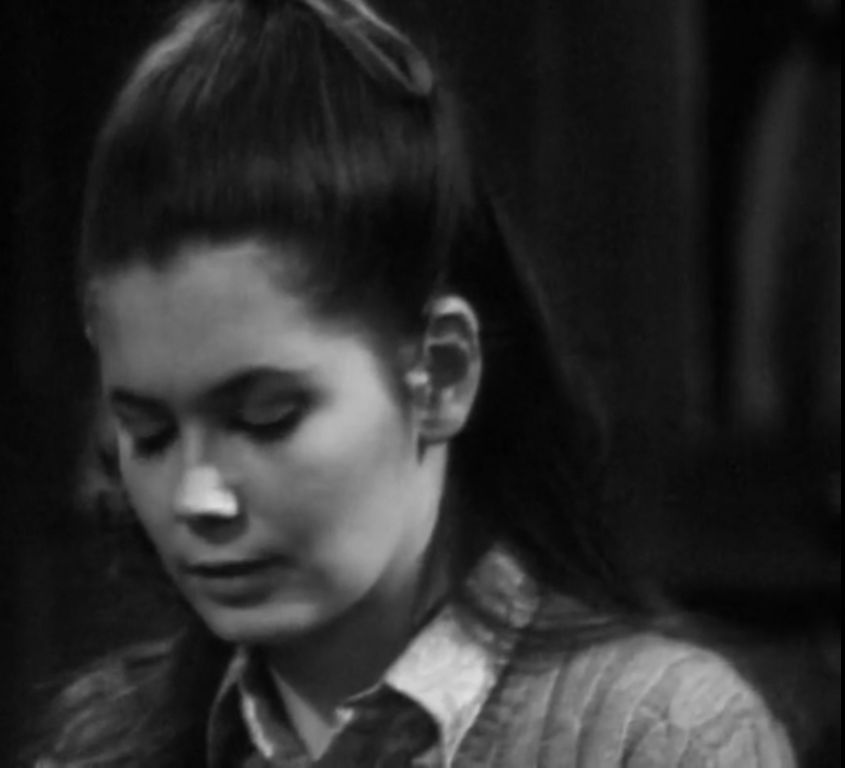
Episode 710: The raven and the viper and all the dark creatures

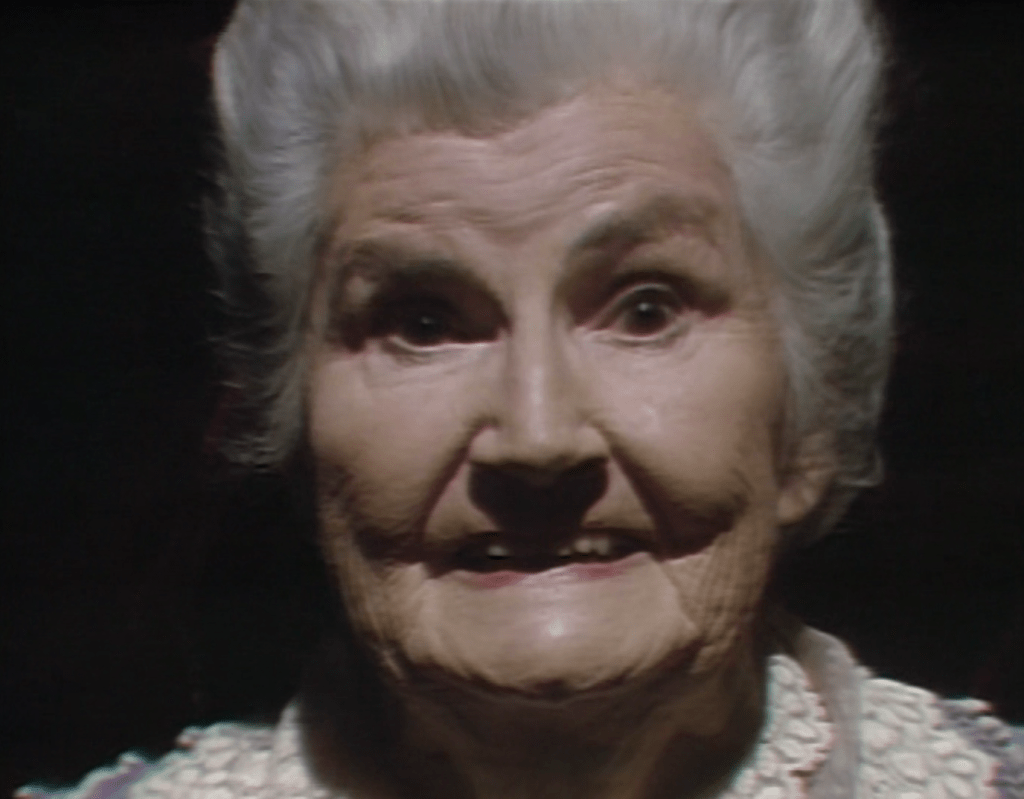
Libertine Quentin Collins has stolen his late grandmother Edith’s will, intending to forge a substitute that will give him control of her vast estate. His distant cousin, the recently arrived and thoroughly mysterious Barnabas, has warned Quentin that Edith’s ghost will haunt him if he persists in this plan. Quentin hears a loud pounding emanating from the walls of the great house of Collinwood. He goes to the study, where Edith lies in her coffin. He sees her there, grinning at him. Quentin returns to his room; the still-grinning Edith sashays in and taunts him. He tells her she is dead; this does not seem to bother her. She just keeps on grinning.

Edith may be dead, but she is clearly having a blast. Screenshot by Dark Shadows Every Day.

Quentin strangles Edith. She falls into an armchair in his room, unmoving but still grinning. He buries her somewhere on the grounds of the estate; her hand sticks up from the earth. He wakes up.

Quentin’s friend, unethical lawyer Evan Hanley, comes calling. Evan asks Quentin to give him the will so he can take it to a forger of his acquaintance. Quentin tells Evan about the dream, and how shaken he is. He also tells him about Barnabas, and his concern that Barnabas is a formidable enemy who may have uncanny powers. When Evan tries to dismiss Quentin’s worries, Quentin responds that he is the last person who should make light of the supernatural. When Quentin speaks of Evan’s “devil-callings,” we learn that the clandestine “meetings” they spoke of the other day are Satanist ceremonies. Evan agrees to meet Quentin at 8:00 that night in the groundskeeper’s cottage on the estate to summon one of the spiritual forces of darkness to fight Barnabas.

Returning viewers know that Quentin is right to fear Barnabas’ connections to the supernatural. Barnabas is a vampire, and his powers include the ability to send hallucinations to torment people with guilty consciences. He is also a time-traveler, who has come to 1897 from 1969 on a mission to prevent Quentin from becoming a ghost who will drive the Collins family of that year out of the great house and plague strange and troubled boy David Collins to the point of death.

First time viewers will not learn that today; aside from the opening voiceover, this episode tells us nothing about Barnabas. It does tell us something about Quentin and Evan. They are super-racist against Romani and Sinti people.

Evan has decided to hire Sandor Rákóczi to forge the will. Sandor and his wife Magda have been staying at the Old House on the estate for some time as Edith’s guests. Quentin’s brother Edward and sister Judith are offended by the presence of these “gypsies” in their midst. Unknown to Evan and Quentin, and unmentioned in today’s episode, Barnabas has bitten Sandor, enslaving him. Presumably Sandor has no secrets from Barnabas, making him a bad choice to be Quentin and Evan’s henchman.

Three times today, Evan addresses Sandor as “Gypsy.” When he is putting it to him that he wants him to forge the will, he barks at him with “Now, one moment, Gypsy.” He insists Sandor fix his price in advance. When Sandor tells Evan he is sad that he does not trust him, he replies “Well, then, be sad, Gypsy, but give me your price, now!” Later, Sandor will express curiosity about Quentin and Evan’s plans, to which Evan will reply “Well, don’t be curious, Gypsy, just do as you’re told.”

Evan told Quentin that the “devil-calling” at the cottage should involve twelve year old Jamison Collins as a “sacrificial lamb.” Quentin sincerely cares about his nephew Jamison, and he protests that he won’t do anything to hurt him. Evan assures him that Jamison will simply be a symbol of the innocence that their dark lord exists to despoil and that the boy himself will not be harmed. When Quentin is talking Jamison into joining him and Evan for a secret meeting that night, he tells him they will look into the future. Jamison asks”How, with a crystal ball?” Quentin replies “No, of course not. That kind of thing is for gypsies. It’s not for men, like you and me.” Scripted television in the US in the 1960s rarely gave such flagrantly racist remarks to recurring characters, not only because the audience included members of minority groups, but also because they are so unattractive that they limit the utility of the characters who make them. In this case, Quentin and Evan are already in league with the Devil, and Quentin is on track to die soon and become a ghost. So we know that they are due for a comeuppance. Moreover, their prejudices may lead them to underestimate Sandor, both on his own account and as a tool of Barnabas, so it is useful to the plot that they are in the grip of such ugly attitudes.

Sandor is in the cottage, preparing to forge a new will for Edith, when Jamison drops in. Jamison does not see what he is doing. He and Sandor spend a couple of minutes sparring verbally. Sandor ends the match when he points out to Jamison that it is getting dark. The boy looks alarmed and runs home while Sandor laughs.

In #701, Sandor and Magda mentioned that the Collinses were afraid of the night. Shortly after, they found out about Barnabas, and learned that they had good reason to be. But Sandor can still laugh when he sees that a boy as old as Jamison runs away at the news that the sun is setting.

Sandor is still in the cottage when Quentin brings Jamison by. Evidently Evan plans to let Sandor participate in the ceremony. Regular viewers will remember that in 1969 the first place Quentin manifested himself outside the little room in the great house where David and his friend Amy discovered him was in the cottage, and that he showed considerable power there. That he and Evan have their Satanic “meetings” in the cottage suggests that the evil he did in 1969 has its roots in what he did during them.

Evan directs Jamison to stare into the fire burning in the hearth. This will ring another bell for longtime viewers. Jamison is played by David Henesy, as is David Collins. From December 1966 through March 1967, David Collins’ mother Laura Murdoch Collins lived in the cottage. She was an undead blonde fire witch, and her plan was to lure David to join her in a fiery death. She would rise from the dead as a humanoid Phoenix, as she had done at least twice before. On each of those previous occasions, she went into the flames with a son named David; the Davids did not rise again, as becomes clear when one of them is available to speak in a séance in #186. Laura often urged David to join her in her favorite pastime, staring into fire. So when Evan urges Jamison to do the same, we wonder if Jamison, too, is in danger of being consumed by its fascination.

As the ceremony goes on, Jamison becomes alarmed. He runs out, and Evan orders Sandor to follow him. Quentin, too, runs to the door and protests that they have gone too far. He points to the flames, in which the likeness of a skull wearing a wig takes shape. We may wonder if more will be added to the skull, perhaps so much as to make up a whole woman, and if this woman will be someone we have met before.

Edith’s role in Quentin’s dream unfortunately marks Isabella Hoopes’ final appearance on Dark Shadows. She was just terrific. I wish they had done a parallel time story set around the period of the Civil War in which Hoopes played an aged Sarah Collins. Her nose, chin, and cheekbones resembled those of Sharon Smyth sufficiently that you can imagine an elderly Sarah looking like her, and she had a playfulness that would make longtime viewers remember the nine year old ghost we met in June 1967.

Episode 675: The best alibi you can have in this town

In #128, wisecracking waitress Maggie Evans opened a conversation in the diner at the Collinsport Inn with that old familiar ice-breaker, “Whaddaya hear from the morgue?” The show took us all the way to Phoenix, Arizona for a trip to that city’s morgue in #174, but it is only today we see the inside of Collinsport’s own morgue for the first time. Sheriff George Patterson brings heiress Carolyn Collins Stoddard in to identify a body found on her property. Carolyn is shocked to find that it is her friend, Donna Friedlander.

Last night, Carolyn and Donna were in the drawing room of the great house of Collinwood with permanent houseguest Julia Hoffman and old world gentleman Barnabas Collins, who lives in the Old House on the same estate. Also in the room was Chris Jennings, a mysterious drifter who caught Carolyn’s fancy and who now lives in the caretaker’s cottage on the estate as her guest. Barnabas invited everyone to dinner at his house. The ladies delightedly accepted, but Chris begged off, saying he would have to leave immediately to keep an important business engagement in Bangor, Maine. Donna said that she was going home to Bangor and that she was ready to leave, and asked Chris for a ride. When he tried to squirm his way out of taking her, Barnabas looked on with smug self-satisfaction.

This morning in the morgue, Carolyn tells Sheriff Patterson that the last time she saw Donna, she was leaving with Chris. But she recoils from the implication. She cannot believe that Chris had anything to do with Donna’s death.

Carolyn does not know what Barnabas has figured out. Chris is a werewolf. When Barnabas told Julia that he had come to that conclusion, she was unconvinced. Barnabas’ dinner invitation was a ploy intended to elicit just the panicked reaction Chris did have. Barnabas’ look of triumph at Chris’ frantic attempts to ensure that he is alone on this night of the full Moon reflects his belief that he has been proved right.

Barnabas went to the cottage some time after the Moon rose, intending to use his silver-headed cane to take control of Chris in his werewolf form. But he delayed too long, and by the time he got there the cottage was vacant and Donna’s mangled corpse lay in the woods nearby.

We cut to the cottage, where we see a disheveled and bloodstained Chris come home. He has just had time to change his shirt and set some furniture right side up when Carolyn drops in. She has come to warn Chris that Sheriff Patterson is coming. The sheriff is right behind her. Carolyn leaves the two of them alone. Chris refuses to allow a search of the premises; when he spots Donna’s purse on his table, he throws a newspaper over it. The sheriff somehow fails to notice this, but takes Chris to his office for questioning.

In the drawing room, Barnabas and Julia are fretting over Donna’s death. Barnabas asks “Could we have stopped it?” He decides that they could not have, and that whatever sequence of events led to the killing must have been “Donna’s fault.” It is always fun to watch the scenes where Barnabas faces the horrific results his actions have on other people, strikes a noble pose while briefly considering the possibility that he may be partially responsible for them, and then agrees with Julia that it is pointless for him to blame himself. Julia and Barnabas’ self-exculpatory attitudes are so transparently absurd that you have to admire Grayson Hall and Jonathan Frid for keeping straight faces while delivering their dialogue.

Meanwhile, Carolyn has called the Collins family lawyer, Richard Garner. Garner agrees to help Chris. We saw Garner and his son Frank a number of times in the first months of 1967, but he hasn’t been on screen since #246. He has only been mentioned a handful of times since then, most recently in #577. This is the last time his name will come up.

Back in the drawing room, Barnabas tells Julia that he can see “So many possibilities” for dealing with Chris’ problem. Frid’s delivery of this line made my wife, Mrs Acilius, shudder. She could hear the evil in his voice as he shows us Barnabas playing God.

Chris is in an interrogation room, telling Sheriff Patterson a series of mutually contradictory lies about what he did last night. The sheriff says he’s going to leave him alone for a few minutes so that he can come up with a more plausible story. You might think this was a sarcastic remark, but in this context it seems it might actually be sincere. Sheriff Patterson’s failure to notice Donna’s purse on Chris’ table is of a piece with the complete nonfeasance he has shown all along, and Vince O’Brien delivers the line so warmly it doesn’t sound like a joke. Moreover, Sheriff Patterson’s predecessor as Collinsport’s chief representative of law enforcement, Constable/ Sheriff Jonas Carter, capitulated to the Collins family’s directions to cover up a crime in his final appearance on the show, back in #32. Longtime viewers may suspect that Sheriff Patterson is as averse to the tough parts of his job as was Constable/ Sheriff Carter.

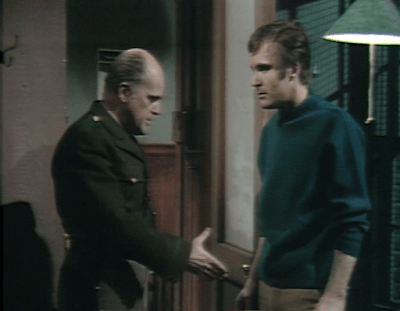
While Chris is alone in the interrogation room, he decides to tell Sheriff Patterson the truth when he comes back. He does in fact open his mouth and get the first few words of a confession out when the sheriff cuts him short. He says that Barnabas Collins called the office to tell him Chris was with him last night, and that Barnabas is “about the best alibi you can have in this town.” He shakes Chris’ hand and sends him on his way. Law enforcement characters on Dark Shadows are symbols of helplessness, and after that moment Sheriff Patterson has reached the zenith of that quality, achieving a measure of futility that cannot be surpassed. We never see him again.

Sheriff Patterson completes his quest. Screenshot by Dark Shadows Before I Die.

Chris goes home and finds Barnabas waiting for him. Chris expresses his gratitude for the alibi Barnabas gave him, but keeps trying to get him to leave before the Moon rises. Barnabas tells him that when he leaves, Chris will leave with him. Barnabas closes the episode by telling him that he knows that he is not only Chris Jennings, but that “You are also the werewolf.”

This episode marks the final appearance not only of Sheriff Patterson, but also of Vince O’Brien. O’Brien joined the show in #148 as the second actor to play Lieutenant Dan Riley of the Maine State Police. O’Brien’s stolid manner suited the role of that ineffective investigator, but he was much less fun to watch than was the man who originated the part, the charming John Connell.

O’Brien took over as the second Sheriff Patterson in #328. He was again a step down from his predecessor; the first Sheriff Patterson was Dana Elcar, an extraordinary performer who always found a way to give the audience hope that his character was only playing dumb. Other actors filled in for O’Brien a couple of times, Angus Cairns in #341 and #342 and Alfred Sandor in #615, leading some fans to refer to “the Patterson brothers” (whose parents named all of their sons George) and others to speculate that for a time Collinsport allowed any man to be sheriff who was willing to change his name to “George Patterson.” Like O’Brien, Cairns and Sandor were accomplished professionals, but none could match Elcar’s gift for overcoming bad writing and keeping our attention focused on the sheriff.

Episode 670: A nice couple

The only story that reliably worked in the first 38 weeks of Dark Shadows was the attempt of well-meaning governess Vicki Winters to befriend her charge, strange and troubled boy David Collins. Its success was less to do with the writers than with the actors. When we saw Vicki in David’s room giving him his lessons, her dialogue was as bad as anything else the actors found in the scripts, including one moment when she had to read a description of the coastline of Maine to him from a geography textbook. But Alexandra Moltke Isles and David Henesy used everything other than the words to show us a young woman and a hurting boy learning to trust each other. Their use of space, of body language, of facial expressions, of tones of voice, all showed us that process step by step, and it was fascinating to watch.

Vicki and David’s story reached its conclusion in #191, when David’s mother, undead blonde fire witch Laura Murdoch Collins, tried to lure David to his demise in a burning shack while Vicki tried to rescue him. At the end, David ran from the shack into Vicki’s arms. When he chose Vicki and life over his mother and death, there was nowhere left for their relationship to go. We saw a few more tutoring scenes in the spring and summer of 1967, when vampire Barnabas Collins was first on the show, but have seen none since. Mrs Isles left Dark Shadows in November, and the recast Vicki made her final appearance a week ago, in #665.

The new governess in the great house of Collinwood is Maggie Evans, who was introduced in #1 as a wisecracking waitress and a hardboiled representative of the working class of the village of Collinsport, but whom actress Kathryn Leigh Scott shortly afterward reinvented as The Nicest Girl in Town. The town barely exists anymore, so when Vicki disappeared into a rift in the fabric of time and space it was almost a foregone conclusion Maggie would move into Vicki’s room upstairs in the great house. After all, the room was first occupied in the 1790s by the gracious Josette, whom Miss Scott played in the parts of the show set in that period.

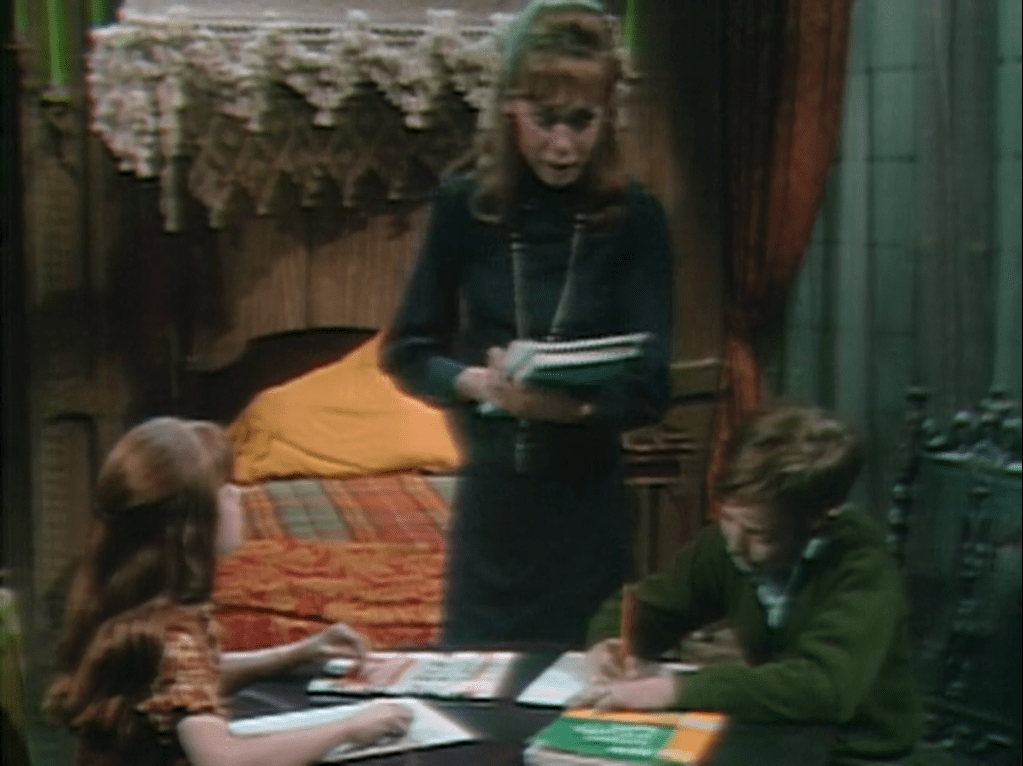
Today, we see our first tutoring scene in over a year and a half. David isn’t Maggie’s only charge; he has been joined by permanent houseguest Amy Jennings. Yesterday and the day before, we saw evidence that Maggie is a poor disciplinarian. We see further such evidence at the beginning of the tutoring scene, when the children complain about their lessons and Maggie quickly starts to explain herself and bargain with them. Amy and David are coming under the influence of the evil spirit of the late Quentin Collins. If the adult who is employed full-time to supervise David and Amy were up to her job, they wouldn’t be much help to him. So it’s no wonder the show three days in a row tells us that Maggie is a squish.

Maggie on the job.

To advance a plan of Quentin’s, Amy pretends to be ill and to faint during the lesson. David Collins is almost as subtle an actor as is David Henesy; when he is pretending to see signs of illness in Amy’s face, he looks at her with one eye and speaks with a most convincing note of concern. By contrast, Amy’s performance is exaggerated, showing none of the easy fluency Denise Nickerson brought to her roles. My wife, Mrs Acilius, chuckled at Amy’s fake faint and at some of the fussing she and David do when they are left alone together. She said it was refreshing to see that David and Amy are still kids. It certainly adds to the poignancy of what we are seeing Quentin do to them when we think of them as real children whose innocence he is exploiting for his evil project.

Amy’s fake faint convinces Maggie, and it leads to a lot of running around, ending with Maggie going to the cottage on the estate where Amy’s big brother Chris is staying as a guest of heiress Carolyn Collins Stoddard. Chris is a werewolf and is about to transform, and Quentin’s goal was to get Carolyn to go to the cottage. David has been making terrible pronouncements to Amy about how Carolyn will never bother them again, and the two of them are distressed to hear that Maggie rather than Carolyn is going to see Chris. So we are supposed to take it that Quentin knows about Chris’ situation and wants him to attack Carolyn.

Episode 669: Hide and seek

Governess Maggie Evans forbids her charges, David Collins and Amy Jennings, from going outside. They ask her to play hide and seek. She agrees, and accepts the role of It. She searches for them for a long time, ultimately finding them outdoors. She points out that she had told them to stay indoors, and they pretend not to have understood that this applied to their hiding places.

Maggie does not punish Amy and David for this obvious insubordination. This establishes that Maggie is a squish who will not maintain discipline. That point had already been made in yesterday’s episode, when Maggie caught Amy hiding in David’s room, in defiance of orders from heiress Carolyn Collins Stoddard. At that time, Maggie lied to housekeeper Mrs Johnson to cover up what the children had done. Maggie’s irresolution bears repeated exposure, though, since the children are coming under the influence of the evil spirit of the late Quentin Collins and would not be very effective as his helpers if they were subject to even moderately competent adult supervision.

Today Mrs Johnson and her son Harry are under orders from Carolyn to fix up the caretaker’s cottage on the estate. Carolyn has invited mysterious drifter Chris Jennings, Amy’s big brother, to live in the cottage. In the opening, Mrs Johnson tells Maggie she objects to this idea on the grounds that the cottage is cursed. Maggie dismisses Mrs Johnson’s belief in such a curse, but she really shouldn’t. Mrs Johnson keeps calling it “Matthew Morgan’s cottage” after the crazed handyman who lived there for eighteen years. Matthew killed Mrs Johnson’s beloved employer Bill Malloy, then tried to kill Maggie’s dear friend and predecessor as governess at Collinwood, Vicki Winters. Maggie knows all about those incidents. Mrs Johnson also says that no good happened at the cottage after Matthew; the only resident of the cottage since Matthew’s death was David’s mother, undead blonde fire witch Laura Murdoch Collins. Maggie knows plenty about Laura as well, since her father Sam was deeply involved in the strange goings-on concerning Laura and Vicki led the fight against her.

Under orders from Quentin, the children contrive to trap Mrs Johnson in the cottage by herself. Quentin appears to her there. She is terrified. This is quite a surprise to regular viewers. Quentin has appeared on screen only once before, in #646. Moreover, the children have made it very clear that Quentin is confined to the little room hidden in the long-deserted west wing of Collinwood where they found him. We are left to wonder how he gained the ability to manifest himself in the cottage and even to walk outside it when no one is looking.

Quentin terrifies Mrs Johnson. Screenshot by Dark Shadows Before I Die.

Perhaps we are to think that Quentin is in some way connected with the curse on the cottage, and with Chris. When the children first contacted Quentin, Amy could communicate with him before David could. This left David miffed, since “Quentin Collins is my ancestor.” That line of David’s led us to expect that we would learn that Quentin is also Amy and Chris’ ancestor. Tomorrow, David will tell Amy that Quentin is “quite pleased” that Chris is living in the cottage. Maybe it was Amy’s presence in the room in the west wing that activated the ghost of Quentin there, and Chris’ impending arrival in the cottage that activates it in that space.

This episode marks the last appearance of Harry. Until today, he was played by Craig Slocum. Edward Marshall takes Harry over the horizon. Mr Marshall must have been watching the show; he does a flawless imitation of Slocum’s very peculiar line delivery. His Harry is just as petulant and resentful as Slocum’s was, but he is so much more physically relaxed and so much more responsive to his scene partners that he is enjoyable to watch in a way Slocum never was. I can’t help but wonder if Harry would have caught on and become a bigger part of the show had Mr Marshall taken the part earlier. Harry’s personality made it impossible for him to figure in a romance of any kind, limiting his usefulness on a soap, but there’s plenty of room on Dark Shadows for comic relief in the form of an inept, grumbly, dishonest servant.

Episode 668: Very odd games

When Ron Sproat joined the writing staff of Dark Shadows in the Autumn of 1966, he used his first several scripts to catalogue the ongoing storylines and classify them according to their potential for future use. Now Sproat is approaching the end of his time on the show, and he is again in a self-referential mood. Today’s episode is mostly about the geography of the great house of Collinwood and the grounds around it.

We first heard about the servants’ quarters in Collinwood in #196, when seagoing con man Jason McGuire imposed himself on matriarch Elizabeth Collins Stoddard as a houseguest. Liz faced front and looked past the camera to stage right, saying she might find a room for Jason that way. He cut her off, saying that was where the servants’ quarters were. He insisted on a room upstairs, among the family.

Today, we see the servants’ quarters for the first time. Children David Collins and Amy Jennings are under the influence of the evil spirit of Quentin Collins, and David tells Amy that Quentin wants them to go to a particular room. Since it is late and they are supposed to be in bed, they take care that none of the adults see them. Rather than go past the other bedrooms and down the main staircase in the foyer, they cut through the long-deserted west wing and enter the drawing room through a secret panel. They are detained there briefly when they hear heiress Carolyn Collins Stoddard talking with Amy’s brother, mysterious drifter Chris Jennings, in the foyer. When Carolyn and Chris go away, Amy and David leave the drawing room and exit the same direction Liz had faced when she tried to get Jason to stay in the servants’ quarters.

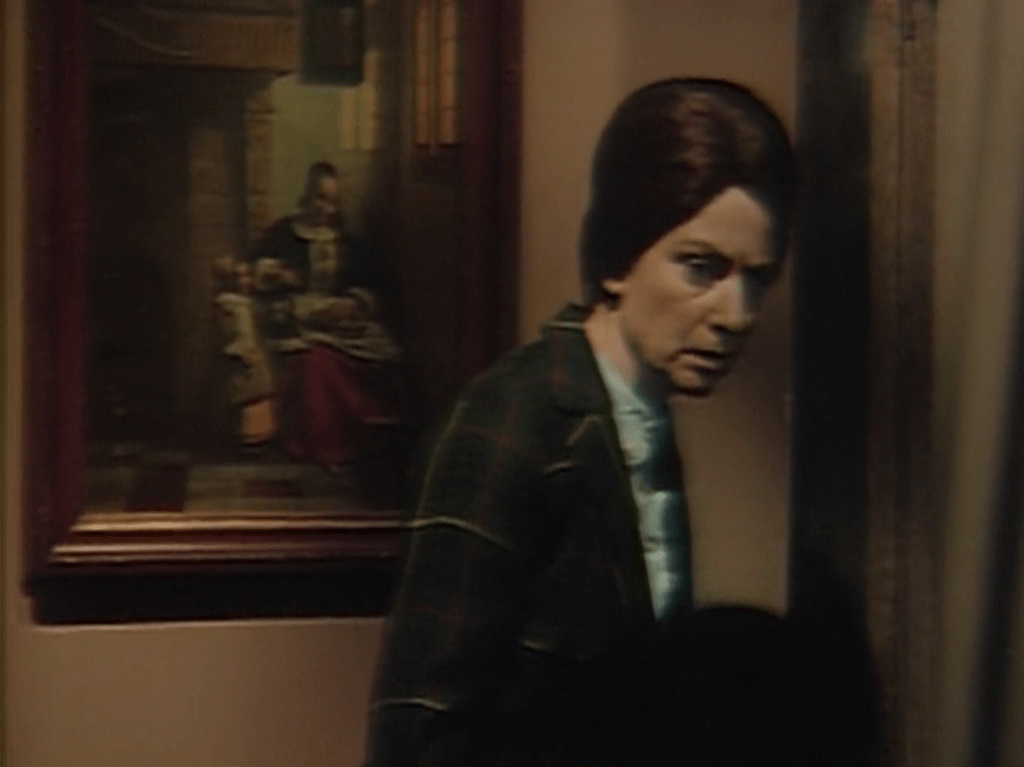
The only servants living in the house now are housekeeper Mrs Johnson and her son, unsightly ex-convict Harry. Mrs Johnson comes down the corridor and hears the children talking behind a door. She is wearing her robe over her nightgown, confirming that the part of the house the children have gone to includes her bedroom. A very nice painting hangs on the wall of the corridor, showing that the Collinses’ habit of cramming their properties with fine art extended to every part of the house.

Mrs Johnson hears the children.

Also in this episode, Carolyn invites Chris to live in the cottage on the estate that was once occupied by crazed handyman Matthew Morgan, and later by undead blonde fire witch Laura Murdoch Collins. Carolyn tells Chris that the cottage is very far from the main house, profoundly isolated. It has been fairly well established that another mansion on the estate, the Old House, is a fifteen minute walk through the woods from the main house, so Carolyn’s tone suggests that the cottage, too, is about that remote.

This might bring a chuckleworthy image to the minds of longtime viewers. In #139, well-meaning governess Victoria Winters carried a breakfast tray loaded with tea things from the main house to Laura at the cottage. She is conspicuously careful with the tray. Vicki was at once so resolute when she had a task to accomplish and so utterly lacking in practical sense that it is very easy to picture her hiking the better part of a mile through the woods carrying such a thing.

Vicki brings a tray to Laura, #139.

Episode 184: It’s been my life

Parapsychologist Dr Guthrie visits blonde fire witch Laura Murdoch Collins in her cottage on the grounds of the estate of Collinwood. He tells her that his researches have led him to the conclusion that she is “The Undead” and that she poses a danger to her son, strange and troubled boy David. She replies that he is being preposterous, but she doesn’t deny anything he says.

Guthrie says that she is probably wondering why he has told her these things. The audience certainly is- Laura has already tried to cast a paralyzing spell on Guthrie, and can hardly be expected to grow more benevolent towards him now that she knows that he has figured out her nature and has told her he is “closing in on” her.

Guthrie explains to Laura that their meeting marks a significant moment in the history of the world- a scientist has come face to face with a being who has died and returned to walk the earth. He wants to learn from her, and offers to help her if she will stop trying to claim David. He tells her that an effort to bring science to bear on cases like hers “has been my life.” “What an interesting way to put it,” Laura responds, in her unforgettable sardonic tone. She dismisses his offer, and tells him he is powerless.

In a way, it’s too bad Laura doesn’t take an interest in what Guthrie might be able to do for her. That’s quite an idea, a scientist trying to help an undead being and to explore the realm of the supernatural thereby. It suggests the 1945 Universal movie The House of Dracula, in which a blood specialist treats Dracula for vampirism, with apparent success. That doctor then encounters the Wolf Man and Frankenstein’s monster. He attempts to treat them also, but things eventually go awry. The House of Dracula runs for 67 minutes; it might be interesting to develop a story like that in a daytime serial, where you have as much time as the audience and the network are willing to give you.

Guthrie is trying to organize a séance to contact Laura’s chief adversary, the ghost of Josette Collins. He tells hardworking young fisherman Joe* that they will have to recruit drunken artist Sam Evans to join them at the séance. Joe laughs at the thought of how Sam will react to such an invitation. Sam’s daughter, Maggie, is Joe’s girlfriend; Joe stops laughing and is a little bit scared when he thinks of Maggie’s likely reaction. But Guthrie insists that Sam’s participation is essential. Josette took possession of Sam to paint pictures that gave them some of their first and clearest warnings of what Laura might do to David, so he has already been one of her most powerful mediums. Joe agrees to ask him.

At the Evans cottage, Joe pitches Sam and Maggie on the séance. Sam at first finds the notion hard to take seriously. The more he thinks about it, the more convinced he becomes that Guthrie’s theories are correct and that it is his duty to participate. Maggie is dead set against her father having anything to do with Collinwood or the supernatural. She has worked on getting him to forget the paintings he made under Josette’s influence and his belief that Laura was responsible for the fire that injured his hands shortly after he painted them. As an Adult Child of an Alcoholic, Maggie is in the habit of heading Sam off when he’s on his way to do something weird. Usually Joe is her most reliable ally and greatest help in looking after her father. Today, she reluctantly gives in when Sam and Joe both think the séance is a good idea.

In the drawing room of the great house at Collinwood, Dr Guthrie is studying some documents. We see Laura staring into the fire in her cottage. Her eyes are superimposed over the image of Guthrie as he becomes ill.

Joe comes in and sees that Guthrie is struggling for breath. He asks Guthrie if he is all right. Guthrie complains of the heat. Since Joe is still wearing his heavy coat and looks perfectly comfortable, he ought to know that isn’t much of an explanation. He mentions that he has completed some tasks Guthrie asked him to perform. Guthrie has no idea what he’s talking about. When Laura attacked Guthrie in episodes 175 and 176, it was through a spell that hit him while he was in this same room. Then also, he had difficulty breathing during the attack and a gap in his memory afterward.

That time, well-meaning governess Vicki came into the drawing room and saw Guthrie suffering the effects of the attack. The attack abruptly ended. While Guthrie was recovering, David came back to the house and told him and Vicki that he had interrupted Laura a few minutes before while she was staring into the fire at her cottage. After David gave Vicki and Guthrie a full account of the incident, they sent him off to have dinner followed by two desserts- cake and ice cream.

That day, Vicki recognized the symptoms of Guthrie’s attack as the same those reclusive matriarch Liz exhibited after a confrontation with Laura and before she lapsed into a catatonic state from which she has not yet recovered. From this, Vicki concluded that David must have stopped Laura while she was in the process of casting the same spell on Guthrie that she earlier cast on Liz. Guthrie agreed with Vicki’s analysis, but was confident he could defend himself against any further spells Laura might cast. He never explained what his defense would be.

Whatever protection Guthrie thought he could give himself against Laura’s powers obviously isn’t working, at least not while he is alone. After Joe goes away, Laura resumes casting her spell.

Featuring Laura, as Egg-Fu

While Guthrie struggles in the drawing room, David strolls into the foyer. The ghost of Josette manifests on the staircase above. She takes a few steps down towards him and points to the drawing room doors.

Josette sends David to rescue Dr Guthrie

David realizes Josette is telling him to go into that room at once. He obeys, and finds Dr Guthrie on the floor by the fireplace, apparently near death.

*Who is evidently fishing again. Months ago, Joe got a white-collar position in the offices of the cannery, a position he accepted only in order to make enough money to buy his own boat. Today David asks him when he will take him along on the boats, and Maggie mentions that he’d recently lost his watch in a mackerel net. They never told us that he’d gone back out, and indeed he was carrying papers back and forth from the office as recently as #174.

Episode 152: Woman in the cottage

The mysterious and long-absent Laura Collins is sitting motionless by the fire in her current residence, the cottage on the grounds of the great estate of Collinwood. A knock sounds at the door. As always in this situation, it takes Laura a moment to rouse herself and begin moving. When she does, her movements are disconnected and robotic, as if she is reassembling herself. This image, coupled with what regular viewers have seen in previous episodes, suggests that what we see when we look at Laura is never more than half of a person. Part of her, maybe most of her, exists in the form of energy that somehow inheres in the fire.

Laura opens the door to instantly forgettable young lawyer Frank Garner. Frank identifies himself as the representative of Laura’s estranged husband, high-born ne’er-do-well Roger Collins, in their divorce. She tells him she doesn’t want any money or property. All she wants is custody of their son, strange and troubled boy David. Since Roger is eager to see David go with her, she doesn’t see the need for a lawyer of her own.

Frank points out that as one of the heirs to the Collins interests, David stands to become a “very wealthy young man.” Laura suggests that all of David’s assets be put in a trust that she cannot access. When Frank asks how she will support David until he comes into his legal majority, she says vaguely “I have… resources.” When he presses the point, she assures him that “where I plan to take [David,] he’ll have no need for anything the Collins family could give him.” Since the Collins family is presented in this episode as “very wealthy,”* that would suggest she is taking him someplace where money cannot be exchanged for goods and services. This is, to put it mildly, an intriguing prospect.

Throughout her talk with Frank, Laura makes it clear her priority is to settle the divorce and leave with David as soon as possible. Frank says that lawyers can usually settle business among themselves more quickly than they can with people unrepresented by counsel and asks if she wants the matter settled quickly. Laura answers that she wants that “more than he can realize.” She asks Frank to represent both her and Roger, to draw up the papers to finalize what they have discussed, and to get it over with.

Before he can leave the cottage, Frank has to break some bad news to Laura. The police in Phoenix, Arizona, are still investigating a fire that destroyed the apartment where she lived in that city and killed an unidentified woman who had a key to it. There might be a hearing. If so she will have to return to Phoenix to testify, perhaps on short notice.

Laura chose to live in Phoenix. She has told versions of the legend of the phoenix both to David (#140) and to Maggie Evans (#128,) who was waiting on her table at the restaurant in the Collinsport Inn. Furthermore, Maggie’s father, drunken artist Sam, knew Laura when she lived in town ten years before and hasn’t been in touch with her since. When Maggie told him that a customer had told her the legend of the Phoenix, he clearly knew that Maggie was talking about Laura. So she has been fascinated with the story for years. In the version of the legend she related to David, it was in the context of a description of a mystical land like those which figure in the stories of the Holy Grail, which “some call Paradise,” and which is her true home. So when Laura implies that she plans to take David someplace where there is no buying or selling, we listen up.

Frank leaves, but before Laura can resume her stupor beside the fire someone else knocks. It is well-meaning governess Vicki. Vicki tells her that her boss, reclusive matriarch Liz, has ordered her to keep Laura away from David. Laura asks if Vicki will obey this command. Vicki says she has no choice. It’s her job, after all, and besides, Liz has been very nice to her.

Laura asks how someone who herself grew up in a foundling home can keep a child from his mother. Vicki recaps all the strange things that have happened since Laura came back. Regular viewers know that these events are signs of supernatural activity. We know this because we’ve seen transparent figures superimposed over shots and have heard theremin music playing on the soundtrack. But Vicki hasn’t been watching the show, so even though she tells Laura almost everything she has seen and heard Laura can provide more-or-less plausible explanations for all of it.

Vicki is unconvinced, but still goes back to the great house and tells Liz that she won’t be able to follow her orders. Laura is David’s mother, after all, and does have her rights. Liz is so angry that she can’t look at Vicki, and stares directly at the teleprompter throughout the entire scene.

Liz demands that Vicki say she will do as she has commanded. Vicki looks down, and even after Liz has repeated herself more than once she still doesn’t say that she will. The closeup on Vicki before Liz sends her away to check in on David is quite a powerful moment. In a couple of seconds, Alexandra Moltke Isles shows very clearly that Vicki is ashamed to be disobeying Liz, embarrassed to be yelled at in the drawing room, and yet determined to continue in her course of action.** It’s a remarkably efficient performance.

Vicki being yelled at

Vicki leaves the room. The camera stays on Liz as we hear voices in the foyer. Roger crosses paths with Vicki. He enters the drawing room and asks Liz why Vicki is upset. Liz dismisses the question, and Roger compares her to Lucrezia Borgia. Irritated, Liz says she is in no mood for his jokes. “Who’s joking?” he replies.

That’s a startling moment. Roger spent the first several months of the show trying to get Vicki out of the house, if necessary by manipulating David into murdering her (#68.) Now, he’s expressing sympathy for Vicki, apparently spontaneously. It’s true that the motive for that hostility was rooted in a storyline that has been partially resolved, but it is still interesting that Roger actually seems to like Vicki now.

A knock sounds. Again the camera stays on Liz in the drawing room while we hear Roger greet Frank in the foyer. It was a week ago, in #147, that we first heard characters speaking while off-camera. I wish they had done that more often. They need all the tricks they can find to create a sense of space, to make us feel that their little sets are actually a huge mansion, a rolling estate, and a whole town.

Frank tells Roger and Liz about his conversation with Laura. Roger is delighted that the only thing Laura wants is custody of David and urges Frank to draw up the papers at once. Liz, outraged, declares that custody of David is the one thing Laura can’t have, and forbids him to draw the papers up at all. Faced with this disagreement between Roger, his client of record, and Liz, who is actually paying his fee, Frank can do nothing. He excuses himself. On his way out, Roger whispers to him that he should prepare the papers- he promises to handle Liz.

The telephone rings. It is a report that the authorities in Phoenix have examined the charred corpse found in the burned ruins of Laura’s apartment. They are positive that it is the body of Laura herself. Roger and Liz are bewildered by the news.

*In other episodes, especially those focusing on the “Revenge of Burke Devlin” storyline, they seem to be gasping along on the brink of total financial ruin. But today, we hear about nothing but how terribly rich they are, so that’s what we’ll go with.

**This is puzzling for regular viewers. In #148, Vicki expressed a determination to keep Laura away from David. The information she shares with Laura is the basis for that determination. It isn’t at all clear why she doesn’t stick with it. For that matter, if she can tell Laura everything she knows when she regards Laura as a menace, why can’t she tell her benefactress Liz that she is thinking the same way she is? It could be that Ron Sproat, who wrote #148, and Malcolm Marmorstein, who wrote this one, didn’t talk to each other, and the producer was too busy with other things to catch the inconsistency. Whatever the cause, Mrs Isles gives such strong performances in both episodes that I’m inclined to treat them as self-contained stories so far as Vicki is concerned.

Episode 135: No one is being kind

Mysterious and long-absent Laura Collins has returned to the great house of Collinwood, seeking custody of her son, strange and troubled boy David, and a divorce from her husband, high-born ne’er-do-well Roger. Roger is enthusiastic about this plan, but David’s attitude has shifted from eagerness to see his mother to the terrified belief that the person who has come to the house is not his mother, and that if he becomes close to her something terrible will happen.

These episodes are loaded with hints that there is something very strange about Laura. When Laura was due to visit the house yesterday, David thought he saw her appear on the lawn and then vanish, an idea Liz dismissed instantly and Roger took as evidence of his great desire to see her. David did indeed want to see Laura at that time; when she came into the house, he was afraid of her. Coupled with other indications that there is something supernatural about Laura and with David’s history of sensitivity to eerie happenings, these disparate reactions might lead us to wonder if there are two of her- a ghost who flickers on the lawn, and a corporeal being who comes inside and carries on conversations.

We have seen Laura at the restaurant in the Collinsport Inn several times; the restaurant’s keeper, Maggie Evans, mentions that Laura never eats or drinks. On Wednesday, Laura’s ex-boyfriend, dashing action hero Burke Devlin, tells her that she seems profoundly different than she had been when they knew each other before. Yesterday, reclusive matriarch Liz told her that her personality had undergone a radical change. She is obsessed with fire* and with the legend of the Phoenix, suggesting that her radical change may have something to do with that myth. Maggie’s father, drunken artist Sam Evans, is possessed by an otherworldly power marked by theremin music on the soundtrack and paints a woman in flames, apparently a consequence of something Laura’s presence has stirred up in town.

Today, we have further suggestions that Laura is not simply a physical entity. She tells flighty heiress Carolyn that although she has been staying at the inn for several days, she has not unpacked her bags. Carolyn looks at Laura’s crisp outfit and flawless makeup and is bewildered by this remark. Laura also explains that a taxi brought her to the house from the Inn and that it is scheduled to return. When she decides not to leave, she tells Carolyn that she will call to cancel the return trip, but when Carolyn leaves her alone Laura turns away from the telephone- evidently there never was a taxi. When well-meaning governess Vicki takes the several mile walk between town and the house, she is wearing the soap opera version of a sensible walking outfit. The style-conscious Carolyn is the perfect person to highlight the improbability that Laura took such a hike looking the way she does.

Laura and Carolyn in the cottage. Screenshot by Dark Shadows Before I Die

Laura will be staying at the cottage at Collinwood. This has been established as an important location, and we’ve been waiting for someone to move into it since its previous occupant, gruff caretaker Matthew, confessed to Vicki that he had killed beloved local man Bill Malloy, had then tried to kill Vicki, and had become a fugitive. Carolyn mentions that Collinwood’s housekeeper, Mrs Johnson, had cleaned the cottage up when Matthew died, but that it needs another cleaning. I found this to be rather a poignant touch. Mrs Johnson had for many years been Bill Malloy’s housekeeper, and was intensely devoted to him. It was quite insensitive to ask her to clean the home of Bill’s killer, and it is quite reasonable that she did not do a particularly thorough job.

*I can’t resist mentioning that Mrs Acilius and I watched this episode while staying in a hotel. I don’t know if this was a consequence of Diana Millay’s performance as Laura, but we had to pause it about halfway in when a fire alarm went off in the building.

Episode 13: Worst thing that ever happened to this house, him comin’ back

Vicki visits Matthew in his cottage, the first time we’ve seen that set. She hopes that he will tell him something about her past. He doesn’t, but he does go on about the Burke Devlin trial. After he has brought up the Devlin trial he asks her why she’s interested in it. She says she isn’t, he scowlingly demands she stop talking about it. She’s bewildered. That might have been meant to be a joke, but if so it doesn’t land- George Mitchell’s Matthew is just too intense, too tortured, for that kind of joke to work.

Vicki’s effort to befriend Matthew fails as completely as does her attempt to get information about her origins, but the cottage set goes a long way towards making it seem that it might succeed. We see Matthew cooking and sharing a meal with Vicki in an intimate setting, and for all his strange ferocity he is very talkative. When she answers a question of his with a lie that is sure to anger him violently if he discovers it, we are in high suspense, hoping against hope that she will not be found out.

The caretaker’s cottage isn’t the only set we see for the first time in this one. We also follow Vicki into the garage at Collinwood. She finds Burke there with a wrench in his hand, standing next to the open door of Roger’s car. Burke explains this odd situation by claiming that he had been thinking of buying a similar car and wanted to look Roger’s over. Vicki is suspicious, and says that Mr Collins wouldn’t like his being there. Burke asks her to keep it secret, an invitation she pointedly refuses to accept.

Unlike the caretaker’s cottage, which is a staple set of the series almost up to the very end, we only see the garage a few more times. That’s a shame, I think. The show is so much about the house that the stories would all be richer if they gave us more of a sense of the physical realities of the house and its functioning. Simply placing a scene in the garage, where people are handling tools and standing in front of machinery while they talk about whatever it is that’s going on in the story, can accomplish that without the need to dwell on anything technical or mundane.

Also, the garage is where cars are kept. A scene there can establish a connection with the outside world. Often the show intentionally builds a claustrophobic sense in the audience, but sometimes they simply have a long string of episodes set entirely in the house and get us feeling more confined than we have any need to do. In those periods, a scene set in the garage could let just enough air in to keep us from being distracted by the closeness of the quarters.