Episode 641: Your time is now

In #2, high-born ne’er-do-well Roger Collins saw governess Victoria Winters standing at the edge of a high cliff overlooking the ocean. She didn’t know he was there until he startled her by asking her if she was planning to jump. As the weeks go on, Vicki will learn of other women who have leapt to their deaths from that spot, including a story that over the years two governesses were among them and that legend says a third will someday follow suit. The cliff is the face of Widows’ Hill, named after women whose husbands never returned home from the sea; several times during storms an eerie note sounds in the wind, a note known as “The Widows’ Wail,” which the locals believe to be the ghosts of the Widows announcing that a tragic death will soon take place.

Vicki stands at the edge of the cliff again at the end of this installment while the Widows’ Wail sounds. She is distraught that she has herself become a widow and is dwelling on the idea that she can be reunited with her husband in death.

Though occult expert Timothy Eliot Stokes told her earlier in the episode that “Your time is now!,” Vicki’s time as a lively part of the show in fact ran out in March 1967, with the resolution of the story about her effort to befriend her charge, Roger’s strange and troubled young son David. Actress Alexandra Moltke Isles finally gave up on the character and left Dark Shadows after #627. Her successor in the role, Betsy Durkin, has essentially nothing to work with. We do not share her grief for the husband she is mourning; he was one of Dark Shadows‘ most repellent characters, and it is such a relief that he is away that we sympathize only too much with everyone who tells her to stop bringing him up. Nor do we have any other reason to care about her, since she is relevant to no ongoing plotlines. Even longtime viewers who remember the foreshadowing of Vicki’s possible death by a jump off the cliff will not react strongly to the sight of her there, since Miss Durkin is not Mrs Isles and does not bring her screen iconography to the reprise of the theme.

This phase of the show actually belongs to a character introduced in #632, eleven year old Amy Jennings. When Amy meets Stokes today she announces that she likes him because he is funny; he replies that he is pleased to find that “My appeal extends to all ages now.” Indeed it does; in its first year, Dark Shadows was very much aimed at adults, some of whom remembered Joan Bennett as one of the great movie stars of the 1930s and 1940s and were impressed by her presence in the cast as matriarch Liz, some of whom appreciated it as a specimen of slow-paced, highly atmospheric Gothic romance, and some of whom were fascinated by the story of Vicki and David and its theme of a grownup trying to make a difference in the life of a troubled child. But by the time Stokes arrived in #464, Dark Shadows had become a kids’ show. As Thayer David plays him, Stokes is amusing enough that anyone can like him, but the absolute seriousness with which he regularly expounds the most preposterous mumbo-jumbo is designed to make him a favorite of the very young.

Amy likes Stokes. Screenshot by Dark Shadows Before I Die.

Amy’s friendship with David develops in scenes that kids will find engaging, as they go exploring the big haunted house of Collinwood and find their way into spooky adventures. She also takes the lead in her relationships with adults more consistently than David ever did. While in the first year and a half of the show David often knew things the adults didn’t know, that was usually because he accepted the facts they refused to see. No matter what he said or did, he couldn’t move them from their habits of denial and evasion. But Amy has sources of information that the grownups around her don’t have. So today she has a vision of her brother Chris in some kind of terrible trouble. When she tells Vicki and Liz about her vision, Liz tries to telephone Chris and is deeply disturbed when he doesn’t answer. As my wife, Mrs Acilius, pointed out, it is after one o’clock in the morning, so you wouldn’t expect her to attach great importance to his failure to pick up the phone. That she does suggests that she is taking Amy seriously.

Returning viewers know that Amy’s vision is correct. Chris is a werewolf, and he just killed a barmaid. That Amy not only has a paranormal means of knowing how Chris is doing, but that she is also able to get through to the adults and influence their actions, suggests that she will have a major impact on the werewolf story as long as it continues. Indeed, she already has- the werewolf was about to eat Liz the other day, but backed off when he saw Amy nearby.

Amy is central to the other storyline that is beginning at this point. That is “The Haunting of Collinwood,” in which the ghost of Liz and Roger’s’ great-uncle Quentin Collins is going to be creating difficulties for everyone. Amy and David went into the long-deserted west wing of the house and retrieved an antique telephone from a room there. Though its cord is cut, Amy can sometimes hear Quentin’s voice through its receiver. When she is alone and worried about Chris, she picks the telephone up and asks for Quentin. She is disappointed he does not answer. None of the adults knows about Quentin’s ghost or the telephone. Not even David has heard more than Quentin’s breathing through the receiver. Again, Amy is uniquely positioned to understand and affect the action.

According to the closing credits, this week’s five episodes were directed by “Penberry Jones.” The name “Penberry Jones” is unknown to Google aside from these credits, and it sounds like a joke of some sort. Though the fansites all mention the improbability of Jones’ name and the likelihood that it is a pseudonym, none that I could find offers any clue as to who might have been behind that pseudonym. From the early 1970s until the quarantines of Covid-19 in 2020, Dark Shadows fans would organize festivals a couple of times every year at which panels of people who had been involved in making the show took questions from the audience. If any of those audiences asked who Penberry Jones was, either they did not get an answer or that answer was not recorded.

The name “Penberry” may remind longtime viewers of Dark Shadows of episode #83, which is about Roger burying a pen. Roger was a major villain then, and his part gave actor Louis Edmonds an opportunity to show what he could do. Roger has long since been demoted to occasional comic relief; one might imagine that Edmonds wanted to take a turn in the director’s chair, and that he chose his whimsical pseudonym as a nod to his character’s origins. Appealing as that idea may be, it does not seem at all likely. So many of the panel discussions among cast members abounded in fond stories about Edmonds that surely someone would have mentioned it if he had directed five episodes.

Indeed, most of the longer-lived members of the cast participated in so many of those panels that they all had moments when they had to grope more or less desperately for something fresh to say. If anyone whose name fans would recognize and who worked closely with the cast were “Penberry Jones,” it’s hard to imagine that one or another of them wouldn’t have brought it up in one of those moments.

Whoever it was must have been known to executive producer Dan Curtis and line producer Bob Costello, and probably quite well known to them. The Directors Guild of America does allow its members to change the names under which they are credited, as for example John Walter Sullivan was allowed to direct several episodes of Dark Shadows as “Jack Sullivan” and several more as “Sean Dhu Sullivan.” But it does not allow them simply to use pseudonyms at will. It wasn’t until 1969 that directors working in features could be billed as “Alan Smithee,” and then they had to prove that they did not really have control of the final product before they were allowed to substitute that name for their own. The first television production credited to “Alan Smithee” didn’t appear until 1970. So it is unlikely that “Penberry Jones” directed any screen productions under any other name. Curtis and Costello probably wouldn’t have chosen a first-time director with no imminent prospects of other screen work unless it were someone they already knew and trusted.

If “Penberry Jones” didn’t cover anyone the cast knew well or a director who worked under another name, but was someone who was close to Dan Curtis or Bob Costello, it should be possible to compile a short list of suspects. I’m not so deeply immersed in the behind-the-scenes lore that I can compile that list myself, but maybe you are. If so, I’d like to hear from you in the comments!

The director’s name isn’t the only puzzle in the closing credits. Every previous episode of Dark Shadows ended with the credits playing in front of a stationary shot of one or another set. It was always one shot per closing credits sequence. This time they start with a stationary shot of Vicki’s room, then cut to a stationary shot of the foyer. It’s hard to see what the point of that transition is. Perhaps we could ask “Penberry Jones,” if we had any idea who that was.

Episode 425: Widows’ Hill

In episode #2 of Dark Shadows, well-meaning governess Vicki first visited the precipice known as Widows’ Hill. She was standing near the edge when high-born ne’er-do-well Roger Collins crept up on her, breaking his silence with a loud voice in a deliberate attempt to startle her. He tells her that she wouldn’t be the first to jump to her death from Widows’ Hill. The precipice is thus established as a place of danger.

Roger surprises Vicki atop Widows’ Hill.

In #5, Vicki again stood atop Widows’ Hill, and again a man she had never met startled her there. He was drunken artist Sam Evans, and he told Vicki the story of Josette Collins, a grand lady of a previous century who leapt to her death from the cliff.

In the same episode, strange and troubled boy David Collins mentions the ghosts of “The Widows” to Vicki. Later, we will hear that these are the ghosts of women who jumped to their deaths from Widows’ Hill at various moments in the nineteenth century. In #12, we will learn of “The Widows’ Wail,” a peculiar sound that can be heard in the wind around Widows’ Hill on nights when the ghosts of these sad women are restless. We will hear the Widows’ Wail several times, most effectively in #344, when Vicki is trying to talk her depressing fiancé Burke out of going on an airplane journey from which he will never return, leaving her a widow before she can become a bride.

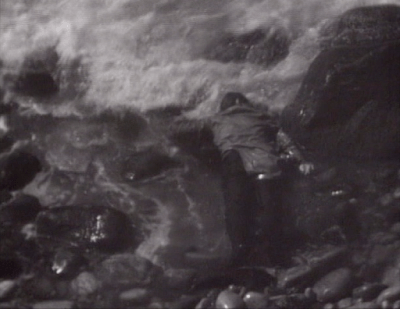
The association of Widows’ Hill with deadly danger is reinforced in #50, when Vicki and heiress Carolyn look down from it and see the corpse of beloved local man Bill Malloy on the rocks below.

Bill in the water, as seen from the precipice of Widows’ Hill. Screenshot by Dark Shadows Before I Die.

In #75, we hark back to Vicki’s first meeting with Roger. Vicki finds Roger standing on the spot where she had stood when he startled her in #2. She reenacts that scene with the roles reversed. He exclaims angrily that she might have caused him to fall; she reminds him that he had done the same to her. He laughs happily and apologizes. They have a sweet little moment together after that, but his protest shows that she really was in danger then, and that she is none too safe now.

The death of Bill set off a series of events that ended with crazed handyman Matthew Morgan abducting Vicki, holding her bound and gagged in the Old House on the estate of Collinwood, and bringing an ax with the express intention of chopping her head off. At the last moment, he is stopped from decapitating Vicki by the manifested ghosts of Josette, the Widows, and Bill. When Bill appears with Josette and the Widows, it ceases to matter that he died somewhere else and only washed up below Widows’ Hill. Thereafter he is joined with them, and like their deaths, his death belongs to that place.

The Dead of Widows Hill confront Matthew. Josette manifested earlier in the episode, and is represented here by her portrait above the mantel. Screenshot by Dark Shadows Before I Die.

In #266, the Widows briefly reemerged from the supernatural back-world implicit in the action into the story, this time associated with a malign intention towards the characters. Reclusive matriarch Liz heard their voices luring her to throw herself off Widows’ Hill. We haven’t heard about them since then.

Liz dreams of the Widows, calling her to join them. Screenshot by Dark Shadows Before I Die.

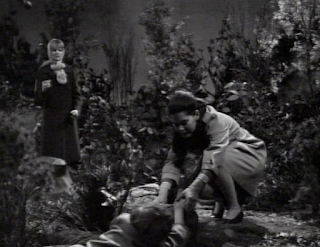
Josette’s ghost was central to the action from #126 to #191, when she and Vicki together protected David from his mother, undead fire witch Laura Murdoch Collins. That Laura posed a danger to David was not clear to the characters in #139 and #140, when Laura startled David while he was at the edge of the precipice on Widows’ Hill. Vicki rescued him, then urged him to go to his mother. 

Vicki rescues David. Screenshot by Dark Shadows Before I Die.

In #185, Sam and Vicki visited the Old House, the seat of Josette’s power. Sam saw the portrait of Josette that hangs over the mantel. He asked if she was “the lady who went over the cliff.” Again, we join the image of Widows’ Hill with the concept of danger and the role of David’s protectress. Sam and Vicki came to the Old House to hold a séance. Josette speaks through Vicki at séances, suggesting that in sharing her role with regard to David, Vicki’s personality is coming to merge with that of Josette.

In April 1967, vampire Barnabas Collins succeeded Laura as Dark Shadows‘ resident supernatural menace. Barnabas was too dynamic an adversary for wispy presences like Josette and the Widows to oppose. In #212, he went to the Old House and told Josette’s portrait that her power there was at an end. In #223 and #240, David lamented that the family had lost its tutelary spirit.

With that, Josette ceased to be an active presence. She lost the role of David’s protectress, and with it her link to Vicki. But Josette is still an important element of the show. Instead of a guardian who intervenes in the story, she becomes the object of Barnabas’ obsession. Instead of a companion who acts with Vicki, speaks through her, and inspires her devotion, she becomes Barnabas’ motivation to victimize women, Vicki perhaps to be among them. Vicki’s personality may yet be replaced, not by a merger with Josette’s spirit, but by Barnabas’ insane plan to find a woman he can brainwash into becoming a facsimile of his long-lost, long-dead love.

The transformation of Josette from an active presence to the object of Barnabas’ delusions revolves around Widows’ Hill. In #233, Barnabas tells Vicki and Carolyn a story about Josette’s fatal leap. He says that she threw herself off the cliff to escape a lover with whom she quarreled there. Vicki was a bright person in those days, and she figured out that the lover must have been Barnabas Collins. She believes the Barnabas in question to have been the ancestor of the one she knows, but of course it is the man himself, as he was in that previous century. When Barnabas realizes that Vicki has picked up more information than he intended to disclose, he reacts apprehensively, and seems as if he is thinking about killing her. Barnabas would revise the story of Josette’s death many times, most notably in #345, when told it while standing on Widows’ Hill with his associate, mad scientist Julia Hoffman.

At the end of #365, the visible foreground and the implicit back-world traded places when Vicki came unstuck in time and found herself in the late eighteenth century. When she first arrived in the year 1795, Barnabas and Josette were living beings, as was Barnabas’ little sister Sarah, whose ghost haunted Collinwood in 1967. Sarah is dead and gone now; Barnabas is dead, but as a vampire he is not at all gone. He’s been sucking Josette’s blood, and today he plans to kill her so that she can rise as his undead bride.

Barnabas became the star of Dark Shadows and turned it into a hit with his efforts to scam everyone into believing that he was a living man native to the twentieth century. When Vicki first found herself in 1795, we may have hoped to see her running an equally suspenseful con game. But the show hasn’t given her any such thing to do. Instead, she flailed around helplessly. Lately, she’s taken to telling everyone how and when they will die. That has led to her imprisonment on charges of witchcraft. She told Josette and her aunt, the Countess DuPrés, that Josette would throw herself to her death off Widows’ Hill. The countess has been trying desperately to keep Josette off the hill, and Barnabas doesn’t want her to go there either. But the ghost of wicked witch Angelique tricks her into going there tonight.

Barnabas realizes what has happened. He races to Widows’ Hill. He sees Josette there. Angelique causes Josette to see a gruesome image of a vampiric version of herself, and brings it home that it reflects Barnabas’ plans for her. Barnabas approaches; terrified, Josette flees, and goes over the cliff.

Bride to be. Screenshot by Dark Shadows Before I Die.

For a scene that we’ve been hearing about for all 85 weeks Dark Shadows has been on the air, Josette’s death is not very impressive visually. Since they are going to pan from Josette and Barnabas over to the ghoul version of Josette, they have to put the camera very close to the action. The whole sequence also has to be in a low contrast color scheme for the ghoul version to have its effect. The tight frame and the drab palette make it impossible to create an illusion of space, leaving Jonathan Frid and Kathryn Leigh Scott looking like a couple of people monkeying around in a tiny television studio. At times we see so little of the set that it is not clear what’s happening. We don’t even see the edge of the cliff, blunting the effect of the climactic fall.

The introduction of the living Josette to the ensemble during the 1795 segment reduced the character’s importance in the show’s mythology. That is not any reflection on Miss Scott’s performance, or even of the scripts she had to work with or the direction she had to follow. It is the consequence of the whole idea of supernaturalism. To accept the idea of the supernatural is to believe that what seems to be weak is in fact strong. The dead, to all outward appearances, would seem to be utterly powerless, and the living would seem to have a monopoly on the means of making things happen in the world. But phantoms and revenants and zombies and vampires and the rest are supposed to have overwhelming advantages that we can defeat only by precise application of knowledge that only the rarest sort of people have. Likewise, people who are disadvantaged by the social order of the visible world are supposed to have access to powers in the supernatural realm that leave even the most eminent people at their mercy. So servant girl Angelique brought lofty aristocrats Barnabas and Josette to the very lowest of positions.

As a living person, Josette is charming, kindly, and beautiful. But she is not at all forceful. She cannot be. If she were, her ghost could not have gained the potency it would have in the 1960s. Our acquaintance with the living Josette has been a long anticlimax to the tales of her sovereign haunting of Collinwood. Her death scene is an anticlimax to that anticlimax. Widows’ Hill itself will continue to be a place of danger and death, but Josette will no longer be its patroness in the way she was before this episode.

Episode 266: The sea is my grave. My grave is the sea.

Reclusive matriarch Liz is despondent, and no wonder. For months and months, seagoing con man Jason McGuire has been blackmailing her. She hasn’t been able to resist any of his demands; today she tells him that “There is no point in not being agreeable.” She makes a great show of submissiveness towards him, asking his permission to leave the drawing room. They are scheduled to marry in a few days, much to the dismay of everyone except Jason.

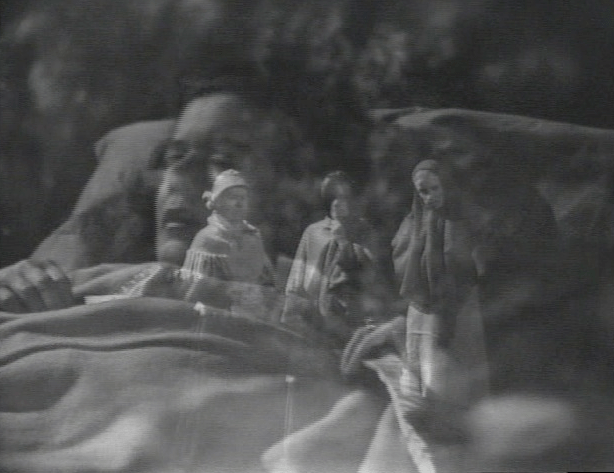
In the pre-credit teaser, we see Liz’ dream that she is standing atop the high cliff on her property, looking at the rocks and the sea far below. The ghosts of the Widows who have jumped to their deaths from the cliff over the years are calling her name. The Widows were a big part of Dark Shadows‘ supernatural back-world in its first months, but this is the first we’ve seen or heard from them since #126. In her dream, they call her name and she tumbles headlong over the cliff.

The Widows appear in Liz’ dream. Screenshot by Dark Shadows Before I Die.

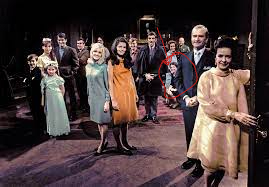
Liz mopes around the house during the day, then goes to the cliff. Housekeeper Mrs Johnson finds her there at nightfall. This is the first time in ten and a half weeks we have seen Mrs Johnson; I don’t usually give spoilers, but we won’t see her again for fourteen and a half more weeks. I suspect she was in this one just to be sure actress Clarice Blackburn would be in the studio when they were taking the cast photo I use as the header on this blog.

Was this photo taken the day this episode was shot?

Mrs Johnson mentions the Widows and tells Liz she doesn’t like hearing the legends about them. So Liz launches a detailed recounting of all of those legends. By the time Mrs Johnson is thoroughly uncomfortable, Liz starts to faint and pitch forward towards the edge of the cliff. Mrs Johnson rescues her, and walks her back to the house.

Liz goes back to bed and has the dream from the opening again. She gets up, opens the window, and tells the Widows she can hear them. As their voices travel in the wind, she repeats a catchphrase from one of the legends- “The sea is my grave. My grave is the sea.”

Episode 126: Do not be afraid

In the long-abandoned Old House on the estate of Collinwood, fugitive Matthew is sharpening the ax with which he plans to kill his prisoner, well-meaning governess Vicki. In the great house on the same estate, strange and troubled boy David is struggling with himself. His hated father, high-born ne’er-do-well Roger Collins, and his idol, dashing action hero Burke Devlin, are waiting for him to tell what he knows about Matthew and Vicki, and he keeps asking for assurances that he won’t be punished if he tells.

While David’s pathological fear of punishment keeps her rescuers at bay, Matthew finishes sharpening his ax. In the secret chamber where she is bound to a chair, Vicki receives a visitor- the ghost of Josette Collins. The ghost tells her she need not be afraid. Vicki asks why not. The ghost simply repeats herself and vanishes. It is by no means clear that the ghosts mean to save Vicki from Matthew, or that they could keep him from killing her if that is what they want.

David finally tells Burke and Roger where Vicki is, and they get some shotguns. David delays their departure still further by pleading to go along with them. Meanwhile, Matthew is in front of Vicki, starting to swing his ax at her head.

Matthew hears ghostly voices and breaks off in mid-swing. He runs out of the hidden chamber to the parlor, where the ghost of beloved local man Bill Malloy comes strolling in to the room, singing one of the more family-friendly verses of “What Do You Do With a Drunken Sailor?” Matthew starts swinging his ax wildly at the ghost, which laughs at him. Four more ghosts, representing the famed “Widows,” follow, and he swings at them.

Bill and the Widows. Screenshot by Dark Shadows Before I Die

In her place of confinement, Vicki can hear Matthew screaming, but cannot hear the ghosts plaguing him. She calls out to Matthew, who falls silent. Burke and Roger come in, she calls to them, they find her and release her from her bonds. Matthew in a chair in the parlor, dead of fright.

With its six ghosts, this is one of the most spectacular episodes of the entire series. It is also one of the most effective. It’s no wonder Patrick McCray resumed his posting about episodes with this one after skipping a couple of months’ worth.

It is notable that Burke and Roger do not actually save Vicki- the ghosts of Bill and the Widows do. When Matthew first tried to kill Vicki in episode 111, it was reclusive matriarch Liz who saved her. Now, it is again a female-led effort, though as the victim of Matthew’s first homicide Bill does get a chance to help. I suppose that fits with the nature of the genre- daytime soaps are addressed to a predominantly female audience, so it only makes sense that female characters will drive most of the major plot points. It doesn’t bode well for the future development of Burke- he’s a dashing action hero, after all, and if all the dashing actions are going to be precipitated by women, girls, and feminine ghosts he’s likely to be left out in the cold.

Episode 50: He wasn’t there again today

This one is so good that I can’t resist going over it scene by scene. It has a wide variety of mood and image, tautly structured in a clearly told story, subtly realized by highly accomplished acting, and memorably presented in superb photography and imaginative sound design.

Well-meaning governess Vicki, out for a night-time stroll, makes her way to the crest of Widow’s Hill, where flighty heiress Carolyn stands looking down at the ocean swirling a hundred feet below. “Advance and be recognized! Friend or foe?” Carolyn challenges. Seeing Vicki, she remarks “Even the tutors are out tonight.”

Despite her whimsical greeting, Carolyn is in a low mood. She’s wondering at her own inability to take hardworking young fisherman Joe Haskell’s desire to marry her seriously. She tries to interest Vicki in some of the ghost stories that surround the great estate of Collinwood, while the wind whips around the hill making the eerie sound known as “The Widows’ Wail.” Vicki stoutly insists on reducing all of Carolyn’s tales to psychology and asking her about her feelings. You can really see Nancy Barrett’s Carolyn trying to maintain a light tone despite her gloom, and in Alexandra Moltke Isles’ Vicki you can just as easily see a determination to cut through the nonsense and stick to what’s real, a determination fueled partly by her empathy for Carolyn and partly by her reflexive rejection of the weirdness of her new home in the old dark house.

In the house, troubled rich boy David Collins is complaining to his aunt Liz that the ghosts won’t let him sleep. Liz tells him to turn the lights on and chase them away. Unsatisfied by that response, David persists. Liz tells him that she has no time for him now and sends him to his room. Ten year old David Henesy trades these well-written lines with veteran movie star Joan Bennett as her professional equal. David Collins continually does nasty things to characters we like, refuses to take responsibility for any of his wrong-doing, and becomes violently surly when interrupted in his endless bouts of self-pity. He ought by rights to be a difficult character to take. But David Henesy finds something lovable in him, and brings that out clearly enough that he’s always a welcome presence on screen.

Vicki and Carolyn come to the house. Liz is disappointed they aren’t her ne’er-do-well brother Roger. Liz had ordered Roger to leave his desk at her company and come home early in the afternoon. She has questions about the disappearance of plant manager Bill Malloy, and about Roger’s lie that he hadn’t seen Malloy the night before. It’s well after 10 PM now, and no one has seen or heard from Roger since Liz called him.

Carolyn and Vicki have tea and try to take Liz’ mind off her worries, but without success. Liz scolds Carolyn for bringing up the ghost stories at a time when everyone is worried about Bill Malloy, but she can’t long keep herself from drifting off into the tale of the two women who died falling off the cliff, and the third who will someday follow them. That drifting, as Joan Bennett plays it, speaks volumes about Liz’ state of mind. She’s agitated about Bill Malloy, about Roger, about the possible connection between their two absences. That agitation gives way to hopelessness.

Roger comes home. Liz greets him with a demand for explanations. He responds with perfect insouciance, informing his sister, in whose house he lives as a guest and from whose business he draws a salary on her sufferance, that he is going to the kitchen to make a sandwich. Louis Edmonds’ delivery of Roger’s lines is brilliantly funny- we laughed out loud.

Liz most definitely does not see the humor. She has a brief scene by herself after he goes off to prepare his snack. All she does is watch him leave the foyer, turn, walk a few steps to the drawing room, and take a seat. With no dialogue and no mugging for the camera, she shows anger, disbelief, exasperation, and despair. It is a wonderfully economical performance, quite as extraordinary as is Edmonds’ comic turn preceding it.

In Vicki’s room, we see the word “death” scrawled on her mirror in all caps. Vicki enters, dragging David behind her. She demands to know who wrote it. He insists that the ghosts of the Widows did it. Vicki remarks that it is surprising that the Widows have the same handwriting as David. Carolyn enters, sees the word, and scolds David. Vicki silences Carolyn with a glance and asserts control of the situation. Only when Vicki threatens to tell Liz about the word does David erase it, though he still insists it was the Widows who wrote it, not him.

After David has left the room, Carolyn tells Vicki how horrid David is. Vicki perks up and makes a series of jokes about the Widows. She’s in such a chipper mood as soon as David is out of earshot that she must have been putting on an act presenting herself to him as angry. Much to Carolyn’s mystification, Vicki likes David and is confident that sooner or later she will make friends with him.

At another point in the series, this scene might have been padded out to fill a whole episode. Today, Art Wallace writes a quick and forceful interlude, showing us everything we need to know about what the three characters in it are like and where they stand in their relationships to each other, shedding some light on the idea of the ghosts of the Widows, then moving on to the next story point. The writing is as economical as the acting, and as absorbing.

Liz and Roger have a confrontation in the drawing room. Liz asks why Roger didn’t come home when she told him to. He tells her that he went to Bill Malloy’s cousins’ house to see if Bill had been there, and that he simply forgot to tell her he would be making the trip. This response is so unsatisfactory that it seems to double the anger with which Liz puts her next question- why did he lie to her when he denied having seen Bill Malloy last night? Roger tries to weasel out of answering that question, and does manage to get Liz to give him some information he can use to craft more plausible lies, but does not get himself off the hook.

The relationship between Liz and Roger is the first of Dark Shadows’ several relationships between a Bossy Big Sister and a Bratty Little Brother. In Liz and Roger’s case, they are literally older sister and younger brother; the most important such relationship will be a figurative one, between Julia and Barnabas. But it’s Liz and Roger who set the pattern. Roger’s impossible behavior in this scene is certainly among the finest examples of brattiness among all the little brothers, and Liz shows with crystal clarity the limitations of the power of the Bossy Big Sister when confronted with a truly horrid Bratty Little Brother.

Carolyn and Vicki come downstairs. They are going back to the crest of the hill to look for Carolyn’s wristwatch. Once they’ve left, Liz meets David at the top of the stairs. She tells David that they are looking for a wristwatch. “That’s not what they’ll find- they’ll find death” replies the boy. Last episode, David received the gift of a crystal ball; that marked the beginning of his career as a clairvoyant.

No sooner has the seer made his prediction than we hear Vicki screaming. Looking down from the cliff, she and Carolyn see a figure on the beach- a man face-down in the water. We hear the tide and the wind, sounds of nature on a large scale, and the immobile figure seems to represent something vast and inevitable.

Face down in the water, wearing an overcoat, with a flask in his back pocket
Screenshot by Dark Shadows Before I Die

Episode 12: You can still hear the widows

Roger and Vicki encounter each other on the peak of Widow’s Hill. Roger remarks it is the highest point in the area. At the end of their conversation, Vicki will call to Carolyn, inviting her to join them “down here.” This may seem to be a blooper, but since we hear “down” used to mean “up” in a later episode, I speculate that it’s a peculiarity of Collinsport English.

Little happens to advance the plot in this episode, but between Roger’s announcement that he and Vicki are standing on the highest point in the area and Vicki’s invitation to come “down here,” we hear a lot about the ghostly legends of the place. After the scene in episode 11 where the ghosts are troubling Elizabeth while David is doing something mysterious involving motor grease and little pieces of metal, it seems that the show is using the ghosts as a sign that something big is happening. Certainly the “Widow’s Wail” is a striking sound effect, and Louis Edmonds does a good job of selling the idea that Roger really does believe in all the legends about the house that his social position might require him and Elizabeth to ridicule publicly.

It’s a bit jarring that Carolyn drifts into the scene asking what Vicki and Roger are doing- “planning a suicide pact?” She had just told Vicki about the legend that a third governess would die by jumping off the cliff, and the series story bible still calls for Roger to throw himself to his death from it. So you might think it would be in questionable taste to bring that particular topic up just now.

There’s also a scene in the Evans cottage where Maggie (Kathryn Leigh Scott) tries to get Sam (Mark Allen) to tell her what’s been bothering him. In episode 11, Conrad Bain had triumphed over a weak script and Mark Allen’s relentless whine to turn what might have been a lot of tedious recapping into a compulsively watchable scene. At the beginning of this scene, Kathryn Leigh Scott is mustering such powerful emotions that it looks like she might be about to accomplish the same feat, but Allen has switched from whining all his lines to bellowing them. So the scene is a dead loss.

The Back-Worlds

In 281 of the posts that follow, I link to comments I made on Danny Horn’s blog, “Dark Shadows Every Day.”

I added most of these comments in the months between the shutdown of live theater in March of 2020 and the completion of the blog in April of 2021. But I have added some since.

In the last few days, I’ve added four. They all discuss on the way the show shifts its focus, once the vampire story becomes a hit, in the direction that will come to define it as the months and years go on. The first three of these comments are on posts discussing episodes where Barnabas the vampire is holding Maggie the lovable girl prisoner and trying to brainwash her into becoming his late love Josette, so that he can kill her and turn her into a vampire. This comment is on the post for episode 253, in which the boy David has broken into Barnabas’ house and had a shouting match with Barnabas’ servant Willie:

The scene between David and Willie marks a definitive break from the pre-Barnabas show. David’s great concern is that Barnabas and Willie are “hurting Josette.” By which he means that he can no longer sense the presence of the ghost of Josette. On the contrary, the name “Josette” now refers to something horrible and that horrible thing is a part of Barnabas’ story.

In the first 42 weeks, the ghost of Josette had been the principal supernatural element in the show. Serene, mysterious, uncanny, the ghost fit perfectly into that series, which was something like 99% atmosphere and 1% story. And Josette came out of the background at two key moments, leading the rescue of Vicki from Matthew in 126 and informing the family of the danger Laura represents to David in 149 and 170. And of course when Barnabas first meets David in 212, David tells him that Josette protects the family.

So when Barnabas starts his rampage, regular viewers would at first be waiting for the ghost of Josette to make its move and stop him. By the time David sees the Josette-ified Maggie in 240 and 241, we know that the imperturbable Josette of the first 42 weeks is not coming back. If we do see Josette’s ghost again after we’ve seen Maggie in her wedding dress, it could not have the lightly amused smile in its voice with which it told Vicki not to be afraid of Matthew; it could return only as a terrifying spirit of vengeance. By the time David and Willie finish their confrontation in this episode, the show has told us that the protecting ghost won’t return at all.

This one is on the post for 255, in response to a comment from someone wondering what Barnabas was planning to do if he had succeeded in his evil plan for Maggie. How could he have gone on presenting himself to the rich Collinses as their long-lost cousin from England?:

I think we have to assume that all the “cousin from England” stuff would have gone by the boards if Barnabas had succeeded with Maggie. When they revisited Barnabas’ Josettifying project in HOUSE OF DARK SHADOWS, they had to ask what would come next, and the answer was “He kills everyone and turns the estate into an impenetrable outpost of Hell.”

Some time after they came back from making that movie, the show would send Barnabas and Julia on a two-week visit to the future, to the far-off year 1995, where they find that most of the family is dead, the rest of them are hopelessly insane, and no one dares go to the estate, all because of hideous supernatural doings that took place there a quarter century before. Those two weeks are sensational, the last genuinely great phase of the show, and part of what makes them so great is that they are a logical sequel to the part of the show everyone remembers most clearly.

This one is on the post for 256. In that episode, the hapless Maggie has seen a mysterious little girl playing outside the cell in which Barnabas keeps her. The girl’s name turns out to be Sarah:

I’d say Sarah’s introduction is the single most important moment in the whole show, more important than Barnabas coming out of the box, more important even than Barnabas’ first decision not to kill Julia.

From the beginning they’d been playing with the idea that there was another cast of characters hidden behind the characters we’ve been watching, supernatural characters who can make their influence felt at certain moments. The most prominent of these was the ghost of Josette…

So the show has discarded the old supernatural realm of Josette and the widows, a realm that was, as you say, never more than slightly accessible. With Sarah’s appearance, we are introduced to an entirely new part of the show. Once again we have a set of characters hidden in the supernatural background, but they can interact with the characters from the main continuity more directly and at greater length than Josette and the widows ever could.

The puzzle of Sarah’s connection to Barnabas, and her talk about looking for the members of her family, indicates that this new order of supernatural beings have complex and unsettled relationships with each other, and that characters from the main continuity can have an influence on those relationships. We will have to figure those relationships out in the weeks and months to come, but as soon as Sarah demands Maggie not tell her big brother that she saw her, we know that they might come to enmesh the living beings. Every scene with Sarah, then, is a step leading directly to the time-travel and parallel universe storylines that will come to define the show.

This one, on the post for 279, sums up the major points of the three comments above. It regards an episode in which Barnabas and Willie are planning to host a costume party in which members of the present-day Collins family will come dressed as their forebears from Barnabas’ time, the late eighteenth century. Barnabas has rather surprisingly claimed that this party will be “the most important night of [his] life”:

‘Dude… you rose from the dead. I think the prize for “most important night of my life” is pretty much taken.’

I think he has a point, though. While it is undoubtedly true that the writers, producers, and other creatives never had an elaborate plan that they had agreed on and that they would stick to regarding the future storylines of the show, they did have some memory of the storylines they had already developed. They spent the first 25 weeks building up the ghosts of Josette and of The Widows as presences in the show, a whole second cast of characters existing in a back-world behind the one in which the events we see take place…

Once the vampire story gets going, Josette and the Widows can’t come back. Their distant, mysterious, impassive qualities suited the slow, atmospheric early months of the show, but once you have a ghoul rampaging about sucking people’s blood there’s no place for remote and uncanny presences. To hold the stage while that’s going on, you need to be a dynamic character…

So the old supernatural order of Josette and the Widows is gone. But the idea of a second cast of characters, mostly invisible to us, properly associated with the distant past, but still wielding powerful influence over the events on screen. is stronger than ever. Barnabas had been hidden away, he belongs dead, yet he has irrupted into the present and taken over the story. Sarah is a denizen of the same back-world, she has broken through with Barnabas, and is steadily pulling aside the curtain that conceals their realm from that in which the established characters live and which the audience sees. The audience is going to have to be introduced to more characters from Barnabas and Sarah’s world, and the party is going to serve that function.

Once we’ve learned their names and how they relate to each other, the back-world characters and their time will have to become a concrete part of the show in a way that Josette and the Widows never could. In retrospect, the only way that could end is with an extended flashback. So the party does turn out to be a solid candidate for ‘the most important night of Barnabas’ life’, in that it is a major step towards the time-travel and parallel-universe stories that would come to define the show.

The time-travel and parallel-universe stories put the back-worlds into the foreground and the usual continuity into the background. Those reversal may not have been the only way to resolve the crisis they created by introducing Barnabas and Sarah, but certainly some kind of radical change in the relationship of back-world and usual continuity was unavoidable.

I’d like to say one more thing about a point I make in that final comment. “While it is undoubtedly true that the writers, producers, and other creatives never had an elaborate plan that they had agreed on and that they would stick to regarding the future storylines of the show, they did have some memory of the storylines they had already developed.” Throughout the blog, Danny repeatedly claims never to have seen most of the episodes from the first 42 weeks of the show. At times this claim seems like it must be an exaggeration- for example, at one point he catalogs all 21 episodes (between #42 and #108) which revolve around the questions of what kind of physical contact had with Burke Devlin’s pen and where Burke’s pen is, a catalog that could only have been made by someone who had seen all of those episodes and all those between. Be that as it may, he does vociferously disclaim any interest in the show as it was before the vampire comes along. Which is his privilege, Dark Shadows was a very different show pre-Barnabas and post-Barnabas and there is no reason to assume that a person who likes one of those shows will like the other.

He also stresses the point that there was no advance planning in the writing of the show, that they were making it all up from week to week, often dropping one story abruptly and expanding another just as abruptly as soon as the ratings came in. That should be obvious to anyone who watches the show for any length of time.

However, it can be misleading to stress the impromptu nature of the stories while ignoring the first 42 weeks, especially when you’re considering the period of the show immediately after those weeks. No one knew what was coming, but the producers, the directors, most of the writers, and many of the actors had been with the show from the beginning and knew exactly where they had been. So the idea of a ghostly back-world and the difficulties that come when you have to define the relationship of back-world to main world were very familiar to them, and it would have been clear that redefining that relationship would have major implications for the future of the show.

Another weakness of Danny’s is a tendency to both emphasize intentionality (a fine thing in itself!) and to reduce intentionality to what “the writers” had in mind. In my comments I usually play along with the focus on intentions, even though I don’t tend to favor that myself. -If it were just me, I wouldn’t be so concerned with proving that anyone associated with the show was thinking about the relationship of back-world to main-world in the summer of 1967- it would be enough that the logic of the show leaves them nowhere else to go. But Dark Shadows Every Day is Danny’s blog, so when I’m there I want to play his game as much as possible.

Where I can’t follow is with his tendency to reduce “intentionality” to “the writers.” A TV series has lots of creators- in addition to writers, there are producers, directors, actors, set designers, costumers, camera people, executives representing networks, executives representing studios, etc, etc. Each of those people has to make contributions, and each has a whole bunch of things to think about at any given time. So there’s always a multitude of intentions, and many levels of intentionality, to be considered.