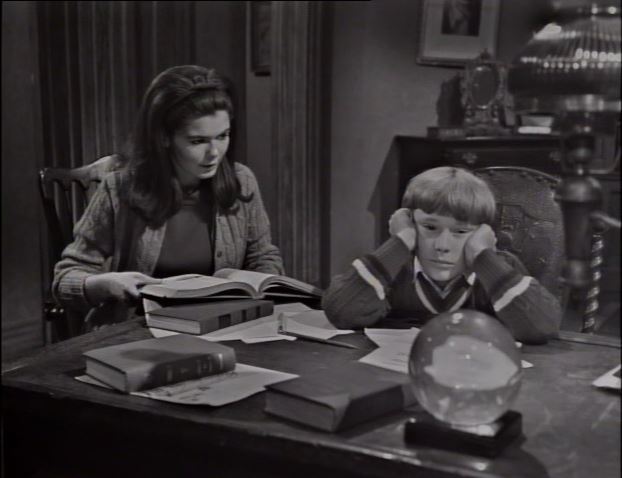
Episode 670: A nice couple

The only story that reliably worked in the first 38 weeks of Dark Shadows was the attempt of well-meaning governess Vicki Winters to befriend her charge, strange and troubled boy David Collins. Its success was less to do with the writers than with the actors. When we saw Vicki in David’s room giving him his lessons, her dialogue was as bad as anything else the actors found in the scripts, including one moment when she had to read a description of the coastline of Maine to him from a geography textbook. But Alexandra Moltke Isles and David Henesy used everything other than the words to show us a young woman and a hurting boy learning to trust each other. Their use of space, of body language, of facial expressions, of tones of voice, all showed us that process step by step, and it was fascinating to watch.

Vicki and David’s story reached its conclusion in #191, when David’s mother, undead blonde fire witch Laura Murdoch Collins, tried to lure David to his demise in a burning shack while Vicki tried to rescue him. At the end, David ran from the shack into Vicki’s arms. When he chose Vicki and life over his mother and death, there was nowhere left for their relationship to go. We saw a few more tutoring scenes in the spring and summer of 1967, when vampire Barnabas Collins was first on the show, but have seen none since. Mrs Isles left Dark Shadows in November, and the recast Vicki made her final appearance a week ago, in #665.

The new governess in the great house of Collinwood is Maggie Evans, who was introduced in #1 as a wisecracking waitress and a hardboiled representative of the working class of the village of Collinsport, but whom actress Kathryn Leigh Scott shortly afterward reinvented as The Nicest Girl in Town. The town barely exists anymore, so when Vicki disappeared into a rift in the fabric of time and space it was almost a foregone conclusion Maggie would move into Vicki’s room upstairs in the great house. After all, the room was first occupied in the 1790s by the gracious Josette, whom Miss Scott played in the parts of the show set in that period.

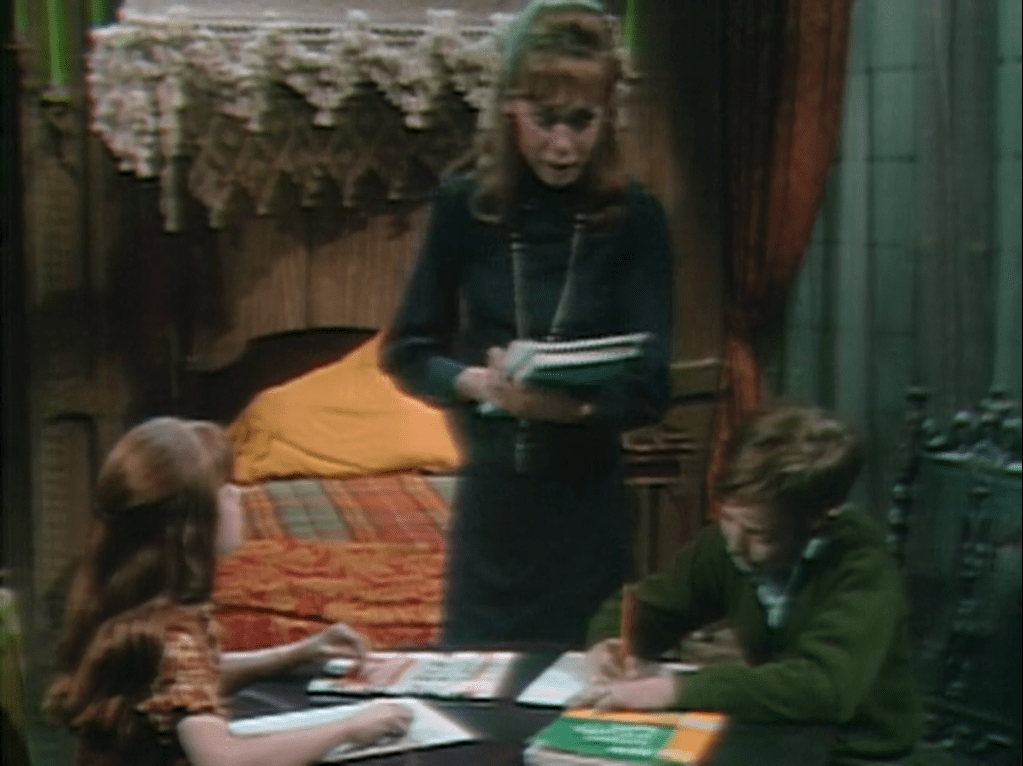
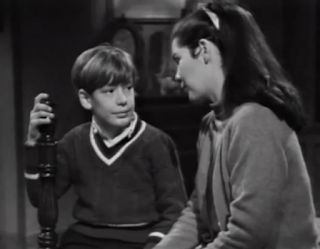
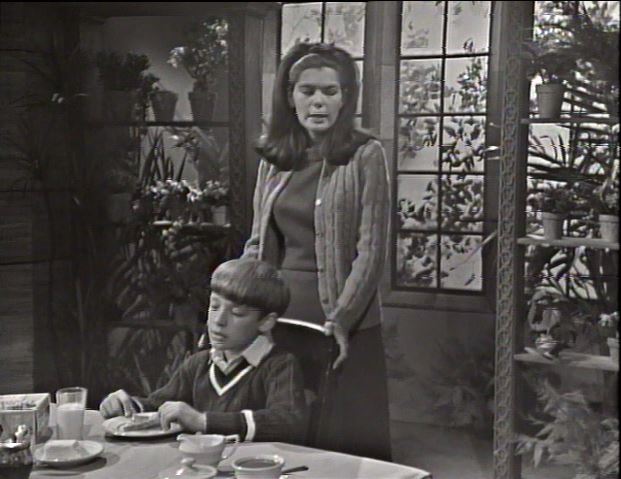
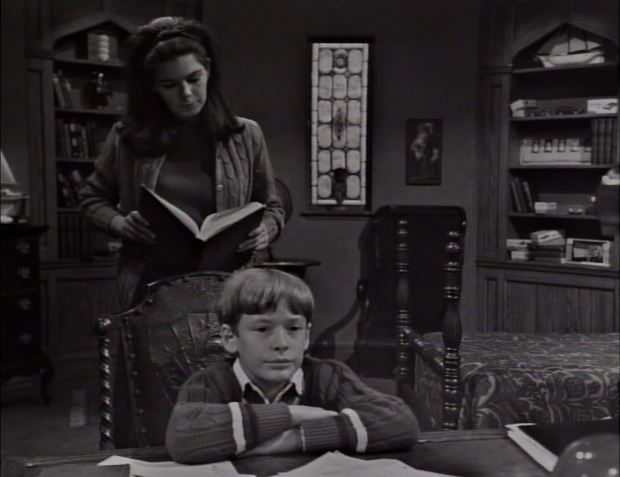
Today, we see our first tutoring scene in over a year and a half. David isn’t Maggie’s only charge; he has been joined by permanent houseguest Amy Jennings. Yesterday and the day before, we saw evidence that Maggie is a poor disciplinarian. We see further such evidence at the beginning of the tutoring scene, when the children complain about their lessons and Maggie quickly starts to explain herself and bargain with them. Amy and David are coming under the influence of the evil spirit of the late Quentin Collins. If the adult who is employed full-time to supervise David and Amy were up to her job, they wouldn’t be much help to him. So it’s no wonder the show three days in a row tells us that Maggie is a squish.

Maggie on the job.

To advance a plan of Quentin’s, Amy pretends to be ill and to faint during the lesson. David Collins is almost as subtle an actor as is David Henesy; when he is pretending to see signs of illness in Amy’s face, he looks at her with one eye and speaks with a most convincing note of concern. By contrast, Amy’s performance is exaggerated, showing none of the easy fluency Denise Nickerson brought to her roles. My wife, Mrs Acilius, chuckled at Amy’s fake faint and at some of the fussing she and David do when they are left alone together. She said it was refreshing to see that David and Amy are still kids. It certainly adds to the poignancy of what we are seeing Quentin do to them when we think of them as real children whose innocence he is exploiting for his evil project.

Amy’s fake faint convinces Maggie, and it leads to a lot of running around, ending with Maggie going to the cottage on the estate where Amy’s big brother Chris is staying as a guest of heiress Carolyn Collins Stoddard. Chris is a werewolf and is about to transform, and Quentin’s goal was to get Carolyn to go to the cottage. David has been making terrible pronouncements to Amy about how Carolyn will never bother them again, and the two of them are distressed to hear that Maggie rather than Carolyn is going to see Chris. So we are supposed to take it that Quentin knows about Chris’ situation and wants him to attack Carolyn.

Episode 521: All the words

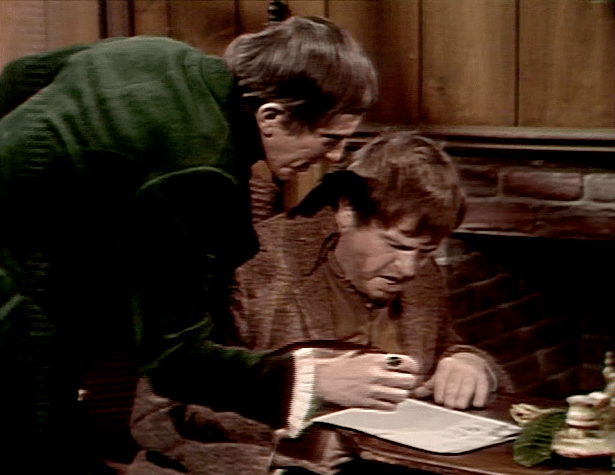
Professor Timothy Eliot Stokes (Thayer David) comes home and greets his house-guest Adam (Robert Rodan.) He says that he envies Adam his freedom from the responsibility of attending lectures delivered by people who are “inferior” to him. However snobby Stokes’ attitude towards his faculty colleagues may be, we immediately see that it does not extend to people who lack educational credentials. He takes out a deck of flashcards with words as short as “car” and as long as “dictionary” and is delighted with Adam’s ability to read them aloud.

The Professor takes pleasure in his pupil’s progress.

From November 1967 to March 1968, Dark Shadows was a costume drama set in the 1790s and Thayer David played Stokes’ ancestor Ben, a servant indentured to the mighty Collins family. We saw kindly scion Barnabas Collins (Jonathan Frid) teach Ben to read. Barnabas became a vampire in those days; his vampirism went into remission only a few months ago, when he went through an experimental treatment that involved Adam’s creation as a Frankenstein’s monster. To the extent that Adam is Barnabas’ responsibility, Stokes is repaying his ancestor’s debt to him in kind.

Barnabas and his friend Dr Julia Hoffman (Grayson Hall) knock on Stokes’ door. Stokes does not know that Barnabas used to be a vampire or what he and Julia had to do with Adam’s creation, but he knows enough to distrust them deeply. He insists Adam hide in the back bedroom before he will let Barnabas and Julia in.

Barnabas and Julia tell Stokes that they telephoned him earlier. He explains that he was out, and they say that someone answered the phone and breathed audibly into the receiver, but did not speak. Before he can suggest they misdialled, they notice that his receiver is still off the hook. He speculates that his cleaning lady, who obviously does not exist, must have done it. He furrows his brow and sounds quite stern when he expresses his disapproval of this imaginary person’s behavior. Barnabas and Julia can’t do anything with that, so they change the subject to the matters they originally wanted to discuss.

Those amount to a recap of the storyline concerning wicked witch Cassandra Blair Collins, who in the 1790s was known as Angelique Bouchard Collins. As Angelique, she was the one who made Barnabas a vampire. She returned to the world of the living in the spring of 1968 in a bid to reactivate that curse. Now she has gone missing, and Barnabas and Julia are hoping she is gone forever. While Stokes is in the dark about Barnabas’ past and his true nature, he knows plenty about Angelique/ Cassandra. He tells Barnabas and Julia that to test their hypothesis, they must find the portrait of Angelique that turned up shortly before Angelique/ Cassandra herself returned.

Barnabas and Julia search for the portrait in the great house of Collinwood, where Angelique/ Cassandra has been living as the wife of Roger Collins (Louis Edmonds.) Julia keeps Roger busy downstairs while Barnabas roots around in Roger and Angelique/ Cassandra’s bedroom. The soundtrack plays a recording of Barnabas’ thoughts about his search while we see him staring at the room. When these interior monologues were new to the show, they tended to be very informative. Lately they’ve had less substance, and this one is totally unnecessary.

It turns out that the search itself was equally unnecessary. As soon as Barnabas makes his way back to the drawing room, Roger pulls out the portrait and shows it to him and Julia. Roger found it in the back of a dark closet, but is badly faded, as if it had been left in direct sunlight for a great many days. Barnabas and Julia know that the portrait has some mysterious connection with Angelique’ Cassandra’s physical being, so this is grounds for hope that she is on the way out.

That hope is dashed within seconds. Barnabas answers the front door, and finds a stranger. The man tells Barnabas he should have recognized him at once- “Cassandra’s husband!” Barnabas was briefly Angelique’s husband, 172 years before, but does not bring that up. Instead, he directs the man’s attention to Roger. The man is unfazed when Roger announces that he, not Barnabas, is married to Cassandra. The man then introduces himself as “Cassandra’s brother!” Barnabas and Julia react with shock.

Episode 375: Decisions melt like ice

Last night Josette DuPrés, fiancée of young gentleman Barnabas Collins, slipped into the bedroom of Barnabas’ uncle and best friend Jeremiah and propositioned him. This morning, Jeremiah thinks he must tell Barnabas that his intended is not the virtuous maiden he thought her to be.

Jeremiah finds Barnabas teaching kindly indentured servant Ben Stokes the alphabet. Ben marvels that children are able to learn something he finds so difficult. After struggling a while with the letter Q, Ben says he thinks it unlikely that he would ever say a word with a Q in it anyway. When Jeremiah says he has something important to discuss with Barnabas, Ben is excused from his lesson.

Minding Ben’s Ps and Qs. Screenshot by Dark Shadows Before I Die.

When Jeremiah sees how devoted Barnabas is to Josette, he can’t bring himself to break the bad news. He simply declares that no one must come between them. and Barnabas happily says that he is sure no one would want to do that.

Jeremiah sees Josette entering the house. She tries to hurry away, ashamed to face him, but he insists they go outside and talk. She swears that she has never before approached a man as she did him, that she is utterly mystified as to what came over her, and that rather than hurt Barnabas she would kill herself.

“Before I did that, I would kill myself.” Screenshot by Dark Shadows Before I Die.

Josette’s aunt, the Countess Natalie DuPrés, is a house-guest at Collinwood. She meets Josette in the front parlor. She wonders why Josette has been out of the house and alone from dawn until after lunch. Josette will not explain, and when Barnabas enters she runs away and shuts herself in her room. The Countess tells Barnabas that Josette is suffering from the sort of jitters girls often have before they become brides, and insists he take her rather than Josette on a furniture-shopping expedition.

Josette, Barnabas, Jeremiah, and the Countess are all unaware of the true situation. The Countess’ maidservant, Angelique, is a witch who has cast a spell on Josette so that she will conceive a mad passion for Jeremiah. She has cast another spell on Ben to make him her henchman. Angelique’s plan was that after Josette threw herself at Jeremiah, Jeremiah would tell Barnabas of the advance and the wedding would be off. Angelique would then be in a position to renew the affair that she and Barnabas had before he became engaged to Josette, and she would end up as the new Mrs Collins.

When Ben reports to Angelique that Jeremiah could not bring himself to tell Barnabas what Josette had done, she is shocked. She comes up with another plan- she will make Jeremiah reciprocate Josette’s feelings. She orders Ben to pour a love potion into the hot toddy he serves Jeremiah at night.

The other day, Angelique had Ben put a sleeping potion into Jeremiah’s hot toddy while he was in his room getting ready for bed. This time, Jeremiah is in the front parlor with Barnabas and the Countess. That makes for a more complicated scene, as Ben has to slip the potion in when none of the three are looking. Moreover, at one point the Countess asks for a drink other than sherry, and at another she urges Barnabas to have a drink. Since Jeremiah has asked for a smaller drink than usual, it seems possible at both of these moments that he might give the hot toddy away, foiling Angelique’s plan. It is all very well handled, and of course it ends with Jeremiah taking the drink and falling into the trap.

The Countess is still playing cards in the front parlor when everyone else is in bed. She sees Josette coming downstairs. Her niece tells her she can’t sleep and is going for a walk. The Countess offers to go with her, an offer Josette firmly declines.

We cut to a new set, a gazebo on the grounds of the estate. Jeremiah is there. He tells Josette that he was compelled to go there, he knew not why, but that some time ago he realized he was waiting for her. Josette says she was compelled to come also. They profess their love for each other and kiss. We turn to the bushes, and see the horrified face of the Countess watching their ominous embrace.

The Countess shocked. Screenshot by Dark Shadows Before I Die.

Episode 324: They shot the wrong man

The Collinsport police have solved the case of the abduction of Maggie Evans, The Nicest Girl in Town. The investigation has been stalled for months, because Maggie is suffering from amnesia covering the entire period of her captivity. So the authorities spread a rumor that Maggie’s memory was returning, camped out on her lawn, shot the first guy who strayed onto the property, and declared him to be the culprit.

Though this method would appear to be impeccably scientific, strange and troubled boy David Collins is unconvinced. The wounded man is the luckless Willie Loomis, servant of David’s cousin, old world gentleman Barnabas Collins. David is sure that Willie wouldn’t hurt anyone, and has developed an intense aversion to Barnabas.

David troubled. Screenshot by Dark Shadows Before I Die.

David’s aunt, matriarch Elizabeth Collins Stoddard, is discussing this situation with his well-meaning governess Vicki. Liz mentions that Willie originally came to the estate of Collinwood as a friend of seagoing con man Jason McGuire. She says that she is prepared to believe any bad thing about any friend of Jason’s.

This is the third day in a row we have heard Jason’s name mentioned. That marks quite a departure from recent months of the show. In #275, Barnabas killed Jason, and in #276 he forced Willie to help him bury the body. He was forgotten, apparently forever, shortly thereafter.

It is not clear at all where the show is heading. A few weeks ago, David learned that the secret chamber where Jason is buried exists, that Barnabas and Willie know about it, and that there is something hidden in it that makes Willie uncomfortable. Barnabas knows that David has been in the chamber, and is thinking of killing him. So perhaps the next storyline will involve Barnabas trying to do away with David lest Jason’s death be discovered.

Bolstering that expectation is the fact that Willie has survived the shooting. When he was first shot, day before yesterday, the police said he had five bullets in his back and that only a miracle could keep him alive. Yesterday, we heard that he was in a coma and that the preliminary medical report on his case gave him virtually no chance of living. Today, his doctor, addled quack Dave Woodard, tells his medical colleague Julia Hoffman that the odds are a hundred to one against Willie seeing another day. Experienced soap opera viewers will know that when a man has been declared dead so many times, he will be with the series for years to come. Willie does feel bad about what happened to Jason, so if David manages to lead the authorities to the secret chamber, that might bring matters to a head.

The scene between Woodard and Julia marks an interesting first. Julia is, among other things, a psychiatrist, and Maggie was her patient for a time. Woodard believes that she is at Collinwood in order to find out who abducted Maggie. He is surprised she plans to stay on now that Willie has been named. She claims that she is trying to keep her cover story intact, that she is an historian studying the old families of New England. This doesn’t make much sense to him, but he doesn’t expect it to- he thinks he knows her real motive. He thinks she is in love with Barnabas. Julia smiles, and doesn’t deny it.

Julia the lover. Screenshot by Dark Shadows Before I Die.

Returning viewers know that Julia’s actual motives are infinitely less wholesome. She is a mad scientist, and Barnabas is a vampire. She is conducting an experimental treatment which, if successful, will relieve him of that condition. For the sake of that experiment, she has become Barnabas’ accomplice. She induced Maggie’s amnesia, she has lied to everyone she has met, including the sheriff, and she is happy that Willie is likely to die and take the blame for Barnabas’ crimes. Woodard’s idea that she is in love with Barnabas delights her because it helps conceal her true role. It also starts us wondering if it is the beginning of a story in which the two of them avoid awkward questions by pretending to be a couple, then perhaps really do fall in love.

Episode 182: That spook bit

Like many children of divorce, strange and troubled boy David Collins finds himself having to decide which parent he will live with. He and his father, high-born ne’er-do-well Roger, have been living in the great house of Collinwood as guests of Roger’s sister, reclusive matriarch Liz, ever since Roger ran out of money some months ago. Now David’s mother, blonde fire witch Laura Murdoch Collins, has reappeared after an absence of many years, and she wants to take David. This idea delighted Roger from the first, but David had initially reacted to Laura with fear. He still has mixed feelings about her.

Today, well-meaning governess Vicki is trying to get David to focus on his studies. He tells her that he is thinking about his living situation. He likes Collinwood, especially since Vicki came. But he has just about decided to go away with his mother.

Vicki asks why David wants to do this. He reminds her of a vision he had yesterday that terrified him. He saw himself in the fireplace, immersed in flames and showing no sign of wanting to escape them. He interprets this as a warning from the supernatural realm that he is in great danger, and that the danger is to be found at Collinwood. He believes he will find safety if he goes far from the estate with his mother.

Vicki knows that David is partly correct. She has considerable evidence that the ghost of Josette Collins has been trying to warn David and her and several other people that David is in danger of being burned alive. She is also sure that the source of this danger is at Collinwood- it is Laura herself. She is an inhuman creature who will burn David alive. Vicki can’t tell David about this, but she does remind him of some of Josette’s previous warnings. David realizes that his mother featured prominently in those warnings, but does not see that she is the one Josette is warning him about. To Vicki’s dismay, David concludes that Laura is also in danger, and that it is urgent that the two of them go off together at once.

When her warnings to David backfire, Josette is running true to form. The first time she tried to rescue someone from imminent peril was in episode 122, when crazed handyman Matthew Morgan had kidnapped Vicki. Matthew’s response upon hearing a ghostly voice was to put a knife to Vicki’s throat. Eventually Josette enlisted some of her buddies from that land of ghosts which forms the back-world behind what we see, and together they would stop Matthew and save Vicki. Here again, Josette needs help getting her point across.

Of all the characters, David is the one who has had the easiest rapport with Josette. In #102, we saw him standing in front of her portrait in the long-abandoned Old House on the grounds of Collinwood, chattering happily away to her. We couldn’t hear her, but he could. She had no need to manifest herself visibly or do anything else spectacular; she and David could just talk to each other.

Now, Laura is blocking Josette’s attempts to communicate. In #165, Josette manifested in a room with Laura and David; Laura ordered her to go away, and she did. In #170, Josette began speaking through Vicki at a séance; Laura silenced her, and in later episodes visiting parapsychologist Dr Guthrie said that Josette was battling against some power at least equal to her own. Strong as Josette’s connection to David has been, she cannot break through his mother’s interference.

Vicki confers with Guthrie. They decide to present their case to Roger, who alone has the legal right to oppose Laura’s wish to take David, and to dashing action hero Burke Devlin, who has a great influence over the boy. Guthrie meets with Roger in the drawing room, and Vicki goes to Burke’s suite at the Collinsport Inn.

Roger despised Guthrie as a quack starting almost as soon as he met him, but in his most recent appearance, in #178, he started to suspect that there might be something to Guthrie’s ideas. He is quite rude to Guthrie throughout their conversation today, but does hear him out.

Burke respects Vicki, but finds it impossible to sit still when she starts talking about Josette. So she sticks to the demonstrable facts. The camera sticks to Alexandra Moltke Isles’ eyes, on which the light plays arrestingly.

Vicki looks at Burke

At length, Burke admits that something strange might be going on. Vicki asks Burke if he will stop encouraging David to go away with his mother. He says he believes that he ought to stop doing that, but that he doesn’t know what he will actually do after he next sees Laura. Vicki says she knows how he feels about Laura. Burke tells her that he himself doesn’t know how he feels about Laura, or about anyone else.

Mitch Ryan projects Burke’s bewilderment about his own behavior when he is with Laura. We haven’t seen any sign that Laura has cast a spell on Burke. So far, it is entirely possible that Burke is just smitten with Laura. She was the ex-girlfriend who left him for Roger and is now suggesting she wants to get back together with him. As such, she is the symbol of both his lost youth and his upcoming triumph over his bitter enemy. Also, she is beautiful, and can be hilariously funny. That combination would be enough to cloud anyone’s mind. But when Burke is telling Vicki how confused he is about his emotions, we wonder if there might be some witchcraft involved as well.

Back at Collinwood, Roger and David are in the drawing room. David tells Roger that he wants to go away with Laura, and when Roger asks why he has made that decision David tells him what he saw in the fire. David asks him if he still wants him to go away. In previous episodes, David had asked Roger about his hostility towards him. Sometimes Roger parried these questions with witty remarks, other times he simply dismissed David and walked away. Now Roger just chokes up. “We’ll see,” he keeps saying. “We’ll see.” What we the audience see in Louis Edmonds’ performance is a man who is starting to realize what he has thrown away by refusing to love his son. It makes a powerful moment.

Roger tries to connect with David

After David leaves him alone in the drawing room, Roger assumes his usual position in front of the brandy bottle and pours himself a glass. He lifts it to his lips, then looks around, as if he detects an unusual scent in the air. He sets the drink down. He turns, and sees an old book open itself.

Roger sees the book open itself

A book first did this in the drawing room in #52. That time the Collins family history opened to a picture of Josette. More recently, Josette’s signature jasmine perfume was in the air in the crypt at the old cemetery when a book opened itself there in #157. Regular viewers will therefore assume that when a book opens without visible aid of a cast member, it is Josette, the spectral research librarian, leading the characters to the information they need.

Roger hasn’t seen these previous occurrences, and he has chosen to disregard the evidence he has seen for the existence of supernatural influences around him. So the sight of the book opening itself comes as a great shock to him. When he looks at the page to which it has opened, he finds out something about the death of a woman named Laura Murdoch Radcliffe, whom Guthrie and Vicki believe to be an earlier incarnation of his wife. That Laura had died by fire in 1867, along with her young son David. Guthrie had told Roger that. A fact he had not mentioned, and which strikes Roger with particular terror, is that David Radcliffe had not wanted to be rescued from the fire. He had wanted to burn.

The idea of Laura the Phoenix is an interesting one, and the storyline gives Josette and the other vague, indefinable spirits of the supernatural back-world Dark Shadows has been hinting at since it began a suitable adversary to bring them into the action of the main continuity. But most of the individual episodes are so slow, so heavy with recapping, and so confused in their development that few of them can be recommended on their own merits. Indeed, this is only the second episode from the Laura arc, after #146, to which I apply the “Genuinely Good Episode” tag.

After we watched the episode, my wife, Mrs Acilius, shared her theory that the show is getting better because they’ve learned that it will be renewed for another 13 weeks. That makes sense- if it was going to be canceled after #195, the writers might not want to come up with any fresh stories and the producers certainly wouldn’t want to pay to build any new sets or hire actors to play new characters. Better just to run out the clock so that the Laura arc ends in #195 and everyone else lives spookily ever after. But if they know they can keep going until #260, they will have time to work out new ideas.

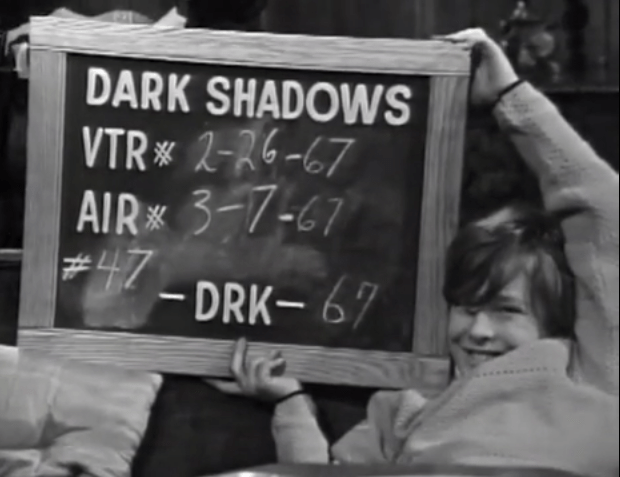
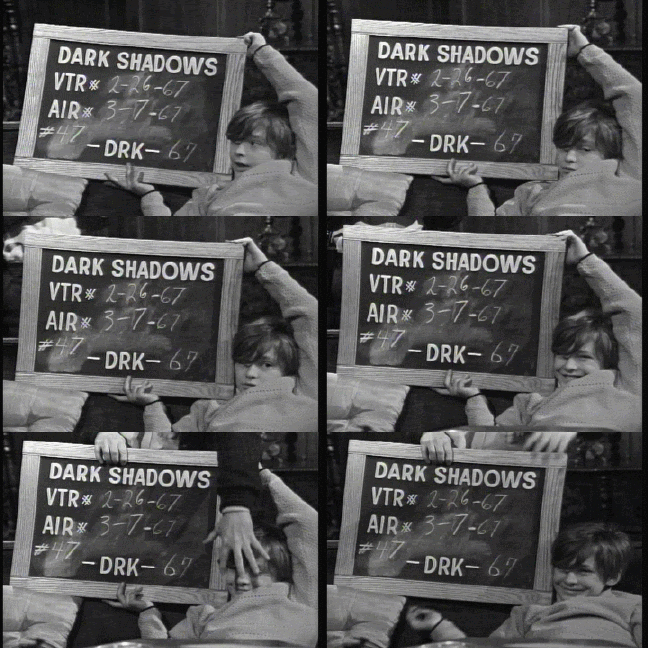
Whatever was going on among the writers, the actors seem to have been in a good mood today. David Henesy and Mrs Isles horse around a bit with the opening slate. He strikes a goofy pose to hold it, and she creeps up on him and puts her hand over his mouth.

Screenshot by Dark Shadows Before I Die

Episode 132: Why don’t you hate me?

Strange and troubled boy David Collins is on intimate terms with many of the ghosts who haunt the great estate of Collinwood, but few living people would be likely to be called his friends. In some ways the closest of these is his governess, the well-meaning Vicki. The formation of that friendship was the one narrative arc that consistently worked in the first months of the show. David’s first words to Vicki were “I hate you!,” the most usual theme of their early conversations was his wish for her immediate death, and he at one point locked her up in an isolated room where it seemed she might die. But in spite of all his displays of hostility, the actors played the relationship between the two characters as one of a steadily increasing emotional complexity, and when David suddenly declares to Vicki that “I love you, Miss Winters!,” we see a dynamic story kicking into a higher gear.

Now, it would seem that Vicki and David’s hard-won friendship has come to a new crisis. David had found Vicki bound and gagged, prisoner of the homicidal Matthew. Overwhelmed by his terror of punishment, David did not free Vicki, but left her to be killed. Eventually she would escape, but only because the ghosts intervened and scared Matthew to death before he could bring his ax down on her head.

Today we have the first scene between Vicki and David since he left her in Matthew’s hands. She is trying to interest him in his math lesson. He describes himself as “not a brain in math- but I am a brain in history!” Vicki cheerfully says that she wants him to be a brain in everything. After a few such inconsequential remarks, David soulfully asks, “Miss Winters, why don’t you hate me?”

Why Vicki doesn’t hate David. Screenshot by Dark Shadows Before I Die

David had been calling her Vicki for some time before her ordeal with Matthew, so the fact that he is back to “Miss Winters” is an indication that he’s feeling uncertain with her. She responds jovially, and when David says that he abandoned her to be murdered she points out that he eventually told someone who would be interested in helping her. The subject then changes to a nightmare David had last night about his mother, and his doubt that he wants to see his mother again.

I think this is a missed opportunity. David Henesy and Alexandra Moltke Isles are great fun to watch together, and the climax of the arc centered on David’s mother will have everything to do with the relationship between David Collins and Vicki. So the “Phoenix” story really is the crown of the David/ Vicki storyline. A heart-to-heart conversation between them near its beginning, therefore, would be something the series could build on for months to come.

Imagining what such a conversation might be, I think of the personage Vicki met after David abandoned her and before Matthew came back with his ax. The ghost of Josette Collins appeared to her and told her not to be afraid. David had been paralyzed with fear, so afraid he would be sent to jail for the aid he had previously given Matthew that he can do nothing to help Vicki. Josette is one of David’s favorite specters, and he would be fascinated by any story about her. Telling David what Josette said, Vicki could broach the subject of David’s own terrible fears. After all, none of the punishments of which David is so obsessively frightened could harm him as gravely as he has harmed himself with his fears.

Yesterday, David’s mysterious and long-absent mother Laura said that she is much healthier than she used to be, in part because she went through psychoanalysis. Thus, the theme of therapy has been introduced. Today, a candid talk between David and Vicki could suggest that he needs an emotional catharsis, and that if he doesn’t get it in professionally recognized forms of therapy, he’ll have to get it as the consequence of tragedy. Instead of that talk, they just hustle the whole topic out of the picture for a while. It is realistic that Vicki wouldn’t want to discuss it in depth right now, but it is a missed opportunity for the show.

There also are some miscellaneous scenes I’d like to mention. Before Vicki gives David his lesson, we see them sitting down to breakfast in the kitchen with David’s father, high-born ne’er-do-well Roger, and his aunt, reclusive matriarch Liz. The kitchen is one of my favorite sets, and this is the first time we start a scene there with four people all sitting at the table. The scene doesn’t lead to much, but it raises hopes that the series will start to feature dialogue among larger groups of characters.

Family breakfast. Screenshot by Dark Shadows Before I Die

Roger at one point brings some firewood into the house. That’s a neat way of marking the transition from the part of the series including Matthew to the part including Laura. Bringing firewood into the house had been the usual way Matthew came into contact with the family when he was the caretaker, before he became a homicidal maniac. That someone else now has to perform this task marks his absence, and service to the hearth reminds us of Laura’s obsession with fire.

Liz breaks the news to David that his mother is back in town. David says he already knows. He says that in his dream he saw Laura wearing a blue coat and sitting beside the fire in the drawing room. Liz is unnerved by this. David was asleep when Laura was sitting beside the fire, and she was in fact wearing a blue coat. Roger refuses to be impressed.

Liz does not know what David told wildly indiscreet housekeeper Mrs Johnson on Friday, that he had seen a lady in a blue coat looking at him while he was using the swing set. Returning viewers know about that, and we also know that Laura’s fascination with fire is so strong that if her son remembers anything at all about her he would probably picture her staring into a fireplace. So the show is giving itself an out if it wants to abandon the hints it has been dropping that there is a supernatural side to Laura.

Episode 82: Gift from the sea

Last week’s episodes established that high-born ne’er-do-well Roger Collins and dashing action hero Burke Devlin are both unpredictable men capable of real cruelty, and that our point of view character, well-meaning governess Vicki Winters, is about to find herself in the middle of a conflict between them. Today, we see that Roger and Burke’s conflict will take the form of a lot of prattling about a fountain pen.

As we open, Vicki is starting a math lesson with her charge, “strange and troubled boy” David Collins. David, son of Roger, has been studying his crystal ball, hoping to find evidence implicating his hated father in murder. Unknown to either of them, Vicki may have stumbled upon just such evidence. While taking a walk on the beach at Lookout Point, she found a fountain pen that Roger may have left there during a homicide. All Vicki knows is that the pen looks nice. She is in a happy mood, and teases David with jokes about the pen. As usual, David refuses to laugh or to cheer up in any way, but he is impressed that the pen looks to be very pricey.

Vicki reclaiming the pen from David

In the restaurant at the Collinsport Inn, Burke invites himself to sit at the sheriff’s table. Perhaps Burke has a crystal ball of his own- he has somehow developed a theory that Roger left the pen on the beach at Lookout Point while killing beloved local man Bill Malloy. The sheriff is unimpressed with Burke’s theory and bored with the whole topic of the pen. In this, he is the voice of the audience. On his blog Dark Shadows Every Day, Danny Horn lists 21 episodes that are largely or entirely dedicated to talking about the pen. I believe it is uncontroversial among Dark Shadows fans to say that 21 episodes was too many for this theme.

Knowing that Vicki has the pen, Roger is close to panic. He succeeds in his second attempt to steal it from David’s room. Between the two attempts, he has offered Vicki thousands of dollars in cash if she will go away and take a job with friends of his in Florida. He has also complied with Burke’s telephoned demand that he go to town and participate in a confrontation about the pen. During this confrontation, the sheriff happens by and earns a cheer from all of us by telling Burke to find another topic.

As the Saga of the Pen begins, the idea that Roger will be exposed as a murderer generates a measure of excitement. Our desire to see justice triumph is in conflict with the fact that Roger is so much fun to watch that we don’t want him to face any consequences that will remove him from the core cast. That is the sort of conflict an audience experiences as suspense.

Today, though, the suspense is blunted. The coroner has ruled Bill Malloy’s death an accident, so the sheriff doesn’t have a case to investigate. Even if there were still a homicide case pending, there is no way of proving that the pen was left on the beach that night. Bill died many days before Vicki found the pen. In that interval, a person, an animal, or the tides could have moved the pen a great distance.

Roger’s conflict with Burke is similarly unconvincing. Burke has searched Lookout Point and knows the pen isn’t there now, and he has no reason to think that it ever was there. He had no reason to summon Roger to town, nor did Roger have any reason to come.

At times, the writing seems to be deliberately tedious. Both the word “pen” and images of the pen are repeated countless times. The sheriff’s exasperation with the topic gets a great deal of screen time, and Roger’s labeling of it as an “endless conversation” is the only memorable phrase in his whole scene with Burke.

The pen was first introduced in episode #42, the second episode written by Francis Swann. Episodes 1-40 were all credited to Art Wallace, who also wrote the original series bible, Shadows on the Wall. Neither the death of Bill Malloy nor the pen is in Shadows on the Wall; those may have been among Swann’s contributions. This is Wallace’s last week on the show. Swann will stick around for another month, leaving after episode #113. I wonder if the tedious parts of today’s script are Wallace’s refusal to try to make Swann’s inspiration interesting, or if they are a positive warning to Swann and the writers who are about to come on board that the Saga of the Pen is going to bore the audience silly unless they rethink it radically.

Episode 53: You can move almost anything by water

Well-meaning governess Vicki and troubled rich boy David Collins are having breakfast in the kitchen at Collinwood. David had heard Vicki and his cousin Carolyn screaming outside the night before, and saw them running back to the house. He keeps badgering Vicki for an explanation of these events, which Vicki refuses to give. In his frustration, he accuses Vicki of trying to replace his mother, and tells her that when she dies, he won’t even go to her funeral.

David and Vicki at breakfast
Screenshot by Dark Shadows from the Beginning

Later in the episode, after David has overheard Vicki telling hardworking young fisherman Joe that she and Carolyn thought they saw a dead man on the beach, he has another scene with Vicki, this time in his room. She’s trying to teach him about the importance of rivers in the economic development of the USA. He continues to demand information about what happened last night. He resists answering her questions about North America’s rivers, she resists answering his questions about what she saw on the beach.

David and Vicki in his room
Screenshot by Dark Shadows from the Beginning

These scenes are full of repetitious dialogue, conversational dead-ends, and descriptions of the Mississippi-Missouri river system. They could have been quite dull. Thanks to the actors, they are engrossing. As David Collins, child actor David Henesy uses an utterly flat voice and affect, to which Alexandra Moltke Isles as Vicki responds with a nuanced slow burn. When David makes common-sense observations (e.g., “Was something chasing you?… Then why were you running?”) his flatness seems to be a sign of sober intelligence. When he says terrible things (“When you’re dead, I won’t even come to your funeral,”) the same flatness is far more disquieting than a display of anger would be. As Vicki very gradually loses patience with David, her eyes never leave his face for more than a second- we can see her searching for something she can empathize with, some opening hinting at a relatable emotion, and not finding it. The two of them are irresistible together.

Director John Sedwick deserves a lot of credit as well. We see Vicki and David in the kitchen and in David’s room, the two most intimate spaces on the show. In each of these spaces, David is sitting still while Vicki moves about. David’s stillness allows him to keep his voice perfectly level, while Vicki’s movements give her opportunities to show signs of the emotional reaction she’s trying to keep in check as she tries to be nothing but a conscientious teacher. The camera catches David’s crystal ball to emphasize the boy’s baleful preoccupations.

Screenshot by Dark Shadows from the Beginning

Reclusive matriarch Liz meets with dour handyman Matthew in the drawing room. Liz revisits the question of the dead man on the beach. She says that she doesn’t believe Matthew has ever lied to her; he vows he never will. Liz points out that Matthew chose his words carefully last night when he came back from searching the beach, and asks if there was in fact a dead body there. He admits that there was, that it was the body of missing plant manager Bill Malloy, and that he put Malloy’s body in the water and watched as the tide carried it out to sea Horrified, Liz asks what Matthew was thinking. All he will say is that he thought it was for the best. Liz calls the police.

In his scene with Liz, Matthew mentions that before he came to Collinwood to be the handyman he worked for Liz’ father on the fishing boats. I’ve seen several websites claiming this is an inconsistency, since in episode 6 Matthew had said that he was sweeping the floors in the Collins cannery when he was called up to the big house. Those could both be true, though. He might have been a fisherman who had to leave the boats for some reason and then took the job at the cannery.

Maybe the reason was Matthew’s personality. As Liz told Vicki in episode 13, Matthew is a “strange, violent man”- it’s easy to imagine him alienating the rest of the crew of a small boat to the point where they would refuse to set out with him on board. A history like that would go a long way towards explaining Matthew’s extreme gratitude to Liz for giving him a job, especially a job where he’s alone almost all the time.

Episode 48: Tell us all where we’re going

In yesterday’s episode, Vicki the governess had come downstairs with a sketch of the great house of Collinwood that her charge David made. She showed the sketch to David’s father, Roger. Vicki tells Roger that she had taken the sketch from David’s room without David’s knowledge. Vicki spent the third week of the show trying to make it clear to David that by taking a letter from her room without her permission, he was stealing from her. Viewers who remember those episodes can’t help but wonder why Vicki is being so hypocritical.

Today, Vicki returns the drawing to David. He is surprised that she took the drawing, but pleased when she tells him how good she thinks it is. He’s starting to warm up to her, until she tells him she showed the drawing to Roger and that Roger liked it. At that reference to his hated father, David tears the drawing to pieces. David then brings up her lectures about his taking the letter and tells her she has one standard for children and another for grownups. She apologizes and agrees that she ought not to have touched the drawing. He refuses her apology and tells her he hates her. It goes on like that for a moment, until David’s aunt Liz walks in. At first Vicki tells Liz that what she’s hearing is an argument about the American Revolution, but she then says that David “had every right to be angry” because she took a drawing of his without his permission. David is involved with something else at that moment, but he does glance back at Vicki when she says “he had every right to be angry.”

Later in the series, Vicki will seem to lose quite a few IQ points. While it was foolish of her to take the drawing from David’s room without his permission and almost as foolish to tell him that Roger liked it, I don’t think this is quite a Dumb Vicki moment yet. Even the smartest adults do occasionally forget to respect children’s rights to privacy and to property, and it isn’t easy for anyone to really absorb the fact that a ten year old boy hates his father as intensely as David hates Roger. The most important thing about the scene is that Vicki admits to David that she’s wrong, apologizes to him, and tells Liz that David was in the right. The growth of a friendship between Vicki and David is going to be the most successful story-line of the first 42 weeks, and we can see the seeds of it right here.

Liz has come to David’s room to deliver a package. The package is a gift with a bow on it, brought by a messenger from the village and addressed to David. It’s a crystal ball, sent by David’s idol Burke Devlin. David loves it. Liz points out that Burke is the Collins family’s arch-nemesis, and says that it would be a good idea to send the present back. David pleads to be allowed to keep it, and she relents.

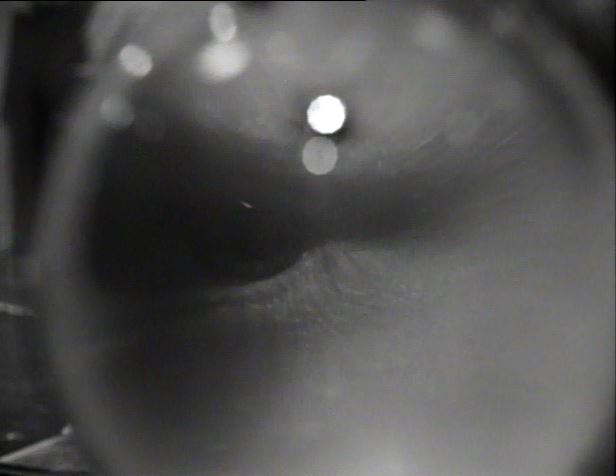
The crystal ball allows David to make all sorts of cryptic pronouncements, and gives the cameramen opportunities to take some ambitious shots. This still is featured on just about every webpage anyone has ever posted about the episode:

Screenshot from Dark Shadows from the Beginning

In a couple of years, we will see similar images, some of them giving great prominence to reflections of characters who aren’t supposed to cast reflections. For now, it is so unlike any other image in the show that I think we have to regard it as a message to the viewer. Just as David was the first character to look directly into the camera- he did it twice, in episodes 17 and 23, and no other character would do so until Sam did it day before yesterday, in #46- so he is the first one to look into a glass that will present us with a distorted image of his eye. The show seems to be laboring to get us to think about David’s viewpoint, about David as an observer.

The other plot also comes back to David as observer. Joe comes to the house and tells Liz that Bill Malloy didn’t come to work and isn’t at home. That gets everyone worried about Bill. Vicki tells Liz that Bill came to the house the night before, revealing to Liz that Roger lied to her. That gets Liz upset with Roger. David ties this together when he tells Vicki that he looked into the crystal ball and saw that Bill is dead, that his death was violent, and that Roger is responsible.

David is absent from the show for long stretches- today is the first we’ve seen him since #36. So it’s easy to regard him as a secondary character. But, we followed Vicki to Collinwood, and she came there because she had been hired to be David’s governess. The name “Collins” is something everyone on the show regards as terribly important, and David is the only candidate to carry that name into the next generation. They build a lot of story points around Burke, and at times Burke seems to be David’s fantasy come to life. David’s actions precipitated the saga of the bleeder valve, which was after all the first story-line on the show to be resolved. And David will be the fulcrum on which several story arcs will turn in the years to come. So perhaps we should see him as the central figure of the whole series.

Episode 23: The dignity of my badge

Roger has finally deigned to notify the police of his suspicion that Burke Devlin tampered with his brakes in an attempt to kill him. In story time, that was twelve hours ago. In the interim, both Roger and Bill Malloy have gone to Burke’s room and told him everything they know and think they know. Roger presented Burke with Vicki and her testimony. The newspaper has run a front-page story about it.

The sheriff is peeved that Roger is bringing him into it only now. Roger explains that his goal in giving Burke all the evidence in advance of any investigation was to persuade him to leave town, but that he never had the opportunity to present that idea to Burke.

Upstairs, Vicki is trying to teach David a lesson about the history of Maine. Considering that we learned in episode 13 that Vicki has never heard of Augusta, the capital of the state, it’s difficult to be optimistic about that instruction. But every scene between David and Vicki in his room is worth watching. No matter what lines they may be required to say, David Henesy and Alexandra Moltke Isles always use body language, facial expression, tone of voice, and spatial position to convey the emotions appropriate to their characters. As episode follows episode, those emotions shift from wild hostility on David’s part and patient solicitude on Vicki’s to genuine affection and trust. It’s the one story-line that really works in the first 42 weeks of the show.

David made some incriminating remarks to Vicki and his aunt the night of his father’s wreck; they both thought he was simply expressing his guilt over his hostility to his father. In this one, he asks Vicki if she ever tried to kill anyone. She tells a story of some fist-fighting she did at the Hammond Foundling Home, and says that’s as close as she got. She looks happy telling David that story, not because it’s a happy story, but because it’s a chance to make a connection.

She isn’t happy at the end of the episode- when David grabs at the bleeder valve and the other adults ignore his action, we see it dawn on her that he is the culprit.

I had a lot to say about this episode in the comments section of John and Christine Scoleri’s Dark Shadows Before I Die. Here it is:

I don’t agree that Constable Carter seems intelligent. He greets David by asking his name. If a cop has been on the job for over ten years in Collinsport, a town under the shadow of a big house called Collinwood, home of the the Collins Cannery and the Collins Fishing Fleet, and he still doesn’t know the four members of the Collins family, he’s an idiot.

Of course, he is sensible when he’s demanding to know why Roger waited twelve hours before coming to him and expressing incredulity at Roger’s visit to Devlin. Characters in soaps and suchlike productions are always declaring they have to do their own investigations before they can go to the police, and often this is treated in the story as if it were a reasonable thing to do. But every step of the way they’ve lampshaded the preposterousness of it. Vicki kept telling him it was a bad idea before he did it, last episode Sam reacted scornfully when he told him what he repeats to the constable here, that he wanted to give Devlin a chance to leave town and never come back. And the constable shows the same scorn for the idea today.

Those scenes make Vicki, Sam, and the constable look smarter than Roger, but we’ve seen enough of Roger to know that he isn’t a fool. Something is clouding his judgment, something more complicated and slipperier than the stories that have been suggested to us so far. Roger is hiding more than one thing, and he doesn’t trust himself with his own secrets.

David looks at the camera again today, when he’s eavesdropping on the conversation with the constable. An effective tactic- we the audience know what he knows, and he seems to be pleading with us to keep quiet.

Another meaningful look at the end of the episode. When the constable, who is an idiot, says cheerfully that now we’ll know how David’s fingerprints got on the wrench, Vicki gives David a grim little glance. Just for a second- but not only is it the last moment of the episode and therefore emphatic, it is also the second time we’ve seen her give David that look. The first time was in his room, when he was betraying himself with some remarks about how terrible it would be to go to prison. We can see a terrible idea starting to form in the back of Vicki’s mind.