A while back, Tumblr user “marcycaa” posted this cartoon summarizing the relationships well-meaning governess Vicki has with strange and troubled boy David and flighty heiress Carolyn in the 1966 episodes of Dark Shadows:
Art by marcycaa
Today, Vicki is being held prisoner by the fugitive Matthew, and Carolyn and David are off their leashes. Carolyn telephones dashing action hero Burke to complain that her mother and uncle don’t want her to see him. Burke reacts with disbelief that Carolyn is nattering on about that when Vicki is missing and might be dead.
David is the only one who knows where Matthew is. He is taking food and cigarettes to him. He has begun to suspect that Matthew has Vicki, and is afraid that he will kill her. This fear contends with his fear that he will go to jail for harboring a fugitive. He sneaks off to see Burke to seek reassurance. When Burke asks him what he wants, he says that he wants Burke to tell him that Matthew is innocent and that his hated father, high-born ne’er-do-well Roger, is responsible for everything Matthew has been accused of. When Burke can’t do that, David slips away.
Back in his hiding place in the Old House on the estate of Collinwood, Matthew lies down on a mattress next to the chair to which he has bound Vicki. Before he can get to sleep, he hears voices calling his name. The portrait of Josette Collins glows, eerie music plays, and one of the voices identifies itself as Josette. Vicki can hear none of this and tells Matthew that he must be dreaming. He wants to agree with her, fearing that the only alternative explanation is that he is going mad.
The audience knows that the ghosts are real, but we don’t know whether they mean anyone well. Matthew’s first action upon hearing the voices is to leap up and hold a knife at Vicki’s throat, so it doesn’t seem that they are protecting her. David considers them his friends, but nothing they have done for him has so far led him anywhere but deeper into his constant agony. The last time Vicki was locked up, the ghost of beloved local man Bill Malloy came and told her she would be killed unless she got away soon, but then vanished, leaving her trapped. While it seems likely the voices represent a power that will destroy Matthew, it is by no means clear they will do so before he kills Vicki. For all we can see, they may be about to drive him to do precisely that.
Vicki is our point of view character, but we’ve known Matthew since the second week of the show. As Carolyn tells David today, he’s always been gruff, but has seemed basically well-intentioned. Reclusive matriarch Liz seems to think that Matthew has some sort of cognitive impairment that would make it difficult for him to function in the world at large, and the sheriff’s manner of ordering him about when they have come into contact would suggest that he has the same idea. Matthew’s killing of Bill Malloy and crimes against Vicki have been desperate acts, committed with displays of reluctance and confusion. The idea that Matthew will end as the victim of a malign force that also spells doom for Vicki is therefore logically satisfying and dramatically compelling.
The only episode of the series to take place entirely outside of the town of Collinsport and the great house of Collinwood, this one is set in Bangor, Maine.
Well-meaning governess Vicki has gone to that town in search of information about herself. When she asks her employer, reclusive matriarch Liz, even the most basic questions about why she decided to hire her and how she knew she existed, Liz becomes evasive, then flatly and transparently lies to her. Vicki has found an old document in the house that may shed light not only on the matters Liz has already refused to discuss, but even on her questions about her birth family. Sure that Liz won’t give her any information about the document, she decides to take it to Liz’ lawyers, the firm of Garner and Garner.
Lawyers on soap operas don’t always follow the rules that bind their counterparts in our universe, but at least in this episode Garner and Garner are not going to tell Vicki anything their client does not want her to know. Indeed, the Garners are realistic enough to present a problem. One of them is Frank Garner, a young lawyer who is going to date Vicki for a few months. As played by Conard Fowkes, Frank is very much the sort of fellow you would expect to meet in a law office in Bangor, Maine. In this phase Dark Shadows still has some room for low-key stories and naturalistic acting, but no TV series this side of C-SPAN would be able to accommodate a character like Frank.
It’s a shame Frank isn’t more suited to Dark Shadows. The show urgently needs more young men in the cast. At this point, the only male actors between the ages of 11 and 40 they have who have appeared more than once are Joel Crothers as hardworking young fisherman Joe Haskell, Mitch Ryan as dashing action hero Burke Devlin, and Dana Elcar as Sheriff Patterson. Sheriff Patterson is supposed to be older than the 39 year old Elcar, and is coded as an authority figure who is unavailable for dating. So Joe and Burke have to provide the male points on all of the love triangles.
I think Frank could have been saved had he been played by a different actor. However dull the dialogue the writers might give him, he is on screen enough that a sufficiently charismatic performer could have grabbed our attention. And maybe stimulated the imagination of the writers, so that he would have had interesting things to say and do. Harvey Keitel had danced in the background at The Blue Whale in episode 33, and so must have been available for a speaking part on the show. Keitel’s quiet, brooding intensity always convinces an audience that a character who is saying very little is thinking deeply and feeling strongly and planning mighty things. Keitel would have been quite powerful as Frank.
Fowkes brought a light tone to his performance, and that is welcome. Dark Shadows always struggled to maintain a bit of sparkle against the background of a setting so gloomy that in this episode Vicki finds it “hard to believe there was ever any real gaiety at Collinwood.” If that line is meant to raise our hopes that a Vicki-Frank relationship will create a bright new mood, it sets us up for instant disappointment. Frank is cheerful and pleasant enough, but he doesn’t project enough personality to change the feeling even of the shots he is in, let alone of the entire series.
Keitel has never been known for lightness. If you wanted that, you could have turned to another Blue Whale dancer- Frederic Forrest, whom we will see in episode 137. Thinking of the goofy charm that Forrest’s character maintained throughout a movie as heavy as Apocalypse Now it’s easy to imagine a breeze of fresh air running through Dark Shadows. Not only would Forrest himself have been fun to watch as Frank, but he might well have brought out some of the most under-utilized aspects of Vicki’s character. A handful of times in these early months, Vicki is allowed to make jokes, usually in her scenes with strange and troubled boy David. David will not be amused, but the audience can see that Alexandra Moltke Isles is capable of being extremely funny. A relationship between a character played by Forrest and one played by Mrs Isles might have given the writers abundant opportunities to showcase that side of her. A pairing with the earnest, cheerful, but entirely humorless Frank represents a death sentence for Funny Vicki.
Well-meaning governess Vicki, fresh from imprisonment at the hands of strange and troubled boy David Collins, gets a few days off work to visit Bangor, Maine. Flighty heiress Carolyn had agreed to drive her to the bus station in the town of Collinsport. Carolyn doesn’t have a job, go to school, or seem to have anything else to do, so why she and Vicki don’t just take a road trip together is unclear.
They wait for the bus at the local restaurant. From there, Carolyn telephones dashing action hero Burke Devlin, her family’s arch-nemesis and the object of her own obsessive crush, and invites him to join the two of them at their table.
Carolyn tells Burke that Vicki has recently seen the ghost of beloved local man Bill Malloy. Vicki tries not to give Burke any additional information. When Burke learns of Vicki’s plans, he volunteers to take her to Bangor in his car. She declines, but he won’t take no for an answer. I don’t drive, and I admire the way this scene shows how hard it can be for a non-driver to decline a ride.
When Burke leaves to get Vicki’s bags, Carolyn blows up at her. Carolyn tells Vicki that she must have known she came to town hoping to see Burke and spend the evening with him. Vicki did not know any such thing. After all, Burke has openly declared his intention of forcing Carolyn’s entire family into bankruptcy and disgrace, and she has expressed remorse for her infatuation with him. When Carolyn makes it clear she is still chasing Burke, Vicki doesn’t know what to say.
The Collinsport Historical Society says that Carolyn spends this week alienating the audience, and her passive-aggressive behavior towards Vicki is indeed exasperating. Watching the scene in the restaurant, it makes perfect sense that Vicki would decide that escaping Carolyn is worth the risk of getting in trouble with her employers by spending an hour with Burke.
Back home at the great house of Collinwood, Carolyn hears her mother, reclusive matriarch Liz, playing the piano. She makes a lot of noise when she comes in, ensuring that her mother will call her into the drawing room. Once there, Carolyn puts on a great show of being upset. She gives partial, teasing answers to each of her mother’s questions, drawing her in as best she can. She finally declares that Vicki is not to be trusted. She reveals that Vicki is in a car with Burke, probably telling him everything she knows about the Collinses and Collinwood. We then cut to Vicki and Burke in the car, where she is telling him everything she knows about her recent sighting of Bill Malloy’s ghost in the house.
Again, the scene in the restaurant explains Vicki’s behavior. Carolyn had told Burke so much about it that it would be hard for Vicki or anyone else to see much point in trying to keep the rest of the story from him. When Burke wants her to say that the ghost accused someone in the house of murder, she insists that it only said it was someone in Collinsport, not Collinwood.
Carolyn has always been tempestuous, and Vicki has always been quick to forgive her. Perhaps now that the relationship between Vicki and David is about to enter a quieter, more complicated phase, the makers of the show wanted to ensure that there would be a continual source of conflict within the house. That might explain why they have chosen to feature Carolyn’s nastier side so heavily this week.
The one storyline in the first 42 weeks of Dark Shadows that has a satisfactory beginning, middle, and end is the transformation of strange and troubled boy David Collins from the deadly enemy of his governess, the well-meaning Victoria Winters, to her faithful friend. That storyline reaches a turning point in today’s episode.
Last Friday, David imprisoned Vicki in an abandoned room deep in the closed off section of the great house of Collinwood. From the other side of the locked door, he taunted her that she would remain trapped there until she died. After she was freed from the room, Vicki decided that she would leave her position unless she could see something new in David that would convince her she could reach him.
In today’s teaser, David visits Vicki in her bedroom and tries to deny that he wanted to kill her. She quotes several remarks he has made to her over the months she has been at Collinwood in which David indicated that he would very much like to kill her, leading up to his declaration that when she dies he won’t even go to her funeral. He retracts that one, explaining that “I like funerals.”
After a few more minutes of this charming conversation, Vicki mentions that, while trapped in the room, she saw the ghost of beloved local man Bill Malloy. David’s attitude changes abruptly. He pleads with her to continue as his governess.
David’s cousin, flighty heiress Carolyn, walks into Vicki’s room in time to hear David begging Vicki to stay in the house. Stunned, she asks what brought this reversal about. Vicki explains that she told David that she saw a ghost, and that “Any friend of a ghost’s is a friend of David’s.” Carolyn wants Vicki to stay, and tries to argue that what David has said is enough to prove that she can become his friend. Vicki is not at all persuaded of this, and is still inclined to go away.
Vicki’s skepticism about David’s sudden friendliness after so much extreme hostility is a sign of intelligence. Her next actions suggest that the Dumb Vicki of later years is not far away.
Gruff caretaker Matthew is replacing the lock on the door that separates the unused part of the house from the rest of it. Matthew leaves for a moment in the middle of this job to attend to other business. Vicki and Carolyn take advantage of his absence to slip through the lockless door and make their way to the room where Vicki was trapped.
While the girls are in the closed-off section, Matthew returns to work on the door. David asks him what would happen if someone were behind that door now- would they be able to get out once he finishes putting the new lock on? Matthew dismisses him without an answer. It would seem to be a question Vicki and Carolyn might have considered asking before they sneaked into the disused wing.
Once they are in the room, Vicki behaves even less sensibly. She tells Carolyn that while she was trapped there, she tried to use a piece of paper to slide the room key under the door. Carolyn asks her to explain what she means. So she recreates the situation. She puts the key in the lock on the outside of the door, closes the door, pushes a bobby pin into the keyhole from the inside so that the key falls onto the floor outside, then slides a piece of paper under the door. The paper slides under the key. To her surprise, this time she is able to fit it under the door. Evidently she had expected to imprison herself and Carolyn in the room.
Fortunately, the two of them are able to make their way back to the main part of the house. They find David waiting for them in Vicki’s room. He says that he was worried about Vicki. The girls wonder if his concern is genuine. He looks up at Vicki, stares into her eyes, and says “I love you, Miss Winters!” Then he rushes out of the room.
David declares his love for Vicki
Thunderstruck, Vicki asks Carolyn if David had ever said those words to anyone or anything before. Looking stiffly off into the distance, Carolyn tells her that he said them once, to a kitten he had. Vicki asks what happened to the kitten. Carolyn tells her that David drowned it.
In Wednesday’s episode, David’s father, high-born ne’er-do-well Roger Collins, had called his son an “incipient psychopath.” Carolyn’s closing line would seem to corroborate that diagnosis. Nor is it the only thing that deepens the sense of danger around David.
David has a couple of interactions with Matthew. David’s aunt, reclusive matriarch Liz, owns the house and has ordered Matthew to change the lock. David asks what reason she gave. Matthew says Liz told him that Vicki somehow made her way in the closed-off part of the house and got herself trapped there. Matthew takes it that Vicki was “snoopin’ around.” In Matthew’s scale of values, “snoopin’ around where you ain’t no call to be” is the cardinal sin. And Liz warned Vicki long ago that Matthew is a “strange and violent man” who might be dangerous to her if he thinks she is overly inquisitive.
We catch a glimpse of Matthew’s violent side today. When David tells him that Vicki saw the ghost of Bill Malloy, he becomes intensely agitated. He grabs the boy by the arm, shakes him, and struggles with himself before he can let go.
Liz is fond of Vicki and has a sense of responsibility for her. Yet given the choice between telling the truth about David’s terrible behavior or defaming Vicki and thereby exposing her to Matthew’s wrath, it’s under the bus for Vicki. That Liz tells the cover story she has devised to shield David from any consequences for his murderous actions to Matthew of all people is not only cruel to Vicki, but a sign of Liz’ extreme unwillingness to face unpleasant facts. Matthew is fanatically loyal to Liz and to the Collins family in general. He is the very last person in the world to use any information against them. Yet Liz can’t bring herself to tell even him the truth about David.
This is not the first time Liz has lied to Matthew to cover up a murder attempt by David. The first time we saw Thayer David in the role of Matthew was in episode 38. In that one, Liz told him to take the blame for an auto crash that might have killed Roger. He is to say that he failed to check the brakes. She refuses to tell him why she wants him to tell this lie. We know the truth- David tampered with the brakes in order to kill his father, and Liz has decided to conceal this fact. Since then, she has behaved as if she never knew of David’s crime.
Liz is not only protecting David- she is protecting herself from a fact she cannot bring herself to face. Liz has all the power in the family, Roger openly hates David, and Carolyn is too selfish to do much for her little cousin. We can see no prospect that anyone will rein David in before he does something Liz can’t hide from the police. Since attempted murder doesn’t qualify, I suppose we have to wonder whether David is on track to succeed in murder. Vicki’s efforts to make an emotional connection with her charge may be his last chance to avoid a hideous future.
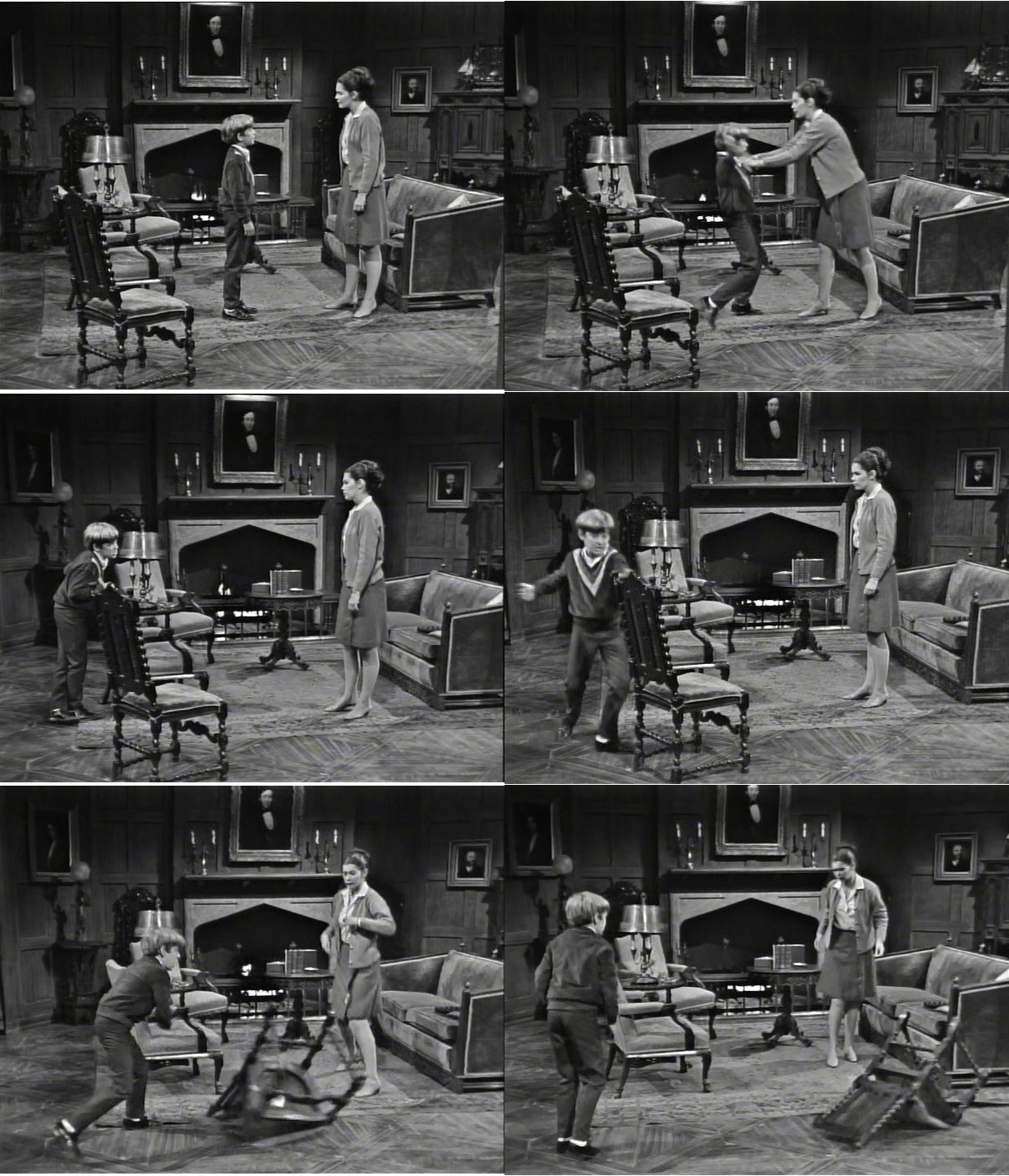
Well-meaning governess Vicki is determined to befriend her charge, problem child David Collins. In today’s episode, David throws a violent tantrum. Vicki looks genuinely frightened:
Meanwhile, David’s father, problem adult Roger Collins, has decided to charm Vicki so as to reduce the likelihood that she will testify against him. Roger walks in on David’s tantrum. After scolding the boy and letting him go, he talks sweetly to Vicki. She tells him that she will do anything she can to understand David. He invites her to a lobster dinner. We see David, who has been eavesdropping on his hated father making friends with his hated governess, looking troubled.
David confronts his father about what he heard. Roger responds with the same charm he showed Vicki, acknowledging that he has been difficult to live with, taking the blame for all of it, and promising to be a new man in the future. He agrees with all of David’s baseless accusations against Vicki, and says that the reason he was being nice to her a few minutes before was to disarm her against David. David says that he wants to frame Vicki for some terrible misdeed that will prompt reclusive matriarch Liz to fire her; Roger replies that he doesn’t want to know what David does about that matter. He asks the boy to consider which he wants more- to be rid of him, or rid of Vicki.
These are outstanding scenes. As Vicki and David, Alexandra Moltke Isles and David Henesy both developed acting styles that built strongly on eye contact. Those styles mesh perfectly and produce an electric effect. As Roger, Louis Edmonds does everything well, but is peerless as a charming sophisticate. When Roger’s scene with Vicki begins, we don’t know that he has any especially sinister plans for her, so that scene plays as a pleasant interlude. We do know that Roger loathes David, so when we see him turning on the charm with his son, and especially when we see him agreeing with all sorts of statements from David that he knows to be false, the effect is alarming. By the time he is instructing David to keep him out of the loop when he acts against Vicki, Roger takes on a Satanic quality. His cold way of asking David his final question demonstrates that he knows David hates him and is unmoved by the fact. It’s heartbreaking to see David Henesy’s little face and imagine him as a child whose father shows that ultimate disregard for him, one of the bleakest endings of any episode in the entire series.
Each episode of Dark Shadows begins with a voiceover. In this phase of the show, the voiceovers are all narrated by Alexandra Moltke Isles in character as Victoria Winters, well-meaning governess, and are brief passages of almost purely decorative prose, meant only to set a mood and to vanish from the audience’s memory as soon as the action starts. Art Wallace and Francis Swann, the writers credited for the first 97 episodes, were old pros who had been turning out scripts for decades, and were good at staying out of their own way. That’s why I haven’t yet said anything about any of the opening voiceovers- when Wallace or Swann set out to write something forgettable, they succeeded. By the time I started writing, I had no recollection of them whatever.
Today’s opening voiceover is unusually substantive, so much so that it threatens to leave a trace in the audience’s mind:
My name is Victoria Winters. Once again it is quiet in Collinwood. There is no sound but the ticking of the great clock in the entrance hall. And the lonely footsteps of a woman who hasn’t left its grounds in eighteen years. A woman whose life is limited to musty corridors and the endless beat of a grandfather clock. A beat that seems to ignore the vitality of the world around it.
Vicki names herself, names the estate where she lives, talks about how quiet it is, mentions the clock, tells the audience that the lady of the house is a recluse who hasn’t left home in eighteen years, complains about the air quality in the house, brings the clock up again, and assures us that interesting things are happening everywhere except here. It leaves us wondering why Vicki is so hung up on the clock, why she doesn’t run the vacuum cleaner herself, and why, if the entire world surrounding Collinwood is chock full of vitality, they don’t turn the camera in some other direction.
That’s the sort of thing we’re going to get from Wallace and Swann’s immediate successors, Ron Sproat and Malcolm Marmorstein. In writing their opening voiceovers, Sproat and Marmorstein fell between two stools. They didn’t write brief, deliberately forgettable passages as Wallace and Swann had done; nor did they integrate the opening voiceovers into the action of the show, as would happen in later years when the story is moving very fast and the episodes start with detailed recaps of events so far. Instead, Sproat and Marmorstein saw the voiceovers as vehicles for long passages of flowery, over-developed imagery. Those are certainly no more effective at setting a mood than were Wallace and Swann’s brief remarks, but they do both try the patience of the audience and linger as distractions. That’s one of the things that prejudices viewers against the character of Vicki- since so many episodes from the Sproat/ Marmorstein era start with Vicki rambling on about the weather or making vague remarks about “one small boy” or whatever, the first impression she leaves on viewers who start watching with episodes from that period is that of a prattling fool.
While Wallace and Swann are the only writers whose names have appeared in the credits thus far, it is very possible that others not credited contributed additional bits. I may be wrong, but my nose catches a whiff of Marmorstein in these six strange, distracting sentences. The description of the clock while we’re looking at it, the specified number of years since reclusive matriarch Liz has left the estate, the evocation of the “musty corridors,” the yearning glance at the eventful world outside, are all typical of Marmorstein’s attempts to turn the voiceovers into freestanding dramatic monologues, but without identifiable characters or plot development.
Today’s episode doesn’t shed much light on Vicki’s relationship to the clock or on the standards of cleanliness in the great house of Collinwood. Instead, it’s a kaleidoscope episode, in which each change of scene varies the combination of characters who interact on each set. The action plays out on two sets this time, the foyer/ drawing room representing the downstairs of the great house, and the Blue Whale tavern, representing the low and bustling life of the village. Because the sets typify the “musty corridors” inside the house and the “vitality of the world around it,” the episode is also a diptych of sorts- not Art Wallace’s usual diptych contrasting two pairs of people, but a diptych contrasting two places and the attitudes those places inspire in the people who spend time in them.
The five pieces tumbling about in today’s kaleidoscope are reclusive matriarch Liz, tightly-wound handyman Matthew, flighty heiress Carolyn, hardworking young fisherman Joe, and Maggie, the nicest girl in town. The regular bartender at the Blue Whale gets a fair bit of screen time as well. In the first 63 episodes, he’s answered to names including “Joe,” Andy,” “Mike,” and “Punchy.” Today, Joe the fisherman calls the bartender “Punchy,” a name he called him most recently in episode 56, the same episode where drunken artist Sam calls him “Mike.” Maybe we’re supposed to think that the young men know the bartender as “Punchy,” the older men as “Mike.” Eventually the show settles on the name “Bob” for him, perhaps because the performer’s name was Bob O’Connell. In one episode (#319,) Sam calls him “Ba-ba-roony,” giving rise to the idea that his name is Bob Rooney.
Liz appears only at Collinwood, of course; Joe and the bartender appear only in the bar. The others migrate back and forth between the two sets. We first see Carolyn with Joe in the bar, talking about what a flop their date has been and how pointless their whole relationship is. Maggie interrupts this thrilling conversation, looking for her father, Sam the drunken artist. After puzzling Carolyn and Joe with a number of cryptic remarks, Maggie gives up looking for her father and goes to Collinwood to look for high-born ne’er-do-well Roger. Roger isn’t home, so she winds up talking to Liz. This is the 63rd episode, and it’s the first time we’ve seen these two major characters together.
We first see Matthew in Collinwood, telling Liz how much he wants to help her. He then goes to the bar, where Carolyn and Joe see him. Matthew is looking for dashing action hero Burke Devlin, whom he hates. He implies to Carolyn and Joe that Burke is to blame for the death of beloved local man Bill Malloy. Joe doesn’t like Burke any more than Matthew does. The instant he hears Matthew’s idea, he is all in on it. Carolyn resists the suggestion.
Carolyn goes home to Collinwood. Maggie has explained to Liz that Burke has been saying terrible things about her father, that she can’t find her father to ask him about Burke’s allegations, and that Roger might know something about them. Liz urges Maggie to believe in her father, and to regard Burke as a dangerous, unscrupulous man capable of many dark deeds. Hearing the last part of this, Carolyn asks her mother if she believes that Burke is capable of murder. Yes, Liz says, she does believe that he is capable of that.
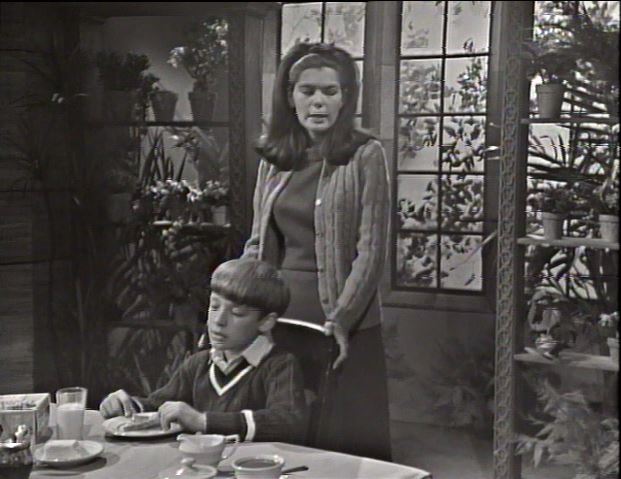
Well-meaning governess Vicki and troubled rich boy David Collins are having breakfast in the kitchen at Collinwood. David had heard Vicki and his cousin Carolyn screaming outside the night before, and saw them running back to the house. He keeps badgering Vicki for an explanation of these events, which Vicki refuses to give. In his frustration, he accuses Vicki of trying to replace his mother, and tells her that when she dies, he won’t even go to her funeral.
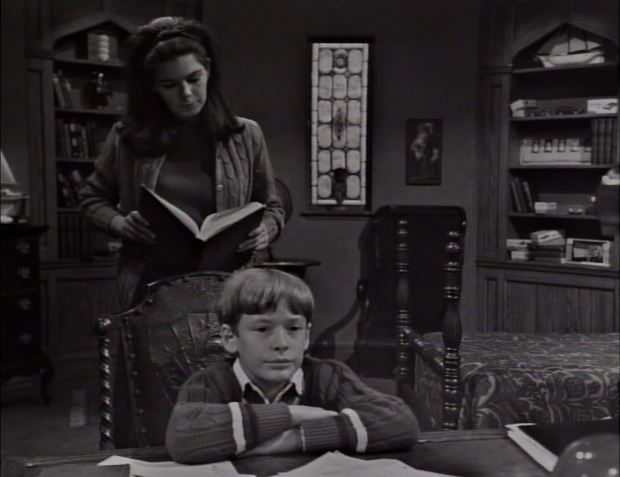
Later in the episode, after David has overheard Vicki telling hardworking young fisherman Joe that she and Carolyn thought they saw a dead man on the beach, he has another scene with Vicki, this time in his room. She’s trying to teach him about the importance of rivers in the economic development of the USA. He continues to demand information about what happened last night. He resists answering her questions about North America’s rivers, she resists answering his questions about what she saw on the beach.
These scenes are full of repetitious dialogue, conversational dead-ends, and descriptions of the Mississippi-Missouri river system. They could have been quite dull. Thanks to the actors, they are engrossing. As David Collins, child actor David Henesy uses an utterly flat voice and affect, to which Alexandra Moltke Isles as Vicki responds with a nuanced slow burn. When David makes common-sense observations (e.g., “Was something chasing you?… Then why were you running?”) his flatness seems to be a sign of sober intelligence. When he says terrible things (“When you’re dead, I won’t even come to your funeral,”) the same flatness is far more disquieting than a display of anger would be. As Vicki very gradually loses patience with David, her eyes never leave his face for more than a second- we can see her searching for something she can empathize with, some opening hinting at a relatable emotion, and not finding it. The two of them are irresistible together.
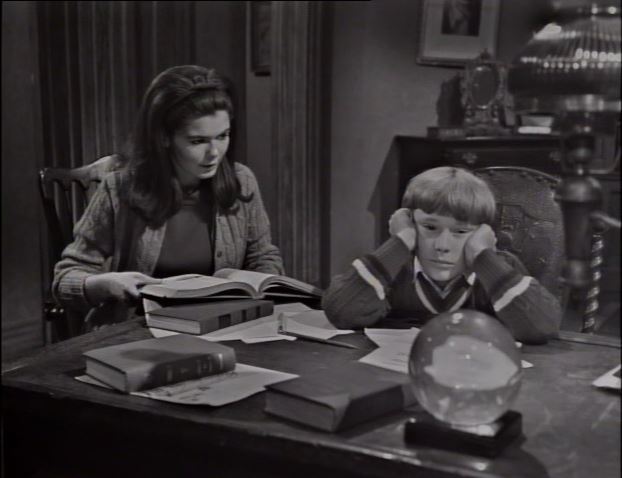
Director John Sedwick deserves a lot of credit as well. We see Vicki and David in the kitchen and in David’s room, the two most intimate spaces on the show. In each of these spaces, David is sitting still while Vicki moves about. David’s stillness allows him to keep his voice perfectly level, while Vicki’s movements give her opportunities to show signs of the emotional reaction she’s trying to keep in check as she tries to be nothing but a conscientious teacher. The camera catches David’s crystal ball to emphasize the boy’s baleful preoccupations.
Reclusive matriarch Liz meets with dour handyman Matthew in the drawing room. Liz revisits the question of the dead man on the beach. She says that she doesn’t believe Matthew has ever lied to her; he vows he never will. Liz points out that Matthew chose his words carefully last night when he came back from searching the beach, and asks if there was in fact a dead body there. He admits that there was, that it was the body of missing plant manager Bill Malloy, and that he put Malloy’s body in the water and watched as the tide carried it out to sea Horrified, Liz asks what Matthew was thinking. All he will say is that he thought it was for the best. Liz calls the police.
In his scene with Liz, Matthew mentions that before he came to Collinwood to be the handyman he worked for Liz’ father on the fishing boats. I’ve seen several websites claiming this is an inconsistency, since in episode 6 Matthew had said that he was sweeping the floors in the Collins cannery when he was called up to the big house. Those could both be true, though. He might have been a fisherman who had to leave the boats for some reason and then took the job at the cannery.
Maybe the reason was Matthew’s personality. As Liz told Vicki in episode 13, Matthew is a “strange, violent man”- it’s easy to imagine him alienating the rest of the crew of a small boat to the point where they would refuse to set out with him on board. A history like that would go a long way towards explaining Matthew’s extreme gratitude to Liz for giving him a job, especially a job where he’s alone almost all the time.
In yesterday’s episode, Vicki the governess had come downstairs with a sketch of the great house of Collinwood that her charge David made. She showed the sketch to David’s father, Roger. Vicki tells Roger that she had taken the sketch from David’s room without David’s knowledge. Vicki spent the third week of the show trying to make it clear to David that by taking a letter from her room without her permission, he was stealing from her. Viewers who remember those episodes can’t help but wonder why Vicki is being so hypocritical.
Today, Vicki returns the drawing to David. He is surprised that she took the drawing, but pleased when she tells him how good she thinks it is. He’s starting to warm up to her, until she tells him she showed the drawing to Roger and that Roger liked it. At that reference to his hated father, David tears the drawing to pieces. David then brings up her lectures about his taking the letter and tells her she has one standard for children and another for grownups. She apologizes and agrees that she ought not to have touched the drawing. He refuses her apology and tells her he hates her. It goes on like that for a moment, until David’s aunt Liz walks in. At first Vicki tells Liz that what she’s hearing is an argument about the American Revolution, but she then says that David “had every right to be angry” because she took a drawing of his without his permission. David is involved with something else at that moment, but he does glance back at Vicki when she says “he had every right to be angry.”
Later in the series, Vicki will seem to lose quite a few IQ points. While it was foolish of her to take the drawing from David’s room without his permission and almost as foolish to tell him that Roger liked it, I don’t think this is quite a Dumb Vicki moment yet. Even the smartest adults do occasionally forget to respect children’s rights to privacy and to property, and it isn’t easy for anyone to really absorb the fact that a ten year old boy hates his father as intensely as David hates Roger. The most important thing about the scene is that Vicki admits to David that she’s wrong, apologizes to him, and tells Liz that David was in the right. The growth of a friendship between Vicki and David is going to be the most successful story-line of the first 42 weeks, and we can see the seeds of it right here.
Liz has come to David’s room to deliver a package. The package is a gift with a bow on it, brought by a messenger from the village and addressed to David. It’s a crystal ball, sent by David’s idol Burke Devlin. David loves it. Liz points out that Burke is the Collins family’s arch-nemesis, and says that it would be a good idea to send the present back. David pleads to be allowed to keep it, and she relents.
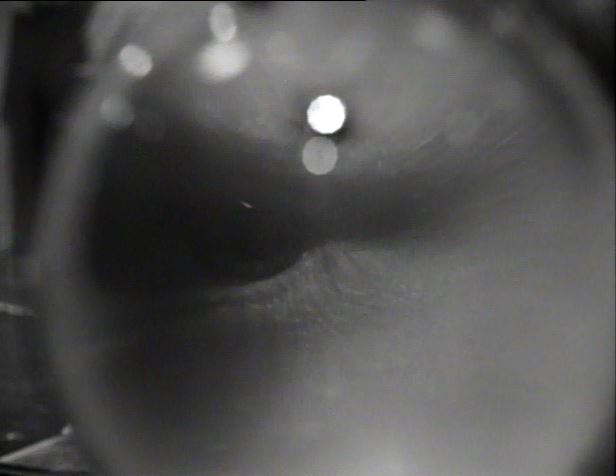
The crystal ball allows David to make all sorts of cryptic pronouncements, and gives the cameramen opportunities to take some ambitious shots. This still is featured on just about every webpage anyone has ever posted about the episode:
In a couple of years, we will see similar images, some of them giving great prominence to reflections of characters who aren’t supposed to cast reflections. For now, it is so unlike any other image in the show that I think we have to regard it as a message to the viewer. Just as David was the first character to look directly into the camera- he did it twice, in episodes 17 and 23, and no other character would do so until Sam did it day before yesterday, in #46- so he is the first one to look into a glass that will present us with a distorted image of his eye. The show seems to be laboring to get us to think about David’s viewpoint, about David as an observer.
The other plot also comes back to David as observer. Joe comes to the house and tells Liz that Bill Malloy didn’t come to work and isn’t at home. That gets everyone worried about Bill. Vicki tells Liz that Bill came to the house the night before, revealing to Liz that Roger lied to her. That gets Liz upset with Roger. David ties this together when he tells Vicki that he looked into the crystal ball and saw that Bill is dead, that his death was violent, and that Roger is responsible.
David is absent from the show for long stretches- today is the first we’ve seen him since #36. So it’s easy to regard him as a secondary character. But, we followed Vicki to Collinwood, and she came there because she had been hired to be David’s governess. The name “Collins” is something everyone on the show regards as terribly important, and David is the only candidate to carry that name into the next generation. They build a lot of story points around Burke, and at times Burke seems to be David’s fantasy come to life. David’s actions precipitated the saga of the bleeder valve, which was after all the first story-line on the show to be resolved. And David will be the fulcrum on which several story arcs will turn in the years to come. So perhaps we should see him as the central figure of the whole series.
Bill Malloy’s investigation into the manslaughter case that sent Burke Devlin to prison ten years ago is coming to a head. Bill tells Burke, Sam Evans and Roger Collins to meet him to discuss the case in Roger’s office at 11 PM. When Bill leaves the Evans cottage, Sam mutters something about stopping him and looks directly into the camera.
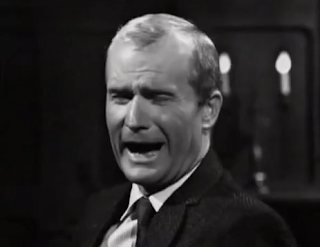
Roger is no happier at the idea of the meeting. Louis Edmonds’ performance ever so subtly hints at Roger’s reluctance to attend:
Roger gives a speech to Vicki about how David is better off than he was at nine, since he already knows that the world is a horrible place. The speech is vague, rambling, and high-flown. That’s suitable for the occasion, since Vicki isn’t supposed to know what the hell he’s talking about, but Louis Edmonds struggles with it. In a future period such speeches will become a hallmark of the show. Malcolm Marmorstein is credited as the writer of 82 episodes in all, from 115 (broadcast 2 December 1966) to 309 (broadcast 31 August 1967,) and often as not speeches just like that crop up in them. Marmorstein’s flowery gibberish will defeat actor after actor, until Jonathan Frid joins the cast as Barnabas Collins. In Frid’s voice, the speeches sound so gorgeous you barely notice that they don’t make a lick of sense. After a while, Marmorstein stops giving them to other actors, and they become the way Barnabas talks. I wonder if Marmorstein did some uncredited work on this episode. Art Wallace, sole credited writer of episodes 1-40, is listed on screen again as the author of this teleplay, but at many points it sounds more like Marmorstein than it does like Wallace.
This one also has a key moment in one of the aspects of the show that most saddens me, the decline and fall of Vicki. In the drawing room, Roger is in a panic about Bill’s investigation. Vicki sees this and asks if the investigation has something to do with her quest to learn her origins. Roger laughs in her face. Of course it doesn’t have anything to do with that story-line- nothing happening on the show does. As long as she’s chained to that rotting corpse of a narrative element, Vicki is going to be of limited relevance.
Bill goes to the restaurant and asks Maggie a bunch of questions about Sam. As he is getting ready to leave, Vicki comes in and Maggie asks her questions about Collinwood. When Vicki leaves, Sam comes in.
Joe goes to the Blue Whale and finds Bill day-drinking. As Joe is getting ready to leave, Sam comes in and he and Bill have a conversation about what Sam told Bill when he was about to pass out drunk. Joe then goes to Collinwood and talks to Vicki about Carolyn.
Vicki’s scenes are, strictly speaking, filler. Alexandra Moltke Isles seems to have known that her character was stuck in a dead end. She plays Vicki very brightly, with maximum excitement, as if she doesn’t get out much and is thrilled that people are paying attention to her. When Joe leaves, she stands in the foyer staring off into space, looking hopeless:
On the one hand, that’s a sign of bad things to come for Vicki. Her great story-line, her winning David’s friendship, is still to come, but once that is complete her character will go completely to waste.
On the other hand, Mrs Isles’ performance in this episode is the first example of a resource they will draw on to introduce all sorts of alarming characters into the cast. That resource is the keen loneliness of the residents of Collinwood. Several times people will turn up whom the Collinses ought by all rights to throw out on the street immediately, most notably a certain cousin from England who will present himself at the house next spring. But they are isolated in their big dark house, battered by hostility, stung by betrayal, and desperate to find someone they can trust.