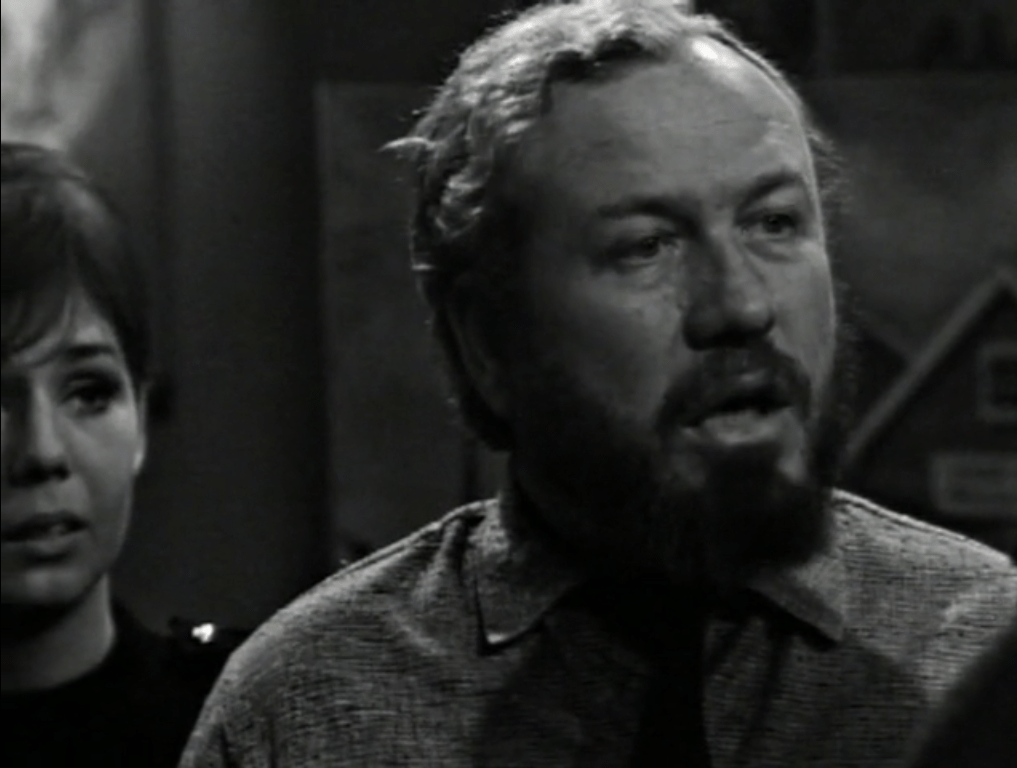
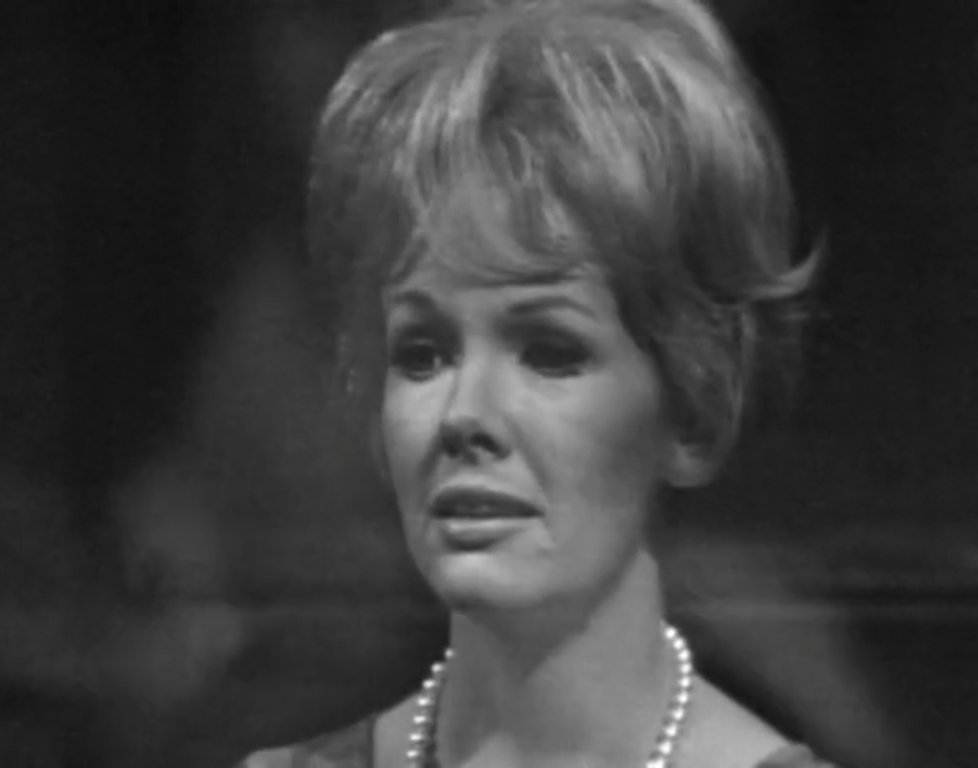
Strange and troubled boy David Collins is in the Old House on the estate of Collinwood with his aunt, reclusive matriarch Liz. David laments to Liz that he can no longer feel the tutelary presence of the ghost of their ancestor Josette Collins. For more than 24 weeks, from #70 when the Old House was introduced to #191 with the conclusion of the storyline centered on David’s mother, blonde fire witch Laura Murdoch Collins, the Old House had been Josette’s sanctuary. Now it is “a new house, a new place,” and she’s gone. David is particularly sad that the house’s new occupant, the newly arrived Barnabas Collins, has removed Josette’s portrait from its place above the mantle in the front parlor and plans to hang a portrait of himself there.
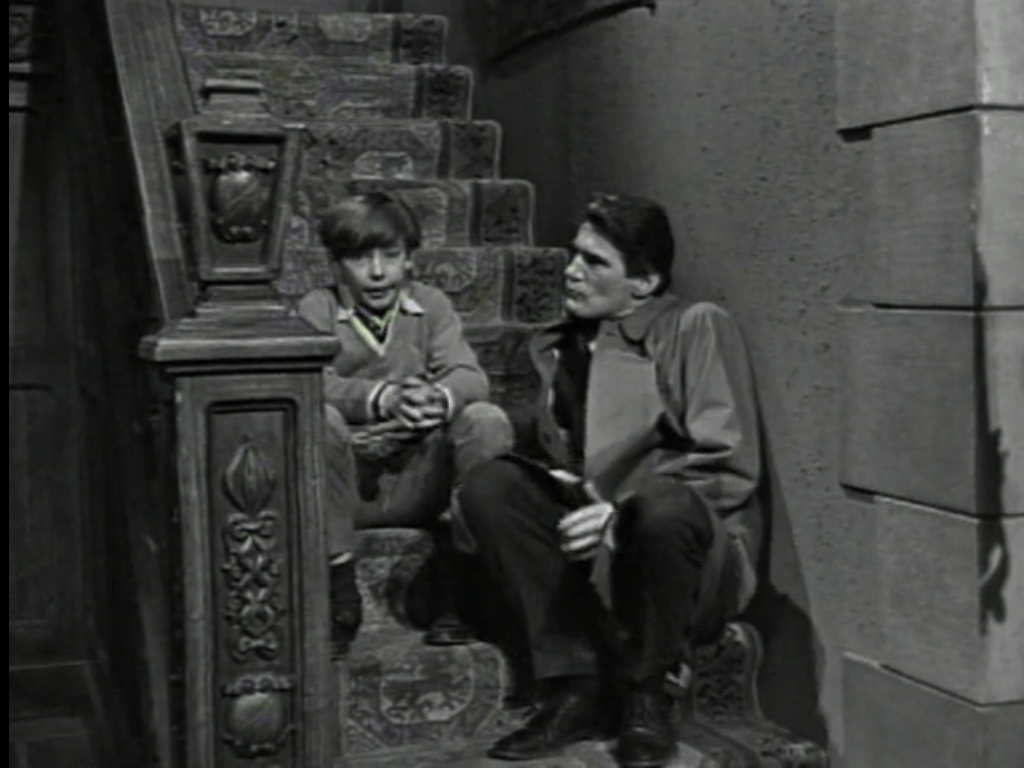
Back in the great house on the estate, David sees dashing action hero Burke Devlin. He sits on the stairs with Burke and talks about his feelings concerning Barnabas, Josette, the portrait, and the Old House. Burke suggests he ask Barnabas to give him the portrait. David is thrilled by this suggestion, and declares that he will go to the Old House at once to ask him. Burke points out that Barnabas probably isn’t home. That doesn’t make an impression on David, but he does stop before going out the door. Burke asks if he is afraid to go there alone, apparently preparing to volunteer to go with him. David says he isn’t afraid, but doesn’t explain what feeling he does have that is holding him back.
David and Burke talk it out
David goes to the Old House and calls to Barnabas. No one answers. The howling of dogs fills the air from every side, frightening David. He calls to Josette. He does not feel her presence. The doors slam shut on their own; when he runs to them, he cannot open them. We conclude with a closeup of his terrified face.
Those three scenes might have appeared in a good episode, but this is not that episode. In fact, it is a real stinker, very possibly the single worst we have seen so far. There is one funny line, when Liz remarks that Willie Loomis’ “illness appears to have caused him no end of convenience.” And the actors and director do what they can. But the script defeats them all.
As David Collins, David Henesy appears to be delivering the lines Ron Sproat actually wrote when he says things like “If I blame [Barnabas] for anything, it’s for changing things around [at the Old House]… I just hope he hasn’t changed [the Old House.]” Some of the words that come out of his mouth may be flubs, but most of it is of a piece with what the adult actors are saying in response to him, and nothing anyone says is close to intelligible. This is one of the rare episodes when Henesy winds up roaming about the sets declaiming like some kid actor in a 60s TV show.
As well-meaning governess Vicki, Alexandra Moltke Isles is trying so hard to remember her own pointless lines that she stands stiff as a board every time she is on camera. Vicki and David’s scenes were the heart of the first 39 weeks of the show, often in spite of writing nearly as bad as what the cast is stuck with today, but their conversation on the stairs today is terribly dull to watch.
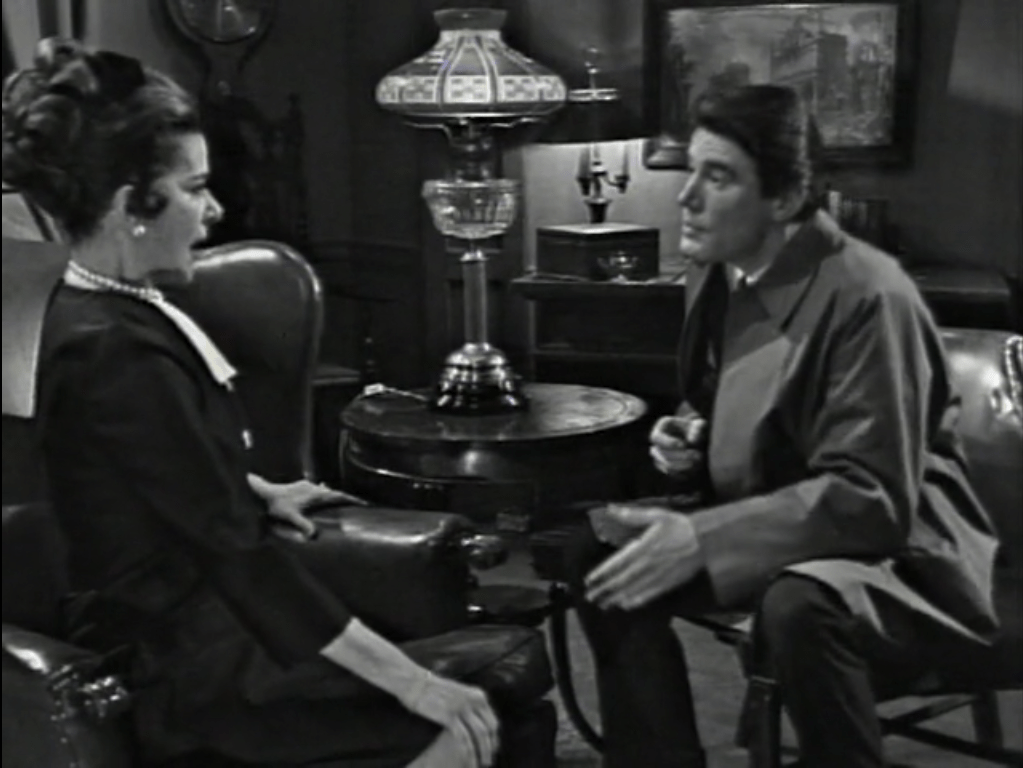
Joan Bennett and Mitch Ryan each had star quality in abundance, and so they manage to hold their scenes together. The opening scene between Liz and Vicki has some snap to it, David’s conversation with Burke is appealing, and when Liz and Burke have a scene in the study arguing about a business deal she made with a man called Hackett* things start to crackle. But even in that scene Bennett and Ryan stumble over Sproat’s awful dialogue and wind up in the ditch more than once. Her frequent glances at the teleprompter and a couple of alarmingly long pauses from him turn the crackle to a fizzle well before it is over.
Burke and Liz argue about the Hackett deal
The scene between David and Liz in the Old House is another defeat for Joan Bennett. David Collins’ nonsensical lines and David Henesy’s flailing attempts to find some kind of through line in them leave her standing in mid-air, and the scene goes on so long they repeat every point they have to make at least twice. By the third time through the sparse material they have to work with, not even she could make it interesting.
Moreover, regular viewers will be puzzled when Liz tells David over and over that the Old House and its contents belong to Barnabas. On Monday, in #220, Barnabas and Vicki had a conversation in the foyer of the great house about the fact that he was not going to own the Old House. There hasn’t been any indication of a change in that plan, but Liz goes out of her way to say three times, not that Barnabas is staying in the house, but that it is his. We are left wondering what she is talking about.
Burke and Vicki spend some time together. They stand in front of the portrait of Barnabas Collins in the foyer of the great house talking about Barnabas’ decision to hire Willie as his servant. Burke remarks that “Cousin Barnabas doesn’t seem too bright.” That’s a fun moment, but then Vicki sticks up for Barnabas and they have nowhere to go with it. The scene doesn’t end until they’ve spent a few more moments standing there jabbering.
Burke and Vicki sit on the sofa together in the drawing room. The nonverbal communication between them raises the question the show has been teasing for some time, whether Burke and Vicki are dating. As with Burke’s paternal moment with David, it shows that the actors and directors can create little stories to keep us interested when they can keep the dialogue out of the way.
Burke says he’s going to talk with Liz about a business matter that he can’t tell Vicki about. He then tells Vicki why he is concerned about the matter. These mutually contradictory lines are no better than David being upset that Barnabas has changed the Old House, and just hoping that he hasn’t changed the Old House. For a moment, friend Burke doesn’t seem too bright.
*A name we have never heard before on Dark Shadows.
We open in the front parlor of the long-abandoned Old House on the grounds of the estate of Collinwood. Willie Loomis, the sorely bedraggled blood-thrall of newly resident vampire Barnabas Collins, is lighting candles.
A knock comes at the door. No one knows that Barnabas has brought Willie to the house. Before Barnabas bit him, he was dangerously unstable ruffian Willie Loomis, a menace to all and sundry. Almost everyone in the great house on the estate and many people in the nearby village of Collinsport have been feeling a great sense of relief for the last few days because they believe that Willie has gone and will never return. So he responds to the knocking by trying to hide.
Willie hides from Vicki
Well-meaning governess Vicki comes in and calls for Barnabas. She finds Willie and demands to know what he is doing there. He tells her not to worry about that, but to get out of the house as quickly as she can.*
Willie tried to rape Vicki in #203, and crazed handyman Matthew Morgan held her prisoner in the Old House in episodes #116-126. So regular viewers will be absorbed in Alexandra Moltke Isles’ performance of Vicki’s refusal to be intimidated by this man in this space. At first she visibly steels herself to stand up to Willie. As he keeps his distance and evades her questions, she starts to suspect that he is more afraid of her than she is of him. She begins to relax, and takes stock of the improvements that have been made to the house. By the time she concludes that Willie is probably telling the truth about being Barnabas’ servant, she has an amused, almost triumphant look on her face and an easy sway to her movements. She talks easily and cheerfully about the improvements made since the last time she was in the house, and Willie squirms.
Vicki stands up to WillieVicki amused by Willie
As Vicki tries to communicate reclusive matriarch Liz’ invitation for Barnabas to join the Collins family for dinner in the great house, Willie denies that he knows where Barnabas is or when he will come back, and continues to demand that Vicki leave. She finally gives up and goes, but with irritation, not fear. She leaves with a sarcastic “Thank you!”
Vicki leaves, irritated
After Vicki leaves, Barnabas appears and scolds Willie. First, he taunts Willie’s roughness (“My, you are a polite one!”) Then, he orders him not to try to protect anyone from him. He is stern, Willie is terrified, the whole effect is suitably sinister.
We cut to the Evans cottage, home of artist Sam Evans and his daughter Maggie, The Nicest Girl in Town. Maggie rushes into the front door panting, as if she has been running. She shows intense fear when she hears a knock on the door. She calls out, “Who is it?” “Barnabas Collins,” comes the reply. “Mr Collins?” “That’s right.” She slowly opens the door, with the chain in place, and peeks out. She relaxes slightly when she sees that it really is the kindly eccentric she met the other night.
Barnabas asks permission to come in. Maggie opens the door and gestures towards the inside of the house. Barnabas asks again. Only after she explicitly invites him does he cross the threshold. There’s a tradition that vampires can enter only where they are invited, and the show has been following that strictly so far. Barnabas didn’t even go into Maggie’s restaurant until she asked him. Perhaps that was why he went there after it had closed, so that she would have to unlock the door and explicitly invite him to come in.
Maggie explains that she is unsettled because she felt someone followed her home. Considering that Barnabas knocked on her front door less than 30 seconds after she came in, I’d say her feeling has had some pretty solid corroboration, but she doesn’t seem to be making the connection. Maggie goes on to say that she is on edge anyway because some unseen man grabbed local woman Jane Ackerman by the throat the other day and vanished into the night when Jane was able to scream and attract a crowd.
Barnabas explains that he was intrigued when she mentioned that her father was an artist. Maggie brightens and ushers Barnabas towards Sam’s paintings. He looks at several and admires them.
Sam comes home. He is as disquieted as Maggie was when she entered. He tells her that he looked for her at the restaurant and was alarmed to see that she had already closed and was presumably walking home. There has been another attack.
The conversation shows how exotic Barnabas is in Collinsport. He speaks with a mid-Atlantic accent, uses old-fashioned grammatical constructions,** and his manners are a caricature of the Old World courtier. Sam is slangy and vulgar, telling Barnabas that the police “think it’s the same guy” behind both attacks. The contrast between the polished Barnabas and the coarse Sam will be developed further in this episode and later.
Barnabas asks Sam to paint his portrait. At the word “commission,” Sam stands up straight and becomes very still, while Maggie holds her breath. When Barnabas offers $1000 for the work, Maggie burst into grin, and Sam visibly struggles to keep from jumping with joy.***
“A commission?”“A satisfactory fee.”
As Sam, David Ford has a lot of trouble with his lines today. So much that Danny Horn, in his post about this episode on Dark Shadows Every Day, writes that “It’s unbelievable that this man was employed, even on this show.” But Ford plays Sam’s response to Barnabas’ offer perfectly, showing us a man who is excited by a lucrative opportunity, but who also remembers a time when he was in a position to negotiate when such offers came in, and who wishes his daughter could remember it as well. In spite of all Ford’s communings with the teleprompter, that moment reminded me of Marc Masse’s rave review of Ford’s first appearances on Dark Shadows and of his theory that Ford’s style of acting had a salutary influence on his cast-mates.
Barnabas wants to sit for Sam before the night is out. He insists that the painting be done at the Old House, and exclusively at night. Sam has little choice but to agree.
We know that Barnabas is unavailable during the day, but it is not immediately clear why the work should be done at the Old House. Barnabas seems to have plans for Maggie, and hanging around her house every night would seem a more efficient way to advance those than having her father come to his.
Perhaps he wants the portrait to have some kind of special relationship to the house. Portraits have been an important part of the show from the beginning. The main set is the foyer and drawing room of the great house of Collinwood, and the oversized portraits of Collins ancestors are among its most prominent visual features. In the early weeks, dashing action hero Burke Devlin commissioned Sam to paint his portrait, which for reasons too tedious to repeat sent high-born ne’er-do-well Roger Collins into a tizzy.
As the show moved deeper and deeper into uncanny themes, portraits became a bridge between the world of the living and the world of the more or less dead. When blonde fire witch Laura Murdoch Collins was driving the action of the show, a supernatural force compelled Sam to paint portraits of her. And Willie freed Barnabas from his coffin because he became obsessed with the portrait of Barnabas in the foyer of the great house and Barnabas was able to call to him through it. So maybe a portrait painted in the much-haunted Old House will derive some kind of magical or demonic power from its place of origin.
Maggie, still radiant with joy at the promising new turn in her Pop’s career, drops him off at the Old House. He sets up an easel, puts a canvas on it, puts a chair where he wants Barnabas to sit, and starts to work right away. My wife, Mrs Acilius, is among other things a painter; when she saw this, she asked in puzzlement what happened to the sketch-making phase of the project. By the time the sun is about to rise and Barnabas disappears from the room, the figure is almost half completed. Comparing that with the weeks and weeks Sam spent dragging his feet in response to Roger’s demand he not paint Burke, and with his frustratingly repetitious role in the Laura storyline, this Bob Ross-like speed would seem to suggest that the show will be picking up its pace sometime soon. ****
One night’s work
Meanwhile, Maggie is visiting Vicki at the great house. In front of Barnabas’ portrait in the foyer, Vicki says that she likes Barnabas very much- after all the troubles the Collinses have had in the last several months, it’s a relief to have someone around who is friendly. This is almost exactly what flighty heiress Carolyn had said to Vicki when they were standing on the same spot in #214, and it accounts for Liz’ instantaneous delight upon meeting Barnabas in #211. It is his contrast with foes like Burke, Laura, Willie, and seagoing con man Jason McGuire that has smoothed Barnabas’ entry into the present-day Collins family, and he is sliding right into possession of the Old House, which is after all a huge mansion.
The episode ends with an inversion of its beginning. Instead of going into hiding, Willie emerges into view. Sam, who had a nasty run-in with Willie in #207, is as surprised and as unhappy to see him as Vicki had been. As Vicki had done, he accepts Willie’s claim to be Barnabas’ servant after he looks around the parlor and realizes that Barnabas must have had someone helping him put it to rights. As the action began with Vicki coming in through the doors of the Old House, so it ends with Sam going out through them. Vicki entered looking up and calling loudly “Mr Collins!” Sam exits looking down and muttering about the idea of resuming work at sundown. The contrast shows how the events of the episode, even those which seemed pleasant to the people experiencing them, have left everyone confused and helpless before Barnabas.*****
*When Willie delivers this line, actor John Karlen briefly assumes an accent reminiscent of his predecessor in the role, Mississippian James Hall. There’s a little bit of the South in some of his lines later in the episode as well, mostly when he says “Ah’m” instead of “I’m.” Karlen was from Brooklyn, and the day will come when Willie is from there as well. But today is not that day.
**He doesn’t use them correctly- twice he uses the objective case form “whom” when the context calls for the subjective “who.” Still, he uses them, that’s the point.
***For several months, ending 1 May 2023, PlutoTV had a channel that showed Dark Shadows 24/7. They had about 600 episodes, starting from #210 and ending somewhere in the 800s, which they run on a loop interspersed with some related material, such as Dan Curtis’ Dracula. Every week or two, I turned it on during odd moments of the day to see which one they were showing. Often as not, I found this episode. Twice in a row, I tuned in at the moment when Barnabas is telling Sam “You are definitely the man for me!” I turned it on in the middle of the afternoon on 18 April, the very day Mrs Acilius and I were going to watch this episode and I would start writing the post above, and there was Maggie telling Barnabas about the attack on Jane Ackerman. I turned away, since I knew we’d be watching it that evening.
Now, Pluto shows a block of episodes on their “Classic TV Dramas” channel in the afternoons. Late this morning I turned Pluto on to have sound in the background while doing some paperwork, found Rat Patrol on that channel, and at noon it gave way to… Dark Shadows, episode 222!
****Mrs Acilius points out that Sam painted Laura’s portraits just as quickly. That time, he was acting as the tool of the ghost of Josette Collins. Perhaps Barnabas can do what Josette did, and is acting through Sam.
She also remarks that what Sam has painted includes Barnabas’ face without his mouth. Considering that the subject is a vampire, it must be significant that the painter is delaying the depiction of that particular body part.
*****As Willie leads Sam out of the house, a bell tower chimes. A single rooster isn’t too hard to accept as a feature of the estate, but since when has Collinwood had a carillon?
We’ve spent over 42 weeks with the ancient and esteemed Collins family of Collinsport, Maine- reclusive matriarch Liz, high-born ne’er-do-well Roger, flighty heiress Carolyn, strange and troubled boy David, and David’s well-meaning governess Vicki. Liz owns all the biggest things in and around the town, but the family is isolated and embattled. Someone bought up Liz’ debts and tried strip her of all her assets, her only servant went on a killing spree and was stopped only by the intervention of ghosts, Roger’s ex-wife showed up and turned out to be a murderous fire witch from beyond the grave, and now Liz herself is being blackmailed by seagoing con man Jason McGuire. Jason even forced Liz to share her home with his rapey henchman, dangerously unstable ruffian Willie Loomis.
Today, an unexpected visitor comes to call on Liz at the great house of Collinwood. He identifies himself as her distant cousin, Barnabas Collins, the last survivor of the English branch of the family. This is the first Liz has heard of the existence of such a branch, but Barnabas’ resemblance to an eighteenth century portrait that hangs in the foyer is strong enough to make his claim plausible. He charms her with his old world manners. Regular viewers, knowing how lonely Liz must be, are not surprised that she is delighted with him.
Liz taking in in the information about her previously unknown relativeLiz warming to Barnabas’ companyLiz falling a little bit in love with Barnabas
Many commentators think it strange that this cousin from England does not have an English accent. I don’t see why. The last character on Dark Shadows to speak with an accent that had anything to do with the show’s setting in central Maine was killed off in #186, and Barnabas has the same mid-Atlantic accent Liz and Roger use. Since he goes on at length about himself as a typical member of the Collins family, we might assume they’ve all been talking like that for hundreds of years.
David plays in the long-abandoned Old House on the grounds of the estate. He sees Barnabas silhouetted in the doorway and greets him. Barnabas enters only after David has spoken to him.
David sees Barnabas
David thinks that Barnabas is the ghost of the man in the portrait. When David tells him that he is on intimate terms with several ghosts, Barnabas gives him a hard look and takes a step towards him.
David thinks Barnabas is a ghost
Barnabas reacts to David’s remarks with such a stiffly attentive face and such a deliberate movement of the body that we might sense menace. A man preparing a deadly attack might look like this. But David does not pick up on any danger. He chatters happily away about his ghost friends. As he does, Barnabas relaxes.
David chatters happily to Barnabas
Returning viewers know that Barnabas is not in fact from England, but that Willie released him from a coffin where he had been confined for many years. He resembles the portrait painted in the eighteenth century because he sat for it. He embodies a malign supernatural force that we heard calling to Willie through the portrait and that the caretaker of the old cemetery has said creates a palpable aura of evil that emanates from the tomb where, unknown to him or anyone else, Barnabas’ coffin lay hidden.
None of the characters in today’s episode knows these things, but when David goes back to the great house he shows that he is onto something. He tells Liz and Vicki that he thinks “there’s something funny” about Barnabas. After Liz leaves, David explains to Vicki that Barnabas does not seem angry, as does the man in the portrait, but sad, terribly sad, as if he were “haunting the rooms” of the Old House. Evidently David is rehearsing the part of Captain Shotover in Shaw’s Heartbreak House, with his famous speech about how “We don’t live in this house, we haunt it.”
Vicki functions as an internal audience in her scenes today. She is the recipient of some flowery gibberish from Barnabas about the loveliness of the syllables in her name, and afterward agrees with Liz that Barnabas is very charming. She has a conversation with Liz about whatever is happening in the Jason/ Willie story, and reacts with alarm when Liz says things we are supposed to find alarming. Finally, she is someone in front of whom David can speak freely enough to tell the audience that we’re going to wind up feeling sorry for Barnabas.
Passive as Vicki is in her time on screen today, her opening voiceover is a bit more intriguing. The first 270 episodes of Dark Shadows open with brief monologues by Alexandra Moltke Isles in character as Vicki. Usually, these monologues allude to events in the story. The implication would seem to be that Vicki either knows what is going on or will eventually find out, and that she is speaking to us from the future, where she is looking back on the events we are about to see. This has very much included the advent of Barnabas. In the opening of #202, Vicki told us that Willie was destined “to awaken and unleash a force that will affect the lives of everyone”; in #209, she said that he had “stumbled onto the darkest and strangest secret of all”; and in #210 and #211, she again referred to his grave-robbing expedition and its fell consequences.
We’ve had two major breaks so far from the pattern that establishes Vicki the speaker of the opening voiceover as the person who already knows what we are in the process of finding out. Vicki opened #15 by saying that she had at that point in the story befriended David, something she was in fact months from doing. She opened #102 telling us that Roger was the only person she had to fear, when in fact Roger was the least of her problems. Now, we break from it a third time.
Today’s opening voiceover runs thus:
My name is Victoria Winters. Night is drawing nearer and nearer to Collinwood, and the man who disappeared into another night has not been found. But out of the falling dusk, another man has come, a stranger who is not a stranger, a man with a face long familiar to those who live at Collinwood, a man who has come a great distance but who still bears deep within him a soul shaped by the far country from which he came.
Some may argue (as the Dark Shadows wiki does) that “the far country” might be a reference to death, and so this monologue might be delivered by someone who knows that Barnabas has risen from the grave. But if you know that, you aren’t likely to say that he “bears deep within him a soul,” since we usually hear that vampires don’t have souls.
Vicki has been, not only the narrator, but the point of view character and the chief protagonist of Dark Shadows up to this point. So when we ask whether her voiceover suggests that she might remain unaware of Barnabas’ nature, we are asking if she will continue in that role.
The blackmail storyline was the only one going on Dark Shadows between #201 and the arrival of Barnabas. It has an expiration date, not only because Liz will eventually run out of stuff to surrender to Jason, but also because actor Dennis Patrick agreed to play Jason on condition that he be allowed to leave whenever he wanted, but in no case later than the end of June. The show has been trending heavily toward the supernatural thriller/ horror story genre since December. Indeed, Jason’s first entry into Collinwood in #195 comes with a hint of the portrait of Barnabas, suggesting that his purpose was to introduce Barnabas to the show.
So, while they could not possibly have foreseen that Barnabas would be the hit he actually became or how they would go about rebuilding the show around him, it was likely that if ABC renewed Dark Shadows and it continued beyond #260, Barnabas would have to be a presence in one way or another.
This might offer Vicki a way back in. The previous deadly threats, crazed handyman Matthew Morgan and blonde fire witch Laura Murdoch Collins, were both thwarted by Vicki’s relationship with the ghost of Josette Collins. Josette’s portrait hangs at the Old House, and her spirit is strongest there. Since Barnabas is already at the Old House, perhaps we should expect Josette to help Vicki defeat him as she helped her defeat Laura.
The first question that expectation brings to mind is whether Barnabas is also connected to Josette, and if so how. Today, he identifies Josette to David as “our ancestor.” It has been established that Barnabas is the son of Joshua and Naomi Collins, that Joshua and Naomi continued to live in the Old House after David’s ancestor Jeremiah Collins built the great house, that Jeremiah was not the son of Joshua and Naomi, and that Josette was married to Jeremiah. In the closing scene today, Barnabas makes a speech to the portrait of Josette, telling her that he claims the Old House for himself and that she and Joshua no longer have power there.
Barnabas’ bracketing of his father and Josette as the two relatives who thwarted him would suggest that those two were closely related. I think the likeliest explanation at this point is that Jeremiah and Josette were the parents of Joshua and Naomi, and that Barnabas’ grandmother took his father’s side against him in their climactic battle. All of that is subject to change, of course- Jeremiah, Joshua, and Naomi are only names, and for all the heavy lifting Josette’s ghost has done in the story since December of 1966 she has spoken only a few words and barely shown her face. So even a drastic retcon wouldn’t require explaining any memorable images away.
If Josette is Barnabas’ grandmother, it would seem that he would know a lot more about her than even her friends Vicki and David do. So Vicki is going to have to be on her toes to recruit Josette and deploy her in a battle against Barnabas as effectively as she did in her showdown with Laura. If, as the opening voiceover suggests, Vicki is going to remain oblivious to what Barnabas is all about, Barnabas’ declaration that Josette’s power is ended will prove correct. In that case, Vicki’s future on the show would appear to be sharply limited.
In Dark Shadows Version 1.0, well-meaning governess Vicki represents our point-of-view. In the 1930s and 40s, radio soap operas would often have a character to whom they would assign that role, one person to whom everything has to be explained so that the audience can be brought into the story. That may have worked on a show in a 15 minute time slot, but it’s a stretch to build a 30 minute daily drama around one character, and today’s hour-long daytime serials couldn’t possibly keep one person on the spot the whole time. In part, that’s because you’d wear the actor out. More importantly, it’s because soap operas are usually about abruptly disclosing secrets to the audience and gradually leaking them out to the characters. A character who has no secrets from the audience can’t generate that kind of action, and will sooner or later turn into dead wood.
Today, we start with reclusive matriarch Liz recruiting Vicki to help her keep one of her secrets. Vicki found Liz in the basement late last night, a fact which Liz has made her promise she will not share with anyone. Vicki does not see why anyone should care whether Liz goes into the basement of her own house at night or any other time, and indeed no one does care. But Liz insists she keep quiet about it, and when Liz’ daughter Carolyn mentions having heard her up in the middle of the night, she makes Vicki lie and say that she was the one who was up.
Since Vicki can have no secrets from us, she cannot be particularly good at keeping secrets from the other characters. If she were able to tell a convincing lie, a person just tuning in to the show might be deceived by Vicki. She has tried her hand at lying a few times so far, always with disastrous results when the lie immediately collapsed. This time, Carolyn doesn’t catch on, and there don’t seem to be any ill effects, but that’s just because it’s a topic Carolyn doesn’t care about. Vicki changes her whole demeanor when she’s getting ready to tell these lies, stiffening her spine, plastering on a smile, and speaking a little bit too loudly. On previous occasions she had different tells, looking down and taking a breath before she speaks, or looking around and stammering while she speaks, etc. A supercut of those scenes might serve as a catalog of the various types of inept liars. Alexandra Moltke Isles renders each type convincingly enough that such a video could be useful to students of acting, of psychology, and of poker. But it would also show why Vicki is facing a limited future as a soap opera character.
We’re supposed to be saddened that Vicki has had to damage her friendship with Carolyn by lying to her, but I was on Liz’ side, rooting for the lie to work and Carolyn to stop asking questions. Otherwise, we’ll have to hear more about Liz’ attitude towards her basement, and that is such a stupefyingly dull topic it makes us yearn for the days when they spent 21 episodes showing people wondering where Burke Devlin’s fountain pen might be. Besides, Liz is an accomplished liar. If Vicki can study under her and learn her skills, she might be able to continue as a major character.
While Vicki is struggling with the rules of the genre in which she exists, another character is comfortably embodying one of the most familiar stock figures of soapdom. That’s Jason McGuire, a con man who has a history with the matriarch of the powerful family. He’s in the restaurant at the Collinsport Inn having a breezy chat across the counter with Maggie, The Nicest Girl in Town, who is impressed by his habit of putting lemon peel in his coffee. Hey, you work for tips, you find ways to be impressed by the customers.
Vicki comes into the restaurant and chats with Maggie about Liz’ recovery from the mysterious illness that recently put her in the hospital. Overhearing Liz’ name, Jason sidles up to Vicki and questions her about the residents of the great house at Collinwood. He won’t give Vicki his name, but gets her to tell him about everyone who lives there. She describes her own duties as “governess… companion… tutor,” to which Jason replies that she sounds busy.
Coupled with the fact that we first saw her today sorting Liz’ mail, the word “companion” suggests that the show is changing Vicki’s job so that she will be the first involved, not only in stories that center on strange and troubled boy David, but also in those centering on Liz. That’s promising- not only would it give Vicki a chance to learn how to lie, but it also suggests that they might have figured out how to mirror the one consistently interesting relationship on the show so far, that between Vicki and David. Perhaps it will be as much fun to watch Vicki as Liz’ pupil as it has been to watch David as Vicki’s.
After Jason questions her, he tells Vicki that he will definitely be seeing her again soon. He then leaves, still not having told her his name. Vicki asks Maggie who he is. She tells Maggie that Jason made her uncomfortable with his questions about the residents of Collinwood, and that the theme of those questions was “not so much how they are… as where they are.” Dark Shadows has been heavy with recapping, but this may be the first example of a conversation in which two characters recap the conversation immediately preceding it, without even a commercial break in between.
Back at Collinwood, a knock sounds at the front door. Carolyn comes downstairs to answer it. As she does so, we see a mirror in a spot by the door. For some time, the mirror has been alternating on that spot with a metallic decoration. We saw the metallic decoration most recently, but now the mirror is back.
Carolyn opens the door to find Jason. He claims to be an old acquaintance of the family, but refuses to give his name. Carolyn eventually gives in and admits him to the house. While Jason is saying that nothing in the house has changed in many years, the mirror is filled with the reflection of a portrait. When we were watching the episode, this brief glimpse led us to believe that the mirror had been replaced with a portrait. We haven’t seen this effect before, and it is so striking that it is hard to believe it was an accident. Indeed, precisely the same image will be used under the closing credits of an episode coming up four years from now, suggesting that it is something they’ve given a great deal of thought.
The portrait by the door
In the drawing room, Jason continues to withhold his name, telling Carolyn that he doesn’t want to spoil the surprise he has in store for her mother. He charms Carolyn with his claims to have gone ten times each to Hong Kong, Naples, Madagascar,* and every other place that pleased him the first nine times he visited.
When Liz comes downstairs, Carolyn tells her that an old acquaintance of hers is waiting to see her. Liz smiles at this news, but when she sees Jason her expression turns to one of utter despair.
*In 139, David’s mother, blonde fire witch Laura Murdoch Collins, mentioned that when he was a little boy he was interested in Madagascar. When Carolyn brings up Madagascar today, we wonder if the Collinses have some connection to the island.
A few times in the early months of Dark Shadows, writers Art Wallace and Francis Swann found themselves in a corner. The story could move forward only if a character took a particular action, but they couldn’t come up with a reason to explain why any character would take that action. So they had the character do whatever it was simply because it was in the script, and hoped the actors or director or somebody would come up with sleight of hand to conceal their desperation.
Since well-meaning governess Vicki was on screen more than anyone else, she was the one most often required to behave without motivation. Sometimes, Alexandra Moltke Isles finds a way to make Vicki’s behavior intelligible in spite of the writers. The scenes in which Vicki tries to befriend her charge, strange and troubled boy David Collins, are Dark Shadows‘ premier example of good acting trumping bad writing, and there are smaller examples as well. But there are three times in the Wallace/ Swann era- in episodes 26, 38, and 83– when Vicki simply looks like an idiot. This “Dumb Vicki” will appear more and more often as the series goes on, and will eventually ruin the character and do grave damage to the show.
Some weeks ago, Wallace and Swann were succeeded as the principal writers of the show by Ron Sproat and Malcolm Marmorstein. Sproat was a cut below Wallace and Swann, and Marmorstein was far less talented even than Sproat. Today, we get a succession of Dumb Vicki moments resulting from basic incompetence on Marmorstein’s part.
Vicki is visiting her friend Maggie Evans, The Nicest Girl in Town. Maggie has shown her a canvas that her father, drunken artist Sam, was possessed by an unexplained force to paint. Sam hates the painting and is surprised as he watches it take shape under his brush, but is powerless to stop working on it. It depicts Laura Collins, mother of David. Laura is shown as a winged figure, nude and engulfed in flames.
Sam has had several scenes in which he was shown in closeup delivering speeches about his hatred for the painting and going through convulsions while spooky music plays on the soundtrack. He has also had scenes with Maggie and with Laura’s husband, high-born ne’er-do-well Roger Collins, in which he tries to explain what is going on with him and the painting. Yesterday, Maggie recapped much of this to Vicki, sharing the suspicion that Laura is somehow responsible for Sam’s compulsion to paint the picture. Since the show has also given us loads of hints that Laura is connected to the supernatural, this all adds up to a very heavy-handed way of telling the audience that Sam is possessed.
Once you can say that your characters are possessed by unseen spirits, you get a lot of extra latitude as to what constitutes motivation. Once they have shown us that he is possessed, all we need to know about Sam for his actions to make sense is that he has some kind of connection to Laura and that Laura has some connection to the supernatural. The results of the possession hold our interest as we compare them with other events in the story and look for a pattern we can fit them into.
As far as the supernatural beings responsible for the possession go, we don’t need much information at all about their motivation. Far less than for human characters. Most audiences have more or less definite ideas as to what human beings are and what makes them do the things they do. We’re more flexible as to what supernatural beings are, and are willing to spend a long time searching for coherence hidden in story elements that don’t seem to have a logical connection once we have seen that there are uncanny forces in operation.
To get the benefit of that audience participation, a writer does have to show that supernatural forces are at work. Today, Vicki seems to be possessed, but there is no scene showing us that this has happened. Vicki looks at the painting and says she wants it. Asked why, she says she doesn’t know. Nothing she says makes much sense, or much impression.
Three seconds of Vicki staring at the painting while we hear a theremin cue on the soundtrack would have sufficed to tell us that she was falling under a spell. Not only don’t we get that, Mrs Isles never gets a chance to show us what is happening to Vicki. When Vicki first looked at the painting, she was partially obscured, standing behind Maggie; examining it later, she has her back to the camera. During her dialogue with the loudly agitated Sam, only a few brief shots focus on her. Sam gives Vicki the painting. When Maggie says she wonders how Laura will react when Vicki brings the painting into the house, Vicki mumbles that she doesn’t know.
Had we seen Vicki falling under the spell, the result could have been a powerful moment. As a supernatural storyline goes on, the mysterious forces behind it spread their influence from one character to another. The first moment in this one when we could see that sort of contagion at work is when the powers that have been controlling Sam take hold of Vicki. To hide that moment from us is to hide the whole development of the narrative arc.
Moreover, that this particular development takes place on this set among these characters is quite significant. When Vicki and Maggie first met, Maggie told her that she was a jerk for taking a job at the great house of Collinwood. She told Vicki that Collinwood was a source of trouble for the town of Collinsport. As the weeks went on, Maggie and other Collinsport natives made it clear that a big part of that trouble comes from the ghosts and ghoulies that are housed in Collinwood and that threaten to break out and take over the town. This will indeed become the major theme of the show in the years ahead.
Now Vicki has lived in Collinwood for over six months, and the only ghosts she has seen are the friendly, protective spirits of Josette Collins and beloved local man Bill Malloy. The first time a supernatural being does something frightening to Vicki is in the town of Collinsport, in Maggie’s own house.
Indeed, the Phoenix storyline is the only one in the whole series to invert the usual pattern of Collinwood as hell-mouth and Collinsport as a beleaguered outpost of normality. There are other storylines where evil powers came from far away, from across the sea or from another dimension, and settled in Collinwood before spreading out to threaten Collinsport, but in this story the source of the disturbance is Laura. While she may tell David in episode 140 that she comes from one of the realms described in the legends of the Holy Grail, that origin applies only to her uncanny side. When Laura first came to town, she had told Maggie that she was originally from Collinsport, and in episode 130, Laura’s estranged husband Roger, and Roger’s sister, reclusive matriarch Liz, had mentioned that Laura’s family had moved away from town.
The episode also leaves us on our own trying to figure out what Vicki is thinking. Regular viewers might take some time during the commercial break to puzzle it out, put it in the context of what we’ve seen previously, and wonder if Vicki is in a stupor because she too is possessed. That might help us to get through the rest of the episode, but if we are to feel a live connection to the character we have to understand what she is feeling while we are watching her. A theory we come up with after the fact is no substitute for empathy we experience during the scene. And of course people tuning in to Dark Shadows for the first time will simply think that Vicki is some kind of idiot.
Many fans of Dark Shadows, especially those who haven’t seen the first 42 weeks of the show or who didn’t see them until later episodes had given them fixed impressions, blame Alexandra Moltke Isles’ acting for Dumb Vicki. But today’s scene in the Evans cottage shows how deeply unfair that is. If an actor doesn’t have lines to deliver, she can’t use her voice to create a character. If the camera isn’t pointed at her, her body language is no use. And if the director is telling her to play the scene quietly while the others are going over the top, she’s likely to fade into the background. Without even a musical sting on the soundtrack to support her, there is nothing Mrs Isles could have done to communicate to the audience what Vicki is going through in this scene.
It is easy for me to denounce Malcolm Marmorstein, since his scripts are so often so bad. I am reluctant to place a share of the blame on director John Sedwick, since I am always impressed with Sedwick’s visual style and usually with his deployment of actors. But I can’t believe anyone would have stopped him pointing a camera at Mrs Isles at the appropriate moment, giving her a chance to play her part.
Back at the great house of Collinwood, David and Laura are sitting by the fire. David asks his mother about her old boyfriends. He wants to know if she ever dated dashing action hero Burke Devlin. She admits that she did. When David lets on that he wishes Burke, rather than Roger, were his father, Laura squirms. We’ve had a number of indications that Burke might in fact be David’s biological father, and Laura is alarmed that David is raising the topic.
The front door opens, and David and Laura are glad to see their friend Vicki. They are intrigued by the package Vicki is carrying. David begs to see what’s inside. Laura, in a light and cheerful voice, tells him that if Vicki wanted him to see it, she would have shown it to them. He continues to beg. Vicki says “All right!,” and unveils it. When we were watching the episode, Mrs Acilius exclaimed “All right!?,” appalled at Vicki’s nonsensical decision to yield to David’s pleas despite the cover Laura was giving her. Again, the idea that Vicki’s weird decisions and vague, distracted manner might be symptoms of possession was somewhere in our minds, but since nothing had been shown to give direct support to that idea our emotional reaction suited a Dumb Vicki moment.
As Maggie had suggested she might be, Laura is horrified to see herself depicted in this fiery image. David is thrilled- he had been plagued by a recurring nightmare, one he had described in detail to the deeply concerned Vicki, in which his mother stood in a sea of flames and beckoned him to join her. He asks how Sam knew about his dream- did he have the same dream? Vicki mumbles that he didn’t, that he didn’t know anything about the dream or even why he was painting the picture. The audience may have wondered why Vicki didn’t remember the dream until now- the explanation that fits best with the story is that she has been possessed by the same spirit that possessed Sam, but with so little attention given to Vicki as she was reacting to the painting some very insightful critics have taken it as another Dumb Vicki moment.
David points to a white space in the painting, one the shape of his own head, and asks what goes there. Vicki mumbles that she doesn’t know, and that Sam himself didn’t know. David is delighted with the painting and wants to hang it in his room. He asks Vicki to give it to him. Vicki tells him that his mother will have to rule on that question. Laura hates the painting and tries to talk David out of hanging it, but he is nothing deterred. She finally caves in.
While David goes upstairs with the painting, Laura asks Vicki what she was thinking bringing such a terrible thing into the house. Vicki says she doesn’t know- something just came over her. That goes to show that the writer wanted us to think that Vicki was possessed, which in turn makes it all the more exasperating that he didn’t let us in on it at the appropriate time. The fact that we know the writer wants us to have a reaction doesn’t mean that we actually have it. Confusion pushes people away from a story, and merely intellectual explanations offered after the fact don’t draw us back in.
Vicki, seeming to regain some of her brainpower, goes to David’s room and tries to talk him out of keeping the painting. He dismisses her concerns immediately, without even changing his delighted manner, and hangs it on his wall. Looking at it, Vicki admits that it looks like it belongs there.
Laura enters, and tells David she has changed her mind. She thinks it would be bad for him to have such an image on display, and asks him to get rid of the painting. David responds by threatening never to speak to her again. Laura has just been reunited with David after years of separation, and his initial reaction to her return was confused and traumatic. So it is understandable that she capitulates to this extortion.
It is more surprising that Vicki responds by turning away and wringing her hands after Laura leaves. Usually Vicki scolds David after he is nasty to people, and she has been on a particular mission to break down the barriers between him and his mother. If it were clear that Vicki was under the influence of a spirit and was not herself, this uncharacteristically diffident response might have carried a dramatic punch, at least for regular viewers. As it is, it slides past as yet another Dumb Vicki moment.
Back in the Evans cottage, Sam comes back from his usual night of drinking at the local tavern. Maggie is infinitely weary of her father’s alcoholism, but does smile to hear him reciting poetry and talking about a seascape he is planning to paint. At least he’s happy. Sam goes to his easel to start that seascape, only to recoil as he realizes that he is in fact painting another version of the picture of Laura in flames.
David is asleep in his room. The painting starts to glow. Then Laura’s painted likeness is replaced with a video insert of her face. The insert grows and grows, and David screams for it to stay away.
Maggie’s suspicion that Laura is behind the portrait fits with the many signs the show has given us of Laura’s uncanny nature. Laura’s reaction when Vicki brings the painting home, though, shows us that what has been happening to Sam does not serve Laura’s interests, any more than David’s nightmare did.
I think there are three possible explanations for the origin of the compulsion Sam had to paint the picture, the compulsion Vicki had to claim it, and David’s nocturnal disturbances. It could be that by exposing David time and again to the image of him following her into flames, Laura is gradually wearing down David’s resistance to a horrible idea that will lead to his destruction. In support of this interpretation, we remember the first night Laura was at Collinwood. She was calling David’s name in a quiet voice at the window of her cottage, far from the great house. Yet the sound of her voice penetrated David’s mind as he slept. He writhed on his bed, and went into the nightmare. Laura’s objection to the painting militates against this explanation.
When we were watching the episode, Mrs Acilius suggested a second reading. There might be a lot to Laura. Maybe in addition to the physical presence in the house that wants David to come away with her, there is also a ghostly presence that wants to warn him and everyone else of the danger that implies. That interpretation would fit with David’s sighting, the night Laura first came to the house, of a flickering image on the lawn that looked like Laura. David longed for that Laura to come to him, but reacted with terror when he saw the fleshly Laura in the drawing room. Perhaps there are two of her, and one is trying to protect David from the other. It is also possible that the two Lauras are not aware of each other, or even fully aware of themselves. So this interpretation is easier to reconcile with apparently contradictory evidence.
Vicki’s involvement suggests a third possibility. The ghost of Josette Collins appeared to her and comforted her in episode 126, and an eerie glow had emanated from the portrait of Josette when David left Laura alone in the Old House yesterday. Laura was alarmed to hear that David was interested in the ghosts of Collinwood, had not wanted to go to the Old House, and lies to David when he asks if he saw any sign of Josette’s presence. Perhaps Josette is intervening to thwart Laura’s plans, and it is her power that is benumbing Vicki today. Josette’s previous interventions have been intermittent and subtle, suggesting that it is difficult for her to reach the world of the living. So if she is preparing for a showdown with Laura, we might it expect it to take her some time to recruit her strength.
Again, this is the kind of search for patterns that an audience will gladly go into once you’ve let them know that there are supernatural forces at work in your story. Since Josette has been in the background of the show from week one, has appeared repeatedly, has a set devoted to her in the Old House, and has established connections with both Vicki and David, we might expect her to be the first of the uncanny presences we think of when we enter a supernatural storyline. That she is a tutelary spirit presiding over Collinwood brings it into sharp focus that the estate is under assault from a supernatural force emanating from the town of Collinsport. Today’s failure with Vicki kicks Josette’s ghost out of the spotlight, and that is one of the major faults with the episode.
High-born ne’er-do-well Roger Collins has summoned the family’s lawyer, kindly old Richard Garner, to the great house of Collinwood late at night. Garner appears in the company of his son and junior partner, instantly forgettable young Frank. Roger announces to Garner & Garner that he is in the worst trouble of his life.
Roger tells Richard that he wants a divorce from his wife, the mysterious and long-absent Laura. Richard replies that Frank is the firm’s specialist in divorce and will handle the case. Laura is not planning to contest the divorce, so that does not seem to be “the worst trouble” of Roger’s life. Roger is anxious to talk privately to Richard, and sends Frank off to the kitchen with well-meaning governess Vicki. Vicki and Frank have been on a couple of dates and would like to go on more, so he is glad to comply with this. In the drawing room, Roger settles in to tell Richard what his “worst trouble” is.
It turns out to be nothing new to the audience or even to Richard. Roger is worried that Laura will help dashing action hero Burke Devlin reopen a manslaughter case from ten years ago. He denies to Richard that he would have anything to hide were the case reopened, and in previous episodes we have seen that Laura has everything to lose and nothing to gain if she helps Burke. So the line about the “worst trouble of my life!” goes nowhere.
In the kitchen at Collinwood, Frank has news for Vicki. Vicki does not know that Laura plans to take her charge, strange and troubled boy David, to live with her, or that Roger is all for this plan. Vicki says that going with his mother might be the best thing for David, but that she would not like to lose her job.
Later, talking privately with Roger in the drawing room, she says the same thing. When Roger says that he thinks the family might find some other job for Vicki, she looks tremendously relieved and quickly assures him that she will do what she can to persuade David to go along with the plan.
Vicki is attached to David, but she has also said repeatedly that Collinwood is the only home she has ever known. After a childhood collecting phenomenally bleak experiences as a ward of the Hammond Foundling Home, Vicki finds herself living in a huge mansion and being treated as a member of the family. A person could get used to that. Alexandra Moltke Isles plays her responses, first to the news of her likely dismissal, then of her possible retention, with just the right shading that we can see her concern for David vying with her own material self-interest.
Vicki smiles in response to Roger’s suggestion that the Collinses may find her another job. Screeenshot by Dark Shadows Before I Die
Vicki is our point-of-view character, David is the focal point of many of the stories, and their growing friendship is the one narrative arc that has consistently held our attention thus far in the series. So the idea that both of them will disappear from Collinwood and therefore, presumably, from the show ought to generate at least a little suspense. It doesn’t really, not today.
Roger has called Frank and Richard to come to the house late at night because he wants to meet with them while their actual client, his big sister Liz, is asleep. Liz is determined to keep both David and Vicki in the house, and Richard explicitly says that the firm of Garner & Garner will do nothing against her wishes. So, while there might be exciting surprises brewing, they are not at all likely to emerge from anything being discussed in Collinwood tonight.
There are also some scenes between drunken artist Sam Evans and his daughter Maggie, The Nicest Girl in Town. Sam is working on a painting that he doesn’t want Maggie to see. Returning viewers will be bewildered by these scenes, since Maggie looked at the painting and discussed it with Sam in episode 129. Sam tells Maggie that he does not like the painting and that some external force he does not understand is driving him to paint it.
The episode intercuts these scenes with Vicki’s report to Roger on David’s nightmare about his mother beckoning him into a firestorm and with closeups of the fire burning in the hearth at Collinwood. Laura is obsessed with fire, Sam is afraid of Laura, and the painting depicts a blonde woman surrounded by flames, so there doesn’t seem to be much doubt that whatever force is driving Sam is associated with Laura. Again, there are plenty of unexplained details as to what this force is and how exactly Laura is connected with it, but the answer to the primary question seems too clear to be a source of suspense.
Mysterious and long-absent Laura Collins has returned to the great house of Collinwood, seeking custody of her son, strange and troubled boy David, and a divorce from her husband, high-born ne’er-do-well Roger. Roger is enthusiastic about this plan, but David’s attitude has shifted from eagerness to see his mother to the terrified belief that the person who has come to the house is not his mother, and that if he becomes close to her something terrible will happen.
These episodes are loaded with hints that there is something very strange about Laura. When Laura was due to visit the house yesterday, David thought he saw her appear on the lawn and then vanish, an idea Liz dismissed instantly and Roger took as evidence of his great desire to see her. David did indeed want to see Laura at that time; when she came into the house, he was afraid of her. Coupled with other indications that there is something supernatural about Laura and with David’s history of sensitivity to eerie happenings, these disparate reactions might lead us to wonder if there are two of her- a ghost who flickers on the lawn, and a corporeal being who comes inside and carries on conversations.
We have seen Laura at the restaurant in the Collinsport Inn several times; the restaurant’s keeper, Maggie Evans, mentions that Laura never eats or drinks. On Wednesday, Laura’s ex-boyfriend, dashing action hero Burke Devlin, tells her that she seems profoundly different than she had been when they knew each other before. Yesterday, reclusive matriarch Liz told her that her personality had undergone a radical change. She is obsessed with fire* and with the legend of the Phoenix, suggesting that her radical change may have something to do with that myth. Maggie’s father, drunken artist Sam Evans, is possessed by an otherworldly power marked by theremin music on the soundtrack and paints a woman in flames, apparently a consequence of something Laura’s presence has stirred up in town.
Today, we have further suggestions that Laura is not simply a physical entity. She tells flighty heiress Carolyn that although she has been staying at the inn for several days, she has not unpacked her bags. Carolyn looks at Laura’s crisp outfit and flawless makeup and is bewildered by this remark. Laura also explains that a taxi brought her to the house from the Inn and that it is scheduled to return. When she decides not to leave, she tells Carolyn that she will call to cancel the return trip, but when Carolyn leaves her alone Laura turns away from the telephone- evidently there never was a taxi. When well-meaning governess Vicki takes the several mile walk between town and the house, she is wearing the soap opera version of a sensible walking outfit. The style-conscious Carolyn is the perfect person to highlight the improbability that Laura took such a hike looking the way she does.
Laura will be staying at the cottage at Collinwood. This has been established as an important location, and we’ve been waiting for someone to move into it since its previous occupant, gruff caretaker Matthew, confessed to Vicki that he had killed beloved local man Bill Malloy, had then tried to kill Vicki, and had become a fugitive. Carolyn mentions that Collinwood’s housekeeper, Mrs Johnson, had cleaned the cottage up when Matthew died, but that it needs another cleaning. I found this to be rather a poignant touch. Mrs Johnson had for many years been Bill Malloy’s housekeeper, and was intensely devoted to him. It was quite insensitive to ask her to clean the home of Bill’s killer, and it is quite reasonable that she did not do a particularly thorough job.
*I can’t resist mentioning that Mrs Acilius and I watched this episode while staying in a hotel. I don’t know if this was a consequence of Diana Millay’s performance as Laura, but we had to pause it about halfway in when a fire alarm went off in the building.
Strange and troubled boy David Collins is about to see his mother for the first time in several years. Well-meaning governess Vicki calls on him in his room, finding that he is so excited about this event that he has gone to what she will describe as “the extreme length of changing his shirt, brushing his hair, and washing his hands.”
As he talks with Vicki, David’s mood darkens. What if he says something to make his mother hate him? Vicki assures him that his mother loves him, but he can’t shake the fear. Vicki shares her theory that he has been so eager to see her for so long that he’s given himself a bad case of stage fright. This idea is perfectly plausible to a first-time viewer observing David’s rapid slide from extreme enthusiasm to deep self-doubt, and makes an even deeper sense for returning viewers who know how badly David’s fear of punishment has distorted his behavior.
David’s mother, the mysterious and long-absent Laura, comes to the house. David’s father, high-born ne’er-do-well Roger, talks with her about potential obstacles to their mutual goal of divorcing each other and sending David off to live with her. Prominent among these is David’s aunt, reclusive matriarch Liz, who has been trying to fill Laura’s place in the boy’s life. A more complicated problem is represented by dashing action hero Burke Devlin, whose plans to take revenge on Roger may soon enmesh Laura. Laura and Roger agree to work together against both Liz and Burke.
Vicki meets Laura and goes up to tell David that his mother has come to see him. While Liz and Laura have a frank discussion in the drawing room, Vicki discovers that David has resolved not to see his mother. She insists that he has no choice, and the two of them walk down the stairs together holding hands. David asks her to stay beside him and keep his hand while he meets Laura. Vicki says she will, “you silly goose.”
David had been extremely hostile to Vicki when first he met her, and it was fascinating to watch the scenes where she strove to win him over. At this point in the series, the two of them are patching up their friendship. After all, it was just a couple of weeks ago that David found Vicki about to be murdered and refused to rescue her because of his fear of punishment. In episode 127, Vicki explained that she didn’t see any need to forgive David, just to understand him. For his part, David has responded to the situation by clinging to Vicki. It’s a dangerous dynamic- she could get into the habit of explaining him to himself, and he could get into the habit of meekly accepting whatever she says. The question of Laura will put this relationship to the test.
David clinging to Vicki
David had told Vicki about a nightmare in which he saw Laura standing in the middle of a firestorm, beckoning him to join her in the flames. Laura is obsessed with fire, and in two episodes earlier this week we saw drunken artist Sam Evans unaccountably driven to paint a picture of a woman surrounded by flames. David has previously shown an ability to communicate with otherworldly beings, and Sam’s painting jags were marked as supernatural by theremin music on the soundtrack. So the audience is likely to take David’s dream as further evidence that Laura is not of this earth.
In the drawing room, holding Vicki’s hand, David looks at Laura. She calls his name and opens her arms to embrace her son. He has a vision of her surrounded by flames, and runs upstairs.
One hot mama
Vicki follows him and tells him that he has done a terrible thing to his mother. He responds “That’s not my mother!” We don’t see Vicki’s reaction, but by this point she has seen enough evidence of the supernatural and of David’s connection to it that we can expect his remark to plant a seed in her mind.
Well-meaning governess Vicki has been rescued from her ordeal as prisoner of the homicidal fugitive Matthew. Now Matthew is dead, Vicki is home, and dashing action hero Burke is having a truce with his sworn enemies, the ancient and esteemed Collins family, during which they try to figure out what the heck just happened.
Vicki is very clear that she saw the ghost of Josette Collins and that a bunch of other ghosts came and scared Matthew to death. The others aren’t quite willing to accept that, but they don’t have any other explanations.
Vicki tells reclusive matriarch Liz that she saw a resemblance to her own face in the ghost of Josette. The show has been hinting pretty heavily that Vicki is Liz’ illegitimate daughter, and Liz reacts to Vicki’s speculation that Josette might be one of her ancestors with a visible shock. She scrambles to cover that feeling and in her most demure voice (which, since she is played by Joan Bennett, is the most demure voice ever heard) says that if she were that would make her a Collins, “and that hardly seems likely.” She also says that Vicki does not resemble the portrait of Josette Collins.
Vicki says that if you look closely at the portrait, there is a resemblance. And so there is. The eyes are the right distance apart, the nose and mouth are about right, and the coloring is the same. The cheeks and chin are a little different, but considering that it is an oil painting rather than a photograph, it is possible that Alexandra Moltke Isles could have sat for it.
Shortly before Matthew took her prisoner, Vicki had told Burke that because he was her employers’ enemy, she could never speak to him again. That’s gone out the window now. Burke visits her in her bedroom, and they have a nice chat. Liz tells Burke that he can bring nothing but trouble to Vicki and flighty heiress Carolyn, to whom she refers as “the girls” and between whom she pointedly draws no distinctions. Not only is the prospect of a Vicki/ Burke relationship back in the cards, but Liz’ denial that Vicki is her daughter and Carolyn’s half-sister is getting thinner and thinner.
In the long-abandoned Old House on the estate of Collinwood, fugitive Matthew is sharpening the ax with which he plans to kill his prisoner, well-meaning governess Vicki. In the great house on the same estate, strange and troubled boy David is struggling with himself. His hated father, high-born ne’er-do-well Roger Collins, and his idol, dashing action hero Burke Devlin, are waiting for him to tell what he knows about Matthew and Vicki, and he keeps asking for assurances that he won’t be punished if he tells.
While David’s pathological fear of punishment keeps her rescuers at bay, Matthew finishes sharpening his ax. In the secret chamber where she is bound to a chair, Vicki receives a visitor- the ghost of Josette Collins. The ghost tells her she need not be afraid. Vicki asks why not. The ghost simply repeats herself and vanishes. It is by no means clear that the ghosts mean to save Vicki from Matthew, or that they could keep him from killing her if that is what they want.
David finally tells Burke and Roger where Vicki is, and they get some shotguns. David delays their departure still further by pleading to go along with them. Meanwhile, Matthew is in front of Vicki, starting to swing his ax at her head.
Matthew hears ghostly voices and breaks off in mid-swing. He runs out of the hidden chamber to the parlor, where the ghost of beloved local man Bill Malloy comes strolling in to the room, singing one of the more family-friendly verses of “What Do You Do With a Drunken Sailor?” Matthew starts swinging his ax wildly at the ghost, which laughs at him. Four more ghosts, representing the famed “Widows,” follow, and he swings at them.
In her place of confinement, Vicki can hear Matthew screaming, but cannot hear the ghosts plaguing him. She calls out to Matthew, who falls silent. Burke and Roger come in, she calls to them, they find her and release her from her bonds. Matthew in a chair in the parlor, dead of fright.
It is notable that Burke and Roger do not actually save Vicki- the ghosts of Bill and the Widows do. When Matthew first tried to kill Vicki in episode 111, it was reclusive matriarch Liz who saved her. Now, it is again a female-led effort, though as the victim of Matthew’s first homicide Bill does get a chance to help. I suppose that fits with the nature of the genre- daytime soaps are addressed to a predominantly female audience, so it only makes sense that female characters will drive most of the major plot points. It doesn’t bode well for the future development of Burke- he’s a dashing action hero, after all, and if all the dashing actions are going to be precipitated by women, girls, and feminine ghosts he’s likely to be left out in the cold.