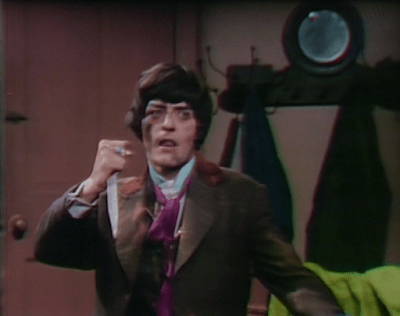
Episode 885: The girl in the portrait

We open with a reprise of yesterday’s closing scene. It is November 1897, and time traveler/ recovering vampire Barnabas Collins is about to be reunited with his lost love, Josette DuPrés, who threw herself to her death from the cliff on Widows’ Hill in February 1796. Josette is now reincarnated in the person of Kitty Soames, the dowager countess of Hampshire. Josette’s personality has been emerging from the substrata of Kitty’s unconscious mind in the eight weeks she has been staying at the great estate of Collinwood. Now Kitty and Josette are merging into a symbiont, and that combined being has agreed to marry Barnabas tonight. Kitty/ Josette is in the Old House on the estate, in the bedroom once meant for Josette, waiting for Barnabas to return from the great house where he has told his distant cousin Judith of their wedding plans.

Barnabas enters the bedroom just in time to see Kitty/ Josette assumed bodily into the portrait of Josette that hangs over the mantel. He reaches up to touch Kitty/ Josette, and the two of them both vanish.

Barnabas finds lying himself on the ground, wearing clothes he last put on in the 1790s. He stands up and calls out for Kitty. “Kitty! Kitty! Where are you, Kitty?” He calls her name several more times. Oddly, he stops short of calling out “Here, Kitty, Kitty, Kitty!” In a comment on Danny Horn’s post about the episode at his great Dark Shadows Every Day, user “kosmo13” wrote “It would’ve been cool if they’d had a cat wander into the scene at that moment and had Barnabas say ‘No. Not you!'”*

Barnabas comes face to face with Ben Stokes, who was his indentured servant and fanatically devoted friend in the 1790s. Ben has no idea why Barnabas is talking as if they haven’t seen each other for a long time- they saw each other last night, as far as he is concerned. Barnabas realizes that he has traveled back in time again. He was in 1897 after being dislocated from the 1960s. Now he has returned to February 1796, to the very night Josette killed herself.

Barnabas tries frantically to keep Josette from repeating her suicide. He sends Ben to the great house of Collinwood to see if Josette is in her room there, as she is supposed to be. He is concerned that, since the trip through the portrait left him on the ground near the woods, there is no telling where it may have dropped Kitty/ Josette.

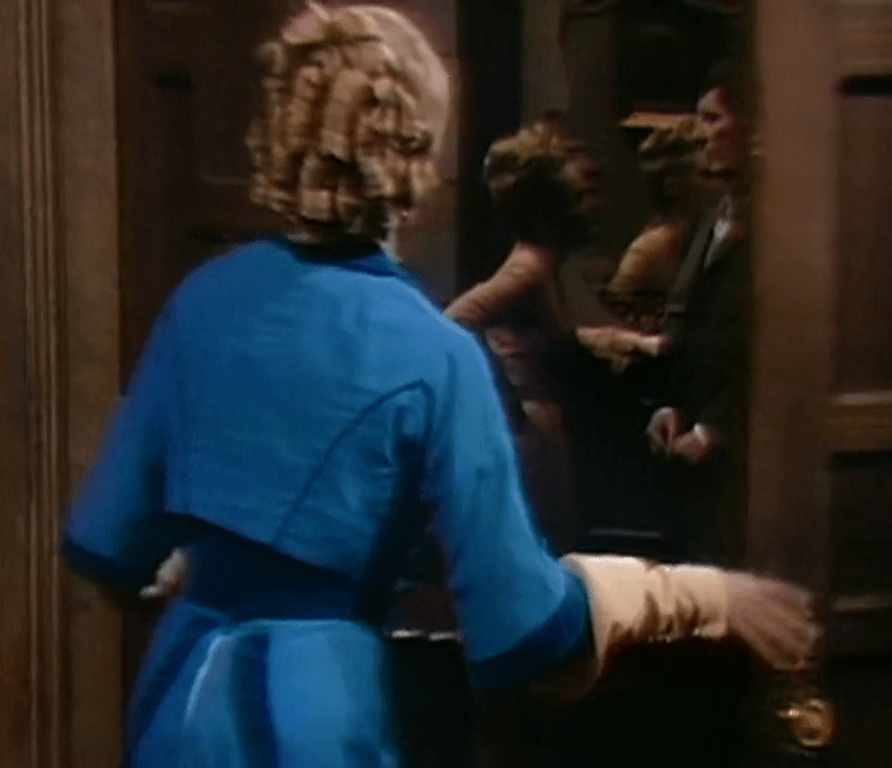
He needn’t have worried about that. We see Josette in bed, as she was in #425, the first time the show took us through this night. Her aunt Natalie, the Countess DuPrés, is with her, and is intensely afraid of a prophecy foretelling Josette’s death this night. That much is identical to what we saw in the previous timeline, when the show was set in the 1790s in February 1968. Josette does tell the countess that she had an odd dream in which she was wearing an unfamiliar dress and having a conversation with a portrait; that dream, which Josette herself dismisses as not at all important, is evidently the only trace of Kitty left in Josette’s conscious mind.
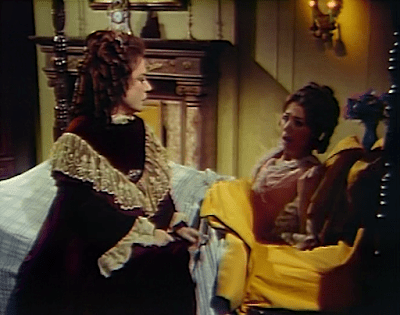
Josette tells the countess about her dream. Screenshot by Dark Shadows Before I Die.

This scene plays on the iconography of these two actresses. From the moment Kathryn Leigh Scott showed up as Kitty in #844, her title has reminded us of Josette’s aunt. So it is with a nice sense of inevitability that we see the show’s first countess again. Moreover, Miss Scott first joined the cast as Maggie Evans, The Nicest Girl in Town; Grayson Hall as Maggie’s psychiatrist, Julia Hoffman, MD. So it seems right to us when the countess becomes a therapist and listens intently to Josette’s account of her dream, growing only more interested as Josette insists that the dream was unimportant.

The first time through, Barnabas was trying to kill Josette and turn her into his vampire bride. Wicked witch Angelique, who had made Barnabas a vampire in the first place, lured Josette to the top of Widows’ Hill and showed her a vision of herself as a vampire. When Barnabas showed up, Josette ran from him and jumped off the cliff, flinging herself to a death on the rocks below rather than let him make her what he was.

This time, Barnabas wants Josette to live. He knows what Angelique is planning. During his eight months in 1897, he and Angelique became allies, almost friends. So it is logical that he meets with her and asks her to leave Josette alone. But this is Angelique as she was in #425. She is enraged with Barnabas, and full of hate for Josette. She does listen to him, and for a moment she seems to be considering his request that she stay with him through the night. One wonders how she would have reacted had Barnabas leveled with her about what happened in 1897, explaining why he thinks they can be something other than enemies. But he holds back, telling her nothing. She makes a hostile remark, and vanishes.

Angelique does just what she did the first time- she tricks the countess into leaving Josette’s room, projects a voice that Josette mistakes for Barnabas’ voice calling her to go to Widow’s Hill, and causes Josette to see a vision of herself as a vampire once she is on top of the hill. At the end, we hear footsteps approaching. The last we saw Barnabas, he announced he was hastening to Widows’ Hill to keep Josette from jumping; if he arrives now, that is exactly what he will prompt her to do.

In the 1897 segment, Grayson Hall played broad ethnic stereotype Magda Rákóczi and also had a few weeks as Julia. Today she returns to the cast after an absence of more than five weeks. She spent that time in Excelsior Springs, Missouri, where she had a part in a movie called Adam at 6 AM. The cast included Michael Douglas, Joe Don Baker, Dana Elcar, Louise Latham, and Meg Foster. Actor Steve McQueen was one of the producers. Hall and Elcar were the only Dark Shadows alums in the company, though Foster later played an ultra-soapy story opposite David Selby in a miniseries called Washington: Behind Closed Doors.

We haven’t seen the countess since #666. In that one, Barnabas had traveled back to a night a few weeks after the one he arrives in today. He made a terrible mess of things, which is his function on the show, and Ben wound up inadvertently killing the countess. Seeing her today, regular viewers can hope that, whatever misfortunes Barnabas brings with him this time, at least that won’t happen. The countess is a likable character, and while there was a point to showing Ben becoming a murderer it is a point they have already made. They won’t lose anything if they imply that the events we are about to see prevent it from happening.

*Posted 25 December 2024 on Danny Horn, “Not in Canvas Anymore,” Dark Shadows Every Day, 21 June 2016.

Episode 884: Departure date

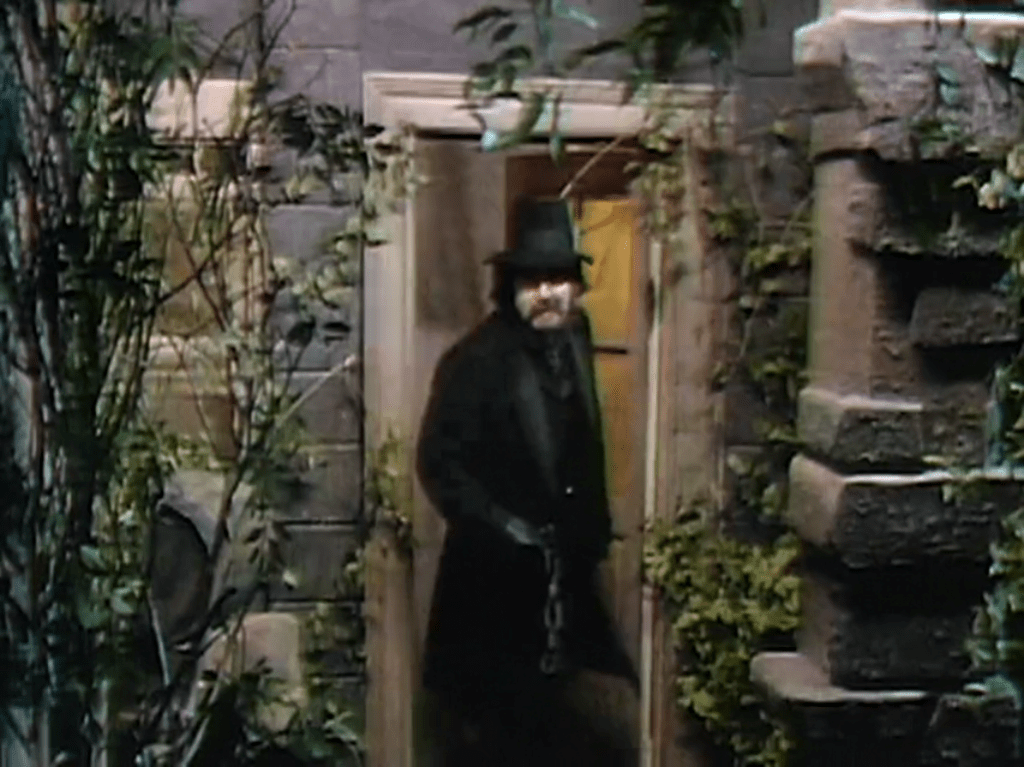
It is November 1897, and time traveler/ recovering vampire Barnabas Collins is searching through the burned remains of a cottage recently occupied by famed artist/ criminal lowlife Charles Delaware Tate. Barnabas finds a pair of glasses just outside the front door and a length of chain just inside. The glasses belonged to Tate’s master, evil sorcerer Count Petofi, the chain to a creature named Garth Blackwood whom Petofi and Tate summoned from the depths of Hell. When Barnabas was last in the house, Blackwood had taken Petofi prisoner there and announced his intention to kill him. Petofi couldn’t get far without his glasses, and the chain was Blackwood’s very favorite murder weapon. So Barnabas has reason to believe both of them died in the fire.

Tate shows up. Barnabas demands he paint another portrait of Quentin Collins to replace the one destroyed in the fire. Quentin is Barnabas’ friend and distant cousin, and, because of some magical powers Petofi long ago gave Tate, the portrait kept Quentin from turning into a werewolf. Tate is a jerk about Barnabas’ demands, as he is a jerk about everything, but finally says he will comply. He tells Barnabas to come back to the ruins of the cottage at 10 PM to pick up the portrait. Barnabas is surprised to hear that Tate can work so quickly, and Tate does not explain why he needs so little time. But after all, the important thing is simply that the magic spell is renewed- the portrait doesn’t have to have any particular aesthetic quality. Perhaps a simple sketch will serve that purpose as effectively as did the full oil painting Tate did previously.

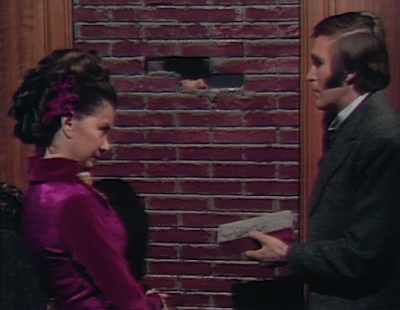
Meanwhile, back at the great house of Collinwood, Quentin’s sister Judith is busy with a project of her own. She is torturing her husband to death. He is the odious Gregory Trask, so she has the audience’s sympathy, at least up to a point. She has had Trask bricked up in Quentin’s old room. There is a telephone there which can receive incoming calls, but not make outgoing calls. Judith has been using it to torment Trask. Today, she directs Trask’s attention to two objects which he has somehow overlooked in his time in the room. One is a portrait of Amanda Harris, a woman he tried to seduce while he had Judith imprisoned in a sanitarium. The other is a loaded gun. When she calls him for the last time, she does not receive an answer, evidently because he has shot himself to death.

Judith is the third role Joan Bennett played on Dark Shadows. In the parts of the show set in the 1960s, she plays matriarch Elizabeth Collins Stoddard. Liz is a depressive personality who keeps trying to kill herself. When from November 1967 to March 1968 the show was set in the 1790s, she played Naomi Collins, Barnabas’ mother, who actually did kill herself when she found out that her son was a vampire. Now she plays someone who, though she was introduced as a psychologically fragile individual, does not kill herself, but drives one of the major villains to commit suicide. Judith’s method of disposing of Trask is not morally defensible, but it is interesting to see Bennett playing a more assertive character.

Trask’s discovery of the portrait of Amanda leads to an interlude in New York City, a place the show hasn’t taken us since #8. Quentin is in a hotel lobby there, waiting for Amanda. She is surprised to see him. They had been lovers, and had planned to leave Collinsport together. He did not meet her at the train station. She had told him that if he did not, she would understand that he had given up on their relationship, so she had gone ahead without him. She says she is so overjoyed at the sight of him that she won’t ask for explanations, but he gives one anyway. He tells her about the portrait. Since she herself came to life as the result of another of Tate’s magical paintings, she can’t very well dismiss the story out of hand. He says that because he does not know where the portrait is, he cannot be sure he won’t become a mindless ravening beast at the next full moon, so he will have to leave her.

Oddly, Judith takes time out from her torture of Trask to perform the same function of motherly talk-to that Liz and Naomi often served. Kitty Soames, the dowager countess of Hampshire, has been staying at Collinwood for the last eight weeks, and is engaged to marry Judith’s stuffy but lovable brother Edward. Contrary to what her title would suggest, Kitty is an American woman in her twenties. Judith sees Kitty coming downstairs with two leather overnight bags. Kitty explains that she will be leaving at once and never returning. She has realized that she cannot marry Edward. She says that she has not told Edward this. Judith says that she is disappointed that they will not be sisters, but that she admires her for facing the truth and doing something about it.

Later, Barnabas comes to the great house. He finds Judith worried that Kitty’s bags are still in the foyer, though she has been gone for hours. He says that he knows where she is. She is waiting for him. They will be married later tonight. Judith is bewildered by this. Barnabas says that they will come back after their wedding and tell Edward what they have done, and that they will then leave Collinwood forever. She is sad to think that they will be going.

In fact, Kitty is two people at once. The young dowager shares her body with the soul of the late Josette DuPrés, whom Barnabas loved when he was a living being in the 1790s and whom he tried to recreate when he was a vampire in the 1960s. Ever since Kitty arrived at Collinwood in #844, Josette has been forcing her way into her conscious mind, triggering psychotic episodes and from time to time pushing Kitty aside and living through her body. Now Kitty is in the bedroom once meant for Josette in the Old House on the grounds of the estate. Josette’s voice keeps speaking to Kitty through the portrait of her that hangs there, urging her to let go and accept her place as part of a combined entity that will love Barnabas and live with him in the bonds of matrimony. Kitty struggles against the voice. For a time she hopes Barnabas will help her thwart Josette’s attempt to come back to life and take the leading part in their symbiotic existence, but when he enters he urges her to give up the fight and become Josette.

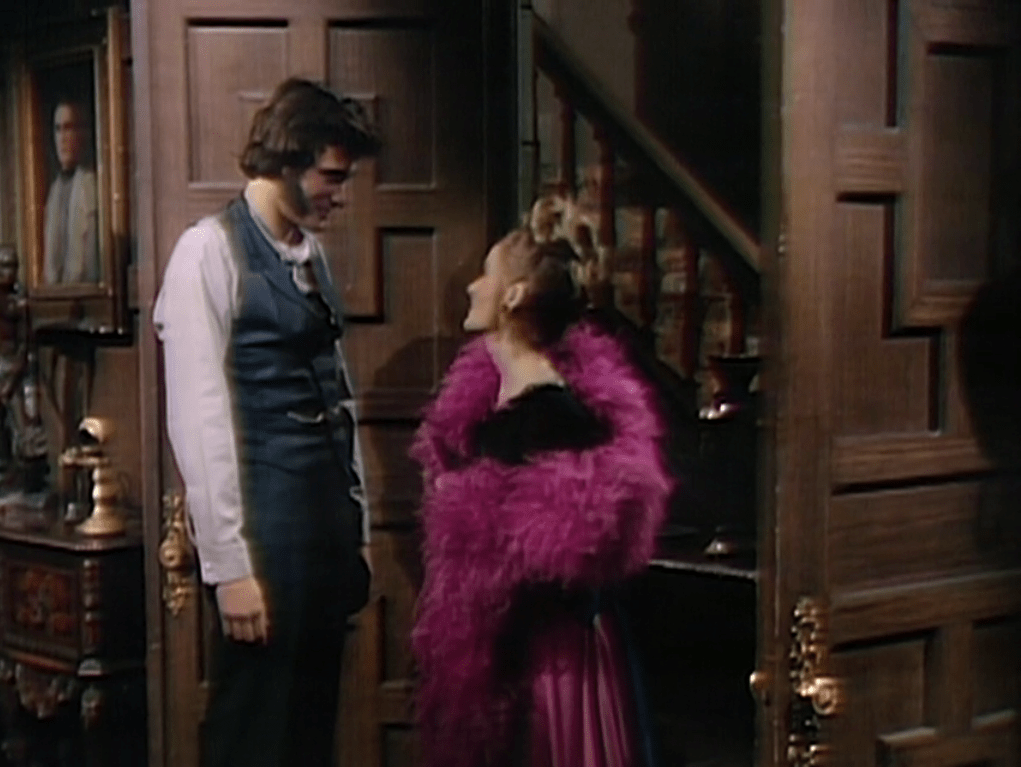
Kitty is alone in the room when she suddenly finds herself wearing Josette’s white dress. She floats off the floor and into the portrait. Barnabas enters just in time to see Kitty merge with the portrait. He reaches up to the Kitty/ Josette entity in the frame above the mantel, and he and Kitty both disappear from the screen at the same time.

Josette puts Kitty in the picture. Screenshot by Dark Shadows Before I Die.

Josette was first mentioned in #5 as the lady who went over the cliff at Widows’ Hill, and her ghost emerged as the tutelary spirit of Collinwood in the months that followed. In #70, our first view of the Old House involved the first truly ambitious special effect, when Josette’s ghost, who was Kathryn Leigh Scott in a veil and a white dress, emanated from the portrait and took three steps from it down to the floor. When Miss Scott’s Kitty rises up into the same portrait today, longtime viewers will see that momentous little journey in reverse.

Barnabas was not dreamed of until long after Josette’s ghost emerged. When we first saw him in the Old House in #212, he delivered a speech to her portrait telling her that her power on the estate was ended, and for several weeks afterward strange and troubled boy David Collins, who had been the ghost’s close friend, lamented that he could no longer feel her presence. In those days it sounded like Josette was Barnabas’ grandmother, and she had sided with his father in the fateful conflict that led to his becoming a vampire.

Later, Josette was retconned as Barnabas’ lost love. In a plot borrowed from the 1932 film The Mummy, Barnabas decided that Maggie Evans, The Nicest Girl in Town, was Josette’s reincarnation, and he tried to torture her into accepting this fact. Maggie resisted Barnabas. She ultimately escaped, only to have her memory of his abuse wiped clean by her psychiatrist, Barnabas’ accomplice and future best friend Julia Hoffman, MD.

Maggie was another Kathryn Leigh Scott character. When Miss Scott played Josette in the 1790s segment, the show was sticking to its source material, in which Zita Johanns played Imhotep’s victim Helen Grosvenor in the contemporary sequences and his lost love, Princess Ankh-Esen-Amun, in the flashback to ancient Egypt. It also left us with the uncomfortable feeling that perhaps Barnabas was onto something when he devised his horrifying program of cruelty towards Maggie. Sure, his methods were wrong, but if she “really” was Josette, he wasn’t just crazy.

With Kitty, they take us a step further. Barnabas’ attempt to Josettify Maggie made the show so bleak for so many weeks that longtime viewers will flinch at the thought that Kitty would be right to yield to Josette’s importunings, and even more at the idea that this will lead to a happy marriage between the Kitty/ Josette symbiont and Barnabas. Yet within the context of what we have seen in the 1897 segment, these would seem to be plausible conclusions. The body they share is as much Josette’s as it is Kitty’s, and Kitty has nothing to lose by merging fully into the being who lurks in the substrata of her mind.

For his part, Barnabas’ relationship to Kitty represents almost as drastic a departure from the personality he showed in his relationships to Miss Scott’s previous characters as the reinvention of Josette as his lost love rather than his estranged grandmother did in his early days on the show. He does not abduct her, torture her, or even give her Josette’s hypnotic music box. It is Josette’s ghost, always before shown as a benevolent force, that keeps pressing the transformation on Kitty. Barnabas is a gentle and considerate lover to the Josette part of the Kitty/ Josette complex, and is solicitous to the Kitty part. When Barnabas disappears with Kitty, we reverse not only the walk Josette’s ghost took in #70, but also the speech he gave in #212. So far from wanting to expel Josette from the world of the living as he did then, or turn her into his vampire bride as he tried both with Maggie in 1967 and with the living Josette in 1796, he wants to revive her as herself.

Barnabas’ function on the show, both when he is an outright villain and when he is trying to be the good guy, is to create problems that other characters will have to solve. So this moment of benevolence and rationality cannot last. It is the ultimate indication that the 1897 segment has indeed ended. But it is a beautiful little thing, for the few minutes it lasts.

This episode marks the final appearance of Trask and of Judith. We will see Kitty again tomorrow, but only in a reuse of today’s closing scene. After that she will only be implied as a feature of Josette’s unconscious mind.

Episode 883: The stone of justice

In the parts of Dark Shadows set in 1966 and 1967, the home of artist Sam Evans and his daughter Maggie, The Nicest Girl in Town, was a frequent set. Sam and Maggie were important characters in several storylines, and in their cottage they represented the working class of the village of Collinsport, as against the rich people in the big house on the hill.

Now, the show is a costume drama set in 1897. In that year, the Evans Cottage is already an artist’s studio. It is occupied by Charles Delaware Tate, who became a nationally renowned painter by making a deal with evil sorcerer Count Petofi. Today, Petofi is staying in the cottage, and Tate is functioning as his goon.

Petofi is deep in a trance, trying to cast a spell that will cause him and handsome young rake Quentin Collins to switch bodies. Once he has accomplished this switch, he will cast another spell to take himself, in Quentin’s body, to the year 1969, leaving Quentin behind in 1897 to face the vengeance of Petofi’s mortal enemies.

Cockney showgirl/ mentalist Pansy Faye has caught on to what Petofi is attempting to do, and has sneaked into the cottage to stop him. He snaps out of his trance and declares he will punish her. She grabs his glasses and runs to the door; Tate enters and grabs her. At Petofi’s behest, Tate ties Pansy up. Petofi then sends Tate to the great house of Collinwood to fetch Quentin. He is to say that Petofi will kill Pansy unless Quentin comes within the hour.

At the great house, Tate finds that Quentin has fled and cannot be reached. Quentin’s friend and distant cousin, time traveler/ recovering vampire Barnabas Collins, insists on going back to the cottage with him. When he arrives, it occurs to Petofi that Barnabas’ body is just as well suited to his purposes as is Quentin’s. He lists some of the characters who are waiting for Barnabas in 1969, and predicts they will receive him “with open arms” when he arrives in Barnabas’ form. Regular viewers are perhaps chilled, and certainly intrigued, by the idea that the show might go forward with Petofi impersonating Barnabas in a contemporary setting while a Barnabas who looks like Petofi tries to make his way back from the past, though there are so few surviving characters and unresolved story points left in 1897 that it is hard to imagine many more episodes even partially set in this period. Petofi uses his magic powers to knock Barnabas unconscious, and goes into a trance to effect the body swap.

The door swings open, and someone called Garth Blackwood enters. The other day, Petofi had Tate draw a picture of Blackwood, a picture endued with magical powers. It brought Blackwood back to life. Some years ago, Blackwood was a jailer murdered by an escaping convict named Aristide. Petofi found Aristide and took him on as a servant. Aristide has recently proven to be unreliable, and Petofi has decided he wants to be rid of him once and for all. He was amused by the idea of resurrecting Blackwood to perform the task. Blackwood has killed Aristide, but Petofi found on Monday that there is more to him than his own magical powers created. He cannot lay Blackwood to rest. Now, Blackwood has resolved to kill Petofi and Tate.

Tate flees at the sight of Blackwood. Pansy, free, asks if he is the police. He identifies himself as the master of Dartmoor Prison. Pansy, being English, is impressed. She points to Petofi and tells Blackwood that he must act against him. Blackwood puts handcuffs on Petofi, then slaps him until he comes out of his trance.

Petofi pleads with Blackwood to drop all charges against him, since he was the one who gave him the chance to kill Aristide. Barnabas comes to and asks what is going on. When Blackwood asks if he testifies for Petofi or against him, Barnabas gladly pronounces “Guilty!” He starts to say that Petofi must be killed immediately, and Blackwood cautions him against giving opinions. The witnesses are to offer only facts. So he asserts that Petofi and Aristide traveled the world together for years and committed every possible crime. At that, Blackwood bids him and Pansy leave. Once he is alone with Petofi, Blackwood picks up a metal can, douses the place with fluid, and lights a fire.

Back at the great house of Collinwood, Barnabas and Pansy talk about what just happened. Barnabas says he is confident Blackwood will kill Petofi, but he thinks he and Pansy may have to fight Blackwood later. Pansy has a vision of Blackwood and Petofi struggling with each other amid the flames in the Evans Cottage. She also sees the portrait of Quentin burning there. Since this portrait has a magical charge that keeps Quentin from turning into a werewolf, that’s bad news.

Garth Blackwood and Count Petofi, battling in the blazes. Screenshot by Dark Shadows Before I Die.

Petofi has been so powerful that it has long seemed likely that his destruction could come only as the result of his own action. When his right hand, the locus of most of his powers, was reattached to his wrist in #815, the show was giving hints it might wrap 1897 up soon. We kept hearing that the Hand had developed a mind of its own in the century it had been separated from Petofi; we could easily imagine it deciding to strangle him, and indeed in #841 it nearly did. But 1897 was such a big hit that they kept restarting it, and for some time now the Hand has done more or less what Petofi wanted it to do.

It would have been fitting had Pansy killed Petofi, since she is, in her present form, one of his creatures. The original Pansy Faye was killed in #771. In #819, Petofi erased the personality of minister’s daughter Charity Trask and gave Charity’s body to Pansy. Pansy’s light-heartedness and apparent harmlessness would have added to her suitability as the instrument of Petofi’s demise. The whole idea of the supernatural is that what appears to be weak is in fact irresistibly strong, so it would be fitting to have a tiny woman who is a character from very broad comedy conquer the great wizard.

Blackwood has only been on Dark Shadows since #878, was never previously mentioned, and is the shallowest character possible. But those weaknesses, too, give him a logical place as Petofi’s executioner. Petofi was never more smug in his self-assurance than he was when he used Tate to bring Blackwood into being in order to murder Aristide. Petofi has so easily defeated efforts by characters who had long records of dominating the action of the show, such as Barnabas and wicked witch Angelique, that we can understand why it would not occur to him that a day player could present him with any serious difficulty. That self-assurance leads him to carelessness, as he creates in Blackwood a being whose strength comes not only from him, but from the fires of Hell from which he came. Indeed, Petofi’s only thought when he brought Blackwood back from the dead was of the suffering he would inflict on Aristide, and his only feeling was delight in contemplating that suffering. Coming as the price of his overconfidence and his gleeful cruelty, it puts a moral at the end of the story when Petofi falls at Blackwood’s hands.

This episode marks the final appearance of the characters Petofi and Blackwood. It is also the final on-screen appearance of Pansy, though her voice will be heard once more, in an episode next week.

Episode 882: The show must go on. That’s the one and only rule there is.

Many fantastic tales dwell on a sense that dreams have a great power in the world, and so their characters are often afraid of falling asleep. Dark Shadows has several times referenced Edgar Allan Poe, who explored that fear in stories like “The Premature Burial,” “The Tell-Tale Heart,” and “The Man of the Crowd.” The show brought up another writer of fantastic tales preoccupied with the fear of sleep in #808. Aristide, henchman of sorcerer Count Petofi, threatened an enemy of Petofi’s with “the mysterious shadow he can cast, the shadow that isn’t your own that follows you.” That was a reference to George MacDonald’s 1858 novel Phantastes, in which a man named Anodos is plagued by a shadow that moves about on its own, following him and blighting his existence. Not only does Anodos fear sleep from time to time in Phantastes, but the main theme of MacDonald’s other very popular novel, 1895’s Lilith, is Mr Vane’s long refusal to sleep and the great battle he must wage in the dream-world when he finally does allow himself to nod off.

Aristide’s threat suggested that the show was about to give us a story based on Anodos and the autonomous shadow. Aristide is dead now, and Petofi is running out of story, so that isn’t going to happen, at least not in the segment of Dark Shadows set in the year 1897. But today we do get a little bit of George MacDonald in the form of a battle against sleep. Petofi is casting a spell over himself and handsome young rake Quentin Collins. If Quentin loses conscious control of his mind for even a moment, he and Petofi will evacuate their respective bodies and be re-embodied as each other. Petofi will then transport himself, in Quentin’s body, to the year 1969. Quentin will be left behind in 1897, occupying Petofi’s aging form and waiting helplessly for Petofi’s mortal enemies to come and kill him, thinking they are taking their long-delayed revenge.

By the time Quentin finds out what’s going on, it is the wee hours of the morning, after he hasn’t slept for a couple of nights. His friends, Cockney showgirl/ mentalist Pansy Faye and time-traveler/ recovering vampire Barnabas Collins, keep marching him around the drawing room of the great house of Collinwood in an effort to keep him awake. They don’t brew up any coffee, strangely enough. But Barnabas does call on wicked witch Angelique and appeals to her to use her powers to put some kind of barrier between Quentin and Petofi.

Angelique tells Barnabas that she is reluctant to help Quentin because she is upset that he wants to go to New York and look for a woman named Amanda Harris. She had wanted Quentin to fall in love with her, and is jealous that he chose Amanda instead. Barnabas points out that if she doesn’t help Quentin, he won’t exist in the form that either she or Amanda knew. Angelique explains that she has a reason for her attitude:

Before I came here this time, I was in the everlasting pits of Hell, where other creatures of my kind live. Only, my stay here on Earth made me dissatisfied with my life there. I longed to come back here… To Earth, to become a human being. I begged my master for the chance.

Finally, he gave it to me on one condition and one condition only… That I make one man fall in love with me, without any use of supernatural spells or powers. One man, one chance. That’s what I was granted.

Since Quentin is the one man who represented Angelique’s one chance, letting him go to Amanda might mean that Angelique has to go back down. My favorite part of her speech is “Only, my stay here on Earth made me dissatisfied with my life there.” Sure, she could have been happy in the everlasting pits of Hell, as one is, but how ya gonna keep ’em down on the farm after they’ve seen Pa-ree. Or, since Angelique’s sojourns in the upper world have all brought her to Collinsport, after they’ve had the lobster roll at the Blue Whale.

While Barnabas is talking with Angelique, Pansy is on Quentin duty. She decides to keep him awake by compelling him to join in a performance of her song. A record of this song, performed by Nancy Barrett and David Selby, hit the stores the very day this episode was first broadcast, so this is product placement. But Pansy is doing exactly what she would do in this situation, Quentin is reacting just as he would react, and it is a charming moment.

The musical number is preceded by Pansy making what literary critics call a programmatic statement. “Feel like it or not, you gotta do it, the show must go on. That’s the one and only rule there is, love. So let’s have a bright chorus from that new team, Pansy Faye and Quentin Collins.” Pansy is not only a good pal and a gifted psychic, she is an accomplished scientist. She has indeed stated the complete physics, metaphysics, and every other operating principle of the universe of Dark Shadows when she says that “The show must go on.”

Angelique and Barnabas enter. Angelique insists on some time alone with Quentin. He says that once he gets to New York he most definitely will be looking for Amanda and that he has no interest in a relationship with Angelique. She looks away from him and talks herself into believing it will be OK if he falls in love with her after Amanda “has ceased to exist.” Longtime viewers can be fairly sure this means that Angelique is planning to murder Amanda, but at the moment the important thing is to get Angelique involved in helping Quentin against Petofi.

Angelique opens the door to the foyer, where we catch a glimpse of Nancy Barrett and Jonathan Frid doing a really marvelous mime depicting “intense conversation.” It’s one of those deliberately stagey bits of business that these twentieth century New York actors do so well.

Angelique opens the door on a silent “conversation.”

Angelique stares into the fire and tries to project psychic power Petofi-ward. We get a process shot simultaneously depicting Angelique in the drawing room and Petofi in his lair. The shot is not very successful, and Angelique explains that her efforts aren’t working either. She says that Petofi is in so deep a trance that she cannot reach him as she has done before.

Petofi’s surroundings are so heavily decorated that this shot just looks cluttered to me. I suppose having Petofi low in the shot and behind the flames is meant to remind us of Angelique’s old neighborhood, but the visual metaphor is spoiled by the cruddy 1960s TV color palette.
In black and white, as most viewers would have seen it in 1969, the shot has different problems- while the more abstract visual style does make the Petofi-as-Satan metaphor legible, it is less clear which shapes are in Angelique’s space and which are in Petofi’s.

Pansy, eavesdropping from the foyer, hears Angelique say that she will need to have something Petofi is wearing right now, something still warm from contact with him, in order to reach him with her powers. Pansy resolves to provide this, and she sneaks out. She makes her way to his lair, and is about to undo Petofi’s necktie when he comes out of his trance and tells Pansy she has interfered with his plans once too often. We have flashed to the motionless Petofi several times today, leading us to think that Thayer David was going to collect his fee without having to deliver a line. So it is quite effective when he springs into action.

Episode 881: Voracious for the future

The dramatic date is November 1897. We open in an abandoned mill on the old North Road in Collinsport, Maine. The late Garth Blackwood, once the keeper of Britain’s Dartmoor Prison, is about to avenge his own murder. Blackwood was raised from the dead by sorcerer Count Petofi and Petofi’s stooge, artist Charles Delaware Tate. Petofi wants to be rid of his unreliable servant Aristide, and decided that Blackwood, whom Aristide killed while escaping from Dartmoor and has feared ever since, will be the one to slay him.

Blackwood is ready to strangle Aristide, who takes a moment to tell him that if he does so he will be endangering his own existence. He explains that there are others who conjured him up to perform the very task he is about to undertake, and that once he has completed it they will not need him anymore. Blackwood says that this is no problem. Once he has killed Aristide, he will kill them too. He pulls a chain tight around Aristide’s neck.

Tate is outside while this is happening. The set represents the exterior of the mill. The set is alternately in deep shadow and illuminated by lightning flashes. We haven’t seen it before, it is rather nice.

Tate hides while Blackwood leaves, then goes into the old mill and confirms that Aristide is dead. Aristide was a nasty and inept fellow, but Michael Stroka found so many ways to make him fun to watch that he will be missed.

Back in his studio, Tate tells Petofi what he saw. He also reminds Petofi that Blackwood has killed two other people, and that he will in all likelihood go on killing everyone he meets. Petofi doesn’t care about any of that. All that interests him is his plan to forcibly swap bodies with handsome young Quentin Collins and, as Quentin, to travel to the year 1969.

Blackwood storms in, declares that Petofi and Tate are his prisoners, and says that they are under sentence of death. Petofi tries to cast a spell to make Blackwood go away; he finds that there is more to Blackwood than his magic can control. He can only hold him at bay, and that only for a moment. Tate shoots Blackwood. The bullet wounds cause him to fall and briefly lose consciousness, but he is soon back on his feet. He leaves, and vows that he will return to finish what he started.

At the great house of Collinwood, Quentin is going through his belongings. Cockney showgirl/ mentalist Pansy Faye enters. Quentin explains that he will be leaving on the early morning train to get away from Petofi. Pansy is sad to see him go, but she well knows how dangerous Petofi is. Quentin further explains that he has been looking through all his old stuff to see if any of it is worth keeping. He doesn’t think any of it is, but she thinks a photograph of him at the age of ten is adorable, and is glad when he makes a gift of it to her. They share a really lovely moment, as she says that she still wishes they could have become lovers and he plays along. She says that if he’d married her, she’d even have given up her career for him. He says gravely that he never would have asked her to do that. Quentin never asked Pansy for any of what she wanted to give him, and her reaction to this line shows that it has reminded her of that fact. But she still cares about him, and it is still a sweet little exchange. They smile their unforgettable movie-star smiles at each other when they part.

Later, Pansy has a dream in which Quentin falls asleep and Petofi seizes his body the instant his guard is down. She awakes, and realizes she must rush downstairs to prevent this dream coming true.

Episode 880: I like all of my stories to have endings

Collinwood: Judith, Trask, Beth, Quentin

In November 1897, wronged woman Judith Collins Trask has had her husband, the odious Gregory Trask, bricked up in her brother Quentin’s bedroom. While Gregory is taking this in, the ghost of another wronged woman appears to him. She is Quentin’s ex-fiancée Beth Chavez. Beth is looking for Quentin. Trask is initially frightened, but then urges Beth to go to Quentin and tell him to come up to the room.

Quentin is in the drawing room, and Beth does appear to him. She says that she cannot rest in peace until she has given him a message. We wonder if she is about to tell him about Trask, but no such thing. Instead, she tells Quentin she forgives him. Then she vanishes, and he shouts that he can’t forgive himself.

We first saw Beth and Quentin at the same time, when their ghosts appeared to children David Collins and Amy Jennings in Quentin’s room in #646. That was broadcast and set in December 1968. Since the show went to 1897 in March, the living beings Quentin and Beth have attracted very different responses from the audience. Quentin has become a huge breakout star, while Beth has faded into the background. She died Monday; this is her first return as a ghost, and her final appearance overall. It rounds things off nicely that her departure begins in the room where we first saw her.

Quentin’s skeleton had been in the room in late 1968. David and Amy removed it and buried it on the grounds. Now history has been changed. Trask’s skeleton may take its place when the show returns to contemporary dress, behind a brick wall there that wasn’t there before. In #839, we saw that while the changes in 1897 have brought peace to the ghosts of Quentin and Beth in 1969, the characters in that year still remember the haunting. So you’d expect the wall to be a puzzle to them, and if they tear it down the skeleton will be as well.

Judith enters and tells Quentin that he can’t go to his room, or to any other room in the west wing of the house. She explains that it cost a fortune to keep that wing open, so she has had it sealed off. She has moved all of his things to a bedroom in the main part of the house. Quentin asks Judith where Trask is; she claims he ran out in pursuit of two violent men who forced their way into the house and hasn’t been seen since, and asserts that she is terribly worried about him. She sounds sincere, but Quentin isn’t fooled. He smiles and asks if he is right to believe that Trask’s story is ended. Judith says that it isn’t, not quite.

Collinwood is supposed to be an immense house, literally. After the first year of Dark Shadows, when a story about the Collinses running out of money was complemented with some specifics about the size of the place,* they have been making it out to be unknowably large. So it seemed inexplicable yesterday that Judith would choose Quentin’s room as Trask’s place of immurement. We learn what her plans were today. There is a telephone in the room; that telephone had been important during the Haunting of Collinwood story. Evidently Judith has rigged it to receive incoming calls only. It rings, and Trask can hear her taunting him. He cannot call out to summon help.

In the first 55 weeks of Dark Shadows, Joan Bennett’s character Elizabeth Collins Stoddard was a recluse who hadn’t left Collinwood in 18 years, believing that she had killed her lousy husband and that his body was buried in a locked room in the basement. It turned out that she hadn’t killed him at all, and the whole recluse theme, and the blackmail plot that it led to, were just one big dead end. As Judith, Bennett is making up for Liz’ lost time.

Outside: Petofi, Aristide, Garth Blackwood, the Widow Romana**

Sorcerer Count Petofi has tired of his unreliable servant, a bungling sadist named Aristide. He has conjured up the ghost of the man Aristide most fears, a jailer named Garth Blackwood whom Aristide killed while escaping from Dartmoor Prison. Blackwood is now hunting Aristide. Blackwood and Aristide were the two violent men who surprised Judith in her bedroom, though Trask never went in pursuit of them.

Aristide ducks into an abandoned mill on the old North Road where he and Petofi had squatted. He hears someone hiding in the back room. A woman jumps out with a knife. Aristide disarms her. He realizes she is the widow of King Johnny Romana, a Rroma chieftain/ organized crime boss whom he killed in #827. Rather than killing her with her own knife, Aristide offers to betray Petofi to the Widow Romana if she will let him join her tribe. He gives her directions to Petofi’s current location. On her way there, she crosses paths with Blackwood, who kills her. Blackwood then makes his way to the mill, where we see him grabbing Aristide.

Aristide draws a map for the Widow. Screenshot by Dark Shadows Before I Die.

When King Johnny died, we learned that in a few days another Rroma somewhere would inherit his immunity to Petofi’s spells and his mission to kill him. That was eleven weeks ago, and we’ve been waiting. The Widow Romana’s appearance today is a gesture towards tying up that loose end.

*In #2, Liz tells well-meaning governess Vicki that there are a total of 40 rooms, most of them in the closed-off parts of the house; in #87, the opening voiceover says that there are 80 rooms.

**Her name is given in the credits as “The Widow Romano,” but “Romana,” which we had heard as King Johnny’s surname in earlier episodes, is a likelier Romany name.

Episode 879: A room of one’s own

The odious Gregory Trask is plotting to murder his fabulously wealthy wife, the former Judith Collins, before she can change her will. He has made an arrangement with Aristide, a sadist who is fleeing a demon his former master conjured up from the depths of Hell to stalk him. He promises to lay the demon to rest once Aristide has murdered Judith.

For her part, Judith has made an arrangement of her own with a man named Tim Shaw. Tim is not appreciably more scrupulous than Aristide, and he hates Trask with a passion. He is also free of the time constraints that the stalking demon imposes on Aristide.

Judith goes upstairs to her bedroom, where Aristide is lurking behind the curtains. The scene looks rather like that in the 1954 film Dial M for Murder, in which a man hides behind curtains while waiting to murder a woman whose husband is blackmailing him into the crime. It is likely that Dial M for Murder was on the minds of the makers of Dark Shadows at this time, since star Jonathan Frid had just missed four and a half weeks while playing the lead in a stage production of it in the Chicago area.

In Dial M for Murder, the wife survives the attempt, killing the would-be assassin. Judith also survives, but not through her own action. Instead, the demon, whose name is Garth Blackwood, bursts into the room. Aristide escapes through the window. Trask enters and finds Blackwood still in the room. Blackwood menaces him with a heavy chain he carries, then leaves in pursuit of Aristide.

Judith persuades Trask to join her in a glass of brandy. He takes a sip, she does not. He passes out, and Tim enters. When Trask awakens, he finds himself in a room in the west wing of the house. Tim is with him in the room. Tim tells Trask goodbye, then springs out the door and locks it behind him. When Trask opens the door shortly after, he finds that Tim and Judith are bricking him in.

So long, Gregory. Screenshot by Dark Shadows Before I Die.

It’s rather much to ask us to believe that the mortar dries instantly, leaving Trask unable to push the wall down. To be bricked up in Collinwood is the fate of all Trasks- Gregory’s ancestor, the original Reverend Trask, was bricked up in an alcove in the basement of the Old House on the estate in #442 by the vengeful Barnabas Collins. Barnabas chained that Trask up, giving the mortar time to set. Moreover, Barnabas chose a dark little out-of-the-way spot in a vacant house. This is in a bedroom suite that Judith’s brother Quentin uses. Most of Quentin’s stuff is out of the room, but there is still some furniture in there and a bunch of candles. You have to wonder what she will tell Quentin when he comes home. For some time they’ve been going on about how vast the great house is, at one point saying that no one had ever counted the number of rooms in it, so it is just bizarre that Judith picked a room that someone is on his way to sleep in.

Episode 878: The moors are my domain

Episode 174 of Dark Shadows, broadcast and set in February 1967, included a scene set in a police station and morgue in Phoenix, Arizona, where we met Lieutenant Costa of the Arizona State Police. Lieutenant Costa was played by John Harkins, who would become a ubiquitous TV presence in the decades to follow.

Harkins returns to the cast today as another law enforcement character. The show is set in 1897, and the action is almost entirely driven by supernatural doings. Harkins’ character, Garth Blackwood, is the late keeper of Dartmoor Prison. He is conjured up from the depths of Hell by sorcerer Count Petofi, who has decided to use him to kill his unreliable servant Aristide. Blackwood was heard but not seen yesterday, in a flashback set near Dartmoor. That flashback broke the record Harkins’ previous appearance had long held for the scene in the series set furthest from Collinsport, Maine.

Blackwood storms into the room where Petofi is recovering from a knife wound Aristide recently inflicted on him. He announces that his prisoner was seen entering the house and threatens Petofi with a heavy chain he carries. Petofi keeps smiling, but points out that he is injured and was unable to stop Aristide leaving. Blackwood exits. The threat suggests that conjuring him up may not have been Petofi’s wisest move. Petofi has such great powers that we have for some time suspected that he himself would have to be the source of his own destruction. Perhaps Blackwood will be the instrument who finishes him off.

At the great house of Collinwood, matriarch Judith Collins Trask tells her lawyer, Evan Hanley, that she is ready to put her husband, the odious Gregory Trask, in his place. She will be changing her will the next day to remove Trask as executor of her estate. Evan, a former co-conspirator of Trask’s in his evil schemes against Judith and others, is reluctant, but can tell there is no point in resisting Judith. He exits, and Trask enters. Judith tells him she will be rewriting her will to pass all of her wealth to worthy causes after she dies, and he is thunderstruck. He exits hastily.

Trask goes to Evan’s house. He tries to talk his onetime partner in crime into stopping Judith’s plan, but Evan says that her resolution is beyond his ability to change. Aristide bursts in. He pleads for help, and reveals that Petofi has conjured up a demon to stalk him. Evan knows Petofi’s power and wants nothing to do with the situation, but Trask does not know what he is dealing with. He promises to help Aristide in return for a favor. Evan leaves the room, and Trask tells Aristide he wants him to commit a murder for him. After he agrees, Evan returns and Trask persuades him to let Aristide stay in his house for an hour.

In Trask’s absence, Blackwood catches up with Aristide. He enters the house, and Aristide flees. He demands Evan let him search the house. Evan’s background as an attorney kicks in, and he declares he will not let Blackwood conduct a search without a warrant. Blackwood’s response is to strangle him with his chain. Evan has been one of the most consistently interesting characters in the 1897 segment; his death is another sign that we will soon be leaving this epoch.

Garth Blackwood dispatches Evan Hanley. Screenshot by Dark Shadows Before I Die.

Episode 877: Put down that sword

Throughout October 1897, which at 4 PM on participating stations of the ABC television network coincided with October 1969, 150 year old sorcerer Count Petofi occupied the body of handsome young Quentin Collins and banished Quentin to his own aging form. Last week Quentin broke that spell, and now the two of them are themselves again.

News of the restoration has not reached everyone, however. On Friday and Monday, Quentin’s lover, maidservant Beth, saw him at the top of Widows’ Hill. Thinking he was Petofi, she flung herself to her death on the rocks below rather than submit to whatever evil magic he had in store for her. Yesterday, Petofi’s unreliable servant Aristide went to Quentin, thinking he was his master, and begged for a task by which he could earn his way back into his good graces. Quentin sent him to murder Petofi, which he is trying to do when we open today.

The attempt takes place in the studio of artist Charles Delaware Tate, an unpleasant man who is tied to Petofi. Tate finds Aristide plunging a knife into Petofi’s chest. He stops the attack and gets through to Aristide that the swap is over and he is stabbing Petofi himself. Desperate to undo his latest offense, Aristide hastens back to the great house of Collinwood, intending to kill Quentin.

Petofi comes to and tells Tate that he intends to repossess Quentin’s body and use it to escape his enemies. When Tate tells him what Aristide has gone to do, he sends him to stop him. He does so, showing up in the drawing room at Collinwood in the nick of time and, at gunpoint, forcing Aristide to lay down the sword with which he was about to run Quentin through.

Back in the studio, Petofi instructs Tate to draw a magical sketch. The sketch depicts a man called Garth Blackwood, a cruel jailer whom Aristide killed when he escaped from prison in England. Petofi remembers meeting Aristide for the first time the night he escaped Blackwood’s prison. In #854 Petofi had said he met Aristide in an alley near the Thames in London, but this time we flash back to a meeting on the moors in the county of Devon. Petofi recalls that Aristide pledged his fealty to him in return for freedom from Blackwood’s ghost.

Once Tate has drawn his sketch, Blackwood will come back to life, determined to take his vengeance on Aristide. Aristide returns to the studio to resume begging for mercy, and Petofi takes great pleasure in showing him the sketch and telling him what is in store for him.

Garth Blackwood.

Episode 876: The gift again

In #425, broadcast in February 1968 and set in February 1796, the gracious Josette was near the cliff on the top of Widow’s Hill when she saw her lost love, Barnabas Collins. Wicked witch Angelique had turned Barnabas into a vampire, and Barnabas planned to kill Josette and raise her from the dead with the same curse. Angelique sent a vision to Josette of what her existence would be like after she rose from the grave to prey on the living. While Barnabas watched helplessly, Josette flung herself to her death onto the rocks far below the cliff.

Barnabas spent the next centuries telling himself that Josette’s suicide was the result of a misunderstanding. In #233, broadcast and set in May 1967, he was masquerading as his own descendant, a cousin from England come to visit the Collinses of Collinsport, Maine. He told heiress Carolyn Collins Stoddard and well-meaning governess Vicki Winters that Josette jumped from the cliff because she did not realize that her lover had come with only good intentions for her. By that time, it seemed he might actually have convinced himself it was true.

Today, it is 1897, and rakish libertine Quentin Collins and his sometime lover, maidservant Beth Chavez, reenact Josette’s suicide. They, however, follow the script which had previously applied only in Barnabas’ head. For several weeks, sorcerer Count Petofi has been occupying Quentin’s body, having confined Quentin to his own aging form. Beth was for a time in thrall to Petofi, and is terrified of him. Petofi was still Quentin-shaped yesterday when he chased Beth onto the top of Widows’ Hill. He collapsed in the woods, and a moment later the spell was broken and the body was Quentin’s again. Quentin, restored to his own person, wanders up to the summit and is surprised to see Beth there.

Quentin tries to tell Beth that he is himself, but she is not disposed to listen. Thinking that he has come to do something worse than simply kill her, she leaps from the cliff.

Terry Crawford says that when they first did this scene, they wanted her to emphasize the drama of Beth’s suicide by really flinging herself down hard. Since the floor was only a couple of feet below the set, the springy mattress that she flung herself on bounced her back into the frame, and they had to retake the shot. I wish we had that out-take, it must have been hilarious.

Quentin returns to the great house of Collinwood, in shock. He doesn’t notify the police or anyone else of Beth’s death- apparently the seascape just isn’t complete without a dead maidservant or two strewn carelessly about.

Barnabas, who has traveled back in time from 1969 to 1897 and who is currently free of the effects of the vampire curse, enters. He has befriended Quentin, and is at war with Petofi. He knew about the body swap, and had urged Quentin to make the effort that reversed it. He does not know how that effort turned out. He is happy to hear that Quentin is himself again, unhappy to learn of Beth’s demise, and insistent that Quentin must go far away before Petofi can get at him again.

We cut to a studio occupied by artist Charles Delaware Tate, a stooge of Petofi’s. We can see that Tate stole the magical portrait that keeps Quentin from turning into a werewolf. He covers the portrait with white paint. A visitor enters. It is Petofi’s servant Aristide. Aristide’s face is covered with dirt. Petofi has turned against Aristide, who has been in hiding. Tate agrees to help Aristide get a bath and clean clothes, but will not intercede with Petofi on his behalf.

Aristide does not know that the body swap is over. He goes to Collinwood, finds Quentin, and assumes that he is Petofi. When he offers to do whatever is necessary to restore himself to his master’s good graces, Quentin tells Aristide to find the man who appears to be Petofi and kill him. Aristide, a sadistic fiend, is delighted to receive this sort of command. He goes back to Tate’s, finds the real Petofi there, and stabs him in the chest.

Aristide getting ready to stab Petofi. Still not using his favorite knife, “The Dancing Girl” (alias “The Dancing Lady.”) Screenshot by Dark Shadows Before I Die.