Episode 857: Champagne for Wanda

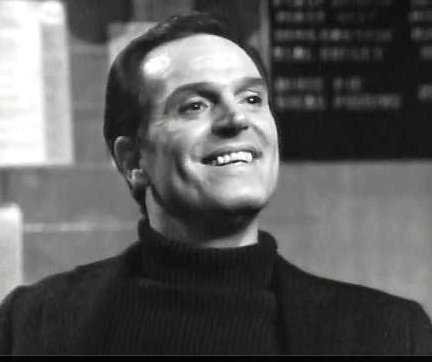
Sorcerer Count Petofi is wearing the body of rakish libertine Quentin Collins as a disguise, while Quentin is trapped in Petofi’s own aging and pudgy form. I will call the villainous Petofi played by David Selby Q-Petofi, and the forlorn Quentin as played by Thayer David P-Quentin.

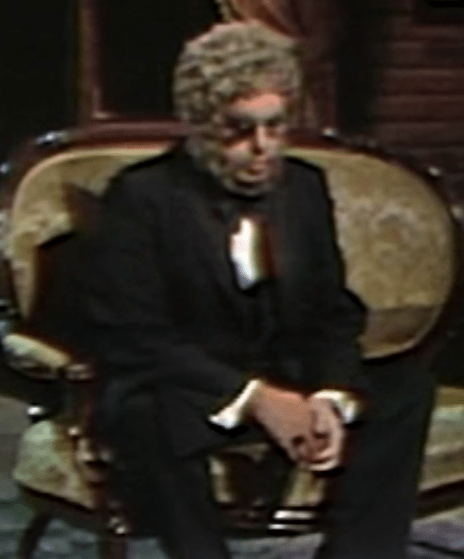
We open with Q-Petofi at the front door of the great house of Collinwood. Yesterday we saw P-Quentin on the same spot, and heard David Selby’s voice articulating the miserable thoughts that showed on Thayer David’s face. Today the roles are reversed, and we see Mr Selby looking exultant while the voice of Thayer David talks about the glories of his situation.

We see that Q-Petofi is accompanied by his henchman, Aristide. He dismisses Aristide’s fear that he will somehow reveal his true identity to the occupants of the great house. He twits Aristide for a little while, pretending that he will use him as a guinea pig in a dangerous experiment he has planned for later in the evening, then sends him off to find someone else to serve that purpose.

Q-Petofi walks in on an argument in the drawing room between stuffy Edward Collins and the overbearing Gregory Trask. Trask is in charge of the house while his wife, Edward’s sister Judith, is in a mental hospital. Trask is going over the household accounts and complaining that Edward is spending too much on his houseguest, Kitty Soames, the dowager countess of Hampshire. Edward asks Q-Petofi to explain Collinwood’s tradition of hospitality to Trask, setting Trask off with a rant about Quentin’s relationship with Trask’s own former houseguest, the lovely and mysterious Amanda Harris. Q-Petofi’s indifference to the whole discussion strikes both Trask and Edward as odd, but it really is quite typical of the old Quentin.

After Trask exits, Edward tells Q-Petofi that he thinks he can subdue Trask by marrying Kitty. He says that it takes money to run Collinwood, and the late Earl’s estate gives Kitty ownership of half the county of Hampshire. Returning viewers know that the Earl died bankrupt, and so far from owning great swathes of southern England Kitty doesn’t even have train fare to get from Collinwood in central Maine to her mother’s house in Pennsylvania. So we have confirmation that Kitty has been less than fully honest with Edward. On the other hand, Kitty is under the impression that Edward is rich, while in fact their grandmother left every penny to Judith. So neither is leveling with the other about their financial status. Q-Petofi knows all of this, but it has nothing to do with his plans, and so he struggles to feign interest.

For his part, P-Quentin is sitting in the caretaker’s cottage on the estate. It seems right to longtime viewers that a character played by Thayer David should seek refuge here. When we first saw the cottage, it belonged to handyman Matthew Morgan, who was at that time played by George Mitchell. In #38, Mitchell was replaced in the part of Matthew by Thayer David, in the first of the many roles he would play on Dark Shadows. When Matthew had to leave the cottage for the last time in #112, his whole world fell apart. So when Aristide comes in and brutally evicts him, we can feel the full weight of the disaster that has befallen P-Quentin.

With nowhere else to go, P-Quentin returns to the great house. Once again it is Thayer David’s turn to look soulfully at the camera while David Selby’s voice speaks desperate words in voiceover. He tells himself that his brother Edward will have to believe him when he tells him the truth.

As it happens, Edward likes Petofi and is glad when he believes he is receiving a visit from him. Based on Edward’s earlier remarks about Collinwood’s tradition of hospitality, we could be quite sure that if P-Quentin presented himself as Petofi, Edward would be glad to offer him a place to stay. But P-Quentin plunges right in and tries to tell Edward the whole story. Of course Edward is not convinced. He treats it as a joke in questionable taste, and offers P-Quentin a brandy. When P-Quentin tells him to forget the brandy, he says that if he really were Quentin, he would never forget the brandy.

P-Quentin insists on going ahead with the lunatic tale, and keeps clutching at Edward’s arm. Edward finds the whole experience revolting, and firmly escorts him to the door. If it has occurred to P-Quentin to tell Edward any of the little stories of childhood that only he and Edward would know, it is too late now to do so. Edward orders P-Quentin to stop talking and go home. Little does he know that P-Quentin has no home to go to.

At the waterfront, the fog machine is working overtime, and so is one of the locals. In a comment on Danny Horn’s post about the episode at his great Dark Shadows Every Day, user “Goddess of Transitory” remarks:

I was remarking to my husband about the really remarkable size and relative wealth of the hooker population of Collinsport. They may hang at the docks (makes sense in a port town–you troll for lonely sailors) but they all have really nice clothes and jewelry and no matter how many of them Barnabas et al. tear through, there’s always more.

Makes you wonder what modern day Collinsport’s main economic generator really is…

Comment by “Goddess of Transitory,” left 7 April 2021 on Danny Horn, “Episode 857: All of Him,” 5 May 2016, Dark Shadows Every Day.

We find today’s well-bathed, well-coiffed, well-made-up young woman of professionally agreeable disposition drinking from a flask. Aristide emerges from the fog and takes the flask from her. When she protests, he says that if she follows him, she will be drinking champagne, and her protests subside. Her name is Wanda Paisley.

Aristide takes Wanda to the cottage, where Q-Petofi is waiting. Wanda is quite pleased at the prospect of sharing her favors with two handsome young men at once, but less pleased when Q-Petofi says that before the festivities get underway she will have to throw some I Ching wands and meditate on them. He assures her that she will be well paid for whatever services she may render, and asks her to agree that this is what really matters. Wanda’s agreement is not forthcoming. When Q-Petofi keeps yammering on about the wands and the hexagrams and the trance and the doors, it dawns on Wanda that this evening is not going to be what she signed up for, and she gets up to leave. Aristide grabs her, and Q-Petofi uses his magical powers to coerce her into cooperating.

Wanda casts the wands and meditates on them. She has a vision of a skeleton with big plastic eyeballs reaching its arm bones out to her. She screams. Where she had been sitting is another skeleton with big plastic eyeballs, this one also wearing a dress and a wig. Q-Petofi tells Aristide that “beyond the door anything is possible.”

Her turn as Wanda today marks Karen Lynn’s only appearance on Dark Shadows. She’s very good, it’s a shame they couldn’t find more for her. Her only other screen credit is a 1963 feature called The Orgy at Lil’s, which an IMDb reviewer says made history as “the first roughie.” I don’t know what a “roughie” is, and based on the description of The Orgy at Lil’s I rather doubt that my education in cinematic history would be significantly deepened by finding out. At any rate, it sounds like Miss Lynn was well-prepared to portray Wanda’s enthusiastic response when Q-Petofi first joined her and Aristide.

I made a contribution of my own to the comment thread on Danny’s post:

This has to be the archetypal Dark Shadows episode. It has Jerry Lacy modeling the style of acting he and Lara Parker invented for the show, Louis Edmonds being sarcastic, a squabble about control of Collinwood, people drinking brandy, a prostitute picked up on the docks while the [fog] machine runs, several kinds of supernatural mumbo-jumbo presented as if we will of course understand them, a dream sequence, and a skeleton in a wig. The next episode opens with a grave-digging scene, which is pretty nearly the only thing missing from this one.

Comment left by “Acilius,” 3 December 2020, on Danny Horn, “Episode 857: All of Him,” 5 May 2016, Dark Shadows Every Day.

It’s true no actors blow their lines, none of the boom mic shadows obstruct our view of anything crucial, and there is only one audible cough from a crew member, so it is an unusual episode in some ways. But I could have mentioned another very typical thing- a practical effect they try for the first time. I believe the split screen shot of Q-Petofi in the drawing room and P-Quentin at the cottage is the first time the show has used this device. It doesn’t work very well, but they were always pushing to do something new:

P-Quentin (Thayer David) and Q-Petofi (David Selby.) Screenshot by Dark Shadows Before I Die.

Episode 840: A man who has betrayed a friend

Artist Charles Delaware Tate goes to the great house of Collinwood, where he interrupts a passionate kiss between handsome rake Quentin Collins and mystery woman Amanda Harris. Quentin is getting pretty serious about Amanda. That is to say, one of his two fiancées tried to kill him the other day, so that engagement is off, leaving him with some free time.

Tate has been commissioned to paint a portrait of Amanda, and he leverages that fact to bully Quentin into leaving him alone with her. Tate goes on a lunatic rant, claiming that he caused Amanda to exist by painting a picture of her two and a half years before, in the spring of 1895. As returning viewers know, this happens to be true, but it sounds preposterous and Tate has no way of getting past Amanda’s instant rejection of it. He doesn’t help his cause when he keeps pawing at her and shouting in her face.

Unclear how much of the reaction is Amanda thinking Tate is a crazy man and how much of it is Donna McKechnie shocked that Roger Davis is groping her breasts on camera. Screenshot by Dark Shadows Before I Die.

Amanda runs out of the room. She passes Quentin on the staircase. He asks what Tate did to her; she refuses to talk about it and keeps running. Quentin confronts Tate, who tells him that he will know all about it soon enough, since he, like Tate, is now under the thumb of sorcerer Count Petofi.

Petofi is staying in an abandoned mill nearby. This was originally a hiding place, but virtually everyone on the show has visited him there by now. He may as well move someplace more comfortable. We saw in #813 that the Collinsport Inn already houses the restaurant which was often featured in the first year of the show, when it was set in contemporary times; if he stayed there, at least he’d be able to get something to eat.

Tate calls on Petofi at the old mill. He tests him, and finds that even though Petofi gave him his skills as an artist he does not realize that he conjured up Amanda and that he can do the same with inanimate objects. Regular viewers have already heard Petofi admit to his henchman Aristide that he does not fully understand his own magical powers, and we have seen him attempt tricks that have not worked very well. So, while Petofi is mighty indeed, his powers have some very definite limits. Perhaps Tate will draw Petofi helpless before one of his enemies.

The enemies Petofi most fears are the Rroma people, to whom he always refers as “Gypsies.” He narrowly escaped death at the hands of Rroma chieftain/ New England crime boss King Johnny Romana in #827 and #828. King Johnny had caught up to Petofi and was about to use his sacred scimitar on him when Aristide threw a knife and got him in the back. With his dying breath, King Johnny told Petofi that another Rroma would be along soon.

Petofi thinks he has hit upon the perfect means of escaping from the Rroma. He has learned that vampire Barnabas Collins traveled to 1897 from the year 1969, and now Barnabas’ friend, mad scientist Julia Hoffman, has followed him. Petofi is convinced Barnabas must have known what he was doing, and that he must have a means of returning to the future. But regular viewers know that Barnabas never knows what he is doing. He stumbled into the past while trying to do something else, and hasn’t the faintest clue how to get back to the 1960s. He has told Petofi as much, and Petofi flatly refused to believe him.

Petofi has Julia in custody. He forces her to tell him that she and Barnabas both traveled back in time using the I Ching. Barnabas cast a particular hexagram, meditated on it, and found himself in 1897. The wands were still in place some time later, and Julia meditated on them with the same result.

Petofi goes to Collinwood and visits Quentin in his room. He knows that Quentin has a set of I Ching wands, the very set Barnabas and Julia used to make their journeys, and he wants to borrow them on the assumption that while meditating on them he will be able to will himself into the 1960s.

Quentin is unhappy to see Petofi. As Tate said, Quentin is under Petofi’s control. Petofi forced him to reveal Barnabas’ hiding place; that’s how he was able to abduct Julia. Quentin rails against the injustice of all this, and declares that he won’t do any more favors for Petofi. But Petofi tells him that he is his slave now. Petofi gloats that while Quentin hasn’t always been a slave, he himself has always been a master. Quentin winds up telling him where the wands are.

Back in the old mill, Julia gives Petofi some pointers about the I Ching. She reads from the Book of Changes, and when she gets to a part that makes it clear it is not a tool that can be used to gain control of anything, he angrily orders her to stop. He casts the wands, meditates on them, and his “astral body” passes through a door. The door leads to a chamber where he sees a hand raising the scimitar King Johnny had wielded.

Episode 839: Second chance

Twenty-eight weeks ago, the ghost of Quentin Collins had made life intolerable on the great estate of Collinwood. Recovering vampire Barnabas Collins, in an attempt to contact Quentin and persuade him to make peace before his haunting killed his twelve year old great-great-nephew David Collins, accidentally traveled back in time to 1897, where he met and befriended the living Quentin.

In that time, he learned that Quentin was a werewolf. In 1969, Barnabas and his friend Julia Hoffman, MD, had been trying to cure a man named Chris Jennings of lycanthropy. Now, Barnabas has figured out that Chris inherited his curse from Quentin, whose infant daughter Lenore will grow up to be Chris’ grandmother.

Julia herself has now traveled back in time. The journey left her dazed and, astonishing to behold, unable to speak. Today, Barnabas and Quentin at her bedside in the hiding place Barnabas has found, and she started talking. She has a vision of 1969. She sees David lying dead and his father Roger mourning him. Suddenly David comes back to life and announces that Quentin’s ghost and that of maidservant Beth are no longer haunting the house. When Julia regains her senses, she tells Barnabas that this means that they should both go back to 1969- their mission in the past is complete.

Barnabas declares that they cannot leave, because Chris is still a werewolf. He doesn’t actually know this. Chris wasn’t in Julia’s vision. His transformations became more frequent and longer lasting as Quentin’s ghost gained power; when Quentin achieved total control over the great house at Collinwood, Chris took on wolf form permanently. For all Barnabas knows, the end of Quentin’s obsession of Collinwood might mean Chris’ return to normal. He also knows that Quentin himself remained human the last time the Moon was full, suggesting that something has happened to the curse. Perhaps if they return to their own time, he and Julia will find that Chris is not a werewolf and never was one.

Barnabas tells Julia that, while she and a fellow mad scientist had managed to free him of the effects of vampirism in the 1960s, he is fully subject to them in 1897. Moreover, everyone knows that he is a vampire, and he is being hunted. And there is an evil sorcerer in the area, Count Petofi, who is closely connected with Quentin and who has malign intentions towards Barnabas. Julia points out that all of these are reasons to return to 1969 at once.

Barnabas demands that Julia develop a treatment that will once more put his vampirism into remission. Julia calls this impossible. The drugs and devices she used to accomplish this in the 1960s have not yet been invented, and even in that time she was just barely able to make the treatments work. In the story we actually saw in 1968, treatments of the kind Julia is talking about worked only for a little while, and the lasting cure came only when Barnabas was hooked up to a Frankenstein’s monster. There clearly is no time to create an abomination of that kind.

But there is no reasoning with Barnabas. Julia concedes this- “I always lose with you, don’t I?” She agrees to stay and to do her best.

Barnabas suspects that Quentin is working for Petofi. This is true. Not only did Petofi save Quentin’s life yesterday, but he also arranged the painting of a portrait which, like the one in Oscar Wilde’s Picture of Dorian Gray, changes while Quentin remains the same. When Quentin realizes that Petofi has the power to make him human or return him to lycanthropy, he caves in to his demand that he act as his spy in his dealings with Barnabas.

Julia has managed to concoct an injection for Barnabas and is planning to give him another when he insists on rushing out. She says this will ruin the treatment; he says he will be back before dawn.

Julia gives Barnabas a shot. Screenshot by Dark Shadows Before I Die.

Barnabas goes to see Quentin. He finds the portrait, puts two and two together, and confronts Quentin about his relationship with Petofi. Quentin lies, and Barnabas goes back to the hiding place. It has been ransacked, and Julia is gone.

Pre-emption Day: Adam in New York

No episode of Dark Shadows premiered 56 years ago today. That was Thanksgiving, and ABC was showing football at 4 PM.

At this point, Alexandra Moltke Isles had left the part of well-meaning governess Victoria Winters, marking the last step in the character’s long decline from her original position as the show’s chief protagonist. Vicki spent her childhood in a foundling home where she was left as a newborn with a note reading “Her name is Victoria. I cannot take care of her.” During Dark Shadows‘ first months, Vicki was on a quest to find out who her parents were. The show hinted pretty heavily that her mother was reclusive matriarch Elizabeth Collins Stoddard and her father was someone other than Liz’ long-missing husband, the scoundrelly Paul Stoddard, but the whole thing was dropped without any real resolution long ago.

In yesterday’s episode, Frankenstein’s monster Adam was on his way to Vicki’s room, apparently meaning to kill her. We understand Adam’s violence too well to regard him as a very cold villain. Most of the harm he has done is the result of his not knowing his own strength, and the rest is the predictable consequence of the abominable education he has received from his creators, mad scientist Julia Hoffman and recovering vampire Barnabas Collins, and from suave warlock Nicholas Blair. To longtime viewers, Vicki has been important enough for long enough that we do not see any prospect that a character as sympathetic as he is will become her murderer. On the other hand, Nicholas has now left the show, and there is nowhere for Adam to go within any of the ongoing storylines. If he simply disappears, he will be another significant loose end.

In September 2023, I left a long comment on Danny Horn’s Dark Shadows Every Day describing a fanfic idea that would at one stroke answer the questions of Vicki’s origin and of Adam’s fate. Below is a lightly edited version of that comment:

Here’s an idea I had today for a story that would save Vicki.

It would be a TV movie airing late in 1969. Start with a prologue set in Collinwood at that time. Adam returns, looking for Barnabas and Julia. He’s very well-spoken and accomplished now, but still socially awkward, still prone to fits of anger, and in need of help to get papers that he needs to establish a legal identity.

He finds that Barnabas and Julia are gone. He also happens upon some mumbo-jumbo that dislocates him in time and space.

It plops him down in NYC in 1945. With his facial scars, everyone assumes he’s a returning GI injured in the war. He meets a young woman, supporting herself working at a magazine about handheld machines, trying to establish independence from her wealthy family back in Maine. This woman, played by Alexandra Moltke Isles, is Elizabeth Collins.

Adam and Elizabeth slide into a love affair. She has another boyfriend, a dashing young naval officer named Paul Stoddard (Ed Nelson.)

Ed Nelson as the Paul Stoddard of 1945
Dennis Patrick as the Paul Stoddard of 1969

Elizabeth is frustrated with both Adam and Paul; Adam refuses to talk about his background, and while Paul says many words when asked about himself, he doesn’t really give significantly more information than Adam does. Paul is slick, charming, and familiar with all the most fashionable night spots, but he does show signs of a nasty side. Besides, he rooms with a disreputable young sailor named Jason McGuire (John Connell) who keeps turning up at the most disconcerting moments.

From #143, John Connell, suggesting the Jason McGuire of 1945
Dennis Patrick as the Jason McGuire of 1967

For his part, Adam is sincere, passionate, and attentive, but given to quick flashes of anger. He’s just as quick to apologize and sometimes blubbers like a giant baby with remorse for his harsh words, but he’s so big and so strong that when he is carried away in his fits of anger Elizabeth can’t help but be afraid of him. Besides, he’s not a lot of fun on a Saturday night. He doesn’t have a nickel to his name, and his idea of an exciting weekend is an impromptu seminar on Freud’s TOTEM AND TABOO, followed by a couple of games of chess.

Elizabeth’s mother (Joan Bennett) comes to town. Mrs Collins is appalled by Adam’s scars, impatient with his refusal to discuss his background, and contemptuous of his obvious poverty. Paul’s effortless charm and sparkling wit, packaged in the naval dress uniform he makes sure he’s wearing when she first sees him, fit far more tidily into her vision of a son-in-law. Mrs Collins presses her daughter to spurn Adam and pursue Paul, and for a time Elizabeth tries to comply with her wishes.

Yet she cannot forget Adam. Paul realizes this, and sees his chance at an easy life slipping away. We see him in a dive in Greenwich Village telling Jason McGuire that Elizabeth and her inheritance are going to end up with the scar-faced scholar. He and McGuire review Adam’s weaknesses, and decide they can exploit Elizabeth’s concern about his temper. They trick her into believing that Adam is on the run from the law, having beaten his wife to death. They lead her to believe that it’s just a matter of time before his occasional verbal outbursts give way to physical abuse, and that when that happens it will be too late- he will kill her. Believing this, Elizabeth gives Paul another chance, but still cannot break things off with Adam.

Adam does not know what Paul and Jason have led Elizabeth to believe. He knows only that she has become distant from him, and that she is still seeing Paul. He becomes angry and shouts at Elizabeth. He reaches for an object; she believes it is a blunt instrument with which he will kill her. In a moment of panic, she grabs a gun she has been studying for an article the magazine has assigned her to write and shoots him. As he lies motionless on her floor, she discovers that he wasn’t reaching for a weapon at all- he was reaching for a love letter that he had written to her. She realizes that he was no threat to her, that she has shot him for no reason.

She flees to Paul and Jason’s apartment, telling them that she has killed Adam. Paul calms her and promises to take care of matters so that she will not be suspected of any crime. Paul and Jason go to her apartment and find it empty. There are bloodstains on the carpet where Adam fell, and a trail of bloodstains leading down the hallway out the front door. They follow the stains and find Adam nursing a serious, but clearly not fatal, wound. They lead Adam back to Elizabeth’s apartment. They draw on their naval training to remove the bullet, clean and dress the wound. After a conversation. Adam admits that there is no point in his pursuing Elizabeth, and he agrees to leave town. Paul gives Adam some money and promises to tell Elizabeth that he is all right and that he doesn’t hold a grudge. Adam shakes Paul’s hand and leaves.

Paul and Jason clean the bloodstains. They then return to their own apartment. On the way they exchange a look that begins as nervous, and ends with two broad grins. Elizabeth asks why they were away so long. They tell her that it takes quite a while to dispose of a corpse. She sobs. Paul holds her.

Paul and Elizabeth announce their engagement. A few weeks later, the doctor informs Elizabeth that she is pregnant. The child must be Adam’s. Paul is not interested in raising any child, and certainly not interested in splitting the estate with a child not even his own. He orders Elizabeth to give the baby up. She refuses. He points out that she wouldn’t be able to do much mothering if she were in prison for murder. She sobs. In the final scene, we see Elizabeth outside on a snowy day, holding a basket and writing a note. In voiceover, we hear the contents of the note: “Her name is Victoria. I cannot take care of her.”

Episode 609: For want of a fig leaf

Adam and Eve are discussing the Fall, comparing their incomplete memories of what came before it. This is not a flashback. The Adam and Eve we see today are Frankenstein’s monsters, and they do not live in exile from Eden when the world was young, but in the town of Collinsport, Maine in 1968. The Fall they have in mind is the one that is also known as Autumn. Adam is ashamed, not because he is naked, but because Eve accuses him of preferring life in captivity. He is not naked at all, even though Eve walks in on him and sees his Harry Johnson. Harry Johnson is the man to whom Adam has entrusted a letter, but since Adam’s favorite pastime is studying the works of Sigmund Freud, and since by 1968 “johnson” had been a familiar English slang word for “penis” for over a century, he would likely have been the first to make the connection to the predicament of their Biblical namesakes.

Adam takes Eve to his old home, a dusty room in the long-deserted west wing of the great house of Collinwood. Heiress Carolyn hid him there for a period that seemed so long the audience might feel that the original Adam and Eve were probably still around when it started. Carolyn greets them there. She is happy to see Adam again and eager to befriend Eve. Adam wants that too, but Eve isn’t having it. She quarrels with Adam and storms out, leaving Carolyn in an awkward position.

On the terrace outside the great house, an unpleasant man named Peter who prefers to be called Jeff is waiting for his date, well-meaning governess Vicki. Vicki has kept him waiting for an hour. Vicki’s charge, young David, happens by. Peter/ Jeff immediately makes it clear why Vicki is in no hurry to see him. He greets David with an accusation that he was hiding from him. When David denies this, Peter/ Jeff demands that he tell him who he was hiding from. Peter/ Jeff may have forgotten who is a guest in whose house, but David hasn’t, and he turns to go. Peter/ Jeff stops him, asking “We’re friends, aren’t we?” David doesn’t explicitly agree that they are, but he stays.

Peter/ Jeff starts to talk about his plans to marry Vicki. David calls him “Peter,” and since the closest thing he has to a personality is his insistence on being called “Jeff” he grabs David and shakes him violently. Watching this scene today, my wife, Mrs Acilius, said one word- “Psycho.” She wasn’t talking about Peter/ Jeff, but about actor Roger Davis. When one character shakes another, it is usually the actor playing the shakee who makes all the movements, while the shaker just mimes the action without actually touching them. Not so Mr Davis- he really did rattle David Henesy around hard enough that it’s pure luck he didn’t give him a concussion. That’s typical of the approach Mr Davis took to his performances on Dark Shadows, in the course of which he assaulted several women on camera. Mr Henesy is uncharacteristically tense throughout this scene, does not sustain eye contact with Mr Davis, and when the scene ends he rushes off stage.

Roger Davis has his fun. Screenshot by Dark Shadows Before I Die.

In his dialogue, Peter/ Jeff makes some pretty bizarre remarks:

You know, David, pretty soon, you’re gonna find out that love isn’t something you can remember. Sixteen years old… You know when you’re sixteen, you can really love somebody. And then you come back ten years later and you wouldn’t even notice her.

At this, David gives Peter/ Jeff a look that accords with Mrs Acilius’ one word assessment of Roger Davis. “Love isn’t something you can remember”? Which item on the sociopathy screening test is that? And what does “Sixteen years old” have to do with anything? David is twelve, Peter/ Jeff and Vicki are in their twenties, no one mentioned the number sixteen. And David would be doing Vicki a solid if he told her that her fiancé won’t remember her in ten years.

David Collins wonders what the #%*^ is wrong with Peter/ Jeff, while David Henesy recovers from Roger Davis’ assault on him. Screenshot by Dark Shadows Before I Die.

David leaves, and Eve shows up. She recognizes Peter/ Jeff and addresses him as “Peter Bradford!” The closing credits start rolling before Peter/ Jeff can shake her violently while whining that he wants to be called “Jeff Clark.” Eve is the reincarnation of an eighteenth century homicidal maniac; she hasn’t killed anyone since she was brought to life the other day, and Peter/ Jeff would be an excellent choice for her first victim. If she does kill him, I would be “Team Eve” all the way.

Episode 577: I imagined we would discuss Freud

Heiress Carolyn came running when her mother, matriarch Liz, woke her with her screams. Liz was having a nightmare about being buried alive. She tries Carolyn’s patience and ours with her obsession that this will in fact happen to her.

Liz tries to call her lawyer, Richard Garner. Whoever answers the phone tells Liz that Garner is not available, hardly surprising since it is the middle of the night. She responds that if he doesn’t call back within the hour, he need never call again. Since we last saw Garner in #246, and his name hasn’t been mentioned since #271, it seems like he may as well get some sleep.

Liz then calls Tony, a young lawyer in town who used to date Carolyn. Tony comes over and Liz hires him to help with some changes to her will. She dictates excerpts from Edgar Allan Poe’s “The Premature Burial” by way of a codicil protecting her from being buried alive, and he tells her he thinks she’s being weird.

The most prominent reference to Poe on Dark Shadows up to this point was in #442, when vampire Barnabas reenacted the plot of “The Cask of Amontillado” by bricking the fanatical Rev’d Mr Trask up in an alcove in his basement. Like Tony, Trask was played by Jerry Lacy, so it is possible that the writers hope the audience will recognize the connection.

Poe wrote punchy little short stories each of which leaves the reader with a single horrifying image. “The Cask of Amontillado” worked well as the basis for an episode, and the bricking up of Trask is one of the most enduring images in all of Dark Shadows. “The Premature Burial” could have made for the same kind of success, had Liz’ obsession begun and ended within one episode. But it has already gone on longer than that, and there is no end in sight. Each time we come back to it, the situation becomes more familiar and less urgent.

Meanwhile, Carolyn takes a glass of milk and a sandwich to Adam, a Frankenstein’s monster she is hiding in the long-deserted west wing of the house. Adam has little to do but read, and he has become quite intellectual. He is playing both sides of a game of chess when Carolyn arrives, pretending that she is his opponent. When she comes, he attempts a joke, pretending she has left him alone so long he does not remember her name. She is distressed about Liz’ obsessive fear of being buried alive, and so does not recognize that he is joking.

Carolyn looks at the chessboard and asks Adam who he is playing. He says that he is pretending to play her. He is smiling and relaxed when he admits this, and he starts joking again as he tells her about their imaginary games. Adam’s pretending that he did not remember Carolyn’s name was a weak joke, but he is actually pretty funny when he tells her that when he pretends they are playing, she doesn’t do as well as he does. She still does not realize that he is kidding, and reacts with horror. She says she doesn’t play chess; in #357, her uncle Roger mentioned that she does, but that she usually loses to him. Perhaps in the 44 weeks since then, she has given up the game altogether.

Adam wants Carolyn to play with him for real. Screenshot by Dark Shadows Before I Die.

Adam shows Carolyn the book he has been reading, a volume of Sigmund Freud’s works, and is disappointed she has not already read it. When she tells him she is worried because of Liz’ condition, he invites her to sit down and says “Tell me about your mother,” suggesting that he is ready to set up shop as a psychoanalyst. Adam is being serious now, but this part of the exchange is hilarious.

Carolyn goes out to the terrace and looks at the night sky, wondering if Freud could help her understand what is happening with her mother. I live in the year 2024, and so I have difficulty imagining how people could ever have taken Freud seriously. But he was very very big in the 1960s, and in its first year Dark Shadows gave us a lot of heavy-handed Freudian symbolism and a number of storylines with obvious psychoanalytic themes. Longtime viewers will find it a reassuring sign of continuity that Freud is still around as the thinker “every twentieth century man should read.”

Tony joins Carolyn on the terrace. He greets her and sees that she has a book about Freud. “I don’t have to ask why you’re reading him,” he remarks. Carolyn asks if he is referring to her mother, and Tony’s response is so indiscreet he may as well spinning his finger around his temple and saying “Cuckoo, cuckoo!” It is clear enough that the concept of “confidential communication” is alien to the lawyers in Soap Opera Land, and now we see that “basic respect” is also very much on the optional list. Carolyn tells Tony to do whatever Liz asks, and starts crying.

I was startled by Carolyn’s crying turn, because it is the first time in the two hundred or so episodes she has appeared in thus far Nancy Barrett has given a subpar performance. The actors all had to work under virtually impossible conditions, so I rarely mention it when one of those who usually does well has a bad day at the office, but the 20 seconds or so she spends very obviously not crying in this scene mark the end of an extraordinary streak.

Tony embraces Carolyn and kisses her. Adam’s room in the west wing overlooks the terrace, and he spies on them while they kiss. After Carolyn excuses herself and goes back into the house, Adam comes up behind Tony, grabs him, forbids him to touch Carolyn, and throws him to the ground.

Episode 272: Nothing downstairs

Reclusive matriarch Liz has spoiled her wedding to seagoing con man Jason by telling everyone that she was only marrying him to keep him from telling that she’d murdered her first husband and he’d buried the body in the basement. Fake Shemp Burke has found a gun and points it at every other character.

Jason denies Liz’ story, knocks the gun out of Burke’s hand, and runs out of the house. Burke runs after him and fires a couple of shots at a figure he assumes to be Jason, though it could be the sheriff or a small child or some other target of convenience for all he knows. The original Shemp Howard might have thought that last display of stupidity was a bit over-the-top for the Three Stooges. On Dark Shadows Every Day, Danny Horn has a bit of fun with Burke’s carelessness. His whole post about this episode is funny.

Out in the woods, Liz’ brother Roger looks directly at Jason, fails to see him, and moves on.

He’s right there, for crying out loud. Screenshot by Dark Shadows Before I Die

The sheriff comes and tells Liz that he is very sorry for bothering her with all of this, and assures her that his men will do everything they can to catch Jason and make things as easy for her as they can. Meanwhile, he needs some help digging up the body buried in her basement.

Liz has loudly refused to talk to her lawyers, a wildly bad move in our world, but under Soap Opera Law she has every reason to believe that, as a good person who has already suffered for her deeds, all she has to do is to tell the authorities about a bad person who has profited from his iniquity. The sheriff’s attitude confirms this assessment.

Liz tells well-meaning governess Vicki that she often went into the room where Paul is buried and cried. Vicki had heard sobbing coming from that room several times in the early days of the show, as had housekeeper Mrs Johnson on her first night in the house. At first, the show was equivocal as to whether it was Liz crying or a ghost. That equivocation fit with the show’s initial attitude towards the supernatural, which was to hint that there might be literal ghosts in the background, but to use the word “ghost” primarily as a metaphor for unresolved conflicts based on past events. Eventually, they showed us the door to the room locked from the outside while sobbing came from the inside, confirming that it couldn’t have been Liz. This week the show is committing totally to stories of the paranormal, yet they retreat to the idea that The Sobbing Woman was Liz all along.

Episode 215: Play the mystery man

In episode 1 of Dark Shadows, dashing action hero Burke Devlin returned to his home town, the isolated fishing village of Collinsport, Maine. He’d left Collinsport in poverty and disgrace, and returned as a millionaire many times over, the master of a financial empire. He had vowed to use his great wealth to exact vengeance on the ancient and esteemed Collins family. In #201, he gave up his quest for revenge, which had never been very interesting to watch anyway, and now is unconnected to any storyline. He’s still in town though, spending his evenings in The Blue Whale, a waterfront tavern where he has appointed himself to act as bouncer.

In #207, dangerously unstable ruffian Willie Loomis was rude to some other patrons at the Blue Whale. Burke defeated Willie in a fight and ordered him to leave town. Today, Burke comes back to the tavern. No one has seen Willie for a week or so, but neither is it clear that he has left Collinsport for good. Burke is looking for Willie, planning to beat him up again if he finds him.

When Burke enters, he sees Maggie Evans, The Nicest Girl in Town, sitting alone at a table. While she waits for her boyfriend, hardworking young fisherman Joe, Maggie talks with Burke about not knowing where Willie is.

Willie’s associate, seagoing con man Jason McGuire, comes into the tavern. Burke goes up to him. They also talk about not knowing where Willie is.

Joe shows up. He’s been helping his uncle search, not for Willie, but for a missing calf. They found remains of the little guy, far from the farm and completely drained of blood by some mysterious process. They are baffled by this development.

Willie drifts in. He sits down at the bar and starts drinking. Burke goes up to confront him, but is confounded by Willie’s broken demeanor. After a few moments, his hostility gives way to compassion, and he speaks gently to Willie.

Burke puzzled by Willie’s meekness. Screenshot by Dark Shadows Before I Die

Jason returns, and Burke tells him he’s worried that Willie seems to be very ill. Jason then confronts Willie, and is astounded when Willie tells him he doesn’t want the $500 in cash Jason is holding for him. Jason also notices that Willie has some bloodstains on his sleeve.

Everything I have to say about the acting in this episode I said in a long comment I left on Danny Horn’s Dark Shadows Every Day in December 2021. Here it is:

I like this one. Sure, the writing has its flaws, and there are a couple of shots where it’s hard to tell what the visual composition was supposed to be. And Mitch Ryan is obviously drunk. But they rise beyond all that.

Kathryn Leigh Scott plays Maggie throughout as an understated version of her original wised-up conception, very apt for the barroom setting and a fine offset to the intensity all the male characters have to show this time. She doesn’t have many lines, but she has everything she needs to keep the show on track.

Dennis Patrick’s face and voice show at least two emotions in every shot, and he and Mitch Ryan do a terrific job as two men who don’t like each other but can’t help getting absorbed in a puzzle that fascinates them both. The music that builds throughout that scene and reaches its crescendo as Jason leaves the bar matches the complex emotional palette with which the actors are working; it doesn’t sound anything like the usual Dark Shadows music, and I don’t think we ever hear it again.

Joel Crothers’ turn as the messenger announcing the tragedy of the calves is as tense as the dialogue between Patrick and Ryan, but his studiousness and deliberation change the pace sufficiently to keep the scenes from blurring together. Ryan and Scott deliver their responses to him with a calm intelligence that emphasizes those qualities and makes Willie’s stumbling entrance a real surprise.

Ryan’s scene with John Karlen is a turning point in the series. Burke’s shift from a menacing demand that Willie leave town to an alarmed concern for his well-being marks the end of Scary Violent Willie and the arrival of Wretched Broken Willie, and his conference with Jason confirms that change. Everything Karlen does on the show from this point on, right up to his performance as Kendrick, begins with this scene.

If that looks familiar, it may be because I linked to it on tumblr.

I should also link to a characteristically insightful post in which Patrick McCray explains how this episode, in which Barnabas Collins is neither seen nor mentioned, contributes substantially to the sense of danger surrounding him. The story Joe tells about his uncle’s calf is the show’s first reference to blood-sucking, and it comes after we’ve started to wonder whether Barnabas really is a vampire, or is some less familiar type of hobgoblin.