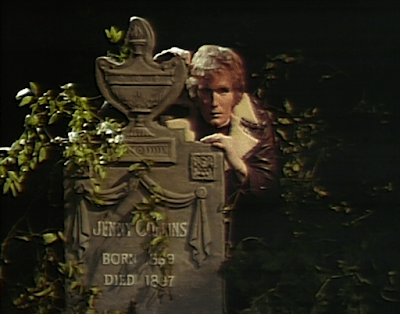
Episode 927: Reasons don’t matter

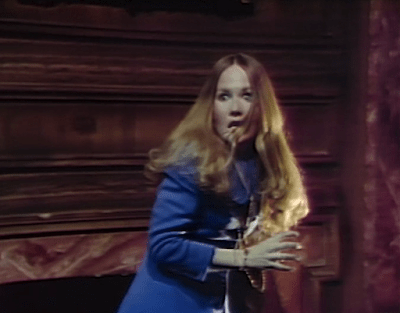
Permanent houseguest Julia Hoffman, MD, is in the drawing room of the great house of Collinwood when a secret panel opens and a boy known as Michael comes strolling out. She asks him how he knew about the panel and the passages behind it; he says that thirteen year old David Collins told him. Julia asks if Michael knows what has become of David’s governess, the missing Maggie Evans. Michael tries to dodge her questions. When Maggie comes running into the room, screaming that she has been living a nightmare, Michael takes the opportunity to flee.

Michael emerges from the secret passage.

Returning viewers know that Michael is not really human, but is the latest in a series of manifestations of a monstrous force that has enlisted the support of several characters for its plan to supplant the human race. We also know that Michael trapped Maggie in the long-disused west wing of the house and tormented her there. She had been sure that Michael was her tormentor, but when Michael’s foster father, antique dealer Philip Todd, came to her rescue, Maggie beaned him with a small candlestick and jumped to the conclusion that he was to blame. She tells Julia that Michael is innocent and Philip is dead.

Maggie’s captivity is a remake of a story that ran from #84 to #87. In those days, the show’s liveliest villains were David and his father, high-born ne’er-do-well Roger. David locked Maggie’s predecessor Victoria Winters up in a room in the west wing, where he hoped she would die. Eventually Roger used the secret panel from which Michael emerges today to go to the west wing and investigate. He went straight to the room where Vicki was trapped. Roger shared David’s ill-will towards Vicki, and had in #68 encouraged him to harm her. In the corridor outside her prison, he took advantage of the situation to terrorize her further, disguising his voice and pretending to be a ghost taunting her with her doom. When he finally opened the door, she flung herself into his arms and declared that he was right and David really was a monster.

That story dragged out for so long that we couldn’t help noticing several steps Vicki might have taken to get herself free. Her failure to try any of them was a major step towards the creation of the “Dumb Vicki” image that would in time destroy the character completely. Maggie doesn’t outdo Vicki in engineering ability, but at least part of her helplessness can be explained by a taunting voice that she hears, on and off, from the beginning of her captivity. This one really is supernatural in its origin, projected by Michael. Her misunderstanding of Philip’s motives and condition is as total as was Vicki’s of Roger’s, but she corrects it by the end of the episode, when she realizes that Philip was coming to rescue her from Michael, and that he is fine now. She goes to his shop to apologize for accusing him.

The contrast between the two stories sheds light on the strengths and weaknesses of the show in the days when they were made. In the first months, individual episodes might have so little action that there was nowhere to hide a logical problem like Vicki’s immediate resignation when she realized that the window in the room was slightly out of her reach, even though the room was full of materials she could stack up and stand on. Still, Vicki’s reaction when Roger enters was electrifying, one of the best moments of acting in the entire series, and the change in her relationship with David in the weeks after her release is pivotal to everything that happens from that point on.

The relative busyness of the stories now allow us to overlook Maggie’s absurd helplessness while she is in the room, and her quick reconciliation with Philip papers over her inexplicable failure to remember that she heard Michael’s voice taunting her. But as Philip points out, Maggie doesn’t really know him. Nor will her experience shape her future attitude to Michael in any interesting way- as a creature who rapidly changes his form, he comes with a built-in expiration date. The whole story vanishes without a trace once Maggie leaves the antique shop. The individual episodes may not seem as slow now as they did at first, but when we find ourselves weeks or months into a storyline and find that very little has happened that we have any need to remember, we are left with a sense of motionlessness.

Roger’s use of the secret panel in #87 was the first time we learned it existed, and we didn’t see or hear of it again for two years, when both David and the ghost of Quentin Collins used it during the “Haunting of Collinwood” segment. David ushered visiting psychic Madame Janet Findley through the panel, directly to her death; Quentin came out of it and killed elderly silversmith Ezra Braithwaite. So to longtime viewers, the panel represents both murderous intentions and an intimate knowledge of the layout of the house. When Michael comes sashaying out of it today, we are meant to be a deeply unsettled.

Philip is disaffected from the project Michael represents; his wife Megan is still all in, and she combines her fanaticism with a desperate love for Michael. She talks with Michael privately, and tells him that he has been making himself so conspicuous that he has raised suspicions in the minds of many people. They will have to take steps to quell these suspicions, steps which neither she nor Michael will like at all.

Michael becomes very ill, and Megan calls Julia to come to the shop to treat him. She finds that his heartbeat is irregular and his vital signs are fading. She is calling the hospital when he goes into some kind of crisis; she leaves the telephone and injects him with a stimulant to jolt him back into stability.

Recently, we have heard several references to “Dr Reeves,” a character who was on the show a couple of times in 1966. Dr Reeves did not appear on screen, much to the relief of longtime viewers who remember how annoying he was, but the sheer fact that his name came up sufficed to assure us that Julia is not the only doctor in Collinsport. Since the group around Michael has been unable to absorb Julia and sees her as a potential enemy, Megan must have chosen her for some reason to do with the plan she was telling Michael about.

Episode 926: I don’t want to know who you are

This episode has the same story as Friday’s.

The current A-story is about the coming of the Leviathans, mysterious beings who act through a cult that has absorbed several people in the village of Collinsport and on the estate of Collinwood. Antique shop owners Megan and Philip Todd have been entrusted with the care of a creature that has assumed the forms of several human children in succession. This creature, currently presenting itself as a thirteen year old boy named Michael, is extremely obnoxious to everyone for no apparent reason, prompting them all to reconsider their commitment to the program. Philip is ready to turn against the Leviathans; Megan from time to time admits that he is onto something, but by the end of yesterday’s episode was back under Michael’s control. She had said Philip needed to be got out of the way and picked up a gun.

Old world gentleman Barnabas Collins goes to the Todds’ shop in the village. He finds Megan pointing her gun at Philip and orders her to cut it out. Barnabas had been the leader who initiated the Todds into the cult and as we hear his thoughts in internal monologues today we hear that he still has some loyalty to it, but Michael has been too much for him. When he tells Megan to listen to him instead of Michael, she is shocked at his sacrilegious words. He hastily claims that he was only testing her.

Barnabas and Philip have a staff conference. Screenshot by Dark Shadows Every Day.

For his part, Michael is at the great house of Collinwood. Last night he was there as the guest of strange and troubled boy David Collins, who has shared supervision of the Todds with his distant cousin Barnabas. David’s governess, Maggie Evans, is not a member of the cult, and she had done something that bothered Michael. So he trapped her in the house’s long-disused west wing. She is still trapped there, and he has returned to use his powers to torment her further. David is anguished about this, but does not feel he can oppose Michael.

Maggie’s captivity prompts us to ask just why it is so frustrating that this episode is essentially a duplicate of Friday’s. In May and June of 1967, Barnabas was a vampire, he was holding Maggie prisoner in his basement, and there were a number of duplicated episodes. It was during that period that the show first became a hit, and it is that story that every revival of the show, from the 1970 film House of Dark Shadows on, goes out of its way to incorporate.

I think what kept people coming back to watch Barnabas’ imprisonment of Maggie was not so much what he was doing to her, but his relationship with his blood thrall Willie. In the course of Barnabas’ abuse of Maggie, Willie went through all of the psychological phases that Megan, Philip, David, and Barnabas exhibit today. I think the actors playing all four of those characters live up to John Karlen’s performance as Willie; even those who disagree with me on that will have to concede that some of them do good work. So the problem is not with the performances.

Rather, these episodes fall short because the character of Michael does not have the depth Barnabas had in the spring and summer of 1967. We kept wondering what Barnabas was thinking, and the more we learned about him the more puzzled we became, since all his ideas were so crazy. In his role as Barnabas’ external conscience, Willie gave us grounds to hope that we would eventually reach a layer of his mind where the nonsense would give way to something intelligible. But we don’t wonder what Michael is thinking, because there’s no evidence Michael is thinking at all. He demands submission from all and sundry and flies into a rage the instant he encounters resistance. He is just a spoiled brat.

Moreover, as a vampire Barnabas needed people to protect him during the day and to surrender their blood to him at night. When David is slow to submit today, Michael tells him he doesn’t need him or anyone else. This seems to be all too true- nothing is at stake for Michael in any interaction. No matter what Michael Maitland brings to the part, no matter how well his four Willies play their roles, the character is a dead end.

One viewer who seems to have been carried away with his frustration with this one is Danny Horn, author of the great blog Dark Shadows Every Day. His post about it includes some rather obtuse remarks about the performances, some of which fit with his usual shortcomings (e.g., his habitual underestimate of David Henesy’s acting.) But in other comments he loses track of his own analysis. For example, time and again throughout the blog he stressed that the show was made for an audience that saw each episode only once, and that their memories of the images that had appeared on their television screens would drift over time. When a particular moment makes a big enough impact that it is frequently referred to in later episodes and is a topic of discussion among fans, the images of that moment that appeared on screen during the original broadcast are at most a starting point, something that the viewers build on in their imaginations, so that the pictures that memory supplies soon enough have little or nothing in common with what was actually produced.

Danny makes all of these points over and over. Yet his post on #926 ends with this objection to the invisible form Michael and the other Leviathan boys assume when they are supposed to be mighty:

Dark Shadows actually has a great track record at creating scary things out of not that much money. The legendary hand of Count Petofi was incredibly cool and memorable — a Halloween decoration that they invested with real power. The scariest thing about the legendary hand was that it wasn’t under anybody’s control, even Petofi’s; it would fly around on its own, doing unexpected things. Not an expensive or difficult effect, just good writing, using what they have to tell an interesting story.

Television is a visual medium; we need to see the thing that the story is about. “It’s better in your imagination” is just a way to weasel out of coming up with a compelling visual. If you can’t actually show us the monster, then maybe you should consider a non-visual medium like print, or radio. Or not doing it at all.

Danny Horn, “Episode 926: The Shark, and How to Jump It,” posted on Dark Shadows Every Day, 15 September 2016.

I reached that point in Danny’s blog more than four years after the post went up, but even so I felt compelled to join those who piled on him for those two paragraphs. Here’s what I wrote:

I don’t think there would be a point in showing the monster. If the monster had done anything really scary, our imaginations would be working overtime to frighten us. Any image they put on screen would let the steam out of our anxieties. And since it hasn’t done anything scary, we won’t be worked up when we see it. Looking at it calmly, we’ll just be examining a costume or a prop or a visual effect or whatever.

Now, you can show the audience a thing or a person that looks harmless, and then build up fear around it. That’s what they did with The Hand of Count Petofi, which Barnabas observes with utter contempt when Magda first shows it to him, but which then wreaks havoc. Or you can build up a fear, introduce a person, and suddenly connect the person with the fear in an unexpected way. That’s how they gave us Barnabas- Willie opens the box, there are vampire attacks, a pleasant man shows up wearing a hat and speaking with a mid-Atlantic accent, and then we see that man without his hat, waiting for Maggie in the cemetery. There are lots of ways to scare an audience, but showing a picture of something that’s supposed to be scary isn’t one of them.

Comment posted 17 December 2020 by “Acilius” on Danny Horn, “Episode 926: The Shark, and How to Jump It,” posted on Dark Shadows Every Day, 15 September 2016.

I still agree with that, more or less, though I suppose it makes the creative process sound a lot tidier than it ever is. I do wish I’d thought of the comparison I make above between the four disaffected cultists and Willie. Danny’s blog was still drawing comments in those days, and I think that would have attracted some responses.

Episode 925: Not like other boys

In #891, old world gentleman Barnabas Collins gave a present to antique shop owners Megan and Philip Todd. It was a wooden box. When the Todds opened the box, it made a whistling sound. By #893, the whistling sound had taken the form of a newborn baby whom Megan introduced to heiress Carolyn Collins Stoddard under the name “Joseph.” In #905, Joseph had taken the shape of an eight year old boy, and was going by “Alexander.” In #909, Alexander briefly shape-shifted. He kept his apparent age and mass, but his body became that of a girl. In particular, s/he was for an hour or two a perfect double of Carolyn as she was at eight. In that shape, s/he tormented Carolyn’s father Paul, who had been absent throughout Carolyn’s childhood. In #913/914, Alexander gave way to a thirteen year old who insisted on being called “Michael.”

Clearly, none of these children is really human. They are manifestations of a supernatural force known as “the Leviathans.” The Leviathans operate through a secret cult that is gradually taking over people in and around the estate of Collinwood and the nearby village of Collinsport. Barnabas, the Todds, Carolyn’s mother Liz, and her cousin, strange and troubled boy David Collins, are among the members of the cult. Paul is one of its enemies, and others are coming into their sights.

As he was when he was Alexander, Michael is a bully, monotonous in his hostility and demands for obedience. Philip has had about enough of this. He spanks Michael today, and tells Megan that it is time they think about quitting the Leviathan cult. Megan is appalled by Philip’s apostasy. She and Michael talk alone. He caresses her face, exciting a physical response from her. She then agrees that Philip should be got rid of, and picks up a gun.

Michael caresses Megan’s face. Screenshot by Dark Shadows Before I Die.

We have seen Barnabas caress the faces of people whom he wanted to bring under the control of the Leviathans, so the makers of the show could tell the ABC network’s Standards and Practices Office that Michael was doing a magic trick when he did that to Megan. But in a period when Sigmund Freud was the among most cited nonfiction authors in the English-speaking world, few adults in the audience could have failed to notice the erotic charge in the contact between Michael and his (foster) mother as they plot the murder of his (foster) father.

Freud has turned up on the show before. In September 1968, Carolyn hid Frankenstein’s monster Adam in a room in the dusty and long-disused west wing of the great house of Collinwood. Adam spent most of his time alone, with little to do but read. When Carolyn brought him a meal there in #577, Adam was disappointed she was not prepared to discuss Freud’s works with him. She mentioned that she was dealing with some family troubles, at which Adam invited her to sit down and to “Tell me about your mother.”

Adam is long gone, but we see today that the west wing is still dusty. Maggie, David’s governess, fell afoul of Michael yesterday and is wandering around there, hopelessly lost. For some time, Adam held Maggie’s predecessor Vicki prisoner in his room; evidently writers Sam Hall and Gordon Russell see some kind of connection between Freudian psychoanalysis and governesses stuck in the west wing.

Like Adam, Michael came into being otherwise than by sexual reproduction, and the arrangement of his anatomy is the result of a series of conscious acts of will. Also like Adam, he has an intense crush on Carolyn, one which does not exclude violence. In #549, Adam attempted to rape Carolyn. In #919/920/921, Michael introduced himself to Carolyn by creeping up behind her and putting his hands over her eyes; moments later, he was yelling at her and demanding “How dare you” when she would not go along with an idea of his. Since Carolyn is virtually the same height as Michael, his disregard of her personal space and his unrestrained bullying come off not only as bratty, but as rape-adjacent.

Furthermore, Marie Wallace, who plays Megan, first joined the show as patchwork woman Eve, Adam’s intended spouse. Megan’s desperate indulgence towards Michael puts her at the opposite extreme from Eve’s total rejection of Adam, but it is equally inflexible, and when she takes up her gun today it seems likely to lead to an equally disastrous ending. Whatever point Hall and Russell were making by associating Adam with Freud is apparently in their minds again when Michael and Megan play out their little Oedipal dance.

Closing Miscellany

When Maggie is first trapped in the west wing, she reaches up to bang on the closed panel. When her shoulders rise, the high hem of the outfit Junior Sophisticates provided Kathryn Leigh Scott exposes parts of her that performers on daytime television in the USA in 1970 did not customarily display.

Yesterday and today, David and Michael play a game they call “Wall Street.” They use Monopoly money and a playing surface which, when Michael overturns it today, proves to be a checkerboard with a backgammon board on the reverse. A board game called The World of Wall Street really was around in those days; it was produced in 1969 by Hasbro and NBC. The dialogue David and Michael exchange during the game sounds like things you might say while playing it. Perhaps the script called for the boys to play that game, but ABC vetoed it since the rival NBC network’s logo appeared prominently on the box.

Episode 924: Afraid of the dark

Mad scientist Julia Hoffman finds that wicked witch Angelique has married a businessman who has a house on an island off the coast of central Maine. Angelique tells Julia that her husband’s love has freed her to live as a human being, and that for the sake of that love she has renounced her powers. In #882, set in the year 1897, Angelique said that she would soon have to return to the underworld unless she could find a man who would love her. The show has since returned to a contemporary setting, and she met her husband less than a year before, sometime in 1969. Evidently her time wasn’t running as short as she led us to believe it was.

In the 1897 segment, the show was quite clear that Angelique was aligned with Satan and that the underworld she was talking about was a Hell that Dante or Milton or other Christians would have recognized. The deal she described with her master therefore made little sense then. But Dark Shadows has drawn freely on the mythologies of many cultures and has made up stories about supernatural worlds of its own. The borrowings from the Christian tradition are a relatively minor part of the universe they have been patching together, and they have recently given us reason to suspect it is something they are backing away from. So I don’t think we are under any obligation to reconcile Angelique’s account of the lord of the damned with the teachings of any church.

Angelique is afraid that Julia has come to reenlist her in the cosmic battles surrounding the estate of Collinwood. In fact, Julia had no idea she would find Angelique. She went to the island because she had figured out that a painting she was looking for was there. It is a magical portrait of rakish Quentin Collins, obscured by a landscape painted over it. Quentin has amnesia, and Julia apparently thinks that if she shows him the portrait she will be able to jar some memories loose.

Angelique agrees to let Julia take the painting and expose Quentin’s portrait, on condition that the overpainting be exactly reproduced on another canvas and brought back to the house on the island before her husband knows it was gone. Julia suggests they tell him a lie that will give them more flexibility, but Angelique says he is “a very thorough man” and would ask too many follow-up questions if they gave him any information at all.

Before and after her scene with Julia, we see Angelique with her husband. The first scene begins with some very awkward kissing. The awkwardness is partly due to Geoffrey Scott’s total incompetence as an actor; he stands stiffly while Lara Parker simultaneously kisses him and nudges him to his mark, making it look like she is moving a couch. But part of the blame must rest with director Lela Swift, who set up the shot from an angle that puts the emphasis on the straining muscles in Parker’s neck and back. Perhaps Swift overestimated Scott’s abilities.

“Move three inches back and to the right, dummy, you’re supposed to be in the center of the frame!”

This scene is accompanied by some music for a small string ensemble; I don’t believe we have heard the track since the very early days of the show. It feels jarringly old-fashioned. All of Dark Shadows’ orchestral score strikes 21st century viewers as a relic of an earlier era, but it set it apart from other daytime soaps of the 1960s and early 70s, most of which had an organ playing on the soundtrack. Compared to the organ accompaniment, which today’s audiences would find simply intolerable, I suppose even these creaky old violins are relatively modern.

The second scene ends with a more successful kiss. It is accompanied by a woodwind piece that used to be associated strongly with well-meaning governess Vicki and her doomed love for dashing action hero Burke Devlin. Burke was written out of the show in 1967, Vicki in 1968, and this music cropped up occasionally in 1969 during sentimental moments. It is still noticeably more old-fashioned than the rest of the score, albeit more dynamic than the string serenade that went along with the first kiss.

Meanwhile, in the great house at Collinwood, strange and troubled boy David Collins is coming down with a cold. David’s governess, Vicki’s successor Maggie Evans, is trying to get him to take his schoolwork seriously. A boy known as Michael appears in the house and announces that he and David will be playing now. Maggie explains that it is not a good time, and Michael bullies both her and David into giving him his way.

Michael is not really human, but is a manifestation of a supernatural force that has subjugated David and many other people. Seeing Michael push Maggie around, we might remember May and June of 1967, when Maggie was the prisoner of vampire Barnabas Collins. Those episodes were bleak and at moments painful to watch, but they also drew a new audience and made Dark Shadows, for the first time, a hit.

Barnabas attracted a crowd, not simply because he was cruel to Maggie, but because we wondered how others would react to his evil deeds, because his motives were unbelievably zany, and because actor Jonathan Frid took a visible joy in playing him. He became a breakout star, familiar to millions who never saw a single episode of Dark Shadows or knew anything else about it, because he generated stories that allowed the whole cast to shine, followed his crazy ideas to the point where many of them became the realities of the show’s narrative universe, and had quirks that dovetailed perfectly with Frid’s strengths.

Michael has none of these things going for him. When he is nasty to Maggie, he does not produce any suspense as to what others will do. Not only do most characters assume that as a teacher she will be able to handle an obstreperous child by herself, but most of the people to whom she would likely turn for support are among Michael’s subordinates. There are no crazy ideas bursting out of him- he is just a little tyrant, who at no point seems to have any hidden motives or nuances of feeling. And Michael Maitland seems depressed the whole time he is on screen. As a result, Michael is as straightforward and tedious as Barnabas was luridly intriguing.

When Barnabas was holding Maggie prisoner, his blood-thrall Willie felt sorry for her. He occasionally made efforts to help her, none of which did anything but make her situation even worse. John Karlen’s portrayal of the feckless Willie brought him almost as much fan mail as Jonathan Frid received during that period. Today it is David’s turn to play Willie to Michael’s Barnabas, and he does not disappoint. Thirteen year old David Henesy plays David Collins’ conflicted feelings more subtly than Karlen had played Willie’s, and as a result we watch him very closely. Disappointed as we may be in Michael, Mr Henesy’s triumph in these scenes brings the episode to a strong close.

Episode 923: He kindly stopped for me

Yesterday, Amanda Harris told the story of a suicide attempt she made in 1897. A supernatural being whom she calls “Mr Best” thwarted this attempt, and told her that he would arrange for her not only to avoid death, but to remain young, for the years that it had been ordained she would live. If in that time she could reconnect with her lost love, rakish Quentin Collins, she and he would never die. Now it is 1970, and Amanda’s time is up. Mr Best is at her door. Amanda has found Quentin, but he has amnesia and is not ready to resume their relationship as Mr Best’s terms require.

Mr Best has changed startlingly since we met him in the flashback that showed us Amanda’s story. Then he was warm and solicitous; today he is truculent and cold. Even his makeup is different. A pale coloring suggests sunken cheeks, making him look corpse-like.

Not so friendly anymore. Screenshot by Dark Shadows Before I Die.

Amanda has reversed her own attitude as well. In 1897, Mr Best lamented her wish for death and pleaded with her to stay alive; now it is Amanda’s turn to beg Mr Best for more time while he shows impatience with her. When she tells him about Quentin’s amnesia, he asks brusquely “Are you making this up?” It merits a laugh that the story of Dark Shadows has become so far-fetched that even Death Incarnate finds it hard to believe. But Mr Best does soften, and gives Amanda seven more days to get Quentin to tell her he loves her.

Quentin’s own perpetual youth is the result of a magical portrait that immunized him from the effects both of aging and of the werewolf curse that was placed on him in 1897. Quentin’s great-grandson Chris Jennings has inherited that curse. Mad scientist Julia Hoffman had learned that artist Charles Delaware Tate was still alive, and hoped he would paint a portrait of Chris that would free him from lycanthropy. Tate told Chris he no longer had the gift, but Chris forced him to paint his picture anyway. The moon rose, Chris transformed, and as the wolf he murdered Tate.

One of Chris’ surviving victims is his ex-fiancée, Sabrina Stuart. Sabrina saw him transform, and as a result was struck dumb for years and went prematurely gray. She can talk now, but she’s still gray. She shows up today at the great house of Collinwood where she calls on heiress Carolyn Collins Stoddard. Carolyn tells Sabrina that she doesn’t love Chris and never will, but that she realizes Sabrina loves him. This adds to a growing list of reasons the show has given us to doubt that Chris will be on much longer. His premeditated murder of Tate establishes him as a pure villain. A villain’s function is to create problems for other characters to solve, and Chris has been too passive and too dependent on Julia to be an interesting villain. His relationship with Carolyn gave him a connection to the core cast, but Carolyn’s conversation with Sabrina makes it clear that that is gone now.

Sabrina insists Carolyn go on a road trip with her. She takes her to Tate’s house and leads her into the room where Chris murdered the artist. She tells her that a man was just killed there. Carolyn asks Sabrina if Chris did it. Sabrina looks pained, and says “Not Chris!” This further undermines Chris’ position. As long as Sabrina was mute, we could wonder whether she would blow the whistle on Chris once she regained the power of speech and if so what the consequences of that would be. But now we see that she is still in denial about him, and can set aside any hope that she might generate a story for him.

Carolyn asks Sabrina how she knows about the murder. No answer is forthcoming, and there doesn’t seem to be any way she could know. Evidently Sabrina has now developed some kind of clairvoyance about Chris’ murders. Since she is apparently determined to use that power to limit Chris’ relevance to the story, it is yet another reason to suspect he will be written out soon.

Sabrina making the most of her turn in the spotlight. Screenshot by Dark Shadows Before I Die.

Julia enters the crime scene. She and Carolyn are surprised to see each other. Sabrina announces that Julia knows all about Chris, and gets upset about it. Julia, a psychiatrist by profession, slaps her in the face, the accepted treatment for angry women in 1960s television shows. Sabrina quiets down, and Julia sends her away with Carolyn. Once they are gone, she settles in at Tate’s desk and starts rummaging through his papers.

Julia wants to cure Quentin of his amnesia. She looked through an old Collins family photo album, and found that two pictures of him had gone missing. She is puzzled as to who took them; this is a continuity error, since in #686 and #687 there was a whole thing about ghosts removing photos relevant to Quentin from albums after Julia had looked through them. Be that as it may, Julia discovers in Tate’s papers that he had painted over Quentin’s portrait and that it is now in a big house on an island nearby.

We see a man holding a telephone and reciting lines of dialogue. He puts the phone down, looks at Julia, and recites more lines in the same unmodulated voice. Grayson Hall stays in character with her responses, and plays Julia asking to see the painting, but the man does not do anything that could be called acting. Dark Shadows has featured its share of lousy performances, but I cannot recall a member of the cast simply enunciating words as if he were in a neurologist’s office demonstrating that he had memorized the unrelated syllables given him to reproduce. It is genuinely bizarre.

The man’s name is Geoffrey Scott, and if anyone had told him he was supposed to act he would be playing a character called Sky Rumson. I suppose “Rumson” is a good name for a character who is identified with a house on the beach, since beach houses are what Rumson, New Jersey is known for, though the beach might not be front of mind in early January in central Maine. Sky is a go-go businessman, and his lines to Julia are about what a great hurry he is in.

Sky shows Julia the painting that covers the portrait of Quentin. He tells her that it isn’t very good. Indeed it is not particularly distinguished, but it is far superior to any of Tate’s other works, some of which they want us to regard as museum pieces. Sky says that he bought the painting for his wife, who has an unaccountable fondness for it. He shows Julia a painting of Mrs Rumson. Julia has seen the painting before, and knows the model very well. It is a portrait of her old frenemy, wicked witch Angelique.

For regular viewers, this ending will be as satisfying and as logical as Geoffrey Scott’s phonetic rendering of his dialogue is disconcerting and inexplicable. Eight weeks ago, the show returned to contemporary dress after a long stay in 1897, beginning a new clutch of stories. Angelique is often absent from the show for extended periods, but she always turns up sooner or later. None of the three major storylines- Chris’ werewolf curse, Amanda’s attempt to rekindle her romance with Quentin, and the menace of the secret cult devoted to supernatural beings known as the Leviathans- is very closely connected to either of the other two, and none of them has any particular sense of urgency. Angelique’s vast powers and maniacal narcissism make it easy for the writers to inject her into every plot and accelerate them all towards a common resolution. In the 1897 segment, they moderated both her might and her mania, so that they can now keep her on indefinitely without overwhelming the show. Angelique is not what Julia expected to find, but she may be just what the doctor ordered.

Episode 922: The beginning was another ending

For most of 1969, Dark Shadows was a costume drama set in the year 1897. In that year, we got to know rakish libertine Quentin Collins, who brought upon himself and his male descendants the curse of the werewolf. For reasons of his own, sorcerer Count Petofi ordered one of his underlings, a repellent little man named Charles Delaware Tate, to paint a portrait of Quentin. As long as the portrait is intact, Quentin is immune from the effects both of the curse and of aging.

Now the show has returned to a contemporary setting. Quentin has come back to the village of Collinsport, still alive, still youthful, still human on nights of the full moon. However, he suffers from total amnesia, and is unwilling to listen to anyone who tells him that he is 99 years old and is enmeshed in a long line of supernatural occurrences.

Mad scientist Julia Hoffman, MD, knows all about Quentin, in part because she traveled back in time from September 1969 to September 1897 and befriended him then. Julia has been trying to help Quentin’s great-grandson Chris Jennings to overcome his own lycanthropy, and when a couple of weeks ago she learned that Tate was still alive she hoped he would be able to paint a portrait that would do for Chris what Quentin’s portrait did for him. Tate refused. Chris subsequently went to Tate’s house on a day when the moon was full enough to turn him into the wolf. He locked himself in a room with Tate and ordered him to start painting. If he finished the painting before sunset, perhaps Chris would not become the animal and Tate would escape the murder he is threatening to commit.

When the 1897 segment ended in #884, Petofi appeared to have died. It was unclear what this meant for the spells he had cast. That his portrait has continued to protect Quentin would suggest that at least some of his powers have lived after him. Perhaps Tate, too, will prove to have kept the ability Petofi gave him to work magic by painting portraits.

But this turned out not to have been so. At the end of yesterday’s episode, Tate had completed a picture of Chris, but come nightfall Chris turned into the wolf and slashed him. Today, Quentin comes into Tate’s studio, finding the artist bleeding to death and the beast still in the room. Looking for a weapon, he turns from a heavy bronze statue to a small silver candlestick. The wolf runs away.

Tate calls Quentin by name and pleads with him for help. Tate doesn’t want him to leave, but Quentin points out that he cannot do anything for him himself. Since Tate has no telephone, he will have to go to a neighbor and call a doctor from there.

Quentin was not the only beneficiary of Tate’s magical paintings whom we met in 1897. Tate had painted many pictures of his ideal woman. Unknown to him, these paintings had caused the woman to pop into existence one day in 1895. The woman took the name Amanda Harris and found her way to Collinsport shortly after Tate took up residence there. When he met Amanda, Tate became obsessed with her and kept shouting in her face that she was his property and must come away with him. Amanda also met Quentin, who is not all that great a person but who is a lot easier to take than Tate, and she fell in love with him. The two of them were going to run off together to New York City, but when Quentin could not find his portrait he had to stay in Collinsport. In #884, we saw a brief encounter between Quentin and Amanda in NYC, during which he told them they could not be together until he found the portrait.

Now Amanda, too, has come back to Collinsport. She has been using the name Olivia Corey, and has become a big star on Broadway. Amusingly, she is played by Donna McKechnie, who would a few years later actually become a big star on Broadway. One wonders if Miss McKechnie felt she had to model herself on Amanda/ Olivia when she achieved that success.

Julia and Amanda met because they have both been collecting paintings by Tate in hopes that they will lead them to Quentin. Julia recognized Olivia as Amanda right off when she met her, rather oddly since they never met when they were both in 1897. We see Julia visiting Amanda in her suite at the Collinsport Inn, getting impatient with her continued refusal to admit her identity, when the phone rings. It is Quentin, asking Julia to come to Tate’s. Amanda volunteers to go along with her, which Julia says is a very good idea. Julia pauses to tell Amanda the alias Tate has been using in recent years, Harrison Monroe.

When Julia and Amanda arrive at Tate’s, Julia takes Quentin aside and very ostentatiously whispers in his ear. He replies that he does not understand what she has in mind, but that he will follow her directions anyway.

Julia goes to Tate. She asks him to tell her where Quentin’s portrait is; he says he will do so only if she saves his life. She looks sad, and he says that if she cannot do that, she has nothing to offer him in exchange for what she wants. She then calls Amanda in, and tells her to address “Harrison Monroe” by his first name- Charles. When he hears her voice and sees her face, he calls her Amanda, and says that she has come back to him. Before he can turn his attention back to Julia, he loses consciousness.

Julia pronounces Tate dead. Julia is in some ways the ablest doctor who ever lived- she has built Frankenstein’s monsters, cured vampirism, etc. But her death pronouncements are so often inaccurate that longtime viewers will expect Tate to spring up and contradict her. Only the fact that the opening voiceover said in so many words that Tate “has no future” allows us to believe that we really won’t be seeing him again.

Overwhelmed by emotion, Amanda bolts out Tate’s door and wanders into the woods. The werewolf comes at her; for some reason that is apparently none of the audience’s business, he decides not to attack her.

Back in Amanda’s suite, Quentin tells Julia that he reached for the small silver candlestick rather than the heavy piece of metal when confronted with the wolf. Julia declares that this proves his identity. Somewhere in his mind, beneath the amnesia, he knows that werewolves are averse to silver. He can’t disagree.

Later, Amanda returns to the suite and gives a soliloquy. Julia emerges from the bedroom where she has been eavesdropping. Amanda briefly protests at the invasion of her privacy, then admits her identity. She tells Julia a story about the last time she and Quentin saw each other in the nineteenth century.

When Amanda gets to the meat of her story, we zoom in on her face for an extreme closeup. An iris wipe starts from her left eyelid, growing into a stage set representing a bridge in New York City. She and Quentin have a conversation that covers the same ground as the one we saw in #884, and he leaves her alone on the bridge.

A man we have not seen before enters and tells Amanda that she ought not to jump from the bridge. He says that she is very beautiful, and that other men will love her. He says that “If I were… different… I’d love you myself.” The words of this kindly confirmed bachelor mean nothing to Amanda, who throws herself off the bridge.

The wipe does not fill the entire screen; the edges of the main image are covered with flickering little blue squares, and we can make out an image of Amanda’s suite on the right-hand side of the screen. This effect becomes distracting while the confirmed bachelor is talking to Amanda, when they are adjusting the camera for the shot that will follow the end of the insert. Not only does the image of the suite wobble jerkily, but it continues as we cut from the two shot to a closeup on the man, taking our attention away from his face at a crucial moment.

Amanda tells Julia that after she jumped off the bridge, she found herself in a hotel lobby. The confirmed bachelor, whom she calls “Mr Best,” met her there and explained that he wants her to live out the long life that she was originally destined to have. He says that she will have all of those years, and will remain young throughout them. If she can find Quentin again before she reaches the time she was meant to die, the two of them will go on living forever. If not, he will return for her at the appointed time. Julia leaves, determined to cure Quentin of his amnesia and return him to Amanda. A moment later, a knock comes at the door. It is Mr Best, telling Amanda her time is up.

A few days ago, Julia brought Amanda one of Tate’s portraits of her. She made no effort to buy it, saying it was of no interest to her. The story of Mr Best explains this indifference. Amanda believes that her supernatural youth is due to his intervention, not to the portrait. She does not know why Quentin has remained young, and has no reason to connect her situation with Tate’s works.

Mr Best is played by Emory Bass, who was at this time playing James Wilson in the original Broadway production of 1776. That cast, to be reunited in the 1972 film version of the musical, also featured Dark Shadows alums David Ford (Sam Evans #2, Andre DuPrés) as John Hancock, Daniel F. Keyes (Cemetery Caretaker) as Josiah Bartlett, Peter Lombard (Oberon) as a stage manager and understudy for the parts of Thomas Jefferson and Stephen Hopkins, and Virginia Vestoff (whom we will see several months from now as Samantha Collins) in the major role of Abigail Adams. With all that overlap, I tend to think of the whole cast of 1776 as having been available for parts on Dark Shadows, and vice versa. Whenever I get unhappy with a cast member, I wonder who from 1776 could have done a better job. Bass was great in 1776, and his arrestingly deliberate phrasing is perfectly suited to an angel of death, especially one like Mr Best who has far more discretion and a more idiosyncratic personality than do the angels described in the orthodox theological statements of the great monotheistic traditions.

Episode 919/ 920/ 921: The giver without a gift

Centenarian Charles Delaware Tate, once a famous painter, is trapped in his parlor with a man who is threatening to kill him. The man is Chris Jennings. Chris tells Tate that there will be a full moon tonight, and he identifies himself as a werewolf. In 1897, Tate painted a portrait of Chris’ great-grandfather, Quentin Collins. That portrait had magical powers that immunized Quentin against both lycanthropy and aging, and Chris is demanding Tate do the same for him. Tate keeps telling Chris that he no longer has the ability to create such things, but Chris won’t listen. Tate does a sketch. He says that his work is finished and tells Chris to take it and leave. Before Chris can comply, he turns into the wolf and attacks Tate.

Chris had been in a secure room at a mental hospital controlled by his friend, mad scientist Julia Hoffman. He deliberately checked himself out and forced his way into Tate’s house because he wanted to use his condition as a weapon to coerce Tate. Julia is the audience’s chief point of view character these days, and she feels sorry for Chris. We also like two characters who care about Chris and don’t know that he is a werewolf. Heiress Carolyn Collins Stoddard is attracted to Chris and seems to have some lingering hopes that a romance might blossom between them, and Chris’ little sister Amy loves him and believes in him. Even one of Chris’ surviving victims, prematurely gray Sabrina Stuart, told Carolyn in #889 that while Chris is dangerous, “he is good.”

Despite everything these ladies are doing to help us like Chris, there can be no doubt that his attack on Tate is murder with premeditation and extraordinary cruelty. Roger Davis can usually be counted on to make us sympathize with anyone who is murdering one of his characters, but he plays Tate today with sensitivity and pathos, leaving us no way to avoid seeing a helpless old man locked up with a vicious killer. Chris’ future on Dark Shadows is limited for a number of reasons, chiefly his passivity in the face of his curse and his dependence on Julia and others to initiate action on his behalf. His abuse of Tate suggests that for whatever time he may have left on the show, Chris will be an unsympathetic villain.

Meanwhile, Carolyn is spending the day working as an assistant in an antique shop owned by her friends Megan and Philip Todd. Our first view of the shop today features Carolyn reflected in a mirror, but the main part of it is the taxidermied head of a baying wolf, emphasizing the danger Chris poses to everyone in and around the village of Collinsport.

The Wolf is loose, Carolyn is boxed in. Screenshot by Dark Shadows Before I Die.

A pair of hands cover Carolyn’s eyes. When they are pulled away, she expects to find that they belong to Philip’s eight year old nephew Alexander, but instead discovers that a thirteen year old boy she has never before seen has introduced himself to her by creeping up behind her and grabbing her face. The boy tells her that his name is Michael, that he is another of Megan and Philip’s relatives, and that Alexander has gone away. He tries to give Carolyn a pendant, but she recognizes it as one Megan wears and says that Michael can’t very well make a gift of something that doesn’t belong to him. He becomes very stiff and screams “How dare you not believe me!?” He doesn’t get any more pleasant as the scene goes on.

Philip comes in and tries to establish some kind of control; Carolyn takes the opportunity to excuse herself. As Michael and Philip talk, it becomes clear that they are part of a secret group with sinister plans. Returning viewers know that Michael and Alexander are not really human children, but are two manifestations of the same supernatural force. As Alexander, this force was a joyless, hateful little tyrant; Michael is no more appealing.

Dark Shadows originally ran on the ABC television network five days a week, from Monday through Friday. The episodes were numbered in a sequence reflecting the order of their original broadcast. When for whatever reason the show did not air on a given day, they would skip a number to keep the episodes airing on Fridays associated with production numbers divisible by 5. That made it easy to figure out how many weeks the show had been on, which in turn made it easy to keep track of where the show was in the thirteen week cycle that governed its long-term planning and the network’s decision to renew it.

In the last months of 1969, the show was being taped several weeks in advance of airdates, in a couple of instances more than five weeks ahead of time. This was atypical, and it led to a problem with the numbering. They knew that no episodes would air on Thanksgiving Day, Christmas Day, or New Year’s Day, but did not foresee that the network would preempt #891 for live news coverage of the return of the Apollo 12 astronauts to Earth on 24 November 1969. Since they had already shot that episode and many following it with the original production numbers on the opening slate, it wasn’t until this one that they had the chance to get the numbers back in synch. That is why it is listed with the three numbers 919, 920, and 921. The only other time they had to skip two numbers was in November 1966, when coverage of football games on and after Thanksgiving Day blotted out #109 and #110. Since that disruption to the schedule was planned, the slate for the next episode was just marked #111. This is therefore the only episode regularly referred to with a triple number.

Episode 918: Ways of remaining young

Mrs Acilius and I did our first watch-through of Dark Shadows on streaming starting in the spring of 2020, when there was no live theater to attend. When we got to the episodes introducing Barnabas Collins the vampire, I found Danny Horn’s Dark Shadows Every Day, which picks up with those and follows the series to its conclusion. I enjoyed Danny’s blog very much, and soon became one of his regular commenters. When we started this watch-through to coincide with the 56th anniversary, I looked for someplace to leave my comments on the episodes Danny didn’t cover, and found that all I could do was to start this blog of my own.

In his post about #412, Danny wrote: “This actor, Roger Davis, plays five roles on Dark Shadows, and they just get more and more angry. By the time we get to Harrison Monroe in late 1969, his character is literally an automaton sitting behind a desk, who yells at people nonstop until his head falls off. That is actually true.” I remember reading that in 2020 and doubting that it was actually true, but by the time we got to this episode and saw it happen, we had learned not to underestimate Dark Shadows. It is far and away the best Roger Davis moment on Dark Shadows. In fairness to Mr Davis, he is a highly trained actor who can do good work, but he chose to do so only a handful of times on the show. When we see that the writers are as sick of his obnoxiousness as we are, it’s an occasion to stand up and cheer.

Much of the episode is taken up with some business about whether matriarch Elizabeth Collins Stoddard and her thirteen year old nephew David Collins are going to murder permanent houseguest Julia Hoffman. Liz and David have been absorbed into a secret cult devoted to unseen supernatural beings called the Leviathans, and Julia, who cannot be absorbed into the cult, is on track to uncover its existence. Liz takes a pistol and aims it at Julia’s back. Julia is absorbed in another crisis, and by the time she notices that someone else is in the room, Liz has put the pistol down.

Liz can’t bring herself to shoot Julia. Screenshot by Dark Shadows Before I Die.

Liz tells David she can’t bring herself to kill Julia, who has been very helpful to the family in the past. David sternly tells her that they must put aside all such considerations and think only of their duty to the Leviathans. They consult a sacred book the Leviathans have entrusted to them, and read that they must not kill anyone, since the ghosts of their victims are more formidable to them than are living people. Since most of the principal characters on the show, including Julia, Liz, and David, have committed or at least attempted homicide, this prohibition would seem to imply that the Leviathans are the good guys.

There is also a story about Quentin Collins and his great-grandson Chris Jennings. Quentin was a werewolf in the nineteenth century and Chris has inherited that curse. In 1897, a repellent little man named Charles Delaware Tate painted Quentin’s portrait. The portrait had magical powers, relieving Quentin of the effects both of lycanthropy and of aging. Quentin recently came back to town, suffering from amnesia and refusing to listen to Julia or Chris when they try to tell him he is 99 years old. Julia and Chris hope that Tate will be able to do for Chris what he did for Quentin, and they have figured out that he is still alive and using the name Harrison Monroe.

The moon was full enough last night to trigger the werewolf transformation, and will be again tonight. Chris turns up. She had taken him to a mental hospital she controls, to be locked up securely while he is in his lupine form; he checked himself out, and says he can’t stand being caged. Since the alternative is killing at least one person at random, it is rather difficult to sympathize with Chris’ insistence on letting himself out.

For her part, Julia was already afraid that a werewolf was on the loose before she knew Chris had left the hospital. She suspects Quentin may have reverted to lycanthropy. She goes to the apartment of the woman who has been keeping Quentin and finds him there, his face soiled and his clothing tattered as it might be the morning after a fit of werewolfery. It turns out that he did not transform- he simply got into a bar fight. When she tells Chris about this, he goes to his great-granddad and demands he accompany him to Tate/ Monroe’s house. Quentin isn’t interested in Chris or his problem or Tate/ Monroe, but he is too drunk to hold his ground for long.

Tate/ Monroe doesn’t want to let anyone in, but when Quentin announces himself he opens the door. Chris and Quentin see a young man sitting at a desk in a darkened room. The young man sees Quentin’s apparent youth and yells “Liar!,” shouting that he is too young to be Quentin. Quentin points out that Tate/ Monroe looks just as young as he does, and Tate/ Monroe responds by shouting something about being a genius. Within seconds, he is shouting that of course he recognizes him as Quentin. Confusing as this transition is, I don’t think it is a flaw in the writing, but in the acting. I suspect Mr Davis was supposed to put some sort of inflection on the lines in between to show that Tate has figured something out, but doing that would not be compatible with his technique of delivering all of his lines in an unvarying petulant shout.

Quentin can’t take Tate’s personality any more than the audience can. He throws a vase at him and runs out of the room. It’s when the vase hits the automaton that the head falls off.

The Leviathan story is based on some of H. P. Lovecraft’s stories. Chris and Quentin do not appear to have a direct connection to the Leviathans, but Harrison Monroe, and today’s closing revelation that he is a pile of junk arranged to look like a person, are taken from Lovecraft’s novella The Whisperer in Darkness. So perhaps werewolves and Leviathans have something to do with each other after all.

Episode 917: People take too much medicine as it is

Professor Timothy Eliot Stokes has parked his car and is walking up to the great house of Collinwood, home to matriarch Elizabeth Collins Stoddard and her daughter Carolyn Collins Stoddard, among others. He sees a man lying on the ground and asks him what is wrong. The man pleads with Stokes to help him get away. Stokes asks him what he wants to get away from; the man responds “I can’t tell you.” Stokes asks who he is; he says his name is Stoddard. Stokes replies “You’re Paul Stoddard, Carolyn’s father.” Paul brightens momentarily at Carolyn’s name, but then draws up tight and asks “They sent you after me, didn’t they?” Stokes assures him that no one sent him, and tells him he will catch his death of cold if he continues lying on the ground.

Paul asks Stokes to take him to the police. Stokes nods to the house and says they can call the police from there. Paul cries out, “No! No, not to Collinwood. Please, Professor Stokes, you’ve got to take me to the police, it’s the only thing you can do for me. If you don’t, I’ll be dead. No, no, no, I am not being hysterical or melodramatic…” At this, Stokes turns to face his car. He gives Paul his arm, and says he will drive him to the police station.

The police station was a frequent set for about a year after its first appearance in August 1966. It hasn’t changed a bit when we see it today. The officer on duty is someone we haven’t seen before, but that doesn’t mean he is a new character. Four actors took turns playing Sheriff George Patterson between September 1966 and January 1969; this man is not named in the dialogue and there are no acting credits on screen today, so for all we can tell he might be a fifth. He is younger and slimmer than were any of the other incarnations of Sheriff Patterson, but maybe he’s been working out.

Stokes introduces Paul to the policeman, and explains that Paul will speak only to the authorities. The policeman sits Paul down, gives him some coffee, and assures him that everything will be all right.

Paul tells the policeman that “It will never be alright until they stop chasing me” and “They have been after me ever since I got here.” The policeman asks “What are these people doing to you?” and Paul replies that “At first, there were just little hints, phone calls, things like that- veiled threats. It was their way of making me know that I was under their control. And I was, too, because when I tried to get away they took me back to Collinwood.”

The policeman responds “I see,” and Paul bursts out with “No, you don’t see! You think I’m mad!” The policeman tries to reassure him that he will listen, and asks him if he can name any of his persecutors. “Yes, I’ll name one, all right! My [ex-]wife, Elizabeth Stoddard.” The policeman says “That’s a little hard to believe,” and Paul responds “It’s impossible to believe, and yet! You tell me why she took me back into Collinwood, after years of open hatred, unless they wanted me there! And you know this town, you know how they gossip. And you know my wife. Why, why would she risk all that gossip, unless they wanted her to do so?” He answers that even so, “It’s still a little hard to believe.”

Paul does not trust the policeman or Stokes. Screenshot by Dark Shadows Before I Die.

Paul angrily says “Yes, and because it’s Elizabeth Stoddard who’s involved, you will do nothing!” The policeman responds “I didn’t say that. I intend to talk to Mrs Stoddard and the doctor and whoever else is involved. If you still feel you’re being held captive, well, we’ll have to do something about it.” Paul visibly relaxes.

Earlier in the episode, we saw Liz forcing medicine on Paul. Returning viewers know that Liz has been absorbed into an evil cult that is trying to do something terrible to Paul, and indeed to the whole human race. We saw today that Liz has assigned her housekeeper, Mrs Johnson, to trick Paul into taking the medicine. It quickly becomes clear that Mrs Johnson has no idea that Liz is involved in anything sinister- she simply trusts her employer to do the right thing, and she follows her orders. Liz owns most of the village of Collinsport, and most of its people would react as Mrs Johnson does.

When we saw the last Sheriff Patterson for the last time in #675, he told a prisoner that he was releasing him because Liz’ cousin Barnabas said he was with him when the crime was committed, and Barnabas is “just about the best alibi you can have in this town.” He shook hands with the prisoner and sent him on his way. Since we know that Barnabas is, off and on, a vampire, and that even when he is free from the effects of that curse he spends most of his time covering up murders, that left us with an impression of Collinsport law enforcement as hopelessly in the thrall of the Collinses. That reinforces the image left by Sheriff Patterson’s predecessor, Constable/ Sheriff Jonas Carter, who was last seen in #32, toddling off after taking Liz’ orders to accept an obvious lie as a way of closing a case against a family member. Paul has every reason to suppose that this new policeman will be as submissive to Liz and her family as were his predecessors.

Now that Paul can hope that the policeman will be different from the others, he asks him to lock him away, to put him under guard someplace where no one can get to him until his daughter Carolyn Collins Stoddard can come for him. Stokes agrees to telephone Collinwood and talk to Carolyn, and the policeman escorts Paul to a back room. Paul awakes from a nap, and smiles at the policeman. He tells him he can’t tell him how much better he feels. The policeman tells him someone has come to see him. Paul’s delight at the thought that Carolyn has arrived gives way to cries of terror when he sees Liz at Stokes’ side. She comes at him with a spoonful of the hated medicine while Paul tells Stokes and the policeman that they are traitors and killers.

This one is primarily a showcase for Dennis Patrick as Paul, but all of the acting is excellent. My wife, Mrs Acilius, found it very difficult to watch the episode to the end, saying that they did too good a job- she felt as trapped as Paul. It really is one of those episodes you could show to a person who had never before seen Dark Shadows with a reasonable confidence that they would understand why we like the series so much.

Episode 916: Julia Hoffman has had her dream

Certain People

Six weeks ago, old world gentleman Barnabas Collins was absorbed into a group serving supernatural beings known as the Leviathans. Also in the group is matriarch Elizabeth Collins Stoddard. Barnabas and Liz are worried that mad scientist Julia Hoffman, Barnabas’ sometime best friend and Liz’ permanent houseguest, is catching on to the truth about their group. They decide Julia must be absorbed into it.

Barnabas finds Julia on a couch in the drawing room, reading a book about lycanthropy. He strikes up a conversation about Chris Jennings, a young man who suffers from that condition. Julia replies bitterly that she still cares about Chris, unlike Barnabas. He tells her that he does care, and they quarrel a bit. He then strokes Julia’s cheek. He did the same thing with Chris’ little sister Amy in #912, at which point Amy fell asleep. Shortly after Amy woke up, she had become part of the Leviathan group. Julia gets a headache and goes to her room, where she does fall asleep.

We didn’t see a dream sequence when Amy fell asleep, but do see one for Julia today. The visuals alternate between two stock clips of lightning flashes as we hear Jonathan Frid give a dramatic reading of some portentous nonsense, then give way to Julia finding Barnabas in the drawing room inviting her to open a wooden box. We saw a dream of Liz’ in #904; she woke from it already transformed into a faithful devotee of the Leviathans. But when Julia wakes up, she just has a worse headache.

They’ve shown us this clip more times than I can count…
… but I don’t think we’ve seen this one before. It’s fascinating to me, like an image David Lynch would have used in Eraserhead or the third season of Twin Peaks.

Julia goes downstairs and find Liz holding the box from her dream. She is urging her to open it. Julia is confused by the situation. A knock comes at the door, and she rushes to answer it. It is Chris, saying that it is time for Julia to drive him to the institution where he is locked up on nights of the full moon. Julia calls back to Liz that she will be back later in the evening.

Barnabas enters and says that Julia will never be absorbed into the cult. If she were suited for absorption, the knock at the door would not have distracted her. He explains that “There are certain people, Elizabeth, whom we are not able to absorb. It has to do with their genetic structure. And Julia Hoffman is one of them.” As a former vampire who is now leading a cult that is trying to bring a race of Elder Gods back into the world where they will destroy and replace humankind, Barnabas is supposed to be strange and unnerving, but hearing him talk about “certain people” and their “genetic structure” is off-putting in a whole other way. Why not just say that she’s Jewish, we know you mean that she’s Jewish.

Barnabas then tells Liz that it is now up to her to handle Julia. So far as we know, Liz does not have any special powers like those Barnabas uses when he fondles people’s faces. Liz doesn’t even know what the cult is all about- today, she asks Barnabas what the goal is they are working for, and he tells her he isn’t at liberty to say. So when Barnabas tells her to deal with Julia, we can only remember the last time we saw Joan Bennett playing a character under the control of an uncanny force, when Judith Collins shot and killed neurotic intellectual Rachel Drummond on the orders of vampire Dirk Wilkins in #776.

In #915, one Leviathan ordered Barnabas to kill Julia. When he refused, another caused him to have nightmares, then told him it was OK to leave Julia alive if he could find another way to keep her under control. That episode was written hurriedly and rushed into production at the last minute, three full weeks after this one was in the can, in response to complaints from fans dissatisfied with the Leviathan story in general and Barnabas’ coldness to Julia in particular. It’s anybody’s guess what they were originally planning to do with #915, but today’s episode makes it clear that it did not include the reset of Barnabas’ character that we saw yesterday. He is still leading the Leviathans, and when he delegates the problem to Liz murdering Julia is pretty obviously the likeliest solution.

Not a Portrait of Quentin Collins

Julia’s plan for Chris is to persuade an artist named Charles Delaware Tate to paint a portrait of him. Tate painted a portrait of Chris’ great-grandfather, Quentin Collins, in 1897. That portrait had magical powers. Once it was painted, Quentin’s own werewolf curse went into abeyance. It was the portrait that transformed on nights of the full moon, while Quentin himself remained human. Indeed, the portrait also caused Quentin to remain young and healthy. He returned to Collinsport a couple of weeks ago, and though he is 99 years old he still looks just like he did when he was 28. In #913/ 914, Julia found that Tate, also, is alive, and still looks like he did in 1897.

Quentin and Tate are not the only emigrés from 1897 currently sheltering in Collinsport. Another of Tate’s magical portraits, a concept piece depicting his ideal woman, caused its subject to pop into existence. In 1897, she went by the name Amanda Harris, met Quentin, and fell in love with him. She, too, is unchanged in 1969, though she now calls herself Olivia Corey.

Amanda/ Olivia and Julia are both hunting for paintings by Tate, and met each other through that pursuit. They have also met Quentin, and vied with each other to decide which would be the one to keep him. He has amnesia and knows only that he was carrying papers identifying him as Grant Douglas. He is open to the idea that this is not his real name, but he finds Julia’s attempt to convince him that he is a 99 year old man ludicrous and is frustrated with Amanda/ Olivia’s unwillingness to tell him when and where they first met.

Amanda/ Olivia comes back to her suite at the Collinsport Inn and finds Quentin there, swilling her booze and enormously drunk. He tells her that he finds his room depressing, because it doesn’t have a bar. He says he can’t stand not knowing who he is. She points out that he has taken this in his stride up to now, and asks why today is different. He says he doesn’t know why it is different, but it very much is. When the show was a costume drama set in 1897 and we saw Amanda, she did not know about Quentin’s lycanthropy, and now that she calls herself Olivia she still does not think of the full moon when she sees him in anguish.

Later, Julia shows up at Amanda/ Olivia’s door. She has brought one of Tate’s portraits of Amanda Harris. Amanda/ Olivia staggers back at the sight of it. She composes herself and says that it is of no interest to her, since she already has several of Tate’s paintings of her “grandmother.” Julia tells Amanda/ Olivia that the real reason she is not interested in it is that it is not a portrait of Quentin Collins. She replies that Julia is the one who is fascinated by Quentin, not she. Julia says that she wants to show the portrait to Quentin. Amanda/ Olivia does not bother pretending that his name is “Grant Douglas” or that it might be something other than “Quentin Collins”; she simply tells Julia that he is in his room sleeping off an alcoholic binge. Julia adopts her most unmistakably Mad Scientist manner when she responds “Then this is definitely the right time to see him!” She marches out, and Amanda/ Olivia follows her.

Julia had told Chris that if Quentin’s portrait has been destroyed, his lycanthropy will be back in force. If that is so, she wants to be with him when he transforms. This was a doubly confusing thing to say. First, if the portrait had been destroyed, Quentin would not only be a werewolf, he would also look his age. She therefore knows it is not so. Second, she does not have anything with her to protect her against werewolves. If she is with Quentin when he transforms, he will kill her immediately.

When Julia and Amanda/ Olivia let themselves into Quentin’s room, they find that it is a shambles and he is gone. As a closing cliffhanger, this is supposed to leave us with the fear that a werewolf is stalking Collinsport. But since we know what the portrait does for Quentin, it only leaves us wondering if Amanda/ Olivia will have to pay an extra housekeeping charge because he trashed the room she was renting for him.

When Julia met Tate in #913/914, she could not get him to engage her in any kind of conversation, much less agree to paint a portrait of Chris. She did not mention Amanda/ Olivia. Since Tate was maniacally obsessed with Amanda in 1897, Julia should have known that her acquaintance with her was the strongest card she had to play. So when she goes to Amanda/ Olivia’s suite today, returning viewers were hoping that she was going to propose they team up to persuade Tate to paint Chris. Perhaps that will still happen. If it does, it might be a lot more interesting than is the revelation that Quentin doesn’t keep his hotel room clean.