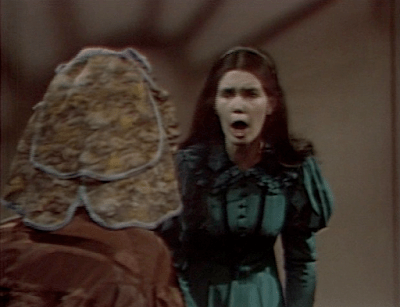
Through the first eight weeks of the part of Dark Shadows set in the year 1795, it seemed likely that wicked witch Angelique would not be on the show when it returned to the 1960s. Her narcissistic personality and consistent record of failure in her evil schemes overlapped so much with what we saw from vampire Barnabas Collins in 1967 that it would be hard to have them on the show at the same time, while her hyper-intense personality and the fast pace of the action she has generated would seem to be signs that she is not meant to stay on a daytime serial for the duration.
That starts to change today. Barnabas is not yet a vampire, but a living being and a gallant gentleman, albeit a deeply selfish and alarmingly violent one. He married Angelique, not knowing that she was a witch until too late. He has tried to kill her three times in the last few days. That was one attempt too many for Angelique, who in her irritation put a curse on him. A bat bit his throat, leaving him with heavy blood loss and a high fever. Today, Angelique tells escaped convict Ben Stokes, who is Barnabas’ loyal friend and her wretched thrall, that if Barnabas dies he will become “the living dead.”
When she is telling Ben what will happen if Barnabas dies, Angelique says that “I am responsible” for the situation. That is a phrase Barnabas never uttered in 1967. Angelique also tells Ben that she must keep Barnabas alive to prevent fulfillment of the curse, and that she will try to lift it altogether when she is stronger. That is another difference from vampire Barnabas- when one of his plans failed, he didn’t try to cure his victim. What failure with one person meant to him was that it was time to kill that one and start over with another. So we can see that the overlap between Angelique’s personality and the one Barnabas will have as a vampire is not total, and that it may be possible to construct plots involving both of them.
Gallant gentleman Barnabas Collins discovered that his wife, Angelique, was a wicked witch and a deadly threat to his true love, the gracious Josette. He did not tell anyone what he knew about Angelique, but did persuade Josette to flee. Today, Angelique discovers that Josette is beyond the range of her powers.
In her rage, Angelique takes a doll belonging to Barnabas’ little sister Sarah. She sticks pins in it; Barnabas has learned that this causes Sarah to become ill. Angelique is about to stick a pin into the doll’s heart when Barnabas takes a dueling pistol and shoots Angelique.
Angelique drops the doll; Barnabas takes the pins from it. Angelique presses her hand to her shoulder while delivering a long, bombastic speech. Barnabas has plenty of time to reload the pistol and shoot her again, but chooses just to stand there and listen to her. This turns out to be a bad decision when she ends the speech by placing a curse on him. He will spend all eternity unable to rest, and everyone who loves him will die. Having completed her death scene, she ostentatiously collapses.
We hear a window smashing. A bat appears. It approaches Barnabas. He yells at it, flails his arms, and walks backward. This is an echo of #330, which ended with strange and troubled boy David Collins reacting the same way when the same puppet appeared in his bedroom. David was a neurotic and isolated pre-teen who had been through a lot of trauma, so that was an effective scene. Barnabas is a grown man who has been trying to function as an action hero. Seeing him as the equivalent of a cartoon lady standing on a chair screaming because she saw a mouse rather undercuts this. Anyway, the bat bites Barnabas on the neck, so now he’s going to be a vampire.
The bite. Not Barnabas’ cloak in the background, playing the role of The Grim Reaper. Screenshot by Dark Shadows Before I Die.
In #330, it was Barnabas who sent the bat against David. This is one of many indications that the vampire Barnabas we knew from April to November of 1967 was not only under Angelique’s curse, but that he was in some sense a manifestation of Angelique. Maybe when she casts a spell, she breaks off a chunk of herself and that chunk goes about the world pursuing its own objectives. The image of a supernatural being as a complex of vaguely related but independent phenomena has been standard in Dark Shadows since undead fire witch Laura Murdoch Collins first appeared on the show in December of 1966, so regular viewers are prepared to learn that the vampiric Barnabas is a subcategory of the syndrome known as “Angelique.”
This episode explains how a couple of the more important props got to be in the places we are used to seeing them. Early in the episode, Barnabas gives Josette a music box. This music box figured heavily in the story from May to August 1967 as a symbol of Josette and as a vehicle for some kind of magic spell that was supposed to turn other people into her. A bit later, we see that Barnabas has hung the portrait of Josette over the mantle in the front parlor of the Old House. It was there when we first saw the Old House in #70, and was the focus of all supernatural phenomena on the show from then until Barnabas reclaimed the Old House in #212.
When I was a kid in the 80s, a friend of mine liked watching syndicated reruns of the tongue-in-cheek Western series Alias Smith and Jones on Saturday afternoons. I didn’t much care for it, but sat through a few of them with him. Eventually they got to some episodes in which the actor who played the character with the alias “Smith” was replaced by a man who was always smiling as if he had just said something terribly clever, even if he hadn’t said anything at all. After a few minutes of that bozo’s inane mugging, my friend couldn’t stand it either, and we could go back outside and play. So that worked out to my benefit.
In those same years, I was a great fan of The Twilight Zone. The man whose pointless self-satisfied smile ruined Alias Smith and Jones for its fans showed up in one of those episodes, but he was used intelligently there. The episode was called “Spur of the Moment.” In it, a young woman has to choose between two lovers, one of them a prosperous fellow whom her father likes, the other a penniless dreamer whom the whole family hates. Any audience will have seen that story countless times and will assume that we are supposed to root for the penniless dreamer. But The Twilight Zone mixed that up for us by casting the likable Robert E. Hogan as daddy’s choice and the man with what we nowadays call an “instantly punchable face” as the poor boy. When the twist ending shows us that the woman was horribly wrong to marry the poor boy, it’s our dislike of the actor playing him that makes it a satisfying resolution.
So, when I first saw this episode of Dark Shadows some years ago, it was with some apprehension that I met the sight of that same repellent man on screen. His name is Roger Davis. In later years, Joan Bennett would look back at her time on Dark Shadows and would refer to Mr Davis as “Hollywood’s answer to the question, ‘What would Henry Fonda have been like if he had had no talent?'” Mr Davis’ head is shaped like Fonda’s, and his character turns out to be a defense attorney, a common occupation among the roles Fonda played.
The first line addressed to Mr Davis is “I forgot you were here,” spoken by bewildered time-traveler Vicki. When his character Peter, a jailer who is reading for the bar, tells her that he can hear her in her cell at night, she tells him she didn’t know he was there. Vicki’s repeated failure to notice Peter’s existence may not sound like an auspicious start to what is supposed to be a big romance, but it isn’t as bad as what happens when he is escorting her back to her cell. He puts his hand on her elbow, and she reflexively recoils.
Mr Davis is just awful in his scene today. He spits each of out his lines as if they were so many watermelon seeds, stops between them to strike poses almost in the manner of a bodybuilder, and looks at the teleprompter. The last was a near-universal practice on Dark Shadows, but I mention it for two reasons. First, because this is his debut on the show- even Jonathan Frid, whose relationship with the teleprompter is the true love story of Dark Shadows, didn’t start reading from it until he’d been on the show for a week or two. Second, in his attempts to defend what he did on Dark Shadows, Mr Davis has many times claimed that he “always” knew his lines, that he “never” used the teleprompter.
Mr Davis is going to be a heavy presence on the show for what will seem like a very, very long time to come. He, more than anyone else, prompted me to make a habit of what I call “imaginary recasting.” When Joan Bennett was stuck playing a scene with him, she evidently made the experience endurable by thinking back to the days when she was a movie star playing opposite the original, talented Henry Fonda. When I am watching him butcher a scene, I think of other actors who actually appeared on Dark Shadows or who would likely have accepted a part on it if offered, and try to visualize what they would have done in his stead.
Harvey Keitel was a background player in #33, and surely he would have accepted a speaking role on the show at this point in his career. Mr Davis’ invariably, pointlessly belligerent tone of voice makes Peter seem like a guy with a lot of anger. Mr Keitel is of course a master of playing men who have issues with anger but are still deeply sympathetic. When it’s time to sit through one of Mr Davis’ scenes as Peter, I have enough fun imagining what Mr Keitel could have done with the part that I am not too sorely tempted to give up.
Closing Miscellany
This is the first episode to show that the sign outside the town lockup is labeled, in a period-appropriate spelling, “Collinsport Gaol.”
Ballad of Collinsport Gaol.
The Bil Baird bat puppet appears in this episode, but is so close to the camera it looks like a felt cutout. Bit of a disappointment.
In his post about this episode on Dark Shadows Every Day, Danny Horn discusses the performance Addison Powell gives as a lawyer who meets with Vicki and decides he can’t take her case. He claims that Powell was THE WORST ACTOR EVER TO APPEAR ON DARK SHADOWS. Powell isn’t one of my favorites, but I don’t think he deserves that title. Of those we’ve seen so far, I’d say Mark Allen, who played drunken artist Sam Evans in the first weeks of the series, was the most consistently worthless performer, while Michael Hadge, who was motorcycle enthusiast Buzz for a while in 1967, was the most endearingly inept. Powell is awkward in his scene today, but Roger Davis is even more so, and he, unlike Powell, is so naturally unpleasant that he has to be flawless to earn the audience’s toleration.
In April 1967, Dark Shadows had the smallest audience of any of the 13 daytime serials on the three major broadcast networks in the USA. With cancellation looming and nothing to lose, the show introduced vampire Barnabas Collins to its cast of characters, and quickly jumped in the ratings, becoming the first genuine hit of any kind on ABC’s daytime schedule. Since Barnabas was the show’s one selling point, there were long stretches when he was in every episode, and almost every scene.
In November, the show went back in time to the year 1795, when Barnabas was alive and kindly. When the 1795 segment began, Barnabas was close to his uncle, the equally kindly Jeremiah Collins. Jeremiah was cleverer than Barnabas. So, while Barnabas merely showed a benign politeness to bewildered time-traveler Vicki, Jeremiah caught on that she was radically out of place and tried to coach her in the con games she would have to master to survive in her new surroundings. Even so, Jeremiah was dull, and were it not for our knowledge of what he was doomed to become, the living Barnabas would have been even duller. While in 1795, Dark Shadows has to explain not only how Barnabas falls under his curse, but also show how he becomes interesting.
Yesterday, we saw Barnabas in one of the modes in which he was most consistently interesting in 1967, that of comic villain. He’d found out that his wife Angelique was a witch and that by her evil spells she is the source of all the misery that has recently engulfed the great estate of Collinwood, and his response to that information was to make a series of farcically unsuccessful attempts to murder her. At the top of today’s episode, Angelique makes it clear that she is peeved with him about this, and she insists that he stop. She also makes it clear that she will use her magical powers to force him to spend the rest of his life being a dutiful husband, however much he hates her.
Outside the great house on the estate, feather-headed heiress Millicent is talking with caddish naval officer Nathan. It is late and Millicent is worried about the impropriety of being alone with Nathan. It is a charming scene, not least to regular viewers who remember the first months of the show, when the same actors were trapped in a pointless storyline as a couple who were so bored with each other they couldn’t muster the energy to break up. Millicent and Nathan, by contrast, are attracted to each other, zestful, and full of ideas. Millicent’s ideas are mostly silly and old-fashioned, while Nathan’s are mostly concerned with getting his hands on her money. Nancy Barrett and Joel Crothers make the most of these roles. As Nathan, Crothers plays a man who is pretending to be dashing and heroic, but who time and again betrays signs that he is cowardly and venal. As Millicent, Miss Barrett adopts an unmistakably stagy diction, articulating each word with great distinctness. Thus she tells us that Millicent has derived her ideas about life from watching melodramatic plays.
Barnabas comes upon Nathan and Millicent. Seeing him, Millicent exclaims “I’m ruined!” Neither man even acknowledges that she has said this. This is a laugh-out-loud moment, but Millicent is onto something- she really is a character in a melodrama.
Barnabas asks Millicent to help him meet Josette while Nathan and the Countess look on. Screenshot by Dark Shadows Before I Die.
Barnabas is desperate to confer with the gracious Josette. He was engaged to marry Josette until Angelique’s spell put them asunder. Josette’s aunt, the Countess DuPrés, is furious with Barnabas for trying to see her. He tells her that Josette is in great danger and will be safe only if she leaves Collinwood tonight. He refuses to explain the nature of the danger. It’s true Angelique threatened to kill Josette if Barnabas exposed her as the witch, but the warning he is already giving would by itself seem to be enough to provoke that. He might as well tell everything he knows- at least then there would be a chance he would persuade the countess and enlist her as an ally.
Again, regular viewers will see something in the exchange between Barnabas and the countess that those watching the show for the first time may miss. The countess is played by Grayson Hall, who in some of the parts of Dark Shadows set in the twentieth century plays mad scientist Julia Hoffman. Julia knows that Barnabas is a vampire, has made herself complicit in some of his crimes, and wants to be close to him. When we see Barnabas failing to make a connection with the countess, we are reminded that one of the most interesting things about him in 1967 was his relationship with Julia.
They didn’t have camera drones in 1795, so Angelique comes up with the next best thing- she casts a spell that causes a bat to watch Barnabas. The bat isn’t subtle- the sight of it alarms Barnabas and terrifies Millicent. But perhaps that’s the point- Angelique wants Barnabas to know he cannot escape her.
Well-meaning governess Vicki is in jail, about to be tried on a capital charge of witchcraft. That couldn’t happen in the New England that existed in 1795 in our timeband, but many things were possible in the world of Dark Shadows that we don’t see in ours.
Gallant gentleman Barnabas Collins has figured out that Vicki is innocent and that the real witch is his new wife, Angelique. Rather than go to the authorities with his evidence, he decides to take a more direct approach and murder Angelique. That won’t be much use to Vicki, but Barnabas can’t be bothered with details.
The longest sequence of the episode is a farce in which Barnabas pours two glasses of sherry, puts poison in the one he then gives Angelique, and tries to get her to drink. They don’t do “the old switcheroo” and mix up the glasses, but instead go with an equally hoary device of having Barnabas’ mother show up and take Angelique’s glass. Barnabas has to claim the glass is cracked and knock it from her hand.
After the failure of his attempt to poison Angelique, Barnabas opens a hidden compartment of his desk and takes out a dagger. If it weren’t for Robert Cobert’s solemn musical score, the effect would be that of seeing Wile E. Coyote open yet another crate from the Acme Corporation. He goes up to Angelique’s bedroom and lifts the dagger. Since there has been no indication that she has got into her bed, and all we see on it are a lump of covers, the audience has no reason to suppose she is in there. We end with the distinct impression that Barnabas, having barely avoided matricide, is stabbing a mattress.
We first knew Barnabas in the year 1967, when he will be a vampire and will develop from a profoundly bleak presence and an urgent threat to our favorite characters into a comic villain for whom we can’t help but feel a kind of affection as we watch him fail again and again in his elaborate schemes. In that way, his maladroit attempts on Angelique’s life today are entirely typical of the Barnabas we had met before Vicki traveled back in time in November.
In another way, this episode represents one of the biggest retcons in the whole series. Throughout his first eight months on the show, Barnabas nursed a bitter hatred for his uncle Jeremiah Collins. In the first weeks of the 1795 segment, we saw that Jeremiah eloped with Barnabas’ beloved fiancée, the gracious Josette, and that Barnabas responded to this betrayal by killing Jeremiah in a duel. When Barnabas is talking today about Angelique’s black magic, he realizes that Jeremiah and Josette ran off together only because they were under a spell, and that neither was responsible for betraying him. He has no hostility left for Jeremiah.
In the various accounts the vampire Barnabas gave in 1967 of his last years as a living being, he never mentioned Angelique. Nor did he ever say that he, Josette, or Jeremiah had been the victim of witchcraft. Instead, he had indicated that he himself had gotten involved in black magic. In #345, he told his sometime friend, mad scientist Julia Hoffman, that he became a vampire after trying to gain eternal youth, and that Josette killed herself when he offered her that eternal youth. In #358, he uses “the secret magic number of the universe,” which he had learned while studying witchcraft under a warlock on Barbados, to torment Julia. The Barnabas we met when we came to 1795 hadn’t done any of that. Until he learned the truth about Angelique, Barnabas was a man of the Enlightenment and didn’t believe that witches even existed.
Perhaps this is a change Vicki’s arrival and her bizarre behavior have wrought. The stories Barnabas tells in #345 and #358 both took place years after Josette and Jeremiah were married. So perhaps in the original timeline, with no one around yammering about what the first 73 weeks of the show were like, events moved much more slowly. The change of loves took place gradually enough that Barnabas did not feel he had to challenge Jeremiah to a duel, but he was still full of hatred and resentment. Angelique was able to cover her tracks so that no one suspected witchcraft was underway. She gradually lured Barnabas into the occult arts, perhaps giving up the idea of marrying him at some point, certainly losing his attention. By the time he brought the vampire curse on himself, the version of Barnabas in that timeline would have forgotten Angelique and would have come to be consumed by his grievance against Jeremiah. That fits far better with the April-November 1967 Barnabas than does the character we have seen so far in 1795.
Barnabas asks a key question in this episode. When Angelique says that she will always love him, he asks her what she thinks love is. She answers “Why of course I do!,” which probably means that the script called for him to ask if she knew what love was, but “What do you think love is, Angelique?” is a better question. She’s been destroying every relationship that makes him the man he is in order to have him all to herself, suggesting that if Barnabas pressed Angelique to explain what love is, she would wind up saying that it means having total control over someone. As a vampire, that’s going to be Barnabas’ working definition too, suggesting that he will be more like Angelique then than he already is now.
In this episode, the portrait of Josette is delivered to Barnabas’ home, the Old House on the estate of Collinwood. This portrait, haunted by Josette’s ghost, was the dominant presence in the Old House from its first appearance in #70 until Barnabas moved back in there in #221, and was important as a symbol of Barnabas’ obsession with Josette thereafter. The makers of the show left it on the wall of Josette’s bedroom at the beginning of the 1795 segment; we see it there in #374, but they replace it with a different portrait in #377. It’s hard to understand why it would already have been there before Josette formally became a member of the family- perhaps it was just a slip-up that it was there in #374, and they’d always planned to show its arrival at Collinwood.
At the top of the episode, much-put-upon servant Ben is locked in a barred cell in the basement of the great house of Collinwood. Haughty overlord Joshua Collins and his family just moved into the house a week or two ago, and parts of it are still under construction. Evidently the basement cells are an essential part of any well-appointed home in the area, and had to be among the first amenities installed.
Until November of 1967, Dark Shadows was set in contemporary times, largely in this house. We saw the basement several times, but never had any indication that there were prison cells there. The old manor house had a cell in its basement, and in June 1967 vampire Barnabas Collins kept the lovable Maggie Evans prisoner in that cell. Maggie escaped when the ghost of Barnabas’ little sister Sarah appeared to her in #260 and told her a riddle that pointed to a secret passage out of it. Sarah told Maggie that her father had forbidden her to tell anyone about the passage, and that even Barnabas doesn’t know about it.
Joshua is Sarah and Barnabas’ father, so when he, they, and their mother Naomi moved out of the Old House in #393 without any reference to the cell downstairs we wondered if the show had decided to retcon away Sarah’s knowledge of it. The first indication that there were not going to do this came in #399, when Sarah visited her sometime governess, Vicki. Vicki had been accused of witchcraft and was hiding in the Old House as the guest of Barnabas, who is at this time alive and gallant. During their conversation, Vicki needs a place to hide while the house is being searched, and Sarah leads her to a room upstairs that Sarah says “everyone else has forgotten about- even Barnabas.” That Sarah knows parts of the house that are secret even from Barnabas is an unmistakable reference to #260, and shows that her knowledge was not a postmortem development. When we see today that Joshua has installed a cell in the basement of the new house, it is confirmed for us that there is one in the basement of the Old House as well.
Dark Shadows is set in and near the fictional town of Collinsport, Maine. This segment of the show takes place in 1795, when Maine was part of Massachusetts. Slavery was abolished in Massachusetts in the early 1780s, at which point the Old House would have been in use for many years. It is never made clear whether the Collinses held any African or indigenous people as slaves, but indentured servants like Ben were subject to beatings and confinement at the command of those who had purchased their labor. Their obligation was limited to a term of years and was not passed on to their offspring, unlike the status of slavery, but the treatment Joshua routinely metes out to Ben makes it clear that he was accustomed to regarding humans as his property. So it is hardly surprising that he maintains a dungeon to which he confines members of his household establishment who have displeased him.
Vicki has been caught and is now a prisoner in Collinsport’s public jail. Barnabas meets her there. He has come to suspect that his new wife, Angelique, is the real witch. During their visit, Vicki makes some remarks which convince him that this is so.
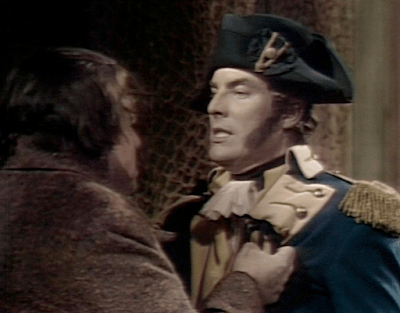
Barnabas believes that Angelique has put a spell on Ben to force him to do her bidding. The audience knows that this is correct. He finds Ben hiding in a fishing shack on the Collins family property. Angelique’s spell prevents Ben from speaking her name, but he does manage to draw her initial in the dust on a barrel top when Barnabas asks him to indicate the real witch’s name.
We spent a fair bit of time in the fishing shack in February and March of 1967. It was introduced in #173 as a favorite haunt of strange and troubled boy David Collins, and in #191 David’s mother, undead fire witch Laura Murdoch Collins, tried to burn him to death in the flames which destroyed the shack. There was a clear echo of #191 at the moment when Vicki was captured in Friday’s episode, and the return of the fishing shack today amplifies that echo for regular viewers. Today’s script is credited to Ron Sproat, the only writer from those days who was still with the show at this point. Sproat would have remembered that #191 marked the end of the first version of Dark Shadows, and would have known that by invoking it he would be telling regular viewers that the events taking place in these episodes are going to have major consequences for the show.
Sproat’s script is clean and direct, one of his best contributions. Lela Swift’s direction is typically crisp and tight. But what really elevates this episode is Jonathan Frid’s performance. Barnabas is alternately transparent and opaque. In the first scene he is open with Ben about his doubts concerning Vicki and Angelique. In the second he talks with Joshua and holds back all the most important information. In the third he is open with Vicki about his problems with her story. In the last, he knows exactly what he wants from Ben, and gets it by deceiving him about his attitude towards Vicki and Angelique. Whether Barnabas is showing his mental processes or hiding them, he is equally fascinating. In the transparent scenes, he draws us into his struggle to choose between two apparently impossible alternatives, and in his guarded ones he prompts us to try to discern his hidden thoughts. It’s a wonderful job, and well worth seeing.
Danny Horn’s post about this episode on his Dark Shadows Every Day is an essay about the similarities between Angelique on Dark Shadows and Samantha on Bewitched. He provides such an extensive and detailed list that there can be no doubt that the connection was intentional and that the audience was supposed to recognize it. I’m not sure what the makers of Dark Shadows wanted us to think when they drew so heavily on that popular prime-time show; in tone, Bewitched was light and silly, Dark Shadows absurdly serious, so I guess it could have been whatever the opposite of satire is. Or the reference to Bewitched could be a sign to the audience that Angelique’s relationship with Barnabas, horribly and all-consumingly destructive as it is now, might eventually settle into something that will run for years and years, as that show already had.
The Rev’d Mr Trask, a cleric of sorts, is convinced that there is a witch in the Old House on the great estate of Collinwood. He is right about this. He is also convinced that the witch is the eccentric Victoria Winters. He is wrong on this point. The real witch is Angelique Collins, wife of the master of the house, the gallant Barnabas. Barnabas, who as a man of the Enlightenment asserts that there are no witches, is hiding Vicki, and has reluctantly agreed to let Trask perform a rite of exorcism, believing that once he is finished he will have to go away and everyone will have to admit that Vicki is innocent.
At the top of the episode, we see Angelique building a house of cards and delivering a soliloquy about her plan to cast a spell to make it look like Trask’s fraudulent ritual has proven Vicki’s guilt. There is an element of suspense as we wonder what the character’s actions will lead to, and an even more powerful suspense as we marvel at the courage it took for the actress to remain calm enough build a house of cards on what is essentially a live television show. Forget the Daytime Emmys, Lara Parker deserved a medal for this feat.
Angelique recites a spell over the house of cards, then sets it on fire. The first time they used an incompletely contained fire on Dark Shadows was in #191, and as a result of that daring experiment a load-bearing beam caught fire and collapsed in the middle of a scene. They finished taping before putting the fire out, and somehow everyone survived. There was also an off-camera fire during a conversation between Barnabas and Vicki in #290, and Jonathan Frid and Alexandra Moltke Isles just kept delivering their lines while we heard fire extinguishers blasting in the background. As a result of an excessive pre-treatment of the cards with lighter fluid, today’s fire burns faster and expels debris over a wider area than had been intended. I suppose a technical term for a rapid fire that expels debris is an “explosion.” Parker keeps up her incantation while this explosion progresses directly in her face. That shows an entirely different kind of courage than she showed with the house of cards, but she exhibits it in an equally rare degree.
Downstairs, Trask is standing at the threshold of the house, doing his own fire ceremony. He draws Vicki’s initials on the doorstep, holds up a dowsing rod, and jabbers for a while. Then he sets fire to the rod. In her room, Vicki sees flames erupting from the floor. She shouts in panic.
Barnabas is upstairs. He hears Angelique shouting “Eye of fire, heart of ice!” Her shouts grow louder and louder as she repeats the phrases faster and faster. My wife, Mrs Acilius, said that the pattern of Angelique’s voice sounded to her like someone having an orgasm. The willingness to risk the laugh that pattern might bring represents a third form of courage; by this point, we would have to admit that whatever we may think of Angelique, Lara Parker was one of the bravest people imaginable.
Barnabas is about to investigate, but then he hears Vicki shouting “Fire!” Between these two shouting women, he goes to the one who doesn’t sound like she’s enjoying herself. By the time he gets to Vicki’s room, she is gone. He sees no sign of fire.
Vicki runs out the front door, into Trask’s arms. He shouts “I’ve caught the witch!” and forces her to the ground. He looks delighted that his shtick actually worked, for once.
This moment is an odd inversion of the ending of #191. That episode ends with strange and troubled boy David running out of the burning building where his mother, undead fire witch Laura Murdoch Collins, was trying to immolate him, and finding refuge in Vicki’s arms. At that moment, life triumphs over death, and Dark Shadows version 1.0 reaches its conclusion.
When Vicki runs out of the house and into Trask’s arms, death and folly win a victory over life and reason. Nothing comes to a conclusion- the story just gains new layers of complexity. We don’t even go to a commercial break, but get a reaction from Angelique first.
Barnabas talks with Angelique, mystified by what just happened. When he mentions that he heard her in her old room shouting strange words, she lies and says she was in the sewing room. After she leaves, we hear his thoughts- he had searched the sewing room, and knows she is lying. He now believes that there is a witch. He would find it much easier to believe that Vicki, a strange girl who claims to be displaced in time from the year 1967, 172 years in the future, is that witch than to face the prospect that his own wife is, but he can neither overlook the lie she has told nor the sheer improbability that so flagrant a quack as Trask came up with the right answer to any question. He remembers that indentured servant Ben claimed to have been enslaved by the witch, and resolves to find out what Ben can tell him.
We first got to know Barnabas in the months between April and November of 1967, when he was a vampire preying on the living in Vicki’s native time. In those days, he never mentioned Angelique, and there was no indication that he suspected any of the witchcraft we have seen since we embarked on our journey to 1795. Perhaps in the original timeline, when the place Vicki has taken was occupied by a woman named Phyllis Wick, Angelique had to proceed more slowly and carefully, with the result that Barnabas was turned into a ghoul without ever picking up on what was going on. If so, it would be Vicki’s complete failure to adapt to her new time in any way that accelerated the pace of events and thereby exposed Angelique to Barnabas’ suspicions.
Little Sarah Collins misses her governess, the well-meaning Vicki. Unknown to Sarah or her elders, Vicki is a time-traveler, displaced from 1967 by Sarah’s own ghost to come to this year 1795 and see how the troubles that will afflict the Collins family in days to come began. Vicki has utterly failed to adapt to her new surroundings, and is now in hiding, suspected of witchcraft.
Vicki is secreted in the Old House on the great estate of Collinwood, the guest of its owner, gallant gentleman Barnabas Collins. Unfortunately for her, Barnabas’ new wife Angelique is the real witch, and by her harebrained behavior Vicki has volunteered for the role of Angelique’s patsy. Angelique takes advantage of Vicki’s presence in the house to cast spells directing ever more suspicion her way and increasing the likelihood she will be caught.
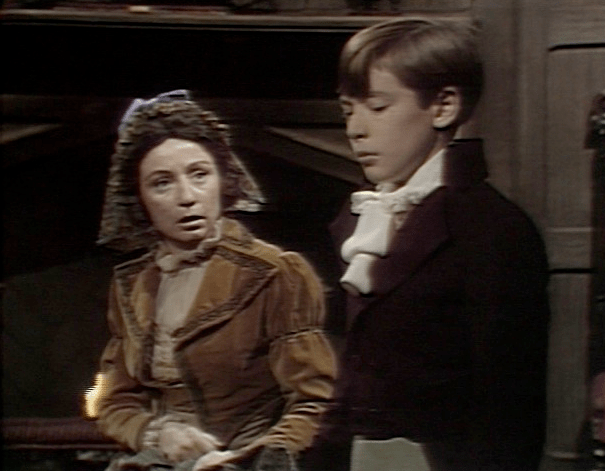
We see Sarah in the foyer of the great house, tossing a ball in the air. Tossing a ball was one of her favorite pastimes as a ghost in 1967. In those days, she usually sang “London Bridge” while playing ball, but she is silent now. Indeed, we have yet to hear the tune in connection with the living Sarah. She is interrupted by Vicki’s disembodied voice calling her to the Old House. Regular viewers, remembering Sarah as the calmest and most adroit of ghosts, will be intrigued to see the living Sarah bewildered by a supernatural phenomenon.
The voice stops, and we cut to the Old House, where a puzzled Barnabas catches Angelique doing something weird with candles. She makes up a story about having needed the light to search a dark corner for a piece of jewelry she dropped. In the course of the story, she says that she was crawling about “like a cat.” It’s a bit startling to hear her compare herself to a cat, since in #378 she turned Barnabas’ father, haughty overlord Joshua, into a cat. It doesn’t make an impression on Barnabas, though, and he quickly disregards the whole thing.
Back in the great house, repressed spinster Abigail meets her brother Joshua in the drawing room of the great house. She is sure Vicki is a witch and that Barnabas is sheltering her in the Old House. Joshua had earlier given Abigail and her favorite divine, the Rev’d Mr Trask, free rein to investigate Vicki; he now seems to regret that decision, and on no account does he want any member of the family to go to his disowned son Barnabas’ house. When Abigail finds Sarah and forces her to tell the story about hearing Vicki’s voice calling her to the Old House, she seizes the high ground. She insists that Sarah go to the Old House and that she and Joshua follow her there. When Abigail says “Come, Joshua,” she leaves him little choice but to comply.
Sarah enters the Old House through the front door, and for the first time in 1795 the strains of “London Bridge” play on the soundtrack. Apparently Sarah’s visit to her former home marks a step towards her postmortem fate. She calls for Vicki. Barnabas asks Sarah what she’s doing there. Abigail and Joshua appear at the threshold and ask to be admitted. Angelique, as lady of the house, invites them in and offers to make tea. Abigail refuses the offer and announces their purpose. While the adults quarrel, Sarah slips out. We cut to Vicki’s room; evidently Sarah went directly to her, for they are already in the middle of a conversation.
In 1967, the spectral Sarah was an expert in the arts of concealment and escape. She has some of those talents already in her living form. She takes Vicki to a compartment in the attic that none of the adults, not even Barnabas, remembers. Vicki hides there while Abigail and Joshua search the house.
Having found Sarah, Abigail questions her closely. Sarah stands with her back to her aunt; it is uncharacteristic of Abigail to allow this, and we wonder why she does. Young Sharon Smyth plays the scene so well that we are glad to see her face. Abigail asks if Sarah knows that “curious and terrible forces” beset them; Sarah replies with a crisp “Yes, ma’am!” She asks if she knows what happens to little girls who lie, especially to their elders; “Yes, ma’am!” We see the struggle on Sarah’s face as she denies having seen Vicki.
After they complete their search, Joshua agrees that Vicki is not there and is embarrassed by the whole thing. Abigail insists that she is there, citing Sarah’s lies as proof. Now we understand why she let Sarah turn her back on her- she didn’t intend to extract the truth from her, since a lie would serve equally well. Abigail demands that Trask be brought back to perform a rite of exorcism. Joshua reacts to this demand with distaste, Barnabas with indignation, but Angelique persuades her husband to allow it.
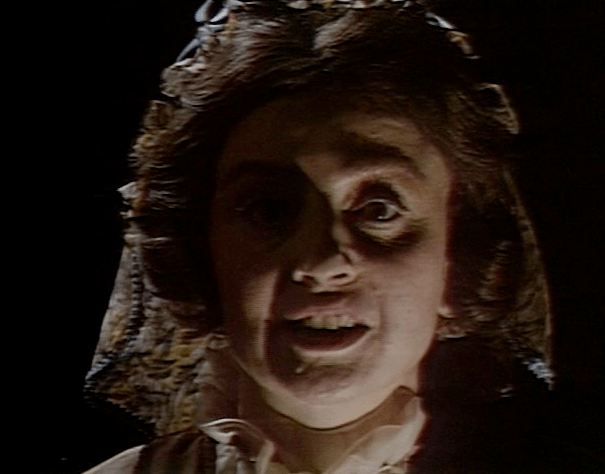
After the visitors have left and Barnabas has gone to be alone, Angelique gives a soliloquy about how she will turn Trask’s fraudulent mumbo-jumbo to her own purposes. Vicki’s face is superimposed over hers in an effect we have not seen since the days of blonde fire witch Laura Murdoch Collins. Laura’s face was superimposed over those of people on whom she cast spells, most significantly over parapsychologist Dr Peter Guthrie in #185. Laura’s spell killed Guthrie; evidently Angelique’s plans for Vicki are equally final.
Wrongly suspected of witchcraft, bewildered time-traveler Vicki has found refuge in the home of young gentleman Barnabas Collins. Vicki doesn’t know it yet, but last night Barnabas married a woman named Angelique. Vicki knew Angelique when they were both working in the home of Barnabas’ family, Vicki as a governess, Angelique as a lady’s maid. Unknown to almost anyone, Angelique is the real witch and is glad Vicki has fallen into taking the blame for her evil deeds.
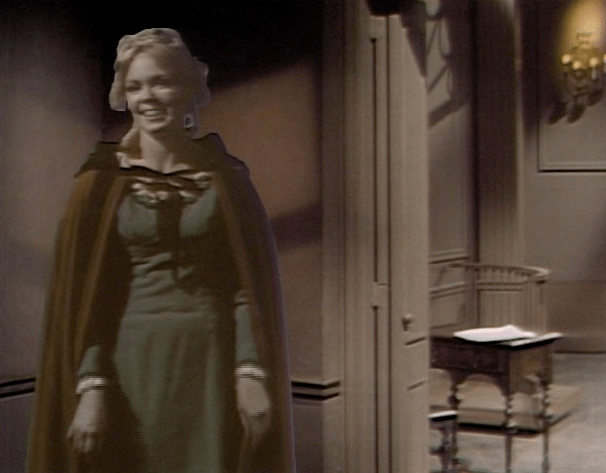
Angelique herself is in the dark about Vicki’s presence in the house. She chances upon Vicki in the morning. Angelique is the only character in the segment of Dark Shadows set in the year 1795 to address her as “Vicki”; everyone else insists on calling her “Victoria” or “Miss Winters.” Since we have known Vicki since the first episode, and we know that her friends call her “Vicki,” hearing her use that form of the name tells us that Angelique has presented herself to Vicki as a friend.
Angelique tells Vicki that she and Barnabas are now married. If Vicki had learned anything from the long string of failures to adapt to the mores of 1795 that have brought her to her current state, she would respond to this by lowering her eyes, curtsying, and saying “Mrs. Collins.” But instead, she reacts with a blank stare. Angelique asks what if she is merely startled by the news, or is shocked. Vicki resumes babbling, still calling Angelique by her first name, still referring to Barnabas by his.
Not only is Vicki continuing to flout the modes of address conventional to the period in which she finds herself, she seems genuinely unaware that a newlywed might be disturbed to stumble upon an attractive young woman her husband is hiding in the house. After a minute or two, it occurs to her to ask Angelique if she wants her to stay. Angelique says that because Barnabas is the master of the house, it is not for her to object. Vicki responds by jumping into her face and exclaiming “But you’re the mistress!” Even after that, she keeps on with her first-naming of Barnabas and Angelique and shows absolutely no sign of awareness that Angelique might be concerned about the nature of Barnabas’ attachment to her.
“But you’re the mistress!”
Downstairs, Angelique asks Barnabas about Vicki. He asks incredulously if she is jealous. Barnabas didn’t visit Angelique in her bedroom on their wedding night and she knows that he tends to make free with servant girls, since that’s how they met. Even so, he can’t figure out why Angelique might be unhappy to find that he has Vicki stashed in the house. It really is a shame Barnabas and Vicki didn’t marry, just imagine what oblivious children they might have had. They might have been the progenitors of a whole line of Detective Frank Drebins.
Later, Angelique has a spell she wants to cast on Barnabas’ aunt, repressed spinster Abigail Collins. She summons indentured servant Ben, whom she has enslaved. She orders Ben to steal Abigail’s hair ribbon from her night-stand. Ben is horrified by the command. It would have been bad enough if he had been caught sneaking into one of the gentlemen’s bedrooms, but he might have been able to talk his way out of that. If he is found in a lady’s bedroom, he’ll be lucky if all that happens is that he’s sent back to prison for several years. Impatient, Angelique tells him not to get caught.
Abigail does catch Ben in her room with the hair ribbon in his hand. She was the first to suspect witchcraft at Collinwood, before there even was any. Ben begs her not to ask him any questions, but she isn’t having it. She presses him, and he says that the witch sent him. She demands he say the witch’s name, wanting to hear him say “Victoria Winters.” He is about to say “Angelique” when we see her, in the Old House, cast the spell that causes him to choke. This scene takes about a minute to make all the points the story needs, but goes on for several times that long. That doesn’t hurt a thing- Clarice Blackburn and Thayer David were such a pair of pros that they could hold the audience’s attention for a good deal longer with a lot less to work with. It’s a fine ending.
Yesterday, the ghost of Jeremiah Collins started to bury wicked witch Angelique alive. Today, we see that he barely got her dress dirty. She’s lying on a mound next to the empty grave when we find her.
This is the one where Angelique marries Barnabas. It ought to be packed with incident. There is a lot of activity, but like the live burial, it doesn’t amount to much. It’s a real disappointment.
One particular weak spot in the episode is the officiant at the wedding, the aptly named Reverend Bland. Actor Paul Kirk Giles does what he can, but as soon as the Rev’d Mr B realizes that something unwholesome is going on he declares that he is getting out of the place. Apparently his conception of the duties of a pastor consists of avoiding people who might need help confronting the spiritual forces of darkness. It doesn’t matter- Bland’s squeamishness disappears after Barnabas orders him to stay and perform the wedding.
After the wedding, Angelique returns to her bedroom. There is a gift that hadn’t been there before. Opening it, she finds a music box. The music box was a big deal in 1967, when Barnabas was a vampire and he thought that a woman who listened to it would turn into his lost love, the gracious Josette. This is the first time we have seen the music box during the segment of Dark Shadows set in 1795. In 1967, Barnabas told various stories about the origin of the music box, but the one thing that remained consistent was that it was meant for Josette.
Barnabas and Josette were engaged when the 1795 segment began, but that ended when Josette and Jeremiah conceived a mad passion for each other and eloped. Unknown to Barnabas, that was the result of a spell Angelique cast in hopes of getting Barnabas for herself. Barnabas responded to the elopement by killing Jeremiah in a duel. He has told Angelique that he still loves Josette and always will, but that he knows there can never again be anything between them. Moments after he had told her that, Angelique agreed to marry him. Evidently it was to be a sham marriage.
Jeremiah’s ghost has been railing at Angelique for raising him from his grave, and apparently he wants to be avenged by making the sham marriage even shammier. When Barnabas comes into the room, he sees the music box, explodes in rage, and storms out.
In life, Jeremiah never knew that Angelique was behind his and Josette’s passion. He has evidently learned that and other of her secrets, and is using them against her. Perhaps Angelique put more of herself into him than she intended.
On The Collinsport Historical Society, Patrick McCray says that this is an important episode because Barnabas and Angelique’s wedding is the basis for some developments much later in the series. That’s true, but by the time he’s talking about the show isn’t very good any more. So I consign it to the ranks of the “Stinkers.”