Twenty-eight weeks ago, the ghost of Quentin Collins had made life intolerable on the great estate of Collinwood. Recovering vampire Barnabas Collins, in an attempt to contact Quentin and persuade him to make peace before his haunting killed his twelve year old great-great-nephew David Collins, accidentally traveled back in time to 1897, where he met and befriended the living Quentin.
In that time, he learned that Quentin was a werewolf. In 1969, Barnabas and his friend Julia Hoffman, MD, had been trying to cure a man named Chris Jennings of lycanthropy. Now, Barnabas has figured out that Chris inherited his curse from Quentin, whose infant daughter Lenore will grow up to be Chris’ grandmother.
Julia herself has now traveled back in time. The journey left her dazed and, astonishing to behold, unable to speak. Today, Barnabas and Quentin at her bedside in the hiding place Barnabas has found, and she started talking. She has a vision of 1969. She sees David lying dead and his father Roger mourning him. Suddenly David comes back to life and announces that Quentin’s ghost and that of maidservant Beth are no longer haunting the house. When Julia regains her senses, she tells Barnabas that this means that they should both go back to 1969- their mission in the past is complete.
Barnabas declares that they cannot leave, because Chris is still a werewolf. He doesn’t actually know this. Chris wasn’t in Julia’s vision. His transformations became more frequent and longer lasting as Quentin’s ghost gained power; when Quentin achieved total control over the great house at Collinwood, Chris took on wolf form permanently. For all Barnabas knows, the end of Quentin’s obsession of Collinwood might mean Chris’ return to normal. He also knows that Quentin himself remained human the last time the Moon was full, suggesting that something has happened to the curse. Perhaps if they return to their own time, he and Julia will find that Chris is not a werewolf and never was one.
Barnabas tells Julia that, while she and a fellow mad scientist had managed to free him of the effects of vampirism in the 1960s, he is fully subject to them in 1897. Moreover, everyone knows that he is a vampire, and he is being hunted. And there is an evil sorcerer in the area, Count Petofi, who is closely connected with Quentin and who has malign intentions towards Barnabas. Julia points out that all of these are reasons to return to 1969 at once.
Barnabas demands that Julia develop a treatment that will once more put his vampirism into remission. Julia calls this impossible. The drugs and devices she used to accomplish this in the 1960s have not yet been invented, and even in that time she was just barely able to make the treatments work. In the story we actually saw in 1968, treatments of the kind Julia is talking about worked only for a little while, and the lasting cure came only when Barnabas was hooked up to a Frankenstein’s monster. There clearly is no time to create an abomination of that kind.
But there is no reasoning with Barnabas. Julia concedes this- “I always lose with you, don’t I?” She agrees to stay and to do her best.
Barnabas suspects that Quentin is working for Petofi. This is true. Not only did Petofi save Quentin’s life yesterday, but he also arranged the painting of a portrait which, like the one in Oscar Wilde’s Picture of Dorian Gray, changes while Quentin remains the same. When Quentin realizes that Petofi has the power to make him human or return him to lycanthropy, he caves in to his demand that he act as his spy in his dealings with Barnabas.
Julia has managed to concoct an injection for Barnabas and is planning to give him another when he insists on rushing out. She says this will ruin the treatment; he says he will be back before dawn.
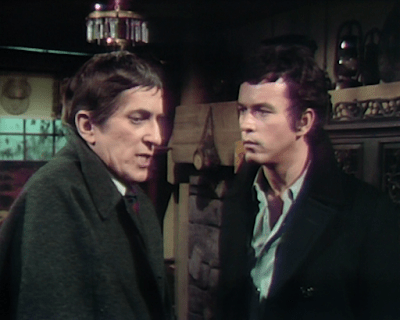
Barnabas goes to see Quentin. He finds the portrait, puts two and two together, and confronts Quentin about his relationship with Petofi. Quentin lies, and Barnabas goes back to the hiding place. It has been ransacked, and Julia is gone.
In #836, the ghost of maidservant Beth Chavez appeared to Julia Hoffman in the year 1969. Beth told Julia what happened on the night in 1897 when she shot the rakish Quentin Collins to death.
Regular viewers would have recognized the events Beth described as different from what would have happened when Quentin originally died in 1897. For the last 28 weeks, the show has been set in that year because Julia’s friend, recovering vampire Barnabas Collins, accidentally traveled back in time while trying to figure out why Quentin had become a ghost bringing death and misery to everyone on the estate of Collinwood. In 1897, Barnabas met the living Quentin and befriended him, but also changed the history of the period substantially. So a wicked witch named Angelique, who was not at Collinwood the first time through 1897, is there on this iteration of events. Beth’s night took the turn that would lead her to shoot Quentin when Angelique told her that her engagement to Quentin was off and that Angelique would be marrying Quentin instead.
After Beth told her what happened in the latest version of 1897, Julia herself traveled back in time, determined to rescue both Quentin and Barnabas. Once she got to her destination, she was too dazed to speak. But Quentin found a letter in her pocket that Barnabas had written, and it led him to Barnabas. Barnabas was able to tell Quentin that he was fated to be killed tonight, after his nephew Jamison rejected him. He had no more to tell him, nor could he restore Julia’s ability to speak.
We open today with Quentin holed up in his room, waiting for midnight to come and go. Sorcerer Count Petofi knocks on his door; Quentin jumps to the conclusion that it is Petofi who will kill him. In fact, Petofi has learned of Quentin’s current fate, and offers to help save him. Quentin has ample reason to distrust Petofi, and refuses the offer.
Jamison then knocks. Quentin lets him in; the two have a happy talk about how much they enjoy each other’s company, and Quentin decides he won’t stay in his room after all. This leads directly to the reenactment of the scenes Beth had described, including Beth’s conversation with Angelique, Jamison’s discovery of Beth in the act of attempting suicide, Jamison’s consequent rejection of Quentin, and Beth’s pointing a loaded pistol at Quentin while she declares that she has decided to kill him.
Quentin’s time in his room shows that his behavior afterward is the direct result, not only of Barnabas’ intervention, but of Julia’s as well. So what we are seeing today is not what happened the first time through 1897 or the second, but is yet a third version of events. It does end quite differently- Petofi turns up in the nick of time and prevents Beth from shooting Quentin. The whole basis of the fantasy of going back in time to change events is the experience of rewriting stories, of what fandoms call “retroactive continuity” (“retcons” for short.) In the contrast between the two versions of the night of 10 September 1897 that Dark Shadows shows us, and in the contrast between each of those and the original events that we never saw, the story merges into the process of writing the scripts, and the characters explicitly create their own retcons.
Petofi tells Beth that she ought to leave Collinwood at once and go as far away as possible, because “Your part in this drama is ended.” The incorporation of retcons as an overt story element shows that metatheatricality can be fun, but I have to say it was pretty cold of Dan Curtis to delegate the job of firing actress Terrayne Crawford to the character Petofi.
Count Petofi tells Terrayne Crawford she won’t be getting another contract.
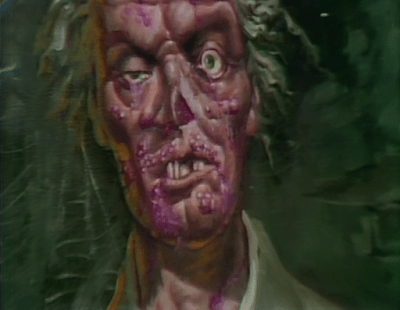
Petofi then goes to Quentin’s room and tells him the price for his services- Quentin must betray Barnabas. Quentin resists this demand until Petofi shows what else he has already done for him. Petofi commissioned a portrait of Quentin. Quentin saw the portrait the other night when there was a full Moon, and he was horrified by what he saw. The portrait bore, not his usual features, but those of a wolf. Since Quentin is a werewolf, he thought the portrait was a cruel reminder of his curse. But when Petofi bids him look at the portrait again tonight, Quentin sees his accustomed face. Petofi explains that the reason Quentin remained human that previous night was that the portrait changed, and that as long as the portrait remains intact Quentin will be free of the effects of the curse. Quentin’s blissful reaction to that news suggests that Petofi was right to tell him that he belonged to him now and would be able to refuse him nothing.
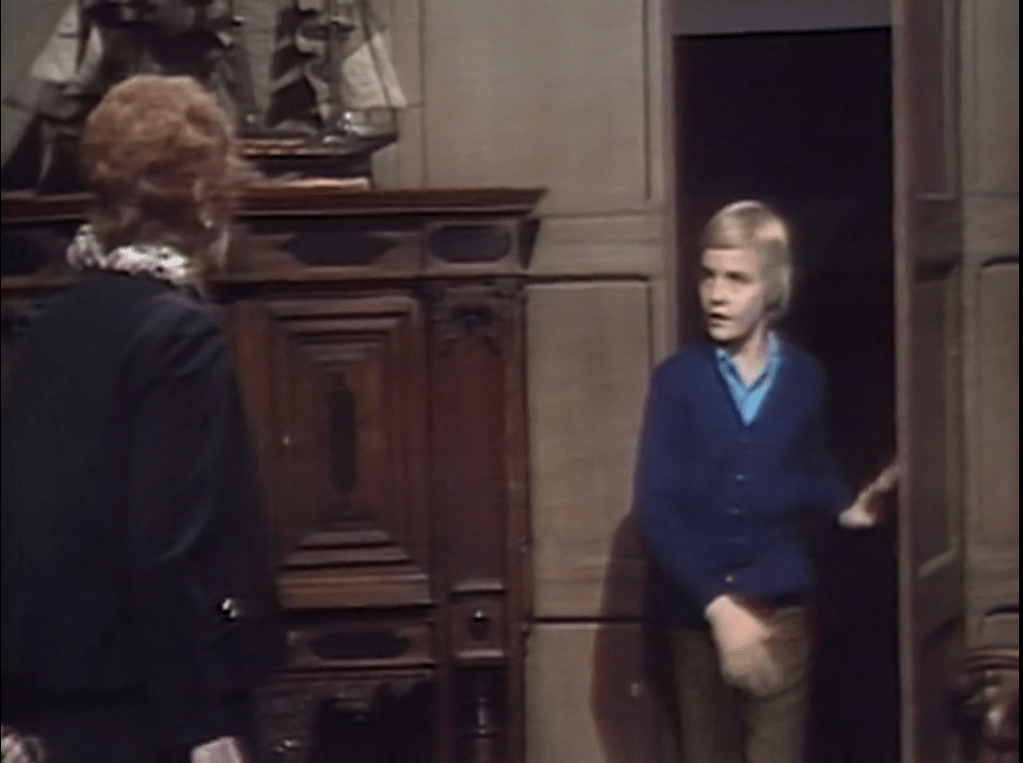
Sadly, this episode marks the last appearance of the character Jamison Collins. David Henesy plays the same scenes with the same dialogue he had on Monday, but he did a great job then and does an equally great one today. He’ll be back tomorrow for a brief appearance as his 1960s character, David Collins, then will be absent from the cast for almost 11 weeks. We’ll miss him while he is away.
Most of the episode revolves around the fact that Julia Hoffman cannot speak. Grayson Hall uses a whole new set of acting techniques playing a mute character than we had seen in her appearances as the most talkative human beings imaginable, and the result is absolutely fascinating. I’d have been glad to watch the episode again as soon as it ended.
We open in the basement of the Old House on the estate of Collinwood. Julia is sitting at a table in front of a set of I Ching wands. These wands are still in the pattern recovering vampire Barnabas Collins cast several months ago, when he was trying to contact the malign ghost of Quentin Collins. Barnabas meditated on them, and his “astral body” went back in time to 1897. Since his physical body was also in 1897, confined to the coffin in which he was at that time trapped, he became a resident of that year, and met the living Quentin.
Julia has decided that she, too, must travel to 1897. So she meditates on the wands. She tells herself that she must visualize them on a door, and she tells herself to “Empty your mind of everything else.”
She follows this injunction only too well. After passing through a series of doors, she collapses outside the great house at Collinwood in 1897. When stuffy Edward Collins takes her into the drawing room and questions her, she can respond only with a blank stare. Quentin comes in and finds a letter from Barnabas in Julia’s pocket. He asks her if she is the Julia addressed in the letter and why she has a letter from Barnabas. She does not recognize her own name or Barnabas’.
Quentin has become Barnabas’ friend, and his brother Edward has become his enemy. When he reads the letter Julia brought, Quentin realizes that Edward has locked Barnabas in the prison cell in the basement of the Old House. When dawn comes, Barnabas will not be able to get back to his coffin. Since he is a full-fledged vampire in 1897, that means he will disintegrate into dust.
Quentin leaves Edward with Julia and goes to Barnabas’ rescue. Quentin knows that Barnabas is a vampire and that he is trying to help him, and he knows that if things keep on as they are going he might become a family-annihilating ghost at Collinwood in 1969. But it is only while talking to Barnabas about the letter that he learns that he has come to 1897 from that year. The pieces start falling into place in Quentin’s mind as he absorbs this information.
Barnabas goes to hide in “the old rectory on Pine Road.” Quentin takes Julia there. Barnabas can’t get any information out of her, but he is sure that she knows how to save Quentin’s life. He is also sure that if they don’t find out what she knows, Quentin will be killed on this night, 10 September 1897.
The basis of Barnabas’ certainty regarding this latter point is a vision that a woman had. This woman used to be the repressed Charity Trask, but has now by supernatural means been transformed into the late Cockney showgirl/ psychic Pansy Faye. Pansy’s psychic act was fake until she came to Collinwood in #771. In the spirit-laden atmosphere of the estate, even her phony mumbo-jumbo called up real voices from the great beyond. Pansy’s stunned reaction when she actually contacted a ghost reminded longtime viewers of #400, when Charity’s ancestor, the fanatical witchfinder the Rev’d Mr Trask, conducted an exorcism to drive a witch out of the Old House and showed delight and not a little astonishment when the person he believed to be the witch came running out at the climax of the ceremony. Perhaps Pansy reminded the writers of Trask as well, and that was where they got the idea of having her spirit take possession of Charity.
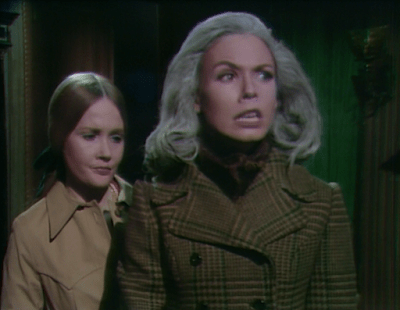
Charity/ Pansy is in today’s episode. She’s the one who finds Julia, and she tells Edward that Julia “has death written all over her face!” She also says that she has a job. She is working at the tavern in the village of Collinsport, the Blue Whale. Presumably she is doing Pansy Faye’s old act there, singing, dancing, and doing psychic readings. We can imagine what Charity’s father, the hypocritical Rev’d Gregory Trask, must think of that.
It is 8 September 1969, and the ghost of Quentin Collins has rendered the great house of Collinwood uninhabitable. The family, including permanent house guest Julia Hoffman, have been staying at the Old House on the estate while recovering vampire Barnabas Collins is on a trip back in time to 1897, when Quentin was killed and the trouble started. But Julia has received a letter Barnabas wrote to her in September 1897 indicating that, as of that date, his mission was about to end in total failure, and so she decides to take matters into her own hands. First, she must learn exactly how and when Quentin died.
Julia goes to the great house and follows the sound of Quentin’s theme song to the tower room. There, she finds the ghost of maidservant Beth, who was one of Quentin’s many lovers. When Beth is in a shadowy corner, she puts on a ghostly voice and tells Julia that her name would mean nothing to her. As soon as she comes into the light, Julia says that they’ve met several times, and soon she is calling her by name. Along with the fact that, as Beth, Terrayne Crawford is just standing there in the same light as Grayson Hall, with no practical effect whatsoever to suggest ghostliness, this deflates whatever feeling we are supposed to have that we are witnessing an encounter with the supernatural.
Julia insists Beth tell her how Quentin died. When the ghost of Barnabas’ nine year old sister Sarah Collins was on the show from June to November 1967, she would often insist on the Ghost Rules and vanish if people put direct questions to her. But Beth just wanders around a little, moans to Quentin that she has no choice but to tell Julia what she wants to know, and starts dishing. Again, they aren’t making ghosts like they used to.
Beth tells Julia that on 10 September 1897, she found out Quentin was going to marry a woman named Angelique. Quentin did not tell her this news himself; he left it to Angelique to do so, making the blow fall all the more heavily. This will remind longtime viewers of #392, when Barnabas could not bring himself to tell his ex-fiancée Josette that he was engaged to Angelique, leaving Angelique to tell Josette herself in #393. Josette waited until #425 to leap to her death from the cliff at Widows’ Hill, but things move faster now. Beth went straight from her conversation with Angelique to her room, where she had a bottle labeled “Poison.”
Sensible shopper that she is, Beth buys her poison in the Generic section of the murder weapon store. Screenshot by Dark Shadows Before I Die.
Before she could do away with herself, Beth was interrupted by a knock on the door from twelve year old Jamison Collins. Jamison came in to show her a puzzle he had solved, then saw the bottle. He demanded to know what was going on, and she admitted that she was planning to kill herself because Quentin was going to marry Angelique. He stopped her doing that, but after he left to confront Quentin she took a loaded revolver out of her dresser.
Jamison found Quentin in the drawing room, in Angelique’s arms. Angelique at first dismissed Jamison, saying that his uncle was too busy to speak with him, but Jamison held his ground and insisted on seeing Quentin alone. Quentin obliged, but would answer Jamison’s questions only with airy assertions that he is too young to understand the situation. Jamison is so composed and forceful, and Quentin’s behavior is so flagrantly irresponsible, that we might expect Jamison to ask to be spared lectures on maturity from a man so much more childish than he. Instead, Jamison simply becomes angry and tells Quentin that after what he has done to Beth, he wants nothing more to do with him.
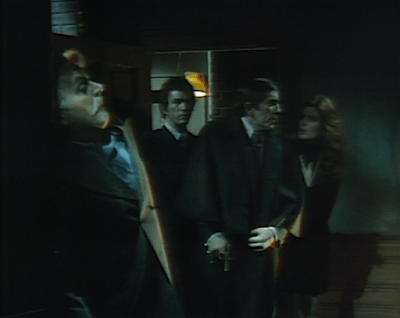
In #767, Jamison had a dream in which Quentin’s ghost said that his death was preceded by three events. The first two events happened shortly after. The third event was that Jamison rejected him. This has now happened, and in the dream Quentin said that once that took place “There was almost no time left for Quentin Collins.” Indeed, shortly after Jamison stalks off Beth shows up with her revolver and shoots Quentin. He staggers from the drawing room and goes upstairs. Since the staircase is made of eleven steps and is eight feet tall, that’s some pretty fancy staggering for a man who has just taken a round to the midsection. Quentin keeps staggering all the way to the tower room, where Beth shoots him a few more times.
We cut back to 1969, where Beth tells Julia she killed herself the day after she killed Quentin. She doesn’t seem to be done talking when Julia excuses herself. Say what you will about Sarah, she always left them wanting more.
Julia finds twelve year old David Collins, Jamison’s grandson, in the drawing room with Quentin’s ghost. Since Barnabas took us back in time with him in #701, we’ve got to know the living Quentin quite well, and he is a charming rascal who has very little in common with the silent, family-annihilating ghost we saw late in 1968. Beth’s story does very little to explain how the one turned into the other. The ghost has been draining the life from David; Julia orders David to come away from him, and he does. David lies down on the couch, and Julia examines him. She finds that he is weak, but resting comfortably.
Occult expert Timothy Eliot Stokes enters. Quentin’s ghost has vanished. Stokes calls Julia by her first name, something he had not done prior to this episode, and asks after David. She at first says he will be all right, then checks on him again. She cannot find a pulse, and declares him dead. Julia has performed wonders in her work as a medical doctor, but her death pronouncements are so often wrong that this does not give much grounds for alarm. However, we then hear Quentin’s voice laughing maniacally, darkening David’s prospects.
Terrayne Crawford seems to be such a nice person that it distresses me to point out that she was not a very good actress. But in this one, Beth’s lack of supernatural quality and Julia’s bland reaction to her make it seem like writer Gordon Russell and director Lela Swift were conspiring to vent their exasperation with Miss Crawford’s limits. She can play one emotion at a time, so that when Beth is shocked to learn that Quentin is going to marry someone else she is only and entirely Shocked. When Beth is suicidal, she is only and entirely Sad; when she decides to take Quentin’s life instead of her own, she is only and entirely Gleeful; when she tells Julia that her vengeance did not relieve her sorrow over Quentin, we can see that’s true, because she is only and entirely Sorrowful. The result is like looking at a series of wood block cuts illustrating various emotions. It’s all very clear and quite vivid, but there’s no sense of development from one scene to the next. Had Miss Crawford been able to lay one emotion over another and play two or more of them at a time, the grin on Beth’s face when she kills Quentin would have shown us that all the layers of complexity of feeling had finally been stripped away and only hatred was left. That would have been a tremendous climax for the character. But since there was never any such complexity to start with, it’s just another block cut.
Often when I see disappointing performances on Dark Shadows, I think of other actors in the cast and try to imagine what they would have done with the part. Gail Strickland, like Miss Crawford, is a tall, thin woman whose chin juts out on a horizontal line, and she was on the show as doomed schoolteacher Dorcas Trilling for a couple of episodes in May. Dorcas’ role would have been well within Miss Crawford’s competence, and in her long and distinguished career Miss Strickland proved she could do just about anything. So on a day like this, I envision a different, much more nuanced Beth. The episode in my imagination is really stellar, I wish you could see it.
Today, David Henesy plays both his 1897 character Jamison Collins and his 1960s character David Collins. He is not credited for either of those roles, but for Daniel Collins, whom he played when the show was set in the 1790s back in late 1967 and early 1968.
Stuffy Edward Collins was under a spell for several weeks that prevented him from keeping up with what has been happening on the estate of Collinwood in 1897. He knows that his distant cousin Barnabas is a vampire who originally died in the 1790s and has come back to prey on the living. From this, he has drawn the eminently logical conclusion that he is a character in a horror story, and that it is his responsibility to be the hero who destroys the undead ghoul.
In fact, Dark Shadows stopped being that kind of show long ago. Others know that it is chiefly about time travel now. That point is made when we flash forward to the year 1969, from which Barnabas has traveled to prevent a disaster that had its roots in 1897. Barnabas’ friends Julia Hoffman and Timothy Eliot Stokes talk about the intersection of past and present, so that the events of 5 September 1897 are somehow also taking place on 5 September 1969. The show has been using anniversaries as substitutes for natural laws in this way since #157, broadcast and set in January 1967, and they spin this out much further today. In his post about the episode at his great Dark Shadows Every Day, Danny Horn writes a big prose poem about the weirdness of the show’s conception of time at this point, it’s well worth reading.
When Barnabas first came on in the spring of 1967, it was set in contemporary times and the writers had a lot of fun with characters who mistook the genre of show they were on. Dangerously unstable ruffian Willie Loomis heard the plot of Daphne du Maurier’s Frenchman’s Creek, concluded he was part of a Gothic romance, and wound up freeing Barnabas and becoming his blood thrall. That mistake continued to shape Willie’s character. Willie was forced to be Barnabas’ accomplice in the abduction and attempted brainwashing of Maggie Evans, The Nicest Girl in Town. Willie listened to Barnabas’ own rantings about his motive being an attempt to recreate his lost love Josette, and kept imagining that he would somehow overcome Barnabas to rescue Maggie and become her lover. Willie also harbored a deep hostility towards Burke Devlin, who was left over from a period when the show really was inspired by Gothic romance.
Willie’s sometime friend Jason McGuire made a similar mistake, believing that the show was still the noir crime drama it was when it spent weeks on the question of where Burke’s fountain pen had got to. So he sleuthed out signs of where Willie went when no one was looking and where Barnabas got his money. All that Barnabas could contribute to that kind of story was murder, and so he unceremoniously strangled Jason in #275.
Local physician Dr Dave Woodard thought he was on the usual daytime dramas of the period. Actor Robert Gerringer had a lot of fun playing Woodard as if he were on The Guiding Light. There were whole episodes built around that conceit- for example, we spend #235 in the Collinsport Hospital, where everyone acts just as you would expect them to on any other soap, except for Maggie, who is there being treated for vampire bites. Woodard notices that his friend Julia is growing close to Barnabas, and in #324 comes to the logical daytime conclusion- they are having an affair. Eventually Woodard finds out that he has misidentified the genre of the show, but it is too late- Barnabas and Julia murder him in #341.
Today, that is to say 5 September 1897, Edward catches Barnabas and locks him in the prison cell in the basement of the Old House at Collinwood. Barnabas kept Maggie in that cell when she was his prisoner, and the ghost of his little sister Sarah helped Maggie find a secret panel that led to a tunnel to the beach. In #260, Maggie escaped through that tunnel at the last minute before Barnabas could kill her, and Barnabas himself later used the same tunnel to escape from the cell in #616. In #781, Edward made it clear that he knew all about the tunnel and expected everyone else at Collinwood to know about it as well. So it is no surprise when he tells Barnabas that he has blocked it off. In fact, he says that he has blocked “all” of the secret passages- we may wonder just how many escape routes there are.
Edward leaves Barnabas alone in the cell, saying he will be back before dawn. There is a writing desk in the cell; Barnabas remembers that Willie moved that desk to the front parlor for him in 1967, and so he describes his predicament in a letter to Julia and closes it in a secret compartment of the desk.
In 1969, nine year old Amy Jennings is in the parlor, playing with her dolls. One of the dolls is named “Amanda”; this will catch the attention of returning viewers. The 1897 story features a character named Amanda, who is an oil painting come to life. If artist Charles Delaware Tate could make his paintings come to life, as in Greek myth the sculptor Pygmalion made a statue come to life as a woman named Galatea, then perhaps we should find out who made Amy’s doll before we let it out of our sight.
Amy first came on the show in November 1968, at the beginning of the story that led from contemporary dress to the 1897 segment. Her very first night at Collinwood, Amy went straight to the room where the magic objects were hidden that would trigger that story. She often delivers her lines directly into the camera, as if she knows perfectly well where the audience is. Amy is at the opposite pole from Edward and such earlier characters as Willie, Jason, and Woodard- she not only knows what genre the show is, she’s read the flimsies for next month’s episodes and is getting a head start on them.
Amy looks in the desk for a book to read to her dolls, and inadvertently opens the secret compartment. She eventually gives the letter to Julia; this is what prompts Julia and Stokes to have their talk about the ontological status of past events and what philosophers call “the reality of tense.” They know all about the time travel aspect of the show; Julia, in fact, has for some time been the closest thing the audience has in the parts of Dark Shadows set in the 1960s to a point of view character, one who knows everything we do. She was certainly the first one to know that the show was transitioning from vampire horror to quasi-science fiction. She surprised Barnabas in #291 with a proposal to develop a medical treatment that might put his vampirism into abeyance.
In the letter, Barnabas refers to his “secret.” Stokes does not know what this is, and is not satisfied with Julia’s lame attempts to answer his questions about it. This makes sense to regular viewers; shortly after Stokes arrived in Collinsport, another mad scientist got hold of Barnabas and succeeded where Julia had failed in putting the symptoms of the vampire curse into remission. For all the time he has known Barnabas, Stokes has seen him moving about in the day, casting reflections in mirrors, eating food not derived from human blood, etc. In 1968 and 1969, his ignorance of his Barnabas’ past vampirism is not much more serious than his ignorance of the details of the automobile accident that killed Mr Hanson in 1956. But the vampirism came back in full force when Barnabas went to the past, so Stokes is at a loss as to what the letter means.
Julia decides that she will try to travel into the past using the same mumbo-jumbo that transported Barnabas there. While Stokes reads up on that, Julia and Amy make a stop at the great house on the estate, which is impenetrably haunted by the ghost of Quentin Collins. That errand seems to be going sideways when the episode ends.
Stuffy Edward Collins arrives at the cottage in the village of Collinsport which artist Charles Delaware Tate is currently occupying. He has come in response to an invitation apparently from Tate.
Tate lets Edward into the cottage, but he cannot explain what occasioned the invitation. Another man enters and says that it was he, not Tate who sent the invitation. Edward is visibly displeased.
Edward once knew the man as Victor Fenn-Gibbon, friend of the English aristocracy, but subsequently learned that he was actually Count Andreas Petofi, Hungarian nobleman and reputed sorcerer. When Edward tells Petofi that his brother Quentin Collins told him that he was the cause of the spells that have recently been cast on many members of the Collins family, including himself and his son, Petofi asks him if he believes everything Quentin says. That earns him a hearing.
Petoi tells Edward that he knows the greatest threat to the Collinses is one of their own number- Barnabas Collins. Edward insists on playing dumb, and Petofi has to say out loud that Barnabas is a vampire. We see Tate eavesdropping on this conversation, and wonder what effect it will have on the story that he now knows Barnabas’ secret.
Edward agrees to work with Petofi to find and destroy Barnabas. Meanwhile, we see that Barnabas is hiding out under Edward’s own roof, in the great house of Collinwood. He and broad ethnic stereotype Magda Rákóczi are in Quentin’s room. They know that Quentin is a werewolf, Quentin and Magda know that Barnabas is a vampire, and all of them are working together to frustrate justice and keep the show fun.
Barnabas and Magda see a portrait that Tate painted of Quentin. There is a full Moon tonight; Quentin did not change. But the portrait did. The year is 1897, and The Picture of Dorian Gray has been in the bookstores for seven years. Moreover, Barnabas is a time traveler from the 1960s, so he had even more opportunity to read it. He catches on right away, and explains to Magda that from now on it will be the portrait that changes, while Quentin remains the same.
Barnabas made his voyage from 1969 by accident. Collinwood was uninhabitable because Quentin’s ghost was haunting it so aggressively that everyone was dying. Barnabas went to Quentin’s old room, and found some I Ching wands. Under the guidance of occult expert Timothy Eliot Stokes, he cast the wands, meditated on them, and his “astral body” found itself animating the physical body that lay in a hidden, sealed coffin in 1897. Now Barnabas looks through the room again, searching for the wands. He finds them, and with Magda goes to the basement of the Old House on the estate. He explains that this is where he did his thing in 1969, and that he will do the same thing on the same spot in order to contact Quentin’s ghost in 1969 and ask him what’s going to happen next. He also says that his physical person will be sitting there motionless, perhaps for several days. Since Edward and Petofi are on their way, and they both know that the basement of the Old House is Barnabas’ very favorite hangout, this would seem to be rather a hazardous plan.
There once was a woman named Miss Charity Trask. Charity was desperate to please her father, the hypocritical and overwhelmingly evil Rev’d Mr Gregory Trask. She faced the world as Trask’s enforcer, and was herself so fiercely repressed that she drained the joy out of every group she joined.
There is no longer such a person as Miss Charity Trask. Sorcerer Count Petofi caused the spirit of the late Pansy Faye, Cockney showgirl and fake psychic, to take up residence in Charity’s body. Charity/ Pansy still lives in the great house of Collinwood, of which Trask has established himself as master, but since her only functioning mind is that of the deceased Pansy, she doesn’t understand why people insist on livenaming her.
Charity/ Pansy enters the drawing room and finds Amanda Harris. Amanda greets her as “Miss Trask,” alienating her at once. Charity/ Pansy demands to know what Amanda is doing at Collinwood. Amanda says that she lives there as Trask’s guest. Charity/ Pansy calls for Trask. She leans out the door of the drawing room and in the loudest, harshest voice Nancy Barrett could manage shouts “Hey, Trask! Trask!” It takes Trask a moment to answer, perhaps because Jerry Lacy had the same trouble we had while watching and couldn’t stop laughing. It is one of the top ten intentional comedy moments in the series, maybe top five.
“Hey TRA-A-ASK! TRASK!”
Charity/ Pansy can see that Trask has designs on Amanda, as can everyone else. But she doesn’t care about that. She is convinced Amanda has come to the house to seduce rakish libertine Quentin Collins, whom she herself is determined to marry.
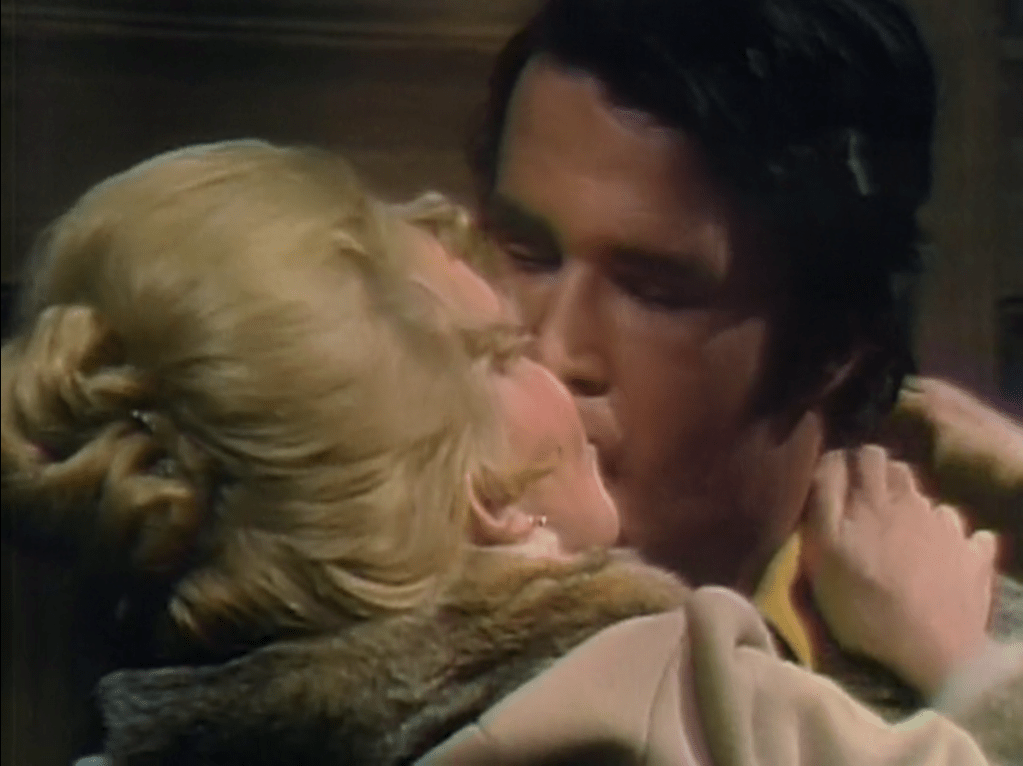
Amanda had no such plans when she first came to the house, but she meets Quentin today, and a few minutes later they are locked in a passionate kiss. Trask surprises them, and declares that he will protect Amanda from her weaknesses.
For his part, Quentin is busy trying to figure out what is happening to him. He is a werewolf, and there is a full Moon tonight, yet he did not transform. He finds a portrait in his room. It bears a plate with his name and the current year- “Quentin Collins, 1897.” But it depicts him as he is when he is in his lupine form. He knows that it is the work of artist Charles Delaware Tate, and goes to confront Tate in his studio in the nearby village of Collinsport.
Quentin handles Tate roughly and demands to know why he painted a wolf on the canvas with his nameplate. Tate says that Charity saw the painting and thought it looked like a wolf, but that when he looked at it himself he saw only Quentin’s face. Quentin takes Tate to his room and shows him the painting; Tate is shocked to see that it is, indeed, the wolf.
Tate gets another shock before he leaves the house. He meets Amanda, and Trask asks him to paint her portrait. Tate has never seen Amanda before, but he has painted her many times. Returning viewers know that Tate’s painting abilities are a gift from Petofi, and that with them comes the power to conjure into existence that which he paints. Amanda is Tate’s creation.
Tate doesn’t want to accept this fact, and so he flees the house. He rushes back to his studio, and tries to take his mind off what is happening by sketching a still life. He adds an imaginary vase to the arrangement of fruit on the table before him. To his dismay, the vase materializes.
Tate painted Amanda into existence two years prior, and has been working steadily as a visual artist since. So you might wonder why he is only now noticing that things pop into being when he draws or paints them.
One possible explanation that comes to mind is about Petofi, the source of Tate’s abilities. Petofi’s right hand was cut off a hundred years ago, in 1797, and most of his power went with it. He was just recently reunited with the Hand. It once more grows from his wrist, and he is restored to his former might. Perhaps when Petofi first gave Tate his abilities, he could give him just enough to create Amanda and a great deal of commercial success. But now he is stronger, and perhaps Tate is stronger too. Petofi had better hope Tate doesn’t think of painting a picture of an avenger putting him to death for the many crimes he has committed against the Rroma people.
As the full Moon is about to rise, hypocritical Rev’d Gregory Trask is standing outside the prison cell in the basement of the great house of Collinwood. He is taunting its inmate, rakish libertine Quentin Collins. Trask knows that Quentin is a werewolf, and is reveling in the prospect of watching him transform, then going to the police.
To Trask’s great disappointment, Quentin stays human. Once the Moon has been up for a while, Quentin grows jubilant. He threatens to contact the police himself, and points out that Trask is committing a number of felonies by holding him in the cell. With singularly poor grace, Trask lets him out. The scene between them is hilarious.
In the foyer, Quentin meets 150 year old sorcerer Count Petofi. He grabs Petofi by the neck, trying the old fellow’s patience. Petofi says that it is quite silly of Quentin to behave as if he can do him physical harm, and that he ought to learn to curb his temper. “But you’re also rather charming, which means there’ll always be somebody who’ll help you.” Of course Quentin is enormously charming- he is played by David Selby. When we first met him, Quentin was a ghost who never spoke but spent months abusing children, murdering day players, threatening to kill our favorite characters, and bringing every storyline screeching to a halt. Still, enough of Mr Selby’s inherently adorable personality came peeking through that Quentin was already a fan favorite long before he delivered a word of dialogue.
Something similar is going on with Amanda Harris, who is an oil painting come to life. Amanda is much nicer than the ghost of Quentin was, but she is a bit shaky in execution. Future Broadway star Donna McKechnie admits nowadays that, while she was a highly trained dancer and singer by 1969, she was still something of a beginner at acting, and that does show when Amanda has a lot to say. But her limited skills really don’t matter at all. Even when Miss McKechnie looks at a scene partner, takes a deep breath, and shouts a whole speech, she is so appealing that your only question is why Amanda acts that way. Maybe that’s how all oil paintings behave two years after they’ve come to life.
In her two-dimensional form, Amanda was the product of Charles Delaware Tate, an artist who received great talents as the result of a Faustian bargain with Petofi. Tate is in the village of Collinsport now. Petofi summoned him to paint a portrait of Quentin. We’ve had many heavy-handed clues that the portrait would function like the picture of Dorian Gray, and that on nights of the full Moon it would transform and leave Quentin as a human. Today Quentin finds the portrait in his room, and it indeed looks like the werewolf. Unfortunately for the show, the werewolf is a cute doggie who wears a tidy little suit, and unless you see him in the act of killing someone it is impossible for us to be afraid of him. As a painting, he wouldn’t pass muster as a set decoration for the walls of an ostensibly haunted house on Scooby Doo Where Are You.
Sorcerer Count Petofi enters the great house of Collinwood, carrying a large painting covered with a cloth. He finds the hypocritical Rev’d Gregory Trask, who is at the moment master of the house, standing in the drawing room, dazed. Petofi realizes that Angelique the witch cast cast a spell on Trask, and that this spell is part of her effort to obstruct his own evil plans.
Petofi meets broad ethnic stereotype Magda Rákóczi in the foyer. He forces her to tell him that Angelique is upstairs, in Quentin Collins’ suite. He exits, taking the painting with him.
Angelique is casting a spell, ordering Trask to point a revolver at his temple. She is about to make him squeeze the trigger when Petofi surprises her. He overpowers her, both physically and in terms of the spell, and frees Trask.
Quentin is in the prison cell in the basement. Together with the scene between Petofi and Angelique, this circumstance will ring bells for longtime viewers. We first saw this cell in #401, when the show was set in 1795. In that part of the series, Thayer David played much-put-upon indentured servant Ben Stokes, who was a plaything in Angelique’s hands. Ben was the first prisoner confined to the cell, when haughty overlord Joshua Collins was punishing him for some or other things he had been powerless to prevent. Now, the dramatic date is 1897, and the same actor is playing Petofi, who stands at the opposite extreme from Ben. Angelique is not much better able to resist Petofi than Ben had been to resist her, and so far from being a place where he will be imprisoned the cell is just another place for him to exercise his power over everyone else.
Quentin is in the cell because he is a werewolf, and this is the night of a full Moon. The closing cliffhanger comes when Trask, released from Angelique’s spell, comes and tells him he will watch him transform into the animal, then go get the police.
We open in the woods on the estate of Collinwood, where a young woman in heavy makeup and bright clothing is crying. Another woman in even heavier makeup and even brighter clothing approaches and asks her what is wrong. The first woman says that she had a vision which told her that the rakish Quentin Collins will die of stab wounds twelve days from now, on 10 September 1897.
The first woman used to be Charity Trask, the miserably repressed daughter of the evil Gregory Trask. She is now possessed by the spirit of Cockney showgirl Pansy Faye. Charity knew that Quentin was a werewolf, and wanted nothing to do with him. Evidently Pansy did not acquire that knowledge when she took up residence in Charity’s body, and has decided that she will marry Quentin. Quentin has no interest in either Charity or Pansy, and already has two other fiancées, one of whom he loves, at least after his fashion, and the other of whom is sealed to him by a pact with the Devil. Yesterday Charity/ Pansy learned of the second engagement, and tried to kill Quentin to prevent it coming about; week before last, she tried to end the first engagement by killing the fiancée. Pansy had her faults, but she wasn’t inclined to physical violence. That part seems to be Charity’s contribution to the symbiont.
The other woman is broad ethnic stereotype Magda Rákóczi. Magda was the one who made Quentin a werewolf in the first place. She cursed him for murdering his wife Jenny, who was her sister. It was only after she had placed the curse that Magda learned that Jenny had given birth to Quentin’s twin children, a boy and a girl. Since the curse is hereditary, Magda is now desperate to lift it, and she and Quentin have become allies.
Some time ago, we learned that if Quentin dies, there will be no hope of lifting the curse. So Magda is terrified when Charity/ Pansy tells her of her vision of Quentin’s death. She takes her back home to the great house on the estate, where her father and Quentin are bickering while they recap yesterday’s story. Trask tries to deny that Charity/ Pansy is insane or that she is capable of killing, but when she enters and announces that she will murder the first person who comes between her and Quentin he has to admit that it might be time to find a place for her in residential care.
We turn our attention to the upstairs of the great house. We see Charity/ Pansy in bed, with Magda sitting in a chair beside. The gramophone is playing a record of Pansy Faye’s theme song. Regular viewers will wonder where Charity/ Pansy could possibly have found such a thing. Charity never met the living Pansy, who was killed the very evening she arrived at Collinwood. Perhaps Pansy’s fiancé, the childlike Carl Collins, bought the record when he met Pansy in Atlantic City and brought it back with him. Carl himself was killed well before the possession began, but perhaps Charity or Charity/ Pansy found it among Carl’s effects.
Charity asks Magda if she likes the tune. “I only like Gypsy music,” she replies. Charity/ Pansy and Quentin both reiterate their theme songs endlessly, but few other characters in the 1897 segment have so much as a dedicated entrance cue. This line of Magda’s makes us wonder what the show might have been like if they had given every major character a theme song.
Trask has a crisis in the drawing room. He hears a ghostly voice warning him that there will be another killing soon. He starts shouting the name “Minerva!” and pleading for mercy. First time viewers might not know what to make of this. Those who have been with the show for a while know that Minerva was Trask’s wife and Charity’s mother, and that he instigated a plot to murder her so that he could marry wealthy spinster Judith Collins and become master of Collinwood. When the voice starts to talk about “the beast that walks like a man,” Trask says “You’re… not Minerva?” Jerry Lacy is an expert comic actor, and his delivery of that line is laugh-out-loud funny.
The same ghost appears visibly to Quentin in his room. He recognizes it as that of Tessie Kincaid, a woman he killed in a recent fit of lycanthropy. He knows that she is appearing to him because tonight there will be a full Moon.
Magda enters and finds Quentin writing a suicide note. She tells him he must not kill himself. She chains him to a post in his room and stands by with a pistol. Trask enters and finds them in this compromising position. Mrs Acilius and I laughed as we imagined how Magda and Quentin might have claimed they were planning to spend the evening.
But there is no point in lying to Trask. Between what Tessie’s ghost told him and what he overheard while eavesdropping on a conversation Quentin and Magda had earlier in the drawing room, he has figured out Quentin’s problem. He takes the gun from Magda and recognizes the bullets with which it is loaded as silver. He announces that he will wait until the Moon rises and see what happens.
Tessie’s turn today marks Deborah Loomis’ third and final appearance on Dark Shadows. Miss Loomis didn’t get to do very much, but she made the most of all of it, and I wish we had seen more of her.