Episode 869: The man who walks in the day

In October 1897, the hypocritical Rev’d Mr Gregory Trask is married to the vastly wealthy Judith Collins, owner of the estate of Collinwood and of the Collins family businesses. For more than thirteen weeks, everything seemed to be going Trask’s way. He had gaslighted Judith into a mental hospital and had almost free rein over all of her assets. In her absence, he invited the lovely and mysterious Amanda Harris to stay in the great house on the estate, and set out to seduce her.

Piece by piece, Trask’s little corner of paradise fell apart. First, 150 year old sorcerer Count Petofi orchestrated a series of events that led Trask to sign a confession to the murder of his first wife, and no matter how many times he destroyed the confession new copies of it kept materializing. Then Petofi erased the personality of Trask’s daughter and enforcer Charity, replacing it with that of late Cockney showgirl/ mentalist Pansy Faye. Later, Amanda fell in love with Judith’s brother Quentin, told Trask off, and wound up leaving for New York by herself. Now, Judith has returned from the mental hospital, all sane and deeply suspicious.

The front door of the great house is Trask’s enemy today. No sooner does he enter it than he finds Pansy in the foyer, singing her song. He demands she stop and tells her he is her father. She laughs at this claim, and reminisces about the late Bertie Faye. Trask goes into the drawing room, and to his horror sees a large oil painting of Amanda on an easel. We saw Pansy setting it up earlier in the episode, and saw her buy it a few days ago. But Trask didn’t see those things, and when she tells him she doesn’t know anything about it, he seems to accept her denials. She exits upstairs.

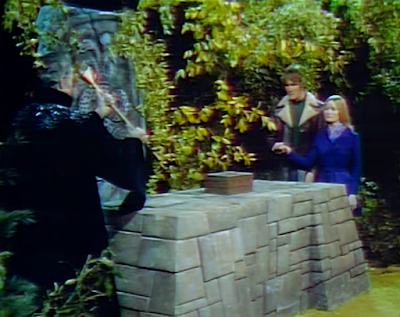
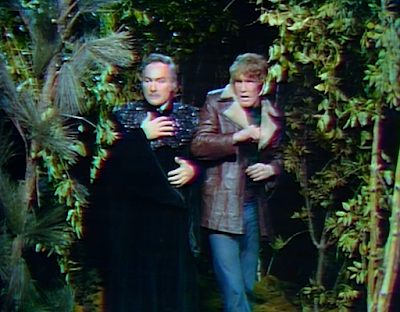
The front door opens again, and Judith’s brother Edward enters with two other men. One appears to be Quentin, but is in fact Petofi in possession of Quentin’s body. The other appears to be time-traveling vampire Barnabas Collins.

Trask and Edward both believe that Petofi is Quentin; since he is played by David Selby, I call him Q-Petofi. The man who appears to be Barnabas is very weak. He says that his name is indeed Barnabas Collins, but that he is not the vampire. He claims to have arrived from England, to have been attacked by a vampire who looked just like him, and to have little memory of what happened after.

In #845, Pansy went into a cave and found a coffin containing what appeared to be Barnabas. She drove a stake through his heart. When Edward and Q-Petofi met this weak Barnabas yesterday in the doctor’s office, they were skeptical of his story. They took him to the cave, opened the coffin, and saw the body Pansy had staked inside, the stake still lodged in its heart. Since they could see the two of them side by side, Edward could only conclude that the weak man is different from the vampire, and that his story is therefore true. Q-Petofi, well aware of the many magical and science-fictional entities in Barnabas’ orbit, is not at all convinced.

Trask sees the weak Barnabas and is enraged that Edward and Q-Petofi have brought the vampire back from the dead. While Q-Petofi takes the weak Barnabas upstairs to a bedroom, Edward tries to reason with Trask. This is seldom a fruitful exercise. When Edward finally points out that it is broad daylight and the weak Barnabas is alive and moving, Trask is left speechless.

Alone with the weak Barnabas, Q-Petofi tries to trick him into believing that he is Quentin and that he can trust him. When Q-Petofi goes on about all the secrets that Barnabas and Quentin have shared, the weak Barnabas responds only with bewilderment.

Q-Petofi goes back to the cave and sets the coffin on fire, acting on the hypothesis that the destruction of the staked Barnabas will have some kind of effect on the weak Barnabas. We cut back to Collinwood and see that it has none. Trask lets himself into the bedroom. After some small talk, he thrusts a large wooden cross at the weak Barnabas’ face and stands silently for a moment. The weak Barnabas looks up from his bed and asks if Trask is all right. He hurriedly says that he only brought the cross to help him pray for his recovery. The weak Barnabas observes that this is very kind, and closes his eyes while Trask kneels beside the bed.

My wife, Mrs Acilius, points out that not only the actor Jerry Lacy, but the character Gregory Trask, seems to enjoy himself very much when there is something to be righteously indignant about. Not only does Trask have a whole set of self-aggrandizing mannerisms and techniques for silencing everyone else when he is furious, but as a con man an atmosphere of crisis provides him with an opportunity to think on his feet and devise new schemes for bilking people out of whatever they have that he wants. Mr Lacy’s joy in performance runs throughout the whole episode, but Trask’s goes through wild fluctuations, peaking each time he thinks he has found a new way to present himself as the champion of The Almighty and plummeting each time his understanding of the situation is deflated. In his first several appearances, Trask was so overwhelmingly evil and so frequently successful that he was hard to watch. When we see him repeatedly brought up short in an episode like this, all of the discomfort of those early days pays off.

In the drawing room, Edward tells Pansy that there is a sick man in a bed upstairs who looks like the vampire Barnabas and is named Barnabas Collins, but is not the man she staked. She is horrified at the thought. Barnabas was indirectly responsible for the death of Pansy as a physical being, and later murdered her fiancé, the childlike Carl Collins. He also took Charity as one of his victims for a time. Besides, in her manner of dress, quantity of makeup, working-class accent, and brashly friendly manner Pansy is the representative of all the “girls at the docks” upon whom Barnabas has fed down the centuries. So no one has more reason to fear Barnabas than does Pansy in the form of Charity. Edward reassures her as best he can, then goes up to look in on the patient.

Pansy absorbs the news that another Barnabas Collins is in the house.

The scene between Pansy and Edward will remind longtime viewers of the characters the same actors played between November 1967 and
March 1968, when Dark Shadows was set in the 1790s. Nancy Barrett was fluttery heiress Millicent Collins, while Louis Edmonds was haughty overlord Joshua Collins. In #450, Millicent had discovered the horrible truth about Barnabas and it had proven to be too much for her rather fragile grip on sanity. She decided that the vampire was not her cousin, but an impostor, and she told Joshua that it was wrong of him to have “That man who says he is Barnabas” in the house.

Not only is Pansy’s horror at the thought of a man who says that he is Barnabas staying at Collinwood reminiscent of Millicent, but her relationship to Charity also reflects the development of Millicent throughout the 1790s segment. Millicent’s transformation from a lighter-than-air comedy character to a darkly mad victim, first of her wicked husband Nathan, then of Barnabas, marked the transition to the climactic phase of the 1790s segment. Charity’s replacement by Pansy in #819 came at a time when the show was flashing many signals that the 1897 segment was nearing its end. Those signals may well have reflected an earlier plan, but 1897 was such a hit that they kept passing by the off-ramps back to the 1960s and restarting the uncertain and frightening journey into the past. Now it seems they really are getting ready to move on, and Pansy’s prominence reminds us of just how radically different a place Collinwood is now than it was when we arrived in this period in #701, at the beginning of March.

Pansy is still quaking at the thought of another Barnabas Collins when Q-Petofi enters and closes the doors of the drawing room behind him. Pansy hasn’t quite figured out his true identity, but she knows that he is not really Quentin, and that he does not mean her well. She is terrified and says she will scream unless he opens the doors.

Regular viewers have reason to believe Pansy will do more than scream. In #829, she tried to stab Quentin. And those who have been with the show for a long time will remember what happened in #204, broadcast and set in April 1967. Heiress Carolyn Collins Stoddard, another Nancy Barrett character, found herself in the drawing room with dangerously unstable ruffian Willie Loomis. When Willie closed the doors and refused to open them, Carolyn didn’t bother screaming- she pulled a loaded gun on him.

Q-Petofi has magical powers that neither Quentin nor Willie could match, so he is not in mortal jeopardy as they would be were they to put themselves in his position. But he has created a volatile situation, and unless he resolves it within a few seconds he is likely to find himself with a huge mess on his hands. Rather than falling back on his occult talents, Q-Petofi takes a page from Quentin’s book and charms Pansy into cooperating. He tells her that he is as frightened of Barnabas as she is. That intrigues her sufficiently that she starts listening to him. He tells her that only she can discern whether the man in the sick bed upstairs is what he claims to be. A moment later, Q-Petofi has persuaded Pansy to go with him to see the weak Barnabas. The episode ends with Pansy looking at the weak Barnabas lying in bed, her eyes widening in a strong but unspecified reaction. We will have to wait until tomorrow to find out whether she is terrified at the sight of her nemesis or amazed to see an innocent man wearing the hated face.

Episode 790: Making a demon of her

The evil Gregory Trask orchestrated a plot to murder his first wife, Minerva, and has married wealthy spinster Judith Collins. Now he and his accomplice, lawyer/ Satanist Evan Hanley, have conjured up a simulacrum of Minerva to hang around Judith and drive her insane. Once Judith is safely confined to the nearest high-class asylum, Trask will enjoy Judith’s riches, minus only whatever percentage Evan squeezes out of him.

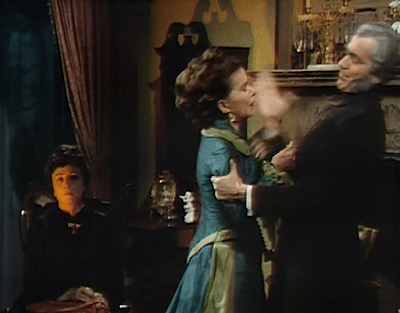
Today, Judith stands in her bedroom in the great house on the estate of Collinwood. She isn’t ready to go to bed, and the simulacrum of Minerva is sitting in the rocking chair, sewing. Trask pretends he cannot see the simulacrum, and forbids Judith to leave the room. When Judith becomes upset, he slaps her. This slap occurs on the soundtrack and in our imaginations. What we see on screen some time before the slapping sound effect plays is Jerry Lacy waving his hand a considerable distance short of Joan Bennett’s face. The two of them do such a good job of acting that this failure of blocking does nothing to undercut the oppressive atmosphere. For her part, Clarice Blackburn plays the pseudo-Minerva with just enough animation that we cannot predict what she will do. These performances take a sequence which may not have seemed like much on the page and make it into one of the most frightening scenes on Dark Shadows. When Judith lies to Trask and says that she does not see Minerva, it’s enough to produce a shudder.

Trask slaps Judith while pseudo-Minerva sews. Screenshot by Dark Shadows Every Day.

Downstairs, Trask answers a knock at the door and broad ethnic stereotype Magda Rákóczi enters. Regular viewers know that Judith despises Magda and Magda hates her, and so it is surprising when we hear that Judith has sent for Magda. Trask blocks her way upstairs. Magda is defiant towards Trask; she knows what he did to Minerva, and is using that knowledge to force him to let her and her husband stay in the Old House on the grounds of Collinwood. But Trask has a new threat to make.

Trask knows that Magda is the sister of the late Jenny, who married Judith’s brother Quentin. He also knows something that not even Quentin knows, that Jenny bore twin children to Quentin after he left her. He threatens to send Jenny’s children away from the village of Collinsport. Evidently Magda wants the children to stay where they are, in the care of a woman named Mrs Fillmore. It is unclear why this would matter to her; we have had no indication that she has met Mrs Fillmore, much less visited the children at her house. But it is important enough to her that they not be moved that Magda responds to Trask’s threat with “What do you want me to do to her?”

We cut to Judith’s room. Magda enters. Judith tells her that the ghost of Mrs Trask vanished a few minutes ago, after sitting in the rocking chair for hours. Judith asks if she thinks she sounds mad, to which Magda replies there is nothing so strange about a simple ghost. The simulacrum reappears, and Judith asks Magda if she sees it. Magda says she does not.

Back downstairs, Magda tells Trask that he is a swine. She spits on the floor next to him and stalks off. Much as Magda hates Judith and many as are the crimes in which she is implicated, she is a warm-hearted sort, and Trask’s bloodless cruelty is not to her liking. Indeed, it is strange she did not tell Judith of Trask’s attempt to extort her complicity and make an alliance with her against him.

Meanwhile, Quentin is being held in the jail. When Magda realized that he murdered Jenny, she turned Quentin into a werewolf. She did not then know about the twins, and so she made the curse hereditary. Once she found out that her own kin were in line to become monsters, she started looking for a way to undo the curse.

The police captured Quentin the night before, while he was in his lupine form. As a result of Magda’s latest futile attempt to cure him, Quentin emerged from his bout of lycanthropy with his face disfigured and his memory a blank. Though his clothing and his hairstyle are so highly distinctive that virtually everyone who has seen the show before can tell that the man in the cell is Quentin, the Collinses suffer from a peculiar form of blindness that keeps them from recognizing people with globs of makeup on their faces, so his brother Edward is at a loss as to who he could be.

Magda is working with time-traveling vampire Barnabas Collins, distant cousin of Quentin, Edward, and Judith, who has set out on a mission to set the events of the year 1897 right so that Quentin will not become a malign ghost ruining things for everyone at Collinwood in 1969. Unfortunately, vampires are not problem-solvers; their function in a story is to create problems. Since coming to 1897, Barnabas has been responsible for at least six homicides. He has wrought a great deal of havoc even beyond those killings. For example, it was as a direct result of his actions that Judith and Trask got together in the first place. Today, Magda goes to Quentin’s cell and tries to tell him that Barnabas will come to him after nightfall and take him to the Old House.

We do not see Barnabas. We are watching Quentin in his cell when we hear a bat squeaking outside the jail. Barnabas can materialize wherever he chooses; he does not choose to materialize in the cell, where Quentin is alone and unattended, but goes into the outer office in his bat form. We hear a deputy in that office talking to the bat affectionately, asking him where he came from. We haven’t seen the deputy before this episode, but one suspects that a fellow who sees a bat in his office and strikes up a friendly conversation with it must have an extremely sweet personality. We then hear the deputy make a horrified exclamation, and the doors to Quentin’s cell and to the world outside open by themselves. As Quentin walks out, we see the deputy slumped at his desk, two bleeding wounds on his neck.

We cut to the darkened interior of the great house at Collinwood. Quentin comes ambling in. Biting the deputy was certainly not part of any plan Barnabas made with Magda, but it isn’t completely surprising- he hadn’t had a square meal for quite a while. But even for Barnabas, it shows an unusually low degree of operational competence to let Quentin wander off by himself when the whole idea is to get him to the Old House.

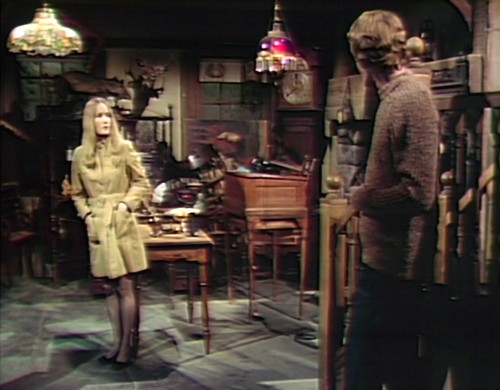
In the drawing room, we hear Quentin’s thoughts as he dwells on his amnesia. He does not know who he is, where he is, or why he has come. He sees his gramophone, and starts playing his only record. That brings him back to himself.

Judith enters. Quentin is not only wearing his usual suit and his distinctive hairstyle, he is listening to the music he has been playing obsessively for months and reciting the lyrics to it. As if that weren’t enough, his voice is quite outstanding- he must be the only senior member of an aristocratic Maine family with a West Virginia accent. Yet Judith not only fails to recognize her brother, she refuses to believe him when he identifies himself to her by name.

The simulacrum of Minerva enters, holding a letter opener above her head. Earlier this week, Minerva’s actual spirit had possessed Judith, and under her power Judith had held that same letter opener in that same position as she confronted Evan and accused him of her murder. Judith does not remember that, and she screams at the sight.

Episode 600: A woman does not like to be thought of in those terms

Suave warlock Nicholas Blair is entertaining two guests in his home. They are Frankenstein’s monsters. The man is named Adam; in the 22 weeks since he came to life, Adam has learned to speak fluent English, to play chess, and to discuss the writings of Sigmund Freud, but he is still very unsure in his dealings with other people. Desperate to be loved but quick to resort to violence, he always winds up taking orders from someone or other.

The woman is named Eve. Created to be Adam’s mate, she came to life only in #596, but has all the memories and personality of Danielle Roget, a homicidal maniac who lived in France and America in the late eighteenth century. Her connection to Danielle was the result of Nicholas’ doing; when he learned of Adam’s existence, Nicholas decided to use him to found a new humanoid species, a race who would owe their existence to Satan rather than to God. In furtherance of that plan, Nicholas said in #575 he wanted to infuse Adam’s mate with the spirit of “the most evil woman who ever lived,” and he settled on Danielle as that woman.

We see today that Nicholas has over-egged his pudding. The thoroughly sincere Adam bores Eve/ Danielle to tears. She can barely stand to look at him while he tries to woo her, and sends him off to bed. She approaches Nicholas and suggests that he become her lover, preferably after she has killed Adam. Nicholas is amused by the idea, but tells Eve/ Danielle that unless she sticks with Adam, he will kill her. If Nicholas wants the two of them to found a whole new breed of creatures who will subdue the Earth for the Devil, he probably should have picked a woman whose vices ran less to violence and more to lust.

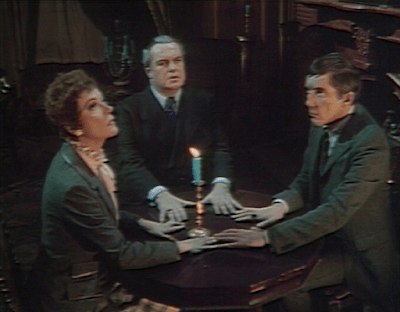
Shortly after Eve/ Danielle came to life, a wind blew into the room where she was staying, indicating that a ghostly visitor had come to her. She addressed it as “mon petit” and said “I will not go back.” Today, the same visitor appears at the Old House on the great estate of Collinwood, home of recovering vampire Barnabas Collins. The ghostly wind knocks a book off Barnabas’ shelf written in 1798 by one Philippe Cordier. Occult expert Timothy Eliot Stokes is visiting Barnabas and Barnabas’ inseparable friend, mad scientist Julia Hoffman. Stokes decrees that the three of them must hold a séance at once.

When there is a séance on Dark Shadows, there are three indispensable roles. There must be someone who gives instructions and supervises the proceedings, usually with considerable gruffness. The first time a séance was held in this room, using this table, was in #186, back in March 1967. Well-meaning governess Vicki was the supervisor that time, and it was startling to see her cast aside her demure manner to take the same gruff tone others would adopt in that role. It is not unusual for Stokes to be gruff, but since Julia and Barnabas have both attended multiple séances before, his tone will strike regular viewers as unnecessary.

The second indispensable role is that of medium. That role falls to Barnabas today. He passes out and starts moaning. At this point the third role comes into play. It is Julia who must express alarm and try to break the trance. As supervisor, Stokes must then sternly rebuke her and insist that the dead be allowed to speak through the medium.

Ready for yet another séance. Screenshot by Dark Shadows Before I Die.

Barnabas speaks a few phrases in French, as Vicki had spoken in French when the spirit of the gracious Josette possessed her in Dark Shadows’ very first séance, in #170 and #171 in February of 1967. He also speaks English with a French accent. Some fans like to poke fun at Jonathan Frid for the French accent that comes out of Barnabas’ mouth today, as indeed some liked to poke fun at Alexandra Moltke Isles for the accent that came out of Vicki’s. To those people I can only say, if those accents sound funny to you, just go to France- you will laugh all day long, because that’s how French people actually talk.

Through Barnabas, Philippe Cordier says that he has been lonely since Danielle’s spirit left him to return to the world of the living. Combined with Eve/Danielle’s refusal to “go back,” this implies that Philippe is Danielle’s boyfriend in Hell. He vows to kill “the man who says he loves her,” viz Adam, which seems illogical- if he wants her to leave the upper world and come back to him in Hell, he could achieve that simply by killing her. If he wants to punish the person who took her away from him, again Adam is the wrong target- it was Nicholas who picked Danielle. Adam had nothing to do with it. But Philippe, even though he was a published author when he was alive, is not an intellect now, only a spirit seeking vengeance. He is raw energy untrammeled by mind, and there is no reasoning with him.

Frid’s turn as Philippe is impressive. We’ve seen Barnabas in many moods, but he always has something to lose and almost always has something to hide. Frid often said that he played him as, first and foremost, a liar. But there is nothing disingenuous about Philippe. He is pure rage. In this tiny performance, Frid embodies that rage, and does not at all remind us of Barnabas.

Adam and Barnabas have a mystical connection that gives them a Corsican Brothers relationship. So far we have only seen this in action twice, both times when Barnabas was suffocating and Adam had trouble breathing. It does not work consistently, and it is not clear if Barnabas will suffer any of Adam’s pain. Indeed, when Adam fell off a cliff and nearly died, it didn’t bother Barnabas a bit. But apparently the bond does in fact go in both directions. When, after the séance, Philippe goes to Nicholas’ house and starts strangling Adam, Barnabas also starts choking.

In February and March of 1967 Dark Shadows was still aimed mostly at an adult audience made up of people who were impressed that the cast included Joan Bennett. But this episode demonstrates how completely it has since become a kids’ show. The first two séances resulted from long preparation, involved great effort, and produced tantalizingly vague, elusive messages. But this time around, the characters see signs of a ghost, Stokes immediately declares it’s time for a séance, and within two minutes Philippe Cordier is complaining about how he has to put himself back on the dating market of the damned. My wife, Mrs Acilius, pointed out that this is like something you would see in a story written by a small child. If the barrier between the dead and the living is inconvenient to the progression of the story, then you throw it out the window and proceed as if you could call up a ghost and have a conversation any time you wanted.

Episode 554: What must be

Recovering vampire Barnabas Collins is in the woods on the estate of Collinwood, searching for well-meaning governess Vicki Winters. He hears dogs howling, as they used to howl when he was in the grip of bloodlust. He goes to pieces at the memory.

Barnabas’ fellow searcher, Vicki’s fiancé Peter Bradford, sees him standing petrified. Barnabas asks him if he can hear the dogs. Peter says he can, and is puzzled that Barnabas was afraid he was hallucinating their sounds. Peter asks Barnabas if he is all right. Barnabas insists that he is just worried about Vicki, and resumes searching.

Shortly after, Barnabas finds himself in the foyer of the great house on the estate, slumped in a chair under his own portrait. He makes a sad contrast with the haughty figure in the painting. His friend Julia Hoffman enters, and he gives her a pleading look that emphasizes the contrast between his present weakness and the arrogant power he wielded when he posed for the portrait, more than 170 years before.

Barnabas tells Julia that he does not know how he got into the house. The last he remembers, he was in the woods and heard the dogs howling. She suggests that their noise may not mean anything, but he is sure there is some unearthly horror afoot.

Barnabas tells Julia something else he is sure of. Earlier this evening, Frankenstein’s monster Adam came to his house. Adam mistakenly believes that Barnabas created him, and demanded that he build a woman to be his mate. When Barnabas told him that would be impossible, Adam vowed to make him sorry, then left. Shortly after, Vicki came by for a brief visit. Barnabas is certain that Adam abducted Vicki to use as a hostage, and that the only ransom he will accept is the artificially created woman he has no way of supplying.

Barnabas goes to the telephone and announces he is going to tell the police what he knows about Adam. Julia objects that Adam can tell the police enough about the two of them to expose them both to prosecution. Barnabas says that he is willing to take that risk for Vicki’s sake, and begins dialing. Julia says she is not, and places her finger on the telephone receiver to end the call.

Julia has never been able to entirely conceal her dislike for Vicki, rolling her eyes when Vicki talks to her and making sarcastic remarks when Barnabas praises her, so regular viewers can hardly be surprised that Julia does not volunteer to go to prison for her sake. Still, Julia has often enough shown a troubled conscience about the many crimes she has committed during her association with Barnabas that her utter coolness represents a new step in the character’s development. The other day she wanted to shoot wicked witch Angelique, but Angelique was not really human and was enormously dangerous. Even so, Julia was deeply upset when she made up her mind to kill her, and she backed down when she came face to face with Angelique. But Vicki is resolutely, unfailingly, rather tediously good, Good with a capital G. That Julia is so blandly willing to consign her to death at Adam’s hands suggests that her sense of right and wrong will no longer serve as a brake on any sinister plans that might advance whatever goals she and Barnabas are pursuing.

Barnabas looks at Julia, shocked. Perhaps her coldness shocks him. Perhaps what shocks him is that he is so dependent on her that he does not resume dialing.

Meanwhile, another drama has played out not so far away. Electrician Tom Jennings was inspecting the wiring in a house that suave warlock Nicholas Blair is renting from the ancient and esteemed Collins family. Tom told Nicholas that he wanted to inspect the cellar to make sure the foundation was in good repair. Nicholas replied that this would not be necessary, but Tom insisted. He opened the cellar door, and found a coffin. Nicholas told him that the coffin was there when he moved in. Tom asked if he’d called the police, and Nicholas replied there was no need, since the coffin was empty.

On his way home, Tom told himself that the Collinses wouldn’t leave a coffin in the basement of one of their houses. That shows what he knows- for the first 55 weeks of the show, matriarch Elizabeth Collins Stoddard thought that her husband was buried in a box in the basement of the great house, and when he was a vampire Barnabas kept his coffin in the basement of his house. It wouldn’t be a Collins house if it didn’t have a coffin in the basement, and a dungeon too.

Tom sees someone and asks who it is. The part of the other person is played by the camera, so we do not know. The camera zooms in, and Tom collapses.

Later, Peter finds Tom propped against a tree. He touches Tom, and Tom falls over, apparently dead. He has two bloody wounds on his neck. Peter goes back to the great house. He tells Barnabas and Julia that he must use the telephone. They hear him describe Tom’s wounds to the police. Afterward, Barnabas and Julia realize that there is another vampire operating in the area.

Tom’s appearance is the debut of Don Briscoe, who would be a big part of Dark Shadows for almost two years. On his Dark Shadows Every Day, Danny Horn told an amazing story about Briscoe:

Many years ago, when I was in high school, my mother walked into the room while I was watching Dark Shadows.

She looked at the guy on the screen, and said, “Is his name Don?”

I said, yeah, that’s Don Briscoe, and she said, “I thought so. I knew him, when I was in grad school. He asked me out once.”

Seriously, true story. She said that they were both getting a master’s in English — he was at Columbia University, and she was at Barnard, which is right across the street. He asked her out on a date, and he was very handsome, and very nice, but he wasn’t Jewish, so she said no.

At the time, I had no way to verify this, and I never really knew what to think about it. I mean, she knew the guy’s first name, but maybe she confused him with some other brown-haired guy named Don.

But now I have this excellent book called Barnabas & Company, which has extensive bios on everybody in the cast. It turns out that he really did get a master’s degree in English at Columbia University, and that means that Don Briscoe is kind of my dad.

Danny Horn, “Episode 565: Weird Science,” Dark Shadows Every Day, 10 January 2015

Granted, hundreds of actors had parts on Dark Shadows over the five years of its run, a great many people have blogged about the show, and I’m sure Danny’s mother was a very attractive young woman who had offers from lots of fellows. But Briscoe was one of the more important members of the cast, and Danny is as good as any of the bloggers. So it really is a noteworthy coincidence that they are connected to each other in that particular way.

Episode 478: Carried on the wind

Soap operas usually have multiple more or less independent storylines going simultaneously. Dark Shadows had trouble keeping that up, usually having an A story with all the action and a B story that never got off the ground and eventually dried up altogether. Now, in the spring of 1968, they have several equally dynamic arcs going at once. As a result, today’s episode is a bit of a jumble, as we catch glimpses of several loosely related events.

For the nineteen weeks stretching from #365 to #461, well-meaning governess Vicki came unstuck in time and found herself trapped in the 1790s. In that period, she met many people, among them gracious lady Josette and wicked witch Angelique. In the 1960s, one of Vicki’s closest friends is Maggie, The Nicest Girl in Town. Like Maggie, Josette is played by Kathryn Leigh Scott. When Vicki saw Josette, she realized that Maggie had some kind of metaphysical connection to her. This was a daring move on the part of the show, since it means that vampire Barnabas was onto something in the summer of 1967 when he abducted Maggie and tried to brainwash her so that her personality would vanish and Josette’s would appear in its place.

Angelique has followed Vicki to 1968. She calls herself Cassandra, wears a black wig, and has married sarcastic dandy Roger, thereby securing residence in the great house of Collinwood. Vicki and Barnabas recognize Angelique/ Cassandra, and each knows that she is a deadly threat to everyone in and around the estate. For her part, Vicki is trying to hide her knowledge from Angelique; Barnabas has taken a different tack, and the other day let Angelique into his house where he proceeded to give her all the information she could possibly need to realize her evil intentions towards him. This is not because Barnabas cannot keep a secret. Vicki has tried to enlist him in the battle against Angelique, but he, now in recovery from the vampire curse Angelique placed on him in the 1790s, does not want Vicki to know the truth about him, and so he will not cooperate with her in any way. It’s only his enemies with whom Barnabas compulsively shares damaging intelligence.

Maggie comes to the great house to have a tea party with Vicki today. Angelique/ Cassandra opens the door, and cannot hide her shock at Maggie’s resemblance to Josette. She so blatantly stares at her that she has to admit that she is unnerved because Maggie looks very much like someone she knew a long time ago.

Vicki comes in, and Angelique/ Cassandra asks her, not in her usual mid-Atlantic accent, but in Lara Parker’s sweetly musical Tennessee voice, if she and Maggie are planning to use the drawing room. Vicki at once offers to use a different space, not only as would be correct for a member of the household staff speaking to one of the family, but in a relaxed and friendly way that betrays nothing of her knowledge of Angelique/ Cassandra’s true identity. While returning viewers know that Angelique/ Cassandra remembers Vicki from the 1790s, the Southern accent is so much more natural than her usual way of speaking that it suggests Vicki has managed to get her to let her guard down to some degree.

While Vicki and Maggie settle into the drawing room, Angelique/ Cassandra goes to a portrait of Barnabas that hangs in the foyer of the great house and delivers a speech to it. She tells the portrait that Maggie is the very image of Josette, and will therefore be the first victim of her latest evil plan. She is going to spam people’s dreams with a series of nightmares, and when the last person has had the nightmare Barnabas will be a vampire again. Evidently the dreamers of Collinsport didn’t have anti-virus programs installed in their brains, because Angelique/ Cassandra expects them all to be helpless before this morphean malware.

In the drawing room, Maggie is too preoccupied with Angelique/ Cassandra’s strange reaction to her to hear when Vicki asks her how she takes her tea. When she tells Vicki that Angelique/ Cassandra was shocked by the sight of her, Vicki amazes her by saying that she is sure she did react that way, and giving her the details of the reaction before Maggie reports them. Maggie asks Vicki to explain how she knew and what it means. Vicki explains nothing.

This is something of a reversal. In #1, Vicki met Maggie. Vicki had just arrived in Collinsport, and went to the diner where Maggie was the waitress. While Maggie served Vicki, she told her that Collinwood was haunted and that it was unwise to go there. Vicki did not at that time believe in ghosts and told Maggie so. Now, Vicki is the one serving the tea, and she is the one who knows far more about the supernatural than does Maggie. At least, far more than is in Maggie’s conscious mind- she has amnesia about her experience as Barnabas’ victim.

Vicki and Maggie’s tea party

Maggie is far more upset by Angelique/ Cassandra’s reaction to her than circumstances would appear to warrant. Vicki’s reticence is understandable, given the extreme complexity and improbability of her story, but she has always been so forthcoming with her friends that when Maggie asks why she is being so mysterious it seems quite likely that Vicki will tell her everything. Together, these two facts suggest to regular viewers that Maggie will eventually hear herself compared to Josette, that the comparison will jar loose the memory of what Barnabas did to her, and that she will go to the authorities. As an audience, we hope Barnabas will get away with his crimes, because the show is most fun to watch when he does. Now that Angelique has come to 1968, we have a morally defensible in-universe reason for this hope. Angelique is even more evil than Barnabas is, and without his active participation there is no hope she can be stopped.

Vicki’s reticence brings up another question. In the months before her journey to the past, she saw a great deal of evidence that Barnabas was a vampire. While in the eighteenth century, she saw so much more that upon her return Barnabas was certain she must have figured out his secret, and bit her to keep her quiet. When his vampirism responded to medical treatment, the symptoms of his bite went away. We wonder what Vicki knew at each stage of the story, and what she remembers now.

One possibility is that she has known everything all along. That would put Vicki in an intriguing position if Maggie’s memory does come back. Vicki originally represented the audience’s point of view; if she turns out to have been aware of Barnabas’ crimes from the beginning, she will put us in the uncomfortable position of wondering what it tells us about ourselves that we are consistently on the vampire’s side.

Vicki changes the subject to her boyfriend, a man named Peter. Vicki met Peter in the 1790s, and like Angelique he has followed her into her own time. Also like Angelique, he keeps insisting that he has a different name. He wants to be called Jeff. Unlike Angelique, Peter/ Jeff is amnesiac, is under the control of mad scientist Dr Lang, and brings the show to a screeching halt every time he is on screen. Vicki asks if Peter/ Jeff can rent the spare room in the cottage Maggie shares with her father. Maggie has never met or heard of Peter/ Jeff, and wants more information before she commits to living with him. Vicki doesn’t have anything to tell her, inflaming Maggie’s curiosity to the point where she exclaims “I can’t stand it!”

Peter/ Jeff telephones from Lang’s laboratory, and Vicki gets Maggie to agree to meet him at her house in an hour. Unknown to Vicki, Lang is building a Frankenstein’s monster, and plans to download Barnabas’ personality into the body once it is completed. Peter/ Jeff has dug up graves and fetched body parts for Lang to use, but is tired of that sort of work and is eager to make a fresh start. Unfortunately for him, Barnabas requested that the body look like Peter/ Jeff. So Lang persuades Peter/ Jeff to call Vicki back to say he won’t be available to meet her and Maggie today after all. He then gives Peter/ Jeff a shot to knock him out, straps him to a table, and sets about cutting his head off. Peter/ Jeff comes to and complains about this; Lang, irritated, tells him he can’t very well have expected him to let him live, knowing what he knows.

Maggie has the dream Angelique has sent. It begins with Peter/ Jeff calling on her. Since they went out of their way to tell us Maggie has never seen Peter/ Jeff, this tells first time viewers that this sequence, as is typical of dream sequences on Dark Shadows, comes not from the character’s mind, but is the product of a supernatural agency. In the course of the dream, Maggie hears the sound of Josette’s music box; Barnabas made her listen to this when he was holding her prisoner. This again raises the prospect that Maggie’s memory will return. The rest of the dream is a concerto for fog machine. Technical director Lou Marchand is credited today; presumably he was the soloist. The fog immerses everything so completely that it is anyone’s guess what exactly Miss Scott is doing for most of the sequence.

Episode 474: A Collins does the unexpected

Wicked witch Angelique (Lara Parker,) pretending to be named Cassandra, met sarcastic dandy Roger Collins (Louis Edmonds) one day and married him the next. Roger’s sister, matriarch Liz (Joan Bennett,) confronts Angelique/ Cassandra. Liz tells her that Roger has not been well and urges her to annul their marriage.

In the course of her confrontation with Liz, Angelique/ Cassandra reveals that she is not all-knowing. She thinks that Roger owns the great estate of Collinwood and the family’s business. Liz quickly explains that Roger owns nothing. He lives as a guest in her house and works as an employee of her company. Angelique/ Cassandra takes this in stride, and stands up to Liz’ insistence that the marriage must end. The only sign that Liz’ words are having an effect on anyone at all comes in the very last syllable of the scene. Unfortunately for Liz, it is not Angelique/ Cassandra who is intimidated by her, but Lara Parker who is intimidated by Joan Bennett. Angelique/ Cassandra’s mid-Atlantic accent vanishes and the purest musical note of Parker’s native Tennessee sounds as the word “you” emerges as “yeww.” If there had been another page or two of dialogue, she might have ended with a honeyed smile and a lethal “Bless your heart!”

From #395 to #461, Dark Shadows was a costume drama set in the late 1790s. In that segment, Angelique came to Collinwood as a servant girl and used her magical powers to manipulate scion Barnabas Collins (Jonathan Frid) into marrying her. Barnabas’ parents, Joshua (Louis Edmonds) and Naomi (Joan Bennett) were unhappy about the marriage. Joshua demanded that it be annulled, as Liz today demands Roger and Angelique/ Cassandra’s marriage be annulled. Naomi took a more conciliatory approach. Advocating Joshua’s position and but showing Naomi’s temperament, Liz combines two challenges Angelique has already shown herself able to overcome easily. Returning viewers will therefore have little hope that Liz will be able to stave off the disasters Angelique has in mind for the Collinses.

Angelique/ Cassandra is eager to get to work on the evil plans she has for the people at Collinwood, and so she is trying to stop Roger taking her on a honeymoon. She contrives to injure her ankle. We see permanent houseguest/ medical doctor/ mad scientist Julia Hoffman (Grayson Hall) in the bedroom Angelique/ Cassandra will be sharing with Roger, bandaging her ankle. Angelique/ Cassandra asks a series of questions about old world gentleman Barnabas Collins (Jonathan Frid,) making Julia visibly uncomfortable.

Barnabas is the same man Angelique married in the 1790s. He is here in 1968 because she turned him into a vampire then. He was relieved of the symptoms of vampirism only a couple of weeks ago. He and Julia are becoming fast friends, and on Tuesday he told her all about Angelique. He identified her as the woman in a portrait that has obsessed Roger, and expressed his belief that Roger’s obsession was a sign that Angelique herself was returning to Collinwood. Julia can see how strongly Cassandra resembles the portrait, and knows that Roger’s obsession led directly to his marrying her, so she really ought to have figured out by now that she is Angelique.

Like the scene between Angelique/ Cassandra and Liz, the scene between her and Julia makes an instructive comparison with the parts the same actresses played in the 1790s segment. Angelique was originally lady’s maid to the Countess DuPrés. We saw her helping the Countess put herself together in a bedroom that was a different dressing of the set on which Julia is now attending to her foot. This apparent reversal of roles illuminates the extent to which Angelique’s command of black magic always made her a mightier figure than her nominal mistress. As a mad scientist, Julia is far more formidable than was the countess, but this scene leaves us wondering if she will be able to stand up to Angelique for any longer than could her counterpart.

Well-meaning governess Vicki (Alexandra Moltke Isles) had traveled back in time and was at Collinwood through the 1790s segment. She recognizes Angelique, knows well how dangerous she is, and is desperate to stop her. She tries to tell Liz about the situation, but Liz has a very limited tolerance for information about the supernatural. Vicki later meets Julia at the gazebo on the grounds of the estate and shares her information with her. Julia knows as much as anyone about the strange goings-on, and what Vicki tells her confirms what she already has reason to suspect. However, Julia pretends to have trouble believing Vicki.

This pretense enables Julia to probe the limits of Vicki’s own knowledge. Barnabas and Julia do not want Vicki to know any of Barnabas’ secrets. Julia incredulously asks Vicki if she thinks the Barnabas Collins of 1968 is the same person she knew in the eighteenth century. Vicki turns away from Julia, looks troubled, and says that she does not believe this. Vicki has encountered plenty of evidence to that effect, not least when Barnabas bit her and sucked her blood, and the audience wonders what she knows. We see Julia studying her, trying to find the answer to the same question. In the first year of Dark Shadows, Vicki represented the audience’s point of view, the resolutely normal outsider getting to know the Collinwood crazies. In this moment, we see Vicki through Julia’s eyes. We identify, not with any sane person from the world of sunlight and natural laws, but with a mad scientist who has cast her lot with a vampire.

Vicki thinking about Barnabas, with a facial expression straight out of MAD magazine. Screenshot by Dark Shadows Before I Die.

Angelique/ Cassandra and Roger chat in their bedroom. He seems utterly delighted to be married to her, until she slips something into his drink. Suddenly he starts having doubts. Nothing we have seen leads us to expect she would want him to feel this way. The scene leaves us scratching our heads.

We end with Angelique/ Cassandra alone in the foyer of the great house, looking at the portrait of Barnabas that hangs there and vowing to restore the curse that had made him a vampire. We know that she is Angelique and that such is her goal, so her speech doesn’t set up any new story points.

It does give us some world-building information. Angelique says that the only way she knew that Barnabas was walking among the living in the 1960s was that Vicki had traveled back in time to the 1790s and told her. That explodes a theory some fans like that Angelique herself called Vicki back in time. When Vicki left the 1960s in #365, it was quite clear that the ghost of Barnabas’ little sister Sarah was sending her on the journey. Sarah has been fading steadily from our awareness, not least because child actress Sharon Smyth aged out of the part, and so it is not surprising that people expect a retcon to attribute the time travel story to a different force. But not only does Angelique rule herself out with this line, Sarah’s name comes up in the conversation between Julia and Vicki, reminding regular viewers of the original explanation.

More importantly, it confirms that once one person has made a wrong-way journey through time, a gate opens through which other unexpected things may come. To some extent we saw this when Barnabas himself was released from his coffin and Sarah’s ghost began showing up around the estate. The cosmological point will become extremely important for the rest of Dark Shadows, as one time-travel story keeps leading to another. Dark Shadows is often described as the story of the house, and so I can’t resist an inelegant metaphor from the building trades. It’s as if Vicki wrecked the plumbing of the universe when she went through the pipes backwards and then abruptly forward. Time will never flow the right way again.

Episode 297: Only my doll

The only story going on Dark Shadows is about the doings of vampire Barnabas Collins. So the only characters we will see in action are those connected to Barnabas. That puts the audience in the odd position of hoping that characters we like will become his victims or his accomplices.

Maggie Evans, The Nicest Girl in Town, has been an audience favorite since she was introduced in episode 1. Months ago, Barnabas bit Maggie and held her prisoner for a long time. After the ghost of Barnabas’ nine year old sister Sarah helped her escape him, Maggie had amnesia and became a patient at a mental hospital run by mad scientist Julia Hoffman, who is now in league with Barnabas. Sarah helped Maggie escape from the hospital and return to the town of Collinsport. Her amnesia lifted, but Julia erased Maggie’s memory before she could expose Barnabas.

The audience is tempted to accept Julia’s crime against Maggie as a convenient resolution of its own conflicting desires. On the one hand, we like Maggie and don’t want Julia to lock her up or Barnabas to kill her. On the other, Barnabas’ destruction would leave Dark Shadows without any stories to tell. That would lead to the show’s cancellation, taking Maggie and all the others with it. With Maggie’s memory mutilated, the show can stay on the air and Maggie can stay on it.

Our conflicting desires and divided loyalties create suspense. In his post about this episode on his blog Dark Shadows Every Day, Danny Horn analyzes a scene in which Sarah visits Maggie in her room today, and shows how it keeps us from simply accepting what Julia has done:

Maggie keeps making closing statements like, “Well, the important thing is that wherever I was, I’m back, and everything is going to be just like it was.” There’s an opportunity here to just wrap everything up in a bow and go do something else, the way they did with the blackmail storyline a month ago.

But then there’s Sarah, the weird little ghost girl who helped Maggie escape from the vampire’s dungeon, and then brought her home from the sanitarium…

It’s not clear whether Sarah actually has a plan to expose Barnabas as the vampire… But for today, at least, she seems to be dropping in purely for a social call.

She stands at the open French windows and watches Maggie read. Maggie looks up, and notices that she has a visitor.

Sarah watching Maggie. Screenshot by Dark Shadows Before I Die.

Maggie:  I didn’t hear you come up.

Sarah:  I can be very quiet.

Maggie:  So, I see. Well, would you like to come in?

Sarah:  Thank you.

And she strolls in, with a big smile…

Maggie is acting like a good-humored, friendly adult who’s meeting a strange child for the first time…

The penny drops. Maggie bends down, and looks Sarah in the eyes.

Maggie:  Little girl… Sarah… Do you know anything about what happened to me?

Sarah:  Will you tell me the truth?

Maggie:  What truth?

Sarah:  Do you remember me?

Maggie:  The honest truth? No, I don’t.

Sarah pulls away.

She says, “You’ve forgotten me. Just like everybody else. You’ve forgotten me.”

Now, she’s not a great actress, and I’m not saying that she is. She’s nine years old and she has a strong Philadelphia accent,* and sometimes it sounds like she’s learned her lines phonetically. But right now, she’s a nine year old kid whose best friend suddenly doesn’t recognize her.

And it’s legitimately heartbreaking. Sarah is really important. She visited Maggie, and showed her how to escape, and told her father where to find her. Then she listened and concentrated for weeks, until she figured out where the sanitarium was, and then she helped Maggie escape from there, too. Sarah’s been faithful, and clever, and she truly believes that Maggie is her very best friend.

So Maggie’s memory loss isn’t just a magic reset button that wraps up this story thread. Sarah feels hurt, and with good reason. It really feels like a betrayal.

Sarah says she wants her doll back, and then she walks out, muttering, “Only my doll remembers me. Only my doll.”

…The important thing that happens in this episode is that Sarah is a lonely little girl who’s made one friend in the last hundred and fifty years, and Barnabas and Julia took her friend away.

That was a very bad mistake. Sarah is pissed. There will be consequences.

Danny Horn, “Episode 297: The Honest Truth,” Dark Shadows Every Day, 31 December 2013

The reference to “the blackmail storyline a month ago” shows what is at stake for Maggie. When that story ended, Barnabas killed the character who drove it, seagoing con man Jason McGuire. Jason will be mentioned a couple of times in the next weeks, and then forgotten forever. If the show decides to “wrap everything up in a bow and go do something else,” there won’t be any way to fit Maggie into the only story they have. In the opening scene, Maggie’s father Sam and fiancé Joe are talking about leaving town. And rightly so- if Maggie no longer has unsettled business with Barnabas, either she and Joe will get married and move away, or they will simply fade into the background. Either way, they will be forgotten.

When Sarah goes away and takes her doll, we wonder if she will no longer protect Maggie. If so, we might see Maggie’s death very soon. Yesterday’s episode ended with Barnabas saying in a soliloquy that he didn’t believe Julia’s mumbo-jumbo would work, and that he would kill Maggie the following night. That night is tonight, and Barnabas is knocking on the door of the Evans cottage.

Sam and Maggie are happy to see Barnabas. Sam asks Barnabas to sit with Maggie while he goes to deliver a painting he has completed. Barnabas and Maggie chat about the gap in her memory. Barnabas says that he wishes people wouldn’t be so persistent with questions about it, a very credible statement. When Maggie says she thinks there is a chance her memory will come back bit by bit, he reacts with a look that tells us he has decided to come back later and go through with his plans.

Barnabas comes into Maggie’s room while she is sleeping. He picks up a pillow, intending to smother her. Why he doesn’t just drink her blood, I don’t know, maybe he’s on a diet or something. Suddenly Sarah’s voice rings out singing her signature song, “London Bridge.” Barnabas calls to Sarah and asks what she wants. She just keeps singing. He backs away from Maggie, then leaves. Sarah may be disappointed in Maggie and unwilling to let her keep the doll, but she is still watching over her.

In an entry in the “Dark Shadows Daybook,” Patrick McCray goes into depth about Sarah’s part today. I won’t quote any of it, because it is full of spoilers stretching right up to the final episode, but it is well worth reading if you have already seen the whole series.

The first well-composed color image on Dark Shadows. Screenshot by Dark Shadows Before I Die.

*I don’t see any reason to object to Sharon Smyth’s accent. I’m sure a dialect expert could tell you all about the difference between the accents of eighteenth century Mainers and those of Baby Boomers from Philadelphia, but no one else could. Besides, the show gave up on having its actors sound like they were from Maine during its first month on the air.

Episode 271: A secret you had no right to keep

A wedding is being held in the drawing room of the great house at Collinwood. Matriarch Liz is marrying seagoing con man Jason. Carolyn, Liz’s daughter by her first husband, Paul Stoddard, has a pistol in her purse, which she is planning to use to shoot Jason before the ceremony can be completed. Well-meaning governess Vicki is distressed, because Liz confided in her in #259 that she is marrying Jason only because he is blackmailing her. Liz killed Stoddard long ago and Jason buried the body in the basement, facts he will reveal if she does not comply with his demands. The other guests hate Jason, but they share neither Vicki’s understanding of the situation nor Carolyn’s sense of initiative, so they just stand around and scowl.

When the judge asks Liz if she takes Jason to be her lawful wedded husband, she exclaims that she cannot. She points to him and declares “I killed Paul Stoddard and that man was my accomplice.” Carolyn drops the gun, Vicki flashes a defiant look at Jason, and everyone else is stunned.

Vicki triumphant

The judge excuses himself. He claims that he might be required to act as a judicial officer in a case that could arise from what Liz is about to say. That may not make sense in terms of the laws or canons of judicial conduct actually in effect in the State of Maine in 1967, where what he has already heard would be far too much to avoid being called as a witness. But it fits nicely with the logic of Soap Opera Law, in which neither the police nor the courts may be notified of any criminal matter until the prime suspect has completed his or her own investigation.

Carolyn says “You killed my father.” Before Liz can say much in response, Carolyn announces that she was about to kill Jason. Vicki’s boyfriend, Fake Shemp Burke Devlin, finds Carolyn’s gun. For some reason, Burke holds the gun up. He points it at whomever he is facing. When Jason announces he will be leaving the room, Burke is pointing the gun at him and forbids him to go. Again, giving orders to a person on whom you have a deadly weapon trained may be a felony in our world, but it is all well and good under Soap Opera Law.

Liz mentions that Vicki already knows that she killed Stoddard and that Jason has been blackmailing her. This prompts Liz’ brother Roger to tell Vicki “That was a secret you had no right to keep.” Liz responds that, had Vicki told anyone, she would have denied it and sent her away. Liz then describes the events of the night eighteen years before when she and Stoddard had their final showdown. We see them in flashback, on this same set.

Stoddard told Liz he was leaving her, never to return. She replied that she did not object to his going, but that the suitcase full of bonds, jewels, and other valuable assets he was planning to take was Carolyn’s property and would have to stay.

When the show started, just over a year ago, Stoddard’s disappearance had been 18 years in the past. So it still is, moving its date from 1948 to 1949. At that time, Stoddard was last seen six months before Carolyn was born. Later, they would say she was a newborn when her father vanished. In the flashback today, he answers Liz’ assertion of Carolyn’s right to the contents of the suitcase by saying that he has been putting up with the child for two years. We saw her birth-date as 1946 the other day, so apparently they are planning to stick with the idea that she was a toddler when Stoddard was last seen.

Stoddard and Liz quarrel over the suitcase. He confirms that he and his friend Jason have a plan to convert its contents into a big bundle of cash. He is walking away from her when she takes a poker from the fireplace and hits him on the back of the head. This may be another deed entirely unjustifiable by real-world law, but under Soap Opera Law any act committed against a man who openly despises his two-year old daughter and tries to steal from her is outside the jurisdiction of the courts.

Stoddard fell to the floor, bled, and remained very still after Liz hit him. Shocked by what she had done, she reeled out of the drawing room and closed the doors behind her. As she stood in the foyer wishing she were dead, Jason entered the house. Liz sent him into the drawing room to look at Stoddard. He came out, told her Stoddard was dead, and offered to bury him for her. After all, everyone in town knew he was leaving- there need be no scandal to cloud Carolyn’s future.

Liz asks why Jason wants to help her- he was Stoddard’s friend, planning to help Stoddard steal from her. Jason explains that Stoddard is beyond help now. Liz goes along with his plan.

In this flashback, Jason’s Irish accent is convincingly realistic. It sounds like he’s from Antrim, or someplace else in Norn Iron. That’s a contrast with what we’ve heard so far, when he’s been more than a little reminiscent of this guy:

Hearts, moons, clo-o-overs

My in-universe, fanfic theory is that Jason hadn’t been home or spent much time with other Irishmen in the years between 1949 and 1967, and so his accent drifted into a music hall Oyrish. My out-of-universe theory is that Dennis Patrick spent some time with a dialect coach after joining the show, but by the time he had learned to sound plausible Jason’s silly accent was already such an established part of the character that he couldn’t change it.

When Jason was done with his work downstairs, he showed Liz the storage room where he buried Stoddard in the floor. We got a long, long look at that floor in #249, when it was clean and tidy and there were many boxes and crates on it. When Jason left it to Liz “18 years ago,” there was dirt piled up all over the floor, a shovel in the corner, and few boxes or crates. Evidently Liz cleaned it up herself and organized its contents at some point. That doesn’t fit with the idea she had before #249, that a person entering the room would immediately discover her secret. Since Liz had often gone into the room in the early months of the show, it never had made sense she would believe such a thing, but it is annoying to be reminded of it.

In voiceover, Liz tells us that when Jason left her with the key to the room she knew she would be a prisoner of the house forever. The episode then ends, after less than 18 minutes of scripted content. That’s the shortest installment so far. The closing credits roll slowly, so slowly that they run out of music. The names scroll by in silence for 25 seconds before ABC staff announcer Bob Lloyd says “Dark Shadows is a Dan Curtis production.”

That cannot have been Plan A. This episode has eight speaking parts, two segments of events set in different decades, voiceover narration, a costume change, etc. So there was plenty of stuff that might have proven impossible in dress rehearsal, requiring a quick rewrite that might have left them running a little short. But they’ve been ambitious before, and have never ended up like this. So I suspect that the late script change that got them into trouble was more complicated than that.

Art Wallace’s original story bible for Dark Shadows, titled Shadows on the Wall, called for the mystery of Vicki’s parentage to be resolved at the same time as the blackmail plot. Wallace’s first idea was that Vicki would be shown to be the illegitimate daughter of Paul Stoddard, and that Liz’ interest in her well-being began with guilt after she responded to the news of Vicki’s existence by attacking Stoddard. Wallace also said that if it were more story-productive, they could say that Vicki was Liz’ illegitimate daughter.

Casting Alexandra Moltke Isles as Vicki committed them to that second course of action. Famously, when Joan Bennett first saw Mrs Isles on set she mistook her for her daughter, and the show has often capitalized on their resemblance to present Vicki as a reflection of Liz. For example, notice how the two women stand in this shot from today’s episode:

Pay particular attention to their legs- it’s the same posture

Moreover, the ghost of Josette Collins took a lively interest in Vicki in the first 39 weeks of the show, and Josette is specifically a protector of members of the Collins family. If Vicki is Paul’s illegitimate daughter, she is not a Collins and not linked to Josette.

The only advantage we’ve ever seen of establishing Vicki as a non-Collins would be the possibility of a romance between her and Roger. Since Vicki the foundling-turned-governess is Jane Eyre and Roger the father of her charge is Mr Rochester, this is an obvious direction to go. The show took a few feints towards such a relationship in the early days, but those clearly led nowhere. Vicki came to town in #1 on the same train as Burke, so they are fated to get together. Roger and Burke openly hate each other and often seem to secretly love each other, making for a potentially explosive love triangle if Vicki comes between them, but neither Roger and Burke’s much-advertised enmity nor their barely concealed homoerotic connection ever developed into a very interesting story. The whole thing fizzled out completely months ago. So there doesn’t seem to be a point in resolving the question of Vicki’s parentage any other way than with Liz admitting maternity.

So the first question is, when did they decide that this episode would not include that admission? The short running time would seem to suggest that it was only a few days before taping.

The second question is, why did they make that decision? Liz’ line today that she would fire Vicki if she had betrayed her secret, coupled with all the remarks she has been making to Vicki in the last few weeks about how Carolyn is the one and only person she really cares about, would suggest that the producers and writers are thinking of moving away from the idea of Vicki as Liz’ natural daughter. But the directors are still committed to it, as are the actresses.

We begin to suspect that the producers and writers are hoping that the viewers who have joined the show since the vampire came on in April won’t care about Vicki’s origin, so that they can just drop the whole thing. Since the only storylines they have going are the blackmail arc, which Liz is bringing to its end with her confession today, and the vampire arc, in which nothing at all is happening at the moment, you might think they would be glad to fill some screen time with Vicki and the rest of them reorienting themselves around a newly revealed family relationship. But, maybe not!

Episode 232: One quick day

Maggie Evans, The Nicest Girl in Town, has been sick in bed. As long as the sun is up, she is very weak, has no memory of what’s been going on, and can sleep. When darkness comes on, she has wild mood swings and has to be physically restrained from running out into the night.

Moreover, the people who have spent the most time trying to help Maggie have no idea what is wrong with her and don’t seem to be making any progress towards finding out. Her doctor is as ignorant of medicine as are the writers, which is to say completely. The parts assigned to her father Sam and her boyfriend Joe consist of variations on the theme of helplessness.

As this episode begins, Maggie is still in bed, Joe is still sitting with her, and they are still at a loss to understand the situation or develop any plans. After yesterday’s episode, in which the actors labored mightily to inject three minutes of nonverbal storytelling into the half hour window Dark Shadows filled, things are looking pretty grim for the audience.

But then we get a sign of hope. Joe calls well-meaning governess Vicki and asks her to sit with Maggie. At the end of #229, Vicki realized that Maggie’s condition is the same as that which befell the luckless Willie Loomis a few weeks back. Moreover, Vicki is our point-of-view character, and she has consistently been the first to catch on to information after it has been shown to the audience. In the storyline centering on blonde fire witch Laura Murdoch Collins, Vicki led the team that opposed Laura’s attempt to burn her son David to death, and ultimately rescued David as Laura vanished in the flames. So if a battle is going to be waged for Maggie’s sake, we expect Vicki to be a central figure in it.

When Vicki takes Joe’s call, she is in the foyer of the great house of Collinwood. Seagoing con man Jason McGuire is in the same space, and asks her about Maggie. Vicki hates Jason, who is flagrantly blackmailing reclusive matriarch Liz. Vicki keeps trying to excuse herself without answering his questions, and won’t make eye contact with him. But Jason insists, and she tells him enough that he, too, recognizes that Maggie is suffering from the same thing that happened to Willie.

If we remember the ending of #229, this is a poignant moment. If Vicki and Jason could work together, they could solve the puzzle and discover that the mysterious Barnabas Collins is in fact a vampire who has enslaved Willie and is preying on Maggie. But Vicki’s eminently justified loathing of Jason, combined with Jason’s own shortcomings, makes this impossible. As a result, Barnabas is free to go on wreaking havoc.

While Vicki makes her way to Maggie’s house,* Jason goes to the Old House on the grounds of Collinwood to call on Willie. He finds that his onetime henchman’s face is badly bruised and scraped. Regular viewers know that Barnabas used his heavy cane to give Willie a beating the other day, and these disfigurements confirm that Barnabas is quite uninhibited in his use of violence.

Jason discovers Willie’s wounds

Jason reminds Willie that he has found him a couple of times in Eagle Hill cemetery.** After one of those visits, Willie turned up very sick, with two little punctures in his skin and a great loss of blood. Though he was desperately weak during the day, at night he gained strength and ran out. Now, Maggie Evans has been found wandering in the same cemetery, and she exhibits the same symptoms.

Jason tells Willie that he won’t tolerate anything that might bring the police to Collinwood, and demands to know what is behind the troubles he and Maggie have had. Willie tells him it isn’t wise to probe into that matter. When Jason says that sounds like a threat, Willie replies that it is simply a warning. “Threat or warning, I don’t need either from you!” Willie has a strange faraway look as he replies “OK… but, at the moment, it’s all I have to give.” Willie then says “You’ll have to excuse me, but Mr Collins doesn’t like my entertaining guests.”

The reluctant host

The dialogue between Jason and Willie in this scene is spare and elegant, without a wasted word. The actors match it, giving delicate performances of a sort the scripts rarely support.*** As Willie, John Karlen begins it trying to conceal his wounds from Jason and scampering about the set looking for a place to hide. As Jason, Dennis Patrick begins in a stern but solicitous manner. When Jason cannot get Willie to tell him how his face was hurt, Jason finally declares “I’m not going to concern myself with what happened to you.” He then becomes more directly menacing, but with a faint undercurrent of panic as his fear that whatever is happening with Willie will upset his own plans grows. He loses his advantage, and Willie stops trying to hide. By the time the scene ends, Willie is in control. Jason promises to find out what Willie is up to, and Willie replies “Fortunately, you’re not a man who keeps his promises. Fortunately for you, that is.”

The scene is not only an improvement over the repetitious jabbering we heard in the episode Malcolm Marmorstein wrote yesterday, but such a departure from the usual standards of the show in this period that it’s hard to believe it was actually written by Ron Sproat, as the credits say it was. Joe Caldwell has been making uncredited contributions to the scripts for months now, and I believe this scene must have been one of his.

Vicki doesn’t know about Willie’s connection to Eagle Hill. She also doesn’t know that it was Willie who called to tell her where to find Maggie, something Jason figures out in his scene with Willie. Again, if it were possible for Vicki and Jason to pool their knowledge, things would start moving very quickly.

Back in the Evans cottage, Joe tells Vicki that Maggie is not herself. “I was in that room with her most of the day. I never missed her so much in my life.” I think that line was also one of Caldwell’s. Sproat was capable of writing the occasional lapidary epigram, as indeed was Marmorstein, but neither of them had much feeling for what the actors could do. So few people could deliver that line in as natural a tone as Joel Crothers achieves that it must have come from a writer who had Crothers’ voice in his head.

When Maggie was alone with Joe, she yelled at him to go away and never come back. Then, she sounded like a sick person who didn’t know what she was saying. With Vicki, she says very calmly that she and Joe must never see each other again as long as she lives. It leaves no doubt that she is protecting him, wanting him to stay away from her as she is absorbed into Barnabas’ world of the undead. That was clear enough to the audience yesterday, when she found herself receiving a transfusion of Joe’s blood and screamed that she didn’t want anyone’s blood, especially not his. If Vicki were able to add Jason’s information about Willie to what she already knows, she might begin to suspect something like it.

The thunder roars, the french windows swing open, and an ominous silhouette appears in the lightning. It is the figure of a man in a cape, holding a cane in his left hand.**** Vicki stifles a scream. The lightning illuminates the night again, and the figure is gone. Vicki rushes to close the windows, ignoring Maggie’s plea to leave them open.

Now you see him
Now you don’t

After closing the windows, Vicki turns to Maggie, bends over, and creaks out in a frightened voice “Ma-a-aggie!” Maggie responds “It’s all right… it’s all right now… it’s all right.” We cut to the closing credits, wondering just how wrong Maggie’s version of “all right” has become.

*How, I’d like to know? It’s unlikely she walked- Collinwood is miles from town, it’s a dark and stormy night, and several local women have been attacked by an assailant who is still unidentified and at large. But she doesn’t ask anyone to lend her a car, as she always has when she has wanted to go anywhere in previous episodes. Joe doesn’t say anything about coming to get her. And there hasn’t been any indication that she herself has acquired a car, or a bicycle, or a pogo stick.

**The show is still equivocating on the name of the cemetery. When it was first mentioned in #209, it was called “Eagle’s Hill.” Vicki and Sam still call it that, but the other characters who have mentioned it call it “Eagle Hill.” Eventually that latter form will become usual.

***John Karlen uses a vaguely Southern accent at some moments today. The first Willie Loomis, James Hall, is from Mississippi, and Karlen sometimes tries to make his version of the character sound like he also came from that part of the world. Eventually he will give up on that, and Willie, like Karlen, will be a native of Brooklyn.

****As a private joke,amusing only to me, I think of this as “Barnabas Collins #4.” Before the part was cast, producer Robert Costello was the model in the first stages of the painting of the portrait of Barnabas. Then stand-in Timothy Gordon played the hand that darts out of Barnabas’ coffin and grabs Willie’s throat in #210. Jonathan Frid first appeared in #211, making him Barnabas Collins #3. Today, stand-in Alfred Dillay becomes Barnabas Collins #4.

Episode 222: The local crime rate

We open in the front parlor of the long-abandoned Old House on the grounds of the estate of Collinwood. Willie Loomis, the sorely bedraggled blood-thrall of newly resident vampire Barnabas Collins, is lighting candles.

A knock comes at the door. No one knows that Barnabas has brought Willie to the house. Before Barnabas bit him, he was dangerously unstable ruffian Willie Loomis, a menace to all and sundry. Almost everyone in the great house on the estate and many people in the nearby village of Collinsport have been feeling a great sense of relief for the last few days because they believe that Willie has gone and will never return. So he responds to the knocking by trying to hide.

Willie hides from Vicki

Well-meaning governess Vicki comes in and calls for Barnabas. She finds Willie and demands to know what he is doing there. He tells her not to worry about that, but to get out of the house as quickly as she can.*

Willie tried to rape Vicki in #203, and crazed handyman Matthew Morgan held her prisoner in the Old House in episodes #116-126. So regular viewers will be absorbed in Alexandra Moltke Isles’ performance of Vicki’s refusal to be intimidated by this man in this space. At first she visibly steels herself to stand up to Willie. As he keeps his distance and evades her questions, she starts to suspect that he is more afraid of her than she is of him. She begins to relax, and takes stock of the improvements that have been made to the house. By the time she concludes that Willie is probably telling the truth about being Barnabas’ servant, she has an amused, almost triumphant look on her face and an easy sway to her movements. She talks easily and cheerfully about the improvements made since the last time she was in the house, and Willie squirms.

Vicki stands up to Willie
Vicki amused by Willie

As Vicki tries to communicate reclusive matriarch Liz’ invitation for Barnabas to join the Collins family for dinner in the great house, Willie denies that he knows where Barnabas is or when he will come back, and continues to demand that Vicki leave. She finally gives up and goes, but with irritation, not fear. She leaves with a sarcastic “Thank you!”

Vicki leaves, irritated

After Vicki leaves, Barnabas appears and scolds Willie. First, he taunts Willie’s roughness (“My, you are a polite one!”) Then, he orders him not to try to protect anyone from him. He is stern, Willie is terrified, the whole effect is suitably sinister.

We cut to the Evans cottage, home of artist Sam Evans and his daughter Maggie, The Nicest Girl in Town. Maggie rushes into the front door panting, as if she has been running. She shows intense fear when she hears a knock on the door. She calls out, “Who is it?” “Barnabas Collins,” comes the reply. “Mr Collins?” “That’s right.” She slowly opens the door, with the chain in place, and peeks out. She relaxes slightly when she sees that it really is the kindly eccentric she met the other night.

Barnabas asks permission to come in. Maggie opens the door and gestures towards the inside of the house. Barnabas asks again. Only after she explicitly invites him does he cross the threshold. There’s a tradition that vampires can enter only where they are invited, and the show has been following that strictly so far. Barnabas didn’t even go into Maggie’s restaurant until she asked him. Perhaps that was why he went there after it had closed, so that she would have to unlock the door and explicitly invite him to come in.

Maggie explains that she is unsettled because she felt someone followed her home. Considering that Barnabas knocked on her front door less than 30 seconds after she came in, I’d say her feeling has had some pretty solid corroboration, but she doesn’t seem to be making the connection. Maggie goes on to say that she is on edge anyway because some unseen man grabbed local woman Jane Ackerman by the throat the other day and vanished into the night when Jane was able to scream and attract a crowd.

Barnabas explains that he was intrigued when she mentioned that her father was an artist. Maggie brightens and ushers Barnabas towards Sam’s paintings. He looks at several and admires them.

Sam comes home. He is as disquieted as Maggie was when she entered. He tells her that he looked for her at the restaurant and was alarmed to see that she had already closed and was presumably walking home. There has been another attack.

The conversation shows how exotic Barnabas is in Collinsport. He speaks with a mid-Atlantic accent, uses old-fashioned grammatical constructions,** and his manners are a caricature of the Old World courtier. Sam is slangy and vulgar, telling Barnabas that the police “think it’s the same guy” behind both attacks. The contrast between the polished Barnabas and the coarse Sam will be developed further in this episode and later.

Barnabas asks Sam to paint his portrait. At the word “commission,” Sam stands up straight and becomes very still, while Maggie holds her breath. When Barnabas offers $1000 for the work, Maggie burst into grin, and Sam visibly struggles to keep from jumping with joy.***

“A commission?”
“A satisfactory fee.”

As Sam, David Ford has a lot of trouble with his lines today. So much that Danny Horn, in his post about this episode on Dark Shadows Every Day, writes that “It’s unbelievable that this man was employed, even on this show.” But Ford plays Sam’s response to Barnabas’ offer perfectly, showing us a man who is excited by a lucrative opportunity, but who also remembers a time when he was in a position to negotiate when such offers came in, and who wishes his daughter could remember it as well. In spite of all Ford’s communings with the teleprompter, that moment reminded me of Marc Masse’s rave review of Ford’s first appearances on Dark Shadows and of his theory that Ford’s style of acting had a salutary influence on his cast-mates.

Barnabas wants to sit for Sam before the night is out. He insists that the painting be done at the Old House, and exclusively at night. Sam has little choice but to agree.

We know that Barnabas is unavailable during the day, but it is not immediately clear why the work should be done at the Old House. Barnabas seems to have plans for Maggie, and hanging around her house every night would seem a more efficient way to advance those than having her father come to his.

Perhaps he wants the portrait to have some kind of special relationship to the house. Portraits have been an important part of the show from the beginning. The main set is the foyer and drawing room of the great house of Collinwood, and the oversized portraits of Collins ancestors are among its most prominent visual features. In the early weeks, dashing action hero Burke Devlin commissioned Sam to paint his portrait, which for reasons too tedious to repeat sent high-born ne’er-do-well Roger Collins into a tizzy.

As the show moved deeper and deeper into uncanny themes, portraits became a bridge between the world of the living and the world of the more or less dead. When blonde fire witch Laura Murdoch Collins was driving the action of the show, a supernatural force compelled Sam to paint portraits of her. And Willie freed Barnabas from his coffin because he became obsessed with the portrait of Barnabas in the foyer of the great house and Barnabas was able to call to him through it. So maybe a portrait painted in the much-haunted Old House will derive some kind of magical or demonic power from its place of origin.

Maggie, still radiant with joy at the promising new turn in her Pop’s career, drops him off at the Old House. He sets up an easel, puts a canvas on it, puts a chair where he wants Barnabas to sit, and starts to work right away. My wife, Mrs Acilius, is among other things a painter; when she saw this, she asked in puzzlement what happened to the sketch-making phase of the project. By the time the sun is about to rise and Barnabas disappears from the room, the figure is almost half completed. Comparing that with the weeks and weeks Sam spent dragging his feet in response to Roger’s demand he not paint Burke, and with his frustratingly repetitious role in the Laura storyline, this Bob Ross-like speed would seem to suggest that the show will be picking up its pace sometime soon. ****

One night’s work

Meanwhile, Maggie is visiting Vicki at the great house. In front of Barnabas’ portrait in the foyer, Vicki says that she likes Barnabas very much- after all the troubles the Collinses have had in the last several months, it’s a relief to have someone around who is friendly. This is almost exactly what flighty heiress Carolyn had said to Vicki when they were standing on the same spot in #214, and it accounts for Liz’ instantaneous delight upon meeting Barnabas in #211. It is his contrast with foes like Burke, Laura, Willie, and seagoing con man Jason McGuire that has smoothed Barnabas’ entry into the present-day Collins family, and he is sliding right into possession of the Old House, which is after all a huge mansion.

The episode ends with an inversion of its beginning. Instead of going into hiding, Willie emerges into view. Sam, who had a nasty run-in with Willie in #207, is as surprised and as unhappy to see him as Vicki had been. As Vicki had done, he accepts Willie’s claim to be Barnabas’ servant after he looks around the parlor and realizes that Barnabas must have had someone helping him put it to rights. As the action began with Vicki coming in through the doors of the Old House, so it ends with Sam going out through them. Vicki entered looking up and calling loudly “Mr Collins!” Sam exits looking down and muttering about the idea of resuming work at sundown. The contrast shows how the events of the episode, even those which seemed pleasant to the people experiencing them, have left everyone confused and helpless before Barnabas.*****

*When Willie delivers this line, actor John Karlen briefly assumes an accent reminiscent of his predecessor in the role, Mississippian James Hall. There’s a little bit of the South in some of his lines later in the episode as well, mostly when he says “Ah’m” instead of “I’m.” Karlen was from Brooklyn, and the day will come when Willie is from there as well. But today is not that day.

**He doesn’t use them correctly- twice he uses the objective case form “whom” when the context calls for the subjective “who.” Still, he uses them, that’s the point.

***For several months, ending 1 May 2023, PlutoTV had a channel that showed Dark Shadows 24/7. They had about 600 episodes, starting from #210 and ending somewhere in the 800s, which they run on a loop interspersed with some related material, such as Dan Curtis’ Dracula. Every week or two, I turned it on during odd moments of the day to see which one they were showing. Often as not, I found this episode. Twice in a row, I tuned in at the moment when Barnabas is telling Sam “You are definitely the man for me!” I turned it on in the middle of the afternoon on 18 April, the very day Mrs Acilius and I were going to watch this episode and I would start writing the post above, and there was Maggie telling Barnabas about the attack on Jane Ackerman. I turned away, since I knew we’d be watching it that evening.

Now, Pluto shows a block of episodes on their “Classic TV Dramas” channel in the afternoons. Late this morning I turned Pluto on to have sound in the background while doing some paperwork, found Rat Patrol on that channel, and at noon it gave way to… Dark Shadows, episode 222!

****Mrs Acilius points out that Sam painted Laura’s portraits just as quickly. That time, he was acting as the tool of the ghost of Josette Collins. Perhaps Barnabas can do what Josette did, and is acting through Sam.

She also remarks that what Sam has painted includes Barnabas’ face without his mouth. Considering that the subject is a vampire, it must be significant that the painter is delaying the depiction of that particular body part.

*****As Willie leads Sam out of the house, a bell tower chimes. A single rooster isn’t too hard to accept as a feature of the estate, but since when has Collinwood had a carillon?