Early in the story of vampire Barnabas Collins, local physician Dave Woodard decided to call in an expert from out of town. Dr Julia Hoffman was doubly qualified as a specialist in psychiatry and hematology, and so she seemed to be ideally suited to make sense of the baffling occurrences taking place around Collinsport. Readers of Bram Stoker’s Dracula will recognize Woodard as the counterpart of Dr John Seward and Julia as Professor Abraham Van Helsing.
Now, Woodard realizes that Julia has gone over to Barnabas’ side. So, crafted to be the stolid Seward, he must try to do the work of Van Helsing. Today, he manages to meet and talk with the ghost of Barnabas’ little sister Sarah, persuades her to show him the secret chamber in the tomb where her body is buried, and confronts Julia.
Sarah complains that “People don’t keep secrets anymore.” She’s had it with this damn century.
All of this would have been very powerful had Woodard been played by Robert Gerringer. Gerringer played the part starting in May. For most of that time, Woodard had little information and no power to advance the plot. He was largely confined to scenes that groaned under the weight of recapping. Gerringer made this thankless role as interesting as anyone could, managing to shade Woodard’s internal life so that we could see how confusing it would be for a trained scientist to confront facts that could be explained only by reference to the supernatural.
Gerringer’s acting style stands apart from those of his cast-mates. Most of the cast of Dark Shadows knew nothing at all about daytime serials when they joined the show, and they don’t sound or move in ways that are typical of the genre. But Gerringer’s voice is that of every doctor in the soaps my mother watched when I was a kid. His presence on Dark Shadows is a constant reminder of the incongruity of a vampire as a regular character on a soap opera in 1967.
Unfortunately, Gerringer is not in this one. The National Association of Broadcast Engineers and Technicians were on strike when this episode was made, and Gerringer refused to cross their picket line. So his part is being played by someone else, and the intended effect of the whole thing is badly blunted.
There’s also a scene between well-meaning governess Vicki and her depressing boyfriend Burke. There was some talk a while ago about them buying a “house by the sea,” and they make it clear today that we won’t be hearing much more about that. That never really amounted to a story, and it’s something of a disappointment that it is a dead end.
Well-meaning governess Vicki was the main character of Dark Shadows in its first 39 weeks, and themost interesting storyline was her relationship to her charge, strange and troubled boy David Collins. That story came to its climax when David chose life with Vicki over death with his mother, blonde fire witch Laura Murdoch Collins, in #191, and Vicki hasn’t had much to do since.
Yesterday, Vicki told her depressing boyfriend, fake Shemp Burke Devlin, about an old vacant house that excites her. Since Vicki’s work with David is compensated mainly with room and board, the only way her interest in an empty house could lead to anything happening on the show would be if she quit her job, married Burke, and moved there with him. Since Burke has even less connection to the ongoing narrative arc than Vicki does, and has been spending his time lately demanding that she stop trying to attach herself to the story and settle in with him in his dead end far away from the plot, that is a dismal prospect.
All the action on the show is centered on vampire Barnabas Collins. In the opening scene, Barnabas talked with his sorely bedraggled blood thrall Willie Loomis about two women. One was Vicki. Willie was agitated that Barnabas is planning to bite Vicki. This is an odd thing to worry about- Vicki has gone out of her way to make herself available to Barnabas for biting, even contriving to spend the night in his house. But she still has all her blood, and no foothold in the vampire story. When Barnabas tells Willie that he does not intend to harm Vicki in any way, those of us who hope she will stay relevant to Dark Shadows have a sinking feeling that he might be telling the truth.
The other woman Barnabas and Willie discuss is mad scientist Julia Hoffman. In contrast to his assurances that he means no harm to Vicki, Barnabas muses openly that he might have to kill Julia at any moment. Observing Willie’s reactions, Barnabas comments that it is interesting that Willie is so concerned about Vicki, but utterly indifferent to Julia. If we remember Willie as he was before Barnabas enslaved him, this may not be so odd.
Before he became sorely bedraggled blood thrall Willie Loomis, he was dangerously unstable ruffian Willie Loomis, menace to womankind. Willie tried to rape Vicki, among others, and his guilt over the use he made of his freedom when he had it is reflected in his solicitousness towards those whom he once used so ill. By the time he met Julia, he had been under Barnabas’ power for months, so he has made no choices concerning her that he can regret.
Barnabas shows up as Vicki and Burke are getting ready to visit “the house by the sea.” Barnabas slips a couple of times as he talks with them about it, revealing to the audience that he is familiar with the house. This raises our hopes- perhaps Vicki’s fascination with the house will lead her to Barnabas and relevance, not to Burke and oblivion. Vicki invites Barnabas to come along with her and Burke as they tour the house, and he agrees.
While Vicki is upstairs changing her clothes, Barnabas and Burke talk in the drawing room. Barnabas points out that little is known of how Burke became so rich so quickly in the years before he came back to Collinsport. Burke responds that far less is known of Barnabas than of him, that his entire life before this year is perfectly obscure to everyone. As Barnabas, Jonathan Frid plays this scene with more variety and subtlety of expression than any previous one, and as Burke, Anthony George gives a tight, forceful performance. It is the first time Dark Shadows viewers have glimpsed the reason George had such a long and busy career as an actor.
George was a cold actor who excelled at characters whose intelligence and determination were obvious, but whose feelings and intentions the audience could only guess at. That would have made him a fine choice for the part of Burke in the early months of the show, but these days he spends most of his time giving big reactions to bewildering news and the rest in passionate love scenes with Vicki. George was just awful at both of those. But in today’s duel with Barnabas, Burke is choosing his every word and gesture with care, putting him right in the center of George’s wheelhouse. Opposite the much warmer Jonathan Frid, the effect is electric.
It leaves me wondering what might have been. Mitch Ryan was compelling as Burke #1, but his hot style of acting pushed Burke’s emotions to the surface and took away some of the mystery that would have been needed to make the “Revenge of Burke Devlin” storyline a success. With George in the part, that story would probably still have fizzled, but it might have taken a bit longer to do so. And of course the part George has been struggling with, until this scene in vain, was written for Ryan. If the two had just traded places and the scripts had stayed the same, Burke #1 and Burke #2 might both have been strong characters.
Of course, they wouldn’t have stayed entirely the same. The writers watch the show and are influenced by what they see the actors doing. But they may not have changed as much as you might expect. Neither Ron Sproat nor Malcolm Marmorstein seemed to have much sense of what actors could do. It’s no wonder that George’s first good scene comes in the second episode credited to Gordon Russell. Perhaps if Russell had been with the show earlier, Burke #2 might have been more of a success.
The scene also brings up one of my favorite fanfic ideas. People are going to wonder about Barnabas’ background, and Burke needs to be written off the show. Why not solve both of those problems by having Barnabas enslave Burke, make Burke set up businesses in Barnabas’ name and use his shadier contacts to get Barnabas false identification papers, then kill Burke off once he has exhausted his resources? You could do that in such a way that the other characters would think Barnabas was a nice guy who was using his wealth to prop Burke up, consolidating his position in their eyes. You could also use it to connect Barnabas to the wider world beyond the estate, suggesting that he poses a menace not only to one family but to a whole community.
At length, Vicki comes back downstairs. Burke greets her first, but she barely acknowledges him. She has eyes only for Barnabas. Barnabas may not be in any hurry to bite Vicki, but she is bursting with readiness to get into the vampire story and back into the main action of the show.
The first major villain on Dark Shadows was high-born ne’er-do-well Roger Collins, played by Louis Edmonds. Edmonds was a master of the sarcastic remark, so that Roger was often funny. But no matter how often he made the audience laugh, Roger was never a comic villain. That requires a character we can empathize with as we watch them scheme and plot, scramble and improvise, in pursuit of goals that could not be achieved without ruining all the fun. We laugh when we recognize our own foibles in an outlandish character, and laugh again when we realize that our ability to feel with others encompasses even those whose feelings have led them to do dastardly deeds.
Roger’s personality was too cold, his motives too contemptible for us to empathize with him. Where a comic villain thinks fast and puts himself in ridiculous situations, Roger stuck with his fixed ideas, using the same tactics time and again to bully his unwilling co-conspirator Sam to stick with their plan. Even when he bumbled about with a damning piece of evidence, a fountain pen left at a crime scene, he was never the coyote caught in his own over-elaborate trap, but a criminal in a police procedural. He was a melodramatic villain who was only incidentally funny.
The first supernatural menace on the show was Roger’s ex-wife, undead fire witch Laura Murdoch Collins, played by Diana Millay. Millay was hilarious, every bit as funny as Louis Edmonds. It was a shame the two of them didn’t play a married couple in a long-running comedy. They could have raised sarcasm to heights previously unknown to humankind. But while Millay gets laughs every time the script gives her the least chance, Laura was even less of a comic villain than Roger.
It is clear that Laura is a malign presence from beyond the grave and that, if she is not stopped, she will burn her young son David to death. But everything else about her is an impenetrable mystery. She is not part of a familiar mythology, and even the most basic questions about her remain unanswered. We cannot empathize with her motives, since we cannot begin to guess what her motives are or even be sure if she has motives.
The first comic villain on Dark Shadows was seagoing con man Jason McGuire, played by Dennis Patrick. Jason had his first comic turns only after he had been on the show for weeks, during which time we had been subjected to many iterations of a dreary ritual in which he made a demand of reclusive matriarch Liz, Liz resisted, he threatened to expose her terrible secret, and she capitulated. When his henchman Willie slips out of Jason’s control and he starts scrambling to contain the damage Willie is doing to his plan, Patrick finally gets a chance to play Jason as a comic villain, and the result is very engaging. But those scenes are scattered too thinly through Jason’s long-running, relentlessly monotonous storyline to make him a success as a comic villain.
Now, the show has struck gold. Vampire Barnabas Collins is becoming a pop culture phenomenon and bringing the show the first good ratings it has ever had. They have to keep Barnabas on the show indefinitely, and he has to be the most important character. That presents a practical difficulty. Vampires usually figure in folklore and fiction as unstoppable killing machines. Daytime soap operas explore the shifting relationships among large casts of characters. It’s going to be hard to maintain that cast if Barnabas sets about murdering everyone. To square the circle, they try to redefine Barnabas as a comic villain.
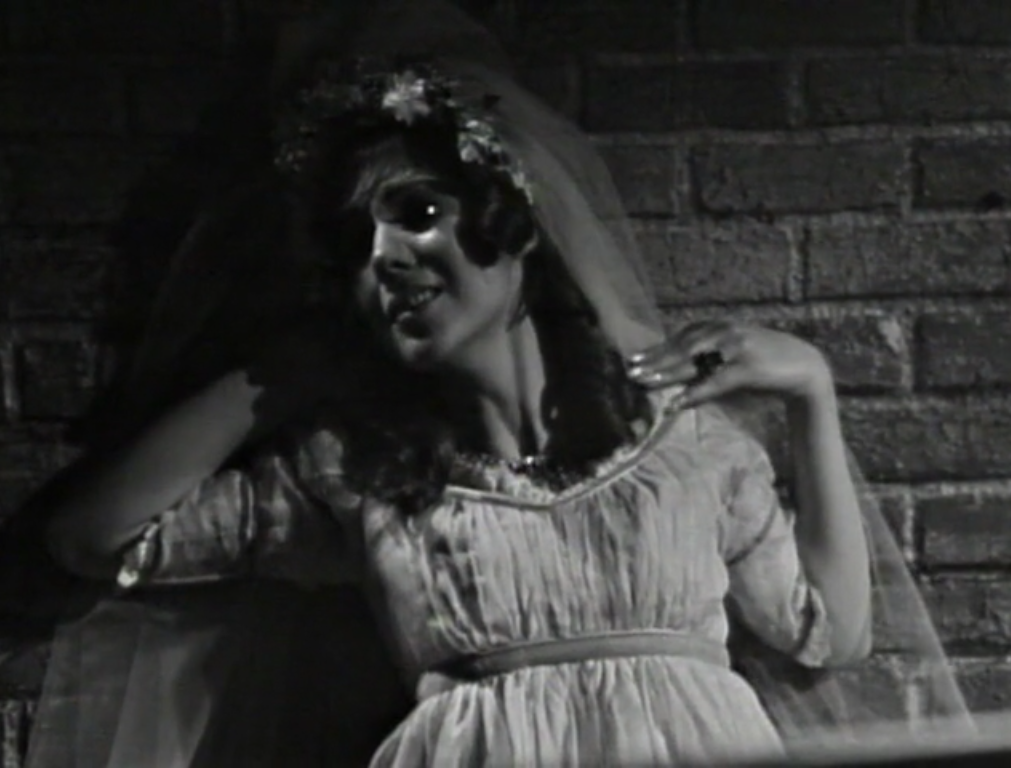
Barnabas is giving a costume party for his distant cousins, the living members of the Collins family. He has invited well-meaning governess Vicki to attend and to wear the dress of the legendary Josette Collins. In the first 39 weeks of Dark Shadows, Vicki had developed a close friendship with Josette’s ghost, so she is excited about this. For his part, Barnabas has borrowed an evil scheme from the 1932 film The Mummy. He will erase Vicki’s personality and replace it with Josette’s, then kill her so that she will rise as a vampiric Josette. So he is glad she likes the dress.
Barnabas asks Vicki to come to his house and help him pick out the antique clothes that the family will wear at the party. She enthusiastically agrees, saying that she loves to go through trunks full of old clothes. The clothes are in a trunk in Josette’s old room, which Barnabas has restored.
In the room, we see the ghost of Barnabas’ 9 year old sister Sarah sitting on the trunk. She vanishes a second before Barnabas and Vicki enter. Both of them have a strong feeling that someone just left the room. Barnabas tries to dismiss the sensation as nervousness, but Vicki has had too much experience with ghosts to be put off so easily.
Vicki has been our point of view character for most of the series. At first, that was because she was a newcomer to the great estate of Collinwood and the nearby town of Collinsport, and so we would learn everything we needed to know as we listened to people explain things to her. Later, it was because she was the key protagonist in the stories, so that the action got going once she knew what was going on. So when Barnabas equals Vicki’s sensitivity to Sarah’s presence, he is presented to us as another possible point of view character.
Barnabas keeps talking about the Collinses’ eighteenth century ancestors in terms that make it obvious that he knew them, so that he more than once has to clean up after himself with remarks like “I would imagine.” He does alarm Vicki when he blurts out something about what will happen to her should she “become Josette.” He hastens to say that he means that Vicki will become her for the duration of the party.
“Become Josette?”
Vicki goes back to the great house and talks with Liz about the party. Liz smiles happily, the first time we’ve seen this expression on her face in the whole run of the series.
Happy Liz
Vicki goes on about Barnabas’ connection to the past, saying that he gives the impression of someone who really is misplaced in time. She has the feeling that he needs to recreate a bygone era, and that he is doomed to be unhappy because of the impossibility of traveling backward in time. Vicki does not know what Barnabas’ plans for her are, but she understands his motives perfectly and empathizes with him deeply. That Vicki, Barnabas’ intended victim, can feel this way suggests that we can, too.
Back in Barnabas’ house, Sarah reappears in Josette’s room and sees her blue dress. She is excited to find it. She looks at her reflection in the mirror and smiles. Her good cheer is emphasized when her musical cue, an excerpt from “London Bridge,” is for the first time played in a major key.
Sarah’s reflection looks like it has never seen a ghost before
The minor key was appropriate during Sarah’s previous appearances. The first several times we saw her, Sarah was associated with Barnabas’ imprisonment of Maggie Evans, The Nicest Girl in Town. Maggie was the victim of Barnabas’ first mad attempt at Josettery, and Sarah intervened just in time to keep Barnabas from killing her. The other day, Barnabas killed Jason, and we saw Sarah when Barnabas was forcing Willie to help him hide his old friend’s corpse. Barnabas isn’t killing anyone today, so Sarah can be a bit more cheerful.
Sarah helps to establish Barnabas as a comic villain. As the ghostly sister who returned to the upper world when Barnabas was loosed to prey upon the living, Sarah and he are part of the same eruption from Dark Shadows‘ supernatural back-world into its main continuity. Perhaps she personifies his conscience, certainly she gives him an occasion to make schmaltzy speeches about his days as a human. More important than either of these, when we see that Barnabas’ 9 year old sister is his most powerful adversary, we begin to wonder just how seriously we should take him.
Closing Miscellany
Yesterday and today, Alexandra Moltke Isles delivered the recorded voiceover monologue at the beginning of the episode. The first 270 times she did this, it was in character as Vicki. Now, they’ve given up the idea that Vicki or any other one character will eventually find out about everything that we see on screen, so the openings are delivered by whatever actress is available as a nameless external narrator.
In those first 270 outings, Mrs Isles sounded like Vicki. She adopted Vicki’s distinctive way of speaking, carefully articulating one word at a time and often ending sentences with surprising little inflections- a curl of uncertainty here, a touch of breathy optimism there, a falling note of despair in another place. The voiceovers were usually remarks about the weather or the sea that were supposed to involve some vague metaphor for events in the story, so that it is open to question whether it was really worth Mrs Isles’ time to put so much effort into creating a character with them. But I guess a pro is a pro, and it was a matter of course that she would do her best no matter how little she had to work with.
In these last two, she has used a relatively flat voice, with none of Vicki’s particular vocal traits. The pacing has been structured, not around sentences, but around an attempt to convey an overall sense of urgency. They sound very much like The Narrator. I wonder what Mrs Isles would have made of The Narrator if the voiceover passages had extended beyond the opening moments and run through the episodes.
There is a famous production error under the closing credits, when a stagehand shows up in the window, realizes he’s on camera, and makes himself all the more conspicuous when he tries to escape from his predicament.
Reclusive matriarch Liz is standing on the edge of a cliff, staring out to sea. Her distant cousin, Barnabas the vampire, comes up stealthily behind her. He grabs her, and she screams.
For months, Liz has been stuck in a go-nowhere storyline about blackmail. So it is exciting to see the beginning of a new story where she is under Barnabas’ power. Or it would be, if that were what was happening. Instead, we come back from the opening credits to find that Barnabas approached Liz that way only because he was afraid she might go over the cliff if he made a noise and startled her.*
As a result of the blackmail arc, Liz is suicidal. Barnabas fears that she may be trying to jump, and tries to cheer her up by spending several minutes delivering a semi-coherent oration about how wonderful it is to be dead.
The scene started with a disappointment, and the dialogue doesn’t make much sense, but it is always fun to see Jonathan Frid and Joan Bennett work together. Frid’s acting style was a bit of a throwback to the nineteenth century, which made him an ideal scene partner for a daughter of Richard Bennett.
In #264, Barnabas had made some remarks to Liz’ brother Roger about the importance of family. Barnabas had then gone on to bluster uselessly at Liz’ blackmailer, seagoing con man Jason. He later told his sorely bedraggled blood-thrall Willie that he might kill Jason soon. As a vampire, Barnabas is a metaphor for extreme selfishness, and his hostility to Jason fits into that- Jason does represent a possible inconvenience for him. But today, we see a hint that Barnabas might actually have some measure of concern for Liz and the rest of the Collinses. After he walks Liz home, he confides in the perpetually well-meaning Vicki that he was afraid Liz would jump off the cliff. He tells Vicki that she seems to be the person most able to help Liz.
Yesterday, housekeeper Mrs Johnson had grabbed Liz as she was about to plunge off the same cliff, and had told Vicki of the incident. But Mrs Johnson just thought Liz was fainting. Vicki had noticed yesterday that Liz was deeply depressed, but she is shocked and disbelieving when Barnabas breaks the news that she seems to be suicidal.
On his way into the house with Liz, Barnabas had seen strange and troubled boy David Collins. David had seen Liz, but Liz neither saw nor heard him- she walked silently away from him, even though he twice called out “Aunt Elizabeth!”
In #256, David had met a little girl wearing eighteenth century dress hanging around outside Barnabas’ house. Unknown to anyone but the audience, the little girl is the ghost of Barnabas’ sister Sarah. David told Willie about Sarah, and Willie himself saw her in #264 and told Barnabas about her. Today, Barnabas tells David that if he sees Sarah again he should tell her to stay away from his property.
Barnabas’ message to Sarah and David
David denies that Sarah is his girlfriend, and says that her habit of singing “London Bridge” gets on his nerves. Barnabas is startled by the mention of “London Bridge.” David says that he isn’t likely to see Sarah near the Old House again, because “I’m not allowed to play at the Old House.” He delivers this line with a pungency that led us to laugh out loud. The whole scene is a lot of fun.
Barnabas had turned his creepy, anachronistic charm on at full force when talking to Vicki, and was obviously disappointed when she told him she had a date with fake Shemp Burke Devlin. He politely responded to this news by describing Burke as “a very interesting man.”
We then go to the Blue Whale tavern, where we see that “very interesting man” drinking and smoking by himself for a minute and a half. He wanders from his table to the bar to get another drink, passing some people whom first-time viewers will believe to be suffering from spastic disorders, but whom regular viewers will recognize as Collinsport residents who think they are dancing.
Notice her right hand- she has her guard up in case the convulsions spread to his arms
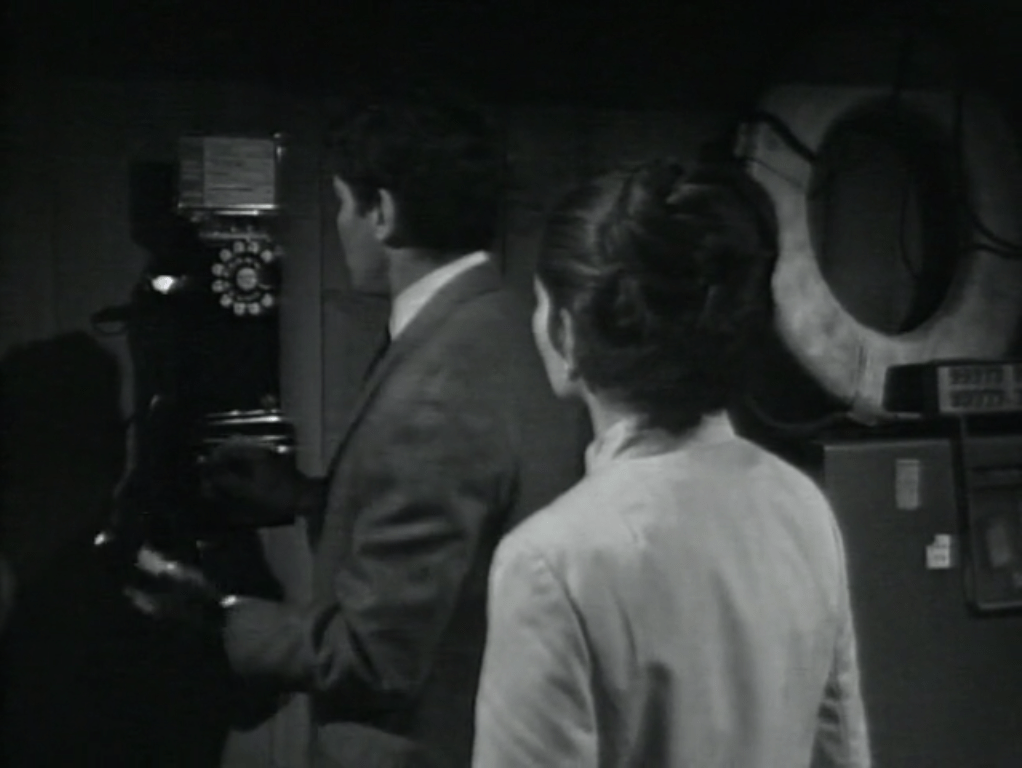
Burke goes to the pay phone to call Vicki. She enters, and he tries to get his dime back. He takes the receiver off the hook, replaces it, probes around in the coin return, bangs the side of the phone, explores the coin return again, and sadly tells Vicki that he has lost his dime. She tells him that if the purpose of calling was to get her to show up, he got his money’s worth. He agrees, but keeps looking back at the phone with longing.
Burke and Vicki dance. She tries to take his mind off the lost dime by recapping the last couple of episodes, but too little of interest has happened to refocus his attention. Vicki gives up and says she’s going home. We don’t see Burke resume his battle with the coin return slot, I guess they decided they had already given us our thrill for the day.
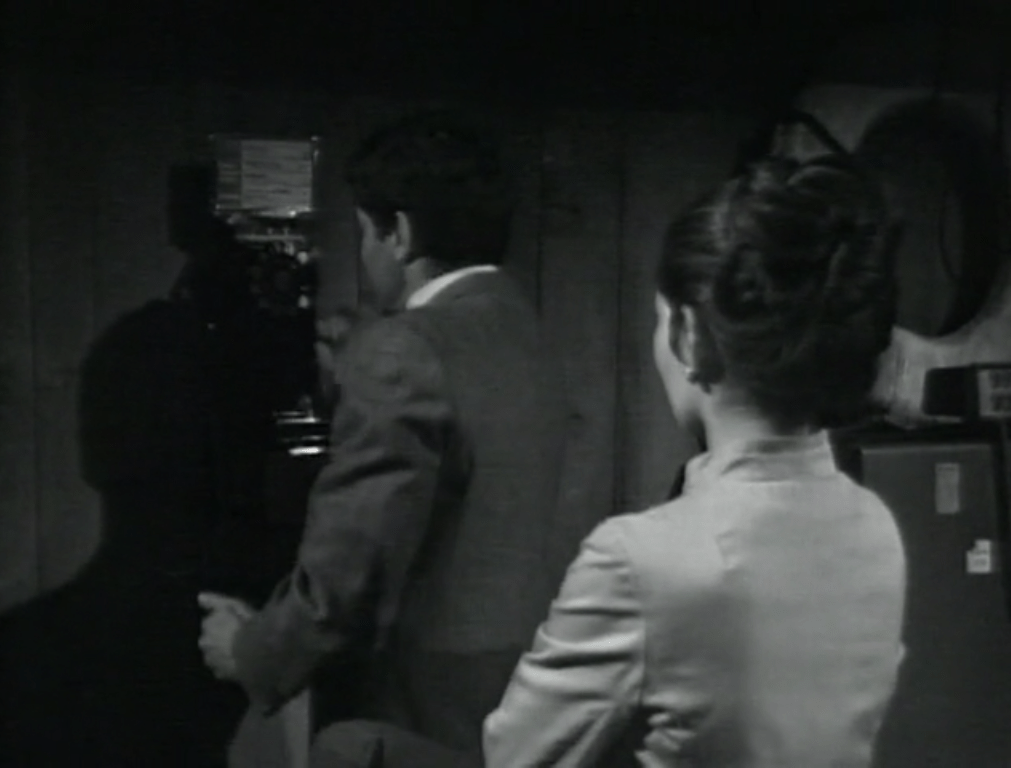
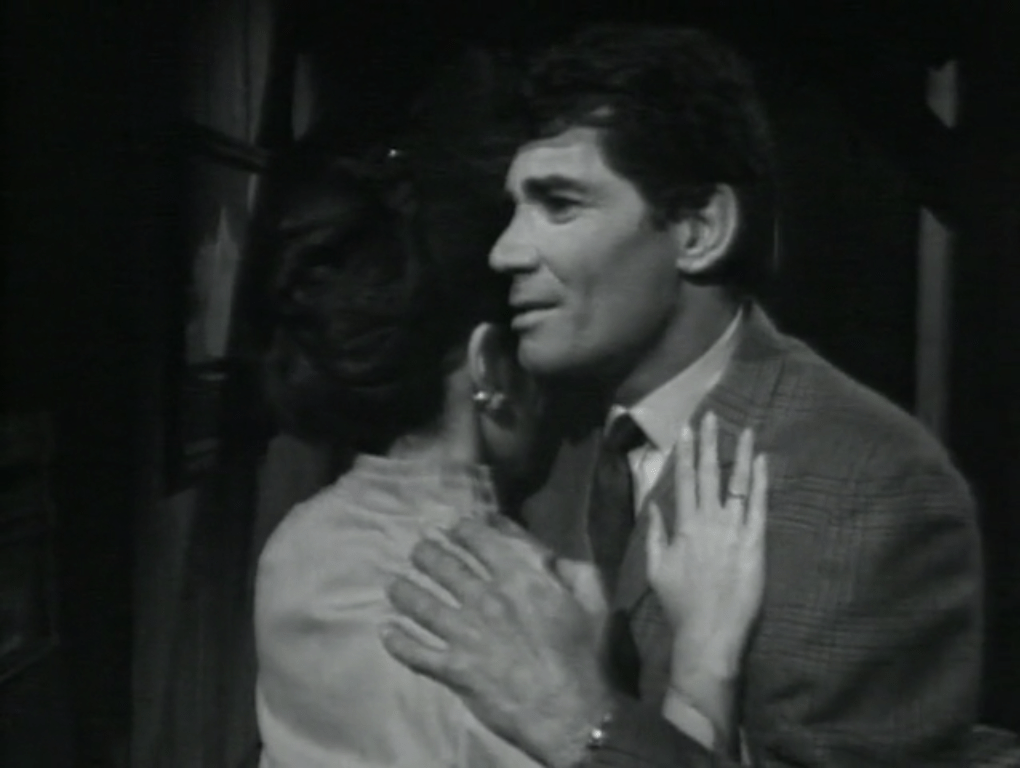
Back in the house, Liz is sitting in front of a table on which there is an open book. She is staring blankly into space. David enters the room. He greets her. She smiles vaguely, mumbles “Oh, David,” then gets up to leave. When Vicki comes in and says hello, Liz mutters “Hi, Vicki,” but doesn’t turn her head to look at her.
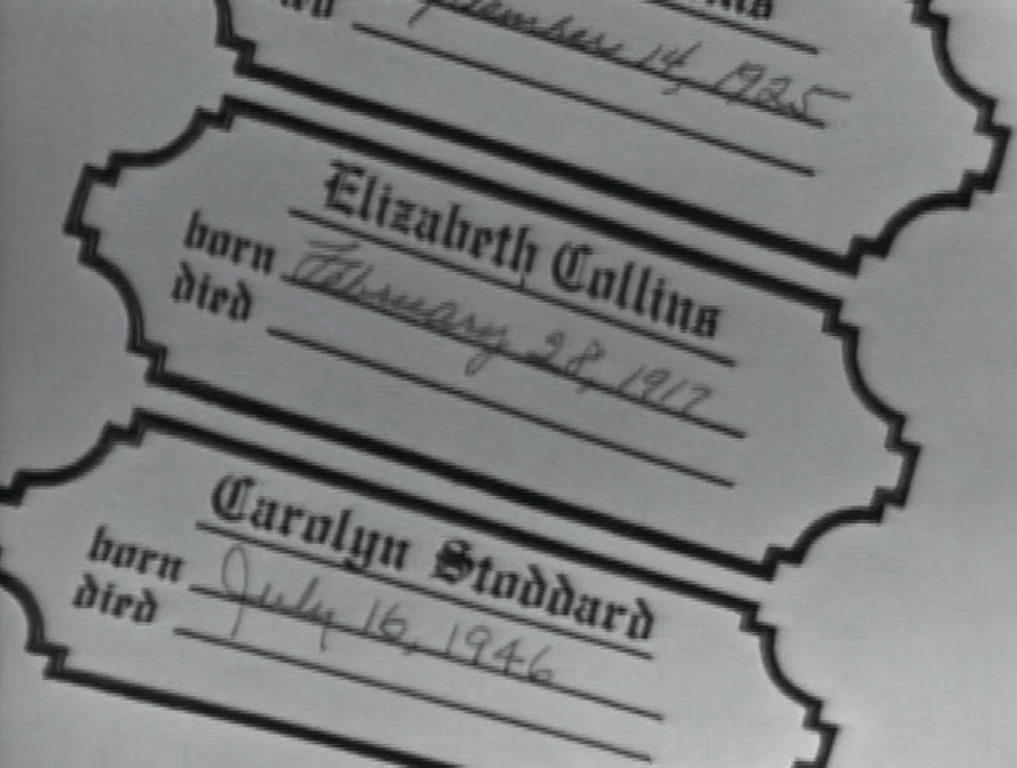
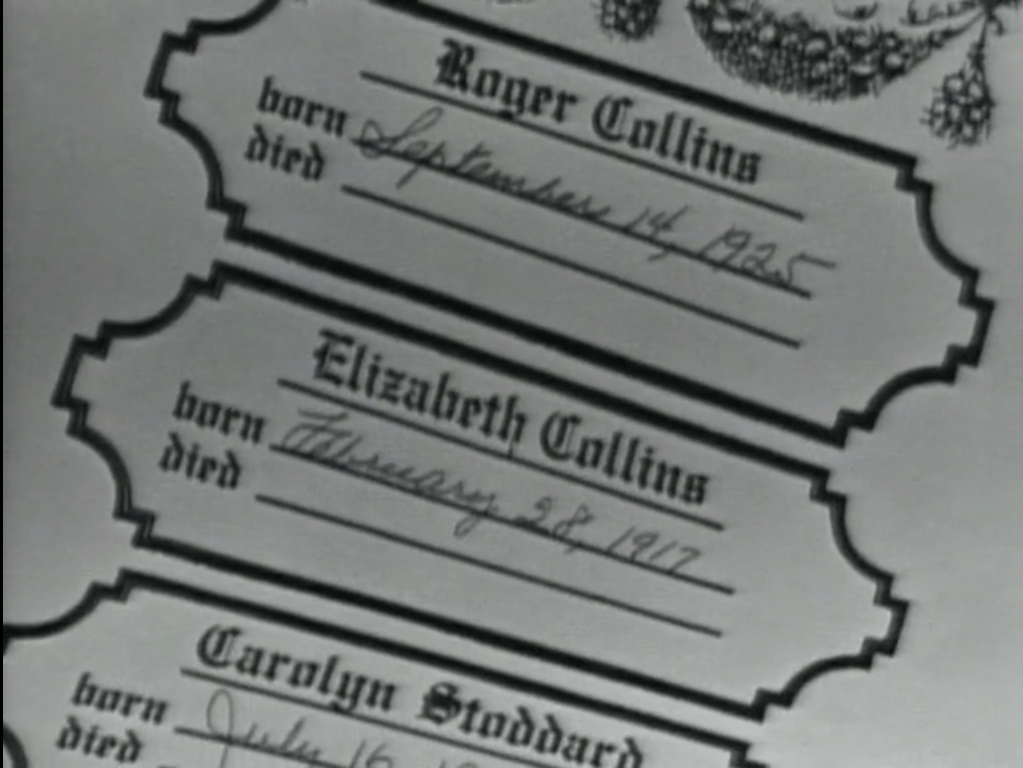
David calls Vicki’s attention to the book. It is the Collins family Bible, and was open to some plates that have been inserted bearing birth-dates for Liz and other members of the family. That’s the end of the episode. I must say, it’s quite an anti-climax after Burke’s attempt to retrieve his lost dime.
Closing Miscellany
Bob O’Connell is not on hand to play Bob the Bartender at the Blue Whale today. Instead, the bartender is Tom Gorman, who played the same role in #104 and will reprise it again in #607.
The birth-dates in the Collins family Bible are:
Roger Collins, 14 September 1925
Elizabeth Collins, 28 February 1917
Carolyn Stoddard, 16 July 1946
By comparison, the actual birth-dates of the actors were:
Louis Edmonds, 24 September 1923
Joan Bennett, 27 February 1910
Nancy Barrett, 5 October 1943
So it looks like they adjusted Edmonds’ and Bennett’s birth-dates by a few days plus a few years in setting their characters’ births, but ignored Miss Barrett’s actual birth-date in setting Carolyn’s. Maybe she refused to tell them what it was!
The show has been hinting heavily that Vicki is Liz’ biological daughter. A birth-date of 16 July 1946 for Carolyn would tend to pull against that- Vicki had apparently just turned 20 when the show started late in June 1966. Unless they were twins, one or the other of those characters is going to have to have her birth-date adjusted if they are going to resolve the question of Vicki’s origin that way.
*That’s a concern we’ve heard several times on this set- in #2, Roger introduced himself to Vicki by startling her as she stood at the edge of the cliff, and in #75 Vicki did the same thing to Roger. In #139, David was at the edge of the cliff when his mother, blonde fire witch Laura Murdoch Collins, surprised him; the episode ended with a literal cliffhanger after Laura made a move David wasn’t expecting. We’ve heard many times that the legendary Josette Collins was “the lady who went over the cliff,” as artist Sam Evans calls her in #185. It’s unclear why she did- maybe someone startled her.
Maggie Evans, The Nicest Girl in Town, has escaped from vampire Barnabas Collins, but not before Barnabas put the zap on her brains. She is being treated at Windcliff Sanitarium, under the care of Dr Julia Hoffman.
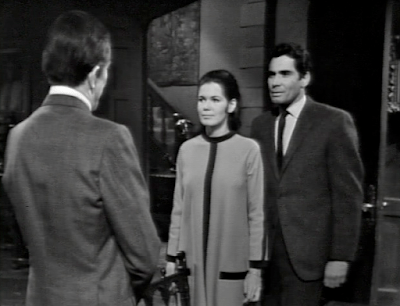
Dr Hoffman’s old acquaintance Dr Dave Woodard shows up with Maggie’s father Sam and boyfriend Joe. Woodard and Hoffman are Dark Shadows ‘ current versions of Bram Stoker’s Dr John Seward and Professor Abraham Van Helsing. As Seward called Van Helsing in when he needed help solving the mystery he encountered treating the victims of Count Dracula, so Woodard has called the expert Dr Hoffman in to help him solve the mystery he has encountered treating Barnabas’ victims. As Van Helsing refuses to answer any of Seward’s questions when they first start working together, so today Dr Hoffman refuses to answer any of Woodard’s questions about the case. There is one departure, in that Dr Hoffman combines Seward’s occupation as chief physician at a sanitarium with Van Helsing’s role as mysterious expert from out of town.
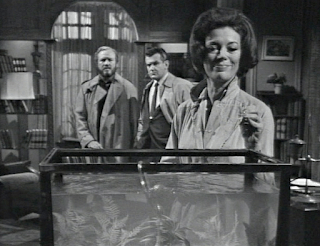
Dr Hoffman tells Dr Woodard that she believes it will be bad for Maggie to see Sam and Joe, but she consents to the visit as a way of discouraging them from trying to come back. When Sam and Joe join them in her office, she attends to her aquarium. In the post about this episode on Dark Shadows Before I Die, Christine Scoleri points out that this is a rather direct way of telling us that there is something fishy about Dr Hoffman.
When Sam and Joe go to Maggie’s room, she has a mad scene. She starts singing “London Bridge,” gets to an obscure verse running “Take the key and lock her up,” and starts screaming “Lock her up!” over and over. It’s magnificently terrifying.
In his post on Dark Shadows Every Day, Danny Horn raves about Grayson Hall’s performance as Julia Hoffman. Rightly so, she will quickly make herself indispensable to the series. He includes a lot of screenshots of her face, showing the wide variety of expressions she uses. I have a more complicated response to this aspect of her style.
As many screenshots as Danny gives of Grayson Hall’s face in his post, I presented even more screenshots of Lovelady Powell’s face in my post about #193, where Powell plays art dealer Portia Fitzsimmons. What impressed me about Powell’s performance is that she takes one of the most basic rules of screen acting- choose one of your eyes and look at your scene partner only with it- and builds a whole character around it. Her left eyelid is all she needs to command the stage and leave an indelible impression.
Hall was at the opposite extreme. She ignores the one-eye rule, and virtually every other piece of guidance professionals give about how to create a character on camera. She uses every muscle at every moment. Her broad, stagy approach works well for Dark Shadows, and the three actors with whom she shares her shots today stay out of her way. Still, she does make me miss Powell’s dominating simplicity.
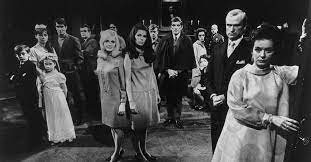
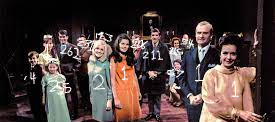
With Julia’s introduction, all of the actors in the photo I use as the header for this blog have joined the cast of Dark Shadows. There is also a version of the picture where the actors are frowning.
Gloom in the shadows
Here’s the smiley version. I’ve marked each player with the number of the first episode in which s/he appeared:
Reclusive matriarch Liz and well-meaning governess Vicki are in the drawing room of the great house of Collinwood. Liz is depressed because her daughter Carolyn is dating motorcycle enthusiast Buzz. She asks Vicki if she has any idea how to break Carolyn and Buzz up, then answers her own question. Liz knows that Carolyn is protesting her engagement to seagoing con man Jason McGuire, and that only by breaking it off with Jason can she change things with Carolyn.
When Liz claims that she is marrying Jason because she wants to, Vicki says it’s none of her business. Vicki has seen abundant evidence that Jason is blackmailing Liz, and won’t pretend she hasn’t. She manages to be quite respectful to her employer without backing down an inch. Despite herself, Liz is impressed with Vicki’s firmness and diplomacy.
Alexandra Moltke Isles was cast as Vicki because she and Joan Bennett looked so much alike, and this is one of the scenes that uses their resemblance to show Vicki as a reflection of Liz. As Vicki is finding tactful ways to express her suspicions, she says things that we have heard Liz say and that we know she is thinking. Each time she does so, Joan Bennett does a quarter turn one direction from the shoulders and a quarter turn the other direction from the neck, as if she were being twisted open. When Liz tells Vicki to stop, she calls her “Victoria,” a name we haven’t heard her use since 1966, and when Vicki asks permission to leave the room she responds, in a near-whisper, with the usual “Vicki.” This alternation also suggests twisting, and to regular viewers who remember that Liz has a secret connected with the fact that “Her name is Victoria” it is another twisting open.
Meanwhile, Jason is entering the Blue Whale tavern with his former henchman, Willie Loomis. Jason wants to confront Willie with the fact that he saw him in town earlier in the day selling a piece of jewelry. Willie says that he was selling it on behalf of his employer, wealthy eccentric Barnabas Collins. Jason knows of Willie’s obsessive fascination with jewels and his tendency to steal them, and does not believe that Barnabas would entrust him with such a task. What Jason does not know is that Barnabas is a vampire and Willie is his sorely bedraggled blood-thrall. As such, Barnabas has a power over Willie that makes it rational to entrust the most remarkable tasks to him.
Carolyn and Buzz enter. They almost leave when Carolyn sees Jason and Willie. Jason and Willie rise and meet them at the door. Jason assures Carolyn that they were just going. Before they do, he taunts Carolyn with his engagement to Liz.
On Tuesday, Carolyn and Buzz started dancing together in the drawing room. Buzz made a few very graceful moves, saw Carolyn going into the Collinsport Convulsion, and sat down to observe. Today, Buzz sees two background players twitching awkwardly while the jukebox plays and declines Carolyn’s invitation to join her on the dance floor. He wants to stop drinking, saying that he is looking for something that will make him feel like he’s never lived before, while “drinking only makes you feel drunk.” It sounds a little bit like he’s going to offer Carolyn a drug stronger than alcohol, but by the end of the scene he just wants to get back on his bike. Liz’ fears to the contrary, Buzz seems pretty darned wholesome.
While Carolyn and Buzz are on their way out of the tavern, hardworking young fisherman Joe comes in. Carolyn asks Buzz to wait outside while she talks with Joe. Buzz reluctantly agrees to spend a few minutes alone with his bike.
Carolyn and Joe were dating when the show started, and there was a whole storyline about how they were tired of each other and couldn’t get themselves sufficiently organized to break up. Their scenes together reminded us that the 1960s were the decade in which Michelangelo Antonioni used the cinema to explore the nature and significance of boredom.
But they are far from boring today. After he and Carolyn finally called it quits, Joe started seeing Maggie Evans, The Nicest Girl in Town. Maggie is now missing and feared dead. Carolyn sits next to Joe at the bar and expresses her sympathies. When I say that Nancy Barrett’s acting style was to throw herself unreservedly into whatever the script gave her character to do that day, it may sound like I’m saying she was undisciplined or that she lacked subtlety. That is not at all what I mean, and in this scene she does one of the most delicate drunk acts I’ve ever seen. Carolyn sits a fraction of an inch too close to Joe, tilts her head back a fraction of a degree too far, opens her eyes the tiniest bit too wide, and speaks ever so slightly too slowly. No one of those signs would even be noticeable by itself, but together they make it very clear why Buzz was anxious that he and Carolyn should leave their drinks unfinished.
Back in the drawing room, Jason is badgering Liz into setting the date for their wedding. Carolyn and Buzz come back, and Jason tells them he and Liz will be married two weeks from tonight. Carolyn says that she and Buzz ought to get married the same night. Buzz is delighted when she first says this, and is still smiling when she insists she is being serious.
My wife, Mrs Acilius, urged me to call this one “A piece of that action,” something Jason says to Willie. Trekkie that she is, that seemed irresistible to her. But Joe’s line that Buzz seems to be “about as much fun as a bag of spiders” is the funniest of the many witty lines in today’s script, and when you remember that Dark Shadows has, since December of 1966, been basically a horror story, you have to think that in its terms a bag of spiders might be a lot of fun. So that had to be the title.
Frustrated that her mother, reclusive matriarch Liz, has decided to marry seagoing con man Jason McGuire, flighty heiress Carolyn spends the day and night with motorcycle enthusiast Buzz Hackett.
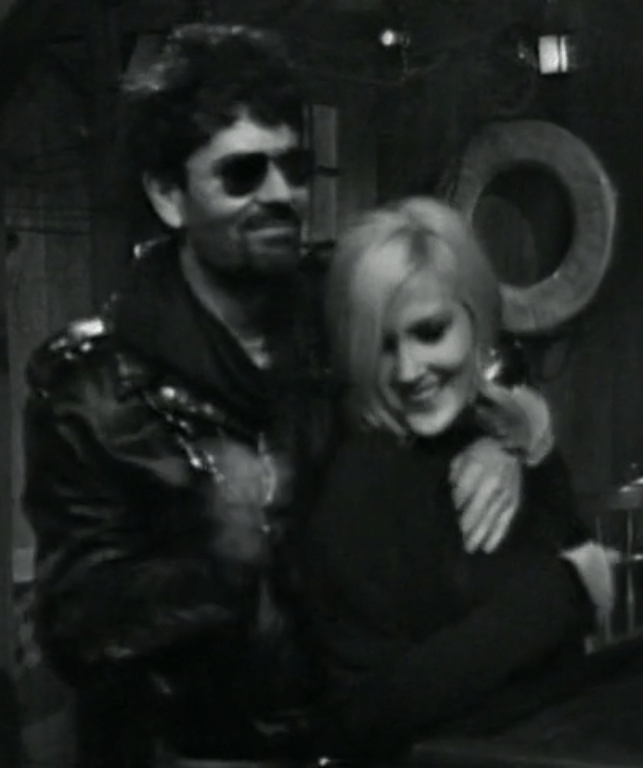
Buzz is modeled on the biker dude villains of Beach Blanket Bingo. Some of his mannerisms, such as speaking in a Beatnik slang that was a decade and a half out of date by 1967 and wearing sunglasses when he rides his motorcycle at night, would have been a little too broadly comic even for that movie, and are ludicrously out of place on the rather solemn Dark Shadows. The very sight of Buzz therefore raises a laugh.
I mean really
Nancy Barrett’s acting style was to throw herself unreservedly into whatever the script had her character doing that day, and seeing her present Carolyn as a newly minted biker mama is hilarious from beginning to end. When Carolyn and Buzz show up at the Blue Whale tavern, she’s already sloppily drunk. They see well-meaning governess Vicki and hardworking young fisherman Joe at a table, and Carolyn insists they go over and greet them. Vicki and Joe give Buzz and Carolyn frosty stares, which are of course the main ingredients of drawing room comedy.
If Vicki put on a police uniform, Carolyn wore a big feathered headdress, and Joe were a construction worker, they could make beautiful music together
As Danny Horn points out in his post about the episode on Dark Shadows Every Day, Buzz is actually pretty nice. That’s a good comic move- the obvious outsider is the one who knows enough to be uncomfortable, while the one who has been a central member of the cast from the first week is oblivious to the social awkwardness surrounding her. If it were the other way around, we might feel sorry for Buzz or be angry with him, but since we know that Carolyn’s place is essentially secure we can laugh at her uninhibited behavior, no matter how much it may make others squirm.
Buzz takes Carolyn home to the great house of Collinwood, parking his motorcycle a few feet from the front door. That isn’t a sign of inconsideration- there only are a few feet in front of the door, they’d be off the set if he parked any further away. It’s still pretty funny to see.
Buzz and Carolyn
Inside the house, Buzz jokes about riding his bike up the main staircase. Carolyn laughs, then urges him actually to do it. He refuses, clearly appalled that she would want such a thing.
Carolyn shocks Buzz
They go into the drawing room. Carolyn picks up a transistor radio and finds some dance music. Buzz is ready to dance, but takes a seat when Carolyn goes into the violent, rhythm-less jerks people in Collinsport do when music is playing. Buzz watches her, apparently ready to provide first aid.
As Carolyn’s performance of the Collinsport Convulsion ends with her falling face first, Liz comes downstairs. She protests against Carolyn and Buzz making so much noise at 3 AM. For the first time, Buzz is rude. He does not stand up when Liz comes into the room, and when Carolyn introduces her as “Mommy,” he greets her with “Hiya, Mommy!” Liz orders him to go.
Before Buzz has a chance to comply, Carolyn starts taunting her mother, yelling at her that her name will soon be “Mrs McGuire!” Liz retreats up the stairs as Carolyn taunts her with repetitions of this name. When Liz is on the landing, Carolyn and Buzz clench and kiss passionately. While they kiss, we see Liz above and behind them, trying to exit the scene. As it happens, the door she is supposed to go out is stuck, so she has to struggle with the knob until she’s out of the frame. Thus, the longest period of intentional comedy on the show ends, not with a break into angry melodrama, but with a huge unintended laugh. It is one of the few truly perfect things ever seen on television.
Door’s stuck
As Buzz, Michael Hadge really isn’t much of an actor- he shouts his lines and goes slack whenever he isn’t speaking. That doesn’t matter so much today. Nancy Barrett’s high-energy performance, the other cast members’ skill at comedy of manners, and the mere sight of Buzz combine to keep the audience in stitches throughout.
Still, I can’t help but wonder what might have been. Yesterday, vampire Barnabas Collins threatened to murder his blood thrall, the sorely bedraggled Willie Loomis. Viewers watching on first run might have wondered if Buzz was going to be his replacement. They might have, that is, if Buzz were played by an actor in the same league as John Karlen. With Mr Hadge in the role, that suspense never gets off the ground.
One of the little games I play in my head when the show gets boring is to ask who else might have taken a part and to imagine how it would have changed with that other actor in the cast. So, if Harvey Keitel was available to dance in the background at the Blue Whale in #33, then surely Mr Keitel’s friend Robert De Niro would have taken a speaking part in #252. Actors inspire screenwriters, and if Mr De Niro had played Buzz I would have wanted to write this line for him to speak to Liz: “Mrs Stoddard, you got me all wrong. You think I want to hurt you, or take something from you, but that’s not the way it is. Me and Carolyn, we’re just trying to have a good time.” Mr Hadge’s shouting wouldn’t have made much of a line like that, but delivered by Mr De Niro to Joan Bennett it could have started a scene between Buzz and Liz that would have expanded his role beyond comic relief and earned him a permanent place in the cast.
It may be for the best that it didn’t work out that way. A De Niro-Buzz might have been such a hit that Dark Shadows never would have got round to becoming the excursion into sheer lunacy that we know and love. And Martin Scorsese might never have been able to get soap opera star/ teen idol Robert De Niro to answer his phone calls.
Closing Miscellany
There are some other notable moments today. We might wonder why Vicki and Joe are sitting together in the Blue Whale, when Vicki has been dating dashing action hero Burke. In fact, the script originally called for Vicki to be out with Burke, but actor Mitch Ryan showed up too drunk to work the day they taped this one and was fired off the show. Burke gave up on his big storyline over ten weeks ago and there hasn’t been a reason for him to be on the show since. Besides, the same cast of characters cannot indefinitely include one whose type is “dashing action hero” and another whose type is “vampire.” The vampire is already pulling in bigger audiences than anything else they’ve done, so Burke has to go. Still, Ryan was such a charismatic screen presence that he was a high point in every episode he appeared in, so it’s sad we’ve seen him for the last time.
The bartender brings drinks to Vicki and Joe’s table and Joe calls him “Bob.” They have settled on this name by now. The same performer, Bob O’Connell, has been playing the bartender since the first week, but in the opening months of the show he had a long list of names. My favorite was “Punchy.”
There is some new music in the jukebox at the tavern and more new music while Carolyn and Buzz are outside the front doors of Collinwood. In the tavern we hear something with brass, and at the doors we hear a low-key saxophone solo.
The closing credits give Buzz’ last name as “Hackett.” We heard about a businessman named Hackett in #223, but Buzz doesn’t seem to be related to him. In the Blue Whale, Carolyn says that her mother has more money than Buzz will ever see, to which Buzz laughingly replies “That isn’t much!”
Maggie Evans, the Nicest Girl in Town, has been the prisoner of vampire Barnabas Collins for some time. At rise, she is in front of her mirror, struggling to remember who she is. Her name and her father’s come back to her, but then the music box Barnabas gave her starts playing, and she begins to believe that she is Barnabas’ long-lost love Josette. This scene takes about a minute more than is necessary.
She renews the struggle later, and this time overcomes the hypnotic power of the music box. She decides to pretend that she believes that she is Josette in order to trick Barnabas and Barnabas’ sorely bedraggled blood thrall Willie into giving her enough freedom to escape. She fools them, only to hear Barnabas tell Willie that her compliance means that the time has come for the final part of his plan.
Maggie hears carpentry work, and sneaks down to the basement. She finds Barnabas watching Willie build a coffin. It sits next to the coffin in which Barnabas spends his days. It becomes clear that once Maggie is fully Josettified, she will be a vampire as well. Unfortunately, Jonathan Frid has a great deal of trouble with his lines in this scene. I don’t usually mind Frid’s bobbles, but his line troubles here take us out of what needs to be a terrifying moment.
In the morning, Maggie goes back to the basement. Willie finds her there. He is not convinced that she believes she is Josette. He presses her, and she finally breaks down and gives up the act.
Maggie shows Willie the diamond necklace Barnabas gave her as a present for their wedding, and tells him it will be his if they destroy Barnabas and escape. Willie’s fascination with jewels was what led him to undertake the grave-robbing expedition that freed Barnabas in the first place, and the necklace does distract him for a little while. But then he hears Barnabas’ heartbeat. He heard that sound before, in #208, #209, #210, and #217, but in those episodes no one else could hear it. Maggie can, since Barnabas has been drinking her blood too, but she can still resist the vampire’s spell. She is holding a large awl, ready to drive it into Barnabas’ heart, but Willie cannot overcome his urge to protect his master. He disarms Maggie.
We see Maggie in her room and hear Barnabas’ voice on the soundtrack going over what she heard him say in the basement. This is the first time an interior monologue has played quotes from another character. They aren’t the lines Jonathan Frid actually delivered, but cleaned-up, intelligible lines, presumably the ones that were in the script.
As sunset nears, Willie takes Maggie back to the basement. He leaves, telling her that she and Barnabas must be alone when he completes “the ceremony.” She finds the awl, picks it up, and opens the coffin. Before she can drive it into Barnabas’ heart, he awakens and shows his fangs. She screams and presses herself against the brick wall behind her.
Back to the wall
This is the second episode credited to writer Joe Caldwell, and is certainly the best teleplay Dark Shadows has seen since Francis Swann left the show in November of 1966. Like Swann and Art Wallace, Caldwell understood what actors could do and knew how to give them a platform to show their stuff.
Aside from Frid’s one bad scene, the actors excel. In 1967, Kathryn Leigh Scott was already a highly trained actress. Maggie Evans, on the other hand, has never acted before. When Maggie is pretending to believe she is Josette, Miss Scott shows her giving a crude imitation of Barnabas’ high-flown style, mixed with some prancing movements you might see from a little girl playing the princess in a school play. Barnabas is so desperate to believe that his lunatic scheme is working that he falls for it completely. When he and Maggie are in the front parlor together, he responds to her amateur performance as a sign that she is matching his pomposity, which of course thrills him.
When Willie and Maggie are in the basement, John Karlen plays his earthy skepticism with a simplicity that makes Maggie’s pretending look ridiculous. When Maggie gives up her act and whispers a plea for Willie to help her, Miss Scott matches the force of Karlen’s performance and the resulting encounter is as powerful as anything the show ever achieves.
The episode is good enough that we barely noticed some major lapses in story logic. If Maggie can sneak down to the basement to eavesdrop on Barnabas and Willie, why can’t she slip out the front door? She knows how to get from Barnabas’ house to the great house of Collinwood, where she has friends and there is a telephone to call the sheriff.
And when did she learn that you can destroy vampires by driving stakes through their hearts? She’s lived in Collinsport all her life, and no one in that town has ever heard of vampires. Granted, the show would move a lot faster and could have more layers of irony if the characters had read Dracula and seen movies from Universal and Hammer, but this is the first hint that any of them has.
My wife, Mrs Acilius, was very interested in the fact that Maggie calls herself “Maggie, or Margaret” in this one. First time we hear the name Margaret! I’m not sure why that impressed her so much, but she’s very bright, so I’m sure it’s important. All I can think of is that “Maggie” waits tables in the diner, cleans up after her Pop has had one drink too many, and is everybody’s pal, while “Margaret” is a saint’s name, and a queen’s name. So Margaret might have a bigger destiny than we’ve seen.
Today is only the second time we hear a voice announce a recast over the opening title. The first time was in #35, when David Ford took over the part of drunken artist Sam Evans from wildly incompetent actor Mark Allen. This time Robert Gerringer is taking over the part of addled quack Dr Woodard from Richard Woods. Woods only played the role twice, and neither time could he find a way to distract the audience from the ignorance of medicine that the writers showed in their scripts.
Gerringer’s lines don’t make much more sense than did the ones they dumped on Woods, but he acts up a storm. Woodard is examining Sam’s daughter Maggie Evans, The Nicest Girl in Town. Unknown to Sam or Woodard, vampire Barnabas Collins has been sucking Maggie’s blood. Woodard is firm with Maggie when she resists his examination. He seems to be somewhat on edge, just enough that we wonder if there is more to it than the difficulties we can see Maggie giving him. Perhaps he is thinking something he isn’t saying. Woods never managed to make us wonder if his version of the doctor was doing that.
When Woodard and Sam leave Maggie’s room, Woodard assumes an alarmed tone. He tells Sam that Maggie is on the point of death and needs a blood transfusion at once. By showing us that Woodard was concealing the true nature of his concern when he was with Maggie, Gerringer gives substance to our hopes that the character’s nonsensical words and deeds will turn out to be a screen hiding something interesting.
Maggie’s boyfriend, hardworking young fisherman Joe, joins Sam and Woodard. Woodard asks if either Sam or Joe has blood type A. Joe does. Woodard doesn’t ask about Rh factors or Joe’s medical history or anything else, he simply marches Joe into Maggie’s room and the bodily fluids start pumping right away. Joe holds Maggie’s hand at first, but her violent protests force him to let go.
Transfusion
In Bram Stoker’s Dracula, Professor Van Helsing and Dr John Seward give blood transfusions to the vampire’s victims. That novel was written in 1897, and blood types weren’t discovered until 1900, so Van Helsing and Seward take blood indiscriminately from all the men cooperating in the effort to defeat Dracula. Van Helsing is particularly enthusiastic when he learns that Arthur Holmwood has given blood to Lucy Westenra, because Arthur “is the lover of her!” Van Helsing is Dutch, and speaks in a vaguely comical broken English. Woodard doesn’t seem particularly excited that Joe is “the lover of her,” but audiences who had read the book will recognize the allusion.
At this point in the production of Dark Shadows, the tentative plan was that Dr Woodard would become something like the expert on paranormal dangers that Dr Peter Guthrie had been during the Phoenix storyline, and that Barnabas would be destroyed in episode 275. Like Stoker’s Dracula, the Phoenix arc had featured a group of stout-hearted men and one valiant young woman coming together to do battle with an undead menace. Dr Guthrie had been their Van Helsing, an expert from out of town who leapfrogs over some weaknesses in the evidence actually available to the protagonists to get them to the same level of understanding that the audience has been given. Also like Van Helsing, Guthrie is the first to realize that the one female member of the team is the key to the success of their efforts, and so he insists on putting her in situations the other men regard as too dangerous for her. As Mina had been instrumental in the destruction of Dracula, so well-meaning governess Vicki is the person who finally thwarts the plans of the Phoenix.
If Woodard and Vicki are going to destroy Barnabas in #275, we have to wonder what story the show will have to tell in #276. The only other plotline going at the moment is the blackmail of reclusive matriarch Liz by seagoing con man Jason McGuire, and that can’t continue indefinitely. Not only will Liz run out of things for Jason to take away from her, but Dennis Patrick, the actor playing Jason, will leave the show no later than the end of June. Since the end of June is when #275 will be airing, we can hardly expect Jason to take the show over after that time.
In fact, Jason is an in-betweener brought on the show to clear away the last non-paranormal plot elements left over from the period before the show became a supernatural thriller in December 1966. By the time he leaves, both the reason for Liz’ long self-immuration in the great house of Collinwood and the identity of Vicki’s parents are supposed to be laid bare for all to see. Neither of those secrets ever generated an interesting story, but as long as they are around it is at least theoretically possible that the show will become a conventional daytime soap opera again. Without them, they are altogether committed to the spook show route. Destroy Barnabas, and you just have to come up with yet another menace from beyond the grave.
I remember Gerringer’s acting style from the first time I saw Dark Shadows. That was back in the 90s, when it was on what was then called the SciFi Channel. He so perfectly represented the doctor characters on the soaps my mother used to watch when I was a kid twenty years before that seeing him in the middle of a story about a vampire told me everything about the strangeness of a conventional daytime serial switching to a horror theme. If that guy is the one to drive the stake through Barnabas’ heart, or if he is even part of the team that finishes him off, it will be a statement that the makers of Dark Shadows have decided to stop being silly and start imitating The Guiding Light.
My wife, Mrs Acilius, was particularly frustrated with the dialogue in this episode. As Maggie, Kathryn Leigh Scott does a good job with nonverbal communication creating the image of a reluctant patient trying to get out of her skin, but her lines consist chiefly of repeating whatever is said to her. The other members of the cast are equally effective at projecting concern for a loved one whose grave illness they don’t understand and can’t help, but their lines too are so heavily loaded with repetition that we started to suspect that Malcolm Marmorstein was writing for a cast of myna birds. In particular, Woodard’s lines to Sam in the living room repeat the word “shock” so many times that they start to sound like he’s stuttering.
The original choices for the roles of Sam, Joe, Dr Woodard, and Maggie. Photo by Bird Ecology Study Group
In his post about this episode, Danny Horn complains that there is not a single interesting still image in it. I agree with that, though I would say that the actors’ movements tell a story. Granted, it is a story that could have been told in a tiny fraction of the actual running time, but they deserve credit for holding the show together when the script gave them zero support.
Danny says that the episode would have been just as good if it were a radio show. Mrs Acilius says that it would have been “a thousand times better” than it is if it were a silent movie. Maybe they could compromise, and it could be presented with neither audio nor video, and the audience could spend the 22 minutes doing something else.
We open in the front parlor of the long-abandoned Old House on the grounds of the estate of Collinwood. Willie Loomis, the sorely bedraggled blood-thrall of newly resident vampire Barnabas Collins, is lighting candles.
A knock comes at the door. No one knows that Barnabas has brought Willie to the house. Before Barnabas bit him, he was dangerously unstable ruffian Willie Loomis, a menace to all and sundry. Almost everyone in the great house on the estate and many people in the nearby village of Collinsport have been feeling a great sense of relief for the last few days because they believe that Willie has gone and will never return. So he responds to the knocking by trying to hide.
Willie hides from Vicki
Well-meaning governess Vicki comes in and calls for Barnabas. She finds Willie and demands to know what he is doing there. He tells her not to worry about that, but to get out of the house as quickly as she can.*
Willie tried to rape Vicki in #203, and crazed handyman Matthew Morgan held her prisoner in the Old House in episodes #116-126. So regular viewers will be absorbed in Alexandra Moltke Isles’ performance of Vicki’s refusal to be intimidated by this man in this space. At first she visibly steels herself to stand up to Willie. As he keeps his distance and evades her questions, she starts to suspect that he is more afraid of her than she is of him. She begins to relax, and takes stock of the improvements that have been made to the house. By the time she concludes that Willie is probably telling the truth about being Barnabas’ servant, she has an amused, almost triumphant look on her face and an easy sway to her movements. She talks easily and cheerfully about the improvements made since the last time she was in the house, and Willie squirms.
Vicki stands up to WillieVicki amused by Willie
As Vicki tries to communicate reclusive matriarch Liz’ invitation for Barnabas to join the Collins family for dinner in the great house, Willie denies that he knows where Barnabas is or when he will come back, and continues to demand that Vicki leave. She finally gives up and goes, but with irritation, not fear. She leaves with a sarcastic “Thank you!”
Vicki leaves, irritated
After Vicki leaves, Barnabas appears and scolds Willie. First, he taunts Willie’s roughness (“My, you are a polite one!”) Then, he orders him not to try to protect anyone from him. He is stern, Willie is terrified, the whole effect is suitably sinister.
We cut to the Evans cottage, home of artist Sam Evans and his daughter Maggie, The Nicest Girl in Town. Maggie rushes into the front door panting, as if she has been running. She shows intense fear when she hears a knock on the door. She calls out, “Who is it?” “Barnabas Collins,” comes the reply. “Mr Collins?” “That’s right.” She slowly opens the door, with the chain in place, and peeks out. She relaxes slightly when she sees that it really is the kindly eccentric she met the other night.
Barnabas asks permission to come in. Maggie opens the door and gestures towards the inside of the house. Barnabas asks again. Only after she explicitly invites him does he cross the threshold. There’s a tradition that vampires can enter only where they are invited, and the show has been following that strictly so far. Barnabas didn’t even go into Maggie’s restaurant until she asked him. Perhaps that was why he went there after it had closed, so that she would have to unlock the door and explicitly invite him to come in.
Maggie explains that she is unsettled because she felt someone followed her home. Considering that Barnabas knocked on her front door less than 30 seconds after she came in, I’d say her feeling has had some pretty solid corroboration, but she doesn’t seem to be making the connection. Maggie goes on to say that she is on edge anyway because some unseen man grabbed local woman Jane Ackerman by the throat the other day and vanished into the night when Jane was able to scream and attract a crowd.
Barnabas explains that he was intrigued when she mentioned that her father was an artist. Maggie brightens and ushers Barnabas towards Sam’s paintings. He looks at several and admires them.
Sam comes home. He is as disquieted as Maggie was when she entered. He tells her that he looked for her at the restaurant and was alarmed to see that she had already closed and was presumably walking home. There has been another attack.
The conversation shows how exotic Barnabas is in Collinsport. He speaks with a mid-Atlantic accent, uses old-fashioned grammatical constructions,** and his manners are a caricature of the Old World courtier. Sam is slangy and vulgar, telling Barnabas that the police “think it’s the same guy” behind both attacks. The contrast between the polished Barnabas and the coarse Sam will be developed further in this episode and later.
Barnabas asks Sam to paint his portrait. At the word “commission,” Sam stands up straight and becomes very still, while Maggie holds her breath. When Barnabas offers $1000 for the work, Maggie burst into grin, and Sam visibly struggles to keep from jumping with joy.***
“A commission?”“A satisfactory fee.”
As Sam, David Ford has a lot of trouble with his lines today. So much that Danny Horn, in his post about this episode on Dark Shadows Every Day, writes that “It’s unbelievable that this man was employed, even on this show.” But Ford plays Sam’s response to Barnabas’ offer perfectly, showing us a man who is excited by a lucrative opportunity, but who also remembers a time when he was in a position to negotiate when such offers came in, and who wishes his daughter could remember it as well. In spite of all Ford’s communings with the teleprompter, that moment reminded me of Marc Masse’s rave review of Ford’s first appearances on Dark Shadows and of his theory that Ford’s style of acting had a salutary influence on his cast-mates.
Barnabas wants to sit for Sam before the night is out. He insists that the painting be done at the Old House, and exclusively at night. Sam has little choice but to agree.
We know that Barnabas is unavailable during the day, but it is not immediately clear why the work should be done at the Old House. Barnabas seems to have plans for Maggie, and hanging around her house every night would seem a more efficient way to advance those than having her father come to his.
Perhaps he wants the portrait to have some kind of special relationship to the house. Portraits have been an important part of the show from the beginning. The main set is the foyer and drawing room of the great house of Collinwood, and the oversized portraits of Collins ancestors are among its most prominent visual features. In the early weeks, dashing action hero Burke Devlin commissioned Sam to paint his portrait, which for reasons too tedious to repeat sent high-born ne’er-do-well Roger Collins into a tizzy.
As the show moved deeper and deeper into uncanny themes, portraits became a bridge between the world of the living and the world of the more or less dead. When blonde fire witch Laura Murdoch Collins was driving the action of the show, a supernatural force compelled Sam to paint portraits of her. And Willie freed Barnabas from his coffin because he became obsessed with the portrait of Barnabas in the foyer of the great house and Barnabas was able to call to him through it. So maybe a portrait painted in the much-haunted Old House will derive some kind of magical or demonic power from its place of origin.
Maggie, still radiant with joy at the promising new turn in her Pop’s career, drops him off at the Old House. He sets up an easel, puts a canvas on it, puts a chair where he wants Barnabas to sit, and starts to work right away. My wife, Mrs Acilius, is among other things a painter; when she saw this, she asked in puzzlement what happened to the sketch-making phase of the project. By the time the sun is about to rise and Barnabas disappears from the room, the figure is almost half completed. Comparing that with the weeks and weeks Sam spent dragging his feet in response to Roger’s demand he not paint Burke, and with his frustratingly repetitious role in the Laura storyline, this Bob Ross-like speed would seem to suggest that the show will be picking up its pace sometime soon. ****
One night’s work
Meanwhile, Maggie is visiting Vicki at the great house. In front of Barnabas’ portrait in the foyer, Vicki says that she likes Barnabas very much- after all the troubles the Collinses have had in the last several months, it’s a relief to have someone around who is friendly. This is almost exactly what flighty heiress Carolyn had said to Vicki when they were standing on the same spot in #214, and it accounts for Liz’ instantaneous delight upon meeting Barnabas in #211. It is his contrast with foes like Burke, Laura, Willie, and seagoing con man Jason McGuire that has smoothed Barnabas’ entry into the present-day Collins family, and he is sliding right into possession of the Old House, which is after all a huge mansion.
The episode ends with an inversion of its beginning. Instead of going into hiding, Willie emerges into view. Sam, who had a nasty run-in with Willie in #207, is as surprised and as unhappy to see him as Vicki had been. As Vicki had done, he accepts Willie’s claim to be Barnabas’ servant after he looks around the parlor and realizes that Barnabas must have had someone helping him put it to rights. As the action began with Vicki coming in through the doors of the Old House, so it ends with Sam going out through them. Vicki entered looking up and calling loudly “Mr Collins!” Sam exits looking down and muttering about the idea of resuming work at sundown. The contrast shows how the events of the episode, even those which seemed pleasant to the people experiencing them, have left everyone confused and helpless before Barnabas.*****
*When Willie delivers this line, actor John Karlen briefly assumes an accent reminiscent of his predecessor in the role, Mississippian James Hall. There’s a little bit of the South in some of his lines later in the episode as well, mostly when he says “Ah’m” instead of “I’m.” Karlen was from Brooklyn, and the day will come when Willie is from there as well. But today is not that day.
**He doesn’t use them correctly- twice he uses the objective case form “whom” when the context calls for the subjective “who.” Still, he uses them, that’s the point.
***For several months, ending 1 May 2023, PlutoTV had a channel that showed Dark Shadows 24/7. They had about 600 episodes, starting from #210 and ending somewhere in the 800s, which they run on a loop interspersed with some related material, such as Dan Curtis’ Dracula. Every week or two, I turned it on during odd moments of the day to see which one they were showing. Often as not, I found this episode. Twice in a row, I tuned in at the moment when Barnabas is telling Sam “You are definitely the man for me!” I turned it on in the middle of the afternoon on 18 April, the very day Mrs Acilius and I were going to watch this episode and I would start writing the post above, and there was Maggie telling Barnabas about the attack on Jane Ackerman. I turned away, since I knew we’d be watching it that evening.
Now, Pluto shows a block of episodes on their “Classic TV Dramas” channel in the afternoons. Late this morning I turned Pluto on to have sound in the background while doing some paperwork, found Rat Patrol on that channel, and at noon it gave way to… Dark Shadows, episode 222!
****Mrs Acilius points out that Sam painted Laura’s portraits just as quickly. That time, he was acting as the tool of the ghost of Josette Collins. Perhaps Barnabas can do what Josette did, and is acting through Sam.
She also remarks that what Sam has painted includes Barnabas’ face without his mouth. Considering that the subject is a vampire, it must be significant that the painter is delaying the depiction of that particular body part.
*****As Willie leads Sam out of the house, a bell tower chimes. A single rooster isn’t too hard to accept as a feature of the estate, but since when has Collinwood had a carillon?