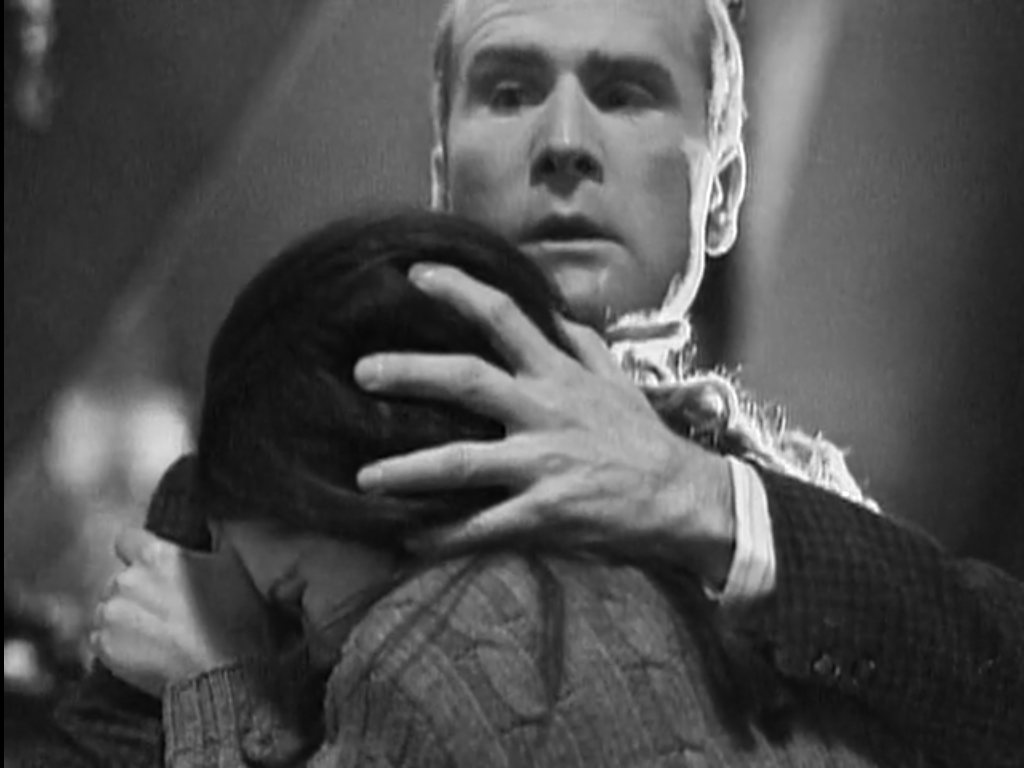
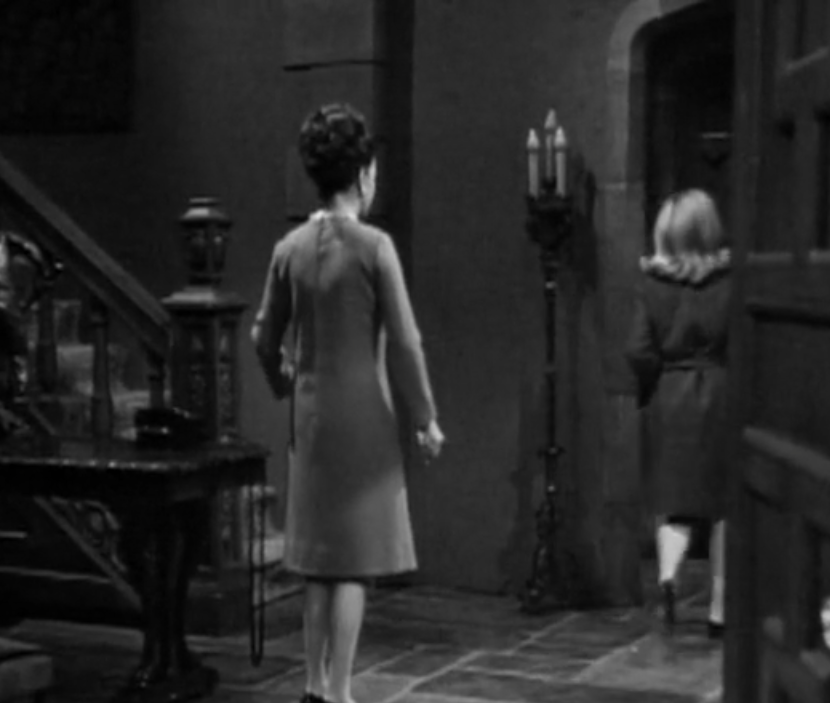
Episode 222: The local crime rate

We open in the front parlor of the long-abandoned Old House on the grounds of the estate of Collinwood. Willie Loomis, the sorely bedraggled blood-thrall of newly resident vampire Barnabas Collins, is lighting candles.

A knock comes at the door. No one knows that Barnabas has brought Willie to the house. Before Barnabas bit him, he was dangerously unstable ruffian Willie Loomis, a menace to all and sundry. Almost everyone in the great house on the estate and many people in the nearby village of Collinsport have been feeling a great sense of relief for the last few days because they believe that Willie has gone and will never return. So he responds to the knocking by trying to hide.

Willie hides from Vicki

Well-meaning governess Vicki comes in and calls for Barnabas. She finds Willie and demands to know what he is doing there. He tells her not to worry about that, but to get out of the house as quickly as she can.*

Willie tried to rape Vicki in #203, and crazed handyman Matthew Morgan held her prisoner in the Old House in episodes #116-126. So regular viewers will be absorbed in Alexandra Moltke Isles’ performance of Vicki’s refusal to be intimidated by this man in this space. At first she visibly steels herself to stand up to Willie. As he keeps his distance and evades her questions, she starts to suspect that he is more afraid of her than she is of him. She begins to relax, and takes stock of the improvements that have been made to the house. By the time she concludes that Willie is probably telling the truth about being Barnabas’ servant, she has an amused, almost triumphant look on her face and an easy sway to her movements. She talks easily and cheerfully about the improvements made since the last time she was in the house, and Willie squirms.
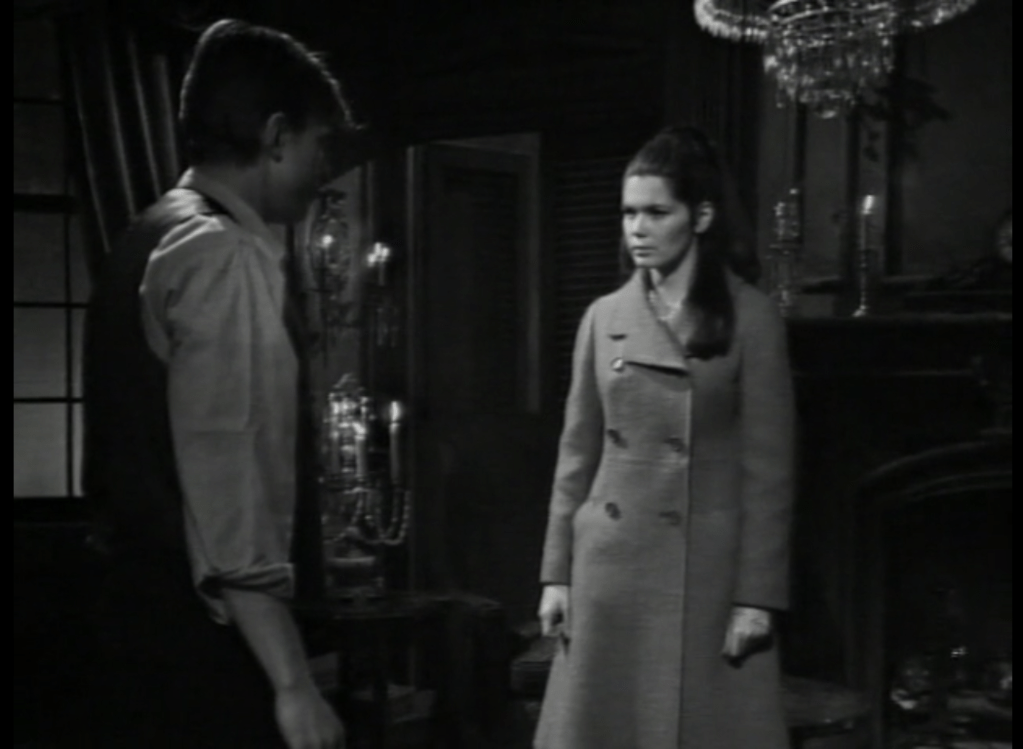
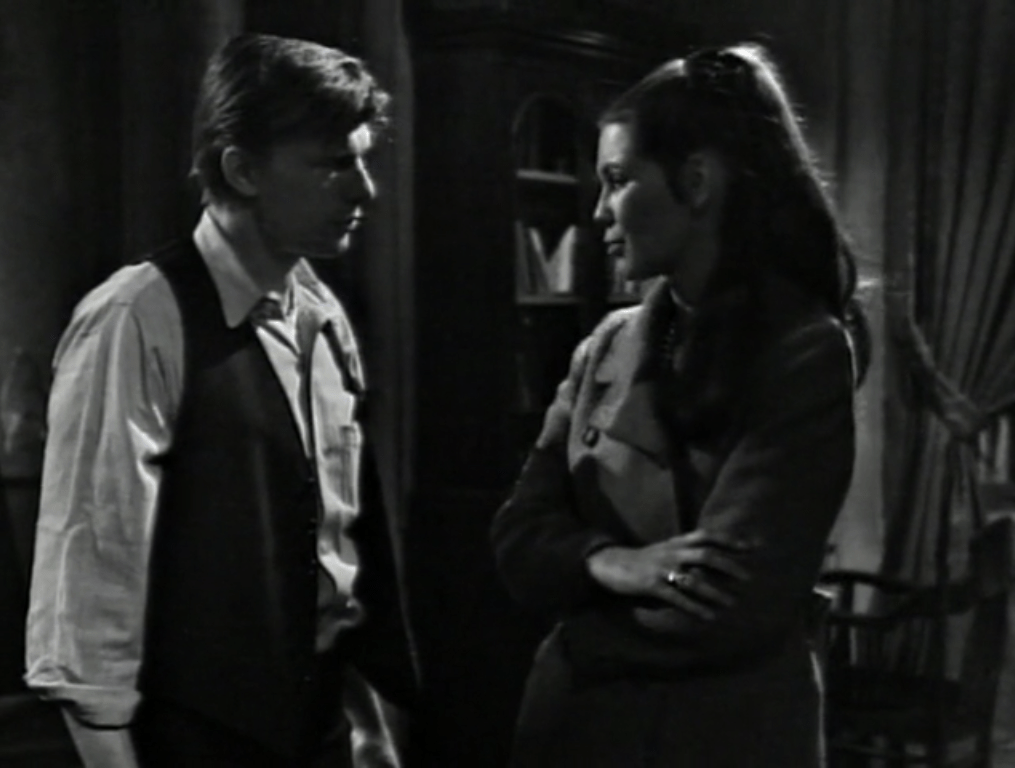
Vicki stands up to Willie
Vicki amused by Willie

As Vicki tries to communicate reclusive matriarch Liz’ invitation for Barnabas to join the Collins family for dinner in the great house, Willie denies that he knows where Barnabas is or when he will come back, and continues to demand that Vicki leave. She finally gives up and goes, but with irritation, not fear. She leaves with a sarcastic “Thank you!”

Vicki leaves, irritated

After Vicki leaves, Barnabas appears and scolds Willie. First, he taunts Willie’s roughness (“My, you are a polite one!”) Then, he orders him not to try to protect anyone from him. He is stern, Willie is terrified, the whole effect is suitably sinister.

We cut to the Evans cottage, home of artist Sam Evans and his daughter Maggie, The Nicest Girl in Town. Maggie rushes into the front door panting, as if she has been running. She shows intense fear when she hears a knock on the door. She calls out, “Who is it?” “Barnabas Collins,” comes the reply. “Mr Collins?” “That’s right.” She slowly opens the door, with the chain in place, and peeks out. She relaxes slightly when she sees that it really is the kindly eccentric she met the other night.

Barnabas asks permission to come in. Maggie opens the door and gestures towards the inside of the house. Barnabas asks again. Only after she explicitly invites him does he cross the threshold. There’s a tradition that vampires can enter only where they are invited, and the show has been following that strictly so far. Barnabas didn’t even go into Maggie’s restaurant until she asked him. Perhaps that was why he went there after it had closed, so that she would have to unlock the door and explicitly invite him to come in.

Maggie explains that she is unsettled because she felt someone followed her home. Considering that Barnabas knocked on her front door less than 30 seconds after she came in, I’d say her feeling has had some pretty solid corroboration, but she doesn’t seem to be making the connection. Maggie goes on to say that she is on edge anyway because some unseen man grabbed local woman Jane Ackerman by the throat the other day and vanished into the night when Jane was able to scream and attract a crowd.

Barnabas explains that he was intrigued when she mentioned that her father was an artist. Maggie brightens and ushers Barnabas towards Sam’s paintings. He looks at several and admires them.

Sam comes home. He is as disquieted as Maggie was when she entered. He tells her that he looked for her at the restaurant and was alarmed to see that she had already closed and was presumably walking home. There has been another attack.

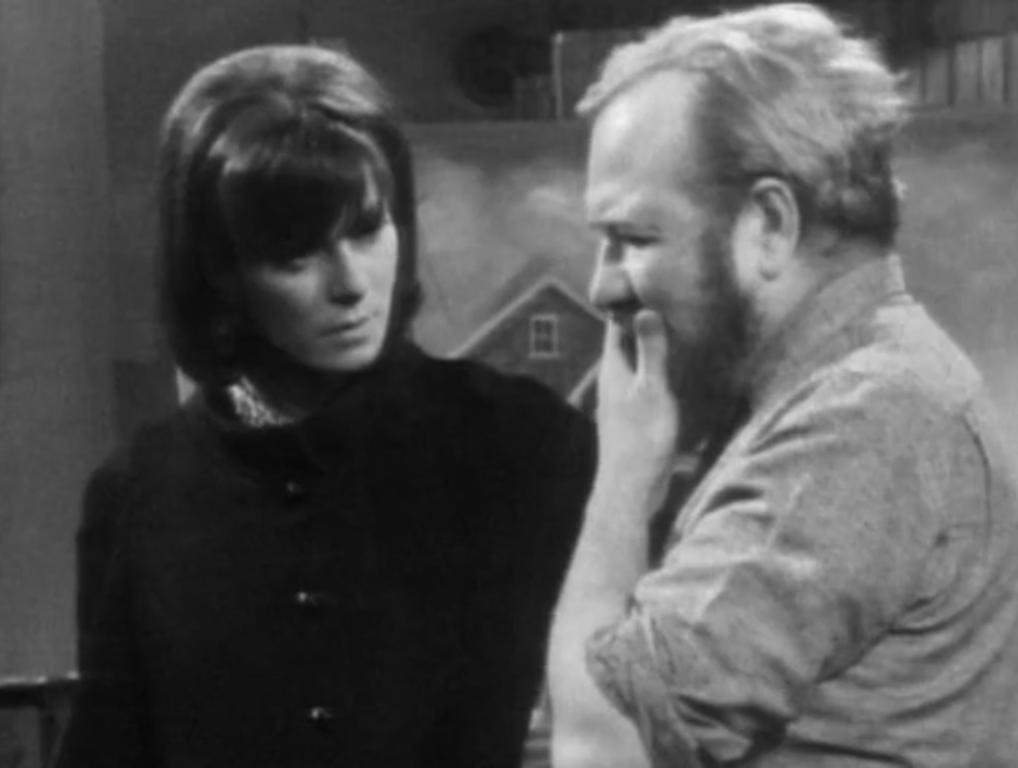
The conversation shows how exotic Barnabas is in Collinsport. He speaks with a mid-Atlantic accent, uses old-fashioned grammatical constructions,** and his manners are a caricature of the Old World courtier. Sam is slangy and vulgar, telling Barnabas that the police “think it’s the same guy” behind both attacks. The contrast between the polished Barnabas and the coarse Sam will be developed further in this episode and later.

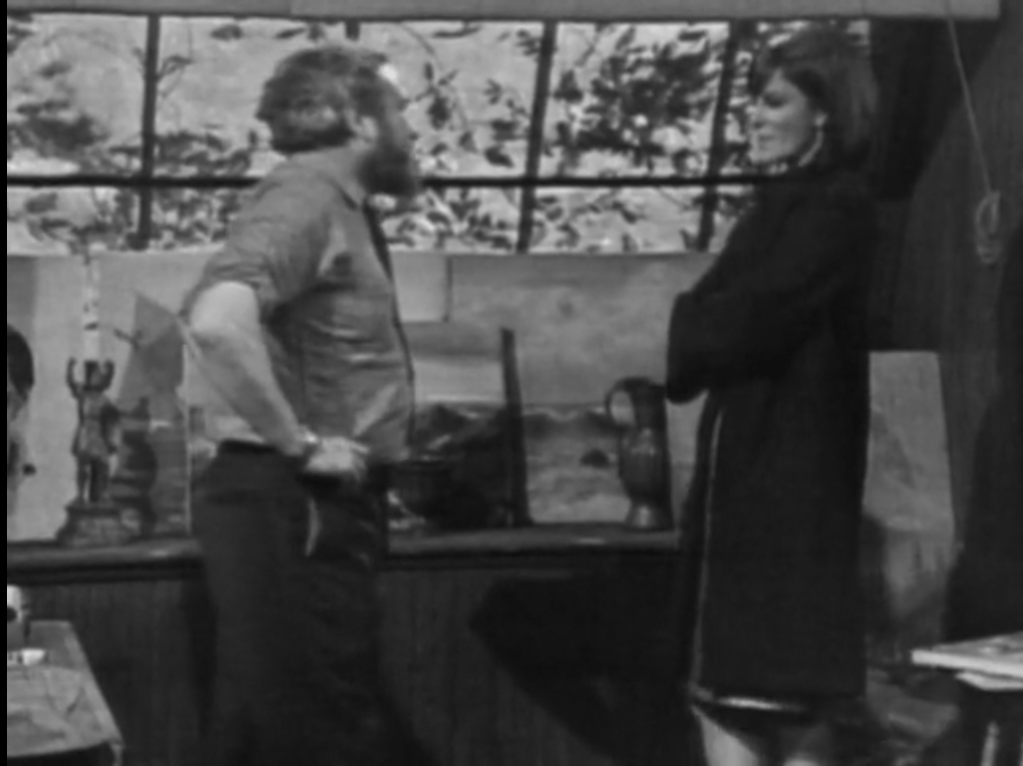
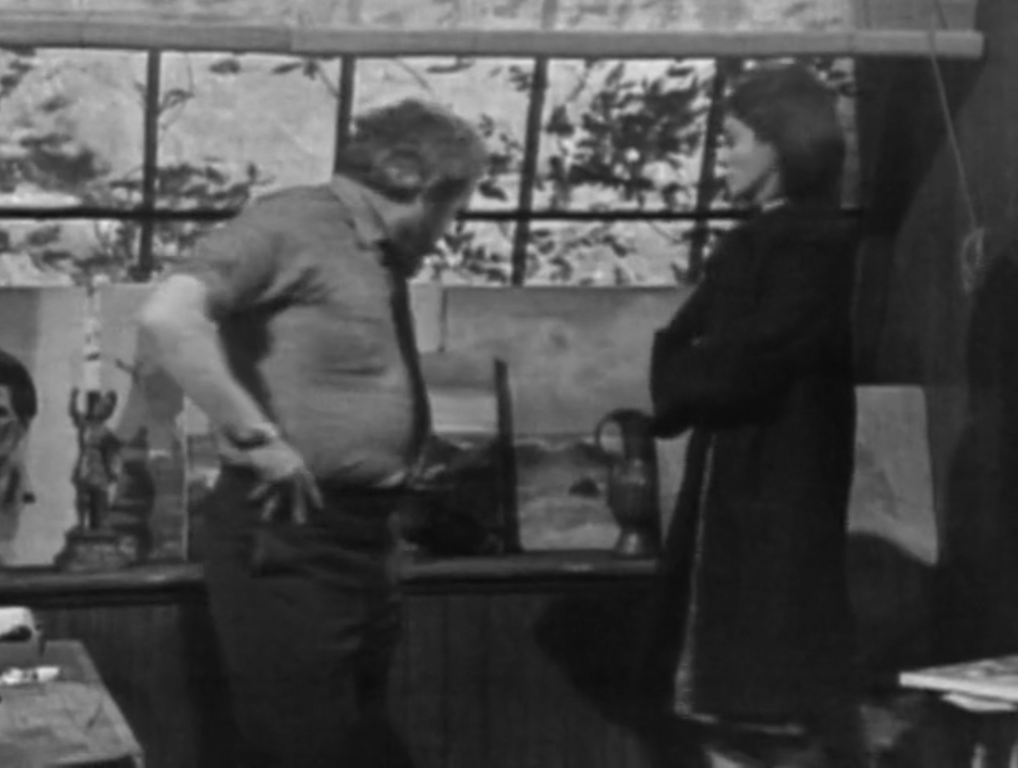
Barnabas asks Sam to paint his portrait. At the word “commission,” Sam stands up straight and becomes very still, while Maggie holds her breath. When Barnabas offers $1000 for the work, Maggie burst into grin, and Sam visibly struggles to keep from jumping with joy.***
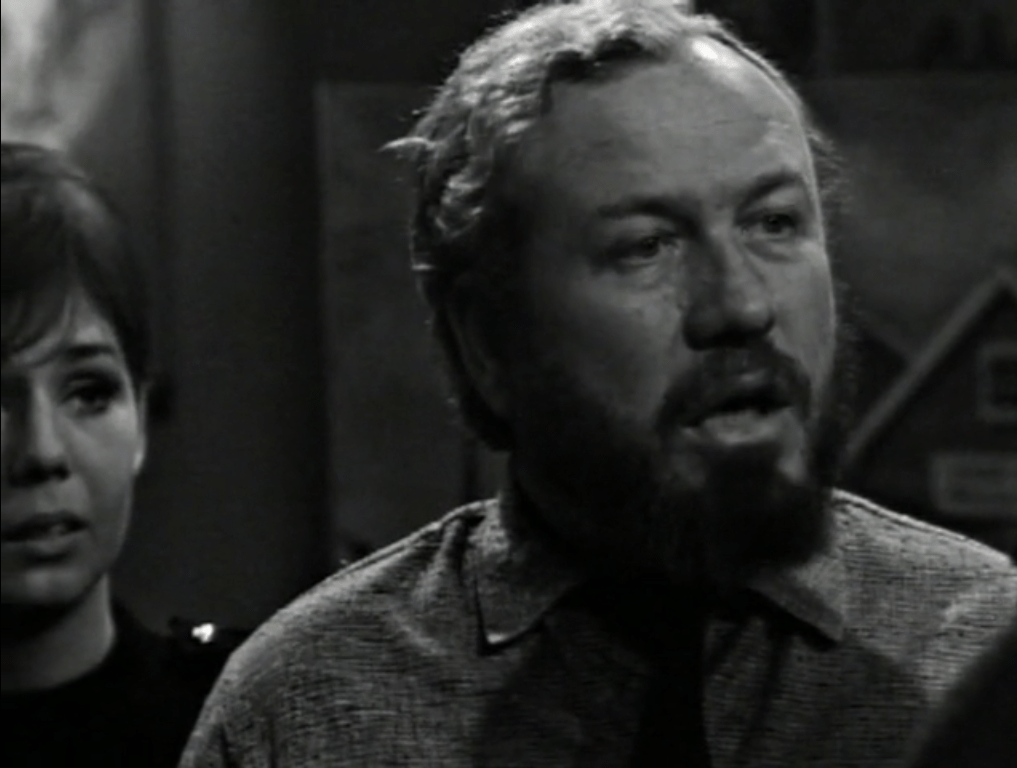
“A commission?”
“A satisfactory fee.”

As Sam, David Ford has a lot of trouble with his lines today. So much that Danny Horn, in his post about this episode on Dark Shadows Every Day, writes that “It’s unbelievable that this man was employed, even on this show.” But Ford plays Sam’s response to Barnabas’ offer perfectly, showing us a man who is excited by a lucrative opportunity, but who also remembers a time when he was in a position to negotiate when such offers came in, and who wishes his daughter could remember it as well. In spite of all Ford’s communings with the teleprompter, that moment reminded me of Marc Masse’s rave review of Ford’s first appearances on Dark Shadows and of his theory that Ford’s style of acting had a salutary influence on his cast-mates.

Barnabas wants to sit for Sam before the night is out. He insists that the painting be done at the Old House, and exclusively at night. Sam has little choice but to agree.

We know that Barnabas is unavailable during the day, but it is not immediately clear why the work should be done at the Old House. Barnabas seems to have plans for Maggie, and hanging around her house every night would seem a more efficient way to advance those than having her father come to his.

Perhaps he wants the portrait to have some kind of special relationship to the house. Portraits have been an important part of the show from the beginning. The main set is the foyer and drawing room of the great house of Collinwood, and the oversized portraits of Collins ancestors are among its most prominent visual features. In the early weeks, dashing action hero Burke Devlin commissioned Sam to paint his portrait, which for reasons too tedious to repeat sent high-born ne’er-do-well Roger Collins into a tizzy.

As the show moved deeper and deeper into uncanny themes, portraits became a bridge between the world of the living and the world of the more or less dead. When blonde fire witch Laura Murdoch Collins was driving the action of the show, a supernatural force compelled Sam to paint portraits of her. And Willie freed Barnabas from his coffin because he became obsessed with the portrait of Barnabas in the foyer of the great house and Barnabas was able to call to him through it. So maybe a portrait painted in the much-haunted Old House will derive some kind of magical or demonic power from its place of origin.

Maggie, still radiant with joy at the promising new turn in her Pop’s career, drops him off at the Old House. He sets up an easel, puts a canvas on it, puts a chair where he wants Barnabas to sit, and starts to work right away. My wife, Mrs Acilius, is among other things a painter; when she saw this, she asked in puzzlement what happened to the sketch-making phase of the project. By the time the sun is about to rise and Barnabas disappears from the room, the figure is almost half completed. Comparing that with the weeks and weeks Sam spent dragging his feet in response to Roger’s demand he not paint Burke, and with his frustratingly repetitious role in the Laura storyline, this Bob Ross-like speed would seem to suggest that the show will be picking up its pace sometime soon. ****

One night’s work

Meanwhile, Maggie is visiting Vicki at the great house. In front of Barnabas’ portrait in the foyer, Vicki says that she likes Barnabas very much- after all the troubles the Collinses have had in the last several months, it’s a relief to have someone around who is friendly. This is almost exactly what flighty heiress Carolyn had said to Vicki when they were standing on the same spot in #214, and it accounts for Liz’ instantaneous delight upon meeting Barnabas in #211. It is his contrast with foes like Burke, Laura, Willie, and seagoing con man Jason McGuire that has smoothed Barnabas’ entry into the present-day Collins family, and he is sliding right into possession of the Old House, which is after all a huge mansion.

The episode ends with an inversion of its beginning. Instead of going into hiding, Willie emerges into view. Sam, who had a nasty run-in with Willie in #207, is as surprised and as unhappy to see him as Vicki had been. As Vicki had done, he accepts Willie’s claim to be Barnabas’ servant after he looks around the parlor and realizes that Barnabas must have had someone helping him put it to rights. As the action began with Vicki coming in through the doors of the Old House, so it ends with Sam going out through them. Vicki entered looking up and calling loudly “Mr Collins!” Sam exits looking down and muttering about the idea of resuming work at sundown. The contrast shows how the events of the episode, even those which seemed pleasant to the people experiencing them, have left everyone confused and helpless before Barnabas.*****

*When Willie delivers this line, actor John Karlen briefly assumes an accent reminiscent of his predecessor in the role, Mississippian James Hall. There’s a little bit of the South in some of his lines later in the episode as well, mostly when he says “Ah’m” instead of “I’m.” Karlen was from Brooklyn, and the day will come when Willie is from there as well. But today is not that day.

**He doesn’t use them correctly- twice he uses the objective case form “whom” when the context calls for the subjective “who.” Still, he uses them, that’s the point.

***For several months, ending 1 May 2023, PlutoTV had a channel that showed Dark Shadows 24/7. They had about 600 episodes, starting from #210 and ending somewhere in the 800s, which they run on a loop interspersed with some related material, such as Dan Curtis’ Dracula. Every week or two, I turned it on during odd moments of the day to see which one they were showing. Often as not, I found this episode. Twice in a row, I tuned in at the moment when Barnabas is telling Sam “You are definitely the man for me!” I turned it on in the middle of the afternoon on 18 April, the very day Mrs Acilius and I were going to watch this episode and I would start writing the post above, and there was Maggie telling Barnabas about the attack on Jane Ackerman. I turned away, since I knew we’d be watching it that evening.

Now, Pluto shows a block of episodes on their “Classic TV Dramas” channel in the afternoons. Late this morning I turned Pluto on to have sound in the background while doing some paperwork, found Rat Patrol on that channel, and at noon it gave way to… Dark Shadows, episode 222!

****Mrs Acilius points out that Sam painted Laura’s portraits just as quickly. That time, he was acting as the tool of the ghost of Josette Collins. Perhaps Barnabas can do what Josette did, and is acting through Sam.

She also remarks that what Sam has painted includes Barnabas’ face without his mouth. Considering that the subject is a vampire, it must be significant that the painter is delaying the depiction of that particular body part.

*****As Willie leads Sam out of the house, a bell tower chimes. A single rooster isn’t too hard to accept as a feature of the estate, but since when has Collinwood had a carillon?

Episode 215: Play the mystery man

In episode 1 of Dark Shadows, dashing action hero Burke Devlin returned to his home town, the isolated fishing village of Collinsport, Maine. He’d left Collinsport in poverty and disgrace, and returned as a millionaire many times over, the master of a financial empire. He had vowed to use his great wealth to exact vengeance on the ancient and esteemed Collins family. In #201, he gave up his quest for revenge, which had never been very interesting to watch anyway, and now is unconnected to any storyline. He’s still in town though, spending his evenings in The Blue Whale, a waterfront tavern where he has appointed himself to act as bouncer.

In #207, dangerously unstable ruffian Willie Loomis was rude to some other patrons at the Blue Whale. Burke defeated Willie in a fight and ordered him to leave town. Today, Burke comes back to the tavern. No one has seen Willie for a week or so, but neither is it clear that he has left Collinsport for good. Burke is looking for Willie, planning to beat him up again if he finds him.

When Burke enters, he sees Maggie Evans, The Nicest Girl in Town, sitting alone at a table. While she waits for her boyfriend, hardworking young fisherman Joe, Maggie talks with Burke about not knowing where Willie is.

Willie’s associate, seagoing con man Jason McGuire, comes into the tavern. Burke goes up to him. They also talk about not knowing where Willie is.

Joe shows up. He’s been helping his uncle search, not for Willie, but for a missing calf. They found remains of the little guy, far from the farm and completely drained of blood by some mysterious process. They are baffled by this development.

Willie drifts in. He sits down at the bar and starts drinking. Burke goes up to confront him, but is confounded by Willie’s broken demeanor. After a few moments, his hostility gives way to compassion, and he speaks gently to Willie.

Burke puzzled by Willie’s meekness. Screenshot by Dark Shadows Before I Die

Jason returns, and Burke tells him he’s worried that Willie seems to be very ill. Jason then confronts Willie, and is astounded when Willie tells him he doesn’t want the $500 in cash Jason is holding for him. Jason also notices that Willie has some bloodstains on his sleeve.

Everything I have to say about the acting in this episode I said in a long comment I left on Danny Horn’s Dark Shadows Every Day in December 2021. Here it is:

I like this one. Sure, the writing has its flaws, and there are a couple of shots where it’s hard to tell what the visual composition was supposed to be. And Mitch Ryan is obviously drunk. But they rise beyond all that.

Kathryn Leigh Scott plays Maggie throughout as an understated version of her original wised-up conception, very apt for the barroom setting and a fine offset to the intensity all the male characters have to show this time. She doesn’t have many lines, but she has everything she needs to keep the show on track.

Dennis Patrick’s face and voice show at least two emotions in every shot, and he and Mitch Ryan do a terrific job as two men who don’t like each other but can’t help getting absorbed in a puzzle that fascinates them both. The music that builds throughout that scene and reaches its crescendo as Jason leaves the bar matches the complex emotional palette with which the actors are working; it doesn’t sound anything like the usual Dark Shadows music, and I don’t think we ever hear it again.

Joel Crothers’ turn as the messenger announcing the tragedy of the calves is as tense as the dialogue between Patrick and Ryan, but his studiousness and deliberation change the pace sufficiently to keep the scenes from blurring together. Ryan and Scott deliver their responses to him with a calm intelligence that emphasizes those qualities and makes Willie’s stumbling entrance a real surprise.

Ryan’s scene with John Karlen is a turning point in the series. Burke’s shift from a menacing demand that Willie leave town to an alarmed concern for his well-being marks the end of Scary Violent Willie and the arrival of Wretched Broken Willie, and his conference with Jason confirms that change. Everything Karlen does on the show from this point on, right up to his performance as Kendrick, begins with this scene.

If that looks familiar, it may be because I linked to it on tumblr.

I should also link to a characteristically insightful post in which Patrick McCray explains how this episode, in which Barnabas Collins is neither seen nor mentioned, contributes substantially to the sense of danger surrounding him. The story Joe tells about his uncle’s calf is the show’s first reference to blood-sucking, and it comes after we’ve started to wonder whether Barnabas really is a vampire, or is some less familiar type of hobgoblin.

Episode 208: From generation to generation

Friday’s episode ended with an important scene. Strange and troubled boy David Collins cheerfully escorted dangerously unstable ruffian Willie Loomis around the great house of Collinwood, giving him little lectures about the portraits of the Collins ancestors. David pointed to a portrait in the foyer and spoke a name we hadn’t heard before, identifying it as Barnabas Collins. Willie, then played by frenzied Mississippian James Hall, became fascinated with the jewels Barnabas wore, so much so that for the first time on Dark Shadows his thoughts became audible as a recording playing on the soundtrack. After Willie left the house, we heard a heartbeat coming from the painting and saw Barnabas’ eyes glow.

When Willie’s associate, seagoing con man Jason McGuire, first entered Collinwood in #196, an optical trick made it look like a portrait was hanging on the spot where Barnabas’ portrait is now. While the face on the painting would have to wait until the actor was cast, the rest of the work on it was already done at that point, so that trick, inconspicuous as it would have been to the audience, was a sign that the production staff had decided that Jason’s role on the show would be to precipitate the introduction of Barnabas. And the opening voiceover of #2o2, the episode in which Willie joins Jason as a houseguest at Collinwood, referred to Willie as “one who is to awaken and unleash a force that will affect the lives of everyone.” The special effects surrounding Willie’s first encounter with the portrait would suggest that Barnabas represents that force, and that the portrait is a means by which that force is expressed.

Today’s episode begins with Willie taking another look at the portrait, and will end with him staring at it again. In between these two sessions, we learn that among the many impulses Willie is unable to control is a fascination with shiny objects.

We also see the ninth and tenth iterations of Dark Shadows’ dreariest ritual, in which seagoing con man Jason McGuire makes a demand of reclusive matriarch Liz, Liz resists, Jason threatens to expose her terrible secret, and Liz gives in. The first time comes after the opening credits. In the pre-credits teaser, they raised our hopes that we might see a conversation between them which does not conform to this pattern. Liz tells Jason that Willie can no longer be a guest in the house, and Jason agrees. But as soon as we return, he demands that she give Willie a parting gift in the form of $1000 cash. She refuses, and says she will call the police rather than bribe Willie to leave her home. After Jason threatens to send her to prison and lowers his demand to $500, she capitulates.

When Jason breaks the news to Willie that he is to leave immediately and take $500 with him, Willie notices a diamond-encrusted emerald pin and slips it in his pocket. Minutes later, Liz finds the pin missing and tells Jason she will have to call the insurance company. Jason confronts Willie in the kitchen and demands he hand the pin over. After a tense moment, Willie admits that he took the pin, not because he thought he could get away with stealing it, but because it was so pretty. He goes on about how supremely beautiful fine jewels are, saying that he can judge the beauty of a gem simply by touching it. He begs Jason to let him touch the emerald again. After Jason leaves him alone in the kitchen, Willie looks like he has had a new idea and is resolved to act on it.

Willie’s compulsion to touch the emerald creeps Jason out

Willie starts the scene with angry defiance, proceeds to humiliated dependence, and ends with a look of brisk resolve. John Karlen takes Willie through all of these emotions without any apparent discontinuity of feeling. He is still the defiant man even while he is begging, and still the begging man even while he is making up his mind to follow his new plan. That is as different as can be from Hall’s interpretation of Willie, who frightened us largely because of his extremely mercurial temperament. His moods shifted so wildly from second to second that you had no idea what he might do. It is remarkable that two performances can be so utterly unlike each other in every way, yet be equally effective at conveying menace and equally exciting to the audience wondering what comes next.

Jason tries to convince Liz that Willie didn’t take the pin, but that it simply fell to the floor. This effort collapses immediately. Liz is no longer disposed to give Willie any money; she is planning to call the police and let the chips fall where they may. Jason does not believe Willie will go quietly unless he gets a substantial sum of cash, and is afraid of the trouble Willie can make. So he again threatens Liz, this time focusing on the effect of a potential scandal on her daughter Carolyn and on David. Liz looks away in despair, unable to refuse Jason’s demand.

Willie depresses some characters and enrages others. The only exception is David, who brightens and chatters gladly when he sees Willie. David leads Willie into the study, where he shows him pictures of the Collins family’s eighteenth century ancestors and goes on about their fabulous jewels. He identifies one ancestor as his “great-great-grand-uncle.” “Grand-uncle” is a bit of Collinsport English that we will hear again later in the series. David suggests that some very valuable items might be found buried in out of the way places around town. David’s tales send Willie back into the foyer to stare longingly at the jewels in Barnabas’ portrait.

As we heard Willie’s interior monologue on the soundtrack while he stared at the portrait Friday, so today we hear a recording of Willie’s speech to Jason about his love of jewels while he studies the jewelry in the portrait. As his words come to an end, the heartbeat plays again and the eyes glow again. This time, Willie sees and hears and reacts. He has found his destiny.

Episode 193: Portia Fitzsimmons

Drunken artist Sam Evans receives an unexpected visitor to his cottage. She is famed art dealer Portia Fitzsimmons, and she is magnificent.

Mrs Fitzsimmons, as she insists on being addressed, was in a junk shop earlier this week, where she found two of Sam’s paintings available to buyers of the frames they were in. The paintings were done ten or twelve years ago, and she declares that they are in a style that will soon become fashionable. If Sam can come up with a dozen more canvases from that period, he will have a one-man show at her gallery, and he will become famous. With that fame, he may even be able to sell some of his newer paintings, countless of which have been collecting dust around the cottage for years on end.

This was the very first scene of Dark Shadows I ever saw. I’d heard of the show when I was a boy in the late 70s and my mother was watching whatever daytime soap she was into. I heard her say something like, “Ooh, they’re going to turn into Dark Shadows.” I asked her what Dark Shadows was, and she explained that it was a soap opera that had been on about ten years before which introduced a vampire as one of the regular characters. At that age, I thought of soaps as the dullest thing in the world. I wasn’t particularly into vampires, but they were obviously too interesting for the televised sleeping pills that beamed into our living room for an hour every afternoon, so I followed up with some more questions. She had never watched the show, so all she could tell me was that it started as a more or less conventional daytime serial, added a vampire, and became a hit.

When the 90s came along and I got cable TV in my apartment, that was still all I knew about it. So when I saw that the Sci-Fi Channel* was showing Dark Shadows, I decided to take a look. There is no suggestion of vampires in this one, but Portia Fitzsimmons is such a dynamic character that I could see that the show was capable of being pretty lively without them.

Actress Lovelady Powell has two physical abilities that enable her to give us something fresh to look at every second the camera is on her. First is her remarkably mobile face. Her left eyelid alone is capable of a wider variety of expressions than most performers can produce with their entire physiognomy. Since it is her left eye that is focused on Sam throughout the scene, that eyelid is going to be the crucial body part in her delineation of their relationship, but she uses it with remarkable facility. Focus on her left eyelid in these three images, and see how it does most of the work in taking her in a few seconds from delighted to dismayed to dismissive:

Delighted
Dismayed
Dismissive

Those three images show a major shift in mood. The same eyelid can also modulate finer shades of feeling. In this sequence a few moments later, the left eye is partially obscured, but still shows precisely what is going on when Mrs Fitzsimmons gives Sam his marching orders:

Laying down the law
Letting it sink in
Adding emphasis
Observing Sam’s reaction
Confirming Sam in his reaction
Making up her mind about Sam

Powell not only made excellent use of the fine muscles of her face, but of her limbs as well. So her second strength is her style of movement. She walks around the set continually, making many wide, sweeping gestures. If those seemed to be a number of distinct motions, she would be a hectic, distracting presence. But in fact, it all comes together as an uninterrupted flow, and defines the entire performance space in terms of her action and her presence. This is difficult to illustrate with still images, but if you look at how she uses her elbows in this sequence I think you’ll get the idea:

Maximum distance
Approaching
Arrival
Starting to unbend

I think an actor could watch this scene a dozen times and learn new things from every viewing.

All these techniques for establishing visual dominance pay off in the scene. Sam is an artist who has so utterly despaired of finding an audience for his art that it simply does not register with him that a famous art dealer has come calling. Returning viewers will remember that Sam has been moping around feeling sorry for himself since his first appearance in episode 5. Two weeks ago, in #184, he told his daughter Maggie that it was too late for him ever to have a one-man show and that all he could ever hope for was to sell a few paintings to tourists every summer. Within minutes, Mrs Fitzsimmons has changed all of that. She watches Sam’s reactions as she turns his life upside down, and visibly calculates the particular sort of flourish with which she will deliver each of her lines. When he tells her that he thinks he will be able to assemble enough paintings within a week, she stands in the doorway and replies that she is sure he will be able to do it then, “if you can do it at all.” She then pirouettes away and wafts off whence she came.

When I first saw the scene, I wondered how big a part Mrs Fitzsimmons would play in the storylines to come. I still remember seeing the name “Lovelady Powell” in the closing credits. With my work schedule at the time, I didn’t have a chance to see another episode for months, and when I did join it again there was no sign of Portia Fitzsimmons. I assumed she’d been written out, perhaps to return in some later narrative arc, perhaps because Lovelady Powell had gone on to bigger things. It came as quite a surprise to learn that this was her only appearance on Dark Shadows, and that her acting career never really took off.

Now that I’m on my second complete viewing of the series, it’s an even bigger surprise. The portraits of the ancestors of the ancient and esteemed Collins family are among the most prominent visual features of the chief sets, those representing the great house of Collinwood. Portraits there and elsewhere, including in the long-abandoned Old House at Collinwood and in the Evans cottage, have repeatedly been shown to have supernatural power, representing a bridge between the world of the living and that of the dead.

Further, every storyline that has been resolved so far has centered on strange and troubled boy David Collins. The show has gone out of its way to show that David has promise as an artist. David Collins is nine, and actor David Henesy turned ten in October of 1966, but the character is unusual enough and the actor is sophisticated enough that it would be interesting to see David interact with the grand dame of the New York art world.

An art connoisseur is therefore as well-positioned as anyone to act as a guide to the uncanny realms into which the show will be venturing from now on. Combining Portia Fitzsimmons’ claim to expertise with her imperious personality and Lovelady Powell’s sophisticated acting style, you’d have a character who could carry us right through the whole series. The producers will be hard-pressed to find another actress who can play as worldly and forceful a Vergil to the various Dantes who will be exploring Collinwood’s weird infernos.

Sam’s reaction to Portia Fitzsimmons’ command that he bring her a dozen canvases that he painted ten or twelve years ago puzzled me on my first viewing, and puzzles me in a different way now. The only group of works that fill that bill are in the possession of high-born ne’er-do-well Roger Collins. Sam sold them to Roger ten years ago for $15,000. Roger likes money, a point made clear in his scene with Sam today. If Sam simply telephoned Roger and told him that the famous Portia Fitzsimmons wants to show the paintings in her gallery and sell them at a great profit to Roger, no doubt he would be eager to find them and make the deal.

Sam does not do anything so straightforward. Instead, he visits Roger at Collinwood. Roger responds to his presence by railing at him, declaring that he never wants to see him in the house and wants him to leave immediately. Sam then insists that Roger give him the paintings. When Roger asks why, Sam denies that any part of the $15,000 was a payment for the paintings. He starts to explain that it was hush money Roger gave Sam to ensure he kept a secret Roger wants withheld from dashing action hero Burke Devlin.** Roger looks around in terror when Sam starts talking about the secret, then orders him never to speak of the matter again. Sam says he will tell Burke all about it unless Roger produces the paintings. Roger dismisses Sam’s threat, but does offer to sell him the paintings for $50,000, unless it turns out that he destroyed them or lost them somewhere along the way.

Now that I’ve seen episodes 1-192 a couple of times, I know that Sam hates Roger, hates himself for taking Roger’s money and betraying Burke, and wants to start a new life in which Roger will have no part. But his undisguised attempt to blackmail Roger into handing over the paintings isn’t really in character for Sam. His tortured conscience has hobbled Sam time and again in his attempts to stand up to Roger. Besides, Sam just had a harrowing encounter with the supernatural in the form of Roger’s estranged wife, blonde fire witch Laura Collins, and that experience seemed like it would make him a kinder and more thoughtful man. That his first act after emerging from it is to commit an out-and-out felony is a disappointment to me.

My wife, Mrs Acilius, wasn’t disappointed. She likes the scenes when Sam is sober enough to stand up to Roger, and she sees this as one of the strongest of those. While she acknowledges that Sam is not being rational, she cheers for his desire to press to the hilt his advantage over the rich so-and-so who has been a blight on his existence for so long.

In the local tavern, The Blue Whale, Maggie Evans is having a drink with her boyfriend, hardworking young fisherman Joe. The camera focuses on a man in a seaman’s coat and captain’s hat sitting at the bar, eavesdropping on their conversation. When they mention Collinwood and reclusive matriarch Liz, the sailor perks up and approaches them.

He apologizes for listening to their conversation, but goes on to ask a series of questions about its content. When Joe makes it clear he does not welcome the intrusion, he apologizes again, while in the act of sitting down with them. When they are finally getting rid of him, he says that it is terribly sad that Liz never leaves her home, and while speaking of that terrible sadness flashes a huge grin. He gives his name as Jason McGuire.

So we are introduced to a second new character in this episode. This one is apparently going to get some kind of storyline started. The actor is talented and the scene has some good things in it, but Jason McGuire is no Portia Fitzsimmons.

*As it then was known.

**A sketch of Burke is on display in Sam’s cottage today. The Dark Shadows wiki speaks with the voice of fans everywhere when it says that Sam tore up a sketch of Burke in #41 and therefore should not have this item now. But Sam made that sketch as part of his preparation for painting a full portrait of Burke. Artists make more than one sketch when they are getting ready for a major painting, so the fact that Sam tore up one sketch doesn’t mean that he doesn’t have any number of others lying around.

Episode 87: She came to us from nowhere, and now it seems she has disappeared into nowhere

Hardworking young fisherman Joe is spending the evening with Maggie, The Nicest Girl in Town. It’s their first date. Maggie impresses him with her knowledge of ships, and he sings a verse of “What Do You Do With a Drunken Sailor?” It may not sound like much, but the actors, Kathryn Leigh Scott and Joel Crothers, sell it so well that we’ll be rooting for Joe and Maggie for years to come. The final moment of the scene comes after Joe leaves. Maggie looks directly into the camera and says to the audience, “Goodnight, pal.”

Goodnight, pal

In the great house of Collinwood, high-born ne’er-do-well Roger Collins greets his niece, flighty heiress Carolyn, on her return home. Carolyn is upset because Joe has broken off their relationship and is having a date with Maggie. The story of Joe and Carolyn was a bore, largely because the two of them never had a scene with any fraction of the sweetness we see between Joe and Maggie today. There was nothing at stake in their quarrels, because they had nothing to lose if they simply gave up on each other.

Roger tells Carolyn that well-meaning governess Vicki hasn’t been seen for hours, and that he promised Carolyn’s mother, reclusive matriarch Liz, that he would sit up waiting for Vicki’s return. Carolyn is worried as well, and asks Roger why he isn’t actively searching for her. He says she’s probably fine. When Carolyn says that people don’t just disappear, he reminds her of family friend Bill Malloy, who disappeared not so long ago, but then turned up. Considering that Bill turned up in the form of a corpse washed ashore by the tide, it is perhaps unsurprising that Carolyn does not find Roger’s analogy particularly comforting.

After Roger persuades Carolyn to toddle off to bed, he makes sure he’s alone (well, alone except for the stagehand in the lower left-hand corner of the screen.)

Once assured that no one mentioned in the script can see him, Roger returns to the drawing room and opens a secret passage we’ve never seen before. After he disappears into it, Carolyn comes to the drawing room and is baffled at his absence.

The suggestion that Carolyn doesn’t know about the secret passage is characteristic of the show. From the beginning, Vicki has represented our point of view. She started off knowing nothing about the other characters, and everything had to be explained to her while she was on camera. If Vicki knows just what we know, Carolyn, who grew up in the house where most of the action is set, can be presumed to know a great deal we do not. When they reveal a secret to us, they can amplify its importance by showing that Carolyn isn’t in on it. They’ve done this several times, mostly in situations having to do with the murky origins of Roger’s feud with dashing action hero Burke Devlin. Carolyn’s ignorance of the secret passage is particularly effective- it’s right there in the most important room of the only house she’s ever lived in. If she doesn’t know about it, it must be a very well-kept secret indeed.

We go with Roger into the secret passage. He shines his flashlight directly into the camera, creating a halo of light around it. This would not seem to be a desirable visual effect, yet we will see it many, many times in the years to come. This is the second appearance of the effect. The first time came when Roger’s son, strange and troubled boy David, was leading Vicki into the abandoned Old House in episode 70. Now we see it when Roger himself is entering another abandoned space, one where he might meet Vicki.

Halo

It’s hard to believe that the repeated use of this effect was altogether unintentional.

All the more so because of what follows Roger’s entry into the passageway. His journey through it actually does seem to wind through a very large space. In the opening narration, Vicki had said that the house is made up of 80 rooms, retconning the total of 40 given in the second episode. Roger’s trek up one flight of stairs, down another, up a spiral staircase, around corners, past windows, etc etc, seems like it must take him past enough space for at least that many. Perhaps the sequence would be a bit more attractive with less time spent focused on Roger’s feet, but all in all it is as effective a creation of space as Dark Shadows would ever do. If there had been Daytime Emmy Awards in 1966, Lela Swift would have had every right to expect to win Best Director for conjuring up this illusion of vast, winding corridors without editing or going outside the tiny studio space available to her.

Roger does indeed discover Vicki’s whereabouts. He hears her calling for David from behind a locked door, promising David not to tell anyone he imprisoned her there if he will let her out now. Roger does not simply let Vicki out. Instead, he makes some loud noises, then puts on a ghostly, wavering voice and calls out to Vicki that she is in great danger as long as she stays in Collinwood. He seems to be having trouble keeping a straight face when he makes these spooky sounds. Vicki isn’t laughing, and returning viewers aren’t either- in Friday’s episode, she and we saw the ghost of Bill Malloy in the room, and heard that ghost warn her that she would be killed if she stayed in the house much longer.

Once he’s had his fun, Roger opens the door. After another flashlight halo, Vicki recognizes him. Alexandra Moltke Isles gives us one of the finest moments of acting in the entire series, when Vicki throws her arms around Roger, her bodily movement as smooth as any ballet dancer’s but her voice jagged, and says that “David is a monster, you were right!” Up to this point, Roger has been brutally hostile to his son, Vicki heroically friendly to him. Her determination to befriend David has become so central to her character that hearing her make this declaration makes it seem that she is permanently broken.

Broken Vicki

Vicki struggles to hold back her sobbing long enough to tell Roger that she saw the ghost of Bill Malloy. That’s an episode-ending sting- Roger wants everyone to forget about Bill’s death, and if his ghost starts popping up he is unlikely to get that wish.

Stunned Roger

Mrs Isles was a “head actor,” one who found the character’s innermost psychological motivation and worked outward from that. That heavily interiorized style would be one of the things that left her in the dust, along with similar performers like Joel Crothers and Don Briscoe, in the period when Dark Shadows was a hyper-fast paced, wildly zany show about vampires and werewolves and time-travel and God knows what. But in the period when Art Wallace and Francis Swann were writing finely etched character studies, she consistently excelled. In this little turn, she shows that when it was logical for her character to go big, she could go as big as any of the stars of the show in those later days.

Episode 72: Whose eye is she after

Well-meaning governess Vicki sits placidly in her bedroom at the great house of Collinwood, sewing and looking out the window. Flighty heiress Carolyn comes in and loudly berates Vicki for spending the day away from her charge, problem child David. Carolyn saw Vicki coming home as a passenger in a car driven by the family’s arch-nemesis, dashing action hero Burke Devlin, and jumped to the conclusion that Vicki was both on a date with Burke and on Burke’s side in his conflict with her family. Vicki is at first bewildered by Carolyn’s rage, and then confronts her with her own record of infatuation with Burke.

This scene shows how well cast Nancy Barrett and Alexandra Moltke Isles were as Carolyn and Vicki respectively. Miss Barrett throws herself completely into whatever her character is supposed to be doing at any given moment, a perfect style for the role of someone who is stormy and unpredictable. Mrs Isles takes a very deliberate approach to her part, working her way from the center of Vicki’s thoughts out to whatever lines she has to deliver. That suits the role of someone who is often baffled by the strange goings-on around her and who gradually gathers the strength to stand up for herself.

Carolyn is on her way to the front door when her mother, reclusive matriarch Liz, asks her where she’s going. Still upset after her confrontation with Vicki, Carolyn snaps at Liz and gives sarcastic answers. Eventually she tells her that Vicki didn’t give David his lessons for the day, that she spent the day with Burke, and that she brought Burke home with her. Alarmed by this report, Liz heads upstairs towards Vicki’s room. Carolyn remembers her latest project, persuading her mother to take Mrs Sarah Johnson onto the domestic staff as a housekeeper. Liz cuts her off, saying that she has no time to think of hiring a housekeeper- all she can think about is firing a governess.

After Liz leaves the foyer to fire Vicki because Carolyn has led her to suspect she might be a spy for Burke, Carolyn picks up the telephone. She tries to call Burke. Evidently the infatuation Vicki had brought up to her is still driving Carolyn to inexplicable actions.

Mrs Johnson is in the restaurant at the Collinsport Inn. In fact, we first see her on the pay-phone there, talking to Burke about her plan to join the staff at Collinwood so she can work as a spy for him. Patrick McCray makes a nice remark about this on his Dark Shadows Daybook:

[P]lanting a spy for Burke Devlin is just the touch of espionage intrigue that Collinwood needs. Finally, someone can actually be the spy that Vicki is suddenly accused of working as. (In the same episode no less, with the irony and subtlety of an anvil landing in your lap.) That kind of duality — especially among the backstairs staff — is a concession to the dramatic thinking that DARK SHADOWS kinda lost over the years. The show gained plot, but it lost those opportunities for characters to reflect one another. As it reached a supernatural frenzy, this earlier, authorial delicacy was a necessary casualty. However, it’s vital to know that a sculpted duality like Mrs. Johnson and Vicki is an instinct buried in the program’s DNA.

I think he paints with a bit of a broad brush when he says that “this earlier authorial delicacy was a necessary casualty.” The frenzied pace of the later years didn’t stop Joe Caldwell or Violet Welles from crafting dramatic miniatures Art Wallace and Francis Swann would have been proud of. While Sam Hall and Gordon Russell were no miniaturists and did often value slam-bang story development over every other consideration, they did take time to show characters in each other’s reflections. Indeed, the whole “1970 Parallel Time” arc is months and months of nothing but “opportunities for characters to reflect one another,” and the actors could often make those reflections interesting (at least the first two or three times you saw them.) Of course, there are also large numbers of episodes written by Ron Sproat and Malcolm Marmorstein, but you can’t blame their shortcomings on excessively rapid pacing.

Mrs Johnson is a difficult customer for Maggie Evans, who runs the restaurant. She sends a sandwich back because she disapproves of the mayonnaise, and the look on Maggie’s face shows us that the cost of that sandwich is coming out of her paycheck. Mrs Johnson insists her meal be served in courses, demands that Maggie sit at her table, and gives her a tip of 10 cents (I checked- 10 cents in October 1966 would have the same purchasing power as 90 cents in October 2022. You could take that to your local hardware store, buy several nails, and still have enough left to operate a gumball machine.) She declares that the death of her late employer, beloved local man Bill Malloy, was no accident, and that according to the Bible someone will have to pay for it. When Carolyn comes into the restaurant, Maggie leaps at the opportunity to leave Mrs Johnson and wait on her.

Clarice Blackburn must have had tremendous fun playing Mrs Johnson in these sequences. The character is exaggerated almost to the level of what would become Dark Shadows’ Go back to your grave!” house style of acting, so that there is no need to worry about overacting. Besides, so many performers wait tables that one of the standard responses young people in Los Angeles get when they tell people they are actors is “Great! What restaurant?” So it must always be gratifying to play a character who will show the world what a bad restaurant customer looks like.

As Maggie, Kathryn Leigh Scott also has a juicy role today. We usually see her in one of two settings. Either she is in the restaurant, where she is required to be nice to everyone, or she is at home with her father, drunken artist Sam. As the adult child of an alcoholic, she has a thousand habits designed to keep the mood light. When she is dealing with Mrs Johnson, Miss Scott shows us what Maggie looks like when her Nicest Girl In Town persona is stretched to the max.

When she greets Carolyn, Maggie goes right into the chirpiest version of that persona. It’s a version that brings home the continuity between Maggie’s relationship to her father and her relationship to her customers. She speaks the first few syllables of each of her lines through a laugh. Many Dark Shadows fans complain about that as a habit of Kathryn Leigh Scott’s, but it’s a habit of Maggie’s. And if you start watching the series from episode 1, seeing all the scenes in the Evans cottage between Maggie and Sam, you’ll recognize it as something many adult children of alcoholics do. At the risk of giving away a spoiler, I’ll say that Sam will eventually cut back on his drinking, and some time after that will be written out of the show altogether. But Maggie’s character is formed in these weeks, when Sam is drunk all the time. Some of Miss Scott’s other characters on the show have similar habits, but those are the characters who are presented as Maggie Evans by other means, so they would have to be recognizable as her.

Carolyn tries to explain to Maggie, sotto voce, why Mrs Johnson is so upset, and Maggie drops her Nicest Girl In Town voice completely for a second- “I know who she is,” she rasps. Carolyn has been friendly to Maggie, and is equally friendly when she goes to sit with Mrs Johnson and tries to talk her into taking the job as housekeeper at Collinwood, assuming that her mother will offer it to her. After Mrs Johnson leaves, Maggie tells Carolyn that she has never been able to stand her- “She’s always given me the willies. I don’t know why,” she says, looking thoughtfully off into the middle distance.

Carolyn’s friendliness to the working class Maggie and Mrs Johnson is a welcome relief from her terribly snobbish sneer at Vicki as “Little Orphan Annie” who should “go back to your precious foundling home.” And it’s an opportunity for Nancy Barrett to take her performance from one emotional extreme to another within a single episode.

Back in the mansion, Liz confronts Vicki about not giving David his lessons. Vicki replies that Liz’ brother, high-born ne’er-do-well Roger, had said that he would tell Liz that he had taken Vicki on a tour of the cannery and had given David the day off. When Vicki hears Liz on the telephone confirming this with Roger, she blows up at Liz. She objects to being checked up on, she objects to being accused of lying, and, turning to look at the last spot where she had seen Carolyn, she objects to being accused of stealing people’s boyfriends. After she is done with her objections, she walks over to Liz. With their backs to the camera, the women quietly apologize to each other. Vicki explains that her protests mark the only way she can go on living in the house. Liz for the first time calls Vicki by her first name. Hearing this conversation when they are looking away from us is remarkably effective at creating a sense that they are sharing an intimate moment- more is happening between the two of them than even the audience can know.

Mrs Isles and Joan Bennett, as Liz, both play a wide array of emotions in their two scenes together, and do so brilliantly. It’s particularly interesting to compare Liz’ startled reaction to Carolyn’s snapping at her in the foyer when she asks her where she’s going to with her startled reaction to Vicki raising her voice at her in the drawing room when she’s been on the phone with Roger. They are two quite distinct startles. We see Liz from behind when Carolyn startles her. From that angle, we see the muscles in the back of her neck tense, signifying anger. That startle gives way to a parental sternness. The startle Vicki provokes is shown in profile. Liz pulls back a little, suggesting guilt. It leads to a rapid retreat.

Startled by Carolyn
Startled by Vicki

Episode 68: Only friend in the world

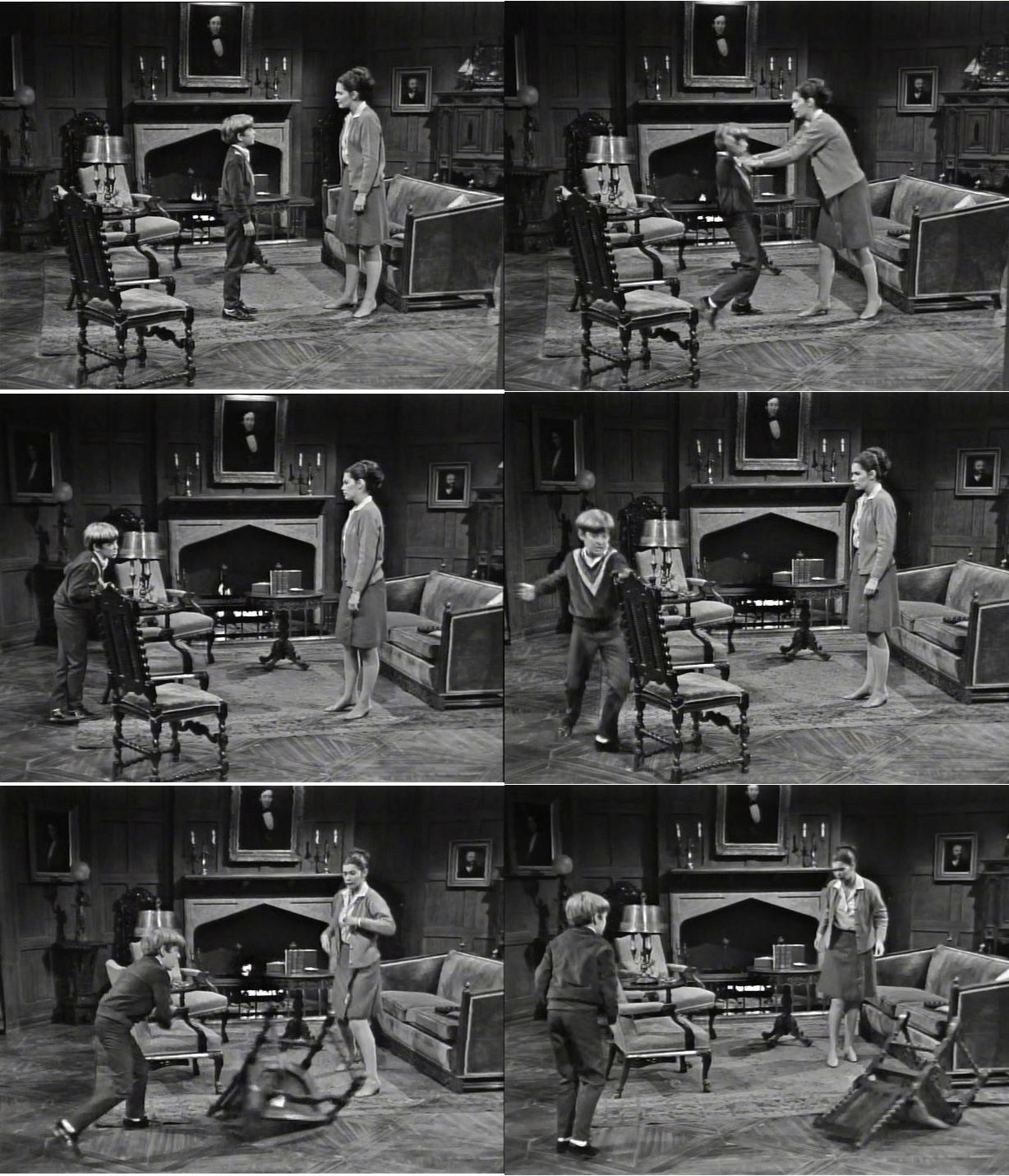
Well-meaning governess Vicki is determined to befriend her charge, problem child David Collins. In today’s episode, David throws a violent tantrum. Vicki looks genuinely frightened:

David throws a chair in Vicki's direction
Screen capture by Dark Shadows from the Beginning

Meanwhile, David’s father, problem adult Roger Collins, has decided to charm Vicki so as to reduce the likelihood that she will testify against him. Roger walks in on David’s tantrum. After scolding the boy and letting him go, he talks sweetly to Vicki. She tells him that she will do anything she can to understand David. He invites her to a lobster dinner. We see David, who has been eavesdropping on his hated father making friends with his hated governess, looking troubled.

David confronts his father about what he heard. Roger responds with the same charm he showed Vicki, acknowledging that he has been difficult to live with, taking the blame for all of it, and promising to be a new man in the future. He agrees with all of David’s baseless accusations against Vicki, and says that the reason he was being nice to her a few minutes before was to disarm her against David. David says that he wants to frame Vicki for some terrible misdeed that will prompt reclusive matriarch Liz to fire her; Roger replies that he doesn’t want to know what David does about that matter. He asks the boy to consider which he wants more- to be rid of him, or rid of Vicki.

These are outstanding scenes. As Vicki and David, Alexandra Moltke Isles and David Henesy both developed acting styles that built strongly on eye contact. Those styles mesh perfectly and produce an electric effect. As Roger, Louis Edmonds does everything well, but is peerless as a charming sophisticate. When Roger’s scene with Vicki begins, we don’t know that he has any especially sinister plans for her, so that scene plays as a pleasant interlude. We do know that Roger loathes David, so when we see him turning on the charm with his son, and especially when we see him agreeing with all sorts of statements from David that he knows to be false, the effect is alarming. By the time he is instructing David to keep him out of the loop when he acts against Vicki, Roger takes on a Satanic quality. His cold way of asking David his final question demonstrates that he knows David hates him and is unmoved by the fact. It’s heartbreaking to see David Henesy’s little face and imagine him as a child whose father shows that ultimate disregard for him, one of the bleakest endings of any episode in the entire series.

Episode 38: The Count in his castle

Vicki first met Matthew in the basement of Collinwood, back in episode 6. So the basement is Matthew’s territory. Not even the cottage where he lives is more so. Before we ever saw it, we heard him go on about how it was a gift from Liz. When we do see him there he’s having an uncharacteristic moment, baking muffins. The basement is the dusty, forbidding workspace is where we expect to find a dusty, forbidding workman like Matthew.

In his remarks on episode 37, Patrick McCray complained about “writing shortcuts that occasionally make Victoria look like a moron.” I didn’t quote him in my post on that episode, because I don’t agree with his assessment of the scene- he thinks Vicki is falling for Roger’s obvious lies, I think she is disregarding them because she knows she has him where he wants him and is about to squeeze some information out of him. But this opening scene is definitely a case of Idiot Plot. Vicki chased David into the basement in episode 6, only to be menaced by Matthew and scolded by Elizabeth; she followed the sound of the sobbing woman there in 37, to be yelled at by Roger. Those were moments of hot pursuit, when she could claim that in the heat of the moment she forgot Elizabeth’s prohibition on going to the basement. But now, she’s just looking for some books. There’s no reason she couldn’t have asked Liz about the books before going to the basement. What’s more, she’s going after those books only because David, last seen telling her he’d make her wish she had never come to the house, suggested she go after them. I realize she’s had a stressful few days, but unless she’s had a massive head injury off-camera, going to the basement at David’s suggestion is inexplicable.

Of course, the out-of-universe explanation is obvious- a new actor is taking over the role of Matthew, and they want to introduce him on this set. On the one hand, the scene is a reprise of the first introduction of Matthew, thereby making it clear that this is a new start for the character. On the other hand, because it is his territory, and our point of view character is trespassing there, he is all the more menacing to us than he would be if we met him in someone else’s space.

I think Danny Horn described Thayer David’s acting style well when he said that “He’s loud, and disruptive, and he plays to the balcony. Not this balcony, naturally; I mean the balcony in the theater next door.” He’s relatively subdued in his first outing as Matthew, but the appliances the makeup shop constructed on his face prepare us for the titanic approach he’ll be taking in the weeks ahead.

Matthew goes upstairs. In the foyer, a more or less neutral space among the residents of the estate, Liz gives him a shopping list to take into town. She then asks him into the drawing room, her home base. There, she asks him to do something horrible- take the blame for Roger’s car crash. He is shocked at the request, and asks for an explanation. She doesn’t give him one, but he agrees anyway. Thayer David’s anguished face shows the terrible price Matthew is paying for Liz’ insistence on covering up what really happened between David and Roger.

This encounter closes the story of Roger’s crash. Along with the Mystery of the Locked Room, Vicki’s search for something David might like, and the talk about ghosts, it ties Thayer David’s Matthew in to four of the stories we’ve been following.

We next see him in town, ordering coffee at the restaurant in the Collinsport Inn. There he’s tied in to a fifth story, The Revenge of Burke Devlin. The Inn is Devlin’s territory, and Matthew encounters him there. Still unhappy because of Liz’s shocking request, Matthew is in no mood to be diplomatic with the known enemy of the family he is sworn to serve. He tells Devlin that if he makes trouble for Liz, “I’ll kill you.” Devlin tries to reason with him, asking if it makes a difference whether the family deserves trouble, to which Matthew does not respond kindly.

Even before Matthew came to town, Devlin had met another Collinwood resident at the restaurant. Carolyn sits at his table and notices he is reading The Count of Monte Cristo. She summarizes the plot, and realizes that it is one of the sources of The Revenge of Burke Devlin story-line. She’s so self-aware it wouldn’t be surprising if she and Burke started gossiping about what the new writers coming on board next week have in mind for their characters. She drops the subject, and immediately starts wheedling him for a date. When he begs off, she deliberately leaves a ring behind.

Back at Collinwood, Carolyn and Vicki talk on the landing overlooking the foyer. This is the first conversation we’ve seen in that space. A couple of times, we’ve seen David Collins standing up there by himself, looking menacing, or as menacing as a not-very-tall nine year old boy could. In the years to come, a succession of villains will take turns declaring themselves to be Master of Collinwood by standing on this spot and looking at the camera. The last of these will be the ghost of Gerard, played by an adult actor about the same height as the nine year old David.

This time, the space is not being used to suggest menace, even though the camera is shooting up at the same drastic angle. Instead, it is a relatively intimate place, separated from the public-facing foyer by the stairs and leading to the bedrooms. Carolyn and Vicki are there because they are at home. Carolyn confides in Vicki about her plan to leave the ring where Burke would find it, obligating him to call her and return it. Vicki confides in Carolyn about the sobbing woman, and Carolyn admits to having heard her many times, and to having lied when Vicki asked her about the sounds her first morning in Collinwood. The friendship between Carolyn and Vicki is settling in as a wide-open information exchange, a regular channel not only to keep the audience up to date on what’s happened in previous episodes, but to make it possible for characters to learn enough about what’s going on to make plans and take action.

Back down in the foyer, Liz talks to Vicki about the basement. Vicki tells her that she can’t believe in ghosts; Liz assures her there’s no one being held in the locked room. Liz offers Vicki the key to the room and invites her to let herself into it and search it. Vicki declines the offer. Liz repeats it, doing everything she can to show that she has nothing to hide. Vicki declines again, and turns away. As soon as Vicki can’t see her, Liz’ face resolves into an expression of immense relief.

Over the closing credits, ABC staff announcer delivers the usual blurb for “Where the Action Is.” He trips over the title. It sounds like he’s stifling a laugh or is distracted or something. Unusual to hear him commit a blooper!

Episode 36: Politeness is a passing phase

The actors all go big in this one. Marc Masse calls it “The David Ford Effect” and concentrates on Louis Edmonds’ thunderous performance in Roger’s confrontation with Liz, but since the entire cast has turned up the volume, I think it is more likely a response to direction coming from the people who hired David Ford (and, to be seen in a couple of days, Thayer David) than to David Ford himself.

Masse isn’t the only commentator who tends to ignore the directors and producers as influences on the acting. Perhaps that tendency goes back to an interview John Karlen gave in which he says that he doesn’t recall ever getting any direction at all on Dark Shadows. His first day, Lela Swift said “Go!” and that was it, he just did whatever he wanted for the next four years. On the other hand, Joel Crothers said that he left the show because the directors were so busy with special effects they no longer had any time to work with actors, implying that they had worked with them at one point. Since Crothers was there from the beginning and Karlen joined the cast ten months in, I can only assume that it was during these first months that the directors told the actors what they wanted.

Why would Lela Swift and the other masterminds behind the scenes start hiring actors like David Ford and Thayer David and tell the existing cast members to start hamming it up at this point? Well, the saga of the bleeder valve has wrapped up, and there is no other story going on that wasn’t there in episode 1. Some of those stories are starting to look pretty pointless. There’s “The Revenge of Burke Devlin”- they haven’t told us what exactly he wants revenge for, but if he ever takes it we will see either the death of Roger, which would have the disastrous effect of requiring Louis Edmonds to leave the show, or Burke taking control of the Collins family assets, which will bring the equally disastrous requirements of a showing a bunch of episodes about various forms of debt and building a new set for Joan Bennett to play her scenes on. So we’re starting to suspect that Burke will just keep going in circles. Roger’s angry scene with Sam in this episode is fun to watch because Edmonds and Ford play well off each other, but as part of The Revenge of Burke Devlin story it doesn’t take us to any new ground.

There’s “Vicki Seeks Her Origin.” We might expect that one to lead somewhere, eventually, but if that happens it won’t be for a good while. In this one, Vicki tells Liz that she’s decided she can’t help David and replies to Liz’ plea with her to stay with “Why am I so important?” She doesn’t renew her inquiries into how Liz knew about her and why she hired her. Of course not- that was getting tedious. So Alexandra Moltke Isles and Joan Bennett just emote furiously while exchanging lines that don’t add up to much.

We don’t see Carolyn or Joe in this one, but their romance is another dead end. Joe is a nice guy who wants to get married, Carolyn is a rich girl who doesn’t. There aren’t that many ways to make a story out of that.

The one story that works in the first 42 weeks is the growing friendship between Vicki and David. Right now there isn’t much to do with that one, either. David has just been caught trying to murder his father- he isn’t going to be particularly reachable. Today, he openly threatens Vicki at the beginning of the episode, then comes out of hiding after Liz persuades her to stay and declares that he doesn’t want her to stay. We have to see them at rock bottom today for the gradual rise in the months ahead to grip us the way they will, but not a lot happens while you’re at rock bottom.

So, maybe the producers and directors decided to dial the acting up to 11 because they knew they didn’t have much of a story to tell. This is Art Wallace’s final week as the sole credited writer on the show; I don’t know how much help he had in those first eight weeks, how much involvement he really had in episodes attributed to him in the nine weeks after, and whether anyone is already around whose name will be printed on the screen in that period. But they don’t have a story to tell right now. So it falls to the cast to distract us while they wait for the next phase.

Episode 35: I got a million recipes how to cure it. None of ’em work.

David Ford joins the cast as Sam Evans, replacing the woeful Mark Allen. Ford was always one of my favorites. He was one of the reasons I started watching the show when it was on the Sci-Fi channel in the 90s- I remembered him from one of my favorite movies, the musical 1776, where he plays John Hancock.

Marc Masse made a point in his Dark Shadows from the Beginning that I hadn’t thought of before. I’d always thought of Thayer David as the founder of the Dark Shadows house style of acting (“Go back to your grave!”) That isn’t wrong, as we will see when Thayer David joins the cast next week. But David Ford made a much bigger contribution than I realized. Several members of the cast, especially Louis Edmonds and Nancy Barrett,* tend to play their roles in a big, stagy manner, but Ford represents a step beyond them.

Masse writes:

To this point Dark Shadows has been written, directed, and acted solely as a vehicle for television.

Here in episode 35, the style of acting on Dark Shadows takes a theatrical turn with the debut of David Ford, who, with one grand and sweeping wave of the arm and eloquent turn of phrase, will single-handedly transform the acting approach from that of a standard television show to that of a teleplay:

“A façade, my dear boy!”

David Ford_gesturing GIF_ep35

You have to wonder if that line was an ad lib; it fit in perfectly with the gesture, and thus far Art Wallace has never written with such a fanciful flourish.

Masse also gives some very interesting information about what Ford was doing when he landed the role of Sam Evans, information that points towards an approach to casting that will become a marked feature of the show in the years ahead:

In the year preceding Dark Shadows, Ford was performing on the Hartford Stage in a successful production of the Tennessee Williams play Cat on a Hot Tin Roof in the role of Big Daddy. That’s why when he first appears on Dark Shadows he has that half a beard type style, having fashioned his performance of Big Daddy after the one made famous in the 1958 motion picture adaptation, especially the way he scrunches up his eyes for the effect of dramatic intensity, giving it his best Burl Ives.

There is indeed a good deal of Burl Ives in today’s iteration of Sam, enough that we can assume that Ford was hired in part as a Burl Ives imitator. In future years, we’ll see Jonathan Frid, who looks like Bela Lugosi and walks and talks like Boris Karloff, playing a character who is a mashup of Lugosi’s Dracula and Karloff’s Imhotep.** And Jerry Lacy, who was most famous for his Humphrey Bogart imitation, and whose first role on the show was as a Bogart-inflected lawyer. And David Selby, who, if you listen to him with your eyes closed, you’d swear was Joseph Cotten. And Roger Davis, who Joan Bennett famously described as show business’ answer to the question “What would Henry Fonda be like if he had had no talent?” Ford is the first of that company of mimics, and among the best.

This is also the first episode where Carolyn and David have a scene together, rather odd considering we’ve had 34 episodes mostly set in the house where they are two of the five residents. Carolyn can’t stand the boy to start with, and in this one she’s just found out he tried to murder his father, her beloved uncle Roger. Besides, she’s in a bad mood because Joe called her up and told her he found Vicki in Burke’s hotel room. So they have a shoving match, she tells him he’s a monster, etc. Nancy Barrett and David Henesy ham these scenes up so grandly that it’s hard to imagine why they haven’t been on camera together before, it’s tremendous fun.

This is a bad episode for Alexandra Moltke Isles. Carolyn is nasty to Vicki about Burke, then apologizes and gets mad at herself, all while Vicki stands perfectly still with a smile plastered on her face. Vicki’s own lines are patronizing and inappropriate, starting with “Carolyn, you idiot” and going downhill from there. When Carolyn makes the painful admission that she has a tendency to grab for everything, Vicki delivers a smugly sanctimonious “That’s a good way to end up with nothing.” At the end of the episode, Vicki has a brief confrontation with David, which Mrs Isles plays well enough, but there isn’t much to it.

I think Mrs Isles’ technique was to start with the emotions the character was supposed to be feeling and to project those through whatever dialogue she is given. That’s served her well so far. Dark Shadows was her first professional acting job, and she fits right in with old pros like Joan Bennett and Broadway up-and-comers like Mitch Ryan. But she’s just awful in these scenes. My guess is that she couldn’t figure out what Vicki was feeling or thinking, since no one would do or say the things she does or says in today’s show, and so she just tried to stay out of Nancy Barrett’s way. Or maybe she read the script, thought Vicki was being an ass, and decided to play the character in the most asinine way possible. Either way, I winced to see it.

*Both natives of Louisiana. I doubt that means anything, but as the series goes on and gradually loses all interest in creating an illusion of being Down East someplace near Bar Harbor, I get more and more interested in the geographical origins of the actors. I’ll try to confine that topic to footnotes for the next three years, but when we hear David Selby’s voice we’re going to talk about the idea of a New England Brahmin with a West Virginia accent.

**Imhotep is the title character from The Mummy. Originally I was going to say that Frid moves and sounds “like Boris Karloff’s Mummy,” but that rather overstates the feminine side of his role.