Episode 534: Selfish fool

This was the second of five episodes credited to director John Weaver. One possible reason he wasn’t contracted to do more is seen in the first minute, when recovering vampire Barnabas crouches down to lift a paper from the floor. The camera lingers on the show’s biggest star in this ungainly posture.

The latest installment of our occasional series of photos, “Sex Symbols of the 1960s.”

The paper is a note in the handwriting of well-meaning governess Vicki. It says that Vicki wants to go away rather than tell Barnabas about a dream she had. It ends with the declaration that Vicki would “rather die” than hurt Barnabas; he jumps to the conclusion that this means she is about to commit suicide, and he rushes off to the great house of Collinwood to stop her.

Barnabas and Vicki know what regular viewers also know, that her dream was no ordinary nightmare, but was the penultimate event in the “Dream Curse” that the wicked witch known variously as Angelique and Cassandra has set as part of her quest to destroy Barnabas. Each of an appallingly long list of characters has the same dream and suffers terrible torment that can be relieved only by telling it to the next person in line, who repeats the process. Vicki knows that when the dream gets back to Barnabas, Angelique/ Cassandra’s goal is supposed to be complete. Vicki thinks that goal is Barnabas’ death; he and we know that it is his relapse into active vampirism.

Barnabas’ interpretation of “I’d rather die than do that” as Vicki saying she is going to kill herself may seem silly to first-time viewers, but those who have been watching Dark Shadows from the beginning will see some grounds for it. In #2, Vicki was standing on the cliff of Widows’ Hill when sarcastic dandy Roger startled her by asking if she was planning to jump; he went on to tell her that she wouldn’t be the first to end her life in that way. In #5, drunken artist Sam saw her in the same place and told her the story of gracious lady Josette, who apparently was the first to do so. In the months that followed, we several times heard of a legend that governesses kept jumping off the cliff. Throughout the first year, Vicki came to be deeply involved with the ghost of Josette. When Barnabas joined the show, Josette was retconned as his lost love, and her suicide as her response to his vampirism. So Vicki’s connection to Josette, her job as a governess, her affection for Barnabas, and her involvement in a crisis about his curse combine to prompt him to think of her as a likely suicide.

When Barnabas gets to the great house, Vicki tells him she did not write the note. They figure out that it was a forgery by Angelique/ Cassandra, meant to bring Barnabas into contact with Vicki so that she would have an opportunity to tell him the dream. Barnabas goes, and permanent houseguest Julia, who is Barnabas’ best friend and partner in crime, talks with Vicki about the dream.

Later, Julia goes to Barnabas’ house, and he tells her that he cannot let Vicki go on suffering for his sake. He says that he will make her tell him the dream to end her suffering. Julia points out that this will make him a vampire again, and he says he will just have to accept that.

Barnabas laments his own past selfishness throughout this scene, but his willingness to revert to vampirism suggests that he has learned nothing. He will not be the only one who suffers if that condition reoccurs. Vicki herself was his victim when his blood-lust went into remission, and there is no telling how many other people he will bite, enslave, and kill if he reverts. That he can strike a noble pose while claiming that he is going to sacrifice himself for Vicki creates an image of total narcissism.

Meanwhile, heiress Carolyn learns that a very tall man named Adam is still alive and is being hunted by the police. Adam abducted Carolyn and held her prisoner in an old shack in the woods some weeks before, but later saved her life. What she does not know is that Adam is a Frankenstein’s monster and that before she met him, he had spent virtually his whole conscious life chained to a wall in a prison cell in Barnabas’ basement. As far as he knew, holding each other captive was just how people behaved. In those days, Adam spoke only a few words, and could not explain this to Carolyn. But she did find a gentleness in him, and even while she was his prisoner she never hated him.

Now, Carolyn is very concerned about Adam’s well-being. She goes back to the old shack in the woods and finds him hiding there. She discovers that he has learned a great many words since she knew him; he confirms that Professor Timothy Eliot Stokes had been harboring him and teaching him. She goes off to get Stokes, promising to bring him back so that he and Adam can reconnect.

In the discussion following the recap of this episode on Dark Shadows Before I Die, Christine Scoleri remarks on Carolyn’s “Frankenfantasy date with Adam.” That was the first I’d seen the expression “Frankenfantasy,” or had thought that enough people harbored erotic feelings about Frankenstein’s monster that such a term would be necessary.

Amused as I am by the word “Frankenfantasy,” I really don’t think it applies to Carolyn. But since she is the only woman with whom Adam has ever had a conversation, it makes sense that he might interpret her behavior that way. As my wife, Mrs Acilius, pointed out, that would continue theme that has been developed among the other male and female characters who interact in the episode. Barnabas sees Julia as a close friend, and she wants him to be her lover. Barnabas and Vicki share a real affection, which he has a vague idea of converting into a romance, but there is zero erotic chemistry between them. If Adam mistakes Carolyn’s earnest friendship for sexual desire, he’ll fit right in.

Episode 531: A blazing light

Yesterday, recovering vampire Barnabas opened the door to his closet. Hardworking young fisherman Joe fell out, and Barnabas saw Frankenstein’s monster Adam at the window, laughing menacingly. Adam has many reasons to hate Barnabas, and Barnabas concludes that Adam wants to frame him for the murder of Joe.

A commenter on John and Christine Scoleri’s Dark Shadows Before I Die, posting under the name “Grant,” pointed out that in Mary Wollstonecraft Shelley’s novel Frankenstein the Creature kills someone and frames one of Frankenstein’s closest friends for the crime. The reference seems to be pretty obvious.

Barnabas’ friend, mad scientist Julia, shows up. She finds that Joe is not dead. She says that he has, in a bit of Collinsport English we have heard once or twice before, “a pulsebeat.” She and Barnabas have a long conversation about a variety of topics, several of them highly incriminating, while Joe lies on the floor. Julia goes off to attend to another matter, and Barnabas’ servant Willie comes. Joe is still on the floor while Willie argues against Barnabas’ orders to take Joe to the hospital. Barnabas, who had told Julia that Adam must have “wanted Joe to be found here,” dismisses Willie as “absurd” when he says that Adam is trying to frame them.

When Willie was first on the show, he was a dangerously unstable ruffian who was determined to rape all the young women and beat up their boyfriends. In #210, he accidentally released Barnabas, who enslaved him and turned him into a nice guy. Now that Barnabas’ vampirism has gone into remission, Willie has taken several steps back to his old ways. He whines that if Joe dies, his fiancée Maggie might turn to him. Barnabas finds this idea “insane,” and Willie tells him that Maggie has recently stopped by the house and talked to him more than once. This is true, and Barnabas’ reaction makes it clear that it is the first time he has heard it. He responds that he is not interested in discussing Willie’s “mental aberrations,” and tells him that if Joe dies he will tell the police about Willie’s interest in Maggie. That leaves Willie no choice but to help get Joe to the hospital.

Julia has gone off to see well-meaning governess Vicki. Vicki is about to have a nightmare that is part of the “Dream Curse.” Three months ago, wicked witch Angelique decreed that one person after another would have the same dream. After Vicki has it, the dream will pass to Barnabas, and Angelique means for it to reactivate his vampirism. Vicki doesn’t seem to know that Barnabas was a vampire, though she has had many clues, as for example when he kept biting her and sucking her blood. I suppose she just thought he had a really aggressive make-out technique. But she does know that Barnabas is supposed to die if he has the dream.

Julia urges Vicki to come with her to Windcliff, a sanitarium she runs, and promises that she will get the best of care there. But she finds that Vicki is resigned to having the dream. Julia reports this to Barnabas, and tells him that she wants to go away with him, far away from Vicki. Vicki can’t pass the dream to Barnabas unless she describes it to him after she has it, and she won’t be able to do that if she can’t find him. Barnabas refuses to go, reminding Julia that those who have the dream suffer terribly until they pass it on to the next person. When he says “You know how I feel about Vicki,” Julia gets a brief closeup, and her reaction reminds us that she is supposed to be harboring an unrequited love for Barnabas. This is rather an easy point to forget. Barnabas and Julia spend all their time together and tell each other all their secrets. Since there doesn’t seem to be any such thing as sexual contact in the world of Dark Shadows, it’s hard to see how her feelings could be much more requited.

Julia urges Barnabas to run away with her.
“You know how I feel about Vicki.”

Vampires are metaphors for extreme selfishness, and Barnabas usually plays to type. It is startling that he tells Julia that any part of his motivation for sticking around is his wish to spare Vicki suffering. But he also talks about his long vain struggle against Angelique in terms that immediately make it clear that whatever goodwill he might have for Vicki is a distant third behind his usual ruling passions, self-pity and laziness, but still, her well-being is among his considerations. That sets him apart from her ostensible boyfriend, a man variously known as Peter and Jeff. As Christine Scoleri points out on Dark Shadows Before I Die, Vicki might never have had the dream at all if Peter/ Jeff hadn’t refused to listen to her explanation of the curse and insisted that she stay where he could visit her easily, yet now that she is suffering from the dream and its effects he is nowhere to be seen. Christine speaks for all of us with her summary of Peter/ Jeff’s character- “What a louse!”

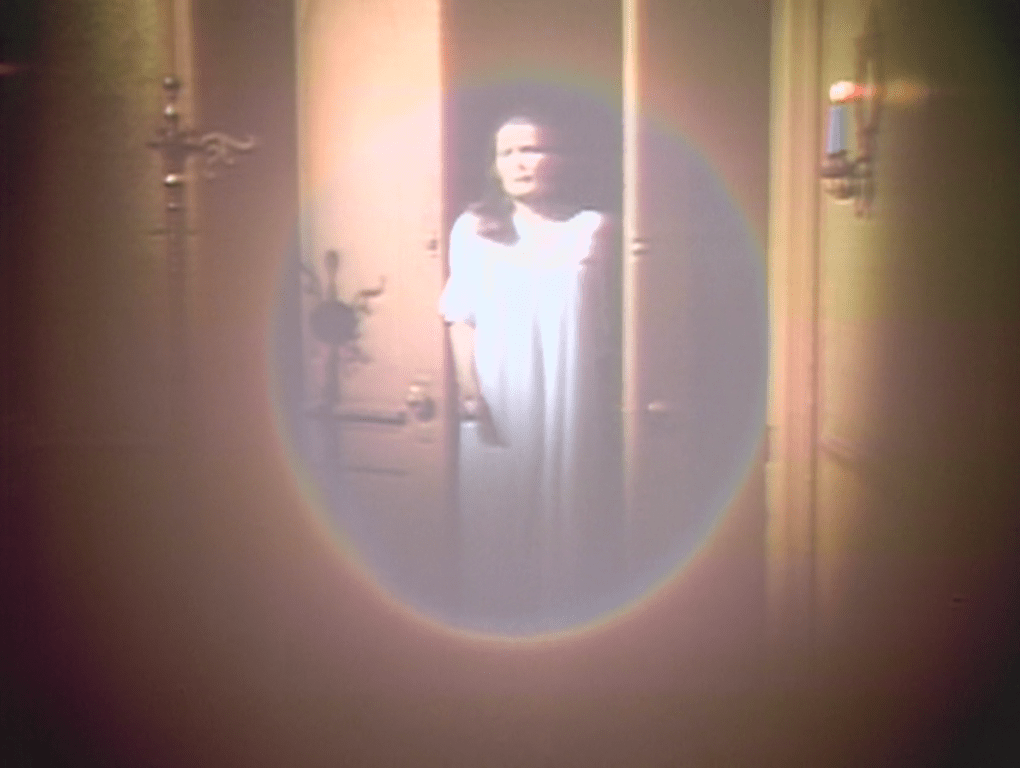
Vicki has the dream. Barnabas beckons her into the haunted house attraction where the bulk of it has always taken place before. She keeps telling him that she doesn’t want to have the dream, not for her sake, but for his. She opens three doors that show Halloween gimmicks we’ve seen before, then opens a fourth behind which she sees the Sun. The Sun shrinks into the distance, and she walks through the door, following it. Her face dissolves into an image of the Sun; the Sun dissolves to the exterior of Barnabas’ house. We cut to the interior, looking at the doors. A small dot of Sun appears there. It expands until it fills most of the screen. The doors open, and the Sun gives way to Vicki. She enters, and sees Barnabas lying on the floor by his desk. He is bleeding from two small wounds on his neck.

Part of the dream is a bit of doggerel that has never made much sense. The last lines are “Ahead a blazing light does burn, And one door leads to the point of return.” These lines are almost explained today. Each door exposes a symbol of something that is frightening either to the dreamer or to Barnabas or to both. Vicki isn’t afraid of the Sun, but she knows that Barnabas has a strange and intense relationship with it. In #277, he harangued her about his hatred for the Sun; in #347, he made plans with her to watch the Sun rise, plans which he had to break under very strange circumstances in #349. So now we know that the “blazing light” is the Sun, which vampires cannot withstand.

Of the ten characters who had the dream before Vicki, only strange and troubled boy David, her charge and dear friend, was able to walk through any of the doorways. In his case, he walked into a gigantic spider web and was caught there, just a few feet beyond the entry. But Vicki is on the path that “leads to the point of return,” and she goes to a different set altogether.

Had Barnabas’ introduction not brought a new audience to the show, Dark Shadows would probably have been canceled in June 1967. In that case, the final episode would have been #260, and it surely would have ended with Vicki, who was in those days the show’s main character, driving a stake through Barnabas’ heart. That she and the Sun overlap in the same space on the screen suggests that by passing the dream to Barnabas she will fulfill her original destiny and become his destroyer.

When Vicki looks into the parlor and sees Barnabas bloodied and lying on the floor by his desk, we are reminded of #405. In that episode, we saw that Angelique originally turned Barnabas into a vampire by sending a bat to bite him in this room. At that time, he fell, not by his desk, but by the staircase. That’s very close to where Joe was lying for the first half of the episode, so they have to do some rearranging to avoid suggesting an identity between them. Barnabas’ vampirism is so much the foundation of the show’s success that virtually everyone in the audience expects him to relapse sooner or later, but they are being careful not to raise the question of whether Joe will also join the ranks of the undead.

Until the dream, the episode is made up of long scenes with a great deal of dialogue. That isn’t unusual for Dark Shadows. It is unusual that the scenes play out with very little background music. I wonder if director Jack Sullivan decided that a spare sound design would set the right mood for the very ambitious dream sequence. I think it paid off- the dialogue scenes felt slow, but Vicki’s dream achieves the surrealistic quality it needs.

One of the main themes Danny Horn developed on his blog Dark Shadows Every Day was his ridiculously exaggerated impatience with the character of Vicki and his severe bias against Alexandra Moltke Isles’ acting. That gave me something to talk about in his comments section, and was part of the reason I started this blog. Danny’s post about this episode very nearly makes up for his incessant Vickiphobia. He alternates stills of Vicki with epigrams written in her voice, and the result is just magnificent, worth anyone’s while to read.

Episode 530: A fine line between love and hate

In the eighteenth century, wicked witch Angelique loved scion Barnabas Collins. He betrayed her in those days, rejecting her in favor of the gracious Josette, and ever since she has been casting deadly spells on him and everyone close to him. Today she encounters him in the woods. After a brief confrontation, she is left thinking about the feelings of love for him that still linger in her and undermine her killing power.

A few months ago, Frankenstein’s monster Adam imprinted on Barnabas when he saw him at the moment he came to life. Barnabas betrayed Adam’s filial love time and again, chaining him to a wall in a windowless basement cell, leaving him alone for all but a few minutes a day, and entrusting his care to his abusive servant Willie. When Barnabas beat Adam with his cane to stop him retaliating against Willie, Adam’s love turned to hate and he adopted “Kill Barnabas!” as his motto.

Today, well-meaning governess Vicki stops by Barnabas’ house to update him on the progress of Angelique’s latest attempt to destroy him. Vicki is to be the next to have a nightmare that Angelique has sent to a series of people, and after she has it she will pass it to Barnabas. Vicki doesn’t know that Barnabas was a vampire from the 1790s until 1968, much less that Angelique is trying to turn him back into one, but she does know that if Barnabas has the nightmare he is supposed to die as a result.

While Barnabas and Vicki confer, Angelique raises the ghost of Sam Evans from his grave. Sam was supposed to tell Vicki the nightmare, causing her to have it, but died before he could do so. Sam resists Angelique’s commands, but finds that Angelique can prevent him from returning to his grave. His soul needs rest, so he complies.

Back at Barnabas’ house, the sound of a gunshot interrupts the conversation. Barnabas goes out to investigate while Vicki waits in the parlor. Sam materializes there. Evidently his need to rest is quite urgent, since he sits down in an armchair while he talks to Vicki. The dead must rest! Or at least take a load off, it’s very tiring being dead apparently.

Vicki pleads with Sam not to tell her the dream, since she does not want to bring death to Barnabas. Sam says that in Barnabas’ case, death might come as a welcome relief. He declines to explain to Vicki what he means, but longtime viewers will be intrigued. Sam now knows about Angelique, so presumably he knows about Barnabas’ vampirism as well. Sam was the father of Maggie, The Nicest Girl in Town, whom Barnabas attacked, imprisoned, tried to brainwash into thinking she was Josette, and set out to kill when his brainwashing plan failed. If Sam knows about that part of Barnabas’ career, you’d think he would be a bit more peeved with him than he seems to be. At any rate, Vicki can’t stop Sam telling her the dream. When Barnabas comes back, she tells him what happened, and tells him she is already tempted to tell him the dream. She must go far away for his sake.

Many people have already had the dream, and none of them had the compulsion to tell it until they awoke from it. Vicki’s relationship to Barnabas is an odd one; shortly after his attempt to Josettify Maggie failed, he decided to repeat the experiment with her. Yet he never made much of an effort to get close to her, even though she time and again went out of her way to present him with opportunities to have his way with her. She even invited herself to his house for a sleepover in #285, only to have him back off the opportunity to suck her blood. He finally bit her in #462, only for his vampirism to be put into remission less than a week later. In this scene, Vicki keeps looking at Barnabas with wide, longing eyes, while he reacts coolly. So perhaps Vicki’s compulsion suggests that her attachment to Barnabas causes the Dream Curse to affect her differently.

Back at the grave, Angelique asks Sam’s ghost whether he told Vicki the dream. He said he did. She heaves a sigh of relief and exclaims “Excellent!,” and lets him go back to his grave. She doesn’t ask any follow-up questions or require any evidence. Clearly she couldn’t read Sam’s mind, or she wouldn’t have had to ask the question in the first place. So he could just as easily have gone off to haunt someone else, then lie to her.

We cut back to Barnabas’ house. Evidently he went somewhere after Vicki left, because he is walking in the front door. He looks around, apparently sensing a presence. He calls for Willie and gets no response. He opens a closet door, and hardworking young fisherman Joe falls out, unconscious. He hears a loud dirty laugh and sees Adam at the window, jeering at him.

This episode marks the final appearance of Sam Evans and of actor David Ford. Ford brought a fresh energy to the show when he took over the part of Sam from the execrable Mark Allen in #35, prompting blogger Marc Masse to discern what he called “The David Ford Effect” in the brightened performances of all the cast in the weeks that followed. But ever since the major storyline he was part of fizzled out in #201, Sam has been at the outer fringes of the plotlines, and Ford has been coasting. He inhabits his characters comfortably enough that he is always pleasant to watch, but it’s easy to forget the verve he originally brought to the show.

A few months after leaving Dark Shadows, Ford would join many other Dark Shadows alumni in the original Broadway cast of the musical 1776. He played John Hancock on Broadway and in the 1972 movie, and John Dickinson in the national touring company. I’ve been in the habit of watching the movie every year on or around the Fourth of July since the 1980s, and so it’s oddly fitting that Ford should depart Dark Shadows early in July. Fitting too that Sam Evans’ grave should be decorated with what looks to be a red, white, and blue floral wreath.

Screenshot by Dark Shadows Before I Die.

Episode 529: Fascinated by that character

It’s the wee hours of the morning, and hardworking young fisherman Joe comes to his fiancée Maggie’s house. Maggie had telephoned Joe and asked him to come right over. Joe can’t imagine what Maggie wants. In the chaste world of Dark Shadows, there is no word for “late night booty call.”

Joe finds Maggie and her friend Vicki waiting for him in their nightgowns. Maggie tells him that she had heard a noise in the bedroom where Vicki is staying, that she went in to investigate, and that she saw a ghost whispering into Vicki’s ear. Vicki tells him that she is staying at Maggie’s house to escape the power of a witch who is trying to make her have a nightmare that Maggie and others have already had, and that if she does have the nightmare it will spell doom for Barnabas Collins, who hasn’t been on the show for a week and a half. Joe gets more and more befuddled as the women go on about these matters. When they mention occult expert Professor Timothy Eliot Stokes, Joe perks up. Stokes is a topic on which he has a definite opinion. He thinks Stokes broke into Maggie’s house while she was away mourning for her father Sam, that he is harboring a fugitive named Adam who was involved in Sam’s death, and that he is in general a slippery sort. When Vicki says she is planning to call on Stokes the following day, Joe insists on accompanying her.

Stokes is slow to answer the door when Joe and Vicki knock. Vicki tells Stokes about her experience the night before, and Stokes replies that he can do nothing for her unless she leaves the town of Collinsport.

Joe finds some beginning reader’s flashcards and asks Stokes what he is doing with them. Stokes claims to be tutoring a three year old nephew in reading. Joe hears footsteps in the back bedroom. He wants to go to investigate, as Maggie had investigated sounds in her back bedroom, but Stokes denies him permission, claiming that there are cleaning people working in there. Joe seems to suspect what the audience already knows, that neither the nephew nor the cleaning people exist and Adam is in the bedroom.

Thus compromised, Stokes is off his guard when Joe reaches into his pocket and takes out a stickpin bearing the monogram “S.” Stokes confirms that it is his, and Joe says it was found in Maggie’s living room. Stokes suggests he dropped it there when he visited Sam. Joe argues this could not have been so, and Stokes is compelled to accept his reasons. He claims to have let himself into Maggie’s house through the unlocked door hoping to find her and offer his condolences, and that when he found no one home he left right away.

Joe has had enough of Stokes. Screenshot by Dark Shadows Before I Die.

Later, Joe lets himself into Maggie’s house and grabs a rifle. Maggie asks him what he is doing. He refuses to explain himself and insists on going away with the weapon. She objects quite forcefully, as one would expect, but cannot stop him. Throughout the first 106 weeks of the show, Joe has been an unfailingly kindly and conscientious fellow; longtime viewers will therefore be as shocked as Maggie is to see Joe behaving in this way.

Joe returns to Stokes’ place. Stokes is unsettled to see him with a gun. Joe declares that he has come to conduct a thorough search for Adam. Stokes orders him out of the house. Joe refuses to go, and Stokes threatens to call the police. Joe encourages him to call them. The two start to scuffle, and Adam bursts in from the bedroom. Joe points the gun at Adam, and Stokes urges him to put it down. Joe and Adam both run out the door. Stokes is looking on and urging Joe not to fire when we hear a shot.

Episode 527: Without the face

Professor Timothy Eliot Stokes has been harboring a fugitive in his apartment for some time. The fugitive, known only as Adam, is a very tall, extremely strong man whose vocabulary was limited to a handful of words when he met Stokes. He has been learning at a prodigious rate, and can now carry on conversations. Stokes gives Adam a break from reading the dictionary and asks him to recount his earliest memory.

Adam speaks once more in isolated monosyllables as he tells the story of waking up on a table and seeing old world gentleman Barnabas Collins. Barnabas’ friend, psychiatrist/ blood specialist Julia Hoffman, then jabbed him with a needle. After a car ride, he found himself chained to a wall in a small room where Barnabas’ servant Willie Loomis was bad to him. Adam broke the chain and attacked Willie, then Barnabas beat him. Stokes is trying to decide what to make of this story when a knock comes at the door. He sends Adam to read the dictionary quietly in the back bedroom while he deals with his visitors.

They are well-meaning governess Vicki Winters and her boyfriend, an unpleasant man named Peter. Vicki wants Stokes to hypnotize Peter in hopes of breaking through the total amnesia that covers all of his life up to the last few months. Stokes sends Vicki away, and puts Peter under.

Peter tells him that a mad scientist named Lang compelled him to assist in the construction of a Frankenstein’s monster, and that Barnabas and Julia were in on the project. Stokes puts two and two together. He brings Adam into the room, and Peter identifies him as Lang’s creation. Still under hypnosis, Peter refuses to regress any further into his past, fearing that he, too, might be one of Lang’s products.

Peter identifies Adam. Screenshot by Dark Shadows Before I Die.

Stokes calls on Vicki at the great house of Collinwood. Vicki says that it makes no difference to her what Peter’s background is; Stokes tells her that she is lying, because if that were the case she would not have taken Peter to him to be hypnotized. When Dark Shadows began, Vicki represented the audience’s point of view; since then, she has tended to be simply a Good Person. It is extremely rare to hear any suggestion that she might have a selfish motive, and even rarer for her to be credibly accused of deception. For Vicki fans, it is intriguing to think that the show might allow her to be a complex character who has secrets and behaves unpredictably.

Stokes meets the suave Nicholas Blair, whom Vicki introduces as the brother of Cassandra Collins. Stokes knows that Cassandra is a wicked witch, and he recognizes Nicholas as a man he saw months ago in an antique shop handling a curio associated with Cassandra. Nicholas denies that he was that man, saying that he is new to the area and there are many people who look like him. Nicholas is such a distinctive looking man that he must know that Stokes will know that he is lying, but it does put a stop to the conversation.

Stokes tells Vicki that she must leave Collinwood at once. He explains that if she does not, she “will have the dream,” that “Barnabas Collins will be your beckoner,” and that this means Barnabas will die. She protests that she cannot have “the dream,” because Sam Evans died before he could tell it to her. He insists that Nicholas and Cassandra will find a way to make her have it. This will be total gibberish to anyone watching for the first time. Regular viewers will know what it means, but most of them will wish they didn’t, since it refers to a slow-moving, heavily repetitious plot that they had hoped the show had decided to abandon.

Episode 521: All the words

Professor Timothy Eliot Stokes (Thayer David) comes home and greets his house-guest Adam (Robert Rodan.) He says that he envies Adam his freedom from the responsibility of attending lectures delivered by people who are “inferior” to him. However snobby Stokes’ attitude towards his faculty colleagues may be, we immediately see that it does not extend to people who lack educational credentials. He takes out a deck of flashcards with words as short as “car” and as long as “dictionary” and is delighted with Adam’s ability to read them aloud.

The Professor takes pleasure in his pupil’s progress.

From November 1967 to March 1968, Dark Shadows was a costume drama set in the 1790s and Thayer David played Stokes’ ancestor Ben, a servant indentured to the mighty Collins family. We saw kindly scion Barnabas Collins (Jonathan Frid) teach Ben to read. Barnabas became a vampire in those days; his vampirism went into remission only a few months ago, when he went through an experimental treatment that involved Adam’s creation as a Frankenstein’s monster. To the extent that Adam is Barnabas’ responsibility, Stokes is repaying his ancestor’s debt to him in kind.

Barnabas and his friend Dr Julia Hoffman (Grayson Hall) knock on Stokes’ door. Stokes does not know that Barnabas used to be a vampire or what he and Julia had to do with Adam’s creation, but he knows enough to distrust them deeply. He insists Adam hide in the back bedroom before he will let Barnabas and Julia in.

Barnabas and Julia tell Stokes that they telephoned him earlier. He explains that he was out, and they say that someone answered the phone and breathed audibly into the receiver, but did not speak. Before he can suggest they misdialled, they notice that his receiver is still off the hook. He speculates that his cleaning lady, who obviously does not exist, must have done it. He furrows his brow and sounds quite stern when he expresses his disapproval of this imaginary person’s behavior. Barnabas and Julia can’t do anything with that, so they change the subject to the matters they originally wanted to discuss.

Those amount to a recap of the storyline concerning wicked witch Cassandra Blair Collins, who in the 1790s was known as Angelique Bouchard Collins. As Angelique, she was the one who made Barnabas a vampire. She returned to the world of the living in the spring of 1968 in a bid to reactivate that curse. Now she has gone missing, and Barnabas and Julia are hoping she is gone forever. While Stokes is in the dark about Barnabas’ past and his true nature, he knows plenty about Angelique/ Cassandra. He tells Barnabas and Julia that to test their hypothesis, they must find the portrait of Angelique that turned up shortly before Angelique/ Cassandra herself returned.

Barnabas and Julia search for the portrait in the great house of Collinwood, where Angelique/ Cassandra has been living as the wife of Roger Collins (Louis Edmonds.) Julia keeps Roger busy downstairs while Barnabas roots around in Roger and Angelique/ Cassandra’s bedroom. The soundtrack plays a recording of Barnabas’ thoughts about his search while we see him staring at the room. When these interior monologues were new to the show, they tended to be very informative. Lately they’ve had less substance, and this one is totally unnecessary.

It turns out that the search itself was equally unnecessary. As soon as Barnabas makes his way back to the drawing room, Roger pulls out the portrait and shows it to him and Julia. Roger found it in the back of a dark closet, but is badly faded, as if it had been left in direct sunlight for a great many days. Barnabas and Julia know that the portrait has some mysterious connection with Angelique’ Cassandra’s physical being, so this is grounds for hope that she is on the way out.

That hope is dashed within seconds. Barnabas answers the front door, and finds a stranger. The man tells Barnabas he should have recognized him at once- “Cassandra’s husband!” Barnabas was briefly Angelique’s husband, 172 years before, but does not bring that up. Instead, he directs the man’s attention to Roger. The man is unfazed when Roger announces that he, not Barnabas, is married to Cassandra. The man then introduces himself as “Cassandra’s brother!” Barnabas and Julia react with shock.

Episode 518: How to speak to people

We open in a hospital room where Sam Evans is in bed, wearing dark glasses. This would tell a first time viewer that Sam is blind, and also that he’s reckless about his glasses.

Sam is begging his daughter Maggie to bring her friend Vicki around so he can tell her about a dream he just had. Vicki shows up and invites Sam to tell her the dream. This leads to a dramatic musical sting and a cut to the opening title. The first time viewer, still worried that Sam might nod off and break his glasses, will be unlikely to see why Vicki’s willingness to listen to Sam’s dream should be a concerning development.

Sam starts to describe his dream. A knock on the door interrupts him. It is Timothy Eliot Stokes. Stokes orders Vicki out of the room. Stokes is wearing a suit, not a white coat, and is addressed as “Professor.” So it should be clear to the first-time viewer that he is not a medical doctor, has no authority in the hospital, and is not particularly close to Vicki, Maggie, or Sam. The women resist his commands, but when it becomes clear he won’t back down they humor him.

In the corridor outside Sam’s room, Vicki tells Stokes “I hope you have some explanation.” He replies “The situation required drastic action.” “Is that all you have to say?” “No, I might add you should be grateful to me.” Thus the first-time viewer learns that Stokes does not feel obligated to be polite to young, pretty women.

Stokes tells Vicki that “Your recent experience in the past has taught you some rather frightening things about witchcraft.” Vicki agrees with this statement. Maggie turns away and looks out into space, wondering what the heck these lunatics are talking about. At last the first-time viewer has an on-screen representative.

Stokes describes a “Dream Curse,” in which a series of people all have the same nightmare. Each dreamer is compelled to tell the nightmare to a particular person who appeared in it. That person then has the nightmare, featuring a third person, and awakens with the same compulsion to tell the nightmare to that person, keeping the cycle going. Vicki declares that she doesn’t know what Stokes is talking about, but Maggie seems to. Vicki grudgingly agrees not to go into Sam’s room, but refuses to leave the corridor.

Maggie reacts to Stokes’ explanation.

Returning viewers know that Maggie was the first to have the nightmare. It will also stretch their credulity that Vicki hasn’t heard about it. Maggie is one of Vicki’s dearest friends, and the nightmare was a terrifying experience that weighed on her for quite some time. The person Maggie passed the nightmare to was Vicki’s boyfriend Peter, who prefers to be called Jeff. Not only has neither Maggie nor Peter/ Jeff told Vicki about the nightmare, neither has any of the three people who have already had the nightmare and who live with her in the great house of Collinwood. These are heiress Carolyn, whom Vicki has addressed as “my best friend”; strange and troubled boy David, who is Vicki’s charge in her job as governess and who feels very close to her; and housekeeper Mrs Johnson, who habitually tells everyone everything she knows.

It will also be strange to those who have been watching the show that Stokes does not tell Vicki the key thing about the Dream Curse, that it is aimed at old world gentleman Barnabas Collins. Vicki is extremely fond of Barnabas; Stokes knows this, because in #509, he told her that he was doing battle with a witch whose goal was to kill Barnabas, and she was most eager to help him. If he told her that by listening to Sam’s account of the dream she would be bringing Barnabas one step closer to death, surely he would have persuaded her to go home. But, as my wife Mrs Acilius pointed out while we were watching the episode, that would let Vicki back into the story. Stokes, like Barnabas and several other major characters, is working to keep Vicki from becoming relevant to any ongoing plot.

Stokes has to leave the hospital to attend to another matter. While Maggie was leading the way out of the hospital room, he looked out the window and saw a man looking in. The man is Adam, a very tall, phenomenally strong, peculiarly inarticulate fellow whom Stokes met at Sam and Maggie’s cottage a few days ago. Stokes is eager to get to know Adam. He lets himself into the cottage and waits there until Adam comes by. Adam is confused to find him there, but Stokes quickly persuades him to come home with him. Stokes promises to give him food and become his friend. The two of them are quite cheerful as they walk out the front door.

The camera repeatedly focuses on a stickpin Stokes dropped on the rug, suggesting that he will get in trouble for having let himself into the cottage without Maggie’s permission. That suggestion is clearer to the first-time viewer than to those who know what’s been happening. Stokes had been in the cottage with Sam not long before, and could easily claim to have dropped the stickpin on that occasion.

Back in the hospital corridor, Vicki hears Sam crying out in agony. She goes to his room. Maggie joins her there, and Sam starts describing the nightmare. Maggie recognizes it as the one that caused her such distress when she had it, and her eyes dart to Vicki. She tells Vicki she doesn’t have to stay. Vicki insists, and a look of panic starts to form on Maggie’s face. Sam doesn’t get far into the nightmare before he dies.

Returning viewers will remember that the luckless Willie Loomis was interrupted in his attempt to tell Carolyn the nightmare in #506, and that when she next went to sleep she could have only the part of the nightmare he had described. So we wonder if Vicki will have the same problem.

We may wonder about something else. Stokes, as an expert on witchcraft, has several times said that a Dream Curse is designed to “end with a death.” We may wonder if Sam’s death will end it before it gets to Barnabas.

That would represent a stinging defeat for the witch. Sam was once a fairly important character, but long ago receded to the margins of the show. He made his debut in #5, and has been played by David Ford since #35. Originally he was a tormented alcoholic, driven to drink by his part in the injustice done long ago to dashing action hero Burke Devlin. Burke’s storyline fizzled out completely in #201, and since then Sam has made only intermittent appearances, mostly as support for Maggie, who is herself usually a secondary character. To launch an attack on the show’s breakout star and hit a tertiary player would be quite embarrassing to any villain. Maybe the witch’s next plan will wind up falling on Bob the Bartender, and the one after that will hit one of the sheriff’s feeble-minded deputies.

Kathryn Leigh Scott tells some stories about Sam’s death scene that do not fit with what is on the tape. In her 1986 book My Scrapbook Memories of Dark Shadows, she writes about the teleprompter falling over and making a loud noise and Ford shouting “Where is it!?” In appearances at Dark Shadows conventions, she has said that the lines Ford improvised to replace the ones he couldn’t read ran over time, and that in her desperation to get to the next break she pushed a pillow on his face and nearly smothered him while saying “Don’t die, Pop!” In his post on Dark Shadows Every Day, Danny Horn says that Miss Scott’s “anecdote was entirely made up. None of that happened.”

I reserve judgment. Maybe the episode we have is a second take. It runs unusually smoothly up to Sam’s death scene, as if the cast had had more practice with its parts than usual. We know that, in spite of all the spectacular bloopers and other production errors they left in, they did sometimes start over, and the incidents Miss Scott described might well have been enough to warrant that.

Episode 515: A word you’re saying

A lot of wonderful acting in this one. We start off with Willie Loomis (John Karlen,) staggering into the cottage Maggie Evans (Kathryn Leigh Scott) shares with her father Sam (David Ford.) Yesterday, Maggie’s boyfriend Joe beat Willie up. Maggie invites Willie in, comforts him, tries to treat his wounds, and agrees to drive him home. Joe had excellent reasons for insisting Willie stay away from Maggie, and those reasons might lead returning viewers to react to the beginning of the scene with frustration. But Karlen and Miss Scott are so good together that they very smoothly defuse that frustration, and we soon find ourselves as absorbed in the scene as we were in the many scenes the same actors shared in May and June of 1967, when Maggie was the prisoner of Barnabas the vampire* and Willie, as Barnabas’ slave, was trying desperately to reduce her suffering.

A very tall man named Adam (Robert Rodan) comes to the open front door and announces “Willie bad!” Maggie has no idea who Adam is. Adam enters the cottage and clarifies his intention with a declaration of “Kill Willie!” Willie tries to talk Adam out of this plan, and reminds him of the good times they had together. Maggie tells Adam that Willie is hurt, and Adam looks concerned when he responds “Willie hurt?” Rodan gets the same flicker of light into Adam’s eyes that you might see in the eyes of a toddler who is intrigued to hear that someone is having feelings he wouldn’t have expected them to have. Before long, though, Adam is angry again. Maggie takes a hammer and tries to hit Adam, leading Adam to state a new plan- “Kill Maggie!”

Sam comes home. Sam befriended Adam during a trip Maggie recently took out of town. He tells Maggie to stand behind him. She does, and he talks to Adam about their friendship. Adam agrees that Sam is his friend and that he would never hurt him, but he refuses to agree when Sam tells him that Maggie is also his friend. Maggie makes a move that confuses Adam. Trying to get at her, Adam hits Sam very hard. Adam sees that he has knocked Sam down, and he runs away.

We see Adam in the woods, and for the first time hear his voice in a pre-recorded monologue telling us his thoughts. “Afraid! Adam afraid! Adam bad! Adam hurt friend!” Rodan’s acting is more than sufficient to enable us to figure out that this was what Adam was thinking even without the monologue, but he does such a good job of voice acting that I don’t really begrudge it. Crude as the lines are, Rodan simultaneously expresses fine shades of fear and guilt through them.

Willie and Maggie have another scene in the Evans cottage. She is stern with him now, demanding to know what Willie knows about Adam. Willie denies that he knows anything, and she points out that when he was trying to calm Adam he appealed to several facts from their previous acquaintance. Willie tells a story to cover that up, essentially the same story Barnabas made up to tell the sheriff in #505. Maggie is a lot smarter than the sheriff- that isn’t saying much, chewing gum is a lot smarter than the sheriff- and even he didn’t buy this line when Barnabas was pushing it. She tells Willie in a firm tone that she will continue to ask questions until she gets answers she can believe. She explicitly tells him she will ask Barnabas. Maggie’s firmness and Willie’s barely controlled panic make for another gripping encounter.

Willie goes back home to Barnabas’ house. Barnabas’ best friend Julia Hoffman (Grayson Hall) is there. Willie tells Julia they have to find Adam before the police do, since he now knows enough words to get them all in a lot of trouble. Usually when Julia and Willie have their staff conferences, she is firmly in charge and full of ideas. But she is at a complete loss today. She has no idea how to capture Adam, and she doesn’t know where Barnabas is.

What’s more, Julia has just seen a ghost. She heard sobbing coming from the basement, and when she went down there she saw a woman in white whom she recognized as Josette Collins, deceased. Josette dematerialized in front of her. Now the sobbing starts back up, and Julia accompanies Willie to the basement.

Josette is already gone when they get there. Julia tells Willie what she saw earlier. She figures out that Barnabas is bricked up behind the wall where Josette’s ghost had stood. She explains her reasoning in terms that viewers who have seen the last several episodes will be able to follow, but which don’t make a bit of sense to Willie. His sharp befuddlement and her vague certitude make for a laugh-out-loud funny scene.

The bricked-up alcove in the basement of Barnabas’ house. Screenshot by Dark Shadows Before I Die.

In the early months of the show, several characters heard a sobbing woman in the locked room in the basement of the great house of Collinwood. It was strongly implied in a number of those episodes that the woman was the ghost of Josette. In #272, matriarch Liz said that she herself was the one who did the sobbing. That didn’t fit very well with what we had seen, but by that point the show had reconceived Josette as part of Barnabas’ story and stopped involving her ghost in the action. Longtime viewers have a strong reminder of the “Sobbing Woman” story today, since Barnabas’ basement is a redress of the set used for the basement of the great house and the alcove where he is walled up is in the same place as the door to locked room in basement of great house.

*Maggie has amnesia about all that, and thinks Barnabas is her friend. His vampirism is in remission now.

Episode 514: Serious talking

Hardworking young fisherman Joe Haskell is engaged to marry Maggie Evans, The Nicest Girl in Town. Early in their relationship, Maggie warned Joe that they might never be able to get married, because her father Sam was an alcoholic and would always need her to come rescue him. Joe liked Sam, drunk or sober, and was always quick to lend him a hand. He didn’t seem to understand Maggie’s worries.

Now, it’s Joe who is worried, and Maggie who doesn’t understand why. Sam’s drinking doesn’t seem to be as much of a problem as it was then. But he has been struck blind, ending his career as a painter. Joe still wants to marry Maggie, and is still glad to help Sam. But Sam has befriended a very tall, phenomenally strong man named Adam, who is wanted by the police because he abducted heiress Carolyn Collins Stoddard several days ago. Sam doesn’t consider the abduction to be a strike against Adam, whose ignorance of social customs he considers to be a disability equal to his own blindness. Joe is convinced that Adam is a violent felon and is alarmed that Sam insists on inviting him to the Evans cottage. Maggie has been out of town and doesn’t know about Adam.

Today, Joe finds a reason to be as alarmed about Maggie’s judgment of men as he is about Sam’s. Maggie was missing for some weeks in May and June of 1967, and when she was found she was so severely traumatized that she could barely talk. She spent months in a mental hospital called Windcliff after that, during which time she had regressed to childhood and developed a tendency to become wildly agitated. She seems to be her old self now, but she still has amnesia covering the whole period from her disappearance through her time at Windcliff.

Like the rest of the village of Collinsport, Joe believes that Maggie was abducted and brutalized by Willie Loomis, servant to old world gentleman Barnabas Collins, and that Willie was trying to kill Maggie when the police shot him in #322 and #323. When he survived his gunshot wounds, Willie was sent to Windcliff. In #483, Joe was appalled to find that Barnabas had arranged Willie’s release and brought him back to work for him. Joe informed Barnabas that he intended to kill Willie if he ever again saw him near Maggie.

Joe is on his way to the Evans cottage when he sees Willie heading for the front door. He confronts him and reminds him of what he told Barnabas. Willie tells him Maggie is no longer afraid of him, that they are friends now, that she visited him at Barnabas’ house earlier that evening, and that it wasn’t the first time she had gone there. Willie is going on about himself as Joe’s “competition” for Maggie’s attention when Joe hits him a couple of times and knocks him out.

Joe goes into the house and tells Maggie what happened. She admits that she did go to Barnabas’ house earlier, that she talked to Willie, and that it wasn’t the first time. Joe reacts with incredulity and says that Willie tried to kill her. Maggie insists that Willie is innocent. Joe asks why she believes that; she can’t explain. He asks why she went to Barnabas’ house. Again, she can’t explain. She says that she does not know why she went there, but that she is sure it wasn’t to see Willie. Joe is shocked that Maggie can’t explain something she did just an hour or two before. He keeps asking, but she insists that she does not know why she went to the Old House.

Joe becomes more and more alarmed. Maggie turns away from him, and he grabs her arm. All the fansites remark on the roughness of this move; it looks like an act of domestic violence. It certainly is not what we would expect of Nice Guy Joe, who was Carolyn’s doormat in the early months of the show and has been a Perfect Gentleman in his relationship with Maggie since then. The 1960s were a particularly bad time for intimate partner violence on screen, so it speaks relatively well of actors Joel Crothers and Kathryn Leigh Scott, and especially of director John Sedwick, that this moment passes briefly. Joe doesn’t follow it up with any further violence, and Maggie seems to forget about it instantly, as if it were an accident. In those days, it might just easily have been highlighted as a proof of Joe’s manliness.

Joe gets rough. Screenshot by Dark Shadows Before I Die.

The arm-grab is not defensible, but Joe’s intense feelings in response to Maggie’s inability to explain her behavior are. Joe and Sam visited Maggie at Windcliff in #265. She didn’t recognize them and started shrieking lyrics to “London Bridge” in what I think is the single most frightening scene in the whole of Dark Shadows. Maggie’s amnesia blotted that out, but Joe can hardly have forgotten it. He also remembers Willie as he was in his first weeks on the show, when he seemed determined to rape all the young women and beat up their boyfriends. The idea of Maggie’s mental health regressing to such a low point that she would wander off with a man like that must terrify Joe.

In his post about this episode on his Dark Shadows Every Day, Danny Horn lists eight ongoing storylines it references. They are:

#1. Sam recently went blind; that’s why Joe has to pick him up at the bar.

#2. “Cassandra” is really Angelique, who’s cast a complicated Dream Curse spell that will eventually lead to Barnabas’ death. The gift that she brought was pipe tobacco, laced with a magic powder that would make Sam have the dream.

#3. Professor Stokes is fighting Cassandra, and trying to stop the Dream Curse. He stole the pipe tobacco, because he doesn’t want Sam to have the dream.

#4. Willie has a crush on Maggie, so he stole a pair of Josette’s earrings from Barnabas, and left them in Maggie’s purse while she wasn’t looking. When she puts the earrings on, she has a flashback to the period when Barnabas held her captive, and tried to convince her that she was Josette — a period that should be blocked from her memory.

#5. Adam, the newborn Frankenstein, has befriended Sam, and is now looking for him…

[#6.] Barnabas… was chained up a couple episodes ago and trapped behind this wall. Now he’s kicking at the wall, desperate for someone to come and rescue him. 

[#7. A] man… abducted Carolyn a few weeks ago.

[#8.] Cassandra putting a curse on Liz, and making her think about death all the time. 

Danny Horn, “Episode 514: That Endless Summer,” Dark Shadows Every Day, published 2 November 2014.

Danny might have mentioned several other stories that don’t come up today, but of which regular viewers are aware and on which the ones that do come up depend. For example, Barnabas’ vampirism has gone into remission, and as a result his sometime victims were freed of the effects of his bites. It is unclear what this means for them, particularly for Willie, who often seems to have become once more the dangerously unstable ruffian whom Joe and the others knew when he first came to Collinsport. Also, a man named Peter is dating well-meaning governess Vicki, and Vicki has trouble remembering that Peter would prefer to be called Jeff. That may not be too exciting, but it’s no duller than Liz moaning endlessly about death. We could also bring up strange and troubled boy David, who has come into possession of a tape recorder with a message that has been played for the audience approximately umpteen billion gazillion times, but that no character other than Adam has heard, and if anyone else does there will be consequences. And Harry, the ex-convict son of housekeeper Mrs Johnson, is staying at Collinwood, and may someday be mentioned again. If he is, there is a danger that the audience will once more have to watch Craig Slocum try to act, truly a grim prospect.

Danny argues that the dense packing of so many storylines into the show makes watching it a stimulating cognitive exercise that “actually teaches people how to process information more efficiently.” As this blog makes obvious, I enjoy this kind of complexity very much. Not only do I keep talking about how ongoing storylines relate to each other, I reach back and find echoes of plot elements from months or years before and consider the significance of the common themes they develop; I look at the way the show borrows stories from books and plays and movies and folklore and notice how they put those source materials in dialogue with each other; and sometimes, my dissatisfaction with stories that didn’t work leads me to think up other stories that might have turned out better, adding yet another layer of narrative accretion to the already extremely intricate existing dramatic text.

I think Danny goes overboard, though, in his presentation of his case. He suggests that an increase in the number of storylines per minute of airtime is equivalent to an increase in the intellectual power of the show. But analysis and collation of plot elements is only one of many kinds of mental activities audiences engage in, and is far from the most important one. If that was all you wanted, you wouldn’t need actors. When an actor creates a character, s/he transforms the story points into the experiences of a person and the audience into witnesses of those experiences. When the drama is well executed, those experiences, even if they can be assigned to some category that is familiar to us, strike us as fresh and unique. When that happens, you don’t need a large number of interlocking storylines to generate complexity- your responses, emotionally and intellectually, will be as complex as your own background can support.

The audience’s background matters. There’s an old saying that when you engage with a literary work, it isn’t just you who read the book, but the book reads you. I often see how true this is in my job as a faculty member in ancient Greek and Latin at a state university in the interior of the USA. When I teach courses on ancient Mediterranean literature in translation, students aged 18-25 have an entirely different reaction than do the “non-traditional” students, those coming back to school after some years doing something else. Most of the students who are in the traditional college age group make interesting connections with a wide variety of topics, while others in that group get bored and can’t see a point in reading old books. But of the dozens of students I’ve taught when they were over the age of 40, every single one has found the reading to be a deeply rewarding experience. The literature that we have from the ancient world was written for adults, and the average American post-adolescent is only going to get so much out of it.

At this point in 1968, Dark Shadows is very much a show for children. The biggest and fastest-growing share of the audience is under 13 years old. So if it is going to be a smart show, it’s going to be smart in the sense that IQ tests measure, transmitting large amounts of information and giving the audience a short period of time to absorb, analyze, and recombine that information before it is followed by another close-packed message. It’s no wonder that an actor like Joel Crothers would become discontented with the show and go away complaining that the cast was being crowded out. He has ever less basis for the hope that he will be able to present the audience with a recognizable human feeling and leave them with hard thinking to do about what that feeling means.

Episode 512: A jury of the dead!

For nineteen weeks from November 1967 to March 1968, Dark Shadows was a costume drama set in the late eighteenth century. Among the more interesting characters introduced in that period were fanatical witchfinder the Rev’d Mr Trask; roguish naval officer Nathan Forbes; fast-talking con artist Suki Forbes; and streetwalkers Ruby Tate and Maude Browning. All five of these characters were murdered by vampire Barnabas Collins, and all five of them are among those who return today for an impromptu trial of Barnabas.

Barnabas killed Trask by luring him to his basement and bricking him up in an alcove, as Montresor did to Fortunato in Edgar Allan Poe’s 1846 story “The Cask of Amontillado.” Some other characters invited themselves to the basement yesterday and held a séance there. As a result of the séance, the bricks fell away and Trask came back to life. Now, Trask has confined Barnabas to the same alcove. He declares that he will give him a trial before he bricks him up.

In the eighteenth century, Trask was the prosecutor in the trial of time traveling governess Vicki Winters. Victoria was convicted of witchcraft and sentenced to death. Vicki’s trip from the 1960s to the 1790s inverted Barnabas’ displacement in time; as Vicki’s witchcraft trial was so chaotic it did not seem to follow rules of any kind, neither does the murder trial Trask improvises for Barnabas fit any conceivable model of procedure. Vicki’s trial stretched over two weeks, from #427 to #437; Barnabas’ begins and ends today, during the second half of the episode.

Trask conjures up Nathan, Suki, Ruby, Maude, and Barnabas’ first homicide victim, his uncle Jeremiah, to serve as a jury; he conjures up a man named Ezra Simpson, of whom we have never previously heard, to act as judge. Trask is the prosecutor, and Nathan is his sole witness. This court of “the damned!,” as Trask calls them, recalls the rogues who confront Jabez Stone as jurors and judge in Stephen Vincent Benét’s 1936 story “The Devil and Daniel Webster.” Unlike Jabez Stone, however, Barnabas does not have a right to counsel.

Court is in session. Screenshot by Dark Shadows Before I Die.

Trask asks Nathan how he died. After Nathan says that Barnabas strangled him, Trask asks him how Suki died. Barnabas objects that Nathan shouldn’t be allowed to speak for others; regular viewers sympathize with this, since Suki, played today as she was originally by Jane Draper, was sensational every second she was on screen, and when we saw Miss Draper again we were happy to think that she would have another chance to show what she could do. Barnabas also shouts at one point that he is innocent; this is less likely to attract the audience’s sympathy. Mrs Acilius and I certainly got a good laugh from it.

Barnabas asks to be allowed to present a defense. Trask invites him to question Nathan. He is about to do so when Nathan smiles at him, turns around, and vanishes. Trask explains that Nathan has already said all that needs to be said. Later, Trask looks at the recompleted wall and laughs with vicious glee, delighted at what is behind it.

Barnabas has neither the powers nor the limitations of a vampire now. The effects of the curse went into remission when mad scientists Eric Lang and Julia Hoffman created a man from parts scavenged from the cemetery and connected Barnabas to him as they electrified him and brought him to life. Barnabas named this man Adam.

Now Adam has escaped from the horribly abusive home Barnabas and Julia provided for him. He has found a friend in Sam Evans, an artist who was blinded when Barnabas enlisted him in one of his hare-brained schemes. Sam is teaching Adam to speak, and is so impressed with his ability to learn that he wonders aloud if he will be able to teach him to paint professionally.

Adam develops a sudden pain in his wrists. He moans “Barnabas! Hurt!” A shot of Barnabas hanging by his wrists in the basement alcove is laid over a closeup of Adam. Evidently the bond between them is such that Adam can sense Barnabas’ pain, even though they are miles apart. Apparently it is mid-1840s day on Dark Shadows; the scene in Barnabas’ house recalls “The Cask of Amontillado,” and the scene at Sam’s house is based on Alexandre Dumas’ 1846 novella The Corsican Brothers. “The Devil and Daniel Webster” was set in that decade or a bit earlier, and while Frankenstein was written in 1818 many adaptations of it, including the one Dark Shadows creator Dan Curtis would make in 1973, are set in the 1840s.

Adam becomes agitated. He cannot explain what is happening to him, no matter how patiently Sam asks. Sam’s son-in-law-to-be Joe Haskell comes in; Adam brushes against Joe as he runs out the door. Though Joe is a tall and sturdy man, Adam is so tremendously strong that this casual contact sends him flying.

It dawns on Joe that Adam is the man who abducted heiress Carolyn Collins Stoddard and then fell from the cliff on Widows’ Hill. Sam calmly replies that he had already figured that out. Joe is shocked that Sam hasn’t called the police; Sam replies that Adam is as disabled as he is, and that he means no one any harm. Joe is not at all convinced of the second of these points, and worries that “Barnabas! Hurt!” might not have reflected a fear that Barnabas is hurt, as Sam thinks it does, but might rather express Adam’s resolution to hurt Barnabas. Joel Crothers and David Ford bring out the full comic value of this scene; Mrs Acilius laughed at the blandness with which Ford’s Sam confirms that he knows who Adam is.

Joe goes to Barnabas’ house to warn him, but finds it locked and apparently empty. Later, Julia goes there too. She has a key, and lets herself in. She doesn’t see any evidence that Barnabas is or has been home; she goes downstairs, and is mystified to see that the alcove wall, which was broken when she was there for the séance, is now bricked up again.

Several times, Dark Shadows has contrasted Barnabas’ home, the Old House on the great estate of Collinwood, with the Evans cottage, a working class residence in the village of Collinsport. Today they draw this contrast in sharp relief. The basement of the Old House is always dark, but even the upstairs is lit by candles today; the scenes in the Evans cottage, taking place at the same time, are sunlit. The basement is the most haunted part of the most haunted house on the haunted estate, and eight characters in costume dress materialize from thin air there; the Evans cottage is a part of the modern world where Sam and Joe can use reason to arrive at agreement about facts, even if they make different judgments about the significance of those facts. When Julia and Joe go to the Old House, each wanders about alone, finding no one to talk to; at the Evans cottage, even Adam is able to have a conversation, and while there he can receive a message from Barnabas by some mysterious means. Trask seizes control of the basement of the Old House to make a parody of the criminal justice system and enact his vengeance on Barnabas; in the Evans cottage, Sam refuses to call the sheriff because he wants to shield Adam from punishment for the crimes he inadvertently committed.