Today, everyone has the memory of a goldfish. Heiress Carolyn receives a telepathic message from her mother, the apparently-dead Liz, urging her to go home to the great house of Collinwood and stay inside in order to escape a terrible danger. A few minutes later, she has apparently forgotten the content of this message, as she goes back outside to check on Liz in her coffin.
During her brief stay in Collinwood, Carolyn talked with permanent houseguest Julia. Julia keeps telling her that Liz is dead and that the dead cannot communicate with the living, suggesting that she too has become a goldfish. Julia is a doctor, and Liz is entombed because she mistakenly declared her dead. She had made the same mistake about her several weeks before, and learned nothing from that experience. But she has also attended several séances, built two Frankenstein’s monsters, seen a number of ghosts, and spent a year and a half carrying on a one-sided romance with recovering vampire Barnabas. She also knows that in #592 and #593, Carolyn herself died and came back to life. So it is bizarre that she goes on about the finality of death and the impossibility of communication between the living and the dead.
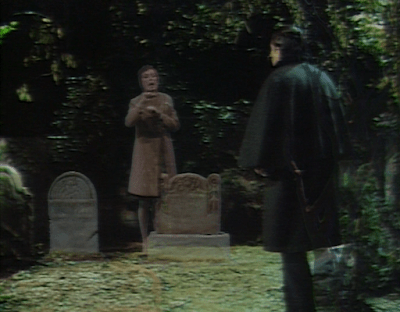
Carolyn goes back to her mother’s crypt and is attacked by a werewolf. Liz knew she would be buried alive, and so insisted her coffin be equipped with a button that would ring bells everyone at Collinwood could hear. While Carolyn is confronting the werewolf, Liz overcomes her paralysis sufficiently to push this button. That brings Barnabas and Julia.
The werewolf paused in his attack on Carolyn when he saw her silver bracelet; that gave Julia and Barnabas time to arrive while Carolyn was still alive. Barnabas strikes him with the silver head of his cane, causing him to run off. When Carolyn tells of the werewolf’s fascination with the bracelet, Barnabas mentions that the head of the cane is also silver; he grows very thoughtful, apparently realizing that silver has a power over the werewolf. Yet later, when he goes to hunt for the werewolf, he takes a gun but nearly leaves the cane behind. He finally takes it, but his long hesitation shows that he, too, is suffering from goldfishism.
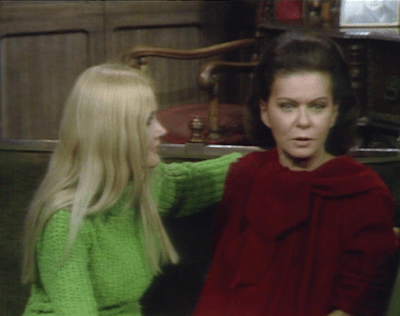
While still in the crypt, Julia had looked at Liz’ body and insisted she was dead. She wrote off the ringing of the bells as a coincidence, perhaps caused by some jostling during Carolyn’s encounter with the werewolf. Later, Liz gets out of the coffin and goes home to Collinwood. There, Julia, Barnabas, and Carolyn are astonished to see her. Julia examines her. After she finds that Liz has what is in Collinsport English called a “pulsebeat,” she seems willing to concede that she might be alive. She then starts giving orders which everyone willingly follows, because she is such a good doctor.
Liz is the one character whose brain seems to be in working order today. She can remember that her trouble started when her brother Roger’s wife Cassandra cast a spell on her. Barnabas and Julia know that Cassandra was in fact a wicked witch named Angelique, and that Barnabas has just returned from a trip back in time during which he destroyed Angelique. They assure her that Cassandra will never return. They can’t tell her why they are sure of this, because they, like the producers of Dark Shadows, have decided that Liz must never know what is really happening around her, lest she become an active participant in the plot. So all they can say is that they just know, and she is of course unconvinced.
It is a relief to wrap up the “Liz will be buried alive” storyline; that was dull from the beginning, and just got duller as it went. It didn’t help that we have seen Liz immobilized by depression twice before. This isn’t even the first time she has been rendered catatonic as the result of a curse placed by an undead blonde fire witch.
It’s also encouraging that Julia and Barnabas have met the werewolf and are engaged with him. They are the show’s chief protagonists, and nothing can really move without their involvement. Now that they are involved with the werewolf, we can stop spinning our wheels.
Time-traveling fussbudget Barnabas Collins has completed the task he set for himself when he went to the year 1796, and has to find a way to return to 1969. He decides to deliberately subject himself to the process by which he was originally transferred from the 1790s to the 1960s. He is, at the moment, a vampire. He orders his servant Ben to chain him in a coffin hidden in the secret room in the back of the Collins family mausoleum, and hopes that he will be released from it in a period when he is human again.
On a sunny morning in 1969, Barnabas’ former blood thrall Willie and his best friend Julia have figured out his plan and gone to the secret room. Julia is a medical doctor; she is at once the best physician in the world, capable of assembling a human body from dead parts, bringing it to life, and thereby lifting the effects of the vampire curse from Barnabas, but simultaneously very unsteady on the question of whether any given patient she is examining is alive or dead. For example, matriarch Liz is entombed at the moment because Julia mistakenly declared her dead twice in a couple of months. Once he has opened the coffin, Willie demands Julia examine Barnabas’ body and tell him whether he is alive, and therefore human, or dead, and therefore condemned to rise at nightfall and prey upon the living. Before she can answer Willie’s question, Julia has to spend quite a bit of time going over Barnabas with a stethoscope, during which time we see his eyelids flutter and his chest move.
While Julia is trying to determine Barnabas if is alive, he sits up and starts talking. Julia and Willie urge him to lie back down, apparently concerned that if he is too active Julia won’t be able to arrive at a clear result. After a break, we see him out of the coffin, telling them about his experience in 1796. After quite a bit of back and forth, they arrive at the collective decision to continue the conversation back home, in the Old House on the great estate of Collinwood.
Barnabas, Julia, and Willie have emerged from the secret room into the publicly known part of the mausoleum and are starting to close the panel behind them when they hear the voices of people approaching. One might expect them to finish closing the panel and to greet whoever is coming as fellow pilgrims paying homage at the graves of Joshua and Naomi Collins and their daughter Sarah. After all, everyone knows that Barnabas is a direct descendant of Joshua and Naomi, that Julia has a lively interest in the past of the Collins family, and that Willie is Barnabas’ servant. They have as much right to be there as anyone.
Instead, they scurry back into the secret room and shut themselves in. They are a bit too slow. Entering are heiress Carolyn and child Amy. Amy sees the panel swinging shut. Carolyn, behind her, did not see this happen, and dismisses Amy’s claim that she did. They tap on the panel, and Amy decides that it is so solid that she may have been mistaken. The mausoleum is so dim that one can imagine a trick of the light causing a person to believe that the wall had moved, so this reaction of hers is plausible enough.
Dimness is not an exclusive property of the outer part of the mausoleum. The trio hiding in the secret panel embody dimness as they do an outstanding imitation of the Three Stooges. Willie is Larry, the universal victim; Julia is Moe, the self-appointed leader who is as lost as either of the followers; and Barnabas is Curly, the chaos agent. Willie left his bag of tools perched precariously on the steps immediately behind the panel; after Amy and Carolyn tap, the bag falls and makes a sound. Julia does not address Willie as “ya porky-pine!” and poke him in both eyes, but it would fit with the flow of the action if she did.
Carolyn and Amy both hear the sound. They puzzle over it. Carolyn suggests that the wind must be blowing a limb from a nearby tree against the outer wall. Amy can’t think of anything else it could be, and accepts the suggestion. They leave, having placed flowers on the sarcophagi.
The flowers are themselves interesting to longtime viewers. Early in the episode, we saw Carolyn arranging them on the writing table in the drawing room of the great house of Collinwood. The last time we saw someone handling flowers over that table was in #346. Barnabas grabbed those flowers out of Julia’s hand. In those days he was still a vampire, and they were enemies. After a few seconds in his grip, the flowers died. When Julia and well-meaning governess Vicki saw this, Barnabas looked embarrassed, for all the world as if he had broken wind. The analogy tends to raise a laugh, but it is apt- when he was a vampire, it was a natural function of Barnabas’ body to do things like that, and he would be expected to control that function so that others would not be aware of it. So when they show us flowers on this spot, they are telling us we ought to be in suspense as to whether Barnabas will be a vampire again.
Carolyn and Amy go back to the great house, where strange and troubled boy David is sulking. Again, longtime viewers might find this suspenseful. David found his way into the secret room in #311 and in #334 tried to show it to some adults. Barnabas had locked the panel, so they disbelieved him. If Amy tells David what she saw, he may well put two and two together and revive the stories that were in progress in those days.
But Amy doesn’t breathe a word of it, and David isn’t interested. He is preoccupied with the evil spirit of the evil Quentin Collins, who is gradually and evilly taking possession of him and Amy and, evil as he is, driving them to do something or other that has not yet been explained, but which will undoubtedly turn out to be evil. Quentin is still confined to a small room hidden in the long-deserted west wing of the house, and can only take full control of one child at a time. Today it is David who is acting as his agent; Amy flatly refuses when David tells her that Quentin wants them to “play the game.” In response, he twists her arm. Carolyn walks in on that act of violence, and orders David to go to his room and stay there for the rest of the day.
Amy speaks up for David and even asks to go to his room with him, but Carolyn stands her ground. She does leave the children alone together while she goes to tell housekeeper Mrs Johnson to take David’s meals to him on a tray.
David fumes and tells Amy that it is her fault that they won’t be able to “play the game” today. He is declaring his intention to “get even with Carolyn!” when Barnabas appears in the doorway.
Evidently David’s declaration did not bother Barnabas, because his only response is “Why so serious?” Barnabas has been pushing a plan to send David and Amy to boarding schools in Boston. Under Quentin’s influence, they have tried to thwart this plan by pretending to be all for it but secretly hanging clothes in the wrong closets. This apparently foolproof method has somehow failed, so they resort to another expedient. They tell Barnabas they would rather not go. He says that’s fine with him, and drops the whole thing.
Alone in his room, David looks angry. He throws a book to the floor. Carolyn comes in, and David tells her that he is sorry and she is right to punish him. She sees immediately that he is lying, and tells him so. The resulting brief scene is far and away the best of the episode.
Later, Amy slips in, and finds David sitting in a chair in a dark corner. In their post about the episode on Dark Shadows Before I Die, John and Christine Scoleri point out that the effect of this shot of David is a bit different on an audience now than it would have been before 1972, since it makes David look very much like Don Vito Corleone in the opening scene of The Godfather.
David is still furious about the whole situation. He tells Amy that they will “play the game” after all, and that Carolyn will play with them. The ominous music on the soundtrack is enough to tell us that this means they will try to kill Carolyn.
This episode shows something about the importance of directors in television drama. Actor Joel Crothers appeared on Dark Shadows for the last time yesterday; in an interview he gave to a fan magazine shortly after leaving the show, he complained that the directors had become so busy managing the special effects and practical effects that they didn’t have time to work with actors. Furthermore, the show never had more than three writers on staff, so scripts were sometimes delivered too close to taping for the actors to do much rehearsal on their own.
Today, each actor finds a note and sticks with it, but few performances mesh with each other sufficiently to seem to be part of the same scene. Denise Nickerson is calm and relaxed even when Amy’s arm is being twisted, David Henesy is angry and confrontational even when Barnabas is falling for David’s pretense that everything is normal, and Nancy Barrett is stern and impatient even when Carolyn is taking Amy’s claim to have seen the panel move seriously. Each of these performances is good, and Mr Henesy stands out when he gets to play “creepy.” But clearly no one gave them an idea of what they should work together to get across to the audience.
Aside from the scene where Carolyn sees that David is lying, there are just two exceptions, and they don’t really help. Committed fans may find it endearing to see the preposterous threesome hiding in the secret room of the mausoleum, but first-time viewers are likely to be put off by that scene of low comedy in the midst of an otherwise heavy and somber melodrama. Jonathan Frid is warm and inviting with the children, which does make sense when Barnabas is talking with the relaxed Amy, but their two-scene about whether he will ask Carolyn to let David out of his room is such a low stakes affair that unexcited actors cannot hope to hold our attention.
The director today was executive producer Dan Curtis. Curtis was a titanic personality and would later direct many TV movies and some features, but he seems never to have directed as much as a school play when he first took the helm of Dark Shadows for a week in 1968. This stretch of episodes marks his second time in the director’s chair. His extreme inexperience as a director of actors may well explain why the cast does not come together more cohesively.
Thayer David joined the cast of Dark Shadows in August 1966, taking over the role of moody handyman Matthew Morgan from George Mitchell starting with #38. In that first episode, Matthew brawled in a barroom and left dashing action hero Burke Devlin gasping. The main storyline of the next few months was the investigation into the death of beloved local man Bill Malloy; it turned out Matthew had unintentionally killed Bill when they got into a fight and Matthew didn’t know his own strength.
Those two events explain the recast. George Mitchell was a slender little man whose white hair and craggy face made him look older than his 61 years. He was a fine actor, but no one would have believed that he could win a fight with Burke or that he was so strong that he would accidentally kill Bill. David was Mitchell’s equal in acting ability, but more importantly was a burly fellow in his late 30s.
Today, we hark back to David’s original function on the show. The setting is the year 1796; vampire Barnabas Collins has traveled back from the 1960s to rescue his fellow time traveler, well-meaning governess Victoria Winters, from death by hanging. David plays another servant. As Matthew was fanatically loyal to matriarch Elizabeth Collins Stoddard, so Ben Stokes is utterly devoted to Barnabas. Ben finds roguish naval officer Nathan Forbes and visiting Countess Natalie DuPrés about to drive a stake through Barnabas’ heart. Ben demands they stop; Nathan aims his pistol in Ben’s direction and squeezes the trigger. The gun misfires. Ben reflexively clutches at his chest, but finding he is not hurt he advances on Nathan. They fight. As Matthew was so strong he could not fight Bill without accidentally killing him, so Ben accidentally kills Nathan. Ben then tells the countess he doesn’t want to hurt her and that she will be all right if she stays put until he can figure out what to do; she is unable to assure him she will do so, and in his attempt to restrain her he inadvertently kills her, too.
Barnabas had originally lived in the eighteenth century. He passed from that time into the 1960s because he was chained in his coffin in 1796 and discovered in 1967 by would-be grave-robber Willie Loomis. Now, he has rescued Victoria, and he is eager to go back to 1969, when he is free of the effects of the vampire curse. He traveled back by standing in an old graveyard and calling to the spirit of Vicki’s boyfriend, an unpleasant man known variously as Peter and Jeff, to pull him into the past. He went to the same graveyard yesterday and tried the same trick in reverse. Peter/ Jeff isn’t in 1969, so he calls instead to his friend, mad scientist Julia Hoffman. That didn’t work, so he decided to have Ben chain him in the coffin and take the long way back.
Barnabas is unhappy to wake up this evening. He leaves his crypt to find Ben using a shovel to pat down some earth nearby. He asks why Ben did not chain the coffin as he was instructed. Ben tells him about Nathan and the countess; evidently he is only now finishing their shallow graves. Ben has never murdered anyone before, so he asks Barnabas’ expert opinion about the next steps. Barnabas tells him to get rid of the countess’ things and to tell whoever asks that she left for Paris.
The reference to Paris is a bit unexpected to longtime viewers. When the countess first appeared in #368/369, she said that she chose to live on the island of Martinique because metropolitan France had become a republic. She and her servant Angelique came to Collinwood along with the countess’ brother André DuPrés and André’s daughter Josette, who was at that time engaged to marry the still-human Barnabas. André is identified as the owner of a sugar plantation on Martinique.
In 1796, France was of course still a republic. But the Terror had ended shortly after the execution of Robespierre in the summer of 1794. Among the beneficiaries were the real-world counterparts of the DuPrés family, the vaguely aristocratic owners of a sugar plantation on Martinique. Their name was Tascher; the daughter of the family was named, not Josette, but Josephine, the widow of the Vicomte de Beauharnais. Josephine was imprisoned in Paris during the Terror, but she was freed, reunited with her son, and restored to her property by June 1795. In May of 1796, Josephine would marry an up-and-coming artillery officer named Napoleon Bonaparte. It would indeed be plausible that the countess would want to go back to Paris and take the opportunity to reestablish a life there.
After the story of Matthew Morgan and the consequences of the death of Bill Malloy ended in December 1966, Dark Shadows was for 13 weeks dominated by the battle between undead fire witch Laura Murdoch Collins and the forces of good, led by Victoria with assistance from the ghost of Josette. Laura was the show’s first supernatural menace.
The ghost of Josette had been introduced in #70 as the tutelary spirit of the long-deserted Old House on the estate of Collinwood. Matthew held Victoria prisoner in the Old House late in 1966, and in #126 he decided to kill her. Josette led the other ghosts out of the supernatural back-world that exists somewhere behind the action to save Victoria by scaring Matthew to death. During the Laura story, Josette’s ghost was deeply involved in the action, literally painting a picture to explain to the characters what was going on.
Prompted by Josette’s ghost, Victoria figured out that Laura was going to burn her son, strange and troubled boy David Collins, to death on the anniversary of similar immolations. This would turn out to be a key turn in Dark Shadows’ world-building. When you are telling stories about supernatural beings, you can’t rely on the laws of nature or logic to shape the audience’s expectations. You need to give them some other mechanism of cause and effect if you are going to create suspense. So from that point on, the show would use anniversaries as causal forces. “It happened exactly one hundred years ago tomorrow night!” means it will happen again then.
That was the basis of Barnabas’ trip to 1796 and of his hope to return by standing on the same spot. Tombstones indicating that Victoria and Peter/ Jeff had been hanged materialized at times related to the anniversaries of those events, and Barnabas must leave 1969 at a certain point to arrive at a certain point in 1796. Eight o’clock on a given night in 1796 corresponds to eight o’clock on a given night in 1969, and those are the times when Barnabas and Julia go to the graveyard from which he vanished and call out to each other.
Even though the conjoined eight o’clocks don’t facilitate Barnabas’ return trip, the structure of today’s episode plays on the same idea of intercutting timelines. We alternate between scenes of Barnabas and Ben in 1796, and of Julia and Willie in 1969. Barnabas bit Willie and enslaved him when he opened his coffin; by the time Barnabas was cured of the effects of the vampire curse, Willie had let go of any hard feelings about that. Barnabas has made the Old House his home, and Willie voluntarily lives there as his servant. Julia has been a permanent guest in the great house on the estate since 1967, but now is apparently staying at Barnabas’.
Julia is determined that Barnabas will return by rematerializing on the spot from which he vanished, and she keeps going back there. Willie doesn’t believe this will happen, but in a long interior monologue comes up with the idea that he might reappear in his old coffin. In her turn, Julia dismisses that idea. They quarrel about these competing absurdities, and Willie decides to put his hypothesis to the test. He goes to the old mausoleum to check on the coffin, and finds it empty. He returns to the house to report this to Julia.
Julia decides it’s time to sleep, so she goes upstairs- apparently to her own bedroom. Seconds later, a ghost appears to Willie. He recognizes it as Josette. She vanishes, and he calls Julia. When Julia comes he tells her that Josette had never appeared to either of them unless Barnabas was in danger. As far as I can recall the audience has never known Josette to appear to Willie or Julia at all, and Barnabas is always in danger, so that remark is a bit of a mystery to longtime viewers.
In the days leading up to Willie’s discovery of Barnabas in April 1967, he, and he alone, heard a heartbeat coming from the eighteenth century portrait of Barnabas that hangs in the foyer of the great house. While he is talking with Julia, Willie turns to the portrait of Barnabas that artist Sam Evans painted in May 1967 and hears the heartbeat again. Julia cannot hear the heartbeat. Willie combines the sound of the heartbeat with the sight of Josette and concludes that Barnabas has returned and the old coffin is no longer empty. We cut to the hidden room in the mausoleum. Chains materialize around the coffin, and we see Barnabas inside it, struggling to escape.
We may wonder if Barnabas has been struggling that way every night since he was chained there in his attempt to return to the 1960s. That would be 173 years, added to the 171 years the first time. It would seem that 344 years confined to a box would make Barnabas even screwier than he is. In a much later episode, we will see Barnabas released after a long entombment and he will be surprised that more than one day has passed. The 2012 film adaptation of Dark Shadows includes a humorous scene based on the idea that time does not pass for Barnabas while he is chained in his coffin. But when he was first released in April 1967, there were indications that he had undergone a nightly torment through the centuries, and the closing image of Barnabas in the box today echoes those indications.
Nathan’s death marks the final appearance of actor Joel Crothers, who has been one of Dark Shadows’ most valuable cast members since his debut in #3, when he played hardworking young fisherman Joe Haskell. We said goodbye to Joe last week; it was nice to have another glimpse of Crothers in his villainous role before he left for the last time.
Vampire Barnabas Collins has traveled back in time to the year 1796 in order to save well-meaning governess Vicki Winters from being hanged. To his disappointment, she was hanged yesterday, and now appears to be dead. The audience knows that wicked witch Angelique intervened so that Vicki would survive the hanging and appear to be dead so that she can be buried alive. Angelique explains at the beginning of today’s episode that she will lift the spell once Vicki is in the ground so that she can die a slow, painful, terrifying death.
When Barnabas left 1969 on his mission of mercy, matriarch Elizabeth Collins Stoddard had been dealing with the effects of a curse Angelique cast on her in 1968 that caused her to be obsessed with a fear of being buried alive. In fact, Liz appeared to have died, and was in a coffin. That story was unexciting when it was introduced, and had been dragging on for months and months.
Regular viewers may sigh when they see that Angelique is still hung up on the idea of live burial, but this time the whole thing moves very swiftly. Angelique goes to Barnabas in the tower room of the great house of Collinwood. She tells him Vicki is still alive and that if he goes away with her she will save her. He disbelieves her, and signals his servant Ben to rush in with a burning torch and immolate Angelique. Lara Parker enjoys the part of the burning Angelique so hugely that I laughed out loud watching it, but that didn’t detract from the episode. On the contrary, the joy Parker took in performance was one of the most appealing things about her.
Angelique’s dying screams attract the attention of a long-term guest in the house, the Countess DuPrés. The countess goes to the tower room to investigate, and catches sight of Barnabas. The countess had seen Barnabas die, and is shocked that he appears to be alive. She talks with perpetually confused heiress Millicent Collins, who has also seen Barnabas and who has discussed him with her husband, roguish naval officer Nathan Forbes. The countess gathers from what Millicent says that Barnabas is a vampire. This doesn’t quite fit with the previously established continuity- Barnabas returned to a night sometime after the events of episodes 449-451, when the countess helped Barnabas’ father Joshua in an effort to free Barnabas of his curse. It seems rather unlikely that it would slip the countess’ mind that Barnabas is a vampire. At any rate, this time she vows to destroy him at the first opportunity.
When Angelique is destroyed, her spell is broken and Vicki revives. Barnabas goes to the drawing room of the great house and is astounded that Vicki is alive. We may wonder if he would have gone away with Angelique had he known she was telling the truth when she said Vicki was not really dead. He urges Vicki and her boyfriend, the irksome Peter Bradford, to go away as quickly as possible, as far as possible. Vicki asks for a few seconds alone with Barnabas; Peter leaves them, and she tells Barnabas that she will always feel close to him. She gives him a little kiss, and rushes off. Barnabas was hung up on Vicki for a long time; his facial expression as he watches her leave with another man suggests that he has for the first time managed to perform a selfless act. It’s a lovely moment. I only wish Vicki had been played by Alexandra Moltke Isles, who played the part for the first 126 weeks of Dark Shadows, instead of Carolyn Groves. Miss Groves wasn’t a bad actress, but if the goal is to give the character some kind of closure it is unsatisfying to see her as someone who only had the part for three episodes as opposed to the person who was there in 335.
Barnabas sees Vicki go.
Barnabas sees that the time has come to return to 1969. Ben does not know that Barnabas has traveled through time; as far as he knows, he was there all along. But when Barnabas announces he will be leaving, Ben insists on following him. Ben stands by and watches while Barnabas stands in a graveyard and calls out to his friend Julia. Ben does not know who Julia is, any more than he knows that Barnabas was standing on this same spot in #661 when he left 1969. Neither he nor Barnabas knows that the countess and Millicent are spying on them from the bushes.
Barnabas keeps calling out to Julia, but nothing happens. Barnabas decides that he will have to make the trip to the 1960s the same way he did before- as a vampire chained in a coffin hidden in the secret room of the Collins family mausoleum. He takes Ben to that room, and tells him to chain the coffin up after dawn. He tells him they will never see each other again. In its own way, this farewell is as poignant as the one Barnabas shared with Vicki. It is also shadowed with menace, as we see the countess and Millicent still watching.
The next morning, the countess comes to the mausoleum with Nathan. It is a bit puzzling to see Nathan. The night before, Barnabas bit Nathan and forced him to confess to many serious crimes; we last saw him in gaol. Yet here he is, not only free but wearing his federal coat with officer’s braid. The countess says that she got him out of gaol to stake Barnabas. Even in Soap Opera Land, this is a bit of a stretch. It’s an even bigger stretch that, having been under Barnabas’ power, Nathan is now able to stake him.
Nathan is holding the stake over Barnabas’ heart and raising the hammer when the lights go down. We hear a loud bang, and the episode ends.
In his post about this one at the Collinsport Historical Society, Patrick McCray outlines its slam-bang plot, full of sudden reversals and poignant farewells. Patrick does such a great job of capturing the verve and joy of this Genuinely Good Episode that I wondered whether I should even bother writing a post about it. At the opposite extreme, Danny Horn’s post on Dark Shadows Every Daywas so full of irritable complaints about continuity problems and other imperfections in Ron Sproat’s script that I was inclined to write a long and impassioned defense.
But I will leave the debate to the two of them. I’ll just say that if anyone is curious about what Dark Shadows is like and wants to watch a single episode to get the flavor of the thing, this would be as good a choice as any.
In January 1969, old world gentleman Barnabas Collins learned that governess Vicki Winters had traveled through time to the year 1796, where she and her boyfriend Peter Bradford were hanged for their many crimes. Barnabas decided to follow Vicki to that year in order to save her and Peter. Barnabas himself lived in the 1790s, and is alive in the 1960s because for 172 of the years between he was a vampire. Once he made his way back to 1796, Barnabas reverted to vampirism.
Yesterday, Barnabas killed a streetwalker named Crystal. After he watched her corpse sink in the bay, he went home to the great house of Collinwood to get to work on his main occupation, feeling sorry for himself. To his shock and bewilderment, he found that Crystal’s body had materialized in an armchair in the study.
Today, Barnabas calls his servant Ben Stokes to help him dispose of Crystal’s body. We have seen that when characters go from the foyer to the study, they walk past the camera, exiting stage right. Once, it seemed the camera might follow a character into the space beyond the foyer. That was in #196, when matriarch Elizabeth Collins Stoddard took several steps towards the camera while telling seagoing con man Jason McGuire that if he wanted to stay at Collinwood he could use a room that direction. Jason called Liz back before she went too far, and insisted on a room upstairs. This time, Barnabas leads Ben all the way off the set. They walk through some darkened space for a couple of minutes before entering the study.
Barnabas and Ben leave the set.
The camera is tight on the two of them throughout this sequence, concealing the fact that there is no set decoration behind them. The episode was directed by executive producer Dan Curtis. Barnabas and Ben’s walk through the void bears Curtis’ directorial signature. Curtis was extremely audacious in everything he did, but had very little experience as a visual artist. He wanted to create the illusion that Collinwood was a big place, but the tight closeup results in a static composition and leaves the audience guessing where Barnabas and Ben are supposed to be. Moreover, making the sequence work at all requires that half the studio be plunged into darkness, creating problems throughout the episode.
In the study, Barnabas and Ben find that Crystal is gone and Barnabas’ ex-wife, wicked witch Angelique, is sitting in the chair. Angelique and Barnabas send Ben away so they can talk privately. Barnabas hasn’t tried to explain to Ben that he is on a return trip to the eighteenth century after 20 months in the 1960s; he hasn’t even told Vicki that he is the man she knew in her own time. But he recognizes that Angelique is not a continuation of her 1795 self, but is a fellow time traveler from 1968. Once Ben is gone, he asks her why she has returned to the era.
Barnabas and Angelique play out their big scene in the lighting dictated by the walk through the nonexistent hallway.
She explains that after she failed to advance the plot in 1968, her demonic masters punished her by sentencing her to remain in “this time forever.” It is not at all clear what that means. Will she relive the year 1796 over and over, like Bill Murray in the 1993 movie Groundhog Day? Or will she just go on living forever and experience time in the usual linear fashion? In the latter case, she would rejoin the 1960s in episodes to be broadcast in the 2130s. Not only would that negate all the timelines we’ve heard about and establish a whole new continuity, it would also mean that Lara Parker had secured the longest-term contract in the history of professional acting.
Angelique tells Barnabas she will help him free Vicki if he will agree to stay and resume their marriage. He is appalled by the notion, but she asks if he can save Vicki without her. He says that he cannot. This is a bit of a puzzle. Barnabas’ vampirism comes with a wide array of powers he could use to break someone out of jail. He could bite the jailers and establish control over them sufficient to force them to let Vicki out. If he isn’t thirsty, he has great physical strength, and is invulnerable to most weapons, so he could just force his way in to the gaol and carry Vicki off. He might not even have to bother with the front door. In #242, Barnabas ripped the iron bars out of the windows of a doctor’s office, and Vicki’s cell at the Collinsport gaol has a window with bars that can’t be much stronger than those were. But I suppose he is worried about distorting the course of subsequent history if he does something spectacular, and he certainly doesn’t want Vicki to find out that he is something other than a human. So he makes a deal with Angelique.
The idea is that Vicki will go to the gallows, appear to drop dead before the hangman does his thing, and that after Barnabas and Peter take Vicki’s body back to Collinwood Angelique will revive her. Both Peter and Ben are horrified at the idea of trusting Angelique, but Barnabas seems to think he has no choice. He insists that Vicki and Peter both wait patiently for Angelique to accomplish her part.
The hanging goes ahead as scheduled. Peter is enraged that Barnabas let Angelique cheat them out of the chance to thrash around and scream during the execution. They take the body to Collinwood and lay it out in the study, a few feet from where Crystal’s body had been at the beginning of the episode. They leave it alone, and Angelique appears. Evidently she does intend to bring Vicki back to life, but she vows that Vicki will be under her power from now on.
Barnabas Collins, on a quest to rescue well-meaning governess Vicki Winters and her boyfriend Peter Bradford from death by hanging, has traveled back in time to the year 1796, reverting to vampirism in the process. He bites roguish naval officer Nathan Forbes and compels him to go to the authorities with a confession of his role in framing Vicki and Peter. This leads them to order Peter’s release, but there is enough other evidence against Vicki that her hanging is still scheduled to go forward tonight.
Barnabas meets with his sidekick, much-put-upon indentured servant Ben Stokes, down at the docks. They confer about this situation. Barnabas says he may have to forcibly break Vicki out of gaol. He and Ben are discussing the difficulties of achieving this when a prostitute emerges from the fog. Barnabas’ eyes lock on her, and he sends Ben away.
The following scene is a reworking of one we saw in #414. Then, Barnabas met Ruby Tate, another professionally agreeable lady, on this same set. As Ruby introduced herself to him, so Crystal Cabot introduces herself. As Barnabas struggled with his impulse to bite Ruby, so he struggles with his impulse to bite Crystal. As Ruby sealed her fate by eventually telling Barnabas she recognized him, so it dawns on Crystal that she is talking with the scion of the family that owns the town and she goes on about having seen Barnabas coming and going from his father’s offices. As Barnabas finally gave in and bared his teeth to Ruby, so he bares them to Crystal. He is a more experienced vampire now than he was then, so he gets Crystal in his grips repeatedly, something he never managed with Ruby. But he has also had several months respite from his curse, during which he has come to think highly of himself, and he is after all on a mission of mercy. So each time he grabs Crystal, his conscience stops him from biting her. In 1967, Barnabas kept trying to bite Vicki, but could not bring himself to do it. Longtime viewers will be reminded of that reluctance when Barnabas keeps holding back with Crystal. The scene returns to the model from #414 when Crystal breaks free of Barnabas and, like Ruby before her, she goes into the water. We hear the same splash we heard when Ruby fell, and Barnabas’ face again tells us that she will not come out of the water alive.
Barnabas goes back to the great house of Collinwood and tells Ben how sorry he feels for himself. He had forgotten what it was like to be a vampire, how overpowering the urge for blood would be. Ben does not know that Barnabas has returned from the future, much less that he had a vacation from the effects of his curse, and so does not know what he is talking about. Ben leaves Barnabas alone in the study, and Crystal’s drowned body materializes in an armchair.
This again harks back to Barnabas’ early days as a vampire. In #440, Barnabas killed yet another sex worker, the luckless Maude Browning. Barnabas took revenge on the fanatical Reverend Trask by planting Maude’s body in Trask’s apartment. The next day, Nathan helped Trask dispose of Maude and evade the police. Barnabas never found out who thwarted his evil plan for Trask.
Nathan is in gaol, and so does not seem available to help Nathan as he once helped Trask. Moreover, it seems Barnabas’ control over him is fading. Nathan’s wife, Barnabas’ feather-headed second cousin Millicent Collins, saw Barnabas and Ben frog-marching Nathan out of the great house of Collinwood. She goes to visit him in his cell and asks why he is there. He doesn’t give her a straight answer, but does try to tell her about Barnabas. She can’t follow his story, but does understand his instructions to go to Barnabas’ coffin in the morning and drive a wooden stake through his heart. It is hard to believe that the giggly Millicent, a character from light comedy whose mistreatment at Nathan’s hands turned her into a hopeless mental case, will actually take any such action. But it is clear that if Barnabas is going to call on Nathan to do any more work for him, he will not only have to get him out of gaol, but will also have to bite him again to renew his power over him.
Sometime vampire Barnabas Collins tells his best friend, mad scientist Julia Hoffman, what happened on the night in the 1790s when his father chained him in his coffin, not to be released until 1967. This story is told to the audience by a series of clips taken from episodes 456-460, with voiceover narration by Barnabas.
Barnabas wants to travel back in time to prevent one of the disasters that took place that night, the hanging of well-meaning governess Victoria Winters. He tells Julia that when he first lived through the events, he wasted his time murdering roguish naval officer Nathan Forbes. If he can get back, he will let Nathan live, but force him to help save Vicki.
At the end, Barnabas feels that he is being pulled to the past. He steps away from Julia and strikes a pose fitting for someone who is about to fade from the screen. He does not fade, but Julia and her surroundings do. We zoom in for a closeup. As we do, we hear the sound of dogs howling. Barnabas opens his mouth, and we see that he is once more a vampire.
Barnabas is surprised to see that Julia, not he, figures in the special effect. Screenshot by Dark Shadows Before I Die.
Vicki’s presence in the 1790s was the result of her own displacement from 1967 beginning with episode 365. She traded places with the original governess, a woman named Phyllis Wick. Barnabas saw Phyllis and recognized her when she appeared in Vicki’s place, and after Vicki’s return he was bewildered by her story. But today he tells the story of the fateful night as if he remembers Vicki. Perhaps the same things happened to Phyllis, and he is just filling in Vicki’s name.
As a clip show, this is the first to feature two names in the closing credits under “written by.” It should feature three- Gordon Russell and Sam Hall get credit for the clips from episodes 456, 457, and 458, but it also includes material from 459 and 460, written by Ron Sproat. The credits also fail to mention that Jonathan Frid played Barnabas, and for that matter the opening title doesn’t appear until after the closing credits, so I suppose Sproat was in good company.
A couple of weeks ago well-meaning governess Victoria Winters vanished into a rift in the fabric of space and time, traveling back to the 1790s to be with her husband, a loudmouthed idiot known variously as Peter and Jeff. Now evidence is accumulating that when Vicki and Peter/ Jeff were reunited, they were immediately put to death for their many crimes. Old world gentleman Barnabas Collins is determined to follow Vicki into the past and thwart the course of justice.
Barnabas and his best friend, mad scientist Julia Hoffman, call on occult expert Timothy Eliot Stokes. Barnabas pleads with Stokes to work the same mumbo-jumbo for him that enabled Peter/ Jeff to go back to the 1790s. Stokes says that the procedure would have no effect on Barnabas. He explains that it transported Peter/ Jeff only because Peter/ Jeff properly belonged to that period. It would do nothing to a person who was already living in his own time. Barnabas then asks “Suppose I am from another century?” Stokes replies “Then it’s one of the best-kept secrets in Collinsport, isn’t it?” while Julia coughs and looks panic-stricken.
Julia and Stokes react to Barnabas’ invitation to suppose that he is from another century.
In fact, Barnabas is a native of the eighteenth century. He finds himself in the 1960s because he was, for 172 years, a vampire. This is indeed one of the best-kept secrets in town. If any part of it leaks out he and Julia will be spending the 1970s and 1980s in prison, so it is no wonder she tries to shut him down before he can make any indiscreet revelations to Stokes. But it is an exciting moment for longtime viewers. As it stands, Julia is the only character who knows Barnabas’ secret, and therefore the only one who can speak freely with him or interpret new information in the light of what the audience already knows. Stokes is a highly dynamic character; if he joins the inner circle, there is no telling how fast the action might move or in what direction. It is a bit of a letdown that Barnabas decides not to come out to him.
Stokes makes a little speech that puzzles many viewers. He says that he has reached the conclusion that Peter/ Jeff really was two people. The spirit of an eighteenth century man named Peter Bradford must have come to the year 1968 and taken possession of the body of a living man named Jeff Clark. Now that Peter has returned to the past, Jeff must have regained control of his physical being and is out there in the world someplace. This theory does not fit with anything we have seen over the last several months, and it won’t lead to any further story development.
Peter/ Jeff himself suggested the same idea a few weeks ago, but he had so little information about himself that we could discount it. Stokes, though, is one of the mouthpieces through which the show tells us what we are supposed to believe.
Many science fiction and fantasy fans like to take the world-building elements of their favorite franchises as seriously as they possibly can, and treat every apparent contradiction or dead end as a riddle to be solved. That kind of analysis doesn’t get you very far with Dark Shadows, a narrative universe whose structure star Joan Bennett summarized by saying “We ramble around.” It is tempting to go to the opposite extreme, and to assume that they didn’t do any advance planning at all. But we know from an interview that writer Violet Welles gave to the fanzine The World of Dark Shadows in 1991 that they did the same planning exercises that other daytime soaps did. They would make up six month story forecasts called “flimsies” and fill those out with more detailed plans covering periods of 13 weeks. Welles explains the resulting difficulty:
The difficult ones were — we were in 13-week segments, and there were sometimes characters that didn’t work, and because they didn’t work, they didn’t use them as much, they weren’t part of the plot. So at the end of the 13 weeks, toward the end of the cycle, you’d have characters who were really not a lot of interest who had to play scenes with other characters who really didn’t have a lot of interest, dealing with things that basically didn’t concern them. Those were hard to write. But you never felt particularly overwhelmed.
In other words, while the writers definitely did long-range planning, those long-range plans come into the audience’s view not a source of secret message to decode, but in the residue left over from stories that didn’t work out. During his months on the show, Peter/ Jeff spent a lot of time getting violently angry when people called him “Peter,” responding in his grating whine “My na-a-ame is JEFF! CLARK!” That disagreeable habit made up about 90 percent of Peter/ Jeff’s personality, and the other 10 percent was no picnic either. Coupled with this Goes Nowhere/ Does Nothing story about Peter appropriating the body of Jeff Clark, I would guess that in some early stage of planning they kicked around the possibility of having two Peter/ Jeffs. But it has long since become clear that one Peter/ Jeff is already one too many. That leaves them to fill out some scenes that would otherwise run short with material that may have seemed like a good idea when they made up the flimsies six months ago, but that is pointless now.
Also in this episode, children Amy Jennings and David Collins visit Eagle Hill cemetery and have questions. Amy suggests they go see the caretaker, a suggestion David derides. He declares that the caretaker is as old as the tombstones, and that he won’t answer any of their questions. Amy insists, and they go looking for him.
The caretaker appeared on the show four times when David’s mother, undead fire witch Laura Murdoch Collins, was the chief supernatural menace. He then made five more appearances early in Barnabas’ time as a vampire. As played by veteran stage actor Daniel F. Keyes, he was a delight, a boundlessly befuddled old chap who seemed to have strayed in from the pages of EC Comics. Sadly, David and Amy don’t find the caretaker today.
Eagle Hill cemetery itself was introduced as one of several burial grounds in the Collinsport area. It is the old graveyard north of town, and Barnabas and his immediate family were the only Collinses buried there. The rest of the Collins ancestors were interred in a private family cemetery, and there was also a public cemetery somewhere in or around the village of Collinsport. They stuck with this geography longer than you might have expected. But today Amy explicitly says that Eagle Hill is on the grounds of the estate of Collinwood, just outside the front door of the main house. This contributes to the effect, growing very noticeable lately, that the imaginary space in which the drama takes place is collapsing in on itself. The occasional excursions the show took to the town of Bangor, Maine in its early days are long gone, and now we barely even see the village of Collinsport. It’s often said that Dark Shadows is Star Trek for agoraphobes; it is starting to feel as if it is retreating into a very small cocoon indeed.
Old world gentleman Barnabas Collins, in temporary charge of the great house of Collinwood, has decided to pack children David Collins and Amy Jennings off to boarding schools in Boston. They pretend to be happy about this, but in fact want to stay in the house, where they have come under the power of the evil ghost of Quentin Collins. Neither they nor Quentin can figure out a way to stop Barnabas’ plan. David takes a photo of Barnabas standing with heiress Carolyn Collins Stoddard; when the photo is developed, a mysterious figure appears in the background, hanging by the neck. Barnabas believes that the figure represents vanished governess Victoria Winters, and that he must travel back in time to rescue her. He therefore has no time to go to Boston and put the children in schools, so the plan is off.
Several characters see the photo, but only Barnabas recognizes the hanged woman as Vicki. No wonder- Vicki has been played by two actresses, and neither of them posed for it. The original Vicki was Alexandra Moltke Isles; the second was Betsy Durkin. This is Carolyn Groves, who will play Vicki in a couple of upcoming episodes. The usual rule of nomenclature when discussing recast parts is to give the performers numbers, and so Mrs Isles would be Vicki #1, Miss Durkin Vicki #2, and Miss Groves Vicki #3. But in deference to their first names, we might call them Vicki A, Vicki B, and Vicki C.
Craig Slocum appears on the show for the last time today. He plays Harry Johnson, a household servant. When Carolyn Stoddard orders Harry to fetch the children’s luggage, the camera lingers on the look of distaste she gives him. Carolyn and Harry had some unpleasant dealings several months ago, when she was hiding a Frankenstein’s monster named Adam in the long deserted west wing of the house and Harry tried to use this information to blackmail her. Carolyn kept control of that situation, but her facial expression as she looks at him today shows that she remembers Harry’s behavior and does not regard him as a man to be trusted.
Upstairs, Harry finds the children in David’s room. He catches them using an antique telephone through which they have been able to communicate with Quentin. He wants to know what they have been doing. David says that they might as well tell him, prompting an alarmed reaction from Amy. He gives a partly accurate account. The true parts are the ones Harry instantly disbelieves. This wouldn’t have worked with any of the other grownups at Collinwood; they have all had too much experience of the supernatural to disregard such a story. But Harry is relatively new to the house, and is too dim-witted to understand what he has seen. Their secret is safe with him.
Slocum ‘s performances were uneven in quality. He first appeared as Noah Gifford, a criminally inclined sailor who figured in five episodes from #439 to #455, a period when Dark Shadows was a costume drama set in the 1790s. He was very bad in those five. He didn’t know what to do with his voice, so that he always sounded like he was reading words one at a time off a teleprompter that kept speeding up and slowing down on its own. Dark Shadows returned to contemporary dress a few weeks after Noah’s last appearance, and Slocum returned to the cast as Harry. He had the same trouble with his speech in his early stabs at that role, but he did eventually learn to relax. In #551, he amazed the world by doing a genuinely good job. He has been passable most of the time since, and he is all right today. Still, Harry doesn’t have much room to grow, and Slocum was so bad so many times that it’s a relief to see him go.
There is an intriguing little blooper near the beginning. Barnabas is supposed to say that he is on his way to see Carolyn. Jonathan Frid actually says that he is going to see “Barrah- Carolyn.” In a recent episode, a day player asked to see “Mister Jonathan” and was ushered to Barnabas, so perhaps he caught the bug and is going to call Carolyn “Barrett, Nancy.”
Old world gentleman Barnabas Collins, temporarily in charge of the great estate of Collinwood, has decided to place children David Collins and Amy Jennings in boarding school in Boston. Under the influence of the evil ghost of Quentin Collins, Amy and David want to remain in the house. While they pretend to be enthusiastic about Barnabas’ plan, they try to thwart it by talking about when exactly certain clothes had been in or out of certain closets. As it plays out on screen, this plan is somehow even more tedious than you might expect. Eventually Barnabas sets aside the idea of Boston, not because of anything the children have done or know about, but because the ghost of their former governess, the well-meaning Victoria Winters, made its presence known. Barnabas is attached to Vicki and he doesn’t want to miss a visit from her.
David and Amy’s new governess is Maggie Evans, The Nicest Girl in Town. For the first year of the show, Maggie was a waitress, her father Sam was a drunken artist, and their house was a counterpoint to Collinwood. As a working-class residence in the village of Collinsport, it represented all the homes affected by the crises the Collinses put themselves through, and scenes there suggested that there is a whole community of people whose futures hinge on what happens on top of the hill. In 1966, there were even stories about the Collins family business and its employees, and events at the Evans cottage were key to those.
When Barnabas joined the cast in April 1967, he was a vampire, and he soon took Maggie as his victim. In time, she escaped, her memory was erased, and he was cured of vampirism. Sam died in #518 and left the show in #530. Maggie’s engagement to hardworking young fisherman Joe Haskell ended a while ago; there isn’t much left to happen in the Evans cottage. When Maggie was hired to replace Vicki in #652/653, she moved into the mansion. The show formally bade farewell to the Evans cottage as a place in its own right at the end of that episode and beginning of the next, when Joe went there to get Maggie’s things and was attacked by a werewolf. From now on our excursions out of Collinwood will be brief; we don’t have any place left to stay.
Maggie looks like she’s rethinking her decision to move into the mansion. Screenshot by Dark Shadows Before I Die.
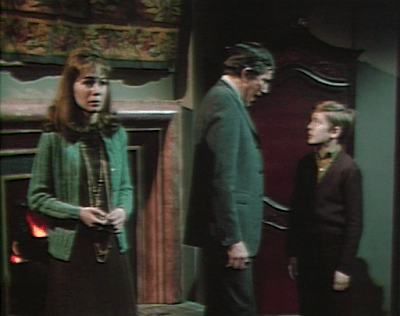
For some time one of the cameras has been on its last legs. In this one, it is almost completely unusable. It is something of a peculiar effect to cut back and forth between two cameras, one of them up to the broadcast standards of the period, the other of which produces only ghostly green images. The episode was directed by Henry Kaplan, who was a poor visual artist under any circumstances. The only remotely ambitious composition he tries today is a shot from a point of view inside a fireplace. They did this several times between December 1966 and March 1967, when David’s mother, undead blonde fire witch Laura Murdoch Collins, was on the show, often to good effect. But this time it is done with the defective camera, and it is simply difficult to see what is going on.





 Dark Shadows Commentary