Paul Stoddard has returned to Collinsport, Maine, the town he left twenty years before when he despaired of getting his hands on his wife Liz’ money. He is being tormented by a mysterious group. What the group is and what it is doing he does not understand, but he knows that they are destroying him and that they want to get their hands on his daughter, heiress Carolyn Collins Stoddard.
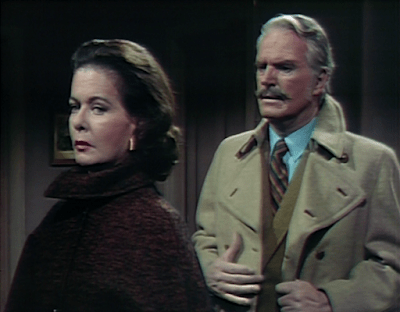
Liz shows up at Paul’s hotel room. He tells her about the shadowy force that is menacing him and Carolyn. He gives her the one fact he is sure of, that her distant cousin Barnabas Collins is a leader of that force. She gets a faraway look in her eyes and says that Barnabas has been different since he “came back,” and that perhaps Paul is right about him. To his astonishment, she invites him to move back into her home, the great house on the estate of Collinwood. If he is the one who has perceived a threat to the family, then he should be in the family’s home where he can make the maximum contribution to the fight against that threat.
Liz’ reaction to Paul’s allegation against Barnabas is intriguing for two reasons. First, Liz has been kept out of the main story consistently since January 1967, when the story centering on blonde fire witch Laura Murdoch Collins was first turning Dark Shadows into a supernatural thriller. Laura cast a spell on Liz to get her out of her way, and she never did make it back into the action. So when we hear her saying that she has noticed something disturbing about Barnabas, concerning whom she has always had a breathtakingly vast blind spot, and that she is ready to do battle, we are presented with the possibility that her character might be reinvented completely. Liz has connections to every other character on the show, and Joan Bennett still had significant star power in late 1969. So a revitalization of Liz might well revolutionize the whole show.
Second, Barnabas’ personality has indeed undergone a drastic change of late. Since every established character on the show is well acquainted with Barnabas, this cannot be concealed for very long. That suggests that the current story will move at a much faster pace than we are accustomed to seeing. If even Liz is entering the action, longtime viewers will suspect that it is already coming to a climax.
Liz sends Paul off to fetch Carolyn. Once he is gone, she picks up the telephone and places a call. We cut to the other end of the call. We see that she is telling Barnabas that everything is going according to their plan. If Liz has merely become one of Barnabas’ minions, the change in her may be temporary and the story may still have some time to run. Paul’s life expectancy, however, may be rather shorter.
Heiress Carolyn Collins Stoddard has been hung up on mysterious drifter Chris Jennings for a while. Unknown to Carolyn, Chris is her third cousin, the great-grandson of her great-great uncle Quentin Collins. That is a distant enough relation that it needn’t be an obstacle to romance. But Chris is keeping another secret that presents a more definite obstacle. He inherited from Quentin a curse that makes him a werewolf.
From March to November 1969, Dark Shadows was a costume drama set in 1897. Old world gentleman Barnabas Collins and mad scientist Julia Hoffman traveled back in time from 1969 to that year, and befriended the living Quentin. They learned that Quentin had been freed of the effects of the werewolf curse when a magical portrait was painted of him. As long as the portrait remains intact, Quentin will not only retain his human form on the nights of the full moon, but will also be immune to injury, aging, and death. Julia and Barnabas know of Chris’ condition, and early in 1969 they were working together to cure him of it. Julia now hopes that another portrait can be painted to do for Chris what his great-grandfather’s portrait did for him.
Barnabas came back from the past wanting nothing to do with Chris. He has secretly been absorbed into a cult devoted to mysterious supernatural beings called the Leviathan people. When Barnabas first saw Chris after his return to 1969, he told him there was no hope for him. Since then, he has been cold and distant both to Chris and to Julia. He has urged Carolyn to forget Chris, and keeps telling her that she has a great future in store for her. We have had other indications that this future will involve a special role in the Leviathans’ plan to take over the world.
Now, Carolyn has met the living Quentin and become smitten with him. She does not know his true identity, but did tell Barnabas about him and that he was coming to meet her. Barnabas’ response was to run Quentin over with his car, claiming afterward that it was an accident.
Now, Quentin is in the hospital with a bandage on his head. He does not speak in today’s episode, but anyone who has seen a soap opera knows that a bandage wrapped around the head is a sure sign of amnesia. Indeed, when Julia addresses him as “Quentin,” he looks at her blankly.
In his post about the episode on his great blog Dark Shadows Every Day, Danny Horn reminds us of another amnesia plot that followed a time travel story. That one dragged on for eight months, was never at all interesting, and ended with the two characters most directly involved being hustled off the show. Remembering it, longtime viewers will shudder at the sight of Quentin’s bandage. But amnesia stories are a staple of soaps, and Danny explains how they can work well by imagining a different version of that dismal flop:
Jeff Clark… might or might not have been a reincarnation of Peter Bradford, Vicki’s boyfriend from 1795. Somehow, they managed to spin that mystery out for a full eight months, until they finally decided that nobody cared, and then they wrote Jeff, Peter and Vicki off the show forever.
The real problem with the Jeff/Peter mystery — and this is important, for the Quentin/Grant Douglas conundrum — is that Jeff Clark was just an empty suit of clothes. Jeff had no memories, and he arrived on the scene with no family, and very little in the way of a storyline.
Worst of all, Jeff’s primary characteristic — being in love with Vicki — was also Peter’s primary characteristic, so it was a distinction without a difference. It didn’t really matter whether he was called Jeff or Peter, so they could just let it drift for month after month, with no appreciable impact on story progress.
Here’s how you do the amnesia story: Think of it as two people inhabiting the same body, and create a conflict between those people. If Peter’s in love with Vicki, then “Jeff” should be cold and distant. “Jeff” didn’t experience any of the events that brought Vicki and Peter together, so her clumsy attempts to revive his memory should upset and frustrate him.
At that point, you can take as long as you’d like to bring his memory back, because the longer this goes on, the more damage “Jeff” can do to Peter’s life. The ideal way to end that story is to have “Jeff” fall in love with Vicki’s worst enemy, and news of their engagement makes Vicki turn to someone new for support and understanding.
Then it should be obvious to everyone that his memory comes back on the day of his wedding, during or immediately after the vows. Suddenly, “Jeff” is Peter again, horrified to discover that he’s married to someone that he doesn’t like, and the love of his life is involved with somebody else.
That’s how you do the amnesia story.
Danny Horn, “Episode 905: Waiting for Quentin,” posted 27 July 2016 on Dark Shadows Every Day.
The sheer fact that Quentin is in a coma as a result of a collision with a car is a puzzle for attentive fans. In #844, sorcerer Count Petofi scraped Quentin’s cheek with a jagged piece of glass. That did not leave a mark on Quentin himself, but a scar appeared on the portrait in the place corresponding to the spot Petofi scratched. Since violence against Quentin leaves him as he was but marks the portrait, why is he hurt now? One of Danny’s commenters tackled this problem:
Yeah, why is he even hurt at all? The painting should have absorbed all the trauma of Barnabas’ reckless attempt at mayhem; the portrait should have amnesia. (Oh, but then it wouldn’t be protecting Quentin any more, since it wouldn’t remember who it’s a picture OF – which is why Quentin has the amnesia and injuries! How’s that for a fanwank?)…
Is it explained later just WHY Quentin thinks he’s Grant Douglas? Did he already have amnesia? And now he has double amnesia? (If I remember sitcom amnesia correctly, the second trauma should have reversed the first – but soap opera amnesia may be different.)
Comment left 29 December 2018 by “John E. Comelately” on Danny Horn, “Episode 905: Waiting for Quentin,” posted 27 July 2016 on Dark Shadows Every Day.
Later, Carolyn is at the antique shop where she has been working. The shop’s owner, Carolyn’s friend Megan Todd, makes a bunch of cryptic remarks about having discovered something greater than happiness. Carolyn wonders about the baby that Megan and her husband Philip have been looking after. She hears a ball bouncing in the upstairs room where the baby has been sleeping, and Megan orders her to ignore it. Eventually the ball comes rolling downstairs, and an eight year old boy follows it. Megan declares the boy to be her darling.
Returning viewers know that the baby was in fact some kind of creature associated with the Leviathans, and Megan has a scene in which Barnabas tells her that the creature is going to be undergoing a change. So we know that this boy and the baby are in fact one and the same.
That two consecutive men who attracted Carolyn turned out to be werewolves is interesting in light of the frequent references to the big plans the Leviathans have for her. The Leviathans have clearly not been giving their devotees a lot of background information about the tasks they make them perform, so that even if Barnabas did not know who Quentin was when he tried to kill him, the unseen forces manipulating him may have been well aware of that. Perhaps the show is suggesting that there is some kind of enmity between the Leviathans and werewolves.
Quentin’s ghost haunted the great house of Collinwood from December 1968 to September 1969 and wrought great havoc there. The haunting broke on the anniversary of an event in 1897 that went differently than it had originally because Barnabas and Julia had traveled back in time. But it was made clear when we returned to contemporary dress that the 1960s characters all remember the events of those ten months, and that Quentin’s ghost still frightens them. Carolyn was one of the few major characters who did not see the ghost, so I suppose it makes sense she isn’t afraid when she sees the living Quentin. But one does wonder what the reaction will be when the other residents of the great house meet him.
The Leviathan boy is played by David Jay, and is named in the credits as “Alexander.” Born in 1961, Mr Jay is the youngest person ever to have appeared on Dark Shadows. He acted off and on until the early 1980s. Evidently he is alive and well, but he never appeared at any of the Dark Shadows conventions and does not do the podcasts on which other cast members occasionally guest. Not one for the fandom, he.
Heiress Carolyn Collins Stoddard thinks that her recently returned father, Paul Stoddard, is mentally ill. She knows that her mother Liz and Liz’ brother Roger are deeply hostile to Paul, and thinks that her distant cousin Barnabas is friendly to him.
We open in the Blue Whale tavern, where Carolyn has been pleased to discover Paul and Barnabas sitting together at a table. Barnabas says that Carolyn is her father’s most precious possession, and she happily agrees. Paul angrily denies that this is the case, and jumps up. He asks Carolyn to go away with him, and leaves the tavern.
Carolyn is bewildered by this reaction, and annoyed when Roger enters. She exits to follow Paul, and Roger goes to the table to warn Barnabas that friendship with Paul would mean trouble with Liz. Barnabas assures him they are not friends.
In Paul’s hotel room, Carolyn tells her father that his troubles are all in his head. She says that she will try to help him, and mentions Julia Hoffman, a psychiatrist who is permanently in residence at the great house of Collinwood. Paul insists that he really does have enemies, and pleads with Carolyn to join him in running far away. She refuses, and insists that he must solve his problems where he is.
Carolyn goes home to the great house. She and Roger have a confrontation. He gives her a check for $5000, payable to Paul. He tells her that the only reason Paul has come back is that he wants to get money out of the Collinses, and that if she gives him that check, he will leave again.
Carolyn goes to the antique shop where she has been working for her friends Megan and Philip Todd. Megan is holding a baby, whom she identified to Carolyn as her nephew Joseph, her sister’s son. Barnabas is with Megan and the baby. Carolyn apologizes to Megan for being late to work, and tells Barnabas she has been late many times. Megan says that it isn’t a problem, that she couldn’t have got away from the shop any earlier even if Carolyn had been there. Barnabas exits.
Carolyn tells Megan that is strange to be reunited with a father who left when she was a newborn. Megan says that she was close to her own father growing up, and that she was an only child. Carolyn furrows her brow, looks at the baby, and asks if he isn’t her sister’s son. Megan scrambles for a second, then claims that Joseph’s mother is her stepsister, one of two daughters of the widow her father married.
Megan takes the baby to his bedroom upstairs. Carolyn answers the telephone, and tells Philip that she will have Megan call him right back. She waits a moment, then goes upstairs. She hears a loud breathing sound coming from the baby’s room, as if a gigantic obscene telephone call were in progress.
Unknown to Carolyn, her father’s troubles are not imaginary, and Barnabas is not his friend. Between her two scenes in the antique shop, we saw Paul in his room. A true Collinsporter, he was in bed fully clothed, wearing even his tie and his shoes, but still he had difficulty sleeping. Barnabas entered the room and told him it was odd to sleep on such a sunny day. To demonstrate the day’s sunniness, he turns a light on. He also ruffles the window-shades, but does not open them. Evidently that would be a little too on-the-nose.
Paul aims a revolver at Barnabas and says that he will kill him if he doesn’t leave him alone. Barnabas says that if he kills him, someone else will be sent in his place. Paul says that he will also kill that person, and he squeezes the trigger several times. That only makes a clicking sound. Barnabas tells him that “we” knew about the gun, as “we” know about everything Paul might do before he does it, and that the ammunition was therefore removed. He also tells Paul that if he leaves Collinsport without permission from whomever it is Barnabas represents, Carolyn will suffer.
The telephone rings, and Barnabas orders Paul to answer it. It is Carolyn. He tells her that he is feeling better, and that he does not want to go away. Barnabas praises him for beginning to see things “our way.”
Paul telling Carolyn that everything is just great with him. Screenshot by Dark Shadows Before I Die.
Today’s closing credits are the first headed by “Starring Jonathan Frid as Barnabas Collins.” From now on, Frid will get the “Starring” designation unless Joan Bennett is in the day’s cast, in which case she gets “Starring” and he follows with “Also Starring.”
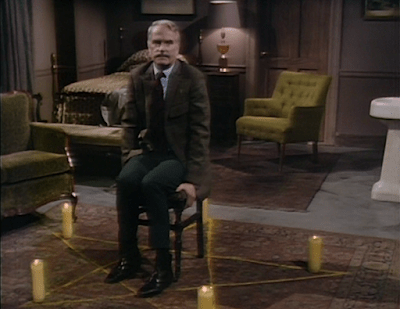
We open with the sight of a man (Dennis Patrick) sitting nervously on a chair placed in the middle of a pentagram marked on a rug. At each point of the pentagram there is a candle. The man is Paul Stoddard.
Regular viewers will remember #752, in which Quentin Collins was told to sit on a chair in the middle of a similar pentagram. Quentin’s friend, amateur warlock Evan Hanley, told him that by doing this he could keep from turning into a werewolf. Paul isn’t afraid of turning into a werewolf, and he doesn’t have a friend like Evan. His worry is vague, but urgent- he knows that someone is after him, that if that someone catches up to him they will do something horrible, and that whoever it is keeps sending him messages that it is time for him to pay his debt. But he has no idea who that is, what they will do, or what the debt they are talking about. Sitting in the pentagram was a suggestion that came from a sailor who cruised him in a gay bar met him in a local tavern.
Paul’s pursuers are a cult associated with mysterious beings known as “the Leviathan people.” It has been made clear to us that both Paul and his daughter, heiress Carolyn Collins Stoddard, are, unknown to themselves, part of its orbit. In #888, Paul and Carolyn ran into each other at a cairn that is the cult’s ceremonial center and looked at it. Carolyn had been on its site many times, and could not understand why she had not seen it before. In #894/895, the cult’s acting leader, Carolyn’s distant cousin Barnabas Collins, took antique shop owner Philip Todd to the cairn. Philip told Barnabas he had walked past the site a few days before and that the cairn was not there then; Barnabas explained that only those connected with the Leviathan cult can see it. Barnabas has also been highly solicitous of Carolyn’s well-being since he became part of the cult, and he keeps telling her that he knows she has an extraordinary future ahead of her. So we know that the cult has plans for her, and Paul’s distress suggests that they have less attractive plans for him.
Paul sees the doorknob turning. He is terrified. Instead of the enemy Paul expects, Carolyn enters. He yells at her to leave. She stays. When he is unable to explain what he is afraid of, but that the pentagram on the floor will protect him, she notices that it is the same as the symbol she has been wearing on a chain around her neck. Barnabas gave it to her some days ago and urged her to wear it always. The audience knows, but she does not, that he intends it to protect her from the local werewolf. When she sees the similarity, the show invites us to wonder what the Leviathans have to do with werewolves. Carolyn tells Paul that if the symbol will protect him from his enemies in the form of chalk or gaffer tape on the floor, it will also protect him when it is composed of a silver pendant. He puts the pendant on and declares that he feels much better. He can no longer hear the voices that have been telling him his payment is due immediately. He embraces Carolyn and tells her he trusts only her.
When Carolyn mentioned Barnabas to Paul, he responded “Who is Barnabas?” Carolyn seems surprised he does not know, since she saw him near Barnabas’ house. Indeed, we saw him enter Barnabas’ house and wander through it the night he first returned to Collinwood, after an absence of twenty years. But he doesn’t remember anything about that.
Not that Carolyn’s own long acquaintance with Barnabas is all that enlightening to her just now. Ever since the Leviathans adopted him as one of their own, he has not been himself at all. We see him in his front parlor with mad scientist Julia Hoffman, who has for a year and a half been his inseparable best friend. She is trying to interest him in some information she has gathered about another storyline, and he makes it clear he could not be less interested in it or in her. She demands to know what he is interested in, and he refuses to answer. Carolyn enters, and suddenly Barnabas is all ears. Julia, frustrated, snaps that now she can see what he does care about.
In the autumn of 1967, Barnabas was a vampire and Julia had failed in an attempt to make him human again. He bit Carolyn and made her his blood thrall. He also decided that he would kill Julia to prevent her exposing him. Julia soon learned that Carolyn was both a wily operator and a most devoted servant. Julia had already realized that she was in so deep with Barnabas that she would be unlikely ever to make a life with anyone else, and so she conceived an unrequited love for him. In her dealings with Carolyn in those days, terror mingled with jealousy. Her bitter remark when she sees that Barnabas, who has been so dismissive of her, is now so concerned with Carolyn, reminds longtime viewers of that jealousy. Combined with the story of a daughter reunited with her long-absent and none too respectable father, this faint suggestion of a love triangle is enough to remind us that we are watching a daytime soap.
For her part, Carolyn was freed of her subservience to Barnabas as soon as he was freed of the effects of the vampire curse in March 1968. For some time, Nancy Barrett went out of her way to play Carolyn in a way that left us wondering if Carolyn remembered her time in his power. The scripts didn’t give her a lot of support in that endeavor, but the closeness she feels towards him combines with Julia’s jealousy to bring it back to our minds.
Carolyn has come to ask Julia to help Paul. Julia is back in the great house of Collinwood getting her medical bag to take to Paul’s hotel room when Paul himself bursts in. He demands to see Carolyn. Julia tells him that she left a little while ago to go to his hotel, and is probably there now. The telephone rings. Julia answers it, and tells Paul it is for him. This doesn’t strike her as odd, even though he hasn’t set foot there in twenty years, not since the night he left his wife Liz thinking she had killed him. Julia hands the phone to Paul. He expects to hear Carolyn, but instead hears the same voice that has been taunting him, saying that his bill is due now. He hangs up, and it starts ringing again. He forbids Julia to answer it, and runs out. We cut to his hotel room, and see that this time it is Carolyn trying to reach her father. Later, Carolyn will come home and Julia will tell her that Paul doesn’t seem to want help, however much he may need it.
Paul goes back to his room, and hears the phone there ringing. Terrified, he runs out, returning to the bar where he’d picked up trade met a new friend the night before. He sees another stranger sitting at a table, looking him over and beckoning him by rolling back one finger. The stranger is Barnabas.
Paul reluctantly goes to the table, and Barnabas introduces himself. Paul says he doesn’t know Barnabas, but Barnabas makes it clear he knows all about Paul. He asks him to think back to the night he left Collinwood in 1949. We dissolve to a flashback.
Paul is at the bar, and another strange man strikes up a conversation with him. The man encourages him to assume that he has the power to grant any wish Paul might make in return for a price they would agree on. Paul says that in that case, he will ask for twenty years of boundless prosperity. At the end of those twenty years, Paul will give up anything he has, even his “most precious possession.” They shake hands on this deal. Paul laughs, and says he has won the game. He said that he would surrender anything he has, present tense- not anything he might gain in the course of his successful future, but anything he has as of 4 December 1949. On that date, Paul assures the man, he has nothing anyone could possibly want. The man laughs, and wants to drink to congratulate Paul on his cleverness.
Back in the present, Barnabas is laughing as heartily as the other man did twenty years before. He finds it preposterous that Paul could have forgotten such an important encounter. Paul can’t see anything important in it- it was just a silly little game, and its only consequence was that a strange man bought him a drink. Barnabas says that on the contrary, the bargain he struck was quite real. The Leviathans kept their side of it by giving him the success he has had over the last twenty years. Now that the twenty years are up, the time has come for them to claim the most precious possession he had the night he fled Collinwood.
Paul says that he supposes Barnabas is talking about his soul. He laughs heartily at that, and tells Barnabas that he is welcome to it. He is telling Paul that that is not what he meant as Carolyn enters. Paul is still laughing, and is delighted to see his daughter. She says she is relieved that the two of them found each other, and he tells her everything will be all right now. Barnabas says that Carolyn is her father’s most precious possession.
The scenes of Paul rushing around in a steadily mounting panic he is unable to explain are highly reminiscent of The Twilight Zone. The last line is a twist worthy of that classic series, especially as delivered by Jonathan Frid. His icy performance as Barnabas in these early episodes of the Leviathan arc not only recalls the malign representatives of alien powers on that show, but is superb in itself. He stumbles a little over his words in Barnabas’ scene with Julia, but is perfectly composed otherwise, and the effect is quite frightening.
I remarked on the gay subtext of the barroom scenes in the comment thread on Danny Horn’s post about the episode at his great Dark Shadows Every Day:
So far, this has been the gayest storyline the show has taken on yet.
In 899, the sailor offers to buy Paul a drink, and Paul shouts “I buy my own drinks!” This isn’t subtext- any man getting that reaction in a bar will know that the other fellow has interpreted his offer as including more than the drink. Paul apologizes and becomes friendly, indicating that he is willing to abandon that interpretation and set aside the hostility that accompanied it.
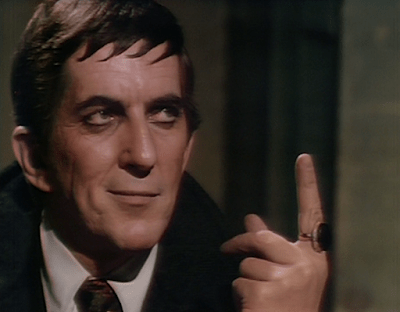
In this episode, we’re back in the same bar. Barnabas beckons Paul to his table with his index finger. I invite any man who doesn’t think we are intended to read this as a reference to a sexual come-on to try that move on a homophobic tough guy in a bar.
Paul’s face shows his inner struggle as he tries to resist Barnabas’ advances, but he can’t. Barnabas coaxes him into reminiscing about yet another night in the same bar, when a casual encounter with yet another guy led to something that seemed at the time like a little harmless tomfoolery, but that has now grown into a threat to his relationship with his family, his standing in the community, his physical well-being, and everything else.
Comment by “Acilius,” left 12 December 2020 on Danny Horn, “Episode 900: The Long Con,” posted on Dark Shadows Every Day, 18 July 2016.
In response to someone who said some kind words about that comment, I made a remark that I no longer think is very good:
Thanks! It’s a bit of a puzzle- so far as I know, none of the writers on the show at this time was gay, so I’m not sure why they decided to go so deep into these themes just then.
Comment by “Acilius,” left 11 April 2021 on Danny Horn, “Episode 900: The Long Con,” posted on Dark Shadows Every Day, 18 July 2016.
What I think now, and probably would have thought then if I had stopped and considered it for a minute before I hit “Post Comment,” is that the writing staff’s sexuality has nothing to do with it. They were worldly, sophisticated people with long experience in the theatrical profession in New York City. They all probably had many gay friends, and when they are called upon to write a story about people being drawn into a secret underworld and learning uncomfortable truths about themselves in the process their minds will naturally turn to themes having to do with closeted homosexuality. Granted, that doesn’t fully account for Christopher Bernau’s decision to play Philip as a much queenier version of Paul Lynde, but it is hardly a “puzzle” that the writers would draw on motifs suggestive of the closet when that’s the story they have to work with.
The man who met Paul in the bar in 1949 is unnamed in today’s dialogue, but will later be referred to as Mr Strak. Strak is played by John Harkins, who appeared in #174 as Lieutenant Costa of the Arizona State Police and in #878, 879, 880, 881, and 883 as Garth Blackwood, formerly the keeper of England’s Dartmoor Prison, and by that time a creature raised from Hell to wreak vengeance on an escaped prisoner and anyone else who caught his attention.
Strak’s name may remind longtime viewers of another minor character whom we saw in episodes #1 and #2, Wilbur Strake, private eye. We saw Strake in this same bar, where he gave reports about Carolyn and other members of the Collins family to his employer, Burke Devlin. Like Strak, Strake was a rather smug, sardonic sort. Add to this the rarity of the names “Strak” and “Strake” and the fact that they sound so much alike, and it seems obvious that there is an intentional reference of some kind. Paul’s presence in this storyline is the result of the writers reaching back to the show’s early days to find a loose end they could attach to this storyline to incorporate it into the Collins family saga, so they probably were looking through the scripts from the first week. Still, I can’t imagine they thought many people would remember Wilbur Strake by this point. Likely the reference is an inside joke, but who was on the inside and what the point of the joke was, I can’t begin to guess.
I wasn’t writing detailed posts with background information when I covered the first weeks of the show, so I will mention here Strake was played by Joseph Julian, who later became a regular on Somerset, a soap that aired on NBC opposite Dark Shadows for the last year of its run. The cast of Somerset included several Dark Shadows alums, including Dennis Patrick, Joel Crothers, and Christopher Pennock in major roles, and, as day players, Dolph Sweet and Humbert Allen Astredo.
A cult devoted to the service of supernatural beings known as “the Leviathan people” is secretly establishing itself in and around Collinsport, Maine. Antique shop owners Megan and Philip Todd are members of the cult. Its acting leader, old world gentleman Barnabas Collins, has entrusted them with several items sacred to the cult. The Todds are responsible for a scroll, a box, a book, and a baby. Now the book has gone missing, and the baby is sick. Yesterday, Barnabas responded to this situation by brainwashing Philip into killing Megan. Today, we open with Philip entering the antique shop and choking Megan.
Megan is Marie Wallace’s third character on Dark Shadows. Her first, fiancée of Frankenstein Eve, was strangled by her intended spouse Adam in #626. Her second, madwoman Jenny Collins, was strangled by her estranged husband Quentin in #748. The murder of Eve came at the end of the Monster Mash period of the show that stretched throughout most of 1968, while the murder of Jenny marked a turning point in the eight-month costume drama segment set in the year 1897. The Leviathan arc is just beginning, and Miss Wallace’s character is already being strangled by her husband. If we were hoping for fresh new story ideas, we couldn’t be more disappointed.
Until, that is, the strangulation is called off. Philip is holding Megan by the neck, reiterating that “There is no margin for error! Punishment is necessary!,” when strange and troubled boy David Collins appears on the staircase and announces “punishment is no longer necessary.” Philip releases Megan, and David informs them that he is now “the keeper of the book, and the protector of the baby.” He gives Megan and Philip medicine that will cure the baby of his illness. He tells them that if they need him, he will know and will appear.
Barnabas was a vampire when he joined the cast of characters in April 1967. As a villain he was unrivaled at giving everyone else things to do, whether as his victims, his accomplices, or his would-be destroyers. In March 1968, his curse was put into abeyance and he became human. He set out to be the good guy, but still had the personality of a metaphor for extreme selfishness. As a result, Barnabas the would-be hero created at least as many disasters as Barnabas the monster ever did. He thus remained the driving force of the show, as well as its star attraction.
While Barnabas can keep things going from day to day, Philip’s attack on Megan suggests that he cannot take the story in new directions. From episode #1, that has been David’s forte. The series began when well-meaning governess Vicki was called to Collinwood to take charge of David’s education, took its first turn towards grisly tales when David tried to murder his father, became a supernatural thriller when David’s mother the undead blonde fire witch came back for him, began its first time travel story when Barnabas was planning to kill David in November 1967, and was launched into both the “Haunting of Collinwood” that dominated the show from December 1968 through February 1969 and the 1897 segment that followed it by David’s involvement with the ghost of Quentin Collins. David was not always a highly active participant in the stories that began with him; indeed, he sometimes disappeared altogether for months at a time. But even from the outside, he is the instrument by which the basic architecture of the show is reshaped. Now that he is, apparently, the leader of the Leviathans, we can renew our hopes that something we haven’t seen before is still in store for us.
David is still in the shop when a gray-haired man enters. David greets him as “Mr Prescott,” the name by which he heard his cousin Carolyn address the man when he met her in the shop the other day. David has a smug look on his face that suggests he knows this is an alias. Indeed, we already know that the man is connected with the Leviathan cult, so the leader of the cult may well recognize him as Paul Stoddard, Carolyn’s long-missing father.
Paul asks the Todds to give a note to Carolyn. David says that he will be going home to the great house of Collinwood in a few minutes, and volunteers to take the note to her there. Paul gladly hands it to him.
At Collinwood, permanent houseguest Julia Hoffman is conferring with mysterious drifter Chris Jennings. Yesterday, Jenny’s ghost appeared to Chris and told him that Quentin could help him with his big problem, which is that he is a werewolf. Jenny did not identify herself, and Chris had no clue who she was.
Julia shows him a Collins family photo album. She shows him a picture of maidservant Beth Chavez and asks if that is who he saw. He says it wasn’t, and they keep turning pages. It is interesting for regular viewers that they take a moment to put Beth’s picture on the screen and to make some remarks about her. Beth appeared several times during the “Haunting of Collinwood” segment, and was a major character during the 1897 flashback. The sight of her picture is the first reason we have had to suspect that either she or actress Terrayne Crawford will be back.
Chris and Julia look through a Collins family photo album. Screenshot by Dark Shadows Before I Die.
When Chris recognizes Jenny’s picture, Julia breaks the news to him that Jenny and Quentin were his great-grandparents, and that Quentin was the first to be afflicted with the werewolf curse. We know that Quentin and Jenny’s daughter was named Lenore, and that she was raised by a Mrs Fillmore. Chris confirms that his grandmother’s maiden name was Lenore Fillmore. Wondering how Quentin could help Chris, Julia decides they will hold a séance and contact Quentin’s spirit.
David enters, looking for Carolyn. Julia asks him to participate in the séance. He agrees, with the blandness appropriate in a house where séances have become almost routine. When Julia tells him that the spirit they are trying to reach is that of Quentin Collins, David becomes alarmed. As well he might- we left 1969 at the beginning of March, but in #839, broadcast and set in September, we saw that the haunting continued in the absence of the audience, and that Quentin’s ghost had killed David. That episode took place on the anniversary of an event in 1897 that was changed by time travelers from the 1960s, and so David came back to life and the haunting ended. But everyone at Collinwood still remembers the ten months that Quentin exercised his reign of terror, and David does not want to return to it.
Julia assures David he has nothing to be afraid of. She says that the past was changed as of September 1897/ September 1969, and that Quentin’s ghost was laid to rest forever. This doesn’t fit very well with her plan to disturb that rest, but David is still ready to go along with the plan.
When they have the séance, David goes into the trance. He speaks, not with Quentin’s voice, but with that of Jamison Collins, his own grandfather and Quentin’s favorite nephew. Jamison says that Quentin’s spirit is no longer available for personal appearances. He doesn’t know more than that, and excuses himself. When David comes to and asks what happened, Julia says she will tell him later and sends him to bed. Once he is gone, she tells Chris that she thinks Quentin may still be alive.
Quentin was a big hit when he was on the show as an unspeaking ghost during the “Haunting of Collinwood,” and became a breakout star to rival Barnabas when he was a living being during the 1897 segment. So the audience is not at all surprised that he will be coming back. But David’s behavior before, during, and after the séance is quite intriguing. He is not simply possessed by some spirit that is part of whatever it is the Leviathan cult serves. He is still David, is still afraid of Quentin’s ghost, and is still fascinated by séances. During the 1897 segment, Jamison was a living being; like David Collins, he was played by David Henesy. That Jamison can speak through his grandson and not express discomfort at the unfamiliarity of the atmosphere suggests that there are sizable expanses inside David which are still recognizably him.
There is a similar moment between Philip and Megan. She smiles at him and in a relaxed voice says she understands why he had to do what he did. Philip has no idea what she is talking about. She reminds him that he tried to strangle her earlier in the evening, and he suddenly becomes highly apologetic. She tells him he has nothing to apologize for, that it was his duty as a servant of their cause. He is still anguished about it. They share a tender embrace. Again, while the force that animates the Leviathan cult may have the final say over what Megan and Philip do, their personalities are still there, and the loving couple we met a not so long ago still exists. There is still something for us to care about concerning them.*
Paul also has a lot of activity today. He goes to the cairn in the woods that is the ceremonial center of the Leviathan cult and that only people associated with it can see. He wonders why he keeps being drawn to it. When he first returned to Collinwood in #887, he was watching when the cairn materialized in its place out of thin air. He didn’t react at all, but merely turned and continued on his stroll. That led us to believe he knew a great deal about the cult, enough that he not only expected to see this extraordinary sight, but knew he need take no action regarding it. But evidently his connection is more subtle, and he does not understand it himself.
In his hotel room, Paul goes into a trance and circles the date 4 December 1969 on his calendar. That was when the episode was first broadcast, so the original audience would have assumed he was merely circling the current date. But when it was taped, the makers of Dark Shadows had expected the episode to be shown on 3 December. In between, there had been a pre-emption when the ABC television network gave its news department the 4:00 PM timeslot to cover the end of the Apollo 12 lunar landing mission. So the intention had been that we would share Paul’s puzzlement as to what was so special about the next day.
Paul is already worked up because some unknown person left him a note at the antique shop reading “Payment Due, 4 December 1969.” By the end of the episode, he notices that a tattoo has appeared on his wrist. It is a symbol that the show refers to simply as “the Naga,” a group of intertwined snakes that represent the Leviathan cult. All of this combines to get him into quite a state.
* I should mention that Danny Horn made the same point in his post about the episode on his great Dark Shadows Every Day: “And then they kiss, and the creepy thing is that I think they’re actually in there… So far, I’ve been critical of Chris Bernau, but he’s the one who pulls this moment together. As far as he’s concerned, the unpleasant incident is entirely forgotten — but when Megan brings up the fact that he was seconds away from killing her, his apology is entirely sincere.” Danny Horn, “Episode 989: Executive Child,” on Dark Shadows Every Day, 12 July 2016.
Yesterday we saw strange and troubled boy David Collins (David Henesy) go to a mysterious cairn in the woods, the ceremonial center of the cult of the Leviathan people, and announce that he was now one of the cult. The cairn then opened, revealing a little gap. David crawled into the gap. The gap was not quite big enough for him, so that the episode ended with an extended sequence of David Henesy wiggling his rear end at the camera while he tried to wedge himself into place.
Today we learn that the carpenters were not the only ones who haven’t caught on that Mr Henesy isn’t nine years old anymore. David has followed the gap to an underground chamber with a steaming cauldron. He takes some vegetation out of the cauldron and recites a cryptic poem, all the while staring portentiously off into space. His manner, words, and actions would be effective as part of a creepy little kid sequence, but the thirteen year old Mr Henesy looks mature enough that we just chalk him up as one more member of the Leviathan cult.
The Trouble with Chris
Heiress Carolyn Collins Stoddard calls on drifter Chris Jennings in his cottage. They talk about someone named Sabrina who has told Carolyn that while Chris is a nice enough guy, he will, in spite of himself, kill her if she keeps hanging around him. Chris tells Carolyn that this is true and that he is “a monster.” He does not explain. She leaves, and he takes out a pistol. First-time viewers will wonder if Chris has a compulsion to fire his pistol at people. Regular viewers know that he is a werewolf, and that his particular case of lycanthropy is so advanced that he sometimes transforms even when the moon is not full. We can assume that he plans to use the pistol to put himself out of his misery.
Regular viewers also know that Chris was safely confined to a mental hospital until he checked himself out recently. When he returned to the great house of Collinwood, he told his psychiatrist, permanent houseguest Julia Hoffman, that he just couldn’t stand the conditions at the hospital. Since leaving the hospital means that Chris will resume killing at least one random person a month, this decision just about completely erased any sympathy we might have for him as a character. It also undercuts his motivation in this scene. If Chris really wants to stop killing, he is free to go back to the hospital at any time.
The ghost of Chris’ great-grandmother, Jenny Collins (Marie Wallace,) appears. She tells him not to commit suicide. Dark Shadows was a costume drama set in 1897 from March to November 1969; in those days, we got to know Jenny as “Crazy Jenny,” who played nothing but one mad scene after another. She was sane and well-put-together just once, when she appeared as a ghost in #810 and #811. In this second postmortem appearance, Jenny is extra mad, wearing a disheveled wig that reaches heights few hairpieces have dared. She does not tell Chris to return to the hospital, but to find his great-grandfather, Quentin Collins. She says that she cannot help him, but Quentin can.
This confirms what the show has been hinting, that Quentin is alive. Chris doesn’t know that, nor does he know of his relationship to Quentin. He is left bewildered and helpless by Jenny’s pronouncement. His response would no doubt be more complex if he were up to date, but he has been so ineffective at managing his curse and so irresponsible generally that we can’t imagine he would do anything constructive even if he knew everything we do. The character seems to have reached a dead end.
The Trouble with Barnabas
Upset by her conversation with Chris, Carolyn goes to her distant cousin, old world gentleman Barnabas Collins. She enters his home, the Old House on the estate of Collinwood, and finds the front parlor empty. She hears Barnabas’ voice coming from behind a bookcase, repeating over and over that “There is no margin for error. Punishment is necessary.”
Longtime viewers know, not only that a room is hidden behind this bookcase, but that Carolyn knows about that room. Her friend, David’s well-meaning governess Vicki, was held prisoner there by a crazy man in December 1966, several months before Barnabas joined the show. Carolyn is moving her hands, as if she is looking for the release that makes the bookcase swing open, when Barnabas comes downstairs.
When Carolyn says that she heard his voice, Barnabas explains that he was simply keeping busy by “conducting an experiment in electronics.” The candles around the room will suffice to show that the house doesn’t have electricity, and even if Barnabas weren’t so resolutely technophobic it would still require explanation that the text he set his speakers to reproduce over and over was “There is no margin for error. Punishment is necessary.” Moreover, Carolyn knows Barnabas well, and she can’t have overlooked that he is not his usual self these days. He is distant, calm, and utterly self-possessed, a far cry from the fussy, excitable chap who so often stumbles over his words. He remains formidably well-composed as he reiterates his position that Chris is a dangerously unstable person whom Carolyn should avoid, and that she has a bright future ahead of her. He gently but firmly guides her to the front door, and she is out of the house in record time.
Carolyn does not know that Chris is the werewolf, but at least she knows that there is a werewolf. She does not know that the Leviathan cult exists, and so it is understandable that she does not suspect that Barnabas is acting as its leader. But as the story unfolds, others will no doubt catch on that something is up, and so many people have spent so much time with Barnabas that it is difficult to see how they can all fail to notice the drastic change in his personality and to connect it with the strange goings-on. Putting him in this position makes it likely that the writers will have a harder time managing the story’s pace than they would if his involvement were more subtle.
Once Carolyn has exited, Barnabas opens the bookcase and reveals Philip Todd, antique shop owner. He rewinds a reel-to-reel tape and replays “There is no margin for error. Punishment is necessary.” Philip and his wife Megan are members of the cult, entrusted with the care of many of its most sacred items. Yesterday Barnabas found out that one of these, a book, had gone missing. He summoned Philip to the cairn, and it seemed he might be about to kill Philip. But now, he sends Philip off to administer the punishment to someone else, presumably Megan.
The Trouble with Megan
Megan (Marie Wallace) has been in an extremely overwrought state ever since she found that the book was gone. Today’s episode ends with a long scene in which she is alone in the shop, feeling that someone is coming to kill her, reacting sharply to every noise.
Danny Horn devotes most of his post about the episode on his great Dark Shadows Every Dayto reasons why this scene does not work, among them the fact that a depiction of a person descending into madness requires that the person start off as something other than over-the-top loony. Megan has been so frenzied for the last few days that Miss Wallace has nowhere to go when she hears the ominous noises. Moreover, her first two characters on Dark Shadows, fiancée of Frankenstein Eve and Crazy Jenny, were both intense, overbearing characters who were so inflexible that they had little opportunity to respond to anything their scene partners might do. Longtime viewers therefore expect to see Miss Wallace screaming and carrying on by herself, so nothing she does here will unsettle us. They lampshade this iconography problem by showing us Crazy Jenny’s ghost today, but that doesn’t help at all.
Many fans compare this scene to episode #361. Most of #361 is devoted to a one-woman drama in which Julia is tormented by sights and sounds in her bedroom, suggesting that her mind is collapsing. I don’t think that episode is a success, but because Julia had always been in control of herself up to that point we can see what is supposed to be at stake in it. That’s more than we can say for Megan’s fearful turn.
In John and Christine Scoleri’s post about the episode on Dark Shadows Before I Die, Christine points out the prominence of the taxidermied animals in the background, and speculates that the scene is an homage to The Night of the Living Dead. I wouldn’t have guessed that director Lela Swift or writer Violet Welles would have studied that film, but Christine provides screenshots from it and from the episode, and the parallels are so striking that I can’t see how she could be wrong.
Closing Miscellany
I think the tape recorder is the same one we saw in the summer of 1968, when it was part of the Frankenstein story. It also appears to be the one that parapsychologist Peter Guthrie brought to Collinwood early in 1967.
Her haunting of Chris marks Jenny’s final appearance. Miss Wallace reprised the role decades later in a couple of the Big Finish audio dramas.
During Megan’s big scene, the camera swings a bit to the left and we can see beyond the edge of the antique shop set. We get a good look at a tree that stands near the cairn in the woods. Making matters worse, when they turn the camera away from the tree they go too far right, showing a stage light on the other side.
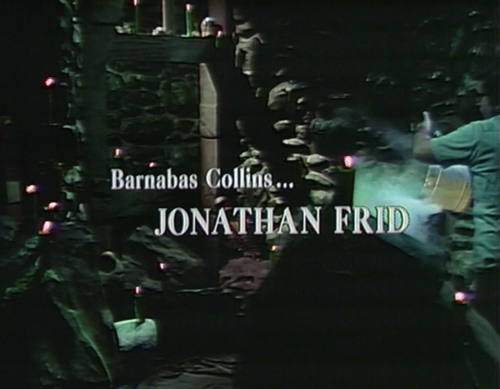
As the opening credits begin to roll, the camera is pointed a bit too far to the right and a stagehand is visible, adding dry ice to the steaming cauldron in the underground chamber.
Old world gentleman Barnabas Collins has become the leader of a mysterious cult. Antique shop owners Megan and Philip Todd are members of the cult, and they have a magical baby who materialized after Barnabas gave them a sacred box. Inside the box was a book that is also of tremendous importance to the cult. Philip and Megan left the book on a table in their shop, so that it appeared to be for sale. Yesterday strange and troubled boy David Collins stole the book. In its absence, the baby has developed a high fever. When Megan and Philip found that the book was gone, they flew into a panic and declared that they would have to kill the person who took it.
Many stories on Dark Shadows start with David, so it could be that the uncanny and sinister forces behind the cult want him to have the book. If so, Barnabas doesn’t know any more about it than do Philip and Megan. He finds out today that the book is missing, and takes Philip to a cairn in the woods. He tells him he will have to be punished for losing it.
When Philip first saw the cairn, he remarked that he had been that way before, but never noticed it. Barnabas explains that only people connected with the Leviathan cult can see it. This casts the minds of returning viewers to heiress Carolyn Collins Stoddard, Barnabas’ distant cousin. In #888, Carolyn saw the cairn and ran into a prowler there. The prowler refused to identify himself to her; the closing credits told us he was Paul Stoddard, Carolyn’s long missing father. We had seen him from behind the day before, when he saw the cairn materialize, then simply walked off. His blasé response told us that he expected to see what he saw, which can only mean he was connected with the cult. Carolyn doesn’t know anything about the Leviathans, but what Barnabas says to Philip today confirms that she is nonetheless associated with them in some sense. Indeed, Barnabas has been very solicitous of Carolyn’s well-being ever since he joined up with the Leviathans and keeps telling her that she has an extraordinary future.
There is also some business going on between Paul and Carolyn. On the surface it would seem to be a typical soap opera story, in which the daughter is trying to reintroduce her errant father into the family circle and has to keep secrets from her mother and young cousin to pull it off. Given what we know about Paul’s awareness of the Leviathans and their interest in Carolyn, we can see that it is in fact part of the supernatural A story.
There are no closing credits today, only the logo of Dan Curtis Productions. The Dark Shadows wiki says that this one was directed by Henry Kaplan. I am certain this is false. Kaplan was very clumsy with the camera, resorting to closeup after closeup and then to ever-more extreme closeups until you have scenes played by one actor’s left ear opposite another’s right nostril. Today, there is a scene between Carolyn, David, and Barnabas in the drawing room of the great house at Collinwood, a scene in which Carolyn presses David with questions about the book, that is so expertly choreographed that only Lela Swift could have blocked it. My wife, Mrs Acilius, marveled at the dance that Nancy Barrett, David Henesy, and Jonathan Frid execute so flawlessly.
This episode is double numbered to make up for a planned pre-emption, when the ABC television network showed football at 4 PM on the afternoon of Thanksgiving Day. Every Friday’s episode was supposed to have a number that ended with a five or zero, so that all you had to do was divide by five and you would get the number of weeks the show had been on. That didn’t work this time, because there was also an unplanned pre-emption when the network’s nes division took the 4 PM slot to cover the return of the Apollo 12 mission. They are producing episodes well ahead of their airdates at this point, in a couple of cases over five weeks ahead, so it will be a long while before they can get back in sync.
No episode of Dark Shadows premiered 56 years ago today. Instead, the ABC television network showed football, as is traditional on the USA’s Thanksgiving Day holiday.
I see I haven’t yet linked to Dark Shadows and Beyond: The Jonathan Frid Story, the documentary film that Frid’s dear friend and longtime business associate Mary O’Leary made in 2021. Any fan of the show who hasn’t seen it should do so at the earliest opportunity. It’s available on many streaming platforms; if you don’t mind commercial interruptions, you can watch it for free on Tubi.
If you look at discussion boards and comment sections on fansites that were up before the movie was released, you’ll see people going round and round at incredible length about whether Frid was gay. We all owe Ms O’Leary and her collaborators a debt of gratitude for confirming that he was and thereby putting a stop to that pointless wrangling once and for all.
Frid was often called a “Shakespearean actor” when Barnabas was a big presence in pop culture. The documentary shows that while he was never the Shakespeare specialist this title would suggest, it isn’t exactly wrong to call him that. He did spend a lot of time on Shakespeare as a student actor in Canada and in England, each of his appearances in a Shakespeare play marked a definite turning point in the development of his style, and his one turn as a director was at the helm of a production of James Goldman’s pseudo-Shakespearean The Lion in Winter. He brought a distinctly Shakespearean tone to all of his works, allowing Dark Shadows to hold our attention even when the stories are as silly as the plots of Elizabethan comedies.
The movie also shows how deeply Canadian Frid was. He grew up in Hamilton, Ontario, son of a prominent businessman and civic benefactor. The discussion of H. P. Frid leaves us with the thought that social prominence in Canada is rather a different thing than it is south of the border. Old Mr Frid seems to have occupied a lordly place that would not have been possible where the USA’s single market pulls even the most remote town into the swing of national life and presents constant reminders that the local bigwigs are themselves somewhere down the pecking order from grander figures elsewhere. Young John Frid may have pursued a career on the stage to escape his father’s shadow, and it is no wonder he had to go abroad to accomplish that.
While in England as a student at the Royal Academy of Dramatic Arts and then as an actor in regional theater, it was his North American identity that dominated people’s perception of him. For all that Canada had the same monarch who put the “Royal” in RADA’s name, in Frid’s appearances on the English stage was usually cast as a US national. And after his fame in the USA and period of residence in Mexico, Frid did go back to spend his final years in Canada. The footage of him there shows him at home in a way that he never was anywhere else.
Old world gentleman Barnabas Collins has given a present to antique shop owners Megan and Philip Todd. It is a wooden box. This box has a strange effect on the Todds, filling them with a mixture of irresistible fascination and nameless dread.
When the Todds go to open the box, it makes a whistling noise. They find a book inside it. The book is noticeably larger than the box. It is written in a script they do not recognize. There is also a scroll. That is in English, but may as well not be- neither Philip nor Megan can understand it, though Megan does say that she feels as if she almost can.
Later, Megan has a dream. It is the sort of dream people had in the first year of the show, before there were special effects. Like the dreams in ancient Greek literature, it takes the form of someone standing by the bed and making a speech. The speaker is Barnabas, and he tells Megan to empty the bedroom of furniture, board up its windows, and let no outsiders enter it. She calls him “master,” and he tells her she will not recognize him as such when she is awake. When she does wake up, she finds that Philip is already following the instructions, and realizes they had the same dream.
Downstairs, heiress Carolyn Collins Stoddard is minding the antique shop. She receives a telephone call from someone wanting to buy a cradle that is on the shop floor. At the end of the call, we hear Carolyn’s thoughts as she congratulates herself on making a sale. She is shocked when Megan comes down and tells her the cradle is not for sale. Philip comes afterward, and with a blank expression on his face carries the cradle upstairs. Carolyn is left to call the buyer back and apologize.
Philip and Megan set the cradle in the special room. They are apparently in awe. They look like any new parents stunned by the fact that they have brought a new life into the world, but the cradle is empty. After they leave the room, it starts rocking by itself.
The cradle is an interesting choice of prop. It was important early in 1969 in the “Haunting of Collinwood” story, when it was associated with the ghosts and rocked by itself. We then saw it a couple of months later in the 1897 flashback, when we learned why it was haunted. Those stories have been resolved in such a way that it won’t occur to us that the consequences of the same tragic events are animating it this time. The cradle seems to have become a generic symbol of spookiness. Considering that its back is coffin-shaped, that’s an understandable association.
Meanwhile, Maggie Evans, The Nicest Girl in Town, has come into the shop. Maggie is the governess in Carolyn’s home, the great house on the estate of Collinwood, and they are friends. Maggie notices the sacred book on a table and asks Carolyn what it is. Carolyn doesn’t know anything about it. Why the Todds would leave such a thing on a table in their shop, a placement that implies it is for sale, is not explained.
Maggie tries on a feather boa. Like the cradle, this prop was significant in the 1897 segment. In that part of the show, Nancy Barrett, who plays Carolyn, was introduced as a woman named Charity Trask. Charity’s body was eventually taken over by late Cockney showgirl/ mentalist Pansy Faye. She wore the boa to indicate that she was Pansy. We last saw Charity/ Pansy, boa and all, in #883, and heard her voice in #887, so when we see it in the shop regular viewers will have fresh memories of her. We may well hope Carolyn will put it on and start singing Pansy’s song. But Maggie is the only one who is interested in the boa, and she doesn’t seem possessed at all. She wants to buy it, but Megan comes in and prevents her doing even that. She declares she is going to be closing the shop early.
Maggie leans very heavily on Carolyn to join her for a drink at the local tavern, The Blue Whale. Even after she drags Carolyn there, Maggie keeps pressuring her to stay for another drink. This is not at all typical of Maggie. When we find out her reason, it turns out to be even less characteristic. A mysterious gray-haired man who has been lurking around Collinwood lately wants to sit with Carolyn. When he comes to the table, Maggie gets up and leaves Carolyn alone with him. She has a self-satisfied smirk on her face as she does so, not a look we have ever seen her give before.
The man introduces himself to Carolyn as Paul Stoddard, her father. Paul abandoned the family when Carolyn was an infant, in the process faking his own death and prompting Carolyn’s mother Liz to believe that she had killed him. That belief led Liz to confine herself in her home for nineteen years, terrified that she would be caught. So it is simply inexplicable that Maggie would think Carolyn would be happy about having this bomb dropped on her.
Paul’s introduction of himself to Carolyn is the first time he is identified in a scene, but it is not the first time viewers have been told who he is. His name appeared in the closing credits for #887 and #891, ruining the surprise that is supposed to give a punch to the ending of today’s episode.
Dark Shadows committed itself to supernatural stories in late 1966 and early 1967, when the chief villain was undead blonde fire witch Laura Murdoch Collins. Since the usual laws of nature weren’t going to restrain Laura, they needed another set of rules that could predict her behavior sufficiently to create suspense. One of the things they settled on was that the barrier between past and present grows thin on the anniversaries of deadly events. So when well-meaning governess Vicki and the team she had assembled to fight Laura discovered that, in a previous iteration, she had taken a young son of hers to his fiery death “exactly one hundred years ago,” they knew that the crisis was at hand.
Anniversaries continued to have this effect in subsequent periods. So when in January 1969 recovering vampire Barnabas Collins wanted to take a day trip to the 1790s, he stood in a graveyard and shouted at a man who had died exactly 172 years previously to ask for a ride. It worked.
Barnabas was using a different form of mumbo-jumbo at the end of February, trying to contact the ghost that had made the great house of Collinwood uninhabitable, when he came unstuck in time and found himself in the year 1897.
In the middle of Barnabas’ long stay in 1897, the show decided to take its conceit that two events occurring on the same date in different years were mystically connected and show us both sides of the link. In #835, Barnabas was locked up in a cell with a secretary cabinet that he knew would be in the front parlor of his home, the Old House at Collinwood, in 1969. He wrote a letter to his friend, mad scientist Julia Hoffman, and hid it in a secret compartment of the secretary. We cut to the front parlor in 1969, exactly 172 years later, where a series of events leads Julia to discover the letter, travel back in time, and precipitate Barnabas’ rescue.
By #839, the events of 1897 had played out differently enough from whatever happened the first time through that year that the ghosts found peace. As we cut back and forth between that year and 1969, we saw that the 1960s characters remembered the haunting and the disasters that accompanied it and were relieved that they were over.
That gives us the present as the result, not of any one series of events in the past, but of a composite of many separate and mutually incompatible pasts. This idea is the logical culmination of substituting anniversaries for natural laws. In the first part of Barnabas’ trip to 1897, he had not yet done enough to lay the ghosts to rest. So the haunting continued, because it was happening on the anniversaries of events that were much the same as those that took place originally. By the time the living people of 1897 who would become the ghosts of 1969 had changed enough that they were no longer doomed to haunt the house, the date was one that would fall almost ten months into the haunting. In #836, Julia had a conversation in which one of the ghosts tells her about events in 1897 that could not have happened in the original timeline without Barnabas’ intervention, and which do not happen in #838 after Julia herself travels to that year. So each anniversary creates another past that becomes another ingredient in the stew that makes up the present.
This conception of the relationship between past and present shows the difference between a set of fantastic tales like Dark Shadows and a science fiction story exploring more-or-less plausible consequences of open questions in science. The “Copenhagen Interpretation” of quantum mechanics posits that the cosmos is made up of countless parallel universes, and that everything that could ever have happened did happen in at least one of those universes. Since that is a defensible position within science, an author can incorporate as much fact and reality as s/he likes in a story based on it. But since the idea that one period of history is the result of a confluence of many conflicting pasts is not only not a live option in science, but does not really make any practical sense except as a metaphor, the logic that really matters is dream logic. As dreams seem perfectly convincing to us when the only connections that lead from one moment to another are random similarities in names or shapes, so all that matters in a fantastic tale is that there is a pattern the audience can follow, whether or not that pattern corresponds to anything in the world where we spend our waking hours.
Now Barnabas has returned to 1969, brought back by a mysterious cult that has brainwashed him and adopted him as its leader. The characters he knew before he left are delighted to see him again. Today, matriarch Elizabeth Collins Stoddard comes to the Old House and is overjoyed that the haunting is over and that she and her family have been able to return to the great house. She is grateful to Barnabas for undertaking his harrowing journey back in time.
Liz and Barnabas talk about Chris Jennings, a young man in whom Liz’ daughter Carolyn is interested. Barnabas gives it as his firm opinion that Carolyn should avoid Chris, and he urges Liz to encourage her to do this. Barnabas knows that Chris is a werewolf, and we saw last week that the cult that has co-opted him has plans for Carolyn which do not include her death as one of Chris’ victims, so this will not surprise returning viewers.
Chris himself is another example of the weird metaphysics the show has stumbled upon. When Barnabas left 1969 for 1897, Chris was in his wolfish form all the time, apparently never to become human again. We learned during the 1897 segment that his lycanthropy is a curse inherited from his forebear, Quentin Collins. The version of 1897 we saw was changed sufficiently from the original that Quentin avoided his own death and was for a time relieved of the effects of the werewolf curse, though at the end of the segment it looked like they might be on their way back. That he is now human part of the time but still subject to transformation suggests that the difference in Quentin’s experiences in the later part of the 1897 stories had some effect on him. It’s unclear whether Chris’ condition fluctuated every time the date marked the 72nd anniversary of something happening to Quentin that hadn’t happened when he was living in a Barnabas-free zone, but it wouldn’t contradict anything we’ve seen if it did.
The Time to Come
Barnabas brought one object back with him from the past, a wooden box. The box must be opened only at a certain time, by certain people, for the cult’s plan to take effect. Today, Barnabas receives a visit from the people. They are Megan and Philip Todd, owners of the new antique shop in the village of Collinsport. Carolyn sent them, thinking that Barnabas would likely have some things they could add to their inventory. He sees that Megan is wearing a necklace with a symbol representing intertwined snakes, which Barnabas calls a “Naga.” When Megan is unable to explain just how she came into possession of the necklace, he shows them the box, which is topped with an oval in which the same symbol is carved. They are both thrilled at the prospect of buying the old furniture he has in the upstairs rooms of his house, but Megan is particularly fascinated by the box.
Later, Philip and Megan are back in their shop. They are confident they can buy a great deal of furniture from Barnabas, but are also sure that they wouldn’t be able to afford the box, even if he were willing to part from it. This is a bit odd- we get a good look at the box, and it is absolutely nothing special. The actors manage to sell the scene, but it would be better if they had either invested in a showier prop or been more sparing about putting it on camera.
Barnabas comes to the shop and gives Megan and Philip the box as a present. After he goes, Megan is overwhelmed by an urge to open the box, which is locked. She is so consumed by this urge that she actually says “Let’s force it!” Since they had just minutes before been talking about it as if it were more expensive than anything they have for sale in their shop, this is a startling line. But when Philip opens the envelope Barnabas left to look at the list of furniture he is willing to sell them, he finds a key.
Philip is reluctant to open the box, having a strange feeling that if they do, nothing will ever be the same for them again. The other day it was Megan who had a strange feeling of impending doom. She wanted to sell the shop and flee Collinsport forever, lest they suffer an irretrievable disaster. That time it was Philip’s turn to urge her to set her misgivings aside. We’ve seen this kind of back and forth before. At the end of 1968, the great house of Collinwood was coming under the control of ghosts. Children Amy Jennings and David Collins kept trading the roles of possessed agent of the ghosts and unwilling sidekick. That alternation showed that the ghosts were not yet powerful enough to possess both children at once, and it faded as the haunting became more intense. It built suspense by suggesting that possible avenues of escape were gradually but inexorably closing.
As Philip and Megan begin to open the box, there is a whistling sound. They are unsettled, but decide they have to finish opening it anyway. They do, and we see their reaction to whatever is inside. Longtime viewers have seen similar reactions as cliffhangers many times; always before, they have indicated amazement that the container is empty.
New People
One of the less appealing villains of the 1897 segment was magically gifted artist/ surly criminal lowlife Charles Delaware Tate. Tate lived in a house that in the parts of Dark Shadows set in the 1960s was known as “the Evans Cottage,” home to drunken artist Sam Evans and his daughter Maggie, The Nicest Girl in Town. The cottage burned down in #883, leading us to wonder if it would still be there when the show returned to 1969.
Sam died last year, and Maggie now lives at Collinwood, where she is David and Amy’s governess. Today she goes to the cottage to prepare it for some tenants to whom she will be renting it. Evidently it must have been rebuilt before the Evanses moved in.
The only movable property in the cottage is a portrait of Maggie’s mother which her father painted. That portrait also appeared in the cottage a few times when Tate was living there; that was just carelessness on the part of the production staff, but it is kind of reassuring to see it again.
A man who has been in a couple of episodes knocks on the door. He identified himself as a friend of Sam’s and is saddened to hear of his death. He enters and asks Maggie to do him a favor. He keeps refusing to give her his name. We haven’t heard his name at all; evidently his identity is supposed to be a mystery to us. Word of that apparently did not reach the department responsible for making up the credits; they’ve been billing actor Dennis Patrick as Paul Stoddard, whom regular viewers know as the long-missing husband of matriarch Liz and father of Carolyn. They do that again today.
This is the last time we will see the Evans Cottage. In 1966 and 1967, the set was a symbol of the village of Collinsport, and scenes there showed the consequences that the doings of the rich people in the big house on the hill had for the working class who live in its shadow. By the time Maggie moved into Collinwood, they had long since given up on those kinds of stories. Dark Shadows is sometimes called “Star Trek for agoraphobes”; as we go, less and less of the action takes place anywhere other than Collinwood, and eventually they won’t even let us outside.
Liz agreed to let Barnabas live in the Old House in #218; by #223, she was talking about it, not only as his home, but as if he owned it and its contents. For while they went back and forth on the question of Barnabas’ legal status regarding the property, but when, at the suggestion of Liz’ daughter Carolyn, he gives the Todds a list of its furnishings that he is prepared to sell to them, I think we can take it for granted that Liz no longer has any claim on it.







 Dark Shadows Commentary