A MacGuffin day today, as everyone is busy trying to get hold of the magical Hand of Count Petofi. Broad ethnic stereotype Magda Rákóczi stole the Hand, which incidentally is a literal severed hand, from Romani chieftain/ organized crime boss King Johnny Romana. She hoped to use it to cure handsome rake Quentin Collins of the werewolf curse she placed on him, but found that she was unable to master its powers. Several people have stolen it from each other since then; at the beginning of the episode it is in the possession of wicked witch Angelique, who is also unable to figure out how to use it to solve Quentin’s problem.
Today, a man named Aristide is holding Quentin prisoner. He straps Quentin to a table under a descending pendulum with what we are supposed to imagine is a razor sharp blade. He goes to Angelique and tells her that Quentin will die in minutes unless she gives him the hand. Since Angelique can’t see Quentin and Aristide doesn’t even describe the predicament, it isn’t clear why Aristide went to all this trouble, but it does create a memorable image and a nice homage to the works of Edgar Allan Poe. It would also warm the hearts of viewers mourning the end of the Batman TV series.
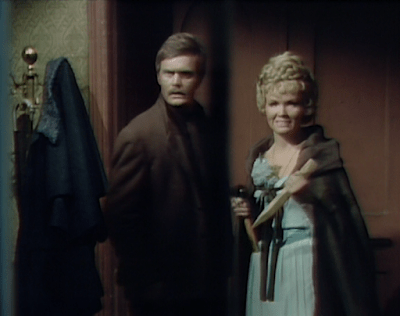
Meanwhile, a small and pretty young woman named Julianka has told Quentin’s distant cousin Barnabas Collins that she can cure Quentin if she has the Hand. He gets it from Angelique and takes it back to his house, where Julianka is waiting. She pulls a knife on him and declares that she is an emissary of King Johnny. She will not cure Quentin, and will stab Barnabas if he does not surrender the Hand. Barnabas calmly offers her money and the Hand if she will cure Quentin before she goes, but she refuses. He gives her the Hand. After she goes, we hear his thoughts as he is feeling sorry for her.
In the woods, Julianka hears a squeaking bat. She reacts with horror as the bat turns into Barnabas in front of her. She asks what he is; he tells her that he believes she knows what he is. He does not bite her, but she does become docile. It seems that Barnabas is using the “Look into my eyes!” vampiric power that he only recently acquired. It also seems that, while Julianka was lying when she originally claimed she had come to Collinwood to cure Quentin, she was telling the truth when she said that she was able to do so.
The Hand recently disfigured Quentin’s face, as it had a few days before disfigured the face of Quentin’s onetime friend Evan Hanley. Evan’s good looks returned after a while, and we have not been told why. Today Quentin’s do as well, and when he asks Aristide for an explanation the best he can do is to suggest it may just be luck. They spent quite a bit of time showing Evan’s efforts to cure himself, and even more time showing Quentin feeling sorry for himself, so this is not at all a satisfactory payoff.
In an original cast panel at a Dark Shadows convention in the 80s or 90s, David Selby reminisced about today’s scene between Quentin and Aristede. He said that when the cameras started rolling, he knew what actions he and Michael Stroka were supposed to perform, that he was supposed to end up tied to the table, and that it was supposed to take a certain number of minutes and seconds. He also knew that there was some dialogue they were to speak in the midst of all that, but he couldn’t remember any of it. The teleprompter was out of view. He looked at Stroka, hoping to see something in his face to jog his memory, and what he actually saw was the same blankness he was himself experiencing. So the two of them improvised their way through it. When they were done, they looked at the clock and saw that they had filled exactly the allotted time. But not a word of what they said was in the script. The resulting scene includes some awkward lines, but it has a great energy to it, just the sort of thing that gets you hooked on live theater.
Undead blonde fire witch Laura Murdoch Collins realizes that Barnabas Collins is a vampire, and that when he was alive he was the “strange, dreamy boy with sad eyes” she was fond of in the 1760s, when she was married to his uncle. Laura and Barnabas confront each other in a graveyard at the beginning of the episode; she tells him he is not human. He passes up the opportunity to reply “So few people are, these days.” At the end of the episode, Laura and her witless henchman Dirk let themselves into Barnabas’ house after dawn. She has a mallet and stake, he has a pistol to ensure no one interferes.
It means something to longtime viewers that we end today with Laura poised to destroy Barnabas. It was Laura who cleared the way for Barnabas’ first introduction. She was the show’s first supernatural menace when she was on from December 1966 to March 1967, and her story was structured very much like Bram Stoker’s Dracula. That was successful enough that the following month they introduced Barnabas as Dracula Mark II. That Laura knew Barnabas in the 1760s when she was already what she is and he was still a boy also nods to this history.
Laura went up in smoke in March 1967, when the show took place in a contemporary setting, and reappeared in April 1969, when it was a costume drama set in 1897. In the interval, Dark Shadows changed from a slow-paced, moody Gothic drama meant for an audience largely consisting of people who were fans of Joan Bennett’s in the 1930’s to a slam-bang supernatural thriller with a huge following among preteens. In her first tour as Laura, Diana Millay could focus on her strengths in dry comedy and subtle psychological drama. This time around, she recognizes the new demographic and plays Laura like a villain on Batman. At times it seems odd that Dirk isn’t wearing a jumpsuit with his name stenciled on it.
Perhaps when she hits the stake with the mallet, the word “Whack!” will be printed in a bubble on the screen. Screenshot by Dark Shadows Before I Die.
Meanwhile, Barnabas materializes inside a classroom at a school where Laura’s nine-year old daughter Nora is alone. Nora tells Barnabas that she is not happy at the school and that she and her twelve year old brother Jamison want to leave with their mother. Barnabas tells her to “Look into my eyes!” and he puts the zap on her. When he is done, he tells her that their conversation will be their secret. She smiles, looks directly into the camera, and tells the audience “I like secrets!” Denise Nickerson had a talent for delivering lines to the camera, and ever since she joined the show in November 1968 they’ve had her do that quite often. Rather too often, I’m sorry to say- it can chill the audience to see a character who is so disconnected from everyone else that they just start talking to us if the effect is used sparingly, but they have her do it so frequently that it has lost its force by now.
Nora and Jamison’s school is a miserable place, less a center of learning than a dungeon where the sadistic Rev’d Gregory Trask gleefully inflicts unwarranted and cruel punishments on both children and teachers. Trask’s daughter Charity is a member of the faculty, and since #727 she has also been Barnabas’ blood thrall. In #753, we saw Charity acting as her father’s second in command at the school, enforcing a particularly vicious sanction against Jamison. It did not then seem that her subjection to Barnabas had modified her role in her father’s operation at all.
When Charity enters and finds Barnabas with Nora, her two enslavements come into conflict. Barnabas tells her that Laura will be coming to the school to see Nora soon, and orders her to let her in. Charity is very confused and starts talking about her father and his rules. Barnabas bites her, leaving her more tranquil but quite weak.
Laura knocks on the door. Charity finds that Barnabas has vanished, and lets her in. She demands to see Nora, saying that she will take her away. Charity says that no relatives are allowed to visit the children at night, and that she will need permission from others to allow Laura to take Nora. Laura insists, and eventually Charity complies. She sends Nora down, and brings her packed suitcase. But Nora has told her mother that she does not want to go. We saw in 1967 that Laura’s children must go with her willingly if she is to perform her evil mission, and so she has to yield. She looks at the collar Charity has drawn up to cover her neck, and says that she will not tell her father that two of Nora’s relatives have visited her tonight.
Some of the actors have trouble with the names “Laura” and “Nora” today. It really was a mistake to give Nickerson’s character a name that rhymes with “Laura.” In #354, set in 1967, matriarch Elizabeth Collins Stoddard told her daughter Carolyn that “Aunt Catherine” would be overjoyed to host her in her home in Boston, and that this never-before mentioned aunt gives wonderful parties attended by men Carolyn’s own age. Catherine cannot have been Elizabeth’s sister or a member of Carolyn’s father’s family; she must be Elizabeth’s own aunt. Nora is the only one of Elizabeth’s aunts we ever hear about, and she would have been 79 in 1967. As a grande dame of Boston society, she might still have been giving big parties featuring people of all ages, and so naming the character “Catherine” would have closed that loop.
It would also have opened the door for another story to add some action to the rather slow period leading up to the 1897 flashback. Aunt Catherine could have come to Collinwood from Boston in 1969 and met the evil ghost of the roguish Quentin Collins. Recognizing her favorite uncle but knowing that he came to a dark and mysterious end, that would have set up a confrontation that might have led to an enigmatic conclusion. Quentin killed other adults who knew about him, but his relationship with Catherine would have made it maladroit to bring their encounter to so straightforward a climax. Better to have her disappear inexplicably. That disappearance would be followed by signs that the disturbances in the house had suddenly grown far more dangerous. We would wonder if Catherine had joined with Quentin as another evil spirit, or if the two of them were doing battle in some unseen realm and inflicting collateral damage in the world of the living.
I have an idea who they should have cast as Aunt Catherine. Isabella Hoopes played dying matriarch Edith Collins at the beginning of the 1897 segment, and she was great fun. Had we been introduced to Hoopes as the spry and sophisticated Aunt Catherine, her turn as Edith would have been even richer. When Quentin chokes and threatens to kill Edith, we would try to read their interaction as a clue to what happened between him and Catherine before her disappearance. When Edith haunts Quentin after her death, we would look for clues as to what happened to Catherine after her disappearance. And of course Nickerson’s role as Catherine’s younger self would have gained another dimension, not only as we watch her interactions with Quentin, but also as we compare her personality at the age of nine to that of the octogenarian we had met previously.
I even have some dialogue Catherine could have exchanged with the Collinses of 1969:
Catherine: Roger, I hear you have married again. Will you present me to your wife this time? I must admit I took it rather personally that I could never meet Laura.
Roger: I’m sorry, Aunt Catherine. Cassandra and I have already gone our separate ways.
Catherine: Oh, I’m the one who should be sorry- it was tactless of me not to know… We Collinses have never have had much luck in marriage, have we?
Elizabeth: You and Uncle Ambrose were happy.
Catherine: Yes. Happy… But there wasn’t much luck to that. After all, he was my fourth husband and I was his third wife. We simply applied the lessons of experience.
Carolyn: So there is hope. After your disappointments, you found your grand passion.
Catherine (a look of frank disbelief on her face): Not exactly. (Pause.) Carolyn, your mother told me some time ago you were the one involved in a grand passion. His name is- what- Bud?
Carolyn: Buzz?
Catherine: Yes, Buzz. I should have remembered that, I once knew a Navy flyer who went by that name. If your Uncle Roger won’t be introducing me to anyone, will you at least present me to Buzz?
Carolyn: Oh, it ended between me and Buzz some time back. He’s left town.
Catherine: Ah, too bad. I’d have liked to meet another Buzz, the one I knew was so elegant.
Elizabeth: This one was hardly elegant. He rode a motorcycle, and that was his whole life. He always wore leather clothing and dark glasses, with a long beard and a ragged mop of hair. You never saw the like, Aunt Catherine.
Catherine: On the contrary, I have seen the like every often. Just such men make up your cousin William’s preferred milieu.
Carolyn (laughing): I once told mother I was going to marry Buzz, but that was an empty threat. Buzz isn’t the sort of man who really wants a wife.
Catherine: Neither is William.
(Elizabeth, Roger, and Carolyn fall silent. After a moment, they all start talking at once.)
Elizabeth: Have you seen-
Roger: How is old Mr-
Carolyn: Was your trip-
(They fall silent again. Another awkward pause ensues.)
Elizabeth: Do you know that there is another Collins at Collinwood?
Catherine: Oh?
Elizabeth: Yes, a distant cousin of ours, from England. His name is Barnabas Collins.
Catherine (furrows her brow): Barnabas Collins? Named for the man in the foyer?
Elizabeth: Yes, the portrait is of his ancestor.
Catherine: How odd. When I was a girl, I asked the old people around here about all of the portraits. They were happy to go on at length about all the others, but they were always tongue-tied when we got to that one. Left me with the impression there was something exceptionally sinister about it, or about the man. Of course that only piqued my curiosity.
Carolyn (suddenly defensive): There is certainly nothing sinister about our Barnabas!
Catherine: Nothing sinister? Are you sure he is a Collins?
(Roger and Elizabeth chuckle, Carolyn flushes.)
Elizabeth: Oh, he is a Collins, all right. He’s quite an expert on the family’s past. I’m sure the two of you would have a great deal to talk about.
Catherine: I’m sure. But I would rather choose another topic. At my age I can’t forget that I will soon be part of the past. I would like to keep my eyes on the future while I still have one.
This scene would have left longtime viewers with some suspense-generating questions. Why did Roger’s wife Laura go out of her way to avoid Catherine? Who were the “old people” at Collinwood in Catherine’s childhood? What did they know about Barnabas? Further, Laura and Buzz were so emblematic of two of the early phases of Dark Shadows that involving Catherine in a conversation referring to both of them would promise that she will be woven in with the whole narrative structure of the show.
Moreover, seeing a Collins who had spent decades far from Collinwood might give us a fresh perspective on the main characters. We see only those whose minds and hearts have been deformed by the many curses that loom over the estate. Meeting one who has been outside their influence for so long would suggest what it has cost the others to stay on the estate. We might then feel anew the tragedy that we have been taking for granted.
Barnabas Collins, old world gentleman extraordinaire, and Julia Hoffman, MD, are helping mysterious drifter Chris Jennings cover up the fact that he is a werewolf, responsible for a great many violent deaths. Lately Chris has started transforming into his lupine shape even on nights when the moon is not full, and this morning they find that he has not changed back even after dawn.
As if that did not present enough difficulty to Julia and Barnabas, one of Chris’ surviving victims is in town. She is his onetime fiancée, Sabrina Stuart. Two years ago, Sabrina saw Chris as the werewolf. She hasn’t told anyone about him, because she hasn’t been able to speak since. Her hair turned white, her skin turned pale, and she has been nearly catatonic.
Others have encountered the werewolf, and none has had this reaction. It’s true that Chris’ cousin Joe had to be taken to a mental hospital after he saw the transformation, but Joe had just been through a very long train of supernaturally induced traumas that had shattered his sensibilities and taken away everything he cared about. Seeing Chris change was just the last step in that process. Sabrina, as we see in a flashback segment today, was fine until she encountered Chris as the werewolf, and she didn’t even see the transformation itself. Yet here she is two years later, unspeaking, immobilized, and wearing the same makeup that Eli Wallach wore as Mr Freeze in the 1960s Batman TV show.
In a comment on Danny Horn’s post about this episode at Dark Shadows Every Day, “Cole” speculates that the show might have meant to tell us that the real reason Sabrina’s condition is less to do with what happened that on night in Chris’ apartment than with her brother and sole caretaker, Ned, played by Roger Davis:
I am once more getting through the Ned/Sabrina scenes thanks to this blog and the comments here; and although I still have to frequently avert my eyes from the screen to hold back the nausea, I keep concentrating on the dialogue while speculating further on JRM’s theory.
It does seem that we– and Julia– might be meant to feel especially concerned by Ned’s refusal to even consider allowing Sabrina to stay at Windcliff. He even says (or, rather, since it is Roger Davis, he SCREAMS), ”I won’t be separated from her!”
I don’t think his character is meant to be overly suspicious of Julia and Barnabas so the vehemence behind his already rather alarming declaration becomes more baffling unless the viewer concludes he has … extremely unnatural feelings of possessiveness towards sad, PTSD-afflicted Sabrina.
It is almost half as frustrating as it is disturbing because, with any other actors, we would surely know for certain how to interpret these scenes.
We would perhaps recognize that when Sabrina stares pleadingly at Julia once Ned leaves the room, that her muteness is caused as much by her horror at being an ongoing victim of her brother’s unspeakable abuse as by having once witnessed Chris’s transformation into a werewolf. We wouldn’t wonder, instead if the actress, Lisa Richards, is actually pleading with Hall to help her endure Davis’s deliberate act of molesting and assaulting her through out these scenes.
If it wasn’t Roger Davis in this role, we would know who Ned is really meant to be since there is no way any of the other regular male cast members would willingly subject their costars to type of abuse Davis is inflicting on Richards.
If it were … say, Jerry Lacy who was currently playing “Ned Stuart” in a manner even remotely similar to Roger Davis’s ‘interpretation’ of the role, we would recognize at once that the character of Ned is obviously scripted to be an incestuous rapist (and I am sure Lacy would still keep his hands professionally and respectfully away from Lisa Richards’s/”Sabrina’s” breasts, instead using actual acting techniques to portray his character’s warped nature). But with Davis ..
It really could be, as Mary commented below, that he is trying to get the poor actress to break character. And how could we expect other than that he would use his usual disgusting and violent Drumph-like/”‘you can grab them by the pussy” sense of Curtis-granted entitlement to assault her as “Ned,” regardless of the intent of the writer and director.
Either way, what a horrifically mistaken choice in casting.
Lisa Richards: fifty years later, I am thinking of you and hoping you weren’t forced to endure PTSD after filming these scenes with Davis.
Comment left 29 August 2021 by “Cole” on “Episode 698: Sister Act,” Dark Shadows Every Day, Danny Horn, 8 August 2015
When I mentally recast the many parts Roger Davis played on Dark Shadows, I divide them between two men who were background players in the show’s first months. I imagine Fredric Forrest playing the two characters with aliases, Peter Bradford (a.k.a. Jeff Clark) and Charles Delaware Tate (a.k.a. Harrison Monroe.) Forrest excelled both as a quietly intense man under pressure and as a sweet, goofy, overgrown kid. In the hands of an actor who, unlike Mr Davis, could project those qualities, those two unloved characters might both have become fan favorites. His other two parts, Ned Stuart and Dirk Wilkins, would have been perfect for Harvey Keitel, who is unsurpassed as a man who is agitated by a deep anger that he himself barely understands and that he certainly cannot explain to anyone else. Not that it’s any secret why Ned is angry at Chris, but when he takes a break from pawing at Sabrina’s face and breasts he handles her so roughly that he is obviously angry with her, and that is something he isn’t going to be giving any thought.
Mr Davis’ behavior wasn’t much better in episodes directed by Lela Swift and others, but it is little surprise director Henry Kaplan didn’t rein him in. Kaplan directed with a conductor’s baton, and actresses complain that he would jab them with it. When the person in charge has that light a regard for women’s personal space, it’s no wonder a creep like Mr Davis felt free to rub himself all over Ms Richards.




 Dark Shadows Commentary