Adam the Frankenstein’s monster has abducted heiress Carolyn and taken her to an abandoned structure. Carolyn says the structure looks like a root cellar. She doesn’t have a television, or she would have recognized it at once. It’s the old Flintstone place.
Adam was created in an experimental procedure mad scientist Julia Hoffman completed, an experiment that Julia’s late colleague Eric Lang designed to free old world gentleman Barnabas Collins from vampirism. The experiment was a success, but Barnabas and Julia are the world’s worst parents. They have kept Adam chained to the wall of the prison cell in the basement of Barnabas’ house for the first three and a half weeks of his life. As far as Adam is concerned, it is normal for people to confine one another in underground spaces.
The cell was in the basement of the house when Barnabas and his little sister Sarah were growing up there in the eighteenth century; in #260, we found that Sarah had found a secret passage leading out of the cell, suggesting she must have spent a lot of time there in her nine years of life. Perhaps the cycle of abuse that Adam is perpetuating goes back a very long way.
Barnabas is out searching for Adam and Carolyn. Julia is in his house, along with his servant Willie. Julia finds that Willie has had a nightmare and is compelled to tell Carolyn about it. The nightmare is part of The Dream Curse. One person after another has the same dream, which the audience sees dramatized every time. Then that person wrestles with a compulsion to tell the nightmare to someone else. We usually see that, too. Finally, the person does tell the dream, giving a speech to repeat the material to us yet again. This time-waster will go on indefinitely, and is supposed to end with Barnabas reverting to vampirism.
Julia knows all about this. She had the dream herself, and has interacted with others who have had it since. Today, she tries to hypnotize Willie into forgetting the dream.
It is very strange Julia hasn’t tried this before. She has a phenomenal ability to use hypnosis to erase memories, so regular viewers would expect her to turn to that right away. When she starts giving Willie the instructions, kaleidoscopic colors pulse on the screen, suggesting that she will have yet another great triumph. Willie does have a vision of Carolyn in the Flintstone house, so Julia must have unlocked his capacity for extrasensory perception. But he still remembers the dream, and is still driven to tell it to Carolyn.
The sheriff comes by. He tells Julia and Willie about evidence that Adam has a connection with the house. They deny everything. Willie is a panicky mess. He is still upset because of the dream, and the barking of the police tracking hounds outside triggers his memories of the nights when Barnabas’ bloodlust prompted dogs to howl. Julia is able to parry all of the sheriff’s questions and observations, but she is too shaken to produce her usual stream of perfectly plausible lies.
Adam comes to the house. He is hungry, and it is the only place he has ever seen food. The sheriff sees him, threatens to shoot him unless he stops, and opens fire immediately. Adam isn’t killed; in fact, he is so healthy that it takes twenty (20) men to subdue him and take him to gaol.
The sheriff sticks around and tells Julia and Willie that Adam gave them a look of recognition. Julia dismisses that, and the sheriff protests “I’m not a stupid man!” Regular viewers know that he is in fact an utterly stupid man, and that Julia is extraordinarily intelligent. Typically, she wouldn’t need more than five seconds to distract him from whatever was on his mind and get him chasing after an imaginary squirrel. But she is so run down from the ongoing crises that she is reduced to challenging him to “Prove it!”
Yesterday, matriarch Elizabeth Collins Stoddard and her daughter Carolyn were in their drawing room quarreling about some family matters when a strange man stumbled into the house. The man was 6’6″ tall, his face was scarred, he trailed a length of chain from a shackle he wore on one ankle, and could speak only a few words. When Carolyn tuned the radio to an Easy Listening station, the man found that the listening was not at all easy for him. Saying “Not music!,” he smashed the radio. This prompted Liz to threaten him with a letter opener. Frightened, the man clutched at Carolyn. The situation escalated when Liz’ distant cousin Barnabas burst in and pointed a rifle at the man. Finally, the man ran out of the house, carrying Carolyn with him.
Today, Liz is moping in the foyer. Local man Tony Peterson, who had gone on a few dates with Carolyn some months ago, comes to the door. He and Liz discuss the situation. Liz laments the harsh tone she took with Carolyn during their argument. She tells Tony that she supposes there is a generational difference between them. He and Carolyn hide their feelings, while Liz expresses hers. This is an exceedingly strange thing for Liz to say- the whole foundation of her character is denial. In the first months of Dark Shadows, Liz was a central character, and the show was largely a study of that psychological defense mechanism and its consequences. She has moved to the margins of the action since then, but hasn’t changed her personality. Indeed, Liz’ conversation with Carolyn took a harsh turn precisely because she refused to face the unpleasant facts Carolyn was reporting to her.
Liz and Tony go to the Old House on the grounds of Liz’ estate, home to Barnabas. They find Barnabas’ servant Willie on the ground by the front door of that house; the door is open, and Willie is nursing a recent head wound. He confirms that the man had been there and that he was carrying Carolyn in his arms. He says that Carolyn appeared to be unconscious. Tony announces that he will go after them, and Willie tells him he will need a gun. “He’s strong, that Adam,” says Willie.
Liz demands to know why Willie called the man “Adam.” Willie denies that he did. That only irritates Liz, who insists that Willie tell her what he knows about the man. Willie repeats his denial, and says that he is worried about a nightmare. He keeps going on about this topic, to which Liz angrily responds “I don’t want to hear any more about your dream!”
Adam has taken Carolyn to an abandoned root cellar somewhere in the woods. This is a new set. Regular viewers, knowing what a rarity new sets are on a show with this one’s budget, will expect something important to happen there. What happens there today is that Adam and Carolyn struggle to communicate with each other. She asks him what he wants; he manages to say “Kill Barnabas!,” a goal which people who have been watching for the last several weeks will agree he has excellent reasons to pursue. He holds a burning pine cone and is surprised to find that it hurts when the fire reaches his hand; she is startled to find that he didn’t know that, and says that he is like a baby. She tries to leave the root cellar, but he won’t let her get to the door.
Liz spoke for the audience when she said she didn’t want to hear any more about Willie’s dream, but it is dramatized for us anyway. It ends with the image that frightens Willie the most, a wolf’s head. Longtime viewers can well understand why this might be a terrifying symbol to Willie. When Willie first worked for Barnabas, Barnabas habitually beat him with his heavy wooden cane topped with a metal handle in the shape of a wolf’s head. In those days, Barnabas was a vampire, and when he felt bloodlust dogs would howl. As Barnabas’ blood thrall, that sound would therefore tell Willie that either he himself would soon be drained of more blood, or that he would be forced to help Barnabas prey on someone else. So it makes sense that for Willie, terror has a canine face.
Virtually every episode of Dark Shadows begins with one of a handful of still images of the exterior of a mansion in Newport, Rhode Island, known in those days as Seaview Terrace.* Before the series went into production, Dan Curtis took the cast up to Newport and shot some video of them on the grounds of the mansion. In 1966 and the first half of 1967, bits of that footage were occasionally inserted to give the show a more spacious and less static feeling. When they started shooting episodes in color at the end of July 1967, they could no longer use those inserts, and they had neither the time nor the budget to go back to make more.
Now, Dark Shadows uses green screen effects to create the illusion of exterior shots. Twice today, they show us actors in front of the still of Seaview Terrace that most frequently appears at the opening, with foliage hanging next to them to give an illusion of depth. The result isn’t as satisfactory as the location inserts were, but it’s nice to know the makers of the show are trying to broaden their canvas.**
Frankenstein’s monster Adam has escaped from the Old House at Collinwood and finds his way to the principal mansion on the same great estate. There, he stands outside the windows and listens to a conversation in the drawing room between matriarch Liz and her daughter Carolyn. Carolyn tells her mother that she saw Cassandra, Liz’ brother Roger’s new wife, having a romantic moment with local man Tony. Liz’ keynote has always been denial, and true to form she refuses to believe Carolyn. They go on with this until Adam stumbles through the front door and terrifies them.
Adam can only speak a few words. He smiles when he says one of his favorites, “music.” Carolyn turns on a radio we have never seen before and we hear Francois Lai’s theme to the movie “A Man and a Woman,” an instrumental hit of the 1960s which played on the jukebox at the Blue Whale tavern in #307. Adam scowls, declares it “not music,” and smashes the radio. I’ve always had a fondness for the tune, but listening to this arrangement I have to admit he has a point.
Liz reacts to Adam’s violent act by grabbing a letter opener and threatening him. Panicked, he grabs Carolyn. Two more residents of the estate burst in. They are old world gentleman Barnabas Collins, master of the Old House, and Julia Hoffman, permanent houseguest in the great house. Barnabas has a rifle and threatens to shoot Adam if he doesn’t put Carolyn down immediately. Adam flees into the woods, still carrying Carolyn.
Julia stays in the drawing room with Liz. It dawns on Liz that Barnabas must have been hunting Adam. Julia denies this, and Liz asks why Barnabas had a gun. In response, Julia talks very fast and says very little. That gives us a wonderful little scene. It’s always exciting when a brick falls out of the wall Liz built between herself and reality, and Julia is one of the most accomplished liars in drama.
Liz realizes that Barnabas and Julia know more about Adam than they are letting on. Screenshot by Dark Shadows Before I Die.
*A family named Carey bought the place in 1974, so these days it is usually referred to as the Carey mansion.
**The screenshots are from John and Christine Scoleri’s post on their blog Dark Shadows Before I Die.
From #133, artist Sam Evans was compelled to paint a series of pictures that explained the evil intentions of undead blonde witch Laura Murdoch Collins, estranged wife of sarcastic dandy Roger Collins. In #146, Laura put a stop to Sam’s work by starting a fire that burned his hands so badly it seemed for a time he might never be able to paint again.
Sam shares his home, the “Evans cottage,” with his daughter Maggie, who is The Nicest Girl in Town and a waitress at the diner in the Collinsport Inn. Between her earnings there and the paintings Sam sells, the Evanses make a living, but it isn’t such a grand living that he can turn down any commissions, even very eccentric ones. Moreover, his work space entirely dominates the interior of the cottage. In the early days of the show, Sam’s old friend Burke Devlin often stopped by, and the conversation always turned to reminiscences of Burke’s youthful days of honest poverty. Nowadays the most frequent visitor is Maggie’s fiancé, hardworking fisherman Joe Haskell. Sam is delighted with the prospect of this upwardly mobile laborer as a son-in-law. When a representative of the moneyed world visits Sam or Maggie at home, as New York art dealer Portia Fitzsimmons did in #193 and old world gentleman Barnabas Collins did in #222, the contrast between their manner and the humble surroundings is meant to jolt us. The Evans cottage is therefore our window on the working class of Collinsport. When the troubles of the ancient and esteemed Collins family have an effect there, Dark Shadows is telling us that the whole town is dependent on the businesses they own and suffers as a result of their problems.
Yesterday, Barnabas came back to the cottage and brought Sam a very odd commission indeed. He presented a painting of a lovely young woman in eighteenth century garb and offered Sam $500* to paint over the image so that before morning the woman would look to be “about 200 years old.” Sam wasn’t in a position to refuse that much money, even though Barnabas wouldn’t explain why he wanted him to do such a thing.
If Sam knew what the audience knows, he would likely have turned the job down even if Barnabas had offered $500,000,000. The woman in the portrait is Angelique, and like Laura she is an undead blonde witch. In the 1790s, Angelique cursed Barnabas and made him a vampire. In #466, Barnabas’ vampirism went into remission. Shortly thereafter, the portrait made its way to the great house of Collinwood, where Roger became obsessed with it. In #473, Roger returned from an unexplained absence with a new wife. She is Angelique, wearing a black wig and calling herself Cassandra. From #366-#461, Dark Shadows had been a costume drama set in the 1790s; during this segment, we saw that Angelique was a far more dynamic and brutal menace than Laura ever was. Sam would hardly want to involve himself in a battle with this wiggéd witch.
For his part, Barnabas first appeared on camera in #210 and #211. But his portrait was first seen hanging in the foyer at Collinwood in #205, having been prefigured in #195. Dangerously unstable ruffian Willie Loomis became obsessed with the portrait of Barnabas. Willie could hear a heartbeat pounding from the portrait in #208 and #209, and followed its sound to the crypt where Barnabas was trapped in his coffin. As Roger’s obsession with Angelique’s portrait would bring her back to the world of the living, so Willie’s obsession with Barnabas’ portrait led to his return.
In the opening teaser, we see Sam working on the painting. He tells it that he can’t understand why Barnabas would want to disfigure such a pretty face, then resumes his task. The camera zooms in on the painting, as it had zoomed in on Barnabas’ portrait in #208 and #209, and the soundtrack plays the same heartbeat. Sam doesn’t react- he can’t hear it. It is addressed to the audience, especially to those members of the audience who remember the show as it was 13 months ago.
Angelique/ Cassandra is in the gazebo on the grounds of Collinwood. She is wearing a hooded cloak to conceal the aging she has already experienced as a result of Sam’s work. Her cat’s paw Tony Peterson, a local attorney, shows up, responding to her psychic summons. She entrances him with a flame and he tells her that the artist who has been in touch with the Collinses most frequently of late is Sam Evans. From this she concludes that Sam is aging her portrait at Barnabas’ bidding. Before Angelique/ Cassandra and Tony can go their separate ways, heiress Carolyn Collins Stoddard comes upon them.
Tony and Carolyn met in #357. In that episode, he was an instance of Jerry Lacy’s Humphrey Bogart imitation. A hard-boiled materialist, Tony had grown up in Collinsport as a working-class boy. He resented the Collinses and attributed all of their unusual characteristics to their wealth and social prominence. At that time, Barnabas was still a vampire and Carolyn was under his power. As a blood thrall, she knew that there was more to life than could be explained by Tony’s reductive logic, but she wasn’t free to offer any explanations. When Tony saw Barnabas biting Carolyn in #463, he interpreted their embrace as a sign of a sexual relationship.
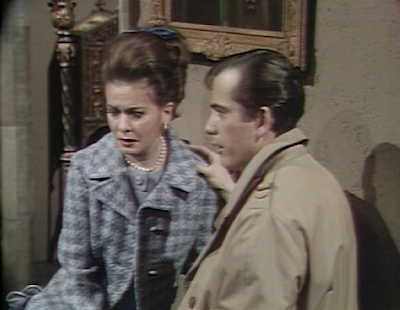
Now their roles are reversed. It is unclear what Carolyn remembers from her time under Barnabas’ control; Nancy Barrett often plays the character as if she remembers everything, but the dialogue doesn’t give her much support for that, and in this scene she is as this-worldly as Tony was in the Autumn of 1967. She interprets Tony and Angelique/ Cassandra’s meeting at the gazebo as proof positive of an adulterous liaison, and declares she will report it to Roger. When Tony tells her that Angelique/ Cassandra has some mysterious power, Carolyn is dismissive, declaring that the Collinses are the ones who have all the power in this town. Tony tries to explain that the power Angelique/ Cassandra has is of an entirely different order from the power their ownership of capital gives the Collinses, and Carolyn responds with unconcealed contempt.
Angelique/ Cassandra knocks on the door of the Evans cottage. Sam opens the door. She ignores his objections and enters. While he keeps ordering her to get out of his house, she stands next to the portrait as he has aged it and points out her resemblance to it. He is astounded, but keeps telling her to leave. She says that she has no grievance against him and that no harm will come to him if he hands the painting over to her. He refuses. She heads out.
Angelique/ Cassandra has barely closed the door behind her when Sam has trouble seeing. After a moment, he realizes he has been struck blind. She comes back in, takes the painting, tells him she warned him, and leaves.
Over the years, several members of the cast said on the record that Sam’s blindness was actor David Ford’s idea. He thought that if he could wear dark glasses it wouldn’t bother the audience that he read all his lines off the teleprompter.
In 2022, a commenter on Danny Horn’s post about this episode on his blog Dark Shadows Every Day identified the portraits of Angelique as the work of ABC Art Department specialist Joseph Guilfoyle:
You asked if anyone knew who painted these portraits. I can verify that the portraits of Angelique were painted by Joseph Guilfoyle. He was an artist in the Art Department at ABC. He was my Godfather and his daughter remembers this very well as it made her a bit of a celebrity at the time. Portraits were not commissioned out but instead were created in the Art Department as it was filled with many talented artists.
Also worthy of note are the two facial makeups representing Angelique’s aging. It’s no wonder they didn’t have the personnel to make David Ford’s fake mustache look convincing when they were lavishing all the work on turning Lara Parker into two quite distinct old crones.
The costumers were involved in a famous production error in the final scene. Angelique/ Cassandra’s hooded cloak cuts off above her knees. There is no old age makeup on her legs, which are featured from every angle, making a ludicrous contrast with her face and wig.
Vampire Barnabas Collins, desperate to save his own life after he aged extremely rapidly as the result of an attempt mad scientist Julia Hoffman had made to turn him into a real boy, bit his distant cousin Carolyn Collins Stoddard and enslaved her in #351. In #462, Barnabas was afraid that well-meaning governess Vicki Winters had learned his secret, so he bit her as well. As it happens, Vicki had not figured out that Barnabas was a vampire, so the bite was unnecessary. That was lucky for Barnabas. After he bit her, Vicki was noticeably less interested in Barnabas and less deferential to him than she had been at any point in the year or so she had known him.
Now, Barnabas has happened upon another mad scientist, Eric Lang. Lang has apparently succeeded where Julia had failed. Barnabas can go around in the daytime and do other things humans do. What’s more, Lang takes a look at Vicki’s neck and sees that the marks of Barnabas’ bite have vanished. Vicki remembers having the bites. Even after Lang has told her that they vanished because the reason for them no longer exists, she has an enigmatic look on her face when she stares into the mirror and studies the spot where they used to be. It was never clear what she made of Barnabas’ biting her and sucking her blood- maybe she just thought he favored an aggressive make out technique. She looks deeply puzzled now, but what exactly she is trying to understand is a mystery. She looks away from the mirror, then looks down, defeated in her attempt to find sense in her memories. Finally, she turns her back on the mirror and goes resolutely about her business.
For her part, Julia is in the great house of Collinwood with Carolyn. Julia is surprised that Carolyn is talking to her in a friendly manner, as she did before she and Barnabas “became so close.” Carolyn removes her scarf, glances in the mirror, and is delighted to see that the marks on her neck are gone. Carolyn asks what that means. Julia says that it means that she is free, as free as Barnabas, and that it must continue to be so.
Unlike Vicki, Carolyn had a full briefing from Barnabas about his condition and its requirements, and she was deeply involved in his criminal enterprises for some weeks. Her joyous reaction to the disappearance of the marks leaves no doubt that she remembers something about this experience. There is nothing in any script after this to tell us what, but we will often notice actress Nancy Barrett giving a line reading or showing an unquiet reaction that suggests she remembers everything. I suppose you could say she was padding her part with these little signs, but the directors obviously didn’t object and it will be quite a while before the writers give her dialogue which forces her to stop doing it.
There’s also a lot of business in this episode with Vicki and an unpleasant man named Peter. Lately, Peter has been pretending to be someone else, even though the audience and Vicki know perfectly well who he is. Today the show suggests that this irritating little storyline is the consequence of Peter having amnesia. The episode ends with him, Vicki, and Julia opening the secret panel that reveals the hidden chamber in the Collins family mausoleum where Barnabas was trapped from the 1790s until 1967. That proves that Vicki traveled back in time to the 1790s and that Peter knew her in that era. Since the audience already knows both of those facts and none of the characters directly involved in the action has any reason to doubt either of them, it’s an anticlimactic conclusion.
When Vicki and Julia are entering the mausoleum, Vicki shines a flashlight directly into the camera. In at least eleven of the episodes made when the show was in black and white, characters entering darkened spaces did this with flashlights, often creating elaborate halo effects. Sometimes this appeared to be a blooper, several times it was obviously intentional. We’ve only seen it once or twice, briefly, since the show went to color in the summer of 1967. It’s nice to see it again.
We open in the old cemetery north of town, where well-meaning governess Vicki and matriarch Liz are looking for the grave of Vicki’s old boyfriend Peter. Vicki last saw Peter this past Friday, which was over 170 years ago. That discrepancy was the result of some time travel she did in between. Vicki met Peter while spending nineteen weeks in the late eighteenth century. She came back home on Monday. By the end of her visit to the past, Vicki and Peter were both scheduled to be hanged for their many crimes. Vicki was whisked back to 1968 at the last possible instant, escaping by such a narrow margin that she had rope burns on her neck.
Vicki and Liz find Peter’s grave marker. Liz remarks that his date of death is the same as today’s date- 3 April. This sets Vicki off. She says that the hangings took place at dusk, that it’s dusk now, and that Peter is therefore being hanged even as they speak. Liz declares that this is gibberish. The date on the stone is 3 April 1795, and today’s date is 3 April 1968. Vicki tries to explain that everything that ever happened is happening over and again someplace. Yesterday, Liz heard similarly opaque verbiage from her distant cousin Barnabas. She didn’t buy this line when Barnabas was pitching it, and she isn’t any more impressed when she hears it from Vicki.
Longtime viewers of Dark Shadows are likely to make a connection. From December 1966 to March 1967, Vicki led the battle against the show’s first supernatural menace, undead fire witch Laura Murdoch Collins. When she saw the dates on which Laura’s previous incarnations immolated themselves along with their young sons, Vicki realized that she acted at intervals of exactly one hundred years. Laura was an embodiment of the cyclical nature of time; fighting her, Vicki is trying to break the cycle of death and rebirth, like a comely young Buddha.
I don’t think the show is making a serious metaphysical point by developing this theme. When you’re telling a story about a place where the usual laws of nature don’t apply, you need to substitute some other set of rules the audience can understand in order to create suspense. The power of anniversaries will do as well as anything else.
Back in the great house of Collinwood, we see Liz’ daughter Carolyn come in the front door wearing riding clothes and carrying a crop. This is the first indication that the Collinses have horses. In the early months of Dark Shadows, the family was running out of money, the estate was decrepit and mortgaged to the hilt, and they were barely holding onto control of their business. The stories those circumstances generated never went anywhere, and they’ve gradually been retconning the Collinses to be richer and richer. If they’re up to horse ownership now, by next year they might have a luxury yacht and a private jet.
The drawing room doors open, and lawyer Tony Peterson emerges. He quarrels with Carolyn about their last encounter. That was two weeks ago in story time, but we saw it before Vicki left for the past in November. It’s an even deeper dive for us than that makes it sound, because our view of Tony has changed profoundly in the interim. He was first introduced as an example of Jerry Lacy’s famous Humphrey Bogart imitation, and he still is that. But in the 1790s segment, Mr Lacy played the Rev’d Mr Trask, the fanatical witchfinder who hounded Vicki to her death and occasioned many other disasters. By now, we have come to see most of the 1960s characters as the (not necessarily dark) shadows cast by their eighteenth century counterparts. When Tony shows up today we find ourselves trying to figure out what it is about Collinsport in the twentieth century that could turn a holy terror like Trask into a basically nice guy like Tony.
Carolyn browbeats Tony into coming back at 8 pm to take her to dinner. He leaves, and Carolyn’s distant cousin, Barnabas the vampire, enters. Barnabas asks Carolyn if she’s noticed a change in Vicki. She has no idea what he’s talking about. He asks if she’s “more like you.” Thus first-time viewers learn that Carolyn is under Barnabas’ power. Returning viewers learn something, too. Yesterday’s episode ended with Barnabas about to bite Vicki, but cut to the closing credits before he sank his teeth into her. We’ve seen that before. Now we know that he has finally gone through with it.
In the opening scenes, Vicki showed absolutely no sign that anything had happened to her; Carolyn hasn’t noticed any change in her either. Soon, Vicki and Liz come home, and Vicki doesn’t react to Barnabas any differently than she had before he bit her. The people Barnabas has bitten have shown a wide variety of effects afterward. Perhaps Vicki will be the first victim who just can’t be bothered.
Vicki has a painting with her that she bought in town after she and Liz visited Peter’s grave. It turns out to be a portrait of Angelique, the wicked witch whose curse made Barnabas a vampire in the 1790s. That portrait first appeared in #449, a sign to the characters that Angelique’s evil spirit was still at work and to the audience that actress Lara Parker would be back on the show after the costume drama insert ended. Barnabas is upset to see this token of his old nemesis, and leaves the house. Vicki does not consciously remember the events she saw during her visit to the past, but when she sees Barnabas go she tells Liz that it makes sense that he would not like the picture.
Tony returns and spends a few moments twitting Carolyn for her glamorous attire, describing the homely pastimes in which a working class boy like himself whiles away his idle moments. This prompts her to tease him back. Viewers who remember Tony and Carolyn’s previous interactions will recognize this as their style of flirtatious banter. They agree to go to dinner.
Before Tony and Carolyn can leave, we cut to Barnabas, standing in the window of his own house and staring at the great house. He calls to Carolyn, summoning her to come to him immediately. We cut back to the great house, and see Carolyn’s face go blank while Tony is still talking. She excuses herself, telling him she will meet him later. He is outraged, and vows he will not wait for her.
In Barnabas’ house, Carolyn tells Barnabas she objects to his summons. Irritated by this, he starts talking about Vicki. He says that he couldn’t understand why biting her did not bring her under his power, but that seeing the portrait explained it to him. The witch is interfering with his efforts. Carolyn laughs at the idea of a witch. This is a bit odd. Carolyn has lived her whole life up to this point in a haunted house and is having a conversation with a vampire. It wouldn’t seem to be a stretch for her to believe in witches.
Barnabas has a bad habit of leaving his front window uncovered. Many times, we have seen people peer into that window and discover Barnabas’ secrets. Now, Tony sees Barnabas bite Carolyn’s neck.
Carolyn goes home to the great house and finds Tony in the foyer. She is delighted at the idea that he is waiting to go on their date, but such is not the case. He is there to berate her for her perverse relationship with her cousin Barnabas and to storm out.
In this, we see the first point of similarity between Tony and Trask. Trask was right that there was a witch at Collinwood and right that the witch was the source of all the troubles afflicting the Collinses. But he was wrong about her identity, and wrong about the means to combat her. Likewise, Tony is right that Carolyn and Barnabas are manipulating him, and is right that their relationship is unwholesome. But he has no understanding of their goals, and his belief that their relationship is sexual is quite mistaken.
Carolyn’s protest that Barnabas is merely her cousin, like Tony’s indignant implication that their family relationship makes what they are doing incest, is rather strained. In the cemetery, Liz mentioned that Daniel Collins was her great-great grandfather, which would make Daniel’s sister Millicent Carolyn’s great-great-great-great aunt. When Millicent and Daniel were introduced during the 1790s segment, Barnabas’ father Joshua identified them as his second cousins. That was a distant enough relative that Joshua considered Millicent a potential marriage partner for either Joshua’s brother Jeremiah or for Barnabas himself. Since Barnabas and Carolyn are second cousins five times removed, nothing going on between them could very well be called incestuous.
Later, Barnabas goes to the drawing room in the great house and looks at the portrait of Angelique. To his surprise, Carolyn is waiting for him. She tells him that she doesn’t want to be his blood thrall anymore. She declares that he loves Vicki and that she has her own life to live. He is too busy to discuss the matter with her, and she leaves.
Barnabas cuts the portrait out of the frame, and throws it into the fireplace. He gives a little speech about how this is the only way Angelique can be destroyed. He turns from the fire, and sees that the portrait has regenerated. Angelique’s laughter sounds in the air, and Barnabas realizes that she is present.
This is not the first time a portrait of an undead blonde witch has been thrown into the fire in the drawing room, prompting a woman’s disembodied voice to make itself heard. In #149, Laura’s estranged husband, Roger Collins, threw into it a painting featuring her with their son, strange and troubled boy David. When that painting burned, we heard a scream coming from no one we could see. Whether the screamer was Laura or benevolent ghost Josette was never explained. What was clear was that burning the painting accomplished none of the goals Roger may have had in mind, as Barnabas’ incineration of this painting serves none of his purposes.
When gallant gentleman Barnabas discovered that his wife Angelique was a wicked witch who had been casting spells to ruin the lives of everyone he knows, she forbade him to disclose this information. If he did, she would kill his true love, the gracious Josette.
Now, Angelique has turned Barnabas into a vampire. When he found out about this, he killed her. Sadly, that didn’t take. For the last few days Angelique’s disembodied head has been floating around foiling all of Barnabas’ attempts to contain the damage he has been doing.
Today, we open in the Collins family mausoleum. Barnabas’ coffin is hidden in a secret chamber inside the mausoleum. He and Josette are in the publicly-known outer chamber, where she found him yesterday. He pleads with her to leave him and forget she ever knew him, but will not tell her why. Angelique has made it obvious that she is already working to kill Josette, so obvious that Barnabas and his friend Ben were talking about it yesterday. So Barnabas has no reason to withhold any information from Josette, and every reason to tell all. But he continues to keep everything back that might persuade her to flee from him. This does fit with his pattern of behavior- half the reason they are in this situation is that Barnabas wouldn’t tell Josette that he and Angelique had had an affair long ago. But it is still frustrating.
Back in the great house of Collinwood, Josette runs into the two characters who have been keeping the show watchable for the last couple of weeks, fluttery heiress Millicent Collins (Nancy Barrett) and caddish naval officer Nathan Forbes (Joel Crothers.) After a series of delightfully played comedy scenes, Millicent and Nathan have become engaged. They break their happy news to Josette. She is so preoccupied with her encounter with Barnabas that she barely reacts.
Nathan leaves. In the drawing room, Josette tells Millicent that she saw Barnabas tonight. Millicent knows that, according to Barnabas’ parents, Barnabas has gone to England. She is therefore certain that Josette could not have seen Barnabas, and she patiently explains this impossibility to Josette. The difficulties Millicent knows about are nothing to what Josette knows- she saw Barnabas die.
In the parts of Dark Shadows set in the 1960s, Nancy Barrett plays another heiress, Carolyn Collins Stoddard. In those same parts of the series, Joel Crothers plays hardworking young fisherman Joe. In 1966, Carolyn and Joe were dating each other for no reason they could discern, and the audience was afflicted with scene after scene of them out on dates staring at each other in boredom. Millicent and Nathan are as much fun to watch together as Carolyn and Joe were dull. They are pursuing objectives we can understand, and we can also be sure that their plans will not work out as they expect.
Nathan is clever, charming, and unscrupulous. He was uninterested in Millicent until he found out she was rich, then immediately began an assiduous pursuit of her hand and her inheritance. In addition to greed, he has also shown a keen eye for opportunities to bed the women on the household staff. When his naval career is threatened by the villains, he shows no sign of courage. Yet we have also seen him behave admirably, even heroically, in trying to help bewildered time-traveler Vicki. And when Barnabas was alive, Nathan was a trustworthy friend to him. So for all we know, by the time he gets his hands on Millicent’s money, this complex man might have fallen in love with her and made up his mind to be a good husband.
Millicent is not a “smart character” in an IQ-test sense, but her limitations translate into an accidental wisdom. Her ideas of life have been shaped by plays she has seen and novels she has read, leading her to think she is a character in a florid melodrama. But of course that is exactly what she is, and so her behavior is, if anything, more situationally appropriate than are the actions of the more superficially rational people around her. Certainly it is jarring when Josette starts telling Millicent about Barnabas, when she knows that Barnabas wants to keep his presence secret. Considering what will happen to Josette if she keeps approaching Barnabas, Millicent does quite the sensible thing when she insists on leaving the official story alone.
Nathan has gone to the local tavern. In the 1960s, this same set will be a tavern known as The Blue Whale. Joe will be a regular customer, and the man who will preside behind the bar is played by actor Bob O’Connell. In #319, a character pretending to be drunk called the bartender “Bob-a-roonie,” leading fans of the show to call the character “Bob Rooney,” a name never used in the series.
Now, in 1796, the tavern is called The Eagle. Bob O’Connell again plays the man who pours the drinks. His name is Mr Mooney. “Mooney” sounds enough like “Rooney” that I wonder if the “Bob Rooney” gag circulated among the production staff. Mr Mooney gets more lines today than Bob the bartender ever did, and his name is listed in the credits for the first time at the end of his 57th episode.
O’Connell did a lot of very good work in those first 56 appearances. He was especially good with facial expressions that showed he had overheard enough of a conversation to think he ought to be more aggressive about refusing to serve drinks to customers before they lose all sense, but not enough to have anything substantial to report to the police. I’m sorry to say that his delivery of dialogue today is not on that level. Partly that’s because he has to put on some kind of Anglo-Celtic accent that he is none too sure of. But that isn’t the only problem. He delivers his lines much too fast and too loud, and does not modulate his voice in response to anything his scene-mates do. He isn’t interacting with the others at all, just waiting for his cues and making sure the microphone picks up the words. His scene is a major letdown for Bob the bartender fans everywhere. O’Connell’s previous successes as a working guy who knows more than others assume he does leave me wishing they could have done another take of the scene with some fresh guidance from the director.
Fortunately, the same scene introduces one of the most magnificent characters in all of Dark Shadows. She walks in, tells Mr Mooney she’s with Nathan, and gives her name as Suki Forbes. That’s Forbes as in “Mrs Nathan Forbes.”
Nathan tries out a series of lies on Suki, each of which she bats away effortlessly. He offers to pay her to leave town; she lets him go collect his money, while she stays in the tavern and gets all the relevant information from Mr Mooney. Nathan has been away for about ten seconds by the time Suki finds out he plans to marry into the family that owns the town. She is quite pleased by the prospects this introduces.
Suki thinks of how much she might earn by pimping Nathan out. Screenshot by Dark Shadows Before I Die.
Our hopes that Nathan would eventually make Millicent happy are thus reduced to a very low order of probability. Regular viewers are again reminded of Carolyn, in this case of Carolyn’s absentee father Paul Stoddard. Paul was a charming, dishonest, and cruel man who married Carolyn’s mother Elizabeth only for her money.
We haven’t seen Paul, and know very little about his background. What we do know is that he was not from the village of Collinsport, had no money of his own, and that his best friend was a merchant seaman named Jason McGuire. We got to know Jason quite well when he showed up and blackmailed Liz for a long dull stretch of the show. Poor men would have few opportunities to meet young women of Liz’ lofty station, and even fewer means of persuading them they were acceptable marriage partners. Since the marriage took place in 1945 or 1946, when a sizable fraction of American men were on active duty in the armed forces, and since Paul was connected to Jason and therefore to the sea, it would seem likely that Paul was a Navy officer. After all, an officer’s uniform can get a man admitted to any social circle, as Nathan illustrates. So the miserable marriage that Liz endured might have echoed a similarly ill-conceived match a collateral ancestor of hers made in the late 18th century.
Hi I am the Jane Draper who played Suki on Dark Shadows! Thought I’d be on it longer but got killed off by Barnabas. I worked on Broadway, film and this soap opera. Now, I play Bluegrass, always my passion, on guitar and upright bass. Born in Illinois, grew up mostly in Southern Indiana and moved to NYC in my teens.
thank you for your kind words.
Jane Draper, comment left 13 August 2020 on “Episode 420: The Stalking Dead,” Dark Shadows Every Day.
When Dark Shadows debuted in June 1966, it was a Gothic romance in which characters sometimes equivocated about whether they were using the word “ghost” metaphorically to refer to present troubles caused by past conflicts or literally to refer to things that go bump in the night.
That version of the series ended with the story of undead fire witch Laura Murdoch Collins. In Laura’s months on the show, her arc absorbed such major plot elements as the conflict between high-born ne’er-do-well Roger Collins and local man Burke Devlin, the psychological problems of strange and troubled boy David, David’s relationship with his well-meaning governess Vicki, and the tensions between the ancient and esteemed Collins family and the working class people of the town of Collinsport. By the time Laura went up in smoke in #191 and #192, there was no life remaining in any open narrative thread, and Dark Shadows 1.0 was at an end.
Dark Shadows 2.0 launched in #193 with the introduction of seagoing con man Jason McGuire. Jason was an in-betweener who would tie up the loose ends remaining from the 25 weeks before Laura joined the gallery of characters and facilitate the introduction of Laura’s successor as a major supernatural menace, vampire Barnabas Collins. Jason kept himself busy blackmailing reclusive matriarch Elizabeth Collins Stoddard, his sidekick Willie Loomis accidentally released Barnabas, and the show kept dropping hints that when Liz finally stood up to Jason all of the original secrets would be laid bare.
The makers of Dark Shadows didn’t do much advance planning, so they kept Jason on the show for 13 weeks after Barnabas premiered while they tried to come up with some other way to fill the time. When Jason’s plan finally blew up in his face, they even left some of the old secrets still buried, most notably the question of where Vicki originally came from.
Barnabas finally killed Jason in #275, and he hasn’t been mentioned in a while. But he is not forgotten. As we open today, lawyer Tony Peterson has caught heiress Carolyn Collins Stoddard in his office, rummaging through his safe. Tony has been dating Carolyn and is clearly very much attracted to her. He invites her to tell him a story that will give him an excuse not to call the police. She has to think fast to come up with one, and what she settles on is a version of the story of Jason and Liz.
Tony knows that Carolyn was trying to steal a notebook that he had put in his safe. This notebook was the property of his newest client, Julia Hoffman, a permanent guest at the great house of Collinwood. Carolyn tells Tony that Julia was blackmailing Liz. The notebook, she claims, is a diary kept by a man with whom Liz had an affair, and it contains proof that the man was Carolyn’s father. Julia knew the man and knew that he was planning to come to Collinwood to squeeze money out of Liz in return for his silence, but he died before he could do so. Julia took the diary and picked up where he left off.
Since Tony’s professional ethics will not allow him to be a party to blackmail, this is the one story that could give him a plausible reason not to report Carolyn’s crime to the police. It also gives him a reason to feel sorry for the Collinses, whom he hated when we first saw him, removing an obstacle to the possibility he might fall in love with Carolyn.
The echo of the Jason/ Liz story in the image of Liz forced to accept a blackmailer as a member of the household offers a great deal more than narrative convenience to regular viewers. The audience knew what Jason was threatening to tell if Liz did not submit to his demands, but the characters did not. One idea that some among them seemed to suspect was that Jason was Vicki’s father and Liz was her mother. Indeed, the makers of the show did plan to explain Vicki’s paternity at the end of the blackmail arc, a plan they abandoned so late that the climactic episode runs some minutes short. When Carolyn brings up the idea of her mother being blackmailed to keep it secret that she bore a child out of wedlock, those of us who have been watching all along will realize that she was among those who suspected that this was the secret that gave Jason his hold over her.
The audience knows that there will be no romance between Tony and Carolyn, because we know that she is Barnabas’ blood thrall. Barnabas sent her after Julia’s notebook, because it contains the records of an experiment in which she tried to cure him of vampirism. It would expose him were it to fall into the hands of the authorities. Since Barnabas wants to rid himself of Julia, perhaps by killing her, perhaps by driving her totally insane, he cannot leave such a document out of his possession.
Dark Shadows has come to as much of a dead end now as it had when Laura’s arc was ending. None of the ongoing stories has room for more than a few steps of further development, and if they keep running through those steps at the current pace everything will be resolved in a couple of days. Bringing up Jason, whose introduction marked the beginning of Dark Shadows 2.0, leads us to wonder if they have something up their sleeves that will launch Dark Shadows 3.0.
Tony takes Carolyn home to Collinwood, where he confronts Julia. He tells her what Carolyn told him. She denies it, and says that she will write a letter entrusting the notebook to him to remain unread unless something happens to her, in which case he will read it and hand it over to the authorities. That satisfies him that he isn’t a party to blackmail, and he agrees to her terms.
For the last couple of days, Barnabas has been using black magic in an attempt to break Julia’s grip on sanity. Her clear thinking and calm demeanor in this scene prove that this attempt has failed. The only open question in the only ongoing conflict is, therefore, whether Barnabas will try to murder Julia. She is such a valuable character that it is hard to feel any real suspense about whether he will succeed in killing her, but there is a chance that he will make an attempt.
David and Vicki have come home from a trip to Boston. David enters the drawing room, sees Julia, and greets her. She can barely pay attention to him long enough to say hello. He asks if she is all right; again, she is clearly not at all focused on him. She excuses herself, saying she has to go to Barnabas’ house.
David’s relationships to the other characters were the engine that drove Dark Shadows 1.0, and when Barnabas began to pose a danger to David that same engine accelerated the pace of Dark Shadows 2.0. Julia has been central to the plot for some time; that she can’t be bothered to take any notice of David tells us that that engine has fallen apart. Whatever they are planning to do next week, David won’t be at the heart of it.
David leaves the drawing room. He gets as far as the foyer. There, he sees his friend, the ghost of Barnabas’ ten year old sister Sarah. He tells Sarah that he has been on a trip. She asks where he went. He says he went to China. “Oh,” she responds, blandly. “You’re not impressed?” “No, my father’s friends used to go to China on their ships.” “Well, I didn’t really go to China. I went to Boston.” “BOSTON!!!” Sarah exclaims. “I went to Boston once!” She’s electrified. It’s adorable beyond belief.
Suddenly, Sarah looks disturbed and says she has to go. David asks why, and she says there is trouble brewing at the Old House. Again, David has been sidelined. If there is going to be any more action, it will have to come from fresh sources.
The Old House is Barnabas’ house, and that’s where we go next. We see Julia arriving there. She tells Barnabas that Vicki is back. He is mildly interested. She then tells him that she has seen Sarah. Barnabas longs to see Sarah, and is tormented that she will appear to others but not to him. He accuses Julia of lying. She insists that she is not, and taunts him with Sarah’s refusal to appear to him. He grabs Julia by the throat. He has done this before as a threat, but this time it looks like he really means to strangle her. Before he can, a wind blows the door open and the candles out, and Sarah walks in. She approaches her brother, glaring at him.
Carolyn Collins Stoddard has been a spoiled heiress all her life, and now is settling into a new role as blood thrall to her distant cousin, vampire Barnabas Collins. Carolyn is trying her level best to comply with Barnabas’ command to seduce lawyer Tony Peterson so that she can steal the notebook mad scientist Julia Hoffman entrusted to him. She is on a date with Tony, and they are starting to do some serious kissing.
No matter how well Carolyn serves him, Barnabas can’t keep himself out of her way. When Barnabas is upset, nearby hound-dogs start baying; Danny Horn calls the dogs Barnabas’ “backup singers.” When Carolyn hears them, her face goes blank and she forgets about Tony. Tony becomes irritated and ends their date abruptly.
Later, Julia goes to Barnabas’ house. Carolyn is there; Barnabas sends her into the next room to eavesdrop on their conversation. The shot of Carolyn in that room recalls a similar shot of housekeeper Mrs Johnson eavesdropping on Carolyn and local man Burke Devlin, on Burke’s instructions, in #69. That shot marked the beginning of the career of the previously guileless Mrs Johnson as a secret agent Burke employed to spy on the Collinses.
As Mrs Johnson once listened to Burke pretending to a romantic interest in Carolyn, so Carolyn today listens as Barnabas pretends to a romantic interest in Julia. Julia realizes that she is unlikely ever to get Barnabas out of her life, and for a time she tried to make the best of the situation by falling in love with him. In his show of contrition and gallantry, she sees a glimmer of hope that he will reciprocate this love. Julia has seen too much to be as taken with Barnabas as Carolyn was with Burke, but she does give serious consideration to the idea that Barnabas might have given up on killing her and might be thinking of becoming her boyfriend instead.
After Julia leaves, Carolyn comes back into the room. She objects that Barnabas was being cruel by raising Julia’s hopes that way. Again, this echoes #69. Mrs Johnson came back into Burke’s room after Carolyn left, and asked him if he thought “the girl [was] involved” in the wrongdoing they thought had taken place at the great house of Collinwood. When Burke replied that anyone in the house was “fair game,” Mrs Johnson asked “Even the girl?” To which Burke replied “Anyone!” That marked the end of the episode, so we didn’t hear how Mrs Johnson reacted to that pronouncement. But she did go on working for Burke, so apparently it didn’t bother her too much.
Barnabas calls Carolyn to him, looks into her eyes, and tells her she is tired. She smiles, and agrees that she is tired. Evidently he used his supernatural influence over Carolyn to erase her misgivings about his treatment of Julia. He hadn’t done anything supernatural to quiet Carolyn’s predecessor, the luckless Willie, on any of the countless occasions when he acted as Barnabas’ external conscience; he usually just hit him in the face with his cane. Barnabas has been picking up lots of new powers lately, gaining the ability to transform into a bat, to materialize inside closed rooms, and to cast magic spells, so it shouldn’t be much of a surprise that he now has greater control over his blood thrall than he had before.
Yesterday’s episode ended with vampire Barnabas Collins telling his distant cousin and newly acquired blood thrall Carolyn that he would punish his associate Julia Hoffman. Carolyn smiled delightedly when she asked “Are you going to kill her?”
Today begins with a reprise of that scene. But there is a difference. Now, it is Barnabas who brings up the idea of killing Julia. Carolyn reacts with horror, tries to talk him out of it, says she won’t be part of a murder, and only reluctantly yields to him.
This instant retcon is disappointing to regular viewers for four reasons. First, while we can accept the show changing course from time to time, we do expect the story to build on itself as a reward to us for watching every day. If they’re going to pull a U-turn as abruptly as this, it may as well be an anthology series. Second, Carolyn’s reluctance to go along with Barnabas’ evil plans is nothing new to us- even her lines are recycled from objections her predecessor Willie and Julia herself had made to Barnabas’ earlier declarations that he intended to kill someone or other. Third, Nancy Barrett was tremendously fun to watch as a happy assistant murderer. She was nowhere near done exploring the possibilities of that persona.
The fourth disappointment goes deeper. It’s easy enough to see why the writers wouldn’t want Carolyn to rejoice in her situation for an indefinitely long period. As Stephen Robinson put it in a comment on Danny Horn’s Dark Shadows Every Day, “There’s no conflict [if] Barnabas’s partner in crime is a fully willing psychopath. They would just stand around going bwah-ha-ha.” But the excitement in the first four episodes of this week came from that very lack of dramatic possibility. It was so clear Carolyn’s relationship to Barnabas could not stay as it was for very long that we’re waiting for some big event to change it at any moment. When they slide back to the same old stuff we’ve already been through with Willie and Julia, that excitement gives way to the sinking feeling that nothing much is going to change in the foreseeable future.






 Dark Shadows Commentary