Nancy Barrett’s acting style is to throw herself unreservedly into whatever the script calls for her character to be doing on any given day, without regard for what the character may have done in past storylines. This turns out to be the perfect approach to playing Carolyn Collins Stoddard. In the first months of the show, flighty heiress Carolyn was fickle, capricious, and self-centered, traits that were all the more disturbing in someone who never showed any particular awareness of what she had said or done as recently as the day before.
That all changed when Carolyn shouldered responsibility for the Collins family business while her mother, matriarch Liz, was away for several weeks in February and March of 1967. After that period, her chief motivation was an earnest concern for the family’s well-being, and her chief difficulty was incomplete information. In her frustration, she tried to save her loved ones by doing just the wrong thing. So when Liz was going to marry seagoing con man Jason McGuire, Carolyn figured out that Jason was blackmailing Liz into the marriage. She also deduced that Liz’ fear was that her secret, if exposed, would ruin Carolyn’s chance at happiness. But Carolyn did not know what the secret was. So, she first tried to ruin her own happiness by dating motorcycle enthusiast Buzz, then when the prospect of Buzz as a son-in-law did not suffice to prompt Liz to stand up to Jason, Carolyn brought a gun to the wedding and planned to shoot Jason dead while he was saying his vows.
By Friday, Carolyn’s concern centered on her young cousin, strange and troubled boy David Collins. David was in touch with the supernatural, and had said that distant relative Barnabas Collins was an undead creature who posed a terrible threat to everyone. Carolyn thought Barnabas a fine and pleasant fellow, but she knew that much of what David had said was true. Though the boy kept pleading with her to forget everything he has said lest she die as the previous adult to believe him, Dr Dave Woodard, died, Carolyn could not do so. She decided to slip into Barnabas’ house to investigate David’s claims. There, she found Barnabas’ coffin. When he bit her and sucked her blood, she learned that he was a vampire.
Miss Barrett’s style usually produces a hot performance, in which she flings the character’s emotions directly before the audience. Today, though, she is playing a vampire’s newly acquired blood thrall. That is a part for a cold actor, one who keeps the audience guessing at the character’s feelings and intentions. On Friday, Barnabas told his co-conspirator, mad scientist Julia Hoffman, that if he bit her she would no longer have a will of her own; having heard that line, returning viewers are supposed to be unsure whether Carolyn even has an inner life now.
Miss Barrett rises to the challenge admirably. In her scenes with Julia at Barnabas’ house and with her mother and her uncle Roger at the great house of Collinwood, she manages to sound faraway and disconnected without seeming bored or confused; in her scenes with Barnabas, she sounds a note of unquestioning devotion without seeming robotic. All of the actors have been doing exceptional work the last few days, and with this eerie turn Miss Barrett is on a par with the very best.
Barnabas gives Carolyn two instructions. First, he tells her to convince everyone that David is mentally ill and that everything he has said should be disregarded. Carolyn smiles readily and says that this will not be difficult to accomplish. Since we have over recent months come to know Carolyn as the determined if maladroit protector of her family, and since she has been so focused on helping David, this easy acquiescence in Barnabas’ wicked plans for David comes as a heartbreak to regular viewers.
Barnabas’ second command is for Carolyn to encourage well-meaning governess Vicki to discard her personality, replace it with that of his long-lost love Josette, and come to him willingly as his bride. Carolyn is a bit puzzled by the Josettification project, but just a couple of days ago Vicki was telling her that she is “more than fond” of Barnabas. Besides, Vicki really is fascinated with Josette, and her current personality hasn’t given her much to do on the show lately. So Carolyn smiles again and says that she will see to it that Vicki comes to Barnabas.
The original videotape of this episode is lost, and the kinescope is particularly gray and scratchy. That is a happy accident. The very cheapness of its look adds to the Late Late Show quality of a story about a beautiful young blonde under the power of a vampire. The abstractness of black and white imagery also takes us out of the literal, workaday world of color pictures, into a realm of dreams and fables where we might expect to encounter vampires.
Most important, the kinescope makes a sharp contrast with images we saw last week. In #348, we got a look at Carolyn’s bedroom. It was the most brightly decorated set we have seen so far on Dark Shadows, so much so that I had to squint for a second when Carolyn switched a lamp on. In color, Barnabas’ house is drab enough, but in black and white it is so severely bleak that the idea of the resident of that glowing bedroom ending up there should give us a shudder. While Barnabas is on his way upstairs to see Carolyn, the camera lingers a bit on this shot of melted candles; for me, that was the moment that particular shudder comes hardest.
Smoldering in the ruins
Of course, a vampire’s bite is a metaphor for rape; of course, Barnabas’ investment in presenting himself as a member of the Collins family makes his attack on Carolyn a metaphorical incest. Every other Dark Shadows blogger who has posted about this episode has explored that theme- Danny Horn (and several of his commenters) here; Patrick McCray and Wallace McBride here and here; and John and Christine Scoleri here. All I have to add to that chorus of voices is that Carolyn’s role as doughty if misguided protector of her kindred makes her a particularly poignant victim of an incestuous assault.
Things have been happening fast on Dark Shadows for the last several days, and writer Ron Sproat was always aware of the need to let new viewers catch up. This is the first chance Sproat has had to write a Friday episode in some time, and since some people would watch daytime soaps only on Fridays, he goes in today for some extra heavy recapping about doings at the estate of Collinwood.
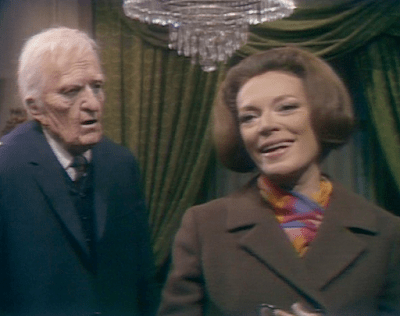
As a result, the first half of the episode is confusing to viewers who have been watching regularly. In recent days, the ghost of ten year old Sarah Collins gave a toy soldier to strange and troubled boy David to keep with him as a talisman against evil; David had a premonition that his cousin, heiress Carolyn, was in danger, and passed the toy soldier on to her; Carolyn saw Sarah, and gave the toy soldier back to David; and as we begin today, David brings the toy soldier back to Carolyn. David catches a glimpse of an extremely old man peering in through the window of the drawing room; he is gone by the time Carolyn turns to look. They talk about ghosts and visions, reenacting in one scene Carolyn’s whole progression from total rejection of David’s claims about the supernatural to total openness to them, and David’s from a desperate need to be believed to an even more desperate fear that Carolyn will be killed unless he can convince her he was lying about everything.
Carolyn tells her mother Liz that she doesn’t think David is lying, and decides to confront Liz’ aversion to the topic of ghosts and tell her that she has seen Sarah. Liz says she thinks David is mentally disturbed and must be sent away to an institution; eavesdropping, David reacts with horror. He meets Carolyn in the foyer afterward. He asks her if she thinks he is crazy. When she says she doesn’t, he says that maybe he is. He pleads with her to reject his stories as either delusions or lies.
The old man David saw looking at Carolyn is their distant cousin Barnabas, who is, unknown to them and the other residents of the great house on the estate, a vampire. Mad scientist Julia Hoffman has been trying to cure Barnabas of vampirism, but she inadvertently restarted the aging process which his condition had arrested. No longer does he look like a man in his forties- now he appears to be about ninety. He fears that if he does not start sucking people’s blood again tonight, he will soon turn into the pile of dust he would have been long ago were it not for his curse.
In Barnabas’ home at the Old House on the estate, we see him talking with Julia. His peeping at Carolyn might suggest that he has her in mind as his victim, but he does not mention her. Instead, he says he will go out into the town of Collinsport and find a stranger. Julia is disappointed that Barnabas is not planning to bite well-meaning governess Vicki, with whom she had hoped never to have another conversation. So she offers herself as a victim instead.
This offer stuns Barnabas so deeply that, for the first time, he addresses Julia by her first name. She smiles when he does this. He seems sincerely dismayed by the thought of enslaving Julia. When he tells her that if he bites her, she will have no will of her own, she smiles even more brightly. Evidently Julia believes that would be a price well worth paying if it kept Vicki from talking to her.
Julia contemplates enslavement. Screenshot by Dark Shadows Before I Die.
Barnabas declines the offer, saying that he might need to call on Julia for medical treatment at some point in the future and that as a blood thrall she wouldn’t be able to function as a doctor. Julia is hurt by Barnabas’ refusal, and asks him if the only reason he won’t enslave her is that he wants to use her professional services, and he assures her that it is.
Back in the great house, Carolyn stands in the foyer under the gaze of Barnabas’ portrait. She looks at the toy soldier and wonders about David. She decides to go to Barnabas’ house and look for evidence of the things David had claimed to see there. Oddly, she sets the toy soldier on the table and leaves without it.
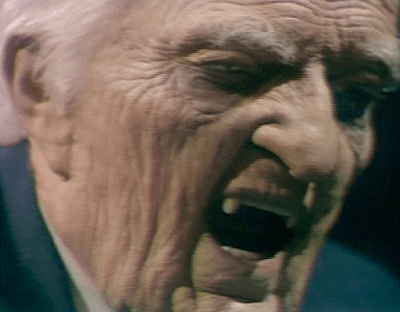
Carolyn lets herself into Barnabas’ house, goes to his basement, and finds his coffin. Julia sees her there and tells her to leave immediately, “before it’s too late.” We hear Barnabas’ voice announcing “It is already too late.” Carolyn is baffled by Barnabas’ aged appearance. He moves in, bares his fangs, and bites her.
Barnabas’ old man makeup is phenomenally good, as all the Dark Shadows blogs mention. The show was very lucky to land Dick Smith, one of the pre-eminent makeup artists of all time, to do it. But I would add that Jonathan Frid’s acting takes Smith’s appliances and turns them to the best possible advantage. It is utterly absorbing to watch him as a man suddenly thrust into extreme old age, trying to figure out how to move his newly enfeebled limbs. In Frid and Smith, two artists at the top of their form collaborated to create a remarkable turn.
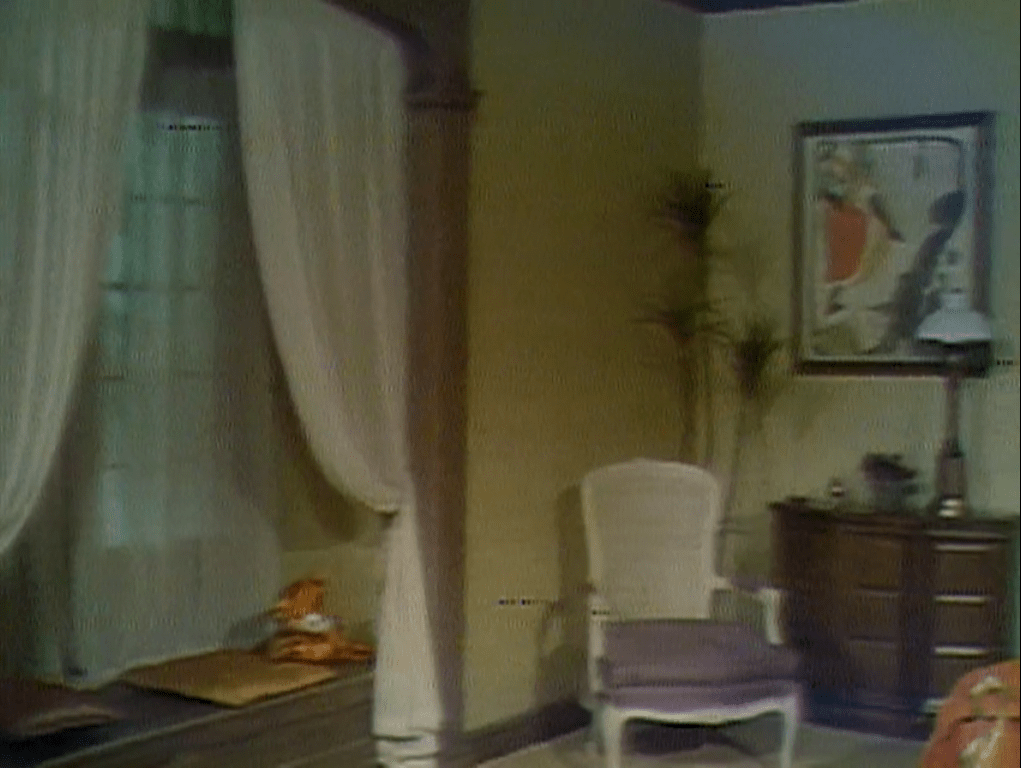
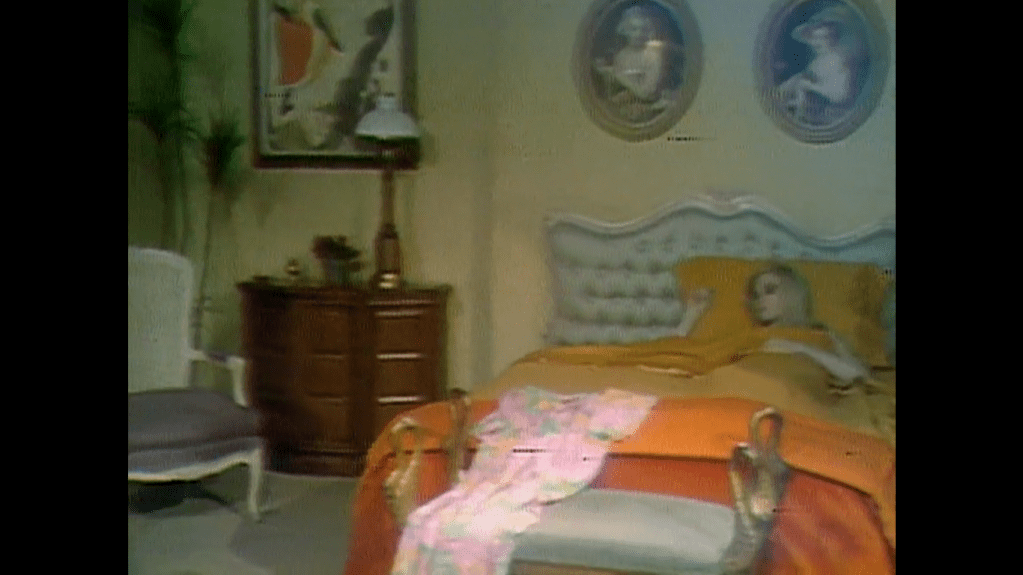
We open on a new set, the bedroom of heiress Carolyn Collins Stoddard in the great house of Collinwood. Dark Shadows has been in color since #295 in August. Though directors Lela Swift and John Sedwick were both ambitious visual artists, they haven’t been able to do much with color so far. With Carolyn’s bedroom, Swift and the staging team have accomplished one of their first real essays in color. It is composed mostly of shades of yellow, pink, and orange.
The color schemes of the other interiors we’ve seen up to this point run the gamut from sedate to subdued to drab to dank, so we already know we are in a unique space. The only other room in Collinwood that might have matched this one for brightness was the kitchen, but we haven’t seen that since #208.
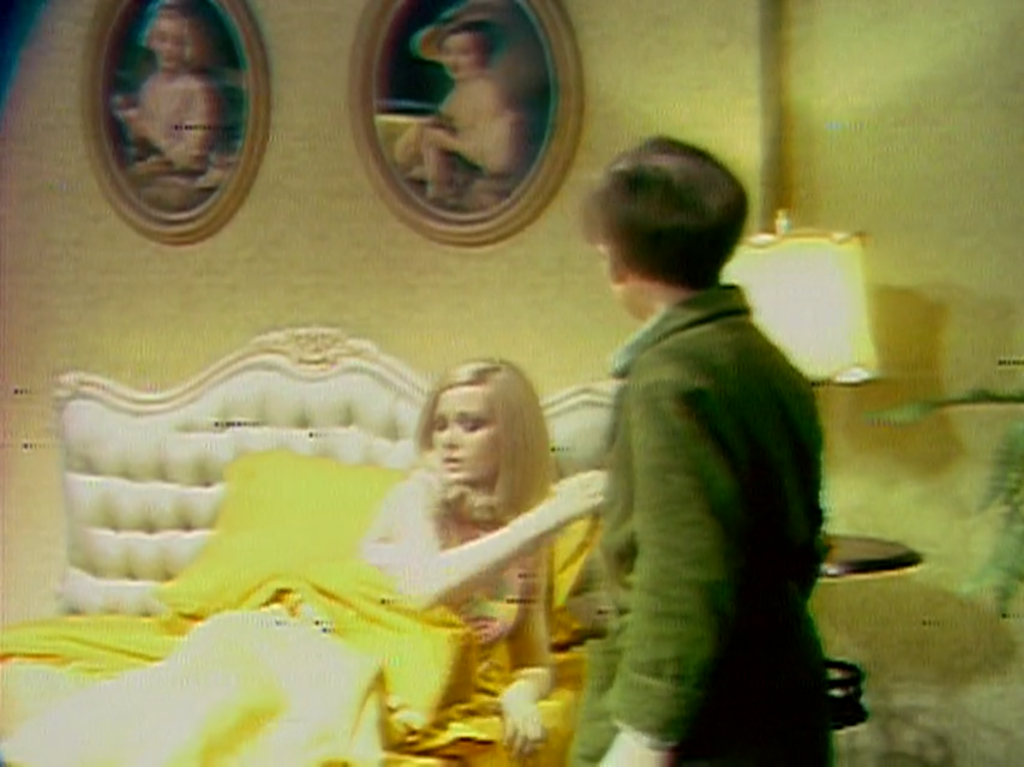
Carolyn’s young cousin, strange and troubled boy David, lets himself into her room. He touches her, and she awakes with a scream. He explains that he just dropped in to make sure she wasn’t dead. When she turns on the light, the screen is so bright that I reflexively squinted, a reaction I’d never before had to an image on Dark Shadows.
Bright room.
David can’t quite explain why he was afraid Carolyn might be dead, but he does insist that she take an antique toy soldier, saying that she will be safe if she keeps it with her. Carolyn’s mother, matriarch Liz, comes into the room to investigate Carolyn’s scream. Liz wonders what David is doing there. Carolyn hastens to say that he was just making sure she was all right.
David goes, and Carolyn tells Liz she doesn’t think anything can be done for him at home. Liz is reluctant to send him away. Regular viewers will not be surprised by this. We know that Liz took David and his father, her ne’er-do-well brother Roger, into Collinwood at the beginning of the summer of 1966 and summoned her unacknowledged daughter, well-meaning governess Vicki, to come look after David starting with #1 on 27 June 1966, so that her conviction that the family ought to look after him got the whole show started. Nonetheless, Liz is so disturbed by David’s unusual statements and depressive affect that she agrees that he needs residential care.
We cut to the Old House on the estate. Vampire Barnabas Collins is sitting in a basement room where mad scientist Julia Hoffman maintains a laboratory. The room is full of electrical equipment, a bit odd since the Old House has no electricity; the laboratory itself is lit by flaming torches. But if we’ve ever seen a Universal Studios production from the 1930s, we know that where you find a mad scientist, you will find electrical currents, so naturally things start buzzing when Julia flips a switch.
Barnabas confined
Julia is trying to implement a medical cure for Barnabas’ vampirism. In the first shot of this scene, we see a visual metaphor for that project. Barnabas, an uncanny being, is confined to a small space in the middle of an elaborate collection of technology. If Julia succeeds, the supernatural will be vanquished altogether and scientific rationality will fill the whole world. The color scheme emphasizes the contrast between Julia’s optimistic goal and the terrain on which she operates. The walls and floor are dominated by the grays and browns of the basement, but the frames and tubing of her equipment are a bright metallic hue, light plays on the glass components, and the intense greens, reds, and blues of the potions are distributed in a slightly unbalanced, lively pattern. The irregular shapes of the frames and tubing emphasize this pattern, and contrast with the solid gray of the floor and the even grid of the brickwork on the walls.
This image not only represents Julia’s plans, but also one of the major themes the show is exploring at this period. Too many characters have encountered too much evidence of supernatural forces and beings for anyone to simply deny that such things exist. But even those who have been most heavily exposed to them keep reverting to a naturalistic frame of reference. Sure, Julia spends all her time hanging around with a vampire and has encountered a couple of ghosts, but she’s determined to ring all of those phenomena around with scientific explanations and technological interventions until they yield to rational control.
Julia’s project has hit its first major setback, as the latest treatment led Barnabas’ hands to age dramatically. He expresses the fear that time will catch up with him, and his apparent age will soon catch up with his actual age, something like 200 years. Julia’s hope that her experiment will not only free Barnabas of his curse, but found a new kind of medicine that will free everyone else of aging and death, will thus be defeated.
Barnabas gives a remarkable little speech about the situation he finds himself in:
I’ve been granted privileges given to few other men… For most men, time moves slowly, so very slowly. They don’t even realize it. But time has revealed itself to me in a very special way. Time is a rushing, howling wind raging past me, withering me in one relentless blast and then continues on. I have been sitting here passively, submissive to its rage, watching its work. Listen. Time, howling, withering.
Writer Joe Caldwell has a fine sense of what actors can do, and this odd little bit of purple prose is right in Jonathan Frid’s wheelhouse. It doesn’t make a whole lot of sense, but the sound of his voice delivering it is so gorgeous it may as well be Shakespeare. Well, maybe not Shakespeare, but Ben Jonson at least.
It is possible to read this speech as a programmatic statement. Daytime soap operas of the 1960s were famously slow-paced; the old joke was that a viewer saw an episode that ended with a character hearing a telephone ring, missed four months of the show, and tuned back in to see the episode that started with the same character saying “Hello.” Even by the standards of the period, the first months of Dark Shadows were notoriously leisurely, with action often as not playing out in real time. When we are watching the 21 episodes centering on Roger’s attempts to find a fountain pen he misplaced, it is indeed the case that “time moves slowly, so very slowly.” But those days are behind us. The show is whipping through plot points at a pace that many prime time series contemporary with it would have had a hard time matching.
If the speech is programmatic, it is also autobiographical on the part of the screenwriter. A fast pace promises excitement for the viewers, but makes life hard for a writing staff that never numbered more than three. Indeed, this is the last episode Joe Caldwell will write for two and a half years. Perhaps he felt the demands of the new pace as “a relentless blast” withering his talents, and had to bow out.
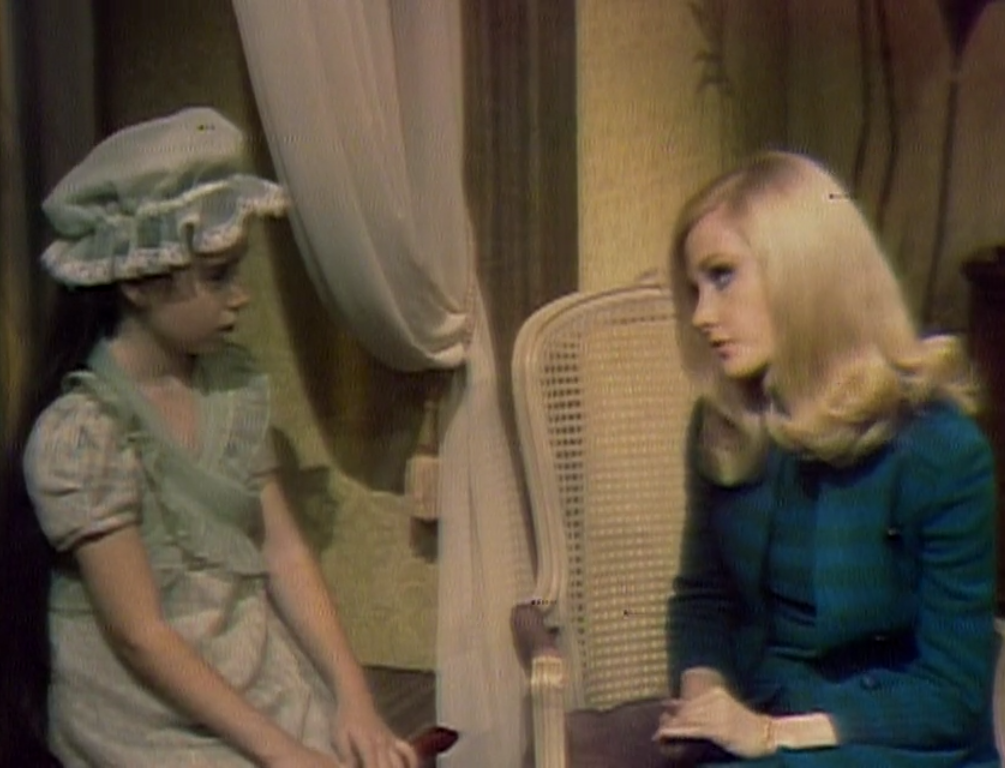
We return to Carolyn’s room. She is in front of her mirror, contemplating the toy soldier. She hears the strains of “London Bridge” playing on a wooden flute, which she has learned is a sign that the ghost of ten year old Sarah Collins is present. Carolyn grew up in this haunted house, so it may not be entirely surprising that her response is to lean back and enjoy the music. But she sits up when Sarah manifests herself in visible form.
Ghost in the mirror
Sarah speaks, and Carolyn sees her reflected in her mirror. The following scene is so extraordinary I’m going to transcribe all of the dialogue:
Sarah: David must have given you that.
Carolyn: Sarah!
Sarah: He told you my name.
Carolyn: Sarah, how did you get in here?
Sarah: Didn’t David tell you?
Carolyn: Tell me what?
Sarah: All about me.
Carolyn: I’m not sure I understand.
Sarah: I think I’m a ghost. Matter of fact, I’m sure I am.
Giving the facts
This is the first time Sarah has described herself in any terms, certainly the first time she has called herself a ghost. Her coyness about herself had left David confused about what she was; it was not until #325 that he finally concluded that she was a ghost. After that, she became more forthright with him. When he wasn’t sure what she was, she would wait until she was out of his line of sight to appear and disappear. But in #327, she fades away while he’s looking right at her.
Coming out to David not only allowed Sarah to relax around him, but has led her to discard her coyness altogether. She is startlingly blunt with Carolyn as this conversation goes on:
Carolyn: B-but- I don’t believe in-
Sarah: Yes you do. Or I wouldn’t have been able to come here. You’re not afraid of me, are you?
Carolyn: No…
Sarah: If you are, I understand.
This is the first confirmation that Sarah can appear only to those who are prepared to believe in her. It’s true that most of the people who have seen and heard her- David; Maggie Evans, The Nicest Girl in Town; Maggie’s father Sam; Vicki; Barnabas; Julia; Barnabas’ sometime blood thrall Willie; and local physician Dave Woodard- have either had extensive contact with the supernatural or had reasoned their way to the conclusion that she existed. But she also showed herself to Maggie’s nurse at the mental hospital Julia runs, and we don’t know anything about her background or beliefs. And local man Burke Devlin heard Sarah when she and David were talking in #327. While Burke has had plenty of contact with supernatural beings and in the early days of Dark Shadows, when he was fun, was willing to believe in them, he was at that point tearing around bellowing that there were no such things as ghosts. So this is new and unexpected information.
Carolyn’s denial that Sarah frightens her is given in a trembling voice that shows it to be a lie. Still, she isn’t as frightened as she might be. The other day, in #344, Carolyn was in David’s room when Sarah manifested there, not in the visible form of a little girl, but as the sound of “London Bridge” and as information appearing in David’s mind about Burke’s imminent death. Carolyn was terrified of Sarah when she came that way.
Carolyn: Well, what do you want?
Sarah: Don’t send David away.
Carolyn: How do you know about that?
Sarah: I don’t know, I just do.
At this point, we see Carolyn’s fear fading. She is starting to react to Sarah as if she really were a ten year old girl.
Carolyn urging Sarah to be reasonable.
Carolyn: But Sarah, we have to send David away. It’s the only way we can help him.
Sarah: But if you send David away, I won’t have anyone to play with.
Carolyn: Well, maybe it isn’t good for David to play with you.
Sarah: Why do you say that?
Carolyn: Because it leads him into believing all sorts of things that aren’t true.
Sarah: How do you know they’re not true?
Carolyn: Well, they’re just not, they couldn’t be.
Sarah: He wasn’t lying about me, was he?
Carolyn: No.
Sarah: Well.. then maybe David is acting the way he is because no one will believe him.
Carolyn: But… it isn’t possible.
Sarah: People say I’m not possible, but I am. Why doesn’t that make the rest possible?
Carolyn: Sarah, maybe you don’t know the stories David’s been telling!
Sarah: Why do you think that?
Carolyn: Because they’re too fantastic! And besides, they’ve all been proved false.
Sarah: How do you know they’ve been proved false?
Carolyn: Sarah, are you trying to tell me that Barnabas actually slee-
This exchange is the ultimate example of a character accepting the existence of a particular supernatural being and then snapping back into a frame of reference that does not allow for supernatural beings. Carolyn knows that Sarah is a ghost, and starts arguing with her about how fantastic the world is permitted to be.
There comes a knock at the door. Carolyn turns away from Sarah to look at the door, and when she looks back, Sarah has vanished. Regular viewers know that Sarah was Barnabas’ little sister, that she wants to keep him from doing horrible things to people she likes, but that she will not say anything against him. So when Carolyn says Barnabas’ name, we know that Sarah is about to vanish.
Sarah’s part is an outstanding example of writing to an actor’s abilities, even more so than was Barnabas’ speech. Caldwell knew that Jonathan Frid had a flair for making flowery gibberish appealing, because that is what he has been doing the whole time he’s been on Dark Shadows. What Sharon Smyth has been doing well as Sarah is being a cutie pie and creating a vague and mysterious impression. When she has more than a few lines to deliver, things tend to get very wobbly. Today, she has to maintain a commanding tone and an adult demeanor throughout an extended patch of rapid-fire dialogue. Absolutely nothing we have seen on screen would suggest that she could handle that. But she pulls it off, more than competently. There are a few glances at the teleprompter, but at no point does she break out of the patient and authoritative manner she has to adopt. It is an impressive job of acting by any standard.
The person at Carolyn’s door is Liz. Liz is Dark Shadows‘ queen of denial. Viewers who have been with the show from the beginning have seen a few cracks in her facade of disbelief in the supernatural. In #10, she dozed off in the drawing room and started talking in her sleep about ghosts. When Vicki insisted to her in #127 that she had seen a ghost, Liz said she believed her. And in #280 and #281, Liz reluctantly agreed to participate in a séance, and afterward agreed that Vicki had been possessed by a spirit. But even in those moments Liz was fighting to keep the topic of ghosts at bay, and the rest of the time she has presented a blank wall to any attempt to face facts about the strange goings-on. So it is not surprising that Carolyn tells her mother she was talking to herself while tidying up her room.
Having talked Liz into sending David away, she now has to talk her back out of it. She manages to get her to agree to wait a few days. “London Bridge” plays. Carolyn reacts to it, Liz does not.
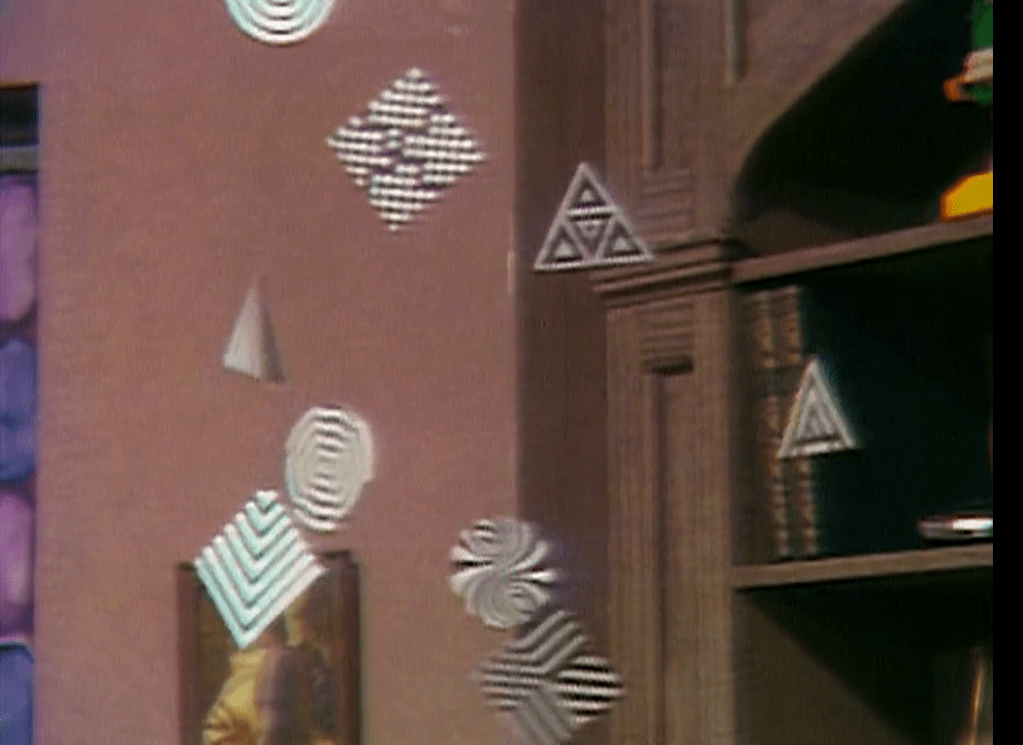
In his room, a distraught David is looking at a mobile. Its whimsical black and white markings suggest a puzzle and make a stark contrast with the vivid colors around them.*
Puzzling shapes.Back to the wall.
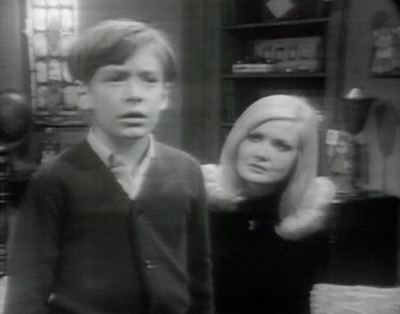
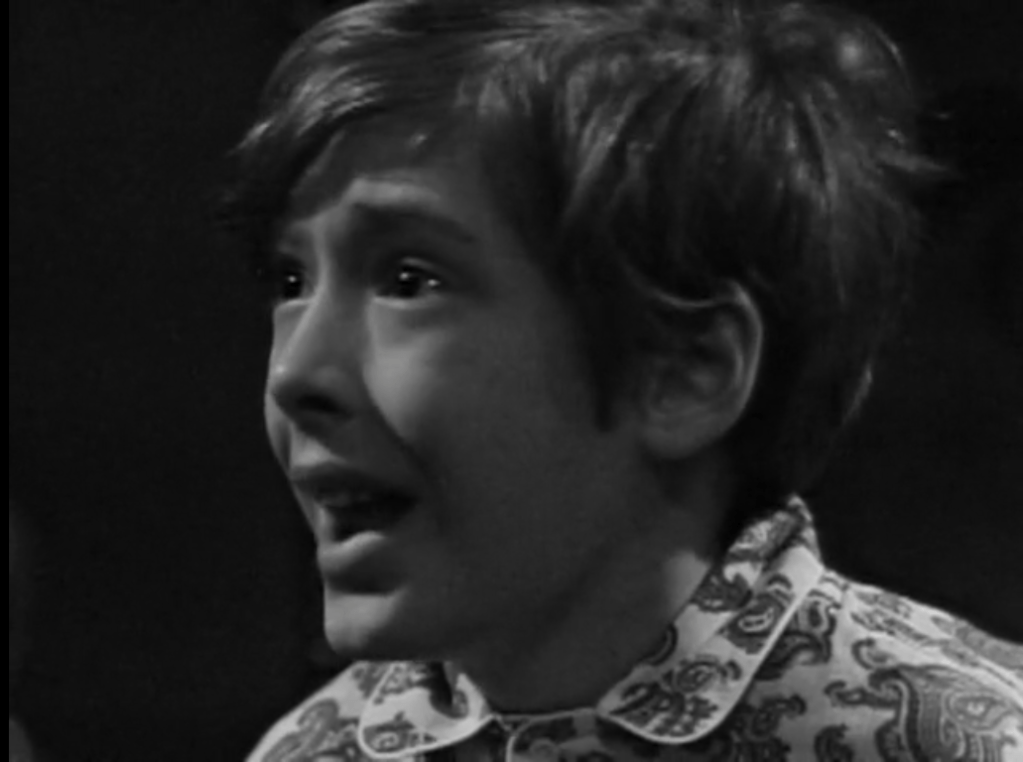
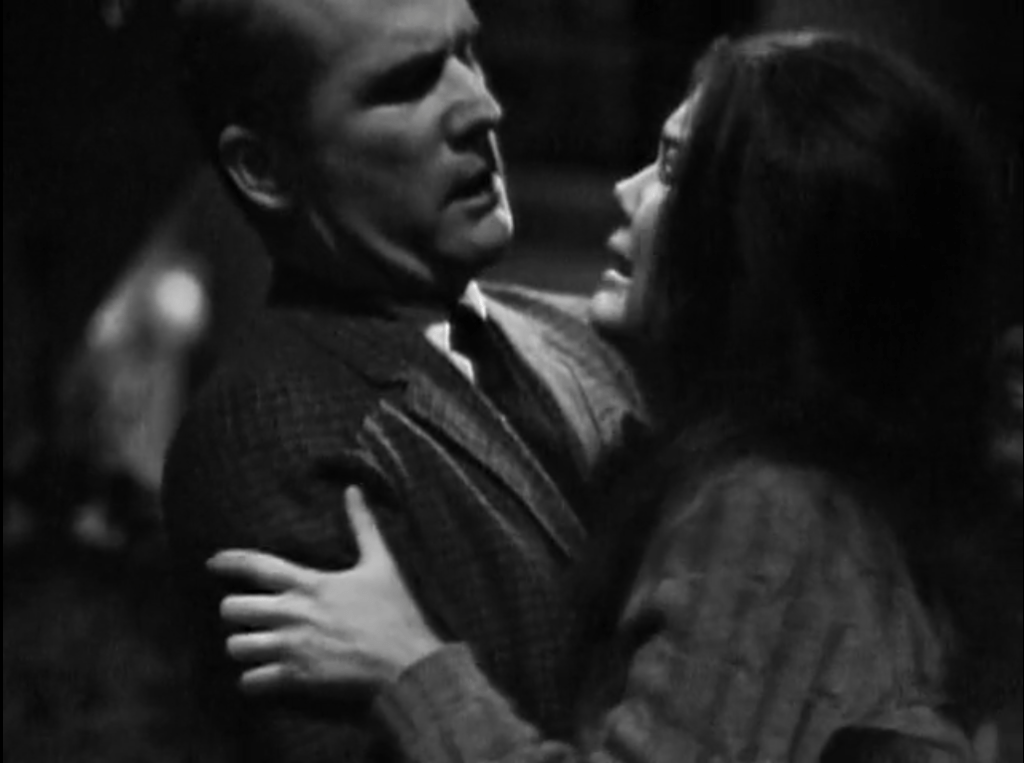
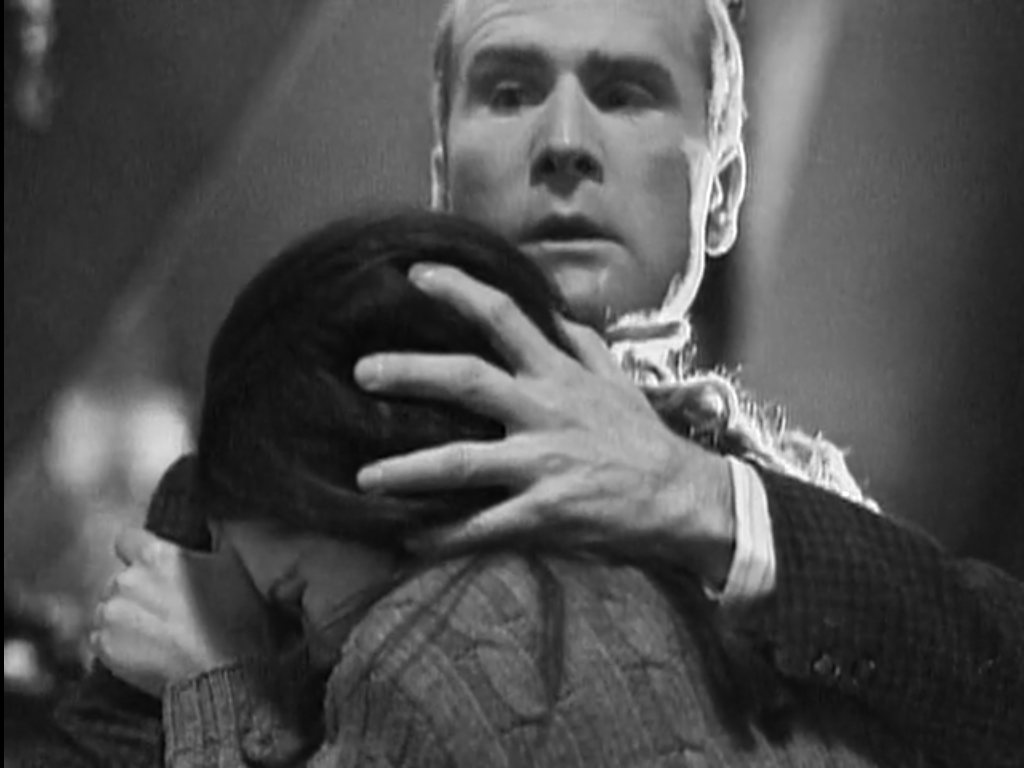
Carolyn comes in. She brings the toy soldier and tells David she doesn’t think she will need it. He insists that she will, but she explains that Sarah visited her and now she believes him and knows how to help him. David is horrified by this. He says that Sarah visited Dr Woodard, that Woodard believed him, and that led to his death. He begs Carolyn not to believe him and claims to have been lying. He sobs and clutches her.
Anguished embrace.
Back in the Old House, Julia prepares to give Barnabas another treatment. He snaps at her. She tells him that whatever happens, she wants him to know that she always wished him well. That prompts him to unload a further stream of sour remarks about her competence and intentions. Julia carries out the treatments, only to find that the aged appearance of Barnabas’ hands has spread to his head.
In his post about this episode on Dark Shadows Every Day, Danny Horn puts it well when he says that “This is just good soap opera construction. People that we care about, facing terrible danger, and desperate to help each other.” He’s referring specifically to the scenes between David and Carolyn and Liz, but it applies to everyone. We care not only about the good people in the great house (well, they’ve been relatively good, lately,) but also about Barnabas and Julia, evil people who are the terrible danger David and Carolyn and Liz are facing, but who make the show fun to watch. We care about Sarah too, and she’s desperately trying to accomplish exactly the result we most want to see, an outcome in which David, Barnabas, and everyone else we enjoy watching stays on the show.
*Evidently this mobile was a commercially produced item. One of the commenters on Danny Horn’s Dark Shadows Every Dayreports having had one like it as a child.
Strange and troubled boy David Collins is sitting on his bed. The ghost of his cousin Sarah is with him, playing “London Bridge” on her flute. She has told him that local physician Dave Woodard is dead, and he is depressed. She explains that she thought she had to tell him.
Sarah says she thinks that Woodard’s death was a terrible one and that it shouldn’t have happened. She denies knowing any more than that, and when David presses her for further information she becomes uncomfortable and vanishes.
David’s aunt, matriarch Liz, comes into his room to break the news to him about Woodard. She is startled to find that he already knows. She is distressed at his attitude of complete resignation. Woodard was the only adult who believed all of the facts about the supernatural menace looming over the great estate of Collinwood and the town of Collinsport that David and Sarah have shared with each other, and when David last saw him Woodard was trying to do something about that menace. David takes Woodard’s death as the end of all hope.
Downstairs, Liz meets her daughter Carolyn and well-meaning governess Vicki. She tells them how sad David is, and Carolyn goes up to see him. She starts talking about imaginary friends, and David asks if she means Sarah. Carolyn says that she doesn’t think Sarah is imaginary, and David replies “You don’t have to pretend. I don’t care.” He isn’t the least bit angry with her- he means exactly what he says when he tells her he doesn’t care how she feels about him.
Viewers who have been with the show from the beginning could see that reaction coming. For the first 24 weeks or so, Carolyn was a flighty heiress, a self-centered young woman who took no interest at all in her little cousin. Since then they have discarded that theme and Carolyn has become a mature and caring person. She and David have had some moments where she has seemed like a big sister. Still, she is still far less involved with him than is Vicki, and David doesn’t have any hopes that even Vicki will listen to him when he tells the truth about the strange goings-on. So when David says “I don’t care,” Carolyn is hit by a freight train that we’ve seen coming for a long time.
This new Carolyn won’t give up on David. She confides that when she was nine years old, she had a friend named Randy, a little boy who always wore a red sweater and who may or may not have existed. Carolyn admits that Randy may have been a ghost, and there is a moment when, as Danny Horn puts it on his Dark Shadows Every Day, “David stands up, and he looks at her, as if they’re really seeing each other for the first time in a long while.” The first time ever, I’d say- David and his father Roger only moved into the house a month or so before the show started, and by that time Carolyn was the character we first saw.
This isn’t the first time the audience has seen this side of Carolyn. In the opening weeks of Dark Shadows, she was one of several characters who had brief conversations with Vicki about the legendary ghosts of Collinwood, and she was the most persistent about laughing those legends off. But before the show had been on the air for five weeks, Carolyn admitted to Vicki that the legends were all true, and that she had tried to downplay them only because she liked Vicki and wanted her to stay.
That development is recapitulated in this scene. Where Vicki had reacted with confusion, telling herself that she ought to be concerned about Carolyn’s mental health but unable to quash a sickly feeling that she might be right, David reacts with wonderment. He is beyond trying to do anything about the horrors that he knows are in progress, let alone appealing to anyone to join him in fighting them, but we can see him absorbing the information that Carolyn is not at all the person she had led him to believe she was.
Once Carolyn stops pretending she does not believe in ghosts, we see why she and the other adults in the family are so insistent about keeping the door shut on the supernatural back-world behind the main action. “London Bridge” starts playing on the soundtrack; Carolyn and David can both hear it. As it goes on, David declares that something terrible is about to happen. It will be an accident- no one will cause it, no one wants it to happen. But it can’t be stopped. Carolyn asks how he knows, and he says he just does.
The little girl we saw in the opening is Sarah, but in this moment we realize she is not the whole of Sarah. The girl is only one manifestation of an unfathomably vast complex of phenomena. The world in which the action appears to be taking place is a tiny, fragile thing by comparison with forces like Sarah. If the characters stray from their little paths of denial and evasion the whole thing may at any moment dissolve altogether, thrusting the back-world into the foreground and leaving them adrift. After a few minutes of David’s soothsaying, Carolyn protests that “None of this is real, it can’t be!” But it’s too late- she knows that it is all too real, and the world of love affairs and hotels and motorcycles and dress shops and restaurants in which she has spent the last 69 weeks trying to find a place is a dream from which she is already starting to awaken.
Meanwhile, Vicki and her depressing fiancé Burke have declined Liz’ offer to live in the west wing of Collinwood when they are married. Liz had hoped to keep Vicki around so that she could help with David. When Burke asks if he should talk to David, Liz tells him not to bother. Carolyn already talked to him, Liz explains, and so far from calming David down she got herself upset too.
That response would suggest that Liz wants to tranquilize David, not to communicate with him. On the heels of the scene between David and Carolyn, it tells us more. Liz has lived in Collinwood longer than anyone, and she has struggled harder than anyone to keep the non-supernatural fore-world in operation. After Carolyn’s experiment in facing facts comes so close to sweeping the “logical explanations” away once and for all, we can see what Liz is trying to protect by keeping David quiet.
Burke is leaving the house, about to go on a business trip to South America, when David emerges from his room and says goodbye. David’s tone makes it clear that it is a final farewell. Burke keeps telling David that he will come back, but David is certain that Burke will die. Burke is shocked by David’s attitude, and says that perhaps they should live in the west wing after all. Vicki is thrilled by the idea.
Burke and Vicki go to a terrace outside the house. There, they hear the wind whistling through the rocks along the shore. On Vicki’s first night in the house, she heard from Liz’ brother Roger the legend of “The Widows’ Wail,” according to which this sound is a warning from the spirits of the widows who haunt the area. In those days, Vicki had little patience for ghost stories, and the “Widows’ Wail” seemed to be the easiest of all the legends to dismiss. But the wind blows every night, and she’s only heard it make that sound on a handful of occasions, usually right before something terrible happens. She’s also seen multiple ghosts, done battle with a humanoid Phoenix, and encountered what anyone with access to old movies would recognize as evidence that a vampire is operating in the vicinity. So she hears the Widows’ Wail the same way regular viewers of the show do, as the sound of the supernatural back-world blasting through and knocking everything else down.
When Vicki pleads with Burke not to go to South America, he replies “Don’t tell me you’re starting to believe all that stuff!” For months now, Burke has been gaslighting Vicki, pretending that she is crazy for believing in supernatural phenomena, including phenomena he himself witnessed and previously acknowledged. But hearing the Widows’ Wail, which was a prominent topic in the early days, and seeing the black and white imagery of the kinescope, we can remember a more appealing version of Burke. Back then, Burke was one of several longtime residents of Collinsport who used the word “ghost” figuratively in conversation with Vicki, each time prompting her to exclaim “Surely you don’t believe in ghosts!?,” to which he would reply that it was entirely possible that there were literal ghosts at Collinwood. For a moment, we see that Burke, and forget the gaslighting abuser. That moment lasts just long enough that we can share David’s sorrow and Vicki’s terror at Burke’s imminent death.
Strange and troubled boy David Collins is sleeping peacefully in his bed. His cousin, flighty heiress Carolyn, comes into his room to check on him. She tucks him in, waking him. He asks what she is doing in his room. When she says that she was making sure he was asleep, he points out that she woke him up. When she keeps showing concern for him, he reminds her that she has called him “a spoiled monster” and a “menace to the civilized world” among other endearments, and that if he showed up in her room there would be no end of hollering.
Carolyn goes on talking to David in a gentle voice about how important he is to her, and says that maybe she’s the one who is a spoiled monster and a menace to the civilized world. After Carolyn maintains an affectionate attitude towards him for a few unbroken minutes, David asks her if she is OK. She assures him that she is. As David Collins, David Henesy’s bewildered response to Carolyn’s friendliness brings the house down.
While we are still laughing, David presses Carolyn to explain why she is being nice to him. A look of fear comes over him, and he asks if something terrible has happened. Carolyn assures him that nothing has, but he just looks more and more alarmed. By the time she leaves him, his expression is little short of heartbreaking.
David alarmed
The next morning, well-meaning governess Vicki is sitting with David in the drawing room, going over his homework. He has written an essay about what it might be like to have an older sister. He wonders if such a sister would love him. Vicki says that she might, and that it is a waste when you don’t love the people who love you. When Vicki asks David where he got the idea of writing about an imaginary older sister who loves him, he doesn’t give a direct answer. He does start talking about Carolyn, making it clear that he is thinking of her.
Vicki leaves David alone in the drawing room for a short while. He looks into the fireplace and sees his own face wearing a placid expression and immersed in the flames. He flees the room in terror, bumping into visiting parapsychologist Dr Guthrie. Vicki comes running, and David holds onto her for dear life.
ReflectionsSafe with Vicki
David’s vision reminds me of a post of Wallace McBride’s on The Collinsport Historical Society from April of 2020. His point is summarized in his title, “In Dark Shadows, Your Reflection Always Tells the Truth.” David lives in 1967, so he doesn’t have access to that article. But he already knows the truth it tells- his terrified reaction shows that he knows it means there is an imminent danger that he will die by fire.
We see hardworking young fisherman Joe poring over old newspapers in the Collinsport Public Library. He finds something that alarms him, and rushes to a public telephone to call Vicki. He tells her he is coming to the house to show something important to her and Guthrie.
Joe on the phone
When Vicki tells Joe and Guthrie that David had a vision of himself in flames, she connects it with a recurring nightmare that had plagued him several weeks ago. David’s mother, blonde fire witch Laura Murdoch Collins, had come back into his life after an absence of several years, and he kept dreaming that she was beckoning him to join her in flames. While he was suffering from this nightmare, drunken artist Sam Evans, miles away in town, inexplicably painted a couple of canvases depicting exactly the image that kept appearing in David’s dreams.
Joe and Guthrie become very animated when Vicki tells them what David saw and how he reacted. Joe declares that what David has seen is a vision of the past. Joe has already shown Guthrie what he found in the library, a newspaper article from one hundred years before. The article is about someone named Laura Murdoch Radcliffe. That Laura Murdoch died in 1867 in a fire along with her young son. His name was David.
A while back, Tumblr user “marcycaa” posted this cartoon summarizing the relationships well-meaning governess Vicki has with strange and troubled boy David and flighty heiress Carolyn in the 1966 episodes of Dark Shadows:
Art by marcycaa
Today, Vicki is being held prisoner by the fugitive Matthew, and Carolyn and David are off their leashes. Carolyn telephones dashing action hero Burke to complain that her mother and uncle don’t want her to see him. Burke reacts with disbelief that Carolyn is nattering on about that when Vicki is missing and might be dead.
David is the only one who knows where Matthew is. He is taking food and cigarettes to him. He has begun to suspect that Matthew has Vicki, and is afraid that he will kill her. This fear contends with his fear that he will go to jail for harboring a fugitive. He sneaks off to see Burke to seek reassurance. When Burke asks him what he wants, he says that he wants Burke to tell him that Matthew is innocent and that his hated father, high-born ne’er-do-well Roger, is responsible for everything Matthew has been accused of. When Burke can’t do that, David slips away.
Back in his hiding place in the Old House on the estate of Collinwood, Matthew lies down on a mattress next to the chair to which he has bound Vicki. Before he can get to sleep, he hears voices calling his name. The portrait of Josette Collins glows, eerie music plays, and one of the voices identifies itself as Josette. Vicki can hear none of this and tells Matthew that he must be dreaming. He wants to agree with her, fearing that the only alternative explanation is that he is going mad.
The audience knows that the ghosts are real, but we don’t know whether they mean anyone well. Matthew’s first action upon hearing the voices is to leap up and hold a knife at Vicki’s throat, so it doesn’t seem that they are protecting her. David considers them his friends, but nothing they have done for him has so far led him anywhere but deeper into his constant agony. The last time Vicki was locked up, the ghost of beloved local man Bill Malloy came and told her she would be killed unless she got away soon, but then vanished, leaving her trapped. While it seems likely the voices represent a power that will destroy Matthew, it is by no means clear they will do so before he kills Vicki. For all we can see, they may be about to drive him to do precisely that.
Vicki is our point of view character, but we’ve known Matthew since the second week of the show. As Carolyn tells David today, he’s always been gruff, but has seemed basically well-intentioned. Reclusive matriarch Liz seems to think that Matthew has some sort of cognitive impairment that would make it difficult for him to function in the world at large, and the sheriff’s manner of ordering him about when they have come into contact would suggest that he has the same idea. Matthew’s killing of Bill Malloy and crimes against Vicki have been desperate acts, committed with displays of reluctance and confusion. The idea that Matthew will end as the victim of a malign force that also spells doom for Vicki is therefore logically satisfying and dramatically compelling.
Well-meaning governess Vicki, fresh from imprisonment at the hands of strange and troubled boy David Collins, gets a few days off work to visit Bangor, Maine. Flighty heiress Carolyn had agreed to drive her to the bus station in the town of Collinsport. Carolyn doesn’t have a job, go to school, or seem to have anything else to do, so why she and Vicki don’t just take a road trip together is unclear.
They wait for the bus at the local restaurant. From there, Carolyn telephones dashing action hero Burke Devlin, her family’s arch-nemesis and the object of her own obsessive crush, and invites him to join the two of them at their table.
Carolyn tells Burke that Vicki has recently seen the ghost of beloved local man Bill Malloy. Vicki tries not to give Burke any additional information. When Burke learns of Vicki’s plans, he volunteers to take her to Bangor in his car. She declines, but he won’t take no for an answer. I don’t drive, and I admire the way this scene shows how hard it can be for a non-driver to decline a ride.
When Burke leaves to get Vicki’s bags, Carolyn blows up at her. Carolyn tells Vicki that she must have known she came to town hoping to see Burke and spend the evening with him. Vicki did not know any such thing. After all, Burke has openly declared his intention of forcing Carolyn’s entire family into bankruptcy and disgrace, and she has expressed remorse for her infatuation with him. When Carolyn makes it clear she is still chasing Burke, Vicki doesn’t know what to say.
The Collinsport Historical Society says that Carolyn spends this week alienating the audience, and her passive-aggressive behavior towards Vicki is indeed exasperating. Watching the scene in the restaurant, it makes perfect sense that Vicki would decide that escaping Carolyn is worth the risk of getting in trouble with her employers by spending an hour with Burke.
Back home at the great house of Collinwood, Carolyn hears her mother, reclusive matriarch Liz, playing the piano. She makes a lot of noise when she comes in, ensuring that her mother will call her into the drawing room. Once there, Carolyn puts on a great show of being upset. She gives partial, teasing answers to each of her mother’s questions, drawing her in as best she can. She finally declares that Vicki is not to be trusted. She reveals that Vicki is in a car with Burke, probably telling him everything she knows about the Collinses and Collinwood. We then cut to Vicki and Burke in the car, where she is telling him everything she knows about her recent sighting of Bill Malloy’s ghost in the house.
Again, the scene in the restaurant explains Vicki’s behavior. Carolyn had told Burke so much about it that it would be hard for Vicki or anyone else to see much point in trying to keep the rest of the story from him. When Burke wants her to say that the ghost accused someone in the house of murder, she insists that it only said it was someone in Collinsport, not Collinwood.
Carolyn has always been tempestuous, and Vicki has always been quick to forgive her. Perhaps now that the relationship between Vicki and David is about to enter a quieter, more complicated phase, the makers of the show wanted to ensure that there would be a continual source of conflict within the house. That might explain why they have chosen to feature Carolyn’s nastier side so heavily this week.
Hardworking young fisherman Joe is spending the evening with Maggie, The Nicest Girl in Town. It’s their first date. Maggie impresses him with her knowledge of ships, and he sings a verse of “What Do You Do With a Drunken Sailor?” It may not sound like much, but the actors, Kathryn Leigh Scott and Joel Crothers, sell it so well that we’ll be rooting for Joe and Maggie for years to come. The final moment of the scene comes after Joe leaves. Maggie looks directly into the camera and says to the audience, “Goodnight, pal.”
Goodnight, pal
In the great house of Collinwood, high-born ne’er-do-well Roger Collins greets his niece, flighty heiress Carolyn, on her return home. Carolyn is upset because Joe has broken off their relationship and is having a date with Maggie. The story of Joe and Carolyn was a bore, largely because the two of them never had a scene with any fraction of the sweetness we see between Joe and Maggie today. There was nothing at stake in their quarrels, because they had nothing to lose if they simply gave up on each other.
Roger tells Carolyn that well-meaning governess Vicki hasn’t been seen for hours, and that he promised Carolyn’s mother, reclusive matriarch Liz, that he would sit up waiting for Vicki’s return. Carolyn is worried as well, and asks Roger why he isn’t actively searching for her. He says she’s probably fine. When Carolyn says that people don’t just disappear, he reminds her of family friend Bill Malloy, who disappeared not so long ago, but then turned up. Considering that Bill turned up in the form of a corpse washed ashore by the tide, it is perhaps unsurprising that Carolyn does not find Roger’s analogy particularly comforting.
After Roger persuades Carolyn to toddle off to bed, he makes sure he’s alone (well, alone except for the stagehand in the lower left-hand corner of the screen.)
Once assured that no one mentioned in the script can see him, Roger returns to the drawing room and opens a secret passage we’ve never seen before. After he disappears into it, Carolyn comes to the drawing room and is baffled at his absence.
The suggestion that Carolyn doesn’t know about the secret passage is characteristic of the show. From the beginning, Vicki has represented our point of view. She started off knowing nothing about the other characters, and everything had to be explained to her while she was on camera. If Vicki knows just what we know, Carolyn, who grew up in the house where most of the action is set, can be presumed to know a great deal we do not. When they reveal a secret to us, they can amplify its importance by showing that Carolyn isn’t in on it. They’ve done this several times, mostly in situations having to do with the murky origins of Roger’s feud with dashing action hero Burke Devlin. Carolyn’s ignorance of the secret passage is particularly effective- it’s right there in the most important room of the only house she’s ever lived in. If she doesn’t know about it, it must be a very well-kept secret indeed.
We go with Roger into the secret passage. He shines his flashlight directly into the camera, creating a halo of light around it. This would not seem to be a desirable visual effect, yet we will see it many, many times in the years to come. This is the second appearance of the effect. The first time came when Roger’s son, strange and troubled boy David, was leading Vicki into the abandoned Old House in episode 70. Now we see it when Roger himself is entering another abandoned space, one where he might meet Vicki.
Halo
It’s hard to believe that the repeated use of this effect was altogether unintentional.
All the more so because of what follows Roger’s entry into the passageway. His journey through it actually does seem to wind through a very large space. In the opening narration, Vicki had said that the house is made up of 80 rooms, retconning the total of 40 given in the second episode. Roger’s trek up one flight of stairs, down another, up a spiral staircase, around corners, past windows, etc etc, seems like it must take him past enough space for at least that many. Perhaps the sequence would be a bit more attractive with less time spent focused on Roger’s feet, but all in all it is as effective a creation of space as Dark Shadows would ever do. If there had been Daytime Emmy Awards in 1966, Lela Swift would have had every right to expect to win Best Director for conjuring up this illusion of vast, winding corridors without editing or going outside the tiny studio space available to her.
Roger does indeed discover Vicki’s whereabouts. He hears her calling for David from behind a locked door, promising David not to tell anyone he imprisoned her there if he will let her out now. Roger does not simply let Vicki out. Instead, he makes some loud noises, then puts on a ghostly, wavering voice and calls out to Vicki that she is in great danger as long as she stays in Collinwood. He seems to be having trouble keeping a straight face when he makes these spooky sounds. Vicki isn’t laughing, and returning viewers aren’t either- in Friday’s episode, she and we saw the ghost of Bill Malloy in the room, and heard that ghost warn her that she would be killed if she stayed in the house much longer.
Once he’s had his fun, Roger opens the door. After another flashlight halo, Vicki recognizes him. Alexandra Moltke Isles gives us one of the finest moments of acting in the entire series, when Vicki throws her arms around Roger, her bodily movement as smooth as any ballet dancer’s but her voice jagged, and says that “David is a monster, you were right!” Up to this point, Roger has been brutally hostile to his son, Vicki heroically friendly to him. Her determination to befriend David has become so central to her character that hearing her make this declaration makes it seem that she is permanently broken.
Broken Vicki
Vicki struggles to hold back her sobbing long enough to tell Roger that she saw the ghost of Bill Malloy. That’s an episode-ending sting- Roger wants everyone to forget about Bill’s death, and if his ghost starts popping up he is unlikely to get that wish.
Stunned Roger
Mrs Isles was a “head actor,” one who found the character’s innermost psychological motivation and worked outward from that. That heavily interiorized style would be one of the things that left her in the dust, along with similar performers like Joel Crothers and Don Briscoe, in the period when Dark Shadows was a hyper-fast paced, wildly zany show about vampires and werewolves and time-travel and God knows what. But in the period when Art Wallace and Francis Swann were writing finely etched character studies, she consistently excelled. In this little turn, she shows that when it was logical for her character to go big, she could go as big as any of the stars of the show in those later days.
Maggie Evans is working the counter in the restaurant at the Collinsport Inn. We open with her on the telephone, explaining to her father Sam that she hasn’t seen Bill Malloy. Dashing action hero Burke Devlin comes in, orders breakfast, and asks Maggie if she’s seen Bill Malloy. Hardworking young fisherman Joe Haskell comes in, scowls at his bête noire Devlin, and asks Maggie if she’s seen Bill Malloy. Flighty heiress Carolyn Stoddard comes in. Carolyn already knows that Maggie hasn’t seen Bill Malloy, so she talks about her car.
Maggie and Carolyn are both cheerful when the episode opens, and by the end the men have dragged them down into gloom. Joe is in a sour mood, not only because shares the universal worry about where Bill Malloy is, but also because of the steadily mounting evidence that Carolyn doesn’t have any intention of getting married. Burke is in a towering rage because of his suspicion that either the dastardly Roger Collins or the drunken Sam Evans did away with Bill Malloy to prevent Bill from clearing Burke of the manslaughter charge that long ago sent Burke to prison. Sam is wallowing in despair, as per usual.
Maggie goes home to the Evans cottage to find that Burke is there, confronting Sam. The two men have been yelling at each other about not knowing where Bill Malloy is. After Burke leaves, Maggie tries to get Sam to tell her what’s going on. He refuses to do so. Downcast, she turns to go back to work. Before she leaves she asks her father “Where are we all heading?” After she’s gone, Sam looks at the closed door and says “Towards death, Maggie darling. We’re all heading towards death.”
Carolyn goes home to the mansion at Collinwood with Joe. They start to hug and kiss when there’s a knock at the door. Carolyn answers. It’s Burke, demanding to speak to Roger. He wants some answers, mainly about where Bill Malloy is. Joe and Burke wait in the foyer while Carolyn searches the house for Roger.
Burke gives an angry and not very coherent speech denouncing the Collinses. Some commentators think the evident difficulty Mitch Ryan has with this speech is a sign that he was drunk during taping. Ryan did have a drinking problem, and admitted that in the 1960s he sometimes showed up to work drunk. But the speech itself is so awkward and weird that I suspect there is another culprit aside from alcohol- uncredited additional dialogue by Malcolm Marmorstein. Be that as it may, the speech rubs Joe the wrong way, and by the time Carolyn comes back and tells Burke that Roger isn’t home, Joe is in a worse mood than ever.
Carolyn finds her mother playing the piano in the drawing room. They have a very sweet conversation about the good times they had when Carolyn was growing up. Liz laughs when her daughter calls her a “bit of a kook.”
Carolyn wants to talk about Roger and Bill Malloy; Liz doesn’t, but can’t help listening when Carolyn tells her that Roger had declared that he wouldn’t be anyone’s sacrificial lamb. Liz is troubled by what Bill had told her about Roger and the manslaughter charge that sent Burke Devlin to prison ten years before, and wonders if the sacrificial lamb has been led to the altar.
In this scene between Liz and Carolyn, we see a relationship we can care about. In the concern the two women have for Roger, we can see their wish that he would just be part of the good times, not a source of heartache.
Roger is in his office, where Bill had told him, Sam Evans, and Burke he wanted to meet them at 11 PM sharp. It’s 11:30 when we first see the three of them sitting around wondering where Bill is. Burke wants to keep waiting, the others decide to leave. Roger tells Burke that he wants to give him his pen back, feels for it in his pocket, and says he must have left it at home.
The three men in the office don’t have anything interesting to do today. They mention that they’ve spent their time talking about the weather and the price of sardines; it’s a wonder that three New England men with nothing in particular to say to each other on an August evening wouldn’t talk about the Red Sox, but I suppose the club had a bad enough season in 1966 that it would just have added to the gloom.
Roger comes home, apparently quite happy that Bill never showed up and the meeting ended without any new information for Burke. Liz confronts him in the drawing room. She tells him that Bill had told her he thought Roger, not Burke, was responsible for the manslaughter ten years ago, and demands Roger tell her the truth. He emphatically denies Bill’s charges. For good measure, he adds more lies, denying that Bill had said the same thing to him. Liz leaves him alone in the drawing room. Out of her sight, he looks stricken.
In yesterday’s episode, the clock in the foyer at Collinwood chimed at 10:10 and again at 10:30 pm. In today’s, it chimes at 11:10 and 11:30. We saw the hands on the clock each time, and today Carolyn even says that it is 11:10 immediately before it chimes. So it isn’t a blooper- they really want us to think that the clock chimes at 10 minutes and 30 minutes after the hour. That’s just a weird thing to set your clock to do, is what I’m saying. Staying home for 18 years isn’t the only kooky thing about Liz.










 Dark Shadows Commentary