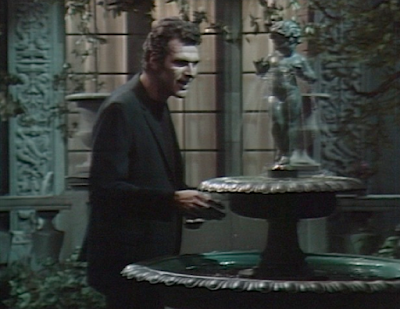
Episode 843: The meaning of shadows

Beth and Petofi

This night in 1897, Beth Chavez has lost both her job as a maid in the great house on the estate of Collinwood and her hopes of marrying rakish libertine Quentin Collins. She goes to the lair of sorcerer Count Petofi and volunteers to work for him. Petofi makes it clear that the position Beth is applying for is that of slave. She accepts without hesitation, and he has her do some mumbo-jumbo on his behalf.

This story point would make sense if Beth were a deeply dependent person who couldn’t imagine life without Quentin or her old job. But we’ve known Beth for months and months, and this is the first we’ve heard that she is like that. Terrayne Crawford’s acting ability was limited to embodying one feeling at a time, and in no scene was she assigned to demonstrate “corrosive sense of personal incompleteness.” So we know she is hung up on Quentin and we know she likes her job, but we also know that as one event follows another she responds with the emotion we would expect a level-headed person to have. Even when she got carried away the other day and tried to shoot Quentin, it didn’t seem to be a sign of mental breakdown. After Petofi showed up and stopped her, he pointed out that the way Quentin treats women, it is a marvel that none of them had tried to kill him before. If anything, her attempt on Quentin’s life suggested Beth has enough strength of character to leave Collinsport and make a fresh start.

Tate and the Creatures

For much of 1968, when Dark Shadows was in a contemporary setting, Roger Davis played a man named Peter Bradford who very loudly insisted that everyone call him Jeff Clark. Peter/ Jeff had no memory of his life more than a year or two before the present. Well-meaning governess Vicki knew that Peter/ Jeff had lived in the 1790s, and his shouting about his preferred name often came in response to Vicki’s attempts to tell him what she knew. Peter/ Jeff was convinced that if there were something supernatural about him, he would be incapable of loving anyone or of being loved.

Peter/ Jeff spent most of 1968 entangled with the story of Frankenstein’s monster Adam. Peter/ Jeff had assisted mad scientist Eric Lang in digging up the corpses from which Lang assembled Adam’s body. After Lang’s death, another mad scientist, Julia Hoffman, completed his work, attaching the body of recovering vampire Barnabas Collins to the body to provide the “life force.”

Mad scientists and vampires are two metaphors for extreme selfishness, so it was no surprise that Julia and Barnabas were the worst parents the newborn Adam could possibly have had. Within an hour of Adam’s awakening, Barnabas had loaded a gun and was on his way to kill him. When he relented from that plan, he and Julia took Adam to the prison cell in the basement of Barnabas’ house, where they locked his ankle in a fetter chained to the wall. They kept him within the blank walls of that cell for weeks on end, giving him nothing to play with, nothing to learn from, and nothing soft to touch. Nor did they ever allow him human contact for more than a few minutes at a time. They delegated Adam’s feeding to Barnabas’ servant Willie, who taunted him cruelly. Unsurprisingly, when Adam escaped from the cell he was rough with everyone he met, and when he found someone he liked he abducted her and found a place to lock her up. That was the only form of human interaction the big guy had ever known.

Now, the show is set in 1897, and Mr Davis plays artist Charles Delaware Tate. Tate combines the most disagreeable elements of all the characters involved in the story of Adam. Like Lang and Julia, he has the power to bring people to life without the usual processes of reproduction and growth. In his case, he simply draws or paints someone, and they pop into existence. He did that two years ago, in 1895, with a beautiful young woman he had imagined. He made a sketch and then a painting, and suddenly there she was, walking along a sidewalk in New York City. She took the name Amanda Harris, and has recently made her way to Collinsport.

Tate wasn’t there to see Amanda’s instantiation. But he recognized her when he did see her, and he has since drawn some inanimate objects that he saw come into being. So he figured out what Amanda’s origin must have been, and he has been shouting at her about it for a while. As Peter/ Jeff did not want to believe Vicki when she told him he was not native to the twentieth century, so Amanda does not want to believe Tate when he tells her that she came into being in the way that, in Greek myth, Pygmalion brought the lovely Galatea to life. But yesterday Amanda went to Tate’s studio, and he drew an imaginary man. That man appeared while Amanda watched.

We open today in Tate’s studio. Amanda is gone, and Tate is screaming at the man and declaring that he will kill him. The man is just standing there- he is fully grown, apparently in his mid-twenties, but in reality he is only a few minutes old. He doesn’t seem to be able to talk. He reacts to Tate’s extreme hostility with bafflement.

Tate rips up the drawing, and is disappointed the man does not die. A knock comes at the door. He shoves the man in the closet and locks him in there. Within moments, he reenacts Barnabas’ attempt to shoot Adam and his confinement of Adam to the cell. Tate had not been written as especially evil before this, but now he takes his place among Dark Shadows‘ cruelest villains. We may wonder if the character would have been developed differently had he not been played by the bombastic Mr Davis. Perhaps if the writers had been scripting a role for a more pleasant actor, they could have let Tate be a relatively nice guy.

Tate opens the door. Amanda is there, standing behind her traveling companion and sometime partner-in-crime, adventurer Tim Shaw. Amanda has told Tim what Tate did, and Tim demands to see the man. Tim sees the closet doorknob turning, and insists Tate unlock it. Tate at first denies that he has a key, but Tim pulls a gun and forces him to comply. In his post about the episode on his great Dark Shadows Every Day, Danny Horn has a funny bit about this moment:

Now, if life was like a Tex Avery cartoon, and I think we can all agree that it should be, then Tate’s next move would be to grab his sketchpad and draw an even bigger gun. Then Tim would reach into his pocket and pull out a machine gun, and Tate would draw a rocket launcher, and we could go back and forth like that until somebody pushes down on a plunger detonator, and there’s an explosion that cracks the Earth in two. That would be a good scene.

Danny Horn, “Episode 843: I Can Make You a Man,” posted to Dark Shadows Every Day, 19 March 2016.

As it is, Tate just hands over the key. Tim unlocks the door, finds the man, and loses all interest in Amanda. He tells Tate that he is sure he will take good care of Amanda as he leaves with the man.

Tim is delighted with his new toy. Screenshot by Dark Shadows Before I Die.

Tate shouts at Amanda and grabs various parts of her body, adjusting their position as if she were an action figure. He’s hollering something about love when she pulls away from him and declares that, as an unnatural creature, she can neither love nor be loved. Again, longtime viewers remember Mr Davis as Peter/ Jeff, yelling the same sentiment. But Amanda goes further than Peter/ Jeff ever did with the affable Vicki. She says that can hate, and that she hates him very cordially indeed.

In his hotel room, Tim is trying to coax the man Tate created into speaking. The man tries to make a sound, but fails. Tate himself comes barging in. He has a gun, and points it at the camera. He announces that the man will never speak, because he is going to murder him forthwith.

In the comments section of Danny’s post, I left a long comment which is I suppose a first draft of this post. You can read it there.

Episode 727: The lost lamb

Well-meaning time-traveler/ bloodsucking abomination from the depths of Hell Barnabas Collins has found himself in the year 1897, where he must take action to prevent his distant cousin Quentin from becoming a malevolent ghost who will ruin everything for everyone on the estate of Collinwood in 1969. He has no idea what that action will be, so has decided to intrude as aggressively as he can in as much of the family’s business as he can until something turns up.

At the moment, Barnabas is strenuously trying to keep Judith Collins, the mistress of Collinwood, from sending her twelve year old nephew Jamison to a boarding school called Worthington Hall. Worthington Hall is run by the Rev’d Gregory Trask, a descendant of one of Barnabas’ old nemeses. Yesterday, Trask had an unsettling encounter with Jamison during which the camera dwelt heavily on Jamison’s nervous habit of fiddling with his belt, prompting us to wonder why Trask gives Jamison the feeling that he ought to make very sure he remains fully clothed.

Today, Trask’s daughter Charity shows up. Nancy Barrett, who previously played the sometimes-capricious, always likable heiress Carolyn and the fragile, highly comic heiress Millicent, makes Charity just as imposing a heavy as her father.

Jamison’s governess, neurotic intellectual Rachel Drummond, tells Barnabas that she was a student at Worthington Hall for many years, and that the place was gruesome. The Trasks kept the children separated from one another, locked them in cupboards for weeks on end when they incurred their displeasure, and generally exploited and abused them. She herself was forced to stay at the school as a teacher when Trask lied to her and claimed that she owed him money, and she escaped with the aid of a fellow sufferer.

Trask confronts Rachel in the drawing room. She tries to stand up for herself, but he breaks her resistance down expertly. Trask’s one moment of weakness comes when he starts talking about Rachel’s lovely hair, and he suddenly turns away. The mask has slipped, and the audience has seen that Trask’s interest in Rachel is sexual. But Rachel is too intimidated to recognize what has happened, and when he resumes his righteous tone she crumbles. When she next sees Barnabas, she rushes away in tears.

Rachel is terrified by Trask. Screenshot by Dark Shadows Before I Die.

Rachel had another traumatic experience over the last few days. Quentin died, turned into a zombie, and abducted her. No one has given her the news yet, but Quentin came back to life yesterday. She is horrified when he comes into the drawing room and sees Quentin. At first he takes on a lumbering gait, and she screams. Then he laughs and starts walking normally. He explains what happened, as best he can, and they have a strangely pleasant conversation. Again, this is a testament to the high quality of the acting. It is hard to imagine that anyone less charming than David Selby could make us believe a woman would be so comfortable with Quentin after what Rachel has been through.

Barnabas takes on the form of a bat and bites Charity in her bedroom. Presumably he does this so that he can use her as an agent against her father. This raises the question of why he didn’t just bite Trask and put an end to the whole thing. Of course, the real-world explanation is that the writers wanted to keep the story going, but usually they take care to maneuver Barnabas into a situation where he is compelled to bite one person rather than another. So it’s rather sloppy to end the episode this way.

Still, this is a very good installment. Too good for some viewers; my wife, Mrs Acilius, refuses to watch the Gregory Trask episodes, because Jerry Lacy plays him so effectively that it ruins her day to spend half an hour in the presence of such an overpowering evil. Kathryn Leigh Scott brings Rachel’s self-doubts and final defeat vividly to life as well. By the time I got to the end of their scene, I was shouting at the screen “Bring back the zombies and werewolves and witches!” So I cheered when Barnabas bit Charity.

Episode 726: A boy’s dislike

When Dark Shadows began in June 1966, strange and troubled boy David Collins (David Henesy) was frantically afraid that he would be sent away from the great house of Collinwood. In #10, David overheard his father Roger (Louis Edmonds) telling his aunt Elizabeth Collins Stoddard (Joan Bennett) that they ought to do just that. As the owner of the house and holder of all the family’s wealth, it is up to Liz to make the decision. Hearing his father press to send him away, David responded by sabotaging the brakes on Roger’s car, nearly killing him.

Roger told Liz that David belonged in an “institution,” but David was just as terrified when it was suggested that he might go to an ordinary school. It was not entirely clear why he had this attitude. David and Roger had only lived in the vast gloomy house for a few weeks when the show started. Roger openly hated David, as did Liz’ daughter Carolyn. Liz loved him, but as a recluse and an aging grande dame had little in common with a young boy. Moreover, David hated his governess, the well-meaning Vicki, as much as he could hate any school. His mother, who did not live in the house and whose name was in those days was never to be mentioned there, was the only person for whom David expressed fondness; when in #15 David watched Roger drive off in the car whose brakes he had sabotaged, we saw him standing by himself, saying “He’s going to die, mother. He’s going to die!” So it is difficult to see why David was so intensely committed to staying at Collinwood.

Today, we see a suggestion that David may have been influenced by an ancestral memory of bad times at a boarding school. It is 1897, and David’s grandfather Jamison Collins (David Henesy) is twelve. Jamison’s father Edward (Louis Edmonds) has asked the Rev’d Mr Gregory Trask to come to Collinwood to urge his sister, Judith Collins (Joan Bennett,) to send Jamison and his nine-year old sister Nora to be students at Worthington Hall, a boarding school Trask runs. As the house’s owner and holder of all the family’s wealth, it is up to Judith to make the decision.

Trask wins Judith’s confidence by performing a ceremony after which Jamison and her brother, Jamison’s uncle Quentin, are restored to themselves after a spell that had made Quentin a zombie and put his spirit in possession of Jamison. Recently arrived, thoroughly mysterious distant cousin Barnabas Collins sputters with rage at the very sight of Trask, and exasperates Judith with his insistence that Trask is evil. Judith does not trust Barnabas, and Barnabas’ inability to either explain or contain his hostility only confirms her favorable judgment of Trask.

Once Quentin and Jamison are themselves again, Trask sends Barnabas and Quentin out of the drawing room. Quentin raises his eyebrows in response to Trask’s order and asks his sister “Are you sure you’re still in charge of this house, Judith?” She does not respond.

Judith makes a remark about Quentin’s influence on Jamison, saying that “He’s been like this ever since [Quentin] came home.” Since Jamison was just freed from possession a few minutes before, it is unclear what she could mean, and Jamison objects “That’s not true!” Trask unctuously replies “Now, your aunt does not tell lies, Jamison.” Returning viewers know that Judith lies constantly. Nor is Trask unaware that Judith is less than perfectly truthful. When he first arrived in Friday’s episode, Judith and Barnabas tried to conceal the situation with Quentin and Jamison from him, and she told a series of lies in pursuit of that objective.

When Jamison continues his attempts to tell the truth, Trask silences him with “Now, there is only one who is constantly right, Jamison, and He is not on this earth, but above. Now, I want you to go out into the hall and consider all the wonderful things your aunt has done for you recently. I am sure you will have much to think about.” Jerry Lacy brings such an inflexible authority to Trask’s personality that we cannot imagine a rebuttal to this sanctimonious little speech. We share Jamison’s helplessness and frustration.

Alone with Trask, Judith agrees to let him take Jamison and Nora to Worthington Hall. Jamison barges back in and declares that he will not go. Trask assures him that he will not take him unless he is willing to go. He then obtains Judith’s permission to talk with Jamison alone in his room.

While Jamison is taking Trask upstairs, we cut to the study. Quentin and Barnabas are alone there. Quentin asks Barnabas if Trask really was his “savior.” Barnabas replies “Apparently.” Quentin asks Barnabas what he thinks really happened; he sidesteps the question. Quentin keeps probing for Barnabas’ interpretation of his recent experience; Barnabas alludes to Quentin’s adventures in Satanism, saying “You dabble in odd things, perhaps one of your interests resulted in this.” Quentin observes that this is “Delicately put,” and goes on to remark on “what an interesting life” he has had.

Barnabas then takes his turn as the questioner. He asks Quentin about his wife, a tall, beautiful, homicidally crazed woman named Jenny who is being held prisoner somewhere in the house. Quentin grows tense, and does not give direct answers. He explodes at Barnabas, saying that he has no interest in making a friend of him. Barnabas observes that he has in fact made an effort to turn him into an enemy; Quentin interjects “Your fault!” Barnabas says they could be useful to each other; Quentin exclaims “Wrong!” When he thinks of Barnabas, Quentin says, only one question comes to mind- “What does he want from me?”

Jonathan Frid said that his favorite scene in Dark Shadows was one he had with Anthony George in #301. Barnabas tells local man Burke Devlin that their relationship to each other is like that of “two superb swordsmen with highly sharpened blades. You thrust, and I parry. I thrust, you parry.” That scene has never impressed me. The Barnabas/ Burke conflict did not have enough grounding in the story to come to life, and having the characters tell the audience that they were like “superb swordsmen” does not make it so. But this showdown really does pay off. Barnabas and Quentin are the show’s two great breakout stars, and we are in the middle of a long run of episodes where everything works. This scene brings out all the values they might have hoped that Burke and Barnabas’ confrontation would put on screen when they planned it.

We return to Jamison’s room, the same bedroom David Collins occupied in the 1960s. Trask is still being friendly. When Jamison says that he would miss his pony if he had to go away to Worthington Hall, Trask says “You must bring him with you!” When Jamison refuses to tell Trask his pony’s name, the friendliness vanishes. Trask darkens, tells him “You’re going to have to learn to answer questions, boy,” and insists they pray together. When Jamison resists, Trask tells him that he must change his ways lest he go on being a disappointment to his father. Jamison protests that his father loves him, and Trask asks incredulously “Does he?” He asks Jamison if he wants his soul to be saved. Jamison can’t very well say anything but yes to that, and so Trask says “Then I think I can help you.” Jamison is trapped.

After a scene in the drawing room where Quentin demands Judith tell him where Jenny is locked up, we return to Jamison’s room. The scene begins with a closeup of the rope belt of Jamison’s robe. Jamison is retying it. He keeps fiddling with it, perhaps a nervous habit, but it is the first thing we see and they hold the shot for a long time. We cannot but wonder whether the belt was untied at some point while Jamison and Trask were alone off camera.

Jamison fiddles with his belt.

Trask orders Jamison to tell Judith that he wants to go to Worthington Hall; Jamison says he will not. The dialogue does not explain how Jamison’s robe came undone, and neither he nor Trask seems concerned with the matter. Their blasé attitude turns an uncomfortable image into a lingering mystery.

In the drawing room, Trask announces to Judith that Jamison has something to say. Jamison says that Trask threatened him and tried to make him lie. Trask says that Judith will have to find another school for him, and she declares that she will not. Jamison will go to Worthington Hall.

Trask exits. Jamison finds Quentin and asks him to help him escape the grim fate in store for him. Quentin promises to do so, and by the end of the episode Jamison will be safely hidden somewhere in the house. Meanwhile, Barnabas throws a fit before Judith, saying that he cannot understand why “You would believe that maniac before you believe Jamison.” Judith scolds him and tells him to treat Trask with respect.

Trask returns. Barnabas asks him if his family is from Salem, Massachusetts. Trask affirms that it is so. Barnabas claims to have seen ink drawings of a Rev’d Trask who was at Collinwood in the 1790s; Trask says that he was his ancestor. He says that the earlier Rev’d Trask disappeared shortly after leaving Collinwood, and that his disappearance was never explained.

Longtime viewers know that Barnabas is a vampire who lived in the 1790s, and that the original Trask is one of those he blames for the many misfortunes that befell the family in those days, including his own transformation into a bloodsucking abomination. We remember the first Trask as a case study of a type much on people’s minds in the 1960s, Eric Hoffer’s “True Believer.” That Trask was so deeply and unshakably convinced of his own understanding of the situation around him that when he set out on a witch hunt, the real witch was easily able to manipulate him into doing her work for her. Barnabas murdered the original Trask in #442 by bricking him up in an alcove, one of the most famous moments in all of Dark Shadows. He seems pleased to hear that people are still wondering what became of the late witchfinder.

Gregory Trask seems to be a different sort. He can change his tune in a way that his forebear never could, putting on a friendly mask when it serves his interests to do so. While the original Trask was single-mindedly trying to live up to his own twisted idea of virtue, the second sometimes responds to bad news with a delighted grin, suggesting that he sees an opportunity to profit from it. The first Trask’s fanaticism sometimes led him to hypocrisy, when he thought that his ends were so good that they justified dishonest means, but this Trask seems to be a hypocrite who has kidded himself into acting like a fanatic. Mr Lacy’s performance makes him a formidable presence; the writers have made him a powerful adversary.

Episode 670: A nice couple

The only story that reliably worked in the first 38 weeks of Dark Shadows was the attempt of well-meaning governess Vicki Winters to befriend her charge, strange and troubled boy David Collins. Its success was less to do with the writers than with the actors. When we saw Vicki in David’s room giving him his lessons, her dialogue was as bad as anything else the actors found in the scripts, including one moment when she had to read a description of the coastline of Maine to him from a geography textbook. But Alexandra Moltke Isles and David Henesy used everything other than the words to show us a young woman and a hurting boy learning to trust each other. Their use of space, of body language, of facial expressions, of tones of voice, all showed us that process step by step, and it was fascinating to watch.

Vicki and David’s story reached its conclusion in #191, when David’s mother, undead blonde fire witch Laura Murdoch Collins, tried to lure David to his demise in a burning shack while Vicki tried to rescue him. At the end, David ran from the shack into Vicki’s arms. When he chose Vicki and life over his mother and death, there was nowhere left for their relationship to go. We saw a few more tutoring scenes in the spring and summer of 1967, when vampire Barnabas Collins was first on the show, but have seen none since. Mrs Isles left Dark Shadows in November, and the recast Vicki made her final appearance a week ago, in #665.

The new governess in the great house of Collinwood is Maggie Evans, who was introduced in #1 as a wisecracking waitress and a hardboiled representative of the working class of the village of Collinsport, but whom actress Kathryn Leigh Scott shortly afterward reinvented as The Nicest Girl in Town. The town barely exists anymore, so when Vicki disappeared into a rift in the fabric of time and space it was almost a foregone conclusion Maggie would move into Vicki’s room upstairs in the great house. After all, the room was first occupied in the 1790s by the gracious Josette, whom Miss Scott played in the parts of the show set in that period.

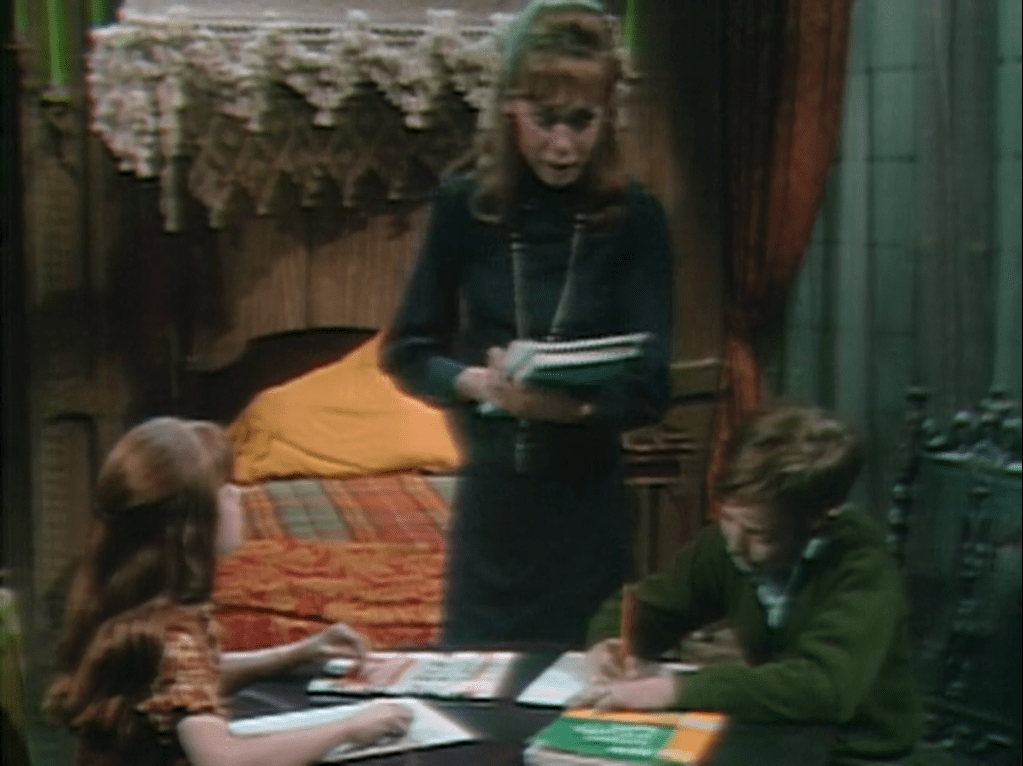
Today, we see our first tutoring scene in over a year and a half. David isn’t Maggie’s only charge; he has been joined by permanent houseguest Amy Jennings. Yesterday and the day before, we saw evidence that Maggie is a poor disciplinarian. We see further such evidence at the beginning of the tutoring scene, when the children complain about their lessons and Maggie quickly starts to explain herself and bargain with them. Amy and David are coming under the influence of the evil spirit of the late Quentin Collins. If the adult who is employed full-time to supervise David and Amy were up to her job, they wouldn’t be much help to him. So it’s no wonder the show three days in a row tells us that Maggie is a squish.

Maggie on the job.

To advance a plan of Quentin’s, Amy pretends to be ill and to faint during the lesson. David Collins is almost as subtle an actor as is David Henesy; when he is pretending to see signs of illness in Amy’s face, he looks at her with one eye and speaks with a most convincing note of concern. By contrast, Amy’s performance is exaggerated, showing none of the easy fluency Denise Nickerson brought to her roles. My wife, Mrs Acilius, chuckled at Amy’s fake faint and at some of the fussing she and David do when they are left alone together. She said it was refreshing to see that David and Amy are still kids. It certainly adds to the poignancy of what we are seeing Quentin do to them when we think of them as real children whose innocence he is exploiting for his evil project.

Amy’s fake faint convinces Maggie, and it leads to a lot of running around, ending with Maggie going to the cottage on the estate where Amy’s big brother Chris is staying as a guest of heiress Carolyn Collins Stoddard. Chris is a werewolf and is about to transform, and Quentin’s goal was to get Carolyn to go to the cottage. David has been making terrible pronouncements to Amy about how Carolyn will never bother them again, and the two of them are distressed to hear that Maggie rather than Carolyn is going to see Chris. So we are supposed to take it that Quentin knows about Chris’ situation and wants him to attack Carolyn.

Episode 616: When a woman has a man in her power

In June 1967, vampire Barnabas Collins locked his victim Maggie Evans, The Nicest Girl in Town, in the prison cell in the basement of the Old House on the estate of Collinwood. The ghost of Barnabas’ little sister Sarah appeared to Maggie several times while she was in the cell. Sarah told Maggie that no one could know she had been to the cell, and particularly warned her not to tell her “big brother” she had seen her. With some reluctance, Sarah eventually gave Maggie a clue that led her to a hidden passage. Sarah’s father had sworn her to secrecy about the passage, and that not even her big brother knew about it. Maggie finally puzzled out the clue, enabling her to escape just moments before Barnabas came to the cell with the intention of killing her. When Barnabas chased Maggie through the hidden passage in #260, the wondering expression on his face confirmed that he had never had any idea the passage was there.

From November 1967 to March 1968, Dark Shadows was a costume drama set in the years 1795 and 1796, the period when Barnabas and Sarah were living beings and the Old House was their home. We saw how cruelly their father, haughty overlord Joshua, treated his indentured servant Ben, and we saw that Joshua had the great house of Collinwood built with a prison cell in its basement. Joshua confined Ben to that cell in #401. With that, we could be sure that Maggie’s cell was already in the basement of the Old House when Barnabas and Sarah lived there, and could surmise that Joshua really did forbid the living Sarah to share with Barnabas or anyone else what she had found about the hidden passage.

The show never explained how Sarah found out about the passage. We might imagine her hiding and watching Joshua or someone else do maintenance on the cell. But the fact that Joshua kept the existence of the escape hatch from Barnabas suggests he wanted the option of locking his son in the cell. Why not his daughter as well? Perhaps Sarah found the passage while confined in the cell herself. Or perhaps some other, older ghost appeared to her while she was there and told her about it. That the clue she gives Maggie is in the form of a rhyme (“One, two, away they flew…”) would suggest this latter possibility. Sarah may have memorized the rhyme as she memorized the lyrics to “London Bridge” and may have solved the riddle as Maggie solves it.

Shortly after Dark Shadows came back to a contemporary setting in March 1968, Barnabas was cured of vampirism. That cure was stabilized in May, when he donated some of his “life force” to the creation of Frankenstein’s monster Adam in an experiment completed by his friend, mad scientist Julia Hoffman. Barnabas and Julia locked Adam up in the basement prison cell for the first weeks of his life. Vampires and mad scientists are metaphors for selfishness, so it is hardly surprising that they are horribly bad parents. But if Joshua was in the habit of locking his children in that same cell, the moments when Barnabas takes fatherly pride in the imprisoned Adam take on a special pathos. It really does seem like a normal situation to him.

Adam escaped from the cell in #500, demolishing the doorway in the process. Today we see that it has been rebuilt. Perhaps to Barnabas, a house just isn’t a home unless it has a prison cell in the basement.

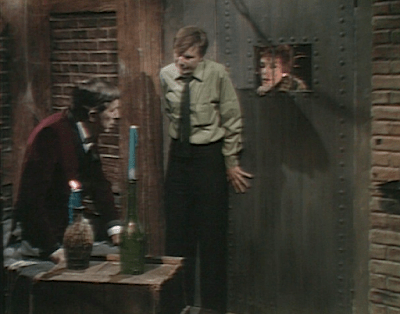
Now, Barnabas has himself become the blood thrall of a vampire, his ex-wife Angelique. Discovering the bite marks, Julia decides to address the situation by locking Barnabas and his servant Willie in the cell. Barnabas won’t be able to get out to heed Angelique’s summons, and Willie hangs a cross over the door to keep her from materializing inside it.

Left to right: Barnabas Collins (Jonathan Frid); Willie Loomis (John Karlen); Julia Hoffman (Lady Elaine Fairchilde.) Screenshot by Dark Shadows Before I Die.

We cut to Maggie’s house. Maggie’s memory of her ordeal as Barnabas’ victim has been wiped from her mind a couple of times. She receives a visitor, the suave Nicholas Blair. Unknown to Maggie, Nicholas is a warlock and Angelique’s master. He has a crush on Maggie which has distracted him from his managerial responsibilities, which to be frank he had not been handling very diligently in the first place. Maggie gives Nicholas several pieces of news that he really ought to have been aware of for some time. She tells him that her ex-fiancé, Joe Haskell, is still alive; that she visited Joe twice while he was at the Old House recovering from some injuries; that Joe is now in the hospital under police guard; and that Joe tried to kill Barnabas and keeps vowing that he will try again, since he believes Barnabas is trying to kill him. Nicholas is flummoxed by all of this, and meekly goes along when Maggie insists on visiting the Old House to pay a call on dear, sweet Barnabas.

The scene in Maggie’s house has an odd feature. We’ve just had a closeup of Willie hanging a cross above the door in the cell to keep Angelique away. In the early days of the vampire storyline, it was not at all clear that the cross would deter vampires in the world of Dark Shadows, since Barnabas was often seen strolling comfortably through a cemetery where half the grave markers were cross-shaped. It was not until #450, during the 1790s flashback, that we saw Barnabas recoil from a cross. In #523, we learned that the cross also immobilizes Nicholas. Yet Maggie is today wearing a dress the front of which is dominated by a red cross, and it doesn’t bother Nicholas a bit. The show is drifting into a spot where it may have to stop and spend time explaining its theurgy. Does the cross only work against a demonic creature if it is specifically aimed at that creature? Or if the person setting it up knows about the creature? Or is there some other qualification? It’s getting confusing.

At the Old House, Julia tells Maggie and Nicholas that they cannot see Barnabas, because he is resting. Maggie keeps insisting, and Julia shifts her ground, claiming that Barnabas went out, she knows not where. When Julia says this, Maggie is incredulous, but Nicholas brightens. Evidently he wants to believe that Barnabas has gone off to respond to Angelique’s call, and accepts Julia’s statement happily. Maggie apologizes for demanding to see Barnabas, and she and Nicholas leave.

Meanwhile, Barnabas is scheming to get out of the cell. While Willie is complying with his request to pour a glass of water, Barnabas bashes him on the head with an empty bottle. He then goes to the hatch for the secret panel, remembers that “Maggie found it a long time ago!” and figures out how to open it. Since we saw Willie open the hatch and show Adam Barnabas’ jewel box in #494, you would think Barnabas already knew how it worked. At that time, it also seemed that the passage behind the hatch had been sealed up, so that it no longer led to the beach. Apparently we aren’t supposed to remember that. Barnabas crawls out and closes the hatch behind him before Julia comes back.

As Barnabas, Jonathan Frid usually moves in the stateliest possible manner. When he escapes from the cell today, the camera lingers on him crawling, driving home the contrast with his typical gait. That is quite different from what we saw in #260, when he followed Maggie into the hatch- then, we saw him move toward the opening, but cut away before he had to take an ungainly position. Today, the makers of the show want us to hold the image of a crawling Barnabas in our minds.

Crawling suggests Barnabas’ weakness under Angelique’s power, certainly, but in this setting it suggests more. This is the house where he was born, and what he is crawling into is a lightless passage that it looks like he will have to squeeze through to emerge outside. He has regressed not only to infancy, but all the way back to birth. If Joshua did indeed confine him to this cell in his childhood, Barnabas would likely have experienced that same regression in those days as well.

The sign of the cross reminds us of one who said that we must be born again to receive a life in which our hopes will be fulfilled more abundantly than we can ask or imagine; Barnabas labored for 172 years under a curse that compelled him to die at every dawn and revive at every sunset, but perhaps even before that he was the prisoner of a cycle of abuse that forced him to experience the trauma of birth over and again, each time finding himself in the same narrow space, a stranger to all hope. Indeed, when Barnabas first became a vampire in the 1790s, he put his coffin in this basement, near the cell, and he persisted in putting it there even after it became obvious that it was very likely to be discovered. That persistence made no logical sense in terms of Barnabas’ need for operational security, but if he saw his vampirism as a continuation of his childhood experience of confinement in the basement cell, it would make all the sense in the world. That is his place, that is where he belongs, that is his reality.

Episode 609: For want of a fig leaf

Adam and Eve are discussing the Fall, comparing their incomplete memories of what came before it. This is not a flashback. The Adam and Eve we see today are Frankenstein’s monsters, and they do not live in exile from Eden when the world was young, but in the town of Collinsport, Maine in 1968. The Fall they have in mind is the one that is also known as Autumn. Adam is ashamed, not because he is naked, but because Eve accuses him of preferring life in captivity. He is not naked at all, even though Eve walks in on him and sees his Harry Johnson. Harry Johnson is the man to whom Adam has entrusted a letter, but since Adam’s favorite pastime is studying the works of Sigmund Freud, and since by 1968 “johnson” had been a familiar English slang word for “penis” for over a century, he would likely have been the first to make the connection to the predicament of their Biblical namesakes.

Adam takes Eve to his old home, a dusty room in the long-deserted west wing of the great house of Collinwood. Heiress Carolyn hid him there for a period that seemed so long the audience might feel that the original Adam and Eve were probably still around when it started. Carolyn greets them there. She is happy to see Adam again and eager to befriend Eve. Adam wants that too, but Eve isn’t having it. She quarrels with Adam and storms out, leaving Carolyn in an awkward position.

On the terrace outside the great house, an unpleasant man named Peter who prefers to be called Jeff is waiting for his date, well-meaning governess Vicki. Vicki has kept him waiting for an hour. Vicki’s charge, young David, happens by. Peter/ Jeff immediately makes it clear why Vicki is in no hurry to see him. He greets David with an accusation that he was hiding from him. When David denies this, Peter/ Jeff demands that he tell him who he was hiding from. Peter/ Jeff may have forgotten who is a guest in whose house, but David hasn’t, and he turns to go. Peter/ Jeff stops him, asking “We’re friends, aren’t we?” David doesn’t explicitly agree that they are, but he stays.

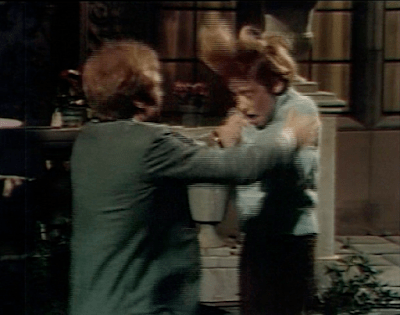
Peter/ Jeff starts to talk about his plans to marry Vicki. David calls him “Peter,” and since the closest thing he has to a personality is his insistence on being called “Jeff” he grabs David and shakes him violently. Watching this scene today, my wife, Mrs Acilius, said one word- “Psycho.” She wasn’t talking about Peter/ Jeff, but about actor Roger Davis. When one character shakes another, it is usually the actor playing the shakee who makes all the movements, while the shaker just mimes the action without actually touching them. Not so Mr Davis- he really did rattle David Henesy around hard enough that it’s pure luck he didn’t give him a concussion. That’s typical of the approach Mr Davis took to his performances on Dark Shadows, in the course of which he assaulted several women on camera. Mr Henesy is uncharacteristically tense throughout this scene, does not sustain eye contact with Mr Davis, and when the scene ends he rushes off stage.

Roger Davis has his fun. Screenshot by Dark Shadows Before I Die.

In his dialogue, Peter/ Jeff makes some pretty bizarre remarks:

You know, David, pretty soon, you’re gonna find out that love isn’t something you can remember. Sixteen years old… You know when you’re sixteen, you can really love somebody. And then you come back ten years later and you wouldn’t even notice her.

At this, David gives Peter/ Jeff a look that accords with Mrs Acilius’ one word assessment of Roger Davis. “Love isn’t something you can remember”? Which item on the sociopathy screening test is that? And what does “Sixteen years old” have to do with anything? David is twelve, Peter/ Jeff and Vicki are in their twenties, no one mentioned the number sixteen. And David would be doing Vicki a solid if he told her that her fiancé won’t remember her in ten years.

David Collins wonders what the #%*^ is wrong with Peter/ Jeff, while David Henesy recovers from Roger Davis’ assault on him. Screenshot by Dark Shadows Before I Die.

David leaves, and Eve shows up. She recognizes Peter/ Jeff and addresses him as “Peter Bradford!” The closing credits start rolling before Peter/ Jeff can shake her violently while whining that he wants to be called “Jeff Clark.” Eve is the reincarnation of an eighteenth century homicidal maniac; she hasn’t killed anyone since she was brought to life the other day, and Peter/ Jeff would be an excellent choice for her first victim. If she does kill him, I would be “Team Eve” all the way.

Episode 503: Man made monster

Adam the Frankenstein’s monster has abducted heiress Carolyn and taken her to an abandoned structure. Carolyn says the structure looks like a root cellar. She doesn’t have a television, or she would have recognized it at once. It’s the old Flintstone place.

Screenshot by Dark Shadows Before I Die.

Adam was created in an experimental procedure mad scientist Julia Hoffman completed, an experiment that Julia’s late colleague Eric Lang designed to free old world gentleman Barnabas Collins from vampirism. The experiment was a success, but Barnabas and Julia are the world’s worst parents. They have kept Adam chained to the wall of the prison cell in the basement of Barnabas’ house for the first three and a half weeks of his life. As far as Adam is concerned, it is normal for people to confine one another in underground spaces.

The cell was in the basement of the house when Barnabas and his little sister Sarah were growing up there in the eighteenth century; in #260, we found that Sarah had found a secret passage leading out of the cell, suggesting she must have spent a lot of time there in her nine years of life. Perhaps the cycle of abuse that Adam is perpetuating goes back a very long way.

Barnabas is out searching for Adam and Carolyn. Julia is in his house, along with his servant Willie. Julia finds that Willie has had a nightmare and is compelled to tell Carolyn about it. The nightmare is part of The Dream Curse. One person after another has the same dream, which the audience sees dramatized every time. Then that person wrestles with a compulsion to tell the nightmare to someone else. We usually see that, too. Finally, the person does tell the dream, giving a speech to repeat the material to us yet again. This time-waster will go on indefinitely, and is supposed to end with Barnabas reverting to vampirism.

Julia knows all about this. She had the dream herself, and has interacted with others who have had it since. Today, she tries to hypnotize Willie into forgetting the dream.

It is very strange Julia hasn’t tried this before. She has a phenomenal ability to use hypnosis to erase memories, so regular viewers would expect her to turn to that right away. When she starts giving Willie the instructions, kaleidoscopic colors pulse on the screen, suggesting that she will have yet another great triumph. Willie does have a vision of Carolyn in the Flintstone house, so Julia must have unlocked his capacity for extrasensory perception. But he still remembers the dream, and is still driven to tell it to Carolyn.

The sheriff comes by. He tells Julia and Willie about evidence that Adam has a connection with the house. They deny everything. Willie is a panicky mess. He is still upset because of the dream, and the barking of the police tracking hounds outside triggers his memories of the nights when Barnabas’ bloodlust prompted dogs to howl. Julia is able to parry all of the sheriff’s questions and observations, but she is too shaken to produce her usual stream of perfectly plausible lies.

Adam comes to the house. He is hungry, and it is the only place he has ever seen food. The sheriff sees him, threatens to shoot him unless he stops, and opens fire immediately. Adam isn’t killed; in fact, he is so healthy that it takes twenty (20) men to subdue him and take him to gaol.

The sheriff sticks around and tells Julia and Willie that Adam gave them a look of recognition. Julia dismisses that, and the sheriff protests “I’m not a stupid man!” Regular viewers know that he is in fact an utterly stupid man, and that Julia is extraordinarily intelligent. Typically, she wouldn’t need more than five seconds to distract him from whatever was on his mind and get him chasing after an imaginary squirrel. But she is so run down from the ongoing crises that she is reduced to challenging him to “Prove it!”

Episode 498: One step closer to the dream

Sarcastic dandy Roger Collins has remarried. His previous wife, undead blonde witch Laura Murdoch Collins, was Dark Shadows’ first supernatural menace, posing a threat to the life of their son David from #123 until she vanished amid a cloud of smoke in #191. The ghost of gracious lady Josette joined in the battle against Laura. Among other things, Josette compelled artist Sam Evans to paint a series of pictures warning of Laura’s evil plans. Laura responded to those paintings in #145 and #146 by causing a fire that burned Sam’s hands so badly it seemed he might never again be able to paint.

Roger’s new wife is also an undead blonde witch, though she wears a black wig all the time. This wiggéd witch calls herself Cassandra, but is actually Angelique, who in the 1790s killed many of Roger’s ancestors and turned his distant cousin Barnabas into a vampire. Angelique/ Cassandra has returned to the world of the living because Barnabas’ vampirism is now in remission, and she is determined to restore it.

Before he met Angelique/ Cassandra, Roger became obsessed with a portrait of her. Barnabas concludes that this portrait is essential to her power. He orders his servant Willie to steal it from the great house of Collinwood. Barnabas takes the portrait to Sam and commissions him to paint over it so that Angelique will look tremendously old. He doesn’t offer Sam any explanations, but we heard him tell Willie his theory that what happens to the painting will also happen to Angelique. If her likeness is aged to reflect her actual years, then she will vanish from 1968 and be confined to the past. At the end of the episode, Angelique’s hands have aged dramatically, suggesting that Barnabas is correct.

This is David Ford’s first appearance on the show since December, and he had shaved his mustache in the interim. The fake is not up to the makeup department’s usual standards. Screenshot by Dark Shadows Before I Die.

Portraits have been a very prominent part of the visual composition of Dark Shadows from the beginning, and a battlefield on which supernatural combat could be joined for almost as long. So it is hardly surprising that the show would eventually get around to doing a story based on Oscar Wilde’s The Picture of Dorian Gray.

It would seem Barnabas has little time to lose. Angelique/ Cassandra has distributed some malware to the minds of the people around Barnabas by means of a dream that one person after another will have. The first dreamer is beckoned into a Haunted House attraction by someone, opens some doors behind which there are scary images, is terrified, and cannot find relief until telling its details to the beckoner. That person then has the dream, changed in only two particulars, the identity of the beckoner and the image behind the final door. When everyone’s brain has been hacked, this worm is supposed to reset Barnabas as a vampire.

Yesterday, David had the dream, and Willie was his beckoner. Today, we open in Barnabas’ house, where Willie is paralyzed with fear. David has already told him the dream, and Willie knows he will have it. With all the previous instances of the dream, the audience had to sit through a highly repetitious dream sequence, then a scene in which the character agonizes about whether to tell the dream to the next person, and finally a speech repeating all the details of the dream. At least this time we skip the second and third of those rehashings.

Since Willie is so close to Barnabas, it seems likely that he will be the last to have the dream before it gets back to Barnabas and makes him a vampire again. So it’s no wonder that Barnabas decides it’s time for the high-stakes gamble of a burglary at Collinwood.

There’s also a scene in Barnabas’ basement. Barnabas’ vampirism is in remission because some mad scientists created a Frankenstein’s monster, whom Barnabas named Adam. They connected Barnabas to Adam in a way that drains the symptoms of the curse from Barnabas without manifesting them in Adam. Barnabas has no idea how to raise any child, let alone a 6’6″ newborn with the strength of several grown men, and so locks him up in the prison cell where he used to keep Sam’s daughter Maggie.

The imprisonment of Maggie was a dreary, unpleasant story, but Adam’s time in the cell is even harder to take. Maggie was established as a strong, intelligent person who knew her way around, she could speak, and she had many friends who cared about her. So we never quite gave up hope that she would get away and be all right in the end. But Adam has none of that. As a result, his scenes in the basement are a tale of extreme child abuse, made all the harder to watch by Robert Rodan’s affecting portrayal of the big guy’s misery.

Moreover, Maggie was a major character, introduced in the first episode and connected to everyone else. It’s unlikely they would kill her off unless the show had been canceled and they were going out with a bang. But only the people holding Adam prisoner know who he is, and Frankenstein’s monsters meet their deaths practically every time they feature in a story.

Worst of all, the show is basically very silly right now. A story about a child locked in a cell from birth can be made bearable only by joining it to some kind of deep insight into the human condition, and there is little prospect that anything like that will crop up among all the witches and vampires and other Halloween paraphernalia. My wife, Mrs Acilius, watched the whole series with me in 2020-2021. She was avidly rewatching it with me this time. But when they took Adam to the cell, she suggested I start watching it on days when I get home from work before she does. I’m sure she isn’t the only Dark Shadows fan who takes a pass on the Adam story.

This is the first episode credited to director Jack Sullivan. Lela Swift and John Sedwick took turns at the helm until #450, when executive producer Dan Curtis tried his hand at directing a week of episodes. Swift and Sedwick then returned to their usual pattern. Sedwick will be leaving in a few weeks; Sullivan, who has been with the show as an associate director since the third week, will be Swift’s alternate until November, and from #553 on will be credited as Sean Dhu Sullivan.

Episode 495: A nice boy

In #134, strange and troubled boy David saw his mother Laura Murdoch Collins for the first time in years. To everyone’s surprise, not least his own, David reacted to Laura with terror. It turned out that he had good reason for this reaction, as Laura was actually an undead blonde fire witch come to lure him to his own death.

In #489, David learned that his father Roger had remarried. Like everyone else in the great house of Collinwood, David was stunned to learn that Roger had known his new wife for less than a day before he married her. Unlike the others, his speechless reaction prompted Roger to jump to the conclusion that he disliked his new stepmother. Roger scolded David and sent him to play outside until he could come back and be charming.

While outside, David had stumbled upon the new Mrs Collins kissing a man other than her husband. Later, he found her alone in the drawing room, told her what he had seen, and informed her that he would tell his father about it.

Roger’s new wife wears a black wig and calls herself Cassandra. What the audience knows, but neither Roger nor David do, is that she is actually an undead blonde witch. Roger does have a type.

The new Mrs Collins’ real name is Angelique. She has come to 1968 from the late eighteenth century to resume her punishment of Barnabas Collins, whom she turned into a vampire in their time, but who has now been freed from the symptoms of the curse. When David told Angelique/ Cassandra that he would report her misconduct to Roger, she used her magic powers to strike him dumb. When his muteness became inconvenient for her in #492, she cast another spell to erase his memory and restore his speech. To execute this spell, she took fire from the hearth and spoke words to David that caused him to drift into a trance. We remember #140, when Laura urged David to stare into the flames of this same hearth while she told the story of the Phoenix, causing him to drift into a trance. From that point on, he liked his mother very much.

Today, David meets Roger in the foyer of Collinwood. He tells his father that Angelique/ Cassandra took him into town, where she bought him a Swiss army knife. He says she would have bought him anything he wanted. Thus we learn that, though she is a wicked witch (as well as a wigged one,) Angelique/ Cassandra is in some ways a typical step-parent. When Roger says he is glad to see that David now likes Angelique/ Cassandra, David is mystified. As far as he can recall, he always liked her.

Roger sends David to answer a knock at the door. It is their distant cousin Barnabas. This is the first time we have seen David and Barnabas together since #333, when David barely escaped with his life after Barnabas caught him looking at his coffin. David now greets him quite calmly.

David leaves. In the foyer, Roger scolds Barnabas for his rudeness to Angelique/ Cassandra. Barnabas could hardly be expected to fail to recognize his old nemesis, but he has indeed shown an extreme lack of prudence in his uninhibited talks with her. Not only has he created unpleasant scenes to which Roger is bound to object, but he has also let Angelique/ Cassandra know exactly what he does and does not know about her.

Roger says that if Barnabas cannot be friendly to Angelique/ Cassandra, he shouldn’t come to the great house anymore. Barnabas asks if Roger shouldn’t ask his sister Liz, who after all owns the house, what she thinks. Roger says that will be unnecessary, since Liz has even less tolerance for rude behavior than he does. Barnabas is promising to do better when Liz runs in, frightened by a tall man she met on the grounds. Liz told the man he was on private property and directed him to leave. The man said nothing at all in response to this challenge or to her subsequent questions. He stood still and appeared to be mute until he spoke Barnabas’ name. Liz ran from him when she saw that he had a shackle attached to his leg. Roger flies into a panic, assuming that a shackled man must be dangerous and remembering that David is alone in the woods. He gets his gun, and rushes out. Barnabas accompanies him.

In the woods, David is playing Mumblety-Peg with his new knife. The tall man shows up; when David finds that the man cannot talk, he says that he is glad. He says that he often wishes no one could talk. He goes on at considerable length about the disadvantages that come with the ability to speak. He then explains to the man that you play Mumblety-Peg by dropping the knife into the ground so that it sticks there. The man becomes excited and grabs the knife. David objects and demands he return it. They struggle; David falls and hurts his ankle. David grumbles that all the man had to do was give him his knife back. The man looks alarmed and picks David up. David doesn’t like that one bit, and insists he be put down.

Roger points the gun at Adam and David.

David’s shouting brings Roger and Barnabas. Roger points his gun at the man and orders him to put David down. When the man does not move, Barnabas tells Roger not to shoot. David, in the line of fire, seconds this recommendation. Barnabas talks to the man in a soothing voice, gesturing towards the ground, and the man does set David down. David runs to Barnabas and gives him a hug.

This is the second time David has run into Barnabas’ arms. The first was in #315. David had been trapped in the hidden chamber in the old Collins family mausoleum, where Barnabas was confined in his coffin from the 1790s until 1967. Barnabas learned that David was there, suspected he might have deduced his secret, and decided to kill him. David got out of the chamber just as Barnabas was approaching it, and ran from it directly to him. He had not in fact figured out Barnabas’ secret while in the hidden chamber, but Barnabas’ behavior in the minute before someone else came along was menacing enough that David caught on that he had sinister plans for him. For the next ten weeks, his fear of Barnabas would deepen, leading him to discover the whole horrible truth about his distant relative. All that is forgotten now, evidently.

Roger jumps to the conclusion that the tall man had “tried to kill David!” He shoots him in the shoulder and runs after him with his gun, over Barnabas’ objections. Roger had been quite unconcerned with David’s well-being throughout the first year of the show. In the first months, he openly hated the boy and continually tried to persuade Liz to send him off to an institution; in #83, he coldly manipulated David into attempting to murder someone who posed a problem for him; even after other characters had begun to realize that Laura was a deadly threat to David, Roger continued to press eagerly for her to get full custody of him and take him away; and in #313, when David was trapped in the mausoleum, Roger could barely be bothered to take part in the search. Roger’s behavior will therefore be less likely to suggest to regular viewers that he is overcome with paternal feeling than that he is a panicky fool who is much too excited about an opportunity to shoot someone.

The tall man is Adam, a Frankenstein’s monster created in the procedure that caused Barnabas’ vampirism to go into remission. Though he is 6’6″, Adam is only a couple of weeks old, effectively a baby. Barnabas has been keeping him in his basement, chained to the wall in the prison cell he maintains for those times when he has abducted a pretty girl and has to keep her from running away. The opening voiceover tells us that “no man has suffered more” than Barnabas, just as we cut to Adam, despondent in his shackles. Barnabas comes in to give Adam a cup of broth and a couple of minutes of rigidly formal social interaction, then leaves him alone again. Somehow this sequence makes it difficult to sympathize as deeply with Barnabas as the narration would have us do.

Episode 493: What horrors we commit

Recovering vampire Barnabas Collins and mad scientist Julia Hoffman brought a Frankenstein’s monster to life the other day. They named him Adam, and are keeping him locked up in the prison cell hidden in the basement of Barnabas’ house. They leave Barnabas’ servant Willie in charge of Adam.

The first two days of the Adam story had their humorous moments as we saw Barnabas and Julia’s farcically total incompetence before the demands of parenthood. Today, Robert Rodan plays Adam as a 6’6″ newborn who is looking for affection and mental stimulation and finds only hostile people and brick walls. Rodan’s commitment to the part is so pure and his face is so expressive that he weighs us down with sorrow for a cruelly neglected child. Moreover, Dark Shadows is so high-concept right now with all of the monsters and black magic and mad science and dream sequences and so on that it is hard to see how it can take a pain that is so raw and make it meaningful for us in a way that will justify showing it.

There are just a couple of moments I want to remark on. In the cell with Adam, Willie smokes a cigarette. He blows smoke in Adam’s face, leading him to freak out, knock Willie unconscious, and flee from the cell to the grounds of the estate of Collinwood.

Outside the great house of Collinwood, Adam finds a toy to play with. Screenshot by Dark Shadows Before I Die.

This isn’t the first time Willie’s smoking has got him in trouble. Willie scattered cigarettes in #210, when he was trying to rob a grave in the old Collins family mausoleum. To his surprise, the coffin he opened held, not the jewels he was looking for, but Barnabas, who seized him by the throat and didn’t let him go until he had bitten and enslaved him. A few days later, in #215, Willie’s old partner in crime, seagoing con man Jason McGuire, asked Willie what he had been doing in the mausoleum. Terrified that Jason might discover Barnabas’ secret and bring the vampire’s wrath down on him, Willie denied he had been there. Jason replied that Willie had a habit of leaving cigarette butts on the edges of things. The same vice that brought Willie to the brink of disaster on that occasion has now caused Adam to panic, and Adam is clearly strong enough to kill a man with a single blow. Smoking is even more hazardous for Willie than it is for the rest of us.

In the great house of Collinwood, housekeeper Mrs Johnson is struggling with her part in “the Dream Curse.” In this curse, a person has a nightmare, is terribly distressed until they can tell a particular person about the nightmare, the person they’ve told then has the same nightmare, and the process repeats until the writers can come up with a less tedious way to fill the time on slow days. Mrs Johnson knows that it will be bad to tell the dream to the next person, and is trying not to. Julia knows all about the Dream Curse, and is herself the person who passed it on to Mrs Johnson.

Julia also has a nearly unlimited power to erase people’s memories with hypnosis, yet she doesn’t try to hypnotize Mrs Johnson into forgetting the dream. The Dream Curse is the product of a spell cast by wicked witch Angelique. Another of Angelique’s spells made Barnabas a vampire. Julia was able to hypnotize Maggie Evans, The Nicest Girl in Town, into forgetting weeks and weeks of vampiric abuse Barnabas inflicted on her, and Maggie has been her old self ever since. So, if Julia can wipe away one kind of trauma arising from Angelique’s curses, why not another? It seems like it would be worth a try.

Also, Julia is in charge of a mental hospital called Windcliff. She has used Windcliff to stash Barnabas’ victims Maggie and Willie where they wouldn’t attract the attention of the authorities. Regular viewers can hardly fail to wonder why she doesn’t think to commit Adam to Windcliff. If we must have him on the show, it would be easy enough to write a couple of lines of dialogue explaining why it would be impossible to send him away. That they don’t take the trouble to do even that is an insult to the intelligence of the audience and another reason to find the Adam storyline depressing.