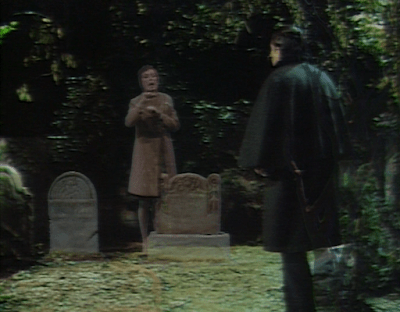
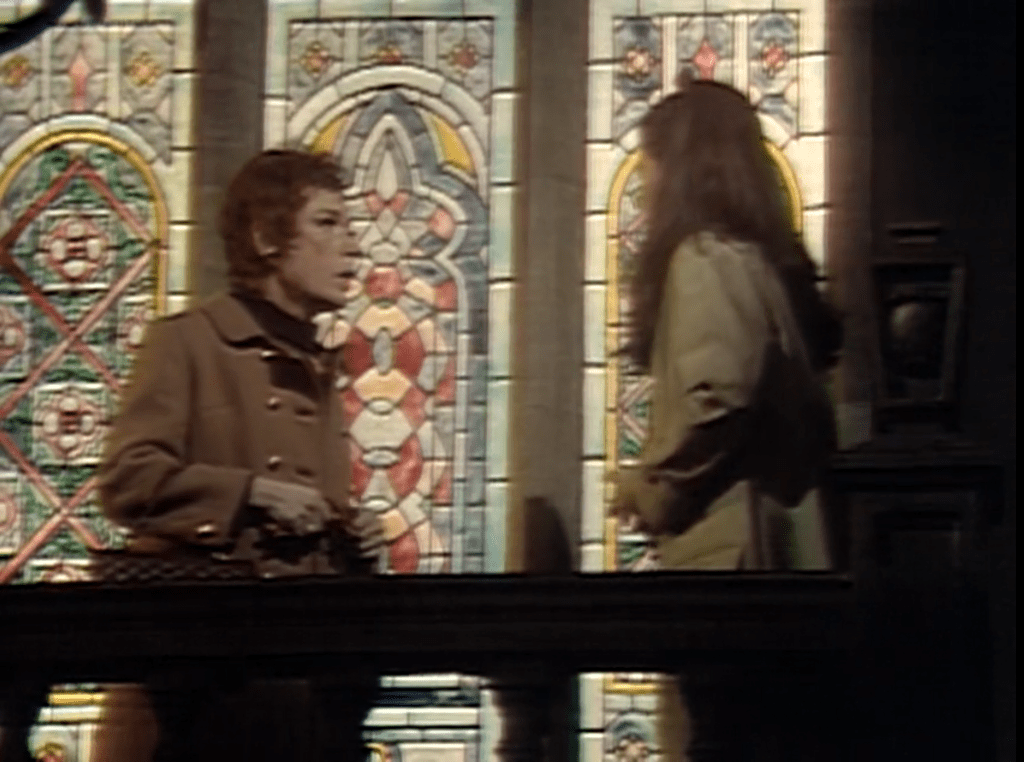
Episode 627: Her name is Victoria. I cannot take care of her.

Dan Curtis often said that the idea for Dark Shadows came to him in a dream about a girl with long black hair taking a journey by train. When he persuaded ABC-TV to let him make a pilot for a series, the most difficult part of the casting process was finding the actress who would embody that girl, whose name came to be Victoria Winters. Alexandra Isles, then still known as Alexandra Moltke, finally emerged as the one person who combined the right physical appearance with a mysterious, otherworldly quality that suggests a figure from a dream.

From Episode 1: The girl on the train. Reflected in the window behind her is Burke Devlin, her original love interest.

Mrs Isles’ casting had an immediate effect on the underlying story in Art Wallace’s original series bible, Shadows on the Wall. Wallace projected a puzzle about Vicki’s origins that would be resolved when it was revealed that she was the child of an extramarital liaison between Paul Stoddard, the long-missing husband of matriarch Elizabeth Collins Stoddard, and some unknown woman. Liz’ guilty feelings about Paul would explain her concern for Vicki and her decision to bring her to the great house of Collinwood as governess for her nephew, strange and troubled boy David Collins. Since Vicki would not be a blood relative of the Collins family, it would also leave an option for Vicki to develop a romance with David’s father, Liz’ brother Roger.

From Episode 1: The front doors of Collinwood open for the first time. Liz and Vicki come face to face, and each sees her own reflection in the other.

Wallace did include a note saying that if it was more story-productive, it could turn out that Liz was Vicki’s mother. Liz was played by Joan Bennett, whom Mrs Isles strongly resembled. When Bennett first saw Mrs Isles, she famously mistook her for her own daughter. From the first episode on, the show heavily signaled that Vicki was Liz’ daughter by a man other than Paul. Liz soon treats Vicki so much like a daughter that the only events that would follow from confirming the relationship would be to make some changes to Liz’ will. Since the business aspects of the characters’ lives ceased to generate action after the first few months, that would have been a severe anti-climax. So they wound up dropping the question altogether.

For the first 39 weeks of Dark Shadows, Vicki was its main protagonist. Not many of the storylines worked in those days; the only scenes that reliably clicked were those between Vicki and David. Even though their dialogue was as dreary as anything else in those early scripts, Mrs Isles and David Henesy managed to use their physical movements and the spaces they occupied to tell the story of a young woman persuading a boy to trust her. That version of the show ended with #191, when David ran from the mother who was trying to lure him to his death and flung himself into Vicki’s arms. That completed their story, and left neither character with a clear path forward.

From Episode 191: David turns from his mother and death, embracing Vicki and life.

After #191, the show was on course for the introduction of vampire Barnabas Collins. Vicki kept trying to get close to Barnabas; she even invited herself to spend the night at his house in #285 and #286. But he wouldn’t bite her, and she couldn’t get a foothold in the A-story otherwise. There was an odd meta-fictional side to Vicki in this phase. In-universe, she didn’t know that Barnabas was a vampire, and she certainly didn’t know that she was a character on a soap opera that was coming to be all about him. But her behavior made sense only if she did know those things and was making an effort to reestablish herself as a central figure in the action. I don’t know whether Mrs Isles or any other particular person was lobbying the writers to present her that way, or if it was a response to fan mail. It happened so often and led to so little that it did seem to be coming from somewhere outside the usual creative process behind the scripts.

In November 1967, Vicki came unstuck in time and found herself in the year 1795. She took the audience with her, and for several months the show was a costume drama set in the late eighteenth century. On balance, the result was a triumph. By the time Vicki and the show came back to contemporary dress in March 1968, Dark Shadows had become a real hit, and Barnabas had become one of the major pop culture phenomena of the 1960s. But Vicki did not benefit from that success. When the costume drama insert started, fans had every reason to expect it would revive her character. Barnabas spent most of his time in 1967 scrambling to impersonate a native of the twentieth century; Jonathan Frid would always say that it was in that scramble that he found Barnabas, and that he thought of him first and foremost as a liar. When Vicki turns up in Barnabas’ original period, we look forward to seeing her doing what he did, and trying to pass as his little sister’s governess. Remembering how well Mrs Isles did during the 39 weeks she carried the show on her shoulders, we look forward to her showing us what Vicki can do when she has to think fast.

But that was not to be. Instead, Curtis and his staff chose to write Vicki as an intolerable moron. She introduced herself to every new person by telling them that they are being played by actors who had other parts in the first 73 weeks of the show. Tedious as that habit was, it was compounded when she made one inexplicably idiotic decision after another as she failed utterly to adapt to her new surroundings. That would have been a difficult role to make appealing even if she had shared her screen time with a partner as capable as David Henesy. It became utterly impossible when Vicki made the least intelligible move of all and fell in love with her jailer/ lawyer/ boyfriend/ accomplice Peter Bradford, played by the abusive and shouty Roger Davis. Marooned in scene after scene with Mr Davis, Mrs Isles withered and Vicki became a cipher. By the time the court sentenced Vicki to be put to death for her many crimes, half the audience was on their side.

Shortly after Vicki returned to the 1960s, Barnabas finally bit her. Each of Barnabas’ victims reacted to his bite differently; Vicki’s reaction was perhaps the most unexpected, and certainly the funniest. She was just sort of chill about the whole thing. She showed up when Barnabas summoned her and didn’t object when he told he her she would become his vampire bride for all eternity, but first she had some errands to run, and she was irritated with him when he tried to get her to skip them. When a doctor saw the bite marks on her neck, she did not react with the fear or defensiveness of other victims, but innocently asked “Why are they bad?” She seemed to regard them as just another hickey, the result of Barnabas’ peculiar make-out technique.

Unfortunately, Peter came back to life and ruined Vicki’s relationship with Barnabas. He jumped out in the road in front of her car while she was driving off with Barnabas, causing her to crash. Vicki and Barnabas were taken to the hospital. There, one of the doctors turned out to be a mad scientist who cured Barnabas of vampirism. Once the cure took hold, Vicki forgot all about her time as Barnabas’ victim, and she sunk into a relationship with the irredeemably repellent Peter. Every time we’ve seen her in recent months, she has dragged Peter back to our attention. Mrs Isles has found ways to liven up Vicki’s scenes; she always projected a forceful personality when she was standing near the clock in the foyer of the great house of Collinwood, and she has even managed to coax Roger Davis into playing a couple of scenes competently. Mr Davis never had quite as much to offer as did the clock, but when Mrs Isles could raise her voice and fix him with a steely stare it does seem to have come back to him that he had had a lot of acting lessons and could deliver dialogue interestingly.

Today is Mrs Isles’ last day on the job. We open with a reprise of the end of yesterday’s episode, when Vicki finds the corpse of a strangled woman in the closet in Peter’s room. Peter assures her he doesn’t know how the corpse got there. She tells him they have to call the police. He says he needs time to figure out what happened before they can involve the police; she points out that delaying will only make him look guiltier in their eyes. He tells her that she should leave so that her name won’t be connected with the case; she tells him it is too late for that. We can see why Vicki has faded- she is thinking like a rational person from our world, not like anyone you would meet in Soap Opera Land.

Vicki goes home to Collinwood and tells permanent houseguest Julia Hoffman that Peter is in jail, suspected of murder. She explains that the dead person is a woman Peter knew only as Eve. Julia reacts with shock to the name; Vicki asks if she knew Eve. Julia says of course not, and Vicki tells her she will go wake Roger and ask him to help arrange bail for Peter. She goes into the door leading to the bedrooms, never to be seen again.

In her final appearance, Vicki talks with Julia, her successor as the principal audience-identification character.

Viewers who have been with the show from the beginning will see a loop closing in the idea of Vicki going to Roger’s bedroom while he sleeps. In #4, Roger had tried to let himself into Vicki’s bedroom at night, only to be caught with his hand on the doorknob by Liz. In response to Liz’ threats, Roger told her not to bother him about his “morals,” a choice of words that made it clear that his intentions with regard to Vicki were of a sexual nature. Later in the episode, he and Vicki bantered flirtatiously after he offered her a snifter of brandy; for the first and last time, Vicki sounded like what she was supposed to have been, a street kid from NYC. Roger has long since been stripped of all his villainous qualities; in #585, he and Vicki even shared a scene in her bedroom while she was in her nightgown, and it was all perfectly innocent. In that scene, we not only saw that the old menacing Roger was gone forever, but that Vicki was also reduced to such a humdrum status that a man can enter her bedroom at night without raising an eyebrow. Now that Julia sees nothing out of the ordinary in Vicki dropping in on Roger while he sleeps, that humdrum status is reinforced.

When Vicki first arrived in the village of Collinsport in #1, she met her original love interest, dashing action hero Burke Devlin. Burke told her she had found her way to “the beginning and the end of the world.” We are reminded of the beginning of the world since we know that the man who killed Eve was named Adam. This Adam and Eve are no one’s parents; they share nothing but hostility and death. The episode ends with the wicked Angelique trying to summon up the Devil, a symbol of the end of the world. She herself disappears, apparently destroyed. Burke’s description is finally fulfilled.

The part of Vicki will be recast twice in the months ahead, but those actresses never had a chance to breathe any life into her. The character had lost any reason to be on the show long before Mrs Isles’ departure. In #87, David had trapped Vicki and left her to die; wondering where she was, Roger said, “She came to us from nowhere, and now it seems she has disappeared into nowhere.” And so, at last, it has come to be. The long-haired girl from Dan Curtis’ dream, the image that started it all, has vanished, never to be seen again.

Episode 626: The sad case of Victoria Winters and Peter Bradford

From November 1967 to March 1968, Dark Shadows was a costume drama set in the years 1795 and 1796. Well-meaning governess Vicki had come unstuck in time, found herself in that period, and failed utterly to adjust to her new surroundings. While she was in gaol charged with witchcraft, she befriended an unpleasant man named Peter, who served as her defense attorney. Peter handled the case so badly that he and Vicki were both sentenced to hang, but they nonetheless fell in love with each other.

Shortly after Vicki was whisked back to the 1960s, she found that Peter had also come back to life. Unfortunately, he had total amnesia covering everything prior to his arrival in the twentieth century, and he became belligerent every time Vicki tried to tell him about himself. These traits did nothing to improve Peter’s already repellent personality, but having fallen in love with him once Vicki remained grimly determined to make a life with him.

The other day, Peter and Vicki were about to get married when a mysterious woman known as Eve presented Peter with evidence that what Vicki has been telling him is true. He ran off to exhume the grave marked with his name and found that the coffin was empty. For some reason he took this to mean that he shouldn’t marry Vicki after all. He has gone back to his room, where he is packing his bags and looking at a train schedule.

Unknown to Peter, there have been two visitors in his room while he was away. Eve came in and called for him, saying aloud that she would “make it all right” for him. A man known as Adam followed her in and overheard this. Adam thus learned that, despite their names, he and Eve would never be a couple. He asked if, when “yesterday, you made me happy- that was a lie, wasn’t it?” She confirmed that it was, that she would never love him, that she had always hated him, and that she found him ugly. That last apparently struck a nerve, because Adam responded with great rage. He choked Eve, and she collapsed.

Vicki drops in on Peter while he is getting ready to leave town. He tells her they cannot be together, and she insists on giving their relationship a second chance. Peter opens his closet to get some more clothes to pack, only to close it quickly. Vicki opens it, and finds Eve’s strangled corpse crumpled on the floor.

There is a genuinely horrifying moment in this episode. Vicki thinks back to the night in the 1790s when she was taken to the gallows, and we see events from her point of view. At one point we see Peter’s face looming towards the camera with his lips puckered. We’ve seen how Roger Davis manhandles his female scene partners, and in particular how miserable Alexandra Moltke Isles is when he kisses her. The sight of him coming at us for a kiss is enough to make even the most seasoned horror viewer flinch.

Get away from me. Screenshot by Dark Shadows Before I Die.

Mrs Isles read the opening narration of episodes 1-274 in character as Vicki. After she lost her monopoly on the opening narrations, she read more than 100 others, no longer as part of that role. This is the final time she takes on that task. It is also the first time “and Alexandra Moltke as Victoria Winters” is followed on screen by other acting credits.

Episode 625: Dead man’s wedding

The first time we might have expected to see a wedding on Dark Shadows was in #270, when reclusive matriarch Liz was supposed to marry seagoing con man Jason in the drawing room of the great house of Collinwood. That wedding was called off when Liz, rather than saying “I do,” announced “I killed Paul Stoddard and that man was my accomplice!” It turned out that Liz didn’t actually kill Paul after all. She only stunned him, and he and Jason connived to trick her into thinking she had killed him so that she would give them a lot of money. The two of them buried an empty trunk in the basement of the great house and Jason told Liz that Paul’s corpse was in it. Liz’ refusal to be blackmailed into marrying Jason led to the exhumation of that empty trunk.

The next time there was supposed to be a wedding at Collinwood was in #380, when the show was a costume drama set in the 1790s. Scion Barnabas was supposed to marry the gracious Josette, but wicked witch Angelique cast a spell that caused Josette to elope with Barnabas’ uncle Jeremiah. We did not see their wedding, but we did see Barnabas and Angelique get married in #397. We also saw them on their wedding night, when Barnabas left Angelique in her bedroom and retired to his, without so much as a goodnight handshake between them. As Jason’s attempt to marry Liz ended with the exposure of a vacant coffin, so these marriages led to vacant coffins as well. Barnabas killed Jeremiah in a duel in #384, and Angelique raised him from the dead in #392. It does not appear he ever did go back to his grave. He opened his own coffin in #397 and tried to bury Angelique alive in it.

When Barnabas found out that Angelique was the witch responsible for Jeremiah and Josette’s elopement and all the misery afterward, he tried to kill her, and she retaliated by turning him into a vampire. His coffin was empty every night for a while, but in March 1968, shortly after Dark Shadows left the 1790s and returned to contemporary dress, he became human again. Now Angelique is a vampire, and it is her coffin that is regularly vacant.

Today, another wedding is scheduled for the drawing room of the great house. Well-meaning governess Vicki is supposed to marry an unpleasant man known variously as Peter and Jeff. A mysterious woman with two names of her own, Eve and Danielle, shows up while Peter is smoking on the terrace.

Peter/ Jeff and Eve/ Danielle both lived in the 1790s, and both have come back to life in 1968. Peter/ Jeff is in deep denial about his own status as a revenant, and gets even more obnoxious than he usually is whenever anyone brings it up. Eve/ Danielle remembers him from their previous lives, and is, inexplicably enough, in love with him. She brings him a note that she acquired on a recent trip through time. In Peter’s handwriting, under the salutation “Dear Danielle,” it says that he would rather go to the gallows on the off chance that in some future life he will be with Vicki than go away with Danielle. Somehow, Danielle takes Peter’s willingness to face death in hopes of reunion with Vicki to mean that he should now leave Vicki and go away with her. The logic may escape the viewer, but evidently it convinces Peter/ Jeff. He leaves Collinwood to go dig up his grave. He finds the coffin vacant. It is unclear whether this means he will reunite with Eve/ Danielle, but apparently it convinced him he should not marry Vicki.

Nobody’s home. Screenshot by Dark Shadows Before I Die.

Liz’ aborted wedding to Jason marked the end of the blackmail arc, which was itself an extended in-betweener meant to clean up the last non-supernatural stories, introduce the vampire, and give the rest of the cast something to do while Barnabas was settling in. The aborted wedding of Barnabas and Josette marked the end of the part of the 1795 segment in which most of the characters don’t know that there is a tragedy brewing, while Barnabas and Angelique’s wedding told the audience that the preliminaries were over and they were about to explain how Barnabas became a vampire. Vicki and Peter/ Jeff’s attempted wedding today marks another ending. Alexandra Moltke Isles will leave the role of Vicki after the episode coming up on Tuesday. Vicki started moving to the sidelines once undead fire witch Laura went up in smoke in #191, and she has long been a secondary character. But she was the main protagonist for the first 39 weeks of Dark Shadows, and Mrs Isles carried the show very capably during those days. It was disappointing when she moved so far out of the main current of the action, and sad to see her go.

Episode 510: One passion in death

Yesterday, wiggéd witch Angelique/ Cassandra sent her cat’s paw Tony to kill sage Timothy Eliot Stokes. Stokes pulled “the old switcheroo” on him, and Tony drank from the glass into which he had put Angelique/ Cassandra’s poison. Today, we learn that Stokes gave Tony an emetic to save his life. Stokes calls mad scientist Julia Hoffman, MD to examine Tony and assist with the next stage of the battle against Angelique/ Cassandra.

Recovered, Tony has no idea why he obeyed Angelique/ Cassandra’s command to kill Stokes, and is ready to surrender to the police. Stokes tells him he is under the power of a witch, and enlists him in the battle against her.

Stokes takes out the memoirs of his ancestor Ben, who was Angelique’s cat’s paw in the eighteenth century. He does some automatic writing in Ben’s hand and finds that they must contact the spirit of the Rev’d Mr Trask, a witchfinder who inadvertently helped Angelique in those days. Fortunately, Trask, like Tony, was played by Jerry Lacy, so it shouldn’t be too hard to get hold of him. Stokes also finds that Trask was walled up in “the coffin room,” which Julia tells him is for some mysterious reason a nickname given to the space at the foot of the stairs in the basement of the Old House on the estate of Collinwood. Stokes decrees that he, Julia, and Tony must go to this room and hold a séance there.

On his way to the Old House, Tony follows Stokes’ instructions and stops at the main house on the estate and tells Angelique/ Cassandra that Stokes is dead. This follows a scene between Angelique/ Cassandra and her husband, sarcastic dandy Roger, in which Roger complains about her lack of interest in him. Her mind isn’t on the game of chess they are playing, she hasn’t been attentive to him for several nights, and she refuses to go on a honeymoon. Angelique/ Cassandra ensorcelled Roger into marrying her so that she could have a perch at Collinwood, and he seems to be slipping out of the spell’s power.

Stokes, Julia, and Tony gather in the coffin room. They begin the séance. This is the fifth séance we have seen on Dark Shadows, but the first that does not include well-meaning governess Vicki. In four of the previous five, it had been Vicki who went into the trance. On the other occasion, it was strange and troubled boy David who became the vessel through which the dead spoke to the living. The first three times Vicki served as the medium, she channeled the gracious Josette Collins, and when David filled that role he gave voice to David Radcliffe. In those days, Vicki was closely connected to Josette, perhaps a reincarnation of her, as David was another version of the cursed boy David Radcliffe. The final time Vicki spoke for the dead, she spoke for nine year old Sarah Collins, with whom she was no more closely connected than were any of a number of other characters. Sarah has no present-day counterpart, so her appearance at a séance suggested that Dark Shadows was moving away from its use of necromancy as a way of connecting characters from different time periods.

This time, Tony goes into the trance. In #481, Angelique/ Cassandra told Tony that she chose him as her cat’s paw because he resembled Trask, so when he is the medium through whom Trask speaks we are returning to Dark Shadows‘ original conception of how séances work. Trask mistakes Stokes for Ben, as Angelique did in a dream visitation last week. The brick wall behind which Trask’s remains are hidden bulges and is about to crumble when we fade to the credits.

True fans of Dark Shadows know that the episode’s real climax comes during those credits. Thayer David strolls onto the set under Louis Edmonds’ credit for Roger. He even looks into the camera when he realizes what he has done.

Screenshot by Dark Shadows Before I Die.

Episode 466: Four o’clock in the afternoon

At the end of Friday’s episode, the well-meaning Vicki Winters was driving her car and bickering irritably with her passenger, Barnabas Collins the vampire. Barnabas wants to elope with her, which she doesn’t object to doing. But first she insists on running an errand in his old neighborhood, the deserted cemetery north of town, and he hates that idea.

A pedestrian wandered into the middle of the road. To keep from hitting him, Vicki had to slam the brakes so hard she lost control of the car and crashed. At least she learned the lesson of the cowardly Roger, who ran over a pedestrian years before the show even started and as punishment was condemned to spend months looking for some guy’s fountain pen.

Today, Vicki and Barnabas are in the hospital. We see Barnabas in bed, moaning alternately for Vicki and his long-lost love, the late Josette. It doesn’t bode well for the planned elopement that in his delirium Barnabas gives Vicki only equal time to Josette. We then see Vicki in her bed, moaning for Peter, an unpleasant young man she got to know recently while visiting the late eighteenth century. She doesn’t mention Barnabas’ name at all.

Vicki comes to and finds Peter at her bedside. He denies that he is Peter, claiming merely to be a strange man who let himself into her room to watch her sleep. She recognizes him not only as her boyfriend from the 1790s, but also as the wayward pedestrian involved in the crash. He admits to this, but will not answer any of her questions.

A nurse enters and finally gets Peter to leave Vicki’s room. Perhaps he will let himself into other girls’ rooms and stare at them while they sleep. The doctor, a man named Lang, comes in.

Dr Lang asks Vicki if she knows Barnabas well. This is an interesting question. Before he bit her on Tuesday, Vicki definitely did not know that Barnabas was a vampire. Her behavior towards him since has been so blasé, not only by contrast with the behavior of his other victims but also by contrast with the eager friendliness and habitual deference she had always shown him in the many months they have known each other, that we can’t tell if she has learned that he is one even now. Indeed, we have no idea what Vicki thinks is going on between her and Barnabas, and as a result their scenes together have been pure comedy.

Vicki nibbles on her index finger and thinks for a moment about Lang’s question. Since they were going off to spend the rest of eternity together, it would be pretty embarrassing for her to admit that she doesn’t really have much understanding of Barnabas, so she says that she does know him well. As she does so, she glances away for a moment, and the light flashes off her eye, emphasizing her unease.

Vicki talking through her hand

Lang asks about Barnabas’ health before the crash. Vicki puts her hands down and stutters slightly as she says “He was in excellent health.” A note of uncertainty gives her voice a childlike quality. When Lang replies with “Really?,” her voice sounds even more childlike when she answers “Y-yes, have you discovered something Mr Collins didn’t know about?” Lang says that he thinks Barnabas knew about it.

Lang looks at Vicki’s neck and finds the marks of Barnabas’ bite. They are just two dark dots, not conspicuously different from the last stages of an ordinary hickey.

The bite marks.

When Lang asks about the marks, Vicki’s grogginess suddenly vanishes and she becomes hyper-alert. Since Vicki has been so bland about her experience with Barnabas, returning viewers might well expect her to answer Lang’s questions about the bite marks by saying that Barnabas gave them to her when they were making out. Instead, she gets defensive, at first denying that she remembers how she got the marks and then asking “What’s wrong with them? Why are they so bad, please tell me?” Alexandra Moltke Isles reads that line brilliantly. There is a touch of defiance in her voice, but also a sincere question- she genuinely does not see any reason she should have to hide the marks or explain them to anyone.

Early in the episode, the telephone rang at the great house of Collinwood, and long-term houseguest Julia Hoffman answered. It was the nurse, reporting that Vicki and Barnabas had been brought in after a traffic accident and that “Mr Collins is on the critical list.” Now Julia is in Barnabas’ room trying to arrange transport to his house. Lang comes in and is astounded at the thought of taking an unconscious patient, who is in critical condition, out of the hospital.

Lang and Julia have a showdown. Lang makes it clear that he knows that Barnabas is a vampire, and has deduced that Julia, who is a doctor doubly qualified to practice as a psychiatrist and a blood specialist, has been trying to cure him. Lang marvels that Julia has been treating “a legendary condition.” He asks to examine her neck; she never removes her scarf, surprising returning viewers who know that Barnabas has not bitten her. He continues to pose direct, well-informed questions, which she continues to parry with lies and evasions. She grits her teeth when he refers to Barnabas as “our patient.” At the last, she agrees to go, and he agrees to keep the room dark.

Barnabas awakens and sees Lang. He becomes agitated and demands to be released. Lang refuses. Lang tells him the time is nearly four o’clock. Dawn broke in central Maine at 4:33 on the morning of 8 April 1968, so Barnabas has little more than a half hour to get back home to his coffin. It is no wonder that Barnabas puts on his murdering face when Lang will not let him go. Lang backs away and says he must explain something Barnabas does not understand. Lang reaches the window. As he opens the heavy curtains, he intones, “Yes, it is four o’clock! But it is FOUR O’CLOCK- IN THE AFTERNOON!!” The sunlight floods the room. Barnabas screams and covers his eyes with his hands. But he does not turn to dust- he is no longer a vampire.

Four o’clock in the afternoon. Screenshot by Dark Shadows Before I Die.

This marks the end of the epilogue to the 1795 segment, and with that the end of Dark Shadows 3.0. Unlike version 1.0, which ended with no unresolved story threads of any interest, and version 2.0, which ended at a moment when the only way forward was the annihilation of all the characters, they have cued up at least three major storylines. Eventually Peter will stop pretending to be someone else and something will happen between him and Vicki; Roger will bring wicked witch Angelique home with him; Lang and Julia will work together to manage Barnabas’ aftercare. There are several other characters available for story-building. We have met kindly eccentric Professor Stokes and expect him to contribute to some or all of these storylines. We do not know how Barnabas’ cure will affect his blood thralls Vicki and Carolyn. Carolyn’s relationship with Humphrey Bogart-esque lawyer Tony is in an awkward spot, and Tony is in a position to trigger a major storyline if he starts telling people what he thinks he knows about Carolyn and Barnabas.

On his blog Dark Shadows Every Day, Danny Horn often identified Addison Powell, who plays Lang, as “THE WORST ACTOR EVER TO APPEAR ON DARK SHADOWS.” I don’t think he deserves that title. In fact, he isn’t even the worst actor in this episode. I’m sure the Nurse was written to be pretentious and silly, but Katharine Balfour’s stiffness and relentlessly exaggerated vocal mannerisms are simply excruciating. Powell isn’t great, and will get much, much worse, but he is basically competent today. Mrs Isles, Jonathan Frid, and Grayson Hall all do excellent work in their scenes with him, and he never once gets in their way. But when Balfour is on stage, the others can do nothing but stop and wait for her to leave. She had an extensive stage career, so I suppose she must have played many parts well, but she is stupefyingly bad today.

After Lang’s big “FOUR O’CLOCK- IN THE AFTERNOON!!,” we cut to the closing credits. Under them is a set where a clock’s hands indicate four. From April 1967 to July 1968, ABC suggested its affiliates run Dark Shadows from 3:30 to 4:00 PM. There were a great many stations which insisted on showing it at 10:30 AM. While it was a hit by this point in the 3:30 slot, its ratings were always rock bottom where it was shown in the mornings, so the great majority of viewers would have seen the correct time as they read the names of the people who worked on the show.

Yep, four o’clock, sure thing. Screenshot by Dark Shadows Credits.

Episode 442: For the love of God, Montresor!

When vampire Barnabas Collins rose from his grave to prey upon the living in April 1967, he was a bleak, frightening presence. As the show went on, we saw him spend a great deal of time ruminating on murders he might like to commit, but he had few opportunities to act on those thoughts. By November, when well-meaning governess Vicki came unstuck in time and wound up in the year 1795, Barnabas had killed only two people, only one of them with premeditation. Both of those victims, seagoing con man Jason McGuire and addled quack Dave Woodard, had long since lost their relevance to the plot, and neither has been mentioned more than a few times since his death. As a result, Barnabas’ talk of killing comes to seem like nothing more than a series of hostile fantasies.

Soon, Dark Shadows will have to return to a contemporary setting. It was the frightening impression Barnabas created in his first weeks that made Dark Shadows a hit, and to keep it going the show will have to make him seem dangerous again. In the fifteen and a half weeks they have been in the 1790s, he has killed at least six people, including his uncle, his aunt, his wife, two streetwalkers, and a woman named Suki. That’s an adequate rate of murders to reestablish Barnabas as a fiend, but volume will only get you so far. They need to give us some shocking images of cruelty, preferably as the result of crimes committed with slender motives, to get him back in place as a truly scary creature.

Today, the show addresses both that need and the need to give a fitting sendoff to a character who has been one of the standouts of the eighteenth century flashback. The Rev’d Mr Trask, visiting witchfinder, was, along with repressed spinster Abigail, one of the two bright lights of the show’s otherwise dreary reworking of Arthur Miller’s The Crucible. Now the witch trial is over, Vicki has been convicted, and she is waiting to be hanged. In #437, Vicki gave a speech which left little doubt that at the moment appointed for her execution she would return to the 1960s and the costume drama period would end. Therefore, Trask can hardly reopen the case without confusing the whole plot. As a personality totally warped by fanaticism, he can’t very well branch out into other kinds of stories without a long buildup, much longer than they are likely to stay in the 1790s. Yet Trask has been so much fun that the audience would feel cheated if he simply went back where he came from.

So Barnabas lures Trask to his basement, ties him to the ceiling, and seals him up behind a brick wall. Unfortunately, this homage to Edgar Allan Poe’s “Cask of Amontillado” does not adapt the most celebrated line of that story and have Trask cry out “For the love of God, Mr Collins!”

Barney’s bricklaying project. Screenshot by Dark Shadows Before I Die.

Closing Miscellany

In a moment of black humor, the closing credits run over an image of the completed brick wall. We might imagine Jerry Lacy still dangling from the ceiling behind the wall. Mr Lacy was often a model of an actor’s devotion to his craft, but I very much doubt that even he took matters that far.

Hey Jerry, you OK in there until tomorrow? Screenshot by Dark Shadows Before I Die.

A recording of Jonathan Frid reading “The Cask of Amontillado” made in the spring of 1992 can be found on YouTube, posted by Frid’s longtime business partner Mary O’Leary.

In #264, high-born ne’er-do-well Roger Collins visited Barnabas at home. When it was time for a drink, Barnabas offered him a glass of amontillado. Poe’s story is so famous and amontillado is such an unusual variety of sherry that it must have been a deliberate reference. Perhaps the idea of Barnabas sealing someone up behind bricks was floating around among the writing staff for months and months.

Several fansites label it a continuity error that Trask reacts to the sight of Barnabas by exclaiming that he is dead. The family has been covering up Barnabas’ death, putting word about that he went to England. Many think Trask should not be among those privy to the Collinses’ secret. But as Danielle Gelehrter points out in a comment on Danny Horn’s Dark Shadows Before I Die, Trask and the gracious Josette discussed Barnabas’ death in #412.

I am writing this post on 19 February 2024. In a bit of synchronicity, yesterday, I saw this post on the site that all normal people still call Twitter:

Episode 332: Worse than a nightmare

Strange and troubled boy David Collins stands outside the drawing room at the great house of Collinwood and overhears his father, Roger, talking with permanent house-guest Julia Hoffman. Roger and Julia are discussing David’s fear of his cousin, old world gentleman Barnabas Collins, and his belief that Barnabas is hiding something terrible in the basement of his home in the Old House on the estate. Roger takes it for granted that Barnabas is above reproach, and has therefore concluded that David is suffering from some sort of mental disorder. Julia encourages Roger in this conclusion, and urges him to send David away to boarding school. Roger is amenable to this idea, but tells Julia that his sister, matriarch Liz, will never allow it.

The last time David overheard his father in the drawing room saying he wanted to send him away to school, he attempted to murder him. But that was in episode #10, almost fifteen months ago. Since then, David has been through a lot, and has decided he wants to align himself with good against evil. So he doesn’t try to kill Roger this time. Instead, he steals a set of keys to Barnabas’ house that Liz keeps in her study and sets off to gather evidence with which he can prove himself right.

Returning viewers will recall that David’s friend, the ghost of ten year old Sarah, has repeatedly warned him not to go near the Old House, and especially to stay away from the basement. David remembers her words, but makes his way into Barnabas’ basement regardless. There, he sees an open coffin. While David is looking the other way, Barnabas comes up behind the lid and slams it shut. David turns, and Barnabas glares at him. Since Barnabas is a vampire who has spent quite a bit of time thinking of killing David, this would seem to leave the boy in something of a pickle.

David caught in the act. Screenshot by Dark Shadows Before I Die.

Closing Miscellany

There are three firsts in this episode, all relating to voice acting. This is the first time Alexandra Moltke Isles appears in an episode but does not read the opening voiceover. Sharon Smyth appears only through the pre-recorded voice of Sarah; her name does appear in the closing credits, the first time a performer is credited for something other than an on-camera appearance. And the closing titles end with Grayson Hall saying “Dark Shadows is a Dan Curtis Production,” the first time someone other than an ABC staff announcer* has delivered that line.

*Usually Bob Lloyd, though someone else filled in for Lloyd in #156 and #167.

Episode 330: bat by Bil Baird

Dangerously unstable ruffian Willie Loomis spent a week staring at the eighteenth century portrait of Barnabas Collins in the foyer of the great house of Collinwood back in April, then tried to rob Barnabas’ grave. That turned out to be an awkward situation when Willie found that Barnabas wasn’t entirely dead. Barnabas was a vampire who bit Willie, turned him into his sorely bedraggled blood thrall, and had lots of conversations with him. Yesterday, Willie was written out of the show.

Today we open with strange and troubled boy David Collins staring at the same portrait. As Willie was obsessed with the idea that there were jewels hidden in the Collins mausoleum in the old cemetery north of town, where in fact Barnabas’ coffin was hidden, so David is preoccupied with the idea that Barnabas has something terrible stashed in the basement of the Old House on the estate, where in fact his new coffin is hidden. As Willie sneaked off to the cemetery on his ill-starred expedition, David will sneak off to the Old House today and try to search Barnabas’ basement.

Unlike Willie, David is not driven by greed. He is afraid of Barnabas, and his friend, the ten year old ghost of Barnabas’ sister Sarah, has told him that he must not go to the Old House. But his aunt Liz and his father Roger dismiss his attempts to warn them about Barnabas, and he thinks it is his duty to provide them with evidence. So he screws up his courage and makes his way across the property.

David lets himself into the Old House by opening the parlor window. Not only have we seen David do this before, but Willie’s sometime friend, seagoing con man Jason McGuire, got into the house the same way in #274. Barnabas would kill Jason when he reached the basement in #275, so you might think he’d have put a lock on that window by now.

Jason’s fate is certainly on the minds of returning viewers when David tries to open the basement door. It comes as a relief when he finds the door locked. Barnabas’ co-conspirator, mad scientist Julia Hoffman, catches him there.

Julia demands to know what David is doing in the house, and he tries to brazen it out. He claims that he has a right to be there, since it belongs to his Aunt Liz. This is a bit of a murky point- we never see Liz transfer title to Barnabas, but she and others act as if he owns the place and its contents. Julia doesn’t clarify it when she responds that Liz gave the house to Barnabas- she doesn’t deny that it still belongs to Liz, only says that it also belongs to Barnabas.

Back in the great house, Roger is banging away at the piano. We saw Liz play the piano in #47 and #91, a reference to the conception of her character writer Art Wallace developed in his original story bible, titled Shadows on the Wall, in which she, like similar characters in a couple of TV plays he wrote in the 1950s under the title “The House,” gave piano lessons. Since then, Liz’ daughter Carolyn tried her hand at “Chopsticks” in #119 and used the piano as a prop in a teen rebel scene in #258, and Jason poked at a few keys in #198. Roger isn’t exactly Vladimir Horowitz, but he’s the first one we’ve seen who actually achieves a melody.

Liz comes in and tells Roger that David isn’t in his room. They fret over David’s attitude towards Barnabas. Julia brings David home and tells Liz and Roger where she found him. After an angry scene between father and son, David goes upstairs, and Liz scolds Roger for his inept parenting. In these as in all of Liz and Roger’s scenes together, we see a bossy big sister who tries to govern her bratty little brother, but who ultimately abets all of his worst behavior.

In the Old House, Barnabas notices that Julia is troubled. He keeps asking what’s on her mind, and she has difficulty deflecting his questions. This is odd- Julia has been established as a master of deception, and Barnabas is the most selfish creature in the universe. All she has to do is start talking about something that does not affect him directly, and he will lose interest at once. Rather than talk about her personal finances, or the job from which she is apparently on an indefinite leave of absence, or some ache or pain she might have, or how sad she is to miss her Aunt Zelda’s birthday, she brings up Willie. That does get Barnabas’ mind off her tension, but it also reminds him of David. He thinks David knows too much about him, and is thinking of murdering him. Julia assures him that the boy doesn’t know so very much, that whatever he does know he hasn’t told anyone, and that if he does say something his reputation as an overly imaginative child will lead the adults to ignore him.

From the beginning of the series, we’ve heard people say that David is “imaginative.” The audience finds an irony in this, since we have never seen David show any imagination whatsoever. All his stories of ghosts are strictly literal accounts of apparitions he has seen. We’ve seen some drawings he has done and heard quotes from some essays he has written. Some of these are technically accomplished for a person his age, but they are just as literal as his ghost stories. And when he tells lies to cover his various misdeeds, he tells simple little tales that fall apart at once.

In #327, well-meaning governess Vicki became the first character to dissent from the “David is a highly imaginative child” orthodoxy. Liz and local man Burke Devlin were dismissing David’s laboriously accurate account of his latest encounter with Sarah as a sign of his “imagination,” and Vicki interrupted with “I don’t think it has anything to do with his imagination.” Now, Barnabas goes a step further. After pronouncing the word “imaginative” in a truly marvelous way that makes it sound like something I’ve never heard before, he tells Julia that she has given him an idea. Frightened, she asks what he means. All he will say is “You’ll see.”

Roger goes to David’s room and has a friendly talk with his son. Throughout the conversation and afterward, David is thinking intensely, trying hard to figure out what his next step should be.

Once he is alone in the room, the window blows open and a bat enters. More precisely, a bat-shaped marionette is brought in on clearly visible strings by a pole that casts a shadow we can see the entire time, but no one who has been watching the show up to this point will doubt for a second that David’s fear, as depicted by David Henesy, is fully justified. David tries to flee from the bat, but he cannot open the door to escape from his room. His back against the door, David slides onto the floor and screams as the bat comes near him.

David finds that he cannot escape. Screenshot by Dark Shadows Before I Die.
David helpless before the bat. Screenshot by Dark Shadows Before I Die.

When Barnabas is about to attack someone, dogs start howling. Sometimes this works to his advantage, but it so often puts his intended victims on their guard that it doesn’t really seem to be something he is doing on purpose. So this bat represents something new. Perhaps Barnabas is using magic to control a bat- if so, it marks the first time we have seen Barnabas use magic to project influence over something other than a human mind. Or perhaps he himself has assumed the form of a bat. If so, that is the first indication we’ve had that he has shape shifting powers. In either case, Barnabas’ powers have just gone up a level.

Closing Miscellany

The bat was created by famed puppeteer Bil Baird. Most famous today for the puppets he created for “The Lonely Goatherd” sequence in The Sound of Music, Baird was a frequent guest on television programs like The Ed Sullivan Show, and Jim Henson cited Baird’s own TV series, the short lived Life with Snarky Parker, as a major influence on the Muppets. In December 1966, Baird opened a marionette theater in New York City, at 59 Barrow Street in Greenwich Village; it operated until 1978, and many leading puppeteers, including dozens who would go on to work with Henson, were members of its company in those years.

Bil Baird’s bat-credit. Screenshot by Dark Shadows Before I Die.
The original string wasn’t quite so conspicuous. Screenshot by Dark Shadows Before I Die.

This is the last episode to end with ABC staff announcer Bob Lloyd saying “Dark Shadows is a Dan Curtis production.” We do hear the announcement again in February of 1969, but that won’t be because Lloyd has returned- they used an old recording for the music under the closing credits that day, and they picked one with him on it.

Fans of Dark Shadows will often talk about “the early episodes” which ended with Lloyd making that announcement. So I suppose #330 is the last of “the early episodes.”

Danny Horn’s post about this one on Dark Shadows Every Day includes a morphology of episode endings. He divides them into five categories, Haiku,* Restatement of Threat, ** New Information,*** Crisis Point,**** and Spectacle.***** It’s an intriguing scheme, and he makes a good case for it.

*Danny explains that “Haiku” “aren’t necessarily recognizable as endings in the traditional sense, because nothing is resolved and no progress is made. It’s just a little moment when a character pauses, and possibly has a feeling about something… In some extreme cases, the audience may not realize that the episode is over until halfway through The Dating Game.”

**Restatement of Threat, at this period of Dark Shadows, usually means Barnabas looking at us through his window and saying that someone or other “must die!” Which of course means that you can safely sell a million dollar life insurance policy to that character.

***”A New Information ending provides an actual plot point, which either advances the story another step, or tells us something that we didn’t know.”

****”The Crisis Point cliffhanger is the big game-changer, and for best effect, it should come at the end of a sequence that’s been building up for a while. This is a big turn in the story, and it should feel satisfying and thrilling… The defining feature of a Crisis Point ending is that the resolution marks a change in the status quo, ending one chapter and setting up the next.”

***** “Obviously, plot advancement is always welcome, but every once in a while the show needs to set its sights a little higher. These are the moments when the show goes above and beyond, in order to surprise and dazzle you… The point of a Spectacle is: You can’t take your eyes off the screen. Housewives in the audience have put down the iron, and switched off the vacuum. Teenagers have stopped swatting at their siblings… A Crisis Point cliffhanger will bring you back for the next episode, because you want to see what happens next. But a Spectacle cliffhanger is bigger than that — you’ll be coming back for the next episode, but it’s because you can’t believe what you’re seeing, and maybe tomorrow they’ll do it again.”

Episode 292: I know who’s dead and who isn’t

Mad scientist Julia Hoffman is hanging around her new base of operations, the Old House on the great estate of Collinwood. She is getting ready to perform an experiment which, if successful, will convert vampire Barnabas Collins into a real boy. She learned of Barnabas’ existence when treating his former victim Maggie Evans, The Nicest Girl in Town. Julia answers a knock on the front door, and sees her old acquaintance, addled quack Dave Woodard.

Woodard has no idea what Julia is up to. So far as he knows, she is still on board with his own idiotic scheme, in which he, along with Maggie’s father Sam and her fiancé Joe, has told everyone in town that Maggie is dead in hopes that her captor would forget about imprisoning girls and draining their blood. In fact, Julia has told Barnabas that Maggie is alive and has lured him into cooperating with her project by promising to keep Maggie in a state of amnesia so that she will not represent a threat to him.

In yesterday’s episode, Sam and Joe called on Woodard and complained that Julia is staying at Collinwood while Maggie is a hundred miles away. They demanded that Woodard take her out of Julia’s care. Woodard tells Julia today that her conduct is growing “more and more unethical.”

Last week, Julia was able to forestall Woodard’s threat to take her off the case by playing dumb. This time, she has to take him partly into her confidence, telling him that Maggie encountered the supernatural and that her case represents an opportunity to find a crossing point on the boundary between life and death. She dangles the possibility of great fame before him, saying that the doctors who make the breakthrough she sees coming will go down in history. When he presses for details, she says that there is great danger in what she already knows, and that she must not tell him more.

Woodard has been on the show for months, and has been stuck in just two modes the whole time. When he’s with a patient, he makes a show of brisk dissatisfaction, as if trying to convince them that they oughtn’t to take their disease so seriously that they give up. This mode was as far as Richard Woods, the first actor to play Woodard, got in his two appearances (in #219 and #229.) When he is talking with someone else, Woodard struggles to find the words to express his bafflement at the terrible case he is treating. These two modes didn’t make Woodard a source of suspense. They were just filler between his announcements of what the script called for him to do next.

When Julia asks Woodard if, when he was in school, he dreamed of making a major contribution to the science of medicine, he gets a thoughtful look and says “Well, of course.” This is the first moment we have seen Woodard outside his two modes. When Julia tempts him with the idea that he will go down in history as the co-discoverer of the most fundamental truth imaginable, he displays an emotion that might lead to him to any of a number of exciting, story-productive actions. The first scene in the first episode credited to writer Gordon Russell manages the astounding feat of turning Dr Woodard into an interesting character.

We cut to the woods on the estate. We see the ghost of Barnabas’ nine year old sister Sarah sitting on a rock crying. All of Sarah’s previous scenes started with some other character on camera, then proceeded to Sarah making a mysterious entrance. That’s what we would expect of a ghost, after all. This time, Sarah is all by herself at rise. The first time we saw a ghost was in #70, when the ghost of Josette Collins emerged from her portrait and danced around the columns of the Old House. That was a solo appearance as well, but people had been in the Old House talking about Josette immediately before, so she was manifesting herself in response to attention from the living. Here, we see a ghost on her own, processing her emotions, hoping someone will come and hang out with her.

Strange and troubled boy David Collins shows up and asks Sarah why she is crying. She says she can’t find Maggie. David breaks the news to her that Maggie is dead. Sarah laughs, and assures David that she is still alive. When David insists that Maggie is dead, Sarah tells him that he may know “about leaves and everything,” but she knows “who’s dead, and who isn’t.”

Sarah laughs at the idea that Maggie is dead. Screenshot by Dark Shadows Before I Die.

Less than a week ago, in #288, David saw a portrait of Sarah and wondered aloud if the girl he has met is her ghost. In the first 39 weeks of the show, he was on intimate terms with Josette and some of the other ghosts. When he first met Barnabas in #212, he asked him if he were a ghost, and was disappointed to hear that he was not. So returning viewers expect David to ask Sarah the same question. Indeed, David has always interacted with ghosts as if they were people with whom he could pass the time of day, share thoughts and feelings, and get to know better from one encounter to the next. Seeing Sarah crying by herself should validate this attitude. But instead, David has developed Soap Opera Goldfish Syndrome, forgetting information which everything we have seen has led us to expect he will remember.

David insists Sarah come home with him to the great house of Collinwood and have dinner with the family. She tries to decline politely, but he will not take “I’ve been dead for centuries” for an answer. He gets Sarah into the foyer, then goes to the drawing room to announce her presence. He finds Julia there, with well-meaning governess Vicki and Vicki’s depressing boyfriend, fake Shemp Burke Devlin. By the time David gets the adults into the foyer, Sarah has disappeared.

Vicki is suffering from an even more frustrating version of Soap Opera Goldfish Syndrome. She had had extensive dealings with the ghosts of Collinwood on many occasions between #85 and #191, and that had been the basis of her bond with David. Vicki’s interactions with the supernatural reached a climax when she led the opposition to David’s mother, undead fire witch Laura Murdoch Collins, from #126 to #191. Since then, Josette has spoken through Vicki at a séance and she has seen Sarah.

But lately, Vicki has started to deny that there are ghosts. This is in response to Burke’s demands. Burke lost his connection to the story months ago, and he’s been trying to gaslight Vicki into dismissing all of her spectral encounters as signs of mental illness so that she will join him on the show’s discard pile of useless characters. In Friday’s episode, Vicki had apparently decided to give in to Burke and make herself believe that there were no supernatural beings at work around Collinwood. As a result, her scenes in that episode were unbearably dreary.

Before David brought Sarah home, Vicki had been dreary again. She’s excited about some old house she saw, and wants Burke to go look at it with her. As David’s governess, Vicki’s compensation consists largely of room and board, so as long as she has her job her interest in any particular piece of real estate isn’t going to lead to story development. If she quits the job and marries Burke, she will be giving up on ever being part of the action again. So her rambling about “the house by the sea” is suspenseful only to fans of Vicki who are afraid she will vanish into the background of the show.

When David starts telling the adults about Sarah, Vicki launches into the same garbage Burke has been giving her, talking down to him about imaginary friends and insinuating that anyone who believes in ghosts is soft in the head. Burke, who had previously been David’s great friend, joins in this abusive behavior. After David indignantly stalks away, Julia gets very uptight and lectures Vicki and Burke about the need to stifle David’s imagination and discourage him from telling them things they don’t already know. This scene is effective, but the effect is claustrophobic- by the end of Julia’s little speech, we feel like the mad scientist is holding us prisoner.

Vicki and Burke decide to leave to look at the house, and Vicki finds Sarah’s cap on the floor. That’s such a great moment that not only do we leave the episode no longer disappointed in David’s goldfish memory, we can even forgive Vicki’s.

The closing credits run over an image of the foyer with Sarah’s cap on the table. My wife, Mrs Acilius, thought it would have been hilarious if Sarah had marched in and taken the cap while the credits were rolling. I’d have liked to see that too, especially if, after putting it back on, Sarah had turned to the camera and put her finger to her lips, telling the audience to keep quiet about what we had seen.

Sarah’s cap on the foyer table. Screenshot by Dark Shadows Credits.