Vampire Barnabas Collins has come unstuck in time and traveled from 1969 to 1897, a year in which he hopes to prevent a disaster. Unfortunately, Barnabas generates disasters with his every action, and so he has taken the grim situation he found upon his arrival and made it incalculably worse.
Now, Barnabas has been exposed as a vampire. Shortly before dawn, he returns to the cave where he has been hiding his coffin. There, he finds lawyer/ Satanist Evan Hanley (Humbert Allen Astredo) waiting for him, holding a cross. When Evan makes it clear he has no immediate plans to destroy him, Barnabas says that he does not want to be treated as an exhibit for the curious or a subject for research. This will remind longtime viewers of Barnabas’ initial response when in 1967 Dr Julia Hoffman (Grayson Hall) offered to develop a medical treatment for his vampirism. That treatment was not entirely successful, but it set Julia and Barnabas on a path that led them to become fast friends, and a later medical intervention did free him of the effects of his curse.
Barnabas needs all the friends he can get, and indeed there have been some signs that he is about to make new ones. But Evan is not going to be one of them. He knows that Barnabas has the famed “Hand of Count Petofi,” a relic of someone to whom Barnabas refers as “the most evil man who ever lived.” When Dark Shadows was set in 1968, Astredo played suave warlock Nicholas Blair, who was hung up on the idea of recruiting “the most evil woman who ever lived” to take part in one of his schemes, an idea which led directly to the failure of his mission and his own recall from Earth to Hell. Evan forces Barnabas and Barnabas’ reluctant sidekick, broad ethnic stereotype Magda Rákóczi (Grayson Hall,) to let him look at the hand. That backfires immediately, and leaves Evan’s face severely disfigured. When Barnabas sees what has happened, he declares that Magda must not go through with her plan to use the hand to release rakish Quentin Collins from the werewolf curse she placed on him.
Meanwhile, the cruel and hypocritical Rev’d Gregory Trask proposes marriage to wealthy spinster Judith Collins (Joan Bennett.) In the parts of Dark Shadows set in the 1960s, Bennett plays reclusive matriarch Elizabeth Collins Stoddard. Liz stayed in her house for 19 years because she thought she had murdered her husband Paul; only when seagoing con man Jason McGuire tried to use this belief to force Liz into marrying him and giving him control of the estate of Collinwood and the Collins family businesses did she confess to the killing. It then turned out that Paul wasn’t dead at all, and the whole thing was a cruel trick he and Jason played on Liz.
Unlike Liz, Judith actually has killed someone. She shot neurotic intellectual Rachel Drummond to death in #775. Gregory prevented Judith from telling the police about this, persuading her that because she was under a vampire’s* power at the time she was not responsible. Since then, Judith has been putty in Trask’s hands. She accepts his proposal, and they are married by the end of the episode.
On Dark Shadows, wedding days are always occasions of horror and sorrow, and today is no exception. Trask’s wife Minerva was murdered in #773; unknown to Judith, Trask conspired with Evan to commit this crime and leave everyone thinking that a man named Tim Shaw did it. Trask’s plan to frame Tim fell apart in #777, when Tim showed up at Collinwood and revealed that he had seen Judith shoot Rachel. Since Trask killed Minerva in order to free himself to marry Judith and take control of Collinwood and the Collins businesses, he cannot risk Judith’s conviction on a murder charge, and so he tells the sheriff that Tim cannot have killed Minerva. When Trask and Judith come home from their wedding, Judith sees Minerva’s ghost in the drawing room. Evidently Minerva is not ready to rest and let Gregory reap the rewards of her murder.
*Not Barnabas, another one. Collinwood is crowded at night in 1897.
Nine year old Nora Collins walks in on her teacher, Charity Trask, being bitten by vampire Barnabas Collins. Barnabas tells Nora to “Look into my eyes!” He hypnotizes Nora and mind-wipes away her memory of him. Barnabas has been on Dark Shadows for more than two years now, and this is only the second time he has pulled the “Look into my eyes!” move with someone whose blood he has not been drinking. The previous occasion was also with Nora, in #756. In the parts of Dark Shadows set in the 1960s, Barnabas is usually paired with mad scientist Julia Hoffman, who is the master of a magical form of hypnosis that allows her to rewrite people’s memories at will. So if Barnabas exercised this traditional vampire power in those segments of the show, he’d be stepping on Julia’s territory. But this episode is part of a time-travel story set in 1897, and Julia is not here.
Barnabas has been exposed and is being hunted by a number of people. His current hiding place is inside a cave. He confers there with his reluctant sidekick, broad ethnic stereotype Magda Rákóczi. Today the show is being taped on new cameras, and the image is crisper and more nuanced than we have seen since it went to color in August of 1967. The cave would barely have shown up through yesterday’s cameras, but it looks nifty today.
Magda is Barnabas’ sidekick, she is quick with lies, and she is played by Grayson Hall, but she does not do hypnosis. Screenshot by Dark Shadows Before I Die.
Magda has stolen a severed hand that a crime boss was keeping in a box, and believes that she can use it to undo a curse she placed on the rakish Quentin Collins. Barnabas is worried that they will not use the hand correctly when the time comes to release Quentin. Since there is no way to test the procedure they plan to use on Quentin, he asks if it will be able to help someone else. Magda says that it should. He has the bright idea to summon Charity. He evidently overate, and she is in danger of dying from loss of blood.
Vampires are metaphors for extreme selfishness, and with this suggestion Barnabas is a case in point. If the hand can lift curses from the people it touches, why does Barnabas not have Magda place it on him? If it freed him of vampirism, that would heal Charity and his other victims, and would allow him to stroll up to the vampire hunters on some sunny day and watch their suspicions of him collapse. But that is out of the question, because he does not know how to control the hand. He is simply using Charity as a laboratory animal.
Barnabas telepathically summons Charity. As it happens, lawyer/ Satanist Evan Hanley is at her bedside. Evan is among the vampire hunters, and knows Charity is under Barnabas’ power. He physically restrains her from leaving her room. Barnabas and Magda despair of bringing Charity and the hand together. The hand then disappears from its box. Magda thinks the hand is simply lost and is terrified that she will not be able to return it to its owner, but Barnabas is serenely convinced that it has gone to Charity under its own power.
This turns out to be true. The hand materializes in Charity’s room. Evan sees it, and, expert that he is in occult lore, exclaims “The hand of Ojden!” It settles on Charity’s face, and when it vanishes the bite marks are gone from her neck and she is once again her brisk, authoritative, and intensely priggish self, no longer a thrall of Barnabas. The hand reappears in the cave next to the box, and Barnabas smugly announces to Magda that it completed its mission.
For some reason, Barnabas’ self-satisfied certitude crumbles and he feels compelled to check on Charity to see that she has indeed been healed. He materializes in her room, but she is not there and the cock is already crowing. When he returns to the cave, Evan meets him, holding up a cross and keeping him from getting back into his coffin.
A lot happens in this one. Inveterate prankster Carl Collins realizes that his fiancée, Cockney showgirl Pansy Faye, is dead. He has a dream in which he meets Pansy backstage as she is preparing for her final performance, then sees her standing on stage before him, his sister Judith, and their distant cousin Barnabas; when he awakes from the dream, Carl is sure he has figured out what happened to Pansy, and he sets out for the very place where Barnabas is planning to rest during the day. This seems to imply that Carl will discover that Barnabas is a vampire.
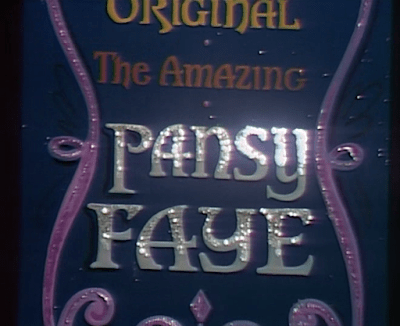
The dream sequence is like nothing we’ve seen before on Dark Shadows, though it is strongly reminiscent of the kind of thing you would have seen on near-contemporary shows like ABC’s prime-time horror anthology Night Gallery hosted by Rod Serling and the Paulist Fathers’ syndicated morality plays Insight hosted by the Rev’d Fr Ellwood Kieser. It starts with a closeup of a sign on which Pansy’s name is emblazoned in glittery letters, and plays over a soundtrack of an audience applauding thunderously. Pansy calls Judith, Barnabas, and Carl to join her on stage, each in their turn; their behavior in this drama-within-a-drama mirrors their behavior in the framing narrative.
Meanwhile, Barnabas’ unwilling sidekick, broad ethnic stereotype Magda Rákóczi, has returned from Boston. There, she met with a leading member of the Romani people, whose name she alternately pronounces as “King Johnny Romana” and “King Johnny Romano.” She shows Barnabas a box she took from King Johnny. It contains a severed hand wearing a ring, which Magda declares will solve their troubles. Magda has placed a curse on Judith and Carl’s brother Quentin, turning Quentin into a werewolf. After placing that curse, Magda learned that her sister Jenny had borne two children to Quentin, and since the curse is hereditary she is desperate to find a way to lift it. Barnabas traveled back in time to 1897 in the course of his own attempt to resist the effects Magda’s curse will have in 1969, so they are allied in this effort.
Barnabas is utterly unimpressed with the hand and with Magda’s plan to place it on Quentin as he is about to transform. He seems convinced that Magda is just trying to conceal the fact that she failed to find anyone in King Johnny’s camp who could actually help them. He doesn’t care about the original owner of the hand, a legendary nobleman named Count Petofi who was himself cured of lycanthropy, or about an incantation Magda says over the hand that is supposed to prepare it to draw the curse from Quentin. He isn’t even interested when she admits that she stole the hand from King Johnny and that if they don’t get it back to him before he realizes it is missing he will send someone to kill her. He reacts as if the whole thing is a show she is putting on to build up her cover story.
In a metafictional set of way, Barnabas is onto something. The original storylines the writers had prepared for the 1897 segment are coming to a head. Several of its major characters have already died, and others, such as Carl, would not be very attractive customers for a life insurance salesman. Apparently the original flimsies, written six months ago, gave only a few more weeks until Barnabas was to return to 1969 and take the show back to contemporary dress. But 1897 is a hit. The ratings are soaring, and there are some dynamics among the characters that they want to explore in a lot more depth. So they want to stay, but to keep the momentum going they need more story and a number of new characters, including a major villain whom Barnabas and Quentin can team up to fight together. So the writers find themselves in the same position with regard to us that Magda is in with regard to Barnabas, trying to sell us on their latest preposterous brainstorm.
Pansy’s farewell performance in Carl’s dream is, alas, Kay Frye’s final appearance on Dark Shadows. Some fans seem unable to look past Pansy’s own hilariously inept performance when we first see her doing her act, and to see that Miss Frye herself does a terrific job playing a cold, cynical working girl. She is good today, when Pansy is on stage and in her character as the “world-famous mentalist and singer,” but is also trying to tell Carl the truth about Barnabas. I only wish they could have brought Miss Frye back as someone else, either in the extended 1897 segment or in another time period.
In the parts of Dark Shadows set in the 1960s, Louis Edmonds plays Roger Collins, younger brother of matriarch Elizabeth Collins Stoddard. In 1966 and 1967, we saw that Roger had squandered his entire inheritance. He was reduced to living as a guest in Liz’ house and working as an employee for her business. Roger was the show’s first villain. His villainy was confined to a storyline known as “The Revenge of Burke Devlin.” That story never really caught on, and by #201 even Burke Devlin had lost interest in it. Roger receded to the margins, and for the rest of the series Edmonds’ gift for sarcastic dialogue kept the character alive as occasional comic relief.
From November 1967 to March 1968, Dark Shadows was a costume drama set in the 1790s. Edmonds, a costume drama specialist in his years on Broadway, came into his own as haughty overlord Joshua Collins. Joshua’s focus on moneymaking and his determination to preserve the glamour of the Collins family name at all costs placed him at the opposite pole from Roger, a blithe spendthrift pathologically lacking in family feeling. Joshua used his power to cover up all of the tragic and horrible events we saw in the 1790s segment, and imposed a false history in its place.
Now, the show is set in 1897. Edmonds plays Edward, the stuffy eldest brother of the adult members of the Collinses of Collinsport. Edward has Joshua’s imperious demeanor and his determination to conceal the family’s disgraces, but like Roger he finds himself penniless, dependent on his sister’s largess. Yesterday he learned that his youngest brother, libertine Quentin, had killed his estranged wife Jenny. So far, Quentin has been a breezily amoral wastrel, easily recognizable to longtime viewers as a kindred spirit of his great-nephew Roger. But Quentin shocked himself when he murdered Jenny, and he had a terrified look on his face as he tried to sneak out of the house afterward.
Edward intercepted him then and forbade him to go. Edward had learned from Quentin’s girlfriend, Jenny’s former maid Beth, what happened. Edward was in a high dudgeon about the mess Quentin had made, but did not seem particularly surprised or at all grieved. He was quite confident he would be able to hush the whole thing up, and fabricated a story about Jenny falling down the stairs and dying shortly after from a head injury.
What did shock Edward was Quentin’s revelation that Jenny was the sister of one of the neighbors, Magda Rákóczi. Magda is a member of the Romani people, an ethnicity against whom Edward and the rest of the Collinses are violently prejudiced. “You married a Gypsy!” he exclaims in utter disgust. He remained convinced that he could keep the whole thing quiet, and drilled Beth and Quentin in the lies they were to tell Magda and her husband Sandor.
Magda did not give Edward a chance to direct the little play he had written. She found physical evidence indicating Quentin had murdered Jenny, and accused him. When she threatened to go to the police, Edward asked her what she imagined the authorities would do when asked to choose between the word of a Collins and the word of a “Gypsy.” At that, Magda dropped her plan to go to the police and vowed to place a curse on Quentin. Edward dismissed that as “words,” but Quentin is deeply involved in the occult. He is helpless with fear.
Today, Edward calls on Quentin in his room. He finds that Quentin has not slept all night. He continues to regard Quentin’s fear of Magda’s curse with total contempt, but perks up when Quentin says that he has thought of a way to escape it. Returning viewers already know that there is one way wide open to Quentin to escape the curse. He can go to the police and confess that he murdered Jenny.
This, of course, is not Quentin’s idea. He wants to offer Magda $10,000. Neither he nor Edward has that kind of money, but their sister Judith, whom their grandmother chose as her sole heiress, does. Edward says that he might be able to persuade Judith to give him that sum on one condition. Their grandmother’s will left Quentin no property or income, but it did guarantee him the right to live in the great house of Collinwood as long as he might wish. If he will sign documents renouncing that right, Judith might give him the money.
Quentin drifts off to sleep. He has a nightmare. Sandor and Magda show him Jenny’s body and tell him he can escape punishment if he blesses it. He does so, and Jenny comes back to life. She asks for a kiss. Quentin gives it, and Magda and Sandor laugh. They say that the kiss has sealed his fate- it is “the kiss of death!”
Edward returns with word that Judith will give him his $10,000, but that she has added a condition. Not only Quentin, but Sandor and Magda too, will have to leave the area forever. Quentin promises to make that happen, and signs the papers.
Meanwhile, Magda and Sandor are at home in the Old House on the grounds of the estate. Magda has mixed a potion and told Sandor that “a very old Gypsy woman” once used it to place a terrible curse on someone called “Count Petofi.” All they have to do is trick Quentin into drinking the potion, and the same curse will befall him. Sandor disdainfully replies that he had thought Magda might have come up with a plan that had a chance of working. He can’t imagine Quentin drinking anything they might give him.
They look out the window, and see Quentin coming to the house. They are pleasantly surprised that he is delivering himself. He knocks. They open the door, and he bursts in. Magda makes a great show of telling him he is not welcome and demanding he leave. He tells them about the nightmare, and says he knows that it is part of the curse. He offers them money to lift it. Magda is at first openly offended, while Sandor behaves as if he is tempted. Quentin shows them the money, and Magda plays the part of a woman succumbing to greed. She asks Jenny’s spirit to forgive her, and takes the envelope. She makes a gesture that Quentin takes to be an act of spellcasting. While she counts the money, Sandor says they will have to share a drink to complete the deal. Quentin happily agrees.
Once Quentin has taken the drink, Magda tells him that he has been fooled. The nightmare was not part of any curse, but was simply the voice of his own conscience. She tells him that the drink brought the curse on him, and that he will begin to suffer its effects tonight. She throws the money at him and tells him to take it. He reels away, dazzled by the horror of it all.
Magda’s curse shows the limits of the Collinses’ power. Their prestige and connections enable them to intimidate the authorities so that they need not worry about an insistent police investigation. But their freedom from that concern has allowed Quentin to travel so far into depravity that he has committed murder and brought a curse upon himself. When they encounter someone who will not be intimidated, their only recourse is to money. Magda’s unwillingness to sell her sister’s vengeance for any number of dollars means that the rich Judith would be as powerless against her as are the impecunious Edward and Quentin.
Not only has the Collinses’ station led Quentin to indulge himself in one vice after another until he is so far gone he cannot imagine good behavior, it has led him to assume that everyone assigned to a humbler place in the world can be bought. Sandor and Magda are quite good actors, almost as good as Thayer David and Grayson Hall, and they look very much like people who are tempted to take the bribe Quentin is offering. But even to make the offer shows a complete lack of perspicacity. Jenny has not been dead for twenty four hours, and he somehow supposes her sister is ready to bargain away her memory.
Quentin cannot say he wasn’t warned. His dream told him that Magda and Sandor would trick him into bringing the curse on himself by leading him to believe they were giving him a way to escape the curse. He is so far gone in the symptoms of his over-privileged background that he cannot even interpret this message. Thus we see that the real curse of the Collinses, the obstacle that blocks the sunlight and casts all the dark shadows that shroud them, is their wealth and power. The first ten months of the show made some feints towards developing a social drama about the relations between the Collinses in their house on the hill and the working people in the village below. The village is mentioned nowadays only as a source for victims of the various monsters bred at Collinwood, but the price everyone pays for the Collinses’ exalted position is always front and center.
In which I complain about “Barnabas, Quentin, and the Dumbest Possible Plan” ad give examples of ideas that I think would have been more interesting to watch play out.




 Dark Shadows Commentary