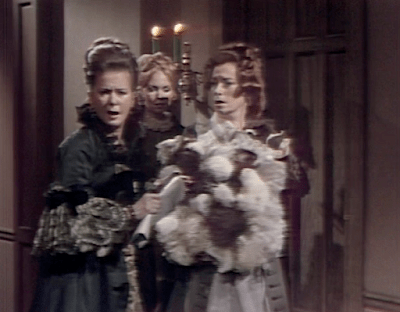
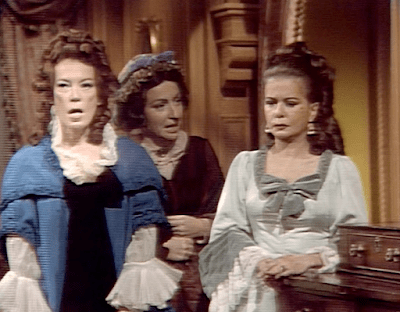
Episode 886: One of the most terrifying tales ever told

In #701, broadcast at the beginning of March 1969, recovering vampire-turned-bumbling protagonist Barnabas Collins was trying to solve some problems his distant cousins were having, and inadvertently came unstuck in time. He found himself in the year 1897, where his vampirism was once more in full force. Barnabas spent the next eight months in that year, precipitating one disaster after another around the estate of Collinwood and the village of Collinsport.

As summer gave way to fall of 1897, Barnabas’ friends managed to put his vampirism back into remission. In #844, he met Kitty Soames, the dowager countess of Hampshire. Despite what her title would suggest, Kitty was an American woman in her twenties. Barnabas recognized her as the reincarnation of his lost love Josette. In February of 1796, Josette found out that Barnabas had become a vampire and that he wanted to kill her and raise her from the dead as his vampire bride. She flung herself to her death from the cliff on Widows’ Hill rather than let him do that to her.

In the eight weeks following Kitty’s first appearance, Josette’s personality irrupted into her conscious mind more and more frequently. Josette wanted to live again and to be with Barnabas. By last week, Kitty could hear Josette’s voice talking to her through the portrait of her that hangs in the Old House on the grounds of Collinwood. Josette suggested that if Kitty stopped resisting her, the two of them could both live, resolving themselves into a composite being.

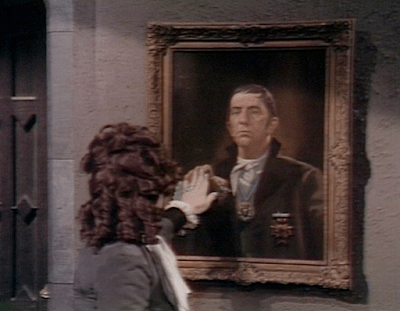
In Thursday’s episode, the boundary between Kitty and Josette had become very indistinct. As Kitty, she agreed to marry Barnabas that night, later to wonder why she had done so. She was holding Josette’s white dress in her hand and struggling with the idea of putting it on when she abruptly found herself wearing it. Barnabas entered the room just in time to see her bodily assumed into the portrait. He reached up to the moving image of Kitty overlaid on the painted likeness of Josette, and both he and Kitty vanished at the same instant.

In Friday’s episode, Barnabas found himself lying on the ground, wearing clothes he had last put on in 1796. He learned that it was the night of Josette’s death. He is a vampire in this period, but he is confident he can again be free of the effects of the curse. He does not want to kill Josette, but to take her back to 1897 with him. His efforts to that end were not at all successful, and Friday ended with her on the edge of the cliff. She hears footsteps, which she and the audience have every reason to think are Barnabas’. If she sees him, she is prepared to jump.

Neither Kitty’s assumption into the portrait nor his own translation to 1796 prompt Barnabas to ask a single question about what forces are at work around him. Regular viewers would not expect him to. He lives in a universe where time travel is easy. Not only did he travel from March 1969 to 1897 without even trying to do so, but in #661 he managed to get from January 1969 to 1796 by standing in a graveyard at night and shouting for one of the residents to give him a ride. And in #365, he was present at a séance where the ghost of his little sister Sarah, speaking through well-meaning governess Vicki Winters, said that she would “tell the story from the beginning.” Vicki then vanished from the circle and Sarah’s governess, Phyllis Wick, materialized in her place. For the next four months the show was a costume drama set in the 1790s, where Vicki flailed about helplessly while Barnabas became a vampire, Sarah died of exposure, and Josette jumped off Widows’ Hill.

Barnabas and we also know that portraits are powerful in the universe of Dark Shadows. When he is in full vampire-mode, he communicates with his victims and potential victims through a portrait of him that hangs in the foyer of the great house of Collinwood. Much of the action in the 1897 segment had to do with a magical portrait that keeps Barnabas’ distant cousin Quentin from turning into a werewolf. Quentin had a romance with Amanda Harris, a woman who came to life when another magical portrait was painted.

Barnabas knows, not only that portraits in general have power, but also that Josette’s portrait in particular is powerful. In his second episode, #212, he went to the Old House and talked with strange and troubled boy David Collins, who often communed with Josette through her portrait. After David left him alone there, Barnabas addressed the portrait and told Josette that she would no longer function as the tutelary spirit of the Collins family. At that point Josette was supposed to be Barnabas’ grandmother who sided against him in a fateful family battle, but even after she was retconned as his lost love he felt the portrait’s power. So in #287, Vicki had invited herself to spend the night at Barnabas’ house. While she slept, Barnabas entered the room, intending to bite her. But he looked at the portrait of Josette and found that something was stopping him from doing so.

Barnabas would not have any way of knowing it, but in #70 Dark Shadows‘ first major special effect came when we saw Josette’s ghost take shape in front of her portrait and take three steps down from it to the floor of the room where it was hanging then, the front parlor of the Old House. She then turned, looked at the portrait, and went outside, where she danced among the columns of the portico. Longtime viewers will see Kitty’s assumption into the portrait as a reversal of this momentous little journey.

Most people nowadays who have been watching the show for some time will therefore take the strange goings-on as much in stride as Barnabas does. But viewers at the time may have had a different reaction. Friday’s episode and today’s originally ended with announcements over the closing credits. These announcements were not on the original master videotapes from which Amazon Prime Video and Tubi and the other streaming apps take their copies of the episodes, and so most viewers these days don’t hear them. But evidently one of the DVD releases reproduces them as they were preserved on some kinescopes. One promises that in Tuesday’s episode “one of the most terrifying tales ever told” will begin; the other, that it will be “one of the most unusual tales ever told.”

A terrifying tale suggests a mighty villain. By the end of the 1897 segment, all the villains have either turned into protagonists, as Barnabas, Quentin, and wicked witch Angelique had done; been heavily defeated, as sorcerer Count Petofi had been; or were dead and forgotten. So “one of the most terrifying tales ever told” would seem to require a new villain, or perhaps a new group of villains. And if it is also “one of the most unusual tales ever told,” those villains will have to be strikingly different from anything we have seen before.

So, having heard those announcements, we will be less inclined to chalk Barnabas’ latest adventure in anachronism up to the usual way things are on Dark Shadows. We will be looking for signs that some previously unknown and hugely formidable malevolent force is luring him into a trap.

At first, no such signs seem to be forthcoming. The footsteps that alarm Josette turn out not to be Barnabas’, but those of her aunt, the Countess DuPrés. The countess talks Josette down and takes her back to the great house of Collinwood. Having saved Josette’s life, the countess takes her to a room occupied by fluttery heiress Millicent Collins. The countess asks Millicent to sit with Josette while she runs an errand.

Millicent means well, but always makes everything hilariously worse. Seeing that Josette is shaking, she observes that she is suffering a shock. She asks very earnestly “Was your shock a romantic one?” Josette responds by wailing. Millicent keeps talking about the dangers of love, causing Josette to get more and more upset. Longtime viewers will remember that Millicent will turn from a comic figure to a tragic one soon after this, when she falls in love with an evil man. That tinges our reaction with sadness, but Millicent’s total insensitivity to the effect she is having on Josette makes for an effective comedy scene. No matter how much the oblivious Millicent is worsening Josette’s mood, this hardly seems likely to be part of a grand evil scheme.

It turns out that the errand the countess had to run was a visit to Barnabas, who is waiting in Josette’s room. This time Barnabas has actually had a sensible idea. Rather than go to Josette on top of the cliff as he did the first time through these events, he asked the countess to go. The countess confronts him about his status as a walking dead man. Barnabas will not explain- how could he? He asks the countess if she thinks he is a ghost; she does not answer. He insists on seeing Josette; she says she will not allow it. He says he does not want to force her to help him; she declares that he cannot force her. Finally, he ends the exchange by biting her.

The countess goes to Millicent’s room and tells Josette to go back to her own room. Millicent is surprised the countess doesn’t go with her, protesting that Josette is in no condition to be left alone. The countess responds numbly.

The countess is one of three characters we have so far seen Grayson Hall play. The first, mad scientist Julia Hoffman, offered herself to Barnabas as a victim in #350; he declined the offer. Julia was motivated by a mixture of despair over the failure of her first attempt to cure Barnabas’ vampirism, an obligation to prevent him harming others, and her own unrequited love for him, so she was disappointed when he said no. The other, broad ethnic stereotype Magda Rákóczi, told Barnabas to “Bite me!” when they were at the grave of her husband, his onetime blood thrall. He refused to do that, too. Magda was angry and defiant, wanting to get something horrible over with, so her reaction was more ambiguous. The countess didn’t know Barnabas was a vampire until his fangs were in her neck, so she is just dazed.

That Hall’s other characters expected Barnabas to bite them, and in Julia’s case hoped he would do so, shows that no new force is needed to explain why he bites the countess. And bad as a vampire’s bite is, from what we have seen in previous segments of the show we can be sure that the countess will forget all about her experience as Barnabas’ victim once he leaves. Besides, when he came back in time in January Barnabas triggered a chain of events that led to the countess’ death- we can assume that whatever he has put in motion this time will have a different outcome for her. So while the bite still has its echoes of rape and is therefore a horror, it in no way shows the presence of any fresh villain that is about to set off “one of the most terrifying tales ever told.”

Josette is in her room. The secret panel opens, and Barnabas enters. She is shocked to see him. He assures her that he does not want to kill her and raise her as his vampire bride; after a bit of prodding, she gets him to admit that this was, at one point, his plan. He starts explaining to her that he has come to her after a sojourn in the 1890s. She reacts with disbelief and confusion. He keeps talking. He asks her if she remembers Kitty Soames. At first the name does not ring a bell, but as he goes on she recognizes what she had thought to be a dream in which she was talking with her portrait. He tells her that it was no dream, but that just a few hours before they were together in that other century.

Finally, Barnabas persuades Josette to meet him at the Old House. He says they must go separately, since he has to go to his friend Ben Stokes and ask him to stand guard for them while they disappear into the portrait. She wants to say goodbye to her aunt the countess, and Barnabas tells her to write a note. They kiss passionately. One wonders if Josette notices the taste of her aunt’s blood on Barnabas’ lips.

Barnabas’ decision to go to Ben and send Josette to the house on her own doesn’t make much sense. This is the first we have heard they need someone to stand guard, and there is no apparent reason why they should. Moreover, the countess is right there in the house with them, and she is under Barnabas’ power. The three of them can go to the house together, Josette can say goodbye to her there, and if they need someone to stand guard she can do it. Afterward she can tell Ben what she saw and tell lies to anyone else who has questions about where Josette went. Besides, regular viewers of Dark Shadows know that when two people are supposed to go to a place separately, they never actually meet there. A smart character who understood how things work in this universe would know that Barnabas’ decree that he and Josette must take their own paths to the house means that they are doomed. But contrary to the glimmers of brainpower Barnabas showed earlier, he has never been that smart. He is so much a creature of habit that his decision to send Josette to the Old House by herself bears no traces at all of any outside influence, least of all the influence of the new villain we are looking for.

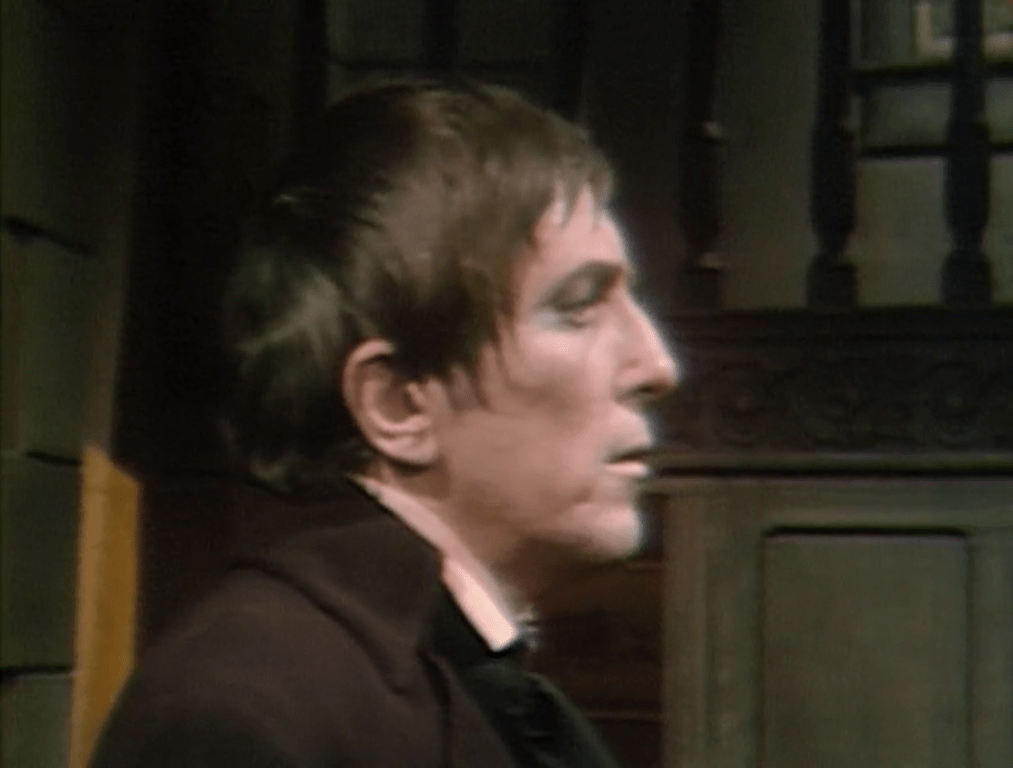
Barnabas is on his way across the grounds of Collinwood to meet Ben when it dawns on him that he is lost. This is the first thing he has done today that is out of character. He has been on the estate for centuries, and knows it surpassingly well. He looks around and sees a cairn, a large stone structure. The cairn has a flat surface in the middle and is flanked with torches and decorated with carvings resembling coiled serpents. Though he does not know where he is, he knows he has been following the same path he used shortly before, and that no such thing was there at that time or in the area ever before. Hooded figures approach, a man and a woman. They make gestures that he cannot understand. He cannot see or feel anything binding him, but neither can he move his feet or use his vampire powers to dematerialize. At last we have encountered the new presence that is supposed to deliver “one of the most terrifying tales ever told.”

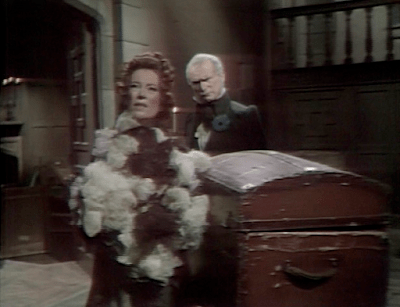
Back in the great house, Millicent and the countess discover that Josette is gone. They read the note. When Millicent reads that Josette has gone to be with Barnabas, she is puzzled. All she knows is that Barnabas is dead. As a visitor from light comedy, she assumes that death is a full-time occupation. She tells the countess that to be with Barnabas, Josette will have to die. The countess replies that “Many have died for love.” Millicent is shocked by the countess’ resigned tone, and declares that she will not give up on Josette even if the countess does.

It would have been impossible for Barnabas to explain the situation to the countess while she was actively opposing him, but one might have thought that after he had bitten her and broken her will he might have tried to reassure her that his plans for Josette were now benevolent. The utter hopelessness in her voice when she says that no one can help Josette suggests he didn’t even try. Again, it wouldn’t have taken the influence of any outside force to cause Barnabas to skip this. As a vampire, he is a metaphor for extreme selfishness, and when he is pressed for time he is especially unlikely to take other people’s feelings into account in any way. Though it is a bit of a shame he didn’t try to smooth things over with the countess, there is nothing in his behavior that needs explaining, and too little at stake here for us to imagine that the mysterious forces launching “one of the most terrifying tales ever told” would care much about it.

In the Old House, Josette is looking at her portrait and wondering why Barnabas is late. She talks herself into believing that he was lying when he told her the story about 1897. She jumps to the conclusion that he really is going to turn her into a vampire, and declares she has nothing left to live for. She takes out a vial she had with her when she was with Millicent and drinks it. It is poison, and she dies.

Back in the mysterious clearing in the woods, Barnabas loses consciousness. The hooded figures say some prayers to Mother Earth, then lay him on the cairn. They place some foliage on him. This action recalls the sprinkling of grain on the necks of animals led to altars in ancient Indo-European paganism, an act known in Latin as sacrificium- it was this ritual act, not the killing of the animal, that made the animal sacer, that is, set aside for the gods. The man declares that when Barnabas awakens he will recognize him and the woman, and that he will then lead them “to a new and everlasting life.” My wife, Mrs Acilius, and I reacted to the idea of Barnabas as a guide to enlightenment the same way every regular viewer of Dark Shadows would, viz. with gales of laughter.

Oberon and Haza sacrifice Barnabas on the cairn. Screenshot by Dark Shadows Before I Die.

If the hooded figures represent the force that has directed the events of this episode and Friday’s, the force that we have been promised will bring us “one of the most terrifying tales ever told,” then something that happened in them must have been a necessary precondition for the sacrifice of Barnabas. After all, that force had him under its power when he disappeared from 1897 and found himself lying on the ground. He could just as easily have materialized on the cairn, accompanied by the hooded figures with their foliage.

The only development in these two installments that would seem to be significant enough to qualify as such a precondition is Josette’s poisoning of herself. That Josette jumped to her death from Widows’ Hill is one of the most firmly established parts of the show’s continuity. Artist Sam Evans told Vicki about it in #5. In #185, a very different version of Sam saw Josette’s portrait for the first time and identified her as “the lady who went over the cliff.” In #233, Barnabas gave a vivid and rather indiscreet account of Josette’s death to Vicki and heiress Carolyn. We saw Josette make her leap in #425, and in #876 the leap was reenacted with maidservant Beth Chavez in Josette’s role and Quentin in Barnabas’. So having Josette poison herself instead of taking the jump is an example of something Dark Shadows did several times in the later phases of the 1897 segment, making a retcon into a self-conscious plot point. That leaves us with a puzzle. Why does it matter so much just how Josette went about killing herself?

Josette’s original death was a desperate flight from vampirism. It barely qualified as a suicide at all. Josette was cornered at the edge of the cliff, seeing no way but a mortal leap to escape transformation into a bloodsucking fiend. She went over the cliff in a spontaneous act that prevented the killings and enslavements that she would have inflicted on others had Barnabas succeeded in making her into the same kind of monster he was. This time, she has been keeping a vial of poison with her, so that her suicide is a premeditated act. Moreover, she drinks it when she is still alone, motivated not by a clear and present danger but by her purely intellectual, and as it so happens faulty, analysis of the situation. She still has options, and she is helping no one. So it could be that “one of the most terrifying tales ever told” is supposed to begin with the audience disapproving of Josette’s suicide on moral grounds.

This doesn’t seem very promising, but we should mention that writer Sam Hall probably did not approve of suicide. He was a churchgoer, serious enough about his Lutheran faith that he insisted Shirley Grossman convert from Judaism before they married and she became Grayson Hall. Christians have traditionally regarded despair as a sinful state and suicide as a religious offense. And Hall does seem to have been in a religious mood at this period. Lately his episodes have shown evidence that he was reading the novels of George MacDonald, a nineteenth century Congregationalist minister whose works of fantastic fiction were enormously popular in their day, but which are suffused with such a heavily Christian atmosphere that by the late 1960s their readership was a subset of that of such self-consciously Christian fans of MacDonald’s as C. S. Lewis, J. R. R. Tolkien, and W. H. Auden. Indeed, the three priests who hosted the podcast God and Comics admitted in a 2022 installment of their show that MacDonald’s novels reminded them a little too strongly of their day jobs to count as fun reading for them.

If Hall was feeling pious enough to keep reading MacDonald, he may well have seen Josette’s intentional and unnecessary self-poisoning as a prelude to “one of the most terrifying tales ever told.” Still, nothing we have seen so far explains just how that would work. Maybe we will find out later that Josette’s soul is in need of some kind of intervention from the other characters to avoid damnation. Lutherans aren’t supposed to think in those terms, but not even MacDonald, churchy as he was, ever let any kind of orthodoxy get between him and a good story.

Today marks the final appearance of both Millicent and the countess. It is also the last time we will visit the 1790s.

The hooded figures Barnabas meets today are identified in the credits as Oberon and Haza. Oberon, King of the Fairies, was a figure in medieval and Renaissance folklore whom Shakespeare used as a character in A Midsummer Night’s Dream. Also, MacDonald mentioned Oberon occasionally in his novels. I don’t know where Hall came up with “Haza.” Bookish people pick up vocabulary items all the time, so any of the various words in the world that take that form might have popped into his head when he was writing this episode.

Oberon is played by Peter Kirk Lombard, Haza by Robin Lane. Miss Lane’s acting career seems to have peaked with her turn as Haza, but for the last six years she has been releasing videos on various platforms under the title Badass Women 50+. As of this writing, her bio on YouTube says that she is 89 years old. Until 2022, her videos ran on a cable TV service in NYC, where she was still living then and for all I can tell is still living now.

Peter Lombard died in 2015. He worked steadily on Broadway for a couple of decades. From the point of view of a Dark Shadows enthusiast, the most interesting work he did there was in the original production of 1776, a cast which also included Dark Shadows alums David Ford, Daniel F. Keyes, Emory Bass, and Virginia Vestoff. Those four were all principal members of the cast, while Lombard was a stage manager and Ken Howard’s understudy in the role of Thomas Jefferson. When the cast appeared on The Ed Sullivan Show, Howard was absent, but the part of Jefferson was played not by Lombard, but by Roy Poole. I think I can spot Lombard in the background in the costume worn by Poole’s main character, Stephen Hopkins of Rhode Island.*
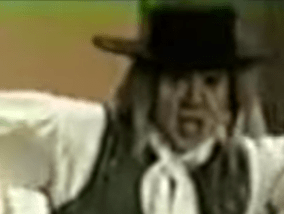
The old age makeup makes it impossible to be sure, but I suspect this is Lombard as Stephen Hopkins.

Lombard bore a resemblance to Carel Struycken, the actor who played the very tall man in Twin Peaks. So much so that when I first saw this episode I was certain he was the same person. But they aren’t related. I do wonder if David Lynch or Mark Frost or casting director Johanna Ray saw this episode and had Lombard in mind when they cast Mr Struycken as “The Fireman,” who like Oberon appears unexpectedly and represents a remote and mysterious world.

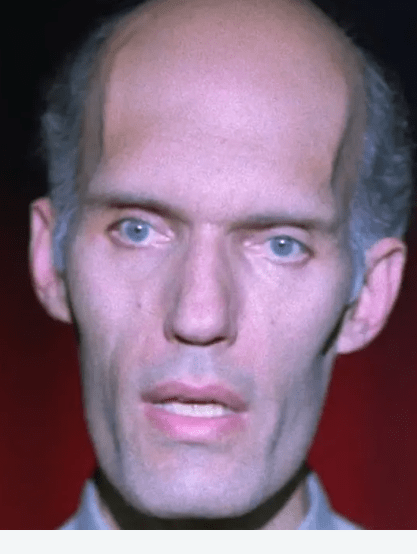
*Stephen Hopkins is not only a character in 1776, but also figures in H. P. Lovecraft’s “The Strange Case of Charles Dexter Ward.” Lovecraft says that (the fictional) Joseph Curwen had been a friend and supporter of his when (the historical) Hopkins was first governor of Rhode Island, but that when Curwen was exposed as a menace Hopkins personally took part in the raid on Curwen’s place. Since the story beginning today is based on another of Lovecraft’s tales, a connection between Lombard and Stephen Hopkins qualifies as a mildly amusing coincidence.
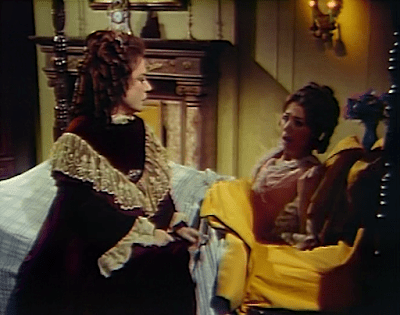
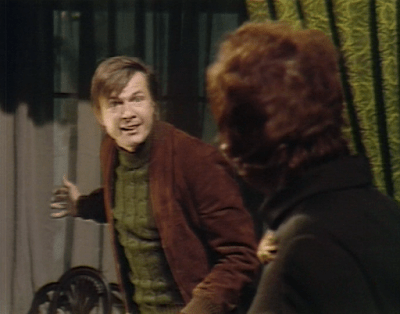
Episode 885: The girl in the portrait

We open with a reprise of yesterday’s closing scene. It is November 1897, and time traveler/ recovering vampire Barnabas Collins is about to be reunited with his lost love, Josette DuPrés, who threw herself to her death from the cliff on Widows’ Hill in February 1796. Josette is now reincarnated in the person of Kitty Soames, the dowager countess of Hampshire. Josette’s personality has been emerging from the substrata of Kitty’s unconscious mind in the eight weeks she has been staying at the great estate of Collinwood. Now Kitty and Josette are merging into a symbiont, and that combined being has agreed to marry Barnabas tonight. Kitty/ Josette is in the Old House on the estate, in the bedroom once meant for Josette, waiting for Barnabas to return from the great house where he has told his distant cousin Judith of their wedding plans.

Barnabas enters the bedroom just in time to see Kitty/ Josette assumed bodily into the portrait of Josette that hangs over the mantel. He reaches up to touch Kitty/ Josette, and the two of them both vanish.

Barnabas finds lying himself on the ground, wearing clothes he last put on in the 1790s. He stands up and calls out for Kitty. “Kitty! Kitty! Where are you, Kitty?” He calls her name several more times. Oddly, he stops short of calling out “Here, Kitty, Kitty, Kitty!” In a comment on Danny Horn’s post about the episode at his great Dark Shadows Every Day, user “kosmo13” wrote “It would’ve been cool if they’d had a cat wander into the scene at that moment and had Barnabas say ‘No. Not you!'”*

Barnabas comes face to face with Ben Stokes, who was his indentured servant and fanatically devoted friend in the 1790s. Ben has no idea why Barnabas is talking as if they haven’t seen each other for a long time- they saw each other last night, as far as he is concerned. Barnabas realizes that he has traveled back in time again. He was in 1897 after being dislocated from the 1960s. Now he has returned to February 1796, to the very night Josette killed herself.

Barnabas tries frantically to keep Josette from repeating her suicide. He sends Ben to the great house of Collinwood to see if Josette is in her room there, as she is supposed to be. He is concerned that, since the trip through the portrait left him on the ground near the woods, there is no telling where it may have dropped Kitty/ Josette.

He needn’t have worried about that. We see Josette in bed, as she was in #425, the first time the show took us through this night. Her aunt Natalie, the Countess DuPrés, is with her, and is intensely afraid of a prophecy foretelling Josette’s death this night. That much is identical to what we saw in the previous timeline, when the show was set in the 1790s in February 1968. Josette does tell the countess that she had an odd dream in which she was wearing an unfamiliar dress and having a conversation with a portrait; that dream, which Josette herself dismisses as not at all important, is evidently the only trace of Kitty left in Josette’s conscious mind.

Josette tells the countess about her dream. Screenshot by Dark Shadows Before I Die.

This scene plays on the iconography of these two actresses. From the moment Kathryn Leigh Scott showed up as Kitty in #844, her title has reminded us of Josette’s aunt. So it is with a nice sense of inevitability that we see the show’s first countess again. Moreover, Miss Scott first joined the cast as Maggie Evans, The Nicest Girl in Town; Grayson Hall as Maggie’s psychiatrist, Julia Hoffman, MD. So it seems right to us when the countess becomes a therapist and listens intently to Josette’s account of her dream, growing only more interested as Josette insists that the dream was unimportant.

The first time through, Barnabas was trying to kill Josette and turn her into his vampire bride. Wicked witch Angelique, who had made Barnabas a vampire in the first place, lured Josette to the top of Widows’ Hill and showed her a vision of herself as a vampire. When Barnabas showed up, Josette ran from him and jumped off the cliff, flinging herself to a death on the rocks below rather than let him make her what he was.

This time, Barnabas wants Josette to live. He knows what Angelique is planning. During his eight months in 1897, he and Angelique became allies, almost friends. So it is logical that he meets with her and asks her to leave Josette alone. But this is Angelique as she was in #425. She is enraged with Barnabas, and full of hate for Josette. She does listen to him, and for a moment she seems to be considering his request that she stay with him through the night. One wonders how she would have reacted had Barnabas leveled with her about what happened in 1897, explaining why he thinks they can be something other than enemies. But he holds back, telling her nothing. She makes a hostile remark, and vanishes.

Angelique does just what she did the first time- she tricks the countess into leaving Josette’s room, projects a voice that Josette mistakes for Barnabas’ voice calling her to go to Widow’s Hill, and causes Josette to see a vision of herself as a vampire once she is on top of the hill. At the end, we hear footsteps approaching. The last we saw Barnabas, he announced he was hastening to Widows’ Hill to keep Josette from jumping; if he arrives now, that is exactly what he will prompt her to do.

In the 1897 segment, Grayson Hall played broad ethnic stereotype Magda Rákóczi and also had a few weeks as Julia. Today she returns to the cast after an absence of more than five weeks. She spent that time in Excelsior Springs, Missouri, where she had a part in a movie called Adam at 6 AM. The cast included Michael Douglas, Joe Don Baker, Dana Elcar, Louise Latham, and Meg Foster. Actor Steve McQueen was one of the producers. Hall and Elcar were the only Dark Shadows alums in the company, though Foster later played an ultra-soapy story opposite David Selby in a miniseries called Washington: Behind Closed Doors.

We haven’t seen the countess since #666. In that one, Barnabas had traveled back to a night a few weeks after the one he arrives in today. He made a terrible mess of things, which is his function on the show, and Ben wound up inadvertently killing the countess. Seeing her today, regular viewers can hope that, whatever misfortunes Barnabas brings with him this time, at least that won’t happen. The countess is a likable character, and while there was a point to showing Ben becoming a murderer it is a point they have already made. They won’t lose anything if they imply that the events we are about to see prevent it from happening.

*Posted 25 December 2024 on Danny Horn, “Not in Canvas Anymore,” Dark Shadows Every Day, 21 June 2016.

Episode 666: Barnabas isn’t like anyone else

Thayer David joined the cast of Dark Shadows in August 1966, taking over the role of moody handyman Matthew Morgan from George Mitchell starting with #38. In that first episode, Matthew brawled in a barroom and left dashing action hero Burke Devlin gasping. The main storyline of the next few months was the investigation into the death of beloved local man Bill Malloy; it turned out Matthew had unintentionally killed Bill when they got into a fight and Matthew didn’t know his own strength.

Those two events explain the recast. George Mitchell was a slender little man whose white hair and craggy face made him look older than his 61 years. He was a fine actor, but no one would have believed that he could win a fight with Burke or that he was so strong that he would accidentally kill Bill. David was Mitchell’s equal in acting ability, but more importantly was a burly fellow in his late 30s.

Today, we hark back to David’s original function on the show. The setting is the year 1796; vampire Barnabas Collins has traveled back from the 1960s to rescue his fellow time traveler, well-meaning governess Victoria Winters, from death by hanging. David plays another servant. As Matthew was fanatically loyal to matriarch Elizabeth Collins Stoddard, so Ben Stokes is utterly devoted to Barnabas. Ben finds roguish naval officer Nathan Forbes and visiting Countess Natalie DuPrés about to drive a stake through Barnabas’ heart. Ben demands they stop; Nathan aims his pistol in Ben’s direction and squeezes the trigger. The gun misfires. Ben reflexively clutches at his chest, but finding he is not hurt he advances on Nathan. They fight. As Matthew was so strong he could not fight Bill without accidentally killing him, so Ben accidentally kills Nathan. Ben then tells the countess he doesn’t want to hurt her and that she will be all right if she stays put until he can figure out what to do; she is unable to assure him she will do so, and in his attempt to restrain her he inadvertently kills her, too.

Barnabas had originally lived in the eighteenth century. He passed from that time into the 1960s because he was chained in his coffin in 1796 and discovered in 1967 by would-be grave-robber Willie Loomis. Now, he has rescued Victoria, and he is eager to go back to 1969, when he is free of the effects of the vampire curse. He traveled back by standing in an old graveyard and calling to the spirit of Vicki’s boyfriend, an unpleasant man known variously as Peter and Jeff, to pull him into the past. He went to the same graveyard yesterday and tried the same trick in reverse. Peter/ Jeff isn’t in 1969, so he calls instead to his friend, mad scientist Julia Hoffman. That didn’t work, so he decided to have Ben chain him in the coffin and take the long way back.

Barnabas is unhappy to wake up this evening. He leaves his crypt to find Ben using a shovel to pat down some earth nearby. He asks why Ben did not chain the coffin as he was instructed. Ben tells him about Nathan and the countess; evidently he is only now finishing their shallow graves. Ben has never murdered anyone before, so he asks Barnabas’ expert opinion about the next steps. Barnabas tells him to get rid of the countess’ things and to tell whoever asks that she left for Paris.

The reference to Paris is a bit unexpected to longtime viewers. When the countess first appeared in #368/369, she said that she chose to live on the island of Martinique because metropolitan France had become a republic. She and her servant Angelique came to Collinwood along with the countess’ brother André DuPrés and André’s daughter Josette, who was at that time engaged to marry the still-human Barnabas. André is identified as the owner of a sugar plantation on Martinique.

In 1796, France was of course still a republic. But the Terror had ended shortly after the execution of Robespierre in the summer of 1794. Among the beneficiaries were the real-world counterparts of the DuPrés family, the vaguely aristocratic owners of a sugar plantation on Martinique. Their name was Tascher; the daughter of the family was named, not Josette, but Josephine, the widow of the Vicomte de Beauharnais. Josephine was imprisoned in Paris during the Terror, but she was freed, reunited with her son, and restored to her property by June 1795. In May of 1796, Josephine would marry an up-and-coming artillery officer named Napoleon Bonaparte. It would indeed be plausible that the countess would want to go back to Paris and take the opportunity to reestablish a life there.

After the story of Matthew Morgan and the consequences of the death of Bill Malloy ended in December 1966, Dark Shadows was for 13 weeks dominated by the battle between undead fire witch Laura Murdoch Collins and the forces of good, led by Victoria with assistance from the ghost of Josette. Laura was the show’s first supernatural menace.

The ghost of Josette had been introduced in #70 as the tutelary spirit of the long-deserted Old House on the estate of Collinwood. Matthew held Victoria prisoner in the Old House late in 1966, and in #126 he decided to kill her. Josette led the other ghosts out of the supernatural back-world that exists somewhere behind the action to save Victoria by scaring Matthew to death. During the Laura story, Josette’s ghost was deeply involved in the action, literally painting a picture to explain to the characters what was going on.

Prompted by Josette’s ghost, Victoria figured out that Laura was going to burn her son, strange and troubled boy David Collins, to death on the anniversary of similar immolations. This would turn out to be a key turn in Dark Shadows’ world-building. When you are telling stories about supernatural beings, you can’t rely on the laws of nature or logic to shape the audience’s expectations. You need to give them some other mechanism of cause and effect if you are going to create suspense. So from that point on, the show would use anniversaries as causal forces. “It happened exactly one hundred years ago tomorrow night!” means it will happen again then.

That was the basis of Barnabas’ trip to 1796 and of his hope to return by standing on the same spot. Tombstones indicating that Victoria and Peter/ Jeff had been hanged materialized at times related to the anniversaries of those events, and Barnabas must leave 1969 at a certain point to arrive at a certain point in 1796. Eight o’clock on a given night in 1796 corresponds to eight o’clock on a given night in 1969, and those are the times when Barnabas and Julia go to the graveyard from which he vanished and call out to each other.

Even though the conjoined eight o’clocks don’t facilitate Barnabas’ return trip, the structure of today’s episode plays on the same idea of intercutting timelines. We alternate between scenes of Barnabas and Ben in 1796, and of Julia and Willie in 1969. Barnabas bit Willie and enslaved him when he opened his coffin; by the time Barnabas was cured of the effects of the vampire curse, Willie had let go of any hard feelings about that. Barnabas has made the Old House his home, and Willie voluntarily lives there as his servant. Julia has been a permanent guest in the great house on the estate since 1967, but now is apparently staying at Barnabas’.

Julia is determined that Barnabas will return by rematerializing on the spot from which he vanished, and she keeps going back there. Willie doesn’t believe this will happen, but in a long interior monologue comes up with the idea that he might reappear in his old coffin. In her turn, Julia dismisses that idea. They quarrel about these competing absurdities, and Willie decides to put his hypothesis to the test. He goes to the old mausoleum to check on the coffin, and finds it empty. He returns to the house to report this to Julia.

Julia decides it’s time to sleep, so she goes upstairs- apparently to her own bedroom. Seconds later, a ghost appears to Willie. He recognizes it as Josette. She vanishes, and he calls Julia. When Julia comes he tells her that Josette had never appeared to either of them unless Barnabas was in danger. As far as I can recall the audience has never known Josette to appear to Willie or Julia at all, and Barnabas is always in danger, so that remark is a bit of a mystery to longtime viewers.

In the days leading up to Willie’s discovery of Barnabas in April 1967, he, and he alone, heard a heartbeat coming from the eighteenth century portrait of Barnabas that hangs in the foyer of the great house. While he is talking with Julia, Willie turns to the portrait of Barnabas that artist Sam Evans painted in May 1967 and hears the heartbeat again. Julia cannot hear the heartbeat. Willie combines the sound of the heartbeat with the sight of Josette and concludes that Barnabas has returned and the old coffin is no longer empty. We cut to the hidden room in the mausoleum. Chains materialize around the coffin, and we see Barnabas inside it, struggling to escape.

Willie realizes what’s going on and tells Julia about it. Screenshot by Dark Shadows Before I Die.

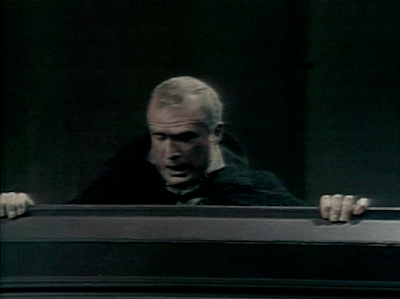
We may wonder if Barnabas has been struggling that way every night since he was chained there in his attempt to return to the 1960s. That would be 173 years, added to the 171 years the first time. It would seem that 344 years confined to a box would make Barnabas even screwier than he is. In a much later episode, we will see Barnabas released after a long entombment and he will be surprised that more than one day has passed. The 2012 film adaptation of Dark Shadows includes a humorous scene based on the idea that time does not pass for Barnabas while he is chained in his coffin. But when he was first released in April 1967, there were indications that he had undergone a nightly torment through the centuries, and the closing image of Barnabas in the box today echoes those indications.

Nathan’s death marks the final appearance of actor Joel Crothers, who has been one of Dark Shadows’ most valuable cast members since his debut in #3, when he played hardworking young fisherman Joe Haskell. We said goodbye to Joe last week; it was nice to have another glimpse of Crothers in his villainous role before he left for the last time.

Episode 665: Burn, witch, burn!

Vampire Barnabas Collins has traveled back in time to the year 1796 in order to save well-meaning governess Vicki Winters from being hanged. To his disappointment, she was hanged yesterday, and now appears to be dead. The audience knows that wicked witch Angelique intervened so that Vicki would survive the hanging and appear to be dead so that she can be buried alive. Angelique explains at the beginning of today’s episode that she will lift the spell once Vicki is in the ground so that she can die a slow, painful, terrifying death.

When Barnabas left 1969 on his mission of mercy, matriarch Elizabeth Collins Stoddard had been dealing with the effects of a curse Angelique cast on her in 1968 that caused her to be obsessed with a fear of being buried alive. In fact, Liz appeared to have died, and was in a coffin. That story was unexciting when it was introduced, and had been dragging on for months and months.

Regular viewers may sigh when they see that Angelique is still hung up on the idea of live burial, but this time the whole thing moves very swiftly. Angelique goes to Barnabas in the tower room of the great house of Collinwood. She tells him Vicki is still alive and that if he goes away with her she will save her. He disbelieves her, and signals his servant Ben to rush in with a burning torch and immolate Angelique. Lara Parker enjoys the part of the burning Angelique so hugely that I laughed out loud watching it, but that didn’t detract from the episode. On the contrary, the joy Parker took in performance was one of the most appealing things about her.

Angelique’s dying screams attract the attention of a long-term guest in the house, the Countess DuPrés. The countess goes to the tower room to investigate, and catches sight of Barnabas. The countess had seen Barnabas die, and is shocked that he appears to be alive. She talks with perpetually confused heiress Millicent Collins, who has also seen Barnabas and who has discussed him with her husband, roguish naval officer Nathan Forbes. The countess gathers from what Millicent says that Barnabas is a vampire. This doesn’t quite fit with the previously established continuity- Barnabas returned to a night sometime after the events of episodes 449-451, when the countess helped Barnabas’ father Joshua in an effort to free Barnabas of his curse. It seems rather unlikely that it would slip the countess’ mind that Barnabas is a vampire. At any rate, this time she vows to destroy him at the first opportunity.

When Angelique is destroyed, her spell is broken and Vicki revives. Barnabas goes to the drawing room of the great house and is astounded that Vicki is alive. We may wonder if he would have gone away with Angelique had he known she was telling the truth when she said Vicki was not really dead. He urges Vicki and her boyfriend, the irksome Peter Bradford, to go away as quickly as possible, as far as possible. Vicki asks for a few seconds alone with Barnabas; Peter leaves them, and she tells Barnabas that she will always feel close to him. She gives him a little kiss, and rushes off. Barnabas was hung up on Vicki for a long time; his facial expression as he watches her leave with another man suggests that he has for the first time managed to perform a selfless act. It’s a lovely moment. I only wish Vicki had been played by Alexandra Moltke Isles, who played the part for the first 126 weeks of Dark Shadows, instead of Carolyn Groves. Miss Groves wasn’t a bad actress, but if the goal is to give the character some kind of closure it is unsatisfying to see her as someone who only had the part for three episodes as opposed to the person who was there in 335.

Barnabas sees Vicki go.

Barnabas sees that the time has come to return to 1969. Ben does not know that Barnabas has traveled through time; as far as he knows, he was there all along. But when Barnabas announces he will be leaving, Ben insists on following him. Ben stands by and watches while Barnabas stands in a graveyard and calls out to his friend Julia. Ben does not know who Julia is, any more than he knows that Barnabas was standing on this same spot in #661 when he left 1969. Neither he nor Barnabas knows that the countess and Millicent are spying on them from the bushes.

Barnabas keeps calling out to Julia, but nothing happens. Barnabas decides that he will have to make the trip to the 1960s the same way he did before- as a vampire chained in a coffin hidden in the secret room of the Collins family mausoleum. He takes Ben to that room, and tells him to chain the coffin up after dawn. He tells him they will never see each other again. In its own way, this farewell is as poignant as the one Barnabas shared with Vicki. It is also shadowed with menace, as we see the countess and Millicent still watching.

The next morning, the countess comes to the mausoleum with Nathan. It is a bit puzzling to see Nathan. The night before, Barnabas bit Nathan and forced him to confess to many serious crimes; we last saw him in gaol. Yet here he is, not only free but wearing his federal coat with officer’s braid. The countess says that she got him out of gaol to stake Barnabas. Even in Soap Opera Land, this is a bit of a stretch. It’s an even bigger stretch that, having been under Barnabas’ power, Nathan is now able to stake him.

Nathan is holding the stake over Barnabas’ heart and raising the hammer when the lights go down. We hear a loud bang, and the episode ends.

In his post about this one at the Collinsport Historical Society, Patrick McCray outlines its slam-bang plot, full of sudden reversals and poignant farewells. Patrick does such a great job of capturing the verve and joy of this Genuinely Good Episode that I wondered whether I should even bother writing a post about it. At the opposite extreme, Danny Horn’s post on Dark Shadows Every Day was so full of irritable complaints about continuity problems and other imperfections in Ron Sproat’s script that I was inclined to write a long and impassioned defense.

But I will leave the debate to the two of them. I’ll just say that if anyone is curious about what Dark Shadows is like and wants to watch a single episode to get the flavor of the thing, this would be as good a choice as any.

Episode 449: To provide a witch

In the parts of Dark Shadows set in the 1960s, Grayson Hall plays mad scientist Julia Hoffman, sometime confidant of ancient vampire Barnabas Collins. Now it is 1796, Barnabas has only recently become a vampire, and Hall is the Countess DuPrés. Like Julia, the countess is deeply versed in the supernatural, and like her she is a long-term guest at the great house on the estate of Collinwood.

Barnabas’ father Joshua has learned of his son’s curse, and is desperate to find a way to free him of it. Today, we open in the Old House on the estate. Joshua has summoned the countess to meet him there. Joshua brings the countess up to date about Barnabas’ condition. He also informs her that the one who played the curse was not the luckless Victoria Winters, who is currently in gaol awaiting execution on charges of witchcraft, but was in fact the countess’ one-time maid Angelique. At this, the portrait above the mantel vanishes and is replaced with one of Angelique.

Portrait of the wicked witch. Screenshot by Dark Shadows Before I Die.

This is the first we have seen the portrait of Angelique. As Danny Horn points out in his post about this episode on Dark Shadows Every Day, it is a message to the audience. Barnabas killed Angelique weeks ago, and her ghost, which was pretty busy on the show for a little while after that, has not been prominent lately. They are running out of unresolved storylines, and will be returning to the 1960s soon. When they show us that they have commissioned and paid for a portrait of Angelique, the makers of Dark Shadows are telling us that she will be back when they return to a contemporary setting.

Joshua asks the countess if she can help lift the curse. At first the countess shows incredulity that Joshua thinks she can “provide a witch” who will counteract Angelique’s spell, but she immediately follows this display by announcing exactly how they will go about summoning such a person.

Back in the great house, naval officer/ sleazy operator Nathan Forbes is continuing with his efforts to drive his new wife Millicent insane so that he can get his hands on her share of the Collins family fortune. Millicent has seen a light in the room on top of the mansion’s tower. Nathan denies having seen the light, and Millicent takes his denial, not as a sign that his vision is failing, but as a reason to fear that she is hallucinating. Nathan insists that she go to the tower room and prove to herself that no one is there.

Returning viewers will be startled by this insistence of Nathan’s. Nathan has deduced that Barnabas is in the tower room. He does not know that Barnabas is a vampire, but does know that he is responsible for the many killings that have taken place in the area recently. When he presses Millicent to go to the room, he is not only trying to unhinge her mind, but is sending her to surprise a crazed murderer in his lair.

Perhaps Nathan hopes only that Millicent will be shocked to see her cousin. But he has been using his knowledge of Barnabas’ presence on the estate to blackmail Joshua. Millicent is a compulsive talker. If she learns that Barnabas is at home, it will only be a matter of time before she tells everyone about it, making Nathan’s information worthless as leverage over Joshua. Unless Nathan does in fact calculate that Barnabas will kill Millicent, it is hard to see what he thinks will happen when Millicent goes to the room.

Joshua and the countess return to the great house. Joshua hustles everyone out, commanding them to go into town to attend a speech by the governor of Massachusetts.* Nathan resists; alone with Joshua, he asks if Barnabas will still be in the tower when everyone gets back. Joshua refuses to discuss the matter.

Joshua and the countess begin their summoning ceremony in the drawing room. Nathan eavesdrops at the door. Joshua finds him there and drives him from the house; the ceremony begins again.

Millicent goes to the tower room. She lets herself in. Barnabas confronts her. He tells her that he will let her go if she will promise never to tell anyone she saw him there; she cannot do that. Patrick McCray puts it well in his post on The Dark Shadows Daybook: “Millicent’s tragedy is that her nature compels her to tell the truth. She knows it will kill her and she knows that she is consigned to it. She is addicted to chatter and chatter will kill her. When she screams at Barnabas’ attack, I think she’s not so much screaming at the terror of the vampire as she is screaming at herself.”

In the drawing room, the countess and Joshua continue the ceremony. We hear the wind. One draft blows out the candle; another blows open the door. An old woman appears in the doorway. She enters the foyer, and says that it is too late- the man they have summoned her to help has already gone.

Enter the good witch. Screenshot by Dark Shadows Before I Die.

*In our time-band, Samuel Adams held that office in 1796. We might imagine that Adams had a counterpart in the universe of Dark Shadows. If so, it would have struck people odd that Joshua was not already committed to attending the speech, and indeed that he had not invited Governor Adams to spend the night at Collinwood. When Joshua first met the countess, he proudly claimed that the French Revolution was an imitation of the USA’s War of Independence; by that point in history, such a claim marked its maker as a supporter of the faction in American politics that the governor represented, the more militant wing of Thomas Jefferson’s party. In fact, much later in the series we will see a portrait of Jefferson prominently displayed at Collinwood. Joshua must surely have been the richest and most eminent Jeffersonian in the region, so much so that even though his family was in mourning they would still have been expected to host the governor in their mansion.

Episode 422: Never gave you love

Yesterday, 5 February 1796, the Countess DuPrés visited suspected witch Victoria Winters in the Collinsport gaol. The countess begged Vicki to lift the spell that she believes to be causing her niece, the gracious Josette, to behave strangely. Vicki responded that she had cast no spell on Josette or anyone else. She claimed that she was not a witch at all, but an unwilling and well-meaning time traveler displaced from the year 1968. As it happens, this is true.

Vicki told the countess that according to the history and legend she learned in the 1960s, Josette will soon die. The last events leading to her death will be triggered when she loses a ring with a black onyx stone. Vicki’s remarks settled any lingering doubts the countess may have. She is now certain that Vicki is a witch, and that when she claims to be warning people against upcoming dangers she is in fact taunting them with her own cruel plans.

In Josette’s room, the countess discovers that Josette has somehow come into possession of just such a ring as Vicki described. Josette refuses to tell her where it came from. Later, the countess stands in the foyer of the great house of Collinwood, studying the portrait of the late Barnabas Collins that hangs there. She recognizes Josette’s new ring as the one in the portrait. Well might she recognize it- she knew Barnabas well, he died only a couple of weeks before, and he wore the ring all the time. He and Josette had been engaged to marry each other, and never gave up their passionate attachment even after they married other people. It is hard to think of a reason why the countess would not have thought of Barnabas at the moment Vicki began describing the ring, much less as soon as she saw it on Josette’s finger.

The countess studies the portrait of Barnabas. Screenshot by Dark Shadows Before I Die.

Barnabas’ father, haughty overlord Joshua, asks the countess what she finds so interesting about the portrait. She asks if the ring was part of a set; he answers that it was unique. He begins to reminisce about Barnabas’ great fondness for the ring. His warm look of recollection gives way to an expression of deep pain, and he stops himself as he is about to say that he left it on Barnabas’ finger when he buried him. He refuses to say any more about Barnabas.

The countess and Joshua do not like each other very much, but they are of one mind about Vicki. It is inexplicable that the countess does not tell Joshua about Vicki’s prediction and about the fact that Josette now has Barnabas’ ring. Her reticence sets up a dramatic moment, when Josette comes downstairs, faints, and Joshua finds the ring on her finger. But that moment would only have been more dramatic if it had also been the first time the countess saw Josette with the ring. Vicki’s description of a ring should have been more than enough to prompt her to study the portrait and ask Joshua about Barnabas’ ring, but perhaps not enough to embolden her to say much to Joshua. The scene in Josette’s room makes a hash of the countess’ motivations here, and leaves Joshua’s discovery of the ring as a pointless repetition.

Joshua goes to Barnabas’ coffin, hidden in a secret chamber of the family mausoleum. He talks to Barnabas for a while. He admits that he was a cold and distant father, but vows to take a terrible revenge on anyone who might have disturbed his rest. He opens the coffin and finds that it is empty. His shock is chiefly to do with the disappearance of the body, but can only be sharpened when he realizes that instead of delivering his heartfelt confession to his son’s corpse he was in the somewhat ridiculous position of delivering it to a piece of furniture. This is a characteristic situation for Joshua- when he is ready to open up about his feelings, he finds that no one is there who can even appear to be listening.

He ain’t got no body. Screenshot by Dark Shadows Before I Die.

Returning viewers know that no one robbed Barnabas’ grave. He has become a vampire. He gave Josette the ring himself, after biting her and telling her she would become his undead bride. All of this has been concealed from Joshua, the countess, and Vicki. Barnabas shows up today and has a forgettable scene with Josette. They get involved with the secret passage leading out of her bedroom.

Josette’s room will be Vicki’s in the 1960s, when she is the governess at Collinwood, and we saw in #412 that she knows about the secret passage. There is one other thing you would expect Vicki to have known. Barnabas returned to prey upon the living in April of 1967; Vicki knew him from then until she came unstuck in time in November of that year, though she thought he was alive. He wore the ring with the black onyx stone all the time in 1967, just as he did in 1795. Vicki was familiar with the portrait, which still hung there in her time. She believed its subject to be the ancestor of her acquaintance, knew that it was the same ring, and knew that the “original” Barnabas had been Josette’s lover. So if Vicki read a book or heard a legend that described the ring in connection with Josette, you would think she would have put one and one together and come up with two.

Episode 393: It would make her more interesting

Every crisis we have seen in the five and a half weeks since well-meaning governess Vicki came unstuck in time and found herself in the year 1795 has begun with lady’s maid/ wicked witch Angelique attempting to use black magic to win the love of young gentleman Barnabas Collins.

Angelique cannot be satisfied with the progress of her efforts. She has managed to end Barnabas’ engagement to the gracious Josette and has now become engaged to Barnabas herself, but even when he was proposing to her Barnabas explicitly told Angelique that theirs will be a sham marriage, something he is settling for because he knows he can never have his true love, Josette. Along the way, she cast one spell causing Josette to conceive a mad passion for Barnabas’ uncle Jeremiah and another causing Jeremiah to reciprocate it, leading them to elope and Barnabas to kill Jeremiah in a duel. She briefly turned Barnabas’ father, haughty overlord Joshua, into a cat. These events led Barnabas’ aunt Abigail and Josette’s aunt, the Countess DuPrés, to suspect that sorcery was afoot among them and to call in a professional witch-hunter, the Rev’d Mr Trask. Only the chance combination of Trask’s comic ineptitude, Vicki’s total failure to adapt to her new surroundings, and Barnabas’ cowardly unwillingness to tell anyone that he and Angelique had had an affair some time before kept Angelique from being exposed before she could lure Barnabas into even a sham marriage.

Barnabas’ agreement to marry Angelique came as the indirect result of another near-disastrous blunder of hers. In a fit of pique, she brought a grave, potentially fatal illness upon Barnabas’ little sister Sarah. When Barnabas happened to see her while Sarah was at her sickest, it dawned on Angelique that she could use his fear for her life as leverage. So she extorted from him a promise to marry her if she cured Sarah. Barnabas has told that story to his mother Naomi, who repeated it to her husband Joshua. Evidently none of them realized that it was much stronger evidence of witchcraft than were even the most bizarre of Vicki’s words and deeds, but that was another case of dumb luck sparing Angelique from the consequences of her actions.

In #377, we heard Angelique thinking about her spells and telling herself that once she has cast them she cannot undo their effects. You might think that because she knows about this limitation on her powers and has already seen one spell after another go wrong, she would be somewhat circumspect about raising the dead, but she is nothing daunted. Yesterday, Angelique summoned Jeremiah from his grave. She also caused Josette to go to the grave in time to see his hand burst out of the soil. This was part of a plan to drive Josette crazy. But again, her efforts misfire. Naomi saw Josette leaving the house and followed her to the grave, where she too saw the hand. With a witness confirming that she saw what she thought she saw, Josette would seem much likelier to keep her grip on sanity than she would be were she the only one who saw the phenomenon.

Today, Josette and Naomi run into the manor house of Collinwood, finding Joshua in the front parlor with Josette’s father André. They tell the men what they saw, and do not get an intelligent response. André hustles his daughter upstairs and puts her to bed, while Joshua stays in the front parlor and verbally abuses Naomi. When Naomi sees Jeremiah’s reanimated corpse outside the window, Joshua refuses to look until it has gone, then declares that its absence proves that she is an unreliable drunkard.

Later, Naomi tells the countess what she and Josette saw. The countess asks if Naomi now agrees that there is witchcraft at Collinwood. Naomi agrees that it seems probable, but says that she cannot believe that Vicki is a witch. They run through the other possible suspects. When they get to Angelique, the countess says that “It would make her more interesting.” She thinks a moment, then dismisses the possibility, saying that Angelique was a child when she entered her service, and that she has always been too boring to be a witch.

“Ever since she was an uninteresting child.” Screenshot by Dark Shadows Before I Die.

We spend some time in Josette’s bedroom. Jeremiah’s ghost wakes her, demanding that she come with him. This had not been Jeremiah’s attitude before his death, when he was so consumed with remorse at what he and Josette had done that he resolved to let Barnabas kill him. He is functioning as Angelique’s sock puppet. We might wonder if he is simply compelled to speak these words, or if she has deposited some share of her personality in his body.

In the morning, Josette awakens again, this time finding her aunt in the room. The countess offers to stay, but when Angelique comes with coffee the ladies decide it would be best for her to take over the vigil while the countess prepares for the upcoming move from the current manor house to the newly built great house.

Angelique breaks the news to Josette that she and Barnabas are to marry. Josette is devastated, but tells Angelique only that she must no longer do the work of a servant, and that she hopes her marriage will be a happy one. Whatever we may know about the injustices of the social system that has exalted Josette and subordinated Angelique, Josette as an individual shows such perfect kindness to Angelique that even the most class-conscious socialists in the audience would have to sympathize with the grand lady and be angry with her rebellious maid.

Joshua and Naomi arrive in the foyer of the great house, followed a moment later by the countess and Angelique. This is the home of the Collins family on the segments of Dark Shadows set in centuries other than the eighteenth, and was where regular viewers got to know them in the first 73 weeks of the show. The old manor house was introduced in #70 as a haunted relic, and since #221 has been the lair of Barnabas, who is in 1967 a vampire. So in terms of its dramatic date, this is the first time the family has settled into what we know as its proper home.

New home, with a new box. Screenshot by Dark Shadows Before I Die.

The ladies go upstairs to the room assigned to the countess. The room was originally to be Jeremiah’s. They find that the door is locked. The countess suspects that Vicki is hiding inside; indeed, she had hidden in the house earlier, making her the first person ever to spend a night there. But the countess’ theory is exploded when they hear a man laughing maniacally from the inside. We know that Jeremiah has moved into the room after all. Hearing the laughter, Naomi and the countess are horrified; Angelique is simply bewildered. She stands behind the others, partially blocked from our view. Unable to control what comes next, she is pushed out of the center of attention.

Hearing the laughter. Screenshot by Dark Shadows Before I Die.

Episode 386: Innocent until proved innocent

For the first nine months it was on the air, Dark Shadows was the story of well-meaning governess Vicki Winters and her efforts to befriend her charge, strange and troubled boy David Collins. That phase of the show reached a climax with the story of David’s mother, blonde fire witch Laura Murdoch Collins, who was on from December 1966 until March 1967. Vicki rallied the regular characters in opposition to Laura’s evil plans for David, and when Laura went up in smoke David found refuge in Vicki’s arms. He had exchanged his destructive, death-oriented mother for the loving, life-affirming Vicki. At that moment, Dark Shadows version 1.0 ended.

Now, Vicki has been thrust back in time to the year 1795. Vicki has managed to get another job as governess on the great estate of Collinwood, supervising the education of ten year old Sarah Collins and her second cousin once removed, the visiting (but so far unseen) Daniel Collins. There is a blonde fire witch here as well, the mysterious Angelique. Viewers who have been with the show from the beginning will remember Vicki’s leadership of the campaign against Laura, and are waiting to see how she will take charge of the effort to defeat Angelique.

It’s already been a long wait. Vicki has not adapted her thinking at all to her new surroundings. Angelique’s spells have wrought considerable havoc, and members of the Collins household have begun to wonder whether a witch might be at work among them. Angelique hasn’t lifted a finger to deflect suspicion to Vicki, but Vicki’s own behavior has been so bizarre that she is the obvious suspect. As we open today, she has been tied to a tree by the Rev’d Mr Trask, a visiting witch-hunter from Salem, Massachusetts.

Vicki’s ineptitude is particularly frustrating to watch because the major theme of Dark Shadows 2.0, which ran from Laura’s immolation in March to Vicki’s temporal displacement in November, had been a brilliantly successful deception by a different sort of time-traveler. Vampire Barnabas Collins presented himself to the Collinses and their neighbors, not as a blood-sucking ghoul native to another century, but as a distant cousin from contemporary England. Barnabas made plenty of slips and raised miscellaneous suspicions in the minds of various people, but he played his part well enough that the Collinses let him take possession of a house on their estate, the people of Collinsport accepted him as a member of the local aristocracy, and in one way or another he made himself indispensable to everyone around him. We began this version 3.0 expecting to see Vicki do in 1795 something like what Barnabas had done in 1967, and instead we see her as a tedious dingbat.

Barnabas is alive and benevolent in 1795. He and his friend, caddish naval officer Nathan Forbes, are men of the Enlightenment who are appalled that there are still people who believe in witchcraft. They hold Trask in contempt and are committed to saving Vicki from him. Barnabas and Nathan ask the Collins family’s house-guest, the Countess DuPrés, what Trask has done with Vicki. The countess had originally believed Vicki to be a witch, but after seeing Trask’s lunatic behavior while interrogating her came to regret her involvement in bringing him to Collinwood. She tells them that Trask tied Vicki up and took her out of the house, whither he would not say.

Outraged, the men head out of the house. They meet Trask coming in. He refuses to tell them where he has left Vicki. Barnabas thunders that “[I]t perhaps has escaped your memory that we have just fought a war recently-a war to establish certain rights. And I am defending the right of this girl to be judged innocent until she is proved innocent. I am sure that this idea is a little complicated for your mind to absorb.” He’s probably right about that, I certainly find it difficult to absorb.

“Innocent until she is proved innocent!” Screenshot by Dark Shadows Before I Die.

Once Barnabas and Nathan are on their way to look for Vicki, Trask tells the countess he has tied her to a tree somewhere in the woods and that if she is a witch, the tree will be dead by morning. Angelique’s regular job is as the countess’ maid. She is in the room with a tea tray when Trask says this, and she smiles delightedly when she hears it. Later, she will sneak out of the house to go searching for Vicki herself.

Barnabas and Nathan find Vicki and untie her. They decide to hide her in the great house of Collinwood. The great house is Vicki’s home in the 1960s, and is under construction in 1795. They set off, and Angelique comes to the tree.

Once she is alone, Angelique takes a cutting from the tree and sets fire to it. This causes the tree itself to burn. It is not entirely clear why she doesn’t just set fire to the tree, since the cutting she has taken is the greenest and least flammable part of it, but witches gonna witch, I guess.

Building a fire the witchy way. Screenshot by Dark Shadows Before I Die.

The next morning, Trask goes to the tree. The countess insists on accompanying him. They find that Vicki is gone and the tree is a hunk of scorched timber. Trask triumphantly silences the countess’ doubts.

In our time-band, the last witchcraft trial in the English-speaking world was held in Scotland in 1727. The Westminster Parliament finally abolished all laws against witchcraft in 1736, including those still on the books in Massachusetts* and some other British colonies in North America. Had they lived in our 1795, Barnabas and Nathan could have gone to the constable and reported that Trask had abducted Vicki, bound her, and left her outside. The constable would help them find her, arrest Trask, and that would be it. But of course Dark Shadows takes place in a world that differs from ours in many respects, not least in regard to the legal history of Massachusetts.

As the countess, Grayson Hall has been doing an excellent job establishing a character who is distinct from mad scientist Julia Hoffman, the role she plays in the segments of Dark Shadows set in the twentieth century. But as my wife, Mrs Acilius, points out, Hall does lapse into Julia a few times today. When she gasps in horror, she makes a little clicking noise in the back of her throat that is one of Julia’s most recognizable mannerisms. Julia is deeply entangled with Barnabas’ activities, and has developed an emotional attachment to go along with her inability to get away from him; shortly before Vicki took us with her to 1795, we heard Julia address him with a deeply felt “Barnabas, Barnabas.” The countess barely knows Barnabas, but in an anguished moment today, she says “Barnabas, Barnabas” to him. Hall does return to being the countess before the episode is over, but there is a weird little visit from Julia in the middle of it all.

Vicki went back to the past after Sarah’s ghost took possession of her at a séance and said she was going to “tell the story from the beginning.” Vicki has traded places with Sarah’s original governess, a woman named Phyllis Wick. Presumably Angelique chose Phyllis as a patsy, and she wound up as Trask’s target. Maybe Angelique did this simply because Phyllis was new to the house and had no old friends to object that she couldn’t possibly be a witch, but maybe it was because she had caught on to Angelique.

It would make it all the more exciting to see Vicki catch on to Angelique and do battle with her. We’ve already seen Smart Vicki defeat one blonde fire witch, so if we see her try to fight another, we will hope that she might win again. Only when we saw the attempt end in disaster would we realize that everything we’ve seen Vicki doing is what Phyllis Wick did the first time around, and that her intervention won’t have changed a thing. That would be a powerful twist ending to the whole 1795 flashback. Instead, we are subjected to Dumb Vicki doing things neither Phyllis nor anyone else who belonged in 1795 could possibly have done, and we end up wondering what she is doing in this story.

*Collinsport is in Maine, which until 1821 was part of Massachusetts.

Episode 385: How long have you been in league with the devil?

Repressed spinster Abigail Collins has invited a visitor to the great estate of Collinwood. He is the Reverend Mr Trask. It’s 1795, so the Rev’d Mr T missed the big excitement in his hometown of Salem, Massachusetts by 103 years, but he’s trying to make up for it by hunting witches elsewhere.

Enter Trask. Screenshot by Dark Shadows Before I Die.

Both caddish naval officer Nathan Forbes and young gentleman Barnabas Collins are appalled by Trask, and each of them wants to defend the target of Abigail’s suspicions, governess Victoria Winters. They are powerless to do much for her. Barnabas cannot overrule his father, haughty overlord Joshua Collins, who is the master of the house and has given Abigail “full rein” in re Vicki. And Nathan cannot persuade Vicki to run away with him, because she distrusts his intentions and cannot believe that she is really in danger.

Unknown to any of the other characters, Vicki is a time-traveler displaced from 1967 by the ghost of Sarah Collins, who is now alive and studying under her direction. Vicki has been making one inexplicably foolish mistake after another since she began her uncertain and frightening journey to the past four weeks ago, and now they are all catching up with her.

It is hard to imagine what the writers were thinking when they made Vicki do such dumb things. Today, Trask, accompanied by his supporters Abigail and house-guest the Countess DuPrés, confronts Vicki in her room. At first, her behavior in that scene makes sense. He keeps putting his hands on her, prompting her to object; he asks her leading questions based on the assumption that she is guilty of witchcraft, to which she reacts with disbelief. But she has been in 1795 for nearly a month, and that whole time she has been a servant in the house of the tyrannical Joshua. She must know that she is subject to arbitrary exercises of power.

Further, we have seen Vicki in 1966 teaching history to her charge, strange and troubled boy David. You would think that she would have some appreciation of social context and would make some effort to play along with people who are native to the setting in which she finds herself. When Trask tells her to kneel and pray, he’s giving her the option to get out of trouble by doing something she wouldn’t have any reason to find objectionable. But she just gets angrier. She and Trask take turns slapping each other, and Abigail helps him bind and gag her.

Vicki slaps Trask. Screenshot by Dark Shadows Before I Die.

Later, Abigail and the countess are in the front parlor of the manor house. The countess has been pushing hard for action against Vicki, but she recoils from Trask’s methods. She tells Abigail that she wishes she knew where Trask had taken Vicki. Abigail reproves her, shocked that she would second-guess “a man of God!” The countess is played by Grayson Hall, who in the parts of Dark Shadows set in the twentieth century plays mad scientist Julia Hoffman. Like the countess, Julia is fascinated with the occult. Julia has expert knowledge that leads her to draw correct conclusions about this subject. Perhaps the countess’ misgivings about Trask show that she, too, is smart enough to see through the charlatans. Maybe Vicki will find herself with a more formidable ally than the irresponsible Nathan or the bumbling Barnabas.

Trask has tied Vicki to a tree deep in the woods. He tells her that if she is guilty of witchcraft, the tree will be dead by morning. He asks her to renounce Satan. In another Dumb Vicki moment, she refuses simply to say “I renounce Satan and all his works.” He leaves her tied up.

Trask leaves Vicki tied to a tree. Screenshot by Dark Shadows Before I Die.

Jerry Lacy joined the cast in #357 as lawyer Tony Peterson. In his performance as Tony, Mr Lacy did his famous Humphrey Bogart imitation. Bogart slips out once or twice today; when Trask looks away from Vicki and goes into monologues, he does sound like he is about to start explaining how he will find out who stole the strawberries from the officers’ mess. But what’s more important about his performance is how very far he goes over the top. Lara Parker famously described the Dark Shadows house style of acting by talking about the hyper-intense manner in which she was expected to deliver the line “Go back to your grave!”; Mr Lacy’s performance today is as intense as any we will ever see.

As Vicki, Alexandra Moltke Isles is usually one of the quietest and most interior-directed members of the cast. In Vicki’s scenes with Trask today, she shows that she can shout with the best of them. If Vicki had taken her brain with her to 1795, it might have been fun to see what Mrs Isles could do with the part under the new regime.

Mr Lacy wasn’t the first shouty actor to share a scene with Mrs Isles. For the first several weeks of the show, the cast included a man named Mark Allen. In alternate episodes, Allen either shouted all his lines or whined all of them. Mrs Isles responded to that memorably in #20 by growing ever more still and quiet as he bellowed at her. But while Allen’s shouting was simply a sign of incompetence, Mr Lacy’s is textured, nuanced, and funny. When other actors shouted back at Allen, the result was a lot of noise. When Vicki shouts back at Trask, she comes to life.

I do wonder about Trask’s name. Just a few days ago, I was looking through a book about Marvel Comics in the 1960s, and learned that a villain named Bolivar Trask was introduced in The X-Men in 1965 and was a big deal in several Marvel titles for the next few years. The writers, producers, and directors of Dark Shadows were all middle-aged, and it is unlikely that they were reading comic books for pleasure. But they had shown engagement with comics before- a graveyard scene in #209 includes a rather clear echo of the visual style of the horror comics EC was putting out fifteen years or so earlier. Since that is part of the lead-up to the vampire story, the directors would have been making an obvious move had they sent a production assistant to a flea market to look for some old horror comics to which they could slip in an homage.

Besides, Dark Shadows itself had been licensed to Dell for comic books by this time. It would only have been natural for people involved with the show to have been curious what might come of that. Maybe they were browsing through Marvel’s output to get a sense of what was going on in that medium.

Or an influence could have come through an even less unusual vector. Several members of the production staff had children who were teenaged and younger, as did writer Sam Hall. Those children might well have been fans of Marvel’s in those days. So it is possible that someone behind the scenes might have heard the name “Trask” mentioned around the house as a good one for a villain.

Episode 382: The devil sent one of his minions

Haughty overlord Joshua Collins, master of the estate of Collinwood in this year 1795, has gone missing. His sister, repressed spinster Abigail Collins, is convinced this is the result of witchcraft. One of the Collinses’ house-guests, the Countess DuPrés, agrees with Abigail, and like Abigail is sure that the witch is well-meaning governess Victoria Winters (whom we know as “Vicki.”) Abigail and the countess also blame Vicki’s black magic for the fact that Joshua’s brother Jeremiah and the countess’ niece Josette have apparently eloped, jilting Josette’s fiancé. That sad man is Jeremiah’s nephew and Joshua’s son, Barnabas Collins.

In fact, Vicki is the audience’s point-of-view character. One night in 1967, she was attending a séance, attempting to contact the ghost of Joshua’s ten year old daughter Sarah, when Sarah spoke through her, said she wanted to tell the whole story from the beginning, and yanked Vicki back through time to 1795, while her own governess Phyllis Wick took Vicki’s place at the table. Vicki can hardly tell this story, and the makers of Dark Shadows have decided not to show her being a con artist, or doing anything else interesting. So Vicki flails about, calling attention to the fact that she is profoundly alien to her surroundings.

If Sarah brought Vicki back to her own time so that she could see what happened then, Vicki’s failure to pick up where Phyllis Wick left off would seem to defeat her plan. Surely Phyllis didn’t go around telling everyone she met that they are being played by actors who had other parts in the first 73 weeks of the show, or constantly blurt out information that she learned from reading the Collins family history. Nor did she show up carrying a copy of that history and wearing clothes from 1967. In the first episode of the 1795 arc, we learned that Phyllis’ carriage overturned, that she is missing, and everyone else aboard is dead. If Vicki was going to become a part of what already happened, she should have been found at the scene of that accident, wearing Phyllis’ clothes and suffering a minor injury that left her unable to speak until she figured out when she was and that she had to pretend to be Phyllis.

Today, we begin with a shot of Vicki being silent while her voice plays in the background, thinking that she must somehow keep from verbalizing her every thought. This might not seem like a great challenge, but she hasn’t managed it yet. The countess enters and confronts Vicki about the evil she believes she has done. Vicki can only feign ignorance and run away.

We cut to the lady of the house, Joshua’s wife Naomi. Naomi is an alcoholic, a fact of which we are reminded when virtually every scene she is in begins with a shot of her alone, pouring herself a drink. This scene is no exception.

Naomi’s theme. Screenshot by Dark Shadows Before I Die.

Abigail enters. After nagging Naomi about her drinking, she denounces Josette for being French and Vicki for being a witch. Naomi likes Vicki and dismisses the idea that she is a witch. She also likes Josette, but can’t deny that she is French.

The countess joins them. She is just as French as her niece, but Abigail is willing to overlook that fault, since they share a desire to persecute Vicki. Naomi resists their arguments.

Abigail and the countess make their case to Naomi. Screenshot by Dark Shadows Before I Die.

Unable to persuade Naomi, Abigail goes on her own authority to Vicki’s room. She tells her Naomi wants to see her at once. Vicki asks her if she will be coming along. Abigail says she will stay in Vicki’s room. Vicki says she wouldn’t stay in Abigail’s room without her permission; Abigail replies “You don’t own this house. We do.” As the governess in the house in 1967, Vicki may have had an expectation of privacy in her room, but that is clearly not the case in 1795.

Vicki exits, and Abigail starts to rummage through Vicki’s things. Since she was looking through the family history right before Abigail came in, we expect her to find that book, which would be a pretty hard thing to explain. Before she can, a cat that had been squatting on Vicki’s bed disappears in a puff of smoke and Joshua takes its place.

Look who’s back. Screenshot by Dark Shadows Before I Die.

Returning viewers know that the wicked witch is the countess’ maid Angelique, and that Angelique turned Joshua into a cat last week for reasons of her own. Abigail doesn’t know anything about that, and she is so discombobulated by the experience that she calls her brother “Josh.. ua!” As soon as he stands up, she faints in his arms.

Back in Naomi’s room, she and the countess are questioning Vicki about her life before coming to Collinwood and her many strange utterances since. Vicki pleads amnesia about the first topic and makes feeble responses about the second. Even so, Naomi is satisfied. Then Abigail and Joshua enter.

Joshua remembers nothing about his time as a cat, and is shocked by the news about Jeremiah and Josette’s disappearance. He and Naomi send Victoria downstairs to do some chores, and excuse Abigail and the countess.

Abigail and the countess let themselves into Vicki’s room and start searching through her things. They find the clothes she was wearing when she showed up. In them they discover a charm bracelet. Among the charms is a cartoon devil.

Abigail and the countess find the evidence. Screenshot by Dark Shadows Before I Die.

The ladies are horrified by this blasphemous thing. Abigail says that she will write to a clergyman in Salem, Massachusetts, a Reverend Trask. The countess is glad to hear that the Reverend Trask has a way with witches.

We can only wonder whether Abigail and the countess called on the Reverend Trask to investigate Phyllis Wick in the original timeline, and if so, what it was about her that aroused their suspicions. Perhaps Angelique simply chose her as a convenient patsy. Or maybe Phyllis made some decisions that generated an interesting story leading up to it. Either way, it would have been significantly different from Vicki’s woeful blunderings.