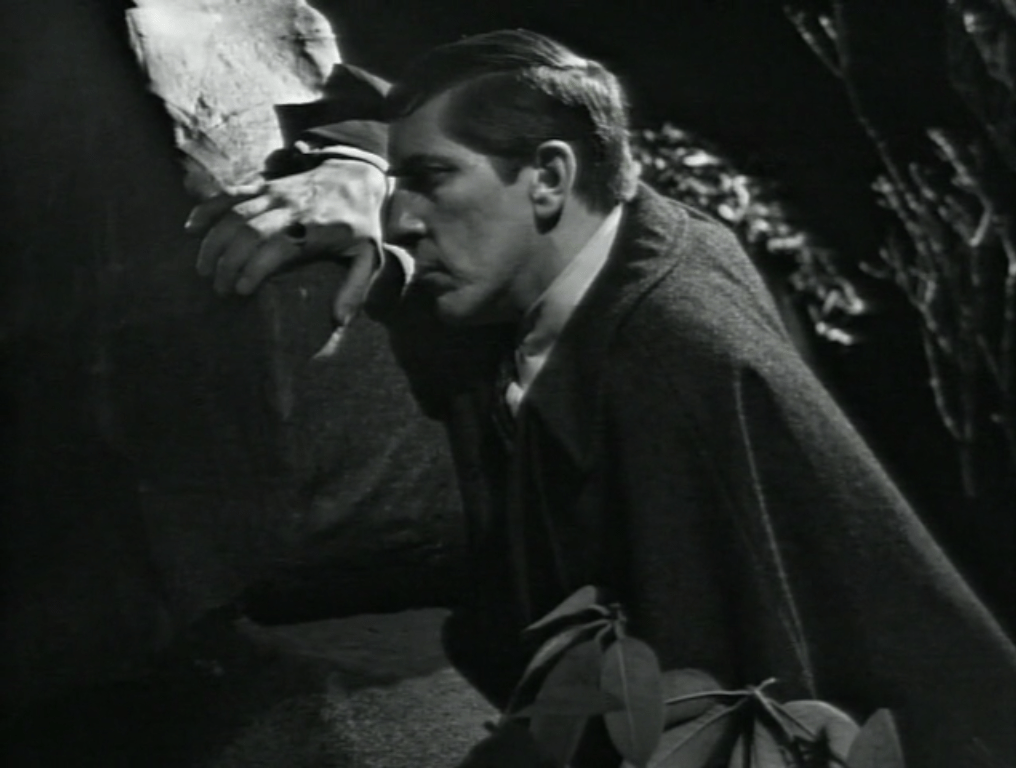
Episode 457: I will meet you

This is the first episode of Dark Shadows credited to a director other than Lela Swift or John Sedwick. It is also the first production of any kind directed by Dan Curtis, the series’ creator and executive producer. Curtis’ inexperience shows at several moments when the camera is in an awkward spot or the actors are unsure what to do, and in his post about the episode on Dark Shadows Every Day Danny Horn documents several of the more egregious examples with screenshots and detailed analysis. The impossible deadlines and tiny budget on which Dark Shadows was produced meant that even Swift and Sedwick, who were seasoned professionals and ambitious visual artists, sometimes had to turn in work that wasn’t much better than what first-timer Curtis manages today, and longtime viewers of the show will take even his worst stumbles in stride.

At the top of the episode, it is daytime, and much put-upon servant Ben Stokes (Thayer David) finds the lady of the house, Naomi Collins (Joan Bennett,) standing at an open coffin that holds the corpse of her son, Barnabas. Ben knows that Barnabas is a vampire who will rise at night to prey upon the living. Naomi has never heard of vampires. All she knows is that Barnabas is dead, and that his coffin has been moved from the family mausoleum to a room atop a tower in the mansion. Ben pleads with her to leave the room and to go with him back to the main part of the house.

Naomi questions Ben. Ben tells her that Barnabas has a “sleeping sickness,” and has been in a coma ever since the night he apparently died. Ben does not like to lie to Naomi, but her husband, haughty overlord Joshua, has judged that the truth would kill her, and Ben is governed by that assessment. He does tell her that the “sleeping sickness” is a symptom of a curse, that the wicked witch who placed the curse was Barnabas’ sometime wife Angelique, and that Joshua is in Boston trying to find someone who knows how to lift it.

Ben asks Naomi how she came to be in the tower room. She tells him that naval officer/ sleazy operator Nathan Forbes told her that Barnabas was being kept there, and also that Barnabas was responsible for the series of murders that had recently taken place in the town of Collinsport. At that, Ben vows to kill Nathan. To his chagrin, Naomi forbids him to do this.
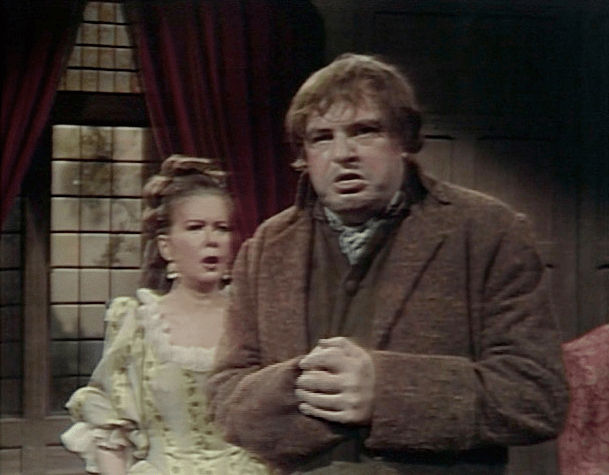
Naomi forbids Ben to kill Nathan. Screenshot by Dark Shadows Before I Die.

In the part of Dark Shadows set between August and December of 1966, Bennett played reclusive matriarch Elizabeth Collins Stoddard and David played her fanatically devoted handyman Matthew Morgan. When well-meaning governess Vicki came unstuck in time and arrived in the late 1790s, she at first mistook Naomi for Liz and Ben for Matthew. This scene takes longtime viewers back to the days when Matthew was always on the lookout for someone who represented a threat to Liz’ interests and she was always sternly prohibiting him from murdering anyone for her sake.

Ben is a far saner man than Matthew ever was; the contrast between them shows the effect that growing up in Collinsport, a town suffering from the consequences of a curse that has been working its way for many generations, has had on Matthew’s personality. While Ben is a brave, kind-hearted fellow whose fierce loyalties sometimes overpower his good sense, Matthew is a paranoid ogre who kills Liz’ friend Bill Malloy and tries to kill Vicki. It isn’t just one family that will be warped by Angelique’s curse. It will breed monsters everywhere the Collinses’ influence prevails.

Naomi then turns her attention to the B-plot. Nathan has married fluttery heiress Millicent Collins, only to find that Millicent has signed her share of the Collins fortune over to her little brother Daniel. Nathan responded to that news by crafting a plot to murder Daniel. His first attempt failed when Noah Gifford, the henchman he hired to abduct Daniel and drown him, fell afoul of Vicki. Vicki found Noah strangling Daniel near the place where she was hiding, having escaped from gaol, and shot him to death. After that, Daniel and Vicki went back to the mansion and told Naomi what they knew. Naomi recognized Daniel’s description of his attacker as a man she had seen with Nathan earlier, and realizes that Nathan is trying to murder the boy. So she orders Ben to take Daniel into town to stay with the Rev’d Mr Bland, a clergyman who looks like a duck.

Naomi confronts Nathan, who keeps telling her that whatever Barnabas might look like during the day, he gets up at night and goes out to murder people. She tries to shut him up, but later she is still wondering whether she should go back to the tower room after dark to check his story out.

She sees Millicent standing in the foyer, staring at the portrait of Barnabas that hangs there. The portrait of Barnabas first appeared under the closing credits in #204, and from #205 on it figured as a means through which Barnabas could communicate with the living. Barnabas bit Millicent the other day, and she hears him summoning her.

Among the 1960s characters who receive their commands from the vampire while staring at the portrait is Liz’ daughter Carolyn, who like Millicent is played by Nancy Barrett. Millicent at times evoked an early version of Carolyn. Until the spring of 1967, Carolyn was tempestuous and irresponsible, sometimes friendly to point-of-view character Vicki, sometimes hostile to her. Millicent is as timid and overly dependent as that version of Carolyn was headstrong and self-centered. One way or another, each is a Spoiled Heiress, and evidently that’s a favorite meal of Barnabas’.

Naomi follows Millicent to the gazebo on the grounds of the estate. There, she sees Barnabas. She is stunned that the son whose corpse she was looking at just a few hours before is up and moving. He bites Millicent, and Naomi lets out a scream. Barnabas looks up, and realizes that his mother has caught him in the act.

The vampire’s bite affects each victim differently. The first victim we saw was Willie Loomis, whom Barnabas’ bite transformed from a dangerously unstable ruffian to a sorely bedraggled blood thrall. Willie was at first gravely ill, then ran to Barnabas like an addict desperate for a fix, and eventually settled into life as a sorrowful servant who could not run away from Barnabas but could resist him to the point where Barnabas occasionally found it necessary to keep him in line with beatings.

The second victim we saw was Maggie Evans, The Nicest Girl in Town. She reacted very much like the first victim in the 1790s segment, gracious lady Josette, who, like Maggie, was played by Kathryn Leigh Scott. At first, those two were alternately blissful and snappish, happy to be under Barnabas’ power and defensive with anyone who might interfere with it. But each recoiled from him by the time it became clear he planned to kill her and make her into a vampire herself. Each escaped from him to the shore below Widow’s Hill- Maggie by running through an underground tunnel that rose to the shoreline, Josette by flinging herself to her death from the top of the cliff.

Later, Barnabas bit Carolyn. She initially contemplated his most gruesome crimes with pure glee and showed great energy as his protector and enforcer. Soon her conscience reappeared, but she was still doing his dirty work faithfully when Vicki disappeared into the past.

Millicent differs from all those others in that she simply continues to go about her business in between Barnabas’ meal-times. Granted, she was already deeply disturbed by that point, so that her business was conducted mostly in show-stopping mad scenes. But it’s still odd that she can talk to Nathan as if their marriage were the main thing in her life.

When we finished watching this one, my wife, Mrs Acilius, wondered if these differences were simply the result of the victims’ personalities coming through or if the vampire can pick and choose how to apply the pressure. He wanted Willie as a slave, and the reaction he produced gave him that. He wanted to turn Maggie into a reincarnation of Josette, and wound up getting the same reaction from Maggie that he had got from Josette. He bit Carolyn in a moment of desperation, with no plan in mind, and her reaction is complicated and volatile. He bit Millicent to keep her quiet, and her reaction is remarkably inconspicuous. Maybe we’re just supposed to think that Barnabas is fabulously lucky, but there is an opening there to tell a story about how him deciding what he wants to do to a person when he sucks their blood.

Episode 335: The imaginary Barnabas

Gordon Russell’s script contains an interesting scene. A psychiatrist brought in to examine strange and troubled boy David Collins gives a little speech attributing David’s fear of his cousin Barnabas to various unresolved traumas he has recently experienced. This speech sounds very plausible to the adults who listen to it, and might go some way towards explaining the appeal of Dark Shadows to its audience. But we know that David’s fears are entirely rational and that Barnabas really is a vampire. When the psychiatrist mentions that Barnabas had fangs in one of David’s dreams, family doctor Dave Woodard catches up with us and realizes that Barnabas really does have fangs and that he used them to inflict bite marks on some of his patients.

Episode 335 of Dark Shadows was a scab job done during the October 1967 National Association of Broadcast Employees and Technicians strike. In March of that year, at a time when Dark Shadows was at rock bottom in the ratings, the actors stayed out in support of the announcers and newscasters when they went on strike, and the show survived even though it went dark by the time the strike ended. Now, the vampire story is pulling in more viewers every week, making it a valuable property to ABC. But it is at this time that executive producer Dan Curtis told the cast that he would pay their union fines if they crossed the NABET picket line, and most of them did, with network executives and their stooges handling the equipment.

Sad to say, only two cast members did the right thing by the technicians. Robert Gerringer, who played Woodard, was one of those. Even if he had been a good actor, the scab stealing food from the mouths of Robert Gerringer’s children wouldn’t have been able to deliver on the moment when Woodard figures out that Barnabas is a vampire- we need Gerringer for that. He is the person we’ve grown used to seeing in the part, and his self-consciously soap operatic style of acting sets him apart from the rest of the cast and highlights the weirdness of this story playing out on a daytime serial in 1967.

But the scab isn’t a good actor. His most memorable moment comes when Joan Bennett, as matriarch Liz, bobbles a line, and he corrects her. She flashes a look of anger, but what does she expect? What she is doing is no better than what he is- if anything, it’s worse, because she was a big star and could have called a halt to the whole filthy disgrace if she’d lived up to her obligations as a member of AFTRA.

I’m writing this in September 2023, month three of the SAG-AFTRA actors’ strike and month five of the Writer’s Guild of America strike, so I’m even angrier about the whole thing than I usually would be. But I always find it hard to watch material produced under these conditions.

The character of Maggie Evans wasn’t in any of the episodes produced during the strike, so Kathryn Leigh Scott wasn’t involved in breaking it. She is walking a picket line today, and in her column she wrote about the particular issues at stake in the 2023 strikes. Different matters hung in the balance in 1967, but it’s always true that we live in a society, for the love of God, and if working people don’t stick together they don’t have anything.

Two actors who were too young to know better. Screenshot by Dark Shadows Before I Die.

Episode 304: Strange vibrations

Yesterday, fake Shemp Burke Devlin tested his hypothesis that old world gentleman Barnabas Collins abducted Maggie Evens, The Nicest Girl in Town, and held her prisoner during the period covered by her current amnesia. On the one hand, he found that Maggie was perfectly relaxed when Barnabas visited her recently, and that she regards him only as a mildly pleasant acquaintance. There would seem to be no way she could have this reaction to someone who had subjected her to such an ordeal. On the other hand, he found that a melody she seems to remember hearing during her captivity might have come from a music box that was in Barnabas’ possession at the time. Since he has also found that the only person Barnabas will admit to having known before his arrival in the town of Collinsport lived over 130 years ago, he seems to be willing to consider that the resolution to this paradox might require a supernatural element.

Since we know that Barnabas is a vampire and have been frustrated with Burke’s recent angry denials of the existence of supernatural phenomena he previously knew all about, that episode felt like a breakthrough. Lately Barnabas has been harmless and all the non-villain characters have been clueless, leaving the show adrift. Maybe Burke will restart the vampire story. Maybe he will again become the dashing action hero he was when the charismatic Mitch Ryan played him in the first year of Dark Shadows, and maybe his investigation will precipitate a crisis that will bring the Barnabas arc to an exciting climax.

That hope shrivels to nothing in the first minutes of today’s outing. We begin with Burke knocking on the door of Barnabas’ house. When sorely bedraggled blood thrall Willie Loomis tells Burke that Barnabas isn’t in, Burke says that he knows he is. Willie asks why he thinks he knows this, and Burke says that he’s been hiding behind a tree for hours staring at the front door. Burke is supposed to be a rich guy- it would be one thing if he’d hired private detectives to hide behind trees, but that he chose to spend his time doing that himself makes him look ridiculous. He pushes past Willie and declares that he won’t let Willie keep him out of the house. So before the opening titles roll, we’ve seen Burke as an unstable man who alternately cowers in the dark and perpetrates home invasions.

After Burke shouts Barnabas’ name a couple of times, he tells Willie he knows Barnabas is there because he never saw him come out of the front door. Willie says he might have gone out the back door. Burke’s response to that is “Maybe.” With that, Burke blows his last shred of credibility as an action hero. He presses Willie with some questions about Barnabas’ business interests; usually when characters ask about that, I think a suitable send-off for Burke would be a story where Barnabas bites him, enslaves him, and uses his money and connections to put some substance behind his pretense to be an independently wealthy cousin from the Collins family’s long-lost English branch. But when we see Burke being such a total schmuck as he is in this sequence, it’s hard to imagine he could be of any use to anyone, or to care very much how they go about writing him off the show.

That “Maybe” is such a preposterous anticlimax that I wonder if it is a sign of some politics behind the scenes. Long after the show was made, writer Malcolm Marmorstein remembered executive producer Dan Curtis wanting to end the vampire storyline around this time and to give the show over to an arc about Burke and well-meaning governess Vicki getting married and moving into a long-vacant “house by the sea.” There have been a few vague stabs at getting such a story off the ground- Burke and Vicki are engaged now, and he is in the process of buying such a house. But the vampire story was so much the biggest ratings draw the show has had that it is hard to imagine Curtis really wanted to scrap it- more likely he wanted to have more than one story going at a time, as soap operas usually do. In any case, the “house by the sea” bits have been so dull that it feels like the writers are simply refusing to develop the theme, and Ron Sproat’s script today could hardly fail to do lasting damage to Burke. So perhaps there is a sneaky kind of revolt in progress.

Meanwhile, visiting mad scientist Julia Hoffman and strange and troubled boy David Collins have left the great house of Collinwood to take a walk in the woods. They are looking for David’s friend, the ghost of nine year old Sarah Collins. Sarah leaves belongings of hers as tokens of her presence; these objects linger in physical existence until she reclaims them, after which they vanish when she vanishes. Some Dark Shadows fans put a lot of energy into saying that this aspect of Sarah “doesn’t make any sense!” To which I reply, she’s a ghost. All you can expect is that the story will tell you what the rules are and will follow them consistently. Not only does Sarah follow this rule consistently, but the ghosts of Bill Malloy and of Josette Collins had both previously left things lying around the house for people to find. Most recently, Sarah left her bonnet in the house, and now David and Julia are on a quest to return it to her.

David takes Julia to a clearing in the woods where he has encountered Sarah before. We hear “London Bridge” on the soundtrack, the musical cue telling us that Sarah is present, but she does not appear. David and Julia look around and don’t see her. David thinks he hears someone nearby to their left. They look that way, but don’t see anyone. They turn back, and find that the bonnet is gone.

This little scene captures some of the feeling of live theater that gave the early episodes of Dark Shadows such a special quality. I particularly like the low camera angle on David and Julia, as if we are looking up at a stage.

Later, Julia goes to Barnabas’ house. She and Willie talk about Burke’s visit. Julia muses about the need to provide Barnabas a more complete cover story to keep Burke at bay. This is the first staff meeting we see between Julia and Willie. Until this scene, the only conversations we’ve seen between two people who knew that Barnabas was a vampire were between Willie and Maggie during her captivity, and only a sharply limited number of things could happen during those conversations. Willie would tell Maggie to submit to Barnabas, either sorrowfully or angrily. Maggie would either express defiance openly, pretend to be cooperative, or give nonresponsive answers that suggested she was losing her mind. Combine those attitudes, and you have six possible interactions. Sometimes the characters would change attitudes in mid-scene, multiplying the number of possible interactions, but no matter how you mix and match you still end with Maggie in the same fix she was in at the beginning. But when both characters have some measure of personal autonomy and both are invested in helping Barnabas keep his secret, the number of possible interactions is very large and the number of possible outcomes is infinite. So this is an exciting scene.

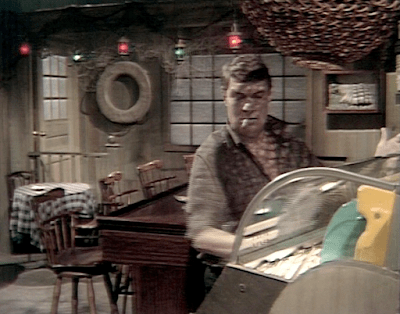
We end in The Blue Whale tavern, where Burke asks Vicki to stay away from Barnabas for reasons he refuses to explain. The only interesting thing about this scene is that Bob O’Connell does not appear in the background as Bob the Bartender. Some other uncredited extra is pouring today. 

Mystery man. Screenshot by Dark Shadows Before I Die.

Episode 261: Nine, ten, home again

Maggie Evans, The Nicest Girl in Town, has solved a riddle posed by the ghost of nine year old Sarah Collins. The solution led Maggie to a secret panel through which she has escaped from the cell in which she has been imprisoned by Sarah’s big brother, vampire Barnabas Collins. Barnabas is chasing Maggie through the corridors on the other side of the panel.

Maggie has reached two doors, both of which appear to be locked. The other day, Sarah had visited Maggie in the cell and played “London Bridge” on her recorder. Maggie hears a few notes of that same tune, and one of the doors opens. She runs through the door, closing it behind her. She finds herself in another maze of corridors. She hears the music again, and follows it to a stairway. A moment later, we cut to Barnabas going through the other door and heading in Maggie’s direction.

Maggie finds herself on the beach. She staggers about and collapses. Apparently her escape took more strength than she had left after her long imprisonment. Barnabas makes his way to the beach and stands over Maggie, declaring that he has defeated her. She screams.

Maggie’s father, Sam Evans, is on the beach. Sarah had visited him at home and told him he might find Maggie if he went there that night. Sam hears Maggie’s scream and calls out. Barnabas retreats while Sam runs to Maggie.

Barnabas hides behind a rock and stares hard at Maggie. When he first sucked Maggie’s blood, Barnabas gained great power over her mind. She has shaken free from that to the point where she can try to kill him and run away from him, but maybe he still thinks he can put some kind of zap on her.

Evil eye

In the hospital, Sam, addled quack Dr Woodard, and Maggie’s boyfriend Joe discover that Maggie has amnesia and thinks she’s ten years old. She greets Sam as “Papa,” a title Sam says she hasn’t used in “a long time.” She did call him that in #200, but that was an ultra-dramatic moment, so maybe he means it has been a long time since she used it when she was calm and cheerful. Sam tells Woodard about Sarah. Maggie reacts to Sarah’s name, which is surprising since Sarah never gave it to her. Maggie has Sarah’s doll, which the men find puzzling but don’t ask her about.

Woodard has an idea. The three of them will tell everyone that Maggie is dead, and she will go to Windcliff, a nursing home a hundred miles north of town, which would put it someplace near Mount Katahdin. There, she will be in the hands of Dr Woodard’s colleague Julia Hoffman.

After Sam and Joe have agreed to this, we see Barnabas enter the hospital. A clock prominently featured on the wall shows that it is 3:30 AM. Barnabas asks to see Maggie. Dr Woodard asks him how he knew she was in the hospital. He claims that he has heard a rumor to that effect from everyone in town. Woodard says he isn’t surprised. Collinsport must be rather an odd place if everyone is up and exchanging rumors at that hour.

Woodard tells Barnabas that Maggie is dead. She never recovered consciousness, so she wasn’t able to tell anyone what happened to her. Barnabas manages to keep from smiling until after he turns his face away from the doctor.

Barnabas’ obvious relief when Woodard tells him that Maggie is dead makes an interesting contrast with the shot of him behind the rock on the beach. Maggie’s amnesia is such a stark change from her mental state in the last couple of weeks that it seems Barnabas must have made a successful attempt to project psychic power against her. But those transmissions go in only one direction- he can’t sense that Maggie is still alive.

This is the first time we hear the name “Julia Hoffman.” Woodard first mentioned Dr Hoffman in #242, when she was a blood specialist and a man. Julia still has expert knowledge about blood, but is now primarily a psychiatrist.

There is a legend among fans of Dark Shadows that Julia transitioned from male to female as the result of a typographical error. Ron Sproat is supposed to have put the name “Julian Hoffman” in the script, but a typist left the “n” off the end of the first name. Executive Producer Dan Curtis liked the idea of a female Dr Hoffman, and they ran with it.

The Dark Shadows wiki explains that the evidence does not support this charming tale. Various members of cast and production staff told various stories over the years to explain the switch, and no surviving paperwork can settle the question for us. It certainly is true that the storylines sometimes took wild U-turns based on last-minute decisions by Curtis and others, and some of those decisions were so whimsical that they may as well have been based on typographical errors. But it is also true that we’ve never heard the name “Julian,” and the near-rhyme of “Julian Hoffman” would be the first awkward-sounding name on Dark Shadows. Further, Woodard stopped mentioning Hoffman weeks ago, likely before ABC had decided to renew the show beyond #260.

If they are going to make another 13 weeks of Dark Shadows, they are going to need new characters and new storylines. They must have responded to the renewal with some story conferences during which the producers, the writing staff, and others tried to flesh out some possibilities.

The writers appear to have decided there would be a secret passage from the Old House to the beach by #238, when well-meaning governess Vicki mentions that the Old House is very close to the sea. That was a retcon that would startle viewers who remembered previous episodes that suggested it was deep in the woods. But it wasn’t clear then that Maggie would be the one escaping by that passage. She was ranging freely through the house at that point, and wasn’t locked up in the cell until #251. Until that point, it was possible Maggie would become a vampire and be destroyed like Lucy in Dracula, leaving Vicki to be the Final Girl who escapes from Barnabas’ clutches and defeats him.

Months ago, they brought parapsychologist Dr Peter Guthrie on the show to help fight undead fire witch Laura Murdoch Collins. In #183 and #184, Guthrie offered to help Laura if she would renounce evil and participate in his research. That suggested the possibility that a complex relationship might arise between the male visiting expert and the undead female menace. Laura was a one-shot monster, on a mission to burn her son David to death and bound to vanish after the attempt, and so could not stay on the show indefinitely. She could respond to Guthrie’s offer only by killing him the night after he made it. But now an undead male menace is here for the duration, so a female visiting expert might be able to pick up the marker Guthrie laid down.

There are a lot of jokes in Dark Shadows fandom about Julia’s two specialties. Psychiatry and hematology don’t usually go hand in hand. I’ve dreamed up a little fanfic that satisfies me about this. I shared it in a comment on Danny Horn’s Dark Shadows Every Day:

The story I made up for myself is that Julia started out as a blood specialist but switched to psychiatry. She was interested in rare diseases, the rarer the better. She found that in hematology, there’s so much money to be made from developing treatments for the most widespread disorders that a researcher with an emphasis in the exotic is constantly fighting an uphill battle for funding and recognition.* Even those colleagues who had an abstract appreciation of the importance of studying rare disorders had to work within a system where all the institutions push them towards the biggest projects possible.

Psychiatry, on the other hand, always had room for the unusual.** In fact, Julia discovered that high-strung rich people would pay a great deal of money to be told that whatever happens to be bothering them at the moment is not the same kind of problem that one of their servants might have, but is a mental aberration hitherto unattested in the annals of psychiatry.*** So she switched to that field and quickly made enough money to open her own, hugely profitable, mental hospital. But she never stopped working in rare blood diseases, and the experiments she was able to finance by flattering the vanity of her wealthier patients earned her such a reputation in a male-dominated field that even her old acquaintance Dave Woodard would commit sexist slips of the tongue and say of “Hoffman” that “he” is “the top man in the field” of rare blood diseases.

Lucrative as Windcliff was, Julia’s true love was never money, or even science per se, but the exotic. When she found herself as the best friend/ frequent accomplice/ bossy big sister of an honest-to-wickedness vampire, surrounded by ghosts and witches and werewolves and Frankensteins and time travelers and interdimensional anomalies and who knows what else, there was never any question of her going back to the office.

*I have no reason to believe this was true in the real world in the middle decades of the twentieth century, or that it is true today. It’s simply part of the fictional world in which I see Julia.
**(Same note)
***(Same note)

“Acilius,” comment left 23 January 2021 on “Episode 1042: Still Another Murderer,” Dark Shadows Every Day, Danny Horn, 2 July 2017

Episode 84: Ten hundred years

In the great house of Collinwood, strange and troubled boy David Collins tricks his well-meaning governess, Vicki, into a room where he locks her up. Hardworking young fisherman Joe comes to the house to tell his sometime girlfriend, flighty heiress Carolyn, that he can’t spend the evening with her because he has a date with someone else.

I suppose this is one of writer Art Wallace’s diptych episodes, in which the contrast between a pair of intercut scenes tells us more about the characters than we would gather watching either scene straight through. Most such episodes are powerful and engrossing. Unfortunately, both of today’s topics are deadly dull. The pointlessness of the one multiplies the tedium of the other.

Joe and Carolyn’s relationship has never been interesting for one second. Their scenes are divided between Carolyn’s flagrant displays of contempt for Joe, quarrels that begin when Joe objects to those displays, and the occasional conversation about how the two of them don’t have a future. Today’s conversation between them is a break-up scene. An actual breakup would be welcome, but they’ve raised our hopes that way before. Since the only emotion Carolyn and Joe have managed to arouse in the audience is impatience, we don’t have any of the mixed feelings that could make the scene poignant or exciting.

The contrast at the hinge of the diptych is between, on the one hand, David taunting the suddenly brainless Vicki with the prospect that she will be in her prison for the rest of her life and, on the other, Carolyn dismissing the suddenly self-assertive Joe with the prospect that they will never see each other again. Joe’s uncharacteristic strength is more appealing, and better grounded in what we’ve seen so far, than is the uncharacteristic stupidity that led Vicki into David’s trap. But even if the breakup is the real thing this time, it’s hard to feel much relief when we know that we’re going to be locked up and miserable with Vicki.

There is some trivia in this one that will appeal to confirmed fans of Dark Shadows. It’s the first time we go inside the west wing; we get a look at a corridor and at the room where Vicki will be confined. Vicki and David talk about the long, twisting way they have taken, suggesting that it is a very large place. Much larger than reclusive matriarch Liz suggested in episode 2, when she told Vicki that the whole house, including the closed-off portions, has a total of 40 rooms.

Also, Vicki mentions that the west wing has been closed for 50 years. David picks up on “50 years” in a story he tells to frighten Vicki, ensuring that it will stick in the audience’s mind. Yet Liz, who is supposed to be in her 40s, has a conversation with her daughter Carolyn in which she remembers a time when far “fewer rooms were closed off.” That suggests that there is not only a locked-up west wing, but perhaps an east wing as well. That won’t be confirmed for four years, but it is implicit here.

Reminiscing about the way the house used to be, Liz says “There’s nothing in those rooms now but ghosts and memories.” In fact, the rooms in the west wing, like the abandoned Old House and the basement, are stuffed to bursting, not only with antique furniture, books, trunks, vases, paintings, rugs, and other things that could be sold at a high enough price to finance a considerable amount of work on the house, but also with old newspapers, tattered clothing, helpless governesses, and other unsaleable items that should not be kept in storage. For his part, David tells us that the west wing is full of mice, and we see so many cobwebs that the air quality in the occupied parts of the house must be severely affected by its dust. The Collinses really ought to empty their disused spaces and hire a couple to keep them clean.

No abandoned corridor would be complete without a full-sized metal candelabra in front of a porcelain vase resting on a dedicated stand

Apparently executive producer Dan Curtis insisted as a point of visual style that abandoned buildings be shown crammed with stuff. Today, that means that Vicki’s failure to pick up any of the blunt objects surrounding her and start beating the door down makes her look like an even bigger idiot than she already does for falling into the trap in the first place. The window is too high for her to reach, but with so much furniture and so many other objects in the room it would be no trick for her to stack something up she could climb on. After all, animal behaviorists give intelligence tests in which they get baboons to pile one thing on top of another so that they can reach a piece of fruit dangling from the ceiling. Too bad Vicki doesn’t have a baboon with her to give her some guidance.

In the room

Episode 1066: This Is How We Do It

In which I wonder what it might have been like if Dan Curtis had had his way and Bert Convy, rather than Jonathan Frid, had played Barnabas Collins. I then try to imagine Jonathan Frid in Convy’s place as host of Tattletales. 

Episode 1066: This Is How We Do It