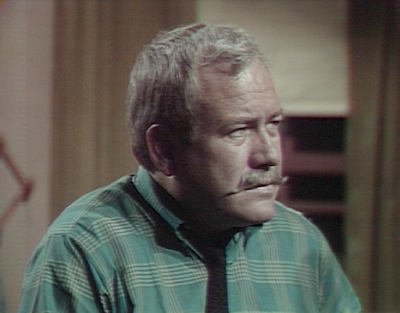
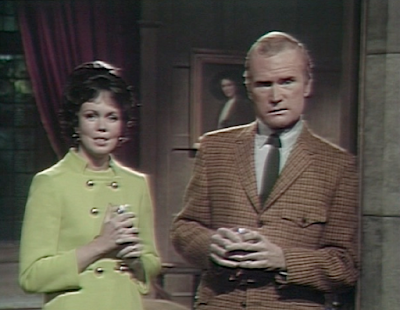
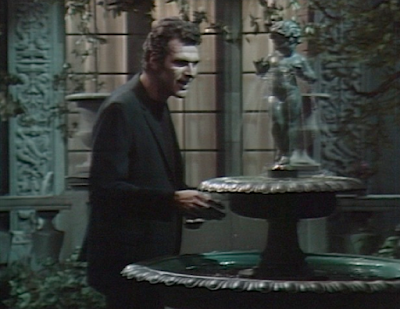
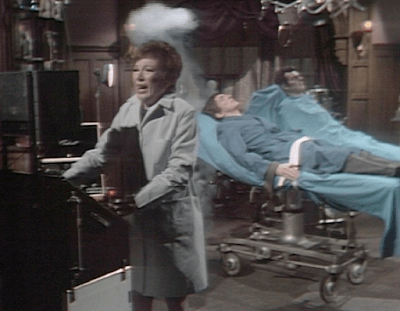
In his laboratory, mad scientist Eric Lang tries to persuade his patient, recovering vampire Barnabas Collins, to let him drain his “life force” into the body of a Frankenstein’s monster he is creating. Barnabas worries that once in the new body, he might be as helpless as a newborn. Lang assures Barnabas that he will not be helpless at all, but “a mature and intelligent man.” Lang also tells Barnabas that he can decide what the creature’s face will look like. Since Lang is building the creature from parts of corpses, this sounds like an offer to kill the person of Barnabas’ choice and sew that person’s face on the front of the creature’s head. One wonders what a phrase like “mature and intelligent man” signifies to either of these two.
In the gazebo on the grounds of the great estate of Collinwood, Barnabas seeks a second opinion from another mad scientist, Julia Hoffman. Having pledged to keep Lang’s secret, he will not describe the particulars of the experiment to Julia. He wants her to tell him whether Lang has a reputation for trustworthiness. Considering the circumstances, a reputation for maniacal sadism might be a better recommendation. Julia is unhappy about the whole situation. She confirms that Lang is a gifted surgeon, but urges Barnabas not to involve himself any more deeply with him.
Barnabas and Julia scurry off and hide when another pair come to the gazebo. They are well-meaning governess Vicki and her sometime boyfriend Peter. Vicki met Peter when she was visiting the late eighteenth century. By the end of her sojourn in the past, Vicki was on the gallows, about to hang for her many crimes. She was returned to 1968 with so little time to spare that there were rope burns on her neck. On the night scheduled for Vicki’s execution, Peter, himself awaiting hanging, vowed that he too would transcend time and would come to her in 1968.
Peter has kept that promise, but now he has amnesia and goes around shouting that his name is Jeff. Lang took Peter/ Jeff out of an institution for the criminally insane and is blackmailing him into digging up fresh corpses. After Barnabas left the lab, we saw Lang and Peter/ Jeff in the graveyard arguing about this situation. Lang tells Peter/ Jeff he was found on the waterfront at Portsmouth, New Hampshire, with a rope in his pocket that matched the marks on the necks of two women who had been strangled nearby. The reference to rope reminded my wife, Mrs Acilius, of Vicki’s rope burns; were Peter/ Jeff to tell Vicki that he was found with rope, doubtless it would add to the already abundant evidence she has that Peter and Jeff are one and the same.
Peter/ Jeff’s waterfront murders may remind us of someone else. When he first became a vampire, Barnabas used to go to the docks and bite prostitutes. When he was done sucking their blood, he would strangle them, perhaps to prevent them rising as vampires themselves. Vicki is fascinated with Barnabas and has thrown herself at him several times in the year they have known each other. So if Peter/ Jeff did indeed use the rope he salvaged from his own hanging to commit the murders Lang describes, he’d be just Vicki’s type.
Peter and Vicki have a sweet little conversation, at the end of which they kiss. Barnabas sees this, and goes back to Lang’s lab. He tells him that he has decided to go through with the experiment, and that he wants a face like Peter/ Jeff’s. Lang says he will do better- he will give him Peter/ Jeff’s actual face. The two smile at each other over this explicit promise to murder Peter/ Jeff.
Barnabas’ attitude towards Vicki is ambivalent. His enthusiasm for killing her boyfriend is one of many things you might interpret as a sign of desire for her, but time and again he has made it clear he is not attracted to Vicki physically, and lately he can barely bring himself to listen to her talk for more than a few seconds at a time. Last Wednesday he claimed to be disappointed that she was unwilling to marry him, then rejected every action that makes up a marriage as he kept turning away from her and putting objects in her way when she pressed herself towards him, confided in him, and showed that she could help with his most important project.
As a beautiful young woman who has made herself available to Barnabas, Vicki seems to represent something that might have been, a life he might have lived had things gone differently. Even though he may not want to live that life now, and certainly does not want to live it with her, he cannot quite let go of her as a symbol of possibility. In his imagination, she is as unfinished and undetermined as is the partially fabricated body Lang is showing him. It is when Vicki displays her fully developed personality that he disengages from her. If, at the end of Lang’s project, Barnabas really is a mature and intelligent man, it will make quite a change.
Recovering vampire Barnabas Collins receives a visitor in his home, Professor Timothy Eliot Stokes. Stokes agrees to lend Barnabas a twelfth century Sicilian talisman to ward off the power of a witch, and makes it clear he will not rest until he finds out why Barnabas needs it.
This scene is a tour de force for Thayer David as Stokes. I’ve already quoted Danny Horn’s remark in his post about it that David “plays to the balcony. Not this balcony, naturally; I mean the balcony in the theater next door.” David’s style works brilliantly in this context.
The rest of the episode is marred by some bad writing. When wicked witch Angelique, pretending her name is Cassandra, comes to call on Barnabas, he immediately calls her by her right name and tells her everything she could want to know in her campaign to restore his vampirism. This is a pattern of Barnabas’; he withholds information from people who would use it to help him, and blabs without inhibition to his deadliest enemies.
Barnabas takes the talisman to Dr Eric Lang, the mad scientist who has freed him of the symptoms of Angelique’s curse. Lang knows that Barnabas has been a vampire and knows that a curse made him one, but scoffs at the idea of witchcraft and refuses to touch the talisman. Jonathan Frid is a good enough actor that we can wonder if Barnabas has a reason for disclosing all his secrets to Angelique, but Addison Powell plays Lang so ineptly that there is nowhere to hide the fact that his skepticism makes no sense.
Angelique shows up in Lang’s office and casts a spell on him that is about to cause his heart to burst. He staggers to the desk, touches the talisman, and quickly recovers. He will not let her take it from him.
Barnabas comes back and asks Lang if he now believes that he must carry the talisman to protect himself from Angelique. He says he does not want to believe, and again walks off leaving the talisman on his desk.
Barnabas presses Lang for information on the final stage of the treatment that is supposed to end the curse once and for all. Lang takes him to the secret laboratory in his home. There, amid a lot of flashy equipment, is a partially assembled Frankenstein’s monster. Lang says that he will drain the “life-force” from Barnabas’ body and use it to animate the creature once it is completed. Barnabas’ old body will be dead, and Angelique will presumably believe that he no longer exists. But he will live in the new body.
Wicked witch Angelique (Lara Parker,) pretending to be named Cassandra, met sarcastic dandy Roger Collins (Louis Edmonds) one day and married him the next. Roger’s sister, matriarch Liz (Joan Bennett,) confronts Angelique/ Cassandra. Liz tells her that Roger has not been well and urges her to annul their marriage.
In the course of her confrontation with Liz, Angelique/ Cassandra reveals that she is not all-knowing. She thinks that Roger owns the great estate of Collinwood and the family’s business. Liz quickly explains that Roger owns nothing. He lives as a guest in her house and works as an employee of her company. Angelique/ Cassandra takes this in stride, and stands up to Liz’ insistence that the marriage must end. The only sign that Liz’ words are having an effect on anyone at all comes in the very last syllable of the scene. Unfortunately for Liz, it is not Angelique/ Cassandra who is intimidated by her, but Lara Parker who is intimidated by Joan Bennett. Angelique/ Cassandra’s mid-Atlantic accent vanishes and the purest musical note of Parker’s native Tennessee sounds as the word “you” emerges as “yeww.” If there had been another page or two of dialogue, she might have ended with a honeyed smile and a lethal “Bless your heart!”
From #395 to #461, Dark Shadows was a costume drama set in the late 1790s. In that segment, Angelique came to Collinwood as a servant girl and used her magical powers to manipulate scion Barnabas Collins (Jonathan Frid) into marrying her. Barnabas’ parents, Joshua (Louis Edmonds) and Naomi (Joan Bennett) were unhappy about the marriage. Joshua demanded that it be annulled, as Liz today demands Roger and Angelique/ Cassandra’s marriage be annulled. Naomi took a more conciliatory approach. Advocating Joshua’s position and but showing Naomi’s temperament, Liz combines two challenges Angelique has already shown herself able to overcome easily. Returning viewers will therefore have little hope that Liz will be able to stave off the disasters Angelique has in mind for the Collinses.
Angelique/ Cassandra is eager to get to work on the evil plans she has for the people at Collinwood, and so she is trying to stop Roger taking her on a honeymoon. She contrives to injure her ankle. We see permanent houseguest/ medical doctor/ mad scientist Julia Hoffman (Grayson Hall) in the bedroom Angelique/ Cassandra will be sharing with Roger, bandaging her ankle. Angelique/ Cassandra asks a series of questions about old world gentleman Barnabas Collins (Jonathan Frid,) making Julia visibly uncomfortable.
Barnabas is the same man Angelique married in the 1790s. He is here in 1968 because she turned him into a vampire then. He was relieved of the symptoms of vampirism only a couple of weeks ago. He and Julia are becoming fast friends, and on Tuesday he told her all about Angelique. He identified her as the woman in a portrait that has obsessed Roger, and expressed his belief that Roger’s obsession was a sign that Angelique herself was returning to Collinwood. Julia can see how strongly Cassandra resembles the portrait, and knows that Roger’s obsession led directly to his marrying her, so she really ought to have figured out by now that she is Angelique.
Like the scene between Angelique/ Cassandra and Liz, the scene between her and Julia makes an instructive comparison with the parts the same actresses played in the 1790s segment. Angelique was originally lady’s maid to the Countess DuPrés. We saw her helping the Countess put herself together in a bedroom that was a different dressing of the set on which Julia is now attending to her foot. This apparent reversal of roles illuminates the extent to which Angelique’s command of black magic always made her a mightier figure than her nominal mistress. As a mad scientist, Julia is far more formidable than was the countess, but this scene leaves us wondering if she will be able to stand up to Angelique for any longer than could her counterpart.
Well-meaning governess Vicki (Alexandra Moltke Isles) had traveled back in time and was at Collinwood through the 1790s segment. She recognizes Angelique, knows well how dangerous she is, and is desperate to stop her. She tries to tell Liz about the situation, but Liz has a very limited tolerance for information about the supernatural. Vicki later meets Julia at the gazebo on the grounds of the estate and shares her information with her. Julia knows as much as anyone about the strange goings-on, and what Vicki tells her confirms what she already has reason to suspect. However, Julia pretends to have trouble believing Vicki.
This pretense enables Julia to probe the limits of Vicki’s own knowledge. Barnabas and Julia do not want Vicki to know any of Barnabas’ secrets. Julia incredulously asks Vicki if she thinks the Barnabas Collins of 1968 is the same person she knew in the eighteenth century. Vicki turns away from Julia, looks troubled, and says that she does not believe this. Vicki has encountered plenty of evidence to that effect, not least when Barnabas bit her and sucked her blood, and the audience wonders what she knows. We see Julia studying her, trying to find the answer to the same question. In the first year of Dark Shadows, Vicki represented the audience’s point of view, the resolutely normal outsider getting to know the Collinwood crazies. In this moment, we see Vicki through Julia’s eyes. We identify, not with any sane person from the world of sunlight and natural laws, but with a mad scientist who has cast her lot with a vampire.
Vicki thinking about Barnabas, with a facial expression straight out of MAD magazine. Screenshot by Dark Shadows Before I Die.
Angelique/ Cassandra and Roger chat in their bedroom. He seems utterly delighted to be married to her, until she slips something into his drink. Suddenly he starts having doubts. Nothing we have seen leads us to expect she would want him to feel this way. The scene leaves us scratching our heads.
We end with Angelique/ Cassandra alone in the foyer of the great house, looking at the portrait of Barnabas that hangs there and vowing to restore the curse that had made him a vampire. We know that she is Angelique and that such is her goal, so her speech doesn’t set up any new story points.
It does give us some world-building information. Angelique says that the only way she knew that Barnabas was walking among the living in the 1960s was that Vicki had traveled back in time to the 1790s and told her. That explodes a theory some fans like that Angelique herself called Vicki back in time. When Vicki left the 1960s in #365, it was quite clear that the ghost of Barnabas’ little sister Sarah was sending her on the journey. Sarah has been fading steadily from our awareness, not least because child actress Sharon Smyth aged out of the part, and so it is not surprising that people expect a retcon to attribute the time travel story to a different force. But not only does Angelique rule herself out with this line, Sarah’s name comes up in the conversation between Julia and Vicki, reminding regular viewers of the original explanation.
More importantly, it confirms that once one person has made a wrong-way journey through time, a gate opens through which other unexpected things may come. To some extent we saw this when Barnabas himself was released from his coffin and Sarah’s ghost began showing up around the estate. The cosmological point will become extremely important for the rest of Dark Shadows, as one time-travel story keeps leading to another. Dark Shadows is often described as the story of the house, and so I can’t resist an inelegant metaphor from the building trades. It’s as if Vicki wrecked the plumbing of the universe when she went through the pipes backwards and then abruptly forward. Time will never flow the right way again.
Dark Shadows‘ first supernatural menace was undead blonde witch Laura Murdoch Collins, estranged wife of sarcastic dandy Roger. Laura was on the show from December 1966 to March of 1967. During that time, Laura tried to rebuild her relationship with her son by Roger, strange and troubled boy David. David’s well-meaning governess Vicki at first encouraged her charge to go to his mother, but eventually figured out that Laura posed a deadly threat to him. Vicki formed a coalition of characters to help her fight Laura, and eventually rescued David from his mother’s clutches at the last minute.
Now, Roger has come home to the great house of Collinwood after an unexplained absence that had Vicki, his sister Liz, and his distant cousin, old world gentleman Barnabas, terribly worried. Roger happily announces that he has taken a new wife, and presents her to the family.
As it turns out, Roger has a definite type. His new bride is also an undead blonde witch, though at the moment she is wearing a black wig that doubles as a physical representation of the concept “1968.” Her name is Angelique, although she pretends it is Cassandra.
Some critics say that the film 2001: A Space Odyssey would more aptly have been titled 1968: A Bad Year for Hats. As you can see, however, headwear in general was passing through a time of trial in that period. Screenshot by Dark Shadows Before I Die.
Vicki and Barnabas recognize Angelique immediately. Vicki came unstuck in time in #365, finding herself in the year 1795, and didn’t make it back to the 1960s until #461. During her nineteen weeks in the late 1790s, Vicki got to know the people who lived at Collinwood in those days, among them Barnabas and Angelique. She saw many horrible things happen to them, and only after being blamed for those catastrophes herself would she realize that they were the consequences of spells cast by Angelique. Due to Angelique’s curse, Barnabas would be a vampire from 1796 until the week after Vicki came back to 1968. Vicki has decided to believe that Barnabas is not the same person she knew in that period, but rather that he is the descendant of that Barnabas Collins. He does not want her to know that he ever was a vampire, and she has resolved not to know that either, even though he used to bite her on the neck and suck her blood.
The battle against Laura was a fairly exciting story, at least in its latter stages. Angelique is a far more dynamic adversary than Laura, and Dark Shadows is much faster-paced and better written than it was then, so a reprise of the structure of that conflict in this new setting would likely be very exciting indeed.
To wage such a battle, Vicki and Barnabas can have no secrets from each other. Many who have been with Dark Shadows from the beginning have been hoping that its original protagonist will eventually become aware of the principal storylines, and this is one of the obvious ways to do it. Vicki can learn that Barnabas was a vampire, can find out that he was the one responsible for all the terrible crimes committed against the women and men and cows of Collinsport in 1967, and can still align herself with him, because she needs his support against Angelique, a more urgent threat. By the time they have vanquished her, not only will the idea of handing Barnabas over to the authorities have lost its salience, but Vicki will doubtless be facing another urgent threat requiring Barnabas’ assistance.
Nothing we see today suggests that such a development is on the horizon. The episode began with Vicki, Barnabas, and Liz worrying about Roger. A couple of weeks ago, Vicki brought a portrait home from an antique store and it had bizarre effects on Roger. The other day, he took the portrait and disappeared.
We can tell that today is not going to be a win for the female characters when Barnabas reacts to Liz’ expression of concern by dismissing her from his presence and she leaves, even though he is in her house. Vicki can tell Barnabas knows more about the situation than she does, and each time he condescends to mete out a little information in response to one of her questions he ends by turning his back to her and explicitly refusing to share anything more.
When Liz first leaves him alone with Vicki, Barnabas sourly remarks “I try to remember… that I must not reproach you for the reasons you’ve given not to marry me.” As Danny Horn shows in a series of screenshots in his post on Dark Shadows Every Day, their body language does not at any point support the idea that Barnabas wants to be with Vicki and she does not want to be with him. Quite the contrary; he withdraws from her, turns from her, and puts physical objects as barriers before her, while she looks at him, follows him, and leans towards him.
This has been Barnabas and Vicki’s dynamic for a long time. By #285, she went so far as to invite herself to a sleepover at his house. Barnabas was a vampire then; he entered the bedroom while she slept and bared his fangs, but couldn’t bring himself to bite her. Time and again, Vicki would all but draw a circle on her neck with the words “Mr Vampire, Bite Here!,” and Barnabas would tremblingly open his mouth, then recoil at the last moment. In #462, he finally sampled her bloodstream. By the end of #466, Barnabas’ vampirism had gone into remission, and that little storyline had evaporated. Now Vicki is vague and confused about what happened between her and Barnabas, and he is afraid he will relapse and bite her again.
Vicki is trapped between two blank walls. On one side Barnabas is excluding her from his life and therefore from active participation in the A story. On the other, she keeps having scenes with her old boyfriend from the 1790s, an unpleasant man named Peter who keeps demanding, for no apparent reason, that she call him Jeff. That habit of his was dead on arrival as a story point, and now that Angelique will be trying our patience by insisting her name is Cassandra, it will become impossibly tedious to have a second character doing the same pointless schtick. As long as she is in this position, Vicki’s prospects for contributing interesting material to Dark Shadows belong to a very low order of probability.
Sarcastic dandy Roger, possessed by the spirit of wicked witch Angelique, visits mad scientist Dr Lang. The village of Collinsport was once a whaling center, and Lang is mindful enough of that long-ago history that he collects harpoons. Roger appears to be fascinated by Lang’s collection. He holds one of the finer pieces, admires it, fondles it, and tries to kill Lang with it. At the last moment, the murder is prevented by recovering vampire Barnabas and Julia, who is a scientist as mad as Lang but infinitely more interesting. As is typical of supernatural beings on Dark Shadows, Angelique projects her power through a portrait of herself; the portrait also has some adventures today.
There is a lot of great stuff in this one, as other bloggers have well explained. The 1960s were the heyday of Freudianism in the USA, and in the first year of the show the influence of that school of thought could often be traced in the scripts of Art Wallace and Francis Swann. Patrick McCray documents in his post on The Dark Shadows Daybook that this was an episode where writer Gordon Russell allowed himself to cut loose and have fun with the sillier side of the Freudian approach.
On his Dark Shadows Every Day, Danny Horn focuses on the scene where Barnabas and Julia decide to go and stop Roger. He points out that it is the first conversation they have had about something other than themselves, the first time Barnabas shares with Julia the secret of how he became a vampire, the first time they take heroic action, and the first time they are recognizably friends. It is that friendship that will drive the action of the show from now on.
In their meticulously detailed summary of the action of the episode on their Dark Shadows Before I Die, John and Christine Scoleri capture the effect on the audience of the steady accumulation of one absurdity upon another as the episode goes on. Reading their unfailingly matter-of-fact description of the ever-mounting lunacies we witness in this half-hour is almost as exhilarating as it was watching them in the first place.
Barnabas calls Julia’s attention to the closing cliffhanger. Screenshot by Dark Shadows Before I Die.
Much to her surprise, well-meaning governess Vicki Winters came unstuck in time in #365 and found herself in the year 1795. She spent the first few weeks of her sojourn in the past telling all the characters she met about the other roles that their actors played in the first 73 weeks of Dark Shadows, thereby puzzling them and irritating the audience. After a few months, the people of Collinsport had decided to try Vicki on a capital charge of witchcraft. There were no laws against witchcraft in Massachusetts or anywhere else in the English speaking world in the 1790s, but Vicki had got on so many people’s nerves by that point that they were willing to overlook that technicality and sentence her to hang. She was whisked back to 1968 in #461, with so little time to spare before she died on the gallows that she came back with rope burns on her neck.
Throughout the first year of Dark Shadows, the writers used Vicki more than any other character to move the action. Unfortunately, they sometimes moved it by having her do things that served the plot, but that the character had no reason to do. That gave rise to “Dumb Vicki,” and Dumb Vicki was very much on display throughout the whole segment set in 1795-1796.
Now, emigrés from the late eighteenth century are starting to join Vicki in her time. We open today as the clock chimes midnight. Vicki, wearing her nightgown, is coming down the grand staircase in the foyer of the great house of Collinwood, roused by the sound of an unexpected voice in the drawing room. It is the voice of haughty overlord Joshua Collins, master of Collinwood in 1795. Vicki enters the room to find sarcastic dandy Roger Collins carrying on a lively, albeit one-sided, conversation with a portrait. Roger is convinced that he is Joshua, and deals with Vicki in just the lofty way Joshua dealt with her during the costume drama segment. He even brings up Vicki’s frequent confusion with names, something Roger could not possibly have known about. This, therefore, is no mere delusion of Roger’s- Joshua’s ghost really is taking possession of him, manipulated by a force with its own malign intentions.
It is no secret from the audience what that force is. Roger has become obsessed with a portrait depicting wicked witch Angelique, who in the 1795 segment wrought terrible harm to the Collins family. Angelique was responsible, in one way or another, for the deaths of both of Joshua’s siblings, both of his children, his wife, and many other people. Too late, Vicki learned that Angelique was the witch for whose crimes she was being condemned to hang. As we have seen other supernatural beings do on Dark Shadows before, Angelique is using her portrait as a means of projecting her powers into the world of the living.
Roger/ Joshua’s remark about the name trouble reminds us of Dumb Vicki, but that is not the version of the character we see today. Instead, we have a visit from Smart Vicki. When Roger keeps insisting that he is Joshua Collins, Vicki picks up a telephone and shows it to him, declaring that it is something that did not exist in Joshua’s time. Roger looks at the receiver in silence for a moment, then groggily asks “Is it for me?”
Vicki says that she will take the portrait back to the antique store where she bought it so that it can be sold to Professor Timothy Eliot Stokes. This is a bit jarring for returning viewers- in #464, Stokes offered Vicki $200 for the painting, and Roger countered with a bid of $50o. Evidently Roger didn’t actually pay Vicki the money, because he doesn’t say that it is his when he urges her to leave it in the house.
Vicki and Roger leave the drawing room. Roger slips back in, takes the painting, and marches out of the house with it. While he does so, a nice little bit of music featuring the harp plays on the soundtrack. I don’t know that it is new, but I didn’t recognize it.
Part Two. Peter/ Jeff
Angelique not only killed Joshua’s son Barnabas, but cursed him to rise at night as a vampire. Barnabas returned to the great estate of Collinwood in 1967. He has been passing himself off to the living Collinses as their distant cousin from England. When Barnabas found that Vicki had visited his native period of history, he bit her in an attempt to keep her from revealing his secret.
Vicki and Barnabas were on their way to spend eternity together when she crashed her car to avoid hitting a pedestrian. In the hospital, the physician on duty when Vicki and Barnabas were brought in, Dr Eric Lang, turned out to be exactly the right sort of mad scientist. He has apparently cured Barnabas of vampirism. It is unclear whether Vicki remembers that Barnabas bit her and sucked her blood, and quite clear that she doesn’t think of him as a monster.
In the 1790s, Vicki met and somehow fell in love with an unpleasant man named Peter. Peter has returned to the present with her; in fact, he was the pedestrian Vicki had to crash her car to avoid hitting. They have seen each other several times since, and for no worthwhile reason Peter keeps insisting he is named Jeff. Peter/ Jeff shows up at Collinwood today. Vicki ushers him into what she alone calls “the living room,” and everyone else calls “the drawing room.” Peter/ Jeff asks Vicki if she loves Barnabas and plans to marry him. She tells him she does not. She says that she doesn’t want to hurt Barnabas’ feelings, but that she will have to break the news to him as soon as possible.
Part Three. Barnabas, Barnabas
Barnabas is still in the hospital. We see him in his room, in the daylight, looking at himself in the mirror. He can’t resist touching his reflection. It is a genuinely beautiful little moment, and an eloquent image. In the contrast between the solidity and familiarity of Barnabas’ standard right profile shot and the fragile little image slightly distorted in the mirror, we see a point of decision. The ghoul has not been destroyed, but a new and very vulnerable human life now co-exists with him in the same body. Wallace McBride says that “On Dark Shadows, your reflection always tells the truth“; this reflection tells a deep enough truth to keep the show going for years.
Vicki visits Barnabas in his hospital room to tell him that she cannot marry him. She thinks that she and Peter might be meant for each other. She also tells Barnabas that there are signs Angelique is making her influence felt at Collinwood again.
Vicki knows that her news about Peter will hurt Barnabas, but she understands that if they are to fight against Angelique, there can be no secrets between them. Barnabas understands this as well. Therefore, he decides to surrender immediately. Right after his scene with Vicki, we see him telling Lang he has decided to revert to vampirism.
That reaction is absurd, but it goes to the heart of the character as we came to understand him in the part of Dark Shadows set in the years 1795 and 1796. He did not believe that gracious lady Josette could love him, so he had a casual fling with her maid, Angelique. He did not believe Angelique cared very deeply about him, so he cast her aside once it became clear Josette was willing to marry him. He did not believe Josette could forgive him for having come to her from a dalliance with Angelique, so he did not tell Josette when Angelique vowed vengeance on them both. At each point, Barnabas’ underestimation of his own lovableness led to disaster. If only Barnabas could have read Jonathan Frid’s fan mail, he and Josette would have had a happy, quiet life and died in obscurity in the first half of the nineteenth century.
Part Four. Vicki
For her part, Vicki spent the first 38 weeks of Dark Shadows growing close to strange and troubled boy David Collins, who tried to kill her more than once, tried to kill his father Roger and frame her for it, who talks to ghosts, and whose mother is an undead fire witch. In the same time, she fell in love with a man named Burke, who spent years in prison for a killing in which Roger had a part but for which he was also very much responsible. While in the 1790s she fell in love with Peter, who committed many crimes and would doubtless have become a killer had Vicki not killed his man before he got to him. So Barnabas’ weird nature and career of homicide hardly guarantee that Vicki will spurn him.
I often wonder what might have been had the show decided to initiate Vicki into Barnabas’ secret. Alexandra Moltke Isles and David Henesy triumphed over some stunningly bad writing to make the story of Vicki’s bonding with David the one consistently interesting thread of the first year of Dark Shadows. Now that there are good writers and other stories that are working, I can only suppose she and Jonathan Frid would have given us something for the ages if they had been allowed to show Vicki coming to accept the true Barnabas.
There are several ways they could have done that. Maybe she gradually learns the horrible truth, can’t go to the authorities right away because she needs Barnabas as an ally against a more immediate threat, and by the time that threat passes decides he’s a good risk. Or maybe she becomes a vampire herself and finds out about his past in the process of being cured.
Or, most daring of all, maybe it turns out Vicki knew that Barnabas was a vampire all along. Sure, she was upset when she thought he’d killed her friend Maggie- why do you think she invited herself to spend the night at his house during that period? She had the guilts because she had failed to save Maggie and wanted him to bite her as punishment. Sure, there were some sleepless nights when it looked like he might be planning to kill David in order to silence him- why do you think she kept making herself available to Barnabas in that period as well, if she wasn’t offering herself as a tool he could use to keep the boy quiet without hurting him?
Vampire Barnabas Collins, desperate to save his own life after he aged extremely rapidly as the result of an attempt mad scientist Julia Hoffman had made to turn him into a real boy, bit his distant cousin Carolyn Collins Stoddard and enslaved her in #351. In #462, Barnabas was afraid that well-meaning governess Vicki Winters had learned his secret, so he bit her as well. As it happens, Vicki had not figured out that Barnabas was a vampire, so the bite was unnecessary. That was lucky for Barnabas. After he bit her, Vicki was noticeably less interested in Barnabas and less deferential to him than she had been at any point in the year or so she had known him.
Now, Barnabas has happened upon another mad scientist, Eric Lang. Lang has apparently succeeded where Julia had failed. Barnabas can go around in the daytime and do other things humans do. What’s more, Lang takes a look at Vicki’s neck and sees that the marks of Barnabas’ bite have vanished. Vicki remembers having the bites. Even after Lang has told her that they vanished because the reason for them no longer exists, she has an enigmatic look on her face when she stares into the mirror and studies the spot where they used to be. It was never clear what she made of Barnabas’ biting her and sucking her blood- maybe she just thought he favored an aggressive make out technique. She looks deeply puzzled now, but what exactly she is trying to understand is a mystery. She looks away from the mirror, then looks down, defeated in her attempt to find sense in her memories. Finally, she turns her back on the mirror and goes resolutely about her business.
For her part, Julia is in the great house of Collinwood with Carolyn. Julia is surprised that Carolyn is talking to her in a friendly manner, as she did before she and Barnabas “became so close.” Carolyn removes her scarf, glances in the mirror, and is delighted to see that the marks on her neck are gone. Carolyn asks what that means. Julia says that it means that she is free, as free as Barnabas, and that it must continue to be so.
Unlike Vicki, Carolyn had a full briefing from Barnabas about his condition and its requirements, and she was deeply involved in his criminal enterprises for some weeks. Her joyous reaction to the disappearance of the marks leaves no doubt that she remembers something about this experience. There is nothing in any script after this to tell us what, but we will often notice actress Nancy Barrett giving a line reading or showing an unquiet reaction that suggests she remembers everything. I suppose you could say she was padding her part with these little signs, but the directors obviously didn’t object and it will be quite a while before the writers give her dialogue which forces her to stop doing it.
There’s also a lot of business in this episode with Vicki and an unpleasant man named Peter. Lately, Peter has been pretending to be someone else, even though the audience and Vicki know perfectly well who he is. Today the show suggests that this irritating little storyline is the consequence of Peter having amnesia. The episode ends with him, Vicki, and Julia opening the secret panel that reveals the hidden chamber in the Collins family mausoleum where Barnabas was trapped from the 1790s until 1967. That proves that Vicki traveled back in time to the 1790s and that Peter knew her in that era. Since the audience already knows both of those facts and none of the characters directly involved in the action has any reason to doubt either of them, it’s an anticlimactic conclusion.
When Vicki and Julia are entering the mausoleum, Vicki shines a flashlight directly into the camera. In at least eleven of the episodes made when the show was in black and white, characters entering darkened spaces did this with flashlights, often creating elaborate halo effects. Sometimes this appeared to be a blooper, several times it was obviously intentional. We’ve only seen it once or twice, briefly, since the show went to color in the summer of 1967. It’s nice to see it again.
In a room at the Collinsport Hospital, very loud physician Eric Lang (Addison Powell) opens the curtains to show his patient, old world gentleman Barnabas Collins, that it is a sunny afternoon. It takes Barnabas a moment to realize that this is Lang’s way of showing him that he has cured him of his longstanding affliction, vampirism. Once he figures it out, Barnabas is very happy to be human again.
Barnabas talks with Lang about the origins of his vampirism. At one point Lang says “Ah, so a curse was responsible.” You know how doctors are, always coming out with the same cliches. Lang does say something novel when he remarks on Barnabas’ “pulsebeat.” That specimen of Collinsport English will be back.
In the great house of Collinwood, Barnabas’ distant cousins Roger and Liz are at odds. Roger keeps having conversations with a portrait, in the course of which he loses track of the time. The correct time is 1968, and he keeps thinking it is 1795. When he does that, he mistakes himself for his collateral ancestor Joshua Collins and his sister Liz for Joshua’s wife Naomi. Today, Liz has to slap Roger to get him back to himself. Louis Edmonds’ alternation between Joshua and Roger is masterful, one of the outstanding moments of acting in the whole series.
The portrait is of Angelique, the wicked witch who made Barnabas into a vampire in the first place. At the hospital, it becomes clear that Angelique’s spirit is controlling Roger through it. He is cold and distant, staring out the window when Barnabas tells Liz he wants to take up gardening, refusing to say a word when Lang enters the room. When he takes his leave, Roger looks at Barnabas and declares “It’s not this easy.” We realize that he is a puppet for Angelique. Roger steals Lang’s cartoonish mirror-bearing headpiece.
We cut back and forth between Barnabas’ hospital room and the drawing room at Collinwood. At Collinwood, Roger shows the headpiece to the portrait and explains that it was Lang’s. He starts to twist it. In the hospital, Lang suddenly leaps up with a splitting headache. Roger stops twisting, and Lang says he’s better. He resumes twisting, and Lang resumes suffering. Roger tells the portrait he cannot obey its command to put the headpiece in the fire, and throws it across the room. In the hospital, Lang suddenly recovers from his headache. Barnabas tells him it was Angelique’s doing, and says that he will have to become a vampire again to spare Lang her attentions.
On his blog Dark Shadows Every Day, Danny Horn identified Addison Powell as “THE WORST ACTOR EVER TO APPEAR ON DARK SHADOWS.” I don’t agree with that. In yesterday’s episode, for example, Powell attained a level that could fairly be described as “competent,” a label that forever eluded figures like Mark Allen (Sam Evans #1,) Michael Currie (Constable/ Sheriff Carter,) and Craig Slocum (Noah Gifford and, later, Harry Johnson.) And there will be times when his ludicrous overacting lends just the note of camp that turns a scene from a tedious misfire to an occasion for chuckling. But he is pretty bad today. When an actor gets to be depressing to watch, I sometimes make his scenes bearable by trying to imagine what it might have been like if, instead of casting him, they had chosen someone else who might have been available.
So many members of the original Broadway cast of the musical 1776 appeared on Dark Shadows at one time or another that I tend to assume that any of them would have accepted any part on the show. Howard da Silva played Benjamin Franklin in 1776, and he is my imaginary Dr Lang.
You can see da Silva’s Franklin in the 1972 movie version of 1776, where he plays the Sage of Philadelphia with frequent chortles that suggest a mad scientist gleefully working to release a murderous nightmare on the world, which is more or less the show’s vision of the founding of the USA. That isn’t Franklin’s only note- he has occasion to speak earnestly about the British Empire’s mismanagement of its North American possessions, and sorrowfully about the need to leave slavery alone while concentrating on the fight for independence. Those who have seen da Silva play subtle and powerfully compassionate men in his other work, for example as the psychiatrist in the 1962 film David and Lisa and as the defense attorney in the 1964 Outer Limits episode adapting Isaac Asimov’s story “I, Robot,” will hardly be surprised that he could be effective in those moments.
So when Powell overdoes the shouting, I imagine da Silva in his place, going through his bag of tricks to show us a man who might be taking a maniacal satisfaction in his blasphemous labors, who might be profoundly devoted to the relief of suffering, and who might be both at once. Sometimes I get a pretty clear image of what that would have been like, and when that happens the show in my head is hard to beat.
The other day, vampire Barnabas Collins added well-meaning governess Vicki to his diet. Barnabas has bitten several people in the year he has been on Dark Shadows, and his victims have reacted to the experience in a wide variety of ways. Vicki’s post-bite syndrome is unique on the show, and as far as I know unique in vampire stories. Her reaction could most succinctly be summarized as “not feelin’ it.”
Barnabas had hoped to enslave Vicki with his bite, as he had enslaved others, and attributes her blasé response to the unseen presence of wicked witch Angelique. But it may be that Barnabas has himself to blame. Several times in 1967, Vicki went out of her way to make herself available to Barnabas for biting. She invited herself to his house for a sleepover in #285, pressed her neck towards his teeth while embracing him in #311, and has rarely missed a chance to be alone with him. There is a hilarious meta-fictional element to this theme, as Vicki tries to secure a place for herself in the main storyline by becoming the vampire’s thrall.
For his part, Barnabas has time and again looked at Vicki’s neck, shown his fangs to the camera, and then backed off. Even when he finally did bite Vicki in #462, he spent so much time and energy displaying his internal struggle that my wife, Mrs Acilius, commented “Barnabas is about to make himself sick.” Indeed, he took so long making that display that the episode ended before he sank his teeth into Vicki, and we had to wait until the next day to be sure he’d actually gone through with it. You hardly expect Vicki to be excited that such a reluctant suitor has at long last deigned to attach himself to her.
Vicki has recently returned from a long visit to the year 1795,* when the human Barnabas died and the vampire began his career. Barnabas fears she may have discovered his secret while in that period, a fear that deepens as her scattered memories return.
In fact, Vicki never discovered that Barnabas was a vampire. She does have some information that, coupled with what she and others have already found out, could lead to his exposure, but she isn’t thinking about that at all. Instead, her main focus is on an unpleasant man named Peter, whom she met and with whom she fell in love in the 1790s. On Wednesday, she learned that shortly after she left the eighteenth century Peter had been hanged for a killing she committed,** and she is frantic with guilt about it.
At the top of today’s episode, Barnabas sends Vicki a telepathic message that they will be eloping tonight. She accepts this without any visible emotion. Then her friend, hardworking young fisherman Joe (Joel Crothers,) comes to the door. In the 1790s segment, Crothers played naval officer/ sleazy operator Nathan Forbes, a villain who was responsible for many terrible crimes against Vicki and people she cared about. This is the first time we’ve seen Joe since the show returned to contemporary dress, and Vicki takes a while to adjust to the fact that it is her trusty old pal before her, not the detestable schemer who did so much to blight her time in the eighteenth century.
Joe has come to bring Vicki a charm bracelet that his girlfriend Maggie had given her. The charm bracelet turned up in the old courthouse in the village of Collinsport. The courthouse has been disused for years and is about to be torn down. Joe wonders when Vicki was there; she makes many cryptic remarks in reply, but can’t bring herself to tell such a sensible fellow that she was tried there for witchcraft and sentenced to death 172 years before, much less that his counterpart gave the testimony that condemned her to the gallows.
After Joe has gone, Vicki still isn’t motivated to do anything to prepare for her departure with Barnabas. Instead, she takes a nap in the drawing room. She has a dream in which she sees Peter in his gaol cell. She promises him that she will prove his innocence, and marches off. She finds Nathan dozing at a desk. She tells Nathan that he could prevent Peter’s execution if he were to tell the judges that he lied when he told them he saw Peter kill the man whom Vicki actually killed. Nathan cheerfully explains that he cannot tell the judges anything, since he is dead. He tells Vicki that she is dead, too- he was strangled, she was hanged.
Nathan, having a wonderful time in the afterlife, proposes a toast “to Death- the best of all possible worlds!” Screenshot by Dark Shadows Before I Die.
Nathan’s statement is proof that the dream is not simply a product of Vicki’s psychology, but a communication with Nathan’s spirit. Barnabas strangled Nathan, but his father Joshua Collins hid that fact from the world, and neither Vicki nor anyone else alive in 1968 has any way of knowing about it. Vicki wasn’t hanged, but she was about to be when she was whisked back to her own time, and Nathan would have no way of knowing she survived.
Vicki goes back to Peter’s cell and finds it empty. She turns and sees the gallows, on which Peter is hanged before her eyes. She wakes up calling out Peter’s name.
Vicki opens her eyes to see Barnabas standing in front of her. He asks her who Peter was; she says he was someone she knew long ago, and that it will be hard for her to forget him. He asks if she knew he was coming; she affirms that she did. If he knew about the contents of the very elaborate dream she just had, he would have all the more reason to ask such a question. The only action of Barnabas’ mentioned in it was Nathan’s murder, and Nathan doesn’t bother to tell Vicki by whom he was strangled. There are four speaking roles and a background player in the dream, and not only is Barnabas not one of them, no one mentions in it his name, sees his image, or comes into contact with any of his belongings. Barnabas has been dominating the show since he was first named in #205, and Vicki, whom he was under the impression he had enthralled, has lost all interest in him.
Barnabas tells Vicki it’s time to go. She says she has to do something else first. She wants to go to the old Collins mausoleum and see if there is a secret room hidden there. If there is, she will know she really did travel back in time.
Barnabas was trapped in his coffin in that secret room from the 1790s until 1967, and is anxious that no one should discover its existence. He is also eager to get going with whatever plan he has made for Vicki. But he finds himself powerless to oppose her. Not only is he not her dark and irresistible master, as he had been of his other blood thralls, he isn’t getting nearly as much deference from her as she had always shown him before he bit her.
We cut to a car, in which Vicki is driving Barnabas to the cemetery. Apparently it is Vicki’s car. This is the first time we have seen Vicki driving, and it brings up a bit of a riddle for viewers who have been paying close attention to Dark Shadows from the beginning. In the first 46 weeks of Dark Shadows, Vicki was continually asking to borrow heiress Carolyn’s car, getting rides from people, walking longer distances than others thought reasonable, trying to catch the bus, and wishing she had a bicycle. In #232, #233, and #259, it was implied that Vicki had a car of her own. They never explained how or when she came into possession of such a thing, but they stopped all the business of her trying to find a way to get around. As we watch Barnabas squirming in the passenger seat, we can believe he would rather be standing with her at a bus stop.
Barnabas keeps telling Vicki that he doesn’t think they ought to go to the mausoleum. She snaps at him that he was originally enthusiastic about going. The statement is entirely false, and the line is entirely convincing. We saw that Barnabas was appalled at Vicki’s interest in the mausoleum, and we saw that she was too absorbed in her own thoughts to notice his feelings. The two of them bicker about the need to get settled before sunrise, and they sound for all the world like an old married couple. Barnabas exercises exactly zero control over Vicki, and the result is hilarious.
The show so often puts Vicki in the role of Designated Dum-Dum, requiring her to facilitate the mechanics of the plot by doing things she would have no reason to do, that the show’s original protagonist is eventually swallowed up by Dumb Vicki. It’s always refreshing to see Smart Vicki put in an appearance. I don’t know if the woman we see today is a perfect example of Smart Vicki, but she certainly is Smart Alexandra Moltke Isles. Mrs Isles’ performance is so good that even a hater like Danny Horn had to admit in his post about the episode on Dark Shadows Every Daythat she is fun to watch. And the character is Strong Vicki, taking action in pursuit of her own objectives, making use of the information available to her, and bending Barnabas to her will.
The scene in the car will have an amusing echo for longtime viewers. From November 1966 to March 1967, instantly forgettable young lawyer Frank Garner kept telling Vicki how interested he was in her. Vicki went on some dates with him and accepted him as her sidekick in her struggle against undead fire witch Laura Murdoch Collins, but all in all was almost as cool towards him as she has been to Barnabas post-bite. In #153, Vicki was Frank’s passenger in his car. He thought they were going out for a glamorous evening, but she abruptly insisted that they go to the old cemetery north of town and visit an old crypt. Frank was about as pleased then as Barnabas is now. I suppose a fellow ought to know what he’s getting into when he and Vicki get into a car together.
Barnabas sees a figure ahead and asks Vicki what it is. She looks and slows down. A man in contemporary dress who looks like Peter lopes into the road, smiles a big goofy grin, and waves. Even though Vicki’s movements and the sound effects told us she took her foot off the accelerator as soon as Barnabas said he saw something, the man is so close to the car that she slams on the brakes, the tires squeal, and she loses control of the vehicle. He must have wandered right in front of the car. That confirms for returning viewers that the man must be Peter. He always did the least intelligent and most dangerous thing, usually while grabbing at people and shouting in a petulant voice. Poor Vicki. Barnabas is a vampire and a cold fish, but she’s managed to get herself stuck with a guy who makes those shortcomings look minor by comparison.
*It was 1795 in #365, and in #413 they explicitly told us the new year 1796 had come. But after Vicki returns to the 1960s in #461, the only year they talk about is 1795.
**With justification- she shot a man who was trying to strangle a young boy.
High-born ne’er-do-well Roger Collins was Dark Shadows‘ first villain. Through the first 40 weeks of the show, dashing action hero Burke Devlin was determined to prove that Roger, not he, had been driving when his car hit and killed a pedestrian ten years before, and Roger would stop at nothing to keep Burke from succeeding. The Revenge of Burke Devlin storyline was never particularly exciting. By the time Burke formally gave up on his quest for vindication in #201, it had been running on fumes for some time. Roger hasn’t been central to a plot since then. The show has capitalized on actor Louis Edmonds’ unrivaled gift for sarcasm by having him deliver the occasional zinger, and otherwise has used him as a symbol of the inability of the Collins family to use its wealth and connections to solve any of its problems.
For nineteen weeks ending this past Monday, Dark Shadows was a costume drama set in the late eighteenth century and Edmonds played haughty overlord Joshua Collins. That performance was a triumph, and the entire segment turned out to be The Tragedy of Joshua Collins. So returning viewers will have an appetite to see more of what Edmonds can do, and will be excited when we come back from the opening title sequence to a scene focusing on Roger.
Roger spends this scene staring at a portrait and reciting poetry to it while various people enter the room and try to get his attention. That may not sound like a promise of thrills, but it is on this show. For example, Roger’s son, strange and troubled boy David, had a lively if somewhat one-sided conversation with the portrait of Josette Collins that hangs in the Old House on the estate in #102, and that conversation presaged danger for David and an important role for Josette’s ghost. The show’s first supernatural menace was Roger’s estranged wife, undead fire witch Laura Murdoch Collins, and several characters had important relationships with portraits of Laura during the four months she was in the cast. And dangerously unstable ruffian Willie Loomis once spent a week staring at the portrait of the late Barnabas Collins that hangs in the foyer of Collinwood. As a result, Willie wound up opening Barnabas’ coffin, finding that he was a vampire, and turning Dark Shadows into an entirely different kind of show.
Roger talks to the portrait of Angelique.
The portrait that has captured Roger’s attention is of Angelique, the wicked witch who turned Barnabas into a vampire in the first place. Well-meaning governess Vicki found this portrait in an antique store and brought it home yesterday. It was Vicki who took us to the 1790s when she became unstuck in time. While there, she met Angelique and the living Barnabas. Shortly after her return to the 1960s, Vicki found that her memory of her time in the past had become spotty. She can’t explain why she wanted the painting, but it does make sense to her that Barnabas reacts to it with violent dislike.
We first saw the portrait in #449, when it was clear that Vicki would be returning to the 1960s soon but unclear whether Angelique would follow her. Showing us that they had commissioned a portrait of Lara Parker was their way of telling us she would be back. Having Roger become obsessed with the portrait is their way of telling us that he will be the instrument of her arrival, as Willie was the instrument of Barnabas’.
We learn that Roger’s obsession will blur the distinction between him and Joshua when long-term houseguest Julia Hoffman approaches him and he speaks to her in Joshua’s voice, addressing her as the Countess DuPrés, who was a houseguest at Collinwood in Joshua’s time. Julia and the countess are both played by Grayson Hall. Vicki mistook the countess for Julia when she first met her in 1795, and since her return to 1968 has kept mistaking Julia for the countess. Now that Roger has made the same mistake, Julia must be trying to figure out what’s going on.
A man comes to the front door. Vicki answers it and sees a familiar face. It belongs to Professor Timothy Eliot Stokes. She hasn’t met him before, but she met his ancestor, much put-upon servant Ben Stokes, in the 1790s.
Like Ben and crazed handyman Matthew Morgan from 1966, Professor Stokes is played by Thayer David. Matthew and Ben were both major characters, so we can assume that Stokes will be as well. Matthew was a bad guy, Ben a good guy. When Ben was on the show, the contrast between him and Matthew was drawn very heavily to make the point that Matthew’s crimes are what Ben’s virtues would have led him to do had his personality been warped by the environment in which Matthew grew up. That environment was the consequence of the curse that Angelique placed on the Collinses in the 1790s. Burke expressed this idea in #64 when he said of Matthew that “Collinwood breeds murderers,” but he was understating the effect. Matthew grew up, not on the estate, but in the nearby village of Collinsport, and the curse leaves its mark on everyone who comes from there. Since Stokes is an out-of-towner, he is likely to be unaffected by the consequences of the curse, and so we do not know what we will find under his worldly and self-possessed exterior.
Stokes is researching his ancestor Ben, and wanted to buy the portrait because he thought it might depict a woman Ben knew. Stokes says that Ben wrote a memoir. Barnabas is in the room; in the 1790s, Ben was his closest friend, and knew all about his vampirism. So he is alarmed by the idea of a volume of memoirs by Ben. He can take some comfort when Stokes tells him that most of the manuscript was lost in a fire a few years ago.
The idea of a servant writing memoirs that might expose Barnabas’ secret first came up in #326. At that point, Willie was out of his control, and Barnabas told Julia, who is a mad scientist and his confederate, that he was afraid Willie might start “writing his memoirs!” That phrasing was meant to raise a laugh, since Willie is conspicuously not burdened with literary ambitions. But it planted a seed that flowers for the first time here, and that will flower again later.
Stokes offers Vicki $200 for the painting. Barnabas is eager to get the thing out of the house and urges her to take Stokes’ money, but before she can Roger bids $500. Stokes can’t afford that, and so it stays at Collinwood.
Stokes’ interest in family history establishes a contrast between him and Roger. Stokes, like Roger, appears to be a confirmed bachelor. But while Roger’s lack of interest in the responsibilities of marriage is of a piece with his indifference to all family ties, so that he was eager to divorce Laura and palm David off on her even after it had become clear to other characters that she was a danger to the boy, Stokes is an avid genealogist. He has renounced the prospect of marriage because he has other ways to be of service, not simply because he wants to wallow in his own crapulence as Roger does.
Suddenly Vicki remembers that the woman in the portrait is named Angelique, that Angelique was a witch, and that her spells caused all the misfortune that began at Collinwood in 1795. We hear all of this while Barnabas is in closeup, squirming gloriously. Stokes leaves with Barnabas and tells him he knew that the woman’s name was Angelique, but that it’s news to him that she was a witch. He is impressed by Vicki’s knowledge, and says that he can sense that she is attuned to paranormal phenomena. He wants to get to know her better.
Most characters we have met spend a long time slowing the story down by scoffing at the idea of the supernatural. That Stokes is a self-identified student of the occult and immediately receptive to Vicki’s identification of Angelique as a wicked witch tells us that he will serve to speed up the pace of events.
This again makes a stark contrast with Roger. When Vicki managed to get Roger away from the painting for a moment in Act One, he told her that he refused to believe that she traveled to the past and returned to the present. When she lists some of the abundant evidence he and everyone else saw that can be explained no other way, he says he attributes all of that to mass hallucination.
In his Dark Shadows Every Day post about this episode, Danny Horn at one point refers to Stokes as a character whose function is “to backfill Dr. Woodard’s spot in the cast,” referring to a stolid medico whom Barnabas and Julia murdered several months back. But in this contrast, we see that the character whose place Stokes is actually taking is Roger. When the show started, the Collinses of Collinwood were the central frame of reference for the action. But Roger and his sister, matriarch Liz, are for various reasons locked out of the supernatural storylines. Since those are the only storylines they have, the show needs to build another family to anchor the action, and that family is going to be defined, not by marriage and genealogy, but by a shared commitment to getting as deep as possible into the weirdest shit going.
Stokes tells Barnabas that there was a series of unsolved murders in Collinsport in the 1790s, and wonders if it might be possible to prove that Angelique was responsible for them. Barnabas suggests that it is too late to do justice in such an old case, to which Stokes replies that it is never too late to do justice to history. Not only does this reply deepen the contrast between Stokes and the amoral Roger, it has, by happenstance, a deep resonance for many who might see the episode today. It originally aired on 4 April 1968, just a few hours before the Rev’d Dr Martin Luther King, Jr, was assassinated. Millions are still unsatisfied with the official answers about who killed Dr King and why; they might cheer the idea that there is a species of justice that is still possible even after 56 years or more have gone by.
Barnabas bit Vicki the other day in an attempt to control her and keep her from revealing any information about him she may have acquired during her sojourn in the past. Disquieted by his conversation with Stokes, Barnabas stares out his window and summons Vicki to his house. In her bedroom, an enchanted music box Barnabas gave her as part of an earlier brainwashing attempt opens itself and begins to play. She rises from bed and goes to him listening to the music box all the way.
At Barnabas’ house, Vicki gives him the music box. He tells her that the next time he calls her, they will go away together forever. He bites her neck.
We cut to Vicki’s bedroom. The music box is back in its place and she is back in bed, asleep. Julia comes in to check on her. Vicki says she’d had a bad dream, and Julia finds the bite marks on her neck.
In the weeks leading up to Vicki’s visit to the past, Julia had alienated Barnabas by opposing his efforts to seduce Vicki. Now she marches over to Barnabas’ house and renews her opposition. She accuses him of having been in Vicki’s bedroom. He answers that he brought her to his house. This might seem to be a trivial distinction, but perhaps not to viewers who have been with the show from the beginning. Today’s focus on Roger might remind us of #4, when Roger tried to let himself into Vicki’s room while she was sleeping, obviously in search of some kind of sexual thrill that would not be preceded by her consent. Barnabas can’t deny that he is the moral equivalent of a rapist, but he isn’t going to miss an opportunity to differentiate himself from Roger.
Barnabas doesn’t seem very interested in anything Julia is saying. Even when she gives him an ultimatum, threatening to expose him if he doesn’t back off by tomorrow night, he reacts with a mild irritation. Regular viewers, remembering the displays of jeering contempt and seething rage which are typically the options from which Barnabas chooses his response to this sort of thing, will be startled by his relative blandness. Julia should be unnerved by it.