Episode 88: Restless souls

Well-meaning governess Vicki and flighty heiress Carolyn are in the drawing room at the great house of Collinwood, talking about Vicki’s recent experience of imprisonment. Vicki’s charge, strange, troubled boy David, lured her to a room in the abandoned west wing of the house and locked her in. As Vicki declares that she saw the ghost of beloved local man Bill Malloy in the room, reclusive matriarch Liz appears in the doorway and reacts with shock.

Liz protests that the idea of ghosts is nonsense. Vicki says she’d always believed that, but that what she saw has convinced her otherwise. Liz repeats to Vicki what her brother, high-born ne’er-do-well Roger, has told her. Roger found Vicki locked in a room in the west wing where David, his son, had left her as a kind of prank. Vicki protests that it was no prank, that she believes David wanted to kill her, and that the time has come for her to leave her position as his governess. Roger comes in, and heartily endorses Vicki’s plan to go away.

Liz sends Vicki and Carolyn out of the room, and quizzes Roger about how he found Vicki. In yesterday’s episode, it seemed that Carolyn does not know about the secret passage from the drawing room to the west wing. Today, Roger lies to Liz to conceal the fact that he used that passage. We’re left wondering if even Liz, who owns the house and has lived there all her life, might not know that it is there. Roger is clearly not inclined to build anything; it must be an old feature of the house that he somehow learned about. If, as Liz’ younger brother, he knows about it and she does not, he must have decided to keep it a secret from her. How he learned about the passage, why he decided to hide it from Liz, what use he may have made of it in the past, and what plans he may yet have for it in the future would all seem to be fruitful questions to build stories around.

Upstairs, Carolyn pleads with Vicki to stay. After Carolyn keeps steering the conversation back to her own problems and Vicki’s usefulness to her, Vicki asks in exasperation “Didn’t anybody miss me?” Less than a minute later, Carolyn is talking about her boyfriend troubles again, giving Vicki a clear answer to that question.

Liz asks Roger if he’s ever seen a ghost in Collinwood. Roger is startled by the question. He says he isn’t sure. He’s seen too many inexplicable things there to be sure that none of them were ghosts, and he tells Liz that he knows she can’t say anything different about her own experience. This is the most candid conversation the two of them have had up to this point, and by far the most candid either of them has been about the supernatural side of the household. We’d better enjoy it while it lasts- when Ron Sproat and Malcolm Marmorstein take over the writing duties in a few weeks, the idea of either Liz or Roger talking openly about ghosts will become unthinkable.

At Roger’s suggestion, he and Liz make their way to the room where David trapped Vicki. They find some things of David’s strewn about, confirming that he knew the room well and deliberately set out to confine Vicki there. Roger airily says that “I suppose it’s a horrible thing for a father to say about his own son, but I think that David is an incipient psychopath.” Roger has been saying equally horrible things about David from the first episode on, so this isn’t an especially dramatic thing for returning viewers to hear. Liz listens to him intently, asking if this is why he believes Vicki ought to leave the house. He says that yes, on the pattern of David’s previous behavior he expects him to continue to pose a danger to Vicki.

They also find evidence confirming Vicki’s story about the ghost of Bill Malloy. She had said that the spirit appeared dripping water and seaweed on the floor; Liz finds wet seaweed there, apparently convincing her that Vicki’s story is true and Bill’s spirit is roaming about trying to set an injustice right.

Screenshot by Dark Shadows Before I Die

Back in the drawing room, Liz makes some general remarks about ghosts. Carolyn and Vicki come in. Carolyn asks Liz to talk Vicki into staying. Liz says that she would like for Vicki to stay, but that she won’t try to influence her decision. Roger urges her to go. Vicki says that she wants to know why David hates her, and that her decision depends on her next conversation with him.

Episode 66: The appearance of hospitality

Downstairs in the great house of Collinwood, high-born ne’er-do-well Roger and dashing action hero Burke have another of their quarrels. Upstairs, well-meaning governess Vicki tells reclusive matriarch Liz about her shockingly lonesome childhood. Nothing happens to advance the plot, but the actors make Francis Swann’s dialogue sparkle.

Roger and Burke’s conversation revolves around one of the two major storylines introduced in episode 1, The Revenge of Burke Devlin. Liz and Vicki’s revolves around the other, Victoria Winters’ Quest to Learn Her Origins. The investigation into the death of beloved local man Bill Malloy has suggested that one or both of these may become interesting, though by now that prospect has been reduced to rather a low order of probability.

The real themes of the conversations are the real themes of the whole series- loneliness and denial. As Vicki goes on about how solitary her childhood was at the Hammond Foundling Home, Liz’ face shows one expression of agony after another. When Liz tells Vicki that she can understand loneliness, Vicki tells her that she could leave the house if she wanted to do so. Liz replies with a note of absolute finality- “No. I couldn’t.” Vicki tries to open a new topic, mentioning Liz’ daughter Carolyn, but the barriers have gone up.

Roger insisted on talking to Burke alone. The two of them go round and round, not answering each other directly or telling each other anything new. They can’t talk productively to each other, but can’t talk to anyone else at all. The unresolved, unexplained past they share binds them together and shuts everyone else out. As he leaves, Burke declares that he will return to Collinwood- “possibly to stay.” He’d been telling Liz that he wanted to buy the house, and in previous episodes we’ve seen him scheming to drive the family to bankruptcy and collect their assets. But in this context, his line sounds less like a threat to take the house from the family than like a proposal to move in with them.

There is also a memorable production fault. A camera bounces out of control and gives the audience a view of the lights above the set:

Lights above the set

Episode 59: He sort of talked me out of it

Yet another G. G. E.- Genuinely Good Episode. There have been several of those this week.

The sheriff is in the big dark house on the estate of Collinwood, questioning high-born ne’er-do-well Roger about the mysterious death of plant manager Bill Malloy. Roger’s sister, reclusive matriarch Liz, joins them. They deny knowing anything, including things we’ve seen them find out in previous episodes. Much of the conversation is to do with drunken artist Sam Evans and the idea that Sam might be keeping a secret.

Roger’s son, nine year old problem child David, is all smiles when he drops in on his well-meaning governess Vicki. Convinced that she can befriend David, Vicki responds instantly to his smile. She asks why he’s so chipper. He says that it’s because he will never see his father again. The sheriff has come to arrest him for murder.

Vicki asks him if the sheriff said that he was going to arrest Roger, and David admits that he did not. But David is sure that he will. He is sure he is guilty. He lists the three sources of information he has that confirm for him that his father killed Bill- the ghosts of the Widows told him, he saw it in his crystal ball, and he used a tide table to calculate the spot at which Bill fell in the water. When Vicki insists that he doesn’t know what he’s talking about, he says she’s just refusing to face facts because she’s afraid his father will kill her, too. By the end of what had begun with the sound of a very cozy conversation, David tells Vicki that he might not be unhappy if his father does murder her.

Vicki keeps her eyes on David throughout this conversation, listens carefully even when he keeps talking after she’s told him to stop, and looks thoughtful after he leaves the room. As Vicki and David, Alexandra Moltke Isles and David Henesy play a wide enough range of emotions in this scene that we, in spite of the dialogue, can see why Vicki is still sure she and David will someday be friends.

Vicki trying to think of a way to reach David

David goes downstairs in time to see the sheriff leaving. He asks him if he’s arresting his father. The sheriff says he’d thought about it, but that Roger talked him out of it. That’s a pretty weird thing for a policeman to tell a boy, but Dana Elcar, as the sheriff, is such an engaging presence that we can accept it, somehow. I think it’s because he makes a show of choosing his words carefully and plays the scene with an eye on Roger, so that we can regard his strange words as a tactic to unsettle his suspect.

David gives the sheriff the book of maps and tide tables, open to the page where he marked the spot at which he believes Bill went into the water. The sheriff thanks David and tells him to keep up the detective work. David and Roger stare daggers at each other. In this staring match, David Henesy and Louis Edmonds, as Roger, do such a compelling job of embodying filial hate that the audience can respond in only one of two ways- either it will send a chill down your spine, or you’ll laugh out loud. This time we laughed, because we’ve seen so much of the show we feel we know the actors and know that they had great fun with scenes like this. I think we were chilled the first time through, though.

David and Roger stare at each other
Staring contest

After the sheriff leaves, Liz tells Roger that she has now lied to the sheriff for him, and demands that he tell her the truth. Roger says that he, not dashing action hero Burke Devlin, was responsible for a killing ten years ago, that his testimony at the trial that sent Burke to prison was a lie, and that he murdered Bill because he was afraid Bill would expose that lie. Liz trembles, sits down, says “It can’t be true,” then Roger bursts out that of course it can’t be true, not one word of it is true. Having heard the story out loud, Liz is happy to disbelieve it.

David listened to this conversation through the keyhole. When Vicki catches him listening, David declares that he had heard his father admit his crimes. He heard the denial as well, but that did not make the impression on him that it made on his aunt. He is as highly motivated to accept the confession as Liz is to reject it.

After David is sent to his room, Liz and Roger ask Vicki what he told her he heard. Vicki says it was nothing- “His imagination.” She is on her way into town to have dinner with friends. Liz asks who those friends are. Vicki tells her they are Maggie Evans and Maggie’s father.

Vicki leaves, and Liz asks Roger if Maggie Evans’ father is Sam Evans. Yes, says Roger. Why does that bother you, asks Liz. Roger denies that it bothers him, and stomps away up the stairs. Liz looks thoughtful, much as Vicki had looked thoughtful when David talked about her as a potential murder victim and walked out of her room.

Liz wonders about Roger

Denial, the psychological defense mechanism, presents a rich challenge to an actor. Liz cannot allow herself to believe that Roger is guilty of the crimes that have been discussed in this episode, and so she gladly accepts his declaration that “not one ugly word” of his confession to her was true. Yet Liz is an intelligent woman, and she knows her brother extremely well. She certainly knows him well enough to know that he is a scoundrel through and through, and it is obvious he has a great deal to hide in connection with these events. So as Liz, Joan Bennett has to play a person who simultaneously rejects an idea and accepts it. That’s a challenge to which she rises brilliantly.

The comparison between Vicki’s pensive moment after David leaves her room and Liz’ pensive moment after Roger leaves the foyer highlights the similarities between Roger and David. Those similarities are prominent this week. In yesterday’s episode, David was cool as a cucumber while others stormed and raged. Today, Roger plays it cool while confessing to a list of serious crimes, some of which he actually committed, and then exposes that list as a tactic to force Liz to deny his guilt. When David is in Vicki’s room, Vicki compares him to his father, to which David replies that he never killed anyone. If she were less concerned with winning David’s friendship, Vicki could have told him it wasn’t for lack of trying- he did tamper with the brakes on his father’s car and cause him a serious wreck, after all.

We can only assume that Roger has always been like this, that he once was what David is, and that unless something changes David will someday be what Roger is. Vicki’s pensiveness is all about the future, about the difference she might be able to make for David. Liz’ reaches into the past, back to all the times she, as Roger’s bossy big sister, tried to keep her bratty little brother out of trouble, and to cover up for him when he slipped beyond her influence. Whatever approach Vicki comes up with in her quest for David’s friendship, then, will have to be different from the approach Liz took to Roger throughout their early days.

Episode 57: All we do is talk about death

Screenshot by Dark Shadows from the Beginning

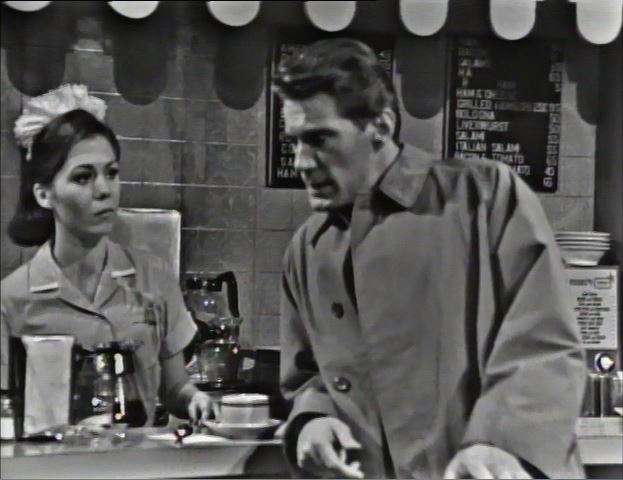
In the opening teaser, dashing action hero Burke Devlin is having lunch in the restaurant at the Collinsport Inn. As usual, he’s alone there. He strikes up a conversation with Maggie Evans, who runs the place. She listens sympathetically while he tells her that he’s worried about the missing man, plant manager Bill Malloy. He goes on about the great meal he’ll buy for his dear friend Bill when he finally turns up. Maggie has to break the news to him that the Coast Guard has fished Bill’s corpse out of the sea.

Burke suspects that his bitter enemy, high-born ne’er -do-well Roger Collins, is responsible for Bill’s death. After he telephones the sheriff’s office to ask for information and doesn’t get answers, he returns to the restaurant, agitated. Well-meaning governess Vicki walks in; Burke snaps at her about Roger, and they quarrel. Burke goes to the sheriff’s office with this suspicion. So far from enlisting the sheriff as an ally against Roger, Burke finds himself being questioned as a suspect.

Burke returns to the restaurant. Vicki is still there, having had a heart-to-heart with her new friend Maggie. Burke yet again asks Vicki for a date; she yet again refuses him, this time because she’s planning to have dinner at Maggie’s house where she will be introduced to Maggie’s father, Burke’s former friend Sam.

Patrick McCray and Marc Masse write characteristically admirable posts about this episode on their blogs. McCray cites this episode as a fine example of the kind of story-telling that defined the show in its first 42 weeks:

Episode 57 is a focused study in how much the show would change in its first year. That’s not damning with faint praise nor stating the obvious about supernatural vs secular threats. It’s a compelling little episode that moves faster than many in the post-1897 run of the series. Within it is an entirely different approach to storytelling. Far more than other soaps, DARK SHADOWS was a show about action. Characters did things in the present rather than just talk about things done in the past. And when time, space, morality, and death are irrelevant to many of your main characters, it’s easy to present a Nietzschean amusement park of action and story twists. That’s not how the program began, though. It was only with the introduction of Laura Collins that DARK SHADOWS became a series about possibilities, not limits. But limits, and seeing attractive, interesting people struggle against them, is the bread and butter of terrestrial TV drama, and episode 57 is a beautifully executed cage.

Patrick McCray, Dark Shadows Daybook

He goes on to talk about the sorts of characters they can have in this period of the show who would become impossible in later days. Bill Malloy, for example: “Malloy was too good at getting things done to coexist with incredibly vulnerable monsters whose only protection came from how unobservant everyone else was.” Because of the centrality of the character of Liz and the theme of her seclusion in this period of the show, I’d always thought of the first 42 weeks as a study in the social and psychological effects of the refusal to face unpleasant facts. But of course denial is still the show’s great theme all the way through.  

Masse discusses the apparent discontinuity of Burke’s wistful tone before he learns that Bill is dead with Burke and Bill’s relationship as we saw it when Bill was alive:

And since when has Burke even cared about Malloy as a person? If he really had revered Malloy for having given him his start as he claims today, then how come he didn’t buy Malloy that best meal ever upon his return to Collinsport, instead of just toying with him at the Blue Whale in episode 3, hanging up the phone on him in episode 9, and then deftly evading his questions before showing him the door when Bill [paid] an unannounced visit to Burke’s hotel room in episode 21?

The above three episodes along with number 57 were all written by story creator and developer Art Wallace, which shows that already by September 1966 Dark Shadows was reinventing itself storywise to such a significant degree that contradictions in continuity would present themselves even if episodes in question were written by the same writer. Burke did acknowledge to Malloy in episode 45, a Francis Swann episode, that he’d been a fair employer to him when he was just starting out working on the boats of the Collins fleet; but in keeping with the opportunistic nature of Burke’s character, this was only after Malloy had offered to make a deal with him, which Burke must have surely understood would greatly benefit his own interests.

Marc Masse, Dark Shadows from the Beginning

I think there is a bit more grounding in what we see for Burke’s rhapsody about Malloy in today’s episode than Masse gives the show credit for. Also, that it is misleading to suggest that only now are we seeing abrupt changes.

I’ll deal with the second of these points first. When Burke came to town in episode 1, he was cold to everyone. They retconned this aspect of his personality in episode 21, where he revisits the sets where he dealt some of his harshest snubs in #1 and is a hail-fellow-well-met even to people whom he had reason to avoid. That was a necessary revision. Soap opera writing is largely a matter of filling screen time with conversation, so a character who isn’t on speaking terms with anyone is useless. But it wasn’t a very well-motivated change in terms of what has happened in the story. Viewers who remembered episode 1 would have had a hard time explaining why Burke’s attitude is so different now.

This time, though, Art Wallace’s script makes it clear time and again that Burke is isolated and getting lonely. He had expected Sam to be his friend, but has learned that Sam fears him. Sam’s daughter Maggie listens sympathetically to him, but he’s a customer of hers, and that’s her job. He certainly can’t expect a social invitation to the Evans house. He thinks he might be able to join forces with the sheriff, but is lucky to get out of his office without a bail ticket. He arrived on the same train as Vicki, and was attracted to her from the first. Every time he sees her, he asks her out and she turns him down. When he finds out that Vicki will be having dinner with the Evanses, it makes the picture of his isolation complete. Burke hasn’t made a single friend all the time he’s been in town, and it’s getting to him.

This takes us back to Patrick McCray’s point, about the “incredibly vulnerable monsters whose only protection came from how unobservant everyone else was.” As time goes on and Dark Shadows becomes more and more a show for young children, it will often be laughable just how unobservant the human characters are. But the first of the incredibly vulnerable monsters will meet a family buffeted by hostility, suspicion, and blackmail, surrounded by enemies even inside the walls of their big dark house on the hill. He will present himself to the Collinses as a warm-hearted, charming, unworldly visitor from a foreign land who wants nothing but their friendship. The lonely people he meets will all but collapse into his arms. In Burke’s rhapsody about Bill, we see the same neediness at work.

Episode 42: The anticipation of doing it

In these early months of the show, the Collinses are in danger of running out of money and losing their position. In yesterday’s episode, we learned that Roger blew his half of the inheritance and Liz drew heavily on hers to keep the business in the family; in this one, we learn that the house is a moldering ruin and the rest of the family’s assets are leveraged to the hilt. Burke plans to take his revenge in part by buying up their debts and making himself their master, which it appears he is in a position to do.

Burke and his investigator are at a table in a restaurant in Bangor when they discuss these matters. Carolyn has followed Burke to the restaurant. Burke spots her, invites her to his table, and sends the investigator away. Burke flirts with Carolyn as he makes sure she didn’t overhear any important information. He makes a show of his elaborately filigreed pen. When she admires it, he makes a gift of it to her.

The last time Carolyn made her way to Burke’s luncheon table, she played with her ring, called his attention to it, and left it behind as a deliberate stratagem to prompt him to call her. She seemed altogether unconcerned with the fact that the ring was a gift from Burke’s sworn enemy, her Uncle Roger, even after Burke indicated that he found it significant; and went ahead to keep an appointment to get the ring back from Burke even after Burke had given it to Roger and Roger had returned it to her. This strange obliviousness in all things having to do with Roger recalls the equally strange blitheness with which Carolyn told Vicki about her crush on her Uncle Roger when they first met “he sends me, he really does!”)

This time the object that passes from one to the other is another distinctive bit of metal associated with some important relationships. Burke tells Carolyn how few pens there are like it in the world, that he had them made to distinguish their bearers as key people in his life. When he makes the pen a gift to Carolyn, he implies that what he is giving her is not just a thing, but a new connection between them.

I made some remarks about these scenes in a comment on John and Christine Scoleri’s Dark Shadows Before I Die:

Carolyn comes to Burke’s table at one restaurant and leaves a special ring with him; she comes to his table at another restaurant and he gives a special pen to her. Even if the mid-60s weren’t the Age of Freud among intellectually ambitious people in the USA, the flirty tone of the two encounters would make it difficult not to see these tokens as body part symbols.

…As for the pen, it is going to become a more and more unmistakable phallic symbol over the next several weeks, leading us to wonder what the show is trying to tell us about the relationship between Burke and Roger and what was really going on between them before that accident ten years ago.

There’s also a scene between Sam and Liz. Yesterday’s episode ended with a big cliffhanger when Liz opened the doors and saw Sam waiting outside, suggesting that he is going to unburden himself of the secret he and Roger share. In true soap opera fashion, once the cliffhanger has brought the audience back to watch the next episode it has served its purpose. It is then to be got out of the way as quickly and anticlimactically as possible.

Today’s anticlimax sheds an unexpected light on Sam’s position. Sam’s extreme reluctance to tell his secret grew out of his assumption that whenever and wherever he started talking, he would find a hyper-attentive audience who would listen to his his every word and lose no time putting them into far-reaching and disastrous action. What he actually meets in Liz is personal dislike for him and impatience with anything he might want to say. Once Sam starts to talk about Roger, she assumes he has come to blackmail her with some sordid information about her no-good brother, and she makes it clear she will not be having it. Joe comes to the house, Liz mentions Bill, and Sam crumbles, his secret untold and unwanted. If the audience is expecting Sam to murdered, this result will add an extra touch of bathos to his plight- a man carrying a secret that spells his doom, but that does not attract the attention of a suitable listener.

Ray Stewart, later to gain a place in history as part of the gay couple on Barney Miller, appears in this episode as a featured extra. He’s the head-waiter in the restaurant in Bangor. Both the Dark Shadows wiki and his imdb page list his role as “Customer,” but here you see him telling the server which table to go to first:

Screenshot by Dark Shadows from the Beginning

And here you see him greeting Carolyn when she arrives at the restaurant:

Screenshot by Dark Shadows from the Beginning

Ray Stewart is still alive, maybe he should complain about his role being mislabeled. In all seriousness, I’d like to see him and other onetime background players on one of those panel discussions they used to have at Dark Shadows cons and now have on Zoom. I’d like to know what it was like being an extra on the show. And of course some of them went on to become big names.

Episode 38: The Count in his castle

Vicki first met Matthew in the basement of Collinwood, back in episode 6. So the basement is Matthew’s territory. Not even the cottage where he lives is more so. Before we ever saw it, we heard him go on about how it was a gift from Liz. When we do see him there he’s having an uncharacteristic moment, baking muffins. The basement is the dusty, forbidding workspace is where we expect to find a dusty, forbidding workman like Matthew.

In his remarks on episode 37, Patrick McCray complained about “writing shortcuts that occasionally make Victoria look like a moron.” I didn’t quote him in my post on that episode, because I don’t agree with his assessment of the scene- he thinks Vicki is falling for Roger’s obvious lies, I think she is disregarding them because she knows she has him where he wants him and is about to squeeze some information out of him. But this opening scene is definitely a case of Idiot Plot. Vicki chased David into the basement in episode 6, only to be menaced by Matthew and scolded by Elizabeth; she followed the sound of the sobbing woman there in 37, to be yelled at by Roger. Those were moments of hot pursuit, when she could claim that in the heat of the moment she forgot Elizabeth’s prohibition on going to the basement. But now, she’s just looking for some books. There’s no reason she couldn’t have asked Liz about the books before going to the basement. What’s more, she’s going after those books only because David, last seen telling her he’d make her wish she had never come to the house, suggested she go after them. I realize she’s had a stressful few days, but unless she’s had a massive head injury off-camera, going to the basement at David’s suggestion is inexplicable.

Of course, the out-of-universe explanation is obvious- a new actor is taking over the role of Matthew, and they want to introduce him on this set. On the one hand, the scene is a reprise of the first introduction of Matthew, thereby making it clear that this is a new start for the character. On the other hand, because it is his territory, and our point of view character is trespassing there, he is all the more menacing to us than he would be if we met him in someone else’s space.

I think Danny Horn described Thayer David’s acting style well when he said that “He’s loud, and disruptive, and he plays to the balcony. Not this balcony, naturally; I mean the balcony in the theater next door.” He’s relatively subdued in his first outing as Matthew, but the appliances the makeup shop constructed on his face prepare us for the titanic approach he’ll be taking in the weeks ahead.

Matthew goes upstairs. In the foyer, a more or less neutral space among the residents of the estate, Liz gives him a shopping list to take into town. She then asks him into the drawing room, her home base. There, she asks him to do something horrible- take the blame for Roger’s car crash. He is shocked at the request, and asks for an explanation. She doesn’t give him one, but he agrees anyway. Thayer David’s anguished face shows the terrible price Matthew is paying for Liz’ insistence on covering up what really happened between David and Roger.

This encounter closes the story of Roger’s crash. Along with the Mystery of the Locked Room, Vicki’s search for something David might like, and the talk about ghosts, it ties Thayer David’s Matthew in to four of the stories we’ve been following.

We next see him in town, ordering coffee at the restaurant in the Collinsport Inn. There he’s tied in to a fifth story, The Revenge of Burke Devlin. The Inn is Devlin’s territory, and Matthew encounters him there. Still unhappy because of Liz’s shocking request, Matthew is in no mood to be diplomatic with the known enemy of the family he is sworn to serve. He tells Devlin that if he makes trouble for Liz, “I’ll kill you.” Devlin tries to reason with him, asking if it makes a difference whether the family deserves trouble, to which Matthew does not respond kindly.

Even before Matthew came to town, Devlin had met another Collinwood resident at the restaurant. Carolyn sits at his table and notices he is reading The Count of Monte Cristo. She summarizes the plot, and realizes that it is one of the sources of The Revenge of Burke Devlin story-line. She’s so self-aware it wouldn’t be surprising if she and Burke started gossiping about what the new writers coming on board next week have in mind for their characters. She drops the subject, and immediately starts wheedling him for a date. When he begs off, she deliberately leaves a ring behind.

Back at Collinwood, Carolyn and Vicki talk on the landing overlooking the foyer. This is the first conversation we’ve seen in that space. A couple of times, we’ve seen David Collins standing up there by himself, looking menacing, or as menacing as a not-very-tall nine year old boy could. In the years to come, a succession of villains will take turns declaring themselves to be Master of Collinwood by standing on this spot and looking at the camera. The last of these will be the ghost of Gerard, played by an adult actor about the same height as the nine year old David.

This time, the space is not being used to suggest menace, even though the camera is shooting up at the same drastic angle. Instead, it is a relatively intimate place, separated from the public-facing foyer by the stairs and leading to the bedrooms. Carolyn and Vicki are there because they are at home. Carolyn confides in Vicki about her plan to leave the ring where Burke would find it, obligating him to call her and return it. Vicki confides in Carolyn about the sobbing woman, and Carolyn admits to having heard her many times, and to having lied when Vicki asked her about the sounds her first morning in Collinwood. The friendship between Carolyn and Vicki is settling in as a wide-open information exchange, a regular channel not only to keep the audience up to date on what’s happened in previous episodes, but to make it possible for characters to learn enough about what’s going on to make plans and take action.

Back down in the foyer, Liz talks to Vicki about the basement. Vicki tells her that she can’t believe in ghosts; Liz assures her there’s no one being held in the locked room. Liz offers Vicki the key to the room and invites her to let herself into it and search it. Vicki declines the offer. Liz repeats it, doing everything she can to show that she has nothing to hide. Vicki declines again, and turns away. As soon as Vicki can’t see her, Liz’ face resolves into an expression of immense relief.

Over the closing credits, ABC staff announcer delivers the usual blurb for “Where the Action Is.” He trips over the title. It sounds like he’s stifling a laugh or is distracted or something. Unusual to hear him commit a blooper!

Episode 33: The one with Harvey Keitel

At Collinwood, Liz tells Carolyn that David won’t be going away just because he tried to murder his father. “Things will go on just as before.” On the other hand, Carolyn should marry Joe and leave the house, because “You’re the only one of us who can have a sane, happy life.” I suppose we’ve all seen that in real life, someone swinging wildly between deep denial and exaggerated despair. Two forms of learned helplessness, I guess.

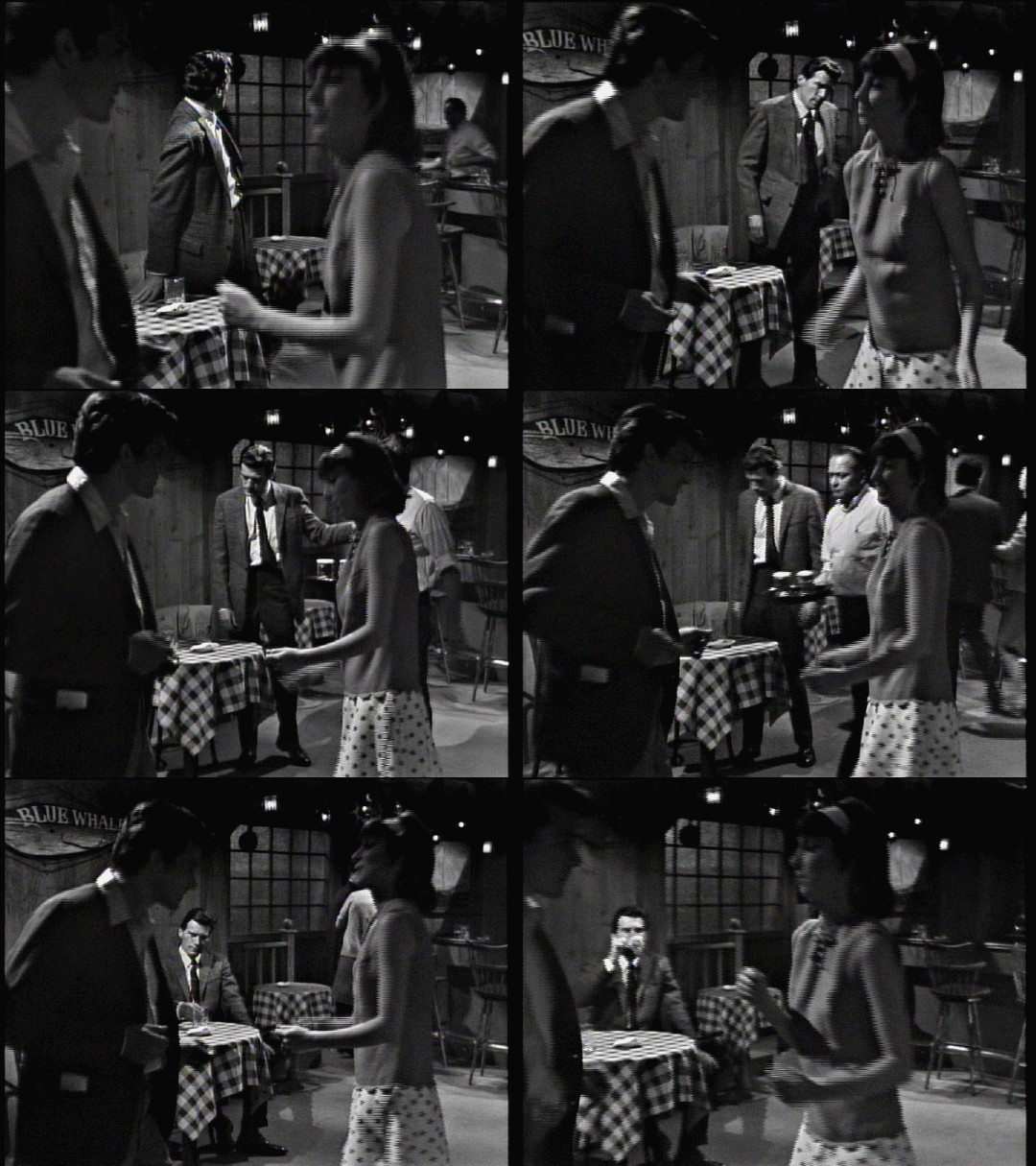
At the Blue Whale, Joe is getting well and truly sloshed. Burke joins him at his table, interrupting a conversation between Joe and his whiskey glass. Joe tells Burke that he doesn’t like him, expresses his frustration with Carolyn’s refusal to get married, then goes to Collinwood, roaring drunk, and tells Carolyn, Liz, and Vicki what he thinks of them.

One thing Joe thinks is that Carolyn is doomed to be a spinster. Considering that she’s supposed to be about seventeen, that does call to mind Barnabas’ line to Carolyn in the 2012 Dark Shadows movie, “Fifteen? And no husband?

Marc Masse brings this point out well on his Dark Shadows from the Beginning, and argues that the depiction of Carolyn may be one of the things that sunk the show with young viewers between the end of the first month and the introduction of the vampire:

You have to wonder what kind of impression the character of Carolyn Stoddard would have made to young viewers in 1966. Here she is having grown up in a mansion with forty rooms and her only option in life is to be married off before her eighteenth birthday to a local fisherman, or else face a life of lonely spinsterhood. In that respect, Dark Shadows seems to belong to the sensibilities of previous decades.

This paragraph is part of an in-depth discussion of Dark Shadows’ place on ABC’s schedule, its ratings, the show that preceded it in its time-slot, and Art Wallace’s rather antiquated view of the world. It’s all very informative, highly recommended.

When Joe passes out on the couch, Vicki goes to town. She goes to the Blue Whale, where Burke asks if she’s looking for someone. “I just found him,” she replies. Obviously, she’s talking about Harvey Keitel, who is dancing a few feet away from her.

That Harvey Keitel was once an extra on Dark Shadows is pretty interesting. If he took that job, clearly he would have taken a speaking part. I gave some thought to parts I wish he had taken in comments on Danny Horn’s Dark Shadows Every Day four times: here (on episode 470,) here (on episode 769,) here (on episode 1057,) and here (on episode 1137.)

Episode 29: The Burke Devlin Special

Today’s exercise in the Art Wallace school of compare-and-contrast juxtaposes Burke Devlin’s hotel room with the interiors of Collinwood. Burke is a bouncy, cheerful host to an unannounced visitor, David Collins; after a short time, David is happy and exuberant, the first time we’ve seen him smile about something other than hatred and murder. Vicki, Carolyn, and Liz are thoroughly miserable.

Liz still refuses to believe that David could be the one who sabotaged his father’s car, at one point suggesting that Vicki might have done it. That idea crumbles immediately in the face of Carolyn’s disbelief, and Liz offers Vicki an apology. But she still clings to the thought that David might somehow be innocent. Her refusal to face facts takes a depressing situation and robs it of all hope for improvement.

David has gone to Burke’s room to hide the incriminating bleeder valve there. He had originally set out a few episodes before, after Vicki found the valve in his own room but before the sheriff had searched Burke’s room. He was caught trying to sneak into Burke’s room before the sheriff got there, so it’s really too late for his plan to work. He goes ahead with it anyway, but tries to retrieve the valve from the cushion after Burke wins him over. That attempt fails as well- unknown to David, Burke has already found the valve and has it in his pocket.

I suppose a definition of “dashing” is a fellow capable of great charm who makes things happen, things which we cannot predict and of which, even when they have happened, we can’t be sure whether we approve. By that definition, Burke is at his most dashing in this episode and the next.

Episode 27: In your room

Vicki tells Carolyn that David was the one who sabotaged Roger’s car, which Carolyn accepts as fact almost immediately. The story does build a foundation for Carolyn’s reaction- she repeatedly calls David a monster, and has been guilt-stricken at the thought that she let Burke into the house to commit the crime. But it is also the first example of what will become the hallmark of all of Nancy Barrett’s performances on the show. Her characters are the first to throw themselves into whatever is going on. She comes to serve as a one-woman chorus backing whoever happens to be the protagonist at the moment.

Liz still refuses to face the facts about David. When Vicki finds David’s Mechano magazine in her underwear drawer with the page about hydraulic braking systems marked, she and Carolyn see it as evidence that David had access both to the drawer and to the technical information he needed to commit the crime. Liz sees it differently, saying in a distant, ghostly voice “It was in your room, Miss Winters.”

Liz’ ghostliness is highlighted strikingly earlier in the episode. In the upstairs hallway, Carolyn is chattering away about ghosts, both the metaphorical ghosts of current problems resulting from past conflicts and the literal ghosts that, she would have you know, most definitely exist. Vicki looks at the door to the rest of the house which inexplicably opened and closed itself a few episodes back, and gasps as it opens again. This time it’s Liz coming out, having looked for David in the closed-off wing. Liz is impatient with the girls’ talk of ghosts, but her manner and appearance as she enters through that door are spectral.

The other setting in today’s diptych is a hotel room in Bangor.* Burke is meeting a private investigator there. He’s giving him a tough assignment. He wants more information about the Collinses in less time than the investigator had originally expected. He also wants the job done in absolute secrecy, and if the Collinses catch wind of the project the investigator will suffer dire consequences. The investigator is played by Barnard Hughes, a highly accomplished actor, and his skills are needed. Burke is being harsh and unreasonable, and the investigator is being deferential. Hughes is able to give his character enough texture that he seems to be keeping his dignity. Without that, Burke would have come off as a bully. The audience has to like Burke, so Hughes makes an important contribution to the show in this, his only appearance.

There’s an irony to Burke’s hard-driving intensity. He’s looking for information to hurt the Collinses, while the women at Collinwood have information far more damaging to the family than anything he’s sending his man to look for. So we’re in suspense as to what he’ll do when he catches up to them.

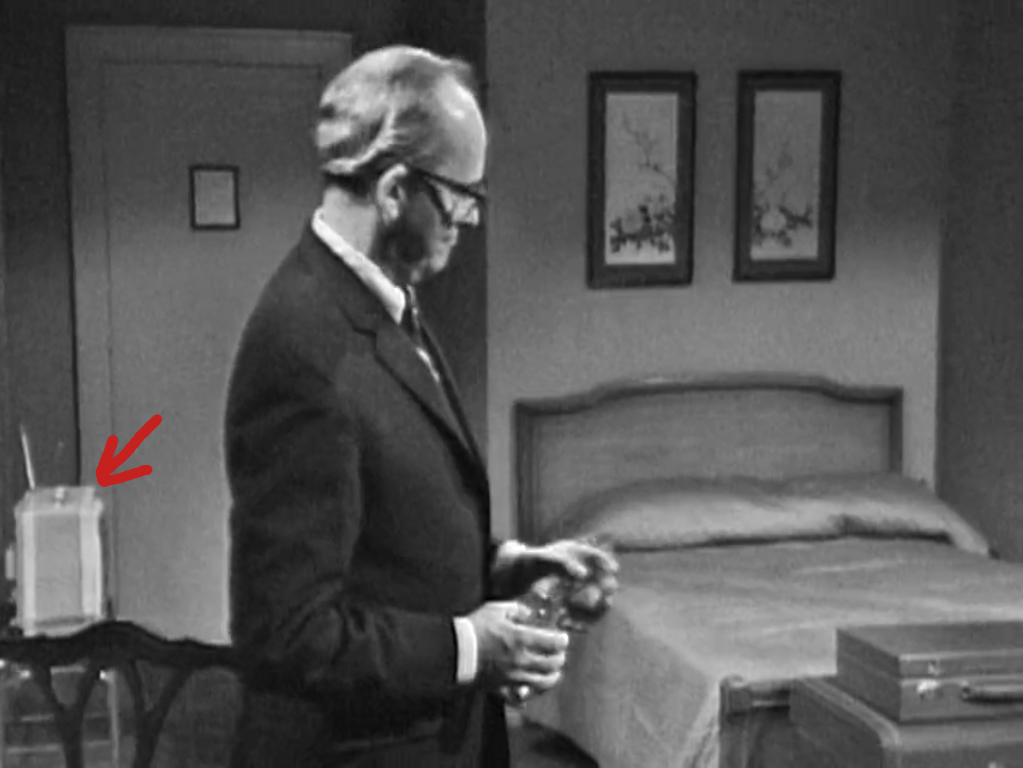
*In a comment on Danny Horn’s Dark Shadows Every Day, “TD” points out that the hotel room in Bangor has a television set, the first such device we see on Dark Shadows. We will not see another until 1970. That one will be in a parallel universe. We never do see a TV set in the Collinsport of the main continuity.

Evidently Mr Bronson had the hotel send a TV up to his room.

My usual themes: Denial and the demonic

In 281 of the posts that follow, I link to comments I made on Danny Horn’s blog, “Dark Shadows Every Day.”

Not all of these comments were absolutely unique. I frequently refer to denial, the psychological defense mechanism, as a story point on Dark Shadows, and more than once I connect it with the show’s supernatural themes.

From the very beginning, the show focuses on the Collinses as a family addicted to denial. Elizabeth hasn’t left her house for 19 years because she’s guarding a secret; she’s summoned Vicki to live with the family for reasons she conceals so deeply that we never find out what they are; she almost loses the house, the business, and everything else as she gives in to the demands Jason McGuire makes in return for his silence. For his part, Roger is terrified that Burke will reveal the secret they share, and goes to extreme lengths to keep that secret hidden; he openly hates his son, but can tell no one why; his estranged wife is a profoundly mysterious figure, whose own secret is so powerful as to imply that the consensus view of reality prevailing in the community where the show is set is an elaborate lie. David sees ghosts; eventually the audience also sees them, and we know that some of the adult characters can see them, too. Yet all of the adult characters hotly deny that the ghosts exist until Vicki breaks the embargo after she sees the ghost of Bill Malloy in episode 126. Not until Carolyn tells David about her childhood friend Randy in episode 344 will another adult even allow David to suspect that she thinks ghosts might be real.

Here’s a concise statement about denial as a theme in the show, from a comment I made on one of Danny’s posts about the “Re-Haunting of Collinwood” segment:

Of course it doesn’t make much difference that Gerard possesses Liz. Liz’ whole thing, from episode 1 on, is that she refuses to acknowledge painful realities. That’s what Gerard wants her to do, so all she needs is a little nudge to go back to her usual state. Even though she isn’t on the show much, I think of Liz as the main character in the sense she embodies denial, and the show is very largely an exploration of what can happen when people are deep enough in denial.

And here’s a somewhat more developed remark, this time from a post about the first “Haunting of Collinwood”:

Roger’s angry dismissal of Barnabas and Julia’s concerns this time, combined with Liz’s triumphant reaction to the sight of Mr Jughans at the end of last Monday’s episode, actually do make sense both of Barnabas and Julia’s refusal to tell her what they’re up to and of Liz’s own acquiescence in their absurd behavior. The Collinses may reside in the state of Maine, but the state in which they hold their true citizenship and to which they give their sole allegiance is the state of denial. If Barnabas and Julia tell Liz what’s going on, she will have to build some structure of lies to conceal it from herself and from everyone else, regardless of the cost. If they simply act like lunatics and impose on her with nonsensical demands, however, she can set about convincing herself that it is somehow all right to have Barnabas and Julia around her house.

Here’s a response to another post about the original haunting of Collinwood, this time dissenting from the view of several others in the thread that the writers had simply lost track of which characters knew what and ended up presenting Liz and Roger as memory-free, “goldfish” characters:

I don’t think Roger and Liz are goldfish in the way that so many characters were in earlier episodes. They’re people in deep denial about the nature of the world in which they find themselves. That’s what makes their scenes powerful in the two or three weeks leading up to this installment. They refuse to believe in ghosts, and so they think they are protecting the children from Maggie, Mrs Johnson, Julia, and Barnabas when those characters talk about what’s going on. In fact, they are enabling Quentin’s abuse of the children. When Liz and Roger break down and face facts, they relieve us from involvement in that terrible situation. They also stun us, especially if we’ve been watching from Episode 1, because we’ve seen the immense price each of them has paid to avoid dealing with unhappy realities.

Both the original haunting of Collinwood by the ghost of Quentin and its re-haunting by the ghost of mini-Quentin Gerard mainly take the form of child abuse. The Collinses respond to that child abuse with a solid wall of denial:

Of course, it is abuse to coerce children into harming their loved ones, so it isn’t just allegorical. It’s realistic to show this form of child abuse working in the same ways as do other forms.

The Collinses are such a wretched bunch that the children of the family must have been the objects of a great deal of abuse over the centuries, yet the show wimps out of exploring that topic at the climax of the Phoenix story, when Roger and Carolyn stop openly proclaiming their hatred for David. For the next 500 or so episodes, the only abuse inflicted on the few Collins children we see is the occasional attempt to murder one of them. In this fictional universe, being the target of a murder plot is a so routine an experience for so wide a variety of people that it seem odd to describe it specifically as “child abuse.”

We don’t really have to think about Collins children being abused until the Haunting of Collinwood story. Then we go to 1897, when the show finally takes child abuse seriously and connects it to the Collinses’ addiction to secrecy and their desperate unhappiness.

In a thread about the 1897 storyline, I go into some depth connecting the show’s theme of denial with its depiction of dark supernatural forces. I compare those depictions with understandings of the supernatural found in some familiar traditions and end with fanfic:

I think of the climax of the Iliad. As Achilles moves in to kill Hector, Athena takes hold of his spear and drives it in, delivering the fatal wound herself.

For modern readers, this may ruin the story. The whole poem has been leading up to this moment; we’ve spent a lot of time with Achilles, listening to him try to figure out what it would mean for him to kill Hector. So why have the goddess take over at the last minute? Isn’t it an evasion of Achilles’ responsibility for his actions, and a cheat for us as we’ve been observing his psychological development?

For the original audience, it was not. They actually believed in their gods. Athena really existed, as far as they were concerned. When an event was important enough, they took a interest. If it was really huge, they would get involved. Moreover, the gods worked closely with each other. So much so that you didn’t pray to one at a time, but always to groups of them. When Athena joins Achilles in his fight, it isn’t her pushing him aside- it’s him doing something so important it blurs the boundary between human and divine.

Something like that is at work in the traditional, pre-modern, conception of demonic possession. To say that a person is possessed is a way of looking at behavior that is reducible neither to moralistic judgment nor to psychological analysis. It isn’t individualistic in the way that those modes of discourse are. Rather, it suggests that the boundaries between the person and the spiritual forces of darkness have broken down. Perhaps the person is partly to blame for that breakdown, but the whole point is that s/he is no longer a distinct being, but is merging into those supernatural forces.

So, imagine a version of Dark Shadows where Elizabeth Collins Stoddard really was the main character. Her whole approach to life is denial. So, you could have had a story with a beginning, middle, and end. In the beginning, we see the lengths she has gone to in her quest to keep from ever having to have an embarrassing conversation. In the middle, we see various horrors take place around her, each worse than the one before, each more obvious than the one before, and each time she finds a way to convince herself it doesn’t exist. At the end, a couple of innocent characters go to her in the drawing room of Collinwood to rescue her from the monsters who are running rampant there. She looks at them placidly and tells them she sees nothing wrong. Why ever do they think she would want to leave her home? All the while leathery-winged demons are fluttering about her head. She doesn’t see them, and they have no choice but to flee.

Made as it was to be shown on the ABC television network from 1966-1971, it is unsurprising that Dark Shadows is, off and on, vaguely Christian in its worldview. At one point they even imply that the Collinses are affiliated with a specific Christian denomination, The Episcopal Church. Of course, the view of the world they present is not exactly orthodox, but the idea of an individual human personality as something that can gradually become less distinct from various spiritual forces is a familiar one, not only to Christians, but to others who are invested in the idea of a supernatural realm.