From November 1967 to March 1968, Dark Shadows was set in the 1790s. The cast included Kathryn Leigh Scott as the gracious Josette, Louis Edmonds as haughty overlord Joshua Collins, and Lara Parker as wicked witch Angelique. Now, the dramatic date is 1897. Miss Scott plays Kitty Soames, an American who went to England to be a governess, married the Earl of Hampshire, and is now widowed, penniless, and scheming to land another rich husband. Edmonds takes the role of stuffy but lovable Edward Collins, who is the focus of Kitty’s ambition. Parker is still Angelique, who is both immortal and a time-traveler.
Ever since arriving at the great house of Collinwood in #844, Kitty has been having psychological breaks during which she acts like Josette. She therefore appears to be suffering from a severe mental illness, an impression which would tend to get in the way when trying to win a new spouse. Today these breaks take a new turn.
Kitty is walking in the woods on the grounds of Collinwood when she is overwhelmed by the sense that she is being watched, and furthermore that the person watching her knows her well and wishes her ill. She runs into the house and flings herself at Edward, describing this paranoid episode to him. Edward has only begun to talk her down when his brother, rakish libertine Quentin, enters with his own fiancée. The fiancée is Angelique.
Edward is about to introduce the two ladies, who have never met. Before he can do so, Kitty becomes Josette. In Josette’s voice, she denounces Angelique. She then grabs her by the throat and vows to kill her for what she has done.
Angelique was responsible for the deaths of Josette and many others at Collinwood in the 1790s, and has been obsessively hostile to her throughout the centuries. When she was first conjured up from Hell to be part of the 1897 segment in #711, she went to the Old House on the estate, looked at the portrait of Josette that hangs over the mantel in the front parlor there, and declared “I am Angelique and I hate you!” During her lifetime, Josette was oblivious to Angelique’s enmity. She knew Angelique as a lady’s maid in service to her aunt, and regarded her as a close friend. But on Dark Shadows, death is a learning opportunity, and we see today that when she is animated by Josette’s spirit Kitty knows everything Angelique hid from Josette when she was alive.
Edward and Quentin separate Kitty and Angelique. In a private conversation with Quentin, Angelique makes it clear to the audience that she knows exactly what is happening with Kitty, and that she regards it as a minor nuisance. Quentin has troubles of his own, and doesn’t ask for an explanation.
Meanwhile, Kitty and Edward have a private conversation of their own. Edward tells Kitty that she is just upset because of her late husband’s death, and assures her that he will help her recover. She flashes a cunning smile at the camera. Well she might- not many people are so good at attaching themselves to rich guys that they can turn a psychotic episode to their advantage.
Kitty has a dream in which Angelique is her servant and is addressing her as “Mademoiselle.” In the dream, Angelique delivers an arrangement of flowers and a book of poetry that Josette’s fiancé wants her to have before their impending wedding. When she wakes up, Kitty finds the arrangement and the book by her bedside, and she realizes that what is happening to her is not simply a mental aberration.
The dream will puzzle new viewers, even those who know that Angelique was a servant in Josette’s household. When Angelique is busy being Evil, she often laughs a maniacal laugh that breaks in the middle with a sharp intake of breath. She keeps doing this throughout the dream, which doesn’t fit at all with the action of bringing a present from a lover. She also tells Josette that her happy life is of the sort that makes the gods jealous, and speaks the lines with an undisguised and exaggerated hostility that leads into another gale of maniacal laughter. People who have joined the show in the last year will wonder why Angelique is being so crudely obvious.
Lara Parker used to say that she didn’t really learn to act until Humbert Allen Astredo joined the cast of Dark Shadows in June 1968. She’d taken acting classes and appeared in plays and so on, but it wasn’t until Astredo explained acting techniques to her while they were rehearsing that it all clicked in her head. You really can see a sudden improvement in her performances at that time. The dream Josette transmits to Kitty’s mind takes her to a time, not only when Angelique was a servant, but when Lara Parker was not a particularly good actress. The contrast between the reliably capable professional we see in most of the episode and the often bombastic student who appears in the dream makes us appreciate just how far she came in a short time.
From April to July 1968, Dark Shadows was bogged down in a repetitious story called “The Dream Curse.” Each of a dozen characters had the same nightmare, in which they were in a small room with several doors. Behind each door they saw something that was supposed to be frightening.
When occult expert Timothy Eliot Stokes (Thayer David) had the dream in #508, he defied its rules, caused wicked witch Angelique to appear in it, and brought the curse to a halt. Angelique had to cast another spell later to restart it.
Now the show has gone back in time and is a costume drama set in 1897. Thayer David plays sorcerer Count Petofi, who is among other things a vision of what Stokes might have been as a supervillain. Petofi has learned that both vampire Barnabas Collins and mad scientist Julia Hoffman have traveled to 1897 from 1969. Petofi is convinced that they would not have made this journey unless they knew exactly what they were doing and had a foolproof plan for getting home. Petofi does not know Barnabas and Julia very well.
Petofi and his servant Aristide are holding Julia prisoner in their home, an old mill. This might be called a hiding place, except that virtually everyone in the village of Collinsport and its environs has visited Petofi and Aristide there at least once. There’s so much foot traffic in and out of it someone could make a fortune if they set up a food cart outside the door.
Yesterday, Petofi forced Julia to tell him that she and Barnabas each came back in time by meditating on a set of I Ching wands. Petofi then cast the wands, and his “astral body” was transported to a room very much like that in which the nightmares of the Dream Curse took place. At first it seems that he will match Stokes’ performance when he had The Dream. There is in the world one person over whom Petofi has no power and who is sworn to kill him. All Petofi knows is that this person is Rroma by ethnicity, and is going to try to use a particular scimitar to cut off his right hand, where his magical powers are concentrated. As Petofi is entering the room, he sees the scimitar. When the unseen person holding the scimitar points it at Petofi’s throat rather than his wrist, he realizes that he is not in jeopardy, and he orders the wielder of the scimitar to be gone.
In the room, Petofi opens a couple of doors. Behind one is Barnabas baring his fangs; behind the other, a wall of fire. One of the notable features of the room are red velvet curtains hanging from the ceiling to the floor. Fans of Twin Peaks sometimes say that “Once you learn to see it, the Red Room is everywhere”; I guess they’re right.
Petofi keeps his cool when he sees the gimmicks behind Door #1 and Door #2, but he does seem uncomfortable when he hears the voices of a male chorus singing a Romani song. After a moment, he finds his magical right hand squeezing his throat. All of a sudden he is back in his physical body, with Julia and Aristide by him, strangling himself. Petofi’s powers are so great that there are times when it seems that he will overwhelm all opposition and leave the show without a story to tell; the image of him crushing his own windpipe with his right hand suggests that he will ultimately be a victim of his own power.
Petofi recovers. He is sure Julia created his experience; he cannot conceive of events taking place outside anyone’s control. This marks a contrast with Stokes. Stokes, an upright and decent man, knows that Barnabas and Julia are keeping many secrets from him. When he has to work with them, he grumbles about this and makes it clear that he has dark suspicions. But though Stokes wishes he knew more about them, he does not press them very hard to reveal what they are hiding. Further, he was the one who explained the I Ching to them, including that meditation is a process of giving up control. Unlike Petofi, Stokes can easily accept that there are things that happen whether or not anyone wants them to.
When Julia cannot answer any of his questions, Petofi tells her why he keeps Aristide around:
Look at Aristide here. In point of fact, I don’t need a servant. The boy himself is no intellectual giant. He detests all forms of culture. Why then do I keep him on? Because I am a man who by nature shuns all forms of violence. I loathe the sight of blood. Aristide, on the other hand, has no such scruples. He revels in every form of torture and bloodshed known to the mind of man. I believe he even invented a few himself. He kills without the slightest feeling for his victims. He will kill you, Dr. Hoffman, if you do not tell me what I want to know.
As Aristide, Michael Stroka’s reactions when Petofi delivers this speech are quite funny. He looks really wounded when Petofi says that he is “no intellectual giant” and that he “detests all forms of culture,” but when he starts talking about how sadistic he is, he brightens up. When Petofi tells Julia that Aristide will kill her unless she tells him what he wants to know, he looks positively blissful.
Since Julia has nothing to tell, Petofi leaves Aristide to do his worst. He ties her to a chair in the back room. He rigs a string to the trigger of a revolver so that turning the doorknob will fire a round into Julia. He tells Julia that he hopes Barnabas will come to her rescue and therefore be her executioner.
Barnabas does shows up and confront Aristide. He turns the knob. We hear a shot, and see Julia slumped over in the chair.
One of the recurring faults on Dark Shadows is that when people are bound and gagged, they often have to use their teeth to hold the gags in place. Today they don’t even bother wrapping the cloth around Grayson Hall’s head- Michael Stroka just tucks it into her mouth. The suspense as Barnabas approaches the door depends on Julia’s inability to warn him not to turn the knob, and the closing shot loses its shock value when we can see Julia still biting down on the cloth. So this time it really is a problem.
In #797, the ghost of Rroma maiden Julianka appeared and placed a curse on her fellow grievous ethnic stereotype, Magda Rákóczi. Julianka blamed Magda for her death, and decreed that everyone Magda loved would die. Today, Magda is trying to prevent Julianka’s curse from taking the life of her desperately ill infant niece Lenore, daughter of her late sister Jenny. Magda goes to Lenore’s crib in company with Lenore’s father, Quentin Collins. Magda and Quentin try to conjure up Julianka’s ghost to plead for Lenore’s life, but instead they get the ghost of another Rroma woman- Jenny.
Jenny assumes physical form. She picks up Lenore and sings the lullaby “All the Pretty Little Horses.” We’ve heard Jenny sing this almost every time she has been on the show. It appears to be the only song she knows. For his part, Quentin has a phonograph and only one record, which he plays obsessively over and over. When they lived together, their home must have been a pretty grim place, playlist-wise.
Jenny lifts Lenore’s illness, and says that if Quentin looks into his heart he will know what he must do to ensure that Lenore has a bright future. She vanishes, and Quentin mutters dismissively at the idea that his heart will be a source of useful information.
Later, Quentin will have a dream while sleeping in the drawing room at the great house on the estate of Collinwood. Jenny visits and tells him that he must have nothing to do with Lenore and that she must grow up far from Collinwood. So far, dream sequences on Dark Shadows have always represented visits from the supernatural, but this one might be an exception. Jenny did say that the information Quentin needed to help Lenore was already in his heart. He is clearly not the stuff of which good fathers are made, and as Jenny explicitly says in the dream no one has ever been happy at Collinwood. So the advice she gives does seem to be correct. Perhaps this is just Quentin’s own knowledge taking a shape he can recognize.
Quentin goes on dreaming that his brother Edward is choking him. He wakes up to find that Edward is in fact choking him. This might seem like a prophetic dream, but it too might just be a natural expression of Quentin’s own unprocessed knowledge. Edward, because of a magic spell not directly connected with today’s events, is under the mistaken impression that he is a valet formerly in the service of the Earl of Hampshire. Quentin has followed the Collinses’ long-established protocol for dealing with mentally ill family members, and locked Edward up in the room on top of the tower in the great house. He knows this makes Edward miserable, and it is reasonable to suppose that he would expect Edward to express anger about it. Strangulation is Quentin’s own preferred method of expressing anger, especially towards members of his immediate family, so it can’t have been hard for him to see that coming.
Edward’s motivation is not as simple as Quentin’s would be if their positions were reversed. The evil Gregory Trask has been visiting Edward in the tower room, and has told him that Quentin is determined to keep him imprisoned in that room forever. He asks him to kill Quentin. Edward apparently has decided to comply.
Earlier in the episode, Edward had been more punctilious about cooperating with Trask. Trask presented him with a document to sign, promising that by signing it he would secure his freedom. Edward read the document, even after Trask very loudly insisted that it was unnecessary to do so. When Edward saw that it involved making Trask guardian of his son, Edward protested that he had no son. Trask said that this did not matter, but Edward would not be moved. Edward later tells Quentin about this encounter.
The tower room is a re-dress of the set used as the bedroom of strange and troubled boy David Collins in the parts of Dark Shadows set in the 1960s. Today it includes the bed from that set, and we see Edward trying to sleep in it. This is a powerful image for longtime viewers. Louis Edmonds plays Edward in this costume drama segment and David’s father Roger in contemporary dress. Edward is the father of Jamison, who like David Collins is played by David Henesy. Not only has the spell robbed Edward of the memory of Jamison and of his role as a father, it has reduced him to curling up in a bed made for a boy rather than a man.
Roger was, for the first year of Dark Shadows, a spectacularly bad father. He openly hated David and exploited David’s miseries to try to manipulate him into doing his own criminal dirty work. He was indifferent to the family’s name and the fate of its businesses, would go to any lengths to hide from the consequences of his actions, had killed someone, and was an alcoholic. Edward shares none of these shortcomings. On the contrary, he goes to the opposite extreme. He is as brave as Roger is cowardly and tenderly loves his children, Jamison and Nora. But he is also stuffy, name-proud, and money-grubbing. The contrast with Roger shows these failings, not simply as negatives, but as the overgrowth of the virtues that separate Edward from Roger. Though Louis Edmonds and Jerry Lacy are such accomplished comic actors that Edward’s scenes with Trask are funny enough to be worthy of a staging of the Jeeves and Wooster stories, Edward’s loss of his identity as father of Jamison and Nora is a genuine tragedy.
Quentin is fond of Jamison, and once he learns that his children exist he seems to wish them well. Nonetheless, he shares most of the other vices of early Roger. As Edward shows us what Roger might have been had he had stronger moral fiber, Quentin is Roger with his vices magnified by black magic. When Jenny tells Quentin that he must not raise Lenore, longtime viewers remember Roger as he was when first we knew him, and remember how grim David’s future seemed at that time. It was only after well-meaning governess Vicki became the chief adult influence in his life that we could have hopes for David. So we cannot doubt that Jenny is right.
This is the last of 21 episodes of Dark Shadows directed by executive producer Dan Curtis. When Curtis first took the helm in #457, he had no experience as a director, and it showed. But he learned very quickly. This one looks great and the scenes play very smoothly. He would later direct the feature films House of Dark Shadows and Night of Dark Shadows, as well as six episodes of the 1991 prime time revival of Dark Shadows and many other productions.
Sorceror Count Petofi has taken possession of twelve year old Jamison Collins. He has also cast a spell on broad ethnic stereotype Magda Rákóczi, compelling her to lead him and his henchman Aristide to the hiding place of vampire Barnabas Collins.
Jamison/ Petofi and Aristide are ready to drive a stake through Barnabas’ heart. They open his coffin and find that he is away from home today. Magda does not know where his other hiding place is. Jamison/ Petofi becomes intrigued with Barnabas and decides to search through Magda’s home, the Old House on the estate of Collinwood, for papers that might give him information about Barnabas.
He and Aristide find a book published in 1965. Since the dramatic date is currently 1897, this seems to be a matter of some interest. Jamison/ Petofi calls for Magda, who tells him that Barnabas told her that the book had been brought back in time from the 1960s by “a girl named Vicki.” Barnabas’ utterance of the name “Vicki” in #797 was the first reference to well-meaning governess Victoria Winters in the 1897 segment, and this is the second. Vicki was the main character of the show for its first year, and remained in the cast for over a year after that. That the name “Vicki” would be heard only in rare and trivial echoes is not something longtime viewers would likely have predicted before she was written out of the show last year.
Magda goes on to explain that Barnabas himself traveled back in time from 1969. She has a vague idea that he was trying to save a dying child, and hasn’t the faintest clue how he made this remarkable journey. Jamison/ Petofi says that they will get the rest of the story from Barnabas himself. He also says that if he can travel in time, he will be able to live forever, a proposition which would seem to require further explanation.
Jamison/ Petofi is satisfied Magda is telling them everything she knows, but Aristide keeps making threats. The most intriguing refers to something Petofi might do to her: “You’ve heard of his powers. Hasn’t anyone in your tribe ever told you about the mysterious shadow he can cast? The shadow that isn’t your own that follows you?” Writer Sam Hall was probably familiar with a novel called Phantastes by George MacDonald, a bestseller of the nineteenth century that was influential among English fantasy writers of the first half of the twentieth century. It tells of a character named Anodos, who is tormented by a malicious shadow that moves by itself and won’t leave him alone. So perhaps Hall is planning to mine MacDonald’s works for an upcoming story.
Meanwhile, in the great house on the estate, Charity Trask has a dream. She sees Jamison/ Petofi with a portrait of rakish libertine Quentin Collins. The portrait is identical to the one she saw turn into a picture of a werewolf the night before, and she asks Jamison/ Petofi if he saw the same thing. He laughs, then tells her Quentin is a lost soul.
Quentin shows up. Charity’s father, the evil Gregory Trask, has directed her to marry Quentin, and she has set out to comply with this command. Quentin has never shown the slightest interest in her in their time awake together, and he isn’t much friendlier in this dream. He asks her to do something to lighten his mood. “Can’t you be happy? Can’t you be gay? Don’t you want to make me happy?” We’ve never seen her happy; as Gregory’s daughter, it’s hard to see how she could be. She has probably never tried to be gay, either, but it would have to be better than marrying Quentin. She does try to make him happy by imitating Cockney showgirl Pansy Faye, whom she never met or saw or heard, but whose spirit has been possessing her off and on for several days now. She sings Pansy’s theme song and does the highly suggestive dance that goes with it, only to find that Quentin has vanished.
Charity turns and finds Quentin embracing and kissing another girl. They are laughing. Quentin tells Charity that, as she can see, she has succeeded in cheering him up, and therefore she should run along. He and the girl then disappear and Magda enters. Magda tells Charity that she should forget Quentin, because he has a terrible secret. She leaves, and Quentin and the other woman reappear, still laughing at Charity.
Charity decides to ask Magda to explain the dream. Before she reaches the Old House, she finds Quentin and the girl from the dream lying on the ground in the woods. Quentin’s clothing is torn and he is unconscious, but he does not appear to be injured. The girl’s face is covered with what in black and white look like slash marks, but in color are obviously purple makeup. She opens her eyes and gasps Quentin’s name. Whether she was calling for Quentin because he was with her when they were attacked or crying out because he is the one who attacked her would not be clear to first time viewers, though returning viewers know that Quentin is a werewolf and will assume he was the attacker.
The evil Gregory Trask has married Judith Collins and become the master of the estate of Collinwood. Trask shows his daughter, the repressed Charity, her new home in the great house. In the drawing room, Trask tells Charity that he wants her to marry Judith’s brother, the rakish Quentin, to whom he refers as the one eligible bachelor remaining in the Collins family. This is odd- like his brother Quentin, Edward Collins is a widower, and unlike Quentin Edward is sufficiently conscious of the appearance of propriety that it would be relatively easy for the sanctimonious Trask to control him. Besides, Edward’s son Jamison is Judith’s heir, giving Trask a reason to keep a close eye on both of them.
Broad ethnic stereotype Magda Rákóczi enters and announces that she wants to speak with maidservant Beth Chavez. Trask says that he wants to talk to Magda alone in the drawing room. Charity wants to leave anyway; she hasn’t visited her mother’s grave today. Trask is worried because it is dark and both a vampire and a werewolf are loose on the grounds of the estate, but he and Charity decide it will probably be fine, so off she goes.
Trask gives Magda 24 hours to vacate her home in the Old House on the estate. She tells him she can prove that he murdered his first wife, prompting Trask to reconsider the eviction notice.
In the woods, Charity sees the werewolf, whom we know to be Quentin. She runs back home in a panic. Trask initially opposes Magda’s offer to walk Charity to her bedroom, but when she insists he crumbles. While Charity rests, Magda takes out her tarot deck and tells Charity she will read the cards for her. She brushes Charity’s objections aside as lightly as she had her father’s. She finds that Charity will be paired with an attractive man, but that this man is evil and that she must avoid him at all costs.
Charity has a dream in which she and Quentin speak tenderly to each other and kiss, only for him to zone out while a werewolf appears. The bulk of Charity’s dream consists of her and Quentin striking poses while the soundtrack plays the sickly little waltz Quentin obsessively plays on his gramophone, and David Selby’s voice recites some dreary lyrics that apparently go with it. This does nothing to explain the characters’ in-universe motivations, but it does explain the real-world reason why Dan Curtis wanted the writers to get the audience thinking of Charity and Quentin as a potential couple and to have her encounter the werewolf. In his post about the episode at Dark Shadows Every Day, Danny Horn explains that the sequence is product placement for some records that were released around this time. It’s interesting that Charity has inherited so much of her father’s money-mindedness that she sells advertising time in her dreams, but the actual sequence is unbelievably tedious to watch.
A lot happens in this one. Inveterate prankster Carl Collins realizes that his fiancée, Cockney showgirl Pansy Faye, is dead. He has a dream in which he meets Pansy backstage as she is preparing for her final performance, then sees her standing on stage before him, his sister Judith, and their distant cousin Barnabas; when he awakes from the dream, Carl is sure he has figured out what happened to Pansy, and he sets out for the very place where Barnabas is planning to rest during the day. This seems to imply that Carl will discover that Barnabas is a vampire.
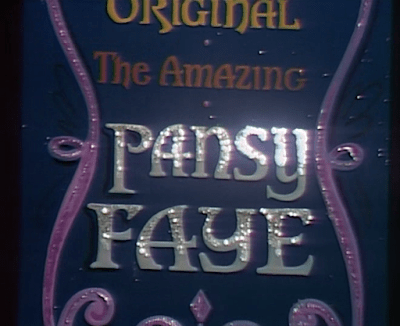
The dream sequence is like nothing we’ve seen before on Dark Shadows, though it is strongly reminiscent of the kind of thing you would have seen on near-contemporary shows like ABC’s prime-time horror anthology Night Gallery hosted by Rod Serling and the Paulist Fathers’ syndicated morality plays Insight hosted by the Rev’d Fr Ellwood Kieser. It starts with a closeup of a sign on which Pansy’s name is emblazoned in glittery letters, and plays over a soundtrack of an audience applauding thunderously. Pansy calls Judith, Barnabas, and Carl to join her on stage, each in their turn; their behavior in this drama-within-a-drama mirrors their behavior in the framing narrative.
Meanwhile, Barnabas’ unwilling sidekick, broad ethnic stereotype Magda Rákóczi, has returned from Boston. There, she met with a leading member of the Romani people, whose name she alternately pronounces as “King Johnny Romana” and “King Johnny Romano.” She shows Barnabas a box she took from King Johnny. It contains a severed hand wearing a ring, which Magda declares will solve their troubles. Magda has placed a curse on Judith and Carl’s brother Quentin, turning Quentin into a werewolf. After placing that curse, Magda learned that her sister Jenny had borne two children to Quentin, and since the curse is hereditary she is desperate to find a way to lift it. Barnabas traveled back in time to 1897 in the course of his own attempt to resist the effects Magda’s curse will have in 1969, so they are allied in this effort.
Barnabas is utterly unimpressed with the hand and with Magda’s plan to place it on Quentin as he is about to transform. He seems convinced that Magda is just trying to conceal the fact that she failed to find anyone in King Johnny’s camp who could actually help them. He doesn’t care about the original owner of the hand, a legendary nobleman named Count Petofi who was himself cured of lycanthropy, or about an incantation Magda says over the hand that is supposed to prepare it to draw the curse from Quentin. He isn’t even interested when she admits that she stole the hand from King Johnny and that if they don’t get it back to him before he realizes it is missing he will send someone to kill her. He reacts as if the whole thing is a show she is putting on to build up her cover story.
In a metafictional set of way, Barnabas is onto something. The original storylines the writers had prepared for the 1897 segment are coming to a head. Several of its major characters have already died, and others, such as Carl, would not be very attractive customers for a life insurance salesman. Apparently the original flimsies, written six months ago, gave only a few more weeks until Barnabas was to return to 1969 and take the show back to contemporary dress. But 1897 is a hit. The ratings are soaring, and there are some dynamics among the characters that they want to explore in a lot more depth. So they want to stay, but to keep the momentum going they need more story and a number of new characters, including a major villain whom Barnabas and Quentin can team up to fight together. So the writers find themselves in the same position with regard to us that Magda is in with regard to Barnabas, trying to sell us on their latest preposterous brainstorm.
Pansy’s farewell performance in Carl’s dream is, alas, Kay Frye’s final appearance on Dark Shadows. Some fans seem unable to look past Pansy’s own hilariously inept performance when we first see her doing her act, and to see that Miss Frye herself does a terrific job playing a cold, cynical working girl. She is good today, when Pansy is on stage and in her character as the “world-famous mentalist and singer,” but is also trying to tell Carl the truth about Barnabas. I only wish they could have brought Miss Frye back as someone else, either in the extended 1897 segment or in another time period.
For the first several months of Dark Shadows, heiress Carolyn Collins Stoddard made no attempt to conceal her loathing of her young cousin, strange and troubled boy David Collins (David Henesy.) That changed at the beginning of 1967, during the storyline centered on David’s mother, undead blonde fire witch Laura Murdoch Collins. Laura cast a spell that caused Carolyn’s mother, reclusive matriarch Liz (Joan Bennett,) to enter a catatonic state. When that happened, Carolyn assumed responsibility for the family’s properties and enterprises. In that position, Carolyn took on a new maturity, and the capricious and often thoughtlessly cruel character we knew in the early days was gone forever.
Laura went up in smoke in March 1967, and the next month vampire Barnabas Collins succeeded her as the show’s supernatural menace. The adults in the great house of Collinwood- Liz, Carolyn, David’s father Roger, and well-meaning governess Vicki- were all taken with Barnabas. Liz gave him the Old House on the estate to live in, and none of them could see the abundant evidence that their distant cousin was a bloodsucking ghoul from beyond the grave. But the ghost of Barnabas’ nine year old sister Sarah appeared to David and led him to suspect that something was off about the new arrival. By late September, David had all but solved the puzzle, and was trying to get the grownups to see the obvious.
In #335, broadcast in October 1967, a psychiatrist named Dr Fisher came from Boston to examine David. Dr Fisher explained Sarah as an imaginary friend David had created in his attempt to control the fear of death he had developed after seeing his mother burn up, and his claim that Barnabas was an undead monster as that fear reasserting itself. We know that this is entirely wrong as far as David goes, but it does go a long way towards explaining the appeal Dark Shadows has for its audience.
In November 1967, Vicki came unstuck in time and Dark Shadows turned into a costume drama set in the late eighteenth century. When she came home and the show returned to contemporary dress in March 1968, David’s understanding of Barnabas and the resulting danger Barnabas would kill David, which had been the chief driving force of the action when she left, had been forgotten. Later that month Barnabas was freed from the effects of the vampire curse, and he set about fighting other uncanny monsters.
Now we are in the fourteenth week of the show’s second major costume drama segment. In late 1968 and early 1969, the malign ghost of Quentin Collins ruined things for everyone. David was under his possession and on the point of death when Barnabas decided the time had come to sit in his basement, throw some I Ching wands, and meditate on them. As a result, he found himself in the year 1897, when Quentin was a living being.
Barnabas has again managed to install himself as master of the Old House, though the Collinses of 1897 are a much less trusting lot than are their descendants in the 1960s. Barnabas and Quentin are becoming friends, but Quentin is increasingly irritated with Barnabas’ refusal to tell him anything about himself beyond the cover story that he concocted when he arrived. The owner of the house, spinster Judith Collins (Joan Bennett,) is more or less satisfied with that story, but her nephew and presumptive heir, twelve year old Jamison Collins (David Henesy,) has come to share Quentin’s belief that there is far more to Barnabas than meets the eye.
Today, Judith approaches Barnabas with a question. She says that Jamison has awoken from a terrible nightmare, and that while he was thrashing about in bed he called out “David Collins is dead!” This comes as a shock to Barnabas, suggesting a message from the future that he has already failed in his weird mission.
Judith has never heard of anyone named “David Collins” and can find no record of such a person, and asks Barnabas if he, who seems to know so much about the family history, has ever heard of an ancestor with that name. This will be of interest to longtime viewers. In #153, it was established that David was the first of his name in the Collins family, and that his mother, undead blonde fire witch Laura, had insisted on calling him that. This would eventually become evidence that Laura’s evil plans for David were in place long before he was born. But in #288, David would see a portrait of a long-forgotten ancestor named “David Collins” in an old volume, and would wonder if he was named for him. The name “David” had such a profound significance in the Laura story that it seemed like a major retcon when David delivered the line, but nothing came of it. Another iteration of Laura was on the show recently, and it seems we are back to the original understanding of how David got his name.
Shaken, Barnabas says that “David Collins is no one who exists!” Judith reacts to his obvious shock and his odd phraseology with the suspicion you would expect it to elicit, but still urges Barnabas to talk with Jamison. By the time she gets the boy to the drawing room, Quentin has joined Barnabas there and is sniping at him about his interest in the family. When Barnabas asks Judith and Quentin to leave him alone with Jamison, Quentin resists, demanding to know why they can’t stay. Barnabas doesn’t give much of an explanation, and it seems to be only Judith’s unwillingness to let Quentin win any argument that leads her to insist that Barnabas get his way.
As it turns out, the reason Judith and Quentin had to leave is that the dream will be played for us as a flashback, and Joan Bennett and David Selby feature in it. We have seen a great many dream sequences on Dark Shadows, but this is the first time one has been presented in retrospect while the dreamer is telling us about it. All previous dream sequences have begun with a character in bed and have shared that character’s experience with us. Several times, including the countless sequences during the “Dream Curse” storyline of April to July 1968, there was a vague possibility that the person would either die during the dream or wake from it irreversibly changed. So even longtime viewers might be surprised when Jamison sits down with Barnabas, starts talking, and we find ourselves in his dream.
Jamison doesn’t know it, but his dream is set in 1969. After Quentin’s ghost made the great house uninhabitable, the family took refuge in the Old House. Jamison goes to its basement, where he sees Barnabas immobilized before the I Ching wands. Unable to get his attention, he goes upstairs to the front parlor, where Carolyn, Liz, and Roger are preparing a birthday party for David. Carolyn is opposed to the exercise. She manipulates a hand puppet while making unpleasant remarks in a high-pitched voice, and says that “Birthdays are for people who get older!” Evidently time is passing in 1969 while Barnabas is struggling with his mission in 1897.
When Vicki was in the 1790s from November 1967 to March 1968, we did not catch any glimpses of the period she had left. Only for a few minutes immediately after she vanished and a few more immediately before she reappeared did we see the drawing room at the great house, and those minutes represented the whole passage of time the contemporary characters experienced during the four months of Vicki’s absence. We’ve already been in 1897 longer than we were in 1795-1796 then, and Jamison’s dream suggests that contemporary time is passing more rapidly now. Since David was within hours of death when Barnabas departed so many weeks ago, his prognosis would seem grim.
The dream is one longtime viewers can imagine David having. Carolyn has been friendly to her little cousin since early 1967, but she was so nasty to him in 1966 that he might well imagine her being impatient with his failure to finish dying sooner. Roger was even more openly hostile to David in those days, and only began to show normal fatherly feeling for him after he realized that he had narrowly escaped death at Laura’s hands. But even though David returned Roger’s open hatred and tried to kill him, he did after all retain a wish for a healthier relationship with him, and so it is not surprising that Roger would appear in a dream of his as someone wishing him well.
David wonders where Barnabas and Quentin are. The adults say that Barnabas is away, but do not recognize Quentin’s name. Roger looks Quentin up in a volume of family history, and finds that there is no entry for him. He declares that this means that there can never have been any such person. Again, if we think of this as a dream of David’s that has intruded itself onto Jamison’s consciousness, it makes sense that Roger, and for that matter Liz and Carolyn, are clueless about what is really going on around them.
Roger can find no reference to Quentin in the family history. Screenshot by Dark Shadows Before I Die.
Quentin appears, at first as the unspeaking ghost he was in when we first saw him from December 1968 to March 1969. Roger, Liz, and Carolyn vanish, and David talks with Quentin. Quentin says that the Roger, Liz, and Carolyn could not see him because he is dead, and that David can see him because he will soon be dead.
Quentin tells David that his own death was preceded by three events, and that if he had understood the significance of any of those events at the time he might have survived. The first event was the discovery of a silver bullet at Collinwood. The second was the murder of someone who might have been able to help him. The third was the turning of the one person he truly loved against Quentin; when that happened “there was almost no time left for Quentin Collins.”
Jamison asks Barnabas what the dream means. Barnabas claims not to know. Jamison replies that he thinks Barnabas knows exactly what it means, and is very upset with him for refusing to share his knowledge. In #660, David had said that “Barnabas knows lots of things he doesn’t tell anyone”; Jamison has already caught on to this same fact.
One of the people with whom Barnabas will not share his knowledge is Quentin. Even though Quentin’s ghost explicitly said in Jamison’s dream that his own demise could have been prevented, and Barnabas’ mission therefore completed, had he known about the three upcoming events, Barnabas flatly refuses to tell Quentin about them. Even when the silver bullet is discovered at Collinwood at the end of the episode, Barnabas still will not pass the dream’s warning on to Quentin.
Instead, Barnabas reenacts Dr Fisher’s part from #335. He seizes in Jamison’s description of the 1960s wardrobe he saw David, Roger, Liz, and Carolyn wearing, and says that it is the key- it shows that the whole scene is a masquerade. As Dr Fisher had said that Sarah Collins was an imaginary figure David had fabricated to contain the fear of death that had afflicted him since he saw his mother Laura die, so Barnabas claims that David Collins is a figure Jamison has fabricated to contain the fear of death that had afflicted him since he saw his mother Laura die. As Dr Fisher’s interpretation was all wrong in-universe but was quite plausible as an explanation of the audience’s responses to the show, so Barnabas’ interpretation is a grotesque lie in-universe but is quite plausible as writer Violet Welles’ description of the creative process that led to the decision to reuse Laura in the 1897 segment of the show. It allows them to pair David with Jamison and Roger with Edward, comparing and contrasting their personalities.
In the parts of Dark Shadows set in the 1960s, Louis Edmonds plays Roger Collins, younger brother of matriarch Elizabeth Collins Stoddard. In 1966 and 1967, we saw that Roger had squandered his entire inheritance. He was reduced to living as a guest in Liz’ house and working as an employee for her business. Roger was the show’s first villain. His villainy was confined to a storyline known as “The Revenge of Burke Devlin.” That story never really caught on, and by #201 even Burke Devlin had lost interest in it. Roger receded to the margins, and for the rest of the series Edmonds’ gift for sarcastic dialogue kept the character alive as occasional comic relief.
From November 1967 to March 1968, Dark Shadows was a costume drama set in the 1790s. Edmonds, a costume drama specialist in his years on Broadway, came into his own as haughty overlord Joshua Collins. Joshua’s focus on moneymaking and his determination to preserve the glamour of the Collins family name at all costs placed him at the opposite pole from Roger, a blithe spendthrift pathologically lacking in family feeling. Joshua used his power to cover up all of the tragic and horrible events we saw in the 1790s segment, and imposed a false history in its place.
Now, the show is set in 1897. Edmonds plays Edward, the stuffy eldest brother of the adult members of the Collinses of Collinsport. Edward has Joshua’s imperious demeanor and his determination to conceal the family’s disgraces, but like Roger he finds himself penniless, dependent on his sister’s largess. Yesterday he learned that his youngest brother, libertine Quentin, had killed his estranged wife Jenny. So far, Quentin has been a breezily amoral wastrel, easily recognizable to longtime viewers as a kindred spirit of his great-nephew Roger. But Quentin shocked himself when he murdered Jenny, and he had a terrified look on his face as he tried to sneak out of the house afterward.
Edward intercepted him then and forbade him to go. Edward had learned from Quentin’s girlfriend, Jenny’s former maid Beth, what happened. Edward was in a high dudgeon about the mess Quentin had made, but did not seem particularly surprised or at all grieved. He was quite confident he would be able to hush the whole thing up, and fabricated a story about Jenny falling down the stairs and dying shortly after from a head injury.
What did shock Edward was Quentin’s revelation that Jenny was the sister of one of the neighbors, Magda Rákóczi. Magda is a member of the Romani people, an ethnicity against whom Edward and the rest of the Collinses are violently prejudiced. “You married a Gypsy!” he exclaims in utter disgust. He remained convinced that he could keep the whole thing quiet, and drilled Beth and Quentin in the lies they were to tell Magda and her husband Sandor.
Magda did not give Edward a chance to direct the little play he had written. She found physical evidence indicating Quentin had murdered Jenny, and accused him. When she threatened to go to the police, Edward asked her what she imagined the authorities would do when asked to choose between the word of a Collins and the word of a “Gypsy.” At that, Magda dropped her plan to go to the police and vowed to place a curse on Quentin. Edward dismissed that as “words,” but Quentin is deeply involved in the occult. He is helpless with fear.
Today, Edward calls on Quentin in his room. He finds that Quentin has not slept all night. He continues to regard Quentin’s fear of Magda’s curse with total contempt, but perks up when Quentin says that he has thought of a way to escape it. Returning viewers already know that there is one way wide open to Quentin to escape the curse. He can go to the police and confess that he murdered Jenny.
This, of course, is not Quentin’s idea. He wants to offer Magda $10,000. Neither he nor Edward has that kind of money, but their sister Judith, whom their grandmother chose as her sole heiress, does. Edward says that he might be able to persuade Judith to give him that sum on one condition. Their grandmother’s will left Quentin no property or income, but it did guarantee him the right to live in the great house of Collinwood as long as he might wish. If he will sign documents renouncing that right, Judith might give him the money.
Quentin drifts off to sleep. He has a nightmare. Sandor and Magda show him Jenny’s body and tell him he can escape punishment if he blesses it. He does so, and Jenny comes back to life. She asks for a kiss. Quentin gives it, and Magda and Sandor laugh. They say that the kiss has sealed his fate- it is “the kiss of death!”
Edward returns with word that Judith will give him his $10,000, but that she has added a condition. Not only Quentin, but Sandor and Magda too, will have to leave the area forever. Quentin promises to make that happen, and signs the papers.
Meanwhile, Magda and Sandor are at home in the Old House on the grounds of the estate. Magda has mixed a potion and told Sandor that “a very old Gypsy woman” once used it to place a terrible curse on someone called “Count Petofi.” All they have to do is trick Quentin into drinking the potion, and the same curse will befall him. Sandor disdainfully replies that he had thought Magda might have come up with a plan that had a chance of working. He can’t imagine Quentin drinking anything they might give him.
They look out the window, and see Quentin coming to the house. They are pleasantly surprised that he is delivering himself. He knocks. They open the door, and he bursts in. Magda makes a great show of telling him he is not welcome and demanding he leave. He tells them about the nightmare, and says he knows that it is part of the curse. He offers them money to lift it. Magda is at first openly offended, while Sandor behaves as if he is tempted. Quentin shows them the money, and Magda plays the part of a woman succumbing to greed. She asks Jenny’s spirit to forgive her, and takes the envelope. She makes a gesture that Quentin takes to be an act of spellcasting. While she counts the money, Sandor says they will have to share a drink to complete the deal. Quentin happily agrees.
Once Quentin has taken the drink, Magda tells him that he has been fooled. The nightmare was not part of any curse, but was simply the voice of his own conscience. She tells him that the drink brought the curse on him, and that he will begin to suffer its effects tonight. She throws the money at him and tells him to take it. He reels away, dazzled by the horror of it all.
Magda’s curse shows the limits of the Collinses’ power. Their prestige and connections enable them to intimidate the authorities so that they need not worry about an insistent police investigation. But their freedom from that concern has allowed Quentin to travel so far into depravity that he has committed murder and brought a curse upon himself. When they encounter someone who will not be intimidated, their only recourse is to money. Magda’s unwillingness to sell her sister’s vengeance for any number of dollars means that the rich Judith would be as powerless against her as are the impecunious Edward and Quentin.
Not only has the Collinses’ station led Quentin to indulge himself in one vice after another until he is so far gone he cannot imagine good behavior, it has led him to assume that everyone assigned to a humbler place in the world can be bought. Sandor and Magda are quite good actors, almost as good as Thayer David and Grayson Hall, and they look very much like people who are tempted to take the bribe Quentin is offering. But even to make the offer shows a complete lack of perspicacity. Jenny has not been dead for twenty four hours, and he somehow supposes her sister is ready to bargain away her memory.
Quentin cannot say he wasn’t warned. His dream told him that Magda and Sandor would trick him into bringing the curse on himself by leading him to believe they were giving him a way to escape the curse. He is so far gone in the symptoms of his over-privileged background that he cannot even interpret this message. Thus we see that the real curse of the Collinses, the obstacle that blocks the sunlight and casts all the dark shadows that shroud them, is their wealth and power. The first ten months of the show made some feints towards developing a social drama about the relations between the Collinses in their house on the hill and the working people in the village below. The village is mentioned nowadays only as a source for victims of the various monsters bred at Collinwood, but the price everyone pays for the Collinses’ exalted position is always front and center.
Well-meaning time traveler/ bloodsucking ghoul Barnabas Collins has met Laura Murdoch Collins in 1897, and has recognized her as the Laura Murdoch Stockbridge he knew when he was a ten year old boy in 1767. The audience knows that she is also the Laura Murdoch Radcliffe of 1867, and the Laura Murdoch Collins who was on Dark Shadows as its first supernatural menace from December 1966 to March 1967. We learned in that period that Laura is an undead blonde fire witch who incinerates herself and a young son of hers named David at intervals of exactly one hundred years so that she- but not the Davids- will rise from the ashes as a humanoid Phoenix.
We have already seen two major retcons of Laura’s story as it was told in 1966-1967. The precise regularity of her one hundred year cycle was stressed heavily in those days; it was not only the central piece of evidence that led the other characters to figure out what was going on and rise up against her, but was also the first instance of Dark Shadows using anniversaries as a way of creating suspense when the supernatural elements of the story meant that the usual patterns of cause and effect did not apply. Laura’s presence in 1897, thirty years off her established cycle, tosses all of that into a cocked hat.
Moreover, her identity as the wife of stuffy Edward Collins and mother of twelve year old Jamison and nine year old Nora Collins is also incompatible with the previous story. The Stockbridges were supposed to have been, in their day, among the most prominent families in the part of Maine where the great estate of Collinwood sits. But the fire in which Laura and David Stockbridge went up in smoke occurred two hundred years before. In the USA, that is a long enough interval for anything to be forgotten. Laura and David Radcliffe met their demise only half as long before, but the Radcliffes do not seem to have been quite as well-known or as close geographically to Collinwood as were the Stockbridges. So we could believe that when the twentieth century Laura Murdoch showed up in Collinsport in the 1940s or early 1950s, no one there would have remembered her namesakes. But we saw in #684 and #685 that there were still elderly people around Collinsport in the late 1960s who remembered 1897 quite well. And Jamison was himself the father of Elizabeth Collins Stoddard and Roger Collins, the adults at Collinwood in the 1960s. It is not plausible that no one would have said anything when in 1956 Roger, the only son of the family that owns the town, married a woman named Laura Murdoch who was the exact double of his grandmother who was also named Laura Murdoch.
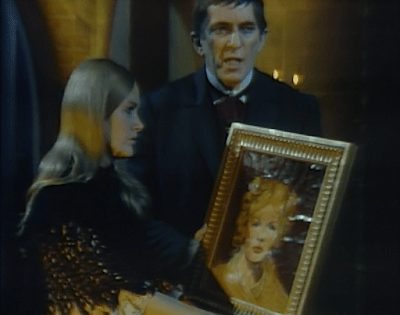
The show doubles down on that implausibility today, when Barnabas summons his blood thrall Charity Trask to look at a portrait he has found in the Old House at Collinwood. It shows Laura Stockbridge, and is a perfect match for the Laura they have met. Barnabas says that Laura was the first wife of his uncle Jeremiah, and that he himself was ten years old when she came to Collinwood.
This gives us a Laura who does not marry into various leading families of the region, but into the Collinses over and again. That makes a kind of sense- the show has not developed any other leading families, not even as characters who are only mentioned but never appear. The Collinses now make up the entire local upper class. In #474, permanent houseguest Julia Hoffman called the Collinses “a very inbred family”; I don’t think she meant that in quite the sense which this new version of Laura is giving it, but as they move towards a dramatis personae that is all-Collins all the time there’s no escaping it.
It also represents a reverse retcon. When Barnabas talked about Jeremiah in his first months on the show, he said that when he was a young man Jeremiah was an old one, and that Jeremiah’s beautiful young wife fell in love with him. But when from November 1967 to March 1968 Dark Shadows became a costume drama set in the 1790s, we saw that Barnabas and Jeremiah, though nephew and uncle, were virtually the same age. With Jeremiah marrying Laura when Barnabas was ten, we return to the previous conception of their ages.
Barnabas’ first conversation about Laura today with Charity is interrupted when another undead blonde fire witch turns up. She is Angelique, who in the 1790s turned Barnabas into a vampire in the first place. She introduces herself to Charity as Barnabas’ fianceé, which prompts Charity to run away and go to bed. Angelique then tells Barnabas that he ought to leave Charity alone, because her father, the Rev’d Mr Gregory Trask, can make trouble that will defeat his mission. Barnabas starts to explain how bad Trask is, to which Angelique responds that he has one job and he’d better stick to it if he is to have any hope of success. She tells him that he will have to settle for blood slaves he selects from among the girls at the docks, girls who have nothing going for them “and above all no fathers.”
Charity, asleep in an upstairs bedroom in the great house of Collinwood, has a dream in which she is getting married. She is in fact engaged to marry a man named Tim, but in the dream Angelique tells her that she is not marrying Tim. She is, instead, to be the bride of Death. This is a very old image indeed; one of the main motifs that runs throughout Sophocles’ Antigone is that the heroine, engaged to marry Haemon, her first cousin (both simple and once removed- Antigone is the daughter of Oedipus and Jocasta, so she knows from inbred families) will instead be married to Death itself. At the climax of the dream, Barnabas bares his fangs at Charity.
Charity’s father comes to the great house. He meets Angelique, who identifies herself as Barnabas’ fiancée and charms him. She urges him to see to it that Charity marries Tim as soon as possible, and warns darkly that there are many kinds of flames burning around them.
The mistress of the house, spinster Judith Collins, then enters and explains to Trask that Charity is still in bed. Trask is shocked by this “sloth” (which he pronounces “slowth,”) but Judith explains that Charity is ill. Judith is sure Charity will be fine after a day of rest. Judith tells Trask that she is deeply saddened that his boarding school has burned down. She offers Trask a great deal of money to rebuild it, and the use of a house on the estate as temporary quarters for the school in the meantime. Trask is delighted. When Judith mentions that his wife Minerva had said that his health was poor, Trask says that it is in fact Minerva whose health is poor, and getting worse. The audience knows that Trask is evil, and many will interpret this remark as a sign that he plans to hasten the deterioration of Minerva’s physical condition.
Judith takes Trask to Charity’s bedroom. They are shocked to find her gone. Judith is sure that she wandered off in delirium, but the filthy-minded Trask raves that she must have set out on some errand of grievous sin. He’s right about the sinfulness, though wrong to focus the blame on Charity- she has answered Barnabas’ summons and is with him in the Old House.
Charity comes back to the great house. Her father is ranting at her when she collapses. He looks at her neck, and finds the bite marks. Perhaps Angelique’s warning to Barnabas came too late.
Libertine Quentin Collins has learned that his estranged wife, madwoman Jenny, is being kept locked up somewhere in the great house of Collinwood. He learned this when Jenny escaped and stabbed him. He also learned that his brother, stuffy Edward, and maidservant Beth Chavez are involved in the plot to keep Jenny in confinement. He spends time today trying to find out where Jenny is, openly telling both Beth and Edward that when he finds her, he will kill her.
Edward is estranged from his own wife, and just yesterday we learned that her name is Laura. Evidently she is the same sort of creature as we came to know from December 1966 to March 1967. In those days Dark Shadows was set in contemporary times, and Edward’s grandson Roger Collins was dismayed at the return of his estranged wife, who was also named Laura. That Laura was an undead blonde fire witch, a humanoid Phoenix who sought to be incinerated with her son, strange and troubled boy David Collins, so that her own life could be renewed.
Today, the year is 1897 and Edward and Laura’s nine year old daughter Nora is convinced that her mother will return after a year when she has been away and it has been forbidden to mention her name. Nora has a vision of Laura’s face in the fireplace, a vision of flames in the corridor, and a dream in which she meets Laura in the woods outside the house. At the end of the episode she wakes up, sneaks out to the woods, and finds the cloak Laura was wearing in her dream lying on the ground.
All of this is recapped from previous episodes, but actors David Selby, Louis Edmonds, and Denise Nickerson make it worth watching. As Beth, Terrayne Crawford is stiff and literal, and her awkward performance does detract from her scenes. But everyone else is so good that you don’t notice her weaknesses too much.
This episode marks the second time we hear the name “Mrs Fillmore.” In #707, we learned that Beth took substantial sums of money into the village of Collinsport to a lady of that name as part of the plot to cover up Jenny’s presence in the house. Today Beth has to remind Edward of that fact, and Quentin looks through the envelope with hundreds of dollars in banknotes meant for Mrs Fillmore.
When Nora screams that there is a fire in the upstairs hallway, Edward and Beth run towards it. Quentin just sulks in the drawing room; evidently the idea that the house is on fire bores him. By the time Beth and Edward get upstairs, the flames Nora saw have vanished, and nothing is burned. She swears that there was a fire, they cannot believe her. This echoes #400, when wicked witch Angelique cast a spell that caused time-traveling governess Vicki to see flames in her room in the Old House on the estate, and subsequently Vicki’s friends were puzzled that there was no indication there of anything burned. That confusion led to trouble for Vicki, and longtime viewers can imagine it is a sign of trouble for Nora as well.
Yesterday, Nora drew a series of Egyptian hieroglyphics saying that her mother was coming home. At the beginning of her dream, a maniacal Edward holds an oversized copy of that drawing and rips it up, declaring Laura will never be back. The oversized drawing harks back all the way to episode #722, when Nora’s governess, neurotic intellectual Rachel Drummond, had a dream in which the daffy Carl Collins held a gigantic pocket watch. That was a striking enough image that not even the Vaseline almost entirely covering the lens could ruin it. But today even less of the picture is legible, and the gambit isn’t fresh anymore. Louis Edmonds does do a fine job of laughing maniacally, though, I will grant that.
The picture really does look like that, and it is supposed to look like that. Director Henry Kaplan was not much of a visual artist. Screenshot by Dark Shadows Before I Die.








 Dark Shadows Commentary