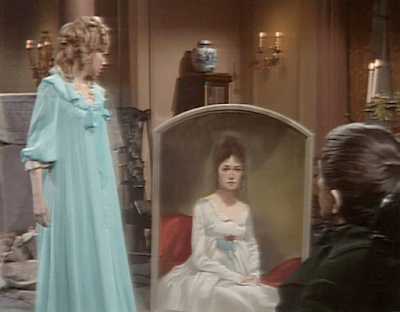
Episode 772: Apologies are the Devil’s invention

The opening voiceover plays over this image, a type of visual effect we have not seen before at the beginning of an episode:
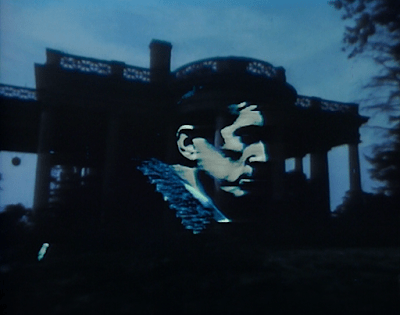
A transparent sticker of Barnabas superimposed on the exterior of the Old House. Screenshot by Dark Shadows Before I Die.

Barnabas Collins has bitten dimwitted servant Dirk Wilkins, turning Dirk into a vampire like himself. Barnabas has been out all night, searching for Dirk’s hiding place. He hopes to expose Dirk and frame him for his own crimes.

Barnabas comes home to the Old House on the estate of Collinwood to find that Dirk seems to be trying to do the same thing to him. There is a blood-drained corpse in an armchair in his front parlor. It is that of Miss Pansy Faye, Cockney showgirl and Dirk’s first victim.

Barnabas’ distant cousins live in the great house on the estate. One of them, prankster Carl Collins, brought Pansy home with the intention of making her his bride. No sooner does Barnabas discover Pansy’s remains than Carl starts banging on the front door, shouting that he wants to speak with her.

Barnabas hides what’s left of Pansy in a secret chamber behind a bookcase, then lets Carl in. Grisly as the circumstances are, one person lying to another about the presence of a third nearby is a stock situation from farce, and John Karlen and Jonathan Frid play the scene with the particular brand of desperate seriousness that only works in farce. Barnabas persuades Carl to go away and search the grounds of the estate.

That takes a few minutes, starting from what the opening voiceover told us in so many words was “an hour before dawn.” In what remains of that hour, Barnabas takes Pansy’s body to a cemetery and buries her in a shallow grave between tombstones, telling her to “rest in peace.”

Barnabas buries Pansy. Screenshot by Dark Shadows Before I Die.

Barnabas comes home, and finds Carl, who has in the interval not only gone to the great house, the groundskeeper’s cottage, and a house on the estate which is currently occupied by a school, but has also gone into the village of Collinsport and made inquiries about Pansy. A speedy bunch, the Collinses.

Before Barnabas returned to the house, Carl had heard Pansy’s disembodied voice singing the song she had so memorably performed for Barnabas in yesterday’s episode. He had spoken to Pansy’s voice telling her that his grandmother’s will gave him a house to live in and that she could live there with him. This is puzzling for returning viewers. In #714, it was made perfectly clear that the will did not mention Carl at all. Edith Collins left her entire estate to Carl’s sister Judith, and the only one of the brothers who was mentioned was Quentin, who received no money or negotiable assets of any kind but who was guaranteed the right to stay at Collinwood as long as he pleased. Perhaps they are retconning that away, perhaps Carl is lying to Pansy, or perhaps Carl is losing his grip on reality.

Whether or not we are supposed to doubt Carl’s sanity, Barnabas talks Carl into suspecting that he might have hallucinated Pansy’s voice. Carl leaves, and Barnabas has time to return to his coffin before dawn.

The rest of the episode is taken up with doings at the school Carl had visited. We saw Carl questioning Charity Trask, daughter of the school’s master, the overwhelmingly evil Gregory Trask. The prim Charity was exasperated that Carl kept asking about Pansy after she had already denied having seen her. The scene is an interesting one- Charity and Pansy are such total opposites that it is a shame they never met. It would be amusing to see them juxtaposed.

Charity is engaged to marry Tim Shaw, a teacher at the school. Neither of them is happy about this situation. Tim was in love with Rachel Drummond, another of the teachers, and Charity is Barnabas’ blood thrall. But Gregory blackmailed Tim and bullied Charity into accepting the arrangement.

Charity’s mother, prudish Minerva Trask, does not like Tim or want him as a son-in-law. She urges Charity to set her sights on Carl. Charity says that she would rather marry Barnabas; Minerva says that her instincts are sound, but that she ought not to settle for a cousin of the rich Collinses when one of the brothers is available. Even if they have retconned Carl into owning a house, he is clearly not a rich man, so this reveals that Minerva knows as little about his financial position as she does about the curse under which Barnabas labors.

Charity tries to engage Tim in conversation, and is baffled that he is not willing to talk to her. Indeed, he does not seem like himself at all. Not only is he dismissive with Charity, but when Minerva confronts him he is bold and insolent, a far cry from the broken man we have seen interacting with the Trasks previously. When Charity tells him their engagement is off, he does not express the relief that she and we expect, but puts on a stagey voice we have not heard him use before and marches off to apologize to her mother.

There is a reason for Tim’s behavior. Gregory enlisted warlock Evan Hanley to brainwash Tim so that he would kill Minerva. There is some business with the Queen of Spades, first when Tim mutters the phrase “Queen of Spades,” then when Evan sends him a note on which is scrawled “Queen of Spades,” and lastly when he walks in on Minerva playing solitaire and sees her turn up the Queen of Spades. Many viewers in 1969 would have remembered Richard Condon’s 1959 novel The Manchurian Candidate and its 1962 film version. In Condon’s novel, Raymond Shaw became a robot capable of murder when he saw the Queen of Hearts; in the film, the card was the Queen of Diamonds. Many first time viewers, seeing Tim Shaw’s reaction to the Queen of Spades, would have made the connection and understood why he ends the episode by poisoning Minerva’s tea.
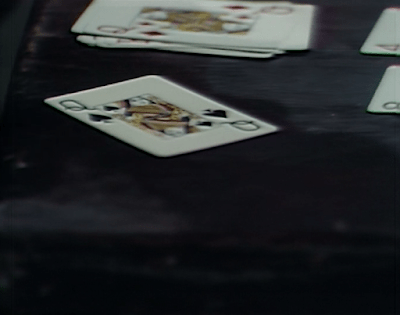
Is this your card? Screenshot by Dark Shadows Before I Die.

Tim Shaw differs from Raymond Shaw in that he is under a spell for a long while, including the whole time we see him today, and he can talk and act independently while it operates on him. Raymond simply became catatonic when he saw the card and remained that way until he heard a command. He then executed the command and came back to himself once he was finished. Tim’s behavior may suggest a nod to another literary work, Pushkin’s story “The Queen of Spades.” That tale, which Tchaikovsky turned into an opera and which in 1949 was made into a feature film, is about a timid man who inadvertently kills a powerful woman and loses control of himself as a consequence. Like Tim, Captain Herman is coerced into marrying a woman he does not love. Presented with an opportunity to get out of the marriage, he finds himself making extraordinary efforts to go through with it, efforts which bring about his ultimate downfall.

Episode 674: When there is a moon

Heiress Carolyn Collins Stoddard is attracted to mysterious drifter Chris Jennings, so much so that she has set Chris up in the caretaker’s cottage on the estate of Collinwood. Today, Carolyn’s friend Donna Friedlander is visiting her. The day’s main action is a classic farce plot. Donna wants Chris to drive her home to Bangor, Maine, but in order to keep a secret from her he makes a series of increasingly frantic attempts to avoid doing so. In the end Donna doesn’t get her ride, and Chris doesn’t keep his secret.

The episode deviates from the typical farce in that Chris is not a man trying to keep his or his roommate’s girlfriends from finding out about each other. He is a werewolf, and the Moon is full. If Donna is with him after dark, he will kill her, as he has already killed an unknown number of people in the last several years.

Donna is a student of interior design, and Carolyn is showing her around the great house. We first see her when Carolyn brings her into the study. Chris is in the room with his sister, nine year old Amy, who has been staying at the great house. Chris is distracted, abrupt, and rude with Donna. His manner grows even less inviting when he sees an inverted red pentagram on Carolyn’s face, typically the sign that the person will be the werewolf’s next victim. His eyes bug out, he breaks into a sweat, and turns his back on the ladies, stalking off to stare out the window.

Donna and Carolyn leave the room. In the hallway outside the study, Donna exclaims “Wow!” and exhales as if she were very worked up. She tells Carolyn that Chris is her type. She summarizes that type as “moody”; a more fitting description of what Donna saw of Chris’ behavior would be “not interested,” but hey, I’m not the sex police. If Donna gets excited by foul-tempered guys who ignore her and want her to go away, that’s none of my business.

Donna expresses her interest in Chris.

The little space in which Donna tells Carolyn she is attracted to Chris is a new set. We’ve been seeing a lot more of these tiny nondescript corners representing hallways lately, and Donna’s identification with interior design makes us conscious of this one. In #664, they even had actors walk from one set to another through some undecorated studio space that they tried to persuade us was a corridor. It seems they are developing a strategy to make us feel that the great house is a bigger place than they have managed to create in our minds just by cutting from one room to another.

Complicating matters for Chris are old world gentleman Barnabas Collins and mad scientist Julia Hoffman. Barnabas has figured out that Chris is the werewolf, and today explains this to Julia.

Barnabas uses the word “werewolf” as he is bringing Julia up to date. This represents a departure from the show’s previous practice. Barnabas was himself a vampire when he first came on the show in #211, but they didn’t use the word “vampire” for 40 weeks, until #410. They aren’t afraid of vocabulary anymore.

Julia doubts Barnabas’ interpretation of the facts, and he decides to demonstrate his thesis by putting Chris in an awkward position. He invites Chris, Carolyn, and Donna to join him and Julia for dinner at his home, the Old House on the estate. Chris excuses himself by claiming to have a business meeting in Bangor for which he must leave at once. At this, Donna asks for a ride to that town. Barnabas watches Chris’ discomfort with a smug grin, confident that he is being proven right.

Outside the front door of the great house, Chris tries to wriggle out of giving Donna a ride by saying that now he is getting a migraine and will have to cancel his meeting. He offers to give Donna his keys, suggesting she hide them under the front seat when she parks his car at the bus station in Bangor. She initially accepts this, but later comes to the cottage to say she has decided against it. She is there when he transforms, and runs away.

Back in the great house, Barnabas is telling Julia that werewolves are vulnerable to silver weapons, so he will be able to use the head of his cane to control Chris. Julia wonders if Chris may already have left with Donna. Barnabas airily dismisses this, assuring her that he knows Chris well enough to be sure that Donna is perfectly safe. In fact, Barnabas barely knows Chris at all, but he is so pleased with himself for having figured out who the werewolf is that we can see there wouldn’t be much point in reminding him of this. At his leisure, Barnabas sets out for the cottage, which he finds to be unoccupied and in disarray. Donna’s mauled corpse lies in the woods nearby.

We might wonder why Chris saw the pentagram on Carolyn and not on Donna during the scene in the study. Is the show telling us the pentagram is out of order as a warning system? If so, is it just breaking down from overuse, or is some other supernatural presence interfering with it? Or maybe it isn’t automatic, but is a message from some spirit that has guessed wrong this time? They don’t explain, and the pentagram has been a big enough part of the werewolf story up to this point that it produces a lot more confusion than you might expect.

Yesterday’s episode ended with a bewildered Chris finding Amy in the cottage. Amy was listening to a mysterious voice Chris could not hear. Chris’ bewilderment deepened when Amy obeyed the voice’s command to hurry away. He finally discovered that Amy lit a fire in his hearth and burned a shirt of his in it. Chris took us to the final blackout holding the scorched remains of his shirt, giving a look in the direction Amy had fled, and exclaiming “My shirt!” in a pained voice that would make anyone laugh.

Today’s episode opens with a reprise of that interaction, but it is played very differently. Instead of a light scene that ends with a note of comedy, we have a heavier confrontation that builds to a melodramatic shock. Chris is alarmed, not bewildered, to find Amy in his cottage, and his alarm mounts when she responds to the mysterious voice. When he goes to the hearth, he is forceful, apparently angry. He still exclaims “My shirt!” even though the wardrobe department did not provide a shirt, but his voice is not the high-pitched, defeated squawk that had made the end of yesterday’s installment so funny. This is a full-throated baritone shout. The more serious tone of the scene sets us up for an outing that is technically a comedy and is at several turns quite funny, but that finally concerns itself with a matter of life and death.

Donna is played by Beverly Hayes, in her only appearance on Dark Shadows. Miss Hayes’ IMDb page tells us that for a few months in 1965 she was a regular on a soap called A Flame in the Wind, that in 1968 and 1969 she had a recurring part on The Secret Storm, and that after her one shot on Dark Shadows she was absent from the screen for 41 years, returning in a 2010 production called Marathon. Since then she has been in other little-known independent films, including something from 2015 called House of Shadows, which sounds suspiciously like an imitation of Dark Shadows. She also has some writing credits. Donna is perfect as a one-shot, but Miss Hayes does such a good job with her I wish they’d cast her in other roles later on.

Episode 643: Magda, whoever she is

The whole episode takes place within the great house of Collinwood. We start with conversations between heiress Carolyn Collins Stoddard, mysterious drifter Chris Jennings, and sarcastic dandy Roger Collins. They are trying to determine the significance of the events of a séance that took place yesterday, during which Carolyn was possessed by the spirit of someone named “Magda.” This name is unknown to anyone in the house.

Through Carolyn, Magda uttered a command to “Stop them!” because “My curse!” means that “He must stay where he is!” Returning viewers know that Chris’ little sister Amy and Roger’s young son David are in touch with the ghost of Quentin Collins, a great-uncle of Roger’s who lived in the late nineteenth century and whom the family history falsely records as having gone to France and died there. We can assume that Magda was a contemporary of Quentin’s, that he is the one who must remain where he is, and that she means the children when she says “Stop them!” But none of the adult characters knows what Amy and David are up to, and Magda’s words mystify them.

Roger is alone in the drawing room while Carolyn is showing Chris out of the house. He is about to take care of some work he brought home from the office when a book flies off the piano and lands on the floor. He finds a letter tucked in the book. Carolyn comes back, and he tells her what happened. He says that the letter is addressed to his father, Jamison Collins; this is the first time we have heard Jamison’s name. He says that it is dated 1887, when Jamison would have been a boy. And he tells her that it is signed “Quentin.” With a look of recognition, he says “We have a Quentin Collins as an ancestor. Actually, I didn’t know very much about him. I think he spent most of his time abroad.”

Roger reads the letter to her. The text is: “Dear Jamison, you must return to Collinwood. I need your help. You must intercede with Oscar. Only you can save me.” Considering how the book spontaneously leapt from the piano, Carolyn is sure that Magda’s ghost must have wanted them to read the letter, and that she is trying to warn them that someone in the house is in danger. It calls Quentin to their attention.

Roger goes upstairs to check on David. As it happens, Amy is in David’s room at the time, and they are about to go looking for Quentin’s ghost. They know that the adults will not tolerate this, and so David jumps into bed and Amy hides behind the door. There is some farcical business as Roger starts to go, Amy starts to come out, then he stops and she scurries back to her hiding place. Once his father is gone, David tells Amy that it was very unusual for him to drop in. “He never says good night to me.”

When Roger returns to the drawing room, Carolyn, who a few minutes ago announced that someone in the house- “It could be any one of us!”- was in imminent danger, asked Roger why he was “suddenly so concerned about David.” Even longtime viewers who remember Roger as the phenomenally bad father he was in the first 38 weeks of the show will think that this is overdoing it. After all, Magda’s warning to him and Carolyn came in the form of a letter addressed to a boy, and David is the only boy in the house. It is natural enough that the reference to Jamison would bring David to mind.

Amy had slipped into David’s room while he was sleeping. She woke him to say that Quentin was angry because “Something has happened.” She knows nothing about the séance or the conversations going on downstairs, and so cannot share our conjecture that Magda is an old enemy of Quentin’s and it is her activities that are disturbing him. David is at first reluctant to get up and irritated when Amy wants to contact Quentin. As he grumbles at her, they begin to sound like an old married couple, even though they only met on Monday and are eleven years old.

David grudgingly agrees to pick up the antique telephone through which he has heard Quentin’s breath and Amy has heard him speak. The breath is audible, and when he gives the receiver to Amy she hears Quentin says that “she would try to stop” them. He didn’t specify who “she” was, but Amy has drawn the conclusion that they should go to the room in the long deserted west wing of the house where they originally found the telephone and contacted Quentin. Every time David resists her ideas, Amy strikes exactly the note that will lead him to do what she wants. At one point, Amy tells David “You’re braaver than I am!” to which he bluffly replies “Because you’re a girl!” He then presses forward with the plan she had formulated.

You know how kids are, always on their phones. Screenshot by Dark Shadows Before I Die.

The children find that the door they had previously used to get into the west wing is now locked. David says that there is another way in, but that it is a secret very few people know about. He leads her to the door of the drawing room, only to find that Roger and Carolyn are still in there. They hide. Once the coast is clear, David leads Amy to a secret panel behind a chair next to the fireplace. We have seen this panel before, in #87. On that occasion, Roger had used it to sneak into the west wing unobserved and release well-meaning governess Vicki from the room to which David had confined her, hoping that she would die. It was unclear whether anyone other than Roger knew of its existence. We haven’t seen it since. Dark Shadows‘ ratings were very low in October 1966, and most of the people watching now hadn’t heard of it then. So when David says that very few people know about the secret panel in the drawing room, his words apply to the audience as well as to the characters.

David opens the panel. He and Amy go into the passage. When the panel is closed behind them, we see the chair move itself back into place in front of it, suggesting an occult power is at work.

David and Amy encounter various signs of supernatural opposition as they make their way to the room. At one point Amy sounds genuinely frightened and suggests turning back, but she has done her work too well- David is now determined to prove his courage. Once they are in the room, the door slams shut and they find that they are trapped. Longtime viewers who remember what David did to Vicki way back when will see an irony in his captivity in the west wing.

Skillful as Amy is in her management of David Collins, Denise Nickerson and David Henesy haven’t quite figured out how to work together yet. They had very different styles of acting, his coming from inside out as he uses his lines and stage directions to project the character’s feelings and intentions, hers coming from outside in as she throws herself into whatever the character is doing at the moment and finding her inner life through those. She is on top of her form right from the start, but he keeps getting thrown off, atypically mangling his dialogue several times and putting the emphasis in odd places in the lines he does get right. That won’t last long- soon David and Amy will be a “supercouple,” as fun to watch together as any other pairing on the show. But this episode is a bad day at the office for Mr Henesy.

Danny Horn’s post about this episode on his Dark Shadows Every Day takes the bits and pieces of information that will fit well with continuity months down the line, contrasts them with the bits and pieces that won’t, and focuses on a case that the writers didn’t have any plan in mind when they were writing the show. I think Danny simultaneously goes too far and not far enough with this point.

In a 1991 interview that Danny himself put online, writer Violet Welles confirmed that the writing on Dark Shadows, as on other soaps, began with a six month story projection that the writers would break down into “flimsies,” day by day outlines of how it might all play out. No one was going to force them to stick with those projections, much less with the flimsies, but creating them meant that the writers spent a lot of time kicking ideas around for possible plots and possible characters. They also meant that there were stacks of paper recording those ideas, so if someone suggests in November that Quentin might have been enemies with a witch named Magda, it won’t require a feat of memory to recall that suggestion in January. So it is going too far to dismiss all thought of a connection between what the characters say today and what we will see next year.

But he doesn’t go far enough when he suggests that the pressure the writers were under to crank out five scripts a week would have kept them from planning for events we wouldn’t see for several more months. They were indeed subject to impossible deadlines, and they did indeed have to improvise at the last minute. So much so that they did not know whether any given event would happen next week, next month, six months from now, or not at all. They may well have planned a story out in detail thinking they might need it soon, only to have it sit on the shelf until next summer.

I always try to write these commentaries as if I hadn’t seen any of the subsequent episodes, so when I mention foreshadowing I try not to say whether or how it will pay off. I also try to write from a perspective that would have been more or less possible for someone watching the show when it was originally broadcast, so when foreshadowing does pay off or when in other ways an episode echoes something we had seen earlier I try to note that echo first and to speculate about what it might mean later, confining any references to information that became public afterward to the bottom of the post. So I won’t quote the particulars of Danny’s argument, or of my comment on it. I hesitated to say as much as I have about Magda, but when I tried to make the same point without using names the results looked like algebra (“Let x be a ghost and y be a witch. Suppose that x and y lived in the same period; call this period P.”) Since the episode leans so heavily into the relationship between Magda and Quentin today, I resigned myself to the spoiler.

Episode 402: Name the witch

Well-meaning governess Vicki is in jail, about to be tried on a capital charge of witchcraft. That couldn’t happen in the New England that existed in 1795 in our timeband, but many things were possible in the world of Dark Shadows that we don’t see in ours.

Gallant gentleman Barnabas Collins has figured out that Vicki is innocent and that the real witch is his new wife, Angelique. Rather than go to the authorities with his evidence, he decides to take a more direct approach and murder Angelique. That won’t be much use to Vicki, but Barnabas can’t be bothered with details.

The longest sequence of the episode is a farce in which Barnabas pours two glasses of sherry, puts poison in the one he then gives Angelique, and tries to get her to drink. They don’t do “the old switcheroo” and mix up the glasses, but instead go with an equally hoary device of having Barnabas’ mother show up and take Angelique’s glass. Barnabas has to claim the glass is cracked and knock it from her hand.

After the failure of his attempt to poison Angelique, Barnabas opens a hidden compartment of his desk and takes out a dagger. If it weren’t for Robert Cobert’s solemn musical score, the effect would be that of seeing Wile E. Coyote open yet another crate from the Acme Corporation. He goes up to Angelique’s bedroom and lifts the dagger. Since there has been no indication that she has got into her bed, and all we see on it are a lump of covers, the audience has no reason to suppose she is in there. We end with the distinct impression that Barnabas, having barely avoided matricide, is stabbing a mattress.

We first knew Barnabas in the year 1967, when he will be a vampire and will develop from a profoundly bleak presence and an urgent threat to our favorite characters into a comic villain for whom we can’t help but feel a kind of affection as we watch him fail again and again in his elaborate schemes. In that way, his maladroit attempts on Angelique’s life today are entirely typical of the Barnabas we had met before Vicki traveled back in time in November.

In another way, this episode represents one of the biggest retcons in the whole series. Throughout his first eight months on the show, Barnabas nursed a bitter hatred for his uncle Jeremiah Collins. In the first weeks of the 1795 segment, we saw that Jeremiah eloped with Barnabas’ beloved fiancée, the gracious Josette, and that Barnabas responded to this betrayal by killing Jeremiah in a duel. When Barnabas is talking today about Angelique’s black magic, he realizes that Jeremiah and Josette ran off together only because they were under a spell, and that neither was responsible for betraying him. He has no hostility left for Jeremiah.

In the various accounts the vampire Barnabas gave in 1967 of his last years as a living being, he never mentioned Angelique. Nor did he ever say that he, Josette, or Jeremiah had been the victim of witchcraft. Instead, he had indicated that he himself had gotten involved in black magic. In #345, he told his sometime friend, mad scientist Julia Hoffman, that he became a vampire after trying to gain eternal youth, and that Josette killed herself when he offered her that eternal youth. In #358, he uses “the secret magic number of the universe,” which he had learned while studying witchcraft under a warlock on Barbados, to torment Julia. The Barnabas we met when we came to 1795 hadn’t done any of that. Until he learned the truth about Angelique, Barnabas was a man of the Enlightenment and didn’t believe that witches even existed.

Perhaps this is a change Vicki’s arrival and her bizarre behavior have wrought. The stories Barnabas tells in #345 and #358 both took place years after Josette and Jeremiah were married. So perhaps in the original timeline, with no one around yammering about what the first 73 weeks of the show were like, events moved much more slowly. The change of loves took place gradually enough that Barnabas did not feel he had to challenge Jeremiah to a duel, but he was still full of hatred and resentment. Angelique was able to cover her tracks so that no one suspected witchcraft was underway. She gradually lured Barnabas into the occult arts, perhaps giving up the idea of marrying him at some point, certainly losing his attention. By the time he brought the vampire curse on himself, the version of Barnabas in that timeline would have forgotten Angelique and would have come to be consumed by his grievance against Jeremiah. That fits far better with the April-November 1967 Barnabas than does the character we have seen so far in 1795.

Barnabas asks a key question in this episode. When Angelique says that she will always love him, he asks her what she thinks love is. She answers “Why of course I do!,” which probably means that the script called for him to ask if she knew what love was, but “What do you think love is, Angelique?” is a better question. She’s been destroying every relationship that makes him the man he is in order to have him all to herself, suggesting that if Barnabas pressed Angelique to explain what love is, she would wind up saying that it means having total control over someone. As a vampire, that’s going to be Barnabas’ working definition too, suggesting that he will be more like Angelique then than he already is now.

In this episode, the portrait of Josette is delivered to Barnabas’ home, the Old House on the estate of Collinwood. This portrait, haunted by Josette’s ghost, was the dominant presence in the Old House from its first appearance in #70 until Barnabas moved back in there in #221, and was important as a symbol of Barnabas’ obsession with Josette thereafter. The makers of the show left it on the wall of Josette’s bedroom at the beginning of the 1795 segment; we see it there in #374, but they replace it with a different portrait in #377. It’s hard to understand why it would already have been there before Josette formally became a member of the family- perhaps it was just a slip-up that it was there in #374, and they’d always planned to show its arrival at Collinwood.

The portrait of Josette arrives at the Old House. Screenshot by Dark Shadows Before I Die.