Episode 295: A special kind of music

Maggie Evans, The Nicest Girl in Town, has come back to Collinsport. This is a surprise to everyone. Months ago, Maggie had escaped from an unknown captor who drained her blood and deranged her mind. Maggie’s family doctor, addled quack Dave Woodard, had persuaded her father and her fiancé to join him in telling everyone that she was dead and to lock her up in a mental hospital a hundred miles north of town. Evidently, Woodard thought that if the captor believed he had got away with his crimes, he would turn into a solid citizen and a good neighbor.

The mental hospital where Woodard sent Maggie was administered by Dr Julia Hoffman, an MD whose specialties in psychiatry and hematology made her seem like the perfect person to oversee Maggie’s care. Unfortunately for Maggie, Julia is also a mad scientist. She has for years dreamed of finding a vampire on whom she can try an experimental treatment that will turn him back into a human. Julia quickly recognized Maggie’s condition as a symptom of vampire attacks, and eventually identified Barnabas Collins as the vampire who held Maggie prisoner. She has now met Barnabas and promised to keep Maggie in a state of amnesia so long as he cooperates with her experiments.

Yesterday, the ghost of Barnabas’ nine year old sister Sarah liberated Maggie from Julia’s hospital and transported her back to Collinsport. This had such a great effect on everyone that the show is now in color.

Barnabas goes to the great house of Collinwood and tells Julia that Maggie has come back. He declares that he will have to kill her. Julia forbids him to kill Maggie, on the grounds that doing so would ruin years of her work. Talented a liar as Julia is, she comes up with this so quickly and in such a tense situation that it is hard to believe it is not her true reason for wanting to leave Maggie alive.

Barnabas clarifies the matter further when he says that he will kill Julia first. He follows Julia around the drawing room, apparently thinking of strangling her then and there. She keeps talking, and he can’t resist responding. The telephone rings, and she answers. It is Woodard, calling her to come to his office and take over treatment of Maggie. Julia triumphantly assures Barnabas that once she has done her work, Maggie will never remember what he did to her.

In Woodard’s office, Maggie’s memory is rushing back. She tells her friend Vicki that when she was being held prisoner she spent time in a special room where she smelled a sweet, powerful fragrance and heard a special kind of music. She had told Julia about those sense impressions in a session in #282, and when in #289 Vicki told Julia about a special room in Barnabas’ house where there was a jar of jasmine perfume and an antique music box, Julia had reconstructed Barnabas’ entire plan. When she hinted to Vicki that Barnabas was trying to recreate the late Josette Collins, Vicki had become defensive and stormed off, indicating that Julia is casting an unflattering light on something Vicki has been looking at through a romantic lens.

The camera is tight on Vicki’s face when Maggie mentions the room, the fragrance, and the music. Vicki’s face darkens in response to each point, a little bit more each time. She seizes on the key word of each statement, rephrasing it as a question- “Special room?… Special scent?… Special music?” So far on Dark Shadows, every plot has come to its climax as a result of Vicki figuring out what’s going on. So each of these reactions generates its own little jolt of suspense.

Special room?
Special scent?
Special music?

By the time Julia gets there, Maggie is saying that she remembers everything. Julia hustles Woodard out of the room, and is alone with Maggie when Maggie says that Barnabas Collins was her captor. She describes him as a creature from the world of the dead. She allows that this description is difficult to believe, but Julia assures her that she believes everything she tells her. Julia then tells her that they must stabilize her memory so that she will not regress to the miserable state she was in when first they met. She takes out a jeweled medallion and hypnotizes Maggie.

Woodard waits outside his office while Julia works on Maggie. Finally, Julia opens the door and asks if he would like to see the change in her. Woodard eagerly goes into his office.

He asks Maggie how she is. As she answers, she sounds just like she did before she fell into Barnabas’ clutches. She has regained her Adult Child of an Alcoholic habits of advertising her happiness by starting every utterance with a laugh in her voice and putting exaggerated stress on almost every syllable with a rising pitch. She tells him that “Apparently, there was something wrong with my memory, but I’m fine now.” He asks what happened to her when she was gone, and she has no idea what he means. She remembers falling asleep in her own bed, and then she found herself here with Dr Hoffman. If he could just tell her what happened in between, she’s sure she will be just fine.

Woodard is shocked, but Julia flashes a look of glee. She does remember to put on her worried face after Woodard looks at her, but the smile never really leaves her eyes.

Julia suppressing a cackle. Screeenshot by Dark Shadows Before I Die.
Julia concerned. Screenshot by Dark Shadows Before I Die.

That Julia was able to achieve so precise and extensive a mutilation of Maggie’s memory in so short a time would suggest that she spent the whole period Maggie was under her care laying the groundwork for it. That would in turn tend to confirm that her only interest in Maggie is as a tool to gain access to Barnabas as a subject for her experiment.

Closing Miscellany

As the opening title sequence begins, an ABC staff announcer says he brings “Good news! This program, Dark Shadows, is now being presented in color.”

Opinions may vary as to how good this news was. In the 1960s and 1970s, most television sets in the USA did not receive in color. So even programming that was made in color had to be composed first to look good in black and white. It took a big budget and a relaxed production schedule to make a show that would also benefit from color, and Dark Shadows never had either of those things. When a sense of atmosphere is especially important, as it usually is early in a storyline, it is best to watch the show with the color turned off.

Still, directors Lela Swift and John Sedwick were ambitious visual artists, and before long there will be some moments when they find ways to turn the muddy, cruddy TV colors of the era to their advantage. The camera operators will learn their craft even more quickly. Today, only a few closeups really meet broadcast standards, while every other shot is badly out of focus. There aren’t many other episodes like that, at least not until the woeful Henry Kaplan becomes one of the directors in December 1968.

This is not only the first color episode, but also the first one where the words “Dark Shadows” swoop and swirl around on the screen during the opening titles. I’m sure that was a very impressive effect in 1967.

When we saw Julia hypnotize Maggie in their sessions in the hospital, she shone a penlight in her eyes. This is the first time she uses the medallion. That is an example of the use of color- the medallion wouldn’t have been anything special in black and white.

Julia’s medallion. Screenshot by Dark Shadows Before I Die.

Episode 292: I know who’s dead and who isn’t

Mad scientist Julia Hoffman is hanging around her new base of operations, the Old House on the great estate of Collinwood. She is getting ready to perform an experiment which, if successful, will convert vampire Barnabas Collins into a real boy. She learned of Barnabas’ existence when treating his former victim Maggie Evans, The Nicest Girl in Town. Julia answers a knock on the front door, and sees her old acquaintance, addled quack Dave Woodard.

Woodard has no idea what Julia is up to. So far as he knows, she is still on board with his own idiotic scheme, in which he, along with Maggie’s father Sam and her fiancé Joe, has told everyone in town that Maggie is dead in hopes that her captor would forget about imprisoning girls and draining their blood. In fact, Julia has told Barnabas that Maggie is alive and has lured him into cooperating with her project by promising to keep Maggie in a state of amnesia so that she will not represent a threat to him.

In yesterday’s episode, Sam and Joe called on Woodard and complained that Julia is staying at Collinwood while Maggie is a hundred miles away. They demanded that Woodard take her out of Julia’s care. Woodard tells Julia today that her conduct is growing “more and more unethical.”

Last week, Julia was able to forestall Woodard’s threat to take her off the case by playing dumb. This time, she has to take him partly into her confidence, telling him that Maggie encountered the supernatural and that her case represents an opportunity to find a crossing point on the boundary between life and death. She dangles the possibility of great fame before him, saying that the doctors who make the breakthrough she sees coming will go down in history. When he presses for details, she says that there is great danger in what she already knows, and that she must not tell him more.

Woodard has been on the show for months, and has been stuck in just two modes the whole time. When he’s with a patient, he makes a show of brisk dissatisfaction, as if trying to convince them that they oughtn’t to take their disease so seriously that they give up. This mode was as far as Richard Woods, the first actor to play Woodard, got in his two appearances (in #219 and #229.) When he is talking with someone else, Woodard struggles to find the words to express his bafflement at the terrible case he is treating. These two modes didn’t make Woodard a source of suspense. They were just filler between his announcements of what the script called for him to do next.

When Julia asks Woodard if, when he was in school, he dreamed of making a major contribution to the science of medicine, he gets a thoughtful look and says “Well, of course.” This is the first moment we have seen Woodard outside his two modes. When Julia tempts him with the idea that he will go down in history as the co-discoverer of the most fundamental truth imaginable, he displays an emotion that might lead to him to any of a number of exciting, story-productive actions. The first scene in the first episode credited to writer Gordon Russell manages the astounding feat of turning Dr Woodard into an interesting character.

We cut to the woods on the estate. We see the ghost of Barnabas’ nine year old sister Sarah sitting on a rock crying. All of Sarah’s previous scenes started with some other character on camera, then proceeded to Sarah making a mysterious entrance. That’s what we would expect of a ghost, after all. This time, Sarah is all by herself at rise. The first time we saw a ghost was in #70, when the ghost of Josette Collins emerged from her portrait and danced around the columns of the Old House. That was a solo appearance as well, but people had been in the Old House talking about Josette immediately before, so she was manifesting herself in response to attention from the living. Here, we see a ghost on her own, processing her emotions, hoping someone will come and hang out with her.

Strange and troubled boy David Collins shows up and asks Sarah why she is crying. She says she can’t find Maggie. David breaks the news to her that Maggie is dead. Sarah laughs, and assures David that she is still alive. When David insists that Maggie is dead, Sarah tells him that he may know “about leaves and everything,” but she knows “who’s dead, and who isn’t.”

Sarah laughs at the idea that Maggie is dead. Screenshot by Dark Shadows Before I Die.

Less than a week ago, in #288, David saw a portrait of Sarah and wondered aloud if the girl he has met is her ghost. In the first 39 weeks of the show, he was on intimate terms with Josette and some of the other ghosts. When he first met Barnabas in #212, he asked him if he were a ghost, and was disappointed to hear that he was not. So returning viewers expect David to ask Sarah the same question. Indeed, David has always interacted with ghosts as if they were people with whom he could pass the time of day, share thoughts and feelings, and get to know better from one encounter to the next. Seeing Sarah crying by herself should validate this attitude. But instead, David has developed Soap Opera Goldfish Syndrome, forgetting information which everything we have seen has led us to expect he will remember.

David insists Sarah come home with him to the great house of Collinwood and have dinner with the family. She tries to decline politely, but he will not take “I’ve been dead for centuries” for an answer. He gets Sarah into the foyer, then goes to the drawing room to announce her presence. He finds Julia there, with well-meaning governess Vicki and Vicki’s depressing boyfriend, fake Shemp Burke Devlin. By the time David gets the adults into the foyer, Sarah has disappeared.

Vicki is suffering from an even more frustrating version of Soap Opera Goldfish Syndrome. She had had extensive dealings with the ghosts of Collinwood on many occasions between #85 and #191, and that had been the basis of her bond with David. Vicki’s interactions with the supernatural reached a climax when she led the opposition to David’s mother, undead fire witch Laura Murdoch Collins, from #126 to #191. Since then, Josette has spoken through Vicki at a séance and she has seen Sarah.

But lately, Vicki has started to deny that there are ghosts. This is in response to Burke’s demands. Burke lost his connection to the story months ago, and he’s been trying to gaslight Vicki into dismissing all of her spectral encounters as signs of mental illness so that she will join him on the show’s discard pile of useless characters. In Friday’s episode, Vicki had apparently decided to give in to Burke and make herself believe that there were no supernatural beings at work around Collinwood. As a result, her scenes in that episode were unbearably dreary.

Before David brought Sarah home, Vicki had been dreary again. She’s excited about some old house she saw, and wants Burke to go look at it with her. As David’s governess, Vicki’s compensation consists largely of room and board, so as long as she has her job her interest in any particular piece of real estate isn’t going to lead to story development. If she quits the job and marries Burke, she will be giving up on ever being part of the action again. So her rambling about “the house by the sea” is suspenseful only to fans of Vicki who are afraid she will vanish into the background of the show.

When David starts telling the adults about Sarah, Vicki launches into the same garbage Burke has been giving her, talking down to him about imaginary friends and insinuating that anyone who believes in ghosts is soft in the head. Burke, who had previously been David’s great friend, joins in this abusive behavior. After David indignantly stalks away, Julia gets very uptight and lectures Vicki and Burke about the need to stifle David’s imagination and discourage him from telling them things they don’t already know. This scene is effective, but the effect is claustrophobic- by the end of Julia’s little speech, we feel like the mad scientist is holding us prisoner.

Vicki and Burke decide to leave to look at the house, and Vicki finds Sarah’s cap on the floor. That’s such a great moment that not only do we leave the episode no longer disappointed in David’s goldfish memory, we can even forgive Vicki’s.

The closing credits run over an image of the foyer with Sarah’s cap on the table. My wife, Mrs Acilius, thought it would have been hilarious if Sarah had marched in and taken the cap while the credits were rolling. I’d have liked to see that too, especially if, after putting it back on, Sarah had turned to the camera and put her finger to her lips, telling the audience to keep quiet about what we had seen.

Sarah’s cap on the foyer table. Screenshot by Dark Shadows Credits.

Episode 291: Doctor Hoffman has fooled us all

Up to this point, Dark Shadows has been scrupulous about avoiding references to Christianity. Of course, that was necessary- you can more or less casually drop in an image from ancient Greek mythology, for example, because not many people put a lot of energy into wondering whether they ought to be worshiping Zeus. But Christianity is very much a live option nowadays, with the result that even a subtle allusion to it tends to take over the audience’s reaction to whatever story you’re telling and turn their reception of it into a theological debate.

It can be particularly hard to steer clear of Christian ideas when you draw elements from stories that were first told in cultures where Christianity was so heavily dominant that people simply took its major concepts for granted and used them without thinking. To take an obvious example, vampires are an inversion of Jesus. Where Jesus is the ultimate example of self-sacrifice, the vampire is a metaphor for selfishness. Where Jesus’ resurrection represents his final victory over death, the vampire’s resurrection leaves him under the power of death every dawn. Where Jesus invites us to drink his blood and eat his flesh and thereby join him in eternal life, the vampire drinks our blood and annihilates our flesh in order to subject us to his indefinitely prolonged dying. Where Jesus commands his followers to spread truth wherever they go, the vampire’s existence depends on lies and secrecy. It’s no wonder that Bram Stoker’s Dracula is all about people using crucifixes and communion wafers to contain and destroy the sinister Count.

The scene that closed Friday’s episode and that is reprised in today’s opening is, I think, the first to include a recognizable allusion to the Christian story. In the Gospels, the first human being to learn that Jesus has been resurrected is Mary Magdalene. She learns this when Jesus interrupts her attempt to mourn his death and calls her by name, and that act of naming creates a new kind of relationship between them and a new place for her in the history of the cosmos. In Dark Shadows, the first person to find out that Barnabas Collins is a vampire otherwise than by becoming his victim is Dr Julia Hoffman. Barnabas learns that Julia has caught on to him when she interrupts his attempt to kill her and calls him by name, and that act of naming creates a new kind of relationship between them and a new place for her in the narrative arc of Dark Shadows.

Furthermore, Jesus had, before his death and resurrection, freed Mary of seven demons who possessed her. The memory of that past liberation was the original basis of her devotion to him. In this scene, Julia, as the anti-Mary Magdalene, promises that she will free Barnabas of the force that has made him a vampire. Hope for that future liberation is what stops Barnabas from murdering Julia, and will become the basis of their initial collaboration. Julia’s promise is not based in any claim of divine power, but in a lot of pseudo-scientific gibberish derived from the 1945 film The House of Dracula, in which a mad scientist tries to cure Dracula of vampirism by an experimental treatment that involves the participation of several other characters from Universal Studios’ existing intellectual property. The echo of the Mary Magdalene story also evokes the “meddling in God’s realm” theme of that and the other monster movies Universal made in the 1930s and 1940s.

Julia is not the first scientist on Dark Shadows to offer to help an undead menace to rejoin the world of the living. That was Dr Peter Guthrie, parapsychologist, who in #184 told blonde fire witch Laura Murdoch Collins that if she would stop trying to incinerate her son, strange and troubled boy David Collins, he would help her. Laura laughed at Guthrie’s offer, and when he said that his research into conditions like hers “has been my life,” she remarked that she found his choice of words strangely apt.

As a humanoid Phoenix, periodically burning herself and her sons to death and then reappearing in a living form, Laura was not part of any mythology as familiar and well-articulated as are the vampire stories from Bram Stoker, Universal Studios, or Hammer Films. The only really well-known thing about Phoenixes, beyond their rebirth from ashes, is their elusiveness. That the Fire Bird can be seen alive or not at all is a recurring theme of medieval and early modern literature based on Celtic and Germanic folklore, and a reason why the Phoenix is so often associated with the mysterious realms that figure in the legends of the Holy Grail. It is essential to Laura that we cannot understand what she is thinking, or even be sure if she has an inner mental life at all. Not only can Laura not give up her plan to burn David alive and retain a sense of menace. If we so much as catch her thinking about Guthrie’s offer, she will cease to be any kind of monster. So it is no surprise that she responds to Guthrie by killing him the moment opportunity presents itself.

Vampires, by contrast, combine decades of prominence in popular culture with a deep resonance for those who identify with their individual compulsions and social isolation. That gives storytellers a whole warehouse of resources to use when shaping a vampire into an image in which the audience can recognize themselves. So when Julia tells Barnabas that she has spent her whole life looking for someone like him to use as an experimental subject, he doesn’t have to make a snappy remark like that Laura made to Guthrie. He takes it in, and spends the rest of the episode weighing whether to cooperate with Julia or kill her.

Barnabas takes Julia back to his house. While she is in the basement picking out a room to use as a laboratory, Barnabas tells his sorely bedraggled blood thrall Willie that he has decided to kill her after all. Willie protests, and Barnabas goes back and forth on the question. When Julia comes back upstairs, Barnabas sends Willie away.

As Barnabas moves in to kill Julia, she tells him that her survival guarantees his. She explains that this is because his former victim, Maggie Evans, The Nicest Girl in Town, is not dead as everyone has been told, but alive and well-hidden. Maggie is suffering from amnesia covering her time with Barnabas. Julia is Maggie’s psychiatrist, and if Barnabas cooperates with her experiment she will see to it that Maggie does not recover her memory.

Julia betrays Maggie. Screenshot by Dark Shadows Before I Die.

From our first glimpse of Julia in #265, she has been a mysterious, forbidding figure, harsh with Maggie and indifferent to the usual norms of medical ethics. But she is, after all, a doctor, and so we’ve been willing to give her the benefit of the doubt. Now that we’ve heard her tell the vampire that she will abet his crimes by using her professional skills to ensure that Maggie’s psychological injury will not heal, we realize that she is not a maverick, but a mad scientist.

Again, the echo of the story of Mary Magdalene in the opening adds to the shock of Julia’s willingness to betray Maggie at the end. Mary was Jesus’ most faithful disciple, accompanying him to the cross when the men he had called were all busy denying him and looking for places to hide. It is also traditional among Eastern Orthodox, Oriental Orthodox, and Roman Catholics to name her in prayers for healing, because of old stories that she had healed people of blindness, mobility impairments, and leprosy, among other conditions. So Mary Magdalene is the most trustworthy of healers, and it is startlingly appropriate that Julia, as her exact opposite, is the least.

Episode 288: Feminine vanity

At the great house of Collinwood, well-meaning governess Vicki is in a stupor, staring out a window and dreaming of a time when she will again be central to the plot.

Ever since #191 when she rescued her charge, strange and troubled boy David Collins, from his mother, undead fire witch Laura, Vicki has been hanging on to narrative relevance by her fingernails. Now Dark Shadows is built around vampire Barnabas Collins, and Vicki longs to play a major role in his storyline. He plans to make her his next victim, but is moving so slowly towards that objective that we’ve started to wonder if he ever will strike.

David comes into the room and calls Vicki’s name several times. When she finally comes to, she admits that she has been zoning out a lot lately, and says that it is a habit she needs to break. David says that it frightens him when she gets that way. She doesn’t look like herself when those spells come over her. He gets the feeling that she’s turning into someone else. Vicki can’t deny that David is onto something, and only when he insists on sticking with the subject after she has clearly become uncomfortable does Vicki become defensive and retreat behind claims that David is letting his imagination run away with him.

Mad scientist Julia Hoffman has insinuated herself into the house, concealing her true identity and pretending to be an historian writing a book about the old families of New England. David shows her an album of family portraits. He identifies one portrait as his namesake, David Collins. In #153, it was established that he was the first member of the family to bear the name “David,” and that his mother Laura insisted on giving her son this name would ultimately become evidence that her evil plans for him were in place long before he was born. So David’s remark about a previous “David Collins” will strike longtime viewers as a significant retcon.*

Though David has looked through the book many times, he finds a portrait in it that he has never seen before. It depicts Sarah Collins, who lived from 1786 to 1796. Sarah’s ghost has been busy in the area in recent weeks, and the clear implication is that she inserted the page. That in turn would suggest that Sarah might have more powers than we have seen her use so far.

Julia and David find a photograph of Sarah Collins, d. 1796.
Screenshot by Dark Shadows Before I Die

David has seen Sarah and played with her on more than one occasion, and he recognizes the portrait. He wonders aloud if the girl he has met is Sarah’s ghost. Julia laughs off the suggestion. Vicki returns. She also recognizes the picture of Sarah. The police circulated a drawing of her when Maggie Evans, The Nicest Girl in Town, was missing. Since Julia is actually a doctor who found out that supernatural doings were afoot at Collinwood when she was treating Maggie, she has heard several facts about Sarah, and by the end of her talks with David and Vicki she knows enough to be sure David is right about her.

We cut to the Blue Whale tavern, where Vicki is on a date with her depressing boyfriend, fake Shemp Burke Devlin. Burke sullenly complains about Vicki’s wish to help Julia with her project, complaining about Vicki’s “interest in the past.” “Interest in the past” is at this point synonymous with “a function in the story,” and Burke lost the last trace of that months ago. It’s as if Burke and Vicki know that they are fictional characters, and he resents her for holding on to a place in the action while he has settled in once and for all on the discard pile.

Vicki mentions that the night before, she had been awakened by the sound of a small girl singing. She says that after she got up and lit a candle, she could still hear the singing, but could not see the girl. Burke is too busy grumbling and making nasty remarks about Vicki’s mental health to ask her why she lit a candle rather than flipping the light switch. Vicki has to press on with more details and then volunteer that she wasn’t sleeping in her own room. She was sleeping in the Old House at Collinwood, home to Barnabas Collins.

Burke is upset by this news. Unfortunately Vicki doesn’t let him believe she went to bed with Barnabas. She tells him she was in a guest room, and that Barnabas was “a perfect gentleman.” Burke demands Vicki never go to the Old House again, and she refuses to make any such promise.

Julia takes the book of portraits to the Old House and insists that Barnabas look through it. While he grudgingly complies, Julia opens her compact. She finds that Barnabas does not cast a reflection in its mirror. This confirms her suspicion that Barnabas is a vampire. In #241 and #278, we had seen his reflection, but perhaps those were slip-ups and they were planning all along to use the idea that vampires do not cast a reflection.

Barnabas catches Julia studying her mirror and angrily asks what she is doing. She smiles and chirps that even historians have their share of feminine vanity. He glowers at her. The camera holds on his menacing look for quite some time, leading us to think that Julia has signed her own death warrant. But she doesn’t seem to think she is in any great danger. She is still smiling when she leaves.

Back in the great house, Vicki wanders up to the portrait of Barnabas that hangs by the front door. Apparently she is planning to stare at it as she resumes her dream of having something to do on the show. It worked for dangerously unstable ruffian Willie Loomis- after a couple of long sessions staring at the portrait, Barnabas summoned him and next thing he knew he was securely established as his sorely bedraggled blood thrall, a core member of the cast. So Vicki is trying to take a proven path to success.

Before Vicki can get any high-quality staring done, Julia enters. Vicki asks her how it went with Barnabas, and Julia exults that she may have learned everything she needed to know.

*My wife, Mrs Acilius, noticed this and had a lot to say about it. I will refer to her insights in later entries, as they would contain spoilers at this point in the run of the show.

Episode 286: No little girl

The most interesting storyline in the first 39 weeks of Dark Shadows was the relationship between well-meaning governess Victoria Winters and her charge, strange and troubled boy David Collins. That story concluded when David chose life with Vicki over death with his mother, undead fire witch Laura Murdoch Collins. Vicki and David settled into a happy and uneventful friendship, and the show moved on. Now its core is vampire Barnabas Collins, and Vicki is trying to migrate into his orbit.

When we open, Vicki has made her way to Barnabas’ house as a storm was breaking. She had made a show of wanting to hurry home, only to find that it was raining so hard she had to stay with Barnabas overnight. The opening scenes take place in Barnabas’ front parlor, where Vicki is all wide-eyed innocence.

Vicki and Barnabas are both excited about the prospect of a sleepover. Screenshot by Dark Shadows Before I Die

Vicki asks Barnabas about the long-ago death of Josette Collins. Unknown to her, Josette killed herself because she feared Barnabas would turn her into a vampire, the fate he has in mind for Vicki now. As he tells the story, Barnabas shows more and more anguish. At the end, he suggests that the storm might be letting up and offers to take Vicki home. She says that the rain sounds worse than ever, and insists on staying. This is the first scene in which Barnabas plays the “reluctant vampire” we hear so much about in thumbnail sketches of Dark Shadows.

Vicki goes up to Josette’s restored bedroom. She lies on the bed and covers herself up, remaining fully clothed. She doesn’t even take her shoes off.

Downstairs, Barnabas’ sorely bedraggled blood thrall Willie brings a child’s ball he found in the basement by Barnabas’ coffin. For a moment they are afraid that David might have made his way to the basement during the daytime, but Barnabas concludes that they would have heard about it by now if that had happened. Willie brings up the little girl whom he and David both saw playing outside the house on separate occasions some weeks ago. He also reminds Barnabas that when he was keeping Maggie Evans, The Nicest Girl in Town, in the prison cell in the basement Maggie talked about a little girl who visited her there. Barnabas won’t listen to anything about Maggie, and is irritated when Willie keeps saying that he has the feeling that there is someone else in the house. But he does go to search the basement.

Meanwhile, Vicki is awakened by the sound of a child’s voice singing “London Bridge.” Returning viewers know that this is the little girl Willie spoke of, and that she is the ghost of Barnabas’ nine year old sister Sarah. Victoria lights a candle and searches the room, but finds nothing.

Willie is startled when Victoria comes down the stairs and calls him. Barnabas hadn’t bothered telling him she was around. We might be startled too. The diffident, girlish manner she had used with Barnabas earlier in the episode is gone; when she calls “Willie!” she is every inch the lady of the house summoning a servant. In their previous interactions, Willie has always called Vicki by her first name. Today she is “Miss Winters” to him, and that’s only to be expected- she retains an air of command even as Willie tries to warn her that she is in danger.

Barnabas enters and hears Willie urging Vicki to get out of the house at once. Willie takes a second to come up with a suitable lie, claiming that he was afraid spending the night in the house would get people talking about Vicki. She and Barnabas dismiss this concern. Vicki praises Willie’s generous offer to walk her home and shelter her from the rain, and Barnabas assures Willie that he will get what he deserves.

Vicki tells Barnabas that she heard a little girl singing “London Bridge.” Shaken by this report, he insists it is impossible for her to have heard any such thing. He says that he understands if she does not want to return to the room, implicitly repeating his offer to let her go, but she happily returns upstairs. In this conversation, she is not as loftily aristocratic as she had been with Willie, but neither does she revert to the diffident girlishness she had shown Barnabas in the first scene. She looks him in the eye, smiles, speaks briskly, and moves from her hips. She is a woman who knows what she wants and has made up her mind to get it.

Barnabas and Willie have an interesting talk after Vicki goes back upstairs. Willie asks about the little girl, and Barnabas hotly denies she exists. Barnabas is his usual menacing self at first, but then says he won’t punish him for trying to warn Vicki. He asks Willie to “talk to me.” Willie is startled by this, then Barnabas says he has a better idea- “don’t talk to me.” This generates a bad laugh. Some think this is Jonathan Frid trying to cover a misreading of a line, but I tend to think it is good acting exposing bad writing. After their talk, Barnabas sends Willie to his room, then goes upstairs and stares at Vicki while she sleeps, apparently contemplating the possibility of biting her.

Episode 275: To the end of the Earth

Part One. Her name is not Victoria Winters.

Each of the episodes of Dark Shadows from #1 to #274 began with a voiceover narration delivered by Alexandra Moltke Isles in character as well-meaning governess Victoria Winters. The implicit promise of these little bits of prose was that Vicki would eventually find out about whatever was happening in the episode we were about to see.

Now, vampire Barnabas Collins is a permanent addition to the cast of characters. If Vicki finds out what Barnabas is up to, she will work to destroy him as she worked to destroy the show’s previous undead menace, blonde fire witch Laura Murdoch Collins. If she succeeds, the show will lose the only ratings-maker it has ever had. If she fails, Barnabas will have to kill her and who knows how many other characters, requiring them to start all over with a new cast. So Vicki has to move off the center of the stage.

Today’s opening voiceover is delivered by Nancy Barrett, not in character as heiress Carolyn, but as an unnamed external narrator. The pattern will be that a female member of the day’s cast will play that role. Mrs Isles still does it when she is in the episode, but if she isn’t they give it to another woman. Eventually they will start letting the men do it, and down the line there will be episodes in which Mrs Isles appears but which she does not narrate. Sometimes they are careless and give the voiceover to an actress whose character’s presence in the episode was supposed to come as a big shock, spoiling it for us.

Part Two. “All those years… there was nothing there.”

Matriarch Liz spent the last eighteen years on the great estate of Collinwood. Ostensibly this was because she was afraid that if she left, someone might wander into the locked room in the basement where the remains of her ex-husband Paul Stoddard were buried, and once there would discover that she had killed him.

This never made much sense-the estate is supposed to stretch for miles in every direction, and she roams all over it. If she is spending a day in the gardens by the groundskeeper’s cottage, she is no more guarding the locked room than she would be if she were skiing in the Alps. It made even less sense when we learn, in #249, that nothing untoward can be seen in the room, which Liz has frequently visited over the years, because the tile flooring over Stoddard’s grave had been replaced and cleaned up. It made the least sense of all when we learned in #271 and #272 that Liz herself must have been the one who replaced and cleaned it.

In #259, Liz confided her terrible secret in Vicki. She told Vicki that she had to keep the secret at all costs, not because she feared prison, but because she feared that her daughter Carolyn would hate her if she found out she had killed her father. Now the secret has been revealed and Liz has discovered that she never actually killed anyone. Seagoing con man Jason McGuire helped Stoddard fake his death, buried an empty trunk in the basement, and told Liz she had killed him. Liz never had anything to hide from either the police or her daughter.

Today, Liz is in bed. She appears to be ill, but it turns out the doctor just overdid it a bit with a sedative, she’s fine.

Carolyn left the house before the truth came out, and thinks her mother killed her father. Liz is distraught. We hear her thoughts in a taped voiceover. She is horrified that Carolyn is under this impression and urgently wonders where she is. We fade to a location insert of Carolyn walking along the beach, she’s fine also.

Her shoes aren’t even sandy.

Carolyn comes to Liz’ room and tells her that she was silly to run- she’s sure that whatever Liz did, she did because she had no choice. She vows to stand by her throughout the trial and what may come after, and mentions that after all, she never really knew her father. Liz then tells her there won’t be a trial, because she didn’t actually kill Stoddard.

On his Dark Shadows Every Day, Danny Horn expresses his exasperation with this extreme anticlimax:

So, you know that blackmail storyline where Liz had to do everything that Jason said, because otherwise she’d go to prison and her daughter would hate her forever?

Well, guess what? Liz finally told everybody that she killed Paul, and now she’s going to prison, and her daughter hates her forever.

But not really. It turns out that Liz never killed Paul in the first place, and Carolyn would have forgiven her even if she had.

Carolyn spent the night wandering around outside, in clear violation of Collinsport’s recent curfew. She’s given it a lot of thought, and now she’s ready to stand by Liz through the trial. Except there won’t be a trial, because there was no murder, and the entire four-month storyline was a complete waste of time.

Danny Horn, “Episode 275: The Last Normal Day,” Dark Shadows Every Day, 29 November 2013

Liz then explains that Jason won’t stand trial either. She isn’t going to press charges for the blackmail because she just wants to forget the whole thing. An understandable desire, to be sure. Carolyn says she hopes Jason has gone a million miles away, two million miles away, even further. “I hope he’s gone to the end of the Earth.”

Part Three. He gets what he came for.

Carolyn gets her wish. As it happens, the end of the Earth is conveniently located right there on the grounds of Collinwood. It is the Old House, where Liz’ distant cousin Barnabas and his sorely bedraggled blood thrall Willie are in residence. Jason broke into the Old House at the end of yesterday’s episode, and is searching the front parlor for a box of jewels he had earlier seen through the window.

Willie catches him there. Willie was once Jason’s henchman, and still has friendly feelings towards him. Willie tries to warn Jason that he is in danger, and even after Jason hits him and twists his arm he resorts to the extreme expedient of telling him the truth- “Barnabas, he isn’t alive. He can walk at night, but he’s dead.” Jason doesn’t believe him.

Jason keeps telling Willie that he is determined to get enough money to start over. The way he expresses it is “I need a stake.” Little does he know how right he is!

Jason forces Willie to accompany him to the basement. He sees Barnabas’ coffin there, and is convinced it is full of treasure. Willie makes one more effort to save his former friend, taking a handful of jewels from a table near the coffin and offering them to Jason if he will leave at once. Jason scoffs at him, and Willie backs sadly away. Jason opens the coffin. A ringed hand shoots out and chokes him. So long, Jason! We can’t say it hasn’t been weird.

Comeuppance

This is only the second on-screen killing we’ve seen on Dark Shadows, after Laura murdered Van Helsing-equivalent Dr Guthrie in #185. Moreover, it’s the first time Barnabas has killed anyone on the show. It’s kind of odd to have a vampire around for thirteen weeks before the first fatality is recorded. We might wonder if he will pick up the pace as he goes on.

Episode 265: Unusual as doctors go

Maggie Evans, The Nicest Girl in Town, has escaped from vampire Barnabas Collins, but not before Barnabas put the zap on her brains. She is being treated at Windcliff Sanitarium, under the care of Dr Julia Hoffman.

Windcliff Sanitarium. Screenshot by Dark Shadows Before I Die

Dr Hoffman’s old acquaintance Dr Dave Woodard shows up with Maggie’s father Sam and boyfriend Joe. Woodard and Hoffman are Dark Shadows ‘ current versions of Bram Stoker’s Dr John Seward and Professor Abraham Van Helsing. As Seward called Van Helsing in when he needed help solving the mystery he encountered treating the victims of Count Dracula, so Woodard has called the expert Dr Hoffman in to help him solve the mystery he has encountered treating Barnabas’ victims. As Van Helsing refuses to answer any of Seward’s questions when they first start working together, so today Dr Hoffman refuses to answer any of Woodard’s questions about the case. There is one departure, in that Dr Hoffman combines Seward’s occupation as chief physician at a sanitarium with Van Helsing’s role as mysterious expert from out of town.

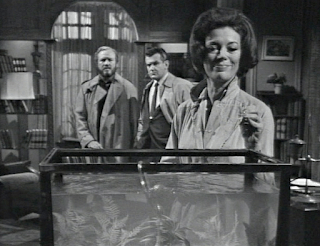
Dr Hoffman tells Dr Woodard that she believes it will be bad for Maggie to see Sam and Joe, but she consents to the visit as a way of discouraging them from trying to come back. When Sam and Joe join them in her office, she attends to her aquarium. In the post about this episode on Dark Shadows Before I Die, Christine Scoleri points out that this is a rather direct way of telling us that there is something fishy about Dr Hoffman.

Fishy doctor. Screenshot by Dark Shadows Before I Die

When Sam and Joe go to Maggie’s room, she has a mad scene. She starts singing “London Bridge,” gets to an obscure verse running “Take the key and lock her up,” and starts screaming “Lock her up!” over and over. It’s magnificently terrifying.

In his post on Dark Shadows Every Day, Danny Horn raves about Grayson Hall’s performance as Julia Hoffman. Rightly so, she will quickly make herself indispensable to the series. He includes a lot of screenshots of her face, showing the wide variety of expressions she uses. I have a more complicated response to this aspect of her style.

As many screenshots as Danny gives of Grayson Hall’s face in his post, I presented even more screenshots of Lovelady Powell’s face in my post about #193, where Powell plays art dealer Portia Fitzsimmons. What impressed me about Powell’s performance is that she takes one of the most basic rules of screen acting- choose one of your eyes and look at your scene partner only with it- and builds a whole character around it. Her left eyelid is all she needs to command the stage and leave an indelible impression.

Hall was at the opposite extreme. She ignores the one-eye rule, and virtually every other piece of guidance professionals give about how to create a character on camera. She uses every muscle at every moment. Her broad, stagy approach works well for Dark Shadows, and the three actors with whom she shares her shots today stay out of her way. Still, she does make me miss Powell’s dominating simplicity.

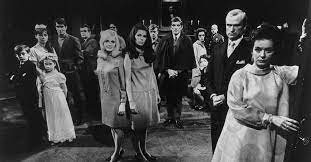
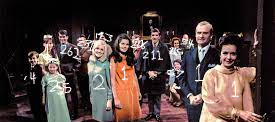
With Julia’s introduction, all of the actors in the photo I use as the header for this blog have joined the cast of Dark Shadows. There is also a version of the picture where the actors are frowning.

Gloom in the shadows

Here’s the smiley version. I’ve marked each player with the number of the first episode in which s/he appeared:

Episode 264: In the shadows

In its first months, Dark Shadows spent a fair bit of time on the business interests of the ancient and esteemed Collins family. In those days, the Collinses were running out of money and their old nemesis, Burke Devlin, had come back to town with a plan to strip them of their remaining assets and drive them into poverty. The “Revenge of Burke Devlin” storyline never really took off, and was eventually subsumed into the tale of blonde fire witch Laura Murdoch Collins. Shortly after Laura disappeared, Burke formally gave up on his revenge. With that, the business stories ended, and there was no particular reason for Burke to stick around.

On Tuesday, Burke was recast. However little his character may have had to do on the show or however much he may have had to drink before he arrived at the studio, Mitch Ryan was always interesting to watch. Anthony George couldn’t match Ryan’s charisma, but by 1967 he had been a familiar face in feature films and primetime television for years. The original audience, even if they couldn’t remember George’s name, would have recognized him as a famous actor and assumed that his casting meant that something big was in store for Burke.

Today, we have two hints that business stories might be making a comeback as well. Seagoing con man Jason McGuire is blackmailing reclusive matriarch Liz into marrying him. Vampire Barnabas worries that the cozy little home he has made for himself in the Old House on the estate of Collinwood might be threatened if Jason takes control of the family’s holdings. He asks Liz’ brother, high-born ne’er-do-well Roger, to look at the original deeds for the Old House and the great house to see if there is some provision he might be able to use to defend his interests against Jason. That Barnabas asks about the deeds would suggest that he has acquired some form of ownership in the Old House. We’ve never seen him buy the house from Liz or receive it as a gift from her, but if both deeds are still in Liz’ name, he could hardly use their wording to claim a right to stay there. So when Roger goes off to look for the deeds, there is a chance he will come back with a story about real estate.

The second hint comes in Barnabas’ confrontation with Jason. Barnabas takes a very aggressive tone with Jason, who responds by asking Barnabas where he goes in the daytime and where his money comes from. “You have no accounts in the bank in town, and I know you don’t operate a business…” If Barnabas is going to be on the show for the long haul, as the ratings clearly indicate we should expect him to be, Jason will not be the last person to ask these questions. We might wonder how exactly he will forestall them.

If we have been watching from the beginning, the likeliest answer would involve Burke. When was a major character, Burke was presented as an inexhaustibly rich man who knew his way around some of the shadiest places in the world. If Burke happens upon Barnabas’ secret, we could expect Barnabas to bite him and thereby bring him under his power. With his money, Burke could set up plenty of bank accounts and businesses in Barnabas’ name. With his contacts in the demimonde, he could secure whatever papers Barnabas needs to establish his identity. Even a photo ID- Burke could easily hire a Barnabas lookalike to pose for a British passport.*

During the “Revenge of Burke Devlin” arc, Burke bought up a lot of Liz’ debts. In particular, he held enough notes payable on demand that she feared he might be able to put her out of business at any time. That hasn’t been mentioned for a long while, but if Barnabas takes control of Burke he could take those notes and exchange some of them for outright ownership of the Old House.

Barnabas could also compel Burke to fabricate some fraudulent papers that would make it look as if he were deeply in debt to Barnabas. When Barnabas got around to killing Burke, those papers would come to light. Liz and Roger would be grateful to Barnabas for taming their old adversary and clearing out some debts that posed a danger to their financial position, while well-meaning governess Vicki would be grateful to him for helping her boyfriend save his face after his business went south. As a result, his position at Collinwood would be unassailable.

Closing Miscellany

There is a location insert of Roger walking to the Old House, a flashlight in hand. I don’t think we have seen this footage before.

Screenshot by Dark Shadows Before I Die

Until today, Barnabas has tried to be very suave with everyone who doesn’t know that he is a vampire. Since he has nothing to say to Jason that will intimidate him, he might as well continue that approach in his scene with him, or at least play dumb. But instead, he is openly, and self-defeatingly, hostile. This will become a pattern in future episodes. Time and again, Barnabas will greet a potential adversary with an immediate declaration of war, often before the adversary even knows who he is, thereby forfeiting whatever element of surprise he might have on his side.

Barnabas catches a glimpse of the ghost of his sister Sarah. He only sees her as a figure moving in the distance as he is looking out the window, and has no idea who she is. But it does confirm that he is able to see her, something we had not known he could do.

*I laid all this out two years ago in a comment on Danny Horn’s Dark Shadows Every Day.

Episode 258: Secret friend

Maggie Evans, The Nicest Girl in Town, is giving up hope. Vampire Barnabas Collins locked her up in the jail cell in the basement of his house some time ago, and everyone she knows is coming to believe that she is dead.

The other day, a little girl in eighteenth century clothing appeared outside Maggie’s cell. The girl did not respond when Maggie tried to get her attention, nor did Barnabas’ sorely bedraggled blood thrall, Willie, see her when she walked past him. Only on her second or third visit to Maggie did the girl interact with her, and then only to warn her not to tell her big brother that she had seen her. Maggie suspects that the girl was a hallucination of hers.

We know that the girl is real, because we saw her interacting with someone else. Outside Barnabas’ house, the girl talked with strange and troubled boy David Collins and played catch with him. If we’ve been watching the show from the beginning, we also know that there are many ghosts in and around Barnabas’ house, and that they have a special rapport with David. Further, this girl gives her name as Sarah and says that everyone she knows went away a long time ago. We’ve been told that Barnabas had a sister named Sarah who died in childhood, so we know that Sarah is the ghost of that sister.

Today, the girl appears to Maggie again. This time she shows up in the cell itself. At first, she tosses her ball in the air, sings “London Bridge,” and ignores Maggie’s repeated questions. Eighteenth century kids didn’t have mobile phones, apparently they had to resort to a ball and “London Bridge” when they wanted to tune out the grownups. Sarah finally comes around when Maggie puts her hand on her shoulder.

Sarah explains that she came because Maggie was crying. She asks what Maggie is sad about, which Maggie doesn’t try to explain.

Sarah won’t answer many of Maggie’s questions. Sarah says that she has been looking for her parents, and she is puzzled as to where they and everyone else have gone. She says she does have one friend. If that is a reference to David, it would show that Sarah can learn information during one apparition and retain it during subsequent apparitions. It is unclear whether she knows that she is a ghost, and her understanding of Maggie’s situation is remarkably slight.

Maggie and Sarah play catch and sing “London Bridge” together. Sarah vanishes a moment before Barnabas arrives. Maggie reacts to him with terror, but when it becomes clear that he isn’t planning to kill her right away her excitement at Sarah’s visit comes bursting out. She tells him that she has a secret friend who visits her in her cell and plays with her. When he asks what she’s talking about, she tells him it’s a secret. She babbles in a gleeful, childlike way.

Barnabas reacts to this with discomfort. He keeps his eyes on Maggie and edges away from her, speaking to her in a pitying tone. Bleak as Maggie’s situation is, this is a laugh-out-loud moment- she’s become too weird for Barnabas.

Maggie weirds Barnabas out

Upstairs, Barnabas tells Willie that Maggie isn’t working out. In a moment of wild hope, Willie asks if that means he’ll let her go. Barnabas sourly replies that of course it does not mean that- they will have to kill her. His plan is to kill her in such a way that no trace of her will ever be found, “because there will be no trace.”

Willie takes a meal to Maggie and demands she stop pretending to be crazy. It isn’t helping her, he says. She denies that she is doing any such thing, and babbles cheerfully that “I do whatever anyone tells me to do.” Willie leans in, putting his face close to hers, and screams and shouts that she has to be her usual self if she is to have any chance of survival.

After Willie leaves, Maggie starts crying again and telling herself that there is no little girl. But then she looks at the floor and finds a doll Sarah left behind. Maggie smiles, knowing that her secret friend does exist.

Maggie’s mad scenes are fascinating. Even though she believes that Sarah is real and we know she is right, seeing Sarah has the same effect on Maggie a psychotic break might have. It takes her out of the reality that she shares with Barnabas and Willie, and gives her an affect that is neither continuous with her usual personality nor intelligible to them.

The three adult actors are all on the top of their form today, just superb. Nowadays, when Sharon Smyth Lentz describes her performance as Sarah, she says that “The first word that comes to mind is ‘clueless.’” But that works out surprisingly well. We know so little about what, if anything, is going on in Sarah’s mind that the keynotes of the performance would have to be “lost,” “confused,” and “vague,” and she had those three things down pat. Things sometimes get rocky when Sarah has a long stretch of dialogue or when multiple actors are moving at the same time, but neither of those is a problem today.

Joe Caldwell started making uncredited contributions to the writing of Dark Shadows early in 1967, and I am tempted to attribute every good thing in a script by Malcolm Marmorstein to him. But Caldwell’s name is showing up in the credits now, and this episode is excellent. So maybe Marmorstein could rise to an occasion every now and then.

My wife, Mrs Acilius, points out that this is the first episode set entirely in the Old House.

Episode 251: Madness preferable to sanity

We reprise the final scene of Friday’s episode, in which vampire Barnabas Collins catches his prisoner Maggie Evans trying to stab him. He flashes his fangs at her.

Doctor Teeth and the Electric Mayhem

The first time around, this had been the climax of a number of powerfully realized scenes, so it still carried a punch despite the silliness of the fangs. From a standing start, though, the result is a bad laugh.

In the 45 seconds following the first commercial, ABC staff announcer Bill Rice* summarizes the action of the previous week’s episodes.** This recap comes so close to exhausting every event we saw in those 110 minutes of scripted drama that regular viewers will have another unintended laugh.

The recap was inserted because many ABC stations preempted Dark Shadows to cover a United Nations debate about the Vietnam War. The show was about as resolutely disengaged from contemporary politics as it was possible to be, but conjoining US policy in Vietnam with a character like Barnabas, who combines a vast capacity for killing with a desperate need to be loved, does bring certain thoughts to mind.

Barnabas and Maggie have a conversation about his inclination to kill her. Barnabas’ sorely bedraggled blood-thrall Willie Loomis joins in, saying that Barnabas will have to kill him first. This would not seem to present Barnabas with any difficulty at all. Willie wouldn’t be missed- everyone else on the show remembers Willie from the days before he met Barnabas, when he was dangerously unstable ruffian Willie Loomis, and has been urging Barnabas to get rid of him. Nor would it be especially difficult for Barnabas to replace Willie- he just has to bite someone else, and that other person will become his new slave. But Barnabas stands around arguing with Willie and Maggie. When someone knocks on the front door, he scolds Willie for failing to keep it locked, such a humdrum complaint under the circumstances as to bring another bad laugh. Barnabas leaves Willie and Maggie in the basement while he answers the door. Before he goes, he sticks out his lower lip, a facial expression known as “pouting.”

Barnabas pouts

The visitor is well-meaning governess Vicki, who tells Barnabas that the sheriff has ordered that no woman go out alone at night. Some think it strange to send a woman out alone at night to carry this message to a man who is indoors, but considering what we’ve seen of the sheriff, doing the exact opposite of what he commands would seem always to be the wisest course.

Vicki notices an antique music box on a table in Barnabas’ front parlor. Vicki admires its tune and makes a few not-very-coherent remarks about “the past” while it is playing. Barnabas has been using this music box as a tool to hypnotize Maggie into believing that she is his long-lost love Josette. After Vicki leaves, he opens it again, then looks at the door through which she left. He turns his head and smiles, looking very much like someone who has just had an exciting new idea.

Lightbulb moment

Meanwhile, Maggie and Willie talk to each other in the basement. The two of them had one of the most electrifying scenes of the entire series down there Friday. The last traces of that energy have been piddled away by the time Barnabas comes back downstairs and resumes his conversation with them.

Willie urges Barnabas to look at Maggie and see how beautiful she is. Barnabas says “No” and looks away. Coming at a moment of high dramatic tension, this might have been powerful. When we sit down as an audience, we enter into a sort of agreement that if the show includes something worth seeing, we will look at it. So when we see a character refusing to look at a sight as well worth contemplating as was the young Kathryn Leigh Scott,*** we might be shocked. But there has been too much idle chatter, and the memory of Barnabas’ pout is so fresh, that all we can think of is a petulant child saying “I don’t wanna look at her!”

Barnabas announces that he will not kill Maggie right away. He tells her that he will make her suffer torments worse than anyone has ever known so that death will finally come as a blessed relief, then locks her up in the prison cell in the basement of the house. What, your house doesn’t have a prison cell in its basement? It’s a standard feature of homes in Collinsport, as we will come to see in future episodes.

Barnabas goes to the great house of Collinwood and talks to Vicki. He brings a handkerchief that, legend has it, was a gift from the queen of France to Josette. They babble about “the past” and Barnabas invites her to drop in at his house “some day.” He says “day,” even though he’s busy being dead every day until sunset. And doesn’t specify when- any old time, if she hears screams coming from the basement she’ll probably just ignore them.

Evidently Barnabas is thinking of Vicki as a backup Josette in case Maggie doesn’t come around. This marks a retreat from #240 and #241, when strange and troubled boy David Collins, who has seen Josette’s ghost many times, saw Maggie in the gown Barnabas gave her and said that she must have been Josette because she looked “exactly the same” as he had seen her before. That suggested, not only that Barnabas chose Maggie because of her looks, but also that he might be right in thinking that she is Josette’s reincarnation. This storyline is modeled on the 1932 Universal film The Mummy, in which Imhotep’s idea that Helen Grosvenor is the reincarnation of his lost love Princess Ankh-esen-amun is substantiated when Zita Johann plays both roles. If Vicki and Maggie are interchangeable, then all of that goes by the boards.

*Presumably no relation to the main character of Gene Roddenberry’s 1963-4 CBS TV series The Lieutenant, one episode of which was written by Art Wallace.

**As transcribed by the Dark Shadows wiki:

For those who have missed the last few episodes of Dark Shadows: Elizabeth Collins [Stoddard,] at Jason McGuire’s insistence, has taken Vicki, Carolyn, and Roger into the basement room and convinces them that it holds no mystery. They don’t realize that beneath the flagstones on the floor is concealed the room’s secret—the body of Elizabeth’s husband, Paul. Elizabeth, now realizing that the secret can never be told, announces to the family that she and Jason will be married. Maggie Evans escaped from Barnabas and attempted to get to her father, but was recaptured and told by Barnabas that unless she assumes the identity of Josette Collins, she will die. Realizing that she can never escape, Maggie attempts to destroy Barnabas.

The title card shown during the recap

***Or for that matter as is the not-so-young Miss Scott of today, she’s one of the best looking octogenarians around.