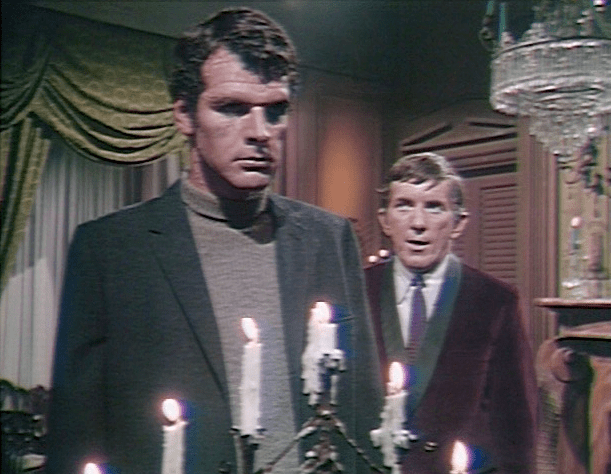
Craig Slocum tops many fans’ lists of Dark Shadows‘ worst actors, so I would be remiss in my duty as a commentator if I did not mention that he does a genuinely good job today as unlovely ex-convict Harry Johnson. Harry brings a tray of food to the very tall, very strong Adam, who is in a dusty room in the long deserted west wing of the great house of Collinwood, hiding from the police as the guest of heiress Carolyn Collins Stoddard. Harry finds that Adam is trying to stab himself to death, and calmly talks him into giving up the effort and handing over his knife.
Harry goes to the drawing room in search of Carolyn, and finds the suave and mysterious Nicholas Blair. Nicholas tells him that Carolyn is out. He shocks Harry by asking if Adam is in trouble. Harry had no idea anyone but he and Carolyn knew Adam was in the house, and Carolyn has scared him out of his few wits with her orders to keep the secret.
Nicholas takes command of the situation. He insists Harry tell him what happened, and posts him in the foyer to wait for Carolyn to return while he goes up to talk to Adam. When Carolyn comes back, Harry tells her about Adam’s suicide attempt and about his encounter with Nicholas. She angrily reminds Harry that Collinwood is her house, not Nicholas’, and Harry had damn well better remember to take his orders from her and no one else. Harry is left with nothing to say but a meek “Yes, ma’am.”
Slocum is convincing as someone who is not intimidated by a physically imposing man with a knife, but who is entirely out of his league when confronted with people who outrank him in social class. So far as I can tell, none of the other fansites mentions his good work today. Dark Shadows fans are accustomed to ghosts and witches and vampires and Frankensteins and time travel, but a good performance by Craig Slocum is such an unexpected sight that they cannot bring themselves to admit that they have seen it.
Nicholas is a middle manager in Satan’s terrestrial operations, a member of Hell’s bourgeoisie.* He knows that Adam is a Frankenstein’s monster. The other day, he persuaded Adam to try to rape Carolyn. Adam’s attempt doesn’t seem to have got very far, but it has convinced Carolyn that she can no longer harbor Adam in her house. The audience knows that Nicholas has plans for Adam; presumably he knew that if Adam attacked Carolyn, she would want him to leave Collinwood, paving the way for him to take the big guy into his own house where he would have unlimited access to him. While Carolyn is downstairs chewing Harry out, Nicholas is up in Adam’s hiding place adding to the evil ideas he has planted in his impressionable mind.
Carolyn goes up to Adam’s room and finds Nicholas still there. Nicholas tells her that the crisis is past, then leaves the room. Carolyn finds that Adam is perfectly composed and looking forward to some improvement in his circumstances, but is unwilling to talk to her about anything substantial.
Carolyn goes down to the drawing room, where Nicholas is playing the piano. This is the first time we have seen anyone play the piano since #330, when sarcastic dandy Roger Collins banged out a few notes. Carolyn has been suspicious of Nicholas since she met him and was angry with him when she first learned he had gone into the west wing and found Adam, but can only thank him when she sees that he has talked the big guy out of suicidal despair.
Later, we see that Adam has left the great house of Collinwood and gone to the Old House on the same estate. The Old House is home to old world gentleman Barnabas Collins. Adam knows that Barnabas was present when he first awoke, in a laboratory, ten weeks ago, and that he spent the first weeks of his life as a prisoner in Barnabas’ dungeon. When he learned yesterday that he was an artificially constructed man, he jumped to the conclusion that it was Barnabas who created him.
Adam knocks on Barnabas’ door. Barnabas is astonished to see that Adam has returned. Adam announces that they will talk and walks in.
Barnabas marvels at Adam’s fluent speech. When last they saw each other, he could speak only a few words, such as “music!,” “food!,” “friend,” and, most importantly, “kill Barnabas!” Now, he tells Barnabas that he no longer plans to kill him, but says that he is right to be afraid of him. He has come for what he is entitled to. He wants Barnabas to make another creature like himself so that he will no longer be alone.
Barnabas tries to explain that he did not create Adam, that Dr Eric Lang did. Adam has never heard of Lang, and dismisses Barnabas’ statement as a lie. Barnabas goes on saying that he isn’t even a doctor, but Adam won’t listen. He will be provided with a mate, or he will take his revenge.
My wife, Mrs Acilius, pointed out that Adam’s demand for a woman who shares his nature should sound familiar to Barnabas. When Barnabas first came on the show in the spring and summer of 1967, he was a vampire, and was obsessed with turning a living woman into a vampiric replica of his lost love Josette. Adam, who came to life by an infusion of Barnabas’ “life force,” shares his longing for a female counterpart.
In 1973, Dark Shadows creator Dan Curtis produced an adaptation of Mary Wollstonecraft Shelley’s Frankenstein for ABC-TV. The second half of that long movie was devoted to the creature’s demand that Frankenstein build him a mate, and the terrible vengeance he exacted when the scientist refused to comply. The original audience of this episode can’t have known that that production was in the future, but they would have been aware of the 1935 Universal film Bride of Frankenstein and Hammer’s 1967 Frankenstein Created Woman. It seems likely they had assumed that Adam would sooner or later set aside his bachelor ways, and were waiting for a development such as this.
*Mrs Acilius has an advanced degree in sociology, and she coined the phrase “Hell’s bourgeoisie.”
Yesterday, recovering vampire Barnabas opened the door to his closet. Hardworking young fisherman Joe fell out, and Barnabas saw Frankenstein’s monster Adam at the window, laughing menacingly. Adam has many reasons to hate Barnabas, and Barnabas concludes that Adam wants to frame him for the murder of Joe.
A commenter on John and Christine Scoleri’s Dark Shadows Before I Die, posting under the name “Grant,” pointed out that in Mary Wollstonecraft Shelley’s novel Frankenstein the Creature kills someone and frames one of Frankenstein’s closest friends for the crime. The reference seems to be pretty obvious.
Barnabas’ friend, mad scientist Julia, shows up. She finds that Joe is not dead. She says that he has, in a bit of Collinsport English we have heard once or twice before, “a pulsebeat.” She and Barnabas have a long conversation about a variety of topics, several of them highly incriminating, while Joe lies on the floor. Julia goes off to attend to another matter, and Barnabas’ servant Willie comes. Joe is still on the floor while Willie argues against Barnabas’ orders to take Joe to the hospital. Barnabas, who had told Julia that Adam must have “wanted Joe to be found here,” dismisses Willie as “absurd” when he says that Adam is trying to frame them.
When Willie was first on the show, he was a dangerously unstable ruffian who was determined to rape all the young women and beat up their boyfriends. In #210, he accidentally released Barnabas, who enslaved him and turned him into a nice guy. Now that Barnabas’ vampirism has gone into remission, Willie has taken several steps back to his old ways. He whines that if Joe dies, his fiancée Maggie might turn to him. Barnabas finds this idea “insane,” and Willie tells him that Maggie has recently stopped by the house and talked to him more than once. This is true, and Barnabas’ reaction makes it clear that it is the first time he has heard it. He responds that he is not interested in discussing Willie’s “mental aberrations,” and tells him that if Joe dies he will tell the police about Willie’s interest in Maggie. That leaves Willie no choice but to help get Joe to the hospital.
Julia has gone off to see well-meaning governess Vicki. Vicki is about to have a nightmare that is part of the “Dream Curse.” Three months ago, wicked witch Angelique decreed that one person after another would have the same dream. After Vicki has it, the dream will pass to Barnabas, and Angelique means for it to reactivate his vampirism. Vicki doesn’t seem to know that Barnabas was a vampire, though she has had many clues, as for example when he kept biting her and sucking her blood. I suppose she just thought he had a really aggressive make-out technique. But she does know that Barnabas is supposed to die if he has the dream.
Julia urges Vicki to come with her to Windcliff, a sanitarium she runs, and promises that she will get the best of care there. But she finds that Vicki is resigned to having the dream. Julia reports this to Barnabas, and tells him that she wants to go away with him, far away from Vicki. Vicki can’t pass the dream to Barnabas unless she describes it to him after she has it, and she won’t be able to do that if she can’t find him. Barnabas refuses to go, reminding Julia that those who have the dream suffer terribly until they pass it on to the next person. When he says “You know how I feel about Vicki,” Julia gets a brief closeup, and her reaction reminds us that she is supposed to be harboring an unrequited love for Barnabas. This is rather an easy point to forget. Barnabas and Julia spend all their time together and tell each other all their secrets. Since there doesn’t seem to be any such thing as sexual contact in the world of Dark Shadows, it’s hard to see how her feelings could be much more requited.
Julia urges Barnabas to run away with her.“You know how I feel about Vicki.”
Vampires are metaphors for extreme selfishness, and Barnabas usually plays to type. It is startling that he tells Julia that any part of his motivation for sticking around is his wish to spare Vicki suffering. But he also talks about his long vain struggle against Angelique in terms that immediately make it clear that whatever goodwill he might have for Vicki is a distant third behind his usual ruling passions, self-pity and laziness, but still, her well-being is among his considerations. That sets him apart from her ostensible boyfriend, a man variously known as Peter and Jeff. As Christine Scoleri points out on Dark Shadows Before I Die, Vicki might never have had the dream at all if Peter/ Jeff hadn’t refused to listen to her explanation of the curse and insisted that she stay where he could visit her easily, yet now that she is suffering from the dream and its effects he is nowhere to be seen. Christine speaks for all of us with her summary of Peter/ Jeff’s character- “What a louse!”
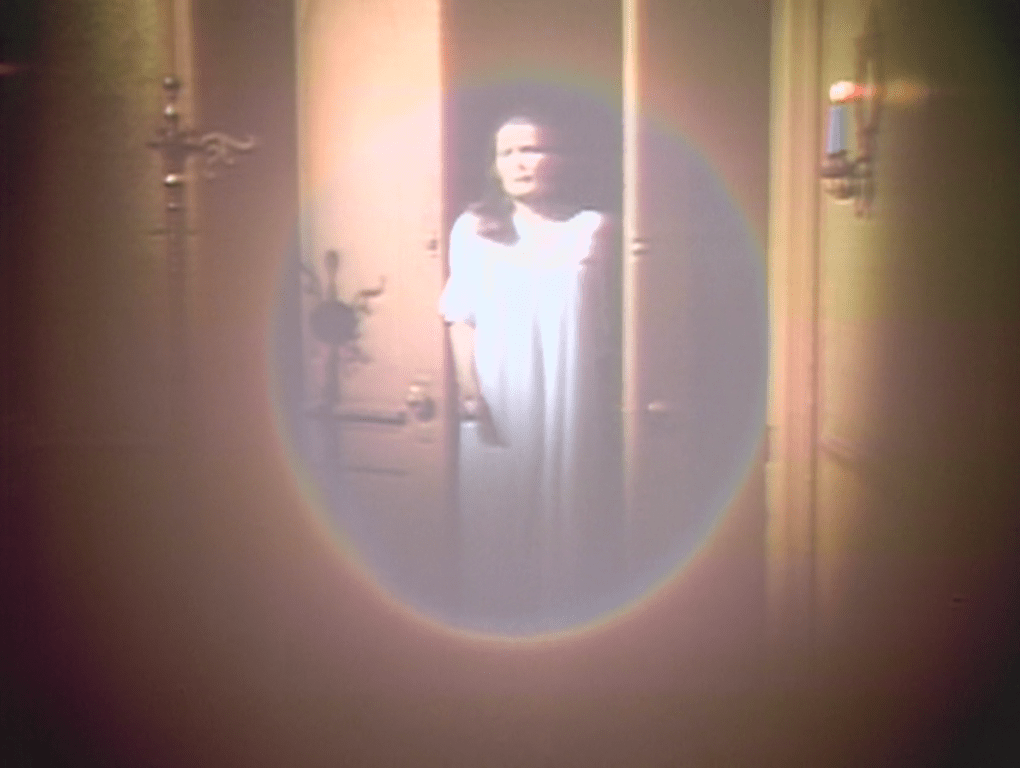
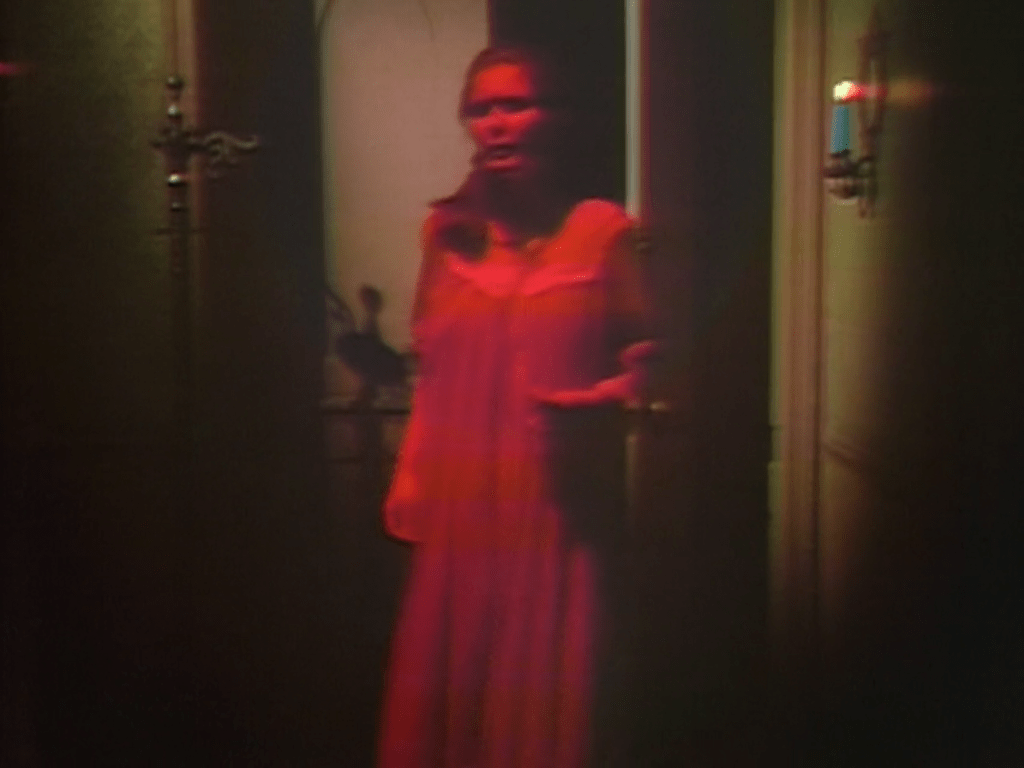
Vicki has the dream. Barnabas beckons her into the haunted house attraction where the bulk of it has always taken place before. She keeps telling him that she doesn’t want to have the dream, not for her sake, but for his. She opens three doors that show Halloween gimmicks we’ve seen before, then opens a fourth behind which she sees the Sun. The Sun shrinks into the distance, and she walks through the door, following it. Her face dissolves into an image of the Sun; the Sun dissolves to the exterior of Barnabas’ house. We cut to the interior, looking at the doors. A small dot of Sun appears there. It expands until it fills most of the screen. The doors open, and the Sun gives way to Vicki. She enters, and sees Barnabas lying on the floor by his desk. He is bleeding from two small wounds on his neck.
Part of the dream is a bit of doggerel that has never made much sense. The last lines are “Ahead a blazing light does burn, And one door leads to the point of return.” These lines are almost explained today. Each door exposes a symbol of something that is frightening either to the dreamer or to Barnabas or to both. Vicki isn’t afraid of the Sun, but she knows that Barnabas has a strange and intense relationship with it. In #277, he harangued her about his hatred for the Sun; in #347, he made plans with her to watch the Sun rise, plans which he had to break under very strange circumstances in #349. So now we know that the “blazing light” is the Sun, which vampires cannot withstand.
Of the ten characters who had the dream before Vicki, only strange and troubled boy David, her charge and dear friend, was able to walk through any of the doorways. In his case, he walked into a gigantic spider web and was caught there, just a few feet beyond the entry. But Vicki is on the path that “leads to the point of return,” and she goes to a different set altogether.
Had Barnabas’ introduction not brought a new audience to the show, Dark Shadows would probably have been canceled in June 1967. In that case, the final episode would have been #260, and it surely would have ended with Vicki, who was in those days the show’s main character, driving a stake through Barnabas’ heart. That she and the Sun overlap in the same space on the screen suggests that by passing the dream to Barnabas she will fulfill her original destiny and become his destroyer.
When Vicki looks into the parlor and sees Barnabas bloodied and lying on the floor by his desk, we are reminded of #405. In that episode, we saw that Angelique originally turned Barnabas into a vampire by sending a bat to bite him in this room. At that time, he fell, not by his desk, but by the staircase. That’s very close to where Joe was lying for the first half of the episode, so they have to do some rearranging to avoid suggesting an identity between them. Barnabas’ vampirism is so much the foundation of the show’s success that virtually everyone in the audience expects him to relapse sooner or later, but they are being careful not to raise the question of whether Joe will also join the ranks of the undead.
Until the dream, the episode is made up of long scenes with a great deal of dialogue. That isn’t unusual for Dark Shadows. It is unusual that the scenes play out with very little background music. I wonder if director Jack Sullivan decided that a spare sound design would set the right mood for the very ambitious dream sequence. I think it paid off- the dialogue scenes felt slow, but Vicki’s dream achieves the surrealistic quality it needs.
One of the main themes Danny Horn developed on his blog Dark Shadows Every Day was his ridiculously exaggerated impatience with the character of Vicki and his severe bias against Alexandra Moltke Isles’ acting. That gave me something to talk about in his comments section, and was part of the reason I started this blog. Danny’s post about this episode very nearly makes up for his incessant Vickiphobia. He alternates stills of Vicki with epigrams written in her voice, and the result is just magnificent, worth anyone’s while to read.
Unloved Frankenstein’s monster Adam has survived a plunge from the cliff at Widow’s Hill and made his way into the home of blind ex-artist Sam Evans. Sam realizes that Adam is badly hurt and cannot speak much English; with great kindness, he tries to clean and bandage Adam’s wounds.
Sage Timothy Eliot Stokes comes in. Adam, who in his few weeks of life has had little but hostility from humans, is alarmed by the sight of another one, and flees. Stokes explains to Sam who Adam is, and Sam’s sympathy for the big guy only deepens. This retelling of the creature’s encounter with the blind hermit in The Bride of Frankenstein is affectingly done.
Wicked witch Angelique, calling herself Cassandra, has made her way into the apartment of local man Tony Peterson. Tony is agitated by the presence of Angelique/ Cassandra and keeps telling her he wants her to go home to her husband and leave him alone. She tells Tony he is “Quite a Puritan,” reminding us that when Dark Shadows was a costume drama set in New England in the 1790s, actor Jerry Lacy played the Rev’d Mr Trask, a fanatical but utterly inept witchfinder who inadvertently served Angelique’s darkest purposes. Mr Lacy plays Tony quite differently than he did Trask, but Angelique/ Cassandra told Tony in #481 that she chose him as her cat’s paw because he reminded her of Trask. She gets him to strike his cigarette lighter, sending him back into the trance in which he can deny Angelique/ Cassandra nothing.
Well-meaning governess Vicki has made her way to Stokes’ apartment. It was Vicki who took Dark Shadows back in time to the 1790s, when she came unstuck in time during a séance in #365. It seemed at the beginning of the costume drama segment that Vicki would regain the position she held in the first months of the show as our point of view character, that she would again provide the emotional anchor of the show in her scenes as governess alone with the young children of the house, and that she would drive the action as she had to think on her feet and come up with plausible lies to secure a place in an unfamiliar century. As it happened, she did none of those things. She was shut out of all the main action, was never seen giving a lesson to either of her charges, and when she was on camera spent her time telling everyone she met that they were played by an actor who had another part in the first 73 weeks of the show. Long before Vicki came back to the 1960s in #461, the character had become all but insupportable.
The action now revolves around recovering vampire Barnabas Collins, and Barnabas steadfastly refuses to include Vicki in his life. Faced with that blank wall, Vicki has spent some time hanging around with a man named Peter whose only story point is that he wants to be called Jeff. This does not make for much drama. Vicki learned a great deal in the 1790s, and recognized Angelique/ Cassandra as soon as she showed up in 1968. But she can’t fight her by herself, and so she has responded to Barnabas’ aloofness by trying to forget what she knows.
Stokes has called Vicki to his apartment to enlist her help against Angelique/ Cassandra. Longtime viewers will remember that Vicki led the fight against Dark Shadows’ first supernatural menace, undead blonde witch Laura Murdoch Collins, and that for support in that battle she was the one who recruited the services of the show’s first sage, parapsychologist Peter Guthrie. This much diminished Vicki is now subordinated to the sage. He calls her in, he commands her to tell her story, he tells her that her story is true, and he requires her services. He shows her a silhouette of Trask and insists she overcome her reluctance to look at it. When a knock comes at the door, he even sends her out the back way and tells her that his next visitor must not know of her connection with him, as if he were dismissing a prostitute.
Stokes tells Vicki he can’t afford to be seen with her.
Oddest of all, Stokes already seems to know everything Vicki does before they talk. In #507, he laid out a theory that would be plausible to someone who knew exactly what Vicki knows about the strange goings-on, but not to anyone who knows one thing more or less than she does. Yet today we see that he is talking with Vicki about them for the first time. It is unclear what he could learn from her, or what contribution she could make to his efforts.
The visitor from whom Stokes wants to hide Vicki is Tony, giving his name as “Arthur Hailey,” perhaps in honor of the novelist whose Airport was topping the bestseller lists when the episode was made. Stokes is quite relaxed around Tony, offering him first brandy and then cheese. Tony accepts both. He exclaims “I like cheese!” in an awkward voice that makes it clear we are listening, not to Jerry Lacy’s acting, but to Tony’s. While Stokes is out of the room fetching the cheese, Tony sprinkles a powder Angelique/ Cassandra gave him into Stokes’ glass. Tony looks away from the table before they take their drinks. When they do, it is Tony who chokes and collapses, not Stokes.
This is the second time we’ve seen that staple of farce, “The Old Switcheroo.” In #402, Barnabas tried to poison Angelique, and had to think fast when she passed her glass to his mother. That use of the trope confirmed that, while Barnabas is undeniably a villain, he is a comic villain who endears himself to us as we watch him scramble through one failed scheme after another, while Angelique is a menace to be taken seriously. Now, Angelique has settled in for the long term, and the show will quickly run out of characters if she maintains the kill rate she had in the eighteenth century. They have to dial her threat level down considerably. One way of doing that is to give her a henchman who is, most of the time, unaware of her power over him, and who is consistently luckless when she activates him; another is for her to use comically unreliable means to pursue her evil ends. She does not yet cut the Wile E. Coyote-esque figure that Barnabas does, but neither is she in imminent danger of vaporizing the whole story and leaving ABC with thirty minutes of dead air on weekday afternoons.
This was the first episode directed by John Weaver. Except for one week in March 1968 when executive producer Dan Curtis took the helm, directing duties for the first 497 episodes of Dark Shadows alternated between Lela Swift and John Sedwick. Now Sedwick is about to leave the show. Associate director Jack Sullivan stepped up to direct #504 and will direct dozens more; Weaver, an associate director on some early episode, will only be credited as director four times before leaving in July. Several more directors will have similarly brief stints as fill-ins before Henry Kaplan joins the show as Swift’s alternate in December.
Episode 509 of Dark Shadows did not air on ABC-TV as scheduled on 6 June 1968. The network instead broadcast news coverage related to the assassination of US Senator Robert F. Kennedy.
At this point, one of Dark Shadows’ storylines was a loose adaptation of Frankenstein. Five years later, Dan Curtis, the show’s executive producer, would bring another adaptation of the novel to the small screen, as part of ABC-TV’s late night programming that ran under the umbrella title Wide World of Mystery.
Originally presented in two parts, each filling a 90 minute window, Dan Curtis’ Frankenstein is now available on Tubi in a 2 hour, 6 minute cut. It is more faithful to Mary Wollstonecraft Shelley’s original novel than were any previous adaptations, a point Curtis frequently made.
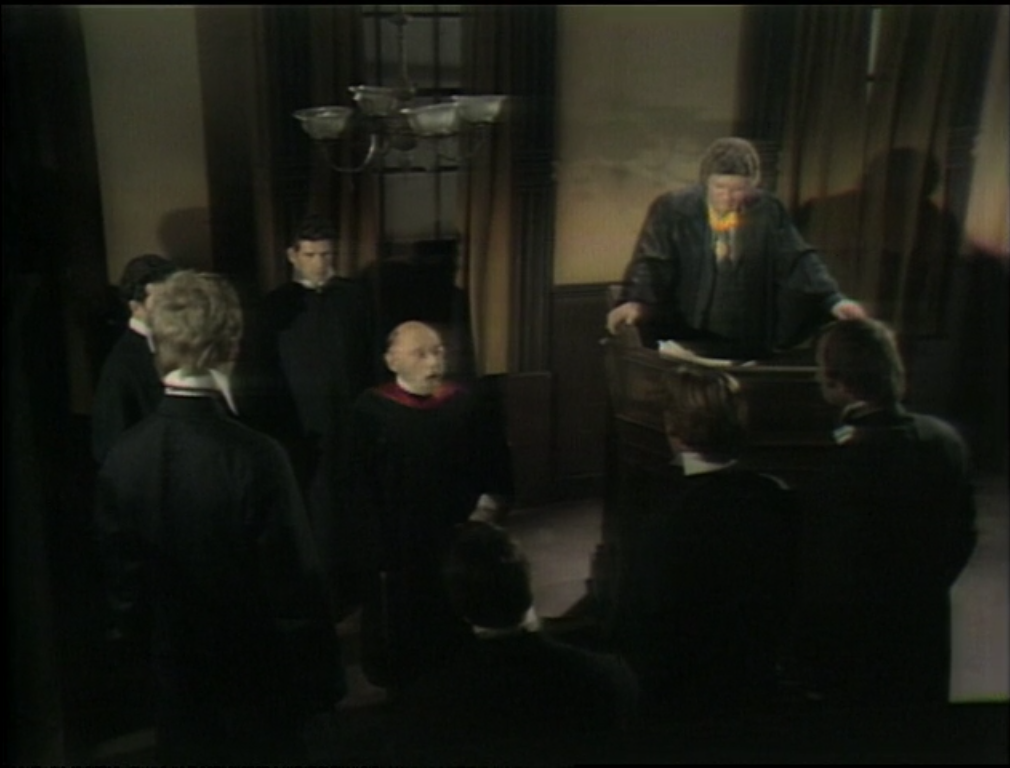
The main theme is made clear in the opening. Dr Victor Frankenstein is supposed to give a talk to a classroom of students in white coats, but they keep shouting him down. The professor identifies Frankenstein* as the winner of an academic prize and urges his unruly pupils to give him a hearing. That gets Frankenstein enough time to tell the class that they don’t understand what he has been saying, to make a little speech about the scientist’s obligation to create a superhuman life form in the laboratory, and to look frustrated when they walk out on him. The professor stays behind and tries to reason with Frankenstein, who doesn’t seem to be listening to a word he says.
Frankenstein can’t get a hearing.
No communication occurs in that scene, and very little occurs in any scene that follows. That’s a natural basis for a drama about the Frankenstein story. The mad scientist is disconnected from any voices of sanity, and the being he creates does not initially understand any language and has no frame of reference in common with anyone he might meet.
Frankenstein goes to his laboratory, where his friends Hugo and Otto are wearing funny hats and preparing to celebrate the prize he won. Hugo and Otto quickly gather that Frankenstein is uninterested in a party, but the heavy, ominous music on the soundtrack** tells us that more is going on in Frankenstein’s mind than his friends know.
Frankenstein insists that the experiment go on, an idea Otto resists. Otto wants to stop “while there is still time”; Frankenstein says that they have already passed the time when stopping was possible. Frankenstein seems to be talking about the danger that the body they have assembled will decompose, while Otto seems to be talking about the consequences of continuing to forage for organs and of bringing the body to life. Again, neither man reaches the other.
Frankenstein, Hugo, and Otto go shopping in the graveyard, where the caretaker shoots Hugo. Frankenstein and Otto get Hugo back to the laboratory. Frankenstein wants to call for help, even if it means prison, but Hugo insists that he and Otto use his heart to complete the experiment. He dies. Frankenstein decides to honor his wish. They will tell people that Hugo went climbing in the mountains, and after a while searching for his body people will simply give up. So Frankenstein and Otto will tell a false story, on the basis of which people will make and follow pointless plans. They then prepare to complete the experiment.
The preparations are interrupted when unexpected visitors arrive. They are Alphonse, father of Frankenstein; Elizabeth, fiancé of Frankenstein; and Henry, brother of Elizabeth and friend of Frankenstein. Frankenstein greets them, flustered, and says that they have come at a bad time and must stay at the inn. Alphonse and Henry wonder why Frankenstein did not receive Elizabeth’s note informing him of the date of their arrival; Elizabeth sees the note, unopened, on a table. Yet again, the emphasis is on a lack of communication.
Frankenstein and Otto resume the experiment. After a long display of flashing sparks, they cannot get any vital signs from the body. Frankenstein declares that the experiment has failed and orders Otto to burn “all the books, every journal!” They are out of the room when the body starts to move. Frankenstein comes in by himself, sees what’s happening, and says, in a voice too quiet to be heard outside the door, “He’s alive.” This unheard “He’s alive” is an obvious contrast with Colin Clive’s manic cry of “It’s alive!” in the 1931 film, emphasizing that while Clive’s Frankenstein may have been alienated from others by his obsessions, Robert Foxworth’s is simply unintelligible to the people he knows. The aftermath of the experiment is a recreation of the equivalent scene in episode 490 of Dark Shadows, but the idea of destroying the records of the experiment is added to show that Frankenstein is fighting against communication as such.
Once Frankenstein and Otto realize that the big guy has come to life, they help him up off the table. The experimenters handle their creation with a gentleness and good cheer that makes a striking contrast with the extreme callousness patchwork man Adam received from his self-pitying creators in Dark Shadows, and comes at a moment when both the immediate aftermath of the experiment and John Karlen’s presence as Otto have brought that story to the forefront of our minds.
Frankenstein and Otto are surprised that the big guy doesn’t have the memories of the professor whose brain they implanted in his head. Frankenstein speculates that the electric shocks they used to animate him may have wiped out his memories, but also thinks that those memories might eventually come back. Their attempts to communicate with him, therefore, are based not so much on listening as on an effort to conjure up the late Professor Lichtman. Still, Frankenstein is happy to note that the big guy has the reactions, not of a newborn, but of a four year old.
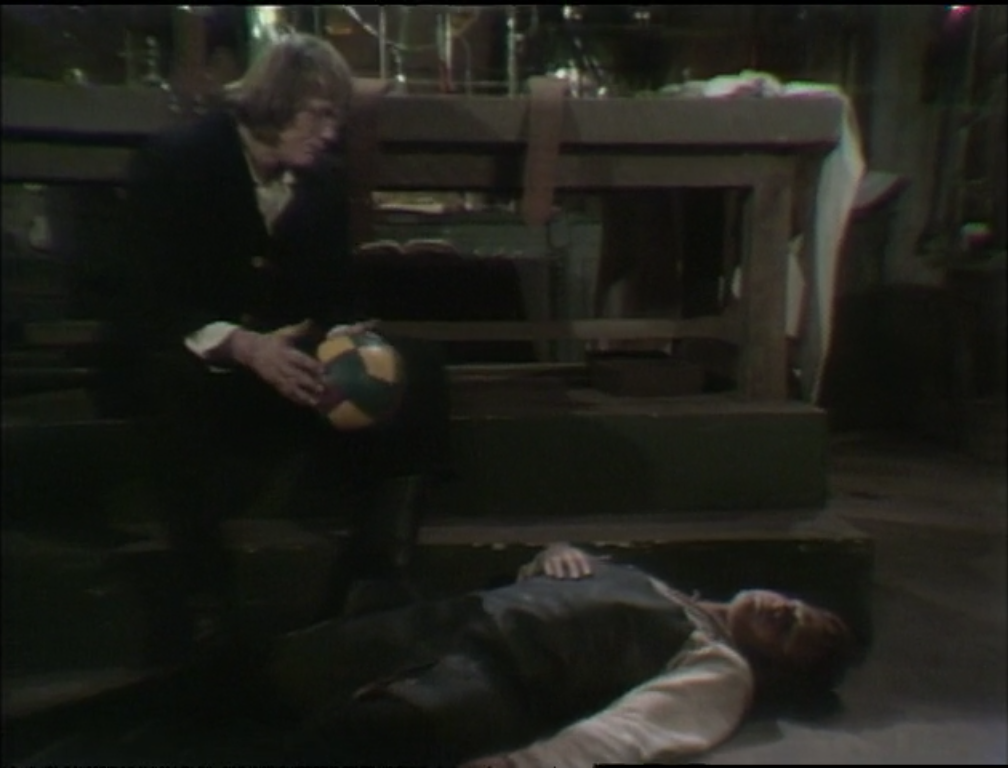
Frankenstein leaves Otto alone with the big guy while he goes off to placate his father, Elizabeth, and Henry. Otto teaches the big guy to play catch. Delighted with this, the big guy hugs Otto. He doesn’t know his own strength, nor does he understand what Otto means when he gasps out “Stop!” When Frankenstein comes back to the lab, he finds the big guy standing over Otto’s corpse, pleading “Play, Ot-ta, play!”
The big guy begs Otto to play
Frankenstein takes out a pistol, but cannot bring himself to kill the big guy. Instead, he orders him to get back on the table. He readily complies, and Frankenstein straps him in place. He takes Otto’s body from the lab. As soon as Frankenstein has left the room, the big guy easily breaks the straps and goes to the door. Finding it locked, he smashes some lab equipment.
Frankenstein takes Otto’s body to his room above what appears to be a tavern. He sets up Otto’s telescope by an open window and drops his body to the ground. By the time he returns to the lab, the big guy is gone.
The big guy wanders about and has some poignant moments when children see him and react with fear. He makes his way to a house occupied by the de Laceys, a blind girl named Agatha and her elderly father. He hides unnoticed in a closet there for, apparently, several months. Shortly after he takes up residence, Agatha’ brother, a sailor, drops his fiancée off at the house. She speaks only Spanish, and Agatha and her father speak only the language of Ingolstadt, which in this movie is identified explicitly as “inglés,” even though Ingolstadt is in Germany. In one of the first English lessons Agatha gives her sister-in-law to be, she says that the storm outside is “a summer rain”; in a later scene, while the big guy is still undetected in the closet, she mentions that October is almost over. Both the dramatized difficulties of language teaching and the unremarked failure of Agatha and her family to detect a huge man crouching a few feet away from them for so long stress the theme of non-communication.
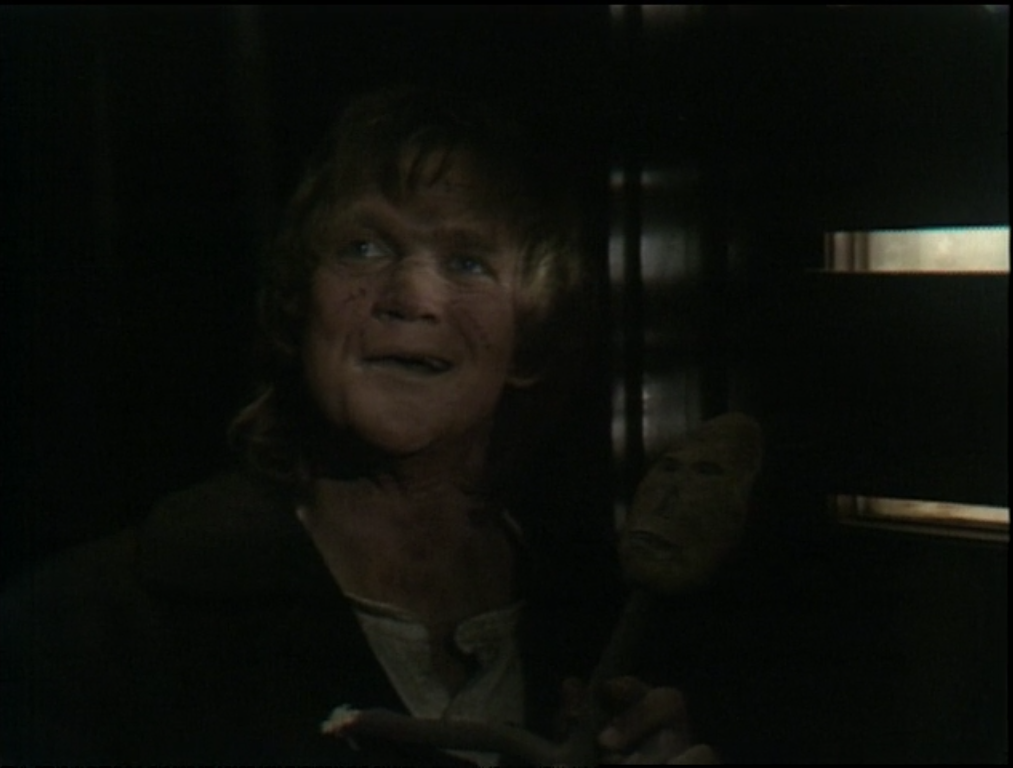
The big guy makes a crude doll and talks to it while Agatha gives her sister-in-law English lessons. He speaks quietly, but not so quietly that it isn’t absurd that they fail to notice him. I suspect that absurdity is as intentional as is the doll’s inability to talk back.
The big guy and his doll.
One autumn night, the big guy comes out of his closet and walks around the vacant living room. He starts talking. He maintains a warm smile throughout, uses sophisticated grammatical constructions and a wide variety of phrases, and acts out a scene full of pleasantries, apologizing for the roughness of his manner and explaining that he has known little kindness from people. He catches a glimpse of himself in a mirror, the first time he has seen such a thing. He recoils from his face, and exclaims “Ugly!”
In the morning, he goes outside and knocks on the front door. When Agatha enters, he tells her he is “a friend you do not know.” She is puzzled by this expression, but lets him in anyway. She jumps to the conclusion that he is a traveler; he tells her that he wishes the whole world were blind. He may have become capable of speech, but now he is terrified of nonverbal communication. The conversation goes quite well until she wants to touch his face. He refuses. She insists, and chases him around the room. At that moment, her father, brother, and sister-in-law to be enter. Misunderstanding, they jump to the conclusion that the big guy is the one chasing Agatha. They fight him, and he injures her brother.
Mr de Lacey, with Agatha and his daughter-in-law to be in tow, brings the injured young man to Frankenstein’s house. When Frankenstein hears their description of the big guy, he mutters a few words about how to tend the patient’s wounds, and sets out with a gun to hunt his creation. They are bewildered that the doctor has rushed off after giving them so little information, and Elizabeth is left to try to smooth things over with them.
That night, Frankenstein catches a glimpse of the big guy and shoots him in the forearm. The big guy gets away. He has no idea who Frankenstein is or why he would shoot him. He finds himself on the grounds of Frankenstein’s house. Frankenstein’s little brother William is outside. They meet at the fountain there. William is unafraid of the big guy and makes a tourniquet to stop the bleeding from his gunshot wound. The big guy and William are quite happy together until William sees Elizabeth and decides to call her over. The big guy tells him not to call anyone, but William ignores him. Panicked, the big guy covers William’s mouth. He still doesn’t know his own strength, so he accidentally breaks William’s neck, killing him instantly. Unlike with Otto, the big guy now knows what he has done, and so his plea is not “Play!” but “Don’t be dead!”
Frankenstein finds William and realizes what has happened. He resumes his hunt. When he finds the big guy, he fails to kill him. The big guy asks Frankenstein who he is and why he hates him. Frankenstein explains enough to draw the big guy’s full rage. He is furious that he was created to be alone, and complains that “I don’t even have a name.” He insists that Frankenstein create a mate for him. When Frankenstein demurs, the big guy threatens to kill everyone who crosses his path. This again echoes Dark Shadows, where Adam insisted that Barnabas and Julia build a “Friend” for him and responded to their protests with a similar threat. Unlike Adam, who was put up to demanding a bride by warlock Nicholas Blair and who didn’t appear to have any idea what sex was, the big guy has seen Frankenstein and Elizabeth together and says that he wants what Frankenstein has.
Frankenstein tries to comply with the big guy’s demand. He has built a womanly body, put it on his table, and hooked it up to wires that will conduct the charges from an electrical storm raging outside. Henry, furious that Frankenstein has paid so little attention to his sister, barges into the lab and sees the body of the Bride. Before he can tell anyone about it, the big guy kills him.
Frankenstein tries to complete the experiment. The big guy lets himself in and watches as the lightning makes the Bride arch her back, open her eyes, and scream. This is far more activity than the big guy showed before Frankenstein and Otto disconnected him, but Frankenstein leaves the Bride hooked up while the electric charges surge into her. She dies on the table. The big guy says that Frankenstein deliberately killed her. He doesn’t bother to deny it, but says that his conscience wouldn’t let him repeat the misdeed he committed in bringing the big guy to life. At that, the big guy vows to stalk Frankenstein for the rest of his life. He tells him that he will be there on his wedding night.
Frankenstein finally tells Elizabeth the truth. She resolves to stick with him regardless. They leave town. They check into an inn, where the innkeeper brings his friend the Burgomaster over to perform a wedding ceremony. The innkeeper and the Burgomaster explain that Frankenstein must go across the square to sign the registry to make the marriage legal. For some reason Elizabeth must remain in the room by herself while he does this. He resists, but Elizabeth and the Burgomaster insist it will be all right. Of course Elizabeth is dead when Frankenstein returns to the room a few minutes later.
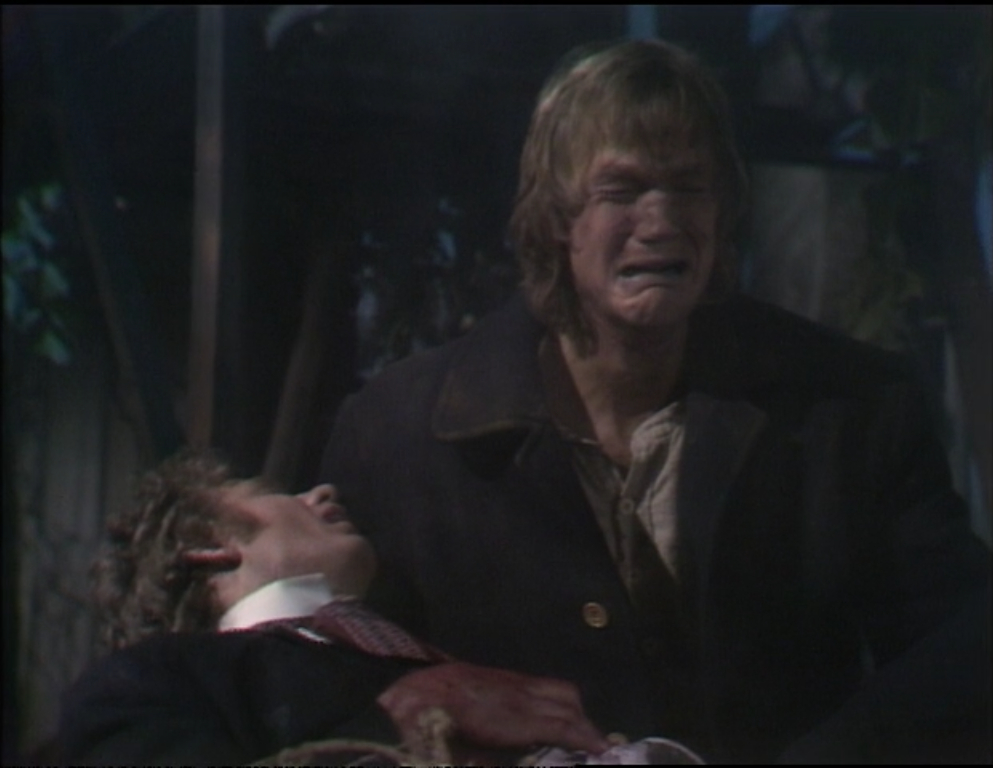
Once more Frankenstein takes his gun to hunt the big guy; once more he fails to kill him. This time the big guy kills him. Frankenstein winds up dying cradled in the big guy’s arms, in a Pietà pose, while the big guy expresses his remorse for his killings. He speaks of “the pain I felt when I killed little William, the hate I felt for myself when I left Elizabeth dead,” and begs Frankenstein not to die. He does anyway, and the big guy walks off, encountering some policemen who shoot him to death.
The big guy wants forgiveness.
For a quarter century before this movie was made, feature films had spent a great deal of time exploring non-communication. Filmmakers like Michelangelo Antonioni, Jean-Luc Godard, and above all Alain Resnais had made dozens of movies about people who simply could not get through to each other. The result was a pervasive sense of tentativeness, as potential relationships were outlined but could not develop and potential events were envisioned but could not occur. The same tentativeness dominates this movie.
*Throughout the movie, people call the scientist “Frankenstein,” while his creation is known only as “The Giant.”
**Recycled from Dark Shadows and other collaborations between Curtis and composer Robert Cobert, as is nearly all the music.
Vampires and mad scientists are both metaphors for extreme selfishness. The vampire exists only to feed on humans, gaining a night’s nourishment for himself at infinite cost to them; the mad scientist takes skills and equipment that could bring great boons to humanity and uses them only to further some perverse private whim. The Frankenstein’s monster emerges as the logical synthesis of these metaphors. As a botched resurrection and a parody of the Christian story, the Frankenstein’s monster evokes the vampire; as the helpless product of the mad scientist’s hubris, he is a child neglected and abused by a narcissistic parent, bringing home the real-world stakes of the issues raised in stories of uncanny horrors.
Mad scientist Julia Hoffman and vampire Barnabas Collins have finally got round to creating a Frankenstein’s monster of their own. His name is Adam. Julia and Barnabas had expected Barnabas to die and his “life force,” what the opening voiceover today refers to as his “spirit,” to animate Adam. They are surprised that the experiment has ended with Barnabas and Adam both alive. They are entirely bewildered about what to do with this 6′ 6″ newborn. Julia goes to her usual default, and injects him with a sedative.
Matriarch Liz comes from the great house of Collinwood to the house where Julia and Barnabas are working. She brings some information about the B plot. Barnabas makes it clear that he and Julia are deeply involved in an experiment begun by the house’s previous owner, the late Dr Lang. Liz is mystified by Barnabas’ new interest in science. She and Julia go to Collinwood, while Barnabas stays downstairs in Lang’s old consulting room. He is waiting for the dawn, wondering if the process of creating Adam cured him of the symptoms of vampirism or if he will crumble into dust when the sun rises.
In the lab upstairs, Adam regains consciousness. He plays with some of the shiny objects around him. It’s rather an odd playpen for a baby, with its electrical equipment spraying sparks, vials of boiling acid, loaded gun, and medical sharps. But he seems delighted with everything until he grabs a scalpel by the wrong end. Then he starts smashing things.
By that point, Julia is back, the sun is up, and Barnabas has learned he is human again. Julia and Barnabas hear the crashing sounds from upstairs. They try to stop Adam. He flings them aside. The episode ends with him sticking his arm out the door while they press it shut. Grayson Hall and Jonathan Frid do such a good job of playing Julia and Barnabas as farcically clueless that the sequence left me and Mrs Acilius roaring with laughter.
There is a bit of self-reference in this one. The first person Adam sees when he opens his eyes is Barnabas. When he can see Barnabas, he is calm. When he cannot, he becomes agitated and dangerous. Most of the people watching Dark Shadows at this point first tuned in because they were curious about Barnabas, and have stayed with the show because they are fascinated with him. The viewer mail whenever Barnabas was not getting enough of the spotlight to please his fans must have been unpleasant for the writing staff to read, and might have made them apprehensive of the crowds that gathered every weekday outside the studio at 442 West 54th Street. Perhaps Adam’s rampage was their nightmare dramatized.
Dark Shadows is in one of its most “High Concept” phases today. Mad scientist Julia is trying to transfer the “life force” of recovering vampire Barnabas into a Frankenstein’s monster named Adam. She is having difficulty concentrating because she is in the grip of an elaborate spell cast by wicked witch Angelique, a “Dream Curse” in which each victim has the same nightmare, is compelled to describe it to someone they saw in the nightmare, and that person is then the next to have the nightmare.
The episode is so completely dominated by these plot elements that the writers couldn’t find time to give the characters motivations. Julia is supposed to tell the nightmare to housekeeper Mrs Johnson. Julia is busy in the house by the sea where the lab is, and there is no reason for Mrs Johnson to go there. So they just have Mrs Johnson show up without a reason. She talked with Angelique on Friday and is in a trancelike state when she enters today, inviting us to imagine Angelique cast a spell that caused her to go to Julia.
Well-meaning governess Vicki also turns up at the house by the sea. She wants to talk to Barnabas about a note he left saying that he would be going away and a man named Adam would be coming. What Vicki lacks isn’t so much a reason to be on this set as it is a reason to be on the show. For thirteen months now, whatever Barnabas is doing has been the A plot of Dark Shadows. Barnabas has systematically refused to let Vicki into his life in any substantive way. In this scene, he confirms that Vicki will not be allowed into the action when he assures her that “loving me would have been the worst mistake of your life.”
For a little while, Vicki was in a B plot about her romance with a man named Peter who insists on being called Jeff. There is no longer any obstacle to Vicki and Peter/ Jeff being together or any connection between Peter/ Jeff and any other story. Besides, Peter/ Jeff is a repellent screen presence, and if Vicki wants to spend time with him we’d frankly prefer she do it when the cameras are off. She and Barnabas do some recapping, and then she goes back to the shelf where the writers are evidently determined to keep her.
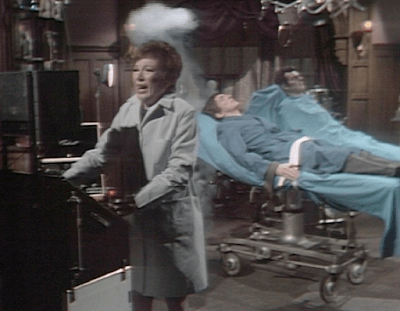
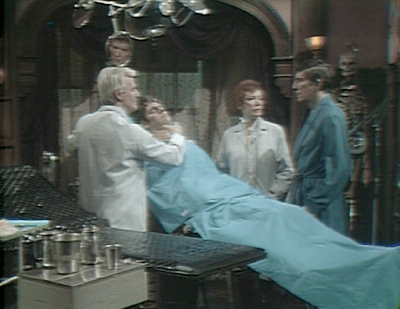
Julia conducts the procedure. There are lots of closeups of gadgets meant to suggest sophisticated medical devices. So many of these are operating in the lab that we wonder why they didn’t hook Adam up to machines that were supposed to make his heart beat and his lungs pump during the many many days he spent lying on the table in this unrefrigerated room. After all, the principle governing the inclusion of machines on this set is clearly “the more, the merrier.”
As the procedure goes on, Barnabas smiles and says with absolute delight “I’m getting weaker. I feel life slipping away from me.” Dark Shadows is already deep into its Monster Mash period, and this kind of misplaced glee is usually the keynote of dramas that are loaded with vampires and witches and Frankensteins and whatnot. But this line is the first time they’ve really sounded that note, and it will be two and a half years before the show outdoes this instance of it.
Some of the equipment crackles and fizzes, and there are explosions. Julia cannot continue, and leaves the room thinking the procedure has failed. Barnabas stays behind to make a speech to the lifeless body, only to see the eyes open. He realizes it is not lifeless at all. The plan was that his original body would die and he would wake up as Adam; he is puzzled that they are both alive.
The late Dr Eric Lang built a Frankenstein’s monster with the intention of draining the “life force” from recovering vampire Barnabas Collins into it. Wicked witch Angelique turned Barnabas into a vampire in the first place, and has returned to the scene to thwart this experiment and make Barnabas once more an undead abomination preying upon the living. Angelique struck Lang dead with one spell, and with another has started a “Dream Curse” that has for the moment compromised the ability of the senior mad scientist in town, Barnabas’ best friend Julia Hoffman, to pick up where Lang left off.
In Lang’s laboratory, Julia and Barnabas recap the plot. Under the stress of the Dream Curse, Julia is having trouble controlling her emotions. At one point she refers to her crush on Barnabas. Every time she has mentioned this before, Barnabas has been a huge jerk about it, ridiculing her and reminding him of the crimes they have committed together, including murder. This time, he is warm and kindly. His non-obnoxious response marks a significant change in their relationship.
Lang left an audio message for Julia on his tape recorder. He said that if she does the experiment and Barnabas and the Frankenstein’s monster, whose name is Adam, both live, neither Barnabas nor Adam will be a vampire. But if Adam dies, Barnabas will revert. His recovery is already hanging by a thread, as he feels ever stronger cravings for blood.
Julia and Barnabas play the tape today, but leave the room before it gets to the part with the message. Lang’s voice plays to an empty set. Addison Powell didn’t do a very good job playing Lang on screen, and he’s no better as a voice actor. Powell appeared in a number of feature films, including hits like The Thomas Crown Affair and Three Days of the Condor, but is best remembered for a series of commercials he did in the 1980s as “The Gorton’s Fisherman.” I remember those spots- I thought he was an actual fisherman they’d hired to read copy. Usually I’m uneasy with the idea of taking a job away from an actor, since I know lots of very talented people who have spent years training in that craft, never to make a living at it. But Powell was so bad I wish my original impression had been correct.
Julia has reached out to Professor Timothy Eliot Stokes, a scholar of the occult, for help with the Dream Curse. When she met with him yesterday, she did not identify Angelique as the witch. She couldn’t tell him anything about the experiment or about Barnabas’ vampirism without confessing to her many crimes. Today, Stokes is trying to fill in the blanks Julia left so that he can help to oppose the Dream Curse. He calls on Barnabas at Lang’s house. He breaks down Barnabas’ resistance and learns that the witch is Angelique, whom he knows under her alias of Cassandra Blair Collins.
Stokes next calls on Maggie Evans, The Nicest Girl in Town, at her house. Maggie was the first person to have the dream, and she gives Stokes a detailed description of it. This gives Kathryn Leigh Scott an opportunity to look into the camera and emote, which is always worth seeing.
There are a lot of shots today using mirrors. In their post on Dark Shadows Before I Die, John and Christine Scoleri include several screenshots of these and of ambitious camera angles from other episodes.
Mad scientists Julia Hoffman (Grayson Hall) and Eric Lang (Addison Powell) are conferring in Lang’s lab. Lang is putting the finishing touches on a Frankenstein’s monster into which he plans to transfer the “life force” of recovering vampire Barnabas Collins. Julia, Barnabas’ best friend, has been opposed to this experiment, but now has accepted that she can’t stop Barnabas and Lang from going through with it. She volunteers to assist.
Lang is having trouble concentrating because of a nightmare he had last night. Unknown to him, the nightmare was part of the Dream Curse, a dead end storyline about wicked witch Angelique sending a dream that each of a series of people will have. When the last person has the dream, Barnabas is supposed to revert to full-on vampirism.
Lang tells Julia about his nightmare. He says that she was in it. When he tells her that she did not speak, she smiles comfortably and says that that was proof that it was a dream. This is not only a genuinely funny line as Grayson Hall delivers it, but it is an extraordinary moment of self-awareness from Julia, a character who usually exists at the outer edge of heightened melodrama. It’s a shame that Addison Powell doesn’t know how to get out of Hall’s way for the half second it would take for it really to land with the audience.
Barnabas and his ex-blood thrall Willie are at home in the Old House on the great estate of Collinwood. Willie is smirking and Barnabas is rigid with embarrassment while the dogs howl outdoors. Willie laughs a little as he makes a remark about how Barnabas hasn’t changed as much as he thought he had. This exchange reminds us of the moment in #346 when Julia and well-meaning governess Vicki noticed that some fresh flowers Barnabas touched had died and shriveled up. Like the howling of the dogs when Barnabas feels bloodlust, the shriveling of the flowers was a consequence of his vampirism, effectively a bodily function that he cannot control. He squirmed when Julia and Vicki looked at him then, and he is stiff and flustered when Willie laughs at him now.
Barnabas orders Willie to take a letter to matriarch Liz at the great house on the estate. It will explain that he is going away on a long trip, and that Adam Collins, a young cousin from England, will be coming to stay in the Old House. Willie is alarmed by this.
Willie asks what Barnabas will do if Liz won’t let him stay in the Old House when he is in the form of Adam. Barnabas is sure she will, and dismisses Willie’s doubts. This is an interesting sequence to regular viewers. The show has never made it clear whether Liz still owns the house or has signed it over to Barnabas. A whole year ago, in #223, Liz was talking to strange and troubled boy David as if the Old House and its contents were Barnabas’ legal property. Since then, there have been moments that tend to confirm that impression, as when Barnabas takes Liz’ keys to the house away from David and does not give them back to her, and other moments that conflict with it. Willie’s question and Barnabas’ response would seem to prove that the house still belongs to Liz.
Another question we might ask is why Barnabas doesn’t go to Liz himself. Certainly she will be unhappy that he went away without saying goodbye to her. Moreover, when he showed up at the great house in April 1967, Barnabas told Liz that he was the only survivor of the English branch of the family. Liz will be skeptical if another member of this imaginary branch presents himself and expects to take possession of a big mansion on her property. She has had unpleasant experiences with Willie, so much so that a letter he delivers seems unlikely to allay that skepticism.
When Willie gets to the great house, Angelique herself opens the door. She is living there under the name Cassandra. She has cast a spell on Liz’ brother, sarcastic dandy Roger, and married him so that she will have a residence at Collinwood while she works to restore Barnabas’ curse to its full potency. Showing his typical degree of strategic ability, Barnabas has not bothered to tell Willie about any of this.
Angelique/ Cassandra ushers Willie into the drawing room, sits him down, and chats with him. Willie answers her questions about Barnabas, not realizing that he has any more reason to be discreet with her than with anyone else. He tells her that Barnabas has been spending his days with Lang. Angelique/ Cassandra already knows that it was Lang who gave Barnabas the treatments that put his vampirism into remission and that Lang is preparing further treatments for him. Barnabas should know that she knows this, since she went to Lang’s house and tried to kill him. Willie also tells her that sometimes Barnabas doesn’t seem to have changed as much as you might expect. Angelique/ Cassandra’s reaction makes it clear this is new information to her, and that it might help her in her efforts.
The scene raises yet another question. Barnabas had expressed the hope that once the experiment was complete, Angelique would see that his old body was dead, would assume that meant that he no longer existed in any form, and that she would then go away and leave him alone. But he knows that she knows about Lang, and now he is planning to come back to Collinwood, where she lives, as another “cousin from England.” The question is this- how dumb does Barnabas think Angelique is?
Back in the lab, Lang and Julia are preparing for the experiment. Barnabas shows up. When he talks with the doctors, his face is reflected in the mirror above Lang’s creature. Not only does this suggest the idea of his personality moving into the creature’s body, it also reminds us that until Lang gave him his first course of treatment, Barnabas did not cast a reflection. The whole idea of Barnabas’ reflection will remind longtime viewers of #288, when Julia first confirmed her suspicion that Barnabas was a vampire by peeking at the mirror in her compact and not seeing him. That draws a contrast between Lang, whose initial success with Barnabas appears to be leading to disaster because his impersonal, hyper-masculine approach leaves him unable to recognize the threat Angelique poses, and Julia, whose own attempts to cure Barnabas of vampirism did not match Lang’s spectacular results, but whose femininity, as symbolized by the compact, represents a fighting chance against the forces that really govern this universe.
Barnabas takes his place on a bed. He tells Julia he is glad she is with him, and she smiles at him with the sad tenderness of someone saying a final farewell to a loved one. As with her self-deprecating joke in the opening part of the episode, this smile shows a new side of Julia. For a time in October 1967 she tried to launch a romance with Barnabas, and he rejected her. Hall played Julia’s unrequited love in the same larger-than-life style that the rest of her action called for. Her feelings seemed to be an outgrowth of despair- she was by that point so deeply entangled with Barnabas that there was little hope she could ever make a life with anyone else, so even though he was an active vampire, she had little to lose by committing herself to him. But this sweet little exchange is played so gently that it opens a window on a more complex inner life for Julia.
As Lang starts the experiment, we cut to Angelique in the drawing room at Collinwood. She is talking to a clay figure, calling it “Dr Lang,” and saying that it cannot overcome her powers, for they were a gift to her from the Devil himself. She jabs at the clay figure. In the lab, Lang writhes in pain, interrupting the experiment.
It was not until #450 that Dark Shadows let on that there might be anything to Christianity. In that episode, good witch Bathia Mapes held Barnabas at bay by showing him a cross. Up to that point, Barnabas had many times strolled comfortably through the old cemetery north of town, where half the grave markers are in the shape of the cross, and they hadn’t bothered him a bit. The only representatives of the faith who figured in the story were repressed spinster Abigail Collins and fanatical witchfinder the Rev’d Mr Trask, both of whom were fools whom Angelique easily twisted to her own purposes. Now we have a character named Adam, a New Adam through whom a resurrection is supposed to take place, and he is wearing a headpiece that is photographed to look like a crown of thorns. Angelique’s reference to the Devil suggests that she can be defeated only through the aid of a being more powerful than the Devil, and since we haven’t heard about Ahura-Mazda or any other non-Christian deities who represented a supreme principle of good pitted against an otherwise irresistible evil, it looks like we’re drifting Jesus-ward.
It is daring to take that direction, even if it is only for a little bit. Vampire legends are pretty obviously an inversion of the Christian story, in which a man comes back from the dead, not having destroyed the power of death once and for all, but only to die again every time the sun rises. While Jesus feeds us with his body and blood in the Eucharist and thereby invites us to share in his eternal life, the vampire feeds himself on our blood and thereby subjects us to his endlessly repeated death. That’s why Bram Stoker’s Dracula has all those crosses and communion wafers, because it is a religious story of the triumph of the promise of resurrection in Christ over the parody of that resurrection that the vampire has settled for. It also explains why Dark Shadows so studiously avoided Christian imagery for so long. Christianity is such a powerful part of the culture that once you let any of it in, it tends to take over the whole story.
There are many reasons the makers of the show would want to avoid that fate. Not least is the tendency of religions to fracture and stories based on their teachings to become sectarian. Dracula itself is an example of that; the vampire is a Hungarian nobleman from Transylvania, connected with the Szekely clan. There really was such a clan, and like other Hungarian nobles in Transylvania its members were Calvinists, supporters of the same version of Christianity that Abigail and Trask represented. Stoker was a Roman Catholic from Ireland, a country where most Protestants are Presbyterians, a tradition that grew out of Calvinism, and so his depiction of the vampire is clearly driven by sectarian animus. The Collinses have an Irish surname, settled in New England when that region was officially Calvinist, and did very well there. So it would be easy to present their troubles as a cautionary tale about Calvinism. That would seem to be a surefire way to shrink the audience drastically. Not only are there millions of Calvinists whom it would offend, there are billions of people to whom Calvinism means nothing at all, and they would be utterly bored by a denunciation of it.
The episode is daring in several other ways as well. When Barnabas and Willie were first on the show, ABC-TV’s office of Standards and Practices kept worrying that viewers might interpret their relationship, which was founded on Barnabas’ habit of sucking on Willie and swallowing his bodily fluids, as somehow homosexual. Not only is the scene between them at the Old House reminiscent of the scenes that attracted memos from that office in the spring and summer of 1967, but the whole idea of Barnabas draining his “life force” into the body of Adam would seem to invite the same concerns.
The experiment scene would only intensify such concerns. The experiment is a medical procedure that is supposed to bring a new life into the world, which by 1968 was how Americans usually thought of the process of birth. Barnabas is the patient, he is lying down, and the doctors sedate him. Thus he takes on all the medicalized marks of a mother-to-be. Julia asked Lang if the process would be painful for Barnabas; he does not disappoint, but ends the episode screaming in response to labor pains. Not only does turning Barnabas into Adam’s mother invert the expected gender performance, but it also introduces a homosexual side to Barnabas’ relationship with Lang, who is Adam’s other parent.
Somebody ought to be there telling Barnabas he’s doing great and urging him to push. Screenshot by Dark Shadows Before I Die.
Christian imagery and gender-nonconformity would have been rather a queasy combination for most Americans in 1968. That’s unusual, in historical terms. Before modern times, Christians didn’t hesitate to discuss ways that familiar gender roles break down in the relationship of humans to Christ. The “Fathers of the Church,” the prominent Christian intellectuals of the fourth and fifth centuries, talked about that all the time, going into depth not just with the image of the Church as the Bride of Christ but of each human soul, whether male or female, as one of Jesus’ wives, and of the physical contact between humans and Jesus in the Eucharist as a consummation of their marriage.
For their part, Calvinists tended to be skeptical of the physical aspect of the sacraments, but that didn’t mean that they shied away from conjugal metaphors to describe the relationship between the soul and Jesus. John Donne, like most priests in the Church of England in the 16th and early 17th centuries, was basically a Calvinist, yet his sonnet “Batter my heart, three-person’d God” is one of the most vivid and uncompromising statements of the ancient idea of an erotic dimension to Christian life that transcends the binaries between masculine and feminine, male and female. That tradition makes today’s conjunction of Christian and homoerotic themes all the bolder- imagine if Dark Shadows wrote itself into a corner where they had no choice but to explain nuptial imagery and mystical eroticism in the writings of Saint Ambrose. The whole audience could fit into a seminar room.
Closing Miscellany
Lang and Julia wear white lab coats. This is the first time Julia has worn a white coat. Her previous lab coat was light blue, which looks white on the black and white TV sets most households had in 1968, but now that the show is being produced in color they are buying costumes and props for color televisions.
The idea of a machine that would cause a person to go to sleep in one body and wake up in another was a big deal on TV in the 1960s. Just today I saw this screenshot from The Avengers on Tumblr:
This episode marks the first appearance of Robert Rodan. When Adam was a nameless heap of flesh under a blanket, he was played by a stand-in named Duane Morris. Rodan had a few small parts on TV shows in 1963 and 1964 and was in a couple of commercials between 1964 and 1968. Adam was his first, and last, recurring role on a series. In 1969, he appeared in a little-seen feature film called The Minx, then spent the rest of his life selling real estate in Southern California.
Dr Julia Hoffman is in the front parlor of the house of her fellow mad scientist, Eric Lang. She is on the telephone, asking the operator to connect her with the police. Even though she has lived in the Collinsport area for months now, she is still surprised that the sheriff’s office doesn’t have an emergency number.
Julia locked the door to the parlor; Lang is outside it with a gun, and recovering vampire Barnabas Collins is knocking and calling her name. They want to stop her reporting to the police that Lang is building a Frankenstein’s monster with body parts retrieved from the cemetery, and that he was planning to cut a living man’s head off to use as the last piece of the creature. Lang plans to bring the body to life by draining Barnabas’ “life-force” into it. Barnabas hopes this will free him of the vampire curse once and for all, and is desperate to complete the experiment.
Barnabas shouts that Julia should remember “someone.” When he can’t come up with the name, Lang prompts him with a yell of “Dave Woodard!” Barnabas and Julia killed local physician Dave Woodard in #341; Julia hangs up the phone, realizing that if the operator ever does manage to find a police officer any investigation of Lang would likely expose her as a murderer.
Barnabas has told Lang a great deal about himself. For example, in #467, Lang was the first person Barnabas told that his vampirism was the result of a curse placed on him by wicked witch Angelique. So returning viewers can believe that Barnabas might have confided in Lang about the murder of Dr Woodard. But it would be strange for him to have done so off-screen. And just Friday, Barnabas explained to Lang that the reason he thinks Julia can be trusted with the secret of the experiment is that she has a crush on him.* He hasn’t had much time to share more information with Lang since then, and if Lang had already known that Julia couldn’t call the cops without exposing herself to a murder charge Barnabas wouldn’t have needed to mention her crush on him. The likeliest explanation is that the loud and clear exclamation of “Dave Woodard!” is not Lang prompting Barnabas at all; rather, it was Addison Powell prompting Jonathan Frid. The result is a blooper that seriously confuses the relationships among Lang, Barnabas, and Julia. It’s early enough in the episode that it really is odd they didn’t stop tape and start over.
At any rate, they never mention Woodard again. He was introduced early in the vampire storyline. He was the counterpart to Dr John Seward, the physician in Dracula who realizes that all the patients who are suddenly showing up with puncture wounds on their necks and massive blood loss need care he is not trained to provide, and calls in his old med professor, Dr Van Helsing. Julia was the Van Helsing analogue, but she wound up siding with the vampire and killing her onetime friend. It is appropriate that the last reference to Woodard comes in this, the second episode of Dark Shadows with no cast members introduced before Barnabas. From now on, the daylight world Woodard represented and tried to restore is no longer present even as a memory.
Julia lets Barnabas and Lang into the parlor, and asks Lang to promise that he won’t kill anyone. He gives such a promise. She is unconvinced, but agrees not to call the police. She also tells Lang she will continue to oppose the experiment.
On the terrace of the great house of Collinwood, Barnabas and Julia talk about Lang’s experiment. Angelique, wearing a black wig and calling herself Cassandra, lives in the house as the wife of sarcastic dandy Roger, and the terrace is surrounded by trees, fences, and other prime screens for eavesdroppers. Barnabas and Julia know this well, as each of them has eavesdropped on important conversations here themselves.
Of course Angelique/ Cassandra comes by and hears everything. Barnabas does catch her, grab her, call her by her right name, and vow that she won’t stop him. After he lets her go, he moans to Julia that it was foolish of them to discuss their plans there. That underlines the foolishness of an idea key to the plan, that after Lang’s creature has been animated Angelique will never realize that Barnabas is dwelling within it and place a fresh curse on it. Barnabas assumes that Angelique, who has transcended time itself to pursue him, will just give up and go away once she sees that his original body is dead, and won’t have any questions about the new guy living at his doctor’s house.
Angelique summons her new cat’s paw, lawyer Tony Peterson. Jerry Lacy plays Tony. From #365 to #461, Dark Shadows was a costume drama set in the 1790s. In that phase of the show, Mr Lacy played the Rev’d Mr Trask, a fanatical witchfinder who inadvertently gave Angelique a great deal of assistance in her campaign to destroy the Collins family and those close to them. Most of the characters in the 1790s segment represent a commentary of some kind on the characters the same actors play in the parts of Dark Shadows set in the 1960s. Tony and Trask have seemed to be an exception. In 1967, Tony was introduced through his profession and served mainly as an instance of Mr Lacy’s famous Humphrey Bogart imitation. Trask did end up functioning as a lawyer in a witchcraft trial, and his lunatic shouting about “THE ALMIGHTY!!” and “THE DE-VILLLL!!!!” were occasionally suggestive of what Bogart might have ended up doing if Captain Queeg’s testimony before the court-martial in The Caine Mutiny had gone on for nineteen weeks. Otherwise, there didn’t seem to be any fruitful points of comparison between the two.
Angelique tells Tony that the reason she chose him as her servant was that he reminded her of Trask. She orders him to go to Lang’s and steal a talisman that can guard against witches. At that, Tony shouts “Against you!,” and he sounds very much like Trask. Perhaps we are to think that a secular education and a steady diet of Hollywood movies could have turned the farcically warped Trask into a basically reasonable fellow like Tony, but that there is no strength in those things to stand up to a force like Angelique.
The talisman was a gift to Lang from Barnabas. Lang refuses to keep it on his person, even though it saved his life to clutch it when Angelique was making his heart beat so fast it was about to burst. Lang shows up at Barnabas’ house, under the false impression he received a telephone call from Barnabas. Barnabas, who has no telephone in his house, explains to Lang that Angelique has lured him away. When he learns that Lang has left the talisman in his desk drawer at home, he insists on accompanying him back there.
It is too late. Tony has already stolen the talisman and delivered it to Angelique. She looks at it and says that Lang will not be able to save either Barnabas or himself. Presumably, not even by reminding him of his lines.
Mad scientist Dr Lang is building a Frankenstein’s monster in the laboratory hidden in his house. Once the body is complete, he will drain the personality of recovering vampire Barnabas Collins into it. That is supposed to bring the creature to life and free Barnabas from vampirism forever.
As we open, Lang is preparing to harvest a head for the creature from the body of the man who had dug up the graves to supply the other parts. This man is, at the moment, still alive. His name is Peter, though for reasons of his own he wants to be called Jeff. Peter/ Jeff keeps waking up and complaining about his impending decapitation, to Lang’s surprisingly mild irritation.
Barnabas comes to the lab. He is afraid of a relapse into vampirism, but is having second thoughts about killing Peter/ Jeff. Lang works hard to talk him back into going along with his evil scheme. He asks Barnabas if he loves well-meaning governess Vicki. Barnabas says yes. First time viewers may be surprised that he doesn’t put much enthusiasm in that response; regular viewers, knowing that Barnabas has never shown any sign of being attracted to Vicki, will not. Lang says that if Peter/ Jeff goes free he will marry Vicki and they will live “a life of unending happiness!” Faced with this horrifying prospect, Barnabas agrees to let Lang butcher Peter/ Jeff.
Barnabas leaves the room and sees Vicki letting herself into Lang’s house. He hides from her, then sneaks back to the lab to tell Lang she is there. Lang goes to get rid of her. Barnabas eavesdrops on their conversation. We see the conflict on his face. He goes back to the lab, stands next to the table where the unconscious Peter/ Jeff is restrained, tells himself that Vicki will always love Peter/ Jeff, and studies one of Lang’s scalpels. For a moment it looks as if he will kill Peter/ Jeff himself, but instead he releases the restraints.
Lang comes back, and Barnabas quarrels with him. When Lang says that they can’t let Peter/ Jeff go knowing what he knows about them, Barnabas tells Lang that Julia Hoffman, the other mad scientist in town, has such potent abilities as a hypnotist that she can erase Peter/ Jeff’s memories. Lang refuses to involve Julia, and pulls a gun on Barnabas. After so many long years as an undead abomination, Barnabas sadly tells Lang that an ordinary bullet is no threat to him. Lang declares that, on the contrary, he is now sufficiently human to die of gunshot wounds.











 Dark Shadows Commentary