When Dark Shadows premiered in June 1966, strange and troubled boy David Collins (David Henesy) was obsessed with his absent mother and determined to get rid of his new governess, the well-meaning Victoria Winters. In #15, David had tampered with his father Roger’s car. As he stood at the window and watched Roger drive down the narrow, twisting mountain road away from the great house of Collinwood, he said “He’s going to die, mother, he’s going to die!” When Roger survived and it was discovered that someone had removed the bleeder valve from his braking system, David planted the valve in Vicki’s room in an attempt to frame her for the murder attempt. Later, Roger would come to fear that Vicki was about to expose a dark secret of his own, and would encourage David to try to kill her.
David eventually gave up on homicide, and dropped his hostility to Vicki. One of the more benevolent influences on him was his best friend, the ghost of the gracious Josette. In #102, we saw David in the Old House on the grounds of Collinwood, carrying on a conversation with the portrait of Josette that hung above the mantel. We could not hear Josette’s side of the conversation, but it certainly sounded like David could. We already knew at that point that Josette was real- we saw her emanate from the portrait, walk out of the house, and dance among the columns outside it in #70, when David first took Vicki to the Old House. In #126, we would see and hear Josette when she led the ghosts of Collinwood in rescuing Vicki from crazed handyman Matthew Morgan. That rescue was not only a good deed for Vicki, but also a favor to David, who had stumbled upon Vicki in the secret room where Matthew had her tied up and, in a panic, left her to her fate.
In #153, we learned that David’s mother, the former Laura Murdoch, was the one who chose his name, one which no previous Collins had borne. Roger had wanted to call David “Charles Andrew,” in honor of some Collins ancestors. In #181, Vicki and her allies learned that two previous women given the name Laura Murdoch at birth had died by fire, one in 1867 and the other in 1767, each accompanied by her young son, and that each of those boys was named David. It would eventually become clear that Laura was an undead fire witch, a humanoid Phoenix who went into a pyre with her sons at intervals of exactly 100 years, gaining immortality for herself, though not for the Davids. In #288, they had forgotten the lore about David’s name, and mentioned a previous David Collins, but in #685 and #767, it was back to being a first in the family. Between those two episodes, from #729 to #760, another iteration of Laura was on the show, suggesting that the writers brushed up on their knowledge of her original storyline.
By the time Vicki saved David from Laura, he had moved out of the villain category altogether. When his third cousin Amy Jennings (Denise Nickerson) moved into Collinwood at the end of 1968, David was as pleasant to her as one could expect. But his behavior towards her and others changed when the two of them stirred up the ghost of Quentin Collins, Amy’s great-grandfather and David’s great-great-uncle. As Quentin gathered strength, he intermittently possessed first one child and then the other. While David was under Quentin’s control in #679, he twisted Amy’s arm to force her to go to a secret room and join in their vengeful ancestor’s evil plans for their governess, Vicki’s successor Maggie Evans (Kathryn Leigh Scott.) The camera lingered on that act of bullying, meant to shock us with evidence that Quentin’s dire influence had overwhelmed David’s kindly nature.
The arm-twisting incident made an impression on the viewers. In #813, set in the year 1897 when Quentin was alive, Henesy and Nickerson played brother and sister Jamison and Nora Collins, nephew and niece of Quentin, grandfather and great-aunt to David. Jamison, possessed by sorcerer Count Petofi, twisted Nora’s arm to force her to give him information, a reference which shows that the writers were confident that many viewers would see David Henesy’s character abusing Denise Nickerson’s in that way and read it as a sign that he is under the power of an outside force.
Now, it is 1970, but we are not in the main continuity at all. We have traveled to an alternate universe, which on Dark Shadows is known as “Parallel Time.” In this “time-band,” to use another bit of Collinsport English, Quentin is alive and the master of Collinwood. His first wife, the counterpart of wicked witch Angelique, has died, and he has remarried. The new Mrs Collins is the former Maggie Evans (Kathryn Leigh Scott.) Quentin and Angelique’s son, strange and troubled boy Daniel (David Henesy,) is obsessed with his absent mother and determined to get rid of his new stepmother.
Apparently the writers still remember the connection between David’s name and the first Phoenix story, because Daniel is the only character we have yet seen in Parallel Time answering to a different first name than his counterpart in the main continuity. Angelique and Quentin gave him the name of the Collins ancestor whom Mr Henesy played in early 1968, when the show was set in the year 1796. We know that the timelines diverged in that period, so it follows that it was the counterpart of the eighteenth and nineteenth century Daniel who was this Daniel’s namesake.
When we first saw Daniel, he was carrying on a one-sided conversation with his mother’s portrait, which hangs in her old bedroom. Today, he devises a plan to use the portrait to frighten Maggie. The plan requires the cooperation of his cousin, Amy Collins (Denise Nickerson.) When Amy refuses, he twists her arm until she agrees to go to a secret room and sing, making Maggie think the portrait is coming to life. This attack is shown only for a few seconds, and Amy’s arm is out of frame. They have already established that Daniel is cruel, and do not need to dwell on the act of abuse.
Daniel claims that his father often goes to Angelique’s room to meditate and talk to the portrait. That lures Maggie to the room, where Daniel is waiting. They have a confrontation. When she says she wishes she could “make him understand-,” he interrupts her and asks if what she wants him to understand is that his mother is dead and is never coming back. She looks at him and answers with a flat “Yes.” He tells her she is wrong, and pleads with the portrait to sing to him. Maggie says she can’t stand to see him like this, and turns to go. Before she gets out of the room, we hear a woman’s voice singing a lullaby. Maggie and Daniel hear it too. She turns around, shocked, and runs from the room. Daniel laughs that his plan worked so well.
Amy comes rushing into the room. Daniel congratulates her on her performance, and asks how she got in from the secret room so quickly. She explains that she never went to the secret room- her brother Chris intercepted her before she could do so. It wasn’t her voice Daniel and Maggie heard. He absorbs her message, and looks at the portrait in wonderment.
The audience could tell it wasn’t Denise Nickerson singing- she had such a high-pitched voice when she was twelve that she had to work hard to keep it in a range that would sound good on television, while the pre-recorded voice we heard singing was definitely that of a grown woman. Angelique was played by Lara Parker; Parker did some very distinctive things with her voice on Dark Shadows, none of which shows up in the lullaby, so I’m sure it wasn’t her. Several fansites attribute the singing to Joan Bennett, who is in this episode, but I’ve heard Bennett sing and she didn’t get from one note to another the way this voice does. I think the singer must be Kathryn Leigh Scott.
Early in the episode, Daniel and Amy had a scene in his bedroom. David’s bedroom was a frequent set in the first 38 weeks of the show, and was occasionally seen thereafter. Daniel’s room is the same set, with the same furnishings and decorations, but they are arranged in the opposite direction from the pattern we see in David’s. His bed is at stage right rather than stage left, and everything else is also transposed. Seeing this mirror image, regular viewers will appreciate this reminder that we are in a Mirror Universe.
When Dark Shadows premiered in June 1966, it was supposed to bring the sensibility of the then-fashionable “Gothic romances” to the small screen. That did not prove to be much of a ratings draw, so six months later they introduced undead blonde fire witch Laura Murdoch Collins, who was at the center of a story that by March 1967 had swallowed up all of the major loose ends and committed the show to becoming a supernatural thriller.
Now, vampire Barnabas Collins has crossed over to an alternate universe. We have seen enough of “Parallel Time” over the last several episodes to know that it will feature a story derived from Daphne Du Maurier’s Rebecca, one of the foundational works of the “Gothic romance” genre. Viewers who have been with the show from the beginning will be intrigued at this return to its starting point.
The first person Barnabas meets is the counterpart of his distant cousin and onetime blood thrall, heiress Carolyn Collins Stoddard. This Carolyn finds him in a room deep in the great house of Collinwood and demands to know who he is and what he is doing there. He starts in on the “cousin from England” jazz that won him his place at Collinwood in the continuity we have been following so far. He cites the portrait of him that hangs in the foyer in the familiar timeline, only to be told that there is no such portrait in this house and that his story does not add up. Carolyn marches off to blow the whistle on the intruder, and Barnabas bites her. We can see that Parallel Time is going to move fast- it took Barnabas 28 weeks to attack Carolyn in the other universe.
This Carolyn is married to the counterpart of Barnabas’ servant Willie Loomis. While Willie is an uneducated ruffian, Will Loomis is the author of several books, including three bestselling novels and a biography of Barnabas’ late counterpart, who died a natural death in 1830. Will and Carolyn live in the Old House, which corresponds to Barnabas’ own house in the main continuity. Quentin Collins, another distant cousin, is the master of Collinwood here, and widower of Angelique, who corresponds to the wicked witch who made Barnabas a vampire in 1796 but was apparently a mortal woman and a native of the twentieth century here. Other characters we see today include: Julia Hoffman, in the other universe, a mad scientist and Barnabas’ best friend, but here a uniformed domestic and Angelique’s fanatical devotee, Mrs Danvers to her Rebecca; Carolyn’s mother Elizabeth Collins Stoddard, who is not the owner of Collinwood and the Collins family businesses but a guest in Quentin’s house; and Quentin’s new wife, Maggie Evans Collins. We also hear that Angelique’s father is “Tim Stokes,” the counterpart of Barnabas’ sometime ally, occult expert Timothy Eliot Stokes.
What we had seen of “Parallel Time” before Barnabas arrived let us know that Quentin was bringing a new bride home, much to the displeasure of Hoffman and Angelique’s other acolytes. We also knew about the Loomises. So that left us with two candidates to play the part of the intimidated, anxiety ridden “second Mrs de Winter.” Those were Kathryn Leigh Scott, who has been Maggie in the main continuity since episode #1 and has played other parts in time travel segments and as a ghost, and Lisa Blake Richards, who plays Sabrina Stuart, girlfriend of werewolf Chris Jennings.
I love Miss Scott, but I was hoping Miss Richards would be the overpowered new wife. Miss Scott has one of the deepest iconographies of any cast member. No matter how far Miss Scott dials down the big brassy Dark Shadows style of acting, regular viewers simply will not believe that she, answering to the name of Maggie, is going to be reduced to the position that the second Mrs de Winter finds herself in, where she is grateful to her own servants for allowing her a piece of bread and butter when she hasn’t eaten all day. It took all the abuse Barnabas could heap on her, supported by Julia’s magical powers of hypnosis, to break Maggie in 1967. Miss Scott was successful as neurotic intellectual Rachel Drummond when the show was set in 1897, but they went out of their way to show that Rachel was not Maggie. The second Mrs Quentin Collins not only has the same name as the wised-up representative of Collinsport’s working class whom we met long ago, we even hear today that her father was an artist who lived in the village, as our Maggie’s was.
Miss Richards, by contrast, would come in clean. Sabrina, stuck in a dead-end story where her character was a mute for a long time, has made relatively little impression. Miss Richards specialized in a very precise, understated approach. She would be the perfect choice to tackle the job Alfred Hitchcock gave Joan Fontaine in his 1940 feature adaptation of Rebecca and depict a character succumbing to obscure anxieties.
We hear today that this Maggie has a sister, which ours never did. Perhaps Miss Richards will appear as that character. We do not hear whether Sam Evans is still alive. He is dead in the main continuity, but that was the result of an attack by a monster who would not have existed in this one. Longtime fans might get their hopes up that we will see David Ford again as Sam’s counterpart. Carolyn Loomis tells Barnabas today that the idea of widowhood is not as unattractive to her as he seems to imagine; since Nancy Barrett had divorced Ford a few months before this episode was taped, bringing him back into the cast might have helped her add some zest to this aspect of her character.
The blocking does not always take into account the dimensions of the brief outfits Junior Sophisticates provided Miss Scott. So when Quentin carries Maggie into the great house today, the camera looks right up her miniskirt. The ratings were still high during this period, but you can tell no one was watching who worked for either ABC’s Standards and Practices Office or the Federal Communications Commission.
Heiress Carolyn Collins Stoddard has had a dream in which her new husband, whom she knows as Jeb Hawkes but who when we first saw him asked to be called Jabe, was in a fight on top of Widows’ Hill. His opponent, a stooge named Sky Rumson, threw him off the precipice to his death. When she awoke, Carolyn ran to the hill in search of Jabe. Instead, she found Sky. He told her that her dream was not complete, because it did not show her death. He then grabbed her by the throat.
Jabe rushes up and knocks Carolyn out of Sky’s grip. He and Sky fight, and Sky does throw him off the precipice. Carolyn escapes.
Back home at the great house of Collinwood, Carolyn finds her mother, matriarch Elizabeth Collins Stoddard, and permanent houseguest Julia Hoffman, MD. It takes her a while to compose herself sufficiently to tell Liz and Julia what happened. Julia offers Carolyn a sedative, which prompts her to jump up and shout a verbal refusal. By the time Carolyn starts telling the story, her distant cousin, old world gentleman Barnabas Collins, has joined them in the drawing room. She interrupts herself to yell at Barnabas that he always hated Jabe and is probably glad he’s dead. When Carolyn finishes, Barnabas slips out. Liz calls the police, and Julia is surprised neither of them saw Barnabas leave.
For the last nineteen weeks, the show has been trying to make a story out of some themes drawn from the writings of H. P. Lovecraft. That segment is usually called “the Leviathans,” after a race of Elder Gods who are behind the action. Jabe was central to the Leviathan segment. Sky is the only other character remaining from it. Barnabas appears in the house where Sky has been crashing and finds him packing his bag. Sky does not understand how Barnabas got in. Barnabas dismisses his question, merely saying that Sky knows there are things he can do that ordinary people cannot. Sky draws a revolver and fires two rounds at Barnabas point blank, without effect. Sky exclaims “Oh, no!” Barnabas is amused that none of Sky’s late colleagues told him that he is a vampire. He takes Sky’s hand, curls his arm back so that the gun is pointing at his heart, and squeezes Sky’s finger onto the trigger.
Back at the great house, Liz gets a telephone call from the sheriff. The police haven’t found Jabe’s body, and have surmised that it washed out to sea. They have found Sky, and have tentatively ruled his death a suicide. Later, Carolyn has another dream. In this one, Jabe shows up and confirms his death. That marks the end of the Leviathan segment. Carolyn will go on using the name “Mrs Hawkes” and saying she misses Jabe, but otherwise the last nineteen weeks will be forgotten.
Before killing Sky, Barnabas had mentioned that he almost regrets not leaving him to the other person who is on her way to do him in. That is Sky’s estranged wife, wicked witch Angelique. Had the Leviathan segment been more successful, or had Geoffrey Scott been even marginally competent in his performance as Sky, they might have made something of the parallels between Sky and Jabe. They are both very tall men with blonde wives who are dissatisfied with them. Angelique is dissatisfied that Sky is a tool of the Leviathans and that he tried to set fire to her on the orders of their representative, and Carolyn is dissatisfied with Jabe because he keeps running away from dangers he has brought on himself by his rebellion against the Leviathans and he won’t tell her anything about himself. Sky is a mortal man, while Angelique may once have been human but has long since become a creature of the supernatural. Carolyn is a mortal woman, while Jabe is now human but was originally a shape-shifting monster from beyond space and time.
But the ratings have been sinking throughout the Leviathan period, and the whole narrative structure of the arc keeps collapsing around them every time they try to do anything with it. So they are in too much of a hurry to move on to the next thing to do any exploring of the characters. Also, Scott is hopeless. As my wife, Mrs Acilius, put it, it isn’t that he is an actor with just one strategy. He keeps trying different things, and none of them comes close to working. We won’t see him again.
The new story has to do with an alternate universe that is occasionally visible in a room in the long disused east wing of Collinwood. Barnabas, Julia, and others have been spying on its inhabitants, and Barnabas is fixated on the idea that if he can cross over into it his vampirism will disappear. Since his bloodlust is overwhelming him, he is desperate to pursue this forlorn hope. He goes to the room when the alternate universe cannot be seen there, and a moment later finds that it has changed with him in it. Julia is in the hallway, looking in. At first she and Barnabas can see each other, and she can hear him, though he cannot hear her. After a moment, Carolyn’s alternate universe counterpart enters and demands to know who Barnabas is and what he is doing in the house.
Barnabas took Carolyn as his blood-thrall in October 1967. The show went back in time to 1795 the following month. In the 1790s segment, Nancy Barrett played fluttery heiress Millicent Collins. We saw that Barnabas first became a vampire in 1796; not long after, he took Millicent as his blood thrall. Shortly after the show returned to contemporary dress in March 1968, one of Julia’s colleagues in the mad science profession applied a treatment that put Barnabas’ vampirism into remission. That freed Carolyn of her connection to him, and at some point she forgot it ever happened.
For most of 1969, Dark Shadows was set in 1897. In that segment, Miss Barrett played repressed schoolmarm Charity Trask. Barnabas bit her, too. Carolyn’s counterpart in “Parallel Time,” known by her married name Carolyn Loomis, is the fourth character* Miss Barrett played on Dark Shadows; considering that Barnabas is so frantically hungry, it looks like she will follow in the footsteps of her predecessors and serve as his breakfast.
*Or fifth- in #819, sorcerer Count Petofi found Charity’s personality to be an irritant, so he erased it and replaced it with that of the late Pansy Faye, a Cockney showgirl/ mentalist. From that time on, Miss Barrett played Pansy, not Charity.
Suave warlock Nicholas Blair first joined the cast of characters in June 1968, posing as the brother of Cassandra, wife of Roger Collins. Since Cassandra was an alias that 200 year old wicked witch Angelique was using, we knew right away this could not be so. Nicholas asserted himself as Angelique’s boss, faced down the ghost of the fanatical Reverend Trask, and kept saying that he had a plan that was far more important than Angelique’s petty little scheme to establish herself in the great house of Collinwood and turn Roger’s distant cousin Barnabas Collins back into a vampire. As played by Humbert Allen Astredo, Nicholas kept us believing for weeks that we would be in awe once we heard his plan.
Eventually, Nicholas stumbled upon the fact that Barnabas’ best friend, mad scientist Julia Hoffman, had constructed a Frankenstein’s monster in the course of a project to keep his vampirism in remission. From that point on, Nicholas declared that his plan was to force Julia to make a female Frankenstein’s monster, to mate the already existing monster to her, and thereby to breed a new race of people loyal only to his master, Satan. He’d been on the show so long at that point that his sudden parachuting into the Frankenstein story only revealed that up to that point, all his talk about his grand design had been empty boasting.
Moreover, Nicholas’ plan for the patchwork people did not make sense in the context of the show. In a novel or movie like Rosemary’s Baby, the audience sees the heroine raped with the acquiescence of her husband, and our horror at that crime gives force to the premise that she will bear Satan’s only begotten son, who, in an inversion of the Christian story, will transform the whole world by the very fact of his birth. Stealing fresh corpses, chopping them up, and stitching them together isn’t the same horror as rape, but it is a pretty disgusting way to spend an evening, so I suppose that will get you off to some kind of start. But if your show is on the air for half an hour a day across the board Monday through Friday, your audience has time to sit with Nicholas’ scheme and think through all of the practicalities it implies. The new race is going to take many years to grow and multiply and overtake H. Sap., even if its members all have Soap Opera Rapid Aging Syndrome. What are we all supposed to do in the interim, watch the Frankenbabies through nanny cams? It isn’t an idea for series television.
Nicholas not only saddled himself with a plan that obviously wasn’t going to work, he didn’t deliver on his claim to be a surpassingly talented sorcerer. In #528, Angelique asked him to slip a potion to one of her adversaries. He complained that “I am much too talented to spend my time drugging drinks,” but he complied with the request. Not only did that turn out to be a waste of time, later he would on his own initiative drug a couple of other people’s drinks, again without the results he wanted.
Eventually, Nicholas fell in love with Maggie Evans, The Nicest Girl in Town. That amused Angelique, who taunted him with all the times when he had sneered at her for the humanity she showed in her emotional attachment to Barnabas. As Nicholas grew fonder of Maggie, his powers became less reliable, and his involvement with the main plot became more tenuous. No longer able to make Angelique obey him, Nicholas was reduced to using unsightly ex-convict Harry Johnson as his henchman. By the time the Frankenstein project collapsed and Satan called Nicholas back to Hell, not even Astredo’s considerable acting talent could make us take him seriously.
Nicholas returned in February 1970, just over five weeks ago. At that point the show was mainly concerned with an attempt the writers were making to take some material from the tales of H. P. Lovecraft and make a story out of them. The Leviathan People are Elder Gods who want to reconquer the Earth and destroy humankind. Their harbinger was a shape-shifting monster who had taken the form of a tall young man and invited people to call him Jabe. Jabe was supposed to join with Roger’s niece Carolyn to produce a new race of people.
The Lovecraft material never came together, and by the middle of February the makers of the show were scrambling to find a new direction. Nicholas appears to have been a last-minute replacement for a different sort of villain who was supposed to take over as the chief menace in the second half of the segment. Now they have thrown out that second half and are trying to get to something else before the ratings drop any further. So they brought back an already established character and plugged him into the scenes originally meant to be played by the one they never got around to introducing.
Bringing Nicholas in to the Leviathan arc makes it hard for longtime viewers to ignore the similarities between the Leviathans’ plan to breed a new race and his 1968 plan for the patchwork people, including the shared weakness that if either plan were successful, it wouldn’t leave you anything to put on a daytime soap. Also, Nicholas explicitly acknowledges that he has already failed in one such project, lampshading the problem but not alleviating it. He also keeps bringing up his “Master,” who is clearly still Satan. No other character in the Leviathan arc makes reference to any themes derived from Christianity- everyone else is living in the determinedly non-Christian world of Lovecraft’s imagination. So he seems out of place from the beginning.
The Leviathans’ plan was already nearing collapse when Nicholas showed up. Every time Jabe has used his powers, the results have backfired on him. His personality has alienated all of his allies. And now he doesn’t even want to be a shape-shifting monster anymore- he fell in love with Carolyn, and just wanted to take her on dates and then marry her. Nicholas is supposed to be the trouble-shooter who will turn this troubled operation around, but nothing about him inspires confidence that he is the right person for that job.
Since Nicholas arrived, things have gone downhill for the Leviathan cause even faster than they had been before. In #966, Nicholas watched in horror as Jabe smashed the box from which he originally emanated, causing all of the Leviathans’ other visible belongings to vanish. Nicholas then declared that everything was over, and that the time of the Leviathans was no more. But they still didn’t have another story ready to go, so he and Jabe have continued to hang around. Nicholas still has one follower, Angelique’s estranged husband Sky Rumson, but since there is no reason for Sky to be on the show either, that isn’t much of a basis for Nicholas’ continued presence. On his great blog Dark Shadows Every Day, Danny Horn called Nicholas a “failure demon”; all in all, that would seem an apt classification.
Today, Jabe turns up at Nicholas’ place. Nicholas knows that Angelique cursed Jabe to be plagued by a mysterious shadow not his own that follows him and drives him mad. This much is borrowed from George MacDonald’s 1858 novel Phantastes, but unlike the Reverend MacDonald’s allegory of sin and anxiety this shadow is a physical weapon that will kill Jabe when it grows strong enough. Jabe asked Nicholas to use his powers to lift Angelique’s spell the other day, but Nicholas refused, even though he claimed that he could and he acknowledged that it would have been to his advantage to do so. The opening voiceover today reminds us that Nicholas knows all about the shadow.
Now, Jabe is telling Nicholas that he was wrong to turn against him, wrong to smash the box, wrong to give up his destiny of leading the Leviathans to global dominion. Nicholas dwells on his exhaustive knowledge of the shadow and tells Jabe he can take the shadow from him and set it on Angelique. He begins to hypnotize Jabe. When he seems to have Jabe in a trance, he tells him he does not give second chances, and that he is going to kill him and Carolyn. Jabe suddenly produces the paper cutout Angelique used to place the shadow curse on him and places it on Nicholas’ jacket. He then runs out of the room. The shadow appears and envelopes Nicholas, who collapses. Even though he knew in advance exactly what was going on, Nicholas still could not avoid death as the result of getting slapped on the chest with a piece of construction paper. He dies as he lived, a failure demon to the end.
Sky enters. Jabe returns, and Sky tells him Nicholas is dead. Sky whines that because Nicholas was not human, his death will not be the end of him and Jabe will not get away with killing him. Geoffrey Scott’s appallingly bad acting reinforces the image of Nicholas as a colossal loser- if this was the only ally he had left at the end, he must have been an even more hopeless stumblebum than we had thought. Jabe exits. A moment later, Nicholas’ ghost appears to Sky and tells him to kill Jabe.
Jabe goes back to the great house of Collinwood to tell Carolyn that he is rid of the shadow. They are married now, but have spent very little time together because the shadow has kept chasing Jabe off. She is puzzled by the whole thing, in part because Jabe refuses to tell her anything about his situation, and is unenthusiastic about Jabe’s renewed insistence that they go away immediately. She agrees to leave with him in the morning.
Carolyn goes upstairs. In the drawing room, Jabe hears Nicholas’ voice telling him that he will never escape. Roger’s son, strange and troubled boy David Collins, enters; Jabe tells him that he and Carolyn are going on a trip tonight.
Jabe sent Carolyn upstairs with orders to pack and tell her mother they were leaving, but it would seem she has not complied. She is snoozing in a chair in her room. She has a dream. It begins with Nicholas’ voice rasping at her that it will all end at Widows’ Hill. She then sees Jabe and Sky, lit in groovy psychedelic colors, arguing about Nicholas and fighting near the precipice. Sky throws Jabe over the edge.
Carolyn awakens, calls for Jabe, and rushes out. On her way she tells David that she is going to Widows’ Hill. A moment later Jabe comes along, and David relays this information to him.
Carolyn gets to the top of Widows’ Hill, where Sky is waiting for her. He tells her that the dream Nicholas sent her stopped short of its end, because he did not want her to see her own death. He grabs her by the throat.
Meanwhile, in another universe…
While Jabe, Nicholas, and Carolyn are cleaning up the messes the Leviathan segment left behind, Roger is busy getting the new storyline off the ground. There is a room in the long disused east wing of the great house in which an alternate universe is occasionally visible. Roger goes there, and sees the counterparts of Carolyn and David. They are talking about the boy’s parents, whom Roger ascertains to be, not himself and undead blonde fire witch Laura Murdoch, but the counterparts of his distant cousin Quentin Collins and of Angelique. Everyone else we have seen in “Parallel Time” has the same first name as their counterpart in the main continuity, but David’s is named “Daniel.”
Roger never found out who Cassandra really was, so it is a puzzle for longtime viewers how he knows Angelique’s name. Carolyn and her mother met her under that name at the house she and Sky shared, but somehow did not recognize her as Cassandra. She visited them at Collinwood after her marriage to Sky broke up, but did not see Roger there.
Arrivals and Departures
This is the first time we see this Daniel Collins, but not the first time we are exposed to his name. The closing credits for #958 billed David Henesy not as David Collins, the role he played that day, but as Daniel Collins. I don’t know whether they had already decided that would be his name in Parallel Time and the person making up the credit roll got confused about it, or if the writers thought the goof was funny and gave the character the name as an inside joke.
Also, Mr Henesy played a character named Daniel Collins in February and March 1968, when the show was set in the year 1796. Since they have established that the two universes diverged during that Daniel’s lifetime, he may be this Daniel’s namesake. There is another connection, an accidental one I’m sure but an accident with a bit of an eldritch quality to it. In #350, three weeks before the 1790s segment began and more than sixteen weeks before Daniel made his first appearance, a slip of Nancy Barrett’s tongue left Carolyn referring to David as “Daniel.” It’s odd that the two Daniels were both heralded by these small inadvertences.
This episode marks, not only the final appearance of Nicholas, but also that of Roger. Louis Edmonds will play Roger’s counterpart in the Parallel Time segment, and as these episodes are being taped he is playing still another iteration of Roger on the feature film House of Dark Shadows. He will also be back in another role later on. But all the character development Roger has gone through since we first saw him in episode 1 is at an end.
Monday’s episode gave Roger his real sendoff, and my post about it summed up his history. I will just mention here that when I first saw Dark Shadows, Roger was something of a puzzle to me. That was the 1990s, when I saw it on what was then The SciFi Channel. The first episode I saw was #193, featuring art dealer Portia Fitzsimmons, but I didn’t have a chance to watch it at all regularly until a month or so after that, when Barnabas had already joined the cast. By that point Roger was already very much confined to the margins.
Curious as to when the dazzling Mrs Fitzsimmons would return, I looked online and found what is now the Dark Shadows wiki. I was disappointed to find that she was a one-off character. I also found that her function was to bring to a head a major story centering on Roger. I then looked through the episode summaries of the first weeks of the show. Those were quite terse and indigestible, meant to remind people who had seen the episodes of points they had forgotten. But one thing I did gather from them was that Roger had been a major character when the show started, indeed its chief villain. I couldn’t imagine the sardonic but lovable Roger of 1967 and 1968 in that capacity, and when I finally saw those episodes many years later I was thrilled by Edmonds’ performance.
One of the strongest themes of Roger’s character in his early days as a villain was his open hatred of David. It is nice for longtime viewers that he makes his final exit with an affectionate fatherly hand on David’s shoulder.
When Dark Shadows began, its most dangerous villain was high-born ne’er-do-well Roger Collins. Since the plan was to kill Roger off after his crimes were exposed, writer Art Wallace and actor Louis Edmonds were free to present him as gruesomely as they pleased. That turned out to be so much fun for all concerned that it soon became impossible to imagine the show without Roger, and the plan changed.
Once Roger was established as a permanent part of the ensemble, they toned his wickedness down. He still did and said awful things, but they would pull him back whenever he might risk alienating the audience. So, he at first openly expressed his hatred for his young son, strange and troubled boy David, and in #68 and #83 coldly exploited David’s mental health problems to manipulate him into trying to murder well-meaning governess Vicki. But when David got Vicki into a situation that might actually have resulted in her death, Roger rescued her. When Roger’s estranged wife Laura showed up and wanted to take David away with her, Roger was so delighted at the prospect of getting rid of the boy that he willfully ignored one sign after another that something was seriously wrong with Laura. But when Vicki finally proved to him that Laura was an undead fire witch who intended to incinerate David, Roger joined in the effort to save him, and was so shaken by the experience that he would never again be overtly hostile to David.
Nor was his attitude towards David the only sign of Roger’s pathological lack of family feeling. He had squandered his inheritance, selling his half of the family business to finance his extravagant lifestyle. His sister, reclusive matriarch Elizabeth Collins Stoddard, went deep into debt buying back what Roger had sold. When Roger ran out of money, Liz took him and David in at the great house of Collinwood. When in #41 Liz reproved Roger for the difficult position she had put him in, he proudly declared that he had “enjoyed” his inheritance, and twitted her for her dreary ways. Liz gave Roger a job in the business, but the only time we saw him visiting his office he answered his phone and told the caller that what he was asking was someone else’s job. When in #273 Roger found that seagoing con man Jason McGuire had tricked Liz into believing that she had a terrible secret that she could keep only by surrendering her whole fortune to him in blackmail payments, he admitted to his sister that if she had confided her troubles in him, he would probably have done the same thing.
When vampire Barnabas Collins succeeded Laura as Dark Shadows‘ supernatural Big Bad, Roger was pushed to the margins of the story. From that time on, he had two things to contribute. The first were sarcastic remarks, many of them very funny, that established him as the show’s sardonic gay uncle. The second, which gave him what little function he retained in the plot, were ostentatious refusals to believe the evidence piling up on all sides that the family was beset by a procession of bloodthirsty monsters. Since several other characters, Liz among them, also refused to face these facts, the show could go long periods of time without featuring Roger at all.
In November 1967, Vicki came unstuck in time and found herself in the year 1795. From then until March 1968, Dark Shadows was a costume drama set in that period. The segment was a hit in the ratings, and a triumph for Louis Edmonds, who was cast as haughty overlord Joshua Collins. Joshua was the opposite of Roger- as protective of the family’s position as Roger was careless of it, as committed to making money as Roger was thoughtless in spending it, as courageous in the face of physical danger as Roger was cowardly. The 1790s segment became The Tragedy of Joshua Collins, as we saw how Joshua’s best qualities led him to create the dark and twisted world in which his descendants would grow up to be weak, selfish men like Roger.
When the show came back from the 1790s, Roger was obsessed with a portrait painted in those days. The portrait’s subject was Angelique, the wicked witch who precipitated the disasters that annihilated Joshua’s family. Before long, Angelique herself returned, wearing a wig, using a false name, and married to Roger. The spell Angelique cast to win Roger occasionally caused him to think he was Joshua, and by the time that story ended Roger had become, if not the imperious tycoon Joshua was, certainly a hard-working, conscientious family man. He still had a languid manner and a way with a quip, but was otherwise unrecognizable as the show’s original Man You Love to Hate.
Evil spirits drove the Collinses out of the great house of Collinwood in #694. That episode marked the end of Roger’s function as one of the “There must be a logical explanation!” people. He was the last member of the family to insist that everyone else was being silly, but when he finally accepted the reality of the situation and was on his way out of the house, he turned to declare to the ghosts that the living would be back to reclaim what was rightfully theirs. From that moment on, Roger was no longer a narrative brake pad.
For most of 1969, Dark Shadows was set in 1897. In that year, we got to know Quentin Collins, who as a ghost would be chiefly responsible for the haunting that had driven the Collinses out of Collinwood. We saw that the living Quentin was a charming rogue, a spendthrift who cheerfully tells his sober-minded sister Judith that he can waste money faster than she can give it to him, inclined to violence when it serves his purposes and quick to run away when he is in danger of being called to account for his crimes. In short, he is what Roger originally was, only played by a younger, sexier actor, and with an unlimited future on a show that has discovered the characters won’t alienate the audience by being evil, only by being dull.
In the 1897 segment, Edmonds played Quentin’s brother Edward, who was not dull, but not evil either. Edward was stuffy and hypocritical. He was occasionally cruel, sometimes because of greed, sometimes because of prejudice, and sometimes because he flew into a panic in the face of an unexpected danger. But he was sincerely devoted to his children, and he had a sense of decency that would assert itself even after he had done awful things. For all his faults, Edward was ultimately one of the most lovable characters Dark Shadows ever created. If 1795 was The Tragedy of Joshua Collins, 1897 was largely the Comedy of Edward.
After 1897, Dark Shadows spent several months bogged down in an attempt to make a story out of some themes drawn from the tales of H. P. Lovecraft. Roger showed up in this part of the show just a few times. Quentin, brought into contemporary dress intact due to his great popularity in the 1897 segment, told Roger what was going on in #958. Rather than scoff as he would have in 1967 or 1968, Roger accepted Quentin’s account at once and helped him in the battle. Roger had by that point turned into Edward. His habit of denial was gone, and with it all of his languor and most of his wit.
Now the show is clearing out the last villains left over from the Lovecraft project and launching a story about a parallel universe that is occasionally visible through a doorway in the long-disused east wing of the great house. Roger is active in both of these plots today.
Even when he was a villain who cared nothing for his son, his sister, his family name, or Collinsport Enterprises, Roger very much enjoyed the company of his niece, Carolyn Collins Stoddard. On Friday, he was hugging Carolyn while she wept about the difficulties she was having in her new marriage; he called her “Kitten,” a term of endearment he has used with her since #4. In those early days, the show was heavy with hints that Roger and Carolyn’s relationship verged on incest. She often answered to “Kitten” in the moments when those hints were most insistent. But there was nothing unwholesome about Roger’s embrace of Carolyn on Friday, and he is irreproachably fatherly in his attitude towards her today.
At rise, Carolyn is in a trap. A man named Bruno, one of the leftover villains introduced while the show was dealing with the Lovecraft-derived material, has tricked her into entering a room where he has already imprisoned her old friend Chris Jennings. Bruno locked the door, and Carolyn saw that Chris was on the floor, writhing in pain. She asks him what is wrong, he won’t answer. Carolyn doesn’t know it, but Chris is a werewolf. The moon is rising, and his pains are the first stage of his transformation.
Bruno’s master wants Carolyn’s husband dead, and has decided that if the werewolf kills Carolyn he will lose the will to live. Since it would have been at least as easy to get the husband into the room as it was to get Carolyn there, and since one of the main things they have told us about the husband is that he is vulnerable to werewolf attacks, this scheme is unnecessarily complicated, marked for the audience as likely to fail. Indeed, since Bruno, his master, and Carolyn’s husband are all short-timers who don’t really need to be on the show anymore, while Carolyn has been a core member of the cast since #2, we can be quite sure it will fail, and if we have spent time over the weekend wondering about the cliffhanger, we’ve spent it wondering what will save Carolyn.
What saves Carolyn turns out to be well-timed intervention by her Uncle Roger. Roger was worried that she wouldn’t tell him why she was crying about her marriage, and followed her to Bruno’s place. He saw her enter, and after a few minutes let himself in. He confronted Bruno in his parlor, heard Carolyn and Chris in the back room, and found that the door to the back room was locked. When Bruno told him the door would stay locked, Roger hit him on the head with a candlestick, knocking him out. He took Bruno’s key, unlocked the door, and freed Carolyn. While Roger telephoned Collinwood to ask for permanent houseguest Julia Hoffman, MD, Chris jumped out of the back room’s window. Roger then decided that he and Carolyn should go home.
It may strike first-time viewers as odd that Roger calls Julia and not the police. Established fans will be unsurprised, knowing that the Collinsport Sheriff’s office is one of the world’s most useless organizations and that Julia is a mad scientist whose powers know few limits. Still, once Roger gets Carolyn home he does tell her they should call the sheriff. She refuses, and also forbids him to tell her mother Liz anything about what has happened.
Roger finds Liz moping in the drawing room. He strikes up a conversation about Carolyn’s troubles. He says that he and Liz both made unhappy marriages, and that it is disappointing to see that the next generation seems determined to repeat their mistakes. He says that he wishes Carolyn would confide in one of them. Liz says that all she knows is that someone or something is threatening Carolyn’s husband, and that she refuses to discuss it. The camera pulls back, and we see that Carolyn is right there. Director Henry Kaplan was pretty bad at moving the actors around and even worse at figuring out where to point the camera, but he deserves credit for this shot. When we suddenly see Carolyn standing there, we realize that Roger and Liz are so deep in their worries that they are oblivious to their surroundings.
Carolyn insists on going to the carriage house on the grounds of the estate to see her husband. Since Bruno is at large, Roger objects. He can’t mention Bruno in front of Liz, since Carolyn has decreed that her mother must not be told what happened earlier in the evening, so he is powerless to stop her going.
Bruno does catch up with Carolyn, and he tells her he is going to kill her. Before he can do so, the werewolf springs out, pushes Carolyn aside, and slashes Bruno. She goes home and tells Roger and Liz what happened. From Carolyn’s description, Liz recognizes the werewolf as the same creature they encountered in late 1968 and early 1969, and Roger rushes out.
Roger finds Bruno on the ground. He tells Bruno he will call a doctor. Bruno says it’s too late. He says a few words (“animal… not an animal…”) and loses consciousness.
Back in the great house, Roger says that the police are searching the grounds for the werewolf. He says it’s terrible that Carolyn should have met with such an incident on top of what has already happened to her. Liz asks what he means, and Carolyn glares at him, appalled at his indiscretion. He stammers out something about how she’s having marital problems, then announces he has to go because he promised to do something for Barnabas.
Roger and Liz never have figured out that Barnabas is a vampire, and though Carolyn was briefly his blood thrall she’s forgotten all about it. So far as the Collinses are concerned, their distant cousin Barnabas is just a night person. Several times now, Barnabas has looked into a room in the east wing and has seen, not the dark space, bare floor, and sparsely decorated walls that are there in his universe, but an alternative version of the room, brightly lit, fully furnished, and heavily decorated. He has seen people with the same looks, voices, and names as people he knows, but with different personalities and relationships. He has reported this to Julia and her friend, Professor Timothy Eliot Stokes, who have explained to him the many-worlds hypothesis.
On Friday, Barnabas told Roger about the room and about Julia and Stokes’ theory. The Roger of 1967 and 1968 would have jeered at Barnabas before he had spoken five words, but in 1970 he believed him readily enough. Barnabas expressed surprise at Roger’s openness to his outlandish account, and Roger acknowledges that “a year ago” he would have dismissed it. It was thirteen months ago that Roger turned and told the ghosts that the living would someday reconquer the great house; when he says “a year ago,” perhaps Roger is rounding down. Roger agreed then to come back and check the room.
When Barnabas showed Roger the room on Friday, it was bare. When Roger goes there himself today, he finds that the parallel universe is there. He cannot pass the invisible barrier in the doorway to enter it, nor can he communicate with the people there, but he can see them and hear them.
The first resident of the parallel universe Roger sees is Bruno’s counterpart. Astonished, he exclaims “I just saw him die!” Parallel Bruno is looking at the portrait of Parallel Angelique that dominates the room and telling it that the music he wrote for her will make her immortal. Roger does not appear to recognize the portrait’s resemblance to his second wife, much less to remember that he himself used to carry on similarly one-sided conversations with her eighteenth century portrait.
Parallel Liz enters and demands to know what Parallel Bruno is doing in the room. He says he belongs there. She tells him he is the only one who thinks so. She tells him that the master of the house, who is Quentin’s counterpart, will be coming home soon, and that he will never tolerate Bruno’s presence. Bruno says that he has heard that Quentin has remarried. When Liz says this is so, Bruno declares that Angelique will never allow another woman in the house. Liz is exasperated that people keep talking about Angelique as if she were still alive. Bruno exits.
Stunned by what he has seen, Roger looks away for a moment. He thinks of going to fetch Barnabas. His attention returns when he hears a conversation between Liz’ counterpart and his own.
Barnabas saw Parallel Roger on Friday; he was talking to the portrait in a way that suggested an obsession not so different from the one which the eighteenth century portrait had inspired in the Roger we knew. Today, Parallel Roger talks to Parallel Liz about Parallel Bruno in an airy, superior manner quite out of keeping with what we have had from our Roger today, but which sounds exactly like him as he was in 1967 and 1968.
PARALLEL ROGER: Was that Bruno, the terrible-tempered boy wonder I saw just now?
PARALLEL LIZ: Yes, he’s come back.
PARALLEL ROGER: Back to compose more of his morbid music and bore us with his tiresome memories of her? Well… It’ll be worth seeing the look on Quentin’s face when he finds out, won’t it?
Alliterative series such as “terrible-tempered” and “more morbid music” were characteristic of the old Roger’s verbal cleverness, as sarcastic expressions like “boy wonder” and complaints of boredom were typical of his habit of advertising his contempt for everyone and everything. Even Parallel Roger’s closing hope of “seeing the look on Quentin’s face,” as opposed to any thought of action he might himself take, is of a piece with the old Roger’s cowardice and laziness. Our Roger is horrified by the sight of his double.
Evidently the makers of the show have decided that Roger’s development has brought him to a dead end, and they are going to use the journey into “Parallel Time” to reintroduce the original villain. That Parallel Roger shares a scene with Parallel Liz suggests that we will again see the dynamic that their counterparts in the main “time-band” pioneered on the show, the conflict between Bratty Little Brother and Bossy Big Sister. This type of conflict is still one of Dark Shadows‘ signature elements, represented most prominently by Barnabas and Julia. The 1897 segment benefited from a similar conflict between Quentin and Judith; the 1795 segment lacked such a conflict, and in its absence they had to lean pretty hard on stories that put individual characters into isolation from the rest of the cast, burning them up one by one. Perhaps they plan to use the old standoff between Bratty Roger and Bossy Liz to keep the Parallel Time story spinning if the overall narrative hits some rough patches.
This episode marks the final appearance of the main “time-band” version of Bruno; the werewolf really did kill him. It is also the last time we will see the werewolf. Alex Stevens was billed as “Stunt Coordinator” when he played the werewolf. He will stay with the show as a stuntman, but won’t get his name in the credits again.
For sixteen weeks, Dark Shadows kept gearing up to tell us about the Leviathan People, a Lovecraftian race of Elder Gods who had a plan to retake the Earth and destroy humankind. During that time, the show gave us several good scenes, some striking images, a few thrilling moments, and many outstanding performances. But it never came together into anything that could be called a story. Today, they officially run up the white flag.
The harbinger of the Leviathans is a shape shifting monster from beyond space and time. The monster settled into the form of a tall young man, fell in love with heiress Carolyn Collins Stoddard, and decided he just wanted to be human and marry her. Nicholas Blair, high priest of the cult devoted to the service of the Leviathans, wants to join him and Carolyn, not in marriage, but in a ceremony that will turn her into the same kind of squamous, rugose, and paleogean creature the monster is when he is relaxed. The monster disrupts that ceremony, and suddenly the whole Leviathan project crumbles.
Nicholas tells the monster that he will die soon, since he can no longer change out of his humanoid form. The monster doesn’t understand what he means. Nicholas explains that the body through which he once invited people to “Call me Jabe” cannot live on its own. Since he can no longer shift shape, the monster’s future as Jabe is extremely limited.
Meanwhile, Nicholas’ henchman Bruno is hanging around the carriage house on the estate of Collinwood, where Jabe has been staying. He peels an apple and sits in a chair next to a zombie. We’ve seen plenty of zombies, but no one on the show has had anything to eat since the diner at the Collinsport Inn was a frequent set in 1966 and early 1967, so the apple is noteworthy.
In a different role, Michael Stroka visited the diner in its one post 1967 appearance, in #813. No one was being served that time, though.
Bruno finds that there is a fire raging in the back room, and orders the zombie to help him put it out. As he gives this order, the zombie’s flesh and clothing disappear. All that is left of him is a skeleton. Bruno goes to the woods and finds another skeleton, this one with eyes in its sockets and clothes around it. He sees Nicholas, and tells him that “All our dead have turned into skeletons!” Nicholas explains that the power of the Leviathans is broken, and their time is up.
Old world gentleman Barnabas Collins takes his distant cousin Carolyn back to her home in the great house of Collinwood. Barnabas tells Carolyn’s mother, matriarch Elizabeth Collins Stoddard, that Carolyn is in a trance. They take Carolyn upstairs and put her in bed.
Liz has been under the control of the Leviathans, a dedicated and ruthless member of their cult. She asks Barnabas what is going on, and he launches into a denunciation of the Leviathans. She responds with complete bewilderment. Barnabas realizes that Liz is not only free of the Leviathans, but that she does not remember them or anything she did for their sake.
This may disappoint longtime viewers. Throughout 1967 and 1968, the show kept Liz firmly shielded from any knowledge of the supernatural stories, let alone active involvement in them. For most of 1969, Dark Shadows was a costume drama set in 1897, and Joan Bennett played Judith Collins. Unlike Liz, Judith was allowed to know what was going on and to take part in the action. She was under mind-control when she shot governess Rachel Drummond to death, but when she was released from that control she remembered what she had done and was desperate to cover it up. In that desperation, she became a player in several plot-lines and we saw what Bennett could do when she had something to work with.
Liz hasn’t actually killed anyone, but she did lock governess Maggie Evans up to keep her from getting in Jabe’s way, and, when it looked like Jabe would kill Maggie, Liz’ greatest worry was that the resulting publicity would exonerate the man who has been framed for the murders Jabe had already committed. So if she came out of the cult remembering what she had done, Liz would be free to become a full participant in any story. Now, she snaps right back into her usual place, which is nowhere at all.
Jabe comes to Carolyn’s room. He orders Liz to get out of his way. As a cultist, she had responded to this sort of thing with dutiful obedience, but now she is quite properly indignant. Jabe is pleased to see that she has changed, but he keeps insisting she let him talk privately with Carolyn, and never thinks to say “please.” At Carolyn’s request, Liz finally agrees to this.
Jabe tells Carolyn that he will die soon unless he goes far away. He refuses to explain why this will happen, as he has consistently refused to answer any of Carolyn’s questions about him. But she somehow loves him anyway, so she agrees to marry him in the morning and leave town with him immediately after. Carolyn writes a farewell note to her mother, then falls asleep.
Carolyn has a dream in which she and Jabe go to the drawing room at Collinwood to get married. They find Nicholas there, and he starts in on the same Satanic invocation he had made before Jabe put the kibosh on the whole Leviathan segment. This was so incongruous that Mrs Acilius and I laughed out loud. Carolyn’s own shocked reaction absorbs the incongruity into the drama. Barnabas interrupts the ceremony and demands that Jabe admit that he murdered Carolyn’s father, Paul Stoddard.
Three times, Carolyn has had dreams in which Jabe made it clearer and clearer that he murdered Paul. Another distant cousin, Quentin Collins, came to her during waking hours and told her the same thing in so many words. But somehow it hasn’t clicked yet. In this dream, Jabe’s reaction to Barnabas finally gets the message through to her. Carolyn says she knows that Jabe killed Paul, and in response Jabe puts his hands around her throat and starts choking her.
Carolyn wakes up. She goes to the carriage house and tells Jabe she can’t marry him. She won’t explain why. Jabe is enraged by this. He puts his hands around her throat and starts choking her.
Christopher Pennock was a fine actor and a seriously nice guy, and in the last few days he has made us want to believe that Jabe has turned over a new leaf. But this closing makes it clear that he is still a no-goodnik. The Leviathan material is all they have had on the show lately; there are some other characters who have problems that could be developed into something, problems such as lycanthropy and vampirism, but those have been completely subordinated to the Leviathans and are in any case nothing new to Dark Shadows. So despite Nicholas’ assurance that Jabe can’t exist much longer, it is hard to see an end to a period when all they have to offer are Jabe’s tantrums.
When Jabe is choking Carolyn, the camera drifts a bit and exposes the “Property of ABC-TV” stencil on the side of the scenery:
A woman is in a bedroom, packing a bag. A man bursts in with a flaming torch. She exclaims:
Sky, what are you doing?
SKY: I wanted it to work out. I really wanted you to be with me, and I’m sorry you can’t. Goodbye Angelique.
Sky then charges at Angelique with the torch, and we break for the opening title. When we return, Angelique is dodging the flames and they are quarreling. She takes a statuette and tightens a cloth around its neck. Sky begins choking. Angelique orders him to put the torch in the fireplace. He does. She continues tightening the cloth, and he collapses. The actions combine with the eerie music on the soundtrack to tell us that Angelique is casting a spell on Sky. Angelique kneels over Sky and talks about how their marriage was all wrong from the beginning. She takes on a calm tone while allowing that they are equally at fault really; “We both kept from each other our darkest secrets.” She tells Sky she really did love him and wishes it could have worked out between them. All the while she delivers this speech in her mature, thoughtful voice, she is pulling the cloth ever tighter, apparently strangling Sky to death.
We cut to a terrace, where a sinister looking man is silently calling for someone named Maggie to come to him. A young woman comes and tells the sinister looking man she felt she had to come to that spot. She is Maggie, and she calls him Barnabas. She says he doesn’t look like himself, and asks if he has been ill. He is distressed at her questions. She says that sometimes he seems very warm, and other times it seems she doesn’t know him at all. He gives her a ring, and tells her it is very dear to him and a token of their deep friendship. They embrace. He looks at her neck and opens his mouth. His canines are unusually long. A young man calls out a sharp “Excuse me!”
The young man marches up, addresses Maggie as “Miss Evans,” and apologizes for interrupting the moment. He insists on talking with Barnabas alone. When Maggie Evans has left them, the young man sternly observes that “I don’t have to ask what would have happened if I hadn’t arrived when I did.” He tells Barnabas that he must stay away from Maggie, because “In your present state you can only hurt her, you know that.” He says that it is almost sunup. Because someone named “Julia” has been unable to locate someone named “Willie,” he will accompany Barnabas home and will spend the day there.
We cut to the young man dozing in a chair. He is awakened by a knock at the door. He answers it, and finds Angelique. He reacts to the sight of her with shock. She greets him with “Well, don’t just stand there, Quentin. Kiss me.” After a commercial break, she repeats the command. Quentin gives a tiny smooch to a spot of air a few inches in front of Angelique’s lips, prompting her to remark that “You never meant it before, but you used to do a lot better than that.”
Angelique tells Quentin that since they last saw each other, “We’re both a great deal older, and I hope one of us at least is wiser.” Neither of them looks to be much more than 30, so one might assume that by “a great deal older” she means that they are in very different stages of life than they were in the few years of their separation. Quentin tells Angelique that “Barnabas said you hadn’t grown any older, and he was right.” She responds that he also looks exactly the same as when last they met. Since we saw in the first scene that Angelique has the power to cast magic spells, this exchange raises the possibility that they may be much older than they look.
Quentin wonders why Angelique has come back. She says “Oh, Quentin, don’t look so apprehensive. Actually, I came here hoping that I’d be able to see Barnabas, that I’d be in time, but obviously, I’m not.” Quentin guardedly asks “What do you mean obviously?” She says that she knows what has happened. Barnabas went to her house the previous evening and told her that her husband had betrayed him to someone called “Jeb Hawkes.”
Quentin is startled to hear this about Sky. Angelique explains. “Barnabas has told you all about the Leviathans, hasn’t he?… Sky was one of them, before I met him. I left him tonight and I’m never going back to him.” Whatever the Leviathans are, it seems genuinely to sadden Quentin that Angelique found out she had unknowingly married one. He asks if there is anything he can do to help her.
Angelique tells him there is nothing he can do. She goes on to explain: “The truth is my interest in you in the past was never more than a device intended to upset Barnabas. I was very good at devices, always have been. Perhaps, in spite of my feelings for Sky, Barnabas has always been my one true love.” Since Quentin was so unhappy to see Angelique and she told him that his kisses were never sincere, it is not too surprising that this confession does not seem to wound his ego in any way. He tells her that he is sorry it is too late for her to see Barnabas, and he sounds like he means it. He is quick to agree when she says she wants to spend the day in the house, and he suggests she take a nap in an upstairs bedroom.
Angelique says that “It feels good to be back in this house.” She reminisces about a time when she lived there and was happy. She says “I’ll sleep in Ang-… I’ll sleep in Josette’s room.” It sounds like the name she checked herself partway through saying was her own. Since she did live there, it would make sense that there would be a room that others would call “Angelique’s room,” but she does not refer to herself in the third person at any other point in the episode, so we are left wondering if the actress just slipped.
The next scene takes place in the same room. Again Quentin is by himself, this time reading the newspaper. Again he is disturbed by a knock on the front door. He gets up, mutters “All right,” and opens it. To our surprise, he finds Sky. It had looked like Angelique killed Sky in the first act, but here he is, without so much as a frog in his throat to show that he was strangled nearly to death this morning.
Sky tells Quentin that he believes his wife is in the house, and asks if he may come in. Quentin says that he would of course let him in if his wife were there, and before he can deny that she is, Angelique comes downstairs. Quentin asks Angelique if she wants him to stay; she says he can go.
Sky tells Angelique that he has spent the day with someone named “Nicholas Blair.” This Nicholas told him all of Angelique’s secrets. Angelique says Nicholas would have done better to tell Sky about her “before you almost got yourself killed.” Sky ignores this and says that things haven’t really changed between them- he still loves her. She points out that just a few hours ago, she had to choke him out to stop him killing her, not a common event in happy marriages. He says that Nicholas has agreed to let them live together if “you become one of us.” Evidently Nicholas, too, is a “Leviathan,” and is inviting Angelique to become one. She rejects this, saying that she wants nothing to do with Nicholas or the Leviathans and would be interested in Sky only if he broke free of them. They part.
Barnabas enters, a tense expression on his face. He tells Angelique that Quentin told him she was there. Angelique praises Quentin for his kindness and understanding and tells Barnabas that he was right about everything. Calling herself a fool, she says that what has happened to him is her fault. She thought she could trust Sky with Barnabas’ secret, and it was Sky’s betrayal that brought his current misfortune upon Barnabas.
Barnabas relaxes, and tells Angelique that she didn’t hurt him deliberately. She concedes this point, but says that she did do so “the first time.” He says that was long ago and is best forgotten. She embraces him, then says that it is “ironic, how it happened in the same identical way.” The more she talks about whatever it is she is referring to, the more visibly uncomfortable Barnabas grows. Finally she says that maybe this means that “we could become closer friends than we were before… Perhaps it means that we can start again. Start at the beginning as we did the first time.” That’s too much for him, and he turns away from her. She keeps going on about how they are “both outcasts,” and he looks like he wants to run screaming into the night.
She mentions Nicholas, and suddenly Barnabas’ eyes are fixed on her again. She hadn’t known he hadn’t known Nicholas was involved. He declares that he must tell Maggie that Nicholas has returned, because when Nicholas was around before he tried to kill Maggie. Barnabas tells Angelique to wait for him, and rushes out to tell Maggie about the new danger she is in. Angelique gives snippy responses to each mention of Maggie’s name, and looks jealous when Barnabas leaves.
Back on the terrace, Barnabas tells Maggie about Nicholas in a quiet, urgent voice. She assures him she knows how to take care of herself. He tells her that “you mean far too much to me” for him to be happy when she is in the kind of danger Nicholas represents. We see Angelique eavesdropping from the shadows, fuming.
In the next scene, Angelique is still on the terrace, still eavesdropping, but Maggie is inside the house with Quentin. They address each other as “Miss Evans” and “Mr Collins.” Quentin Collins is urging Maggie to stay away from Barnabas “for your own good and for his.” He tells her that “the people he was involved with” are “out to kill him,” and that “if they know you are seeing him, they may do it through you,” by using her as the bait for a trap. Maggie will not agree to stop seeing Barnabas.
At this confirmation that Maggie and Barnabas have been “seeing each other,” Angelique turns to the camera. “You asked if there was any way you could help me, Quentin. Well, there is. Only, you’ll never be aware of it. I am what I was and what I shall always be. I call upon the powers of darkness to help me once again. Make a flame where there was no flame before and let that flame transmit the power of love to those who look into it.” The fireplace in the room where Maggie and Quentin are talking to each other flares up and they look into it. Angelique does some more spellcasting, and all of a sudden Maggie and Quentin are calling each other by their first names, embracing, and talking about their mad love for each other. They look at their hands and notice each of them now sports a trident-shaped symbol that had not been there before.
What a Longtime Viewer Might See
Barnabas’ trouble, unspecified in today’s dialogue, is that the Leviathans have turned him back into what he was from the 1790s until March 1968, a vampire. Barnabas was one of the pop culture crazes of the 1960s, and Dark Shadows was known to millions who never saw a second of the show as the soap opera with a vampire. So even first time viewers were unlikely to need an explanation. But not mentioning it will bring fond memories back for some longtime fans, since Barnabas had been on the show for 40 weeks before the word “vampire” was uttered.
Maggie is the governess to the children at the great house of Collinwood. In 1967, Barnabas abducted her, tortured her, and tried to erase her personality and replace it with that of his lost love Josette. Her memory of that experience has been wiped several times, once by Nicholas, and now she thinks Barnabas is just peachy. They’ve been getting very cozy for the last several weeks. The ring that he gives her today is Josette’s.
Considering their past, it’s pretty weird Barnabas has a shot with Maggie, but it wouldn’t be any less weird if Angelique had a shot with Barnabas. Not only did she kill him and raise him from the dead as a vampire, she was also responsible for the deaths of the people he cared most about, including Josette, his mother, and his little sister. Her approach to him today reminds us that they have so much in common that it often seems as if Barnabas were not only cursed by Angelique, but possessed by her.
Maggie’s predecessor as governess was the well-meaning Victoria Winters. Vicki was Dark Shadows‘ original audience identification character, and drove most of the action in the 42 weeks before Barnabas debuted in April 1967. When Barnabas replaced Vicki as the show’s big attraction, she kept putting herself in situations where it would be difficult for him not to bite her. It was as if Vicki knew that she was a character on a show of which Barnabas was the star, and she was working to establish herself in the A story. The terrace set made its first appearance in one of those situations, in #299. Vicki hugs Barnabas and moves her neck as close as she can get it to his fangs, before a friend shows up and interrupts him, pushing Vicki back out of the plot. Quentin’s interruption brings that scene back to the minds of those who saw that episode.
Angelique and Quentin got to know each other when Barnabas had traveled back in time to 1897 and the show was, for eight months in 1969, a costume drama set in that year. By the end of that period, she was as monomaniacally fixated on Quentin as she had previously been on Barnabas. She didn’t even care that Barnabas was off chasing another woman. So we might wonder if she is putting on a brave face when she tells Quentin that she merely used him as a means of getting Barnabas’ attention.
From November 1967 to March 1968, Dark Shadows was set in the 1790s. That segment introduced Angelique as the witch who first made Barnabas a vampire. The spell she casts on Maggie and Quentin today is identical to one she cast on Josette and Barnabas’ uncle Jeremiah in 1795, right down to the tridents on their hands. Since Maggie and Josette are both played by Kathryn Leigh Scott, the connection will be hard for longtime viewers to miss.
First time viewers might be puzzled by Maggie and Quentin’s protestations that their attraction to one another does not make sense. Even if Maggie has been “seeing” Barnabas, she and Quentin are such a gorgeous pair of young people that it would be weird if they didn’t get together sooner or later. But those who saw #691 will remember that at that point, Quentin was a ghost who tried to strangle Maggie. During the 1897 storyline, history was changed so that Quentin didn’t die, but after the manner of time on Dark Shadows that difference only took effect on the anniversary of the event. The haunting still took place, and Maggie and the others affected by it remember vividly what Quentin’s ghost did.
Heiress Carolyn Collins Stoddard is mourning her father, who was recently murdered. She tells Maggie Evans, governess to the children in the great house of Collinwood, that she will not rest until she finds the killer. Maggie urges her to leave that up to the Maine State Police. Returning viewers know that the culprit is a monster from beyond space and time. We also know that the monster takes the form of a very tall young man who, when he first materialized, asked people to “Call me Jabe.” They called him “Jeb” instead.
Jabe has no impulse control, no awareness of other people’s feelings, and no long-range plans. He wants to marry Carolyn tomorrow, which, considering that a disagreeable encounter yesterday was the first time he met her while in his current form, she would be unlikely to agree to do even if her father had not just been killed.
Carolyn is taking the night air on Collinwood’s terrace when she hears some strange noises. Most of them are being produced by the late Sheriff Davenport, whom Jabe recently murdered then raised from the dead to serve him as a zombie. He’s hanging around in the bushes, idly watching.
Jabe shows up and says he’s sorry if he startled Carolyn. He tells her that they will be married tomorrow, exasperating her beyond endurance. She gives him a piece of her mind. She uses the word “crazy” to describe his behavior, prompting him to get very stiff and snarl “Don’t ever call me that!” She turns to go, and he grabs her arm. She tells him to let go. He refuses, and she threatens to scream. He still does not let go, but she breaks away and goes back inside.
Maggie sees a flustered Carolyn come rushing into the house. She asks her what’s wrong. Carolyn won’t answer. She hurries upstairs to her bedroom.
Carolyn’s distant cousin, old world gentleman Barnabas Collins, comes in. He and Maggie talk about Carolyn. Maggie says that she is deeply impressed by Barnabas’ concern for Carolyn. She takes his hand. They put their heads together and talk quietly about how important their friendship is to each of them while the camera zooms in on their hands. Barnabas used to be a vampire, and spent the spring and summer of 1967 torturing Maggie so viciously she suffered a complete mental collapse. Her psychiatrist, Julia Hoffman, saw in Barnabas her chance to pursue her dream career as a mad scientist, and so she sold Maggie out. She used her magical powers of hypnosis to rewrite Maggie’s memories so that she forgot all about what Barnabas had done to her. Her feelings of terror were replaced by warm friendliness towards him. Still, longtime viewers will find it a bit jolting to linger over this handclasp, with its suggestion that romance may be about to bloom between Maggie and Barnabas.
The next day, Carolyn finds a note of apology and some red roses in the drawing room. They are from Jabe. She is putting them in a vase when Barnabas turns up. He is concerned when she tells him the flowers are from Jabe. She says she is not sure what to make of Jabe.
We hear Barnabas thinking that if Carolyn starts seeing Jabe, there will be no hope for her. He’s thinking of Jabe’s monstrous nature and his association with the Elder Gods who are on their way to destroy the human race, but even first-time viewers who know nothing of those things have seen enough of Jabe to agree with him. Regular viewers know that, while there is, in an ontological sense, more to Jabe than Carolyn has seen, she has already taken the complete measure of his personality and temperament. If she winds up deciding he is an acceptable partner, it can only be because the writing staff has decided to sacrifice her character once and for all to the business of moving the plot forward.
Longtime viewers will find this prospect especially disturbing. The terrace was the scene of many grisly encounters between Maggie’s predecessor, well-meaning governess Vicki Winters, and Vicki’s boyfriend, a repellent little man named Peter who preferred to be called Jeff. Peter/ Jeff was not a monster from beyond space and time, he was something much worse- a character played by Roger Davis. At least when Jabe grabs Carolyn’s arm, it is only the characters who are in an abusive situation. When Peter/ Jeff clutched at Vicki, Mr Davis squeezed Alexandra Moltke Isles out of shape and blocked the camera’s view of her. Vicki, Dark Shadows‘ original protagonist, had been pushed to the margins of the story for a number of reasons, but it was her inexplicable insistence on sticking with the loathsome Peter/ Jeff that finally made it impossible for her to continue on the show.
For some unaccountable reason, the producers and directors seem to have liked Mr Davis. They kept him on the show for a couple of years, in a variety of roles, and allowed him to assault his scene partners with abandon. The writers seem to have caught on that he was not so good; his most recent character, Harrison Monroe, was a robot who just kept yelling at everyone until his head fell off. But the directors were still fans; when Christopher Pennock joined the cast as Jabe last week, they told him to imitate Roger Davis. To his credit, he instead conducted himself in a professional manner. However much of a dead-end Jabe is, you will never see Pennock hurting another member of the cast or obstructing her performance.
The Leviathan People, a mysterious race of Elder Gods, are planning to retake the Earth from humankind. They’ve started small, putting together a secret cult of devotees in and around the village of Collinsport, Maine, and placing a rapidly growing creature in a room above an antique shop there. Now the creature has taken the form of a 24 year old man, murdered a couple of people, and lost interest in the plan. All he wants is his intended bride, heiress Carolyn Collins Stoddard, and he wants her by Friday. Since she does not know the creature and is in mourning for her father Paul Stoddard, whom the creature murdered a couple of days ago, he would seem to have put some obstacles in his own way.
When he is in human form, the creature calls himself Jabez Hawkes. When we first saw him, he told people to “Call me Jabe.” Everyone called him Jeb instead. “Jabe” is such an unusual name, and the creature is so obnoxious and uninteresting, that it is understandable they would disregard his wishes in this matter, but I believe in calling people by the names they choose, so I’ll call him Jabe.
The Leviathan story has so far been pitched to an adult audience far more heavily than most segments of Dark Shadows, and today’s episode is a case in point. Carolyn’s family gathers in the foyer of the great house of Collinwood, ready to depart for Paul’s funeral. They have a big scene where Carolyn gets upset with her mother and uncle because they didn’t like Paul, and the bad feelings flare up again after the funeral, when they are at the graveside. That’s typical fare for soap operas meant for grownups, but we’ve never seen anything like it before on Dark Shadows, where graves are less often places of mourning than targets for robbing.
Jabe spies on Carolyn from behind the tombstone of Crazy Jenny Collins. For most of 1969, Dark Shadows was a costume drama set in 1897. Marie Wallace played Crazy Jenny then. Since the show returned to contemporary dress, Miss Wallace has been Megan Todd, fanatically devoted Leviathan cultist and foster mother to the creature now known as Jabe. They’ve had some fun depicting an erotic dimension to the relationship between Megan and the creature; Jabe clings to the tombstone suggestively, echoing this hint of Oedipal tension.
Carolyn goes to the antique shop to leave a note thanking Megan and her husband Philip for attending the funeral. Jabe sneaks up behind her and puts his hands over her eyes by way of introduction. You might think that Jabe, being just a couple of months old, would be ignorant enough to expect Carolyn to be charmed by this invasion of her space. But he pulled the same stunt on her when he was in the form of a thirteen year old boy, and she objected to it fiercely then. When she reacts just as negatively now, it leaves regular viewers with the sense that Jabe is going to keep doing the same pointless things over and again, not learning anything from his experiences. By the end of the scene she is showing some signs of attraction for Jabe, but she’s the only one. They haven’t given the audience any reason to expect him to be worth watching.
Later, Jabe tells old world gentleman Barnabas Collins that when the time comes, all members of the Leviathan cult will share his shape-shifting abilities, that “each one of you will be able to take on any form.” We know that Jabe is sometimes an inhuman monster, and that he once assumed the form of Carolyn as she was when she was eight, but this is our first confirmation that he can turn into anything he wants. It is also the first suggestion that the Leviathans’ human accomplices will receive any benefits at all from their triumph.
Permanent houseguest Julia Hoffman, MD, is in the drawing room of the great house of Collinwood when a secret panel opens and a boy known as Michael comes strolling out. She asks him how he knew about the panel and the passages behind it; he says that thirteen year old David Collins told him. Julia asks if Michael knows what has become of David’s governess, the missing Maggie Evans. Michael tries to dodge her questions. When Maggie comes running into the room, screaming that she has been living a nightmare, Michael takes the opportunity to flee.
Michael emerges from the secret passage.
Returning viewers know that Michael is not really human, but is the latest in a series of manifestations of a monstrous force that has enlisted the support of several characters for its plan to supplant the human race. We also know that Michael trapped Maggie in the long-disused west wing of the house and tormented her there. She had been sure that Michael was her tormentor, but when Michael’s foster father, antique dealer Philip Todd, came to her rescue, Maggie beaned him with a small candlestick and jumped to the conclusion that he was to blame. She tells Julia that Michael is innocent and Philip is dead.
Maggie’s captivity is a remake of a story that ran from #84 to #87. In those days, the show’s liveliest villains were David and his father, high-born ne’er-do-well Roger. David locked Maggie’s predecessor Victoria Winters up in a room in the west wing, where he hoped she would die. Eventually Roger used the secret panel from which Michael emerges today to go to the west wing and investigate. He went straight to the room where Vicki was trapped. Roger shared David’s ill-will towards Vicki, and had in #68 encouraged him to harm her. In the corridor outside her prison, he took advantage of the situation to terrorize her further, disguising his voice and pretending to be a ghost taunting her with her doom. When he finally opened the door, she flung herself into his arms and declared that he was right and David really was a monster.
That story dragged out for so long that we couldn’t help noticing several steps Vicki might have taken to get herself free. Her failure to try any of them was a major step towards the creation of the “Dumb Vicki” image that would in time destroy the character completely. Maggie doesn’t outdo Vicki in engineering ability, but at least part of her helplessness can be explained by a taunting voice that she hears, on and off, from the beginning of her captivity. This one really is supernatural in its origin, projected by Michael. Her misunderstanding of Philip’s motives and condition is as total as was Vicki’s of Roger’s, but she corrects it by the end of the episode, when she realizes that Philip was coming to rescue her from Michael, and that he is fine now. She goes to his shop to apologize for accusing him.
The contrast between the two stories sheds light on the strengths and weaknesses of the show in the days when they were made. In the first months, individual episodes might have so little action that there was nowhere to hide a logical problem like Vicki’s immediate resignation when she realized that the window in the room was slightly out of her reach, even though the room was full of materials she could stack up and stand on. Still, Vicki’s reaction when Roger enters was electrifying, one of the best moments of acting in the entire series, and the change in her relationship with David in the weeks after her release is pivotal to everything that happens from that point on.
The relative busyness of the stories now allow us to overlook Maggie’s absurd helplessness while she is in the room, and her quick reconciliation with Philip papers over her inexplicable failure to remember that she heard Michael’s voice taunting her. But as Philip points out, Maggie doesn’t really know him. Nor will her experience shape her future attitude to Michael in any interesting way- as a creature who rapidly changes his form, he comes with a built-in expiration date. The whole story vanishes without a trace once Maggie leaves the antique shop. The individual episodes may not seem as slow now as they did at first, but when we find ourselves weeks or months into a storyline and find that very little has happened that we have any need to remember, we are left with a sense of motionlessness.
Roger’s use of the secret panel in #87 was the first time we learned it existed, and we didn’t see or hear of it again for two years, when both David and the ghost of Quentin Collins used it during the “Haunting of Collinwood” segment. David ushered visiting psychic Madame Janet Findley through the panel, directly to her death; Quentin came out of it and killed elderly silversmith Ezra Braithwaite. So to longtime viewers, the panel represents both murderous intentions and an intimate knowledge of the layout of the house. When Michael comes sashaying out of it today, we are meant to be a deeply unsettled.
Philip is disaffected from the project Michael represents; his wife Megan is still all in, and she combines her fanaticism with a desperate love for Michael. She talks with Michael privately, and tells him that he has been making himself so conspicuous that he has raised suspicions in the minds of many people. They will have to take steps to quell these suspicions, steps which neither she nor Michael will like at all.
Michael becomes very ill, and Megan calls Julia to come to the shop to treat him. She finds that his heartbeat is irregular and his vital signs are fading. She is calling the hospital when he goes into some kind of crisis; she leaves the telephone and injects him with a stimulant to jolt him back into stability.
Recently, we have heard several references to “Dr Reeves,” a character who was on the show a couple of times in 1966. Dr Reeves did not appear on screen, much to the relief of longtime viewers who remember how annoying he was, but the sheer fact that his name came up sufficed to assure us that Julia is not the only doctor in Collinsport. Since the group around Michael has been unable to absorb Julia and sees her as a potential enemy, Megan must have chosen her for some reason to do with the plan she was telling Michael about.

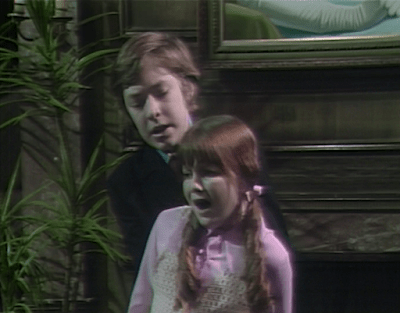
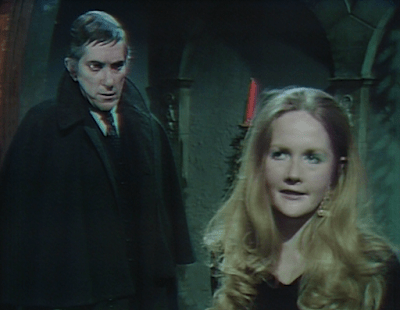
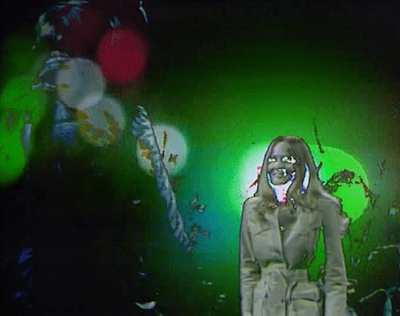
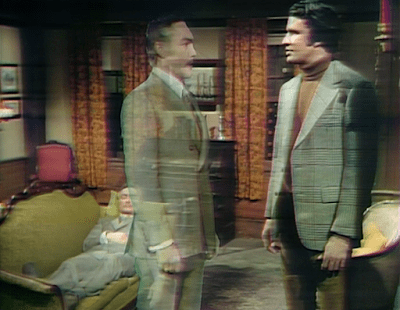
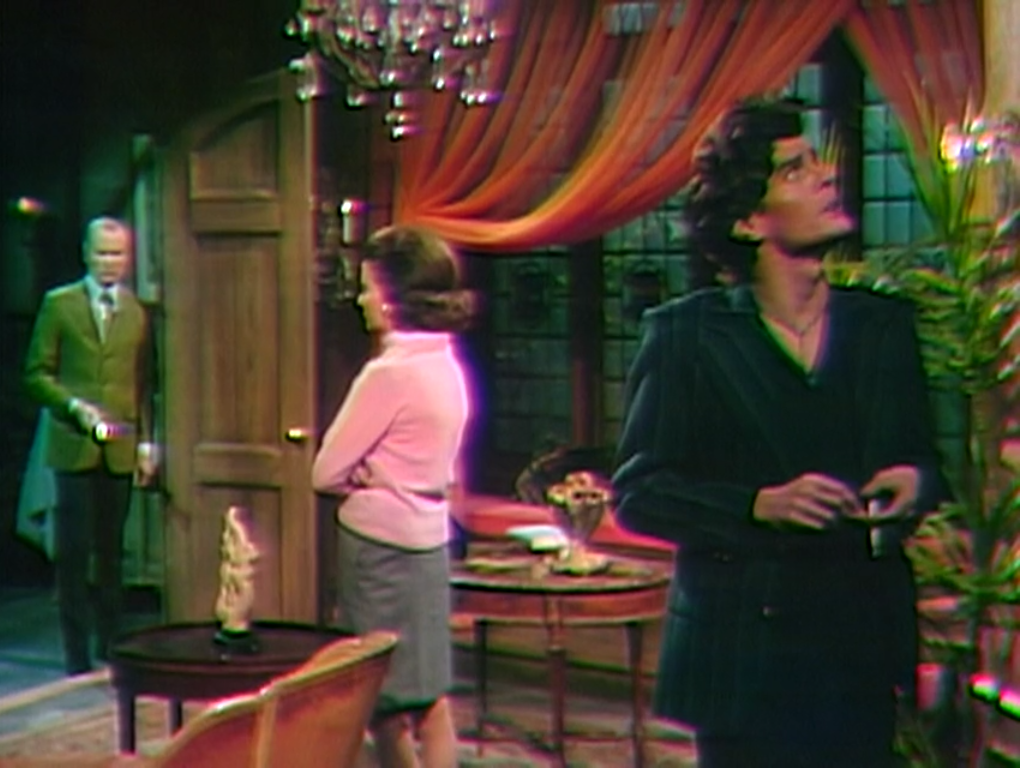
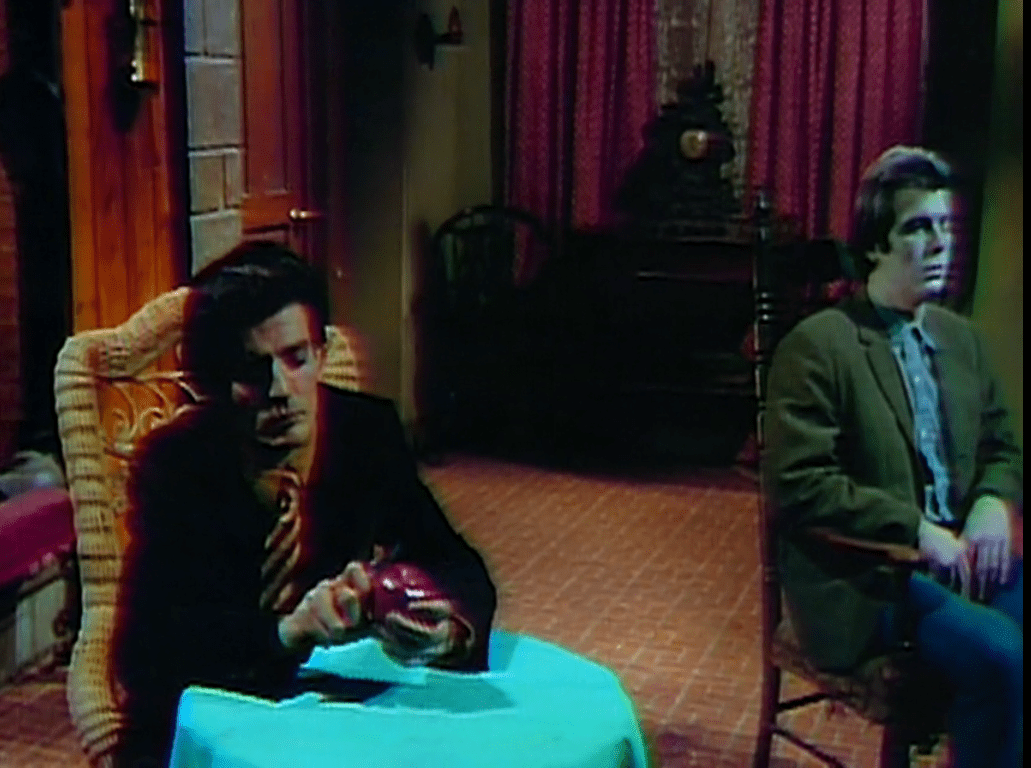
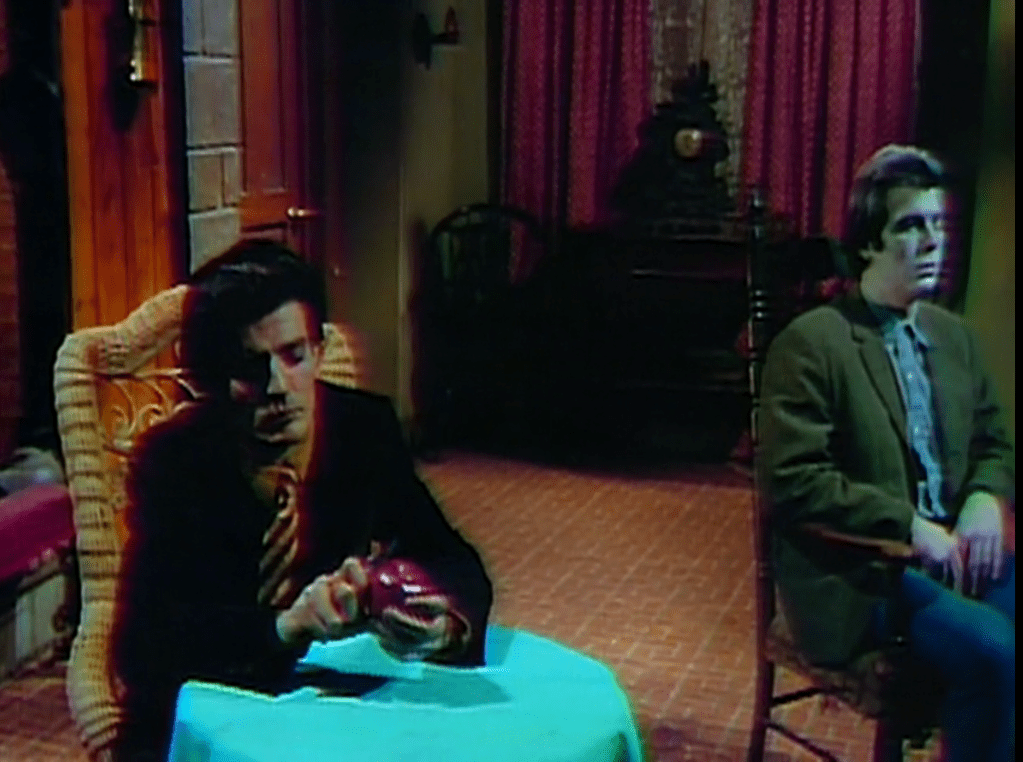
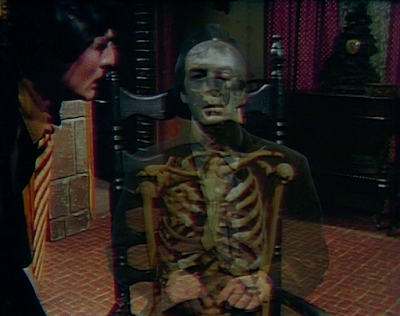
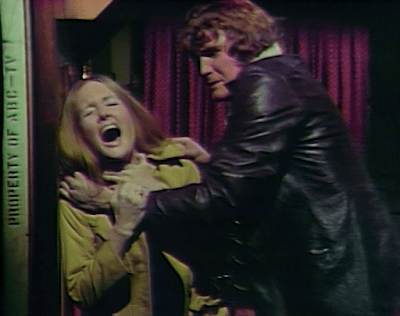
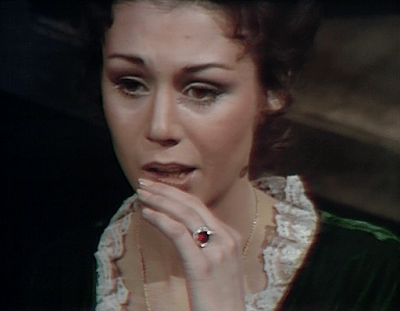
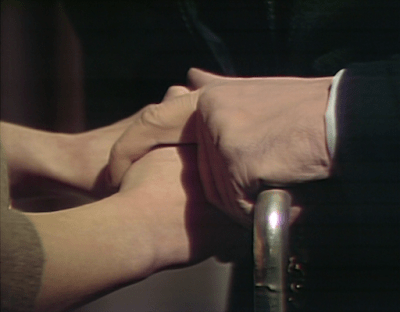
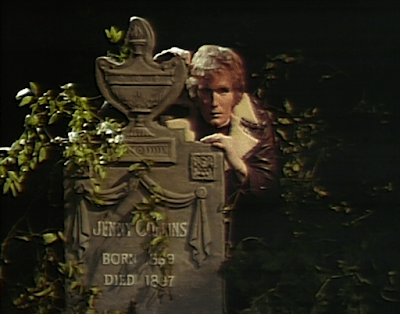
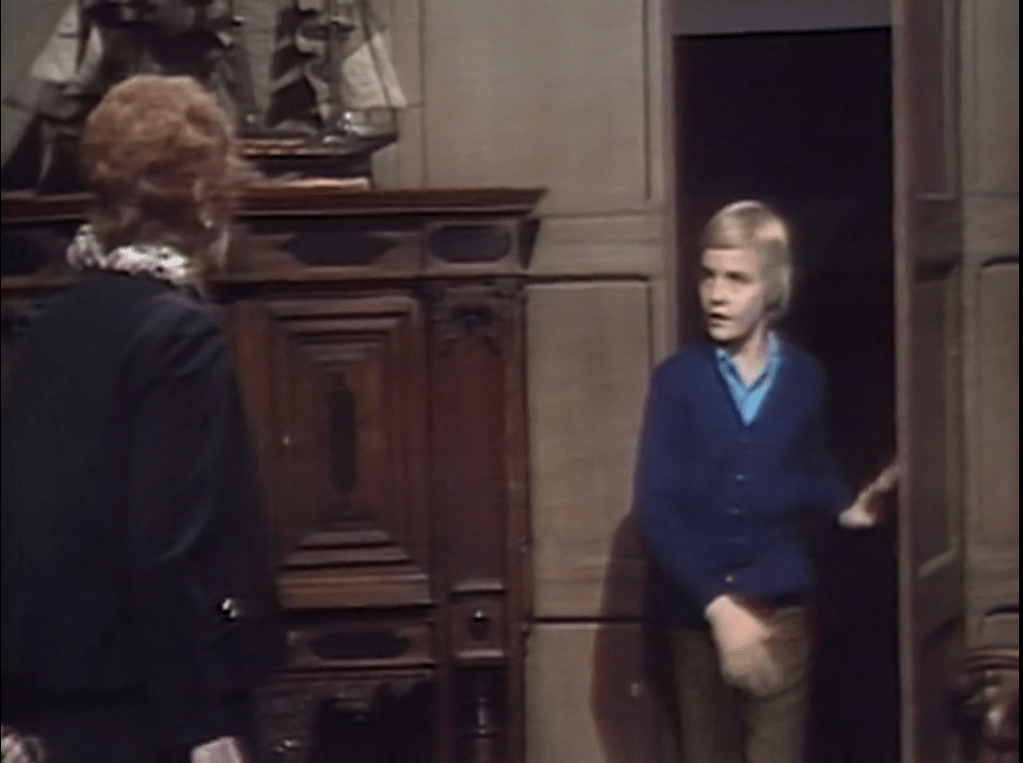
 Dark Shadows Commentary