
Thayer David joined the cast of Dark Shadows in August 1966, taking over the role of moody handyman Matthew Morgan from George Mitchell starting with #38. In that first episode, Matthew brawled in a barroom and left dashing action hero Burke Devlin gasping. The main storyline of the next few months was the investigation into the death of beloved local man Bill Malloy; it turned out Matthew had unintentionally killed Bill when they got into a fight and Matthew didn’t know his own strength.
Those two events explain the recast. George Mitchell was a slender little man whose white hair and craggy face made him look older than his 61 years. He was a fine actor, but no one would have believed that he could win a fight with Burke or that he was so strong that he would accidentally kill Bill. David was Mitchell’s equal in acting ability, but more importantly was a burly fellow in his late 30s.
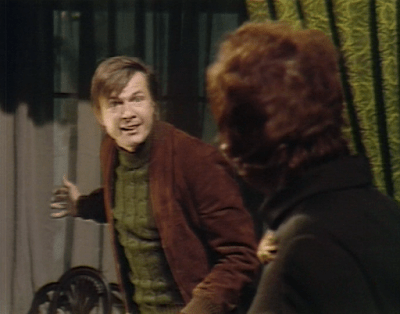
Today, we hark back to David’s original function on the show. The setting is the year 1796; vampire Barnabas Collins has traveled back from the 1960s to rescue his fellow time traveler, well-meaning governess Victoria Winters, from death by hanging. David plays another servant. As Matthew was fanatically loyal to matriarch Elizabeth Collins Stoddard, so Ben Stokes is utterly devoted to Barnabas. Ben finds roguish naval officer Nathan Forbes and visiting Countess Natalie DuPrés about to drive a stake through Barnabas’ heart. Ben demands they stop; Nathan aims his pistol in Ben’s direction and squeezes the trigger. The gun misfires. Ben reflexively clutches at his chest, but finding he is not hurt he advances on Nathan. They fight. As Matthew was so strong he could not fight Bill without accidentally killing him, so Ben accidentally kills Nathan. Ben then tells the countess he doesn’t want to hurt her and that she will be all right if she stays put until he can figure out what to do; she is unable to assure him she will do so, and in his attempt to restrain her he inadvertently kills her, too.
Barnabas had originally lived in the eighteenth century. He passed from that time into the 1960s because he was chained in his coffin in 1796 and discovered in 1967 by would-be grave-robber Willie Loomis. Now, he has rescued Victoria, and he is eager to go back to 1969, when he is free of the effects of the vampire curse. He traveled back by standing in an old graveyard and calling to the spirit of Vicki’s boyfriend, an unpleasant man known variously as Peter and Jeff, to pull him into the past. He went to the same graveyard yesterday and tried the same trick in reverse. Peter/ Jeff isn’t in 1969, so he calls instead to his friend, mad scientist Julia Hoffman. That didn’t work, so he decided to have Ben chain him in the coffin and take the long way back.
Barnabas is unhappy to wake up this evening. He leaves his crypt to find Ben using a shovel to pat down some earth nearby. He asks why Ben did not chain the coffin as he was instructed. Ben tells him about Nathan and the countess; evidently he is only now finishing their shallow graves. Ben has never murdered anyone before, so he asks Barnabas’ expert opinion about the next steps. Barnabas tells him to get rid of the countess’ things and to tell whoever asks that she left for Paris.
The reference to Paris is a bit unexpected to longtime viewers. When the countess first appeared in #368/369, she said that she chose to live on the island of Martinique because metropolitan France had become a republic. She and her servant Angelique came to Collinwood along with the countess’ brother André DuPrés and André’s daughter Josette, who was at that time engaged to marry the still-human Barnabas. André is identified as the owner of a sugar plantation on Martinique.
In 1796, France was of course still a republic. But the Terror had ended shortly after the execution of Robespierre in the summer of 1794. Among the beneficiaries were the real-world counterparts of the DuPrés family, the vaguely aristocratic owners of a sugar plantation on Martinique. Their name was Tascher; the daughter of the family was named, not Josette, but Josephine, the widow of the Vicomte de Beauharnais. Josephine was imprisoned in Paris during the Terror, but she was freed, reunited with her son, and restored to her property by June 1795. In May of 1796, Josephine would marry an up-and-coming artillery officer named Napoleon Bonaparte. It would indeed be plausible that the countess would want to go back to Paris and take the opportunity to reestablish a life there.
After the story of Matthew Morgan and the consequences of the death of Bill Malloy ended in December 1966, Dark Shadows was for 13 weeks dominated by the battle between undead fire witch Laura Murdoch Collins and the forces of good, led by Victoria with assistance from the ghost of Josette. Laura was the show’s first supernatural menace.
The ghost of Josette had been introduced in #70 as the tutelary spirit of the long-deserted Old House on the estate of Collinwood. Matthew held Victoria prisoner in the Old House late in 1966, and in #126 he decided to kill her. Josette led the other ghosts out of the supernatural back-world that exists somewhere behind the action to save Victoria by scaring Matthew to death. During the Laura story, Josette’s ghost was deeply involved in the action, literally painting a picture to explain to the characters what was going on.
Prompted by Josette’s ghost, Victoria figured out that Laura was going to burn her son, strange and troubled boy David Collins, to death on the anniversary of similar immolations. This would turn out to be a key turn in Dark Shadows’ world-building. When you are telling stories about supernatural beings, you can’t rely on the laws of nature or logic to shape the audience’s expectations. You need to give them some other mechanism of cause and effect if you are going to create suspense. So from that point on, the show would use anniversaries as causal forces. “It happened exactly one hundred years ago tomorrow night!” means it will happen again then.
That was the basis of Barnabas’ trip to 1796 and of his hope to return by standing on the same spot. Tombstones indicating that Victoria and Peter/ Jeff had been hanged materialized at times related to the anniversaries of those events, and Barnabas must leave 1969 at a certain point to arrive at a certain point in 1796. Eight o’clock on a given night in 1796 corresponds to eight o’clock on a given night in 1969, and those are the times when Barnabas and Julia go to the graveyard from which he vanished and call out to each other.
Even though the conjoined eight o’clocks don’t facilitate Barnabas’ return trip, the structure of today’s episode plays on the same idea of intercutting timelines. We alternate between scenes of Barnabas and Ben in 1796, and of Julia and Willie in 1969. Barnabas bit Willie and enslaved him when he opened his coffin; by the time Barnabas was cured of the effects of the vampire curse, Willie had let go of any hard feelings about that. Barnabas has made the Old House his home, and Willie voluntarily lives there as his servant. Julia has been a permanent guest in the great house on the estate since 1967, but now is apparently staying at Barnabas’.
Julia is determined that Barnabas will return by rematerializing on the spot from which he vanished, and she keeps going back there. Willie doesn’t believe this will happen, but in a long interior monologue comes up with the idea that he might reappear in his old coffin. In her turn, Julia dismisses that idea. They quarrel about these competing absurdities, and Willie decides to put his hypothesis to the test. He goes to the old mausoleum to check on the coffin, and finds it empty. He returns to the house to report this to Julia.
Julia decides it’s time to sleep, so she goes upstairs- apparently to her own bedroom. Seconds later, a ghost appears to Willie. He recognizes it as Josette. She vanishes, and he calls Julia. When Julia comes he tells her that Josette had never appeared to either of them unless Barnabas was in danger. As far as I can recall the audience has never known Josette to appear to Willie or Julia at all, and Barnabas is always in danger, so that remark is a bit of a mystery to longtime viewers.
In the days leading up to Willie’s discovery of Barnabas in April 1967, he, and he alone, heard a heartbeat coming from the eighteenth century portrait of Barnabas that hangs in the foyer of the great house. While he is talking with Julia, Willie turns to the portrait of Barnabas that artist Sam Evans painted in May 1967 and hears the heartbeat again. Julia cannot hear the heartbeat. Willie combines the sound of the heartbeat with the sight of Josette and concludes that Barnabas has returned and the old coffin is no longer empty. We cut to the hidden room in the mausoleum. Chains materialize around the coffin, and we see Barnabas inside it, struggling to escape.
We may wonder if Barnabas has been struggling that way every night since he was chained there in his attempt to return to the 1960s. That would be 173 years, added to the 171 years the first time. It would seem that 344 years confined to a box would make Barnabas even screwier than he is. In a much later episode, we will see Barnabas released after a long entombment and he will be surprised that more than one day has passed. The 2012 film adaptation of Dark Shadows includes a humorous scene based on the idea that time does not pass for Barnabas while he is chained in his coffin. But when he was first released in April 1967, there were indications that he had undergone a nightly torment through the centuries, and the closing image of Barnabas in the box today echoes those indications.
Nathan’s death marks the final appearance of actor Joel Crothers, who has been one of Dark Shadows’ most valuable cast members since his debut in #3, when he played hardworking young fisherman Joe Haskell. We said goodbye to Joe last week; it was nice to have another glimpse of Crothers in his villainous role before he left for the last time.


