The Leviathan People, a mysterious race of Elder Gods, are planning to retake the Earth from humankind. They’ve started small, putting together a secret cult of devotees in and around the village of Collinsport, Maine, and placing a rapidly growing creature in a room above an antique shop there. Now the creature has taken the form of a 24 year old man, murdered a couple of people, and lost interest in the plan. All he wants is his intended bride, heiress Carolyn Collins Stoddard, and he wants her by Friday. Since she does not know the creature and is in mourning for her father Paul Stoddard, whom the creature murdered a couple of days ago, he would seem to have put some obstacles in his own way.
When he is in human form, the creature calls himself Jabez Hawkes. When we first saw him, he told people to “Call me Jabe.” Everyone called him Jeb instead. “Jabe” is such an unusual name, and the creature is so obnoxious and uninteresting, that it is understandable they would disregard his wishes in this matter, but I believe in calling people by the names they choose, so I’ll call him Jabe.
The Leviathan story has so far been pitched to an adult audience far more heavily than most segments of Dark Shadows, and today’s episode is a case in point. Carolyn’s family gathers in the foyer of the great house of Collinwood, ready to depart for Paul’s funeral. They have a big scene where Carolyn gets upset with her mother and uncle because they didn’t like Paul, and the bad feelings flare up again after the funeral, when they are at the graveside. That’s typical fare for soap operas meant for grownups, but we’ve never seen anything like it before on Dark Shadows, where graves are less often places of mourning than targets for robbing.
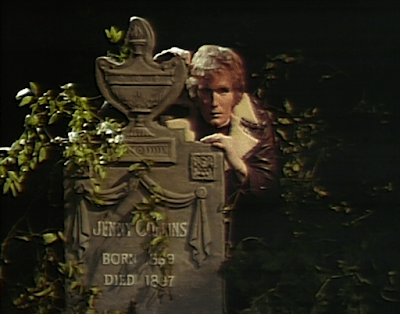
Jabe spies on Carolyn from behind the tombstone of Crazy Jenny Collins. For most of 1969, Dark Shadows was a costume drama set in 1897. Marie Wallace played Crazy Jenny then. Since the show returned to contemporary dress, Miss Wallace has been Megan Todd, fanatically devoted Leviathan cultist and foster mother to the creature now known as Jabe. They’ve had some fun depicting an erotic dimension to the relationship between Megan and the creature; Jabe clings to the tombstone suggestively, echoing this hint of Oedipal tension.
Carolyn goes to the antique shop to leave a note thanking Megan and her husband Philip for attending the funeral. Jabe sneaks up behind her and puts his hands over her eyes by way of introduction. You might think that Jabe, being just a couple of months old, would be ignorant enough to expect Carolyn to be charmed by this invasion of her space. But he pulled the same stunt on her when he was in the form of a thirteen year old boy, and she objected to it fiercely then. When she reacts just as negatively now, it leaves regular viewers with the sense that Jabe is going to keep doing the same pointless things over and again, not learning anything from his experiences. By the end of the scene she is showing some signs of attraction for Jabe, but she’s the only one. They haven’t given the audience any reason to expect him to be worth watching.
Later, Jabe tells old world gentleman Barnabas Collins that when the time comes, all members of the Leviathan cult will share his shape-shifting abilities, that “each one of you will be able to take on any form.” We know that Jabe is sometimes an inhuman monster, and that he once assumed the form of Carolyn as she was when she was eight, but this is our first confirmation that he can turn into anything he wants. It is also the first suggestion that the Leviathans’ human accomplices will receive any benefits at all from their triumph.
Sheriff Davenport and his new sidekick, mad scientist Julia Hoffman, have come to the top of the stairs above Philip and Megan Todd’s antique shop in the village of Collinsport. The sheriff has a search warrant that specifies the room by the landing as a place of interest in connection with the violent death of one Paul Stoddard. Philip begs the sheriff not to enter the room, saying that a boy who lived there recently died and that any disturbance would “defile” it. He swears the room is entirely empty. The sheriff expresses his sympathy, but opens the door anyway.
Inside is a young man. Philip seems as surprised at the sight of him as are the sheriff and Julia. He gives his name as “Hawkes, Jeb Hawkes. Short for Jabez… Call me Jabe.” No one calls him Jabe, which seems a bit rude. Jabe claims that he came by earlier when Megan was in and Philip was out, and that she offered to let him live in the room.
The room does not contain any furniture, any luggage, or any other movable property whatsoever. Moreover, while it is possible Megan might have rented the room without mentioning it to Philip, it is difficult to see what Jabe has been doing up there since she left, and since Philip has been moving around the rest of the building it is even more difficult to suppose Jabe could have left his belongings elsewhere without attracting Philip’s notice. Jabe claims to be a photographer, but does not appear to have any camera equipment. Moreover, the sheriff will later tell Julia that he noticed a distinctive odor on Jabe that was prominent on Paul’s corpse, and that he found one of Paul’s cufflinks, damaged as by fire, on the floor of the antique shop. In the finest traditions of Collinsport law enforcement, the sheriff does not take Jabe or Philip into custody, question either of them more than cursorily, or close off the antique shop for a further search. He does come back later to tell Jabe that he should think about finding another apartment.
Jabe is the latest embodiment of a mysterious creature that has previously taken the form of a newborn boy, an eight year old boy, an eight year old girl, and a thirteen year old boy. The boys were vicious little tyrants who did not seem to think at all, only to follow impulses to dominate and humiliate whomever they met. The girl was a Doppelgänger of Paul’s daughter Carolyn as she was when she was eight, and she existed specifically to make Paul feel worthless because he was a deadbeat dad. None of these children engaged with another character in a way that meant there was anything at stake for them in any scene. They as much as tell us that the same will be true of Jabe. When Philip complains today that he has put him and Megan in a difficult position by failing to tell them of his plans, Jabe answers “Maybe I just didn’t want to let you know. Maybe I just wanted to see you sweat it out.”
The only time one of the children did anything surprising in an effort to take on an adversary was when the eight year old boy shape-shifted and became the young Carolyn. Had the sheriff not shown the clownish ineptitude typical of his office, but instead done what a real cop would do and arrested Jabe and Philip, they might have created a situation in which Jabe would have to surprise us again. It might be interesting to see him turn into the grown-up Carolyn, for example. As it is, Jabe just insults Philip, goes to the police station, and murders the sheriff.
This puts a new spin on Roger Ebert’s category of “Idiot Plot.” Ebert said that a movie had an Idiot Plot when its story would end immediately if any of the characters had the brains of an average member of the audience. In this case, the story stays stuck in an angry and utterly predictable rut because of the sheriff’s inexplicable nonfeasance.
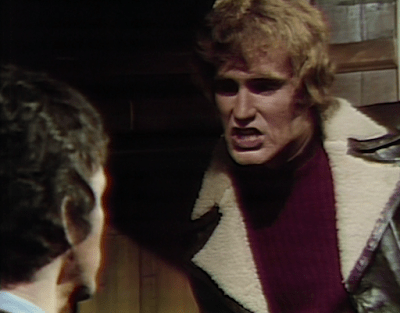
The first time Mrs Acilius and I watched Dark Shadows through, we hated Jabe and didn’t want to see Christopher Pennock again. Later, Pennock will return in several quite different roles, each of them more appealing than the one before. By the end of the series he had become one of our favorites, and it occurred to us that even as Jabe he managed to do a lot of things right. But there is only so much an actor can do to work around a script problem, and as written Jabe is barely a character at all. His actions cause problems for several other people, but nothing we see him do or hear him say makes us care about why he takes those actions as opposed to any others. It certainly doesn’t help that half of his episodes, including this one, are directed by Henry Kaplan, whose idea of visual composition was to shove a camera so close to an actor’s face that you can see about one half of one cheekbone.
It didn’t have to be that way. Not only was Pennock a fine actor when he had something to work with, but in this episode we have a scene between Julia and rakish libertine Quentin Collins that shows how a character with a bizarre backstory and a record of evil deeds can become an audience favorite. Quentin is down in the dumps because he just failed to rescue his one true love, Amanda Harris, from the realm of the dead. Julia urges him to reconnect with the Collinses of Collinwood. He asks how he can possibly explain that he is 72 years older than he looks and is now alive, even though his ghost carried out a protracted and deadly haunting of the estate. This dialogue shows that Quentin’s origins require us to believe any number of impossible things, and longtime viewers remember that he is a murderer who killed his wife in cold blood, among other unspeakable acts. But all we see in this scene are his charm and the affection that he and Julia have for each other, and we want to see more of that, as much as they can give us. With similar material, Pennock could have achieved similar results. But it is already clear that he won’t get it as Jabe.
Postscript
In his scene with Julia, Quentin says that no one at the hotel where he and Amanda have been staying remembers her, and that all traces of the alias she had been using seem to have disappeared. Julia speculates that when he lost her in the underworld, the last 72 years of Amanda’s life were negated, that the past was reset so that she did in fact die on a night in the 1890s when she might have died had one of the gods of the dead not intervened.
This raises two questions. First, Amanda has been keeping Quentin. If they are now in a timeline where she never came to town, who’s paying his hotel bill and buying his liquor? It’s a standard feature of soap operas that unless they are telling a story about conflicts over ownership of a business or a house or some other valuable property, everyone just has an inexhaustible supply of money, but they put enough time into Amanda and Julia’s squabble as to which one of them would be Quentin’s sugar mama that you might have expected a line or two about this question.
Second, if everyone else has forgotten Amanda, how does Julia remember her? Quentin journeyed through the infernal regions with her, and so I suppose it makes a kind of sense that from that supernatural location he would have a perspective that would transcend our perception of time and space. But Julia was in and around Collinsport the whole time Quentin and Amanda were harrowing the abode of the permanently unavailable. I suppose the real answer is that she is the audience’s point of view character, and as such knows everything we know. But it does leave us wondering if, in the course of her adventures, some kind of uncanny power may have rubbed off on her.
In which I complain that the show has run so low on story ideas to plagiarize that they are trying to turn the title into a plot point. I wonder what the next step is beyond that.

 Dark Shadows Commentary